Cat tale: Wolf

People telling you about their pet cats and dogs can bore one more efficiently than even those who haul out photos of their grandchildren, worn from months of friction in back pocket wallets. Singular tales do exist, however. John Steinbeck’s Travels With Charley leaps to mind, and of course Jack London made his name with a tale about a dog, though certainly not his pet dog. More recently I choked up when I read Gwen Cooper’s Homer’s Odyssey very accurately subtitled A Fearless Feline Tale, Or How I Learned About Love and Life with a Blind Wonder Cat.

With this in mind, I viewed a recent comment on this blog with trepidation. It can be summed up as “more cat photos!” and my initial reaction somewhat remains: this space isn’t for memes, political screaming, or cute cat photos. But there was one singular cat…and so the author succumbs…

This is a story about Wolf the Cat, as different from most cats as her name: companion, roommate, best friend, zen master, and a being who made the most of a physical challenge for most of her life.

At the beginning of 1978, having pried a degree from the dons at the University of Washington and snagged a newspaper reporter/editor/photographer job in the foothills of the North Cascades, I began to live in responsible society. Two months in, I adopted a gorgeous white cat with blue eyes. Natasha’s pelt could have been marketed in a high fashion boutique. She demonstrated an independent nature, spending large amounts of time outside. (Times were different then; most cats went outdoors.)
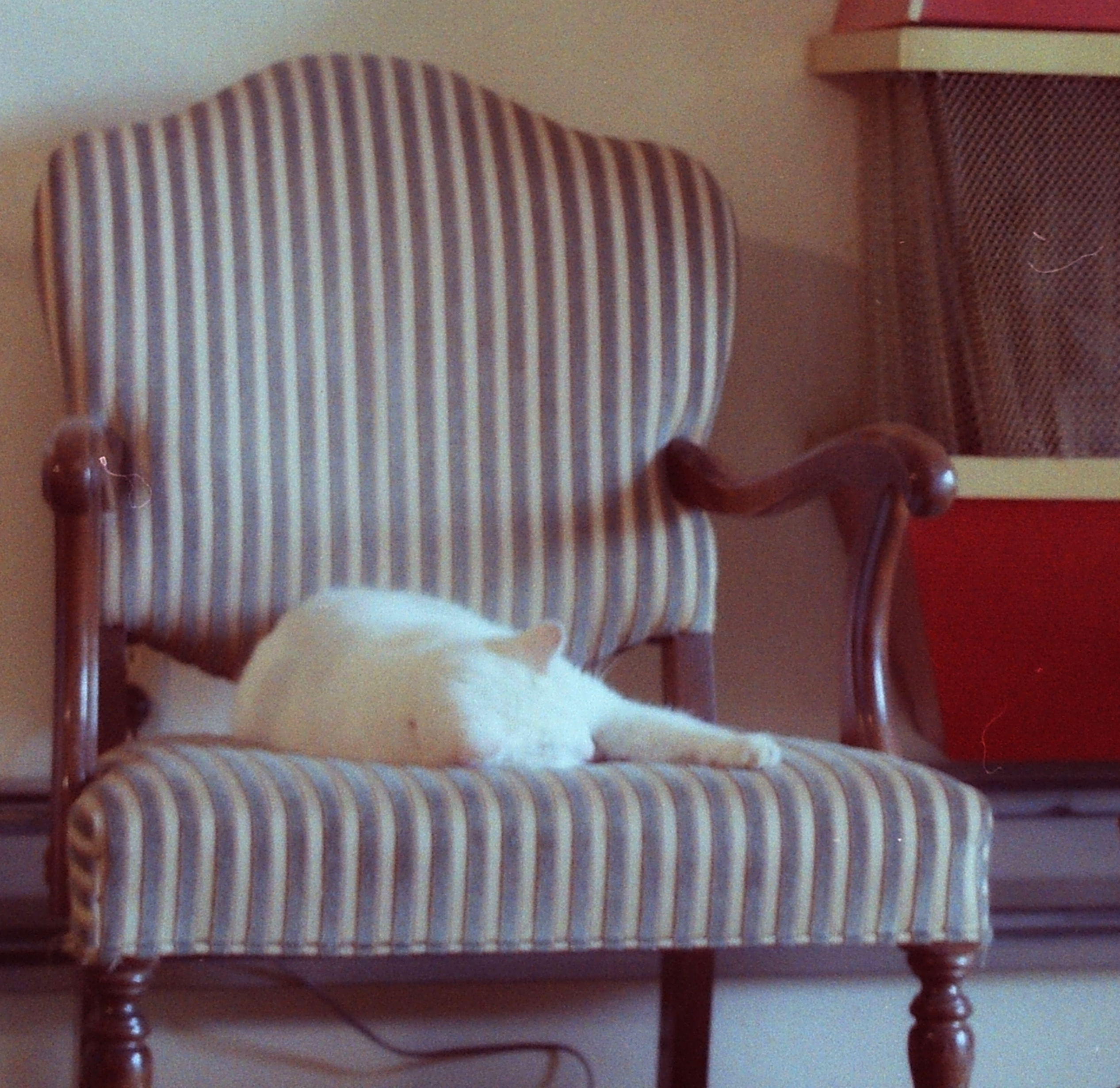
Natasha at rest. Sometime in 1978, probably April-June. Monroe, WA.

Natasha, or Tasha as I came to call her, only sets our stage for the true star, her daughter Wolf. After a few months of frequent sorties to who-knows-where, Tasha began to show the swelling belly of pregnancy. Six months after she arrived to live with me, she littered. She obviously had consorted with a similar solidly-colored cat, but black. Three of the five kittens were white like their mother, with one black smudge on the tops of their heads in varying amounts: one had just a few hairs, one had a small fingertip’s worth, and one had more of an adult’s thumbprint. The most purely white one was delivered three months later to a friend in Walla Walla, who called her Powder…because, well, The 70s. Of the final two, one was all black, striking, and mischievous. I called him Shiva the Destroyer based on his habits, and gave him to my brother about a half year later. Shiva promptly revealed he was a she, littered on the middle of my brother’s matrimonial bed, and Shiva soon found herself and her litter at the local animal shelter.

And then there was this nondescript gray tabby, a commoner among the gorgeous and highly born. Because this kitten had a fuzzy overcoat of lighter gray and looked a little jowly, it reminded me of a wolf, so I called her Wolfrydda, a completely made-up attempt at Norski-ness. It was Wolf on the vet records and in my mouth–so what indeed was her name? Wolf showed a precociousness that captivated me. She always wanted to be with me, climbing up the side of my couch to get to me even though she could barely walk.

Wolf and her siblings deeply annoyed Tasha, whose maternal instincts were minimal. When Tasha had weaned her progeny, they didn’t leave–so Tasha did. I saw Natasha every four or five days until I found her weeks later, dead on the side of our country road.
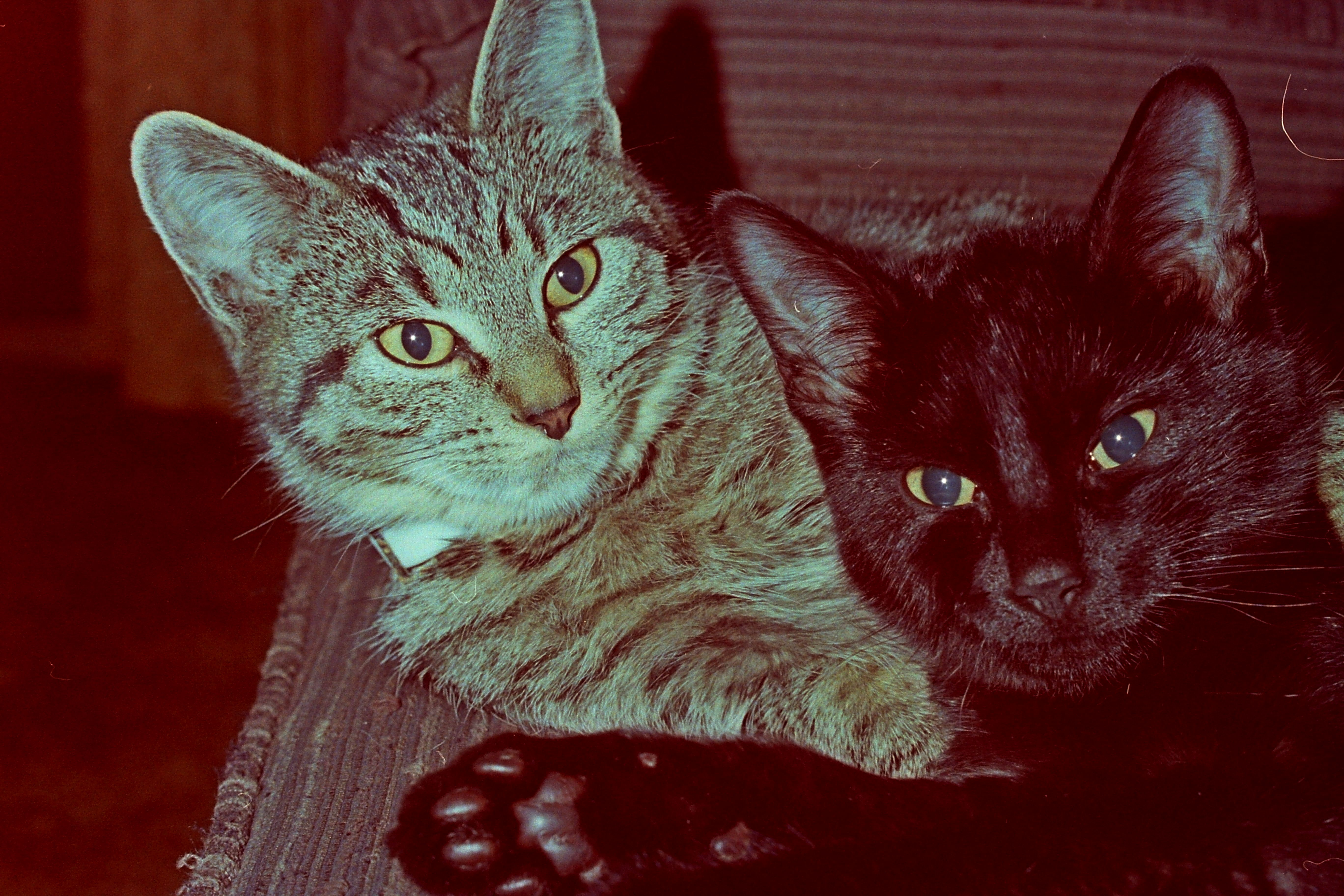
Wolf and Shiva, Fall of 1978. Monroe, WA.

Wolf proved every bit as companionable as she first indicated. By the time she died almost 20 years later, we had been through a lot together. She had advised me, entertained me, put up with me, and shown me through her quiet approach to life how I probably should have lived myself. But I’m getting ahead of myself. Wolf calmly accepted life as it came at her, much like the zen masters I read about later. If a chest of drawers had one left open, she slept there. Or the waterbed was good, and being covered up seemed even better:

Always aware, always calm. Wolf the Zen Master. January 1980, Monroe, WA.

At one year she gave birth to a litter of four anemic kittens who all died. Wolf spent the week crying in the bathroom where I had put the kittens in a box directly under the ceiling heat lamp. By February 1980 she had littered again, four again, a black one, two gray tabbies, and an odd beige one with caramel-colored tabby markings. The two tabbies stayed, but one, Noko Marie, died. I suspected the vet who had spayed her. (Hold that thought; we’ll return to it momentarily.) The other tabby grew into a big lug and into his name: Frank N. Stein.

About six months later Wolf disappeared for three days. I spent mornings, lunchtimes, and after work hours standing on my apartment’s little patio, whistling the special Wolf whistle, and scouring the large rocks a few feet beyond the edge of that patio which prevented erosion on the steep slope lying below. On the third day I saw her, hopping oddly from rock to rock as she laboriously climbed the hill with what turned out to be a broken right rear leg. She had gone across the road at the bottom of the hill, perhaps to get to the creek on the other side. Her luck ran better than her mother’s, and with a cast on her leg a few hours later, I headed back to work. That night I couldn’t find her until I looked on the top of the refrigerator. Somehow, with a newly applied cast on one of her jumping legs, Wolf had climbed onto the seat of a kitchen chair, then to its back, balanced herself there and leapt to the counter (three to four feet). Once on the counter she had dragged herself past the sink to where the refrigerator rose and again had leapt with only the one leg to get to the top of the fridge.

Two weeks later I took her to the vet to check on the leg. He unwrapped the cast, examined her, and rewrapped the garish pink stretch tape over the casting material. In a couple of more weeks I noticed the tip of the cast was wet. Back to the vet we went. The vet discovered a gangrenous leg and admitted he had likely wrapped the cast too loosely in a mistaken effort to give her a little more comfort. The cast had turned and cut off the blood supply to the leg. The leg would have to be amputated or Wolf would need to be put down. It didn’t seem to be much of a decision. Wolf was barely over two years old, and had demonstrated over the past four to five weeks she could get around quite well dragging her right leg behind her. I figured it would be easier for her at that point not to have the leg versus the cast. The vet said he felt badly about it and wouldn’t charge for the amputation! Back then I was naïve; I would not be as nice today. Since he wasn’t getting any money for the operation, he said he was going to do it after hours and did I want to watch and/or assist? I said “sure” and found myself that evening holding up a furless leg that looked remarkably like a chicken leg/thigh you buy at the grocer’s while the vet used a large pair of side-cutters to snap through the bone.

Wolf educated me over the next year with what was possible. We moved across the state only two months later, and Wolf discovered a new favorite spot in a tree beside the driveway. This tree grew as one trunk to approximately five feet and then shot many branches straight up from there. It thus formed a natural nest. One night I came home from work and found her there, staring at me eye to eye, five to six feet up. I figured at that point she could ramble around outdoors without too much fear. She had taken to sticking close to home after the accident, and she always spent the night indoors. Smart cat. I wish I had listened to her more.

In mid-1981, six months after our move, I met a woman allergic to cats. She gave herself shots which seemed to work a bit, but extended time around my two cats (Frank was still in the picture), and she would start suffering. Wolf neither hated nor liked her–tolerated would be more accurate. Within two months this woman helped me decide to quit being a reporter/editor, go back to college, earn a teaching degree, and join her in the teaching ranks. I found a cheap apartment in Spokane, WA, but it didn’t allow pets. Pressed for time, I convinced my parents (who also lived in Spokane, just ten minutes from the apartment) to take in Wolf for a year. They had never had cats in their adult lives, and they had a dog, something Wolf hadn’t encountered before. Despite this, they agreed, and a few weeks later–after living in my car for a day while I attended classes–Wolf went to her new, temporary home. To get away from the dog she learned within the first hour to jump with that one rear leg to a small basement window four or five feet above the tallest furniture. The dog was lazy, and after his initial curiosity, he let her be. (Frank is another tale for another time, when I feel like confessing a poor decision.)

Enduring my parents and their dog. Sometime between Sept 1981 and August 1982. Spokane, WA.

After ten months I earned a degree in English Education, August 1982, grabbed Wolf, and moved in with my woman friend now living in a small lake cabin with a small dog. We married in 1983, moved to a small city in the mountains of Washington, and over eight years we welcomed four more cats into our house. In 1990 we moved to a new, bigger house, dropping Dolly with a friend. Three days after the move, Cooper disappeared. Suddenly we weren’t a 5-cat family, but only a 3-cat one. My wife laid down a new rule: cats in the basement at night. The rule lasted until she moved out ten months later, taking the dog and Petunia with her.

Four years and counting. Livin’ the lake life. Late 1982. Diamond Lake, WA

Wolf, Calvin, and I spent a year rattling around the 4000 square foot house. I met a different woman which gave me the pretext I needed to upend my life. The cats and I moved to a Philadelphia suburb.

Nearing 14 years: supervising the mover (me). June 1992. Colville, WA.

Wolf spent her time, per usual, under the seat of the Ryder rental truck I had procured for the move. Calvin ate tranquilizers and sat in a cat carrier the whole time we were in the truck. Occasionally Wolf would perform recon, hopping across the dash and then spending just enough time on top of Calvin’s carrier to annoy him, before she retreated to her under-seat abode. In Philly I intended “to become a freelance writer”. Such was not to be. I did, however, let my fling die away and in 1994 met a lovely woman who to this day keeps sticking around for no good reason I can fathom. Wolf liked her. Calvin spent most of his time outdoors and didn’t care.

Shortly after our marriage in 1995, we lost Calvin in the middle of an overnight December snowstorm when he insisted he needed to go outside exploring. (Another sin on my cat balance sheet.) My focus on the missing Calvin prevented me from noticing Wolf’s increasing lethargy. A Friday trip to the vet didn’t net much of a diagnosis; on Monday morning she couldn’t hold her head up while sitting on my wife’s lap. A second trip to the vet (and a diagnosis from a more competent vet) revealed a bad failure of her kidneys. They were flushed with large infusions of saline water twice that week, and Wolf The Miracle Cat bounced back as good as ever.

Eventually I convinced my new wife to move back to Spokane. Wolf joined us on a pillow on the middle console. We moved into a rented house complete with swimming pool. By this time, nearing her 19th birthday, she spent most of her time at the new house on top of a stack of deconstructed cardboard boxes from our move. The sun shone there most of the day.

In May 1998 we moved her one last time to a house we bought there. Wolf had been complaining of something for a week or so before the move. She worsened just a week or two after the move, and we learned her kidneys were failing again. A few tries at jump-starting them with fluids failed, and we decided to stop the pain in mid-June, just a couple months short of her 20th birthday.

Along the way I appreciated this cat more and more. She benefited by being my first real feline companion–Natasha had disappeared far too quickly and been too standoffish to claim that role. She liked rock and roll: playing one of my favorite albums, The Who Live At Leeds, at full volume not only didn’t disturb her, it caused her to climb up in my lap and enjoy the tunes! She enjoyed sleeping right on top of me (or my bed partner), which made me thankful for her light weight. She had a two-toned purr, with a high-pitched note above the customary low, growly one. When purringly happy she would drool, just one drop which would sit at the tip of her muzzle. She exhibited calm, patience, and live-in-the-moment wisdom. (I once watched her sit at the corner of the house waiting for a couple sparrows to work their way down the side of house toward her. She knew this was the only way a three-legged cat could hunt them. She missed anyway.) After losing her leg at the age of two, we moved five times from 1981-1990. I moved her five more times from 1992 until her death almost exactly six years later. She took it in stride, so much so that I’ve been shocked since then to have a cat stress out over moving. Throughout it all I never felt I was in charge; I felt I had a roommate who just happened to keep moving with me.

If I had listened to this cat, I would not have married when I did in 1983. I would have become far less upset about life’s tribulations. I would have accepted the bad with the good, and learned to not grasp either. To this date, almost 25 years since Wolf died, no other cat has quite captured her spot in my heart. I doubt that one will. I’m nearing 69. The years run together now. First time events, like meeting such a cat, become less and less prevalent. No matter how much I try, I can’t quite connect with my cats like I did this one. Maybe the right one just hasn’t appeared. Maybe they just don’t come but once in a life.

This profile seems abysmally truncated to me, long as it must have seemed to the reader. I covered a decade in one paragraph! (1982-1992) I had thought, “hey, from time to time I’ll tell tales of the others, but I’m not sure how I could. Everything would seem downhill after Wolf.
Retirement, reality, time, and other important things

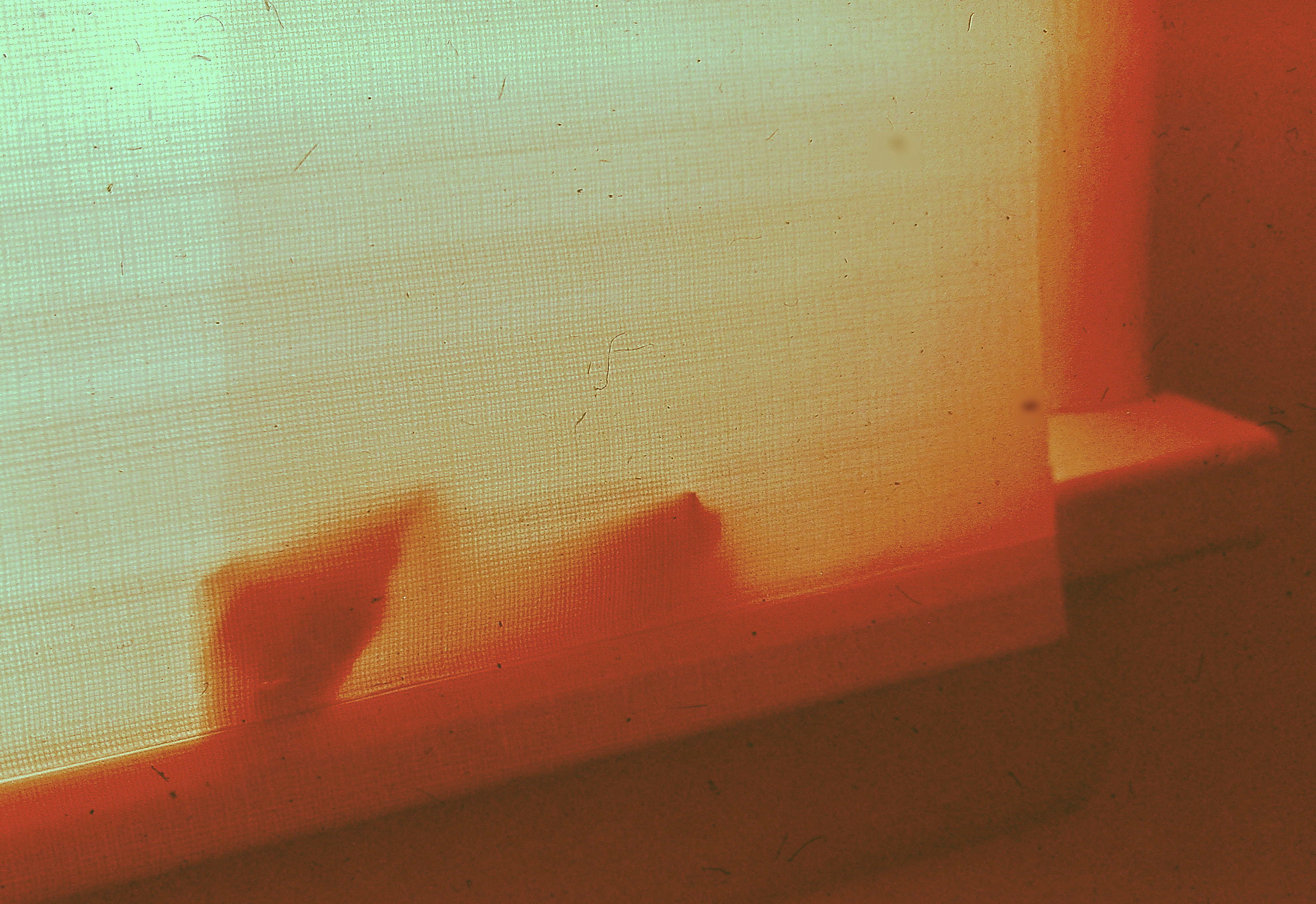
Window treatment. Chester, MT. April 1977.

One of the nicest things about retirement occurs every morning. The alarm doesn’t go off–not that it sounded much in the past 25 years–and I lie in bed debating about getting up or rolling over for a bit more ‘driftology’ (the study of drifting through my inner time and space). Usually five minutes proves I won’t be dropping back into sleep. I quietly slide out of bed; leave my sleeping wife to her dreams; grab some clothes, my cellphone, my glasses, and the glass of water sitting on my bedside stand; and I walk to the kitchen to start the morning ritual. I avoid the weakening spot on the bedroom floor near my side of the bed, the one which squeaks loudly. Similarly, I walk closely to the wall as I pass the living room, again avoiding the creaking spots in the floor. In the kitchen I put on my morning clothes in the dark. They’re a completely inappropriate fashion statement proclaiming “hey, it’s warm.”

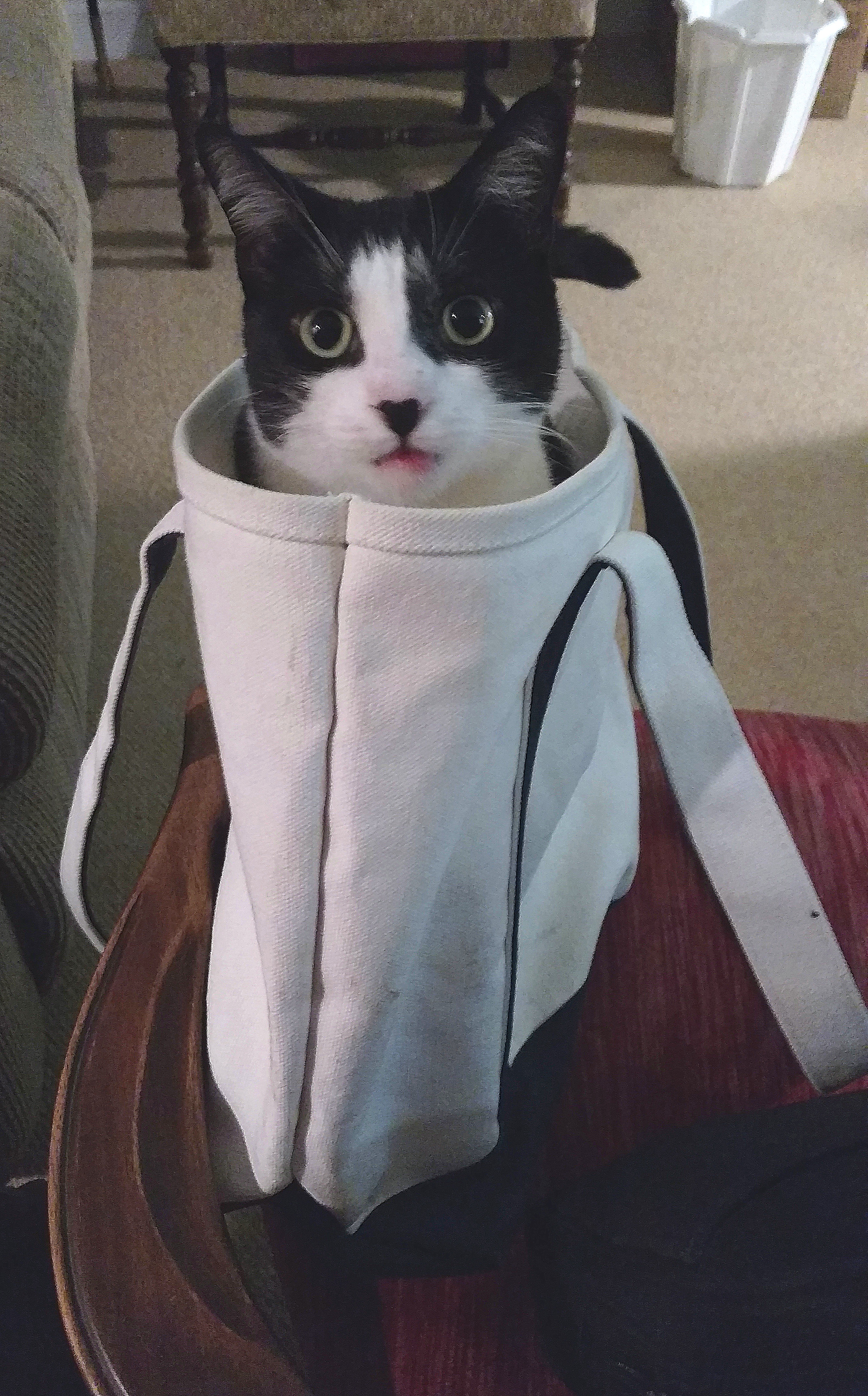
Sometimes Benny, one of our two nearly-identical black-and-white cats, accompanies me. The rest of the time he trots out a few minutes into my routine. I’m made aware of his presence by a gentle body slam against my calves. Despite having started the morning coffee ritual, I’ll stop and feed him. He likely isn’t hungry but why not? Returning to the ritual: coffee filter wetted, cup warmed, grounds measured, and when the water boils, a gentle dribble coaxes the coffee’s blooming. Then a steady pour fills the filter holder. After years of this I usually pour just the correct amount of water to fill the cup.

While these steps play out I’ve downed a glass of water to quench dehydrated cells, and I’ve opened kitchen blinds to prepare for the day. Regardless of standard or “daylight saving” time, very little light comes in these now-opened blinds, unless we’re near the summer solstice: on Retired Saving Time I wake at the slight lightening of the pre-dawn sky regardless the time. Birds will have just started their chirping in the spring. The sun will have become more insistently bright near the summer solstice. Nearing the winter solstice I might beat the sun to rising.

How to convey the calm of living rhythmically? Of waking at first light? Of eating a midday meal when hungry, regardless if it’s 11:30 a.m. or 2:30 p.m.? Of going to bed when tired, never caring if it’s 8:30 p.m. or 11 p.m.? The day becomes a physical meditation. Divorced from it, I can turn into a snarly bear, but being in tune with it resembles breathing at the steady, resonating rate synchronous with All Being.

In 1995 or 1996 I removed the watch from my wrist and never returned it. I turned off the morning alarm. Though I benefitted from a corporate job back then which allowed a laissez-faire approach to the start of the workday, I’m pretty sure I would have done this even had I been a shift worker. The slight tension induced in knowing there’s no alarm served to wake me with plenty of time to tackle morning matters; it proved far preferable to waking 25 minutes before the alarm was due to go off only to lie there cursing because I couldn’t get back to sleep and “why bother anyway”. In retirement this natural rhythm has extended to the whole day, but the slight tension doesn’t wake me anymore.

Coffee in hand, my day officially begins with reading. It may be the Morning Briefing from the New York Times. It might be the comics. It might be baseball, more specifically anything written overnight about the Phillies. Recently, during Lent, my morning read has been The Sign of Jonas, the journals of the Trappist monk Thomas Merton. This last requires turning on a light since it is a physical book, not something on my tablet or cellphone. For that reason my reading necessarily takes place downstairs where a light can illumine without bothering my sleeping wife. Benny benefits too: when I comfortably settle in front of a fire downstairs or in an old wing-backed chair in our library, Benny gets to jump up for a morning petting session. (If I’ve happened to have decided on reading material on my computer, he’ll happily claim my lap there, too.) Reading becomes a bit challenging with a cat squirming around, kneading and delivering headbutts. Soon he settles down and allows me to continue my study of Merton, my inquisitive plunge through data at my computer, or the latest take on This Stuff Really Matters (Today).

Henry Clay Mansion, KY. July 2014.

Because I’ve moved to the rhythm of the day for nearly 30 years, I alternate between chuckling or muttering in irritation when people rant about jumping forward to Daylight Saving Time or falling back to Standard Time. Time–being but a mental ruler imposed by humans upon our perception of past, present, and future–doesn’t exist. Every day we are reminded how a group of people living through the same events do not experience it in the same way, do not remember it in the same way, and will sometimes seek to rewrite those events to suit a particular purpose. To put it in someone else’s words:

What usually happens is that, once scientists have worked out their equations [for a Grand Unification Theory], time is nowhere to be found. And if it’s not part of the fundamental fabric of the universe, how do we know it’s not something we’ve invented to explain what we don’t understand?

Javier Yanes on BBVA OpenMind

In most senses I don’t care if it exists or not. Hours, minutes, and the clocks which measure them indisputably resemble rulers, nothing more. Just as that tree on the hill doesn’t get any closer if I declare I’m a foot closer to it (while not moving my feet), I don’t perceive time appearing or disappearing because we move to DST. Just as retirement has brought a detached view of the working world (and many other matters), so too has it altered my perception of time. (Time as a malleable substance?) Stereotyped jokes show us older folks forgetting the day of the week with regularity. Is this any wonder when time doesn’t exist? If I stop using a tape measure to measure how far I travel, am I assailed when I lose touch of my sense of distance? I can still walk from Here to There, can’t I?

[Which sparks a possible and humorous but too truthful dialog:

“Do you know what day it is, Mr. Pilcher?”

“Yes.”

“Would you tell me?”

“Yes.”

“What day is it Mr. Pilcher?” (a bit of exasperation now)

“It’s today.”

“And what day is ‘today’, Mr. Pilcher?” (more than a bit of exasperation now)

“It’s always today. I don’t understand your question.”

“What DAY of the WEEK is it, Mr. Pilcher?”

“Gee, I’m sorry if I annoyed you. I have no idea what day of the week it is. It’s a day between Sunday and Sunday; I go to church on Sunday, and I didn’t go to church today.”

(lengthy pause while Mr. Pilcher’s treatment plan is revised to indicate he is losing his marbles)]

My paternal grandfather spent many minutes and hours staring out of windows in his later years. He at times seem befuddled. He also showed he was sharp as a tack when it came to philosophical and existential questions. He had studied theology and led congregations for decades. Staring out of a window came with the territory, especially when composing this week’s sermon. While the need to write sermons disappeared in retirement, the window-staring did not. Did this indicate a dissociative mind? Doubtful. More likely old habits outlived their usefulness. So too my need to keep track of every hour of the day, every day of the week. I never did, much. Why should I be punished for that? I wouldn’t be punished for a deteriorating sense of distance; why a deteriorating sense of time?

I would argue my rising with the predawn light, moving through the day totally in touch with what needs to be done Now, whether it be eating, my taxes, planning meals, pruning shrubs, reading books, attending a doctor appointment on time, or going to bed when tired keeps me in a meditative state. Retirement provides extra incentive to be in touch with the here and now. I shouldn’t be penalized because I’ve approached a more natural state of being, I should be admired or at the very least respected. Instead, I feel the need to document how my memory of many things has been tenuous throughout my supposedly ‘with it’ years. I have never  been able to tell you what I have to do today. As a reporter in my late 20s, I would drive to work oblivious of what stories I had to run down that day. As a teacher in the years that followed, I had only a fuzzy idea of what I had to teach that day, usually because I had planted the seed in my brain the night before: “you have to get to school quickly to print that test you’re giving today.” Ask me on Monday what the lesson plan for Thursday will be, and you would have received a panicked look. In the corporate world where each day’s list of to-do’s varied quite a bit, I had no idea what I would do that day until I looked at the task list. (Bless you Franklin planners for focusing me the idea of A, B, and C tasks.)

And now? How do I prove to those who will judge my mental competence that I have never been able to remember what I have to do today? That I’ve marched through many a day thinking it was Thursday, only to be reminded continuously “no, it’s Wednesday”? When my mother neared the end of her life, she was subjected to many a judgement like this. When she microwaved a throw pillow because she thought she could warm it up and use it on her sore neck, her dramatically shocked visiting nurse felt that Mom was ‘losing it’. Well, somewhat, yes, I concurred. “But Mom has always had a tenuous grasp of the physical sciences including those which govern a microwave. Just because it wasn’t marked “microwavable” on the throw pillow shouldn’t totally count against her. After all, she had several microwaveable neck pillows which she did put in the microwave each night–and they didn’t have “microwavable” on some tag attached to them, because they were handmade by the good ladies at her church. Should she have responded to the smoke filling the room? Yeah, probably. Then again, my wife should have reacted to the smoke filling our house that night in midwinter 2002 when the furnace’s chimney had decomposed, and I came home to a house filled with smoke and a wife merrily preparing my dinner. Losing your marbles doesn’t occur when you misplace the bag of marbles. You lose one here, one there, never noticing the slightly lighter bag you’re holding.

Our perception of time varies from person to person, and time’s but a human construct. Our perception of reality–whatever reality is according to the popular philosophers of the day–varies even more. We should be judged on who we are and who we were, not on who someone wants us to be. Want to scare yourself? Pretend you’re the plaintiff in a court hearing to prove that you are mentally incompetent. My guess? You can’t prove you’re competent right now! Good luck when you’re 80.

God forbid I should be denied my mornings with Benny, coffee, and reading material simply because someone says I need to stay in bed longer, or get into a shower, or do anything else I don’t want to do. “Oh Lord, I pray my ability to perceive how I’m being treated matches how I’m being treated.”

don’t help me, I want to fall

Christmas 1972

True creatives relax the fierce grips most of us place on sanity, societal norms, orthopraxy, trends, and well-meaning advice from friends and acquaintances, even relaxing the grip on having acquaintances. Foremost among these, the creative accepts insanity, allows it to dwell inside: allows the voices to speak, to be heard, to take over, voices which suggest new and totally different ways to think, to do, to sing, to view life, to write, to design that building.

I may learn a set of rules which seek to bind me to the doctrine of electrical engineering, biochemistry, pedagogy, painting, poetry, investment banking, mapmaking, archiving, heavy construction, medicine, the law, or managing a grocery store, but as a creative I use this knowledge as a springboard to think, to act out, to say, “well that’s all well and good, but what about this?”

Learn the rules like a pro, so you can break them like an artist.”

Pablo Picasso

Me stuff

When I tossed my 1968 J. C. Penney’s Towncraft wool coat, it was older than about half my co-workers. Its brown, blanket-thick fabric had kept me warm for 38 winters. It arrived in my life as I began my freshman year for high school (still to be served in a junior high school), when my mother decided my brother and I needed new coats. We both came home with nearly identical wool coats, cut at the hips, and lined with polyester faux fur. They cost $20. According to the website in2013dollars their purchase price would be $170 or so today. That’s a little difficult to believe, because I know Mom wouldn’t have spent $170 in today’s marketplace to buy me a coat, but not everything remains the same today as it was then. A gallon of gas should cost about $2.90 based on 1968, but I’m paying more than that and only briefly did I see it below $3 at all in the past twelve months.

But back to the coats. In January 2006, more than 37 years later, I threw that coat away. It had hung in our basement, only coming out when I took walks in the woods behind our house, and the coat had developed a green sheen indicating some type of moss which I couldn’t see individually had taken over the wool. I promised my wife I wouldn’t try to save it when we moved south to North Carolina.

Moments before it went into the dumpster: the 37-year-old coat. Grafton, New York, January, 2006.

I still hear my parents saying you wear clothes until you outgrow them or they wear out. Before I reached 30, I realized I wouldn’t be throwing many clothes away for the latter reason because I just didn’t wear clothes out much for reasons I still don’t understand. Sadly, I do outgrow them still, but these days it has to do with an expanding waistline. I absolutely love buying clothes. The fact that they will take years to wear out frustrates the consummation of that desire. I prod myself to ‘just give them away–if they don’t bring joy…’ but it’s a lost cause. Most of them still bring joy. A few bring sweet pain:

  • There’s a wool Pendleton wool shirt I just took off two days ago. My father wore it in the last years before he died at the end of 2013. The shirt shows absolutely no wear, and I would bequeath it to my son except I don’t have one. I’ve donated most of the shirts I took from his closet, but a fleece pullover remains for reasons which elude me: I dislike it and wear it little, thus ensuring it will be good enough to bury me in, or at least keep me warm in the nursing home.
  • Look up at my avatar photo. Though difficult to see, I’m wearing a robin’s-egg blue sweater. The photo was taken at Christmas 2009. There are several other sweaters in my closet purchased at the same time, since I tend to buy several things at once but only once or twice a year.
  • Yesterday I wore a pair of sneakers which I distinctly remember purchasing when we lived in New York. We left New York in January 2006 as mentioned above.
  • I’ve lucked out more with t-shirts. The oldest one (I think) appears to be one purchased while on vacation in Boone, NC. We took that vacation in May 2013. The T-shirt looks fine; I’m sure it has years ahead of it given that I’ll only wear it in certain circumstances because it’s not 100% cotton, and I dislike such shirts. (“Why don’t you throw it or donate it?” “Because…”)

In the room two doors down from this office, a leaf-green down jacket is draped over a plastic lawn chair. I purchased three items in the summer of 1972 to keep me warm while camping in the Rocky Mountains. Recently graduated from high school, I had never camped in my life, and in the fall of that year I would enroll at the University of Montana in a program featuring frequent camping trips. My new advisor recommended two things for camping: a down jacket and a wool sweater. More precisely, he recommended buying two wool sweaters at Goodwill, cutting the bottom six-to-eight inches off of one and sewing them on to the other to make a wool tunic. I bought the jacket and the two sweaters as directed, paying $1.99 for one sweater and 99-cents for a second. My mother made the necessary alterations. (The more expensive sweater fell to her shears.) When camping ended a year later, I removed the add-on, and kept the 99-cent sweater until it joined the mossy wool coat from 1968 in the commercial dumpster in my front driveway. Mostly I tossed it to appease my wife, but I admitted to myself that the high neck on the coarse wool sweater irritated my skin. The green down jacket sports a two-inch square of green plastic tape on one elbow where a spark from a campfire fell and melted a hole. It’s the original tape from 40 years ago. I wore the jacket just a few weeks ago during a cold snap when temps lived in the teens and twenties. Come to think of it, I’m wearing it in the photo above as I toss its older brother into the dumpster!

My first real camping trip with Woolco, a group of us leaning in to the message of our faculty advisor: “you gotta wear wool if you wanna stay warm”. Arrowhead Lake, Glacier National Park, Montana. October 1972.

I’ll toss expired food as if it insulted my mother. I’ll throw away half of our Christmas decorations because I don’t like putting it all up in early December only to take it down as January begins. I once sold off virtually every piece of furniture from a 4000 square foot house prior to a cross-country move. I don’t hoard in general; I hoard specifically. To wit:

  • While working in New York I picked up the habit of using scratch paper for most computer printouts. From that point forward I routinely brought home scratch paper from work once I moved to North Carolina at the beginning of 2006. I still run across paper from those years. We’ve moved three times since then.
  • I recently forced myself to ‘designate for assignment’ most of the old computers I’ve clung to. Those which remain able to perform at an acceptable speed sit around waiting for a purpose in their sad little electronic lives. Until I joined the ranks of music streamers a year ago, an old laptop from 2012 sat on my downstairs bar to serve up our digitized music. Though it’s slipped into retirement again, it sits on the bar still. Perhaps it will become a photo display.
  • But for a divorce, I would still own a Yamaha amplifier and its matching cassette tape deck, purchased in 1986. (Well, not the latter. I’ve not needed a cassette deck for a decade.) I still cart around the Boston Acoustic speakers which they powered; these speakers were in use through 2009 when I discovered the woofer in one had shredded. I still plan to fix it, more than a dozen years later.

I want to think my distinction involves the usefulness for the tools in my life: the clothes which keep me warm, the computers which enable me to work and communicate, the audio/video equipment which entertains me. If so, how to explain all the memorabilia, the extensive library, the suits I will never fit into again, or, frankly, the pool table which came with the house and hasn’t heard the crack of a cue stick on the white cue ball in years? Perhaps the memorabilia serves as a tool for memory, and I can rationalize the books because every few months I want to look something up in them, but the suits? The pool table?

We’re all biologic collections at war with ourselves: laziness versus industriousness versus mindfulness versus purpose; emotion versus analytical thinking versus empathy versus pragmatism; habit versus creativity versus spontaneity versus thoughtful planning; childlike wonder versus mature knowledge versus arrogant authority. Those things around us, be they physical or metaphysical, play the part of a charcoal rubbing of our psyches, of who we are. I’m going to look a bit more closely at this “stuff”. It seems to want to tell me something.

A meditation on death

Mission San Juan, San Antonio, TX. November 2021.

My friend’s mother died this week. These deaths of friends, relatives of friends, and famous people we’ve known of our entire adult lives, become more frequent as I march toward the end of my 60s. When they strike near, they strike deeply. I’ve been reminded of my mother’s passing in 2019 and to a lesser extent of my father’s passing in 2013. Then, thinking of my father’s death reminds me of my friend’s father passing about four and half years ago. In turn, I recall I became close to this friend of mine when a very close friend of his died much too young. One thing leads to another, then another. Memory isn’t so much a card catalog as it’s a word-association game.

Each recurrence resonates with those which came before. Though my personal losses do not gut-punch me anymore the way they did when they occurred, memory-tropes have become stronger through the ensuing years. More and more, very specific moments become the definition of the entire event. Other details fall away. My friend’s mother had fluid building up in her lungs. My mother had the same though caused by a cancerous tumor. When I learned about my friend’s mother this week and her symptoms, I also heard the watery sound of my mother’s lungs as she tried to draw her final breaths, like smoke burbling through a hookah. It wasn’t pleasant, then or now.

Deaths link up in my memory, each resonating the others. This day the bells of death sound across my entire life. My first memory of death occurred when I had just turned 14. My family vacationed to San Francisco where we drove through The Haight staring at hippies–“make sure your doors are locked, boys!” We also visited my great-grandmother lying on what she assured us was her deathbed. “I’ve run the good race, I’ve fought the good fight,” she proclaimed to Mom, her granddaughter. “Oh, don’t say that, Grandma!” my mother exclaimed which I thought odd since the old lady obviously lay at death’s door. (We lack so much tact in our early teens.) I remembered this because my friend’s mother remained lucid into her final hours, just as had my great-grandmother. My mother and father both were not, each of them passing in a morphine-laced state of unconsciousness. I remain grateful I didn’t have to encounter the attitude my mother did in San Francisco in 1968. Do you protest as a matter of good taste, as my mother did? Do you agree with the fading relative, thereby assuring yourself honorable mention in the Total Jerk Hall of Fame? Do you hesitate, mumble something neutral, and earn their scorn for your equivocation? Maybe it all goes well if you’re lucky.

My mother slowly lost her engagement with reality, not that her grasp had been firm. (I too suffer from that state, having one foot firmly planted in a hallucinatory land where reality exists somewhere between a fond memory and a meaningless joke.) We crossed a threshold in 2017 when Mom could not grasp why failing an eye test meant she could no longer have a driver’s license. “But I had just recently had eye surgery!” She remained convinced a simple form filled out by her doctor and sent to the DMV would straighten everything out. I think she didn’t give up hope so much as the matter just faded into the background. By the time she entered the hospital 18 months later, diagnosed with stage four breast cancer at 89, she couldn’t quite comprehend how she had gone from her daily existence to this state of affairs–never mind that her life at that point had become rely-on-strangers-for-meals-and-all-tasks. In truth she only changed venues and caretakers, swapping neighbors for nurses.

This disturbed me less than it may sound. When she fought to understand why her driver’s license had been suspended, my superficial exasperation papered over how my mother’s stance resonated with all of those memories where she also couldn’t understand the logical progression of bureaucracy in all its forms; when she cried because in attempting a sewing class exercise called Idiot’s Delight she couldn’t get it “to work” and felt she was worse than an idiot; and those myriad times when she couldn’t understand electro-mechanical issues, made all the more rich because her father had been an electrical engineer. Does it sound as if I mock my mother? Absolutely not! Love of the maternal wraps itself around what the maternal is, regardless of its logic, perseverance, emotive sustenance, or intellectual prowess. I loved my mother. Everything followed from that. The mother I loved, and what I loved about her, relied wholeheartedly upon her husband and in her final days upon my brother and me, but truthfully mostly on her neighbors since my brother lived hundreds and I thousands of miles away.

Bells from my father’s death ring different tones; they peal a melancholy chorus. He never outgrew being a preacher’s kid, a PK. He learned the social skills that most nomadic children do, those whose parent(s) are in the military and travel from base to base, those who follow their academician parents from university to university, and those like my father who moved from place to place as his father pursued Calling after Calling. His father was an American Baptist minister. My father experienced a couple of moves early in his life, but by 3 or 4 began a decade in the suburbs of Minneapolis. His family then moved to Havre, Montana, where my father spent all of his high school years. His graduation from high school in 1942 permitted but one short year in college before the United States Army came calling because of World War II. He served in the Quartermaster Corps, achieved the rank of Sergeant, and told us absolutely nothing else about it other than he apparently sailed back and forth across the Pacific. I learned later how dangerous those convoys were and the dangers he faced. His background is relevant here because it informs his passing.

Just as he hid from his war years, my father hid from the aspects of his personality which didn’t fit into the mold of being a PK, a devout Christian, of being the “perfect kid” (a different kind of PK). The monsters in his closet slipped out a few times during his life, most notably at the end of it: he retreated from the corporate track he was on and moved his family from Los Angeles back to Spokane, Washington, returning to the same job he had left less than 24 months previously; he quit that job because he couldn’t conform to the ethical stances of his peers (or was it just a midlife crisis?); and at the end, he fell into a crevasse of personal turmoil when as chair of the church finance committee he learned the church secretary had embezzled a substantial sum from a struggling church. This final trip to the dark side took place when he had marked 82+ years and the pall of it never lifted. Retirement makes us face the delightful dilemma of the retired: how much meaning must one instill into one’s life? How ‘permissible’ is it to just “take it easy,” “take it as it comes” or in essence to live in the moment when the moment requires nothing significant of you? My father seemed to have no issues with the relaxation of retirement until The Failure. After that, he could see no path out of his darkness, and it continued to haunt him until he died in the middle of his 88th year.

If I wander the aisles of memory’s storeroom where I’ve tucked so many things, I come across other deaths, less impactful but salient nonetheless. The Sunday School classmate who died of a brain tumor the year following my great-grandmother. The teaching friend of my first wife who lived longer than expected with her congenital heart defect. When young I found it more difficult to feel these deaths, to be sorrowful. I don’t know why. Youth? Failure to connect with these people? Perhaps the latter. Before the teaching friend, my father’s father died of a stroke in 1980. (I was going to write “massive stroke” but any stroke which strikes down a man in his mid-80s packs a wallop.) Despite the sorrow I felt at his death, my strongest memory from that time is of our very small family–his two sons, my father and my uncle; my four cousins with a spouse or two; and my mother and me–hanging out in a motel room reminiscing in what passed for a wake.

But as the 1980s closed out my remaining three grandparents died in successive years: my mother’s mother in 1988; my father’s mother in 1989; my mother’s father in 1990. My second strongest memory at my grandfather’s passing haunts me. Because it is of my grandmother, I don’t think of it right away when I think of his death. I think of it as a bridge memory to hers. I arrived early to my grandparent’s house but everyone had gone somewhere except my grandmother. I still can see her clearly, staring, staring into her backyard as the gentle rains of the Willamette River Valley fell. Lost in thought? In shock? Numb? A mixture perhaps. I’ve noticed no pattern to the reaction of the surviving spouse when they’ve lost their lifetime companion. My father’s mother had her emotional heart ripped out of her when her husband died. She never recovered. Soon she lived in assisted living because of a gentle dementia, and afterward suffered a stroke in 1983 or 1984. She then lived in a vegetative state for five years. My mother’s father also slowly lost the mental faculties which made him my grandfather. The final time I saw him he lay sleeping in the infirmary where he had lived for several years, even before his wife died.

I look at the memories of those last two deaths reluctantly. I do not handle hospitals and deathbeds well. I visited each of them only once. My grandmother ate and breathed with machines. My grandfather just hung on for no reason anyone could articulate. When I said “the final time I saw him” it also was my first time seeing him in the infirmary.

My mother’s mother died between these troubling deaths and the early one for my father’s father. Today I’m reminded more of her passing because like my friend’s mother, my grandmother passed in a lucid state albeit with a bit of morphine-induced hallucinations. (“Why do they allow cats in here, Louise?” she asked my mother toward the end.) Despite certain traits which lessened her as a Good Person, she and I connected throughout our lives. I mourned her more than the others, especially as I had matured by then and learned to cry. (I’m guessing that I cried when my final two grandparents passed, but I do not remember one way or another.)

All these peals from the bells of memory ring back when someone dies, more loudly when it is someone close such as my friend’s mother this week. I met her at least a half dozen times in her final five years. I see her legacy in my friend. I offer my support, I share his grief, I attempt to help where I can. What strikes to my core, however, isn’t this. It’s those resonant bells which call me back to the deaths in my family, to my loved ones. And, frankly, to my own and my wife’s which have yet to occur. What lies ahead for us? Will I meet it with dignity? Perhaps. Will I cry and moan and complain about my state in the world? Much more likely. Will I be aware I’m dying? Do I want to be aware? What if my wife goes first? How will I cope? I’m not a mentally strong person; I fear I will act as my father’s mother did and just withdraw from the world.

These bells ring across time’s arc from the past and into the future. They sound more frequently these days. They’re louder. They’re more insistent. I sometimes would like to ignore them, but that would be like ignoring the sun or perhaps more aptly, like closing one’s eyes while driving a car. Best to listen and maybe learn.

Mission San Francisco de la Espada Catholic Church, San Antonio, TX. November 2021.

A Facebook allegory

Imagine you live in a country. It’s larger than Lichtenstein, but smaller than America, lots smaller. Maybe something like Portugal or Austria even.  That’s significantly smaller than Texas. France is a bit smaller than Texas. We’re talking some country only a quarter or less of California. It’s still a country with cities and such–it would take quite a while to walk from one end to the other, especially if you stopped to talk to folks along the way.

Now suppose, in order to make it much, much easier for everyone in the country to talk to each other, all the sports fields–soccer pitches both professional and amateur, all the school yards, all of the parks–were converted into Talk Bubbles. A new technology. Inflated domes were put over these areas, shiny so you couldn’t see inside. Everyone could step inside the Bubble nearest them and talk to anyone…anyone, that is, who also had stepped inside a Bubble in their own locale. You didn’t even have to pay to walk inside your nearest Bubble; all you had to do was agree to wear a monitoring device which you were assured didn’t listen in “exactly” but parsed words it heard and relayed those words back to the folks who ran the Bubbles. Oh, and the device also relayed where you walked in the Bubble. That’s all. Easy-peasy, ever so sleazy. (woops, sorry about that).

You love it at first. Your job took you to Lisbon but look, right over there’s a handful of schoolmates from college, from that little village we loved so well (and so long ago)! And more, from your elementary school! You can just talk to them! Of course, as you walk over to them you have several persons intercept you and say things like, “Have you ever wondered about removing your ugly warts?” and “Let me tell you why you should never invest in stocks!” It’s annoying but you brush them off, basically just ignoring them and walking away.

Over time you start to wonder why the guy about the warts–or a woman; it’s not always the same person but the message is the same–keeps intercepting you no matter where you walk. You realize you once said to your friends, “Remember that song from when we were children, ‘Walter Wart, the Freaky Frog’?” (That’s a real song by the Thorndike Pickledish Choir; look it up.) Suddenly you realize you started seeing Wart Guy after you asked that question. Then you realize you’re starting to see that guy and his cohorts everywhere you walk. Even weirder, nameless folk come up to you and say things like, “Do you know Melissa Mickleberger? She’s over there.” Sometimes you do know Melissa, but sometimes Melissa is just some stranger. These interruptions occur a little more frequently now…plus your paranoia starts to grow, making it doubly annoying.

Later you find out the owners of the Bubbles actually are listening to what you say, and they’re selling that information. Never mind why, it’s too boring and scary all at the same time. What’s far more annoying to the point of effrontery seems to be occurring more and more: a contentious election approaches, and when you’re having a nice polite discussion with your friends, someone else walks up and screams “WHAT A COMPLETE IDIOT YOU ARE!”. Your friend just smiles and says, “Oh, don’t mind Roger, he just gets a little worked up is all.” Then pretty soon your friend starts saying to you, “You know, I’m not sure about that. My friend Roger says, ….” and then adds something so outlandish, you wonder what has happened to this friend of yours. If your friend and you were still in grade five, you would merely point out that Roger also wears his shirts backwards and the two of you would laugh, secure in the knowledge that you’re both still on the same friendship page, and Roger is a Very Peculiar Individual who shouldn’t be trusted to provide accurate, truthful, relevant information. Instead, when you cautiously query your friend privately, you find out she thinks Roger might be on to something. “After all, a lot of Roger’s friends are saying the same thing, and lately so are quite a few of my friends. You’re still my friend, aren’t you?”

Disturbingly, you’ve noticed your friendship now depends, at the very least, on tolerating Roger, and you can see the writing on the wall. Pretty soon you’ll have to agree with what Roger says if you want to remain friends. A friendship built on shared experience has become predicated on Belief and Opinion. You start to notice also that all of this friend’s friends say almost the exact same thing, much like a Twilight Zone episode or that Stepford Wives thing from a long time ago.

It finally comes to this: when you’re standing around as part of a circle of old high school chums–and frankly you don’t know a lot of them, but the ones you do know are all friends with the other ones, and hey, it was a big school–the topic turns political again. Strong opinions get stated, opinions you agree with. One person, though, says something not logical and all the others immediately say, “yeah! That’s right!” When you speak up to say, “well, but that’s not actually factual or logical” the group turns on you as if you were carrying typhoid or you had just molested a child or something equally reprehensible.

You walk to the Bubble’s exit. To the attendant there you state, “I am not coming back. You can take my name off of the list of approved entrants.” “Oh, no!” cries the attendant. “You can’t be serious! Are you sure you don’t want to just take a vacation from the Bubble?” You’ve taken vacations before so you say, “no, I don’t,” to which the attendant replies, sorrowfully, “well, okay, but any time you want to come back in, all you have to do is show up, say to the current attendant ‘just reactivate my Bubble Device’ and you can rejoin the Community!” The last phrase has a near-religious tone to it.

While walking the streets of Lisbon you begin to realize some things. Virtually all of those friends with whom you connected were not so important that you ever took time to look them up when you were in the home village. The few you talked to who weren’t historical friends–in other words, people you met in the Bubble–were people you only knew from limited conversation in the Bubble. You’ve had similarly engaging but shallow conversations in bars on a Thursday evening with strangers. Your friend who kept bringing Roger to the conversation had a habit of listening to and spreading outrageous gossip about teachers and students when she and you were classmates. You also realize your True Friends were those you stayed in contact with before the Bubbles. Though a few say they miss your presence in the Bubble, when they see you on the streets, you still see them, you still laugh/cry/argue with them. Nothing has changed; life still goes on outside the Bubble; the Bubble is not life or an approximation thereof.

And then it hits you: the Bubble has somehow focused, distilled, accentuated the tendencies we had before. It has connected the gossips from your early schooling with those of your university and those early co-workers. All of the people who annoyed you individually but in isolation as you grew up now have the ability to connect in the Bubble and reinforce each other’s message. They’ve grown in volume simply because they speak in unison. The promise of the Bubble–that we can connect and forge a more social and socially aware community–has produced just the opposite. People are meant to interact differently: anonymously sometimes, reservedly most of the time, and definitely more intermittently than in the Bubble.  In the Bubble people seem to talk as if they are in their cars where no one can hear what they’re saying. What the Bubble has produced then are people revealing the thoughts which just ought not to be revealed. Not that individuals should repress themselves, but any psychotherapist will likely confess they hear things which should remain between the patient and the therapist for the good of society, for the individual, and for the individual’s friends and social life.

After a few weeks you notice other, rival Bubbles have sprung up which you did not know about. You see that the people entering these Bubbles do not enter your former company’s Bubble. Far from encouraging societal discourse, you realize people have been splintered into non-communicating Bubbles built, not on ideology but on the corporate interests of those launching the bubbles. Still, you try one, thinking it might offer something a bit less manipulated than the first Bubble. It does, in a limited way, but none of the people you want to talk to are here. The Bubble itself is confusing. Soon, lacking patronage, this alternate Bubble shuts down.

You go back to the Bubble nearest you operated by the original Bubble company (OBC?). When you approach the door, the attendant gets ready to admit you but you say, “No, I want you to erase me from your lists. I want you to make it so I will never enter a Bubble of yours again. I want you to delete all of the information you’ve gathered about me. I frankly never want to enter a Bubble of yours again.” The attendant huffs and makes you sign some forms where you acknowledge you will lose all of the conversations you’ve ever had in the Bubble–to which you inwardly say, “oh thank God”–and then it’s done.

You walk away with a bounce in your step, knowing you will have True and Real conversations for the rest of your life.

yes, I posted this once before…but it was just a year ago, and this month got me thinking, and…

Quail

California quail in a white pine. Spokane, Washington, November 2019.

My mother loved the quail which started to appear in the backyard years after I had left home for good. I’ve never bothered to find out why deer and quail became so common in the past few decades. Loss of habitat as the city limits pushed further out? Seems backwards. Regardless, appear they did, more and more, until coveys could be observed daily running through the backyard, spring through fall. Smaller groups appeared in the winter. My mother just loved them. She purchased a small wooden carving of one.

My wife, Philadelphia-born and -bred, also loves quail. A city girl, any game bird interests her, but the cuteness and the comical mating calls of the males in spring really grabbed her fancy and held on.

When my mother died in the fall of 2019, and we settled out the belongings, I took a quiet satisfaction when she opted to snag the little wooden quail and place it on our mantel at home.

California quail, Spokane, Washington. January 2020.

The Essayist

Inadvertently, I have discovered I’ve always been meant to essay.

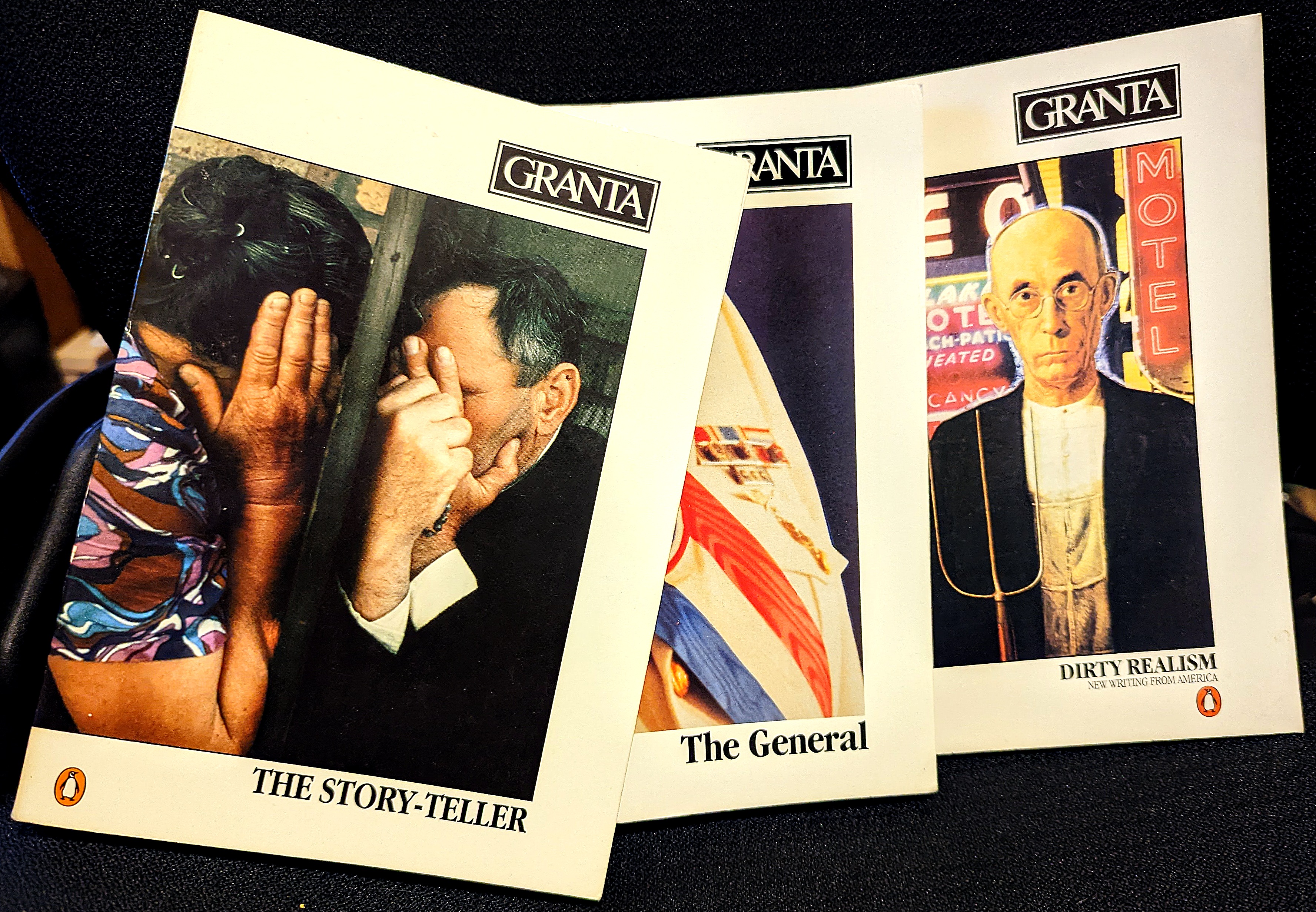
Today I pulled down a dozen issues of Granta, with the intent to pluck the issue I once received which had travel writing as a theme. This I would gift to my brother with whom I share a love of good travel writing: Paul Theroux, Bruce Chatwin, Bill Bryson, et al. Because these issues were from the 1980s, I reasoned, this would be a fun backwards look at writers we now respect, writers who were but beginning to be known at the time.

For those who remain unfamiliar with Granta, its existence since 1889 as an outlet for literary exploration has been a source of refreshment to us literati (of which I am only an acolyte). Founded by students at Cambridge University, the publication fell on hard times in the 1970s. It was acquired by postgrads and their friends and relaunched in 1979 as a quarterly publication. I subscribed somewhere around 1986 or 1987 and continued through 1990.

Some issues of Granta from the late 1980s. The authors in “The Story-Teller” are: John Berger, Michael Ignatieff (interviewing Bruce Chatwin), Bruce Chatwin, Ryszard Kapuscinski (plus an interview of him by Bill Buford), Richard Ford, Raymond Carver, Patrick Suskind, Isabel Allende, Oliver Sacks, Jonathan Schell, Vaclav Havel, Ian Jack, and Primo Levi. Astounding. 255pp.

In an oddly fortunate turn, I couldn’t find the issue I remember, “In Trouble Again” which featured a panoply of then-current travel writers. Perhaps I gave it to him already? No matter. It caused me to look through all of the issues I have, those from Spring 1987 to Spring 1990 plus an issue I think was a bonus for subscribing, volume #8 from 1983. (I believe the  issue I’m looking for was also a bonus issue.) In looking through all of my issues, which I have not since the early 1990s, I realized what fantastic writing it is. I want to read these pieces again, all of them. Here is Hanif Kureishi writing “With Your Tongue Down My Throat” back when he only was known for writing plays, and not many of those. Multiple issues feature Bruce Chatwin and Bill Bryson. Gabriel Garcia Marquez. Mario Vargas Llosa. Jay McInerney (Mr. “Bright Lights, Big City”). Ryszard Kapuscinski, wandering the world as a Polish communist. Salman Rushdie. And certainly I should but don’t recognize some of the other names out of the volumes I just pulled at random.

When I left off with Granta I instinctively turned to other sources of expository writing: Pushcart essay collections, books by Nicholson Baker (A Box Of Matches), Verlyn Klinkenborg (The Rural Life), Joan Didion (Slouching Towards Bethlehem), Annie Dillard (Pilgrim at Tinker Creek), and Making Waves, a collection of essays by Mario Vargas Llosa. I reveled in a large book purchased for $2 from a used bookstore in Hobart, New York, (population 400-something), The Art of the Personal Essay, an anthology of essays from the classical era to the present curated by Phillip Lopate.

From when I was 13 I fancied myself a writer. As I’ve detailed in other pieces, I beat my head against the wall of You Are A Writer Of Fiction. It has always appealed to me because you invent the stories out of your head. You don’t have to go research anything, you don’t have to be an expert, you don’t have to go interview people, you don’t have to do anything but be creative. I grew up, though, and learned that yes, you do need to do these things to be successful (i.e., make enough money to not starve).

Yet after I took this literary excursion I realized I have arrived where I always wanted to be. Essayists do not make special efforts to research so that they can write. They usually write out of experience, wisdom, and self-contained knowledge. They do not attempt to follow a structure to ‘hook’ the reader or create characters who will follow the inevitable crisis-obstacles-solution-redemption cycle which ‘guarantees’ success. They do not attempt to sway society through pithy and incisive novels commenting on the human condition. Essayists just write. They attempt to entertain themselves, yet write to a wider audience. They seek to illuminate an idea, a feeling, a place, a time, a memory, a person, and sometimes several of these at once. What they don’t do is attempt anything grand. In essence, they don’t “attempt” anything. They just write.

I’ve been bemused that after 15 months this site has yet to see one piece of fiction. I had thought to post short stories and micro-novellas here, but nothing has moved me to do so. I’ve just written, and what gets published has been poetry and essays. So be it. We write what we write.

Perhaps at an earlier age I would have attempted to force myself through other hoops. Practicing certain techniques, I might have become adept at it, enjoyed it, and then you would (maybe) be reading those works of fiction. It has not been thus. My entire writing life has been 99% expository writing: a journey of persuasion, reflection, explanation, instruction, and self-discovery. As Ursula Le Guinn wrote in A Wizard of Earthsea, “The truth is that as a man’s real power grows and his knowledge widens, ever the way he can follow grows narrower: until at last he chooses nothing but does only and wholly what he must do.”

My one-draft-and-done approach to college papers, my write-on-a-deadline life as a reporter makes it such that I must hold myself back from hitting the Publish button reflexively. What might be “good enough” isn’t usually good enough. I have an exhilarating freedom, however, in writing from my heart and my experience without worrying where the chips should fall. I guess I’m an essayist. There are worse things to be.

RP for the win!

This is about RP, whom I’ve mentioned before. It’s also about how attitude–sometimes called “clubhouse culture” in baseball–affects the championship possibilities of a team. Thus, it’s also a little bit about the 2022 Phillies.

RP nearly always had a smile on his face. You could call it RSF: Resting Smiling Face. He provided everyone with an example of how to be childlike–not childish but taking a delight in whatever life had to offer. He joined the district where I taught in 1983, the same year I did. I taught English to 13-year-olds. He taught Social Studies to these same students, which in most Washington school districts back then meant they received a healthy dose of United States history. I wish I could’ve taken it from him or at least sat in for a few sessions. It must have been entertaining, because he always entertained. When he didn’t find things entertaining enough he raised the entertainment level. To wit:

Toward the end of one school year our school held its annual Open House. Teachers prepped for Open Houses by putting their best visual foot forward–bulletin boards were spruced up, posters and other motivational aids adorned walls, and where possible certain subject matter teachers were allowed to create displays in our cafeteria (the only gathering space in the main building). These displays were typically science, home economics, or art related subjects, those which naturally produce something to look at.

This year our art teacher planned to display collages. Nearing retirement, he mostly mailed it in when it came to teaching. He had issues with his home life, also, which probably affected his abilities in the classroom. This apparently led to his lack of judgment when he allowed a couple of his students to make collages of photos torn from magazines, all of which featured naked women. None showed those “absolutely forbidden areas”, but they were torn from women’s magazines and primarily advertised such products as bath oils, shaving, and other products which would display a lot of skin.

Our staff learned about this one day as we lounged about the  faculty room immediately after students had been dismissed. Two of the younger teachers, both women and both outspoken feminists, marched in brandishing two questionable collages and demanded, “What the hell, B—-! You can’t put up stuff like this!” Turning to our principal they implored her to “do something”. Most of us stood there, seeking the mild entertainment level or clucking a bit disapprovingly to stay on the Right Side of Things. Not RP. Not enough entertainment for him. He and I were standing in the doorway to the faculty room when he took a half step back so that I obscured him from the others. Leaning closer to me, he whispered, “watch this.” He wiped the ever-present smile from his face to look serious and stepped into the room.

“Well, really, I mean, I don’t see what’s so bad about it.” That’s all he said. It was like throwing a match onto a pool of gasoline. The two young women turned around so fast I’m surprised they didn’t pull a muscle. They raised their already loud voices to screeching level. “What’s wrong with you! You can’t see how inappropriate this is? I can’t believe it! We can’t display this to the parents.” One of them went so far as to impugn him because he was a coach: “Well I guess coaching all the time you wouldn’t understand!”

Sure it was momentary, but it provided both him and me a great deal of entertainment. More importantly, RP didn’t care what they thought of him at that moment, nor that he immediately wound up on the wrong side of a couple of the more conservative members of the staff. Heck, even I thought it was inappropriate to display something like that to parents because we were sure to be attacked for letting their precious little children be exposed to that…never mind that 13-year-olds are about the most oversexed beings on the face of the planet.

RP encountered several of us in the faculty room another time as April 15th neared. All Americans know this day better as Tax Day since that is the deadline for submitting our annual tax returns detailing how accurate our tax withholding had been during the previous calendar year. Many people play with their withholding levels, artificially lowering them to have more money in each paycheck, or artificially raising them to guarantee a refund. As Tax Day nears, the latter like to provoke the former by asking the former things like, “I’m only getting back a thousand dollars this year–how ’bout you?” 

Both strategies are short-sighted. Over-withholding means letting the government hold onto your money, interest-free for up to a year. Under-withholding represents the epicurean approach, living large in the present, and ignoring the bill which comes due in the future. RP shared my belief that one shouldn’t seek either a large refund or pay a large tax bill, but instead should seek to pay a very small amount: this guaranteed that an appropriate level of your own money stayed in your pocket paycheck to paycheck, the government didn’t get to hold onto it any longer than legally necessary, and your tax bill remained easily affordable.

RP, however, had his own twist to taxes. He listened a bit to a couple co-workers complain about how much they owed, and said, “I never pay very much. I just decide how much I think is fair for me to pay and just work my taxes backward from there.” For a moment you could hear the ticking of the clock on the wall. Several jaws hung slack. Soon several rushed to educate him about how wrong he was. By this time I had learned more about RP and just leaned against the wall, amused. Did he really do his taxes that way? I didn’t know, and I didn’t care. He had highjacked the conversation from its annual woe-is-you-and-I’m-so-great theme. He yet again provided entertainment.

Perhaps RP just felt one should envision what one wants and then go get it. He certainly encountered this every year when he coached high school sports. In the fall he played his part on the coaching staff for the football team. (American-style.) He must have chafed under someone else’s coaching style, because I knew his philosophy and that it diametrically opposed the current head coach’s. Our district had the lowest student population of all the districts in our athletic league. This is a serious thing for football: the team fields 11 players at a time, and one usually trots out different players for defense than for offense. When special situations come up (extra point attempts, kickoffs, etc.), one would like to send out at least a few special teams players. Small districts just don’t have the turnout to field teams of this size. Some players play both offense and defense. They tire. The team can’t perform by the final minutes in a game. They lose.

Come basketball season our district should have excelled. Basketball lends itself to small schools as Gonzaga University, Creighton, Xavier and others can attest. RP helped coach football, a boys sport, but in the basketball season he took over as head coach for the girls basketball team. Those girls teams did quite well under his guidance. Our boys? Not so much. RP got most of those boys when he served as the head coach for baseball season in the spring.

“Pilcher, it just sucks,” he said to me enough times it’s been burned into my memory cells. “Our district is so small we’ve got the same boys playing football, basketball, and baseball. By the time I get them, they’re convinced they’re losers. Hell, this year they didn’t win any games in football and only one in basketball. They actually started chanting on the bus after a football loss ‘WE SUCK!’

“I get them and spend the first half of the season convincing them they can win. Teach them the right way to play. We play twenty games each season. This year we went oh-and-ten the first half of the season and ten-and-oh the second half. If I could just get those boys before they’re convinced they’re losers!”

In professional sports, but particularly in baseball, there’s a term thrown about by fans, sportswriters, players, just about everyone: clubhouse culture. It’s indefinable and unmeasurable which means the statisticians don’t like it. It’s difficult to discount, though. Teams such as the 2003 Florida Marlins, the 1993 Phillies, the 2004 Boston Red Sox, and yes, the 2022 Phillies will attest to what it means when it seems they captured lightning in a bottle. Repeatedly they cite the team camaraderie and other factors which allowed them to play relaxed, to the best of their abilities. RP would be saying, “hell yeah!”

In 2018 the Phillies–I told you this would be about them sooner or later–were supposed to be “better”. In the parlance of fans, that means “we’re going to have a winning season and maybe contend for the playoffs.” Up and comer Aaron Nola had been pitching for three years for a cumulative Earned Run Average of 3.94, and Rhys Hoskins had debuted in 2017, hitting 18 home runs in just 212 plate appearances. The team boasted a number of stars-in-the-making: catcher Jorge Alfaro, third baseman Maikel Franco, centerfielder Odubel Herrera, and rightfielder Aaron Altherr. Several other players looked promising, as did the pitching staff, and the team had a proven first baseman (Carlos Santana…no, not that one). Things looked bright. Hoskins, a natural first baseman was shoved into left field where hitters go to watch balls die somewhere not near to where they’re standing. Things looked good on paper, but the games are played on grass, and the Phillies finished 80-82. This vastly bettered 2017’s record of 66-96, but wasn’t the winning season everyone expected.

In 2019, therefore, when the team signed superstar Bryce Harper to a contract whose value would allow more than two hundred families to retire comfortably, fans got hopeful. They traded that young stud catcher Alfaro for a proven commodity, J. T. Realmuto. They ditched Santana and put Hoskins at first. They snagged Andrew McCutchen, a five-time All-Star and National League Most Valuable Player in 2013, and they traded a surefire prospective shortstop (J. P. Crawford) to the Seattle Mariners for Jean Segura. Sure the new manager from 2017, Gabe Kapler, seemed to be an idiot, but he got better during 2017, didn’t he? This team looked like it was “going places”. Where it went was one win better than 2018, 81-81. Kapler got fired because …you have to blame somebody or it’s going to be your fault isn’t it Mister General Manager (Matt Klentak). Former Yankee great as both player and manager, Joe Girardi, took over managing the team.

Everyone got a pass in 2020. Well, everyone but Matt Klentak.  To fill in a better option at shortstop, the Phillies had signed Did Gregorius, hoping he could regain the star statistics he had displayed through 2018. Segura moved to second base. A rookie third baseman, Alec Bohm, showed up and hit a bunch. The team finished 28-32 in the pandemic-shortened season, two games under .500, a backwards direction from the previous year. Worse, the postseason field was expanded to reflect that the 60-game season couldn’t sort out teams like a 162-game would. The Phillies, had they just played to .500 ball as they did in 2019, would have been in the postseason. GM Klentak had no one left to blame, and out the door he went.

Enter Dave Dombrowski. He exhibited patience. He pushed a few prospects to manager Joe Girardi’s dugout but spent 2021 figuring things out. A lot of “stupid money” had been spent but the team had underachieved by a lot. Players arrived to the major league team unprepared to fit in. Worse, Girardi seemed to have a short leash with these players, seemingly saying, “hey, the minors are supposed to prepare these guys!” At the end of 2021 the Phillies tried to make the most out of the fact they went 82-80, the first actual winning season since the juggernaut 2011 team won 102 games. But c’mon–one more win than the dissatisfying 2019 team? Really?

Let’s bring it back to RP and clubhouse culture. Here’s the point: Dombrowski made sweeping moves regarding the scouting and player development systems, changes which will eventually prove to be more important than his signings and trades for 2022. Most impressively he signed Kyle Schwarber, not just because he smacks a lot of home runs but because he walks into a clubhouse and pulls it together into a cohesive unit. The Phillies aren’t in the World Series this year without him. And they aren’t in the World Series if Dombrowski doesn’t fire Girardi on June 3rd. Yankee Joe remains an admirable player/manager, but he wasn’t the right fit for this baseball club. Looking back at it, no one ever wanted to mold the franchise into the Yankees, and that’s all Joe really knew. He expected certain things his players could not, would not deliver.

Ultimately clubhouse culture, attitude, atmosphere–whatever you want to call it–rests with the guy at the top. For the players in the clubhouse, that’s the manager in the dugout. Dombrowski’s most important move was putting even-keeled Rob Thomson in charge. (RP, anybody?) Secondly, putting Kyle Schwarber in the clubhouse. His batting drove in 94 runs; the team scored 747 runs in the season. That means Schwarber was responsible for 12.5% of the runs scored. It would take more math than I want to perform to compare his plate appearances against total plate appearances for the Phillies, but considering all the “extra” guys who play because of substitutions, filling in for injured players, and giving guys a breather, it’s significant Schwarber could manage one-eighth of all the team’s runs. But remember, it’s the clubhouse attitude which sets Schwarber apart.

As RP would say, “Hell, Pilcher, Schwarbs thinks the team can win on any given day! It’s like having a second manager in the clubhouse!” (By the way: it was RP who nicknamed me “Pilchbo” which has stuck for these 40 years.)

Against the baseball fanboys

It’s October 29, 2022, and I’m weary of reading comments from fans that the Phillies don’t belong in the World Series (or perhaps even the postseason) because they won “only” 87 games to Houston’s 106. I’m getting numb to one sportswriter after another say “it isn’t about the best team, it’s about  the team that gets hot.” And I could be channeling a bit of guilt because I’ve been on the other end of those comments. I’ve gnashed my teeth when a team with a record that’s barely above “losing” was in the postseason. I’ve hurled insults at the teams which in essence bought their way into the Series and the Championship (looking at you, Wayne Huizenga).  But I think there’s a difference this year, and I think I’ve come to understand the game more.

Ironically in 1997 this same Houston team got into the postseason with a record (84-78) that was only four decisions away from being a losing season and worse than this year’s Phillies! Houston managed to win its division that year, the National League Central. Based on season records, the second-best team in the NL, the Florida Marlins, got in only because of that relatively new concept, the Wild Card, because the Braves placed first in the NL East. Houston lost in its very first round. Even though the Atlanta Braves won nine more games during the season, the Marlins beat them in the NL Championship Series and then beat the Cleveland Indians in the World Series. The Indians (now Guardians) finished the regular season 86-75, only two wins (but three losses) better than the Astros…and the Indians were in the World Series. Wait, what? We’ve got people complaining about the Phillies’ record of 87-75? Where were they in 1997? Maybe they weren’t born yet?

I would like to let these baseball fans off the hook–after all, it takes a bit of time to look up records from 25 years ago, and it takes age to remember them, and I have both. However, you’re just being lazy when you ignore what happened in this season! Consider:

  • With hindsight, no intelligent baseball fan can dispute the Phillies were finding their way as a team in the first 8 weeks of the season. Their two biggest offseason acquisitions, Kyle Schwarber and Nick Castellanos, signed on March 20th and March 22nd, respectively. Games began to count less than three weeks later on April 8th. Did other teams sign marquee players that late? I don’t know without looking it up, and I don’t care. If there were others, those players and those teams also started with a handicap. The Phillies’ signings were BIG. Every fan should be aware of them.
  • In addition to starting with a bit of a handicap to integrate the star players, when manager Joe Girardi received his walking papers before the June 3 game, nearly every major baseball writer made it clear he lacked patience with younger players. The Phillies had a number of experienced veterans–Bryce Harper, Castellanos, Schwarber, Rhys Hoskins, J.T. Realmuto, Zach Wheeler, Aaron Nola, Jean Segura, Didi Gregorius–but it takes eight to play the positions and Alec Bohm, Bryson Stott, Matt Vierling, Mickey Moniak all needed more than Girardi gave them. (Ironically, Girardi lobbied for some of those guys to be on the roster!)
  • Since the beginning of June, less than eight weeks into the season, the Phillies posted a 66-46 record, a winning percentage of .589, while the teams they faced in the postseason did this: Cardinals 65-48 (.575), Braves 75-34 (.688), and Padres 59-54 (.541). Obviously, only Braves fans should feel shocked by watching the Phillies dispatch their team…if we’re really saying that a few wins one way or the other makes a big difference in the postseason. And those same Braves fans might want to recall their reigning World Champions went four months last year without a winning record! Somehow they got to the postseason with an 88-73 record that was (wait while the author does some heavy math) only one win more than the Phillies this season? Seriously? Where were the whiners last year? Oh, I see–because the Braves won the division with that record it’s all okay?
  • More importantly the head-to-head records show something interesting. Of the NL teams in the postseason, the Phillies bested the Cardinals 4 games to 3 and beat the Padres 4-3. Only the Braves have a right to complain a bit since they beat the Phillies 11 out of 19 meetings. Some games against the Braves were lopsided, some were close, i.e., a typical series. What if the Phillies had played the two teams they didn’t meet in the postseason? Well, they beat the Dodgers 4-3 (including a sweep in Los Angeles). The Mets? Funny thing: some crazy scheduling decisions were made by a back-office dweeb when assembling the schedule this year (and maybe that explains many a team’s record). The Phillies encountered the Mets 12 times during those first eight weeks when things were just coming together, April 8-May 31. And Philadelphia got thumped, winning only three of those games. And you know what? When they met the Mets in August for seven more games? They got thumped some more! I don’t think I was only Phillies Phan hoping the team would not encounter the Mets in the postseason. My point? If you consider the seven-game series against non-divisional opponents (Cards, Dodgers, Padres) as if they were postseason contests, the Phillies were victorious in all of them. The Phillies played the Braves tight in quite a few games, so their fans shouldn’t be super-surprised the Phillies managed to beat them this fall. And thank the good lord we didn’t play the Mets. (Now, the Mets fans have a good complaint against the Padres, but that’s for their fanbase, not this one.)

The only thing left is to comment on the first game of the World Series where the Phillies shocked the Astros fanbase by somehow winning the first game. One should note that in the very first meeting of these two teams, the Phillies backed Aaron Nola with a 3-2 win, clinching the Phillies’ trip to the postseason. The two losses after that? Did you see the champagne-soaked party in the visitor’s locker room? Not to mention the “who cares?” aspect of those final two games? Note that the Phillies beat the Astros on Oct 3rd and when they met on Oct 28…the Astros lost again.

In just a few games, even a seven-game series, luck and weirdness play a bigger part than in the regular season. Here is where we have to give some serious consideration to the folks who object to the Phillies being here at all. The argument is that teams with a “better” W-L record deserve to be beneficiaries of that luck aspect. Well, how would the Milwaukee Brewers have fared? They only finished one win behind the Phillies. They also beat the Cards head to head, 9-8. They lost to San Diego 3-4. They split with the Braves, 3-3 (I thought these things were always odd numbers?). Given that they traded their closer to San Diego, couldn’t muster much offense, and added little at the trade deadline, I doubt they would’ve gotten past the Padres assuming they could have bested the Cards.

These same persons who don’t seem to understand baseball in either its long season or its postseason, would argue that somehow teams such as the Phillies just not be let into the postseason at all. The argument is vaguely similar to when I graded papers as a teacher and there was a clear break between the A and B students for a particular assignment. The problem is, it’s not just one assignment. It’s a 162-game season. Those who manage to show they’re capable of participating in the postseason have by definition earned their place. Would any team with a record worst than the Phillies have fared as well? Extremely doubtful. Therefore the argument against the Phillies is that given their record, they just shouldn’t have been  granted a seat at the table. Were the Padres more worthy? They managed, over 162 games, to have won just two more games. Wow–a .549 winning percentage against the Phillies’ .537 percentage. Or would these same complainers be also upset at the Padres? Where is the line between “okay, they’re worthy” and “who the F are these guys”? As a teacher, I would draw a line between the Dodgers, Mets, and Braves, all of whom won more than 100 games, and the Padres, Cards, and Phillies who won 89, 93, and 87 games, respectively. But MLB has, rightly in my opinion, decided that teams who ‘right the ship’ two to three months through the season and have fought well head-to-head against the top three teams, all have a right to be vying for the title. Look again at the 100+ winners. These erstwhile Fanboys who think that record is everything, what do they have to say that the Mets would have been out of the postseason if not for the Wild Card format? You can’t complain about a format which lets the Mets in, but also lets the Phillies in.

There isn’t a formula for fairness. Baseball recognizes that no team’s performance over the regular season guarantees its success in the postseason. If it did, we wouldn’t have the postseason at all, except for the top NL team meeting the top AL team. (And even that is going to become less meaningful next year when schedules become more balanced.) The regular season exists to establish which teams have ‘grinders’ who will, day in and day out, make sure their team wins more than they lose. It’s up to the managers to make sure these grinders are playing. It’s up to upper management to make sure there are enough grinders on the team. These teams earn their ticket to the postseason. But the postseason is different.

Billy Beane famously said that the postseason is a crap-shoot. Lately though, pundits have wondered why a head honcho (president? general manager?) can’t craft a plan for the postseason. The two purposes, winning in the regular season and winning in the postseason, are at odds. I would argue that Dombrowski has started to manage that conundrum. He correctly realized the addition of the DH to the NL meant that offense meant more than defense (especially in the Phillies home ballpark). Did he realize that the defense would gel a bit? I don’t think so. He didn’t care; he just lucked out. He trusted his own ability to make moves mid-season. He added incrementally and skillfully, the way that Pat Gillick did when the Phillies went to the postseason in 2008 and won the World Series: he grabbed Edmundo Sosa from the Cardinals for a pitcher who pitched only 14.1 innings and wasn’t any good by any metric. Meanwhile, Sosa played in 25 games (out of the approximately 50+ games left in the season) and batted .315, with a nearly perfect record by defensive metrics. Dombrowski snagged a defensive gem of a player but struggling at the plate, Brandon Marsh, from the LA Angels and gave up a catcher who will likely play a solid career as a backup and occasional starting catcher (Logan O’Hoppe). He tapped the Angels again for Noah Syndergaard sending failed project Mickey Moniak and a pitcher who’s never pitched above low-A baseball. Seriously? Who makes trades like this? And to ice the cake, Dombrowski got David Robertson from the Cubs, parting with a promising, but again only-in-high-A ball pitcher.

Additionally, Dombrowski made a few additions by subtraction. He parted ways with Didi Gregorius, a .210 hitter on the season with a fairly crappy defensive record. Would Girardi have continue to play him, had he been around after June 3rd. Hell yeah! They both hailed from the all-wonderful Yankees! Never mind that Gregorius became available to the Phillies because the Yankees correctly recognized his best days were past. Dombrowski also said a not-so-fond farewell to Odubel Herrera, the maddeningly promising but never quite fulfilling the promise outfielder who had laid at least partial claim to the centerfielder’s position. And the final addition-by-subtraction? Designating Jeurys Familia for assignment. Three days later he latched on to the Red Sox. Over those two months he pitched only 10.1 innings and compiled a 6.10 ERA. Enough said about that.

And Dombrowski recognized that having adequate pitching, adequate fielding, and batters who could turn a game with a swing of the bat would be more valuable in the postseason. Multiple pundits have put forth that the team which has good pitching and hits home runs will win in the postseason. Maybe Dombrowski is onto something? Construct your team to score multiple runs when it can, and hope they do so in the postseason?

Philadelphia belongs in the postseason. The haphazard and perplexing schedule of 2022 made many a team a victim. The Phillies ‘hangover’ from its last General Manager left Dave Dombrowski with a mess prior to 2021. That he managed to correct it enough by June 3rd of this year and by August 2nd adjusted enough to get a team into the postseason is a testament to expert roster construction and an intimate knowledge of what the postseason is all about.

And it’s not all about who wins how many, contrary to the shallow fans who think the Phillies shouldn’t be here. The 19-game margin between the Astros and the Phillies represents less than 10 games which could have been won but were lost. In other words, 5.9% of the season. These fans would be well advised to consider the only other time that such a large margin occurred in the World Series: in the fourth year of the World Series, 1906, the Chicago White Sox finished the season with 93 wins (respectable) versus the Chicago Cubs’ record of 116 wins: a discrepancy of 23 wins (i.e., more than this year, folks). The White Sox won the championship, four games to two.  Think about that, Houston, and all of you who think the Phillies don’t deserve to be in the postseason.