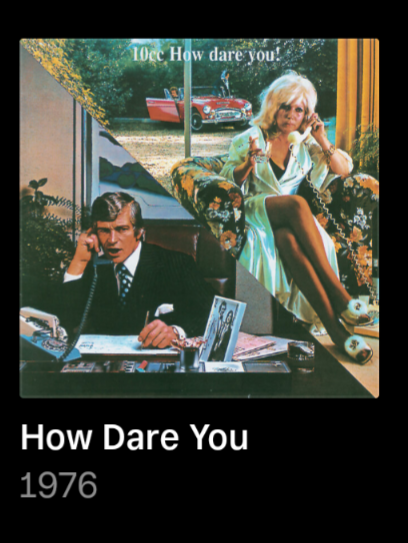
I recently revisited “How Dare You” by 10CC. What a great album for these times! Particularly “I Wanna Rule The World”. If you feel a bit disrupted by politics lately, give it a listen. Some of the tunes just say “wow, what a masterful control of the pop genre.” Others? A bit close to the bone in these times. Seems to me that the band anticipated the 1980s rather well.
In my childhood we peered between [FCC: public airways belong to everyone.] slatted media-control fences, won- [We cannot allow any but market forces to] dering where these LP's we saw came [dictate who will get licenses, who will be] from, artists we'd never heard, never seen [allowed to own a broadcast station, what] over our airwaves. Sometimes these fen- [those stations will play. If young people] ces presented themselves as white, snowy [represent compelling market demogra-] static on those TV channels which deli- [phics, market dynamics will act as incentives] vered no signals. We scoured back [to serve them.] [Record exec: one cannot] pages in magazines, looking for 'just one [suppose your average teenager knows] more' to satisfy our latent curios- [good music from bad. We don't truly get] ity. Our comics straddled two worlds to sur- [this so-called music ourselves, you un-] vive. Real good ones, 'too offensive,' hid in [derstand; certain performers make] head shops near bongs, fringed [better stars than others. We help main-] leather jackets, patchouli oil. Even shows [tain morality, give kids something to do,] we liked fenced us this way, making us [keep them from getting into trouble.] endure dog acts, plate spinners, [Sure, we pay to get our records on] Borscht Belt comedians to catch [the air. Capitalism's the name of the] three minutes from "Today's Latest [game, baby, how the world works.] Greatest Group, the..." Yardbirds. [You don't mind if I light this cigar?] Troggs. Beatles. Elvis. Lovin' Spoonful. [Your local politician: Zoning laws] Car radios came with buttons, we [can be used creatively to keep this] thought, to facilitate quick-punch- [craziness in check. If you really don't] ing from 'that awful song by...' [want your child to listen to this...stuff,] only to hear it anyway on our city's only [don't let them buy it. It's how Ameri-] other pop music station. We saw fences [ca works, donchaknow? {wink}] everywhere: Midwest, small towns, the [Now remember to vote for me next month!] South, anywhere without "a scene".
We chipped at, kicked at, hammered
at, pulled at those fences. Bit by
bit those slatted boundaries fell.
[Where ya bin'? I've sang these words] Ninety-minute TV concerts at [every day. Never saw you here before.] midnight. Imports in our record stores. [Listen to me. This ain't jazz, it ain't classi-] Lyrics about living, loving, dying, in- [cal, it ain't nutthin' but music, dude!] stead of "wake up little Susie" or [Ya payin' attention? Hey! I'm talking] "Tell Laura I love her...", we heard [here! Ah, forget it. You don't get it.] Woodstock's Fish chant. We cheered
I must make some corrections, regarding a post I made mid-2024 when I wrote a post called The S-R Ten, regarding some free and, in some cases, important albums I picked up as a new high school graduate at the local newspaper. I’ve since discovered there were more than ten, and at this point having gone from 13 to 14 in the space of just days, I’ve decided to just admit it, and edit this post as is warranted. It’s a completely narcissistic endeavor anyway, of interest only to folks who might get entertainment value from seeing what kinds of albums were being picked up for free back in the day (David Bowie? Really?) or what crazy bands thought they would get somewhere back in the days before the music industry collapsed in only pushing The Next Sure Thing.
Here’s one I can’t believe I forgot to include:
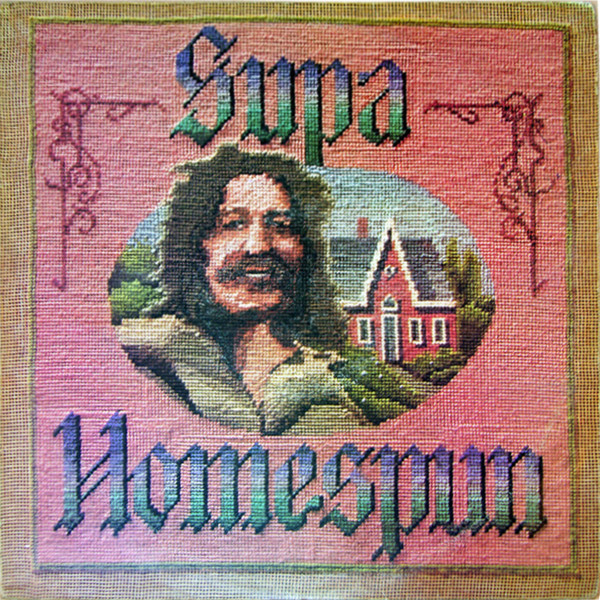
Homespun by Richard Supa
An album which never gained traction. Summer 1972.
Richard Supa hit my radar only because of this album. When I used Wikipedia a few years back to find out about him, I was surprised to see he worked with Aerosmith, The Rascals, Richie Sambora, Mika, and Ozzy Osbourne. Though he released four albums, he never got popular acclaim. He’s most closely associated with Aerosmith for filling in at guitar and co-writing some of the band’s songs, including the hits “Chip Away the Stone”, Lightning Strikes”, “Amazing”, and “Pink”. He also wrote for Johnny Winter. I’m pretty sure I read somewhere else that like many of that period, he had a bit of an tussle with drugs. This perhaps is indicated by the fact he is now director of creative recovery at a treatment center “where he uses music to help addicts in recovery.” [Wikipedia]
As best I’ve been able to tell from a survey of the albums in my digital library (approximately 1700 albums), there were three others:
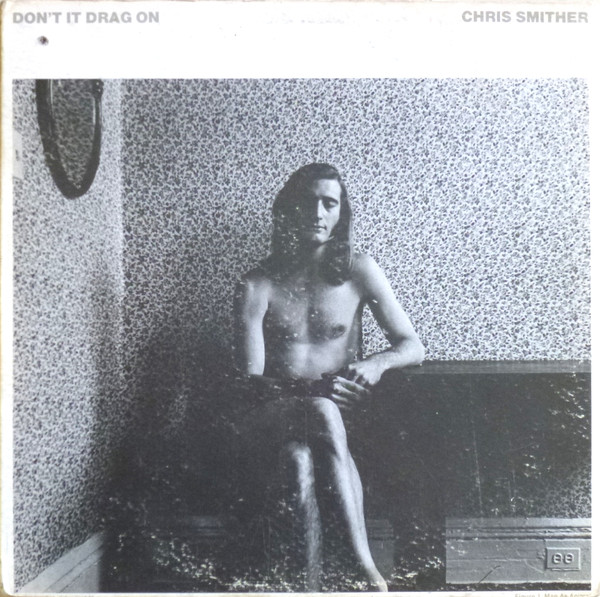
Don’t It Drag On by Chris Smither
A prolific folk/blues artist who started in the mid-1960’s.
This was Smither’s second album, having joined the 60’s folk scene late, comparatively. Bob Dylan had already “gone electric” to the horror of his purist folk-fans. As an 18-year-old I didn’t quite know what to make of this album. In the past 20 years I learned Smither has risen to quite the stature in the folk/bluegrass/blues world. I’ve wondered at times if his unusual voice with more than a bit of ‘croak’ in it might have helped him along. I’ve found myself humming lines from his songs throughout my life, when circumstances suggested it. “Send me rich ones, and young ones in their twenties…” from “Lonesome Georgia Brown”.
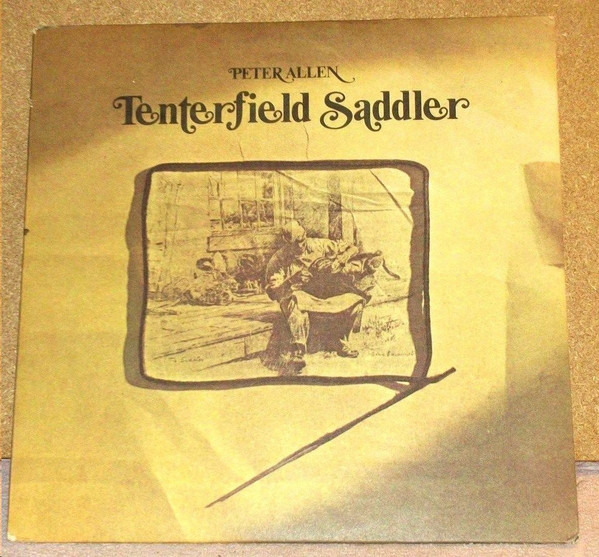
Tenterfield Saddler by Peter Allen
Another odd fit in the pantheon of musicians from the early 1970’s.
I have a visual memory of watching Peter Allen on some TV special, cranking out his pop songs at a grand piano. He’s wearing one of those weird jumpsuit things that men wore in the mid-1970’s. I cannot say when I watched it, but I’m thinking it was around 1979 or 1980 because of his 1979 Up In One concert tour which I believe aired on Australian TV and therefore could’ve been picked up by PBS here. Regardless, this album has so many quirky pop songs on it, I couldn’t stop humming them. “Somebody Beautiful Just Undid Me”, “I Can Tell A Lie (But I Just Can’t Sing One)”, and the hauntingly sad “Harbour”. Allen did much better with his songwriting than his singing. He wrote Olivia Newton-John’s “I Honestly Love You” and Christopher Cross’s song “Arthur’s Theme (Best That You Can Do)” from the move Arthur. Given that I knew he was gay, I was surprised to learn his first marriage was to Liza Minnelli. (It was her first, also.) And here’s a peculiar little factoid from Wikipedia: “In 1998, a musical about his life, The Boy from Oz, debuted in Australia. It ran on Broadway and earned Hugh Jackman the Tony Award for Best Actor in a Musical.”
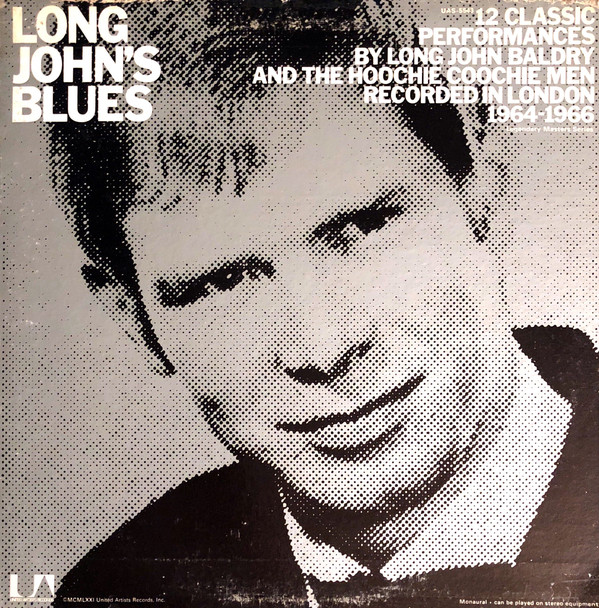
Long John’s Blues by Long John Baldry
Thanks to the extensive liner notes, I learned early of the large impact Baldry made on the British music scene which took American music and spit it back out at us.
I loved this album and still do but for different reasons. At the time, it opened my mind to how jazz and blues melded and worked their way into rock ‘n’ roll. I also had just started to learn about the melting pot of talent in Britain which had transformed popular music in America just as I started listening to it around 1965. Now I love it because of its place in the history of rock and blues, because of the songs themselves, and because I just like his musicianship.
Baldry joins John Mayall and a couple of other guys (Alexis Korner for one) who were the foundation of the entire British rock scene. Rod Stewart and Elton John were members of bands led by Baldry, and Mick Jagger, Jack Bruce, and Charlie Watts played with Baldry in the Alexis Korner Blues Incorporated band. (Keith Richards and Brian Jones played with them at times.) I love the genealogies of British music at this time. Baldry joined the Cyril Davies R&B All Stars in 1963. Davies died, and Baldry took over the group and renamed it Long John Baldry and his Hoochie Coochie Men. Hence this album. Rod Stewart sang with this band, and Nicky Hopkins played keyboards. These two were in an iteration of the Jeff Beck Group. By 1965 Brian Auger was playing the Hammond organ with them. (Brian Auger’s Oblivion Express anyone? He played with Jimi Hendrix, Eric Burdon, Sonny Boy Williamson, and John McLaughlin, among others.)
It all intertwines. When Baldry decided to return to his edgier blues style, he recorded what became It Ain’t Easy which included his US minor hit, “Don’t Try To Lay No Boogie-Woogie On The King Of Rock and Roll”. By that time Stewart had a semi-successful thing going with The Faces and had launched a solo career; soon he would issue Every Picture Tells A Story. Stewart came on board to produce the record. When he encountered Elton John at a party, the guy he and Baldry had played with before, John came on board to produce also, plus he contributed a lot of the piano work. Ronnie Wood (Jeff Beck Group, Faces, and The Rolling Stones) played guitar. This is becoming like an episode of Connections. We’ll stop.
Although the record I grabbed in that pressroom long ago was released at the end of 1971, apparently, it didn’t hit Spokane until the summer of 1972. On it one can hear how those steeped in the British music hall tradition (Paul McCartney, anyone?) listened to American blues and bluesy jazz and molded it into something a bit different. Oddly the Wikipedia article’s lead paragraph doesn’t mention Baldry’s minor hit from It Ain’t Easy. It also doesn’t specifically recognize this album that I’ve highlighted, the closest being Looking at Long John Baldry: The UA Years 1964-1966 which was issued in 2006. I’m guessing it’s the same album?
To the Reader:with apologies, I’ve decided to catch up to some drafts which never reached publication. Or should I apologize to myself? By dumping several lengthy posts on the same day, I’m just about guaranteed less readership…
I’ve sadly realized my 7-10 year love affair with streaming music appears headed for the “let’s be friends” stage. I just finished listening to Adeste Fidelis recorded by The Choir of Westminster Cathedral and released in 1993 by The Musical Heritage Society, and now I’m listening to The Martin Best Ensemble’s album Thys Yool: A Medieval Christmas released in 1988 on Nimbus Records. I purchased both on CD, ripped them more than a decade ago, and I’m listening to them using MediaMonkey, my jukebox program of choice for over 20 years. Soon I’ll move on to another Christmas album, played again through MM instead of streaming it. Why is any of this important? Because I’m not streaming them, and I fell in love with streaming during the pandemic.
Finding both of these albums on Tidal (and Spotify before I switched) proved difficult. A search right now in Tidal using “Martin Best Ensemble” and variants produced no such artist. Only when I searched for “Thys Yool” did the album pop. I performed these searches on a desktop with a full keyboard—I would hate to do this on my phone or tablet. The former album doesn’t seem to exist on Tidal. I can find only four albums by The Choir of Westminster Cathedral, despite Discogs listing 91 distinct albums dating back to the 1950’s. All four seem to duplicate each other closely; in essence it’s four variants of one album.
I could mark these albums as Favorites, and in the case of Thys Yool I have done so, but it’s useless: at some point in the past year or so, the overlords at Tidal decided that the Albums collection will show users not only the albums they’ve specifically tagged as Favorites, but every album they’ve ever played, and in reverse chronological order! Thus, to find this album I would need to scroll through every album I’ve listened to since last Christmas. My year-end report from Tidal doesn’t tell me how many unique albums I streamed, only the number of unique artists.
And tagging the Westminster album as a Favorite wouldn’t do me any good since it doesn’t exist. Oh, sure, I could search for “Adeste Fidelis” — I’m sure it won’t produce too many hits, right? Okay, just to humor you, I’ll do it. There are 106. Scrolling through them…sonuva…there it is! Only took five minutes or so to find it. Didn’t pop because in this iteration the artist is “Westminster Cathedral Choir” not “The Choir of Westminster Cathedral.” Undoubtedly Tidal didn’t obtain rights to the MHS version of the album where the artist name appears differently.
No, I’ve reached that stage in any doomed relationship where you just can’t overlook the other’s faults and those faults loom large. I’ve just described my difficulties keeping in touch with favorite artists and albums from the 60 years I’ve been collecting music. During that time (pre-streaming) I’ve collected nearly 1700 albums over those 60 years of musical pursuit, and these hold about 19,000 unique tracks. Discounting about ten percent which I would never listen to and are there because my wife wanted them there, or they represent some passing fancy of mine, that’s around 17,000 tracks I want to stay in touch with. I can’t just surface some artist’s name or a particular song at will. This was brought back to me by a drive I completed December 30th from Fredericksburg, VA, to our home in Raleigh. We took a ‘back way’ suggested by Google Nav and at one point we drove a mile on Ghoston Rd. Suddenly a song called “Goshen Road” popped into my head. I came by the album Homespun by Richard Supa the summer of 1972. Until I got home and listened to the album, I hadn’t listened to it in years. Not surprisingly, I today I can’t find it on Tidal—I didn’t bother to try a couple days ago. (Dang! I need to update the S-R Ten! Only I guess it isn’t Ten anymore.)
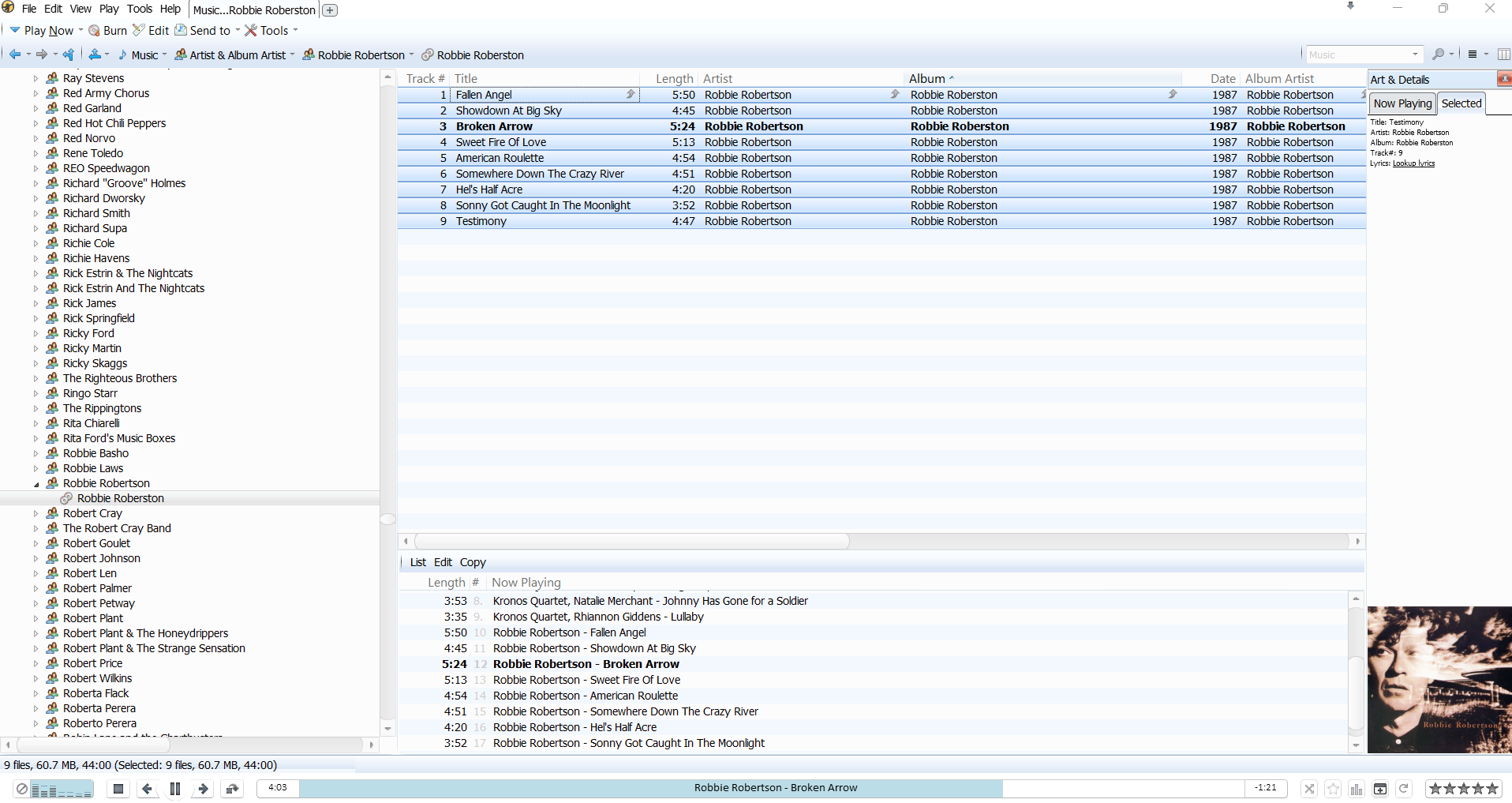
Finding it in MediaMonkey took all of a few seconds once the program loaded. I have used MediaMonkey since 2005 because it handles large libraries with aplomb. Tidal, Spotify, whatever service you want to name, have interfaces which just aren’t as useful, nimble, and quick as a desktop-based jukebox program. (It does have a mobile version.) MM retains the old-school look popular with jukebox programs from decades ago, and I make it more so by choosing a classic look then modifying it further:
What I listened to when starting this post. December 2025. A newer version of the program has an updated interface.
MediaMonkey layers database tools over a simple view of folders and files, similar to File Explorer. Judicious tagging when adding the music allows one to find music by genre, any of the performers, album title, and composer. MM really shines in the case of classical music, providing a more composer-centric set of tools and the ability to find music based on the conductor of a particular orchestra. Could streaming sites do this, and do it better? Yes, but the album/artist/composer/director has to be there in the first place! Reference my comments above.
When I ask MediaMonkey to show me music by artist, I get what you see in the left pane above. There are 43 artists listed there. (You’re welcome; now you don’t have to count them.) With a quick scroll of the mouse wheel I can see dozens and dozens more; I can jump to a specific location in the alphabet if I just drag the little slider on the right of that pane. You just can’t get through your Tidal artists that quickly. (It’s the same for Spotify, et al, so let’s assume every time I say “Tidal” I mean all of them.) I have over 2000 artists in my personal music collection. There’s no way I would ever “favorite” that many on a streaming service, but could I remember them to search for the ones I didn’t?
I’ve spent my life trying to NOT remember lists and lists of things. Even as a student in public school, if I didn’t look at a list, I didn’t know whether I had homework or not. I carried this to the many desks I’ve used in my life: if it ain’t on top, I better have another method for remembering something because just filing it away means I’ll never see it again. Likewise, I can’t surface the name of every artist, song, or album I’ve liked in my life. We’re all like that to a certain extent. Just think how someone will mention a TV show or song from 20 years ago, and your reaction goes something like, “Oh yeah! I forgot all about that! Gosh, I loved that [show/song].”
Streaming services want you to stream many, many artists, wending your way from song to song, artist to artist, discovering playlists you like…anything to keep you on the site. They create many barriers to any user who simply wants to listen to specific artists, albums, and songs. When they take away our ability to scroll through a list of favorite artists or favorite albums, or modify them to make it more difficult and less helpful, they also take away our ability to remember that we like these artists and albums. Sure, I can remember The Beatles, Bruce Springsteen, Neil Young, and David Bowie, to name a few of my top favorites, but I removed a name I almost typed over there, Rick Estrin & The Nightcats, because not long ago I remembered a song of theirs and couldn’t remember the exact name of the band. When a streaming service asks us to remember a name of an artist, album, or song prior to retrieving it for us, it excludes all of those artists, albums, and songs which we can’t remember right now. The jukebox program doesn’t have this problem. Simply scroll up and down your list of artists and the names slide by, each one saying, “listen! listen to me!”
Perhaps the worst aspect of streaming services when discussing how difficult it is to find albums is this: many albums just aren’t there, particularly classical recordings. And good luck finding a complete recording of most tribute albums. I suppose the service couldn’t get releases from all of the artists on the recording? Try finding Woodstock on any streaming service. Individual artist performances have been brought to Tidal, but not the original album (or the excellent Rhino Records 6-CD collection which came out in 2009 to mark the 40th anniversary of the festival). There’s a tribute to Elton John called Two Rooms containing some great covers, including a truly haunting cover of “Tonight” performed live by George Michael. The Michael performance can be found under his name, but the tribute album cannot be found on the site…at least when last I looked for it.
There. Thanks for allowing me to rant. When a relationship hits the rocks, a guy just needs a friend, a drink, and a chance to spew. I think I need a drink….
First, my “daily suggested playlist” included these highlights: “No One Is To Blame” by Howard Jones; “Circle” by Edie Brickell & The New Bohemians; “Your Own Sweet Way” by The Notting Hillbillies; “Weather With You” by Crowded House; and “Seeing Things” by The Black Crowes.
An aural perusal of The Notting Hillbillies’ sole album, Missing…Presumed Having A Good Time. A weird side trip by Mark Knopfler.
[probably something in here I’m forgetting]
AntennaHead, ZZ Top, but I bailed after “PCH”
“Locomotive Breath” by Jethro Tull
“Barracuda” by Heart
“The Battle of Evermore” by the Lovemongers (still one of my all-time faves, and certainly better than Led Zeppelin’s)
Christmas lights through the front door. Christmas Day, 2025.
“Oh my! I don’t usually have more than one, but it is the holidays….” [cue hysterical laughter]
Merry Christmas, y’all! I wish you all the meaning of the day. For the Catholics, and the similarly aligned, we look forward to the 12 Days of Christmas beginning today. To our fellow Christians, we celebrate fraternally, the incarnation of God, the Creator of the Universe. To the rest of America and those who choose to throw in with us, this represents a time vaguely associated with the Solstice that causes the Northern Hemisphere to contemplate the brightening of days, the eventual advent of spring, and a time where we think about love of our fellow humans, the idea we may achieve peace on Earth, and that individuals will find the emotional connection we all seek. (I’m sorry, Southern Hemisphere. I haven’t got anything for you on this one. The days will grow shorter. The warmth will fade away. And in your coldest times you will not have the bright spot of Christmas to look forward to. I’m feeling your pain.)
Our personal Christmas has been especially meaningful to me. My best friend in the choir, a bass like me, died 18 days ago. An ordained priest who left the clergy to pursue a ‘worldly life’, he never stopped being what priests aspire to be (if they are true priests): the lowly shepherds who gather the sheep who stray and return them to the fold. I suppose he never will be venerated, beatified, or sanctified, but he established a spiritual North Star for me, and his death so close to Christmas has rocked me emotionally and spiritually. That I say this day’s mass proved especially moving to me makes me think that the last time I felt this way occurred in 2019 exactly two months after my mother died (and I retired). It’s funny how we imbue meaning into the same annual ritual liturgy.
I approach my faith through music and musical ministry. Thus, the Midnight Mass this year meant I dwelt in the choir loft yet again despite thinking, “How much longer can I stay up until 2 or 3 a.m.?” I reference my comment to my recently departed friend from the bass section who last year at 84 found it a requirement to be in the loft on Christmas Eve, preparing for the first hour of the birth of Jesus. He could not stand for more than 10-15 minutes. He exerted himself to climb the steps to the top riser where the basses reside. Contrary to offering complaint, he climbed with a smile on his face. I kept thinking about him, about my slight musical retreat from participating in what my vocal gift allows me to do, and about how this night above most others enriches the spiritual experience for those who attend but Christmas and Easter.
We presented 45 minutes of music from a brass quintet (plus tympani), two organists using our CB Fisk Opus 147 pipe organ, and the two dozen voices of our choir. I invite you to follow that link to the page describing the organ. It inferentially mentions our cathedral space which remains one of the largest Roman Catholic cathedrals in America, providing space for about 2,000 worshippers.
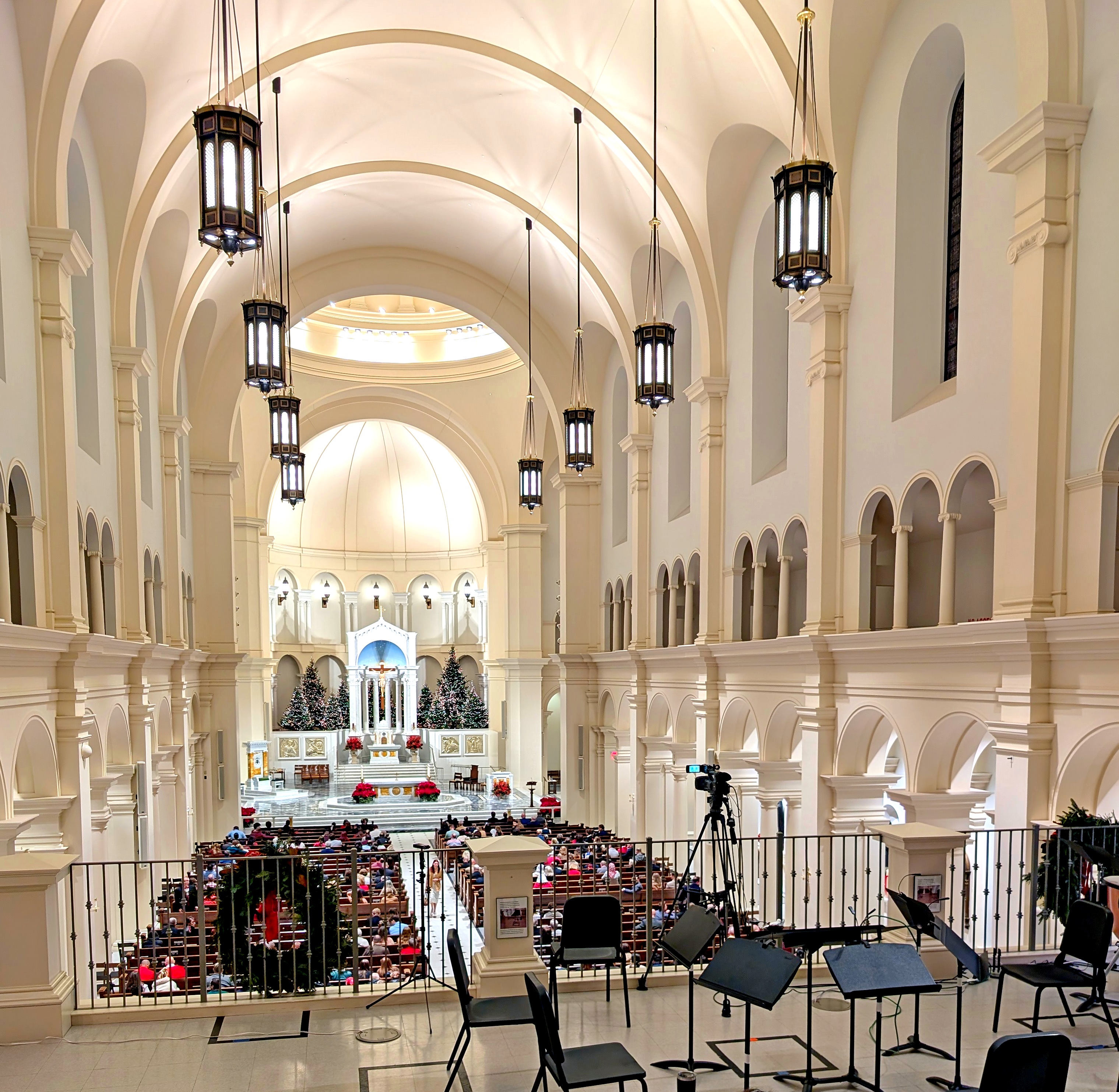
Holy Name of Jesus Cathedral, Raleigh, NC, preparing for Midnight Mass 2025. Two transepts exist to both sides of the altar area. The choir loft, foreground, shows the camera which will transmit a YouTube livestream, the seats and stands for the brass quintet, and is taken from the top riser where the basses sit. Christmas Day 2025.
Not unusually at Christmas, parishioners packed our cathedral.
Here’s a not-unusual detail for folks like me:
Spend Christmas Eve morning planning the logistics for the next 48 hours.
Align meal times with reality
Take a nap for 1-2 hours sometime during the 9 a.m. to 3 p.m. timeframe
Shower a second time…perform necessary personal grooming functions
Continue day to its normal concluding time (for seniors), but have dinner just a bit later
About the time one would prepare for bed, prepare to go to church instead
Get to church at 10:45 p.m.
Participate in pre-mass musical program from 11:15-midnight
Support the mass with musical ministray/leadership
When mass ends at 1:30 a.m., engage in social chat, drive home
Arriving home about 2 a.m. or later, and realizing you are far too jazzed to go to sleep, crack a bottle of “Christmas cheer” and calm in the alcoholic-existentialist manner until approximately 3:30 a.m.
Go to bed
Wake on Christmas Day about 8:30-9:00 a.m. Absolutely beat, and with no more than 6.5 hours’ sleep (usually more like 5.0), stumble through a few hours before saying, “Screw it, I’m having a beer, dear.”
There you have it: a raw, day-after download of what this (and many other) Christmas has meant to me. I wish you and yours the merriest of the day. Here on the east coast of the United States, about eight hours remain on Christmas Day. I hope however many you have (or had), they will be/were meaningful.
I remember this too. It had sound. I could taste the colors.
A friend of mine speaks of his “phonographic” memory. I believe all of us interested in music have this, else ear-worms would not be a thing, right? Over the past ten years I’ve focused more on this phenomena, and I further believe there’s a distinguishing characteristic between songs we can recall and songs which form our sonic foundation. In the latter type, I don’t mean these are fundamentally good, I just mean that they come unbidden on a Tuesday morning when you’re in the shower, or when you’re driving to the grocery store. Or perhaps you hear a snippet of conversation and an overheard phrase comes to you overlaid with music because it’s word-for-word (or nearly so) with a phrase in a song from your youth.
Here’s one which illustrates the vagaries of this kind of aural memory. “It’s Good News Week” pops into my head every few months for the past couple of years. Why? I have no idea. It gets billed as a protest song, and certainly some of its lines will shake you up–perhaps a few will offend. All I remember, however, are two short stanzas which I have always sung together, but which do not appear consecutively in the song:
It's good news week
Someone's dropped a bomb somewhere
Contaminating atmosphere...

...It's good news week
Doctors finding many ways
Of wrapping brains on metal trays
To keep us from the heat.
Plus, I remember the refrain:
Have you heard the news
What did it say?
Who's won that race?
What's the weather like today?
Memory clouds things, too. I’ve remembered this for nearly 60 years as a novelty song, and listening to it today, it didn’t sound the way I remember it. I wonder if that has something to do with the tiny transistor radio I used to listen to it? Looking at the lyrics today, it seems anything but a novelty song. So many songs from the mid-60’s through the mid-80’s just can’t be played these days. Not like “Walter Wart” from 1966 by The Thorndike Pickledish Choir!
A few days ago my Daily Discovery playlist on Tidal offered up a track by Robben Ford, “Talk To Your Daughter” from 1987. It was pretty good, good enough to click through and see what else he’s done. Holy crap. The guy’s been around for 45 years and he’s still playing it hard? How the heck have I gone all those years and never heard of this guy?
After listening to that entire album, I listened to his newest recording available on Tidal, Live At Montreux 1993 released in 2024. Okay, now I’m really intrigued. He’s playing blues sometimes, jazz other times, and he’s echoing Jeff Beck, Kenny Wayne Shepherd, John McLaughlin, Al DiMeola, and a bit of Eric Clapton? His vocals sound like JW-Jones (another great guitarist)?
I’ve since listened to Night In The City (Live) partially; Schizophonic (again, partially); and Lost in Paris Blues Band a perfectly excellent recording with six other musicians I don’t know. In the discography I see he’s played with Bill Evans for an album released in 2019. If that’s the jazz pianist, I’m intrigued. He’s played with Charlie Musselwhite and Jimmy Witherspoon before turning 25. His first solo album in 1976, Schizophonic, resulted in the Yellowjackets, a well-known American jazz-fusion band. He’s release 30 albums, either as a solo act or with a partner or two. He’s played as a session musician in so many sessions it’s difficult to count. Let’s just throw a few names in: Miles Davis; Jing Chi; Little Feat; Tommy Emmanuel; Barry Manilow; Michael McDonald; Bob Dylan; Joni Mitchell; and gosh, we better stop or I’ll just be pasting in the Wikipedia article. Let’s just add this: five Grammy nominations and named one of the “100 Greatest Guitarists of the 20th century” by Musician magazine.
Additionally, we watched Elvis Costello and T-Bone Burnett appear on The Late Show with Stephen Colbert which prompted a bit of listening of tracks from my favorite (and only) Burnett album, The Criminal Under My Own Hat.
In other listening news:
Delbert McClinton’s Nothing Personal continues to enthrall with its combination of country, blues, and soul. Highly recommended if you like the raw side of music.
I’ve been reading Rocks Off: 50 Tracks That Tell the Story of the Rolling Stones by Bill Janovitz which tells the musical history of the Stones through what he considers to be salient songs. It’s a joy to listening to the tracks while reading his in-depth analysis thereof. I’m up to “Under My Thumb”.
And finally, all this good semi-modern blues, i.e., “it came out since 1990,” drove me to Kenny Wayne Shepherd. Today’s final albums: Dirt On My Diamonds, Volumes 1 and 2 (two separate albums) and Live In Chicago still one of my favorite live albums. If you don’t get either a chill or a jolt from “Dance For Me Girl” then you’re either not a rock/blues lover, or you’re not alive.
Over the past weekend we attended a wedding in the nexus region for our family: greater Philadelphia. Google maps failed us at least once on our northerly journey, when I disregarded a patently stupid suggestion which turned out to be… not so stupid. Regardless. There are times when silence is the best soundtrack. The rest of the time was spent thusly (in no particular order):
Greetings from Asbury Park by Bruce Springsteen
Steve Goodman by Steve Goodman (highlight: “Riding On The City Of New Orleans” which he composed and sang for Arlo Guthrie)
Sunshine on Leith, The Proclaimers
Get On Board by Taj Mahal & Ry Cooder (a bit too rootsy for the moment)
The Color of Love by Ronnie Earle and The Broadcasters
Live from the Ryman, Vol. 2, by Jason Isbell and the 400 Unit
Promise by Sade
Orleans by Orleans
Oh Brother by Dawes (Just as good the second time, and my wife loved it)
Ode To The Village by Bearcat (but not at all like the first album and we abandoned it)
Legends Live In Concert by Ry Cooder (but again, too hillbilly for the suburbs of Washington, D.C. Ry Cooder has so many different styles across his career. He produced the classic album Buena Vista Social Club of old Cuban musicians, and I have an album of his where he collaborated with Indian musician V.M. Bhatt on A Meeting By the River)
Blessings and Miracles by Santana
Try It…You Might Like It: GA-20 Does Hound Dog Taylor by GA-20
Sunday fun: “Let’s walk across a real volcano!” Or…why not kick back with some great tunes? Hawaii Volcanoes National Park, HI. September 2024.
Moondial by Pat Metheny
I Trust You To Kill Me by Rocco DeLuca and The Burden
Carney by Leon Russell
“Für Elise” by Jon Batiste (apparently from an upcoming album?)
“While My Guitar Gently Weeps” by Lucinda Williams (almost surely from a forthcoming album entitled Lucinda Williams Sings the Songs of The Beatles from Abbey Road)
Oh Brother by Dawes
You Should Be So Lucky by Benmont Tench
Mudcrutch by Mudcrutch
One of the great things about music streaming services (mine is Tidal), at least for old folks, rests on the opportunities for music discovery. I appreciate that Tidal doesn’t just pop the usual “because-you-listened-to…” stuff, but also just flat suggests stuff from across many genres. (Although it might be because I listen so eclectically. Hadn’t thought of that.) Today’s playlist reflects that. Saturday I listened to Moondial because it showed up on a recommended albums list. Today, a couple tracks on the 5-track “Recommended new tracks” list caught my eye: the Jon Batiste and Lucinda Williams tracks listed above.
The Dawes album appeared on a different list, “Suggested new albums for you”. I cannot believe I’ve gone 15 years without hearing of this group, since they fit comfortably into one of my favorite musical areas where intelligent lyrics and innovative musical lines collide with folk, rock, and jazz. This newest of albums from the group is like Paul Simon meets Jackson Browne meets the Eagles with just a dash of musical thoughts of Iggy Pop. (Yeah, I heard a line in there that I swear is a near rip-off of one from Brick By Brick.) Maybe they listened just a little to They Might Be Giants? Barenaked Ladies? This latest album is the only one I’ve listened to but I’m cueing up more in my near future.
While reading about Dawes on Wikipedia, I ran across the name Benmont Tench and finally separated him mentally from Bobby Tench, a vocalist on a couple of old Jeff Beck Group albums, Rough and Ready and Jeff Beck Group. The band Simon Dawes broke up and out of it came the new group Dawes. They played a bunch of jam sessions which included one with Tench, who’s a pianist/organist and vocalist. Because Tench joined Tom Petty in the group Mudcrutch which later evolved into Tom Petty and The Heartbreakers, this led in turn to learning about Mudcrutch which reformed in 2009 (the same year that Dawes formed–huh). Which completes the musical journey that underlies the playlist above.