Candids as portraiture

Recently I’ve been discussing with a friend of mine posed photographs in the context of a ‘photo shoot’. I am deeply prejudiced—wait, I should stop right there and not finish this sentence—to the candid. Just as the “live album” gives us a more raw, more honest performance of a musician’s music, the candid gives us a more honest visual glimpse into the soul of a subject. But—I cannot argue that a studio performance of a song might be better from a musical standpoint, and might offer more insight into the true meaning of a song. Similarly, a posed shot can, with expert crafting by the photographer, offer a deeper insight into the subject than a quickly, randomly shot photo of them. People have many reasons to want a posed shot: weddings, family gifts, graduation, proms, amid others. (A former colleague of mine spent weekends creating boudoir portfolios for wives and girlfriends who wanted to surprise their lover!)

For many decades I’ve been a firm believer in the candid that looks as if it is posed. To get a shot like this, the photographer must insinuate himself/herself into the situation to the point where snapping photos is no more unnatural than the sun shining through the window. Here is my first argument:

Louise Pilcher. Early 1981.

The above photo of my mother is unretouched, unedited—and unposed. She had drifted mentally from the family conversation in the living room. She is sitting on the hearth of the fireplace, likely because there were only so many chairs and a sofa, or maybe because in a few minutes she need to be in the kitchen again. From the angle, I can tell I was sitting on the floor. I believe it was taken in the summer of 1981, but I’m not totally sure. I would have been 27 that year. To my point, my mother knew I was snapping photos, but previous to this shot, I likely was pretending to snap in a different direction. I had/have a habit of just pointing and pretending to shoot because it puts my subject in a relaxed state. Example: I would note that my subject is about 15 feet away, then pick something that is about the same distance and focus on it. Swing around and snap! Subject usually isn’t even paying attention to me because my interest is elsewhere.

Sadly, one of the best portraits I ever took this way appears to have vanished. In 1981, just a few months after I started working for the Newport Miner and Gem State Miner publishing company, my editor sent me to ‘cover’ the story of a Native American woman whose relatives had informed us was celebrating her 100th birthday. I dutifully drove up to the Kalispel Reservation north of Newport, WA, to report the event. She had a beautifully craggy and lined face with a bandana tied around her head. Being less than pushy, I stood about ten feet away, chatting and taking notes, with a camera slung around my neck. Given a breather by the relatives, I swung my attention and my camera to the ‘birthday girl’ as she smoked a cigarette. A tiny bit of zoom on the telephoto and click: I took a head-and-shoulders shot which captured her hand with a cigarette. When it was processed, my editor exclaimed, “Damn, Pilcher, you sure can take a photograph!” It graced the cover of their quarterly features tabloid.

Here’s another one of my mother. My wife and my parents were visiting the Hancock Shaker Village on the western edge of Massachusetts in 2004. Mom stopped for a physical respite, and I said, “Hey, Mom!” before snapping this shot. We used it at her funeral fifteen years later.

My mother in 2004.

Does she look a bit startled. Yes. But does she also look as if someone just said, “Hey, Louise?” Yes, again, and I would argue that’s the impact of the photo. She looks like an 18-year-old who just turned to her boyfriend, except she’s 75 in this photo which adds to the depth of meaning.

I’m still having difficulty describing what I feel is a gray area between “posed” and “candid” where I think a lot of portrait photographers would like to live. The best examples I can think of are those photographers who take photos to accompany interviews, sometimes while the interview unfolds. I don’t know most of their names, but one famous one would be Annie Leibovitz who I know primarily because she photographed musicians for Rolling Stone. She photographed John and Yoko Lennon hours before John was gunned down. She photographed Demi Moore naked and pregnant. Bruce Springsteen had her photograph the covers for Born in the U.S.A. and Tunnel of Love. And on and on. There’s a good list on Wikipedia.

Maybe I’m just fooling myself. I’m never sure on this topic. Maybe I’m confusing the stray candid that looks posed for those that actually are. My point, if I have one: people are better known when shot candidly, when they have relaxed into who they are. As photographers we need to work toward putting our subjects into that state, even if the photos will be taken at a formal shoot. What if you click, click, clicked every few seconds? And you carried on a conversation while doing it? Wouldn’t your subject just get used to the snapping shutter? Do you have the ability to shoot someone without putting the camera up to your eye? (Oh, how I miss the two-and-a-quarter Hasselblads! A glance down there and you’ve got a shot they don’t even know you’re taking.) Can you use the “hey, I’m not recording these shots right now” ruse (presuming you’re shooting digital—it was so much easier in the film days)? You of course are lying. Can you carry on innocuous conversation while you shoot? Ask provocative questions? Or will it be the mundane, “Okay, Shirley, now let’s get some with you looking to your left”?

Failing, with photos

Front path, with goldenrod. July 2026.

I’m just not going to make a poem today. My brain feels so scattered, I think the only thing holding it together is my skull. Heat? Maybe. More likely the increasing difficulty with being older and watching the world change into something we envisioned only not like this. (non sequitur? no.) Life now resembles a city’s marathon, only you’re not in the race anymore, in fact, you’re not even on the sidewalk watching. You’re up in your apartment looking down and saying, “I wonder what they’re doing down there?”

In lieu of posting nothing, I took a walk around the yard.

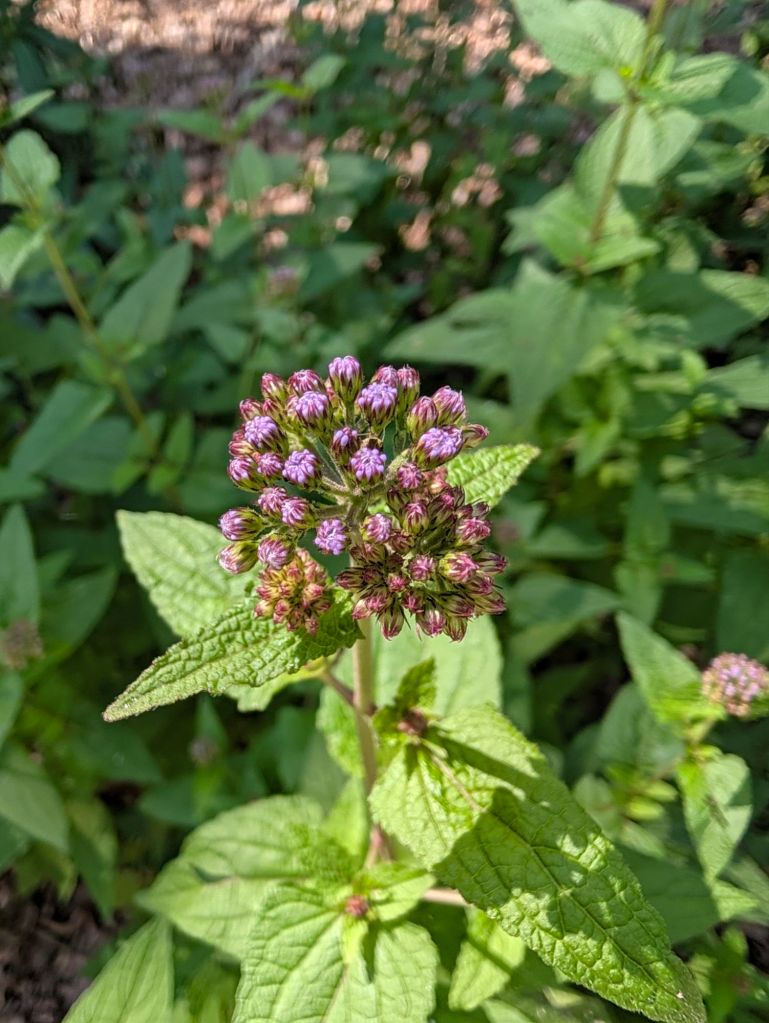
Lovely, ubiquitous goldenrod. Prime suspect in my investigation into the dermatitis which has cropped up again. July 2026.
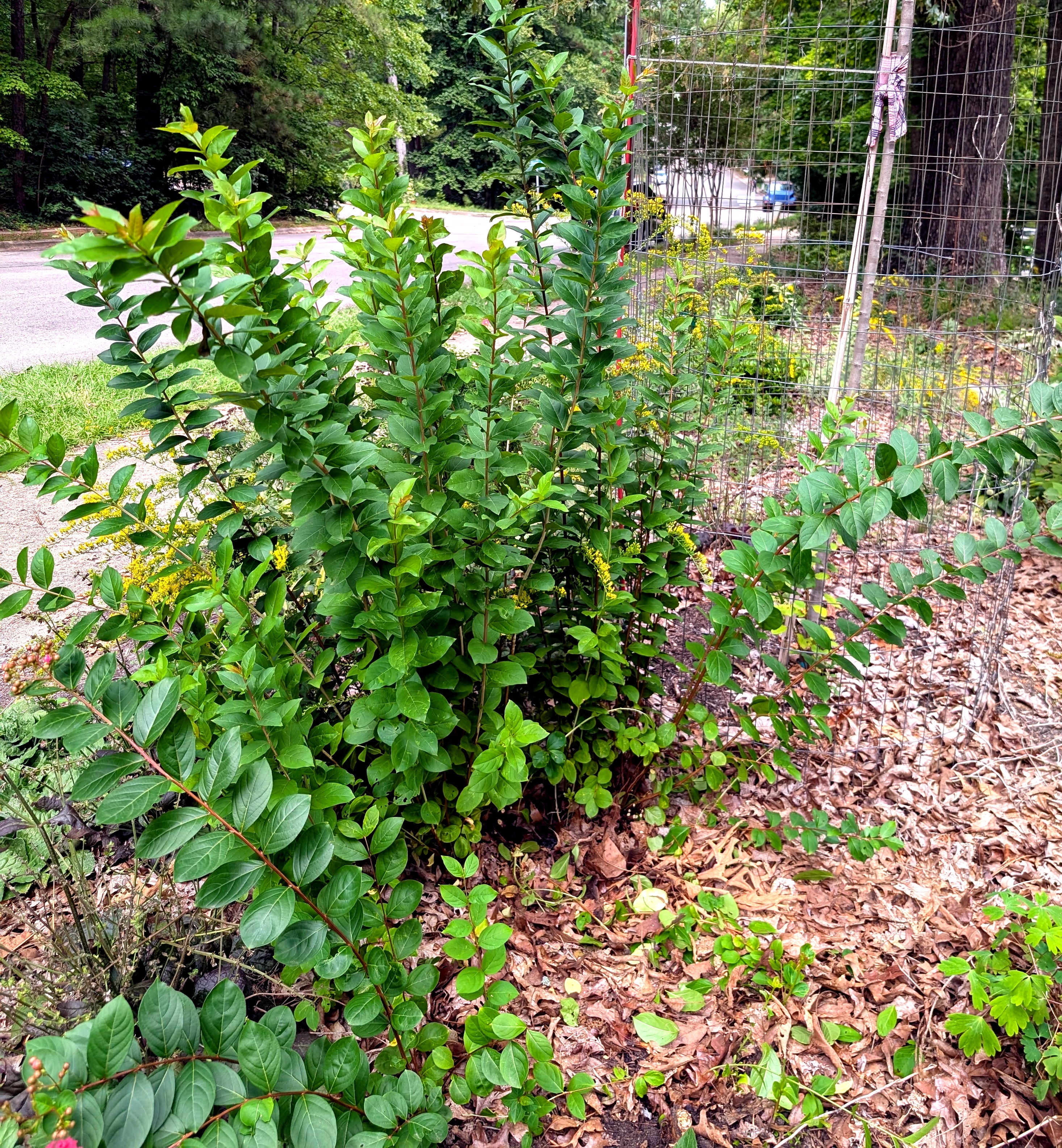
One of the few remaining non-natives. Couldn’t bring myself to rip out what amounts to a mailbox decoration. July 2026.
Our purple coneflowers typically droop starting this time of year, but pounding rain a week ago didn’t help. Good thing these guys were tied up beforehand. That’s mountain mint in the background. July 2026.
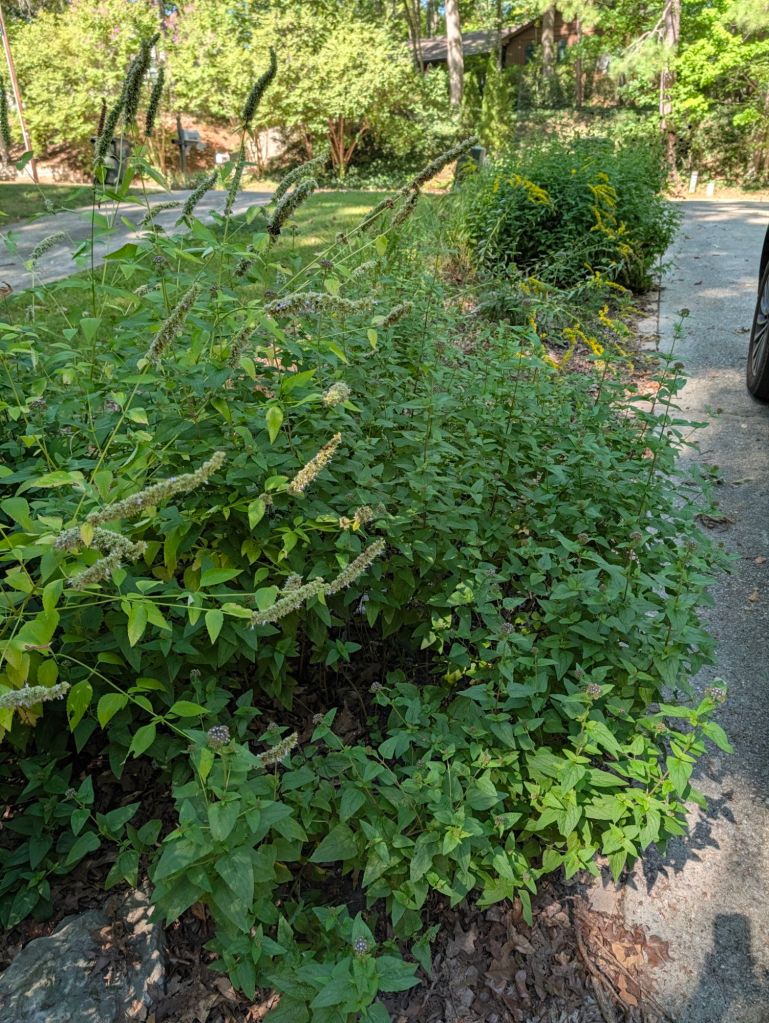
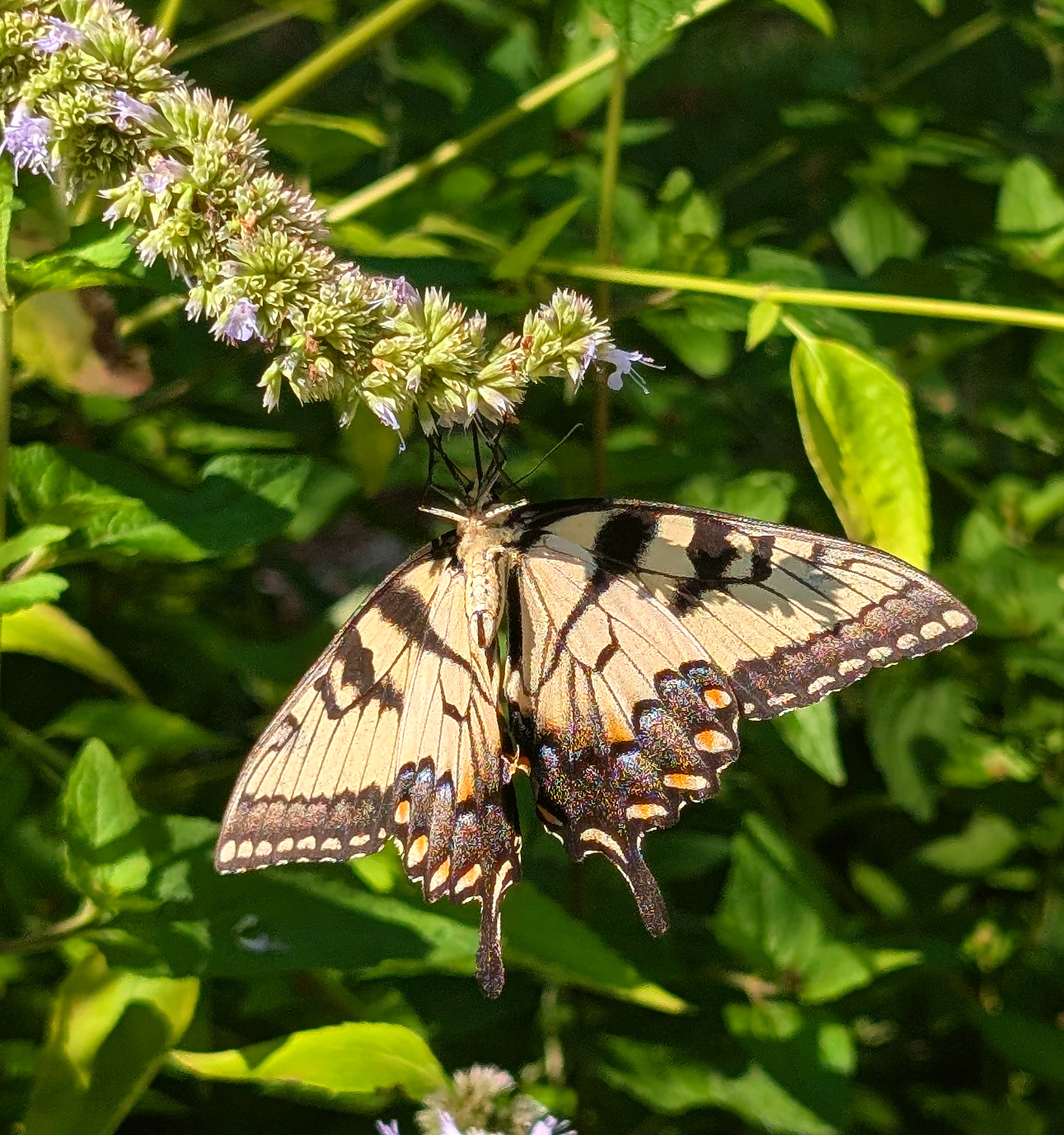
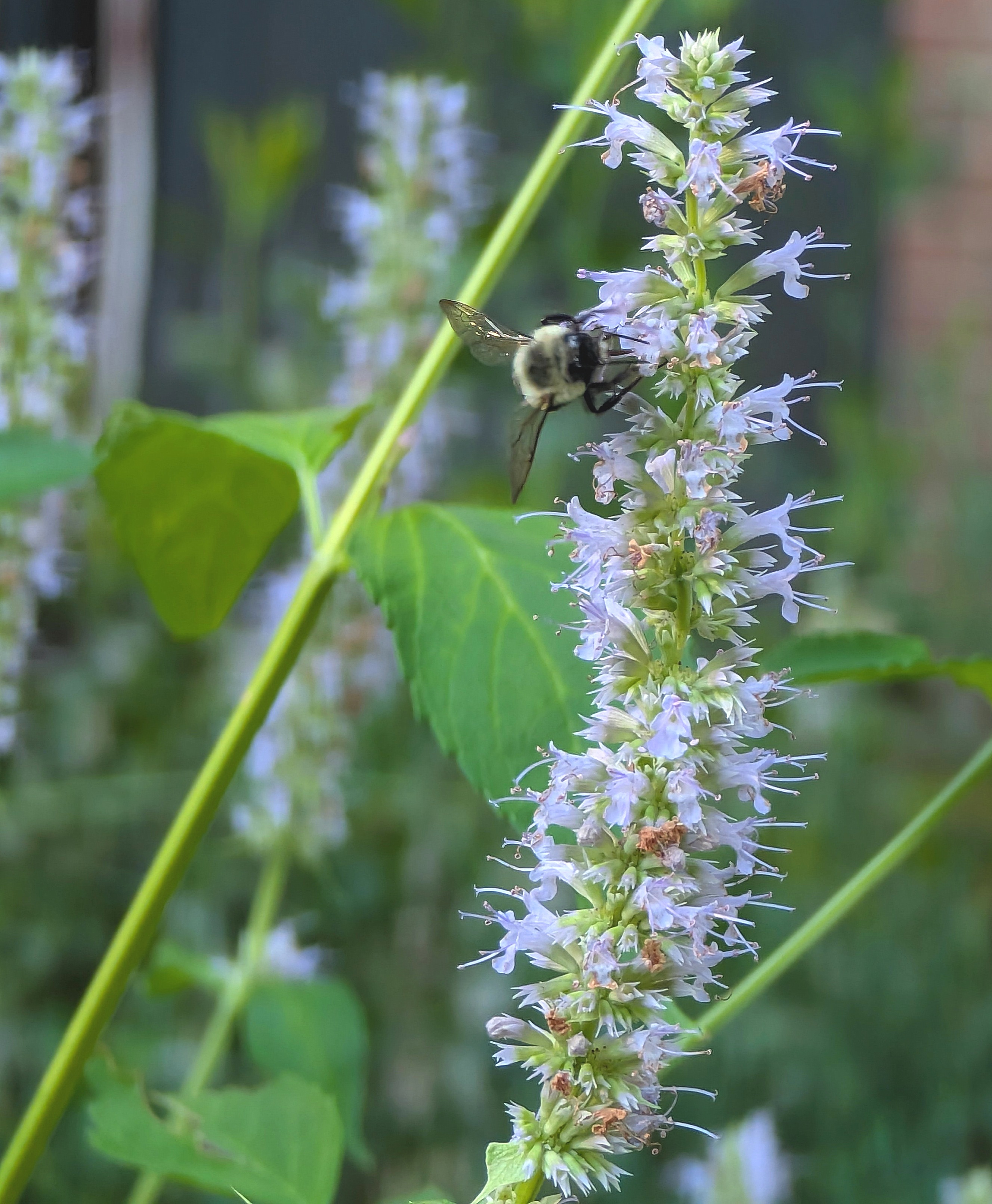
Our yard now represents a pollinator’s dream. Here an eastern bumblebee (I think) heads off for the next blooming sprig of anise hyssop. July 2026.
One of the strangest plants: rattlesnake master. Is it called that because of the thorned, sword-like leaves? Or the spiky flower-balls? It didn’t flower last year, nor did it come close to growing over six feet tall as it has this year. July 2026.

There you have it. Perhaps my melancholy intro will produce a poem later tonight. Time to get down to the pub.

Self-help or social commentary?

From the helpful Alcohol Beverage Control folk. July 2026.

[Note to those outside the USA: each state in America makes its own laws to regulate alcoholic beverages. In North Carolina where I live, Alcohol Beverage Control establishes state-operated liquor stores. Beer, wine, and similar low-alcohol drinks may be sold in grocery stores, but all liquor is only sold in ABC stores.}

I grabbed an old paper bag this morning, and I had to laugh. On an ABC bag used to transport several bottles of liquor out of the store, “Where Does My Money Go?” Really? How about “you’re pouring it down your throat, loser!” Or maybe it’s a not-so-subtle commentary on how someone might have forgotten where it went due to alcoholic stupor. Or maybe it’s a simple matter that ABC sold some advertising to a consumer support company? Nah…. I’m going with one of the first two.

Full disclosure: We spend nearly [redacted] per month on alcoholic beverages which means I have no right to make the jokes that I do.

Bodnant Garden

A stream in the Bodnant Garden. June 2026.

A funny thing happened on the way to this post a week ago: all three monitors started blinking on and off rapidly for 20 seconds and then my video driver software said it had crashed. Since I thought I had installed it only two months previously, I swore and deleted said software… Not a good idea. After rebooting I had only one monitor functioning and it displayed smaller fonts/icons and a fuzzier image. Turns out I had only updated the driver a couple months before. Two days later I’m humming along with three glorious monitors again, but not enough time in each day to complete this post. Wherewith…

After experiencing Edinburgh, Scotland, and England’s Lake District on our recent tour of the United Kingdom, we headed toward Llandudno Bay, Wales. Just before we arrived, though, we took in the Bodnant Garden, a National Trust property near Conwy and Llandudno Bay. The five generations of one family developed it, and Henry McClaren donated it. I got that from Wikipedia mostly, and would recommend a quick tour over to that page because the photos capture it very well. It’s 80 acres present all sorts of habitat from well-manicured English garden to “nearly wild” and has exotic species like the American sequoia. (Hey, it’s exotic there.) We started walking in a summery rain shower but the sun soon overcame it; we regretted layering for rain as we sweated our way into a steep gully and back out.

The McClaren mansion. The family still lives there…on occasion. Bodnant Garden, Wales. June 2026.
Seemed to be a lot of locals enjoying a Sunday afternoon in the garden. Bodnant Garden, Wales. June 2026.

The couple above were gazing into the gully (when not gazing into each other’s eyes, I presume). If they had turned around they would have seen…

Bodnant Garden, Wales. June 2026.

The light varied. As we descended into the gully, cut by a fast-moving stream, it grew dark—not because the clouds had obscured the sun, but because the foliage had. As we walked along the stream, it got lighter. We found some old stone buildings, repurposed into a refreshment center. We however needed to head back to our bus and Llandudno.

River Ridge Baptist Church

My mother taught Sunday School at River Ridge Baptist Church in northwest Spokane, Washington. The church doesn’t exist by that name anymore. A church called the Cornerstone Community Church seems to be in the correct place and though photos show a cream-colored building (not the dusky red I remember), the structure of the building coincides with my youthful memory and the photo below. My family moved from Spokane when I was but eight. That I remember it at all counts for something, I guess. But I’m attempting to resurrect a time and place with which I can set memories of my mother, a supremely good-hearted woman.

River Ridge Baptist Church as I remember it. Spokane, WA. June 4, 1961.

Imagine it as I saw it on that day just before my birthday: a deep brick-red. The current building looks clad in maintenance-free siding. Imagine instead twelve-inch boards, rough-hewn such that little children easily could get splinters in their soft hands. I thought the roof had the typical white steeple one sees on a Baptist church, but if it did, it must be on the far hidden end. That would make sense since the sanctuary was back there. To the east side of the current church is a lawn surrounded by a cyclone fence. In the time I’m talking about, approximately 1957-1962, no fence separated the church from passersby, and the where the lawn spreads out a house stood: the parsonage for our minister. I can almost remember the name of the one who was serving when we moved away—he had dark blonde hair and a wife named Dorothy (I think). In the photo above the parsonage lies just out of the picture to the right.

It seems important to set the scene. Mom and Dad would dress themselves and us boys for church of a Sunday morning. My brother and I at this time wore matching medium-gray sports coats and black slacks extending down to our dress shoes. We wore ties, clip-ons to be sure, but ties nonetheless. Perhaps we only dressed that finely for Easter—the photo is only dated “April” but Easter was in April in 1961. I’m reconstructing this detail from several photos reclaimed when my parents died. Mom would wear one of her nice dresses and Dad of course wore a suit.

Dressed so fine for Easter Sunday. That’s me on the left, my brother on the right…and Baba Looey in the center. He was Quick Draw McGraw’s sidekick. Look it up. My brother loved him. April 1961.

I distinctly remember Sunday School from the time immediately preceding our move. Mom taught Sunday School for the primary grades (1-3), and my brother and I were both in it as first and third graders, respectively. One of Mom’s duties was to letter the words for our simple hymns onto lined, kraft-colored sheets which were hung by their tops on a blue frame. It remains one of my salient memories, marveling at the decidedly weird way she printed letters, so different than I was being taught in school. Do businesses or conference still use those pads with the easy tear-off sheets? The ones you can set on an easel? Usually the sheets wind up being placed all over the room as a group activity, likely an “ice breaker”? Our hymn sheets were that size. Two big rings were at the top of the frame and two holes in the sheets enabled one to hang multiple sheets. To sing a particular song, one simply flipped the sheets until you found the one you wanted. Hymns could be written on both sides of the paper—you just needed to turn the frame around. We children would gather around on the floor to sing the hymns. If you look closely at the church building, you can see it has a partial daylight basement level. This was where our Sunday School took place. Rugs were thrown on the concrete floor. Little wooden chairs, just big enough for childish derrieres were also used.

I’ve no idea what my father did while Mom taught Sunday School with one or two other women. I think he likely had a type of Bible study with other adults, because after Sunday School we would have a break, then everyone would troupe upstairs to the sanctuary for our worship service. Imagine this: the floor is covered in industrial-dark-brown linoleum tiles, one foot square. As with the current building, the windows are high on the walls, the better to minimize distractions while the minister is preaching! Putty-colored metal folding chairs (no cushions) would be arranged in rows. Mom and Dad both sang in the choir, and therefore sat behind the pulpit in the altar area. My brother and I, being ages six and eight, were seated in the front row, on either side of the center aisle. This prevented most misbehavior; being fully exposed to our parents’ gaze prevented the remainder.

This exhausts most of my memories. I have snippets of running around the church after a service, of going to the sanctuary on a Saturday with Dad to do something and taking advantage of his careless supervision so that I could look at the full-immersion baptismal tank. I knew all about that because Dad’s father also was a Baptist minister, and had a pair of waders to prove it! I can slightly picture the parsonage and the minister himself. I remember some of the people because my family was very involved with the church. I can see the pink background that stretched up from the baptismal tank.

[this post will be updated as I find more photos]

Space-Time Re-entry

Thoughts upon waking in my own bed again on June 17, 2026

As Jules Verne pointed out fictionally in 1872, travel over any distance isn’t just spatial, it’s temporal. In this age of electronic connectivity, this gets thrown in our face every time we realize our friend lies many time zones to the west: “I can’t send that text! My buddy’s gone to bed!” Or maybe he’s hours away from waking. Phileas Fogg’s seemingly lost wager reminds us we must consider how we’ve slipped through time as we’ve traversed any significant part of this globe.

Less than 24 hours ago we re-entered America’s Eastern time zone, which currently runs it clocks on the hijacking concept of “daylight savings” time (as if one could just pocket a bit of sunshine for a rainy day). Twelve hours previously we’d been delivered to the front of Heathrow airport’s Terminal 3 and just a few hours before that we had walked to St. James’s Square for a bit of air, exercise, and an attempt to distract my wife. She became quite agitated upon waking when she learned our flight’s departure to America had been delayed by 2.5 hours. The square is not spectacular in London terms: many areas exceed it in acreage and beauty. Yet the square offered a lovely little distraction and glimpse into the morning working world of London. Within it a very small area of peace existed. Few, if any, used it as a shortcut, no doubt due to its strategic gate locations. Had they been on the corners the story might have been different.

Not for the first time on our two-week sojourn I marveled at what I believe are plane trees. (I will happily consider being corrected.) I’m attempting to learn if the way the trees’ massive trunks (compared to each tree’s canopy) is natural or produced by extensive pruning over the years. Regardless, it’s striking.

Plane tree in St. James’s Square. June 2026.

By the time of our walk we were experiencing our 14th day of wandering the island, our 14th day of experiencing how 2000 years of history permeates this land. Or perhaps the British/Scots/Welsh just hang onto it more. I never felt France or Germany along the Rhine River held onto their historical tropes the way these Celtic, Anglo-Saxon, Gaelic, Viking, Norman descendants do. Thus this bench brought me up short. I don’t read a physical book but maybe once per year and only then because I have a Luddite friend who insists on buying me one for my birthday. If this is the definition of contentment, I will be hard-pressed. Additionally, I received the reminder that my particular method of e-reading doesn’t work well in direct sunlight.

Bench in St. James’s Square. June 2026.

We wandered out. As we left I captured this photo showing how the natural world attempts to insinuate itself into the busy metro-life of London. Then again, how natural is it when every branch, stem, flower, even the plants, are artificially formed, planted, pruned, moved, replaced, and trained? The English do seem to love their carefully manicured gardens, at least within the historical districts of London.

Leaving St. James’s Square. June 2026.

Other elements for the returning traveler: an odd disjointedness associated with returning to one’s home country, but fearful about proving one belongs (via passport); having a distinctive experience of how different countries are…different countries, not just a place where “hey, people are people”; looking forward to the first time in two weeks that temperatures will actually align with “the summer months” of June/July/August; using toilets which aren’t square; drinking American beer which doesn’t hold a candle to the ones available around every corner in Great Britain; and realizing the myriad little ways a country founded on liberty has innate limits, wonderful as that liberty might be.

Removing oneself from the group grants both perspective and a desire (usually) to return to the group, the familiarity. Thus it was with us. All the little ways the United Kingdom differs from America brought our usually habitual daily habits into focus. Several hotels had Nespresso machines. One didn’t re-stock the capsules, however, despite our four-night stay. The simple act of looking right for oncoming traffic when crossing a street. (And on controlled-access highways, never getting used to the passing lane being on the right.) Marveling at how green everything was, everywhere. Sunrise occurring prior to 5 a.m. preceded by a leisurely pre-dawn that started around 4. On occasion, paying to use a toilet. Calling them toilets instead of restrooms. And the simple expressions of everyday life, turned sideways by a different culture despite ostensibly speaking the same language:

Not a “detour”. London, June 2026.
We don’t have these in America. Windsor, June 2026.
A double-dose: Top, the indication of the exit; bottom, how to take “fire action”. Chipping Campden, June 2026.
I prefer toilets that work, but that’s just me, I guess. Stratford-upon-Avon, June 2026.
…but some things remain the same, such as stating what should be obvious. Chester, England. June 2026.

I’ve decided not to publish an itinerary-based series of posts about our two-week tour of Scotland, Wales, and England. This partially is based on the fact I’ve never completed the Rhine River cruise series which we experienced in August 2025! Mostly it’s based on the fact I have over 1000 photographs of far too many locations to handle it adequately in the time I have for writing. Instead, I’ll drop in from time to time on a particular excursion: Conwy Castle on the edge of Llandudno; the Royal Mile in Edinburgh; the Lake District of England; and all that touristy stuff from London. Hope you’ll join me.

Wooten Meadows

In the past 50 years or so, a “walk around the block” has a different meaning. Streets meander, dead end, and lead to yet another meandering street, not to the nearest arterial. Thus, a walk around the block entails much more walking! With my brother in town, I chose to walk to a nearby park, Wooten Meadow. If my measurements are correct, the around-the-block part equaled roughly two miles. Add in the stroll through the park to make it 2.5 or so. Regardless, we had a fine time in this very small park which locals once knew as a horse pasture, according to my friend who grew up here.

Tucked alongside a bustling arterial, one sees the remnants of the horse pasture:

Wooten Meadow Park, Raleigh, NC. May 2026.

Half of the open area of the park is shown above. It’s not a large park. A figure-eight path leads one beside ponds which serve to handle high water during heavy rainfall when Hare Snipe Creek overflows its banks.

Wooten Meadow Park, Raleigh, NC. May 2026.

At the back of the meadow (middle left in the first photo) we discovered an unpaved trail which led into the woods. Spying a park bench, we gained assurance we were allowed to be there. No other people followed us, nor did we see any ahead of us. We saw instead several bucks sprouting antlers.

A non-concerned buck across Hare Snipe Creek. Wooten Meadow Park, Raleigh, NC. May 2026.
Further into the brush away from Hare Snipe Creek. Wooten Meadow Park, Raleigh, NC. May 2026.

Half of “the block” remained, so we headed toward home.

Moth becoming

What I believe is a Regal Moth becoming… Next to a Blue Mistflower “becoming”. April 2026.

Two weeks ago I’m walking the path along the front of our house when movement in the dead leaves caught my eye. I saw an amazing insect squirming around, kind of walking in little circles. Examining the photo, I figured it to be a moth with wings not yet dry and fully erect. Regal Moth was the closest I could come (only having a photo of a female). The wing markings don’t seem to be correct, but they might change when they are fully deployed.

A couple hours later it had disappeared.

Today’s quote…

Woodland pinkroot in the spring. May 2026.

I have come to regard with some suspicion those who claim that the Bible never troubles them. I can only assume this means they haven’t actually read it.

Rachel Held Evans, (1981-2019)

I came across this quote in my morning devotions which for me are structured by Give Us This Day a publication of The Liturgical Press. The LP is “an apostolate of St. John’s Abbey” which is a Benedictine order of Catholic monks. They skew to the liberal end of the spectrum and therefore highlight people who aren’t necessarily Catholics in the daily “Blessed Among Us” profile which appears at the end of the morning devotions. (The devotional schedule is built upon the Order of the Hours, a monastic tradition.)