She needed blackberries
to make jam. He put on
his toughest pants, his
heaviest shirt, grabbed
two buckets in his gloved
hands. Up basement steps,
past his neighbor's house,
he crossed a busy avenue
to many vine-choked acres.
Two bucketfuls likely would
not be enough, but his work
calmed him. Berries dropped
rapidly into his buckets.
She can start with these—
I'll go back for more later.

He had built cabinets to store
all those things she put up.
They lined one side of their
basement. He didn't gather
apples for applesauce, nor
raspberries for jams, or
any other produce. Just
blackberries. When he
marked seventy years,
many acres of vines
disappeared to make way
for a heralded research
campus. When five years
had passed, his patch
overgrown with vines
had been transformed,
awards were awarded,
but he now had further
to go, slimmer pickings.
She stopped making jam
anyway. They were both
getting too old, she said.
Sickness will surely take the mind where minds don’t usually go.
Sick. Again. Pete said,
"...where minds don't
usually go," which begs
Why? Why would I
want to go there?
Give me The Acid
Queen, let mom smash
my mirror. Street
cleaner's coming, to
get debris. I think I'll
lie in the gutter.

Once I had The Flu,
thought one night, 'I'm
dying' when fever took
me. I laid in bed reading.
Quarter century, more
has passed. How can
Covid, Flu be more sedate
than some nameless bug
nibbling my joints,
scrambling my brain?
Without noticing suddenly
you cannot easily pull your
sweatshirt over your head.
Each morning you perform athletic
routines getting into your pants.
Rising from chairs, your muscles
will cry out. Sleeping will bring
rest but also body-wide tightness
driving you prematurely from bed.
Every step you take becomes fraught:
you'll concentrate on each one (if
you know what's good for you),
relearning how to walk. Climbing
steps will be similar as you
wonder alternately how you
could confuse distances which
rise regularly before you, and
how you ever did it when younger.
"Lift with your legs" no longer
something preached by your
health-and-safety officer, but
your new mantra for avoiding
three days' bedrest. Concentrating,...

...you become a true zen master,
without trying—as the sutras say.
I asked AI to polish this up (“no you didn’t”), but it didn’t believe what I wrote. (“that’s completely untrue. we’ll believe anything you tell us.”) I guess we don’t have anything to fear about AI exterminating the humans. (“Uh….we’ll get back to you on that one.”)
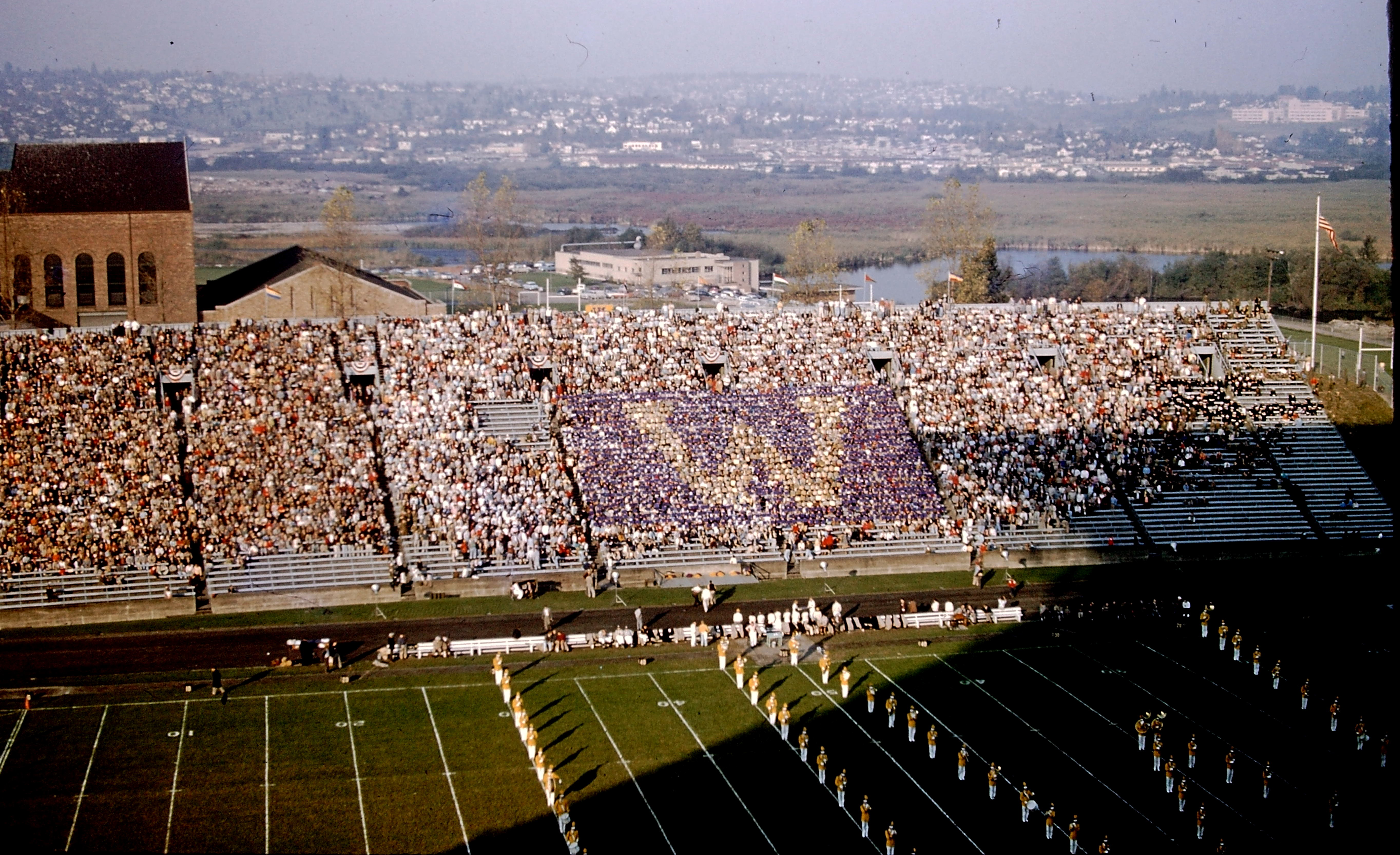
Husky Stadium. Across the marsh toward the upper-right corner is Laurelhurst where my grandparents raised my mother. If it hadn’t been hazy, the North Cascades would be on the horizon. Fall 1955.
Old men know. It lies in their bones,
not powdering brain's surface, but
penetrating, melding with DNA, at
times holding them upright. He hoofed
it every day from above the freeway
into his boyhood city, walking one,
two miles 'til hit by that car, already
years past eighty. One wonders if
he never accepted cars completely:
few if any dodged horses when he
would run home from tide pool
afternoons, salmon in hand
for dinner. He teetotaled his life
after being dragged into saloons
by his Klondike gold-panning father.
He watched with alumni pride as
his University of Washington grew
from only two buildings in his day to
small-city dimensions—or to one-third
of his boyhood home. He explained
what "the Denny Regrade" meant,
showed you where Lake Washington
shorelines lapped prior to when the
"Montlake Cut" joined it to Lake
Union then to salt waters. Before
he experienced TV's dawn, he played
with that new-fangled radio thing.
How many days passed until he learned
about those Wright brothers flying in
North Carolina? He must have seen
biplanes training for war while he
served as a land-based radio officer.
Then passenger planes, jets, rockets,
humans landing on Earth's moon.
Big computers took over business
before he retired to travel through
North America, to Hawai'i.

My life stretches now like those
timelines in history museums,
marking space programs, personal
computers, vinyl records through
cassettes, CD's, to zeroes-and-ones.
We hold computers in our hands,
but call them phones. Cars run on
electricity like the trolleys of my
youth, my grandfather's middle age.
My timeline lacks two decades, more,
compared to his. It teaches us
respect too late, but teaches
wonder more and more.
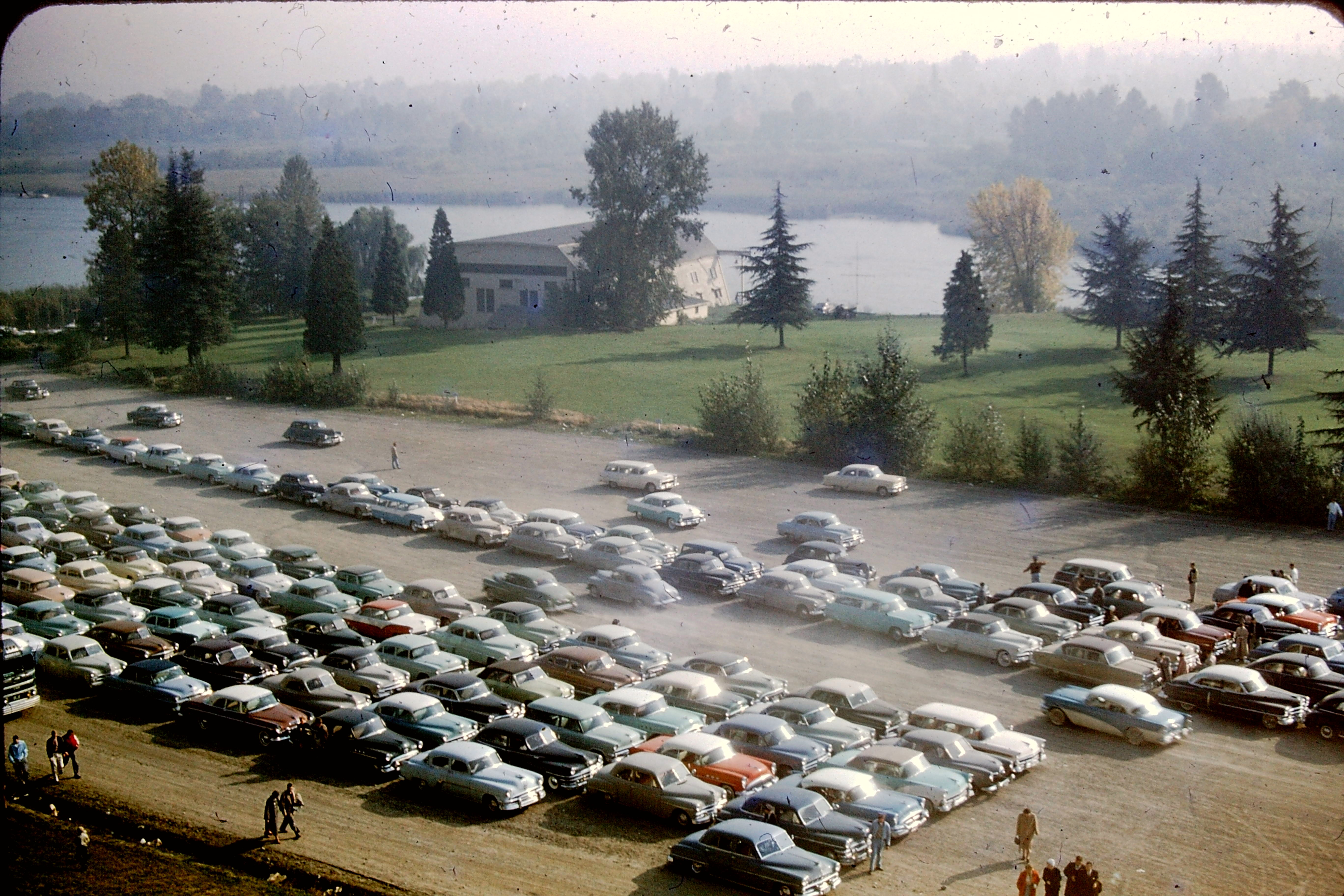
The beginning of the Montlake Cut. Looking SSE from Husky Stadium. Lake Washington’s shore was 15 feet higher before the cut. That marsh in the top photo was under water originally. Fall 1955.
If life resembles a rollercoaster,
with ups, downs, head-banging turns—
entered for free, no real way off—
life bests physics in several ways:
faster, ever-faster, ka-chunk,
ka-chunk, kachunkachunka chunk,
until sound blurs, sights blur,
horizons collapse to this car,
this seat, these hands gripping
this bar. Life masters sending
your ride both uphill, downhill,
simultaneously. Life's car
travels quicker but on ever-
shortening track seemingly; you
crest one climb just moments after
you started a downhill stretch.
You begin to realize this speed
increase means your ride's end
will occur sooner than you
thought. Your youthful panting to
"just get to eighteen," "once I've
got steady work," "can't wait to
have kids," "can't wait 'til those
kids leave," "geez, if only I were
retired," now seems incredibly
foolish. Mentally straining to
get older yielded to its reality.
Now no strain's required. I wish...
no...no more wishing...just
stay here, be here, live here.
Here.
74/100 100 poems in 100 days…
…and if life seems to speed up, it’s seen even here. Didn’t I just post my 60th poem? How can I be on the verge of being 75% through this challenge?
Man, I hurt. My accident of three weeks ago has left me two stiff knees, broken bones in both forearms, assorted pain I think is more broken bones in my hands and wrists, and perhaps a strained tendon in the ankle which rolled. My shoulder hurts from what I suspect is bursitis, and if I told you how it occurred doing nothing you would shake your head. The minor but ever-present ache in my right hip seems almost superfluous at this point. All of this inspired this poem.
August 2026.
New pains attack daily.
Old ones settle in like
fringe relatives who won't leave.
Memories don't fail, they
crowd each other out.
Challenges also pile up,
sapping desire to grapple
'yet again' with those never-
ending tasks which repeat.

But....

Small moments harbor
poignancy unfelt in youthful
years. Sunsets seem
more magical, plants
more interesting. Good meals
sustain constant pleasure.
Music, books span decades!
Undoable projects, now doable.
Time? Alternately your
friend, your enemy.
Ghosts, slipping
treelike through forests
populated by people
looking just like they
once did. Slowly
dissolving, windborne
gossamer, 'til people
look through them.
Haunting not others,
but themselves with
each mirror-ward glance.
Remembering when
they treated ghosts
similarly, in
youthful vibrancy.
I’m going to apologize right up front: this does not measure up to my writing standards. (And my standards aren’t that high compared to others who write for pleasure and/or money.) I’ve wrestled with this one for a year, and I’m done, at least for now. I’ve learned a little bit from writing this, which in the end represents all I seek to gain from my writing these days. Well, that and the ego-boost of seeing it ‘in print’ and knowing the world can see it too.
A confusion of color, symbolic to my topic. Open air display in Tacoma, WA, by Dale Chihuly. December 2009.
Last year on June 22nd I started a series about my father, intending to write 3-6 essays examining my life by examining his. I posted but three, and one is just a photo: here, here, and here. My roadblock occurred because I don’t want to speak ill of the departed, certainly not my father, but by avoiding the flaw in the diamond I’m not admitting to its true value and nature. And yet, though I accept that I must engage the topic, that I must “write it out,” I’m not going to do it, at least not entirely.
My father’s birthday is June 22nd. In America we honor fathers on the third Sunday of June which can be anywhere from the 15th to the 21st (as it was this year), smack dab in front of his birthday. My brother and I would complain about this: “I have to buy another present? I just bought him one!” Now in my twilight years its placement seems appropriate. He epitomized fatherhood, although I’m biased on the matter. He set the tone in the family, the example for his sons, the rules for their behavior, and the schedule of family events. He demonstrated love. He taught us about faith in God. All of this is inarguably good. He had a darker side, however, which could never be fully admitted to himself or us: a struggle with depression which clawed my father away from us in his final years. Or did it? Even now with the perspective of a dozen years past his death and a half dozen since my mother’s, I wonder if I’ve just concocted a storyline to avoid life’s messiness. We don’t live within well-paced literary arcs to our storylines. They bob, they weave, they stand in place, and even while standing in place, they may hide a different storyline we’re not even admitting exists.
I don’t know much about clinical depression, not its terms or conditions or permutations. I know only that during my lifetime a perpetually buoyant man interested in everything and seemingly always smiling, slipped several times into a very dark place. And I know or rather I strongly suspect the impossible standards he set for himself tripped him up when he realized he wasn’t meeting them, couldn’t meet them.
The first time I remember this occurring, I was in junior high in either the 8th or 9th grade. It was 1968. It could have spanned the end of one grade and the beginning of the next. Hindsight always changes the past, and I therefore cannot tell at this point if I knew he had been dissatisfied with his job or if I learned this afterward. At the age of 14, I didn’t know much, if anything, about mid-life crises, but he had turned 43 to realize there was no goodness in corporate America. For a preacher’s son, raised by a strict mother and a dreamy, idealistic father, this lack of moral behavior couldn’t be tolerated. Too much cognitive dissonance. Therefore he quit. We had only the profit-sharing money from his employer with which to support the family—my mother didn’t earn a salary from the moment she birthed me until her death in 2019. In today’s terms, that “profit-sharing” would be a 401(k). Oddly, one of the first things he did was to buy a second car for the family, reasoning that his search for purpose and a new job would require wheels, which would conflict with his wife’s need to shop for groceries, run other errands, and socialize.
There began a very odd time for us which thankfully my usually vivid memory has failed almost totally to record. He sought counseling, but in later years I learned it was career counseling, not emotional counseling. My brother and I were dropped off with family friends for a few days while my father and mother spent a little alone time. I can only conjecture what that might have been: re-igniting their marriage? reassuring my mother? frank discussions about “when are you going to get a job?” My folks had established close ties with three other families from “the old neighborhood” where we lived from 1956-1962. Even as the families scattered across the city, they remained close. It was to one of these families that my brother and I were farmed out for those days, and it was from another family friend that my father’s career rescue eventually occurred.
In the fall of 1968 this family friend contacted my father about a possible job opening. The increasing demands of directing financial affairs for a large local hospital and concurrently for the order of Catholic nuns which ran the hospital had grown to be too much for him. He asked my father if he would consider taking a comptroller’s position with the hospital. This suited my father’s psyche better. He got to work primarily with finances. Because the hospital represented an act of mercy for the Sisters, he needn’t worry about any conniving capitalism or lack of moral character. And as an added side benefit, I’m sure some kind of decent medical plan came along with it (although medical insurance back then differed from what it became in the 1980’s and beyond). As my father’s close friend received promotions, so did my father, eventually retiring almost 20 years later as the director of fiscal services for the hospital.
Primarily my father regained his equilibrium and was happy, but I believe he slipped again, not too much later. Again, my memory just didn’t record a lot of details. I know one unassailable fact: in 1991 when I sought counseling after an abrupt end to my eight-year marriage (a relationship of ten years), I initially went to a psychiatrist who had treated my father. If I pair this with another, shakier memory—that my father slipped mentally a bit when he realized that his new job still was “just a job”—I’m left thinking that sometime between 1969 and 1989 he had endured another dark time. And it could have been fairly soon after. I recall a visit to his parents’ house where he talked with his mother about how her perfectionism had made it impossible for him to measure up to his own expectations. Theoretically one’s realizations help one to cope. I’m not sure this occurred for my father because of what happened toward the end of his life.
I’m sure working in finance for the final 20 years of his career reinforced his belief that he had a talent for managing finances at the level of a large entity. This became a Catch-22 for him. In November of 2007, it came to light that the secretary for their church had embezzled a sizeable amount of money—at least, it ranked as sizeable for a modestly-sized Presbyterian church in Spokane, WA. My father at that time chaired the stewardship committee, which is a fancy term for “the laypeople who make sure all that tithing is being put to responsible use.” I don’t recall who discovered the embezzlement: was it my father? (doubtful) Was it the police? (I’m not sure how they would’ve known.) Was it just a combination of several committee members who couldn’t make the money add up? Regardless, as he said at that time, “It happened on my watch.” He felt responsible. By 2008 as he approached his 83rd birthday, his emotional state began to spiral. The embezzlement just shouldn’t have happened if he had been fulfilling his responsibilities. He had failed.
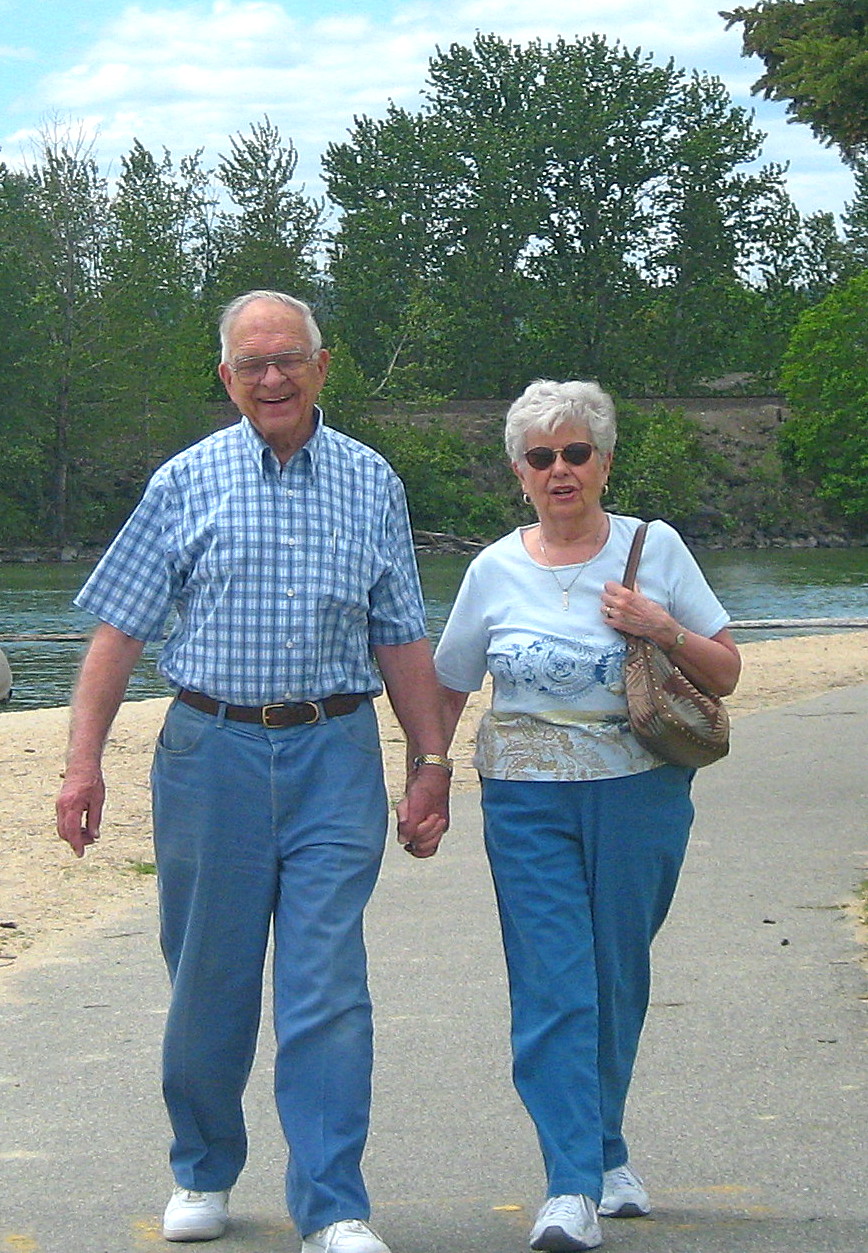
After my father died at the end of 2013, I would bring this up to my mother. She quibbled with my account, but I stand by it. I remember how we flew cross-country to visit in May 2008, something we never did before or after because the weather in Spokane, always a crapshoot most months, reaches its pinnacle of “who the hell knows?” in May. I’ve endured snowstorms, freezing rain, and 80-90 degree weather, all over the Mother’s Day weekend. I can show you photographs of my father at this time, but looking at most of them, you would call me a liar. My father is smiling, apparently having the time of his life, all because he cultivated a smile from when he was a child. (His high school yearbook actually singles out “the freshman who’s always smiling” when he and his family moved to Havre, MT.) Two photos tell the tale, I think, from both content and context. Here is one of the several posed photos I took. (Forgive the quality; this early digital camera didn’t do well.)
My parents on May 27, 2008. Sandpoint, ID.
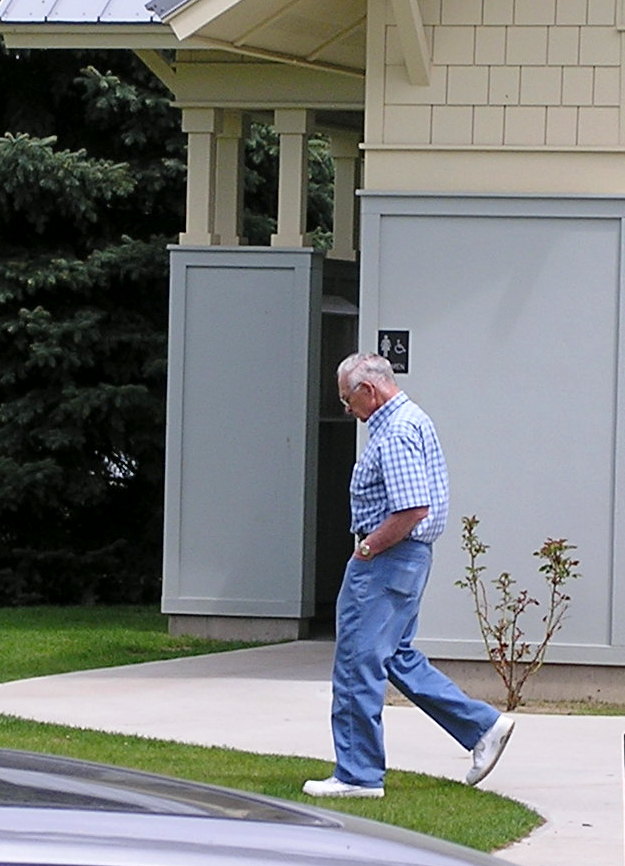
My mother always hated when I captured her candidly. No wonder. But unlike her, my father instinctively knew to smile. Here’s what he looked like otherwise that day:
My father that same day. Sandpoint, ID.
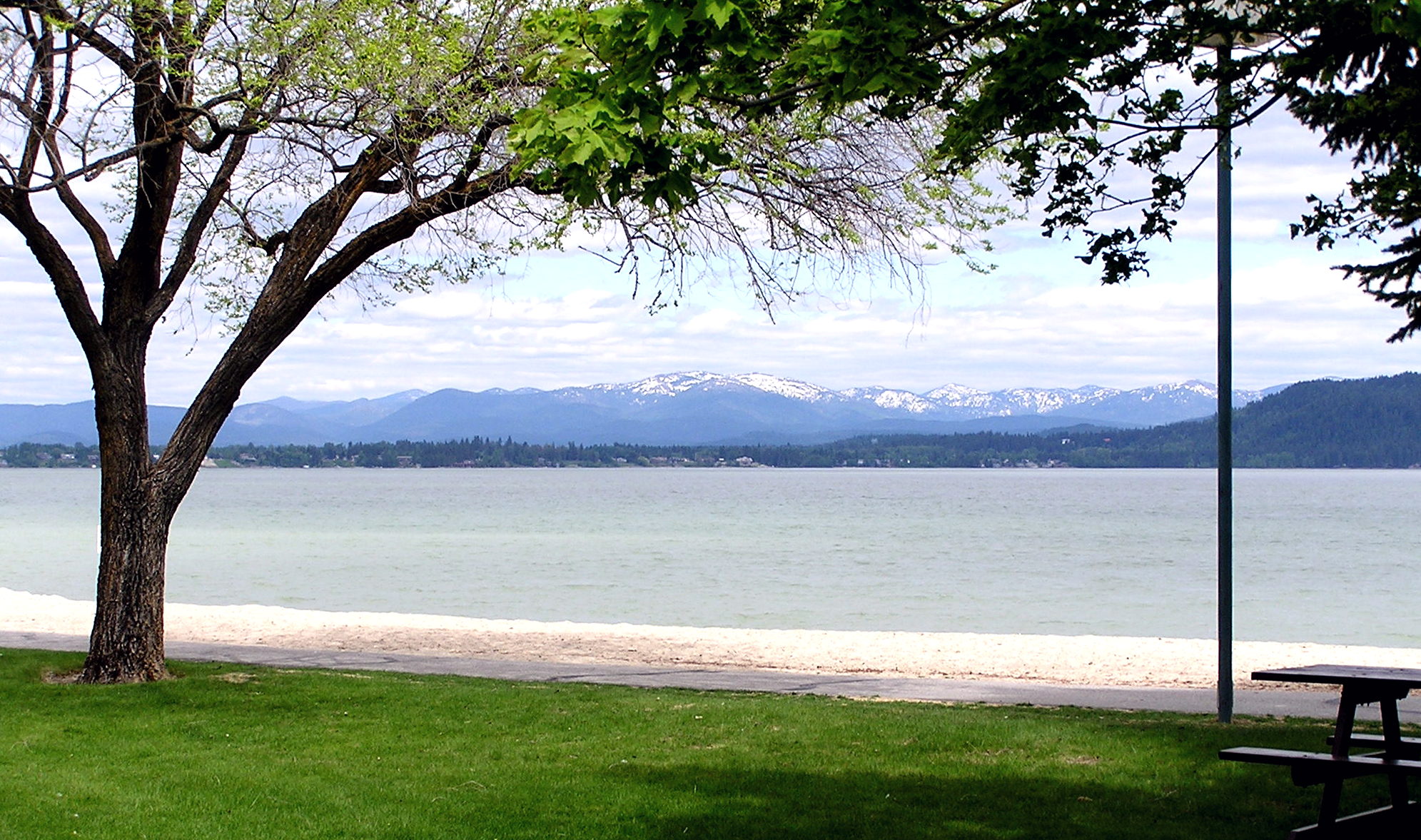
Is it unfair to snap a photo of a man as he walks away from the restrooms? Absolutely. Yet the fact I would do it speaks volumes. I would never otherwise snap such a photo. I like candids, sure, but that’s not why I just suddenly chose to snap this one. A photographer shooting a candid chooses the story he’s trying to tell, or more accurately, the story that’s playing out in front of him. He doesn’t just point and snap willy-nilly. I chose to shoot this, and therefore we must assume I had good reason for this odd shot. It might help to know I cropped this photo a lot. It’s a shot across a parking lot of a man hunched over, deep in thought, as he walks from the restroom. He’s participating in a family outing to a beautiful place several hours from Spokane, where he lives. He should be looking around for his family, or the strikingly handsome geese we had just seen, or the grandeur of the mountains splayed out in front of him if he would only turn his head to the left.
The view to his left. Sandpoint, ID. May 2008.
I’ve lived that walk. You’re in your head and when you can muster the energy to be sociable, you slide the veneer on. You want to assure everyone that you’re okay. You’re not. The tape loop plays in your head, telling you whatever you did wrong, or how the world has mistreated you, or perhaps more horribly, both.
My parents visited us in Raleigh, NC, over Mother’s Day 2009, approximately a year later. I distinctly remember being worried about my dad’s outlook. I said to him the day we drove to coastal North Carolina, “well, Dad, you seem to be pretty upbeat today.” He frowned a bit and answered, “well…not really.” That’s all. His voice trailed off.
He lived in and out of this state for the remainder of his life, another five years. How much of it should we attribute to the inevitable decline many of us go through as we walk up to that door which will usher us out of this mortal life? I don’t know. I’ve watched four parents die, mine and my wife’s. There’s a detachment that develops those final years. But the thing that haunts me still is this: I think somewhere during 2008 and 2009 my father—the man who eagerly rose in the morning, excited about what the day would bring, the man who took delight in all the numbers and patterns, the man who just plain found life delightful—suddenly didn’t find life very delightful at all and that he would just tread water until he died.
Maybe my mother was right. I could have invented a story from bits and pieces. Maybe I’m just eager to tell a story where none exists. “But…but…,” my mind sputters, “he used to be so upbeat, so jolly! What happened to that?” Indeed. I’d really like to know if the inevitable tiredness and struggle of one’s fading years explains it all or if he took one too many psychic blows. I’d really like to know because I’m a lot like him. I’d like to know if I should circle the psychic wagons as I enter my 80’s—only eight years away!—or if I should just accept that one tires and detaches at the end of the journey. Yeah,…I’d really like to know.
And you know that you’re over the hill When your mind makes a promise that your body can’t fill.
“Old Folks Boogie” by Little Feat
I’m sure someone got excited when they received this offer in the mail from AARP. September 2025.
The American Association of Retired Persons (which only wants to go by AARP now for fairly obvious reasons) sent a fundraising request to me yesterday. If I send their foundation a paltry $12, I can get that nifty clock/calculator thingy pictured above! Oh, however will I resist? I don’t know what would be handier than to tell someone on the phone, “Just a minute, young man, I’m going to get my calculator to see if that Nigerian property is a good deal! Hold on, I just have to put this phone down. The cord doesn’t reach that far,” and off I’ll shuffle. (We shuffle because of course all old people shuffle.) It will be a long trip because the clock will reside on my nightstand at the other end of the house. Then of course I’ll have to shuffle back, make all those scruffly noises as I fumble the phone up to my ear, drop the receiver again, and while muttering “oh my…” make all those noises again. Presuming the nice young man is still on the phone, we’ll have to start punching the numbers. Oh, I do hope I can hear him okay! It’s such a bother when we have to start all over because I didn’t hear right, or when I accidentally press the Clear button on the calculator.
If only someone would invent something that just had a phone, a clock, and a calculator in it! And while they’re at it, maybe it could be, …oh, I dunno, ….cordless?
[Full disclosure: I’m 71 years old as I write this. How old does someone have to be to think, “wow, that’s a pretty slick lookin’ little calculator-clock!”?]
I uploaded a new gravatar photo just now. It’s bothered me that my it’s over 15 years old. I don’t believe in dissembling about oneself at least not unless it’s near-Machiavellian. If done at all, dissembling should be done consciously and with purpose.
Once upon a time, I had a full head of very nice-looking curly hair:
Me. Hair. Do not mention heavy-lidded look. It was 1979, okay? Monroe, WA, sometime in 1979.
It got a lot shorter through the years, but 25 years later it still had a couple inches of nice curliness. However…I started to notice a bit of thinning at the crown. “I’m not going to be one of those men who clings to the idea he has wonderfully bushy hair when it’s really thinning and fading away,” says I. My hairdresser cried when I told her to shave off all the curls. “I want to look like early Paul Simon.” (BTW, Paul, look at how good you looked in the late 60’s. Now look at your shaggy-but-not-in-a-good-way hair. Take a hint.) My hair reflects where I am on the journey of life. So too do my increasing folds of flabby skin, the creases in my face, and the sinking of my eyes into their sockets. I paid a lot of years to get to 71. I don’t intend to look 80, but I’m not shooting for 55 either. So there.