I’ve come to believe everyone thinks in pictures, even if they don’t know it. By adulthood some of us go on autopilot, our connection to the pictures, images, emotion-movies cemented so far in the foundation-concrete of our makeup that we know only words anymore.
Creativity demands turning away from the words and toward the pictures. Visual creatives, you live here. Connect your hands to your pictures. We wordsmiths, though, must act as our own interpreters, must turn our backs on the pictures while remembering them, must translate the pictures into words.
At least, that’s how it works for me. When it works for me. (The rest of the time I just wander among the pictures and say to myself, “sure, I’ll remember this for later.”)
Maybe my purpose simply lies in imitating Charlie: hang out at the bar and drink a half gallon dry? May 2024.
I’ve several pieces of writing sitting on the shelf in a to-be-born state. Some even sit at the front edge of the shelf, just waiting to be taken down, polished, exhibited. This beckons now, however. It underpins the others.
I’ve too often settled for what I can do instead of striving for what I want to do. This blog and its recent lack of activity exemplifies that. There exist but a handful of activities which bring me as much pleasure as posting photos, essays, poems, and other pieces of writing here. Why the weekslong gaps?
At the age of 13, as inchoate as any such a creature, I became focused by two things: my Language Arts teacher said (using a bit of poetic license), “Damn, Pilcher, you can write! You should consider being a writer!” The other event occurred in the same year when a partner and I debated some topic which I now forget in front of the entire 8th grade class, all 300-400 of us. I got a glimmer into my innate bent toward logic and reasoning, both inductive and deductive. Our duo lost the 8th grader vote, but we won the teacher vote, similar to winning the electoral college but losing the popular vote. I considered myself a Writer and a Debater from that point forward. I did not know they were sometimes mutually exclusive.
In high school my teachers redirected my interest in writing. I learned they placed little emphasis on writing creatively, focusing instead on the expository writing of the essay, the critique (book reviews), and the like. Can one function in society where business letters rule the day? (At least they did then. If those teachers could only see today’s society…alas, most are dead.) I therefore looked to the available outlets, enrolled in Journalism, and joined the school paper (an elective class). In my senior year the two points of view in C. P. Snow’s The Two Cultures collided. All that expository writing reached new heights when Senior Humanities brought me the two-hour essay as a substitute for a test. But…the loosening of curricular philosophies brought me the elective of Creative Writing. Suddenly I wanted to go back to the latter. Yet already I had applied to the University of Montana because it had an excellent School of Journalism.
To shorten this up: I did attend the U of M, but enrolled in an experimental education program instead of journalism. I spent one year there. There followed a year of earning money, a two-year stint at a regional college learning to be a recording engineer—no, wait, a radio-TV newsman—no, wait, a weird combo of that with Economics—before I enrolled in journalism (again) at the University of Washington, determined to make my way in that field because, “if I don’t focus on something, I’ll never do anything!” And I did work in newspapering for almost four whole years.
Pause. This supposedly promised to be about how he couldn’t focus his desire to write into the pursuit of WRITING. He settled for what came to hand, taking the path of least resistance, doing what he appeared to be reasonably talented for. Compress the next twelve years: convenience and aptitude led to a ten-year teaching gig. Divorce and early-onset midlife crisis led to One Last Attempt to Be A Creative Writer. It failed in less than a year. (Insert all the comment you want; I/we know our psyche. I/we did what seemed necessary to maintain mental health.) Through a series of events which defy a bad Hollywood script, I wound up analyzing data and writing scientific reports for the world’s largest pharmaceutical manufacturing company at that time. I did well. I spent a quarter century at it, eventually as a consultant, and retired.
WAIT! WTF? I THOUGHT THIS PROMISED SOMETHING ABOUT HONOR AND ALL THAT?
What is honoring thyself? Youth #1 has innate talents for playing baseball, thinks “I really like buying and selling stuff” but goes into baseball because his/her innate talent take them that way. They succeed as expected, then coast for the rest of life realizing passive income from the insane amount of money earned as a ballplayer. They neglect to build a business empire based on that initial desire to be a capitalist. Youth #2 loves baseball despite having mediocre talent at playing it. He/she works every waking moment for years to make this dream come true. They are drafted into professional baseball, succeed despite what their projected ceiling is, and spend the rest of their life in baseball as a coach or a manager or a consultant developing young talent.
Which one honors themselves? The one who leaned into their innate talent? Or the one who ignored who-knows-what talent to pursue a dream? Youth #1 drifted into baseball on talent. Youth #2 ignored talent to pursue a dream which consumed the remainder of their life.
And for the religious among us, which one is pursuing their God-given path? Youth #1 made the most of their innate talent. Not #2.
How can I be nearing 70 years on the planet and still wonder which one of these I am, and what the answer is to that question about honor?
When I volunteer to write a database/listing application for my church choir, am I fulfilling my innate talent, or am I defaulting on my dream? Ditto for ditching teaching to write business reports that pretty much anybody could write. To make it more mundane, when I derive great joy and satisfaction in planning a set of weekly menus, selecting good recipes, and cooking them, am I dodging my greater dream, my greater desire to Be A Writer?
Is Being A Writer just an ephemeral dream, a wisp of wanna in a wind of reality?
Deep down I think I fear that though I have a talent for crafting language, I have nothing to say with it. I need to be explaining something, reacting to something, pontificating upon something. (I’m doing it now.) Avoidance mechanism or recognition of doing what I truly want to do? I fear it’s a bit of both.
I intended to end this with a promise about upending my approach to the day, the week, my life. To declare, “I will write FIRST, I will read FIRST, and only then will I tackle the mundane!” (“Dear, have you emptied the cat boxes yet?”) I cannot do that. I’m sitting here thinking about the monks with writing skills who eschewed them to pray aloud and work the fields. Of soldiers skilled in various practical skills who instead served on the front lines. Of women (and a few men) who gave up promising careers to raise children. What is a Calling and what is a desire?
In the end I come back to this: you have done what you wanted to do at the time. If more high school guidance counselors—do they still have those?—had told this to their junior and senior clients, a lot more of them would have been able to pursue what they were drawn to. I know I would have.
There will be no end to this piece. Not until I reach my death bed and give you the answer, and likely not even then.
Among my pantheon of pet peeves I count the astronomical definition of the seasons. People look around on March 21st–or 22nd, because They Say So–expecting some radical change. You can almost hear the globe laughing. Let’s leave astronomy to matters of astrophysics: rotations, revolutions, light years, and such. Let’s leave Spring to what our eyes see, our noses smell, our ears hear, and what our skin feels as it collides with our sun’s radiant energy and the increased load of humidity it can carry. Here in central North Carolina, it’s definitely the beginning of Spring. For over two weeks I’ve posted photos of such, and this past week left no room for doubters:
The star magnolia has hit full bloom…
Star magnolia. February 29, 2024.
The camellia has busted out its peppermint blossoms, and in its exuberance, an aberrant deep pink one:
Normal camellia blossom. February 2024.Abnormal camellia blossom. February 2024.
…and daffodils (or relatives thereof) are blooming everywhere:
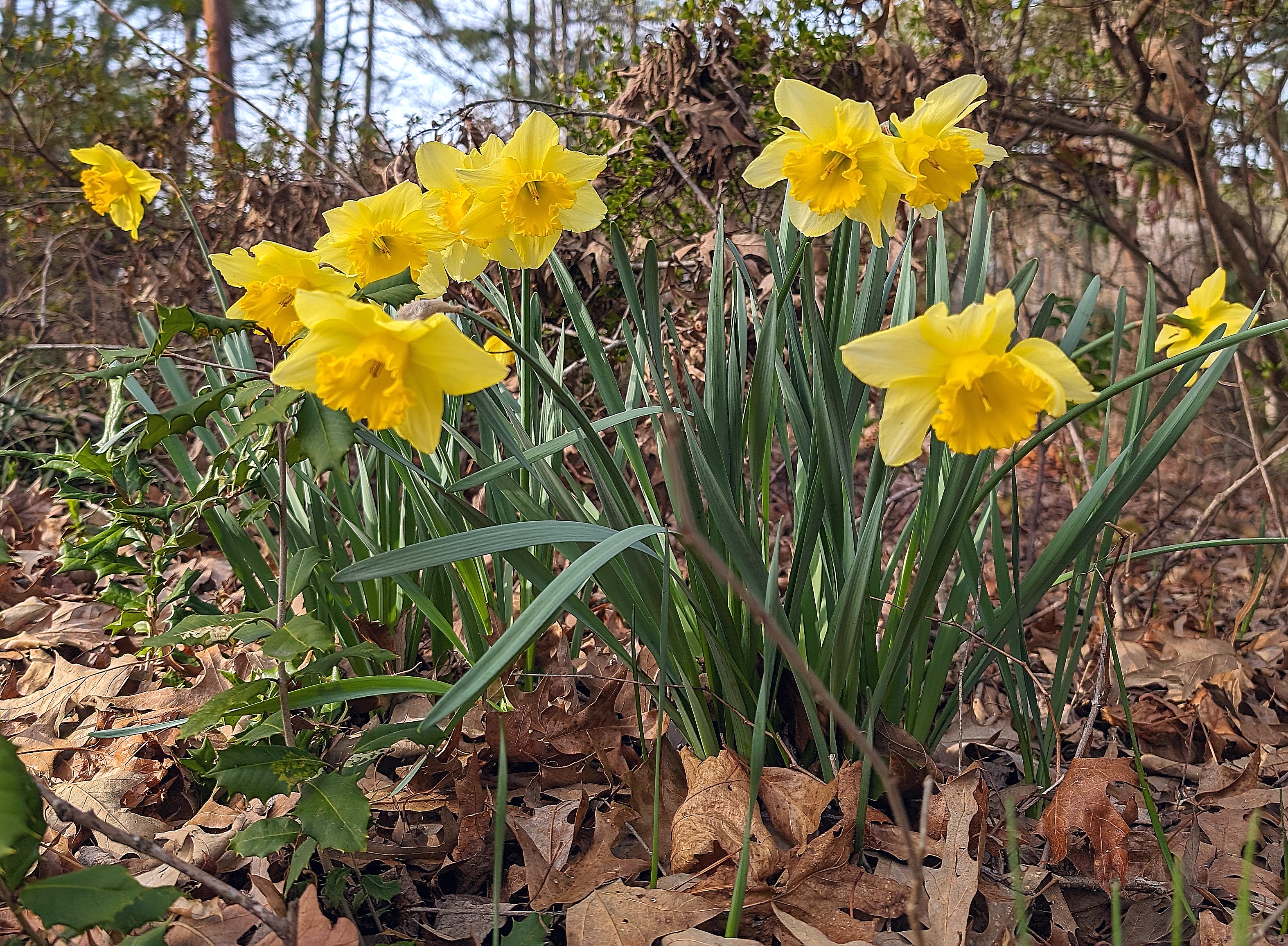
Ready for their close-up: daffodils. Leap Day 2024.
A screeching blush of robins stopped by a week ago, but I had no time to properly photograph them. Just arrived from further south to torment those who stuck it out? Or just a gathering to kick off the aggressive mating season? One of them has been attacking his own reflection on my side storm door for ten days now. The bird feeder needs filling about five times more than usual. Yes, it’s good. Soon I’ll note that first sheen of green as I look through the tops of the until-now bare trees, a sheen foreshadowing the imminent burst of leaves as we launch into the heightened glory of full Spring.
Growing up, my parents’ chairs interested me little. They still don’t. I consider them in my mind: the bulbous thing they reupholstered from a shocking golden mélange of 50’s colors, vaguely like a tweed, to a deep blue-green as hideous as you likely just pictured. Another horrible chair, this one chalky gray underlaid with a chocolate brown, thankfully disappeared from our lives as my parents focused ever more on Danish modern. Two deep mustard gold chairs sculpted from a cube joined the blue-green thing. I took Danish modern for granted then, hate it in retrospect. For reasons never given, our sofa matched nothing else in the room, either in style or color. Its creamy colored soft contours with the ever-present throw pillows would scream Rooms-To-Go today. Back then it just said, “I came from the middle aisle of our local furniture store.”
Chairs only rarely occupy our minds beyond whether we can find one to sit in. We take them for granted, I suppose because those of our upbringing formed part of the Always-There background. We sat on hard wooden chairs in school, replaced later by hard plastic seats, replaced in turn by a hard substance which defies any characterization other than “smooth”. College offered the same but with more variety unless you attended something exclusive in which case the chairs weren’t any more comfortable but they looked a lot older, more distinguished. When newly graduate, one’s interior decorating attitude toward chairs usually is something like, “is there one” and “is there room for one or two?” Perhaps I should add, “Can I get them from Mom and Dad?” because that’s their provenance for the most part.
“For the most part.” I moved from my dorm to my first apartment towing the usual hand-me-down furnishings including a deep brown and deeply ugly sofa. Along the way, however, I stopped at my grandparents’ house to pick up a chair from their basement which meant a lot to me. Now in their 80s, they were moving to a senior-living apartment. At the time this chair represented a place where I had sat a lot, a place I found both comfortable and comforting. Over time my bones became more brittle, my muscle turned to fat, and I found the chair less comfortable. At the same time, the comfort of seeing a chair with deep green shiny silk-like ribbons running vertically on a cream background, with dark-stained wooden arms and legs, sustained me emotionally. In 1992 I looked at the chair in my new Pennsylvania apartment where I had fled my divorce and my teaching career, seeing the chair as an anchor to my past and to my family. As a child I sat on the floor of my grandparents’ basement when Grandpa read Mr. Murphy the Irish Potato. (It’s horribly inappropriate, but times were different then.) A little older, I sat in that chair when my brother and I would hide out from the adults upstairs. In college, I ducked over for dinner every few weeks with my grandparents and spent a couple weeks there my final college summer as I waited for summer quarter to become fall quarter. I’m sure I sat in that chair then, also. Fifteen years after graduation I could reflect on that in Pennsylvania. My one regret with regard to it? We reupholstered it 20 years after I took it from my grandparents’ house. We chose fabric practically instead with our hearts, and the upholsterer somehow made a hard seat even harder. Today it’s usually covered in blankets and our cat sleeps there.
My hands have contributed to the wear on those arms. February 2024.
Other chairs came later, mostly as my grandparents died. The shield chair from those same grandparents, still sporting the upholstery I know from childhood, sixty years ago:
That red looked a lot more crimson about 60 years ago! February 2024.
My parents claimed one chair from my mother’s parents and kept it until they both had died by 2020. True to form, they immediately reupholstered it to a completely inappropriate modernist pattern, cream with trailing colors of brown, muted oranges, and dusky rose. Later, perhaps recognizing the error of their ways, they chose a formal but slightly modern pattern in rose, and that is what sits in my library today (and yes, I posted this chair once before):
The rose Queen Anne chair in the corner has become my library reading chair. For more than a decade, the heart-shaped table beside it has played a supporting role. The footstool might have been needle-pointed by my grandmother, and certainly has been around for more than 60 years. The torchiere lamp graced my father’s parents’ house. An oil painting of my grandmother, the one who purchased these chairs, painted from a very old black-and-white photograph, adorns the wall. February 2024.
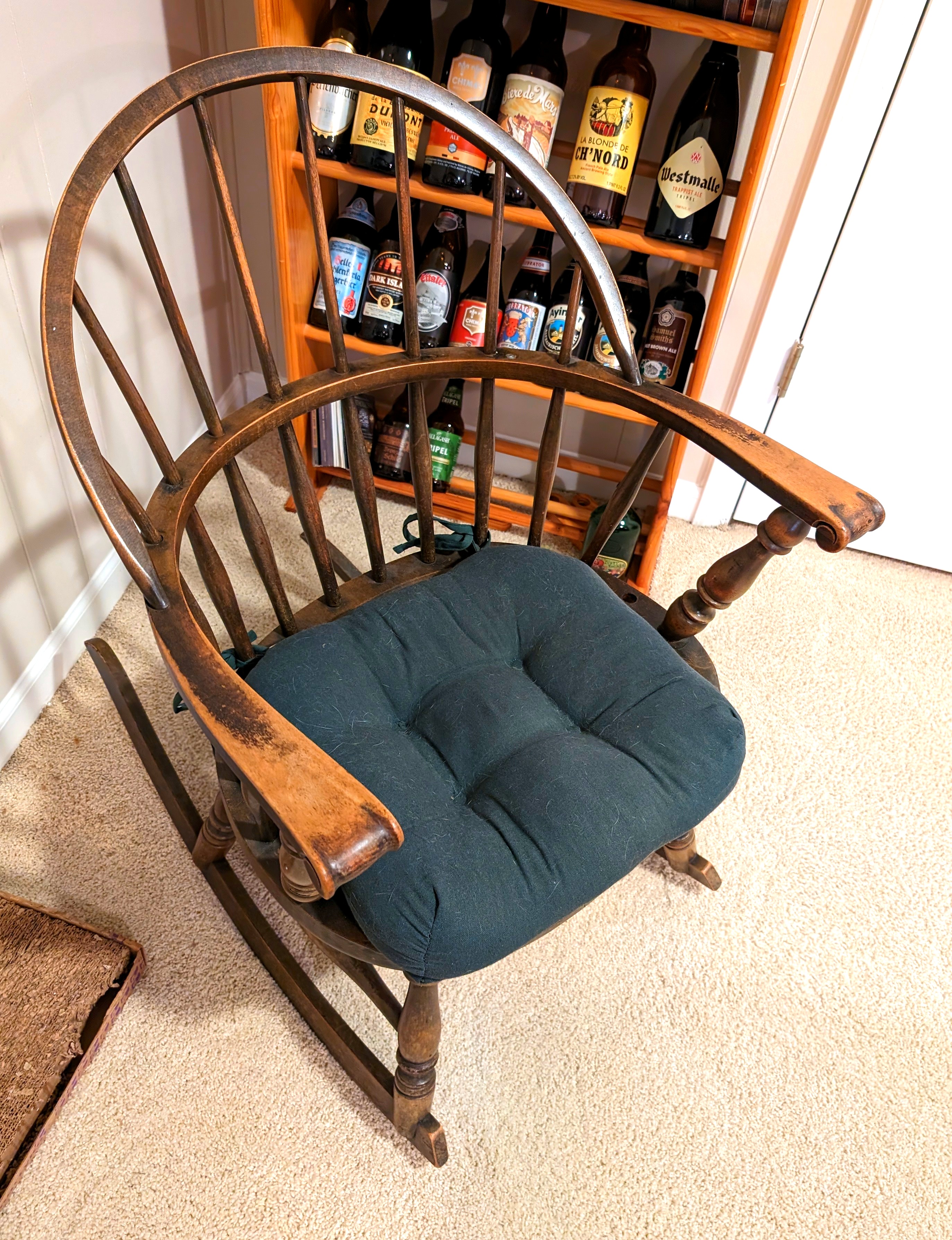
Some chairs entered my life at times indeterminate. I can tell you where they’re from, but not when and how they came to me, or at best guess at it. The cherrywood rocker which my mother’s mother sat in the corner of her bedroom to match the shockingly gorgeous cherry bedroom set. Every morning I too sit on this to dress, just as my grandmother did about 100 years ago.
A truly beautiful piece of functional furniture. February 2024.
Then again there’s the wooden rocker with a caned seat which I used to sit on to dress myself until the caning gave way one day, and I thought I would go through it to the floor. My father’s father sat in this chair in his study while taking a break from his duties as a Baptist minister. I remember the beautiful rolltop oak desk he would work at. Sometimes he needed a break. He would move to this rocker, sitting in an opposite corner near the window of his study which looked out to the next-door church. I can see him rub then rest his eyes from all the reading he had done.
So beautiful. Now it sits beside my wife’s side of the bed, perpetually encumbered by clothes. But I know it’s there. February 2024.
When my father’s father died, and his mother entered a nursing home, I inherited another rocker and its matching straight-legged chair, a captain’s chair style. I wish I could remember their position in their household. These two must have had either sentimental or practical value for my grandparents to have moved them from a large Victorian three-bedroom house to a small two-bedroom home in a retirement community. The rocker is missing one of the dowels between the seat and the arms. My father’s brother got his leg stuck between two dowels and my panicking grandmother insisted to her husband that they break out one dowel to free him.
The true Captain’s chair. February 2024.The matching chair. Note how all of these old chairs have lost the finish on the arms, due to loving wear. February 2024.
Despite my love for this older furniture, it has only graced our main rooms by necessity. Early in our marriage (the second, lasting one) we purchased a Broyhill recliner which echoed the wing-backed design of these older chairs complete with a brocade upholstery. It also complemented our older, inherited chairs. Unfortunately, only a few years after we did, we invited a streetwise cat into our house whose scratching habits proceeded to turn it into a tasseled mockery of itself. It sits in the rec room now, with the other rejects who form the viewing area for our ‘home theater’. (It’s not really a home theater; it’s two chairs and a love seat, all of which recline and are positioned as optimally as possible to a large TV with a surround speaker system. We invited the other chair in the ensemble into our living room in 2009, and sent it to the basement in 2017.) I’m thinking we should reupholster it and return it to its rightful place in our living room.
Early relegation to our basement (or worse) seems to be the norm for modern furniture. I would tell you of the two loveseats which have been purchased and abandoned in that time, falling out of favor and usefulness just as the one now in our basement, and I could detail the two sofas we purchased in 2006 and 2013, the former being replaced by the latter, the latter going “to a deserving home” in 2020. But we’re talking of chairs. We started 2020 with a fixation on chairs. We purchased four chairs which looked decent, solid, and worthy of the prices we paid. Two of them replaced two of the inherited chairs detailed above. Two motorized recliners replaced the sofa. Now, barely more than four years old, the two recliners have entered middle age, declaring themselves for the James Dean life with the exception they’ve never lived fast nor will they leave a beautiful corpse. They’ve become more uncomfortable to me as I deal with lower back issues. Luckily the two side chairs have been making their case for sticking around more than a few years. They simplistically mimic the older inherited chairs, causing me to wonder: why I don’t seek out chairs like that?
Before ending this, office chairs should be mentioned. Though often unremarkable, they offer a unique feature: they almost always have wheels. On top of industrial-grade, quarter-inch-thick carpet, these babies provide transportation to those unwilling to stand simply to walk 10-20 feet to a neighbor’s cubicle. (And that one time my four-person team found ourselves housed in a former microbiological incubation room with hard, sealed floors? One of eight such rooms on a hallway with the same flooring? Do you know how far you can push a well-lubricated chair on such floors? Not if you haven’t tried it!) Once, though, I purchased an old office chair my employer had slated for disposal. Although the calendar said 1997, this chair hailed from the 1950’s. Completely upholstered with wood accent on the arms, this chair would swivel and tilt just like modern chairs–but with no ability to make adjustments. Yes, it had wheels. And from that year until 2006 (I think) it served me well as my computer desk chair.
Ultimately we think of office furniture similarly to most of our then co-workers: there have been many but we remember only a few. Not so our heirloom chairs. Not so the chairs of our childhood, from the plastic-sheathed kitchen chairs to the kitchen stools to the weird plastic furniture used on our parents’ patios. Not so the chairs which graced our first apartments, entering the doorway by whatever means necessary, whether begging, stealing, inheriting, or in our last-ditch efforts, purchasing. Not so where we sat when visiting our grandparents, our uncles/aunts/cousins, or even our friends in college when a Naugahyde sack full of styrofoam could be called “a bean-bag chair”.
When I look at this cycle, I see that my parents’ chairs came and went, my chairs in school could at best be called functional, my chairs in early adulthood had value only because they were there, my chairs throughout my life have primarily existed only until I could replace them–but the chairs I inherited from my grandparents, the ones constructed in the 1920’s, the 1930’s, the 1940’s, have outlasted all of the others and, like the British monarchy, say, “yet, I’m still here!”
A plant’s leaf. In North Carolina. At Biltmore. May 2007.
Today’s photograph has about nothing to do with today’s topic, but I’ll try: some folks think (or rather don’t think) about how some things don’t belong together in all cases. Red and green for instance. On this plant it’s a natural thing. At Christmas it evokes the symbolism of holly and green leaves and all that. In July it says, “Who’s this freak that thinks it’s Christmas?” Today we’re going to talk about people putting words together which don’t belong together.
For newcomers to this blog: Once upon a time I taught English to 8th graders. Once upon a time I took a graduate-level course in grammar, most of which consisted of diagramming sentences. I killed that class–most of my fellow students were returning teachers who clustered around me after the final to learn how I had diagrammed the sentences on the test, even though these were sentences which we’d already diagrammed in homework assignments. I’m not bragging, merely establishing my credentials for the next paragraph.
There’s a grammatical distance between “on to” and “onto”. The latter one is a preposition. The first one, however, is an adverb followed by a preposition. Or some would say it’s a compound preposition. I disagree, but it’s debatable. What’s not debatable is when you put them together as if they’re one word but they shouldn’t be. Here:
Ken wants to turn his audience on to prepositions.
The turtle hauled himself onto the log.
“Onto” indicates position. In the first sentence you can see I am not trying to physically turn my audience and put them “onto” a preposition. Children, pets, and occasionally a frisky adult will get onto the furniture. A lace hem might be sewn onto a dress.
Prepositional phrases usually come in a three-word format of preposition-article-object/noun, and they’re often strung together one after the other. Here’s one: Susan got out of the bed, put her pajamas in the clothes hamper, and made her way to the shower. I boldfaced the prepositions. (If you’re really into the stuff, that’s a compound predicate where the subject “Susan” has three verbs to go with it, “got”, “put”, and “made”. It has direct objects, “pajamas” for the first verb phrase and “way” for the third. This looks really cool when you diagram it, but let’s hold that thought for now.)
Why am I doing this? Who gives a rodent’s rear? Here’s the deal: I see at least one writer who doesn’t know how to use prepositions, homophones, or those tricky complement/compliment words every morning when I read my news. I read (in this sequence) MLB.com to see if there are Phillies stories; The Athletic for Phillies stories and general baseball news; the Washington Post, primarily for the comics, but some headline always snags my attention; and the New York Times. All of these sites command highly respected writers. One assumes there are editors, at least a few. How is it something as basic as this can’t be understood by some of the top writers in the country? To wit:
She turned her father into the police. Perhaps she did, but only in her mind (parents behaving like cops sometimes). Dad never joined the force, though, and she has no magic wand to turn him into the police. She turned him in. To the police. See? Separate words.
Note to grammarians: yeah, I know this isn’t grammar. It’s not even usage. It’s mechanics and those are a slippery thing. Fifty years from now what I’m saying will be as anachronistic as railing against tomorrow because it’s supposed to be to-morrow indicating the link to its linguistic past, to the morrow. I don’t care. I will hasten e-mail by typing email wherever I can, which I did in the 1990s and 2000s. I will type awhile even when the algorithms in the software says “no-o-o-o!” I’ll even type alright because I think it’s alright. (And I wonder if anyone under 50 or 60 wonders what the heck I’m talking about.)
I will not give in to compound prepositions. (See what I did there?) There is meaning contained in the words the heathen are stringing together, and those meanings change when you join the two into one. I hope you’re turned into frogs. Or is it turned in, to frogs? I hope the latter, and that said frogs will thwwpt! your face with their tongues for eternity.
Look, I’m all about breaking rules. You need to know the rules before you can break them, though. Picasso said that, more or less. If you just ignore the fact rules exist, you’re just a hellion-without-a-clue.
And now for that diagramming I promised. I’m afraid that nearly 42 years later I have not kept every assignment but I kept the quizzes and the final. Below is the last page of the final. It’s a ditto, so the questions are faded quite a bit. (“Ditto”–look it up. They were as much fun to make as it was typing on a manual typewriter: every mistake basically was uncorrectable.) We can discuss this below in the comments. The little blue zero means no mistakes. Grant Smith, the chair of the department and teacher of the course (Eastern Washington University) graded this stuff like golf is scored: mistakes were 0.5, 1.0, and 1.5 point mistakes, and the more you got, the lower your grade. Thus, the highest score possible was “0”. (And another day, children, we’ll discuss why I put the period outside of the quotation marks. You may background yourselves by reading William Safire.) By the way, at 28 years of age I already exhibited the anal qualities which now circumscribe my life. Those lines look nice and straight because I used a 6-inch ruler on all of my assignments and on my quizzes and tests.
I took my tumble into poetry when I returned to college in 1981 for an English Education degree after four years spent writing and editing weekly newspapers. We were required to pick one of three concentrations: Literature, Composition, or Linguistics. While we were expected to take classes in all three areas, the majority of our coursework would occur in the concentration we chose for our major. I already possessed a degree in Communications (with a concentration in Journalism), so I chose Literature. It seemed to be the most useful choice between that and Linguistics. I don’t recall how many courses in poetry I took; I presume it was two plus I had a class in Shakespeare. (As part of my Communications degree I also had taken a course in Medieval Literature which is as much poem as prose, in my opinion.)
I remember my poetry professor as a grandfatherly figure: white hair, thick glasses, dressed always in a button-down shirt and a thin cardigan sweater. He wasn’t pedantic; rather he sought to lure us in to the beauty of poetry, slowly instilling an appreciation for the nuances which one poem achieves perhaps a bit better than another. He taught the meaning of the word “scansion” and how to do it. He taught us the formal structures of historic poetic forms, such as the various forms of sonnets. I distinctly remember he appreciated but ultimately relegated to B-status the poems of Henry Reed (“Lessons of the War: I: Naming of Parts“) and A. E. Housman (“Terence, This is Stupid Stuff“). He attempted to relate a continuum where doggerel existed on one end and truly sublime, great poetry existed on the other. “There is a difference between verse and poetry,” he insisted.
A while back I wrote a poem about why I don’t often write rhymed poems. Too many of the poems I read online from those who fancy themselves poets barely nudge the needle from where it pegs at “doggerel”. It’s down here at this end of the spectrum where we read “cowboy poems” and such. Rhymed poetry doesn’t have to be doggerel or its cousin, trite whimsy. I hope my poem might exist in the middle ground, somewhere between a clerihew and Housman’s “Terence”. Here’s the beginning of the latter:
"Terence, this is stupid stuff:
You eat your victuals fast enough;
There can't be much amiss, 'tis clear,
To see the rate you drink your beer.
My barely informed opinion about rhymed poetry? Look to Shakespeare who crafted his poems to specific rhyme schemes, with specific metric schemes which must scan appropriately. Another, more modern poet who understood how to write a poem which rhymed is Robert Frost. Here’s an example, to be discussed below:
Locked Out
(As Told to a Child)

When we locked up the house at night,
We always locked the flowers outside
And cut them off from window light.
The time I dreamed the door was tried
and brushed with buttons upon sleeves,
The flowers were out there with the thieves.
Yet nobody molested them!
We did find one nasturtium
Upon the steps with bitten stem.
I may have been to blame for that:
I always thought it must have been
Some flower I played with as I sat
At dusk to watch the moon down early.

(as transcribed from Robert Frost: Collected Poems, Prose, & Plays [The Library of America])
Is this a great poem? No, but Frost tells a small tale easily, conversationally, with rhymed words. He warns us in a sense by titling it “as told to a child” and keeps the central thoughts of the poem simple. And what’s this? He chooses not to rhyme the very last line? Doesn’t that just punch it up all the more? Great poets reveal their hand even when the poem isn’t truly great. Looking deeper, I’m reminded how just as adults get nuances out of ‘children’s cartoons’, we gather meaning in passing from lines like the first three lines. A child would take it simplistically, but we consider the symbolism of locking up all that is natural outside of ourselves, of shutting ourselves off from beauty, of starving the fair flowers of our existence from the light of our presence. Frost uses the tenth line (“I may have been to blame for that”) to zing us with a perfect iambic (dah-DAH) tetrameter (four of ’em). To my mind, it hurries us through the line as if the narrator feels a bit guilty that his inadvertent playing with a flower has been used to invoke a threat of thieves to a small child.
Those are just a few thoughts which occur to me in looking at this poem again after first reading it about a week ago. Look, I understand we’re not all four-time Pulitzer Prize winners. But can’t we at least try? Must we succumb to “My boyfriend left me/I’m feeling blue/I’ll leave the country/Now that we’re through”? Just as a prose thought can be made meaningful by converting it to poetry, consider if your poem isn’t so mundane it ought to be simply stated as prose. Making four lines rhyme A/B/A/B shows about as much skill as photographing a sunset and thinking you’re a great photographer just because you captured a glorious sight made-to-order.
I applaud the poets I read online who use blank, free-form verse yet hew to ideas of tune, rhythm, compression, precise word choice, and who frankly have something worthy to say. We can’t realistically dream we’re rhymers like Frost, or poets laureate like Stanley Kunitz, or poets-for-the-ages like Dante Alighieri. But…we can try.
Five days after a funeral. Lake Lynn, 07 November 2019.
Warnings & Notes: This post contains a few graphic depictions of death, some examples of socially unacceptable behavior, and is just generally a downer if you look at it a certain way. Also, some of these observations have been made before. If you read this blog regularly (there’s only a half dozen or so of you), well, sorry….a little.
This year All Souls Day, November 2nd, marked the fourth anniversary of my mother’s funeral. It’s the day I most think back upon her life and death. The anniversary of her death, October 24, I barely note. Sometimes it even slips by me before I realize it. The funeral symbolizes my mother’s love, her life, and all those influences we spend a lifetime unraveling. In contrast, the date of her death represents thoughts I acknowledge but do not celebrate, and her passing is hardly something to celebrate in and of itself. I would rather focus on the entirety of her life and death: the funeral marked that, not the death.
My mother and I lived more than 2100 miles apart at that point. My profession had taken me to the eastern United States; she remained in Spokane, WA, from where she had encouraged me to follow my dreams wherever they led. Her parents had, my father’s parents had, they had themselves, so why shouldn’t their children? Still, it didn’t reduce my guilt much for not being more available to her in that last year, indeed that span of a half dozen years when she lived on after my father’s death. My brother lived nearly ten times closer in Tacoma but it took me only a few more hours to get there by plane versus him taking a drive across the state. He encouraged her to move to Tacoma. I half-heartedly supported him. She refused, saying her friends and neighbors were in Spokane. I strongly pushed that she could move to a “retirement community” there in Spokane where some of her friends lived. She demurred, then refused. Her best support network were the good neighbors she had. She was right. We were wrong. I saw one of those retirement homes at the end of her life. I was really wrong, and–
But I’m not going to rehash that whole period. I’ll just note this: I watched her steadily decline during the five years after my father died, visiting her more and more frequently. (The Fates blessed me in several ways when 13 months after my father died, I started traveling the country for work. It became just as easy to fly to Spokane as to Raleigh.) In December 2018 my mother learned she had Stage IV breast cancer. At 89 years, she recoiled from and declined chemotherapy, threw her lot in with hormone receptor treatment (a pill, nothing more), and for various reasons was in and out of hospitals, convalescent homes, and her new apartment in a “retirement community” through the fall of 2019. She celebrated her 90th birthday in that apartment.
I visited my mother a dozen days into October 2019 as she lived her final days. I returned home only to receive The Call two days later. It was a Thursday. Knowing my brother could drive there quickly, and emotionally exhausted from watching her exist in a morphine-induced stupor, I rolled the dice, told him I wouldn’t come until Monday, and I let him spend Friday through Sunday with her. I flew back on that Monday, and sat beside her bed a lot until she passed away on Thursday. My brother had returned to his home and job. Thus it fell to me to handle the first round of details.
From the moment a loved one dies, those closest to them experience a bewildering whirlwind of details thrust upon them which must be handled immediately. As the elder of two children, the most controlling of us, and frankly, just because I was the one there, it fell to me to make those arrangements. Again, I shall refrain from a step by step accounting of it. This is supposed to be an accounting of All Souls and a celebration, not a macabre dwelling on those days of death. One example shall suffice: on Thursday morning, the day she died officially at 10:22 a.m., I had to leave her to be at the bank when it opened at 9 a.m. The instruction manual entitled “What You Will Have To Do When Your Second Parent Dies” never made it into my mailbox, I guess. If it had, maybe I would have been better prepared than to learn in her final hours that her investment accounts would be frozen for disbursement when she died, and that as her executor I would be paying bills with whatever sat in that bank account for the foreseeable future. The bank account had less than $3200 in it when I dumped a huge amount in there. Take note if you’re ever in this position: for the next year, I had to pay bills from that account. If I hadn’t done that, my brother and I would have had to agree on splitting the bills. Really, take note.
My mother’s death came as a relief. I’m saddened to admit her death came as a relief. I know many have said this, but I feel as I feel. She had suffered with increasing pain from the breast cancer for a year. I doubt anything can prepare you to listen to your mother slowly drown and die, to realize the fluidic sounds of her breathing come from her lungs as they slowly fill, to watch from a removed perspective as your voice sharply criticizes the health staff which insists on turning a patient even when this obviously makes the breathing worse. Beyond prayer, I simply endured. I carry with me that immense relief I felt when I re-entered her room after a short phone call from her cousin and discovered my mother had died. I also carry with me the commensurate load of guilt for not being there at that moment. The part of me formed by social mores scolds me perpetually; the accepting, independent side of me simply says, “that’s the way it happened. There’s nothing which could have been done at the time, and there’s no shame in feeling relief.”
In contrast to the anniversary of her death, which represents a smorgasbord of feelings, few of them good, even fewer comforting, the anniversary of the funeral represents a day of love. It’s the day remaining friends and family gathered to mark how much they loved your mother and how much they would miss her. It’s the day you created all the little remembrances which would afterward become powerful symbols in your life. It’s the day you got to reminisce about all the times: mostly good, some bad, some funny, some sad. It’s the day when many told you “You did a good job by your mother,” even if they were lying a little bit. And it’s the day you closed the door, for just a bit, on all of those things which just have to be done. It’s the day when you looked forward to a few days where nothing about your mother’s funeral and estate needed to be accomplished: those things would wait a few days–with luck, a few weeks.
Each All Souls Day since that time refreshes all these memories. It’s the stem that gathers all the roots of remembrance and supports the branches of What Has Come To Be. For me, it’s inextricably bound up with my decision two weeks after her funeral to retire. Those twin events, her passing and my retirement, have become tied to those crazy years when a pandemic changed our society, or perhaps, when it revealed who we had come to be. All Souls Day, which exists quietly in the immediate shadow of its more important sibling, All Saints Day, and is heralded by All Hallows’ E’en, tells us it’s important to mark the passing of those we loved and to pray for them, to remember them, to honor them. By its existence, it says to ignore the ones who have been declared important, and that we must instead recognize the importance of each of us.
Mostly, though, All Souls Day reminds all of us of the death of those we loved. It picks at the scab of a wound which will not scar over and which has become part of who we are.
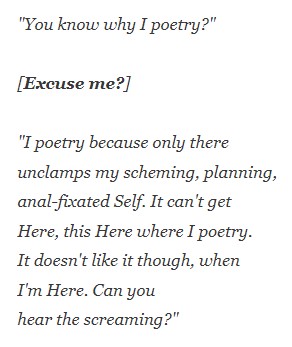
what my latest poem looks like on my desktop computer monitor. October 2023.
Something perhaps has changed with WordPress. I’ve been irritated to see that choosing the “Verse” setting for a block, which I thought yielded the above, doesn’t even come close on some devices. Here’s what my friend received in his email:
what my poem looks like on an Android phone, as delivered in a Gmail message. October 2023.
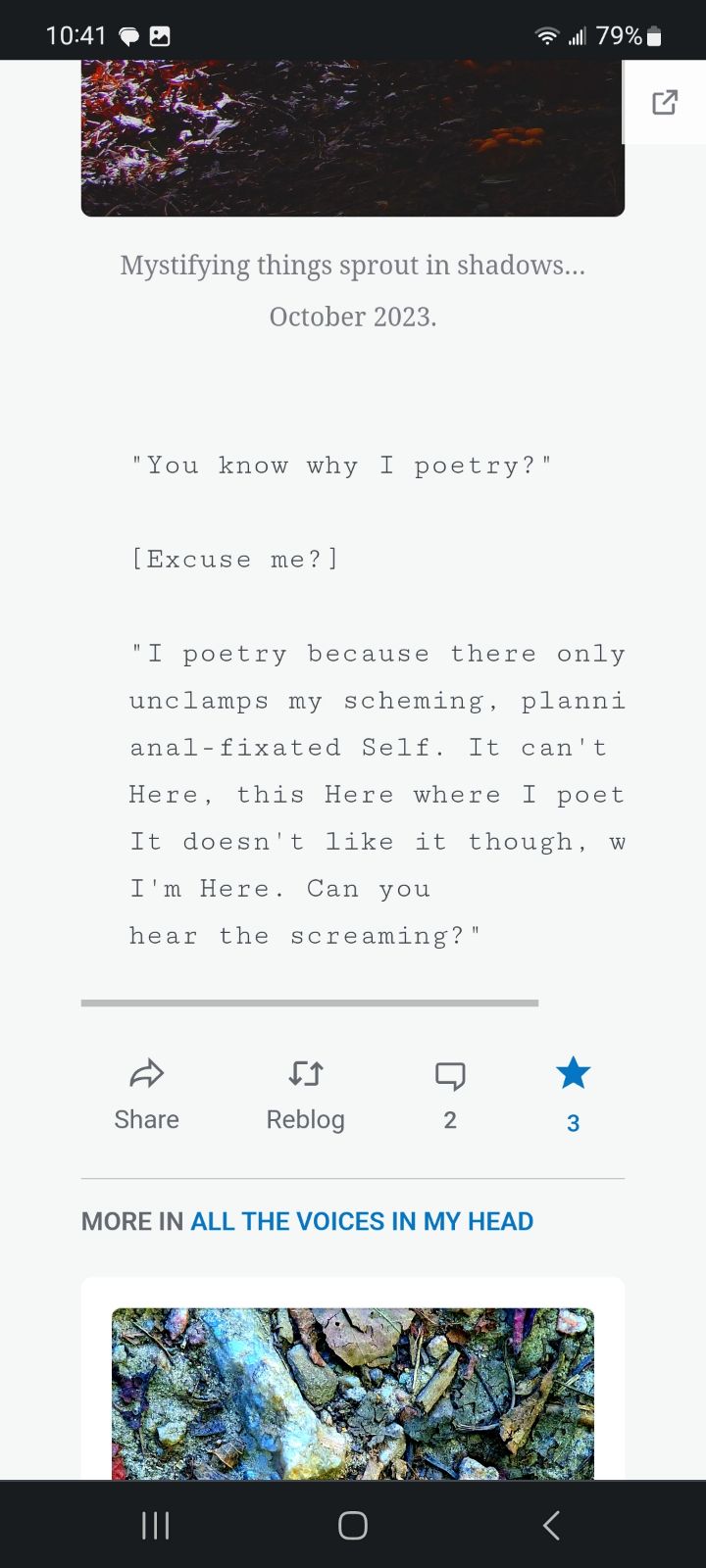
I knew that WordPress converted poetry to a monospaced font, rather liked it actually, because I follow a couple of poetry blogs which deliver the entire poem to my inbox. I’m pretty sure in the past that I saw the same thing on the WordPress website when I used my phone. Ah, but now there is Jetpack, newly changed for the…better? This is what appears on my actual blog when using an Android phone:
What my poem looks like on an Android phone using WordPress/Jetpack. October 2023.
That’s not “verse,” WordPress, nor is it “poem.” That is called “paragraph” and “prose” and perhaps “simplistic crap” unless one makes a living as a stream-of-consciousness author, and even then one must establish a certain cadence and structure to ‘musically’ signal to the Reader that yes, this is something beyond prose. (Unless one is James Joyce, then nevermind.)
Canadian philosopher and communications theory god Marshall McLuhan invented the phrase “the medium in the message”. I’ve perverted what this means. He meant that content doesn’t really matter, that a children’s cartoon or a vicious slasher movie is all the same when broadcast identically on television. To me he meant the message of any communication effort takes its ultimate meaning from the medium by which it is delivered. Spoken words in a living room conversation take on new meanings when sung in a concert hall. More familiarly, books turned into movies tell a different story and cannot help do otherwise. Even if Peter Jackson had managed to control every reference in his Lord of the Rings movies, visual, aural, or what-have-you, the story still would have been just as vastly different than the books as they turned out to be.
For these reasons, it’s deeply unsettling to oldsters such as me to watch the different devices reformat and repackage the content of what purportedly is the same thing. I see this nearly every day as I follow Major League Baseball. MLB.com presents a side-by-side box score for both teams, but on the phone you must select one team or the other–never can you present them at the same time on your phone’s screen. Baseball-Reference.com displays a wonderfully useful tool when looking at any particular season for a baseball team: a histogram of green and red bars which tell the tale of the entire season, game by game, read left to right. Mouse over any bar and it tells you the date of that particular game, who this team played (and where), and what the score was. It also shows what the team’s Won-Lost record was when the game finished. On a mobile device (tablet or phone) this histogram tool disappears. It makes me wonder if certain features of a website are completely unknown to a majority of the younglings who stare into their phones for 90% of the time they’re awake.
Thus, we come back to my dilemma/consternation and the question posed in the headline. Have I delivered a poem at all when it looks like a short paragraph raising an offhand question? Does the trivialization effected by the mobile presentation indicate my poem lacked substance and can only stake a claim to poetry because of its window-dressed arrangement? (Believe me, I’ve thought some unkind thoughts about other’s postings which, if returned to a more prose-like arrangement, look like the musings of a teenager in a diary. Am I just as shallow?) Did McLuhan not go far enough? Does the message ultimately get defined by how the technology delivers it, even when it lives simultaneously in different media formats?
A light bulb creates an environment by its mere presence.
Marshall McLuhan from Understanding Media (as quoted in Wikipedia)
Ultimately I think McLuhan would argue each device configuration represents a medium. But I never signed up for this, WordPress! My understanding of the matter was this: you give me the tools to put my message together, and I pay for it by giving you ultimate ownership of my content (which I cannot believe I did, but there ya go). I expected a bit more, though. I expected a very nuanced difference to my content. Sure, I’ll accept McLuhan’s theory that those who read my stuff on a phone get a different message than those who read it on a big desktop monitor, but I would prefer to be left out of the “definition changing” part of the equation. You’ve made me a partner to it by changing my content not just the medium.
Which leaves me little closer to answering my question but has given me an excellent opportunity to rely on that first college degree and to prove yet again that old age clothes old men in curmudgeonly behaviors as surely as dogs become grizzled and oaks gnarled.
This month LibraryThing provoked me with its monthly newsletter. It contained a link to an ongoing discussion topic (months-long): “What is the most disturbing book you’ve ever read?” (If like me, you find library cataloging software and sites lacking, you might want to look at LibraryThing which offers a version for running small libraries. For a control freak like myself, who also needs much more data than a site like Goodreads can provide, this has been a godsend.)
When I read that question, I immediately thought of One Day of Life by Manlio Argueta. I read this book in the first half of my 30’s; it came as part of a four-volume set of Latin America writers from Quality Paperback Books. I enjoyed them, great works all: 100 Years of Solitude by Gabriel García Márquez; Aunt Julia and the Scriptwriter by Mario Vargas Llosa; Dora, Doralina by Rachel de Queiroz. But the fourth one, One Day of Life by Argueta haunted me then and haunts me whenever I think about it, and that’s more often than you would think despite its detailing the lead up to the El Salvador Civil War in the 1980’s and despite the fact I never re-read it.
The book’s matter-of-fact, simple prose details horrors the same way any war-zone child would. It just happens. It is what has happened. It is their life. Though it covers a single “day of life”, the flashbacks offer more detail, all of it disturbing. This was the time of the death squads where people were tortured and executed at the hands of faceless men.
[SPOILER COMING UP]
Though I haven’t read the book since the mid-1980’s, it’s seared into my brain. All I had to do was read this synopsis of the end of the novel, about the central character, Guadalupe Guardado and the novel came back to life. Guardado’s granddaughter, involved in the protests of the time, is Adolfina:
At the end of the novel, the authorities bring a beaten man to Guadalupe and Adolfina who had said the name “Adolfina” after being severely beaten. Adolfina does not recognize the man, but Guadalupe recognizes her husband José. On his previous advice, she denies knowing him, and he is taken away.
Wikipedia entry “One Day of Life”
There’s a horrific beauty contained in vessels such as this which exquisitely contain the pain, the despair, the sadness, the very twisted ways of life which the mainstream hopes to avoid. Argueta’s novel reminds me of another version of the same thing, a song by Rubén Blades, “In Salvador” on the album Nothing But the Truth released in 1988. (I’m unable to find a YouTube video of the song although you can watch a “complete album” video of the album. It’s the 7th song.) Although Lou Reed, Elvis Costello, and Sting contributed songwriting efforts to this album (Blades’ first in English), this song is not one of those. Critics have knocked the fact that Blades sings with an over-enunciated English but to me, it makes the album more honest. We’re hearing his description of what life is still like in El Salvador, and we’re hearing someone from Central America (Blades is Panamanian) speak to us. We wouldn’t expect to hear someone speak fluid English when it’s a second language. The refrain:
“No one can protect your life in Salvador. Judges that condemn you have no name. Could it be the gentleman who lives next door? Or the guy who goes with you to work?
transcribed from the album Nothing But The Truth
There are several other disturbing songs on the album in varying degrees. “The Hit” describes how a young Hispanic male violates the main law of the street that “you don’t double-cross the ones you love”. He’s gunned down. “Letters to the Vatican” describes a woman who’s lost a good chunk of her mind, but finds support in the bar scene where the patrons remember how she was “before she got this way”. In “Ollie’s Doo Wop” Blades sings about the cultivated ignorance of Ronald Reagan to Ollie North’s nefarious doings. I get a very personal meaning from “Hope’s On Hold” where Blades sings of all the things that inhibit falling in love, which leads to “hope’s on hold”.
If we go into the beauty of ugliness, of disturbance, I would offer up Lou Reed’s Berlin which has a semi-rock opera construction. It’s about speed freaks living in Berlin. You can imagine the seaminess of it.
Raw emotions of any type remain more true to me than than the equivocal nature of living in polite society. For this reason, I rarely tell anyone, even my wife, what is going on inside my head. As a creative, we entertain the un-entertainable, the unappreciated, the unapproved. We shed the mundane memories which frankly hamper our movement in polite society. We accept all, winnow it, and feed it back to our world, hoping that if we do it in a meaningful manner, it will illuminate rather than obscure.
Read Argueta’s book. It remains pertinent because the horror merely moved to different countries. It’s the same visceral, hateful viciousness which fuels America’s cultural and political battles. It blossoms in central Africa, in Singapore, in India, in the Europe. It sustains all ideologues on right and left.
Or if you need the short course: listen to Rubén Blades’s song.
Fog at the mouth of the Columbia River sets a standard for fog. Fog defines where Oregon and Washington share its outlet to the Pacific. It also defined my nascent and up-to-then non-existent career as I drove to Ilwaco, WA, and my second job interview of that early weekend in December 1977.
Car-less at that point of my life, my folks loaned me a 1968 Ford Galaxie 500. Though only nine years old, one could see already why it had been handed down. I piloted this coffin on wheels toward the southwestern tip of Washington through a typically drizzly early winter day in the western part of the state. “Man, talk about wet!” I muttered. At the same time I thought this, I drove my 1968 Ford Galaxie 500 into a fog bank. Until that point of my life–all 23 years of it–I don’t think I had ever realized what the phrase “bank of fog” meant. Within 100 yards I drove from a gray, drizzly day into a shroud of bright nothingness. I could barely make out the highway signs along the shoulder of the road.
How had I gotten here?
Simple. In mid-December 1977 I found myself in imminent need of a job. The University of Washington School of Communications planned to foist me on society with a degree. I had trained, in a mediocre fashion, for a job as a reporter. I realized I wouldn’t get any top-tier jobs at the dailies of Washington State, Idaho, Oregon, and I wasn’t plugged into destinations further away. (No Internet, no networking skills, no time spent learning about how to get jobs pretty much anywhere.) The state association of independent weekly newspaper publishers had to do. For one thing, the association headquartered itself in Seattle just a couple miles from the University campus. I figured, correctly as it turned out, they would be desperate (in a relative sense). Our corner of the US hadn’t experienced the stagflation of the Carter Administration, and talented graduates don’t seek jobs with weekly newspapers. Neither do most graduates want to head to the hinterlands to report about social teas, high school sports, and local city council meetings. It sounded easier, and I was all about easy, then and now.
Shortly after finishing my final final, I traveled to my parents’ home in Spokane. Once there, I gorged on home cooking, spoke to them as little as possible, and grabbed their old Ford for some serious job hunting.
My first stop that early December weekend was in Moses Lake, afairly strange place if you’re from outside of the state. To us it merely offered a respite in the cross-state drive. I met a married couple who owned and managed two newspapers. One was a weekly in Ritzville, WA, which is a small farming-oriented community at the northern edge of the Palouse wheatfields where it enjoys a location on the main east-west corridor through the state, I-90. They also published a paper in Cle Elum, but I do not remember if it was the Miner Echo or the Northern Kittitas County Tribune. I tend to think it was the former.
The owners were salt-of-the-earth, don’t-give-me-shit small business owners in a small community, a class of person I soon was to become deeply knowledgeable about. They didn’t make the job sound attractive. And they offered $125 a week. (Keep that figure in mind.) I told them I was interviewing elsewhere, and I would let them know. Notice they offered me a job on the spot. My alarm was sounding, but not loudly: I had kinda figured this wouldn’t be extremely difficult. A theme of my life to that point, and for a goodly part of my life from thereafter, was to flow into the path of least resistance.
This was a Saturday. I continued after the interview to drive westward, arriving at my dorm sometime in the late afternoon. (What a “thrill” to park a car in the student garage like all the kids that had more money than I did!) On Sunday I got myself up at a non-student, responsible hour, got in the car again, and headed to Ilwaco where an interview at the Chinook Observer awaited me.
My encounter with the fog bank said, “Welcome to Ilwaco.” It continued, growing more dense as I got into town. I found the office and parked outside. Upon knocking on the door, I was met by a pasty-complexioned man who owned the paper. He seemed ill at ease, hesitant, insecure. I immediately wondered how a man could own a weekly newspaper, the klaxon of any community, the polestar of community ire, and have a personality like this. We had a milquetoast interview and he offered me my second job in two days, also at $125/week. He seemed upset when I said I already had one offer on the table and another interview pending.
The Skykomish River near Monroe, WA, at dawn. There is a river there. And trees on the far bank. Almost as foggy as the mouth of the Columbia River near Ilwaco. Sometime in 1979 or 1980.
On Tuesday two days later I headed to Monroe, WA. Only 15 miles east of Everett and about 30 miles from my dorm in Seattle, Monroe was the gateway to the North Cascades via US Highway 2. Tuesdays, I learned later, was publication day which meant that the paper was being “put to bed” while I interviewed with the owner. I omit his name in case I say something which might get me in trouble.
This interview started out weird and stayed weird. The antithesis of the Ilwaco publisher faced me. He’d served as motorcycle courier in World War II in Europe, and he carried that hard-bitten attitude with him. He revered John Wayne. He kept Cutty Sark in his desk drawer. He ended the interview thusly: “So…I can start you at $150 per week. When can you start?” I trotted out my now-practiced “well-I-have-other-offers-on-the-table” speech and he said, “Well, call them and tell them you’ve accepted this position!” I was caught off guard. He asked, “Do you want this job or not?” I thought (quickly) about $25 more per week. He was offering $7800 per year. In 1977 more than 25% of Americans earned less than this. I was young. Earning less than the median American ($13,572) didn’t sound that awful. I would be working as a reporter. I told him yes, I would give those others a call. He said:
“We’ve got phones, I’ve got an extra office. You can call from there.”
So I wound up on a Tuesday in mid-December sitting in what was definitely not an office but more a glorified cube (and would soon become my cube), calling the other two publishers and telling them that I had accepted an offer elsewhere.
Because we were at this point looking at the issue which would come out right before Christmas, we agreed it would make the most sense for me to arrive right after Christmas and start work on Monday the 27th. I got in the old Ford Galaxie, drove to my dorm, cleaned it out, and drove to Spokane. I celebrated Christmas with my family, including my brother, home from a separate university in the state.
On Sunday the 26th I drove across the state for the fourth time that month, the old Galaxie towing a U-Haul trailer with all my possessions. I got to my mother’s childhood home in Seattle very late afternoon, when it was dark. There my grandparents bequeathed me a chair and some other odds and ends, some of which–like the chair–I own to this day, more than 40 years later. I pulled into the parking lot for the Monroe Motel later that evening, checked in, and reported to work the next morning.
Fog defines my entire job interviewing process and my newspaper work thereafter. I’d no idea what I really wanted to do other than write. I couldn’t discern which job sounded better until the last publisher just plain told me. I stumbled through my first year until I managed to trust that all those empty inches would somehow be filled by Deadline Day. Less than four years later I drifted into something else.