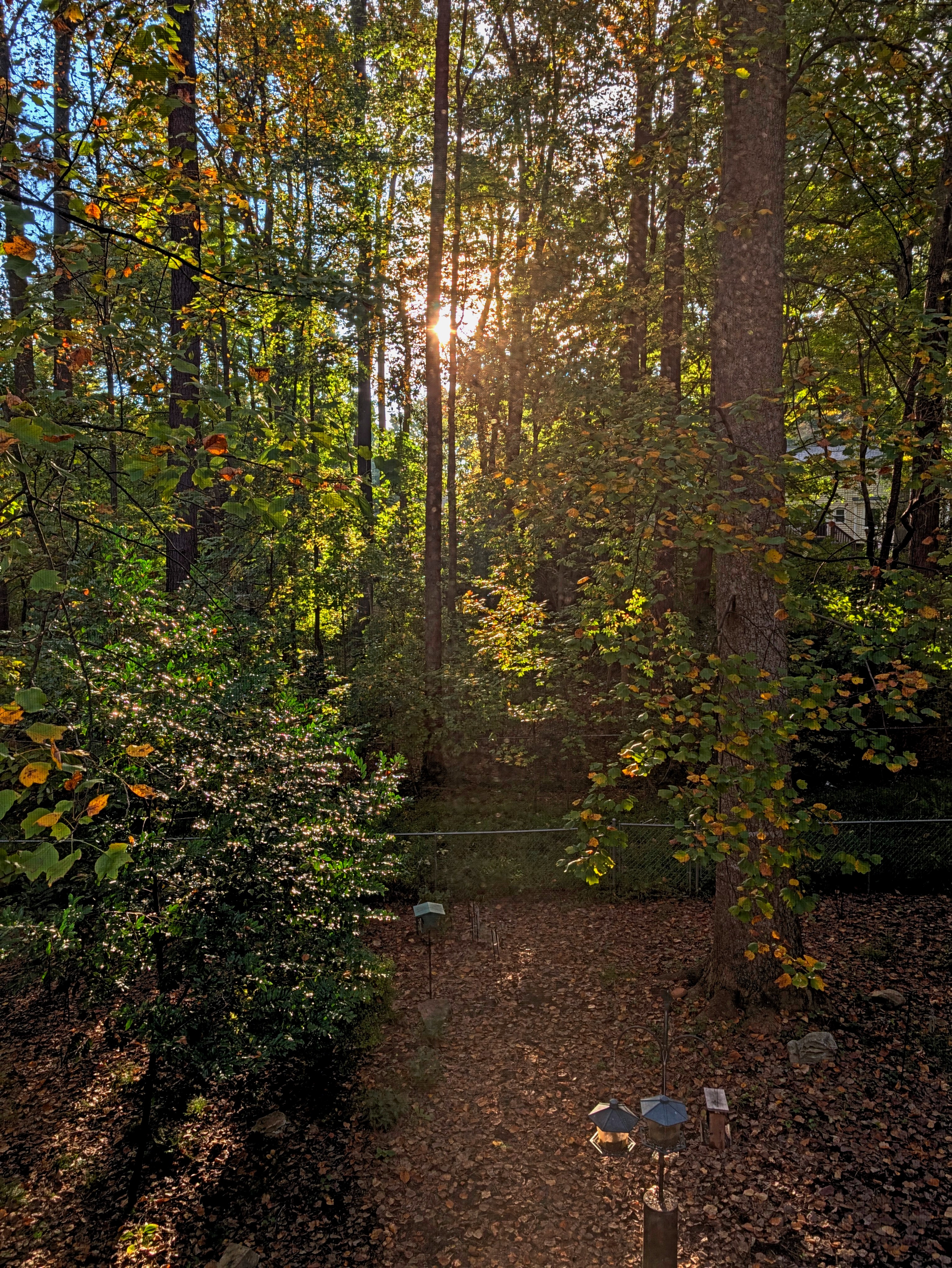
I always believe my house faces west and backs onto east, but it isn’t so. Therefore we arrive at this point where nearly a month after the equinox the sun shines directly into the house through the door to the deck—Thursday the 15th—and I realize we’re looking southeast, not east. It’s momentarily saddening, but how can one be sad when the day opens like this and fulfills its promise to deliver near-90° temperatures?
Yes, that’s a lot of dirt down there. Not very green is it? That’s actually what a natural forest looks like around here, more or less. This fall and next spring we’ll be filling it in with some more plants, but mostly this is it. Soon the yellowing leaves on the tulip poplars (one at the right in the photo) will carpet the ground. The Carolina cherry Laurel keep its leaves—it’s an evergreen.
I took myself outside to seek a dawn which did not come.
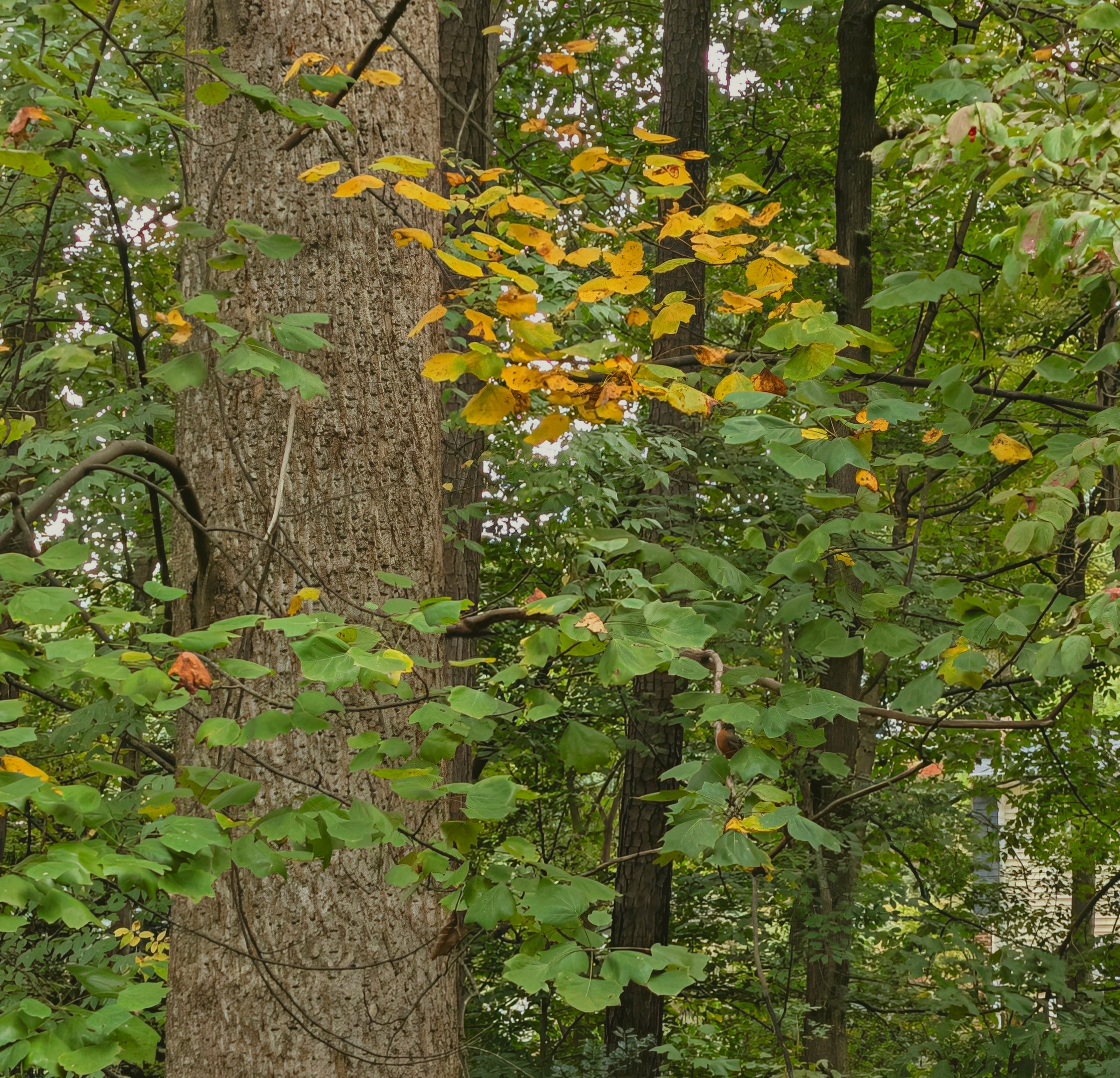
Tulip poplar. October 2026.
Cool, cooler than most mornings we've
had for the past five or more months.
Dawn's only evidence: white sky where
once night's charcoal glowed with city lights.
Occasional cool breezes stir the tulip poplar
leaves, make the yellow ones dance excitedly.
Acorns have started their rat-a-tat assault
on neighborhood roofs. Only ours seems
spared, which also seems impossible.
Cawing crows on the move signal some
kind of discontent. Who knows with crows?
Murky morning light half-reveals visitors
to bird feeders full once again with seed:
cardinals claim high perches; nuthatches
perform hit-and-run, exuberant, vocal.
Gray squirrels blend into the bland,
starting their day-long search for dropped
seeds and other treasures. In front, cars
swish by more frequently with each minute.
Dawn marks morning's commute these days.

Now Wren takes up his daily post on our
stairway, trilling his claims to the morning,
or perhaps just boasting. His simple song
gets answered by another wren who voices
"Where'dja eat? Where'dja eat? Where'dja eat?"
Scree-ing discontent or merely hunting, a
red-shouldered hawk cries from the top
of the tree canopy, scattering cardinals,
but not anyone else. A third wren joins his
friends with a shrill version of the cardinals'
soft sibilance, and rail-wren answers.
Overhead, one of man's attempts to
emulate birds whines, sounding as if
it will imminently be crashing.

Do you remember when you woke as
a child and the day held nothing but
possibilities? When all that mattered
was Now? When so little Past sat on
your shoulders, you couldn't feel it?
Fall jammed its foot
in our weather's door
today. Summer will
make peace with it
three days from now,
but we'll all be uneasy.
Perhaps Summer might
assert itself? Take over
October's start? Push
those eighties at us?
"Eighty is the new Ninety."
But Fall's persistent.
It knows its time has
come. One, two weeks,
no big deal. It can wait.
Regardless, trees will
shower leaves now, birds
will pack their bags, our
storms will turn cold.
How can sixty-some feel balmy,
nice, when Spring reminds
Winter it's time to leave? How?
Remember that while you're
resurfacing sweaters, wool,
long sleeves, rain gear, while
readying fireplaces, heaters,
thermostat settings, while
finding those recipes for
soup, stew, hearty breads.
While dreaming about when
these temps will be welcome.
Missing my old choir buddy who died last December. He always, always, stayed deeply involved in life. In his 80’s, having just beat his battle with cancer, he trained for our local crisis hotline and began counseling the suicidal and the abuse victim. Anyway, thought of him today in mass, and this poem began.
November 2025
Why his clarity, his ocular spark,
so near does death's shadow creep?
Others, with near-dead eyes, long
encumbered by that dark shadow,
seem to have surrendered. What?
Something. That spark, that signal,
that engagement. Oddly, we note
both say similar words: "I'm
ready to die. Take me, any time,"
but our engaged example
has said it all his life.
Our yard on the left, neighbor’s on the right. Photo is unretouched. January 2026.
Last October we paid to have our back yard replanted with plants native to North Carolina, the American Southeast, and the Atlantic seaboard. As in colder climes, the vast majority of native plants drop their leaves and enter dormancy for the colder winter months. We also “leave the leaves” which allows them to decompose into the soil as they should, creates cover for the little creatures to stay warm (and avoid hawks), and supports the lives of little bugs which in turn provide food for the ground-feeding birds. Thus, the predominant color of our back yard and our front yard is brown.
Our neighbor’s yard represents most yards around us. The green of English ivy covers the ground and the trunks of the trees. Saplings of non-natives take advantage of the warmer winter weather much as sunbirds head for Arizona or the coast of the Gulf of Mexico. Some keep their summer foliage—no need to drop leaves and protect a plant conditioned to far colder climes. It’s not that leaves fall only in our yard; there’s an oak or two and some poplars over there. It’s that the ivy manages to conceal somewhat the leaves in my neighbor’s yard.
In winter, therefore, brown is good, and green is at best questionable. (Before my southern readers chime in, yes, there are plenty of Southern evergreens, but not many around here consciously cover their yard with them.)
Our natives, once established, should have staying power also. It’s kind of defined by the word “native” is it not? I will need to wage constant war, though, on the ivy, the Virginia creeper, the japonica, and the various saplings which will inevitably attempt to broach the property line. It’s a battle I freely take up. For the time I live on this speck of the Earth, it will bring forth those plants which grew here naturally and nurtured the birds, mammals, insects, reptiles, and amphibians which depend on them for healthy populations.
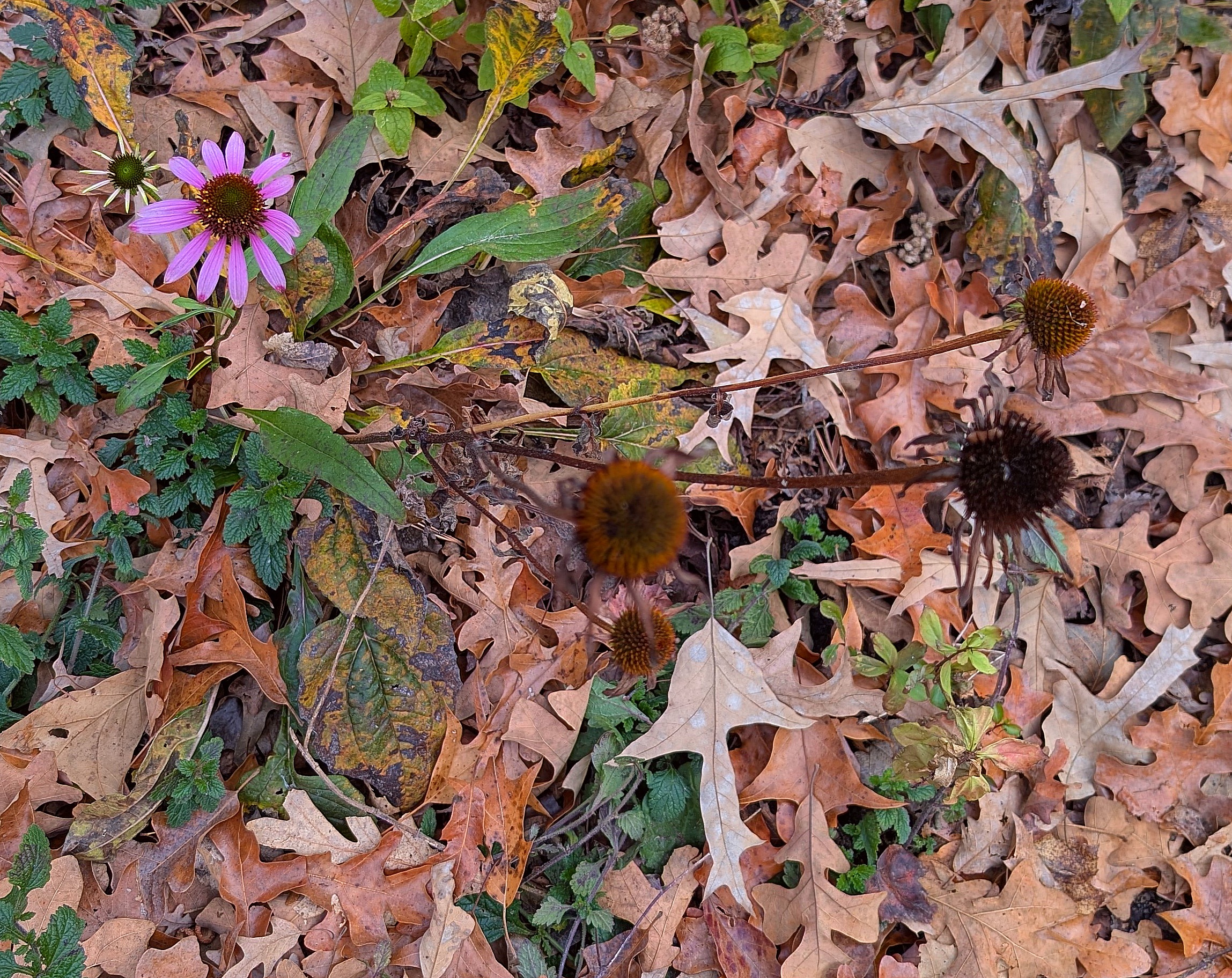
I seem to be on a leaf and garden kick. Though two short cold snaps have sent 99% of the plants into dormancy (unless they’re evergreen), a few brave stalwarts instead focus on the above-average warm weather to pop one last bloom out. November 3-9 ranged 65-75F with just a dash of rain the final two days. And then the 12th through 16th blessed us with sunny days of 64-73F. Look at these little troupers:
The blue mistflower who refused to die. All of its nearby compatriots are brown. Interestingly, the broad leaf or two at the top are from a purple coneflower, also still green. November 2025.Another purple coneflower with living on its mind. All of the originals have gone to see on the right, but no matter. Let’s make more! A nascent bloom can be seen to its immediate left (the little white spiky one). November 2025.Black-eyed Susan: you can see dead plant everywhere but it decided to come up again when the weather warranted. November 2025.
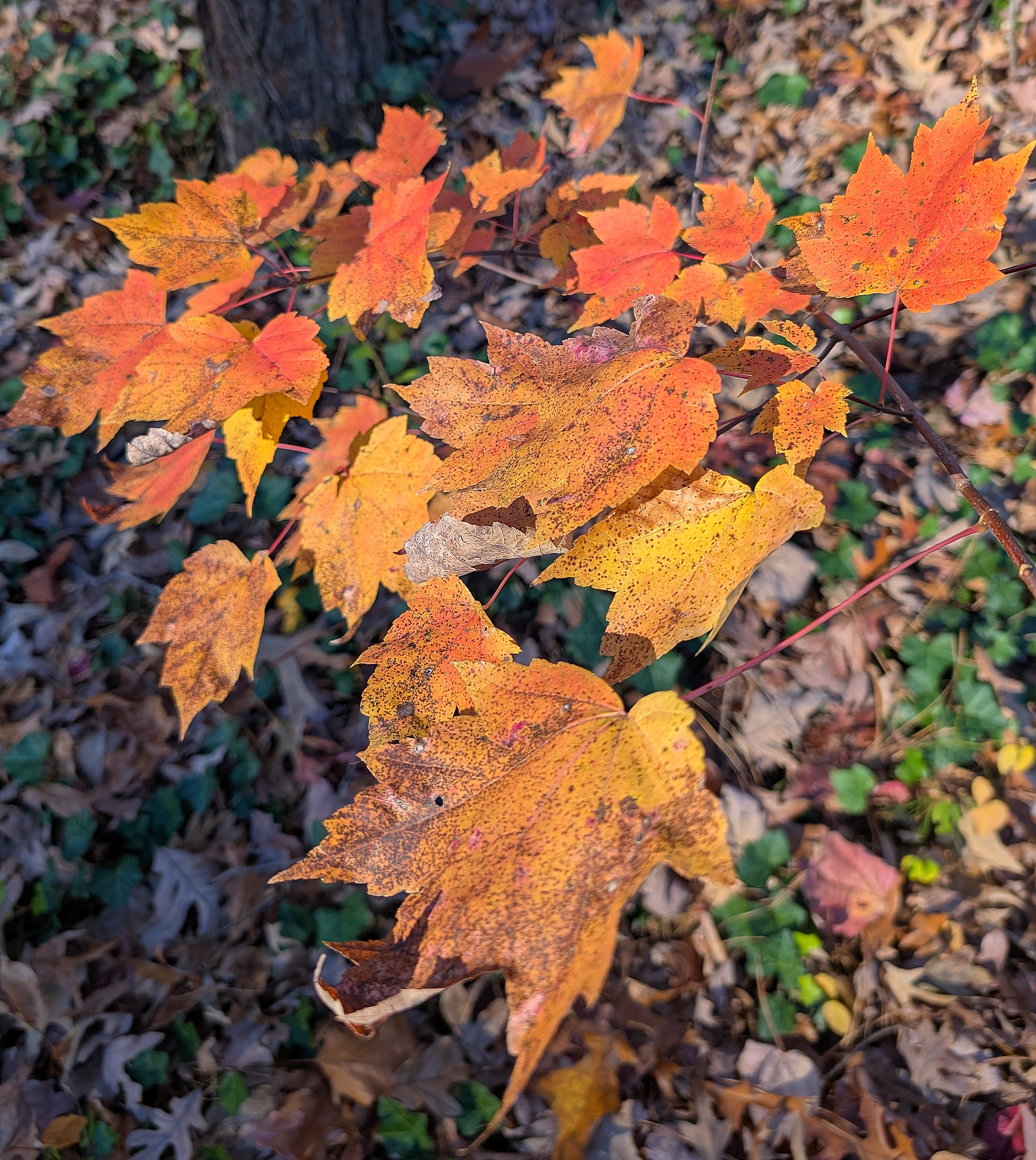
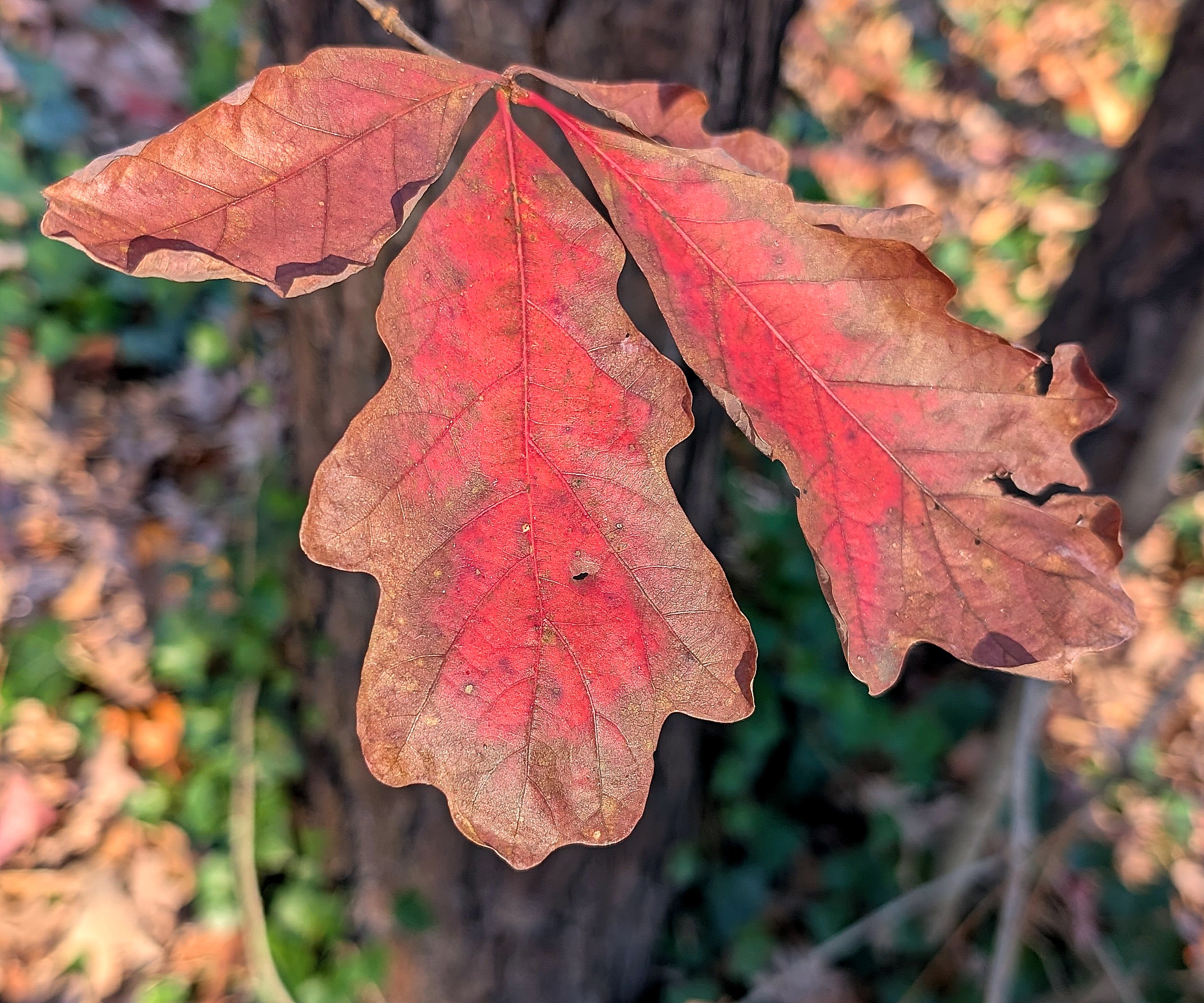
I took a walk this morning as the newly risen sun filtered through the tops of trees. The ethereal lighting isn’t quite captured here, sadly. Nice to see the natives doing well.
American beech, a.k.a., Carolina beech. November 2025.Red maple. November 2025.White oak…maybe…looks different than our white oak. November 2025.
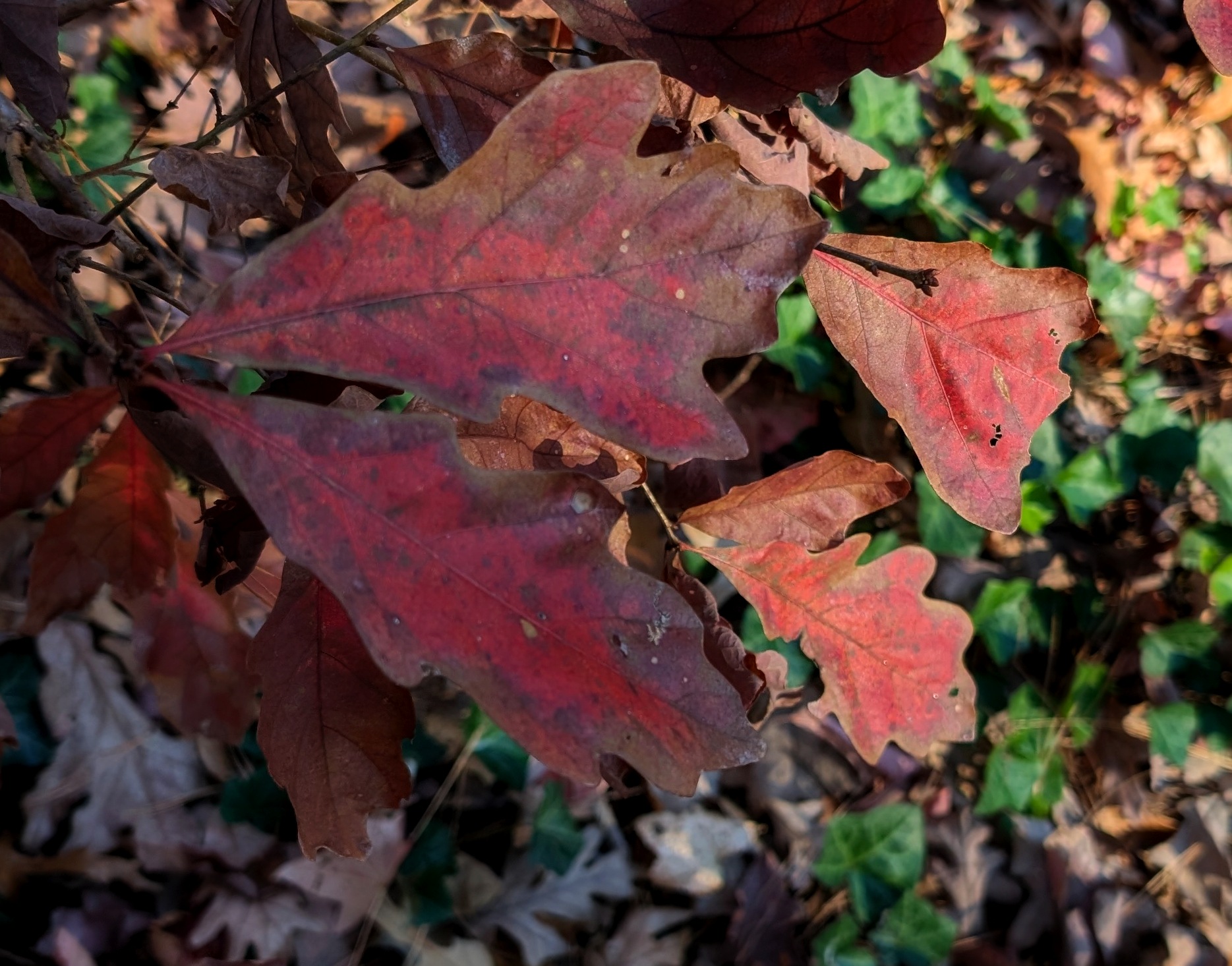
Unlike most years here in central North Carolina, temperatures have been colder than normal and our first hard frost occurred this morning. The above photo from November 24th last year, shows the glory of our lone non-native tree to survive The Culling, a.k.a., the landscaping project of 2024-25. This year it still retains red leaves but they are dulling. Dogwood, which in years past held onto their dusky maroon-colored leaves, now stand bare, attesting to the weather with a solitary leaf here and there. Plants closer to the ground now are yellowing and soon will follow the trees.
On the personal front, fall seems an apt term the past two years. At this time last year we were winning our battle against Covid, entering our third week in its grip. This year a Covid-like virus laid me low all of October 26th through November 2nd, and its nasty little cousin showed up yesterday, an intestinal thing. (“Detestinal” thing?)
Dry, sunny weather accompanies these low temperatures, providing a yin to the biting yang of it. Our bird world changes almost overnight: the year-rounders come back to the feeders to start bulking up, others disappear, and soon birds of prey will become more prominent on their leafless perches. Last week a raven lingered in front of the house, a surprising sight.
This year brought an unusual amount of treework in our near neighborhood. Trees and large limbs fell frequently during unusually rainy weather this summer. Fearful homeowners culled trees simply because they stood near the owners’ houses. A red oak ‘shared’ with our neighbor—it has managed to grow across the property line—dropped a limb the size of a small tree onto the neighbor’s driveway in a spot which had held a car until a week or two before the limb fell. Our good friends around the corner were not so lucky, losing a vehicle when a limb fell on a minivan about six weeks ago.
NC weather continues its wonderfully contrarian ways, at least to born, bred, and experienced Northerners (a.k.a. “Yankees!” as the Southern epithet is uttered). Temperatures promise to level out and this coming weekend will rise as high as 76. Any day after Halloween which promises temperatures in the 70’s (let alone the 60’s) seems to be a gift, even after living here nearly 20 years. And the most anticipated weather event for the coming months? The knowledge that someday in our near, winter-weary future, a singular weather pattern will convince a 70+ degree day to appear in late December or January. Always a welcome respite, even if its appearance always remains a cameo.
In milder years (2021), our trees still held green leaves on Nov 10th, let alone yellow. November 2021.