
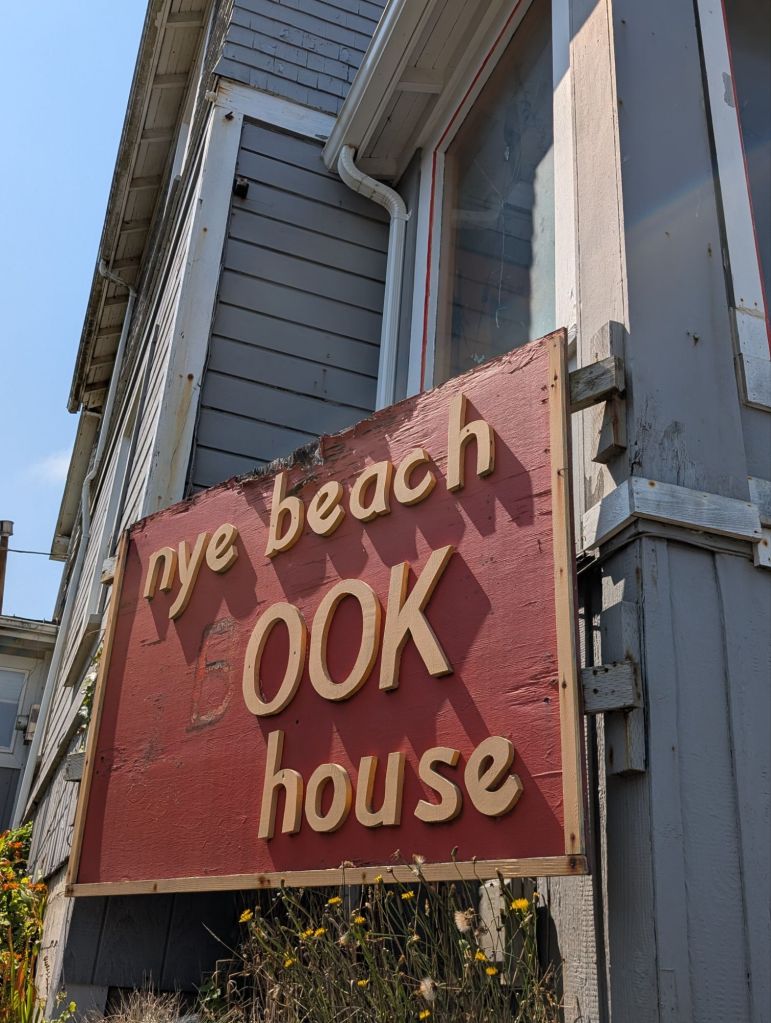
In 2011 I had one of the most serendipitously good book-buying experiences of my life. Perhaps it was aided by occurring in the middle of a family vacation I had arranged. My little family (parents, brother, niece, and wife) had gathered in a vacation rental on a bluff just north of Newport, OR, overlooking the Pacific Ocean. On a typically rainy day in early October we trotted from shop to shop in the Nye Beach district. Seeing a quaint bookstore, I headed up the stairs.
Inside, a multi-leveled converted house crammed full of books greeted us. I purchased four wonderful books, used. For very little money I bought:
- The Book of Bob, by Paul Chasman, easily the weakest book of the four, but highly enjoyable nevertheless. “In the beginning, Bob didn’t plan to start a religion; it just happened.” That’s the opening line. Written during the two George W. Bush administrations, it takes a swipe at them, but mostly it pokes fun at the craziness of American society and religion, of course.
- Buddenbrooks: The Decline of a Family by Thomas Mann. What a fantastic introduction to Thomas Mann! And fittingly, it was his first novel. Primarily chronicling the decline of a wealthy north German merchant family—images of which still reside in memory, popping out on occasion—it also gives a great portrait of the wealthy in Hamburg in the middle decades of the 1800’s. Though it was published 125 years ago, it reads “more modern” when compared to other authors publishing 1880-1925.
- Anna Karenina by Leo Tolstoy, translated by Richard Pevear and Larissa Volokhonsky. The translators won the PEN/Book-of-the-Month Club Translation Prize for this work. Their comment was: “In their version, Anna Karenin becomes a surprising rediscovery…..Pevear and Volokhonsky may truly be said to be the reinventors of the classic Russian novel for out time.” Seeing this on the back cover and knowing it had received good press, when I saw it for ridiculously low price….
- Shadow Country by Peter Matthiessen. It’s difficult to say how much this book has impacted me. I tumbled for Matthiessen’s The Snow Leopard in the very early 1980’s, and when I read Killing Mr. Watson sometime in the late 1990’s or early 2000’s, I just got captured by this vague, tenuous storyline which fictionalizes a real historical event: the killing of Edgar “Bloody” Watson by a posse of his neighbors in 1910 in Florida’s Ten Thousand Islands. Imagine encountering this book and discovering two things: Matthiessen had actually written a trilogy about this event through the 90’s and then collected them into one volume, which he rewrote, condensing them to this one volume. I felt like I’d struck gold. In the second volume of the story, Watson’s son’s story is told from adulthood (with flashbacks) as he attempts to figure out his father’s tumultuous life which led to his death. In the final installment, Watson’s story is told from his point of view, childhood to his demise. With each volume we get a richer understanding of the conflicting points of view which collided there in southern Florida. The best fiction illuminates without overtly preaching, and this trilogy leaves us wondering how guilty Watson was, though understanding how he could have provoked his own killing. Unfortunately I did several things which led to me not having this book in my library anymore. I loaned the trilogy to a very good friend, but ve-e-e-r-r-ry slow reader. That was 11 years ago. Last year I donated the original book, Killing Mr. Watson to a local bookstore dealing in used books. Then, just three weeks ago, I visited my slow-reading friend who offered the book back to me (unread), but I mentally mistook this book for the one-volume story and told him to keep it. Oh well.
Five days after I mistakenly left a cherished book in another’s hands, I had the opportunity to revisit the Nye Beach Book House where I had bought these wonderfully received books. Sadly, I found it had closed only ten months before.
I know where all but the most outstanding independent booksellers are headed. Too much of what they offered can be easily handled online. I buy 95% of my books to be delivered to the Kindle app. I might be 72, but the ability to make the text bigger, to look up an unknown word just by highlighting it, and to mark passages and be able to find them again is just irresistible. Yes, there is an aesthetic plus to a physical book, but when I occasionally read them these days, I feel hampered by the inability to do those things an e-book can do. But…I thought a store like Nye Beach Book House would survive, especially given its touristy location in Newport, OR.
But readers like me, more than young readers, must shoulder the bulk of the blame. As I’ve just described, I have many positive reasons to read an e-book, and few to read a physical book. Physical books require light and that’s an issue when I’m sitting in bed trying to drag the bedside lamp ever-closer. I’ve tried those so-called ‘book lights’ and hated them all. Physical books require me to hold them. I currently have lifting restrictions on both arms due to break the radius in both of them. Minor things: it’s easier to lose your place in a physical book—whoops, the bookmark just fell out, or, I just dropped the book; I worry about bending the pages; some are printed poorly.
FWIW, my unread book status is just five books short of 400. But of those, we must note (with embarrassment) that only 262 are not “reference” books of which the vast majority are cookbooks. My library cataloging program, LibraryThing, has many strengths, but doing a complicated Boolean search doesn’t seem to be among them. We’ll have to take an educated guess and say that there are about 130 physical books I’ve tagged “to read” (or perhaps I’ve encountered and said, “nah’). Will I read these when e-books present so many positives? Yes. I just read Hamnet a physical book gifted to me by the same person who now holds my treasured Shadow Country. I’m reading a thick, thick Lord of the Rings which holds all six ‘books’ and which I’ve not read for over 40 years. I think the physical books I own will get read at a slow but steady pace, but I’m old enough to know there will be unread ones. I recently bought a book in physical form from a local arborist and native plant enthusiast. It looked too beautiful to encounter electronically.
And there’s where an e-library falls flat. I’ve purchased books which purport to reproduce the original’s photographs and illustrations, but it’s seldom if ever been as good as I know the physical book must have been. Additionally, how can I impress visitors with my vast and well-read habits! I submit:
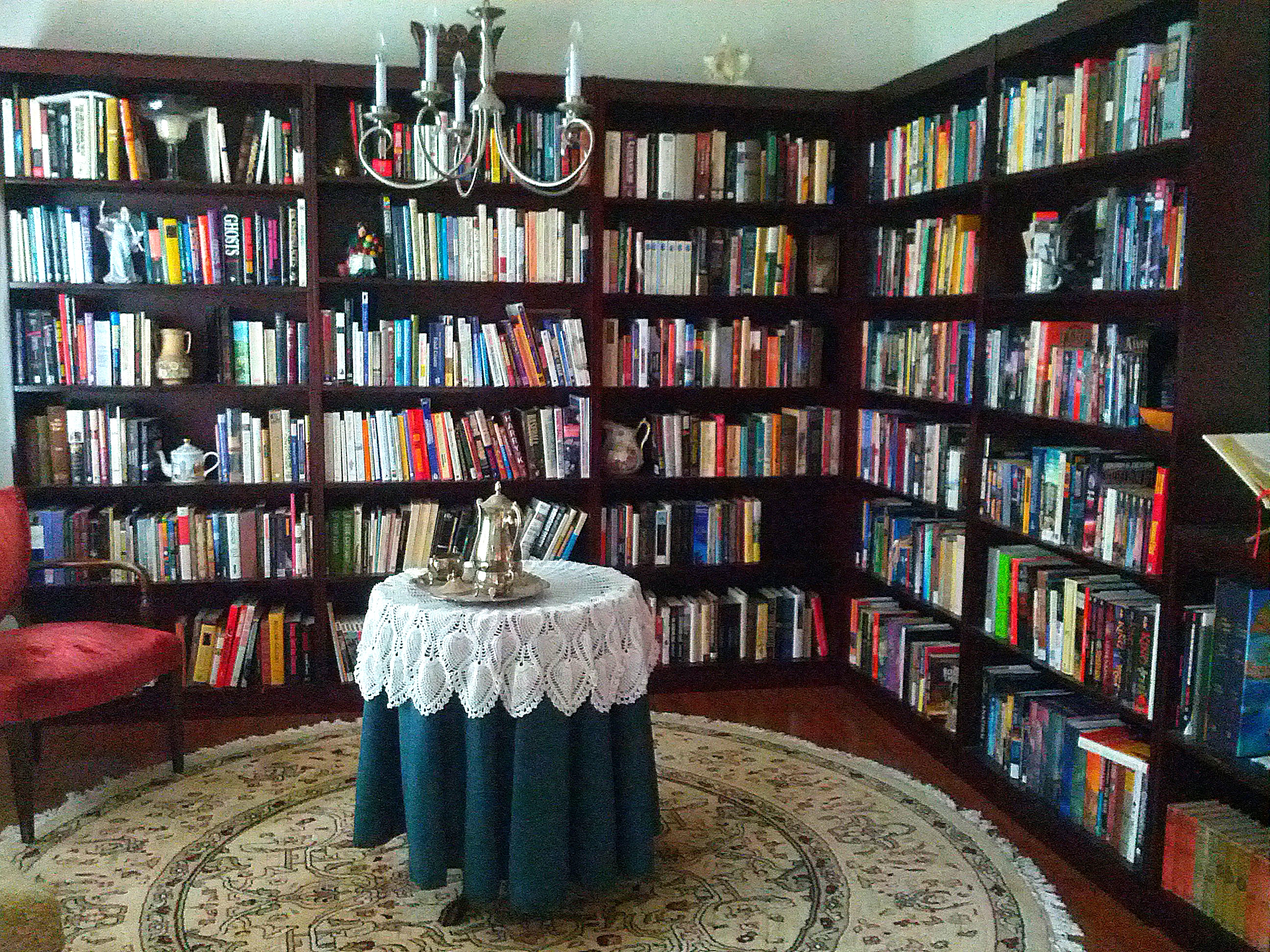


That’s a pretty beautiful library! I buy too many books; books I can’t afford, books my friends write, books I think are pretty. I read far fewer than I should, always citing time, which is partly true, but I also find so many things distracting these days. I do buy from my local independent bookstore though, which I feel good about. Lovely selection you found in Oregon. I’ll have to look for some bookstores next time I visit my mom. Not sure if it’s just where she is, but it seems there are more independent dispensaries than anything else.
Happy, first of all that you saw this post. It vanished into the ether when I hit “post”. There is/was a decent store in Seaside where I got another favorite book. We drive through there ten days ago but I couldn’t see it from the main highway. It might be gone. It has been 27 years, after all.