

Dawn on our second morning at Kapalua Bay struck clouds delivering a rain shower between us and Molokai, creating a brilliant rainbow. This may be common: I’ll post another instance later in this series.
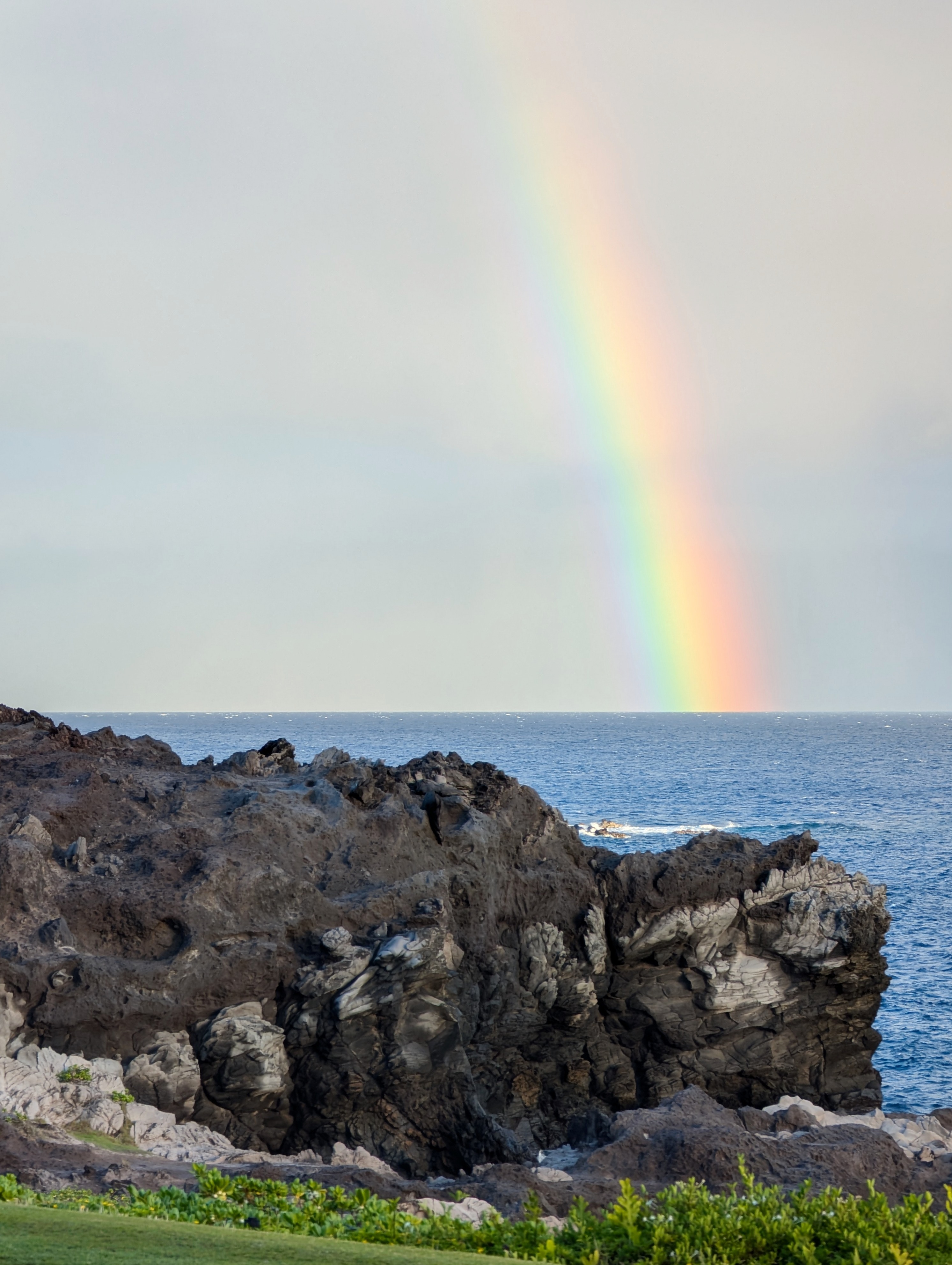
Dawn on our second morning at Kapalua Bay struck clouds delivering a rain shower between us and Molokai, creating a brilliant rainbow. This may be common: I’ll post another instance later in this series.

Our first full day on Maui consisted of settling in to a condo (“we need food” we realized). Then, we rendezvoused with one of my few cousins after more than 50 years. While spending the afternoon with them, we wandered an upscale mall. I spied a coffee shop and within, some ground Kona coffee. I needed coffee. I grabbed the package pictured above. At check-out the clerk said, “That will be forty-three dollars” and change. A mixture of shock and avoidance of embarrassment made me extend my credit card, tap the terminal, and commit to one of the most foolish purchases I’ve made in my life. You’ll note the package is only 7 ounces. As in barely-more-than-half-a-pound. Unfortunately, I can’t resist doing the math, and that’s more than $98/pound. Ouch.
I don’t like Kona coffee. I’ve had it off and on (mostly off) over 45 years of fine coffee drinking. I therefore didn’t think too much about buying something that purportedly was a lot less well-positioned on the ladder of quality. Because I absentmindedly left the package in my cousin’s car, I therefore needed coffee still. I purchased this:
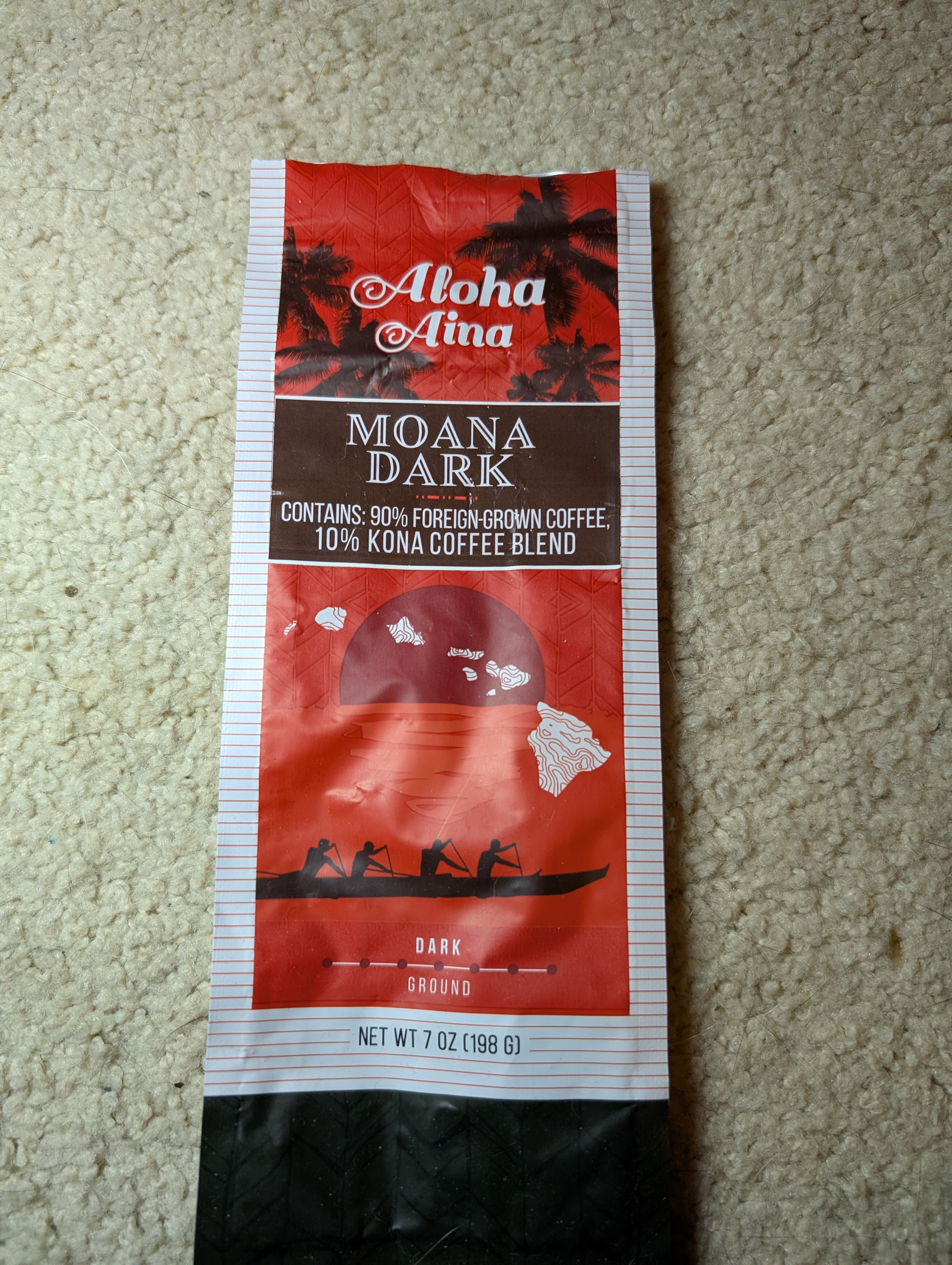
The pound above cost around $12-13. Same amount of ounces. Tasted…not quite as good, but really it wasn’t a three-fold difference. I felt stupid. And there you go.

Apologies, everyone. I’m going full Grandpa Mode in this one. It needs to be done.
After passing through three airports ranging from nice to delightful (see I Love You Hilo B. Airport), renting a car, and driving around the western lobe of Maui, we negotiated the contactless check-in process to our condo (another post for another day), unpacked, and stepped outside just as the sun set. Apologies for posting yet another sunset photo! It fits and I love ’em!
By the time our first full day in Maui dawned, we had made the decision we wouldn’t be driving around much. That drive from Kahului Airport to our condo at Kapalua Bay had taken nearly an hour. With little of interest in the miles and miles of condos stretching south of us to Lahaina, which itself offered much less after the 2023 fire wiped out half of its center, we realized going to any of the attractions mid-island would mean a two-hour roundtrip drive…every day. Attractions on the eastern part of the island (Haleakala National Park, for example) would be even further. If this had been our first few days in Hawai’i….but they were not.
We did drive back that very first day, however, so I could connect with my cousin whom I had not seen in 40-50 years. I grew up with only three cousins, all girls, who lived many hundreds of miles distant by the time I entered school (especially when they moved to Hawai’i for a few years). I gained a fourth when she was born as I finished high school and college, but the cousin one year older than me passed away about 20 years ago. With only three surviving cousins, and only two I actually knew growing up, seeing my Maui cousin qualified as a Big Deal. We met at the Maui Brewing Company in Kihei. After a delightfully long meal full of laughter, reminiscences, and plenty of beer, we toured the gated community where my cousin’s husband works as head of security. It’s a sweet gig: he works but two or three days each week and rubs shoulders with The Rich. He dropped some names, but I’m not allowed to pass them on to you. Suffice to say, when one of them purchases a home there, they promptly drop about a million to remodel it.
At the end of the afternoon we faced that one-hour drive back. We stopped in Lahaina at a Safeway for supplies, representing the first time I’ve ever seen a wine cellar in a Safeway.

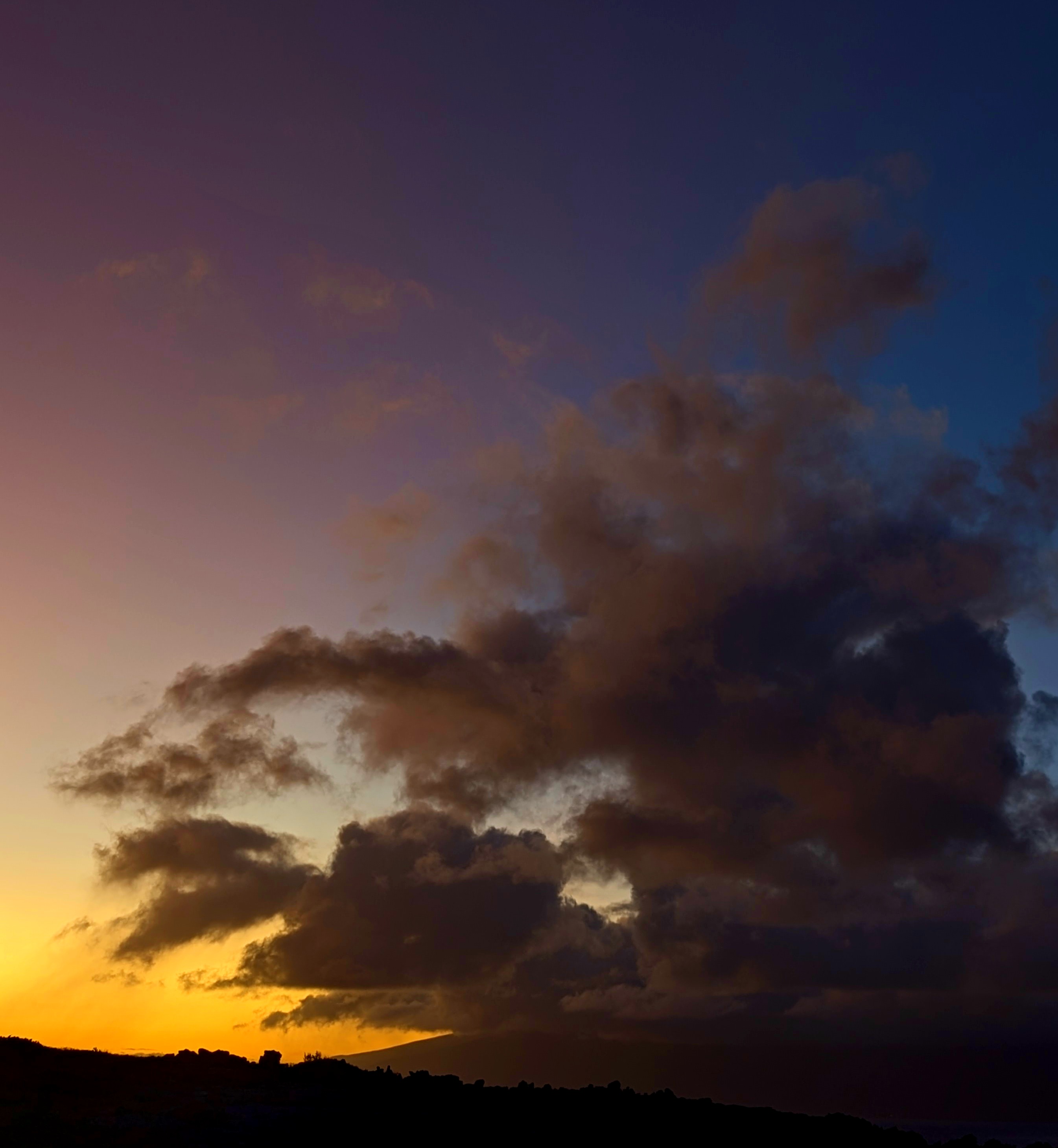
That night the sun dutifully set, and I just as dutifully captured it photographically with twenty shots.

Our final full day on The Big Island, we drove west across the island to the Kona Coast. It didn’t totally waste our time, but it validated our decision to stay in Hilo. In our short taste of it, the Kona Coast appeals to people who aren’t us–hence they’re nuts: Kona Nuts. Near as I can figure out, the west side of The Big Island appeals to people who like:
We don’t like any of that. Okay, we’ll take an occasional hike, and we’ll poke into those small shops catering to tourists (but they’re better when they don’t). We’re not the physically active types. I’m not at 70, and haven’t been since I flipped the dial past 40.
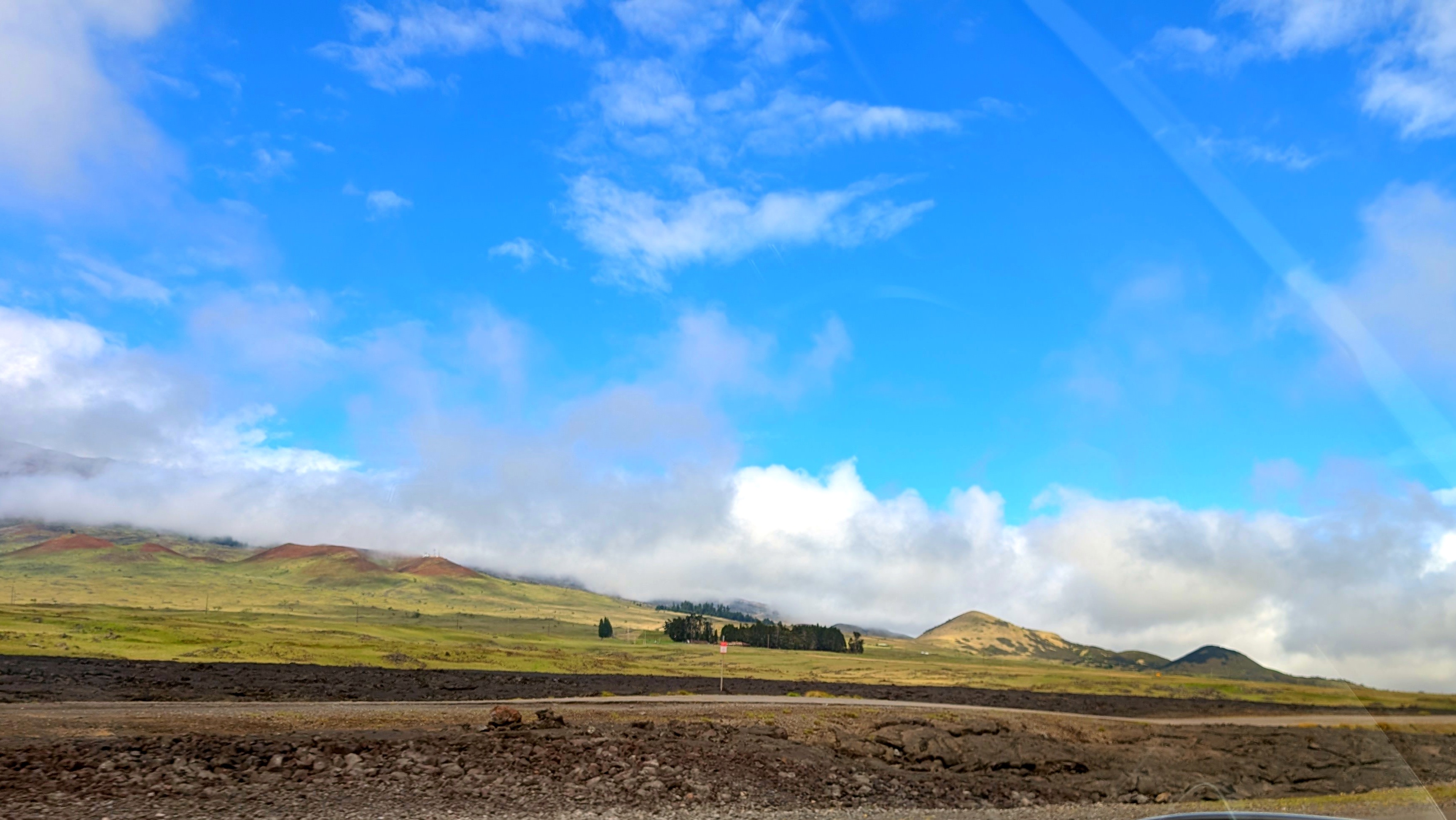
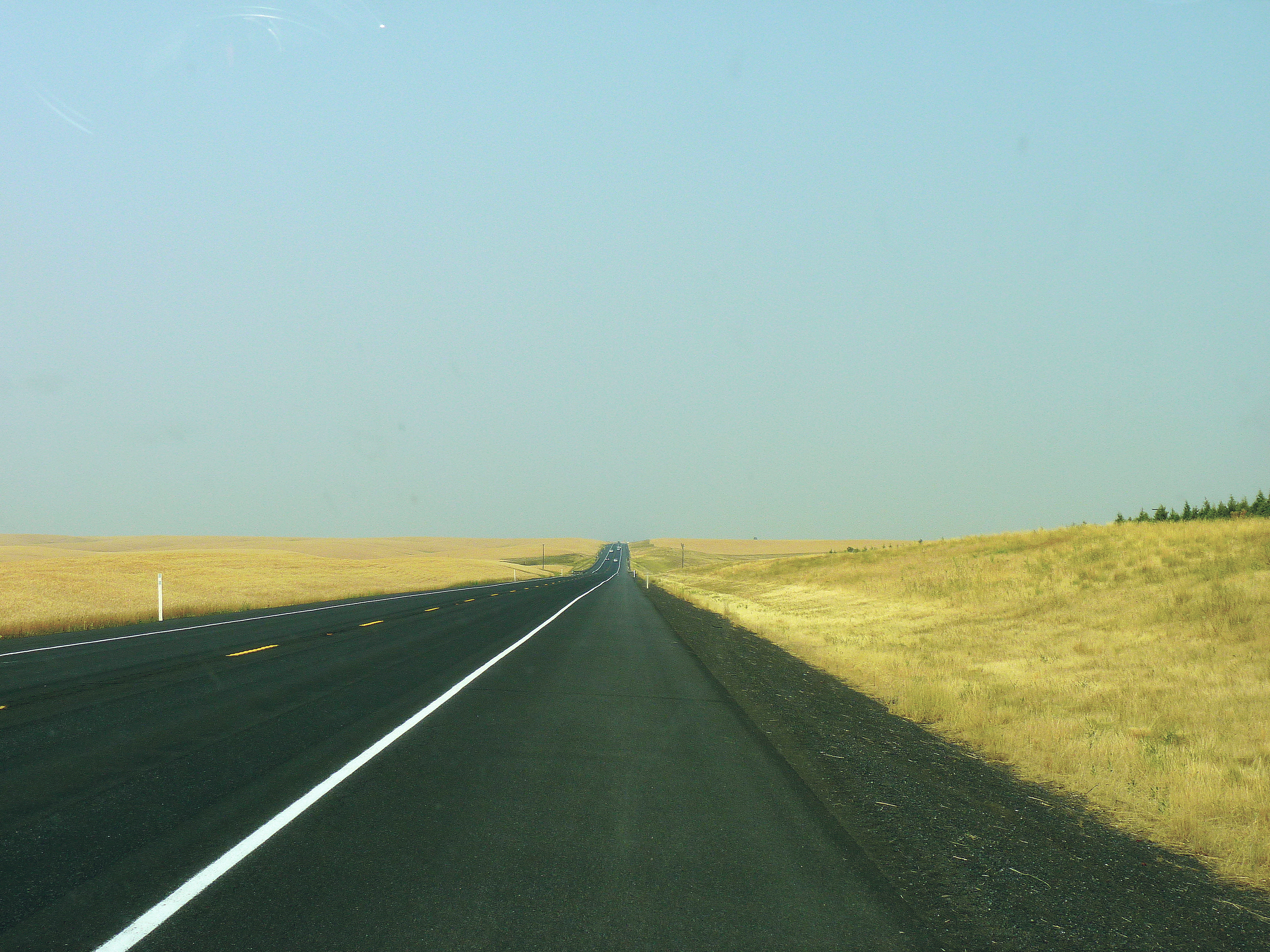
On top of that, we found the western side of the island to be hot, dry, a bit desiccated. Our first inkling occurred driving across the the caldera of Mauna Kea. We had left rain in Hilo, low wispy clouds misting us, sprinkling us with life-encouraging water. Once we climbed to the center of the island, things looked quite a bit different. (Photos are from our return drive to the east.)
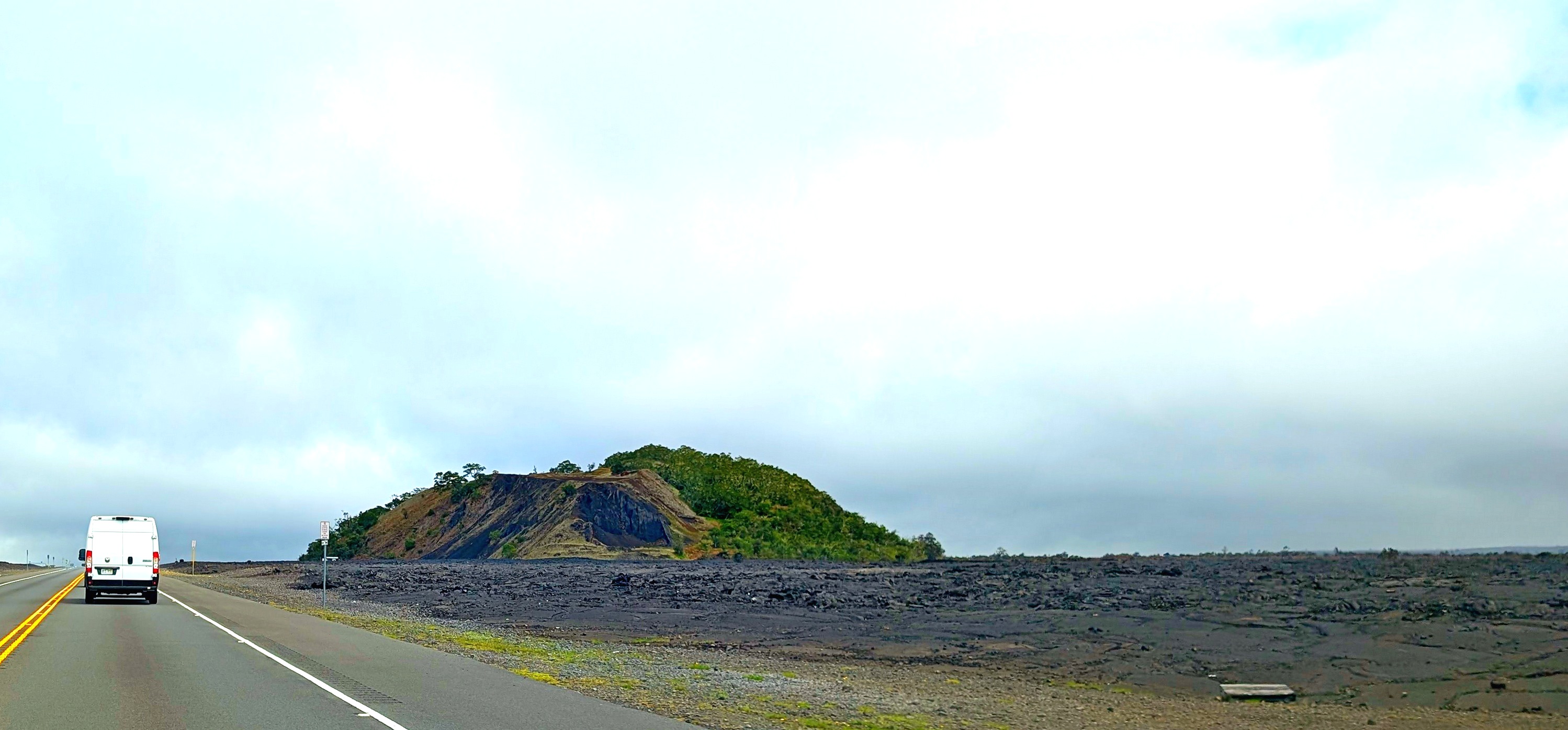
I grew up in eastern Washington State where lava flows poke like basalt bones through a grass-covered skin of dirt. It looked a lot like the western half the Big Island. If you told me this next photo was the interstate exchange just west of Spokane where students head south to Eastern Washington University, I would believe you:

Once we descended the steep slopes to Kona coast–an oddity to me; shouldn’t the leeward side be more gently sloped?–we found a whole lotta nothing…which isn’t really fair, but our first stop gave us that impression. The Kaloko-Honokohau National Historic Park starts out looking like this:
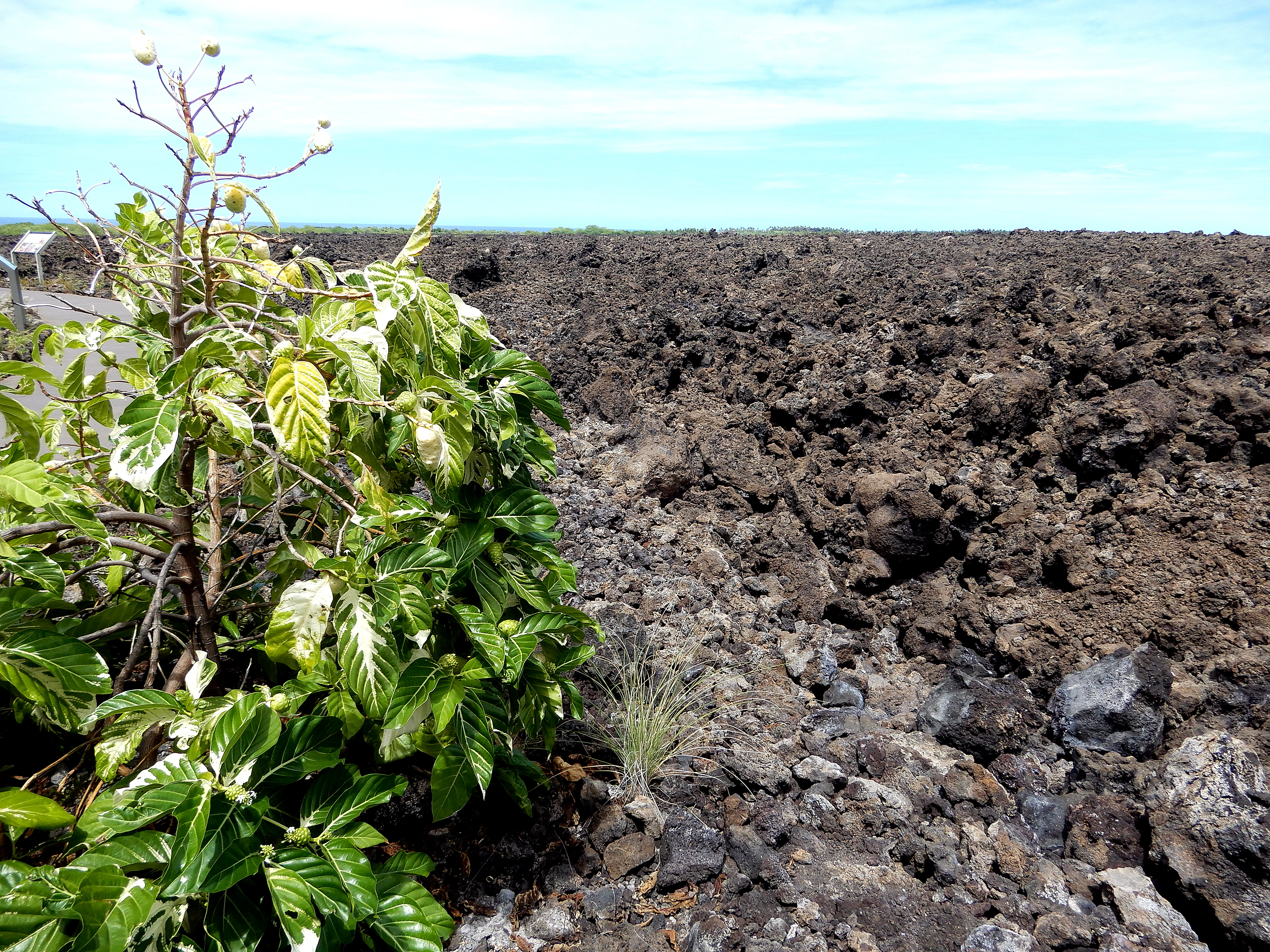
Although bleak, this stop proved informative. Indigenous peoples used these coasts to trap fish and perform other ocean-related activities (I think they got salt also–can’t remember). Families owned narrow parcels of land stretching from the shore up the slopes. Those members who lived at higher elevations would farm and bring their harvests to the shore to trade for fish and seafood. We chose not to walk the mile-long trail to a recreated site about the coastal folks, primarily because the 90+ degrees and lava fields intimidated us. Finding the entrance to that area of the park proved elusive, hidden and nearly unmarked as it was in the backmost corner of a parking lot for various marina businesses.
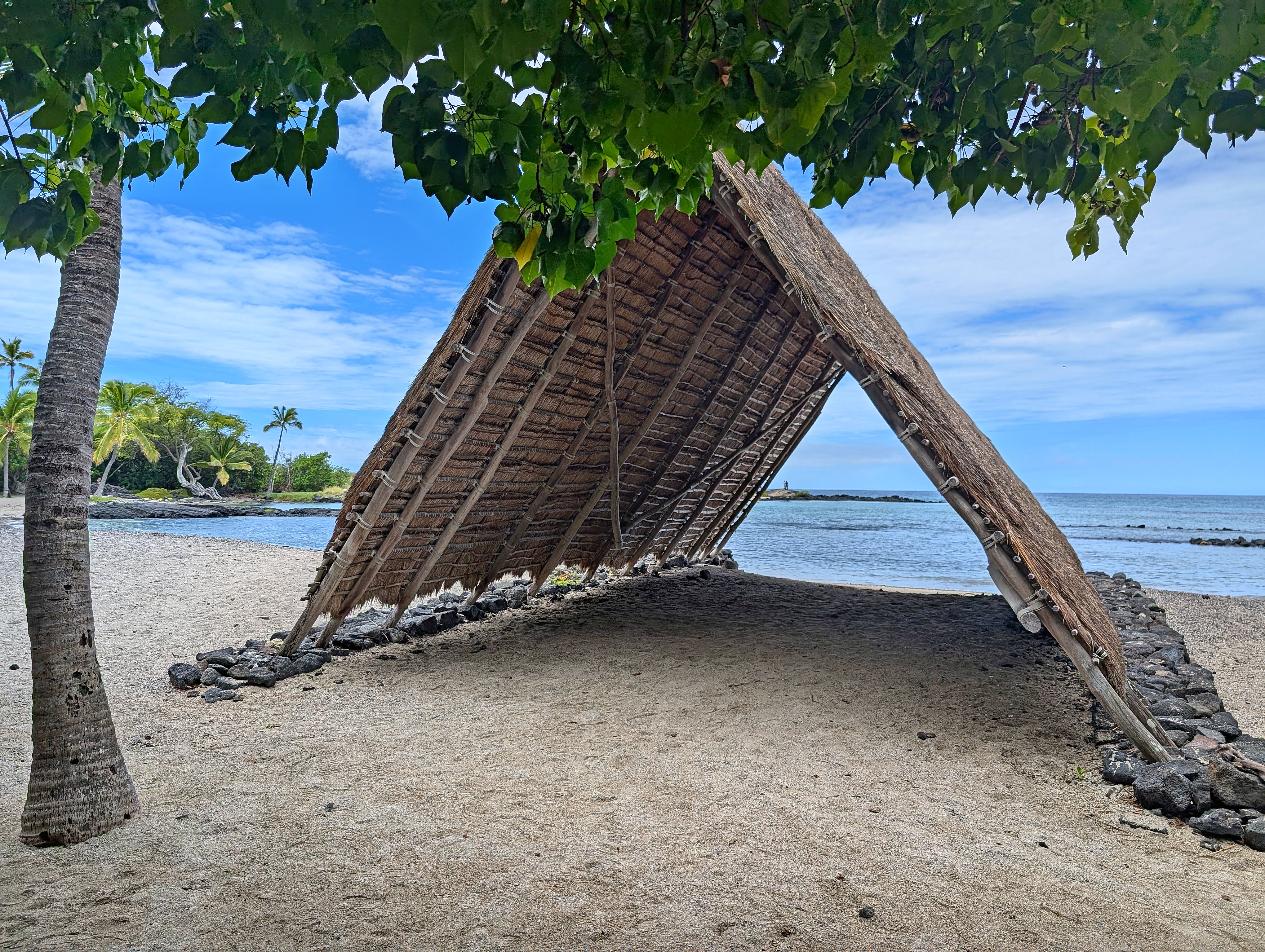
After this we drove south into Kailua-Kona proper. We found nothing but strip malls, hotels, gas stations, various support businesses, and the airport where virtually every airline flies except for Southwest Airlines (explaining why we flew into Hilo). We found restrooms and beat feet to the east side of the island. We had great views on our climb out of Kona: foregrounds of all the roofs of the vacation homes, backgrounds of the ocean. Yay.

The island of Hawai’i could be called triangular. The west coast roughly runs north to south. From its northern tip, though, the coast runs northwest to southeast. Then from that easternmost point it runs northeast to southwest to join up with the west coast. Situated inland from the southeast-facing coastline lies Volcanoes National Park. Volcanoes presents much more than just dormant craters. Its most active feature (inland) turned out to be the first thing we saw: steam vents. Craters? I found their vastness difficult to comprehend.

I’m not even sure the photo above shows only Kilauea. I see “Hale Ma’uma’u Crater” on the ol’ Google Maps. Lava flowed in 1919, 1921, 1954, 1959, and on and on I would guess. I paid little attention to information, so I’ve only myself to blame! Seeing it seemed more important than reading about it on signs, the internet, pamphlets, and the like.
Trade winds blow northeasterly toward the park. There are dry plains inland, but plenty of slopes catch the moisture. Plant life abounds there. Even in this dryness:

Where the rain can fall, things change rapidly. Just a few miles away from the photos above…

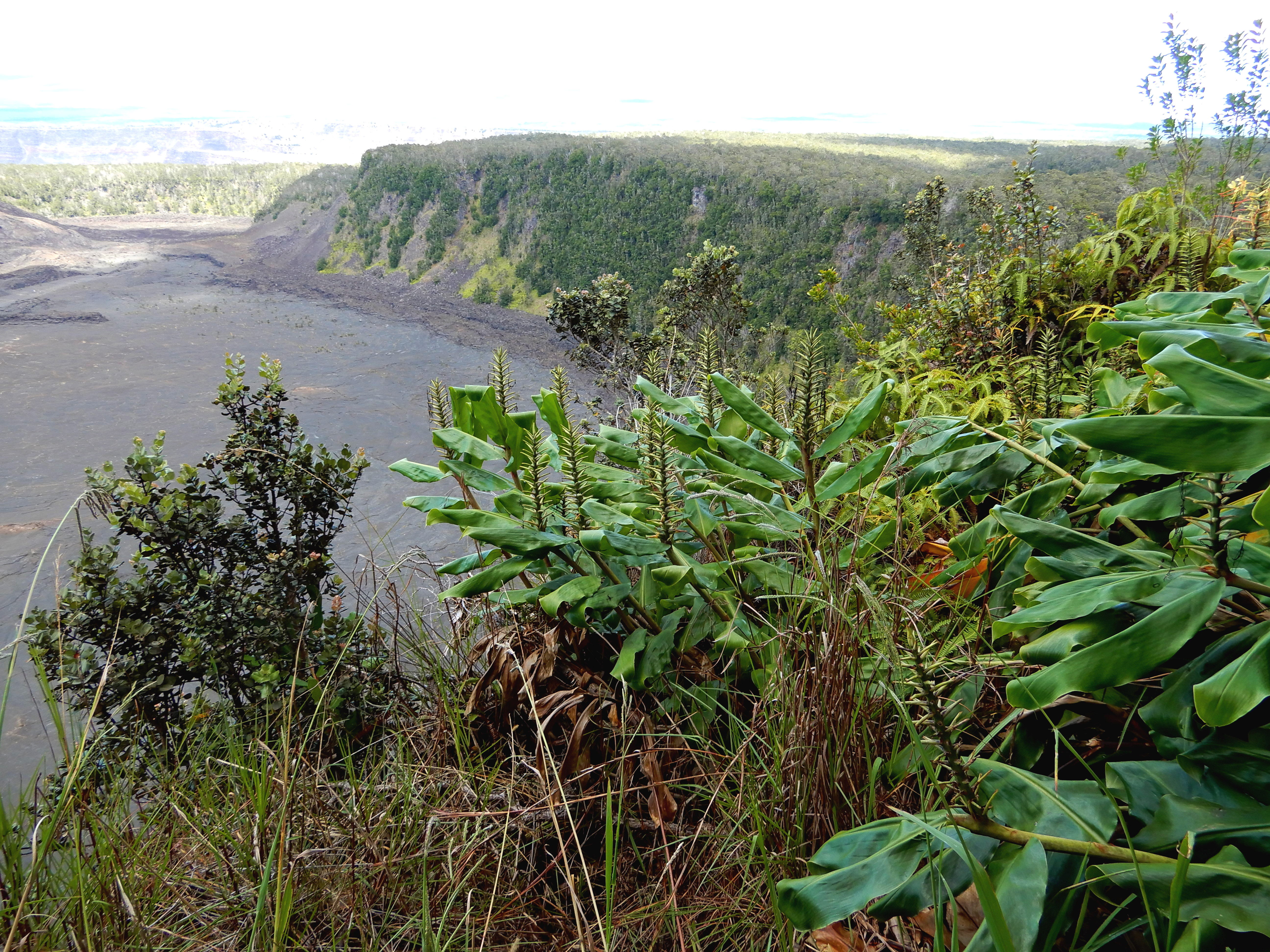
Eventually I realized this incredibly wide circle we were tracing surrounded a ‘family’ of volcano craters. We continued past many tantalizing side trips, acknowledging our (a) laziness, (b) general physical un-fitness, and (c) certain time constraints. Turning off of the Crater Rim Drive where it intersected Chain of Craters Road–further westward travel was blocked–we traced the path of lava flows to the ocean.


Now that I know more about this park, I would go back to look into lava tubes, to hike a bit here and there, to see if some of the roads had opened up, and to maybe hike down into a crater…maybe. It looked kinda boring to be truthful.

It all impressed this guy who grew up with the volcanoes of the North Cascades, a far different kind of thing.
…volcanoes! We forced the agendas for our final two Big Island sightseeing days, simply by allowing our lazy natures free reign. Sunday received its designation, Volcanoes Day, and promptly rewarded us with an atmospheric eruption.
Twenty-five years ago I purchased the book A Home for the Soul: A Guide for Dwelling with Spirit and Imagination by Anthony Lawlor. It featured beautiful photos and promised to address that point where functions meet features and both bow to the soul. Unfortunately Lawlor’s book, though gorgeously printed, never connected with me–it remained a beauty with no brains. I mention this because the idea has long played out in my head and heart that we are drawn to some places on Earth more than others, despite our innate interest in almost all of them. I’ve mostly thought this gets imprinted on our psyches during the formative years of our childhoods, much as ducklings will imprint on their mother. (I wonder how this would work with children of military personnel and others who move their families frequently to vastly different geographies?)
Recently a friend of mine quoted author Pat Conroy who made his mark writing books set in coastal South Carolina, including The Citadel in Charleston. In this particular quote, Conroy described how the Low Country spoke to his soul. This returned me to my
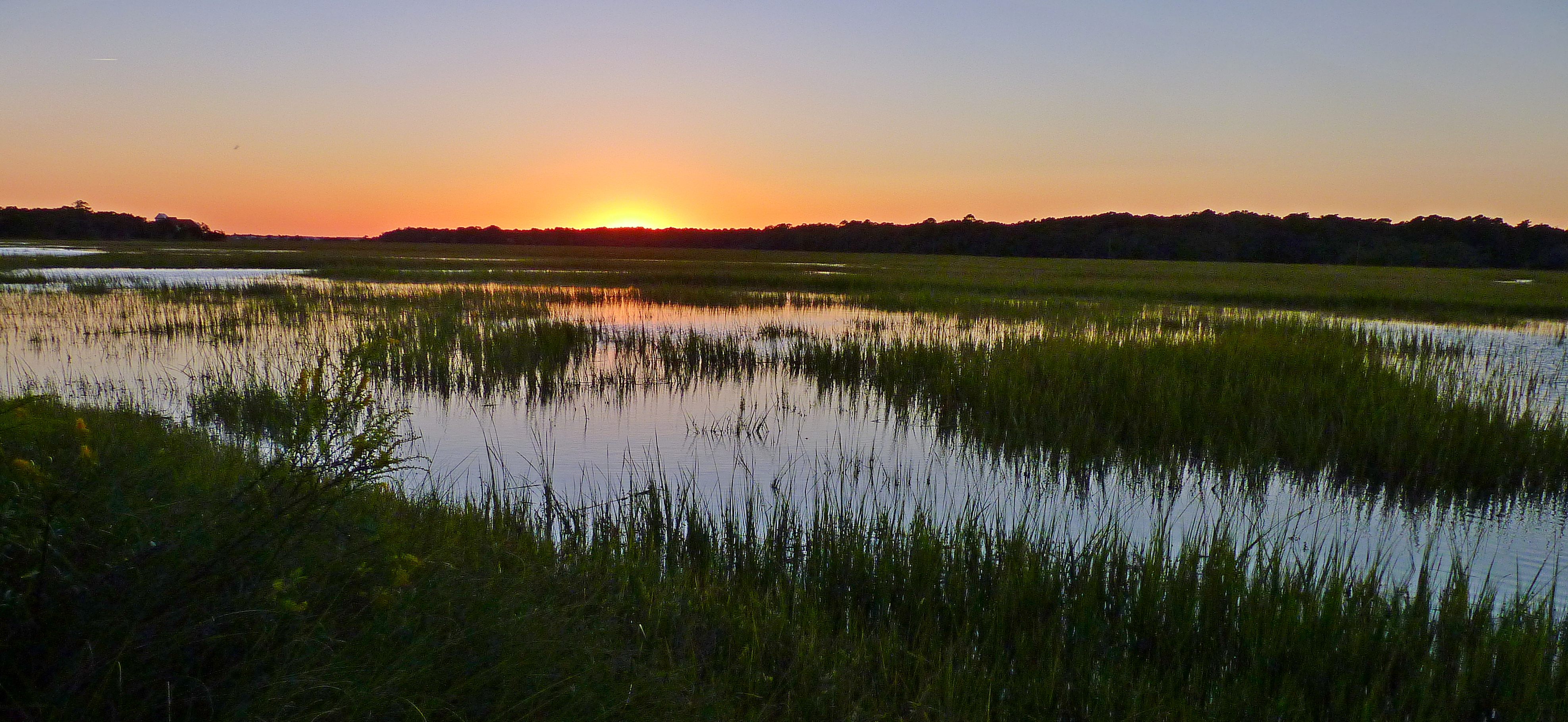
ideas of place. Much as I like the coastline of Eastern America, and the distinctive features of it from Chesapeake Bay south, it never ‘grabs’ me. Intellectually, I love its nooks and crannies, its sultry feeling which exudes relaxation, its birds, the novelty (to me) of its marsh grasses, and the soul-satisfying feeling brought on by its mostly horizontal nature.
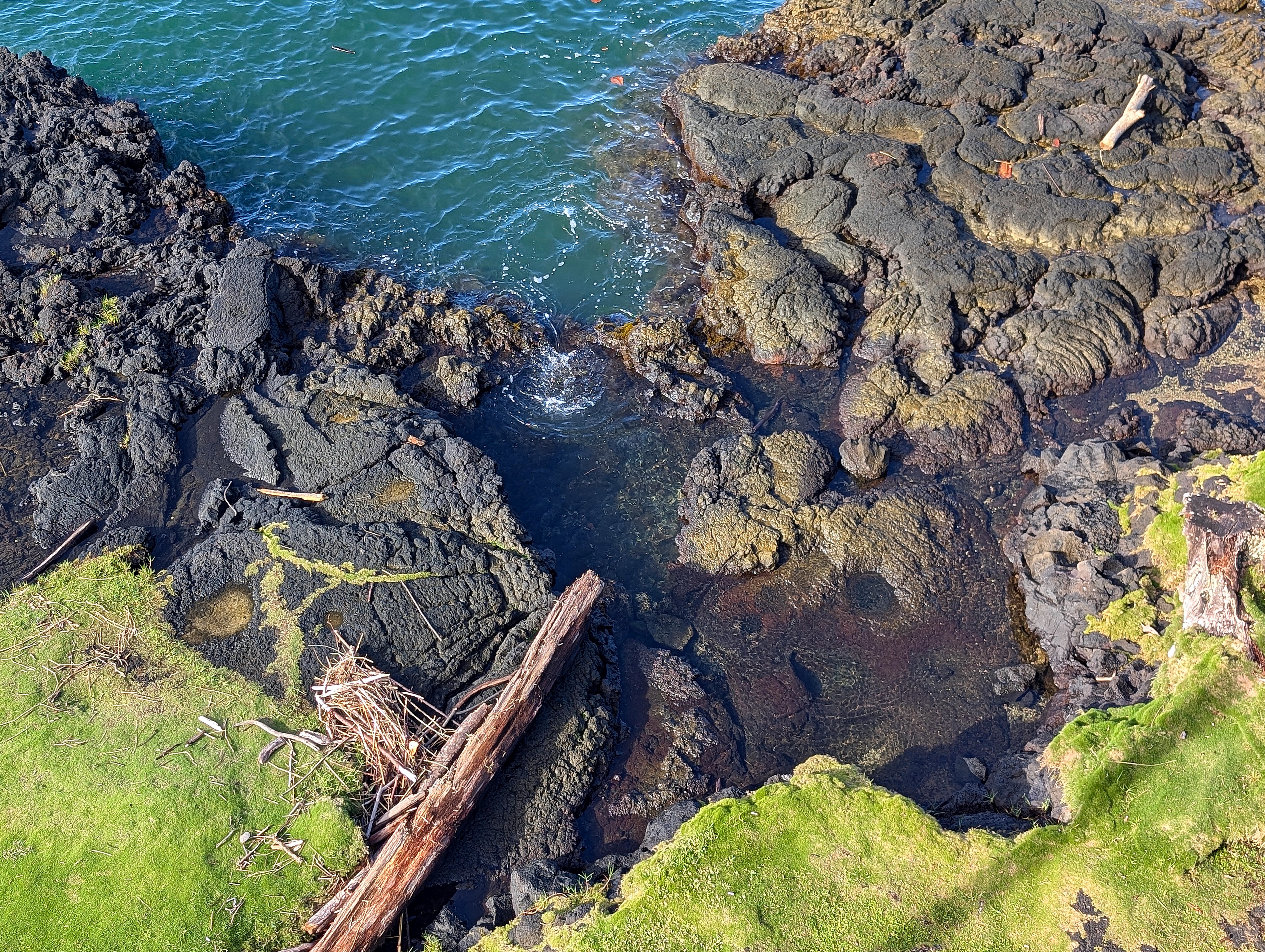
In Hawai’i, though, I found my heart beating in sync with its coastline as if I had found a long-lost sibling. I suspect this has something to do with being taught at an early age that “coast” means “what it looks like around Puget Sound” and to a lesser extent the Pacific Coast of Washington State: volcanic rocks to the coastline; cliffs of sand, sedimentary rock, and mountaintops which send their flanks plunging through the intertidal zone to significant depths in mere meters. But could it be more genetic? As far as I know, my ancestors all came from either Norway or that island divided into England/Scotland/Wales. From photos it seems a rocky coastline, lashed by pounding waves, much of it featuring knobby cliffs which prohibit dipping one’s toes in the water–and this water is crystal clear.


A counter-argument: what to make of the three centuries my patrilineal line spent in the mountains located at the Virginia/North Carolina border? Of my matrilineal line descending from the hollers of Kentucky to live along the Ohio River? Do I counter that with my father’s mother, whose parents stepped off the boat straight from Norway? Or the suspected similar condition for my mother’s father who was put up for adoption by a Swedish lass?
I land on nurture more than nature. I believe my father preferred eastern Washington with its undulating surface of grains and grasses because he had been raised in a similar grassy, agricultural flatness outside Minneapolis and later, in Havre, Montana. My friend associates the North Carolina coast with meaningful times in his life, not least of which was refurbishing a getaway house on the Intracoastal waterway with his father. My brother and I experienced a semi-dry climate through high school. Perhaps this explains why, after decades spent in rainy and cloudy western Washington, he retired to Santa Fe?
Unless…unless… I must admit, I like rain. I discovered this when I moved to the Philadelphia area in 1992. In 1997 I returned to Spokane, WA, a semi-arid part of the country. Four years later I could barely get out of town quick enough, and the dry, dusty summers played a large role in that attitude. I found I did like rain, just not the rain of Puget Sound which I experienced on and off during my childhood and lived in from 1976-1981. Rain on the east coast of America doesn’t resemble rain in the Puget Sound area, despite both regions receiving similar amounts annually. (Philadelphia–41.45in; Seattle–37.13in, both according to WorldClimate.com.) Rain clouds on the east coast bring rain, and then they go away. Rain clouds in Puget Sound just hang around seemingly forever, misting you once in a while to remind you they carry moisture. Where, then, does this love of rain come from? Why don’t I like snow? I experienced it every winter of my childhood, and I continued to do so through my 47th year. Is it my North Carolina ancestors calling to me through our shared genes, reminding me that for centuries we Pilchers have enjoyed warmer, less snowy climes? If so, would they in turn find the wind- and surf-lashed cliffs of western England and Wales instantly familiar and soothing? It’s a confusing amalgamation of influences.
Maybe we just like what we like, inexplicable as it may be. A postcard I have reads: “Every traveler knows it is possible to be homesick for a place one has never seen.”
Thus ended our day-to-market. My usual procrastinating nature had combined with Hawai’i’s induced laziness to leave two journeys for the final two days on this island. To be continued…

By our fourth full day in Hilo, the island attitude had taken over. Friday’s meandering around town (waterfall, museum, brewery, dinner) could’ve been followed by something energetic. Instead we took our time before heading downtown to visit the Farmers Market (photo above) and an equally large area where local crafters sold their wares. A few souvenirs were purchased, always with an eye to the minimal space in our luggage. (We pack light. A carry-on suitcase each, a large purse/bag for my wife, a soft attaché-style bag for me.)
After the market we wandered the downtown area. Hilo manages to look like my childhood of the late 50s and the 60s, except for the modern cars:


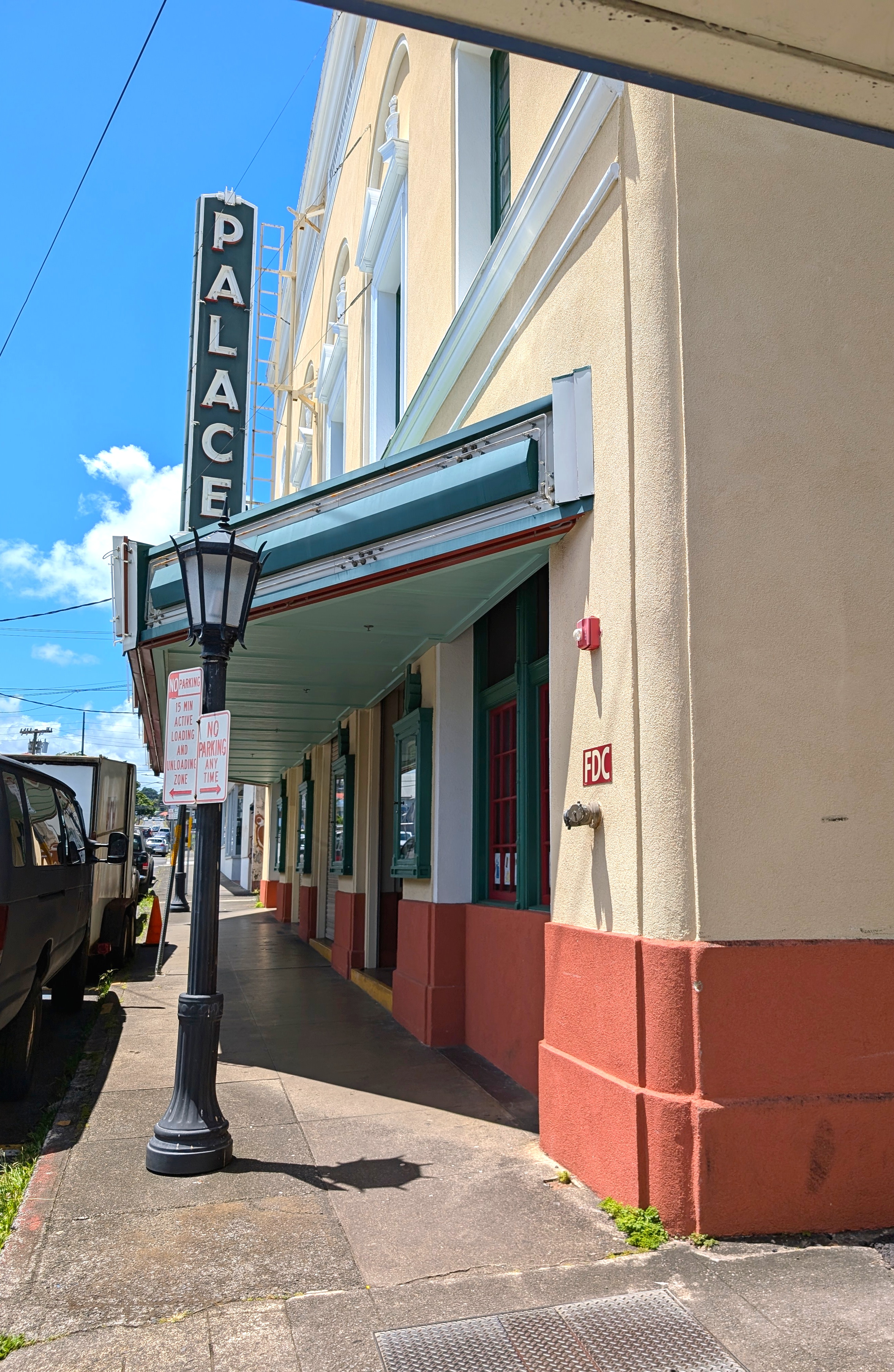
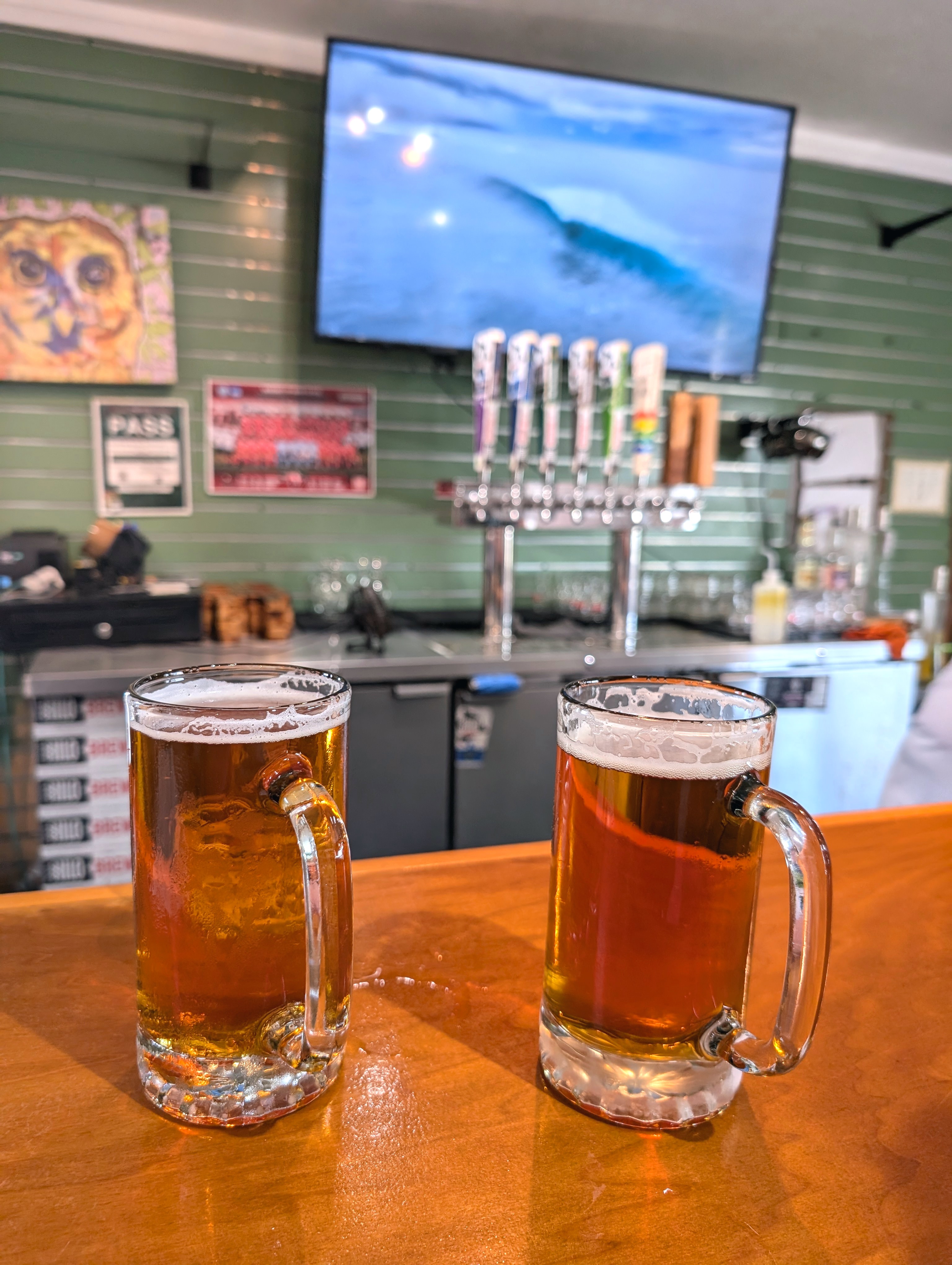
Eventually we ended up at Hilo Brewing Company which sits about a mile from the beaches of city center. It reminded us of the rough-looking ones around Raleigh and in San Diego County where all the work goes into the beer, all 4-6 kinds of it. We like that.


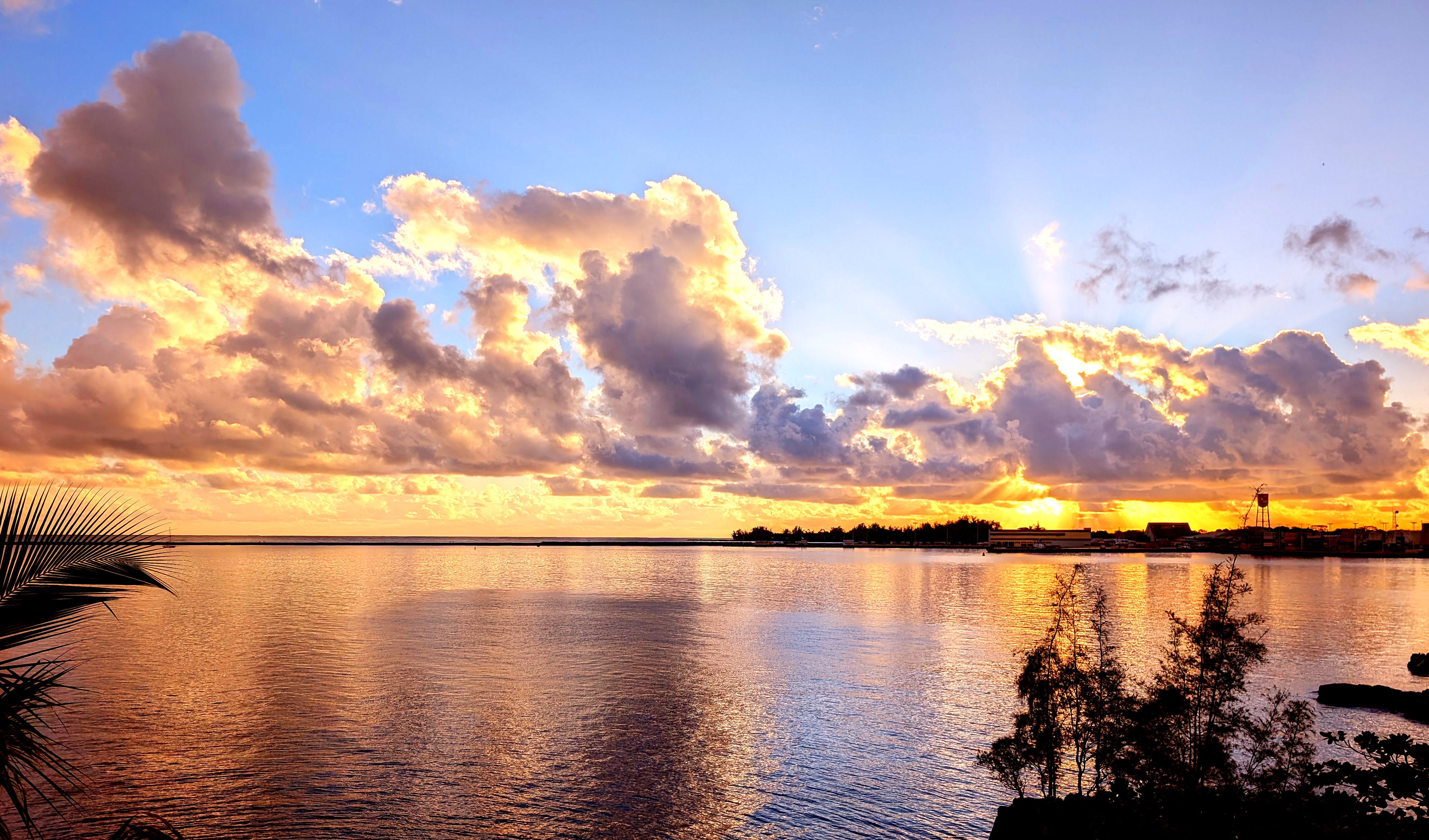
As I type this the sun is peeking over the horizon here in Raleigh. I won’t see it due to trees and ridges…and because I’m sitting in a windowless room in the basement. Nine weeks ago our first Saturday in Hilo brought an orange glow as the sun peeked over the industrial buildings at the port of Hilo (located east of Hilo proper). I never tired of this. I think people who live where they can see to the horizon unimpeded by anything must have a different outlook on life or at least on the natural world. I know it has that effect on me.
 all the voices in my head