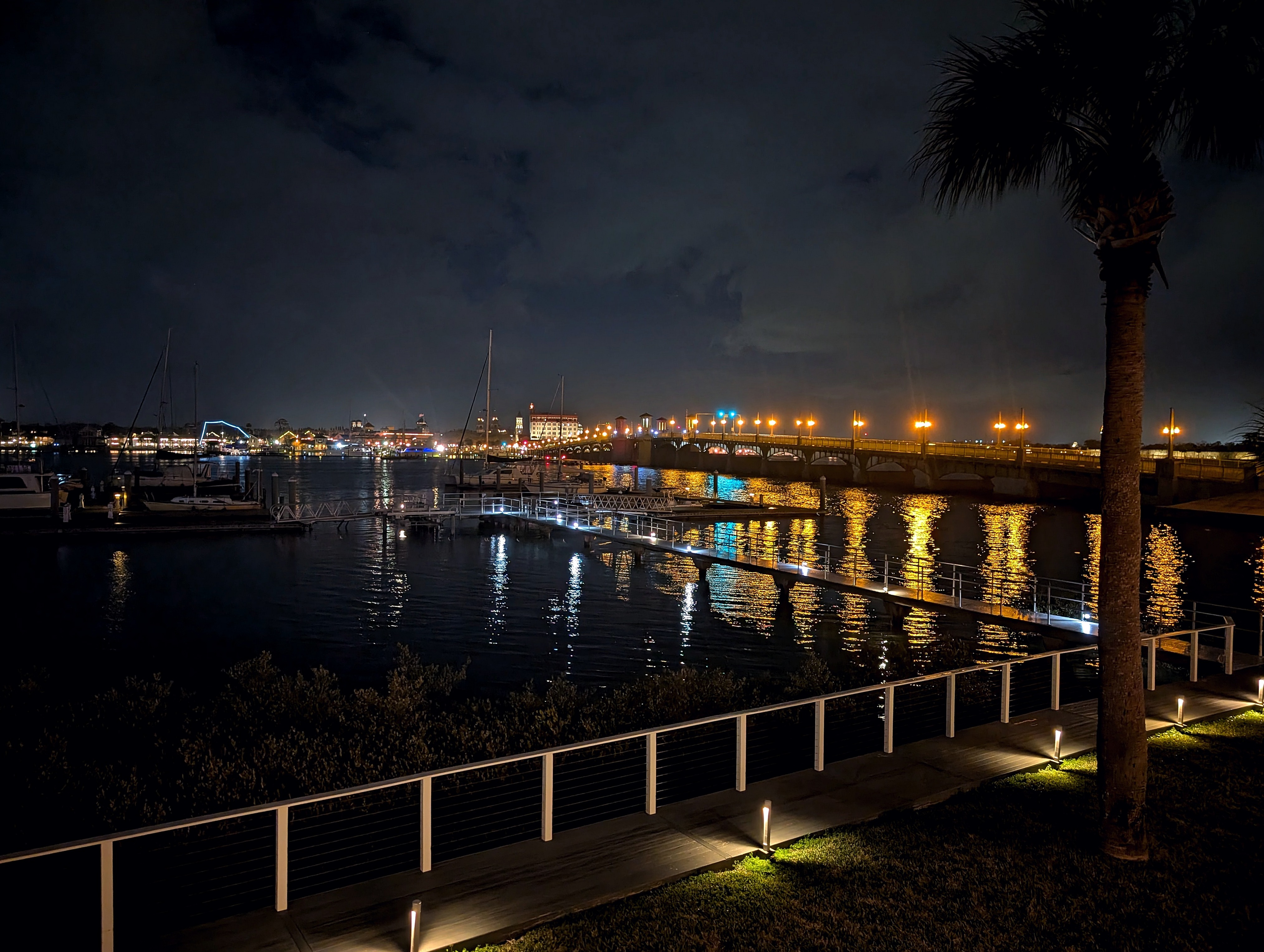
Help me out. I’m jumping the gun on our Southern Florida trip. I should be discussing Miami, our drive up to St. Augustine, and our first day there. But…I’m curious about this photo I took that evening. After downloading and performing minor editing of the photo, it looked like this:
Mickler Oconnel Bridge looking at the historic center of St. Augustine. March 2026.
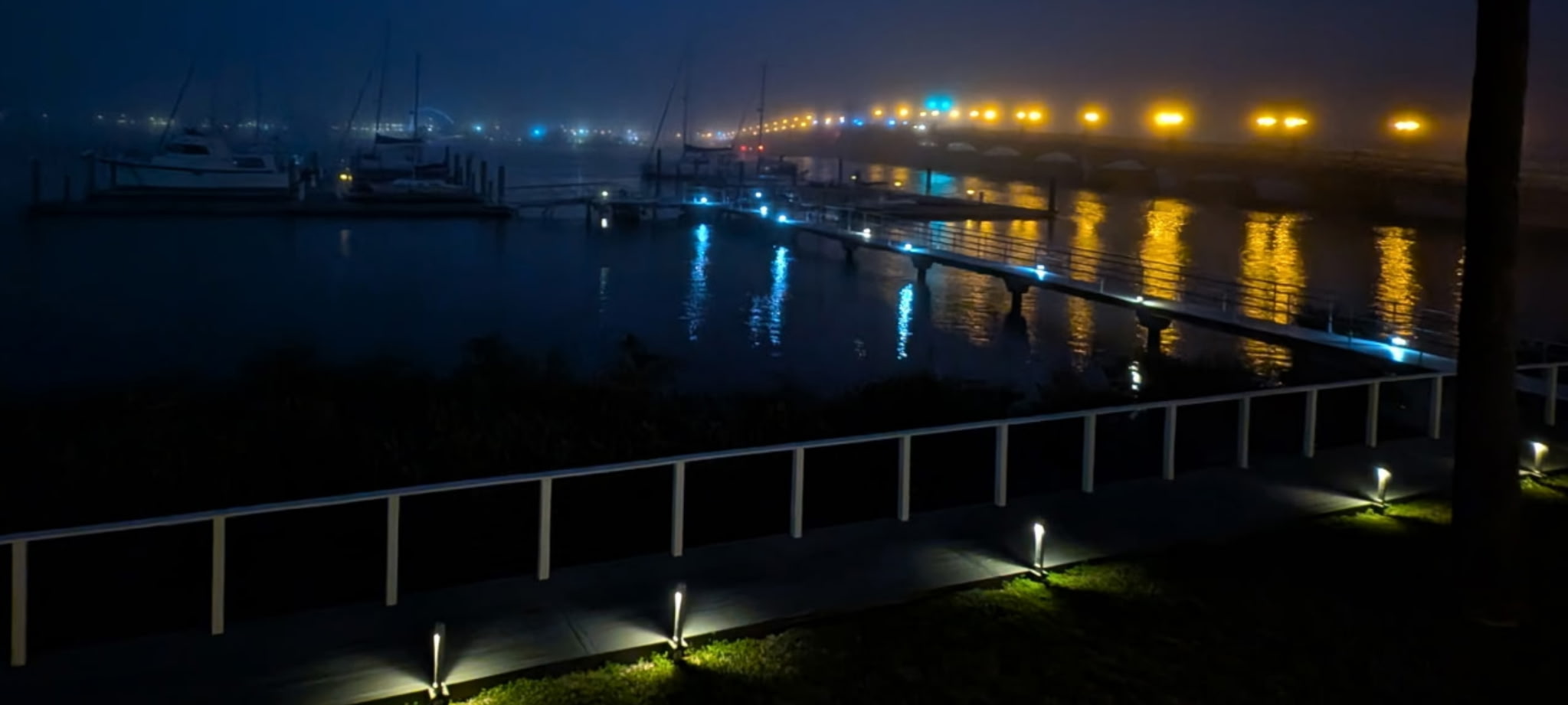
The photo above hasn’t been cropped other than the amount shaved off when I straightened it 0.2 degrees (because I never hold a camera level, it seems). I was very happy with this photo. I don’t often crop appropriately in the viewfinder, especially when shooting with my Pixel phone. I sent it to my buddy who loved it, but said he would crop it like this:
My friend’s cropping of the photo above (minus the straightening). March 2026.
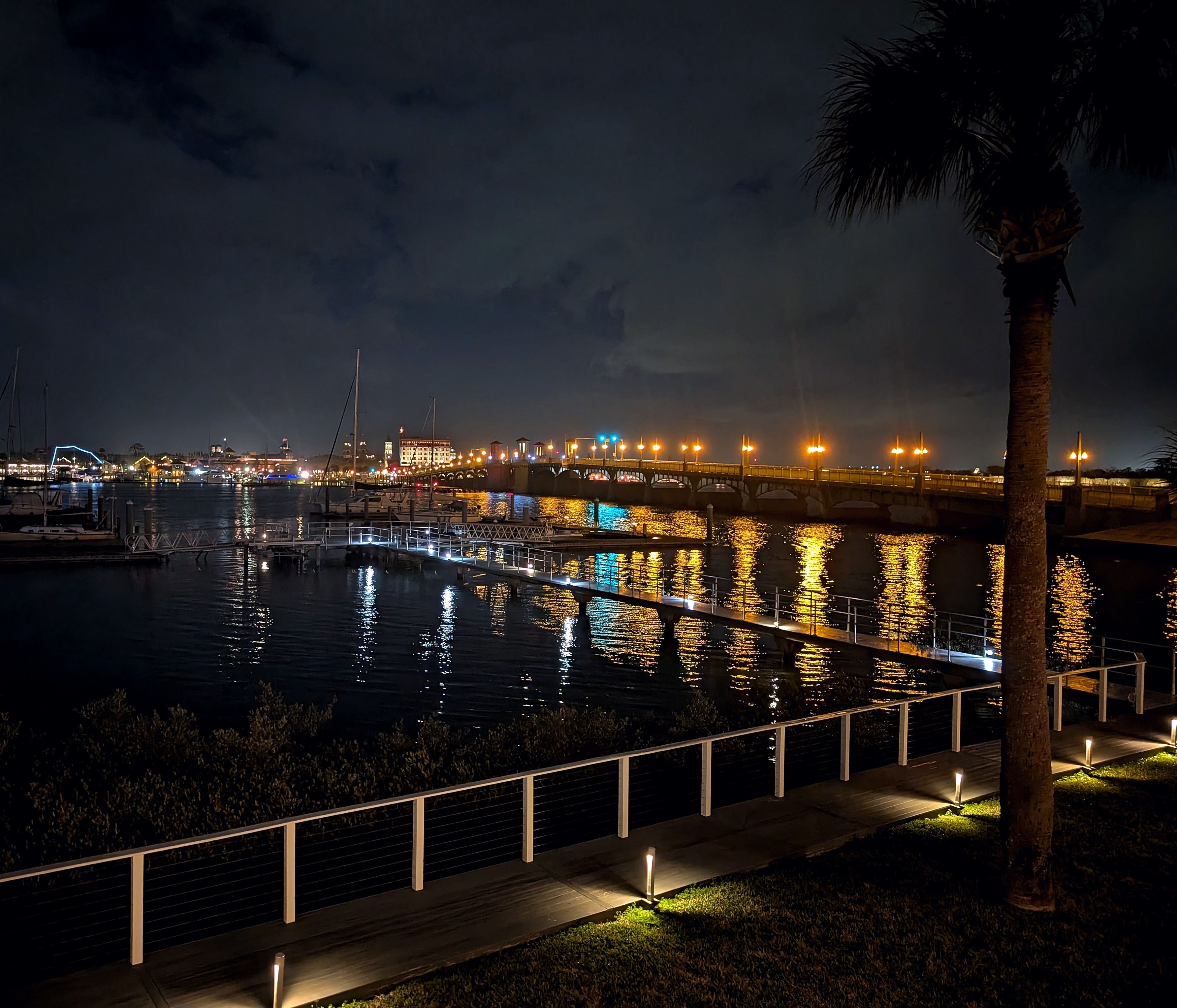
…and I think I see one of the issues. I don’t believe he purposefully fogged/blurred it, but it obviously looks different than the original. I like the mystery of it, perhaps more than my original. I think all in all, I would crop it like this:
Not much detail lost by cropping it on the left. March 2026.
It’s not often I feel pulled in several directions on a landscape shot like this. Critters, oh absolutely! Flowers present so many ways to go. And then all the artistic shots one can take with the simple everyday patterns presented by Nature and Humans. But….weigh in if you would. Constructive comments appreciated.
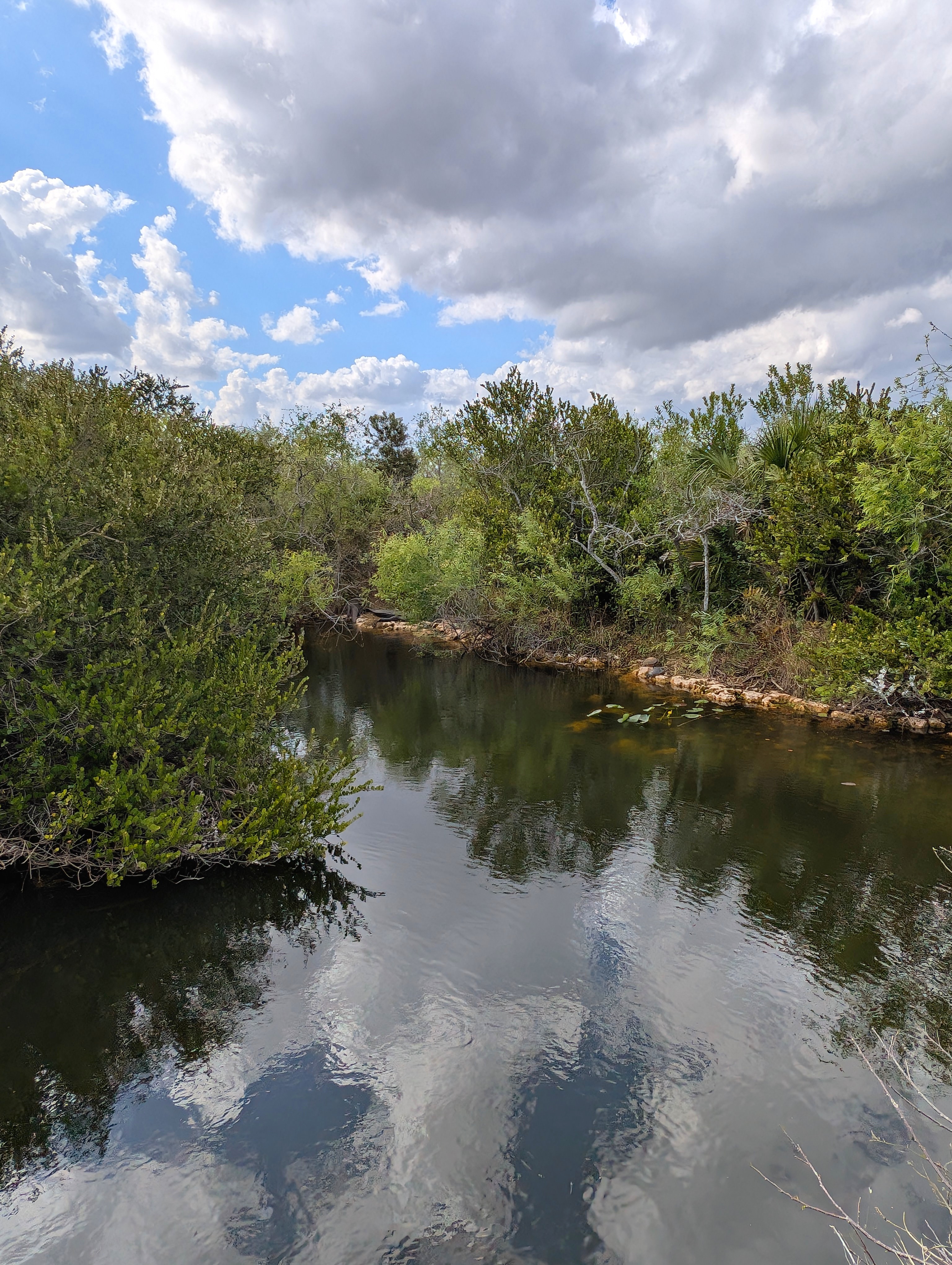
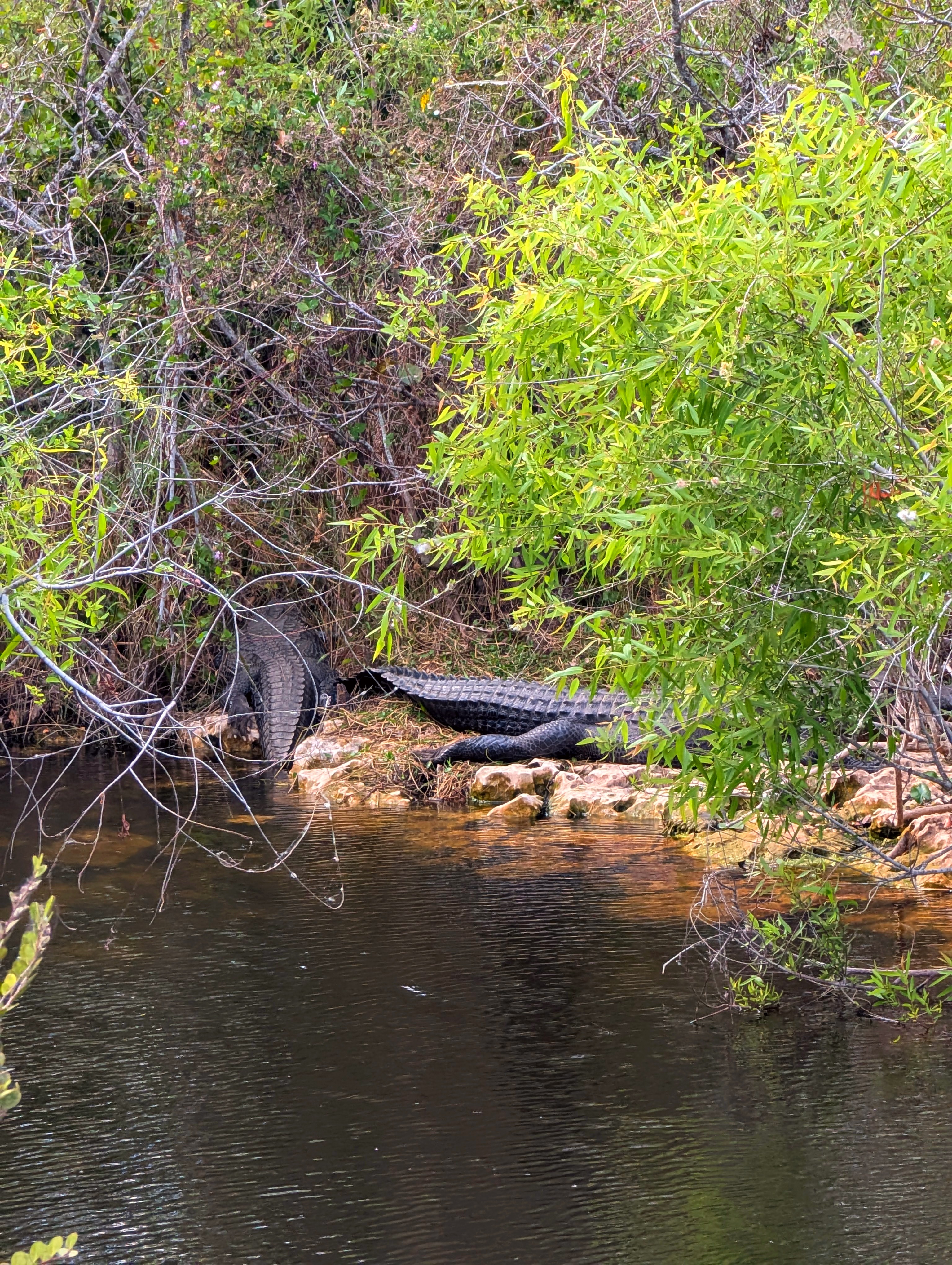
View from Shark Valley Visitors Center, Everglades National Park. There are two alligators in this photo. February 2026.
Technically we re-entered the Everglades National Park at the end of our day in the Big Cypress National Preserve, stopping at the Shark Valley Visitors Center at the end of the afternoon. We didn’t want to take the tram ride to the actual Shark Valley viewing tower, which left us little to do there. Another hour brought us to Homestead, FL. I discovered a Cuban restaurant next door which delighted me a great deal. But first, where are those alligators in the photo above? Look up that slough in the center of the photo. On the far bank? Just above the light-colored shoreline? Here’s a zoomed in photo:
Alligators at Shark Valley Visitors Center. February 2026.
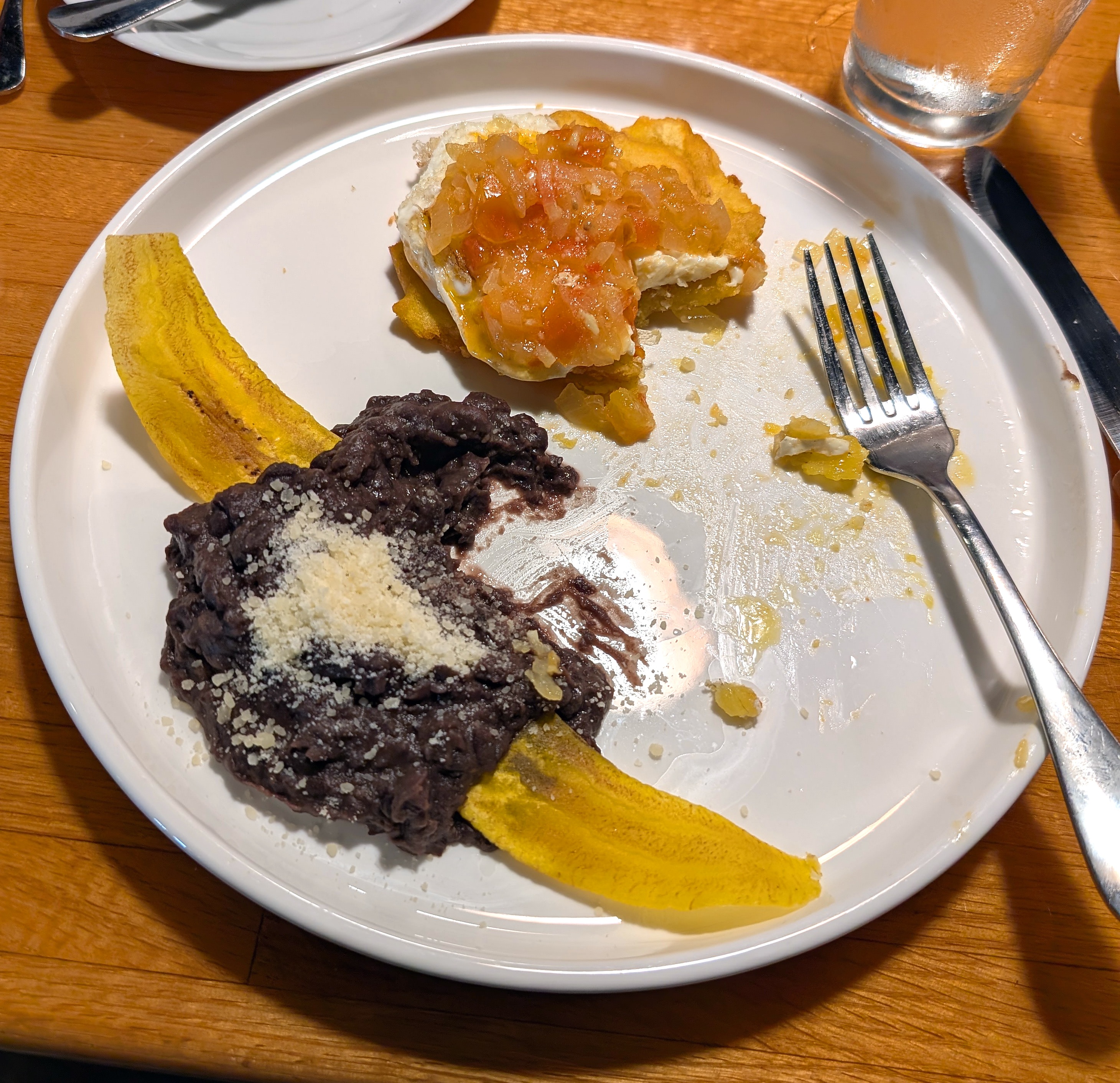
We hit up the Cuban restaurant for breakfast, easily besting the hotel’s “continental” offering, then headed to what I still regard as the heart of the Everglades—the Ernest F. Coe and Royal Palm Visitor Centers and the road which leads deeply through the park until it reaches Flamingo where one can stare southward at the Florida Keys. We arrived just as the Coe center opened then headed southward.
Huevos rancheros, Cuban-style: plantain pancake under the egg and a fruited salsa atop. February 2026.
After spotting a half dozen or so school buses in parking lot, we decided to visit Royal Palm at the end of our day, on the way back out of the park. Quietly spotting wildlife with a hundred or so elementary students alongside (we checked) seemed to be mutually exclusive. We stopped at some of the major sights on the way south, a few on the back out.
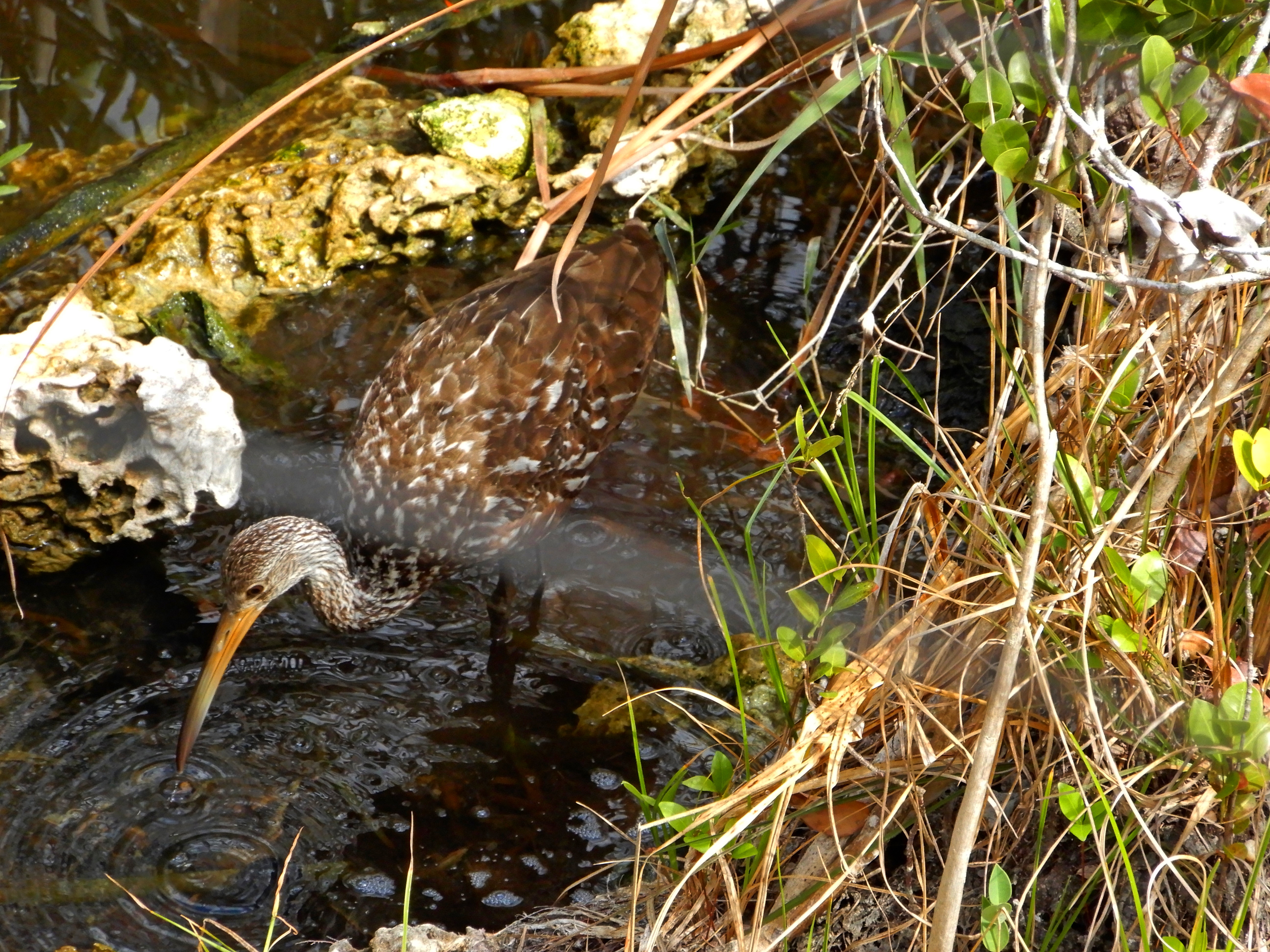
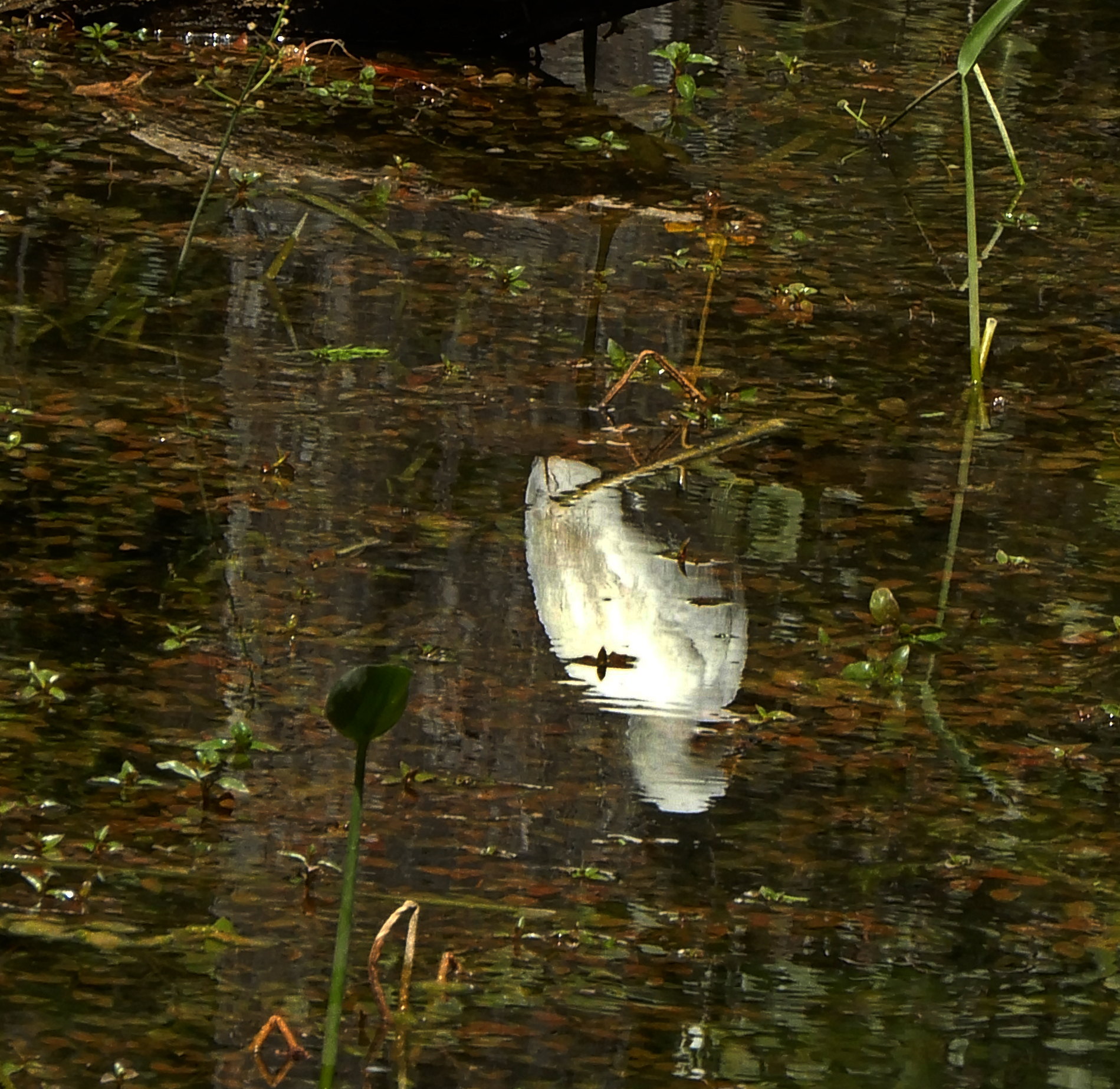
A juvenile heron. Not sure which one. Looks like a Black-crowned Night Heron, but those don’t have the yellow/orange beak. Closest I can come would be a Tricolored Heron but it doesn’t seem to be quite like this patterned brown. February 2026.
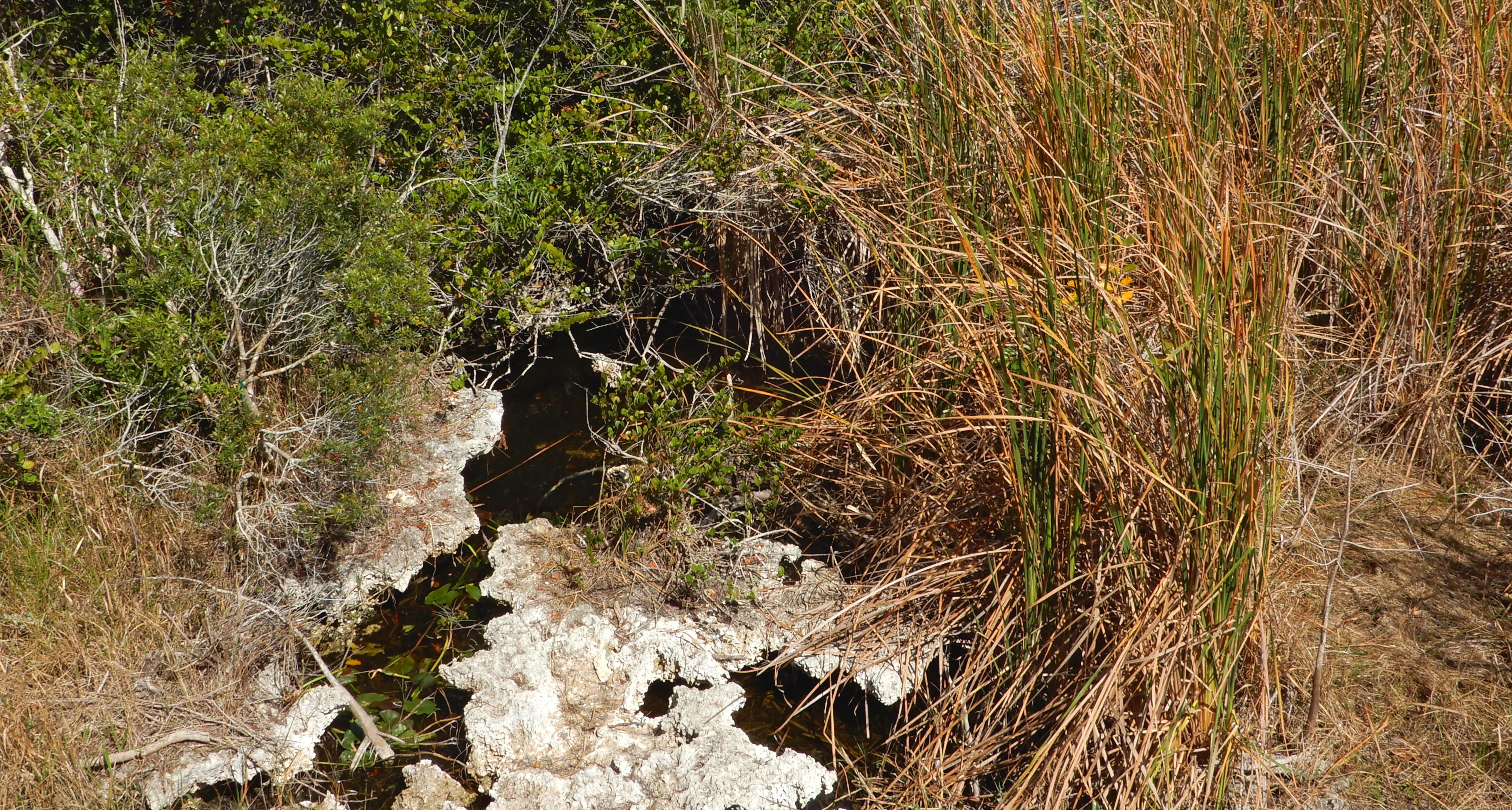
Small drainage creek at the Pa-Hay-Okee Lookout Tower, Everglades. February 2026.
My wife spotted a heron jumping in and out of the darkness of a creek at Pa-Hay-Okee Lookout (left and above). I needed a telephoto to see what she was talking about!
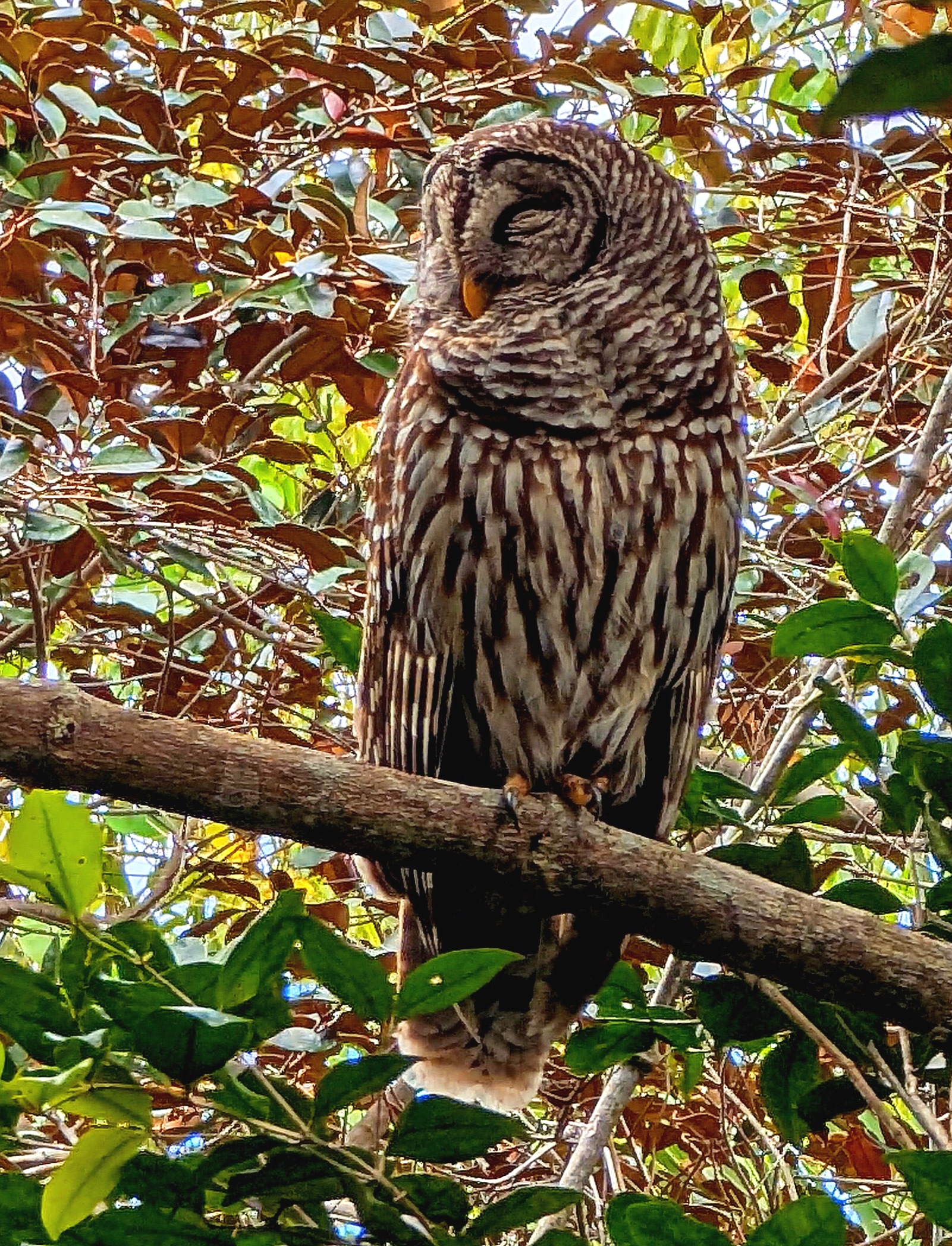
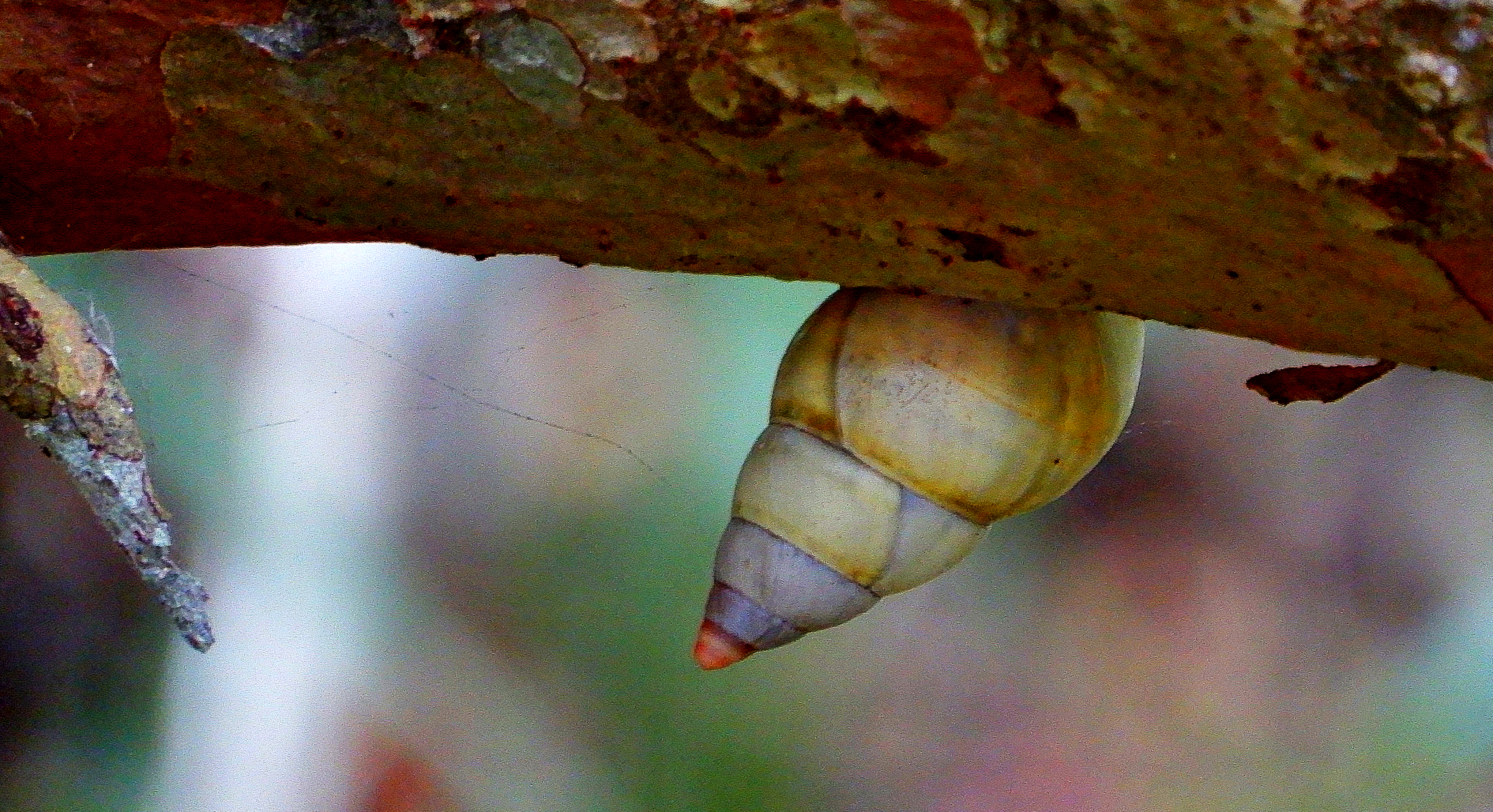
We spotted a barred owl at the Mahogany Hammock walk. While watching him (nearly positive this was a male), we were treated to a call-and-response with an owl we couldn’t locate. This apparently is classic barred owl behavior between a male and female. A sharp-eyed teenager pointed out a snail which I had difficulty locating even after she had described the location. Other attractions at this stop included huge root systems seen from underneath because hurricanes had blown them over in the past.
Barred owl at Mahogany Hammock. February 2026.
Tree snail at Mahogany Hammock. Approximately two inches. Everglades, February 2026.
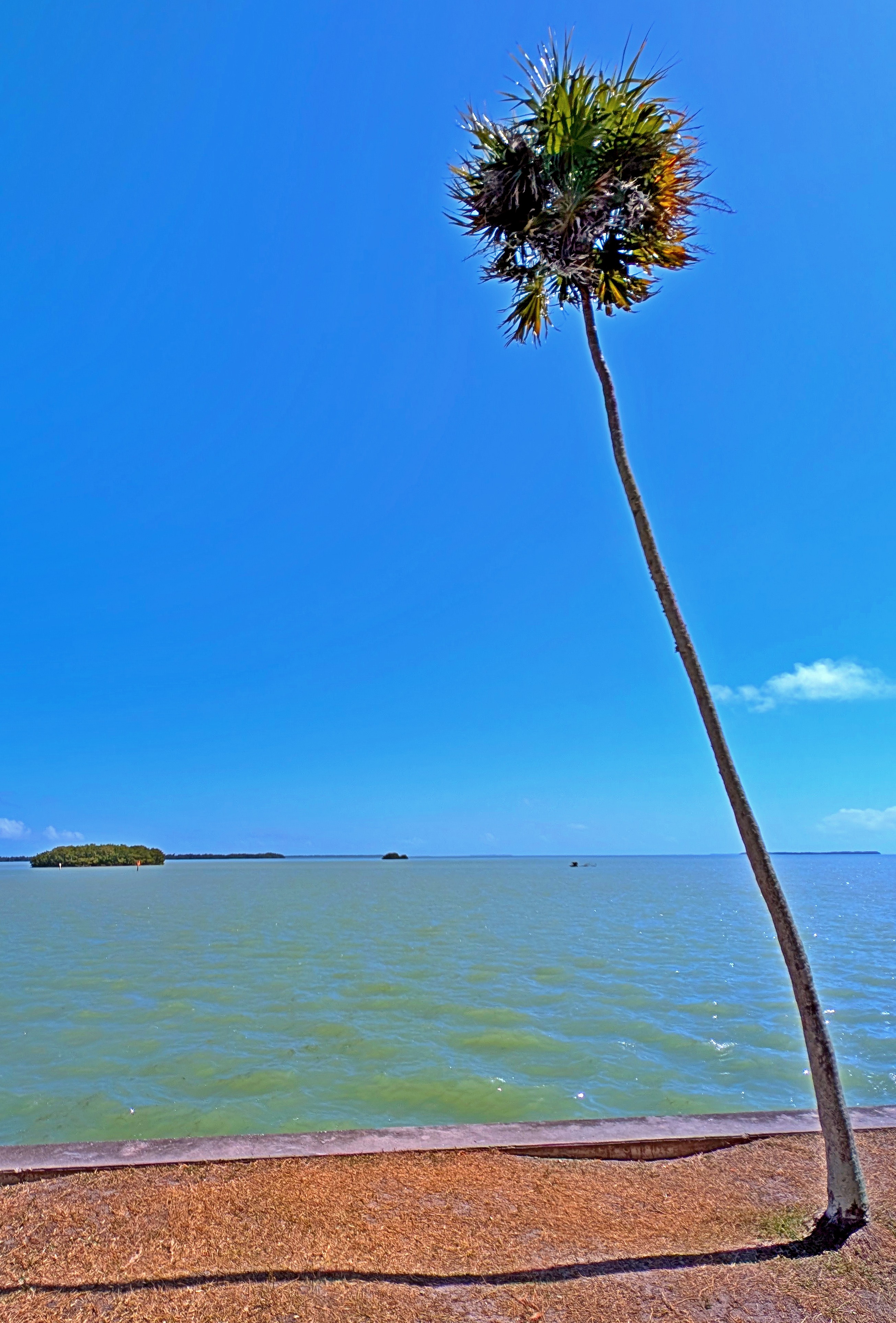
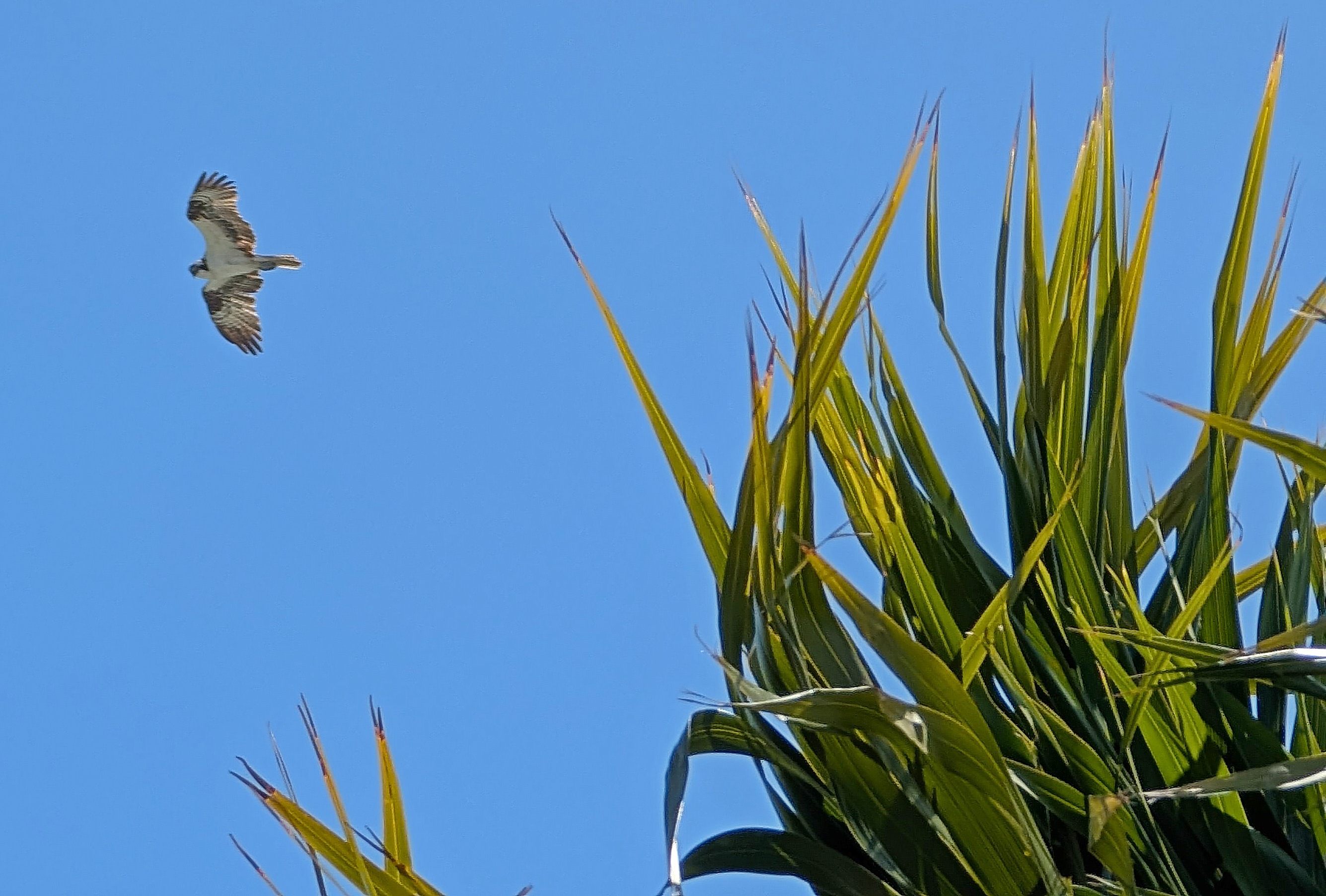
We arrived at Flamingo a bit tired. Thankfully the best thing to do there involved sitting and staring at the shallow waters leading out to the Keys—unless you wanted to take a boat charter which we had done in the past. We spotted an osprey flying back and forth over the shoreline waters, and we saw the near-ubiquitous flock of White Ibises. Then we drove north again.
A stylized view of the Keys. Flamingo, Everglades. February 2026.
Osprey at Flamingo, Everglades. February 2026.
We turned around and drove north toward the Royal Palm Visitors Center, hopefully now without the youngsters. Royal Palm deserves its own post, however, so we’ll bring this to a close.
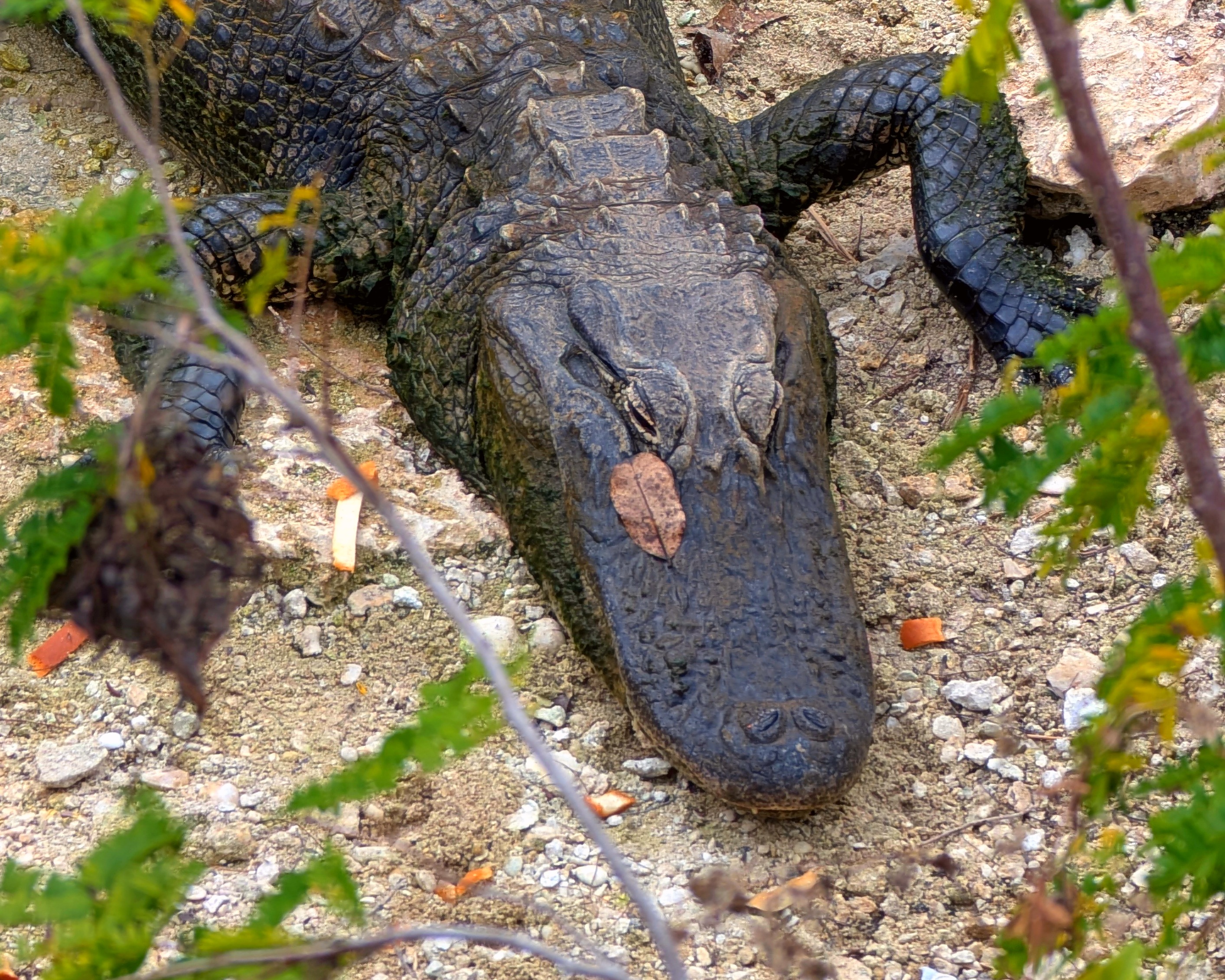
Ever had a day when it’s too damned much trouble to brush a leaf off of your face? (Yeah, I’m having one today.) Oasis Visitor Center, Big Cypress National Preserve. February 2026.
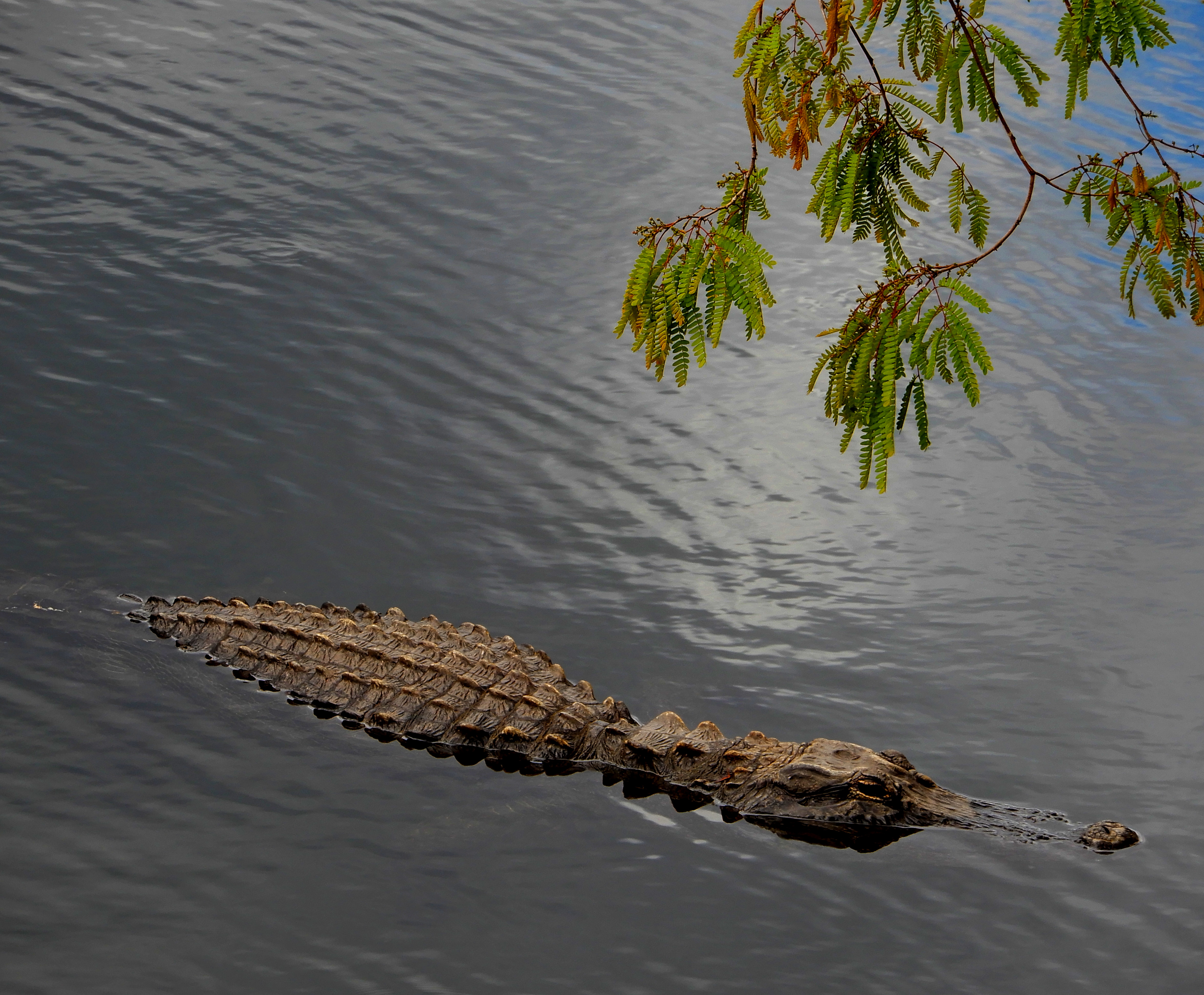
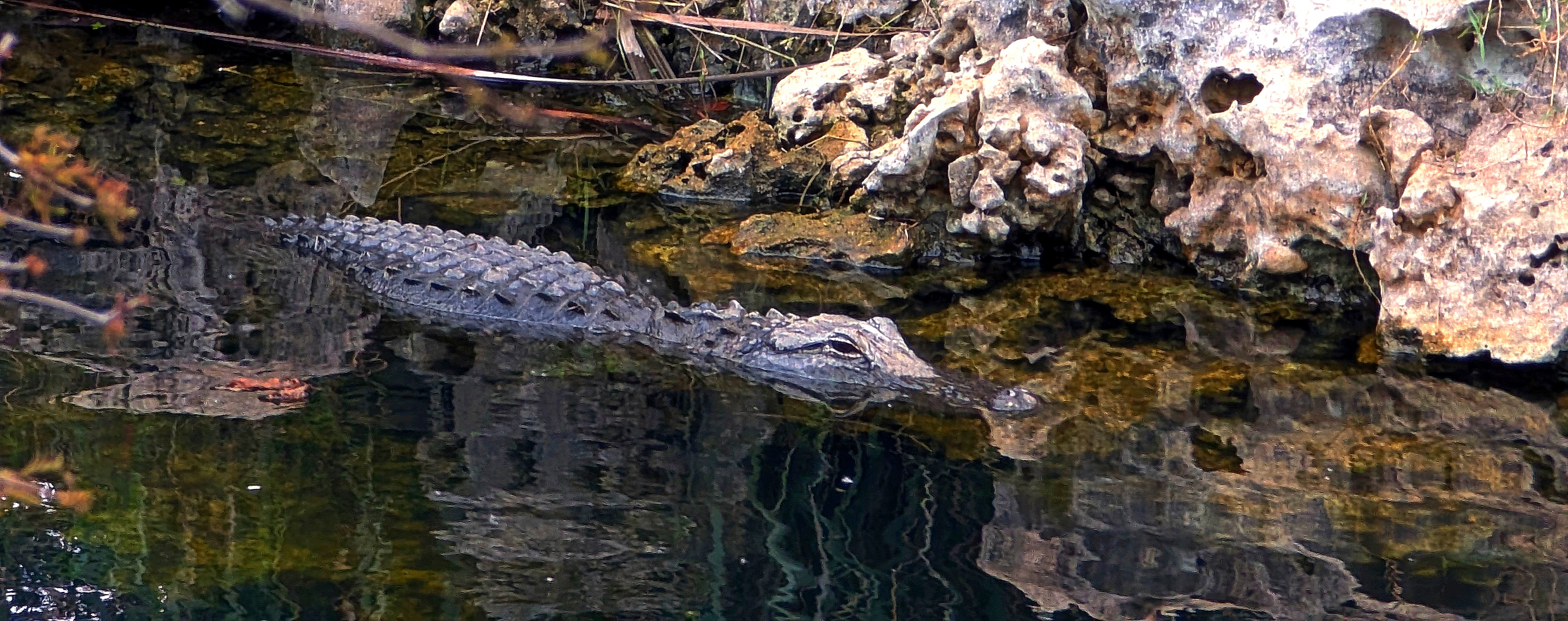
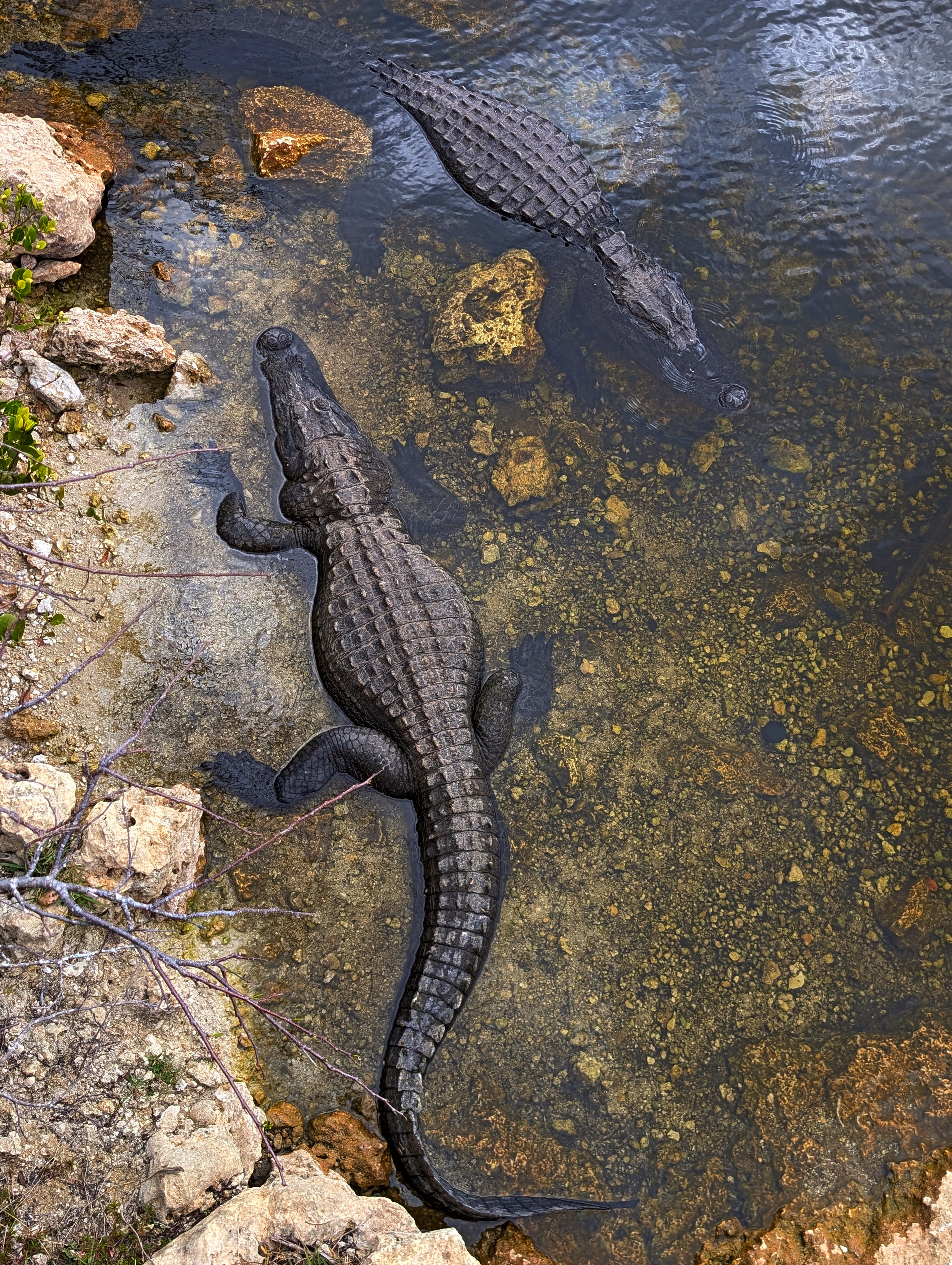
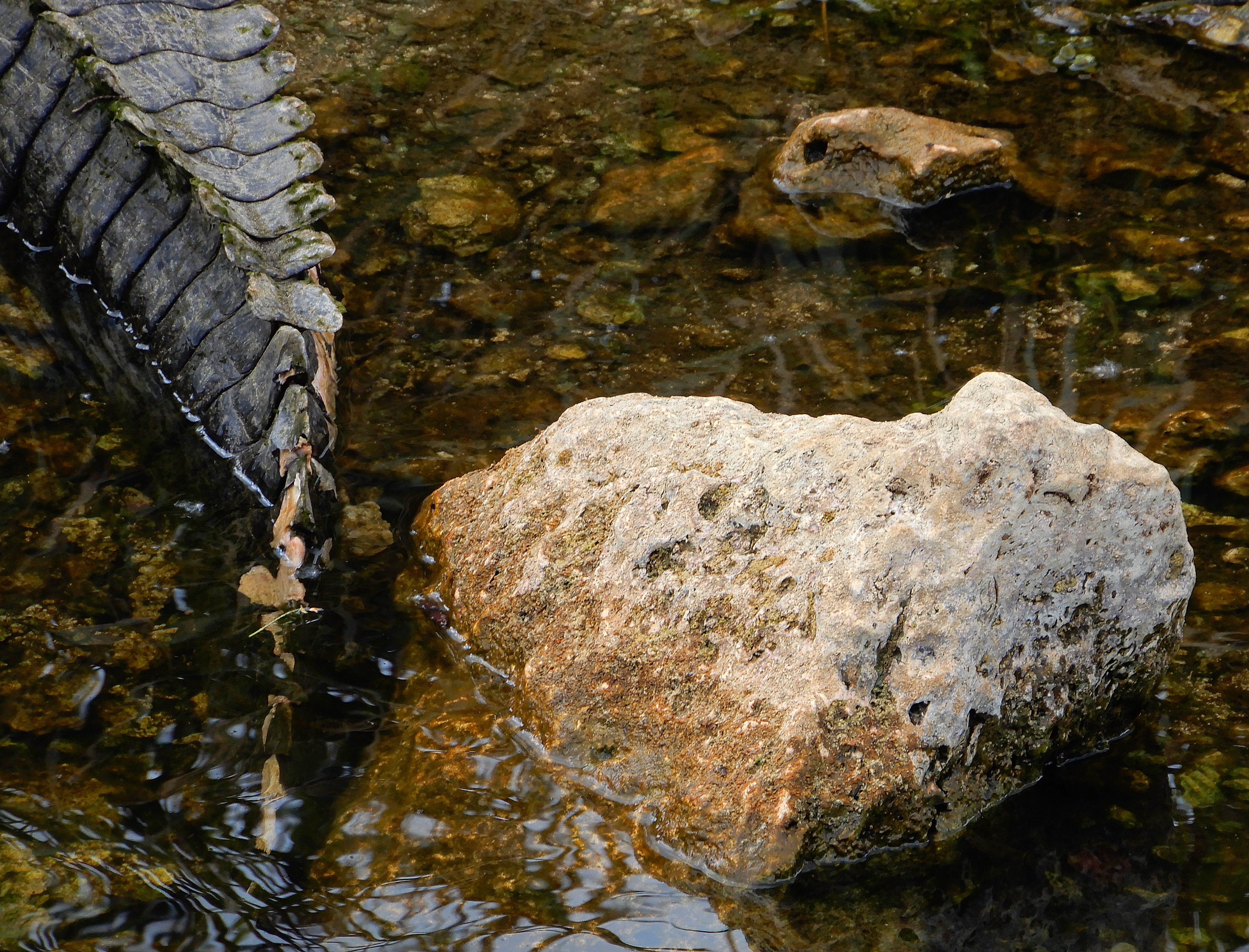
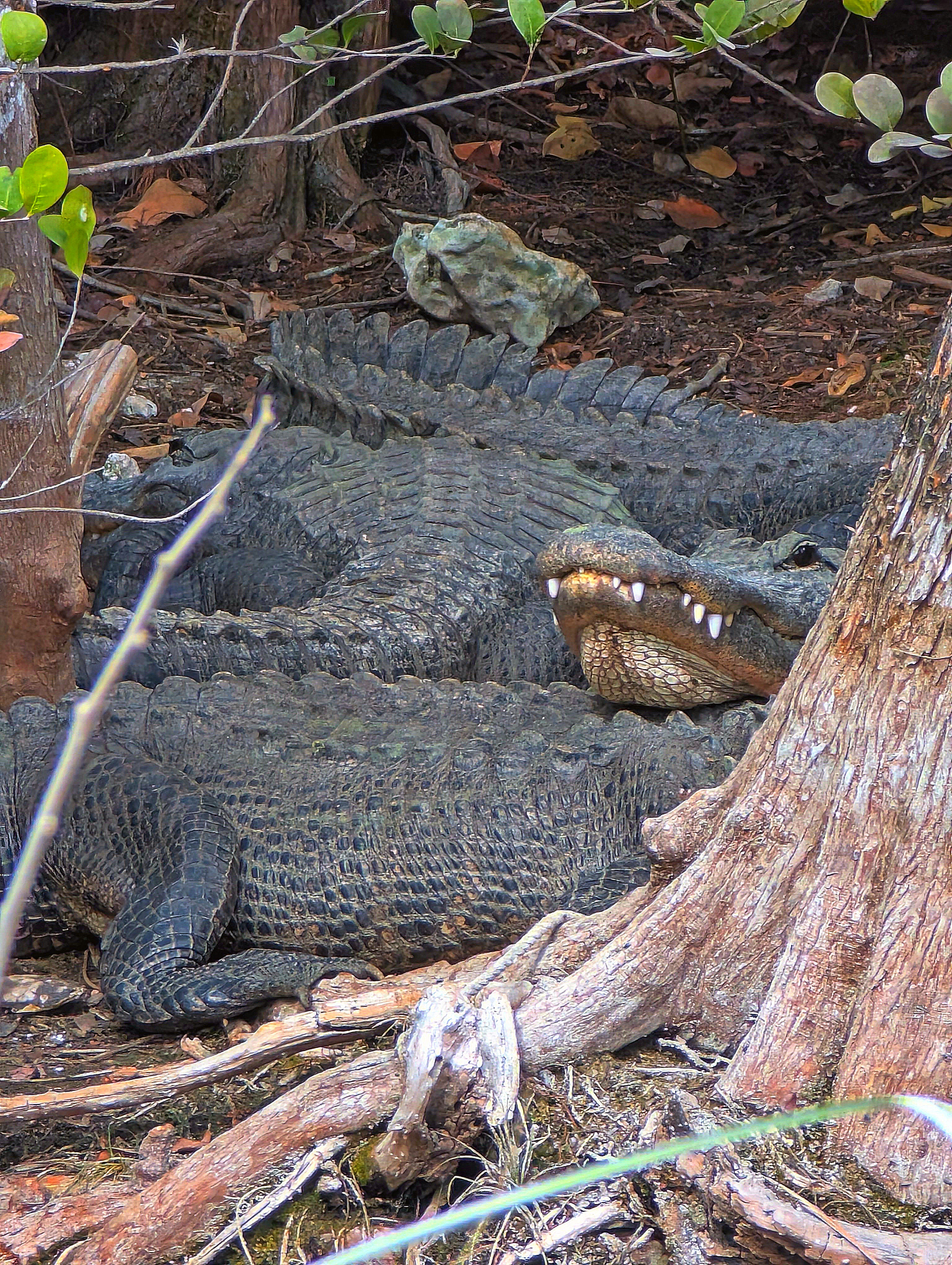
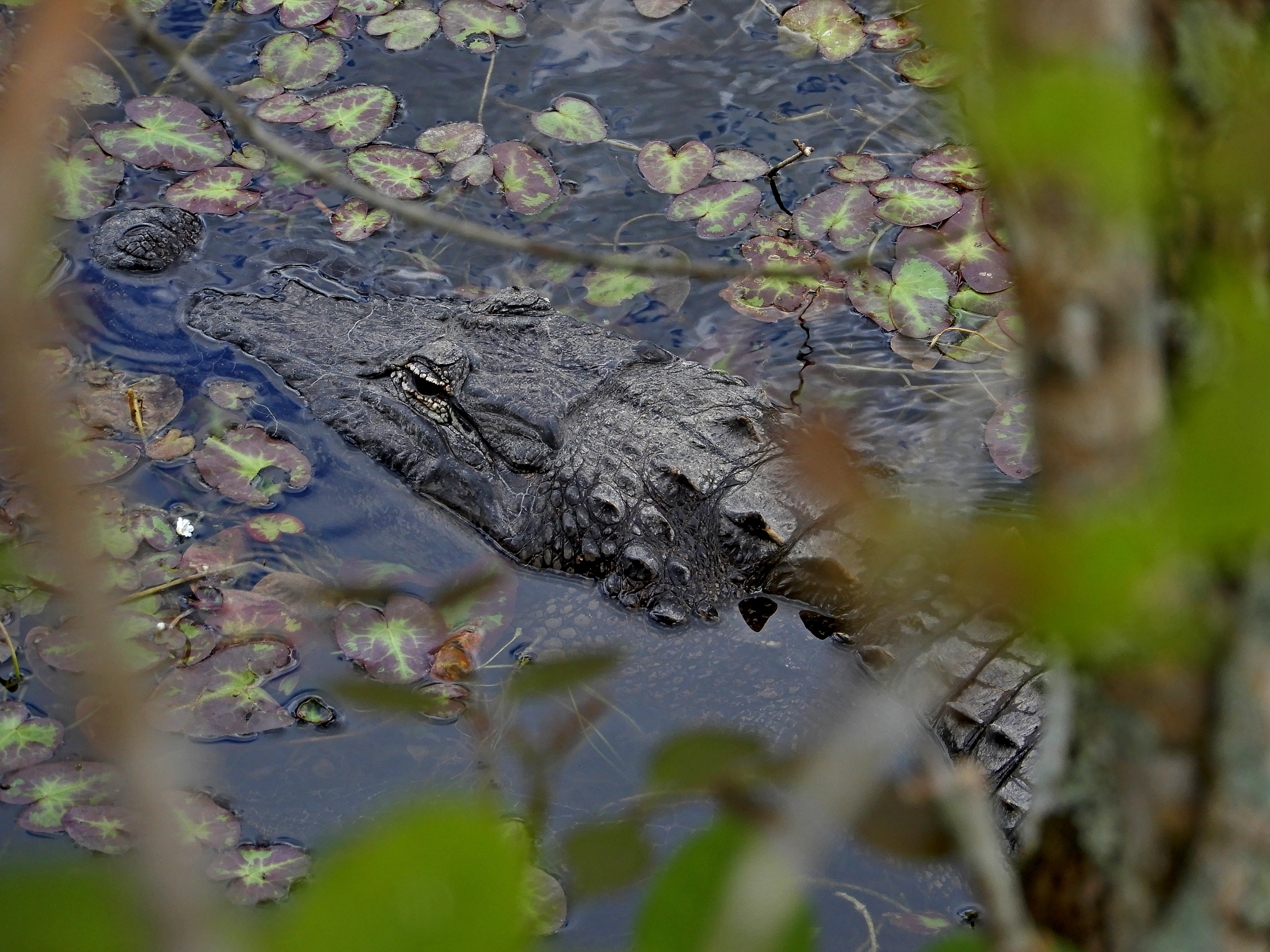
One of oddities about some of the Everglades-area areas for observing nature lies in the feeling one isn’t so much looking at Nature but more that one is looking at a ditch into which some Nature just happened to fall. The Oasis Visitor Center to the Big Cypress National Preserve on US-41 has a largish ditch running parallel to the highway. No more than 15 feet wide and likely much less, it delights the gator-gapers and folks like me who don’t mind looking at big reptilian laze-abouts who don’t offer much of a challenge to the person seeking them out. Here are a few to illustrate my point:
“I don’t care if you can see me. I’m just judging how close you are…and how slowly you move.” Oasis Visitor Center, Big Cypress National Preserve. February 2026.Alligator with rocks. Oasis Visitor Center, Big Cypress National Preserve. February 2026.Stilllife with gators. (Redundant.) Oasis Visitor Center, Big Cypress National Preserve. February 2026.Implication. Oasis Visitor Center, Big Cypress National Preserve. February 2026.
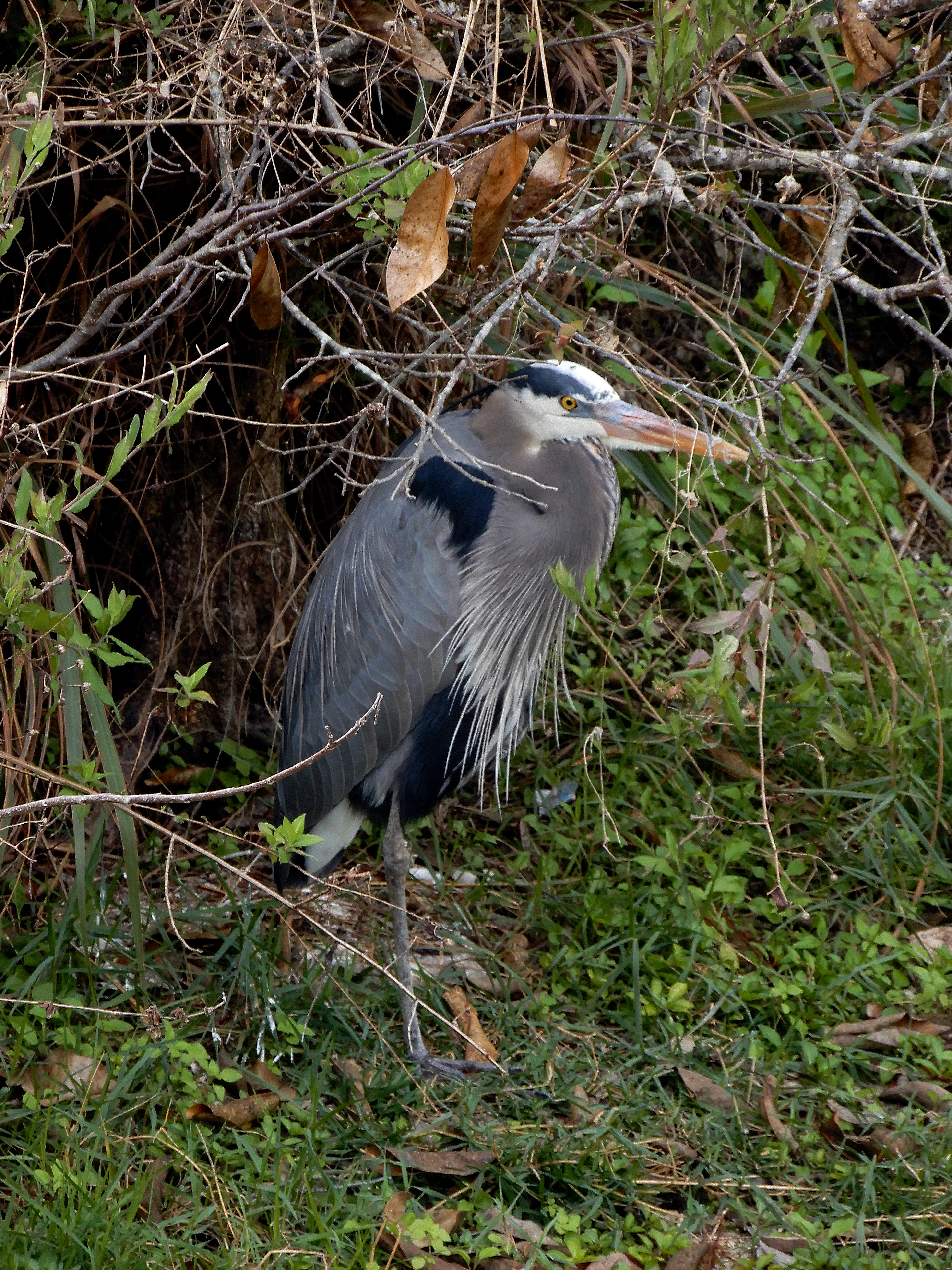
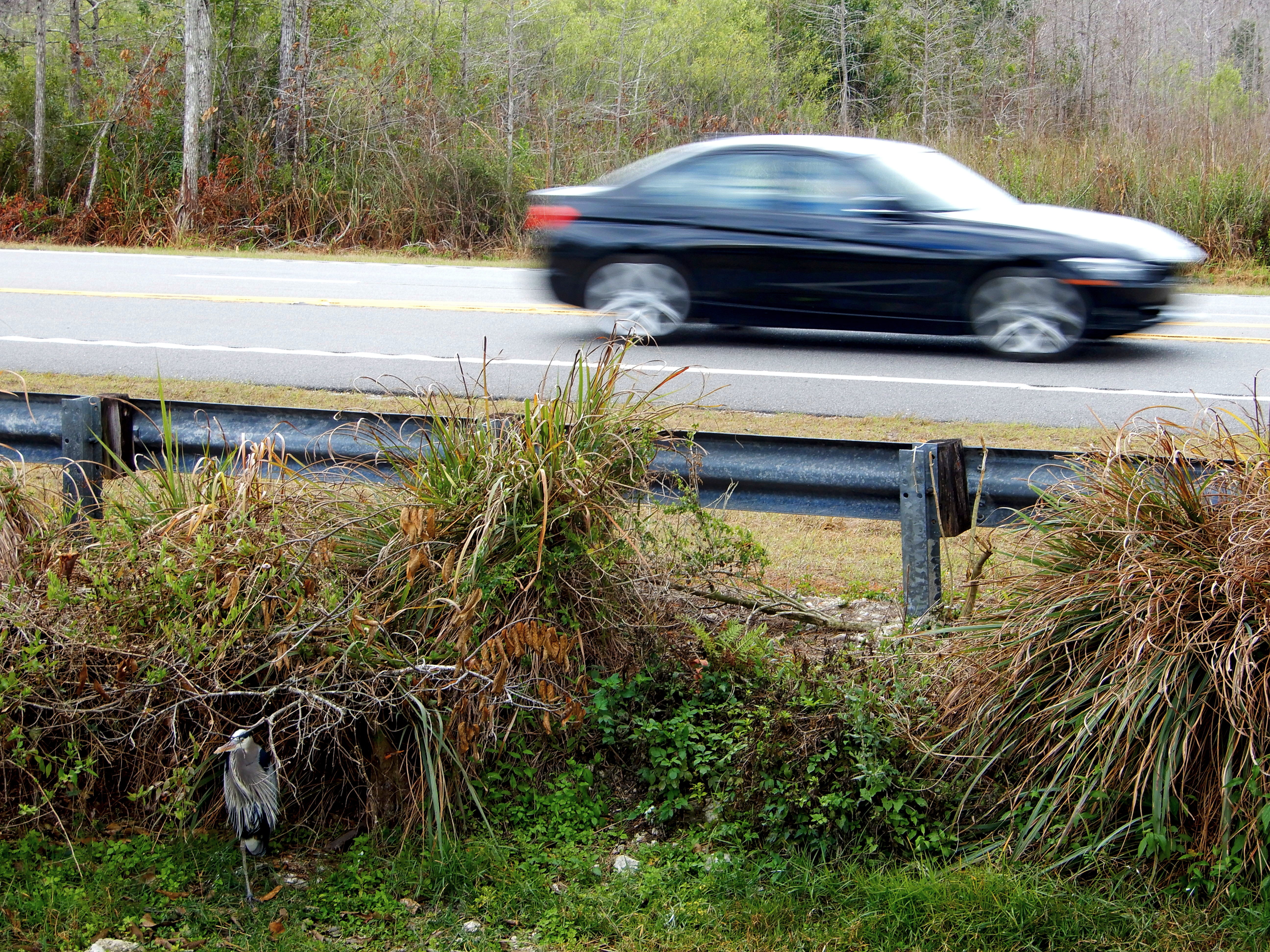
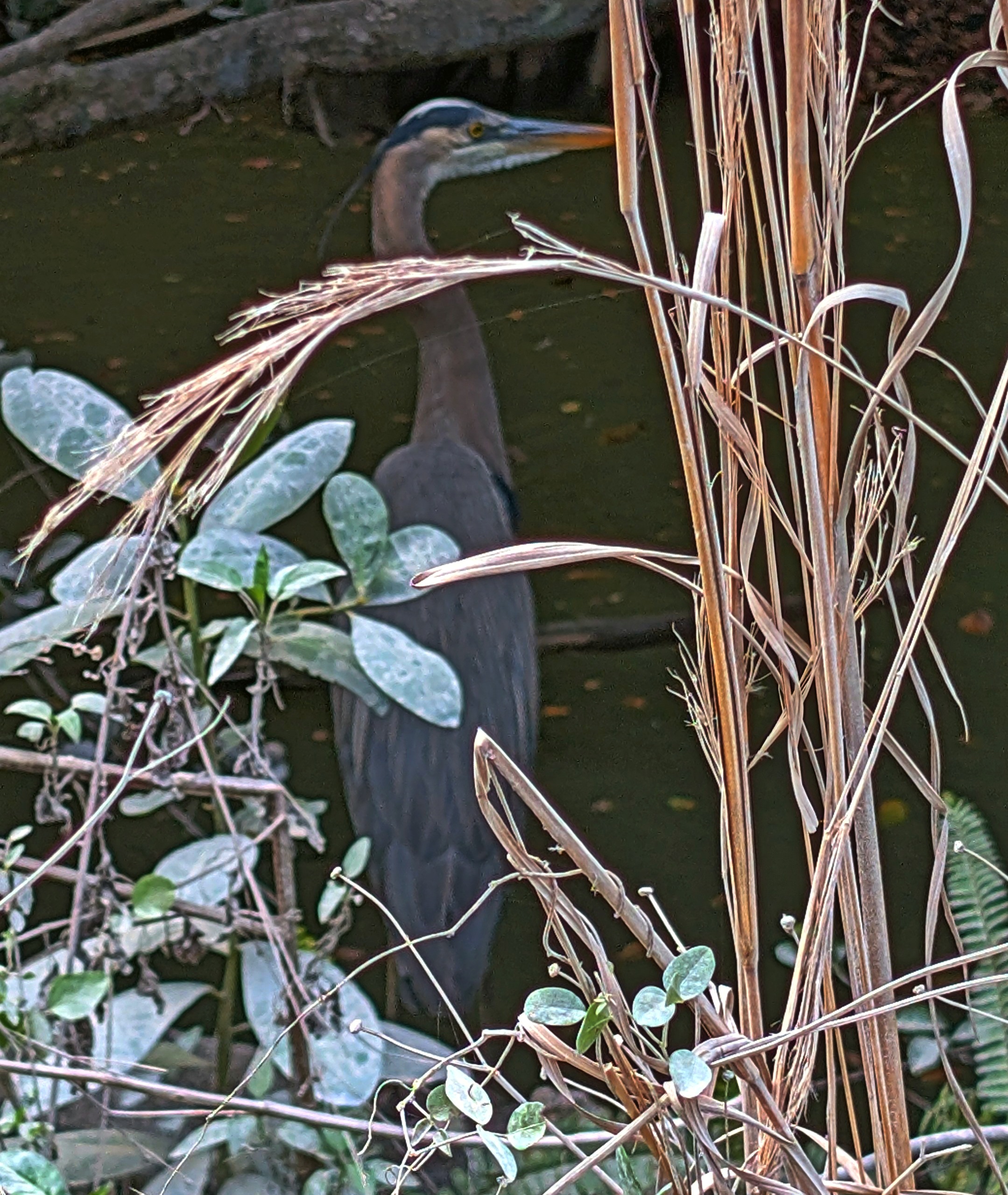
Lest one think the only denizens of this ditch were the alligators, I present some other residents. On the far side of said ditch stood a Great Blue Heron in full breeding plumage. He didn’t seem to mind the nearby highway.
Great Blue Heron. Oasis Visitor Center, Big Cypress National Preserve. February 2026.I trust guardrails less than this heron. Oasis Visitor Center, Big Cypress National Preserve. February 2026.
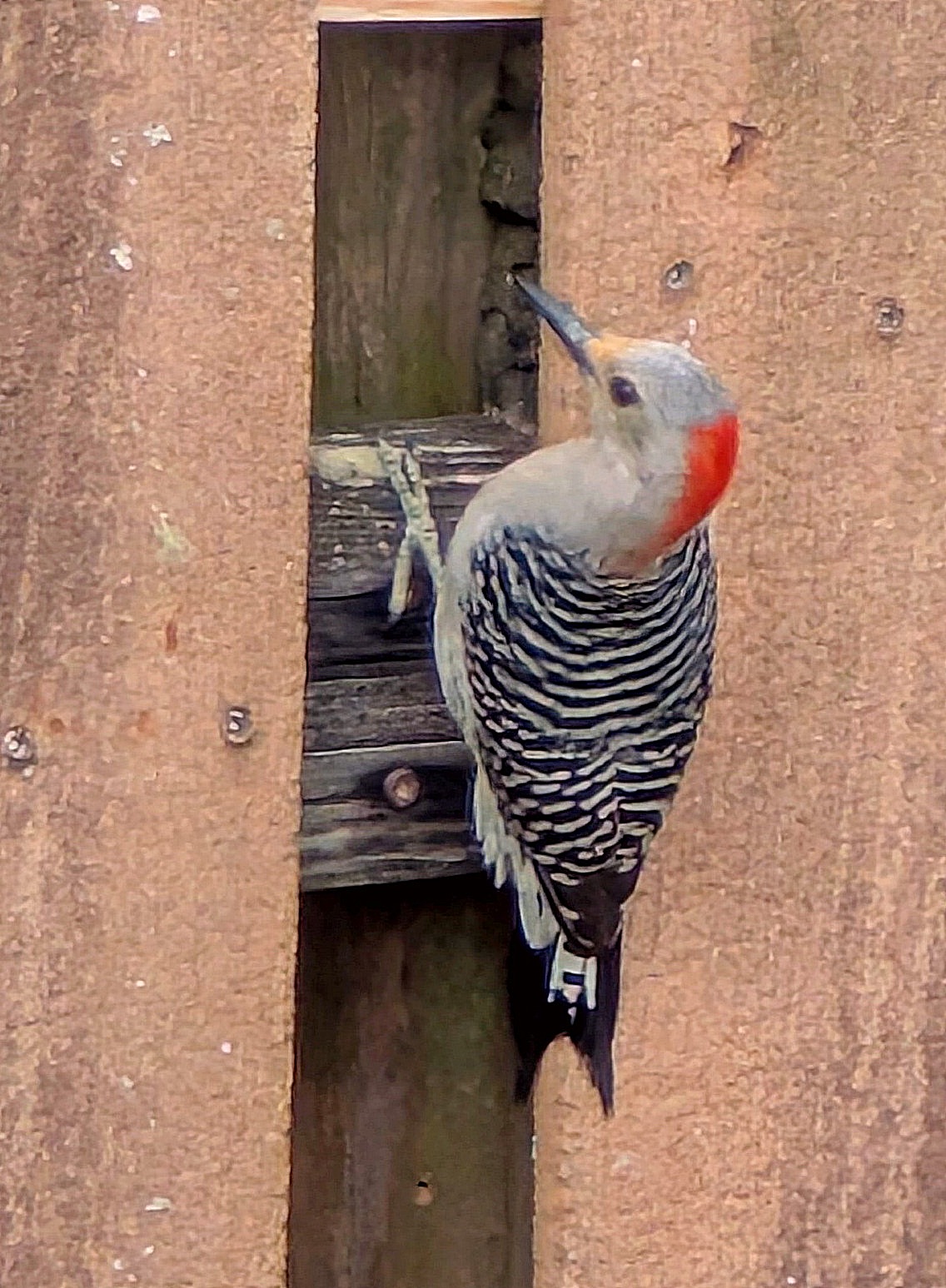
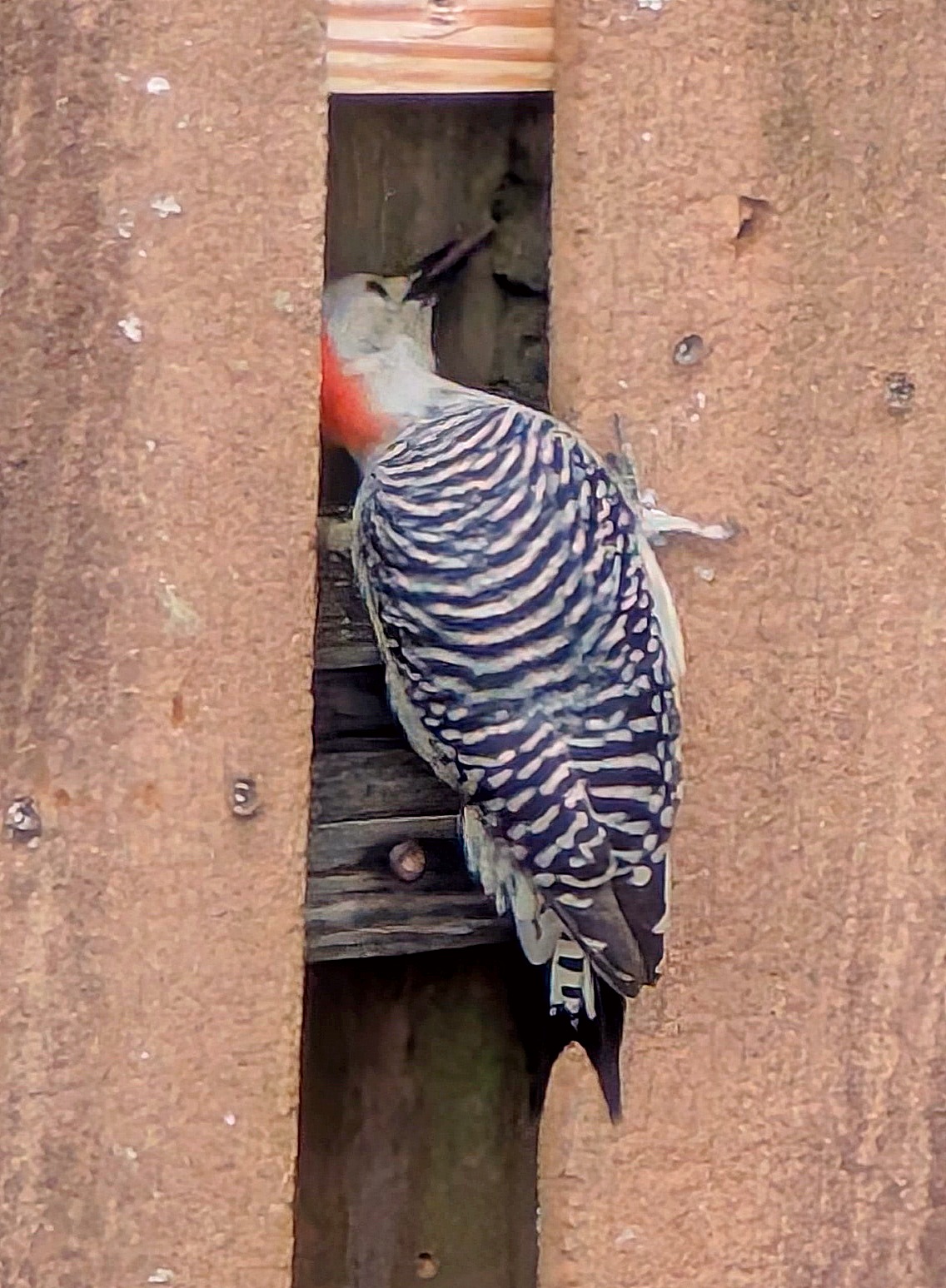
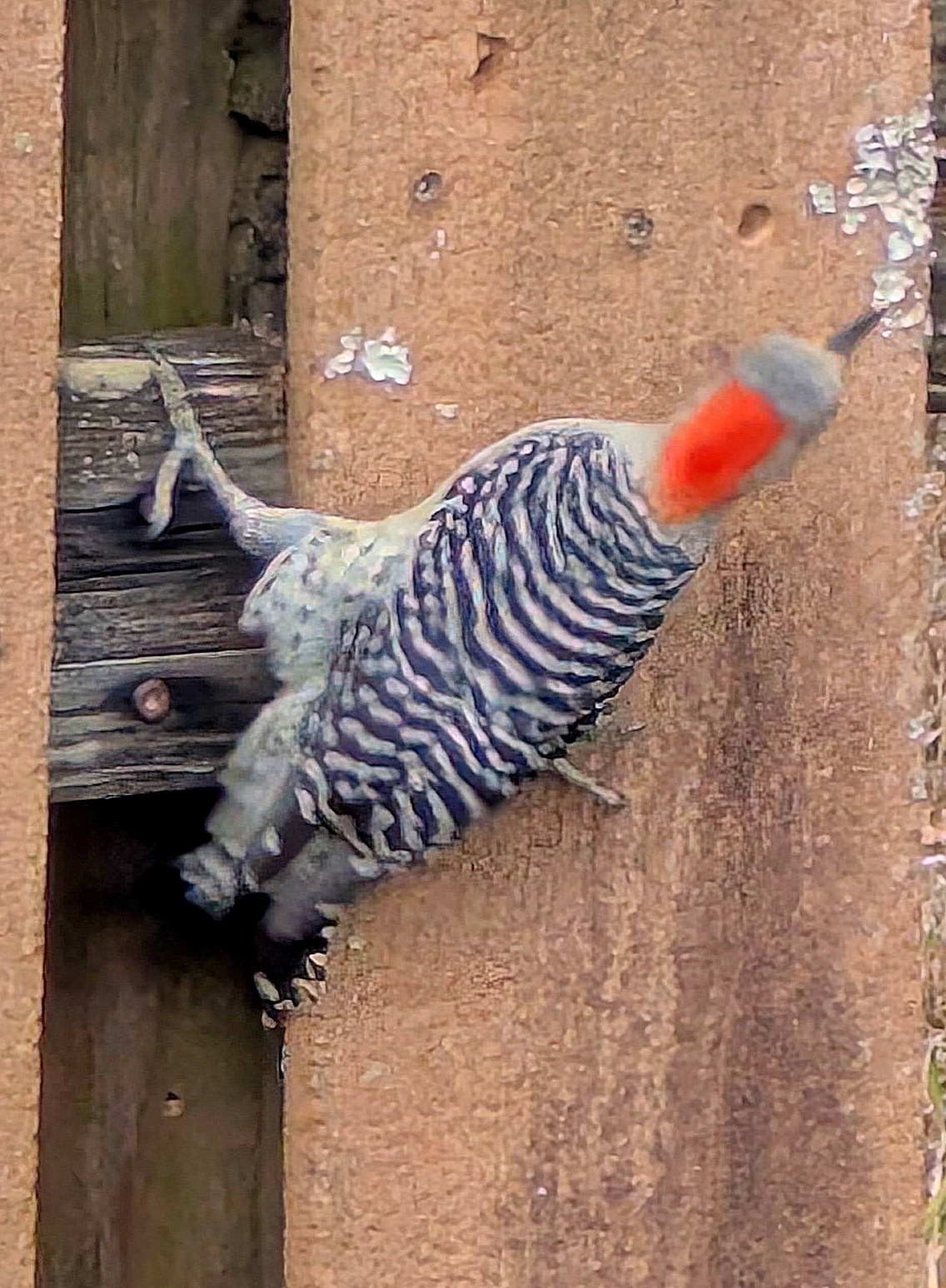
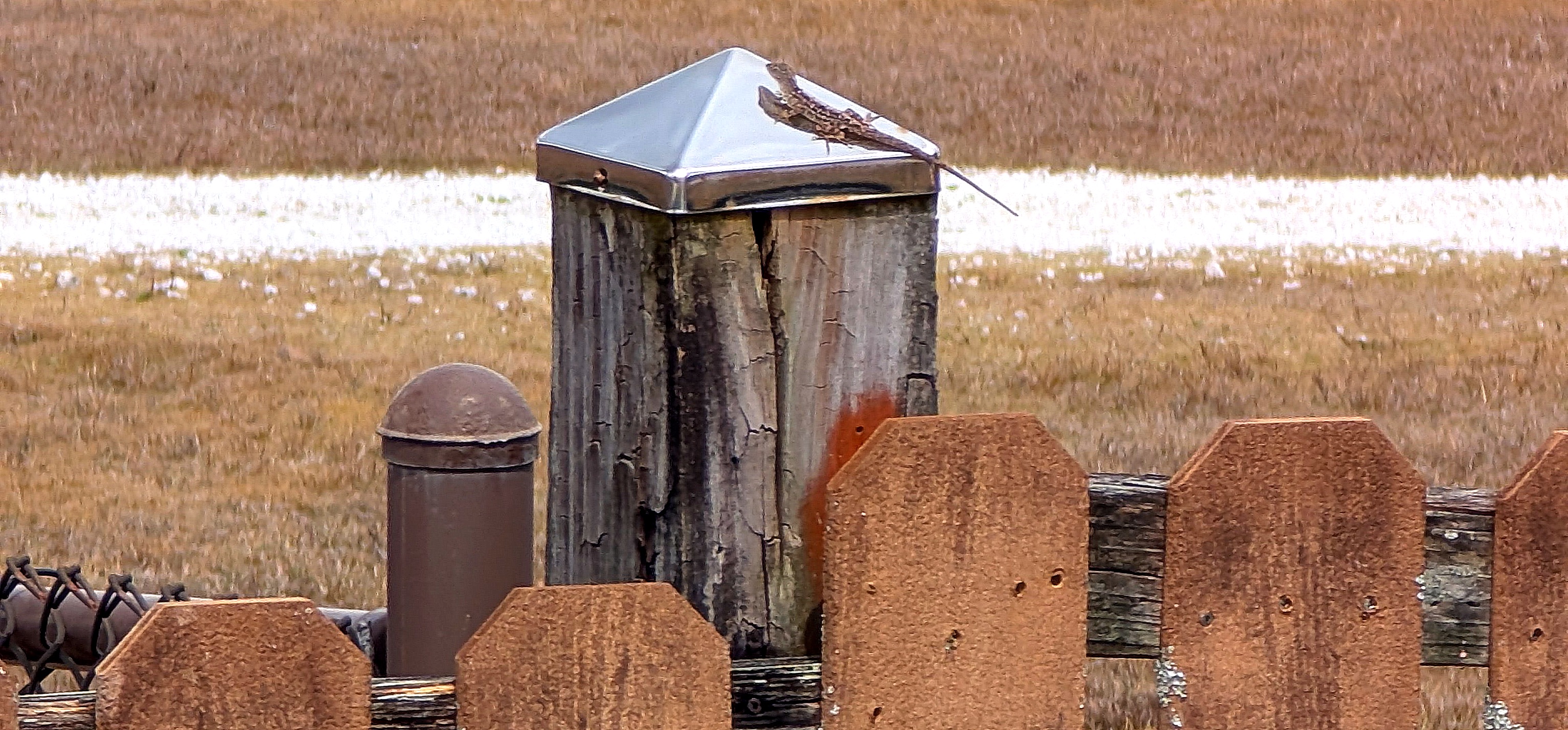
Turning back toward the Visitors Center proper, another birding couple pointed out a Red-bellied Woodpecker which frustratingly couldn’t locate a lizard. Said lizard had moments before been on the fence but had since retreated to the top of the fencepole.
I wonder how a lizard knows it’s much safer at the top of the pole? He waited until the woodpecker finally left, then returned to his original position.
Leaving the Oasis Visitors Center, we backtracked four miles to the turnoff for the Big Cypress Loop Road Scenic Drive. We’d been told the road was rough “but you’ll be okay in your SUV” but really any vehicle could take this road except for perhaps a tiny thing like a Fiat or Smart Car. Suspension would be the main issue here, since the road consists of hard-packed dirt, rocks, and a LOT of dust. Driving slowly through the first miles, we had watery land on either side of the raised roadway. This boded well:
Great Blue Heron. Big Cypress National Preserve. February 2026.
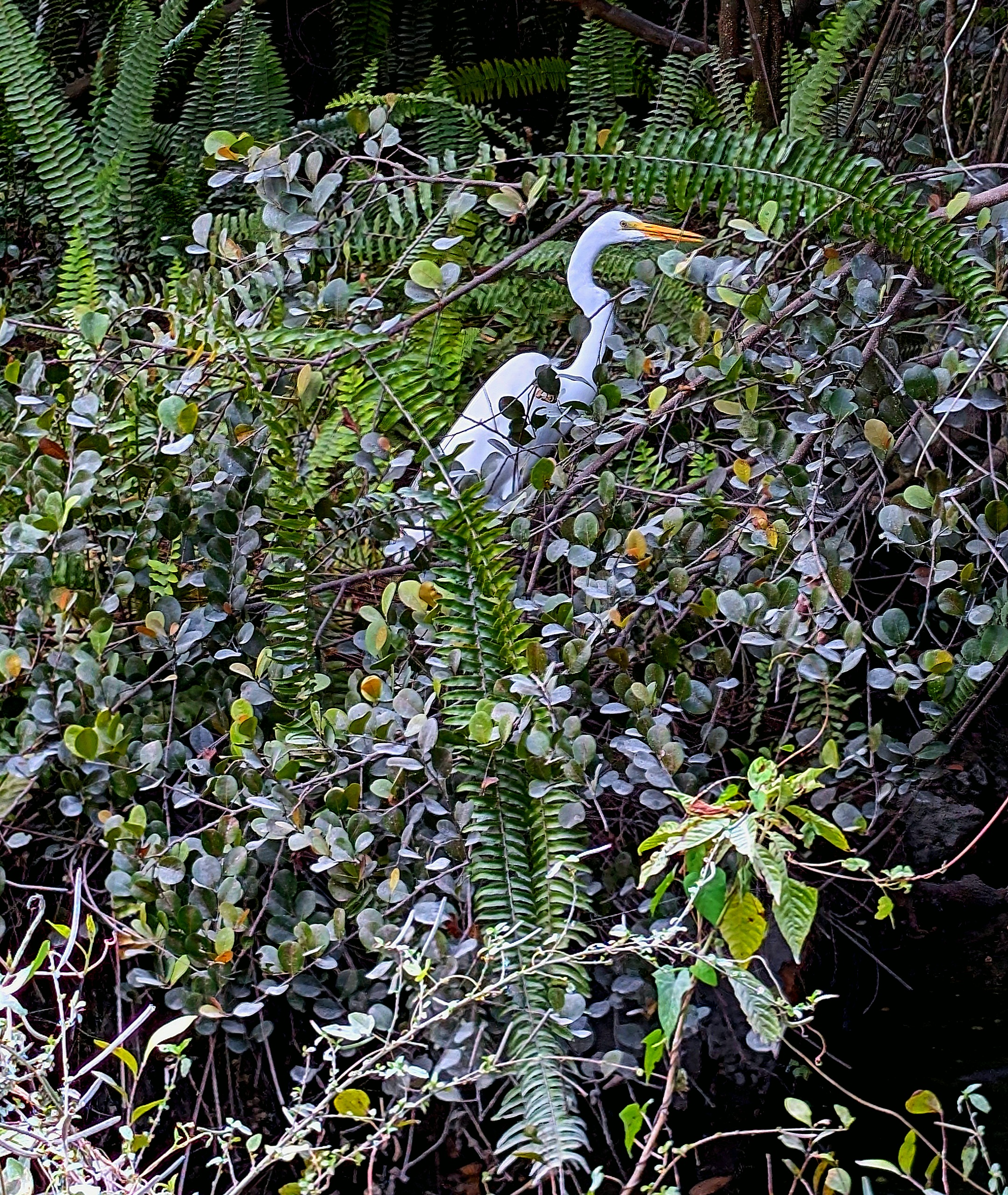
Great Egret. Big Cypress National Preserve. February 2026.
…and then we hit the birding jackpot…a waterway on both sides of the road, darkened by overhanging limbs from a variety of trees and such. Numerous birds congregated there.
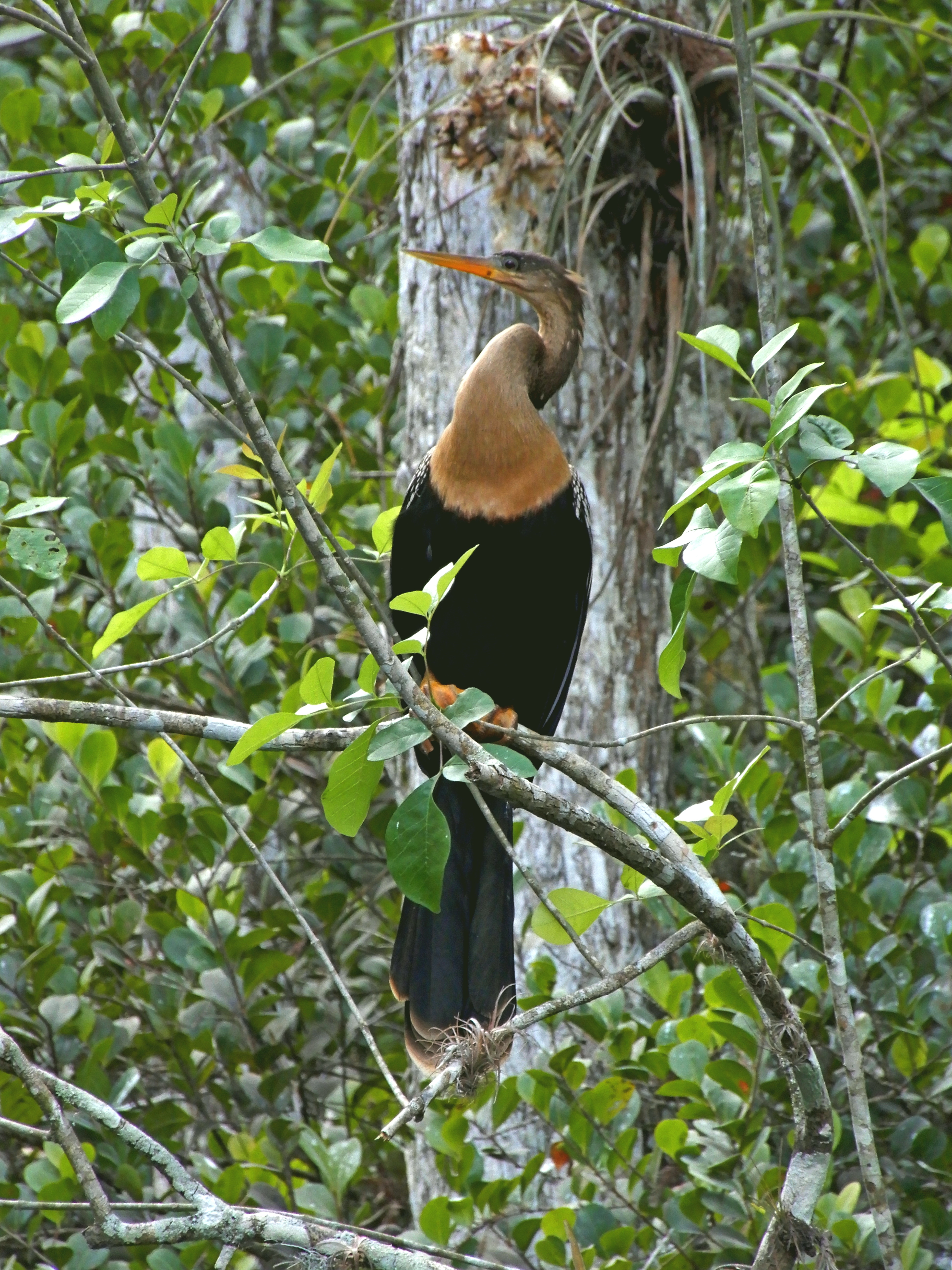
A female Anhinga surveys the swamp…or maybe the nearby males? Big Cypress National Preserve. February 2026.
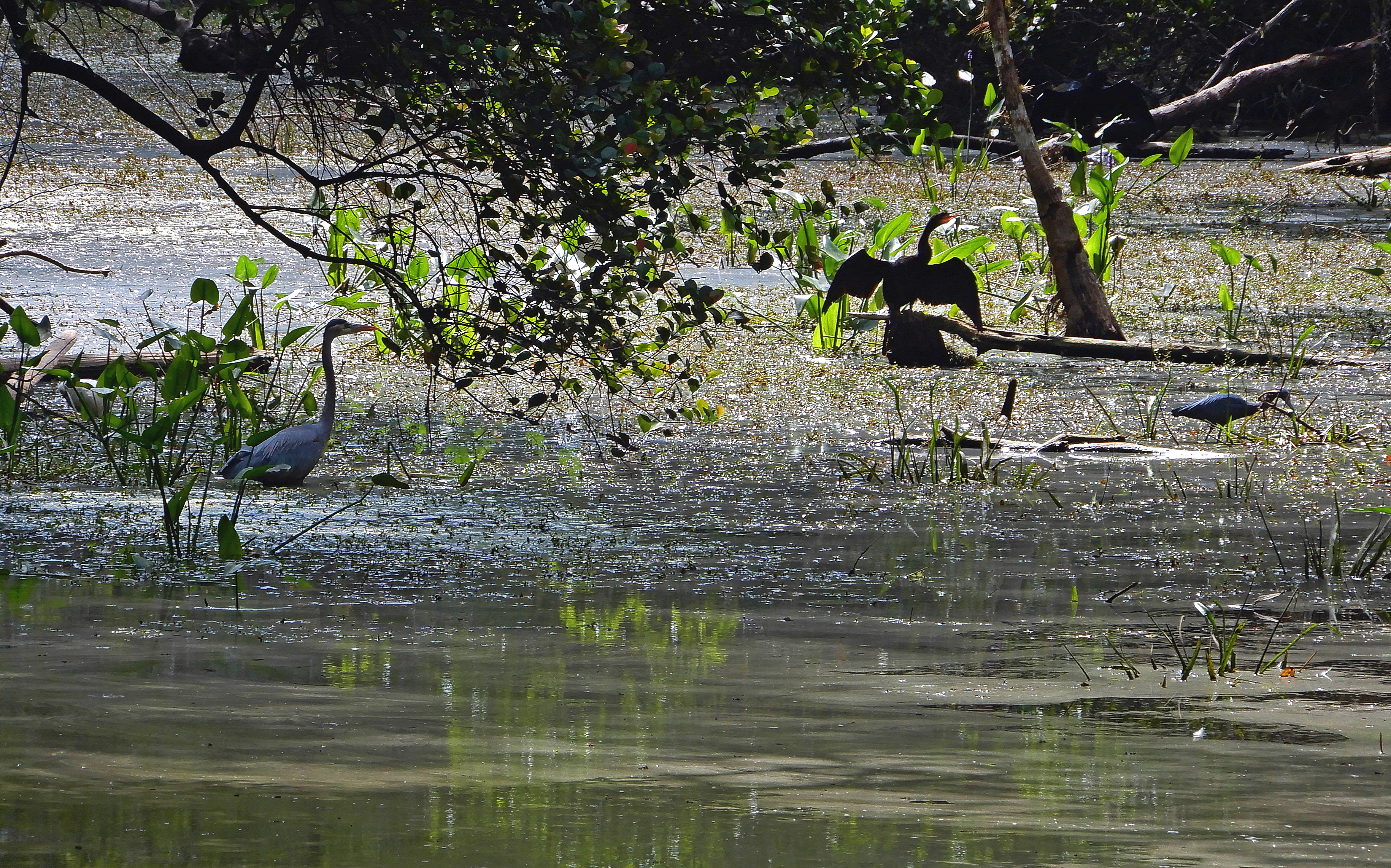
The wetlands stretched into the distance on the right side of the road where we spotted the Anhinga. We saw several male Anhingas, two or three species of egrets, and tri-colored herons.
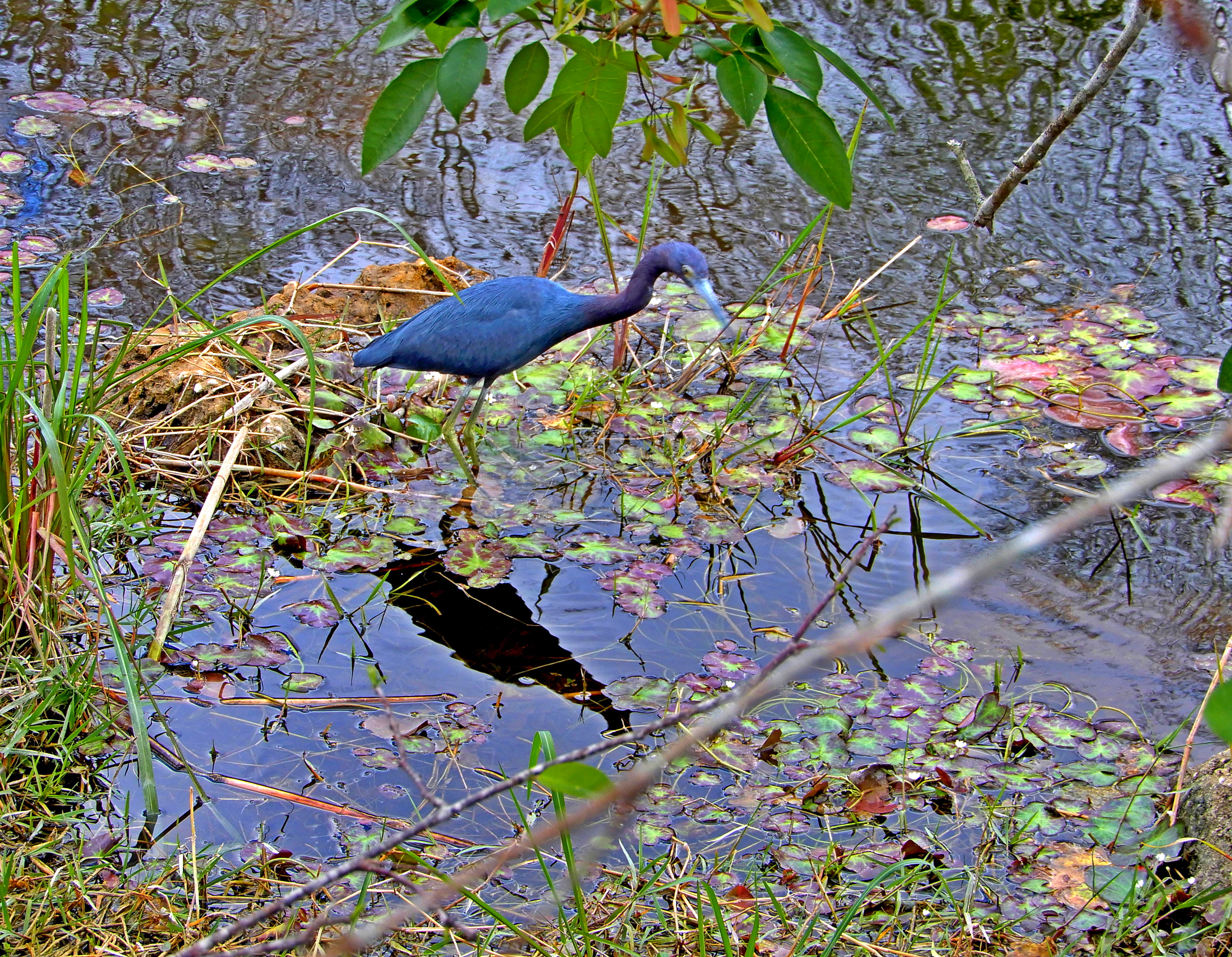
An Anhinga dries its wings in the center while two Tri-colored Herons, left and right, work the shallow waters for prey. Big Cypress National Preserve. February 2026.
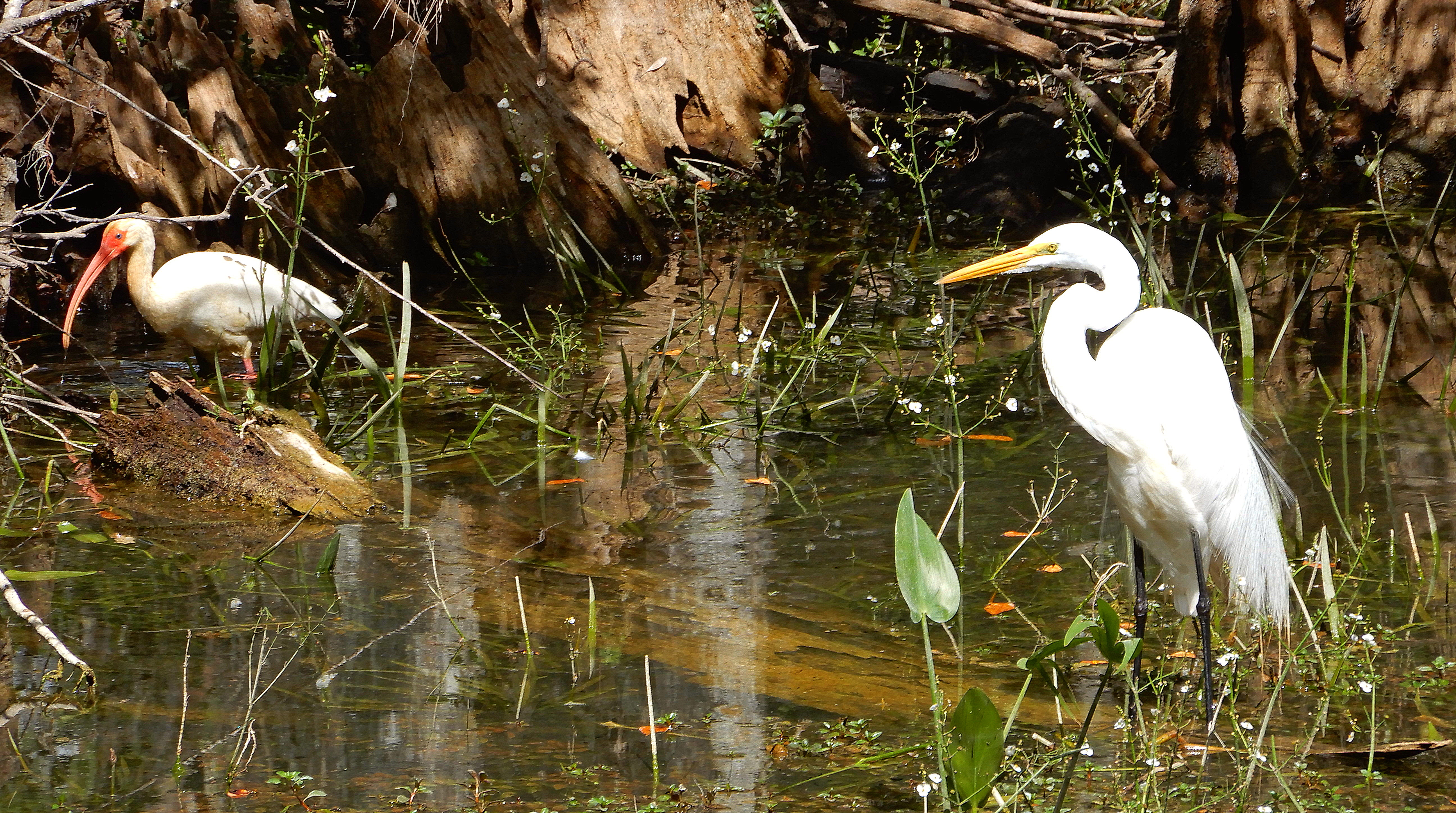
Turning to the left side of the road, a largish bit of standing water showed many birds. The Wood Stork eluded a sharply focused photo, but the others cooperated.
A Great Egret watches a White Ibis. Big Cypress National Preserve. February 2026.
Ultimately my impressions far exceeded my ability to capture them….
White Ibis, reflected. Big Cypress National Preserve. February 2026.
While two other cars of bird-loving folks like us spent time photographing and watching these avian wonders, a large vehicle pulled up and stopped. It seemed the driver wanted something so I walked over. I cannot remember what the vehicle was, but I had to look up, and I mean UP! Either a jacked 4-wheeler or something in its ballpark. The driver lowered his window and asked what we were looking at. “Gators?” he said emphatically. I replied that no, we were looking at birds. He said, “oh” in a disappointed way, raised his window and pulled around us, heading up the road to find “gators”. I wondered why he took this out-of-the-way road when gators hung around the ditches of every road in southern Florida. They jump out of pools and eat pet dogs, and they loll in copious numbers on slopes of I-75 where anyone driving through Alligator Alley could see several hundred. Then again, to be fair, the birds I thought were so interesting mostly could be seen at any reservoir in any typical Florida housing development. Who’s the idiot? As we left the scenic loop, I hoped the guy managed to stop and look around as he left Big Cypress. If he had, he might have seen the “elusive” alligator:
They’re just so gosh-darned difficult to spot! “Wish I could see me some ‘gators!” Big Cypress National Preserve. February 2026.
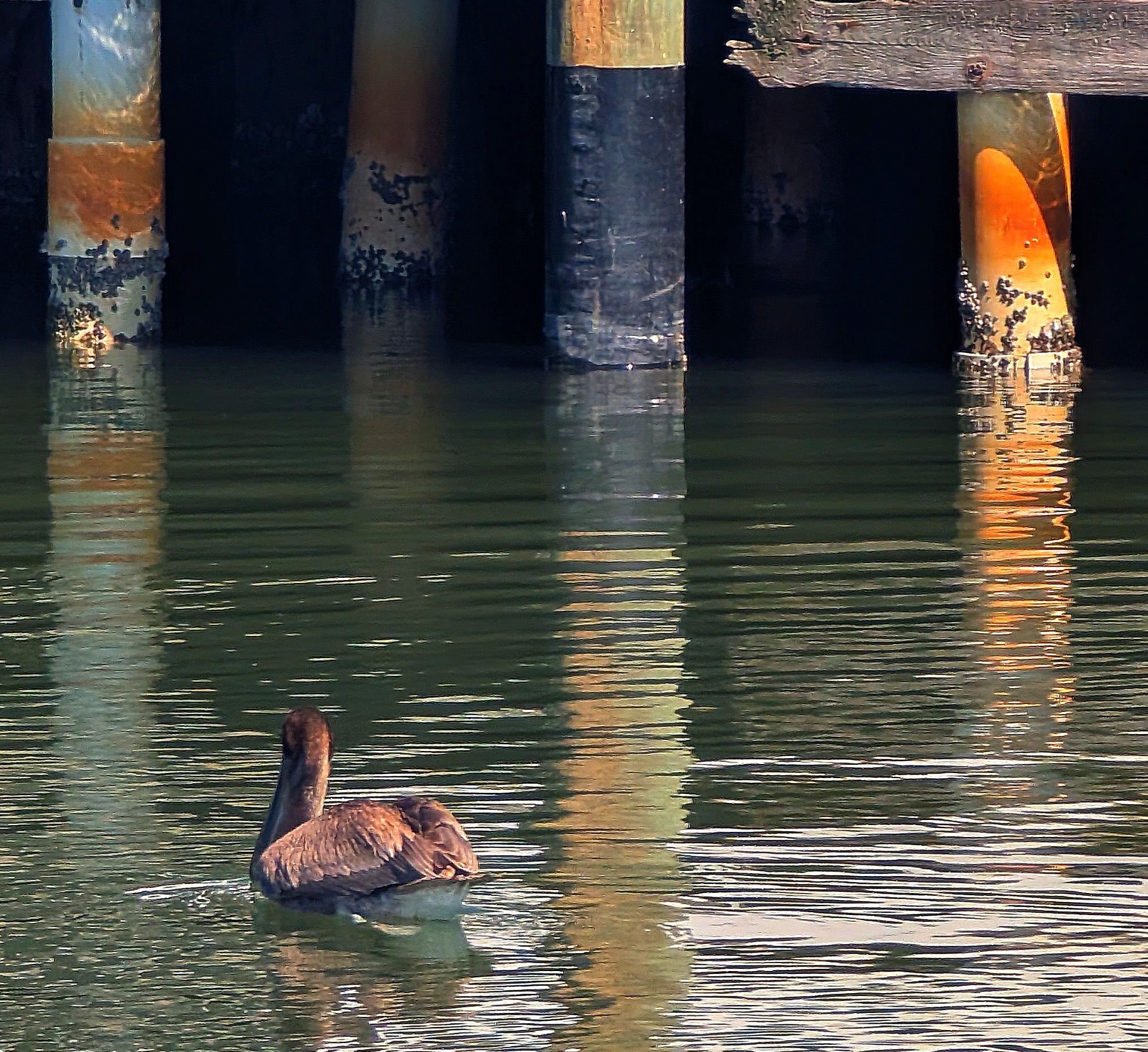
One of a good-sized group of brown pelicans we watched while we ate lunch in Tin City, a group of shops located in old tin buildings on Naples Bay. Naples, FL, February 2026.
We had brought the frigid temps of the Carolinas and Georgia with us to Tampa, and my wife’s sister lamented the loss of her typical 70’s and 80’s. It warmed a bit on our second day there. I bundled up in the warmest things I’d packed and walked to a nearby reservoir to see what bird life I could find. Driving south the next day, we arrived at the Tin City shopping mecca early afternoon, and tucked into a late lunch. The food and the bird life entertained; the shops did not. Tin City seemed a poor and miniscule version of Seattle’s Pike Street Market. Most shops sold typical tourist trinkets which said “made in China” on the bottom. Combined with the exorbitant hotel rates—$300+ for a Springhill Suites on the outskirts of greater Naples?—I doubt we’ll be back in Naples. One saving grace? We’re not exactly foodies but we’re kissin’ close, and discovering that the Cracklin’ Jack’s just up the road from the hotel had recently been featured on Diners, Drive-Ins, and Dives sure put a fine end to the day. Best fried catfish I’ve ever had! We looked forward a bit more eagerly to entering the Everglades and surrounds the next day.
Although the westernmost entry to the Everglades National Park, the Marjory Stoneman Douglas Visitor Center, purported to not be open until the end of February, we decided to chance it on the 26th. We were rewarded with an open, brand-spanking-refurbished center….but not much else because it’s a jump-off point for visitors who want to boaters and to those who want to hike/camp in the Ten Thousand Islands. We are neither of those types. We traveled east on US-41, a.k.a. the Tamiami Trail, the southern route across the Florida peninsula which parallels I-75 a.k.a. “Alligator Alley”. I planned the US-41 route; it became a wise decision when a fire broke out between the two and officials closed sections of the interstate. (It also precluded driving very far north from the US-41.) The southern tip of Florida is a patchwork of state parks, state forests, national preserves, and the national park. We stopped first at the Big Cypress Swamp Welcome Center in the Big Cypress National Preserve. After that, a stop at the H.P. Williams Roadside Park gave us our first good glimpse of alligators, and some nice views of the bird denizens.
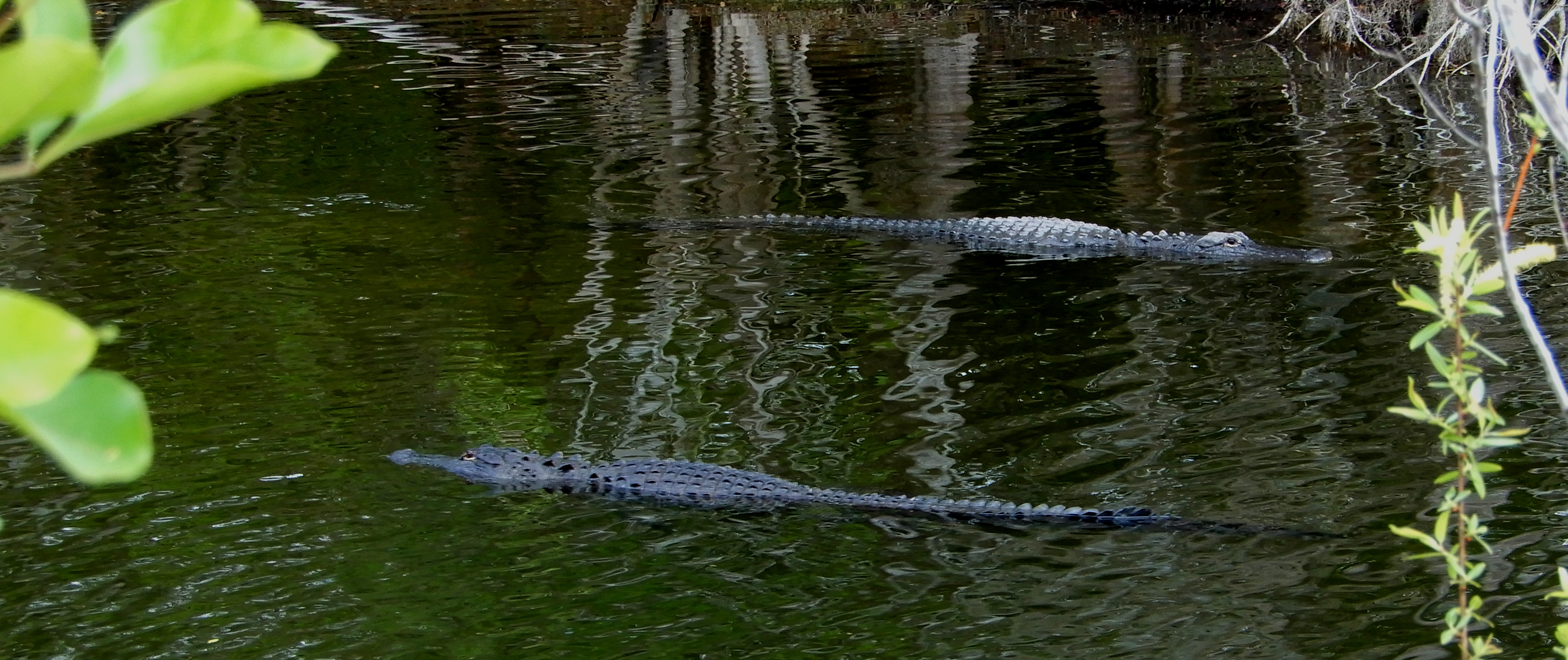
A Tri-Colored Heron stalks its prey. Big Cypress National Preserve, February 2026.It’s not “oh, look, there’s a gator.” It’s more a find-the-gator experience. Sure they’re swimming up and down the minor canal you’re looking at. Can you spot the one hanging out under your nose? Big Cypress National Preserve, February 2026.“like ships passing in the night…” Some gators were easier to spot. Big Cypress National Preserve, February 2026.
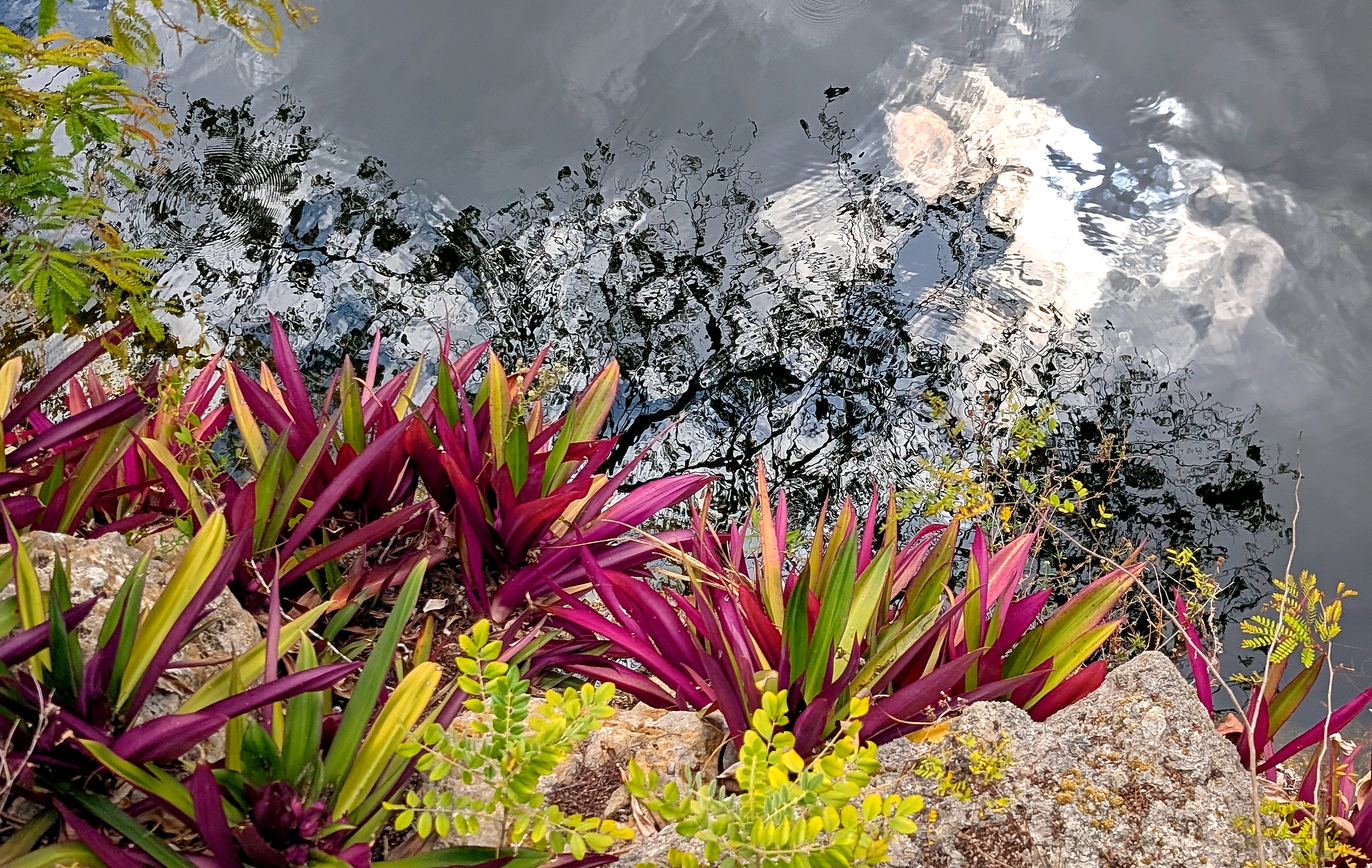
Sometimes, though, the subtropical plants grab one’s attention…
“Moses-in-the-cradle”??? That’s what my plant ID program says, but it seems doubtful. Regardless, it created a stark contrast to the water’s edge. Big Cypress National Preserve, February 2026.
Technically, the final photo of the plants was taken at the Oasis Visitor Center for the Big Cypress National Preserve. If you’re traveling “to see the Everglades,” I would highly recommend US-41 and the Big Cypress route, because it’s basically the northern environs of the Everglades. When one leaves the eastern boundary of the preserve, it’s less than a mile before the Everglades’ Shark Valley Visitor Center. As good as our day’s beginning had been, we had much to look forward to, it turned out.
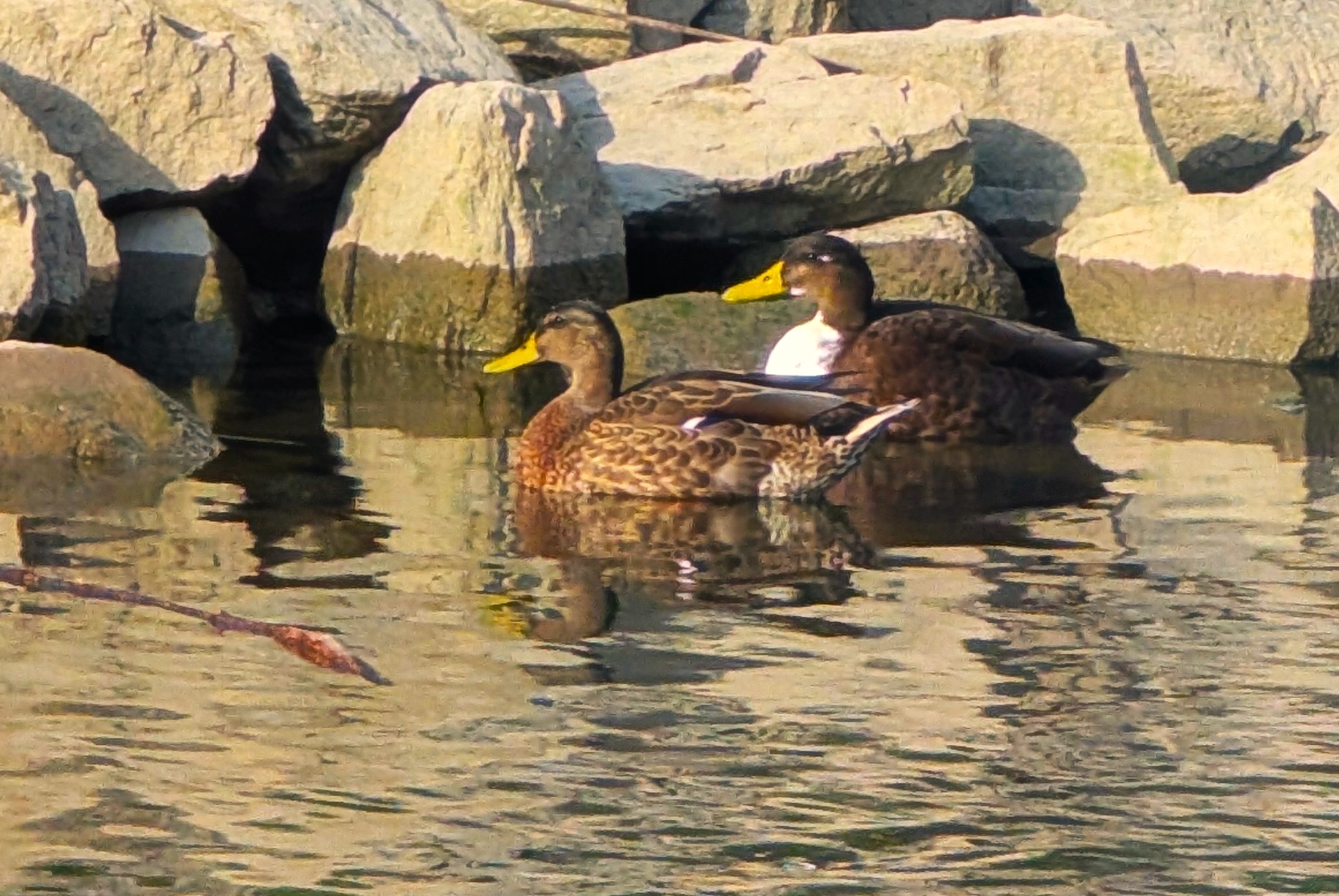
One of the several species of waterfowl we saw while moored at Rüdesheim, Germany. August 2025.
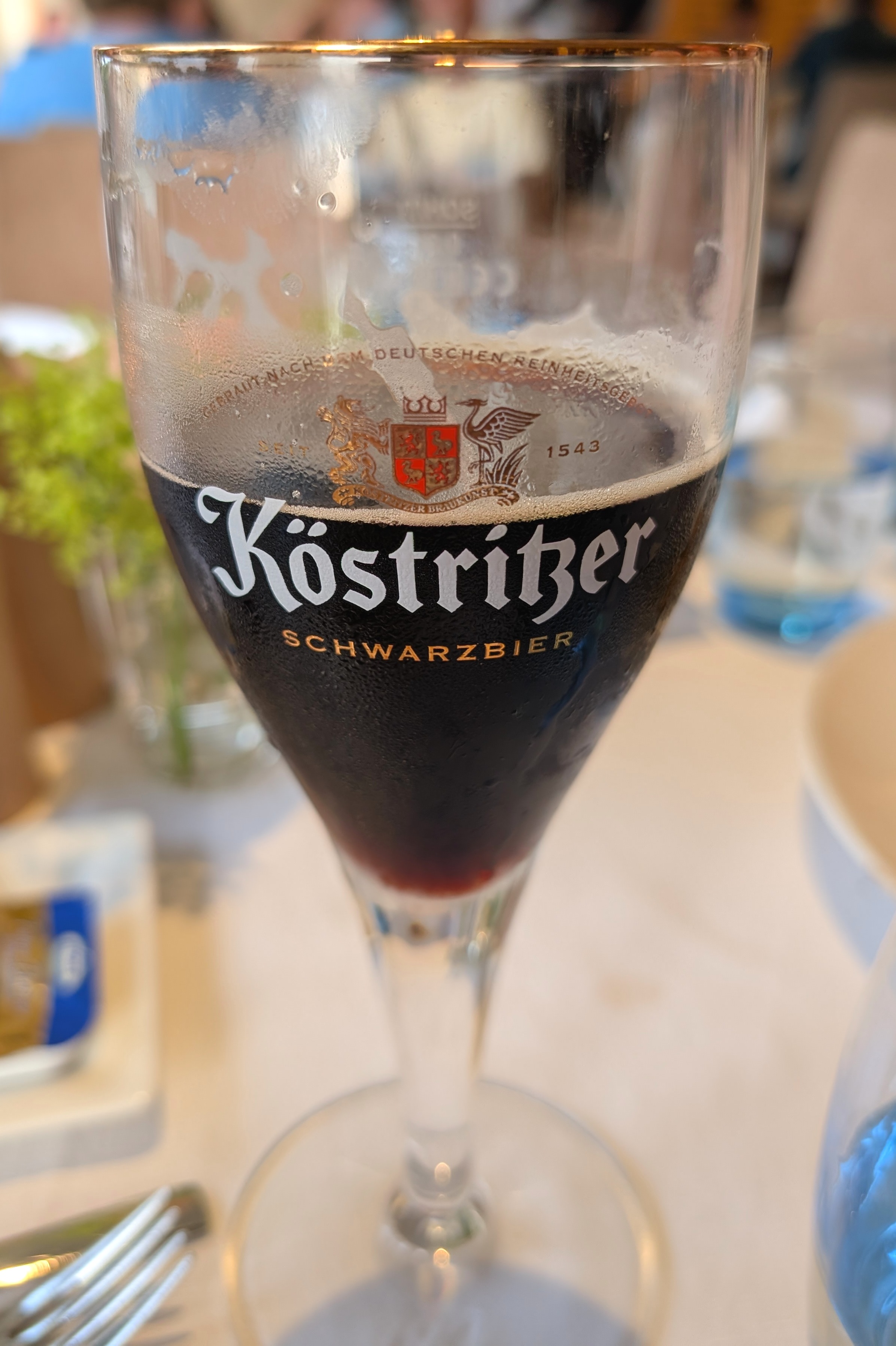
River cruising resembles train travel: you journey from Here to There but don’t have to do the driving yourself. One thus experiences the journey. (Flying lacks this: one experiences only the point of departure and the destination. The experience of travel disappears, lost in abstract non-motion at 30,000+ feet.) Our afternoon cruising capped our morning in Speyer, just right for my still-recovering wife. Once moored at Rüdesheim, we chatted with the local ducks and enjoyed fine beverages. For me, that included this delightful Schwarzbier from Köstritzer.
…or Spires if you want the English name, presented a much-needed comfort level after the unanticipated end to our “Strasbourg Buildup” of expectations. Only 50,000 folks live in this city on the west bank of the Rhine. Yes, we now saw Germany on both sides of the Rhine. Midway through the night’s cruise to Speyer our ship had passed the point where the pentagonal border of France had turned to the northwest and left the Rhine behind. For the first time since Basel, we docked on the west bank of the river. We had the worst guide of the trip there, but a lovely time nonetheless—we simply ignored him and tried to stay within shouting distance of the group. (“Worst guide ever” equates to having him leave a third of our group at a crosswalk where the light had turned against us. He continued with the tour, and then admonished us when we saw a break in the traffic, crossed against the light, and ran to keep up with his idea of pacing a tour!)
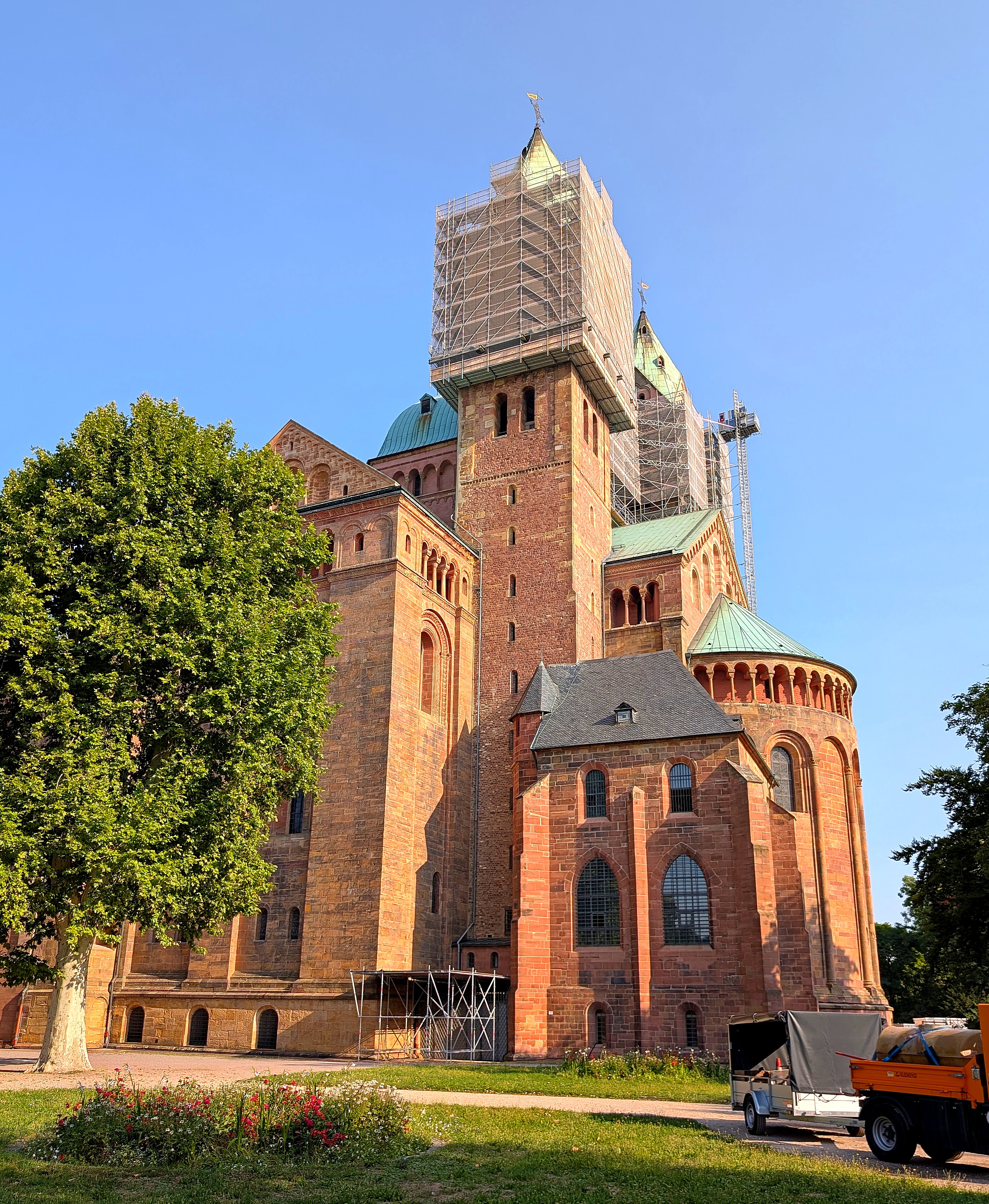
Speyer’s cathedral dominated the city both in its placement on the edge of the bluff overlooking the river, and simply because its size completely outstripped any other building around it. I need two photographs to show all of it:
Speyer Cathedral, east end, with extensive renovations occurring. August 2025.Speyer Cathedral, west end. I normally avoid wide-angle shots on buildings like this, but it proved necessary. The abutment on the right edge is visible in the previous photo behind the tree on the left. August 2025.
Parishioners built the cathedral in several distinct phases. Though our guide dryly and boringly explained it to us, I concentrated on photographs to his exclusion. I therefore can’t give you much history about the building’s timeline. I do remember that like all “touristy” cathedrals you will ever see, this one was the biggest in some category or other—I think “biggest at the time it was built.” If I remember correctly, the middle part of the building (seen in the second photograph) predated either end. Part of it had to be rebuilt after WWII, also. Look on the tower in the second photograph and you’ll see stones laid much more hodge-podge on the lower right of it. The rest gets a more uniform, geometric treatment.
Our guide left us no time to go inside the church. Instead, he took us into the center of the city, a small area of just a few blocks which extend westward from the church. As we turned westward from the cathedral, he noted (for our safety) an oddity I’ve not seen anywhere but Speyer: a city street routed through the plaza, marked only by regularly spaced concrete posts. It struck me simultaneously as beautifully quaint and dangerous.
Speyer cathedral throws a shadow on the historical building across the plaza from it. In the foreground runs a city street, marked by the posts visible in front of the building. I don’t remember if the lighter paving stones represent ‘sidewalk’ or not, but I think ‘not’ is the operative word. I believe the building pictured served at one time as quarters for the bishop, but now might be a private residence. Speyer, Germany, August 2025.
Our guided trip into town proved blessedly short, after which we broke free and wandered at will. We quickly encountered a beautiful Orthodox church…I think.
As far as we could get into this beautiful sanctuary—a locked glass door prevented entry but facilitated photography. Speyer, Germany, August 2025.
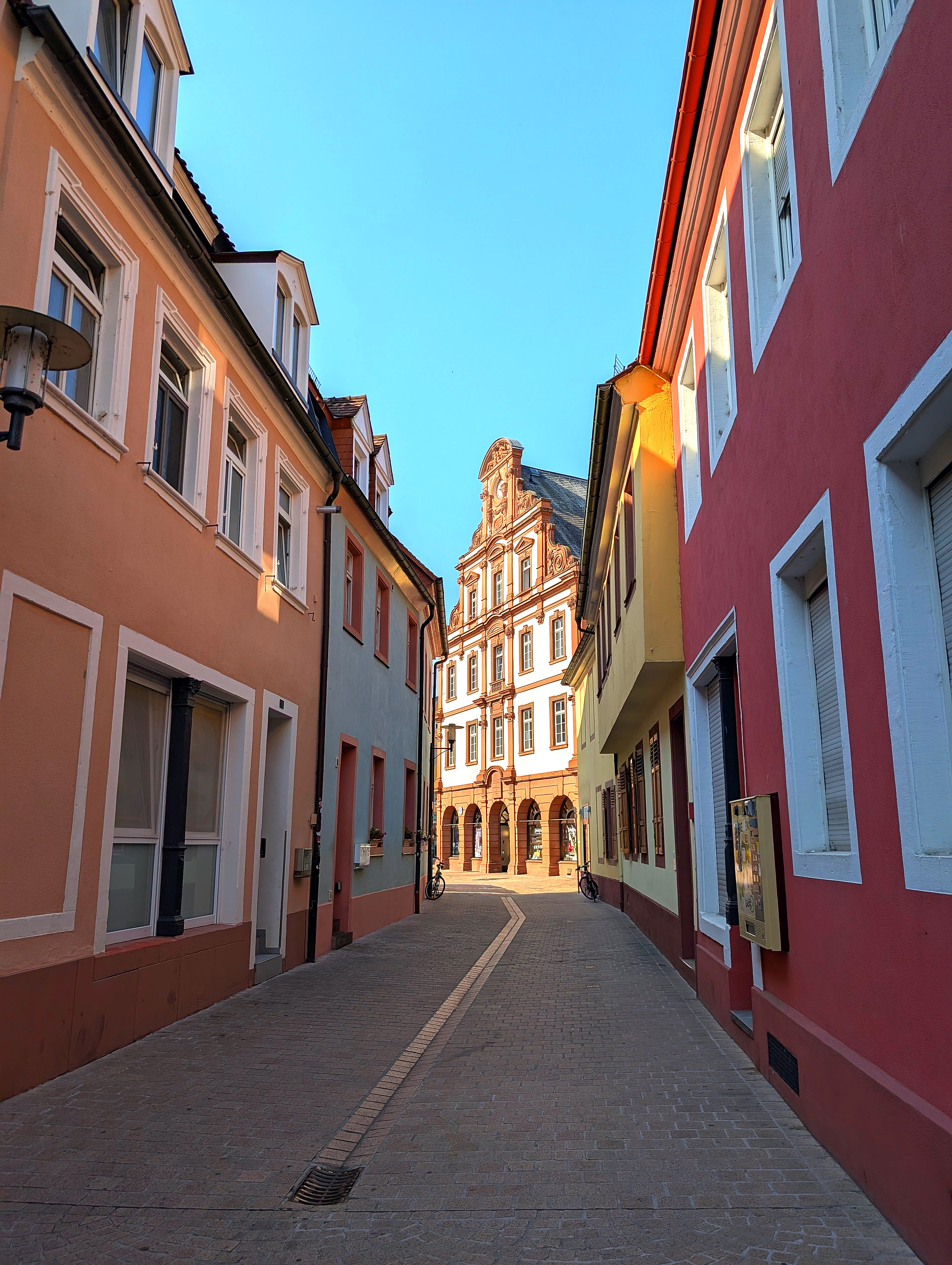
We struck off from the main street through the city center and found little plazas tucked behind several other buildings. One hid a strikingly designed school of drama, if I read the German correctly. The streets off of the main drag lived up to my fantasies of narrow, old, and quaint. A sign informed us that many of these buildings were associated with the Jewish community. Speyer and the nearby cities of Worms and Mainz have been recognized as UNESCO World Heritage Sites. Near the photo on the right (below) we passed an old synagogue.
Yes, they allow cars down this street. Note center-of-street gutter. Speyer, Germany, August 2025.
It’s true, all streets curved to the left! (Unless you turn around.) Speyer, Germany, August 2020.
Walking back toward the cathedral to meet up with our group for the walk back to our buses, we finally had time to enter the cathedral. We made a good decision to allow time for that.
Much older than other churches we encountered on our trip, Speyer’s looks much smaller in this photo than it is. This is due to the large supporting columns which frame this shot. Speyer Cathedral, August 2025.
Speyer’s cathedral offered a delightful blend of modern furnishings contrasting with the centuries old structure. The minimalist lines of its furnishings complement the austerity of the stonework. It had several altars. I surmised different ones get used depending on the size of the congregation at that particular service. Perhaps at least one stands there for historical reasons. The most modern one sits far forward. The candles flanking it, both those on stands and the votives to the side, were displayed on modern metalwork which evoke the baroque in a minimalist way. The bishop’s chair sat halfway back in the sanctuary (altar area), to the right in the photo below. The next photo gives a sense of the depth of the sanctuary/chancel.
The first altar of the Speyer Cathedral. Note the organ in background. Speyer Cathedral, August 2025.Bishop’s chair and back portion of the sanctuary. Speyer Cathedral, August 2025.
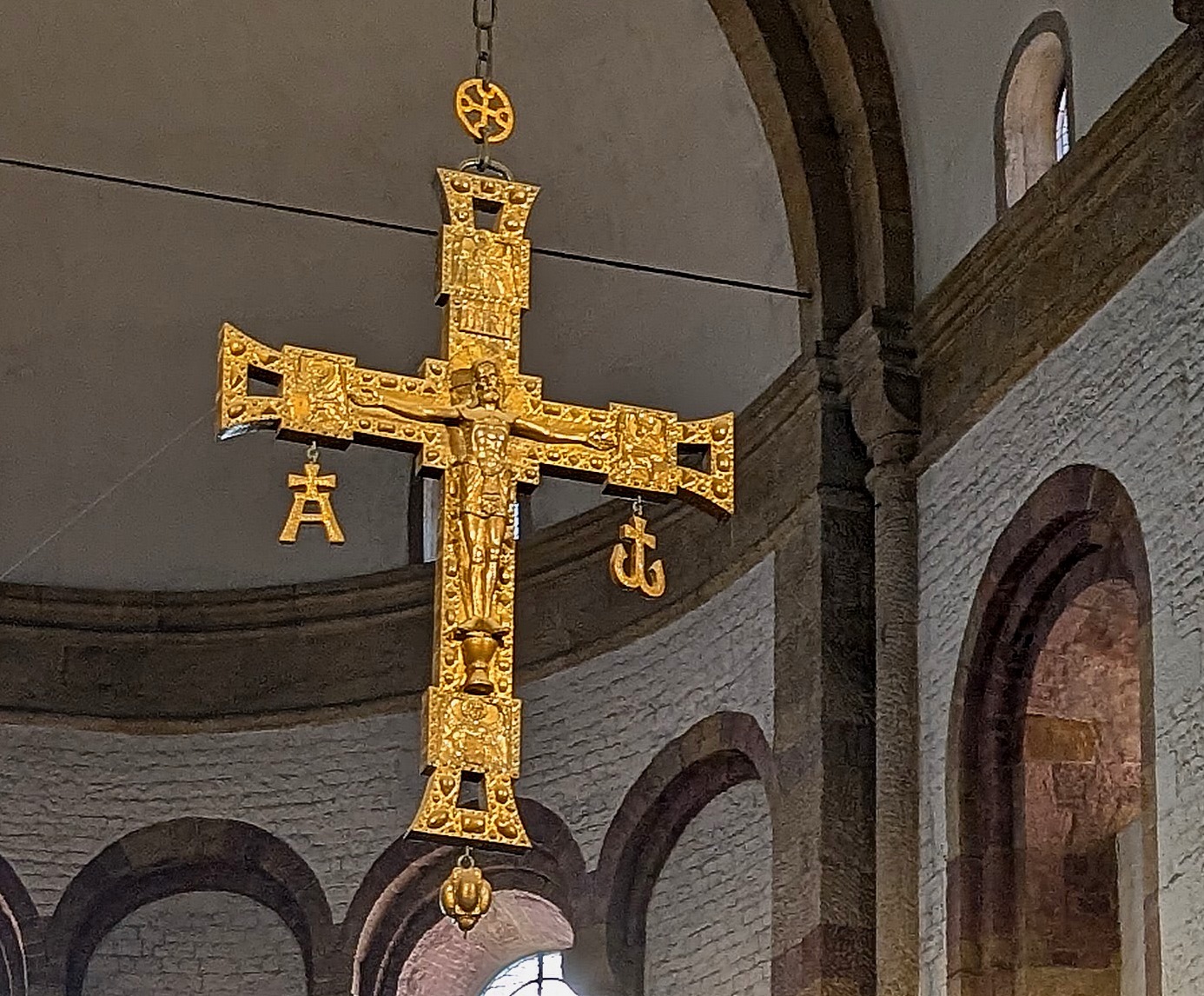
Detail of the suspended cross just rear of the “bishop’s altar” in the middle of the chancel. August 2025.
When looking at the photo above, you’ll remember the bishop’s chair is to the right of the first altar. In the lower right corner, note the raised floor. This is for the second altar. Light shone into the cathedral from many angles. At the top of the photo is the lowest tip of a suspended cross, caught in sunlight which casts a shadow on the back wall. See detail, left.
Our several tour groups boarded buses for a short trip to Worms where the good ship Hlin had tied up after getting a head start on the afternoon voyage to Rüdesheim. We couldn’t seem to take enough photos as the historical buildings glided past us. That evening we stayed aboard. Others had purchased one of two different dinner packages (one at a fort high atop an overlooking bluff).
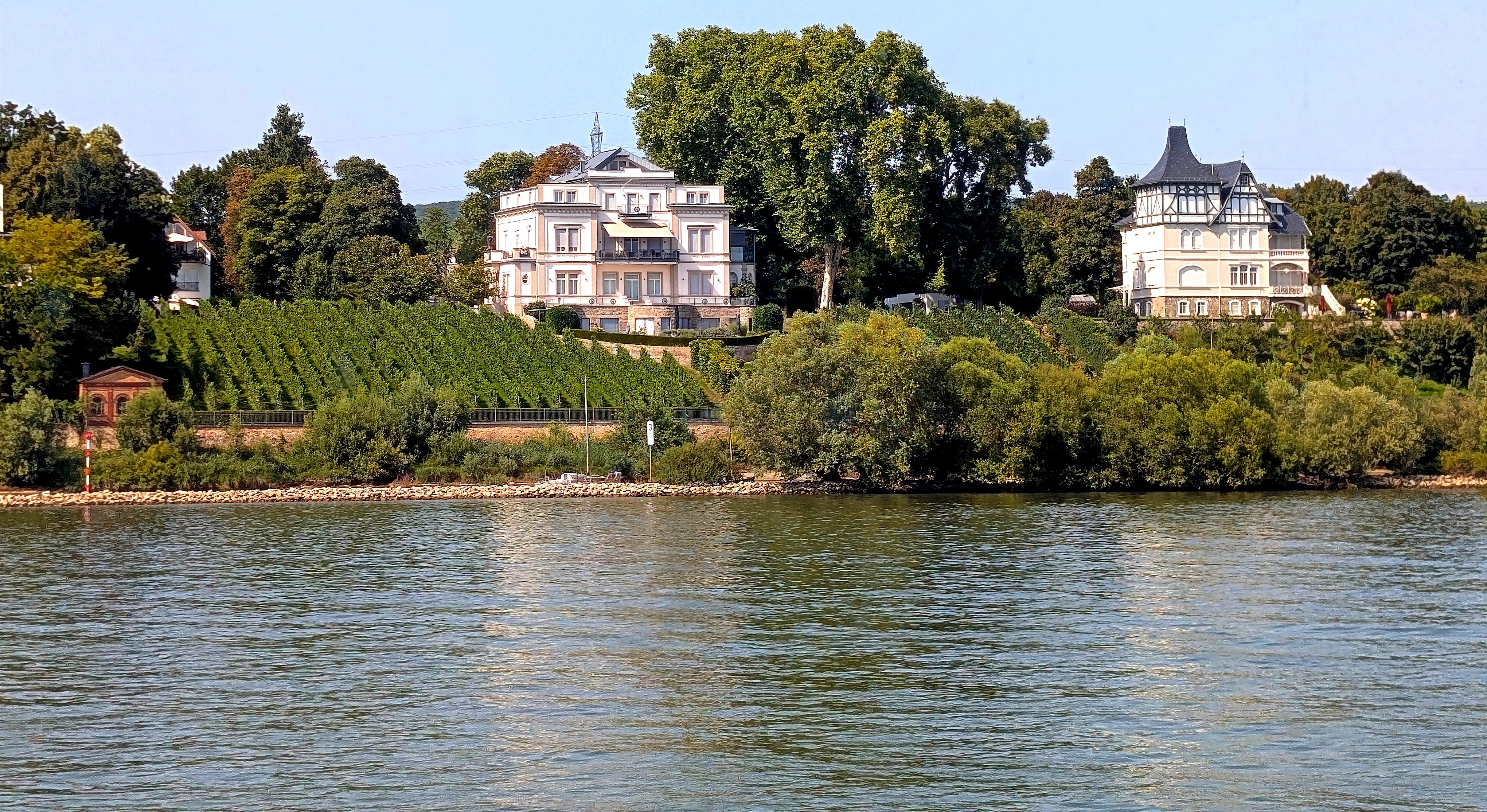
From the starboard side, first you photograph the building on the right. Then you see the next one to the left…then its vineyards…then the little red stone building down by the railroad tracks which run along the Rhine. Then there’s another building…it never ends. And you’re sitting in the lounge where the next cool beverage is only steps away. August 2025.
I planned our cruise on the Rhine River to celebrate our 30th wedding anniversary, and redeem the ruination of our 25th. I purposefully reserved a cruise which docked at Strasbourg on our anniversary, looking forward to all it promised. The Year 2020 had teamed up with my back to scuttle our (limited) plans for our 25th. As that day dawned, I experienced a spasm in my back which necessitated taking an emergency muscle relaxant I keep on hand for these occasional problems. A fine dinner which we had planned to cook for each other became a take-out pizza, and for my wife, some wine. I crawled into bed early. Therefore, 2025 promised to atone for all of that. The pandemic had subsided, we had our health, and, well, what could go wrong? The trip had far exceeded our expectations for four days.
The day promised much: Strasbourg with its cathedral and its amazing clock where I planned to walk inside of it and marvel. Then my wife croaked from bed, “I don’t feel well.” We traded our anniversary cards, and she dragged herself out to breakfast. I chose to forego the group tour of Strasbourg on the French side of the river. “I can catch the afternoon shuttle back into the city,” I told myself. “At least I can see the cathedral and that famous clock.” I tucked my wife into a deck chaise to soak up some sunshine and spent a few minutes observing the begging swans and a heron across the river…
Swan at Kehl’s riverfront park. August 2025.
Finally I decided to go wandering. I stopped first to admire the mooring strategy of our ship, the Hlin, wondering still why the woman at the guest services desk couldn’t explain to me why our ship’s bow pointed southward when we were cruising northward. Later I learned from our “hotel manager” that the captain turns the ship around when docking so that the bow points upstream whenever the river runs high and the current proves strong.
The good ship Hlin pointing south as I photographed it looking to the north. Note the pedestrian bridge supports in the background. They figure into my afternoon adventure. August 2025.
I watched river ships carrying freight along the Rhine. Gases, coal, cars, and livestock all sailed past me. As I walked south, the river to my right and the park to my left, I saw a strange tree not far ahead. It proved to be a manmade thing, demonstrating the Germans’ ingenuity while reinforcing stereotypes about their precision and exactitude. The ‘tree’ looked real enough, and the whimsy of opening a neighborhood for sociable birds seemed admirable, but I couldn’t help noticing how the houses spiraled around the trunk in a near-perfect corkscrew. Other pedestrians paid it no mind, apparently inured to its presence.
I reversed course and headed north. The children’s waterpark to my left had become a bit too boisterous for me.
Bird treehouse. Kehl, Germany, August 2025.
I soon encountered a small marker in the ground, its painted message cracked from the sun’s rays and the weather, modestly announced, “Biblischer Garten/Jardin bibliqu” the remainder of the French title cut off by the sign’s erosion. I intuited it announced a Bible Garden and intrigued, set off on the graveled path. I learned at the end of the path its plan had been for residents to approach the river from land not vice versa; I had walked it backward. It made little difference. Each stop along the path—there were 17—announced an important aspect of the Judeo-Christian Bible, and not entirely the ones I expected. Yes, The Resurrection received a marker, and so too Pentecost but The Field of the Dead? And some I didn’t understand until I could translate them. (I didn’t think to use my smartphone.) Here are a few:
Das Totenfeld / Les ossements desséchés or in English, The Fields of the Dead. Biblischer Garten, Kehl, Germany, August 2025.
I especially like how The Last Supper rose up out of the shadows in my photo and how wheat had been planted in support of the marker.
Das Letzte Abendmahl / La Sainte Cène i.e., The Last Supper rising out of a field of wheat. Biblischer Garten, Kehl, Germany, August 2025.Crossing the Red Sea, Biblischer Garten, Kehl, Germany. August 2025.
The marker for Paradise evoked humankind’s ignorance of what is to come: it consisted only of a shiny cylinder rising out of a simple terra cotta marker similar to the others. A separate, hexagonal marker had the names of six different churches on it of varying denominations. I realized they had paid for the installation and marveled how such a thing could be placed in what seemed to be a public park, given the “separation of church and state” we have in America.
I returned to the Hlin and my wife, took her to lunch on board, and then tucked her into bed because she felt even worse than before. For my part, I planned to catch the 2 p.m. shuttle to Strasbourg. One learns to be prompt on board, so I gathered in the ‘lobby’ of the ship at 1:55 to walk with the other guests to the bus which we had been told would take 15 minutes. Remember that pedestrian bridge in the background of the photo above? That was the first bridge. The bus would be parked at the next bridge downriver. When I arrived at the gathering point, I surmised something might be amiss when I found myself alone with the guest services representative. She informed me the bus left at 2 p.m., not the group of guests walking to it. “But you still might be able to make it,” said the chipper (and overly optimistic) young lady. Google Maps tells me the hike should take twelve minutes; I had five. The distance (900 meters) equates to more than a half mile. I tried, really I did, but I simply can’t walk six miles per hour, and at my age and physical shape running isn’t an option. I missed the bus. I watched it/them drive across the bridge when I still needed about two more minutes.
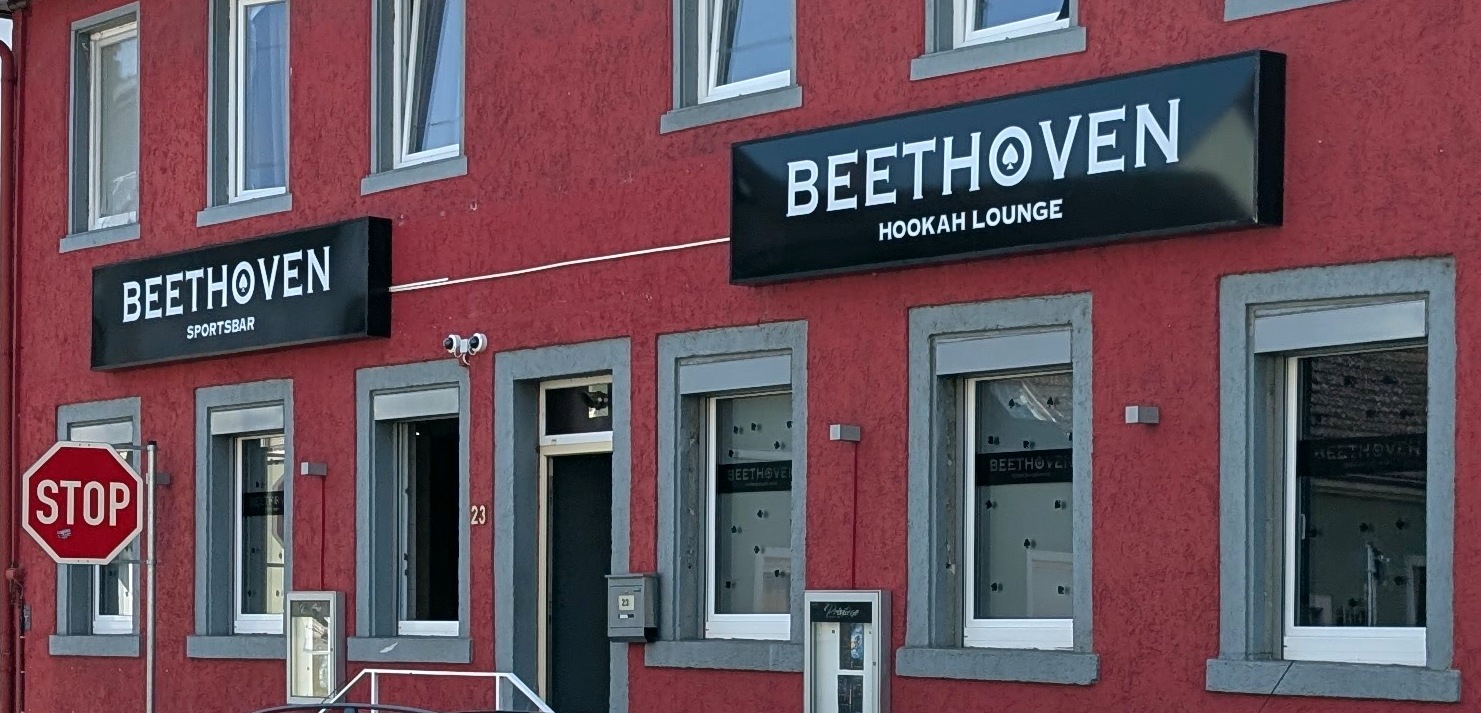
Dejected, I attempted to see the upside. Yes, I had just force-marched myself through 92+ degree weather (Fahrenheit), but my wife might appreciate some medicines, right? And the steward for our deck had mentioned a pharmacy very close to the ship. I walked toward the center of Kehl. Along the way, I encountered a very, very strange sign:
Yes, just STOP. I do not think Beethoven would approve. Kehl, Germany, August 2025.
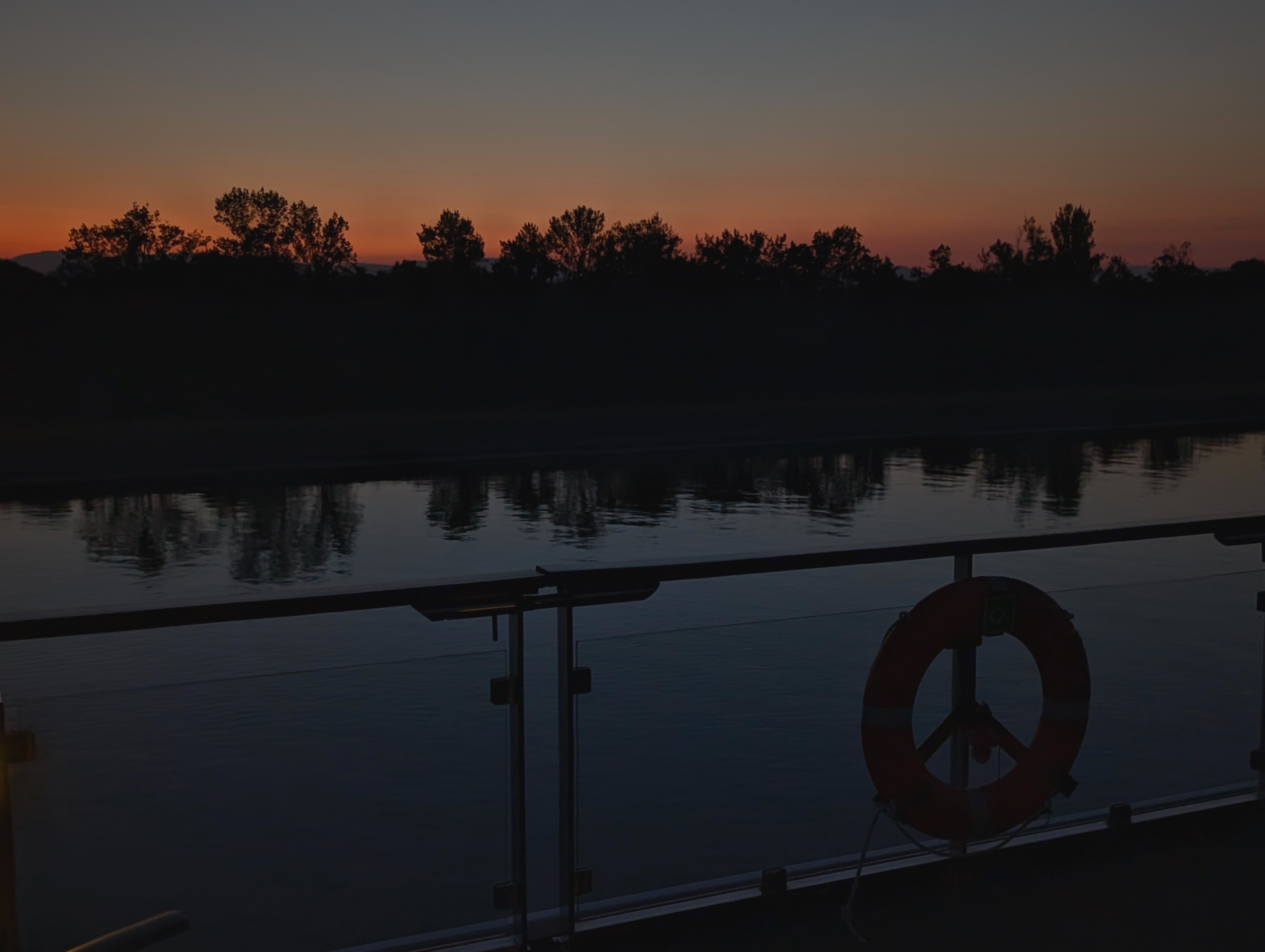
I located the pharmacy. Kehl is charmingly small (38,000), similar to so many small cities in America. Its downtown proved easily negotiable, and my first encounter with a European pharmacy enlightening. The ability to get a physician’s assistant-grade consult from the clerk impressed me. I returned with aspirin and throat lozenges. As I walked back to the ship, not sure exactly where I needed to go, I realized I would need to drop off the meds, turn around, and immediately march my way back across the park again to catch the final bus shuttle at 3 p.m. My first exercise session in mid-90’s weather had caused my shirt to stick to my back and chest. I realized some things are not to be. My wife and I would need to return, together, to experience Strasbourg as we had intended. Meds delivered, I grabbed my tablet, retired to the lounge for my first beer, and fired up an eBook. Later, the setting sun seemed to say, “You did alright today, sir.”
The sun sets over Strasbourg, France. August 2025.
The Rhine River north of Breisach, Germany. August 2025.
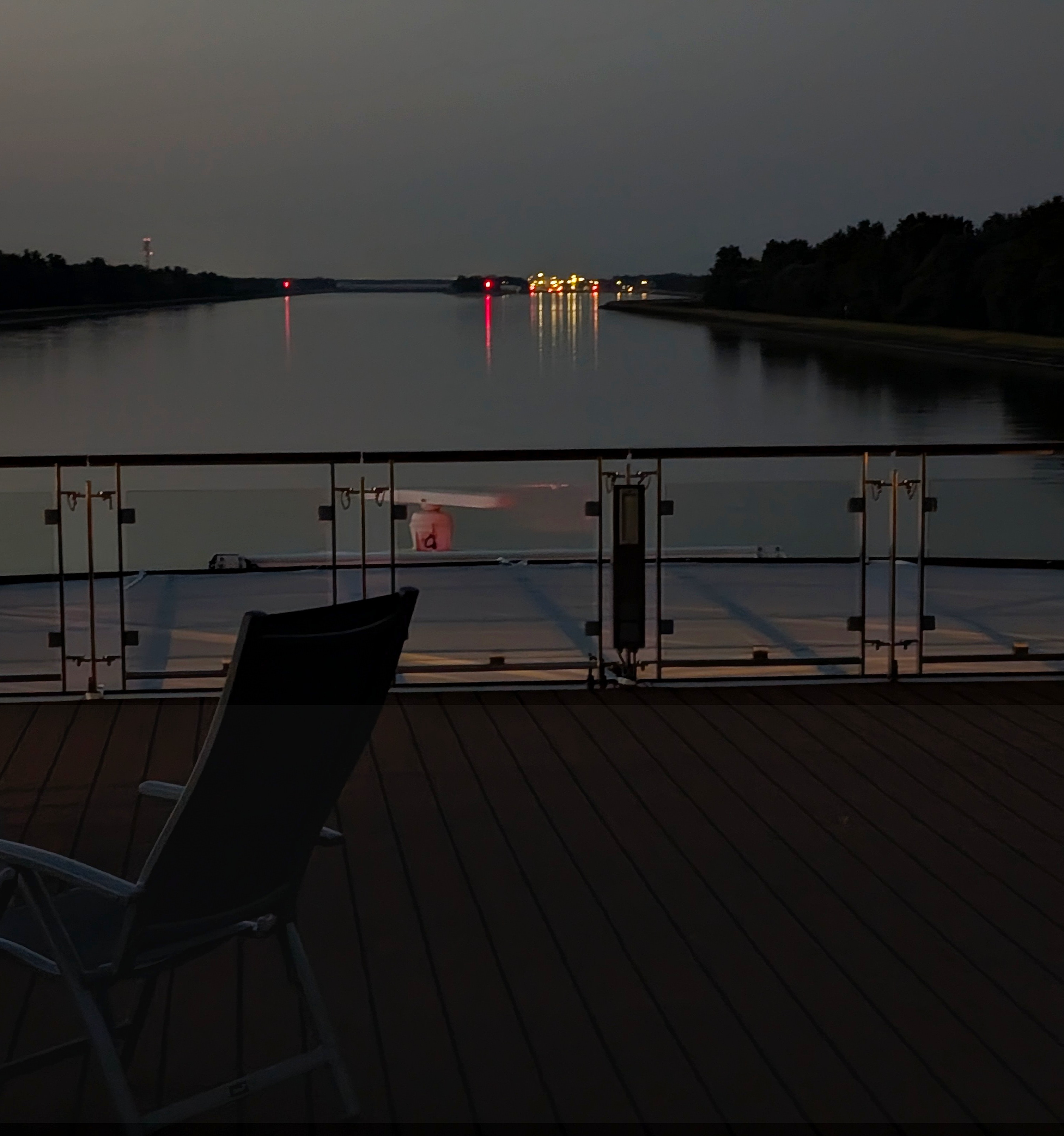
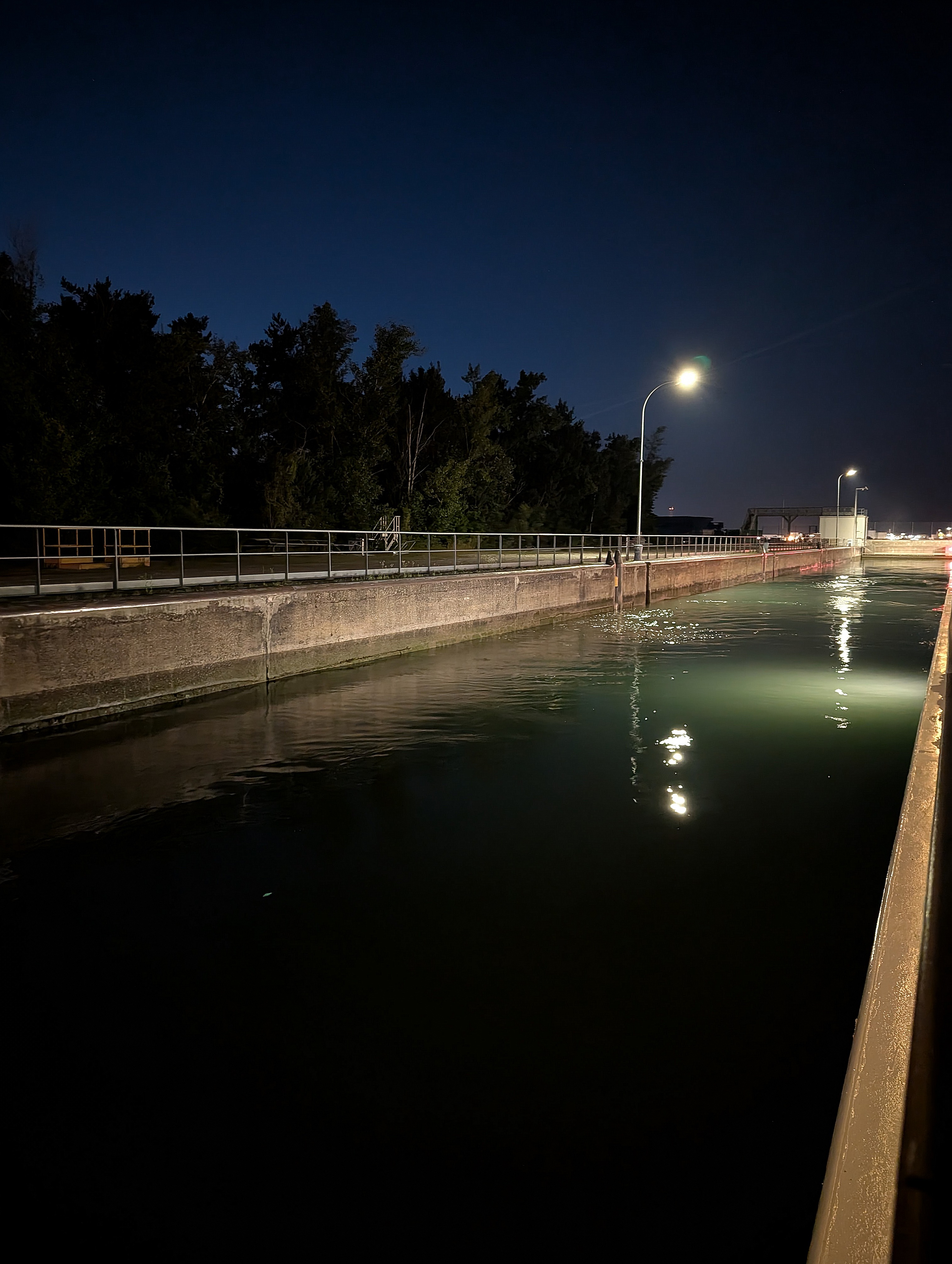
We returned from our afternoon in Colmar, dined, and watched the sun set as we sailed north toward one of the many locks on the Rhine. I stayed up to watch, but the night grew later…
Approaching lights on the Rhine River. Locks? August 2025.
I managed to catch the first lock before bed beckoned beyond my ignoring it. I always cringe when I lean over a railing holding a smartphone to take a photo. I’m sure I’m going to watch an expensive tool/toy go “plop!” into the waters (or rocks) below.
Entering our first lock of the evening on the Rhine River. August 2025.
Heading downstream, the ship entered full locks which then drained before the ship continued its journey through the night.
The lock drained, the gate rises, and we continue on our way. August 2025.
At that point the clock chimed 10 p.m. and I headed to bed. Some of the folks stayed on the top deck through midnight and beyond as more locks were negotiated. The novelty never wore thin—any night which promised locks, a gathering topside seemed in order. If this appeals to you, I recommend booking in the May-September timeframe when temperatures support being outside comfortably. Even with temperatures in the 90’s during the afternoon, nights got very cool: by morning all but the really hardy wore a sweater or light jacket.
This past week we journeyed to Santa Fe, NM, where my brother has lived for about four years. This represented our last chance to do so, because he plans to relocate to a different state next year. Although our first two visits in 1996 and to my brother’s house in 2022 left us unimpressed with the city and its surrounds, I found my attitude changing this time. I think taking a more relaxed approach to each day helped, plus I’ve slowly decompressed over the past five years of retirement. My past as a Road Warrior for several years took a big hit when we all sat around in 2020 during the Covid pandemic. It kicked into gear again in 2021 and hadn’t dissipated by 2022. For whatever reason, we found ourselves hitting a few museums, seeing familiar sights, finding some new ones, and spent late afternoons in conversation prior to dining out every night. (Dining out might have aided our feeling of “vacation”.)
A few representative photos:
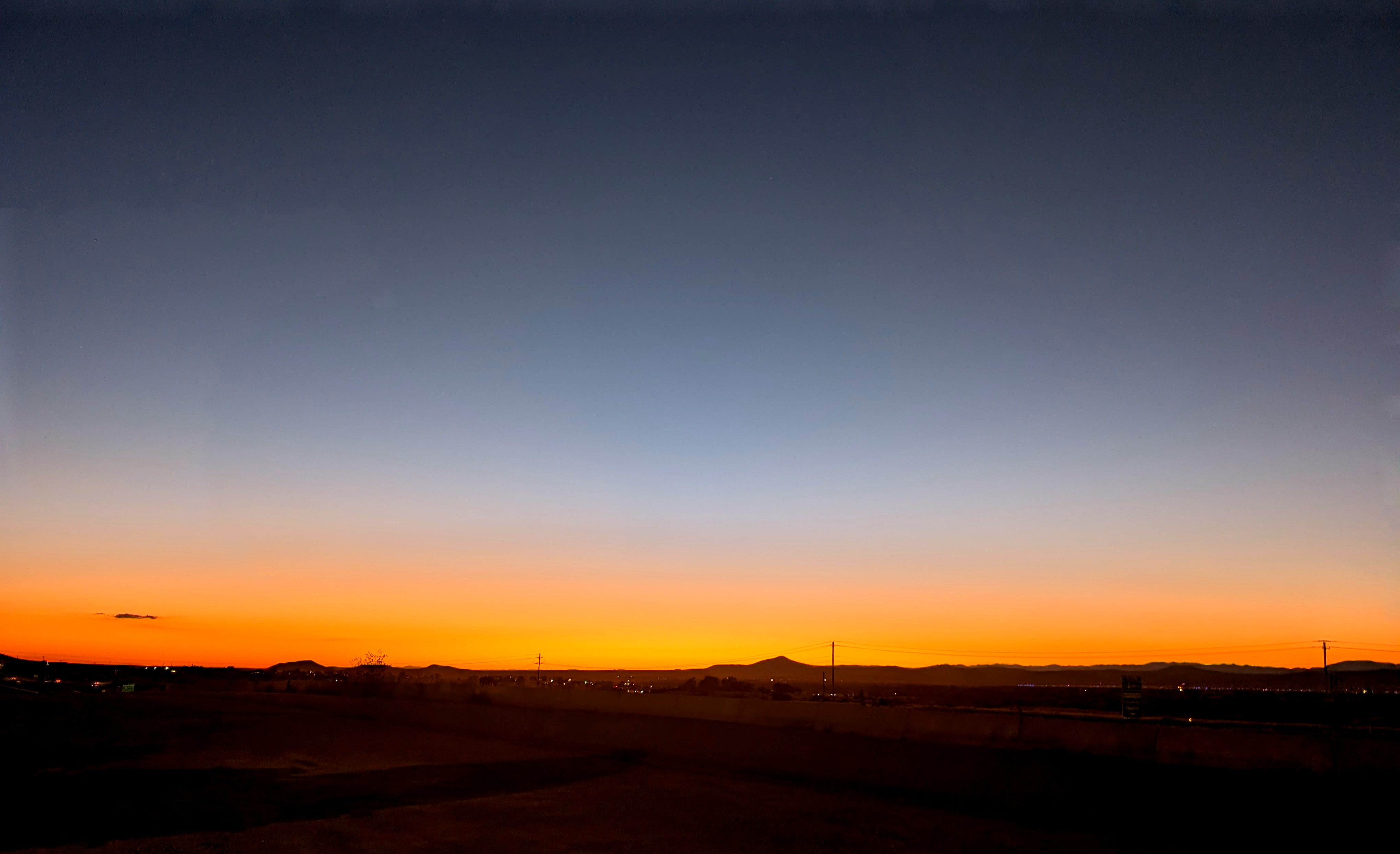
October begins: outside the Santa Fe Brewery on October 1st. Less than 2 miles from my brother’s house as a crow flies, but 4.4 miles by car. We stopped for a couple six-packs after a fine dinner at Escondido Santa Fe. I miss sunsets like this from my first decades in the western US. One needs to see the horizon to get good sunrises/sunsets. October 2025.
By October 2nd the federal shutdown in America took full effect, and we found all facilities closed at Pecos National Historical Park. I was unaware an important Civil War battle had been fought here when the Confederacy attempted to control the gold being mined in southwestern states. October 2025.
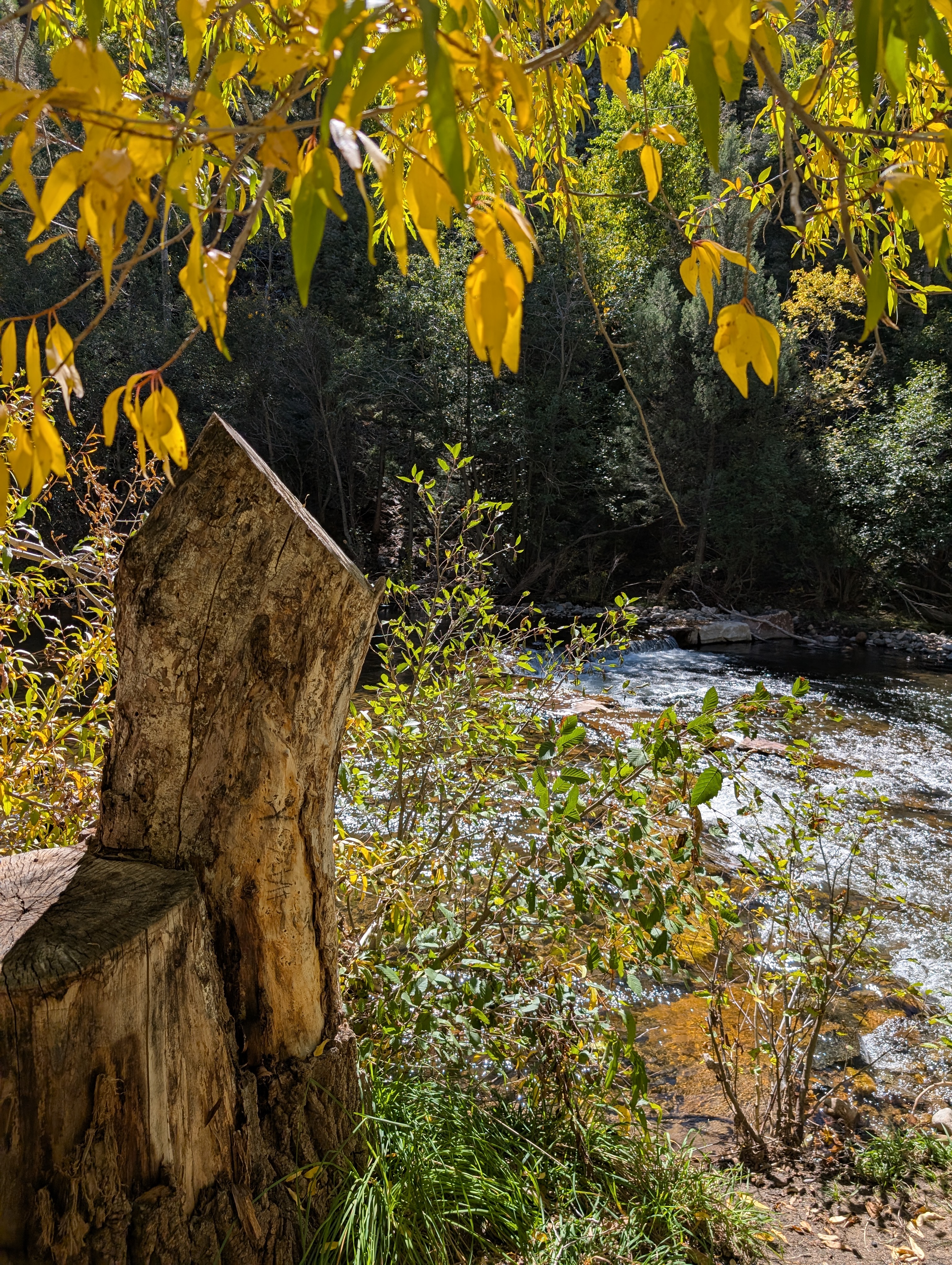
Because the national park closed, we turned north to a state park on the Pecos River. It catered mostly to campers and anglers, but provided some beautiful spots to stop and admire swiftly flowing water beneath the first signs of autumn. Rivers aren’t common in the semi-arid southwest. October 2025.
We visited the Georgia O’Keeffe museum Wednesday, a must stop because we had missed it in 2022 when our only day to do so turned out to be the day it closed. Out of deference for the artist I won’t reproduce her work here, although photos were allowed. Similarly I won’t reproduce the artwork I photographed at the Wheelwright Museum of the American Indian on Friday, October 3rd.
We ate New Mexican style food at Escondido, La Choza, and a super-high-end place called Sazón in downtown Santa Fe. On the 2nd we ate Indian at Paper Dosa, a restaurant we had seen on Diners, Drive-Ins, and Dives (Food Network). Mostly I will remember north central New Mexico like this:
On a walk from my brother’s house. This actually is in the middle of housing developments in the southwest part of Santa Fe. Housing in central Santa Fe is very expensive. I don’t remember the name of this yellow plants, but it’s everywhere. October 2025.
This little thing actually is a very small house. I think our guide said 600 square feet, but that might be overstating it. August 2025.
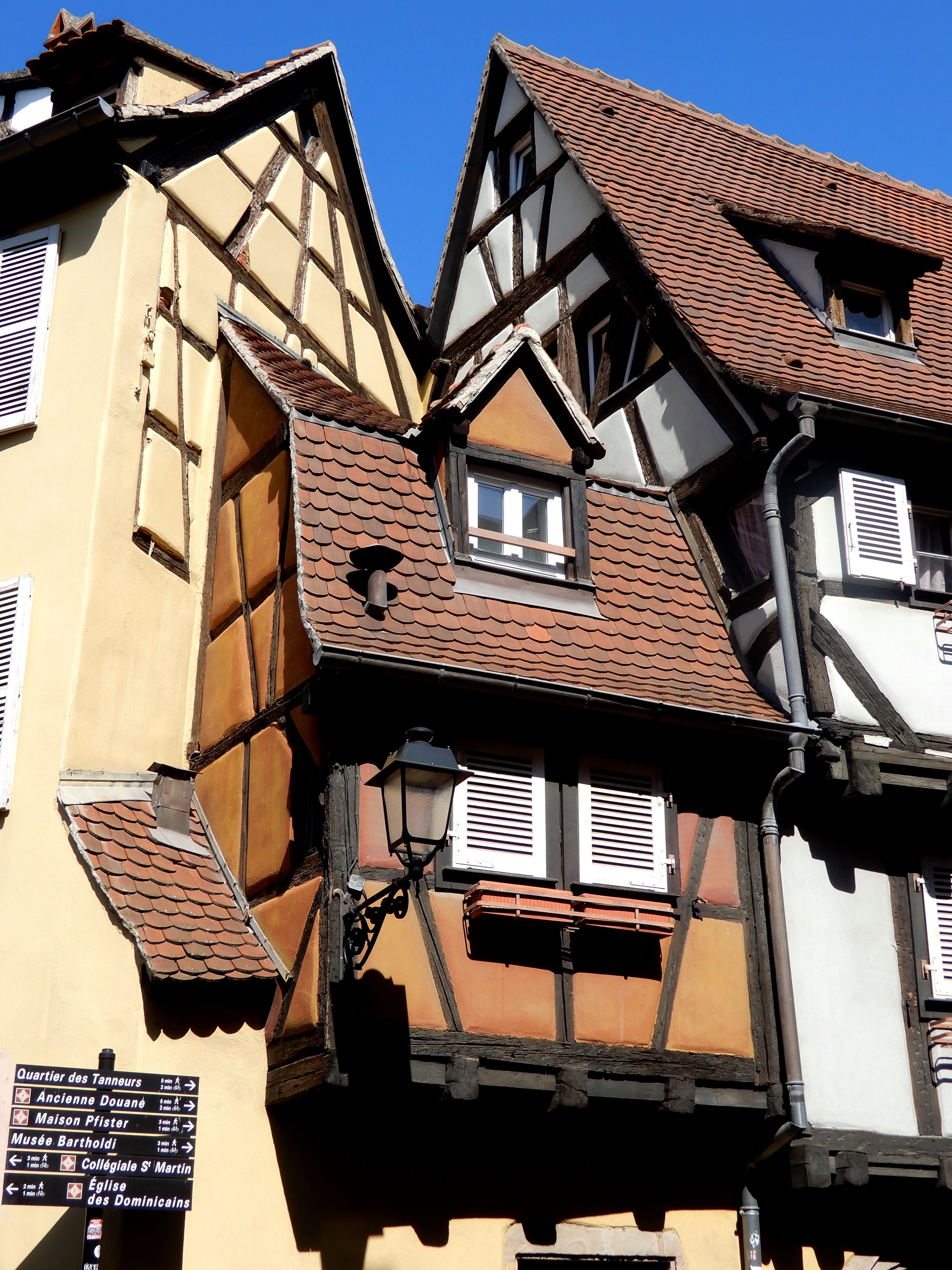
Monday, August 11, brought our first real step into France. (“Real” because technically the airport we landed at on the 8th, the Basel-Mulhouse-Freiburg Airport, is in France and we were in France a good 10 minutes after we left the airport, too!) Colmar has the historical distinction of holding no military value when the Allies came bombing in World War II. Therefore an important city from the 800’s and a major trading town in the Holy Roman Empire can still show a visitor many historical and undamaged buildings. Being in the Alsace region, Colmar shifted back and forth between France and Germany after the Roman empire broke up. It’s been in France since the end of WWII. I think if we had known it considers itself to be the capital of Alsatian wines, my wife might have taken a different interest in it.
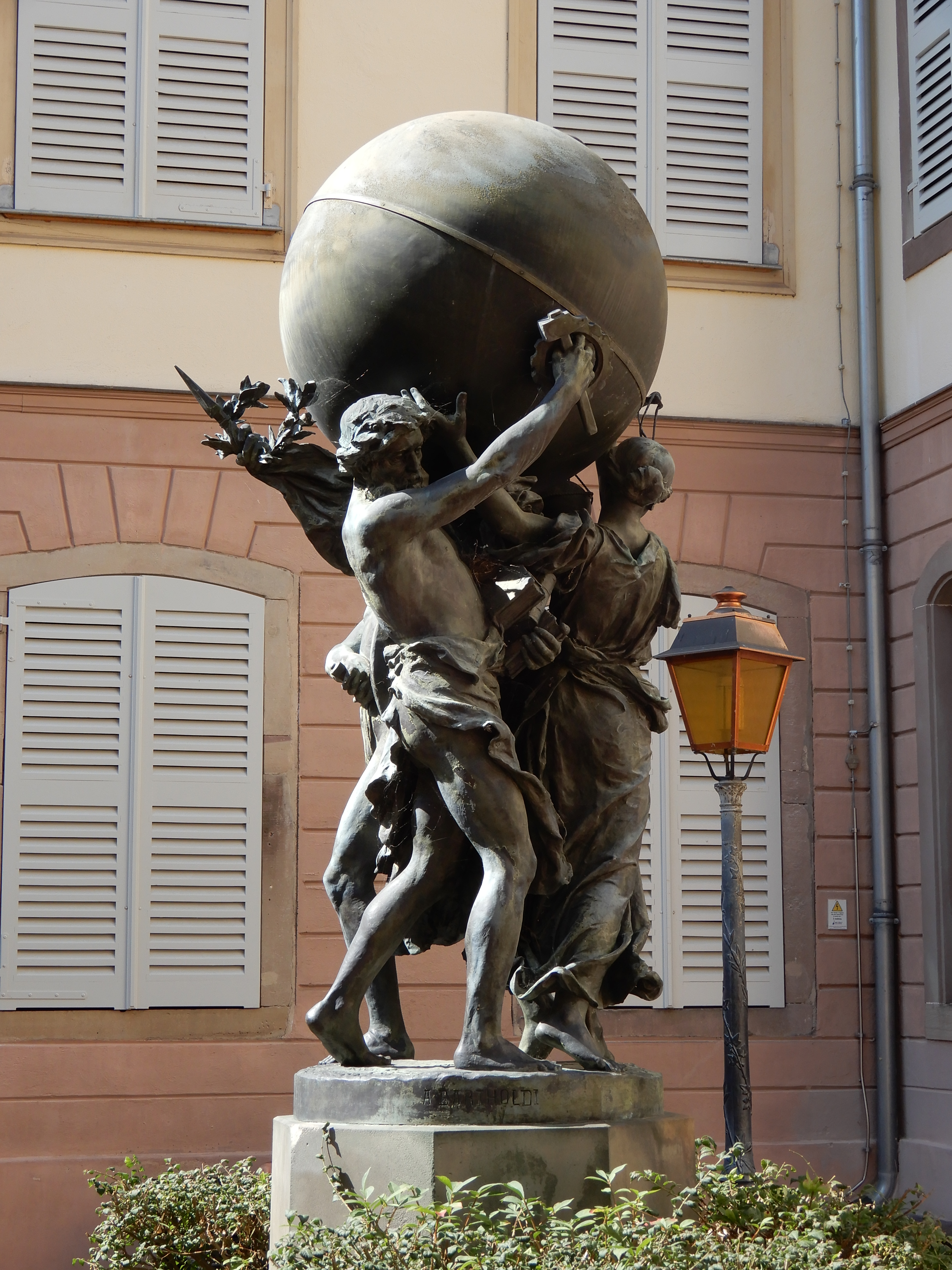
But it was hot. Really, really hot, about 95 degrees F. Having poorly planned my traveling wardrobe (a recently developing habit), I roasted in a collared shirt over a T-shirt. Our guide Johannes had narrated our Black Forest tour in the morning, and he continued his adroit guiding and droll humor in the afternoon. A small but critical step with a guide I learned later: make sure everyone has crossed the street on the light. He performed admirably, and I’m sure he narrated a good tour, but between the heat and the fact it occurred over a month ago, I remember only one thing distinctly (other than the lack of WWII bombing): it’s the birthplace and home of Frédéric Auguste Bartholdi, the sculptor best known for designing Liberty Enlightening The World, known in America simply as The Statue of Liberty. His sculptures appeared in several locations.
In the courtyard of Musée Bartholdi. “Les Grands Soutiens du Monde”. There’s a great deal of symbolism here having to do with the three figures (one hidden) representing Patriotism, Work, and Justice. September 2025.
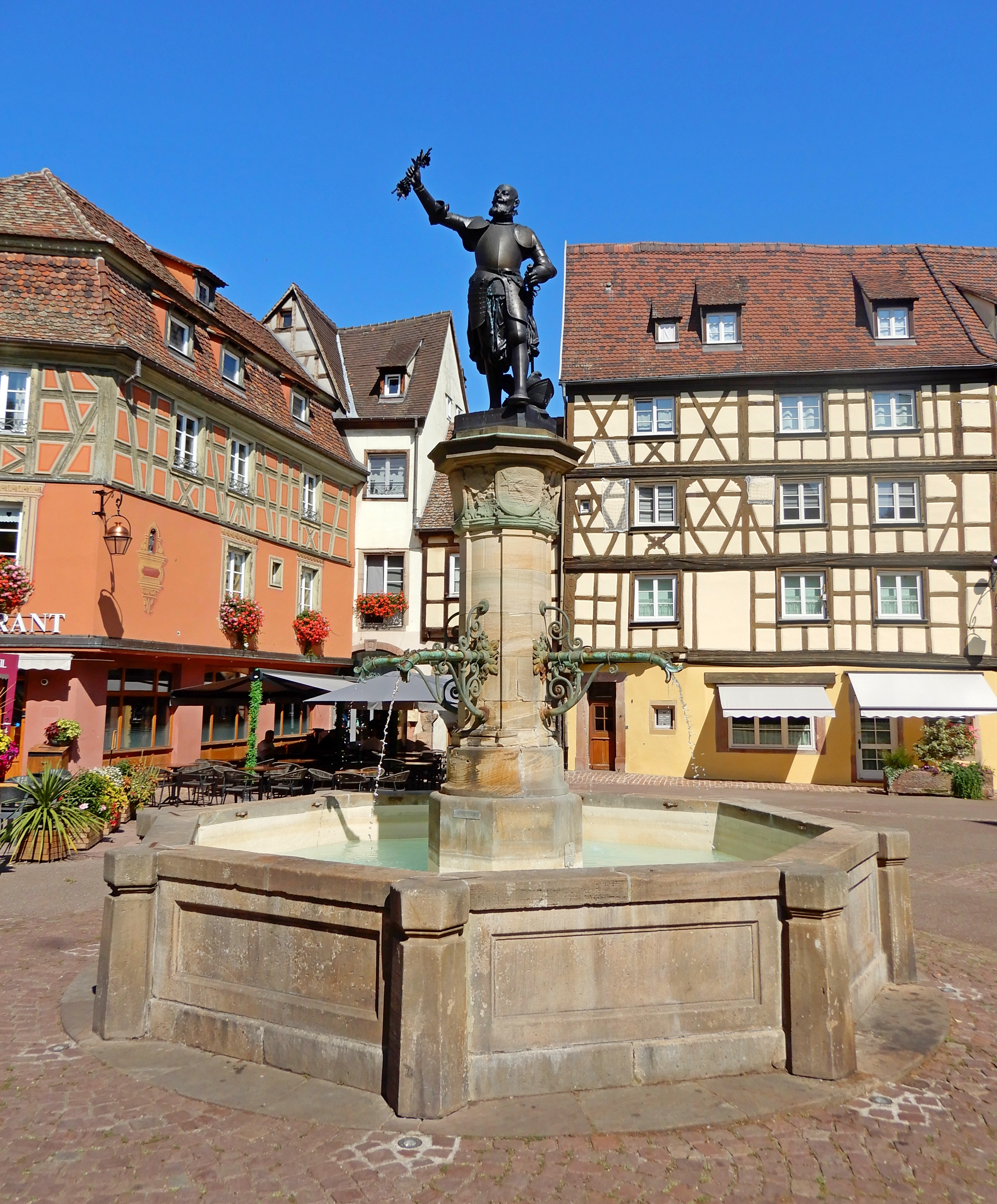
A different view of Les Grands Soutiens du Monde. September 2025.A “pulled back” shot to display how this statue was situated, and the general ambiance of the Old City. I think this is “Fontaine Schwendi” depicting Lazarus von Schwendi who brought a Tokay grape to Alsace from Hungary. This grape became known as Pinot Gris and thus crucial for development of Alsatian wines. September 2025.
This building feature apparently will be recognized by players of some video game, or perhaps some strange streaming thing. I think it was “video game”. Obviously I have no clue. September 2025.
We wandered around the first of a good handful of cathedrals we would encounter during the trip, but ultimately we had to spend some time in what little shade we could find. Despite being a Monday, it also was August when it seems most of France takes a holiday.
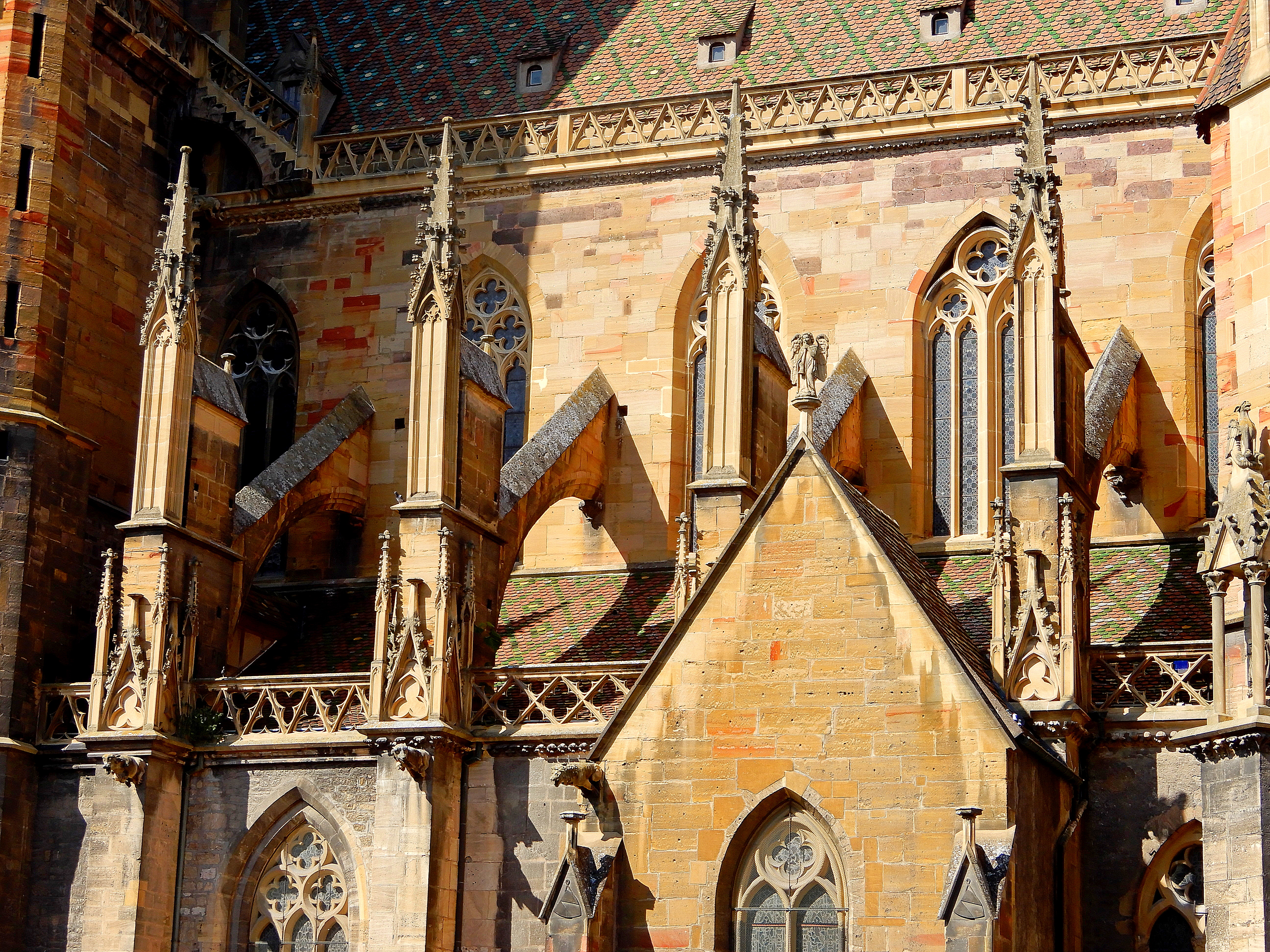
Flying buttresses. I can’t remember if we were allowed inside–I wish we had gone in if the answer is “yes, you were.” Difficult to see are the bullet holes on the façade. Colmar didn’t escape allof the damage from WWII, just the bombing. September 2025.
Market Square, Colmar, France. September 2025.
The Colmar Market Square, stylized. September 2025.















 all the voices in my head