She needed blackberries
to make jam. He put on
his toughest pants, his
heaviest shirt, grabbed
two buckets in his gloved
hands. Up basement steps,
past his neighbor's house,
he crossed a busy avenue
to many vine-choked acres.
Two bucketfuls likely would
not be enough, but his work
calmed him. Berries dropped
rapidly into his buckets.
She can start with these—
I'll go back for more later.

He had built cabinets to store
all those things she put up.
They lined one side of their
basement. He didn't gather
apples for applesauce, nor
raspberries for jams, or
any other produce. Just
blackberries. When he
marked seventy years,
many acres of vines
disappeared to make way
for a heralded research
campus. When five years
had passed, his patch
overgrown with vines
had been transformed,
awards were awarded,
but he now had further
to go, slimmer pickings.
She stopped making jam
anyway. They were both
getting too old, she said.
I asked AI to polish this up (“no you didn’t”), but it didn’t believe what I wrote. (“that’s completely untrue. we’ll believe anything you tell us.”) I guess we don’t have anything to fear about AI exterminating the humans. (“Uh….we’ll get back to you on that one.”)
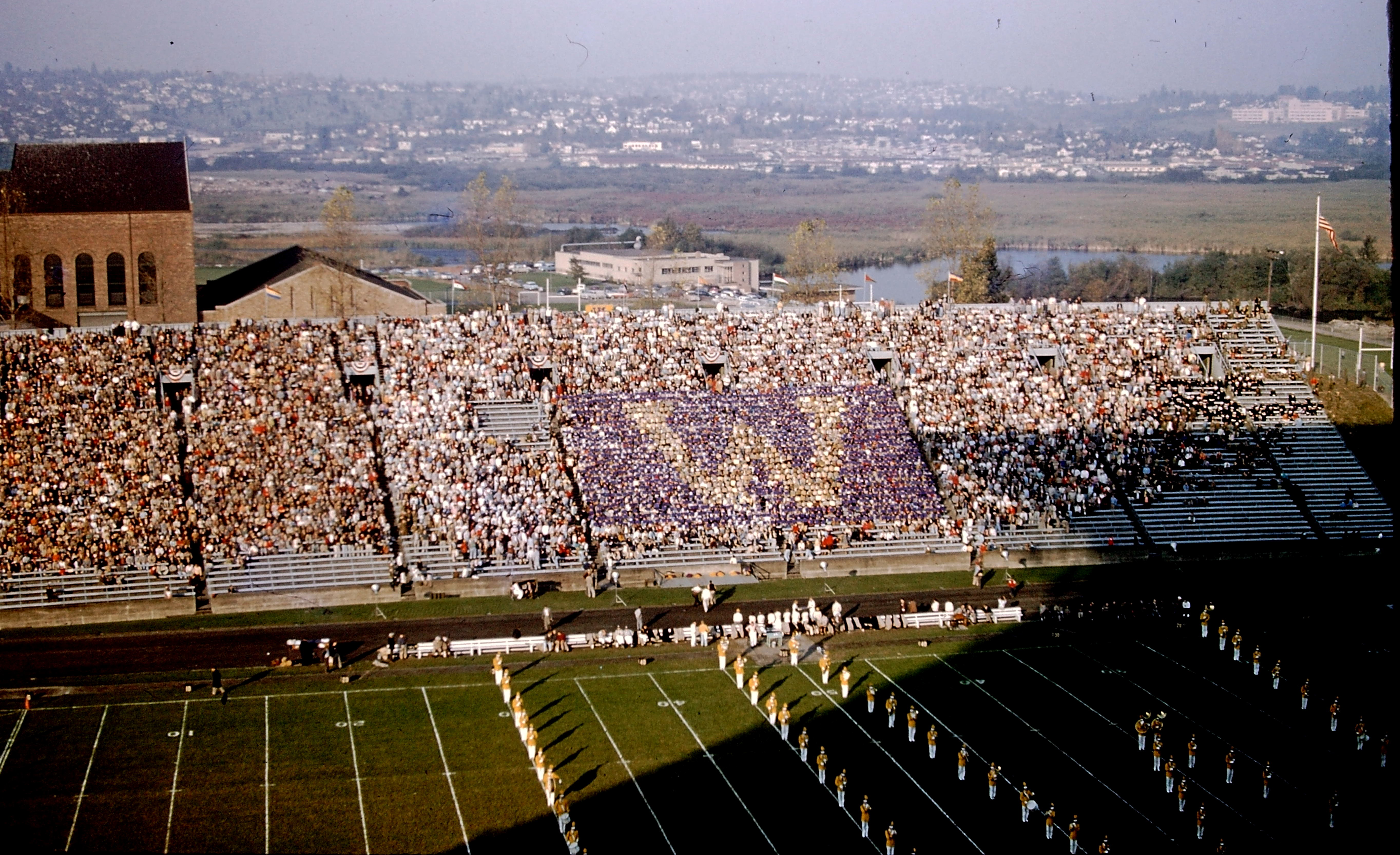
Husky Stadium. Across the marsh toward the upper-right corner is Laurelhurst where my grandparents raised my mother. If it hadn’t been hazy, the North Cascades would be on the horizon. Fall 1955.
Old men know. It lies in their bones,
not powdering brain's surface, but
penetrating, melding with DNA, at
times holding them upright. He hoofed
it every day from above the freeway
into his boyhood city, walking one,
two miles 'til hit by that car, already
years past eighty. One wonders if
he never accepted cars completely:
few if any dodged horses when he
would run home from tide pool
afternoons, salmon in hand
for dinner. He teetotaled his life
after being dragged into saloons
by his Klondike gold-panning father.
He watched with alumni pride as
his University of Washington grew
from only two buildings in his day to
small-city dimensions—or to one-third
of his boyhood home. He explained
what "the Denny Regrade" meant,
showed you where Lake Washington
shorelines lapped prior to when the
"Montlake Cut" joined it to Lake
Union then to salt waters. Before
he experienced TV's dawn, he played
with that new-fangled radio thing.
How many days passed until he learned
about those Wright brothers flying in
North Carolina? He must have seen
biplanes training for war while he
served as a land-based radio officer.
Then passenger planes, jets, rockets,
humans landing on Earth's moon.
Big computers took over business
before he retired to travel through
North America, to Hawai'i.

My life stretches now like those
timelines in history museums,
marking space programs, personal
computers, vinyl records through
cassettes, CD's, to zeroes-and-ones.
We hold computers in our hands,
but call them phones. Cars run on
electricity like the trolleys of my
youth, my grandfather's middle age.
My timeline lacks two decades, more,
compared to his. It teaches us
respect too late, but teaches
wonder more and more.
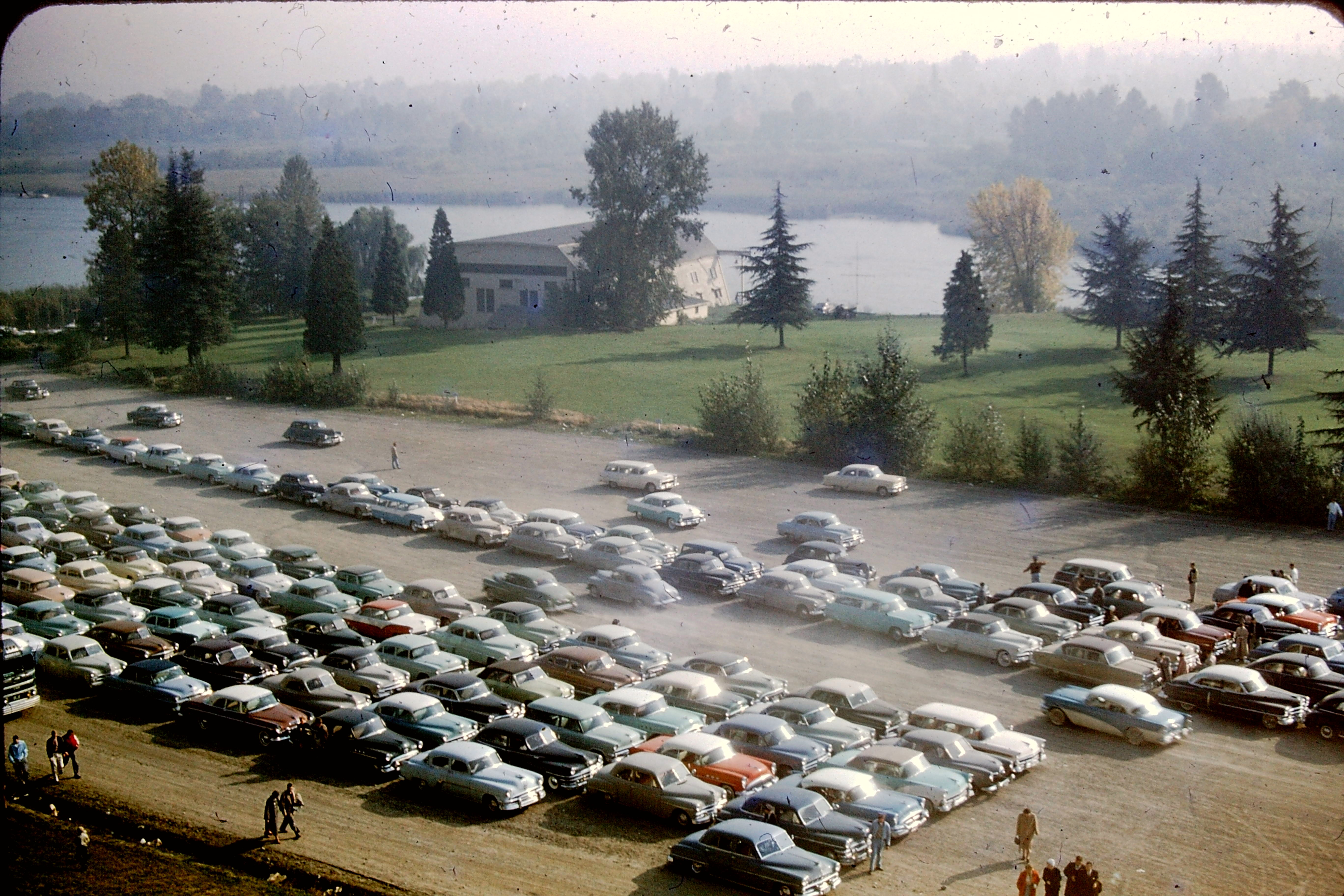
The beginning of the Montlake Cut. Looking SSE from Husky Stadium. Lake Washington’s shore was 15 feet higher before the cut. That marsh in the top photo was under water originally. Fall 1955.
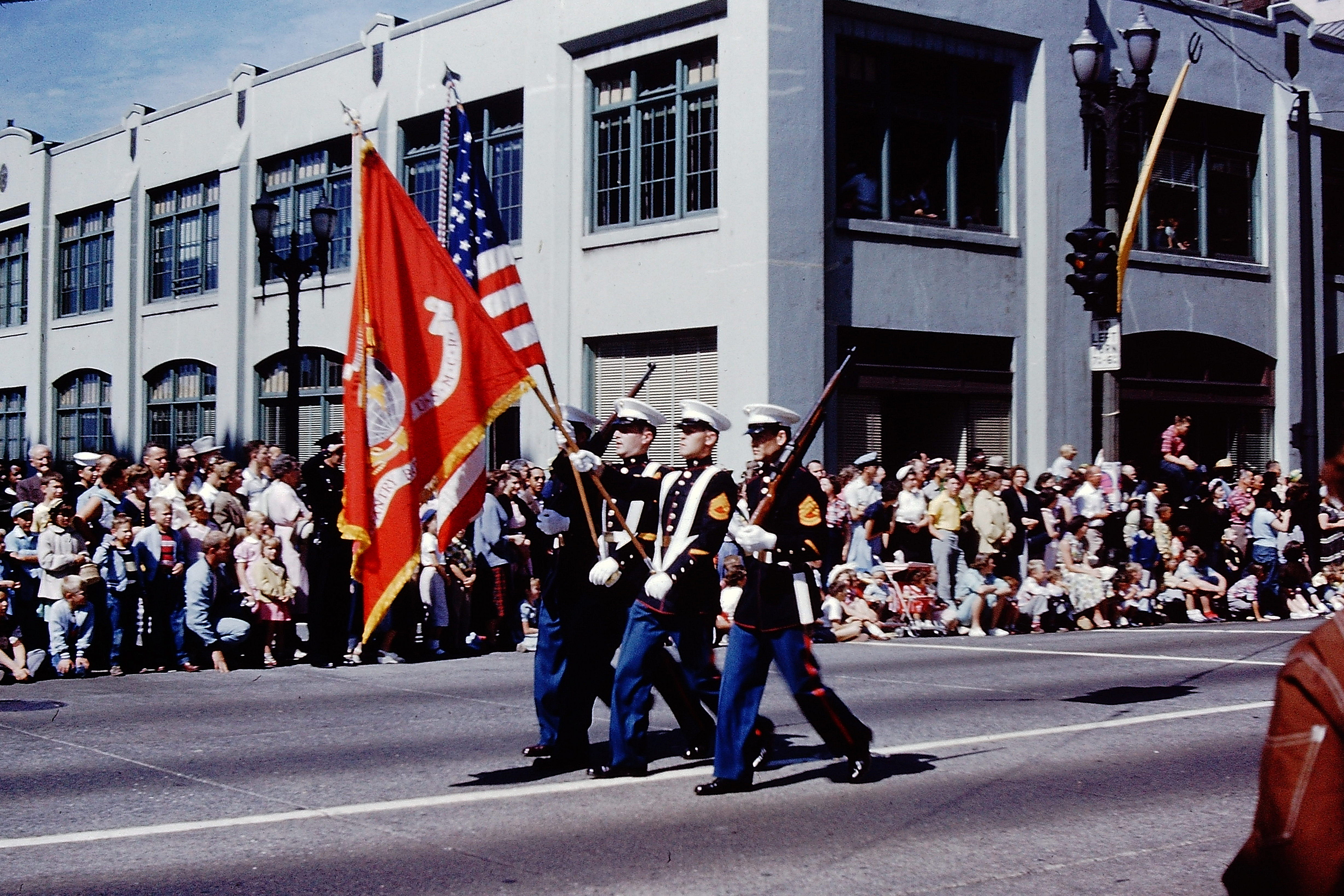
Mostly to show a friend. My grandfather took these at what I presume is the annual Seafair Parade in Seattle. I snagged all of his slides when they landed at my parents’ house, and I’ve digitized about 25% of them. And when I went looking for a photo from the parade, I find I’ve posted one once before. Better go find it…
Photo by R. O. Bach. Seafair Parade (?) in 1953. Seattle, WA.
…gave to me…we’re going with drummers drumming which have occupied ninth through twelfth places in all versions of the past century. In 1980 I attended a Japanese Festival at the Seattle Center. The highlight for me occurred with a show of taiko drumming which had been preceded with a film about the religious origins of the drumming-based music. It’s impossible to describe it other than to say it was a lot of drumming.
Small and medium-sized taiko drums with drummers. Seattle, 1980.Largest taiko drum with two drummers who do not always beat the same rhythm if I recall correctly. Seattle 1980.
It’s not August, but I feel like posting a photo taken by my grandfather almost 70 years ago. He grew up in Seattle from the final years of the 1800s until he passed in 1990. He would regale me about what Seattle was like in those early years, before Grandma would say, “hush, now, Roy, he doesn’t want to hear about all that old stuff!” I actually did. This photo is one of three dozen (a long roll of 35mm film back then). From the shots I can tell my grandfather never moved, just shot what paraded by. This photo is interesting because the young woman in the position of honor on the float looks like my mother. I doubt it’s her–she was way too shy to be this involved in things–but nonetheless… I’ve not delved deeply enough into parade routes, but it’s very likely this corner now has one or more skyscrapers on it. I can tell from some of the photos that it’s at an intersection and the street that leads off in front of the building in the background goes steeply downhill toward Elliott Bay…but then, many streets do that in Seattle. I can see Bainbridge Island in the background of some of the photos shot just a few more degrees to the left. Today it would be impossible to see Bainbridge Island this far up from the Bay.