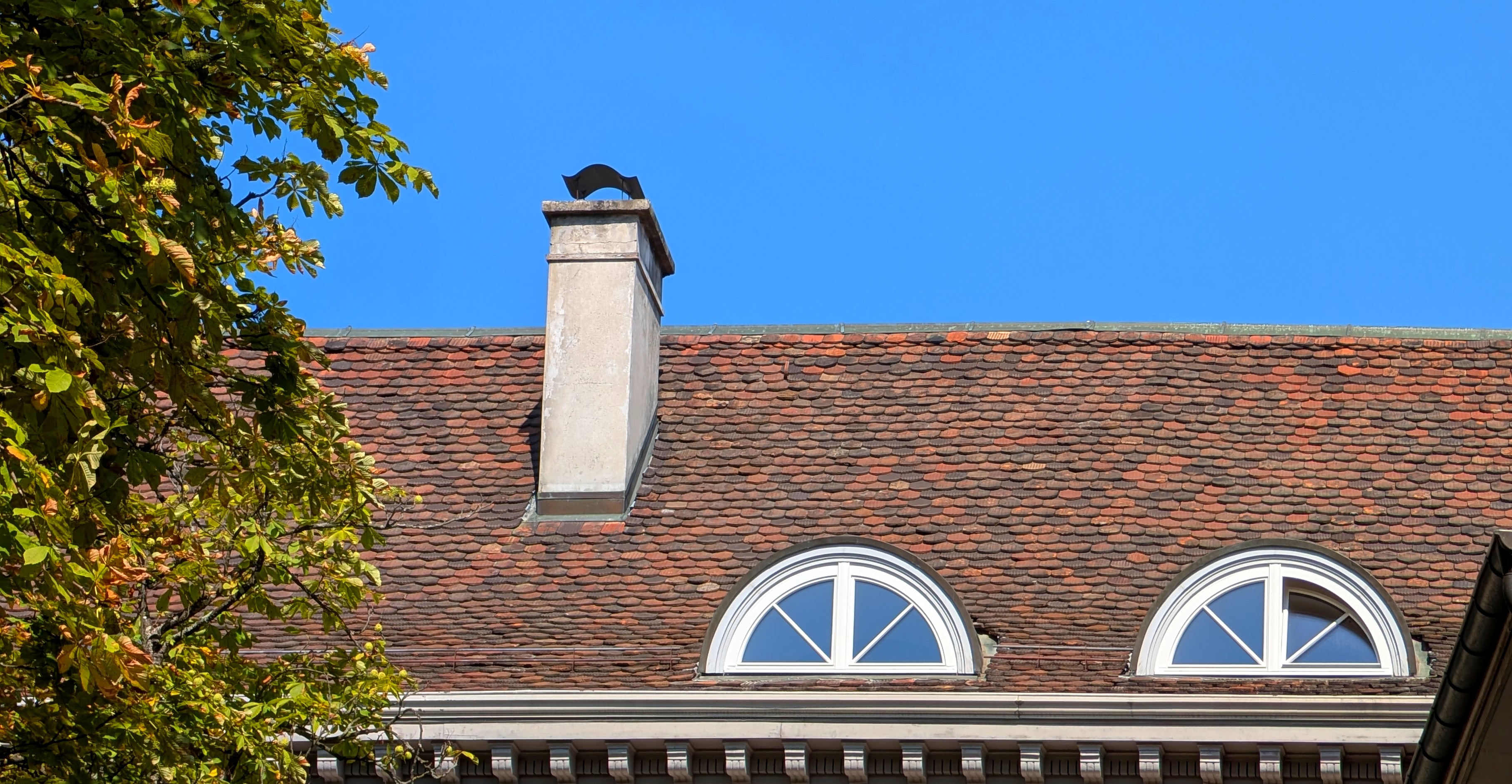
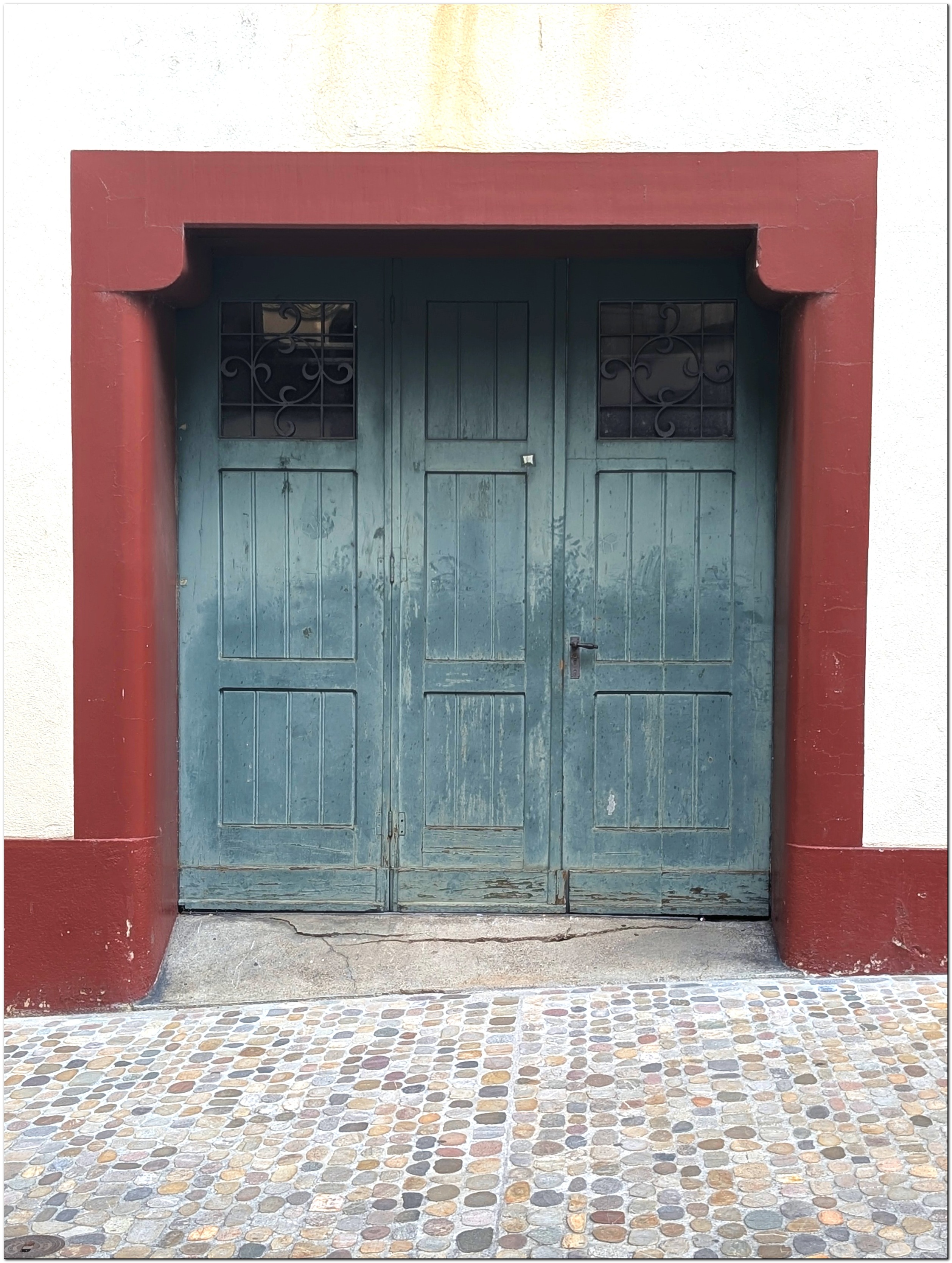
I’m fascinated by doors, windows, and any other portal between Inside and Outside. Part of it’s architectural, but over years I’ve learned I have a near obsession with any door or window which says “different” or “sturdy” or which carry an emotion perhaps symbolic of the wall it pierces. And if our eyes are windows to our soul, what then are a house’s windows?
Our first full day in Basel began with the sumptuous breakfast buffet I’ve come to expect from upscale European hotels. Afterwards we embarked on a walking tour of the historic part of Basel, reached via a short trolley ride from in front of the hotel. Several hours later I had collected six or seven dozen photos. On our second day, we wandered a little park across the street from our hotel, and trolleyed into Basel again where we visited a small but good botanical garden. So many strange doors and windows! (including these…)
Residence, Basel, Switzerland. August 2025.Converted carriage door to residence entry. Basel, Switzerland. August 2025.Clashing architecture. Basel, Switzerland. August 2025.Upscale residence (backs onto the Rhine River). Basel, Switzerland. August 2025.Overlooking the market square, Basel, Switzerland. August 2025.Entrance to a cylindrical chapel in a little park across from our hotel. Basel, Switzerland. August 2025.
Vacationing has meant several things over the years. As a child it meant adventure. Dad would plan a two-week sojourn through the beauty of the American West, plotting the journey for months, and utilizing guidebooks (well, the AAA one) to find both motels and sights to see along the way. By the time I reached “summer job” stage and such vacations no longer were possible, we had seen most of the national parks from the Rockies westward, plus the Grand Canyon, and the tourist hot spots of Southern California (Disneyland, the San Diego Zoo, Knott’s Berry Farm, etc.). We visited San Francisco in 1968 where I saw my great-grandmother on her deathbed and hippies in The Haight. And we always tried to loop through either Seattle or Woodburn, OR, to visit one set of grandparents. Back then, vacationing meant lots of hours in a car reading or imagining things as the countryside went by. It meant rolling with the punches when the road Dad wanted to drive was under construction or the motel he wanted looked better suited to hookers than small children. It mostly meant seeing state after state, park after park, city after city which I had never seen before, and which in my short life presented amazing memories and lessons.
I couldn’t capture that as a younger adult. Vacations at first mostly entailed going home to visit my parents and my friends. I tried a brief camping trip along the Snake and Salmon rivers, but the spectacular views couldn’t make up for my inability to build a fire and thereby have any food to eat. (Or perhaps one could say, the views couldn’t make up for my ineptness as a camper.) A bit later as a newly wedded teacher, summers were for further training, loafing at my in-law’s lake cabin a couple times, and once or twice attempting to emulate my father’s grand tours of the West. I thereby got to see parts of Arizona south of the Grand Canyon for the first time and see some lesser known but equally impressive sights. I explored my own state, Washington, better. The 10 to 11-week length of our summer breaks diluted the compressed wonder of a two-week vacation.
Life changes and a relocation to greater Philadelphia put the kibosh on traditional vacations. Just living there was a new experience. After two years there I discovered a new type of vacation which brings a different kind of satisfaction: the introductory tour. I had met a new love (who married me the next year), and I had entered corporate America where two weeks is the only significant time off you get. I took this woman on a whirlwind nine-day tour of Washington and meet-the-folks. My bride-to-be loved the state and my parents loved her. I repeated the tour in 2017 for a dear couple of friends from North Carolina.
[Disclaimer time: despite the fact I’ve lived in Washington for only four years since I left it back in 1992, I still consider it one of the best places on Earth. My values have to do with variety. In my mind only California comes close to the diversity of climactic zones and has the varied population densities ranging from the Seattle-Tacoma-Olympia wash of people to areas where it’s difficult to find the next house from the one you’re standing beside. Want desert? Check. Alpine? Check. Rainforest? Check. Scablands, Arctic, Temperate forest? Check, check, and check.]
Less than a year after our marriage in 1995, we vacationed to New Mexico for two weeks. We wandered from Albuquerque north, were unimpressed with Santa Fe and hightailed to Taos. In ’95 it had started to build up, but only a little. We stayed at an honest-to-God auto court, and breakfasted at a old West-style cafe on the square. (Revisiting in 2022 saddened me when I saw all of that charm washed away by touristy stuff.) That second week of the vacations, all my tensions dropped away as we shot into southwestern Colorado for two nights before striking to southern NM and the Carlsbad Caverns. Until a couple weeks ago, I held this up as our standard of Best Vacation Ever.
Then we cruised down the Rhine River for eight days on the Viking Hlin, and visited Basel, Switzerland, and Antwerp, Belgium, at the beginning and end of the voyage, respectively. Viking is known for catering to old folks like us (no one under 18 is allowed) and for its all-inclusive approach. We could have been very happy just eating the food, drinking the beer and wine with lunch and dinner, and taking the included tours, but it made sense for us to add two optional tours, take care of gratuities in one tidy little package, and buy the Silver Sipper beverage package so that we could drink beer, wine, and cocktails just about any time we wanted. Given the slant toward the retired and soon-to-be-retired, I must say my initial introduction to the ship gave me a jolt:
“Welcome aboard” kinda takes on a whole new meaning with a tag like that! August 2025.
I’ve nothing against people living the love lives they desire, but still I was thankful there occurred no hot gay sex (that I know of ) on the Hlin. It reinforced my initial reaction after two nights in Basel before boarding, that European cities seem to take a more blasé view about tagging. There seems to be an unwritten rule that it isn’t done on cathedrals and other historical buildings, but other than that…sure, indulge yourself.
As with my Hawaii series [tag: Hawaii] and my Virtual Vacation series [tag: Virtual Vacation] about Michigan and Ohio, this will be a lengthy series of posts recounting how two neophytes who never traveled abroad for pleasure decided to do so in retirement. For now, I’ll end with two photos about our first few hours onboard.
The appearance of swans became commonplace by the end of the cruise. They paddled up for treats just as ducks do in cities throughout the United States. Rhine River just downstream from Basel, SW. August 2025.
On the first night I met one of my new friends: Köstritzer schwarzbier. If you think you don’t like dark beers, give schwarzbier a try. Light-bodied, crisp, but it has a nice roasted taste lacking in traditional lagers. One of the handful of beers offered on board. I wish there had been more! And yes, Europeans are civilized: each beer has its dedicated glass. Viking Hlin , August 2025.
Lap number…I dunno…I lost count. Fawn feeling frolicky, Raleigh, NC. July 2025.
I almost feel embarrassed to post this photo of such poor quality. In my defense, the fawn zipped by so quickly, this represents my best. Much like a swimmer in a lap pool, the fawn ran back and forth, taking about 100 yards for each lap. The crashing of the brush is what grabbed my attention. It had rained for hours the previous night, which caused me to attribute the crashing sound to a falling branch at first. I tried to pan with the fawn, but you can see how difficult that was. Additionally, I shot the photo through the screen of my screened-in porch. Meanwhile, mama calmly moved from yard to yard sampling the greenery.
Eastern honeybee (?) on just opened sunflower. July 2025.
I feed birds, mostly black-oil sunflower seeds. This year it looks like I’ll through about 400 pounds of them. Apparently one got planted in our newly landscaped front yard, and there amid many of the similar-spiky Obedient plants was this lone sunflower. I love sunflowers. Therefore, I got pretty irritated when something, probably a deer, nipped off the top where a bud had been forming. The joke’s on the deer, though. By trimming the plant, it put up TWO stalks from where it had been lopped, each of which had buds…until one burst open on Independence Day.
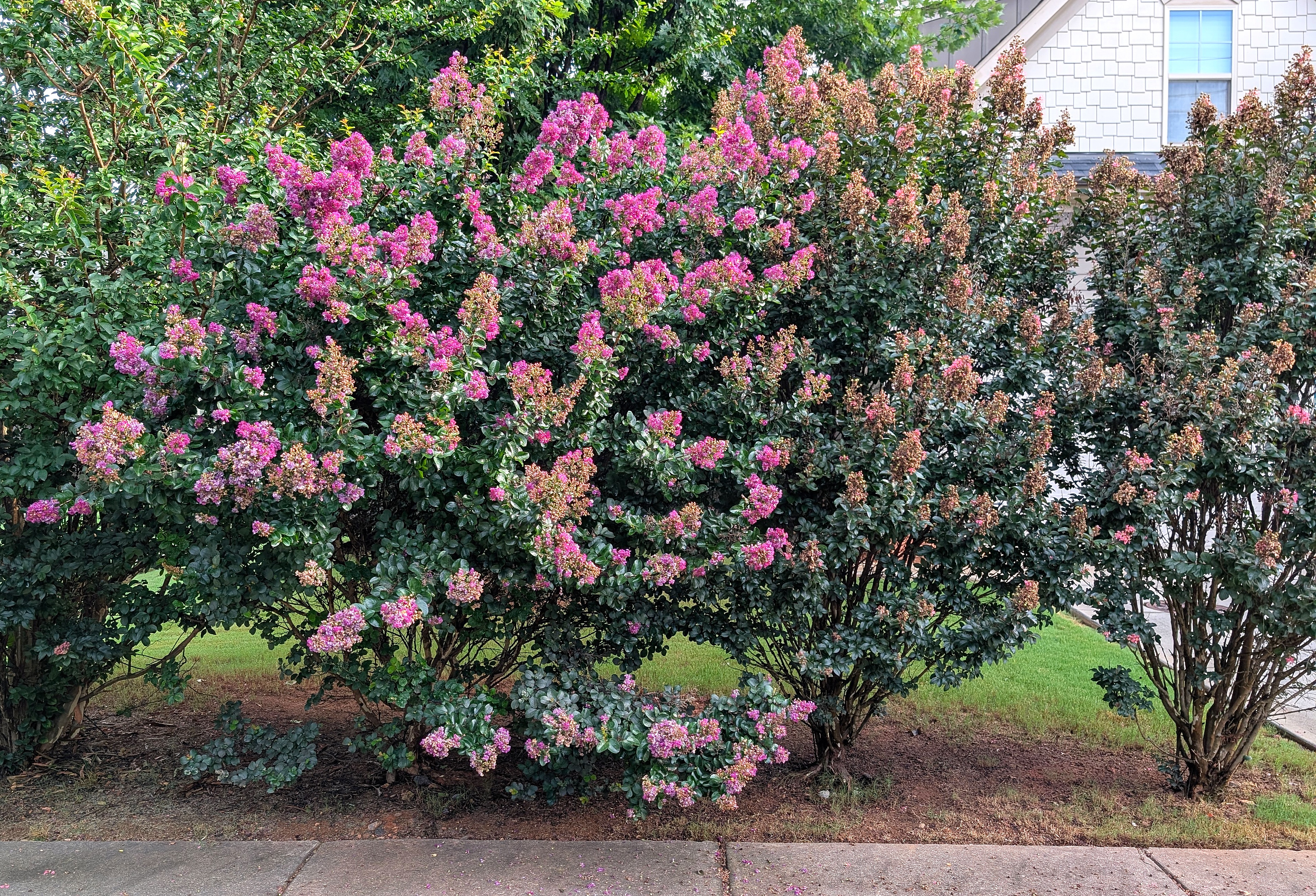
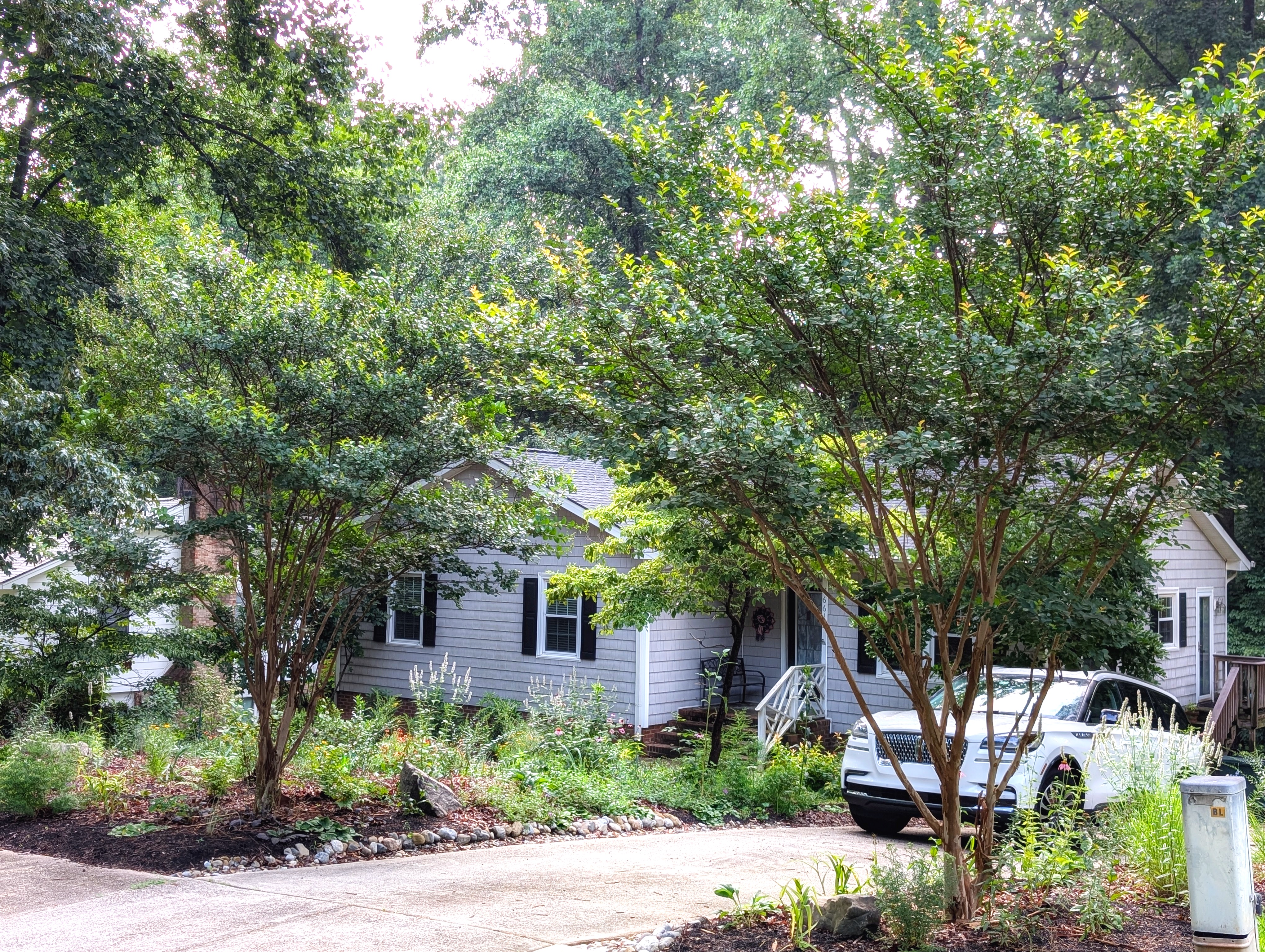
…or crepe myrtles if you prefer…seem ubiquitous here in Raleigh, NC. From what I read and hear they’re throughout the South, though I haven’t paid enough attention while driving through our neighbor states. Crape myrtles take their time, slowly becoming substantial trees of a type called thicket trees. They can be well-tended and trained, as this one is:
With care, the trunks grow together. Raleigh, NC. July 2025.
Usual care involves letting them grow as they will, but pruning suckers and sometimes trimming the tops to shape them:
Crape myrtle with usual thicket look and showing white blooms. Raleigh, NC. July 2025.
Crape myrtles are everywhere here. The photo above is across the street from the first photo. The thicket-trunked myrtle in the foreground has a substantial myrtle right to its left, the one with a more substantial trunk. Follow the sidewalk and you’ll see two more, smaller (younger) crape myrtles flowering. These last two demonstrate the variety of the approximately 50 species of crape myrtle (or are a particular cultivar of one):
Younger, different crape myrtles. Raleigh, NC. July 2025.
Crape myrtle are maintained by the City of Raleigh in the decorative medians:
Three “City” crape myrtles at the end of my street. Raleigh, NC. July 2025.
To me the Ultimate Crape Myrtle lives in my neighbor’s yard. Its branches extend from the edge of the sidewalk and tower over her house. It’s at least 30 feet tall. Someone appears to have pruned a few suckers in its youth, but mostly it’s been left to its own.
Crape myrtle in neighbor’s yard. Our white car and yard in the background. Raleigh, NC. July 2025.
And then there are our crape myrtles. Ours were planted sometime between 2007 and 2014 (using Google Maps Street View), with the most likely time frame being 2010-2012, a period when the former owners rapidly changed the landscaping and interior of the house. The myrtles probably were purchased as saplings, and have doubled in height for the eight years we’ve lived here. For reasons I suspect have to do with amount of sunlight and my utter lack of any care beyond occasional pruning, they flower very late. I suspect sunlight because my other neighbor has three, also near the sidewalk, which haven’t bloomed yet either. In the photos above you might have noticed most of the myrtles nearing the end of their blooming period. Ours?
Our two crape myrtles, either side of the driveway, not blooming. July 2025.
But here’s the thing: though closely identified with the American South, they are not native to it. To quote the NC State University’s Extension Gardener website, “[Crape myrtle] is native to the Philippines, Japan and central Himalayas to southern China and Indochina.” Our whole move the past 12 months has been to replace everything in the front yard with native plants. (note that in the photo above) After a year of debate, and many years of saying, “Maybe they will bloom better when they get bigger,” we’ve decided to replace them. (Sorry, former owners. Consider it payback for removing that big tree in the front yard and not properly having the stump ground. I nearly broke my ankle in that mess many a time.) On one side will be an ‘Amethyst’ witch hazel which blooms in winter and very early spring. (Photo here.) On the other side will be a serviceberry. It mimics the look of a crape myrtle with the multi-trunk growth, but it will provide berries for birds and other critters.
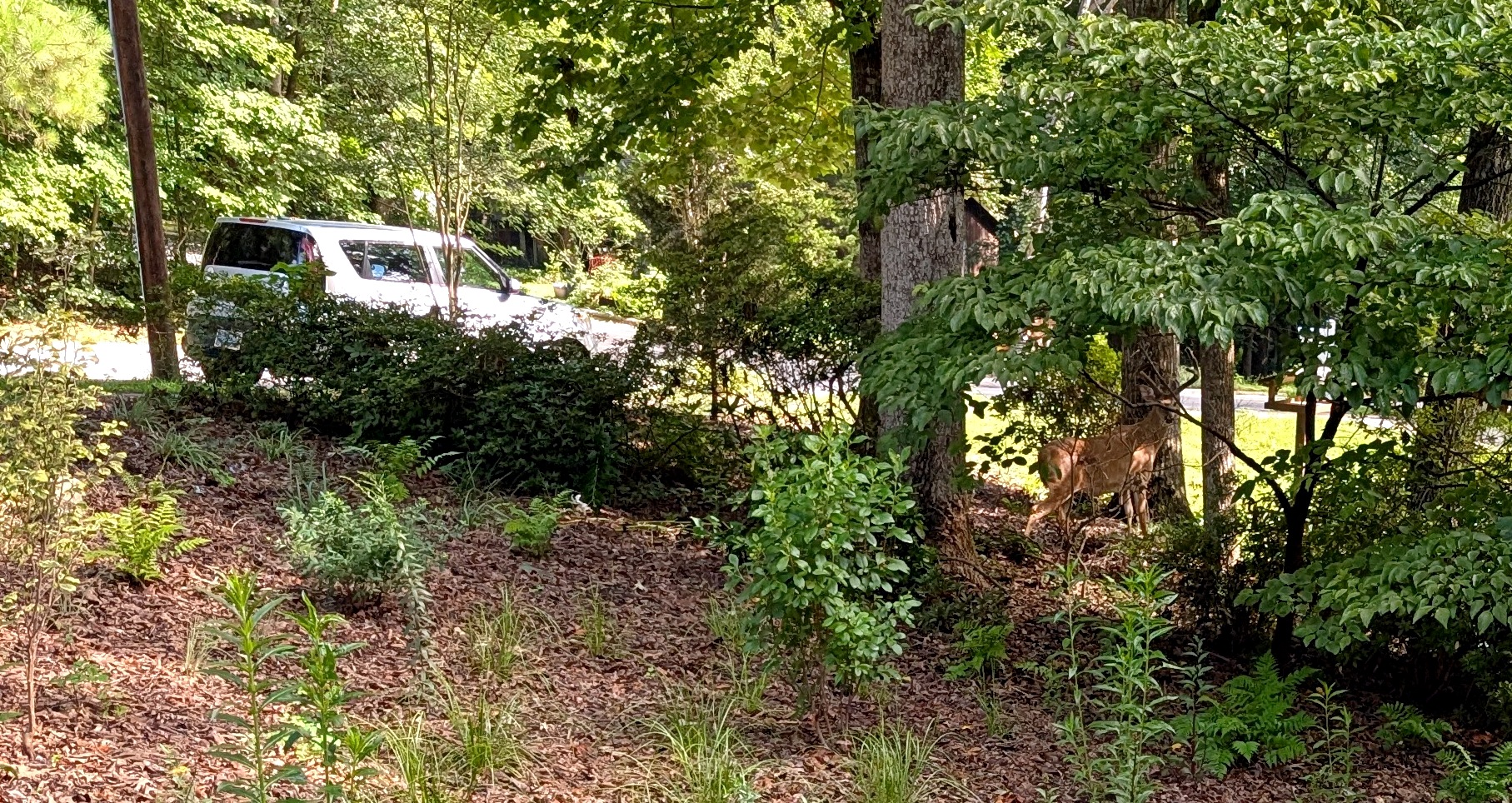
Eight-point buck meandering through our trees. July 2025.
Our street, above, regularly sees traffic of 35 mph and above now that a lot of drivers have discovered it’s a better-than-nothing shortcut from one arterial to another. (Raleigh arterials commonly have a 45 mph speed limit.) It amazed us therefore to see this buck come down the slope of the yard across our street, then cross the street around 9 a.m. and continue downhill between our houses. Here’s a lower-resolution close-up from the photo above:
Eight points!. July 2025.
We lost sight of him for a minute, then my wife spotted him in the back corner of the neighbor’s yard. He was in no hurry. He’s eating some leaves there…
Eastern carpenter bee working the beebalm. June 2025.
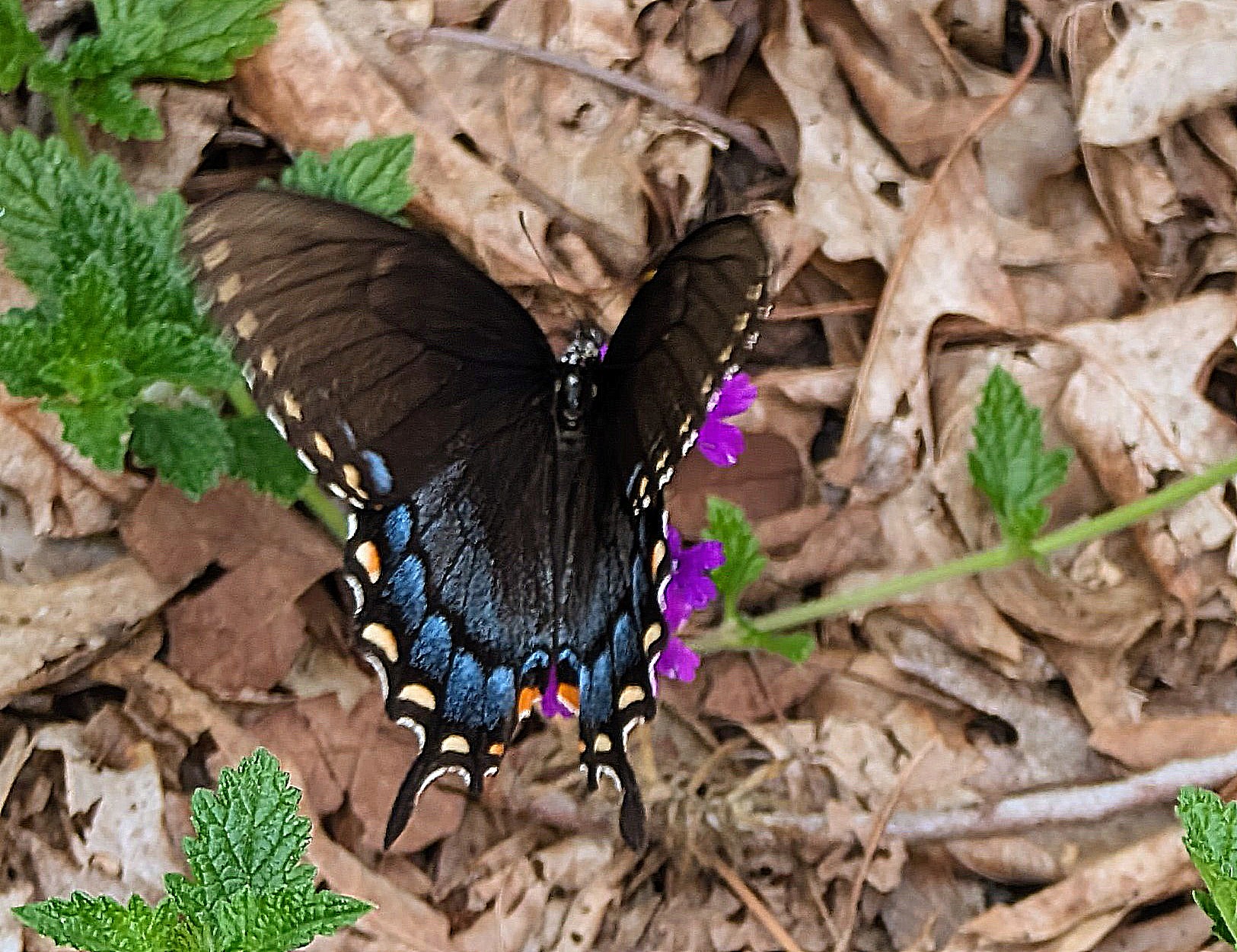
I opened the month shooting photos of the beebalm with a swallowtail butterfly on it. This photo is from the same set. The swallowtails, bumblebees, and little tiny bees I haven’t identified yet all had to work around the behemoths of the flowers, the carpenter bees. At 1.25-1.50 inches (or more!) they pretty much go where they want to. Now the beebalm has slowly dropped all those fuchsia-colored petals. (Or are they petals? I don’t know much about plants.) All that remains are the ball in the center, still suspended on those long stems. Our new visitors love these: goldfinches. They flit from flower to flower, their nearly weightless bodies hardly making the stems bend at all. It seems too soon for seeds, but what do I know?
Summer temperatures, documented a few days back, will continue for the near term future. Americans look forward to celebrating Independence Day on Friday, the 249th of our country’s existence. In these muddled times, I wonder what that will bring. Meanwhile, the business of life marches on, from the mundane (it’s Gather the Garbage Day) to the inconvenient (workers coming to work on the leak in the bathroom shower) to the calm and simple (my wife returned from a coastal sojourn yesterday afternoon; this day will be our first together in a week).













 all the voices in my head