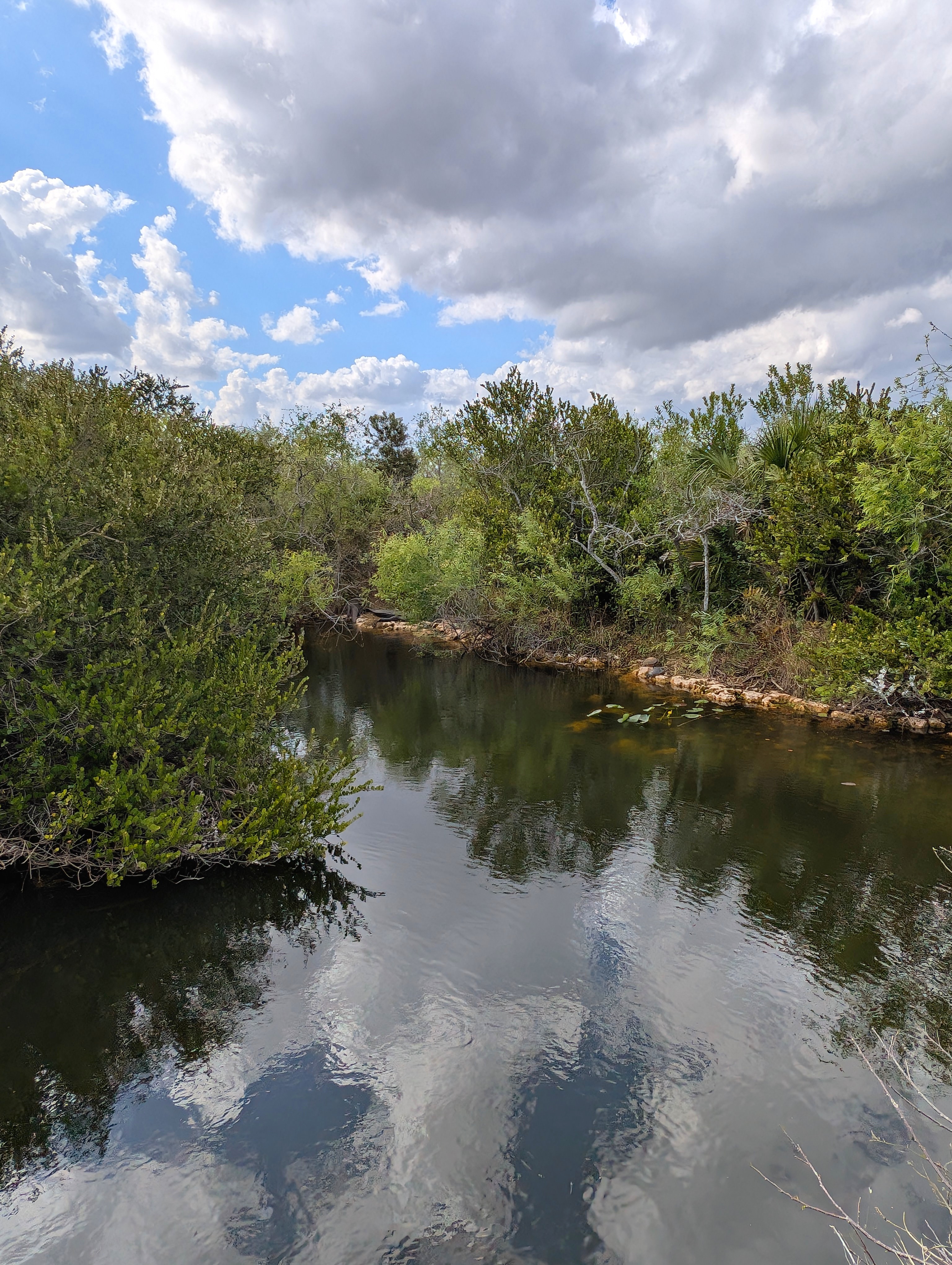
View from Shark Valley Visitors Center, Everglades National Park. There are two alligators in this photo. February 2026.
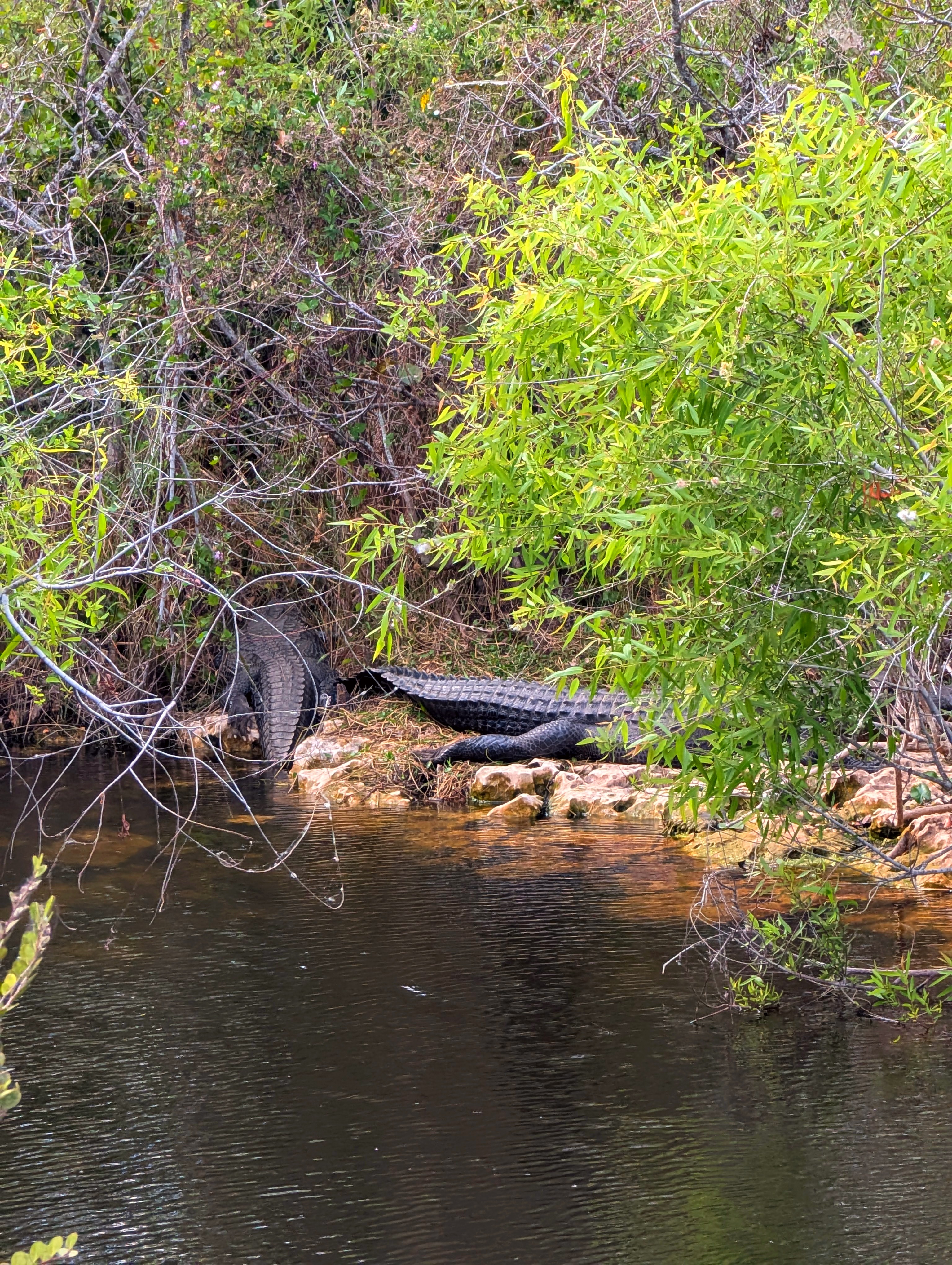
Technically we re-entered the Everglades National Park at the end of our day in the Big Cypress National Preserve, stopping at the Shark Valley Visitors Center at the end of the afternoon. We didn’t want to take the tram ride to the actual Shark Valley viewing tower, which left us little to do there. Another hour brought us to Homestead, FL. I discovered a Cuban restaurant next door which delighted me a great deal. But first, where are those alligators in the photo above? Look up that slough in the center of the photo. On the far bank? Just above the light-colored shoreline? Here’s a zoomed in photo:
Alligators at Shark Valley Visitors Center. February 2026.
We hit up the Cuban restaurant for breakfast, easily besting the hotel’s “continental” offering, then headed to what I still regard as the heart of the Everglades—the Ernest F. Coe and Royal Palm Visitor Centers and the road which leads deeply through the park until it reaches Flamingo where one can stare southward at the Florida Keys. We arrived just as the Coe center opened then headed southward.
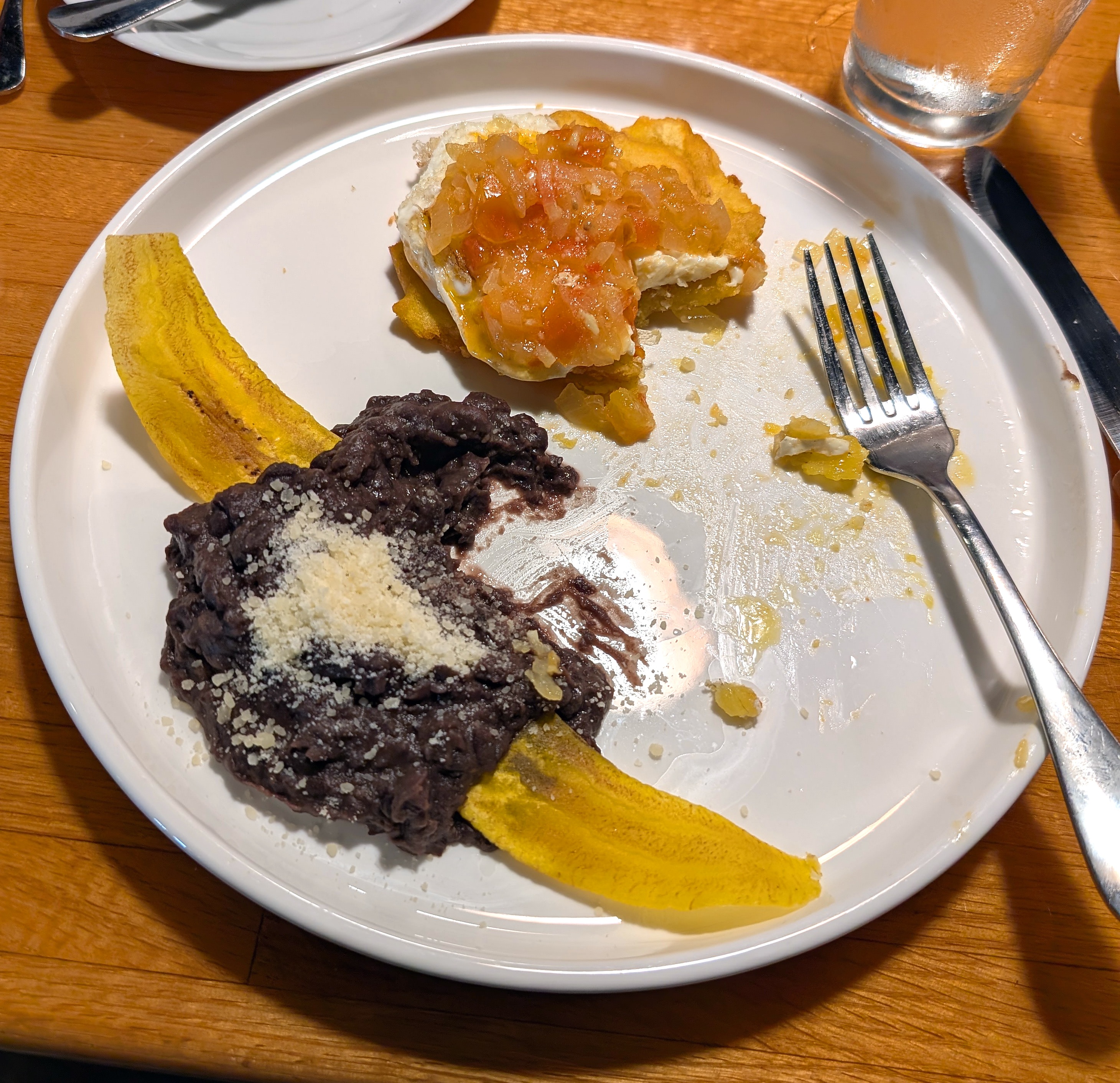
Huevos rancheros, Cuban-style: plantain pancake under the egg and a fruited salsa atop. February 2026.
After spotting a half dozen or so school buses in parking lot, we decided to visit Royal Palm at the end of our day, on the way back out of the park. Quietly spotting wildlife with a hundred or so elementary students alongside (we checked) seemed to be mutually exclusive. We stopped at some of the major sights on the way south, a few on the back out.
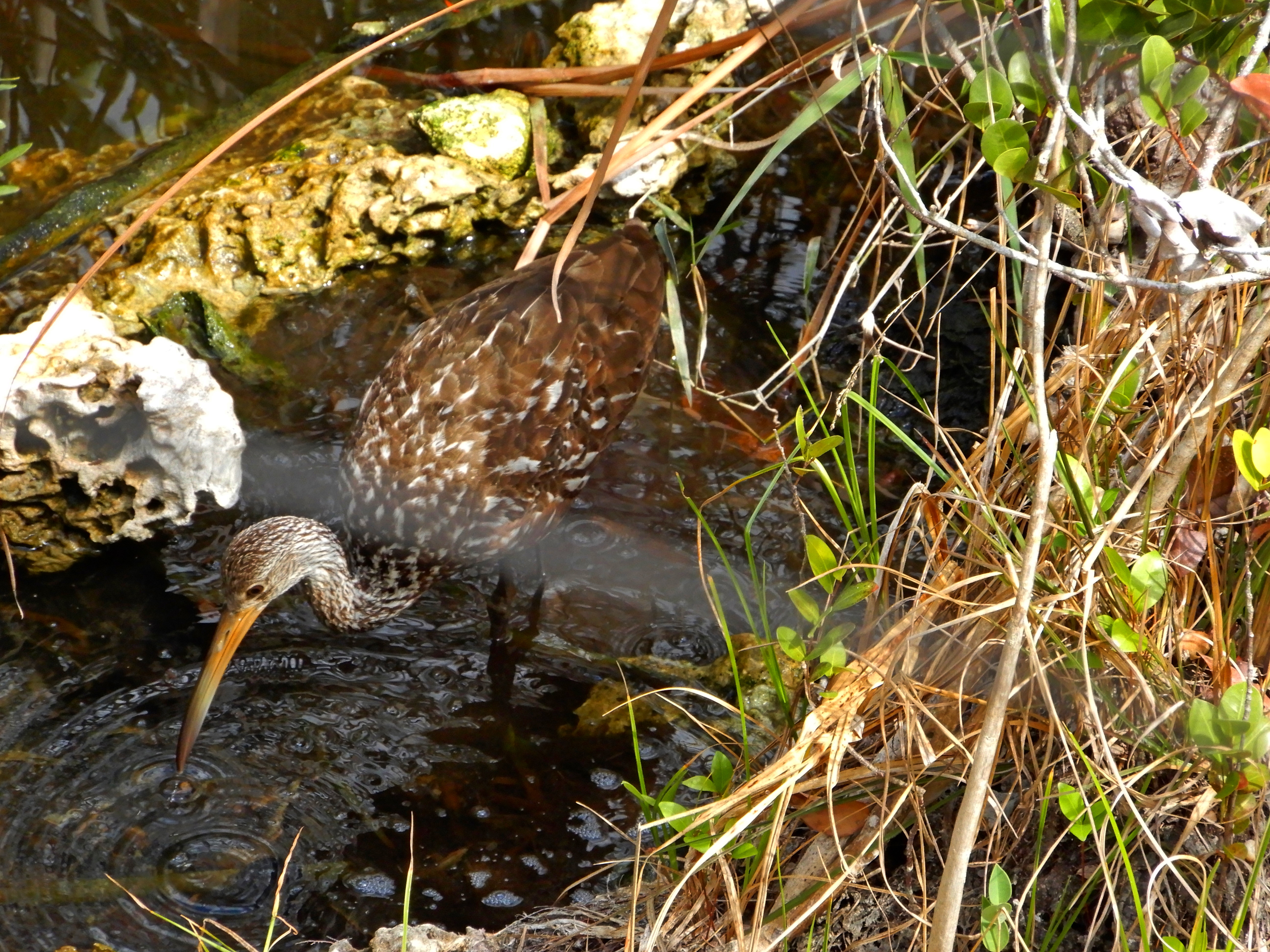
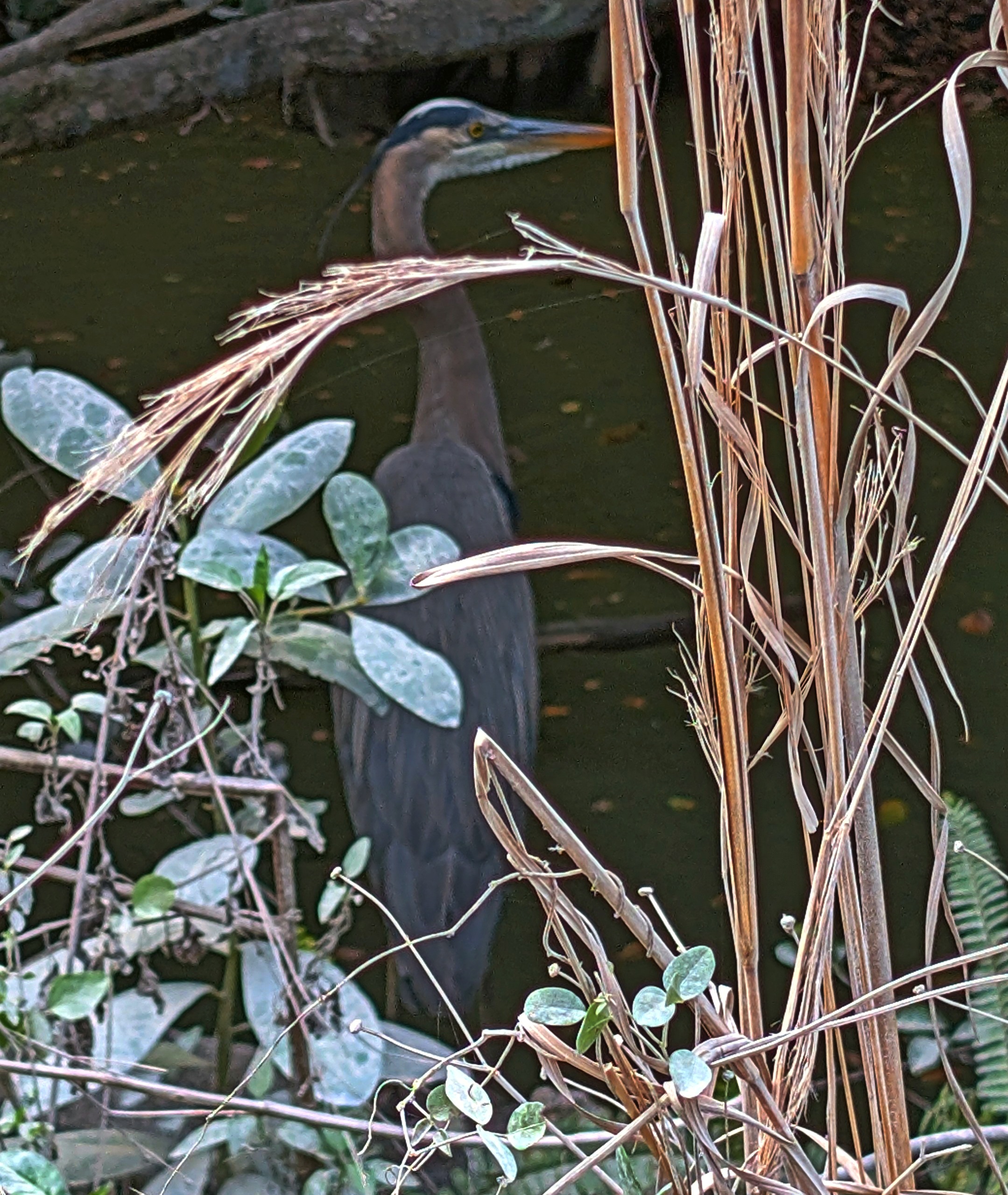
A juvenile heron. Not sure which one. Looks like a Black-crowned Night Heron, but those don’t have the yellow/orange beak. Closest I can come would be a Tricolored Heron but it doesn’t seem to be quite like this patterned brown. February 2026.
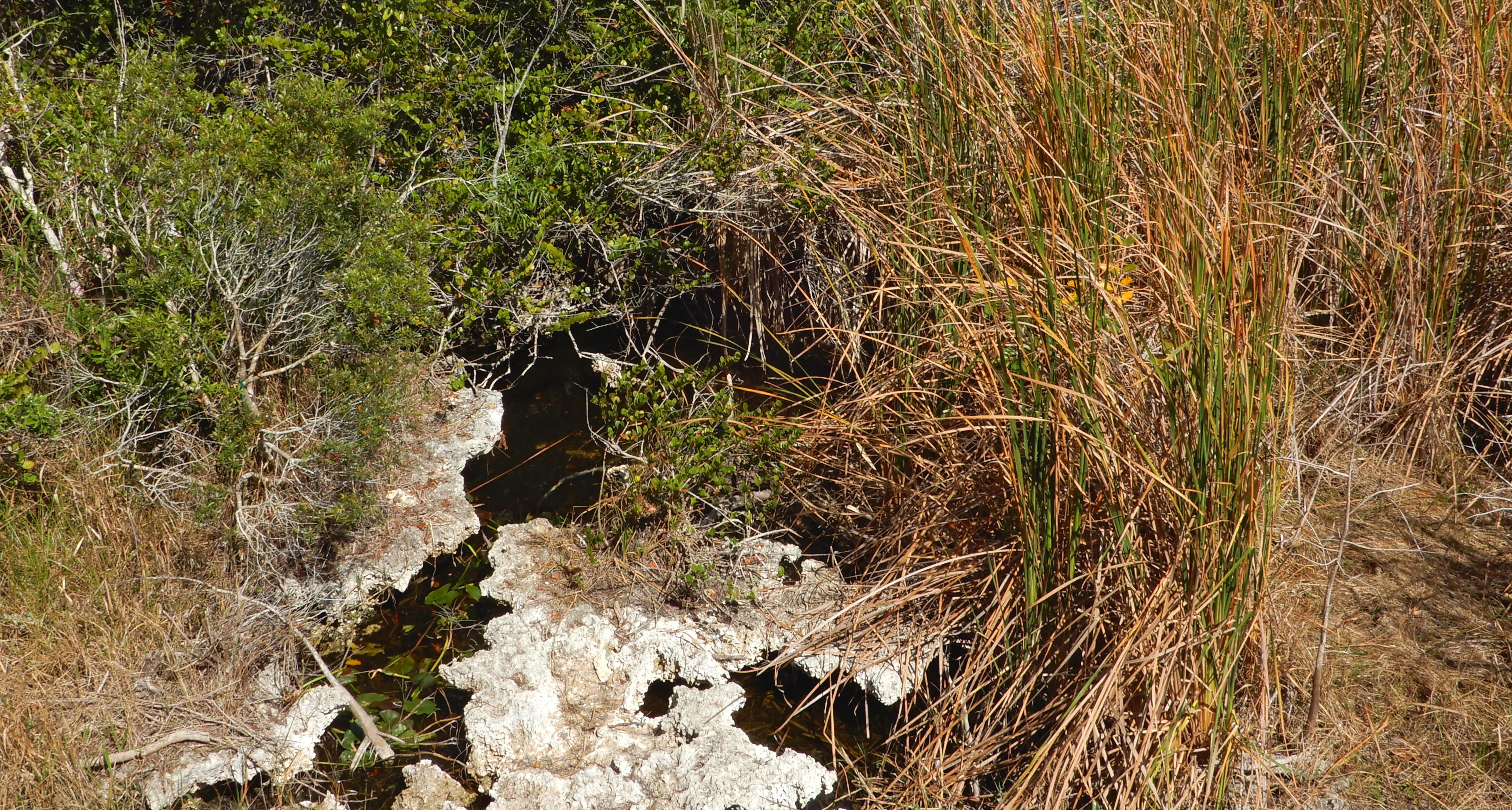
Small drainage creek at the Pa-Hay-Okee Lookout Tower, Everglades. February 2026.
My wife spotted a heron jumping in and out of the darkness of a creek at Pa-Hay-Okee Lookout (left and above). I needed a telephoto to see what she was talking about!
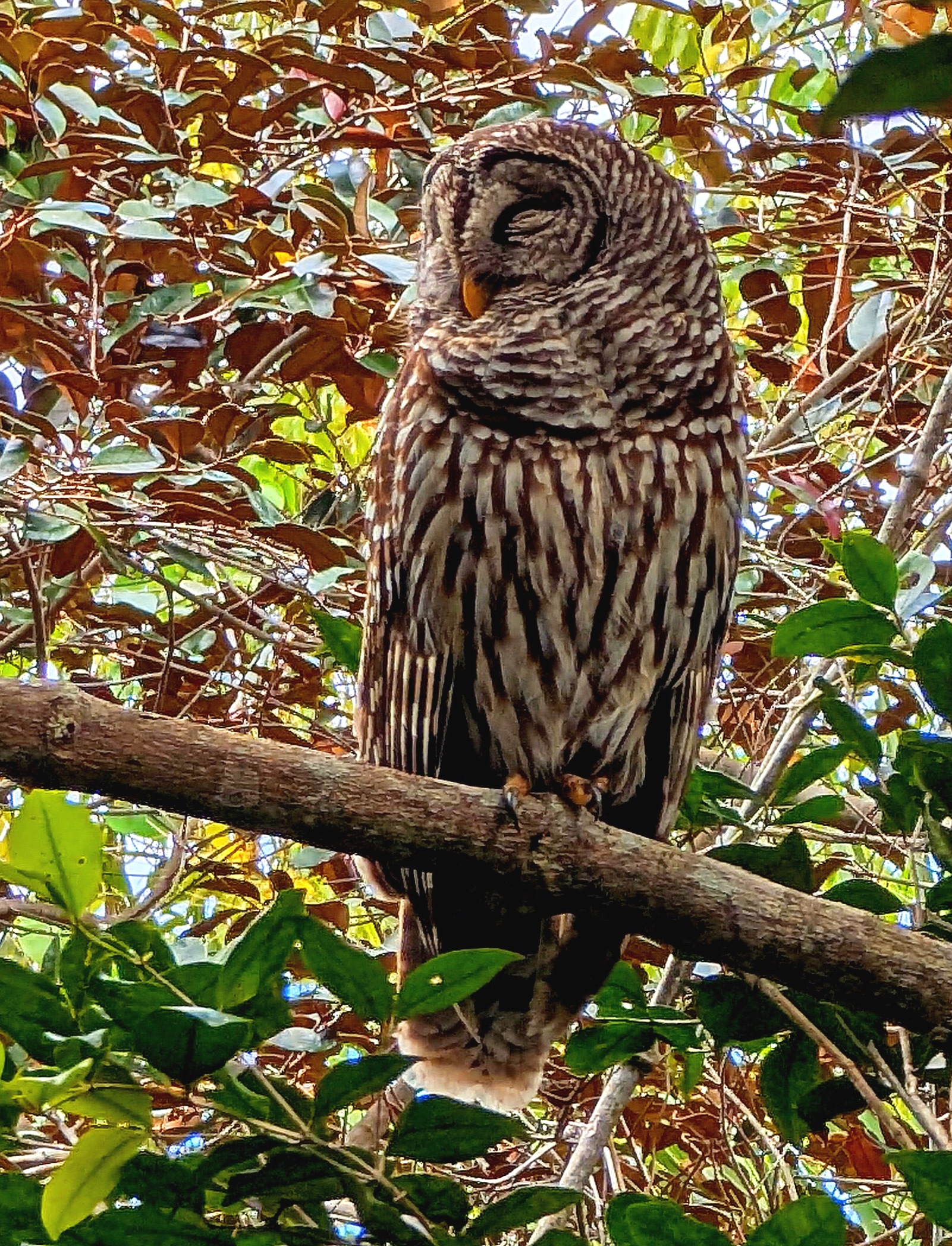
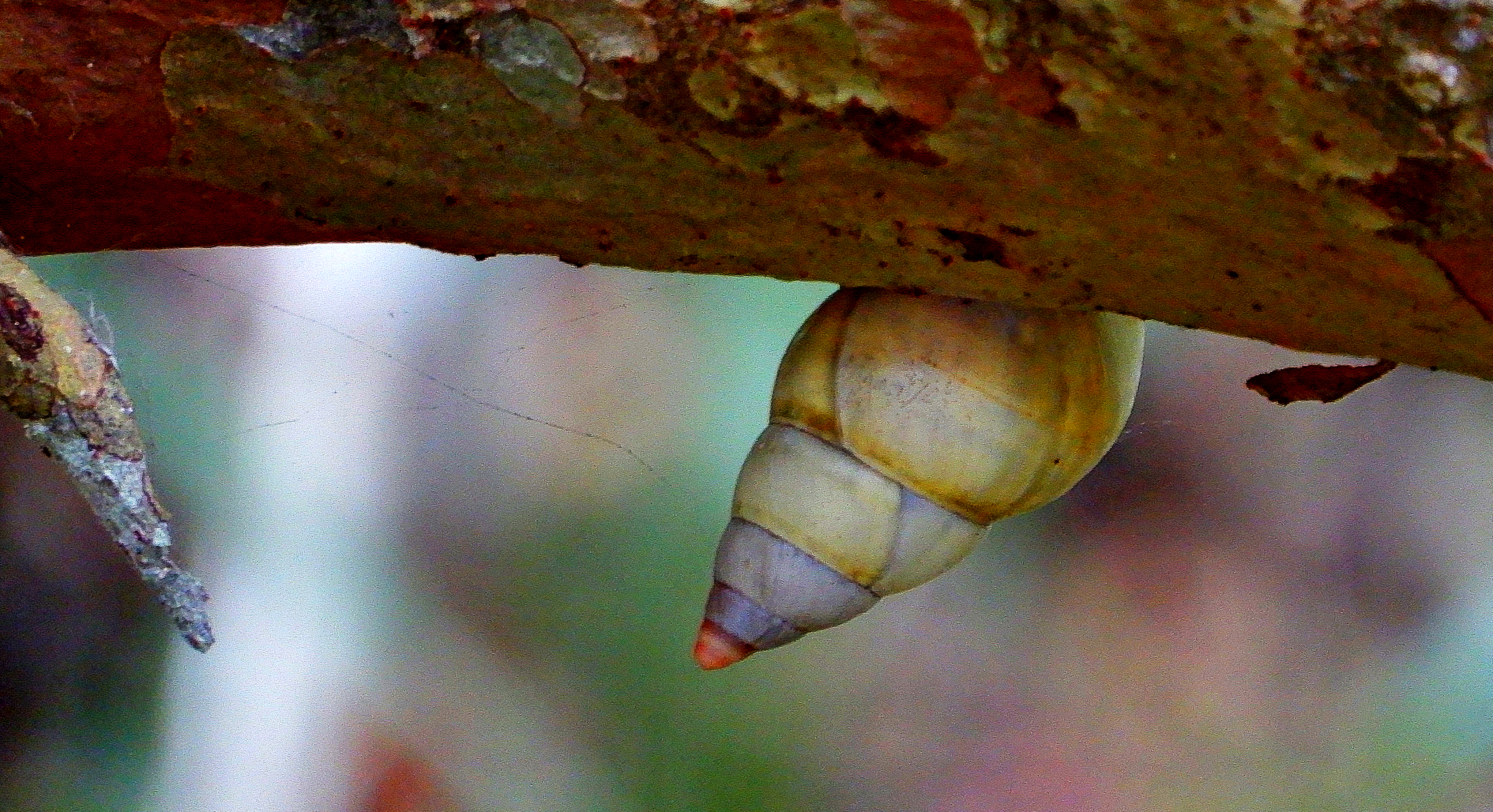
We spotted a barred owl at the Mahogany Hammock walk. While watching him (nearly positive this was a male), we were treated to a call-and-response with an owl we couldn’t locate. This apparently is classic barred owl behavior between a male and female. A sharp-eyed teenager pointed out a snail which I had difficulty locating even after she had described the location. Other attractions at this stop included huge root systems seen from underneath because hurricanes had blown them over in the past.
Barred owl at Mahogany Hammock. February 2026.
Tree snail at Mahogany Hammock. Approximately two inches. Everglades, February 2026.
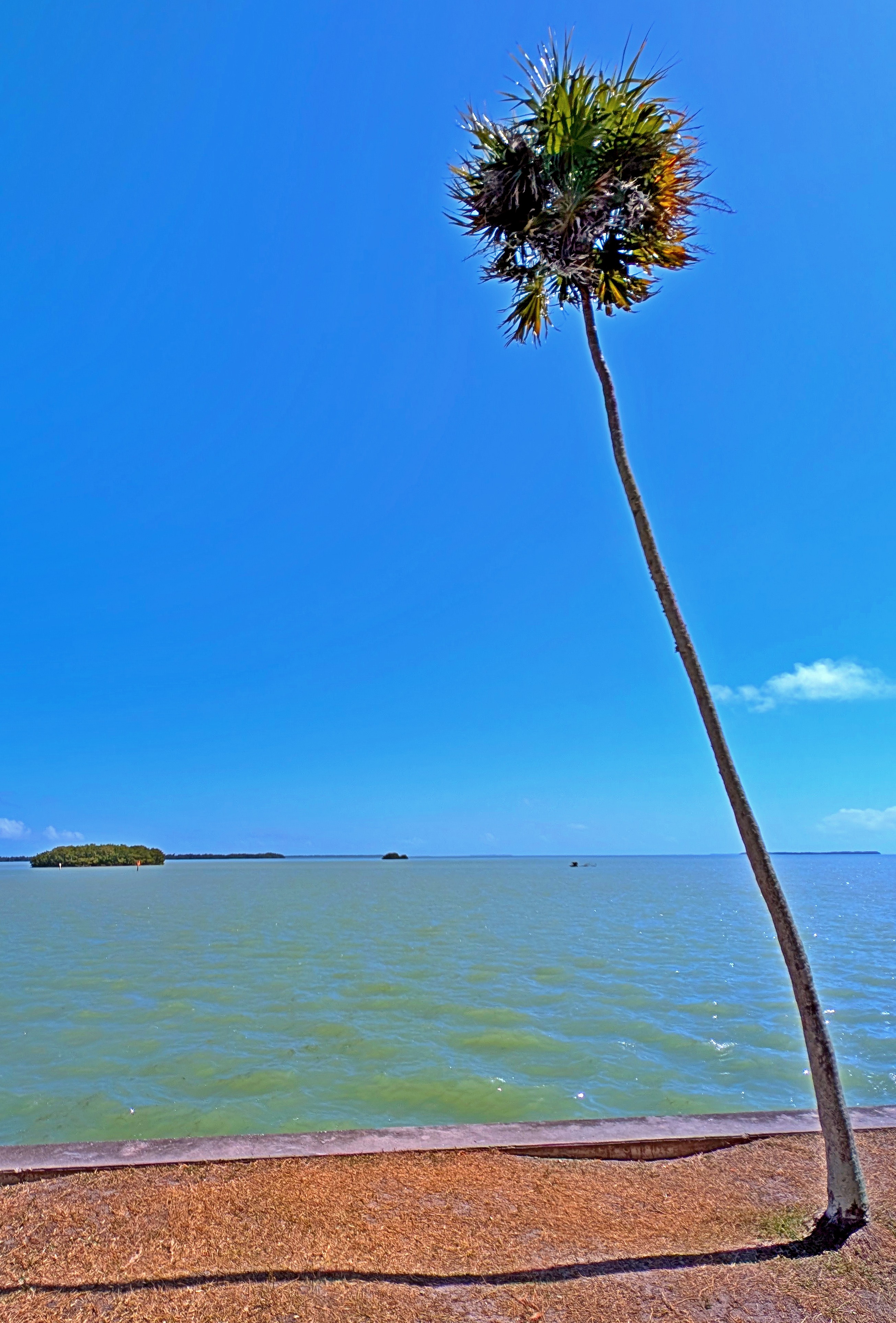
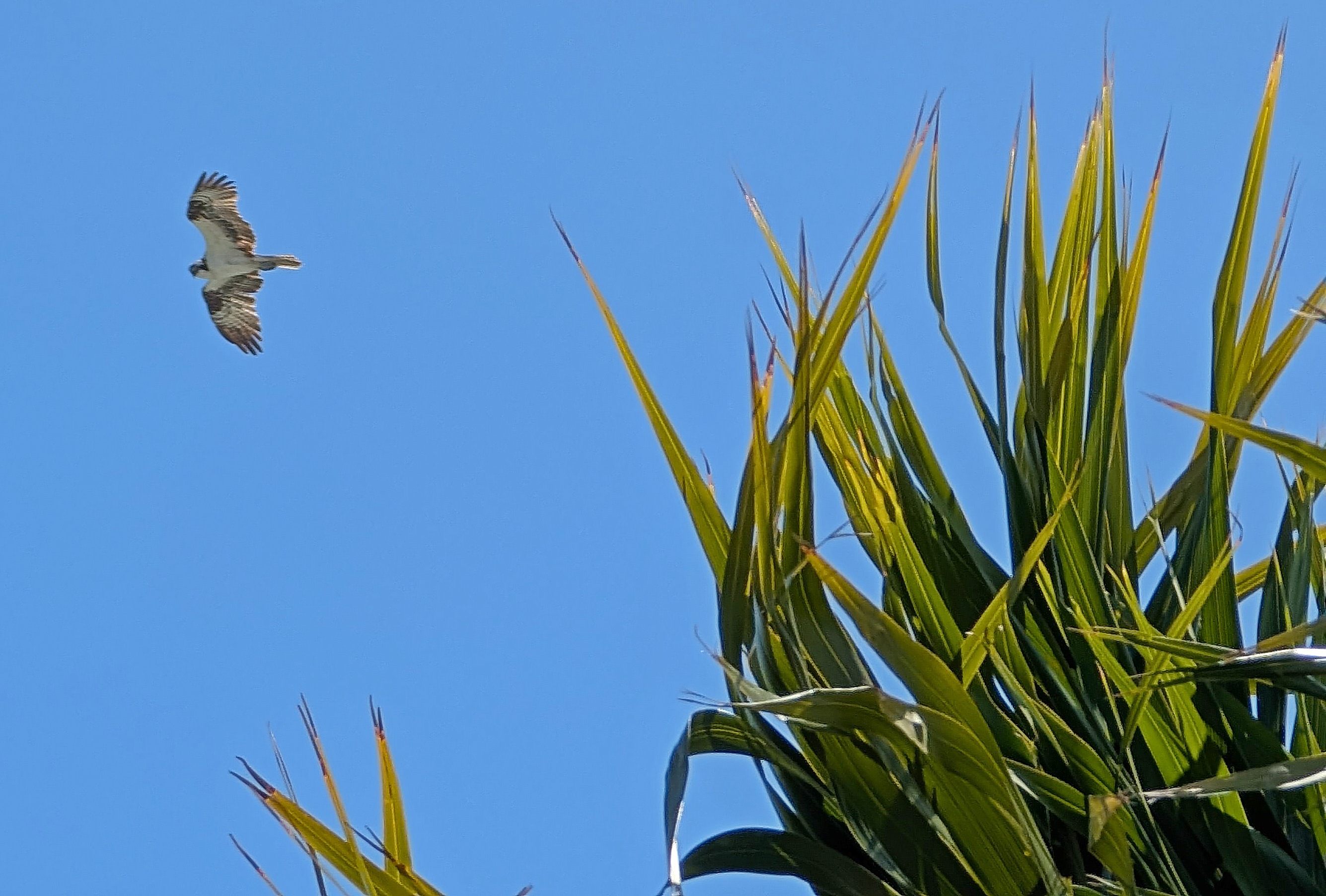
We arrived at Flamingo a bit tired. Thankfully the best thing to do there involved sitting and staring at the shallow waters leading out to the Keys—unless you wanted to take a boat charter which we had done in the past. We spotted an osprey flying back and forth over the shoreline waters, and we saw the near-ubiquitous flock of White Ibises. Then we drove north again.
A stylized view of the Keys. Flamingo, Everglades. February 2026.
Osprey at Flamingo, Everglades. February 2026.
We turned around and drove north toward the Royal Palm Visitors Center, hopefully now without the youngsters. Royal Palm deserves its own post, however, so we’ll bring this to a close.
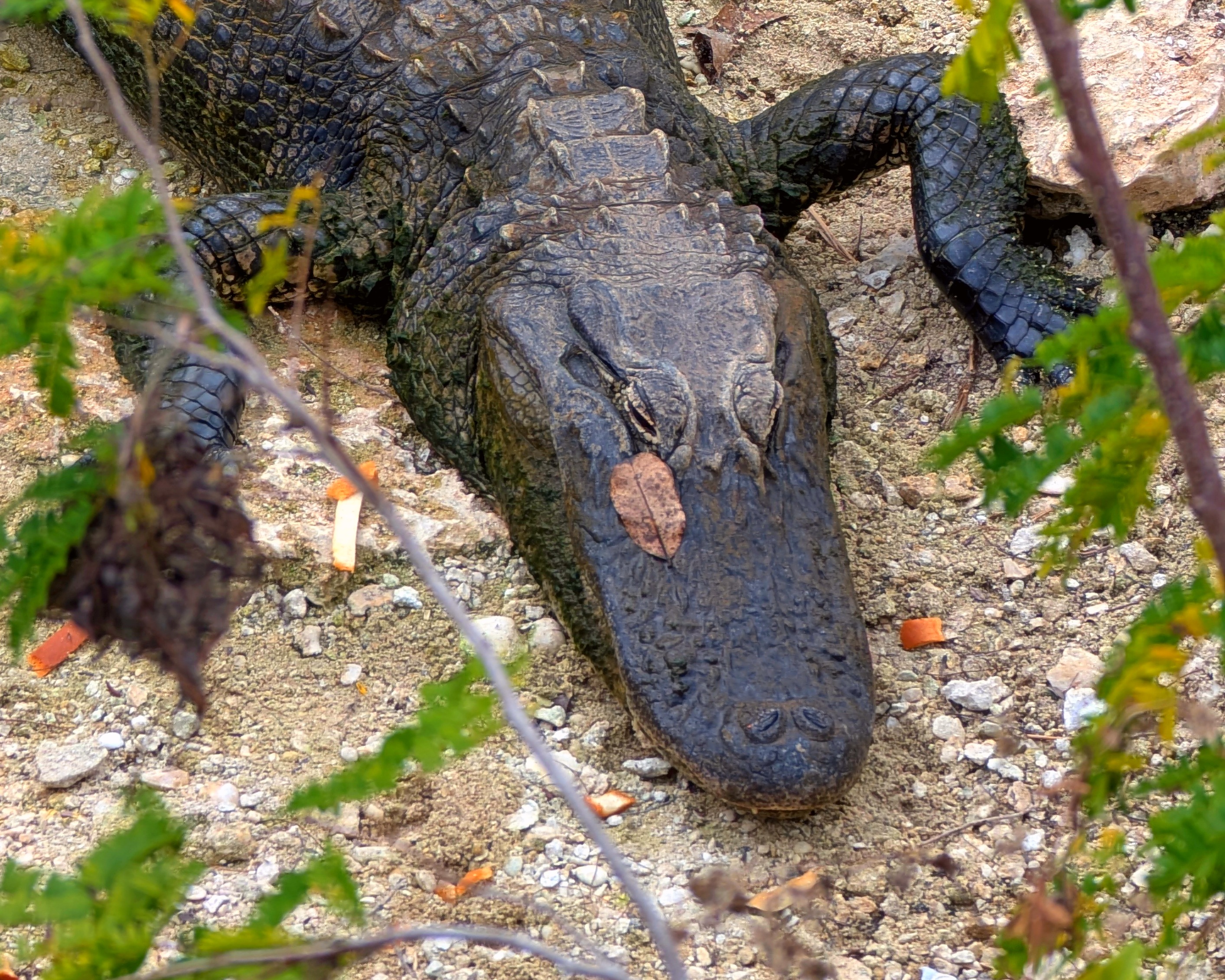
Ever had a day when it’s too damned much trouble to brush a leaf off of your face? (Yeah, I’m having one today.) Oasis Visitor Center, Big Cypress National Preserve. February 2026.
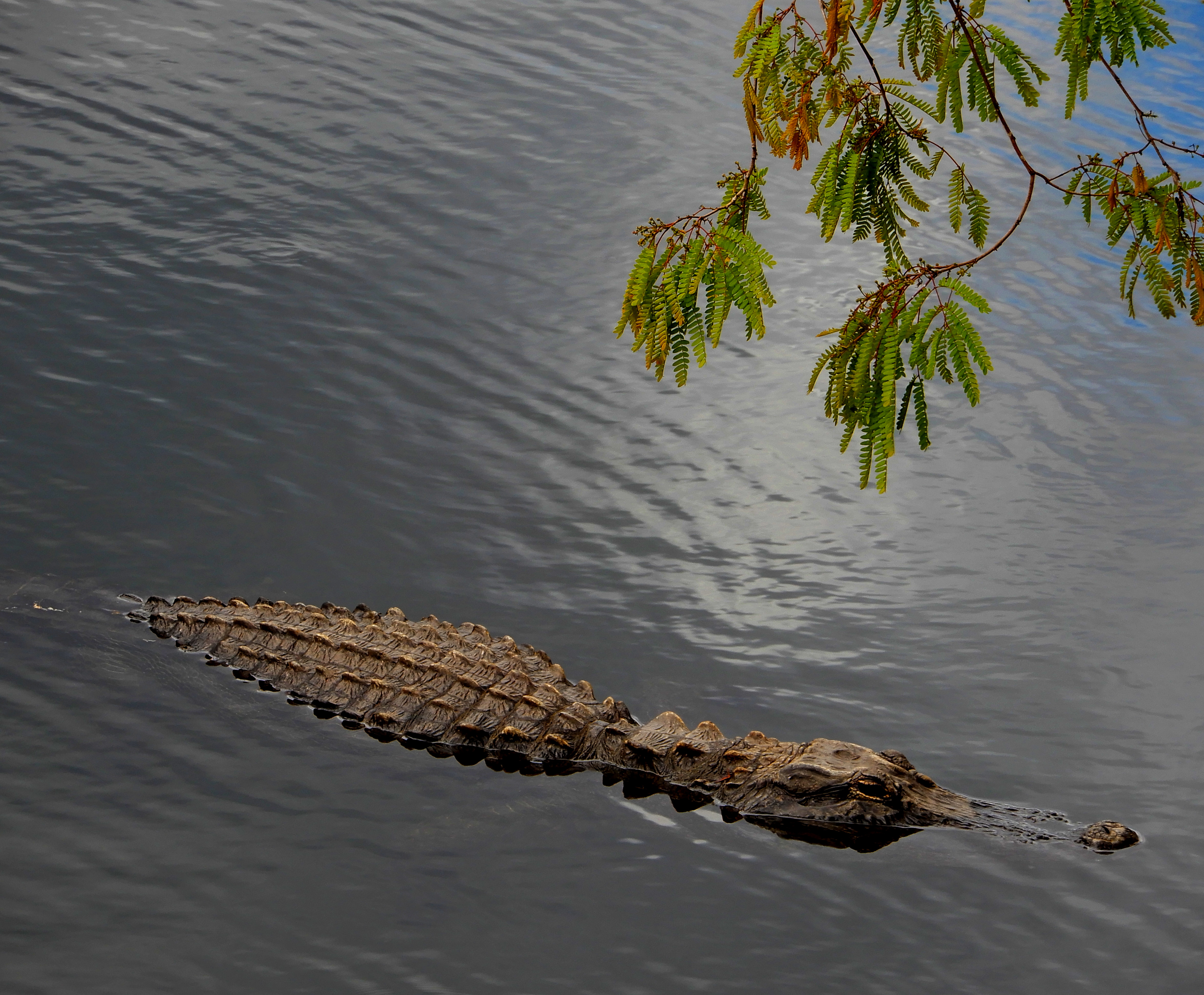
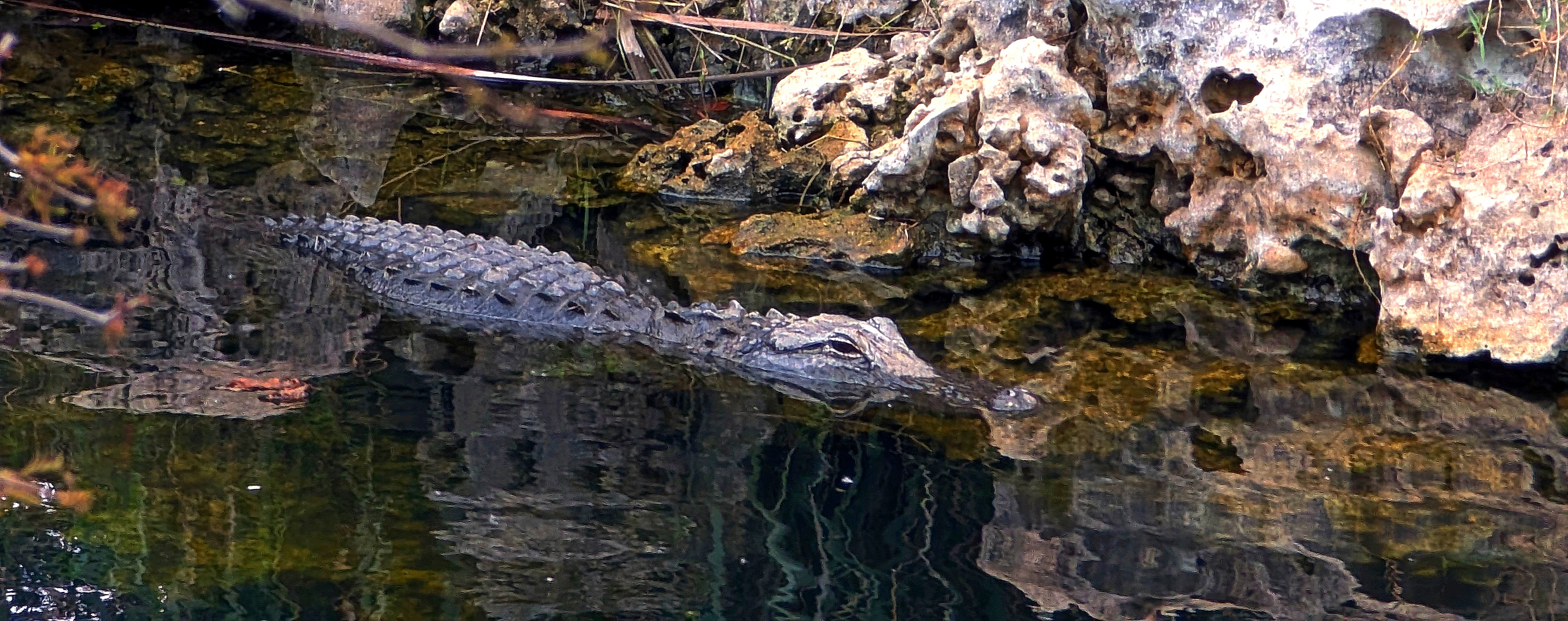
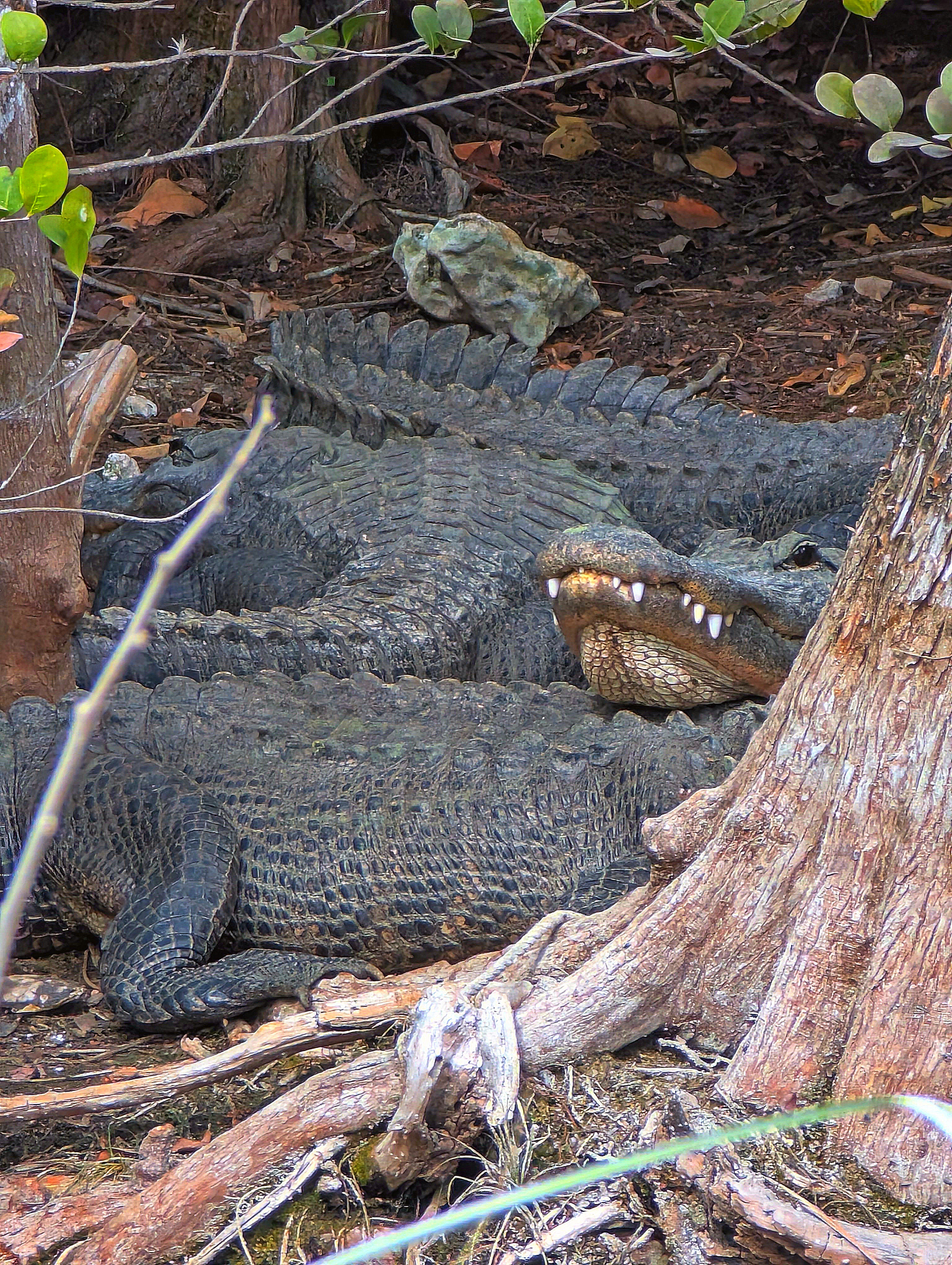
One of oddities about some of the Everglades-area areas for observing nature lies in the feeling one isn’t so much looking at Nature but more that one is looking at a ditch into which some Nature just happened to fall. The Oasis Visitor Center to the Big Cypress National Preserve on US-41 has a largish ditch running parallel to the highway. No more than 15 feet wide and likely much less, it delights the gator-gapers and folks like me who don’t mind looking at big reptilian laze-abouts who don’t offer much of a challenge to the person seeking them out. Here are a few to illustrate my point:
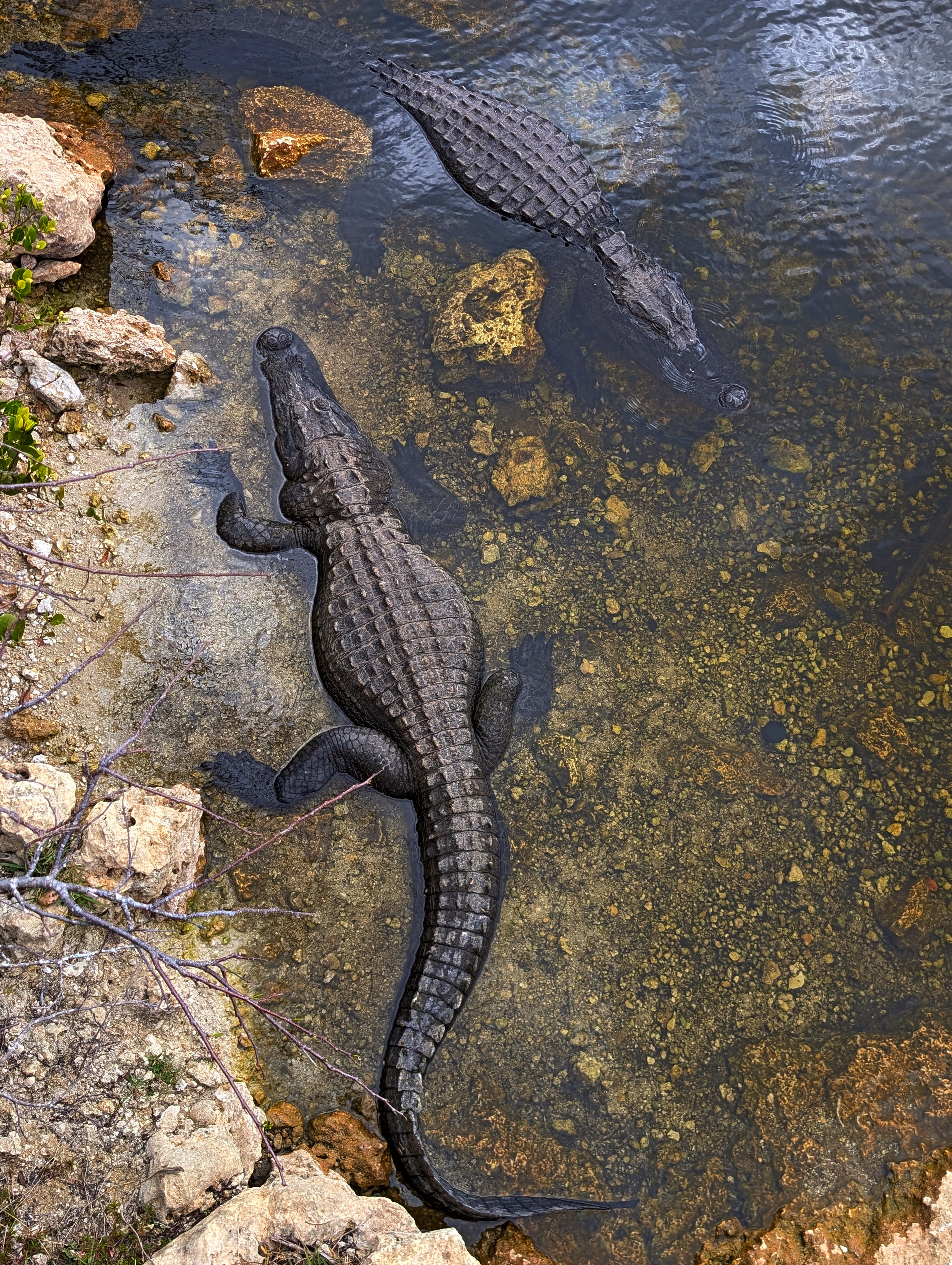
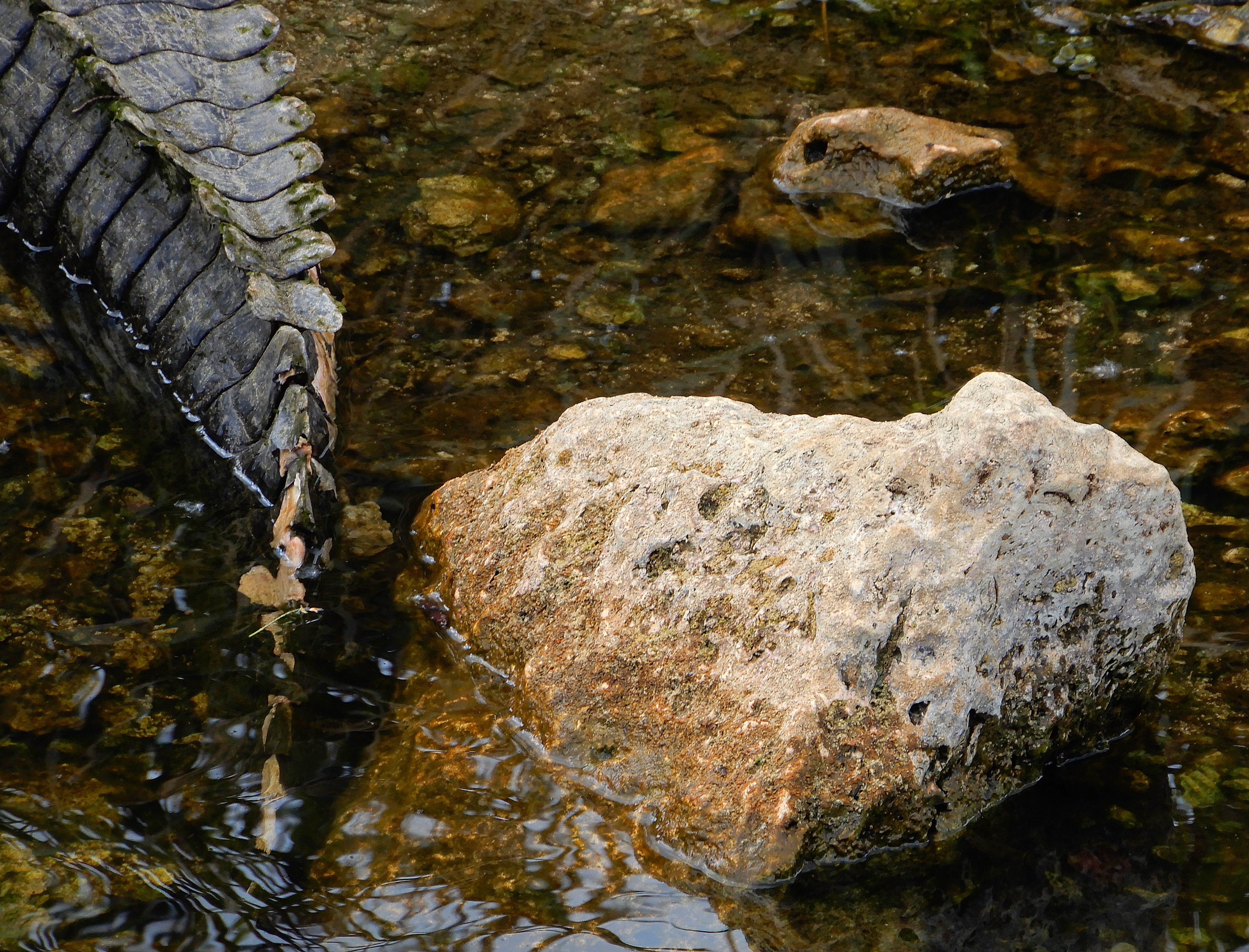
“I don’t care if you can see me. I’m just judging how close you are…and how slowly you move.” Oasis Visitor Center, Big Cypress National Preserve. February 2026.Alligator with rocks. Oasis Visitor Center, Big Cypress National Preserve. February 2026.Stilllife with gators. (Redundant.) Oasis Visitor Center, Big Cypress National Preserve. February 2026.Implication. Oasis Visitor Center, Big Cypress National Preserve. February 2026.
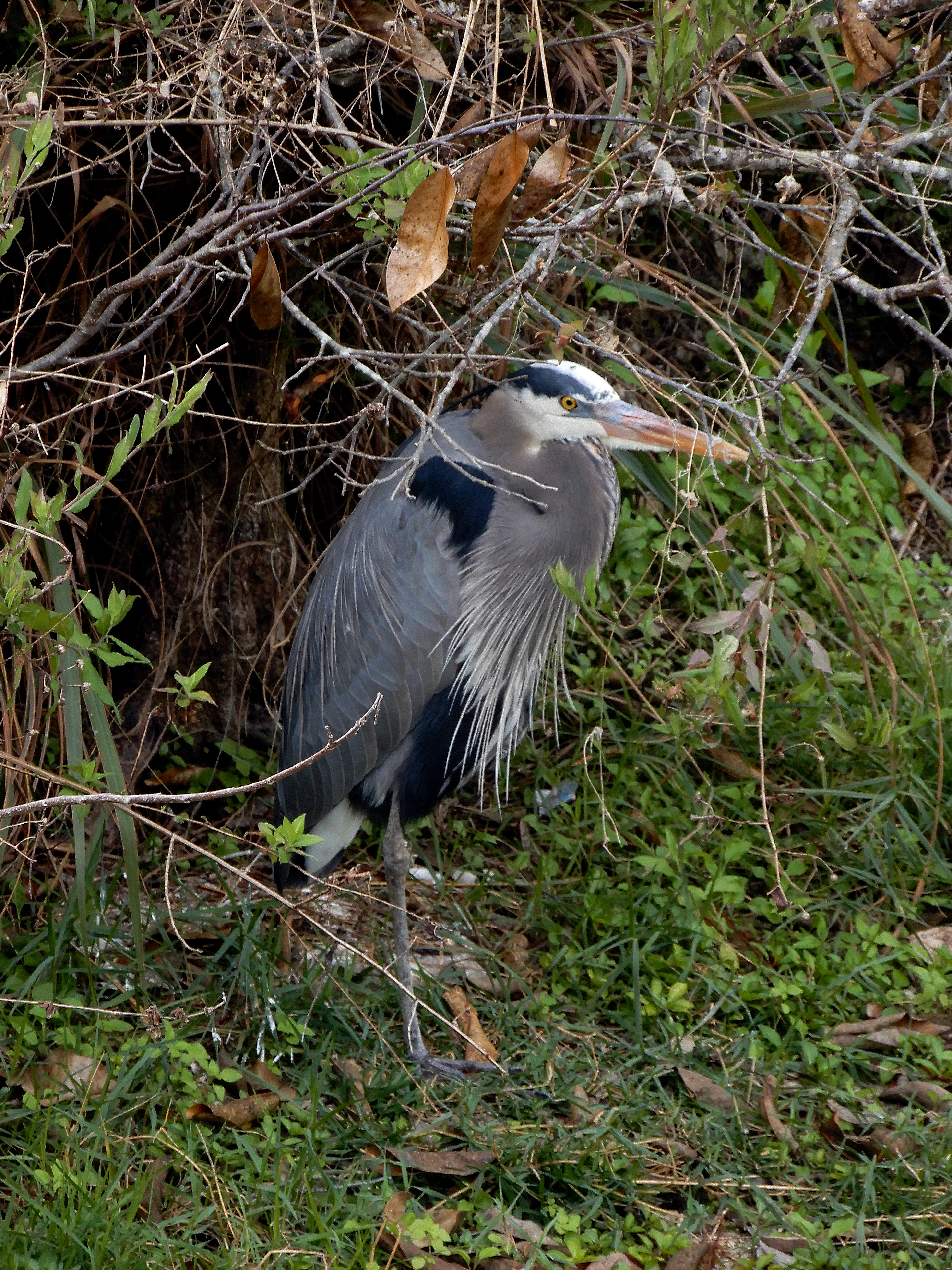
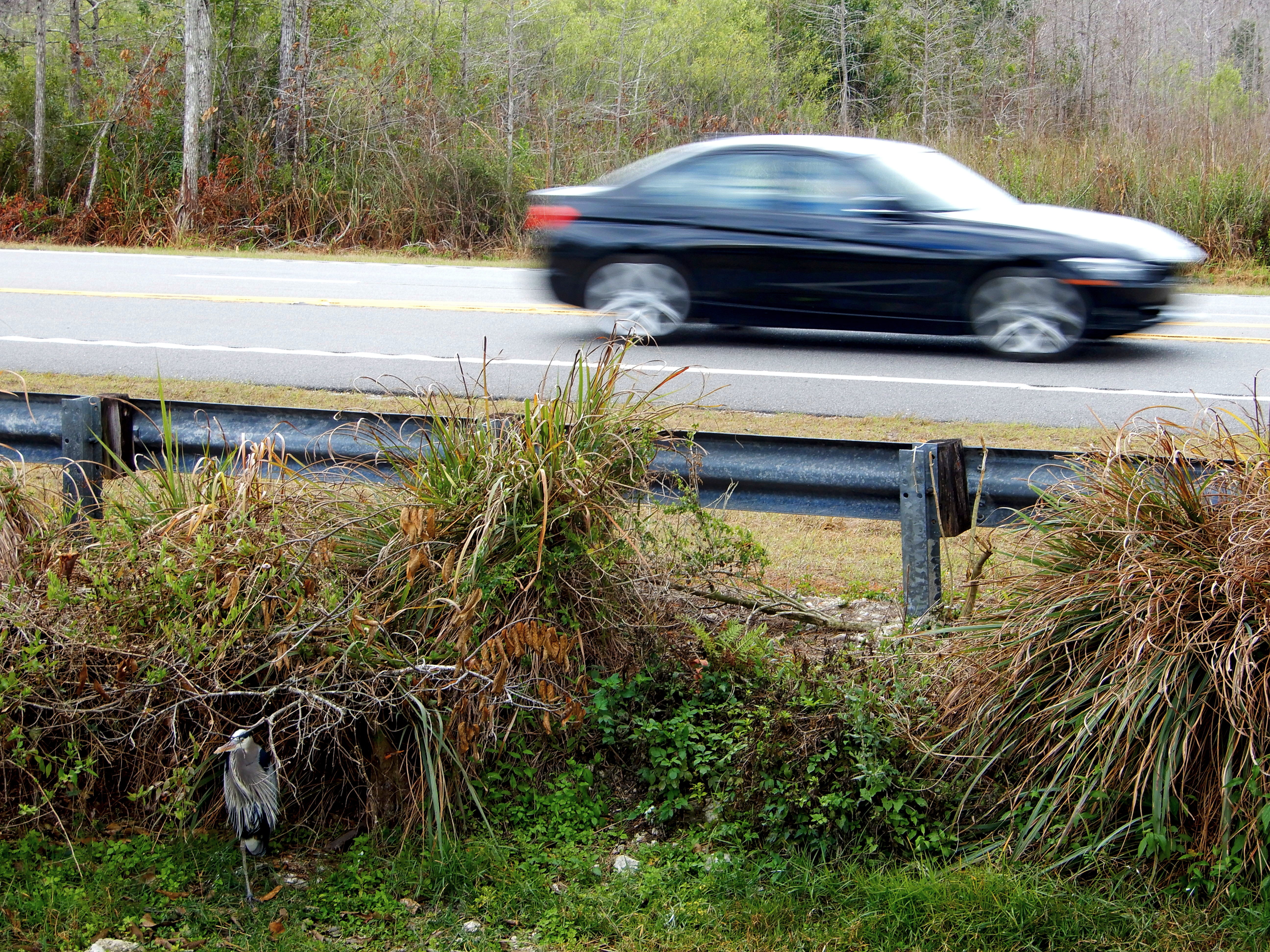
Lest one think the only denizens of this ditch were the alligators, I present some other residents. On the far side of said ditch stood a Great Blue Heron in full breeding plumage. He didn’t seem to mind the nearby highway.
Great Blue Heron. Oasis Visitor Center, Big Cypress National Preserve. February 2026.I trust guardrails less than this heron. Oasis Visitor Center, Big Cypress National Preserve. February 2026.
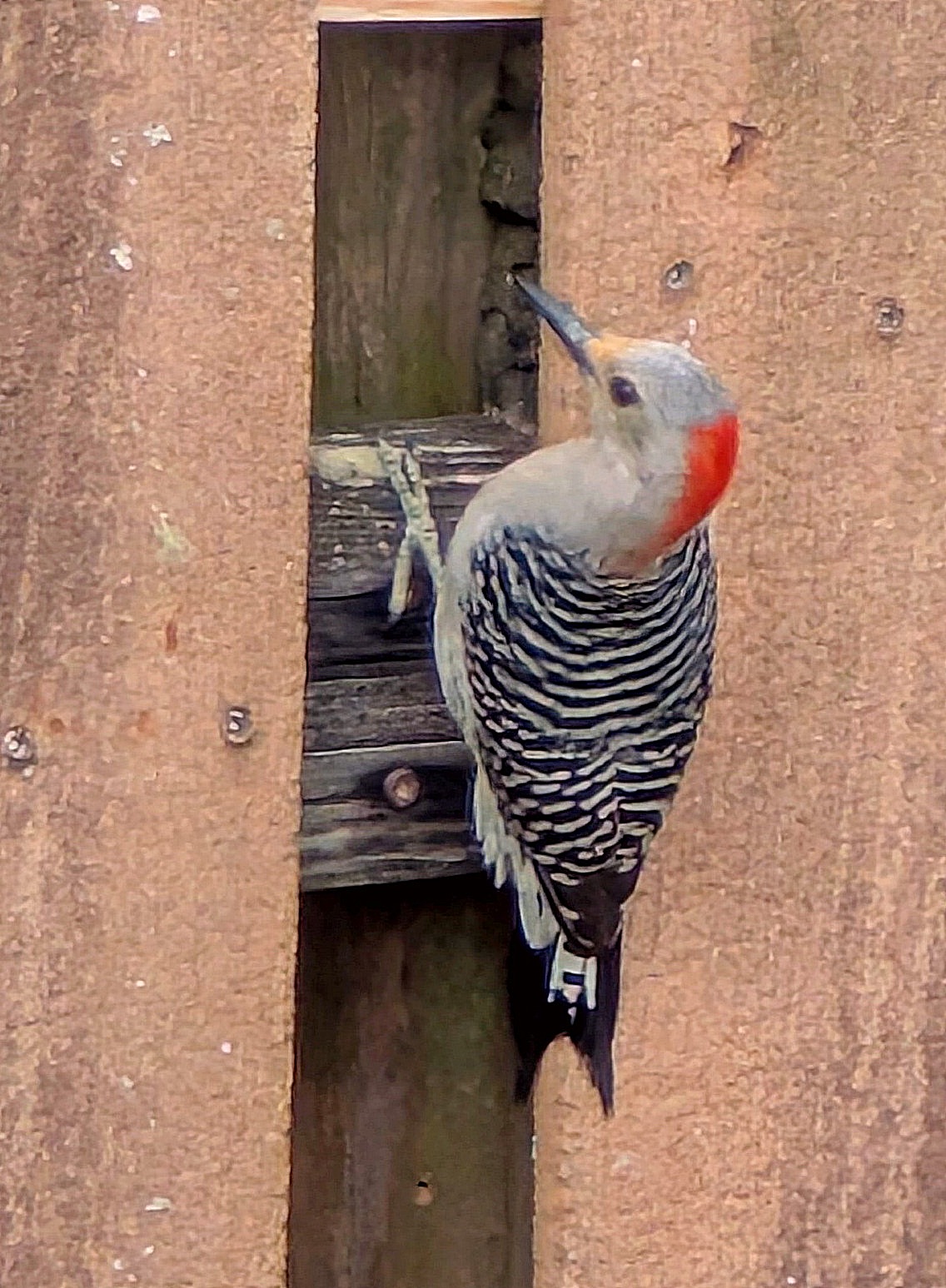
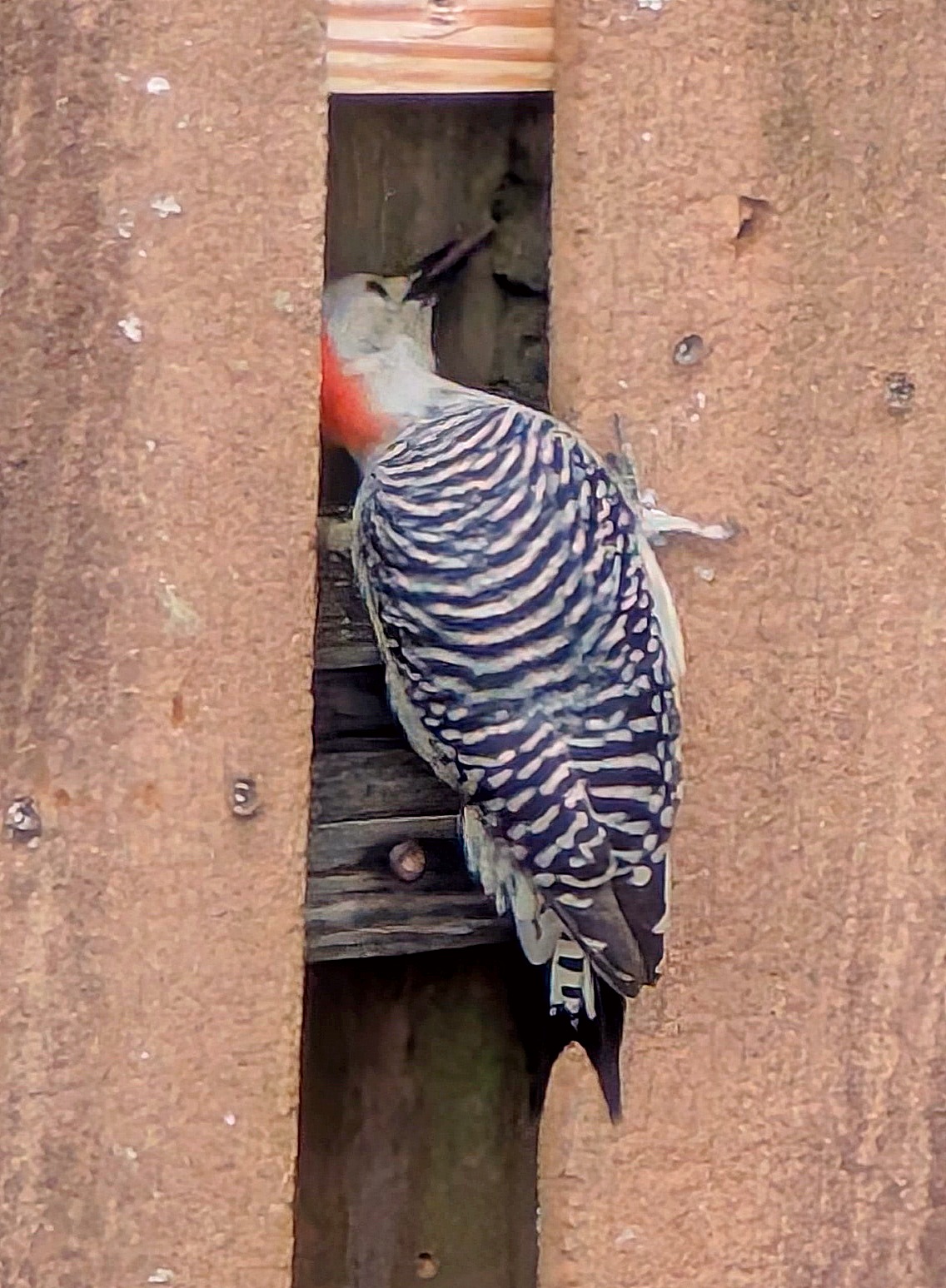
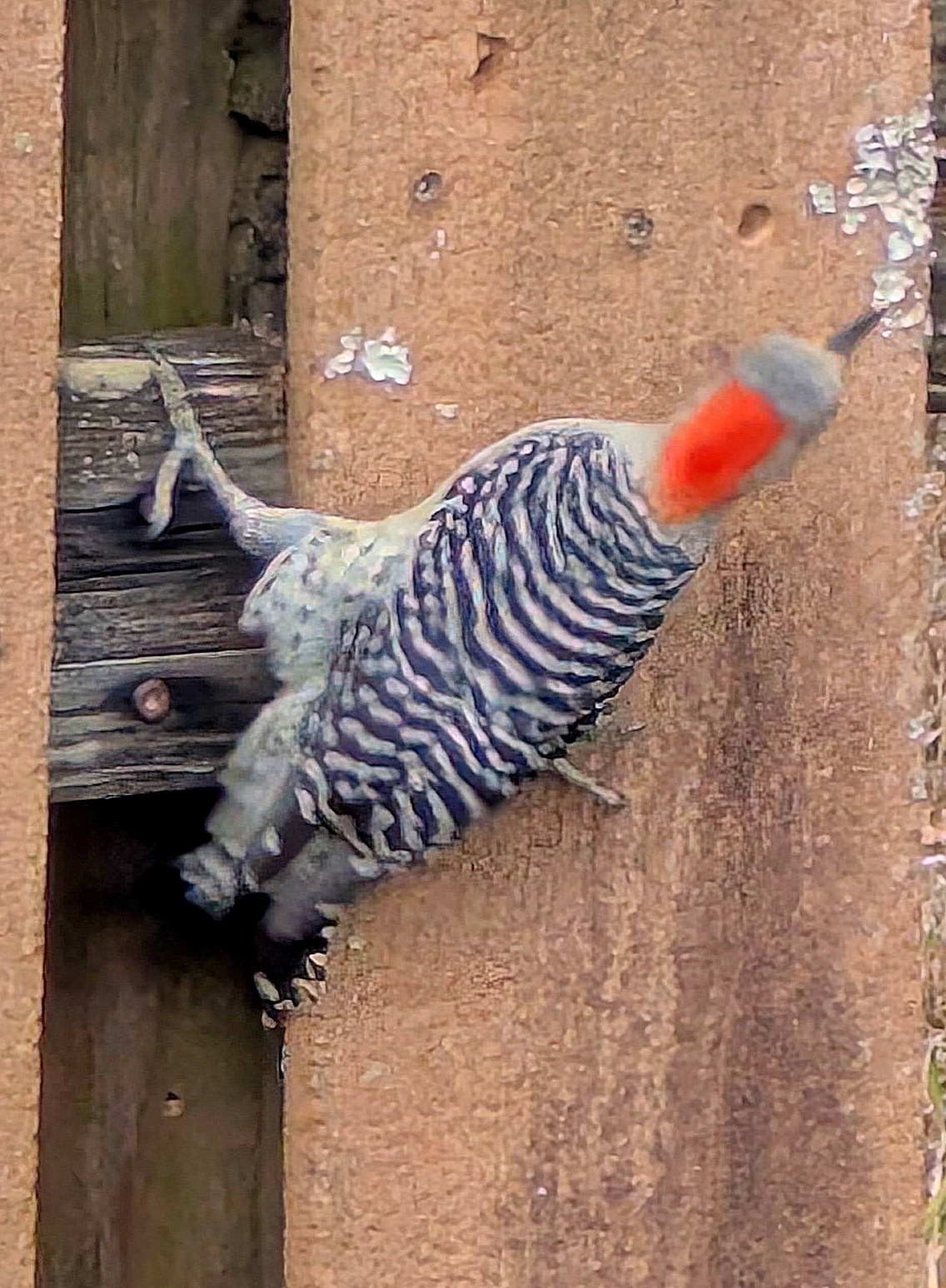
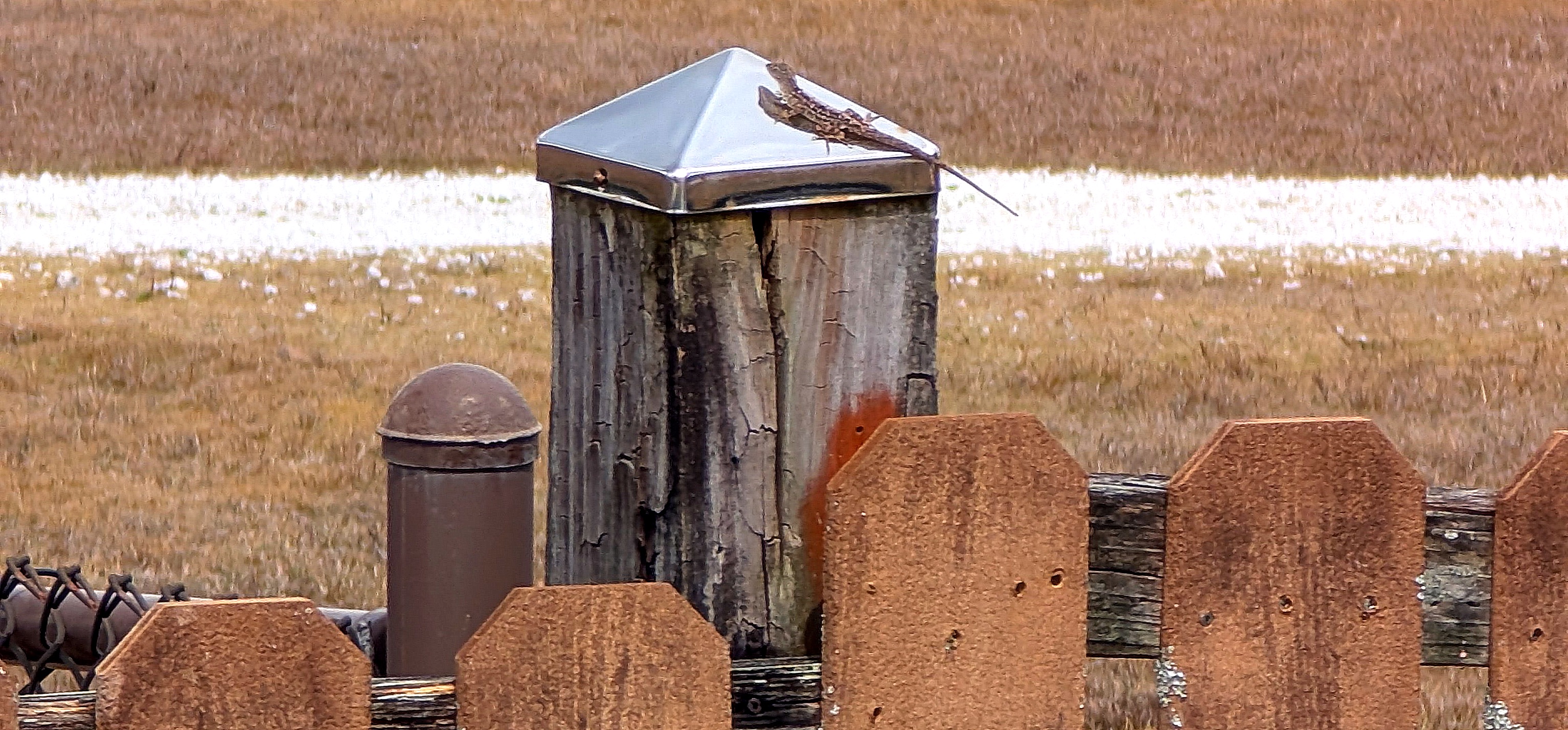
Turning back toward the Visitors Center proper, another birding couple pointed out a Red-bellied Woodpecker which frustratingly couldn’t locate a lizard. Said lizard had moments before been on the fence but had since retreated to the top of the fencepole.
I wonder how a lizard knows it’s much safer at the top of the pole? He waited until the woodpecker finally left, then returned to his original position.
Leaving the Oasis Visitors Center, we backtracked four miles to the turnoff for the Big Cypress Loop Road Scenic Drive. We’d been told the road was rough “but you’ll be okay in your SUV” but really any vehicle could take this road except for perhaps a tiny thing like a Fiat or Smart Car. Suspension would be the main issue here, since the road consists of hard-packed dirt, rocks, and a LOT of dust. Driving slowly through the first miles, we had watery land on either side of the raised roadway. This boded well:
Great Blue Heron. Big Cypress National Preserve. February 2026.
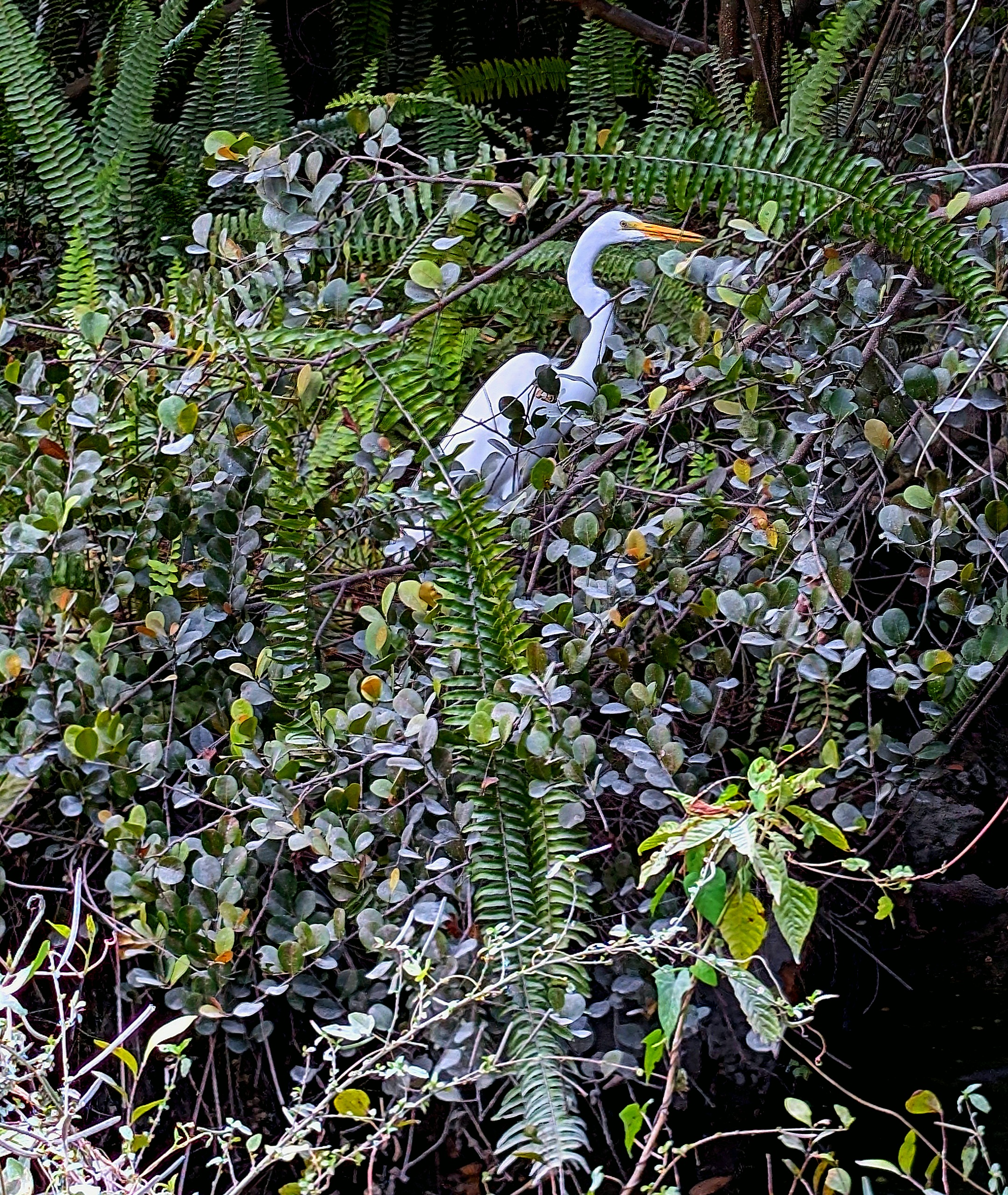
Great Egret. Big Cypress National Preserve. February 2026.
…and then we hit the birding jackpot…a waterway on both sides of the road, darkened by overhanging limbs from a variety of trees and such. Numerous birds congregated there.
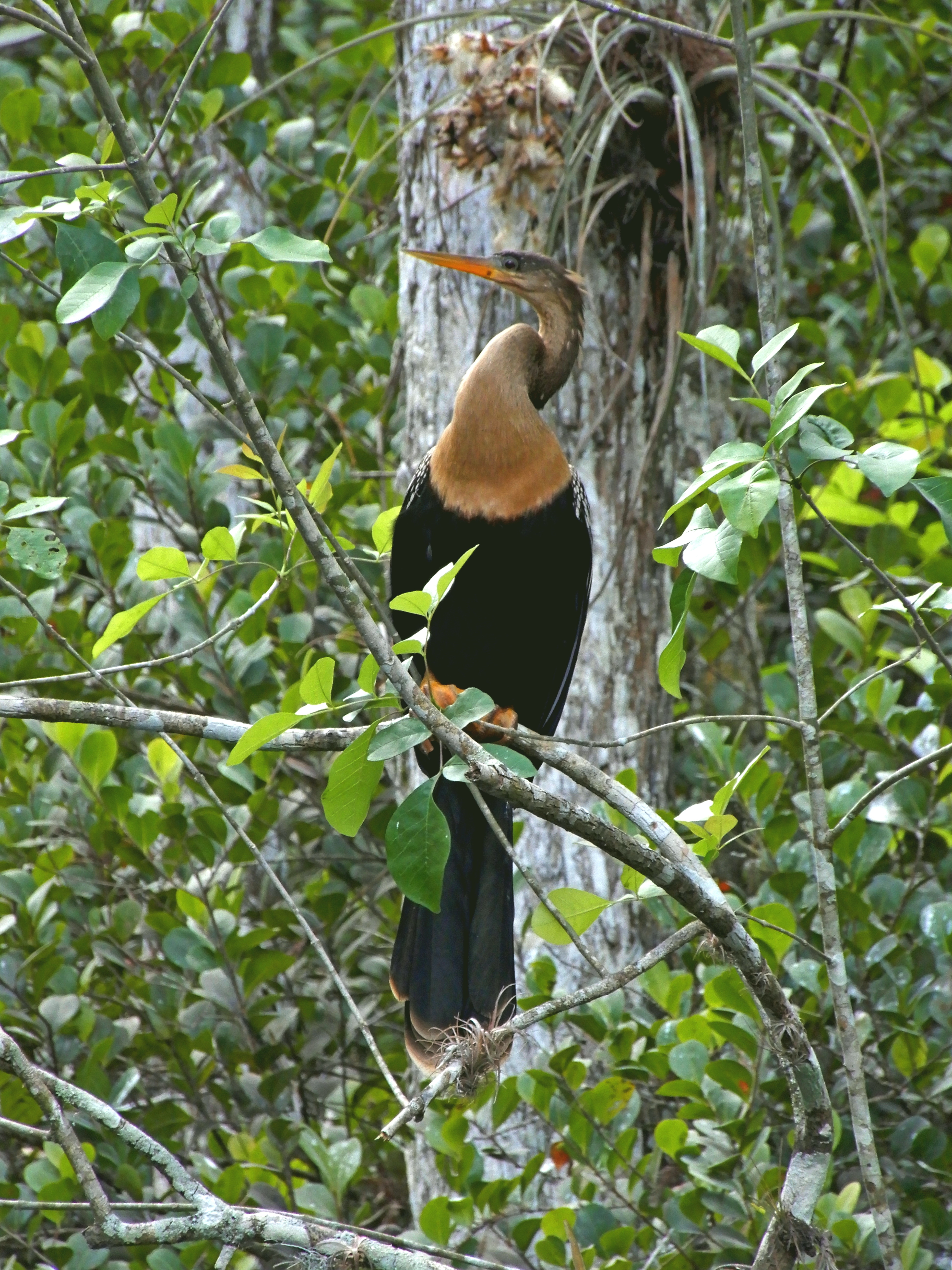
A female Anhinga surveys the swamp…or maybe the nearby males? Big Cypress National Preserve. February 2026.
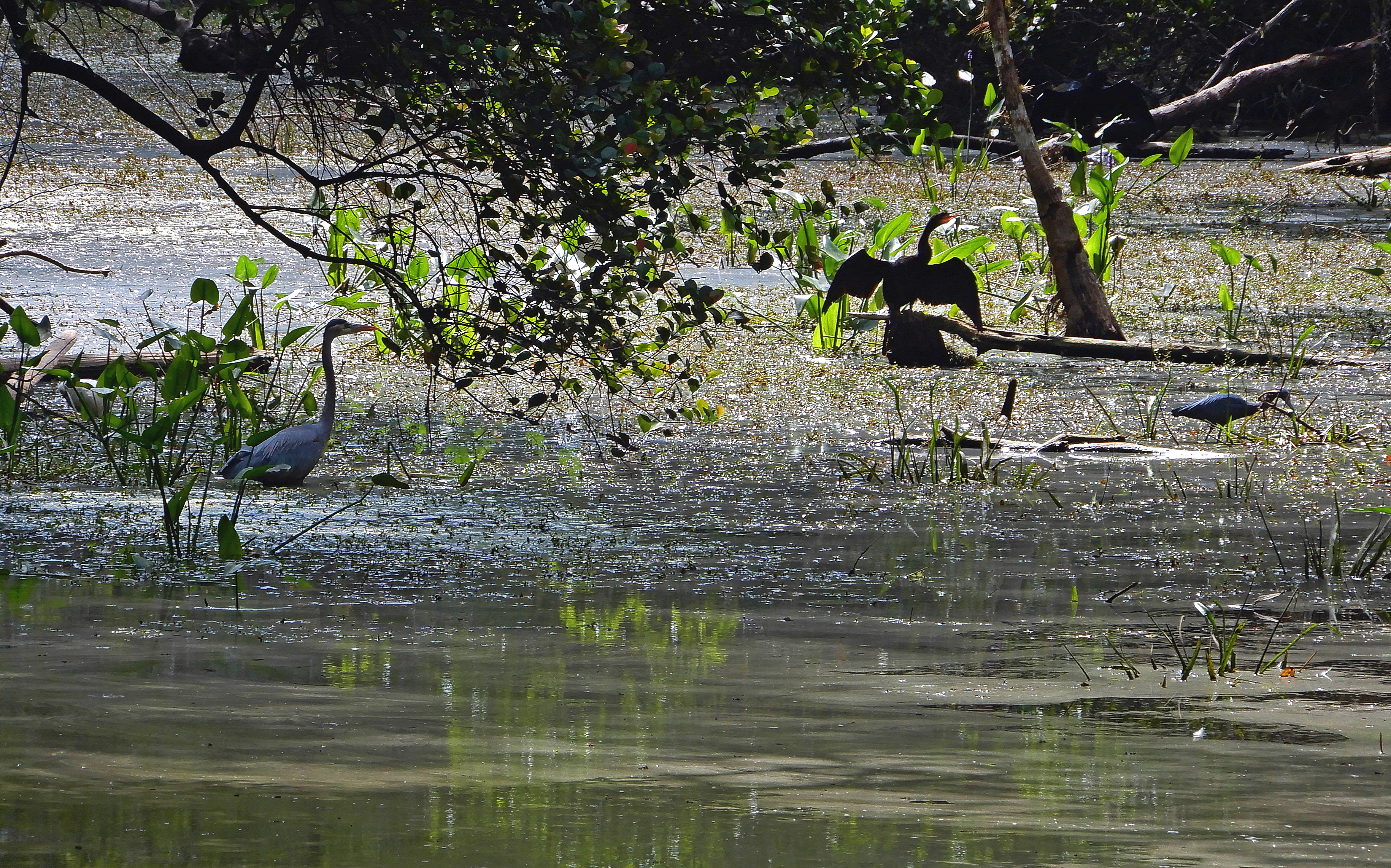
The wetlands stretched into the distance on the right side of the road where we spotted the Anhinga. We saw several male Anhingas, two or three species of egrets, and tri-colored herons.
An Anhinga dries its wings in the center while two Tri-colored Herons, left and right, work the shallow waters for prey. Big Cypress National Preserve. February 2026.
Turning to the left side of the road, a largish bit of standing water showed many birds. The Wood Stork eluded a sharply focused photo, but the others cooperated.
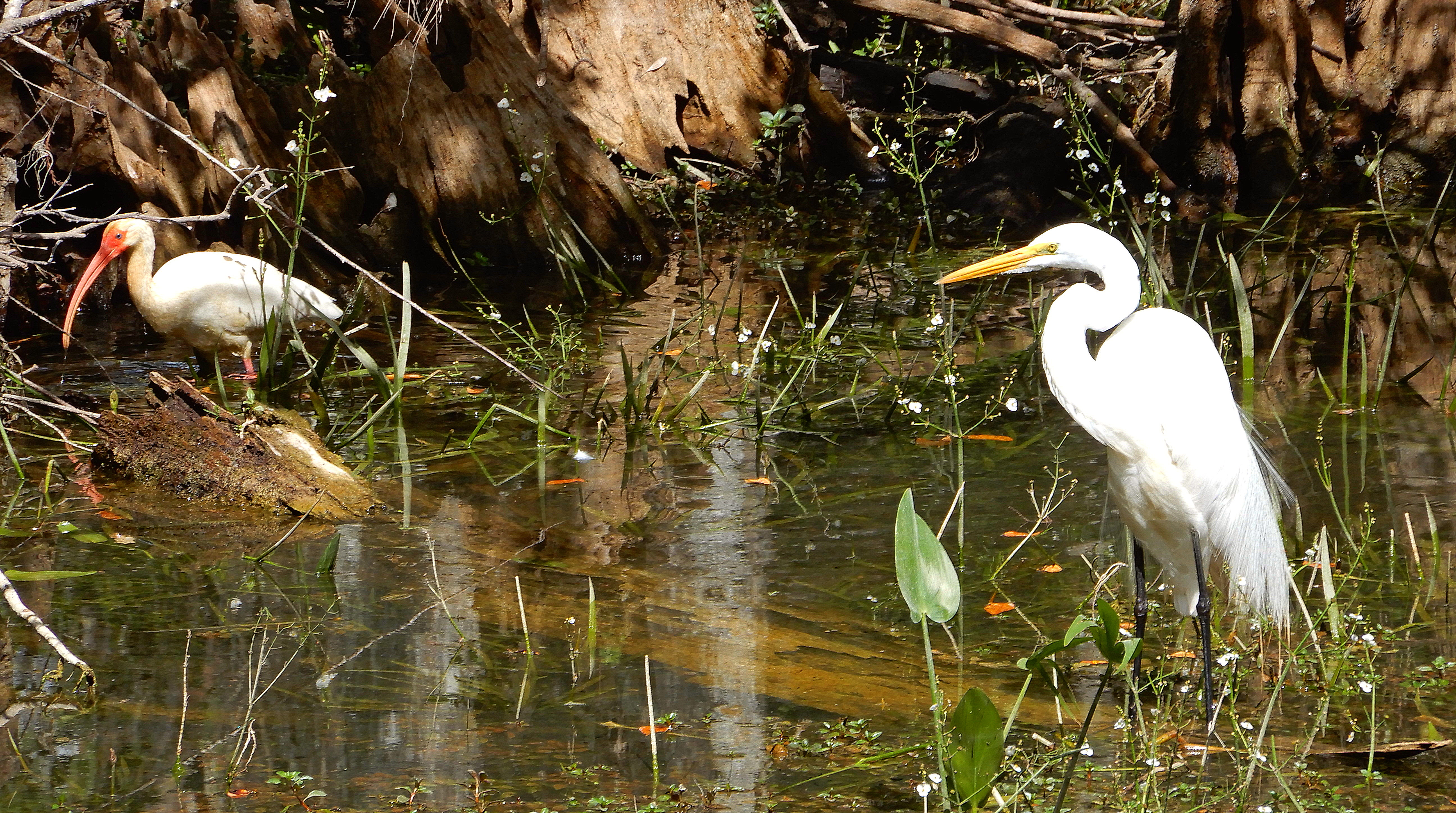
A Great Egret watches a White Ibis. Big Cypress National Preserve. February 2026.
Ultimately my impressions far exceeded my ability to capture them….
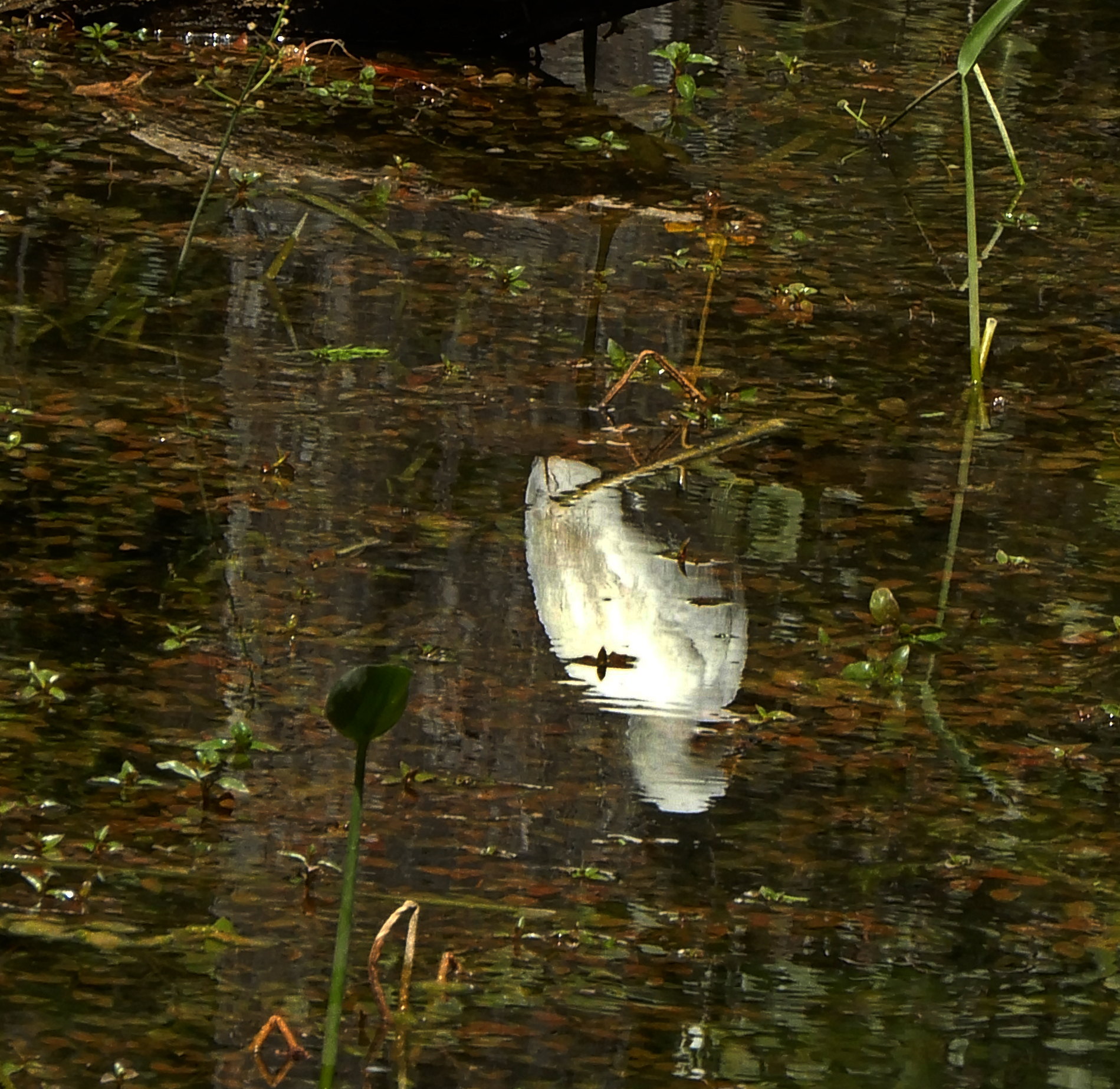
White Ibis, reflected. Big Cypress National Preserve. February 2026.
While two other cars of bird-loving folks like us spent time photographing and watching these avian wonders, a large vehicle pulled up and stopped. It seemed the driver wanted something so I walked over. I cannot remember what the vehicle was, but I had to look up, and I mean UP! Either a jacked 4-wheeler or something in its ballpark. The driver lowered his window and asked what we were looking at. “Gators?” he said emphatically. I replied that no, we were looking at birds. He said, “oh” in a disappointed way, raised his window and pulled around us, heading up the road to find “gators”. I wondered why he took this out-of-the-way road when gators hung around the ditches of every road in southern Florida. They jump out of pools and eat pet dogs, and they loll in copious numbers on slopes of I-75 where anyone driving through Alligator Alley could see several hundred. Then again, to be fair, the birds I thought were so interesting mostly could be seen at any reservoir in any typical Florida housing development. Who’s the idiot? As we left the scenic loop, I hoped the guy managed to stop and look around as he left Big Cypress. If he had, he might have seen the “elusive” alligator:
They’re just so gosh-darned difficult to spot! “Wish I could see me some ‘gators!” Big Cypress National Preserve. February 2026.
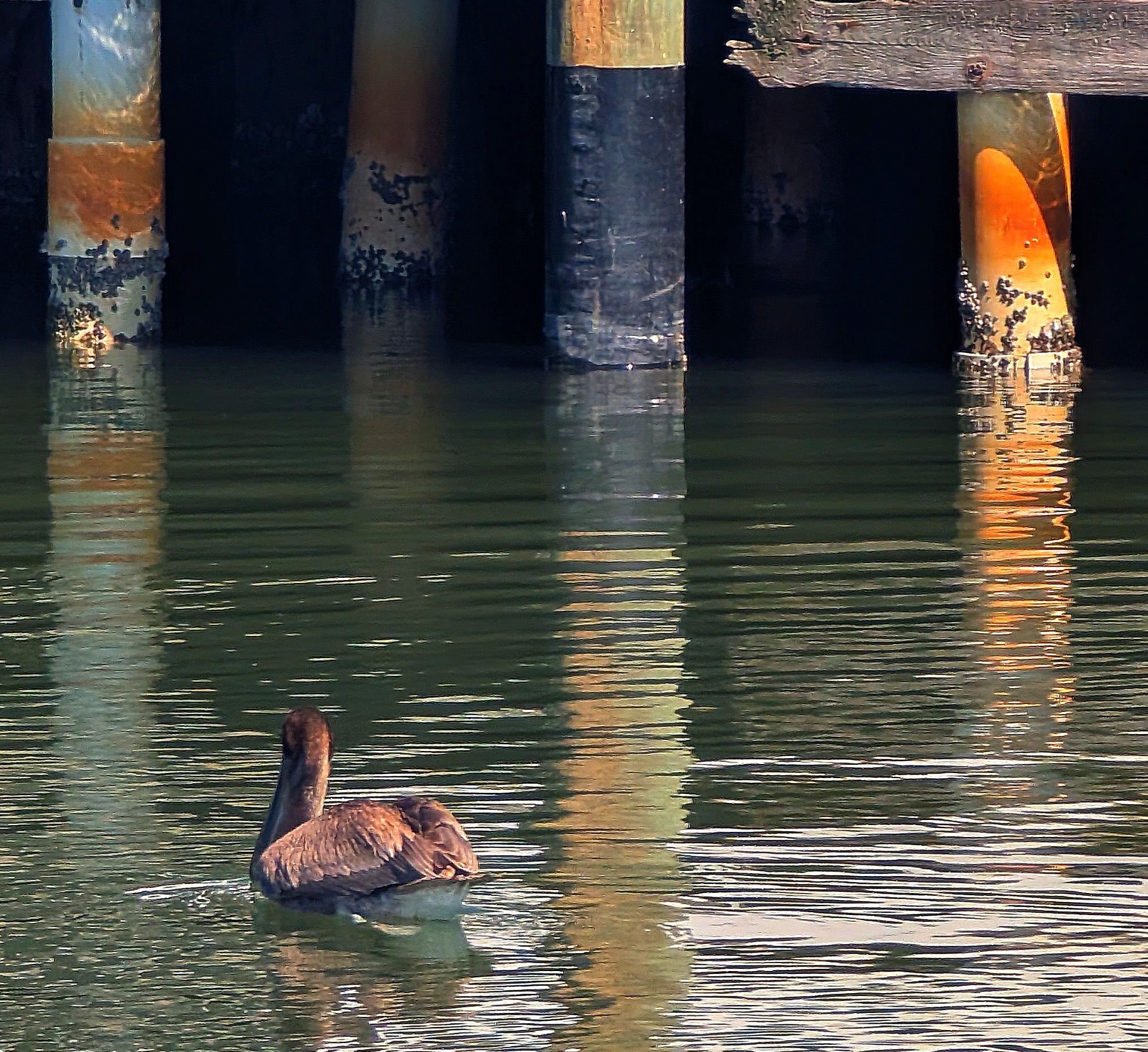
One of a good-sized group of brown pelicans we watched while we ate lunch in Tin City, a group of shops located in old tin buildings on Naples Bay. Naples, FL, February 2026.
We had brought the frigid temps of the Carolinas and Georgia with us to Tampa, and my wife’s sister lamented the loss of her typical 70’s and 80’s. It warmed a bit on our second day there. I bundled up in the warmest things I’d packed and walked to a nearby reservoir to see what bird life I could find. Driving south the next day, we arrived at the Tin City shopping mecca early afternoon, and tucked into a late lunch. The food and the bird life entertained; the shops did not. Tin City seemed a poor and miniscule version of Seattle’s Pike Street Market. Most shops sold typical tourist trinkets which said “made in China” on the bottom. Combined with the exorbitant hotel rates—$300+ for a Springhill Suites on the outskirts of greater Naples?—I doubt we’ll be back in Naples. One saving grace? We’re not exactly foodies but we’re kissin’ close, and discovering that the Cracklin’ Jack’s just up the road from the hotel had recently been featured on Diners, Drive-Ins, and Dives sure put a fine end to the day. Best fried catfish I’ve ever had! We looked forward a bit more eagerly to entering the Everglades and surrounds the next day.
Although the westernmost entry to the Everglades National Park, the Marjory Stoneman Douglas Visitor Center, purported to not be open until the end of February, we decided to chance it on the 26th. We were rewarded with an open, brand-spanking-refurbished center….but not much else because it’s a jump-off point for visitors who want to boaters and to those who want to hike/camp in the Ten Thousand Islands. We are neither of those types. We traveled east on US-41, a.k.a. the Tamiami Trail, the southern route across the Florida peninsula which parallels I-75 a.k.a. “Alligator Alley”. I planned the US-41 route; it became a wise decision when a fire broke out between the two and officials closed sections of the interstate. (It also precluded driving very far north from the US-41.) The southern tip of Florida is a patchwork of state parks, state forests, national preserves, and the national park. We stopped first at the Big Cypress Swamp Welcome Center in the Big Cypress National Preserve. After that, a stop at the H.P. Williams Roadside Park gave us our first good glimpse of alligators, and some nice views of the bird denizens.
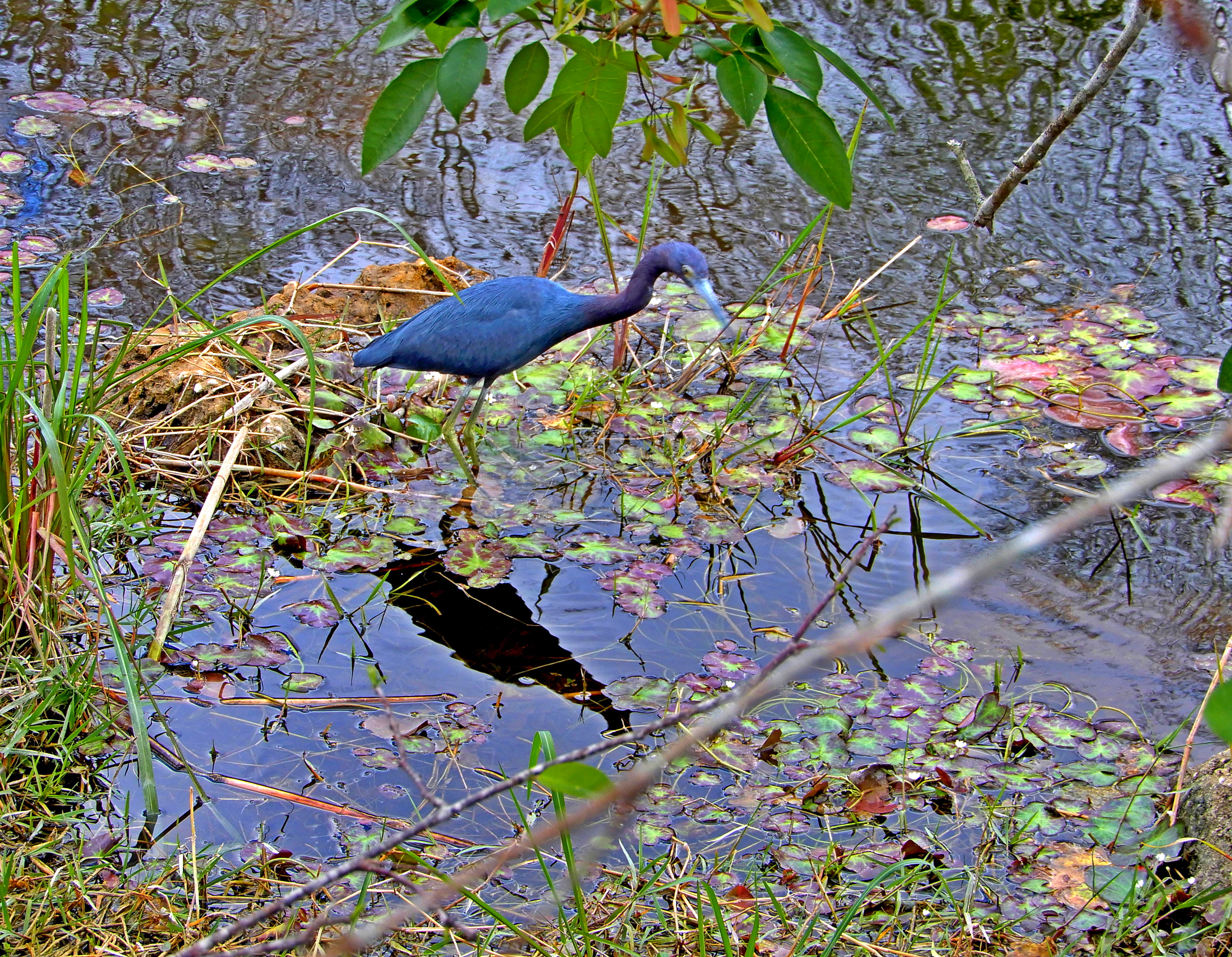
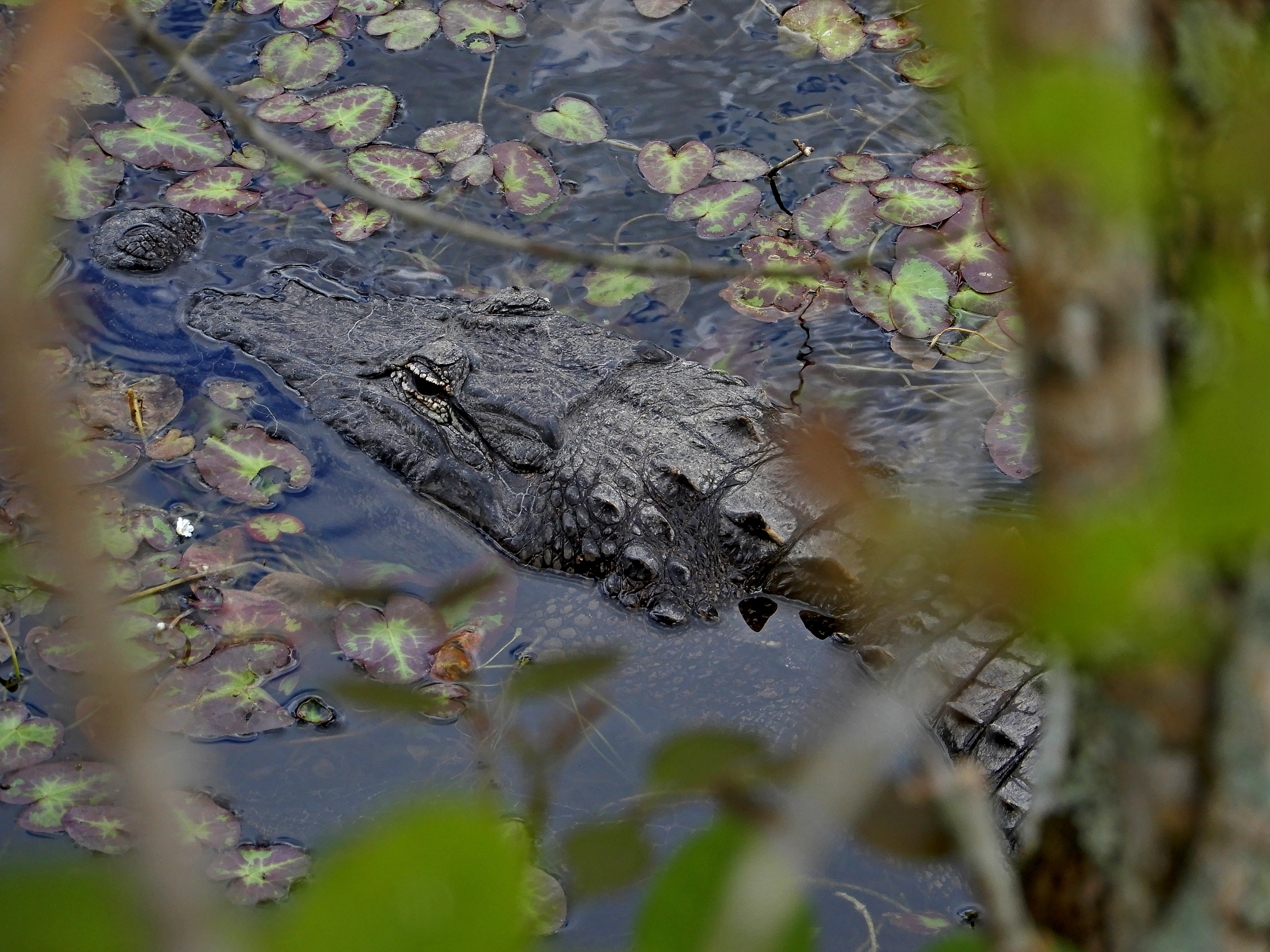
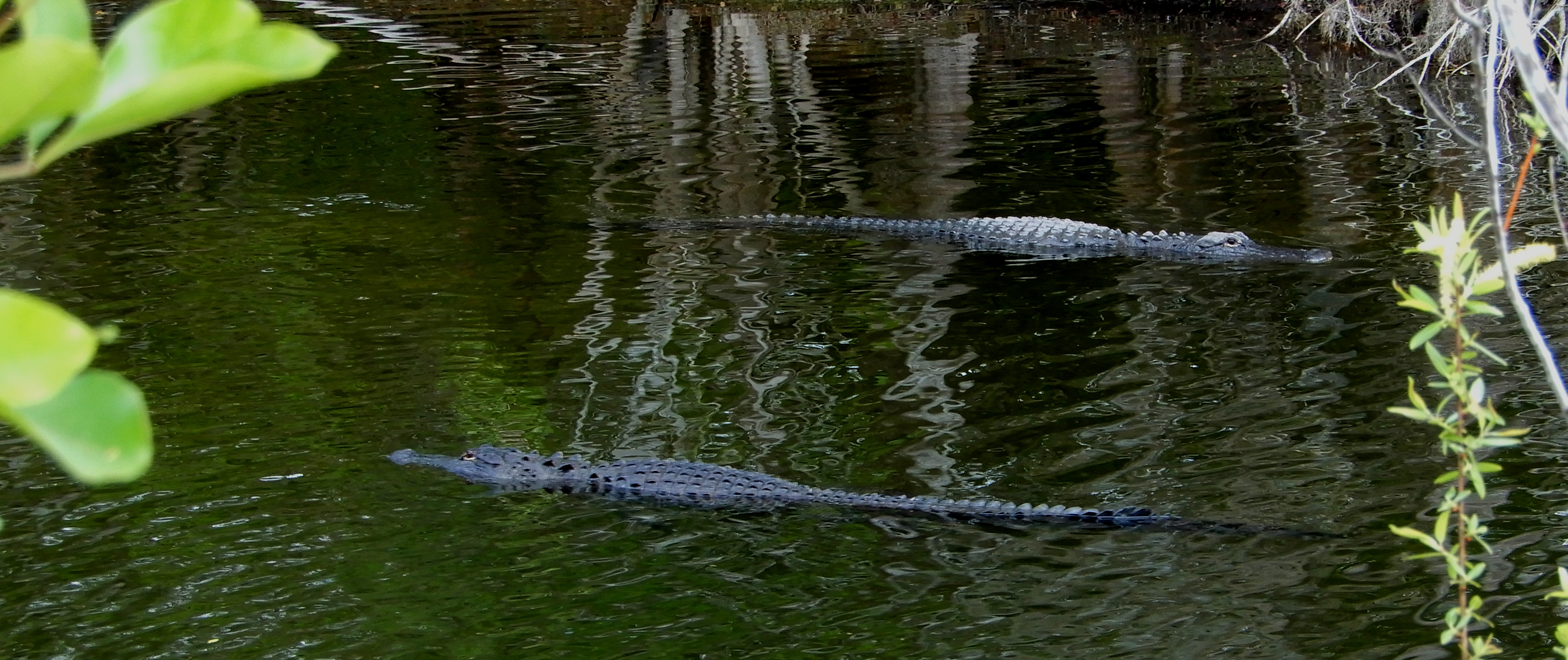
A Tri-Colored Heron stalks its prey. Big Cypress National Preserve, February 2026.It’s not “oh, look, there’s a gator.” It’s more a find-the-gator experience. Sure they’re swimming up and down the minor canal you’re looking at. Can you spot the one hanging out under your nose? Big Cypress National Preserve, February 2026.“like ships passing in the night…” Some gators were easier to spot. Big Cypress National Preserve, February 2026.
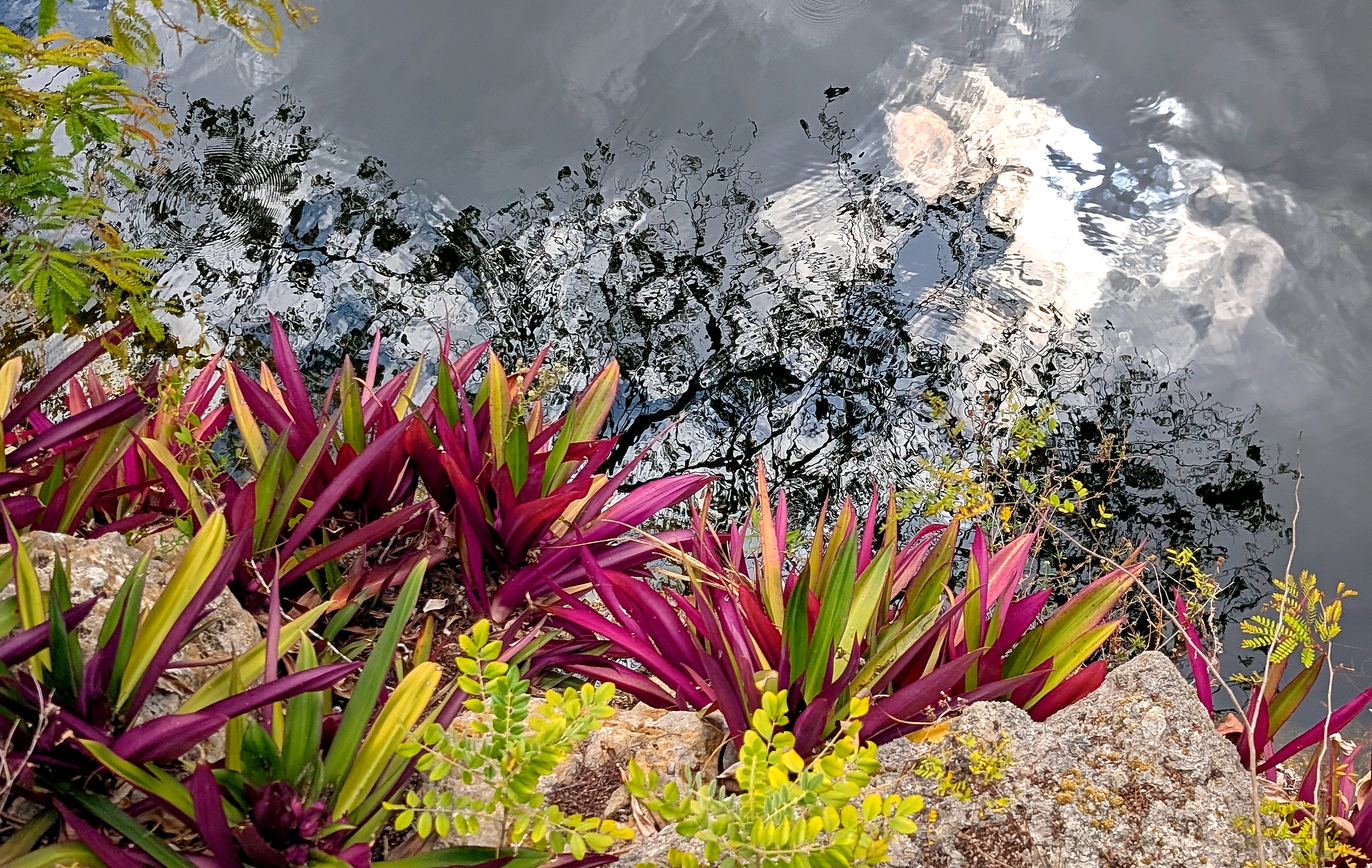
Sometimes, though, the subtropical plants grab one’s attention…
“Moses-in-the-cradle”??? That’s what my plant ID program says, but it seems doubtful. Regardless, it created a stark contrast to the water’s edge. Big Cypress National Preserve, February 2026.
Technically, the final photo of the plants was taken at the Oasis Visitor Center for the Big Cypress National Preserve. If you’re traveling “to see the Everglades,” I would highly recommend US-41 and the Big Cypress route, because it’s basically the northern environs of the Everglades. When one leaves the eastern boundary of the preserve, it’s less than a mile before the Everglades’ Shark Valley Visitor Center. As good as our day’s beginning had been, we had much to look forward to, it turned out.
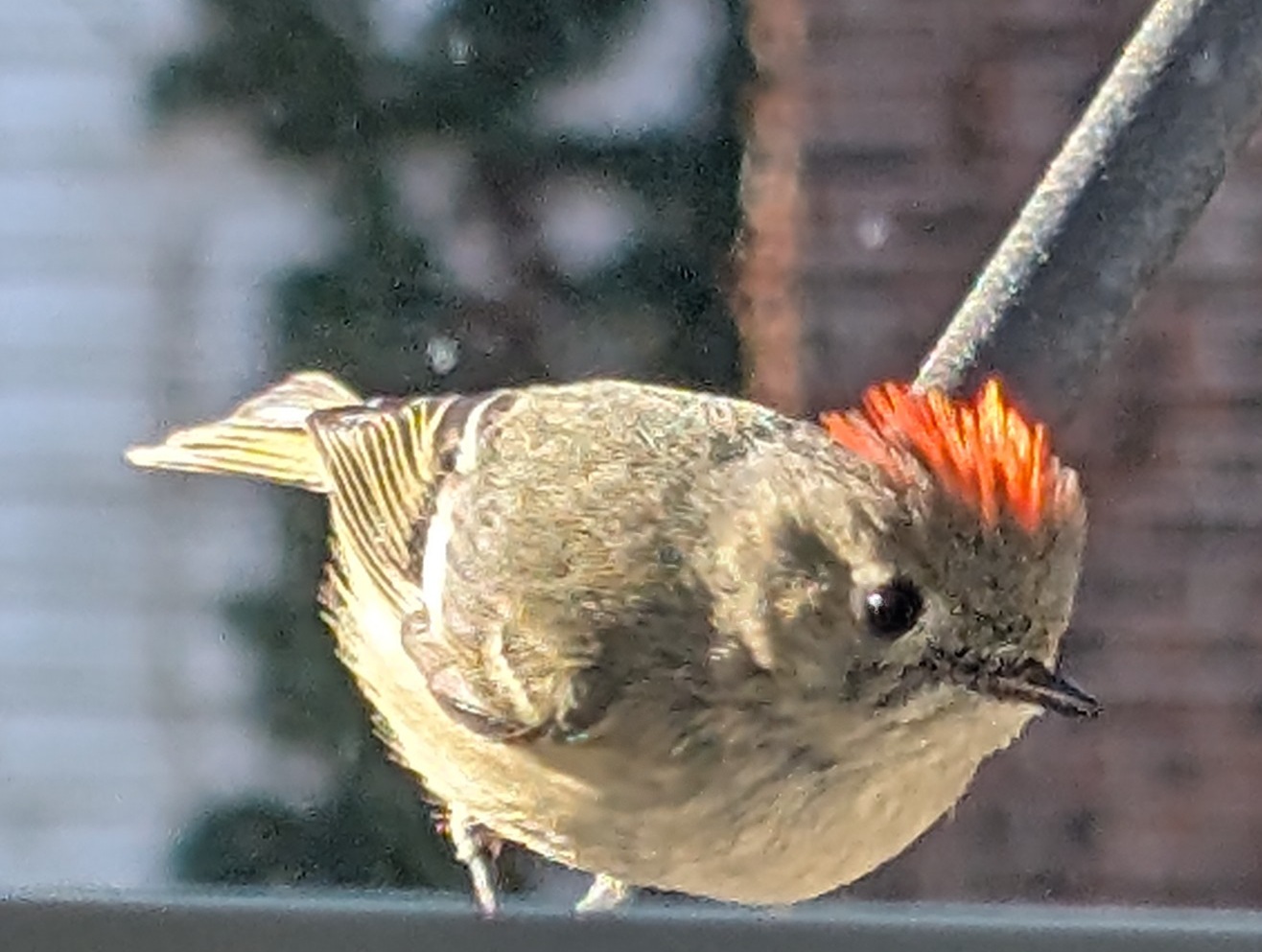
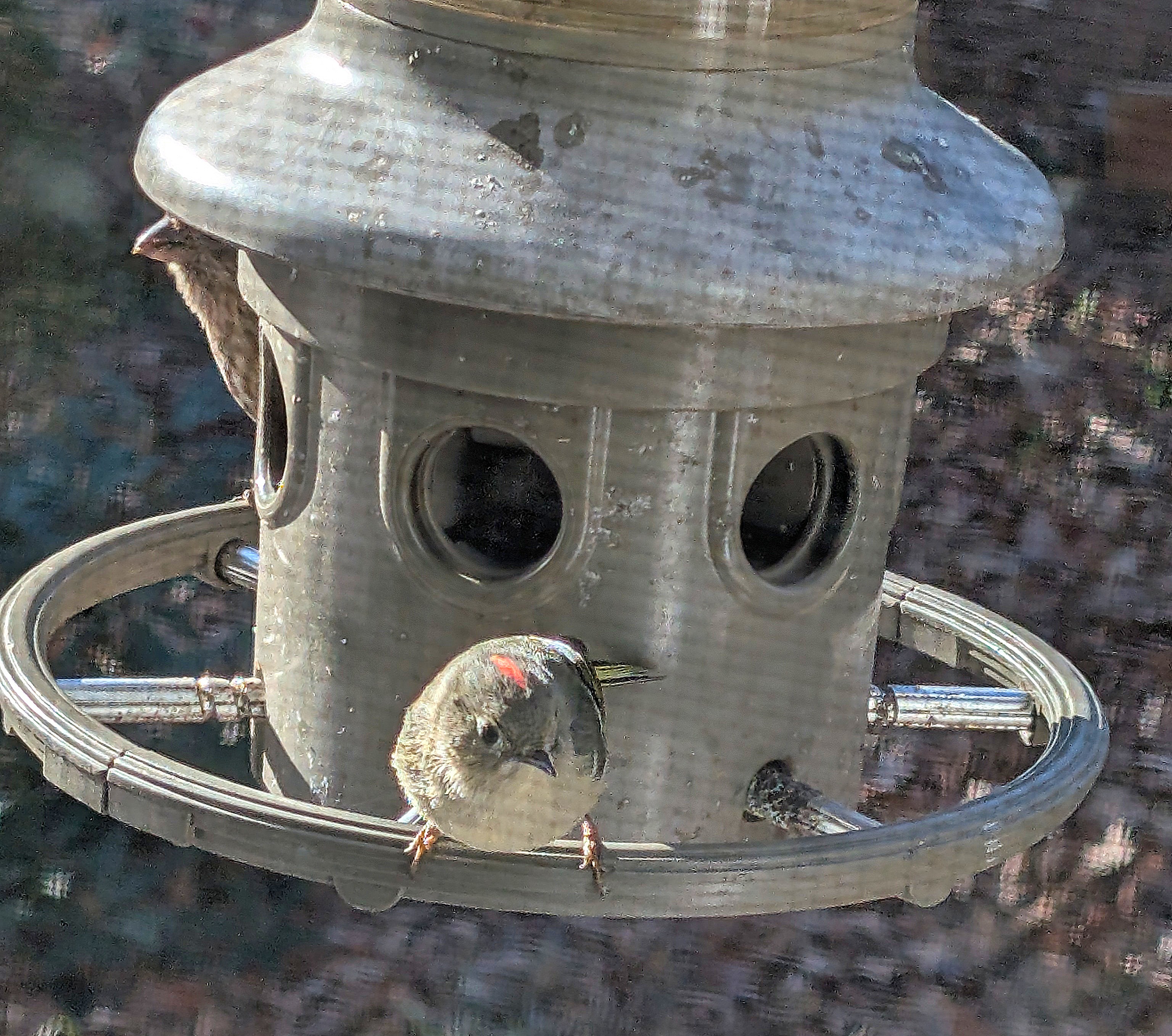
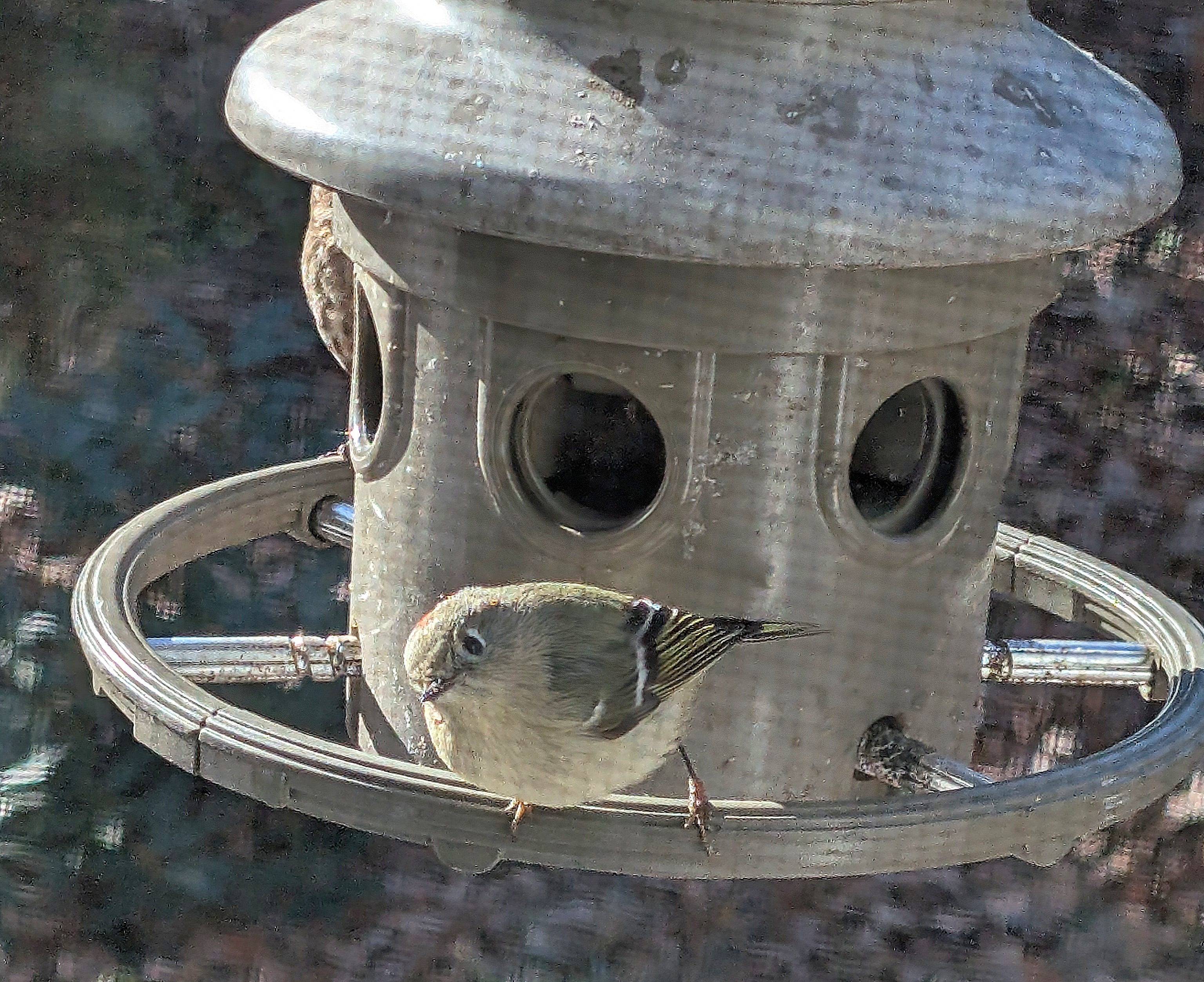
I finally identified a little bird this morning which had been zipping all around our feeder while ignoring it all the same. He mostly seemed interested in getting into our kitchen. The cool thing about him is the crown: when a bit agitated, he flips it up as it is in the photo above. When he’s calmer, it’s down and more difficult to see, as shown below.
Ruby-crowned kinglet with crown feathers in the ‘down’ position. Both photos shot less than 60 seconds apart. Unless you are looking down at the bird, the red crown is very easy to miss. At first I thought I was looking at a warbler. (The bird is barely 4 inches long.) January 2026.
Our yard on the left, neighbor’s on the right. Photo is unretouched. January 2026.
Last October we paid to have our back yard replanted with plants native to North Carolina, the American Southeast, and the Atlantic seaboard. As in colder climes, the vast majority of native plants drop their leaves and enter dormancy for the colder winter months. We also “leave the leaves” which allows them to decompose into the soil as they should, creates cover for the little creatures to stay warm (and avoid hawks), and supports the lives of little bugs which in turn provide food for the ground-feeding birds. Thus, the predominant color of our back yard and our front yard is brown.
Our neighbor’s yard represents most yards around us. The green of English ivy covers the ground and the trunks of the trees. Saplings of non-natives take advantage of the warmer winter weather much as sunbirds head for Arizona or the coast of the Gulf of Mexico. Some keep their summer foliage—no need to drop leaves and protect a plant conditioned to far colder climes. It’s not that leaves fall only in our yard; there’s an oak or two and some poplars over there. It’s that the ivy manages to conceal somewhat the leaves in my neighbor’s yard.
In winter, therefore, brown is good, and green is at best questionable. (Before my southern readers chime in, yes, there are plenty of Southern evergreens, but not many around here consciously cover their yard with them.)
Our natives, once established, should have staying power also. It’s kind of defined by the word “native” is it not? I will need to wage constant war, though, on the ivy, the Virginia creeper, the japonica, and the various saplings which will inevitably attempt to broach the property line. It’s a battle I freely take up. For the time I live on this speck of the Earth, it will bring forth those plants which grew here naturally and nurtured the birds, mammals, insects, reptiles, and amphibians which depend on them for healthy populations.
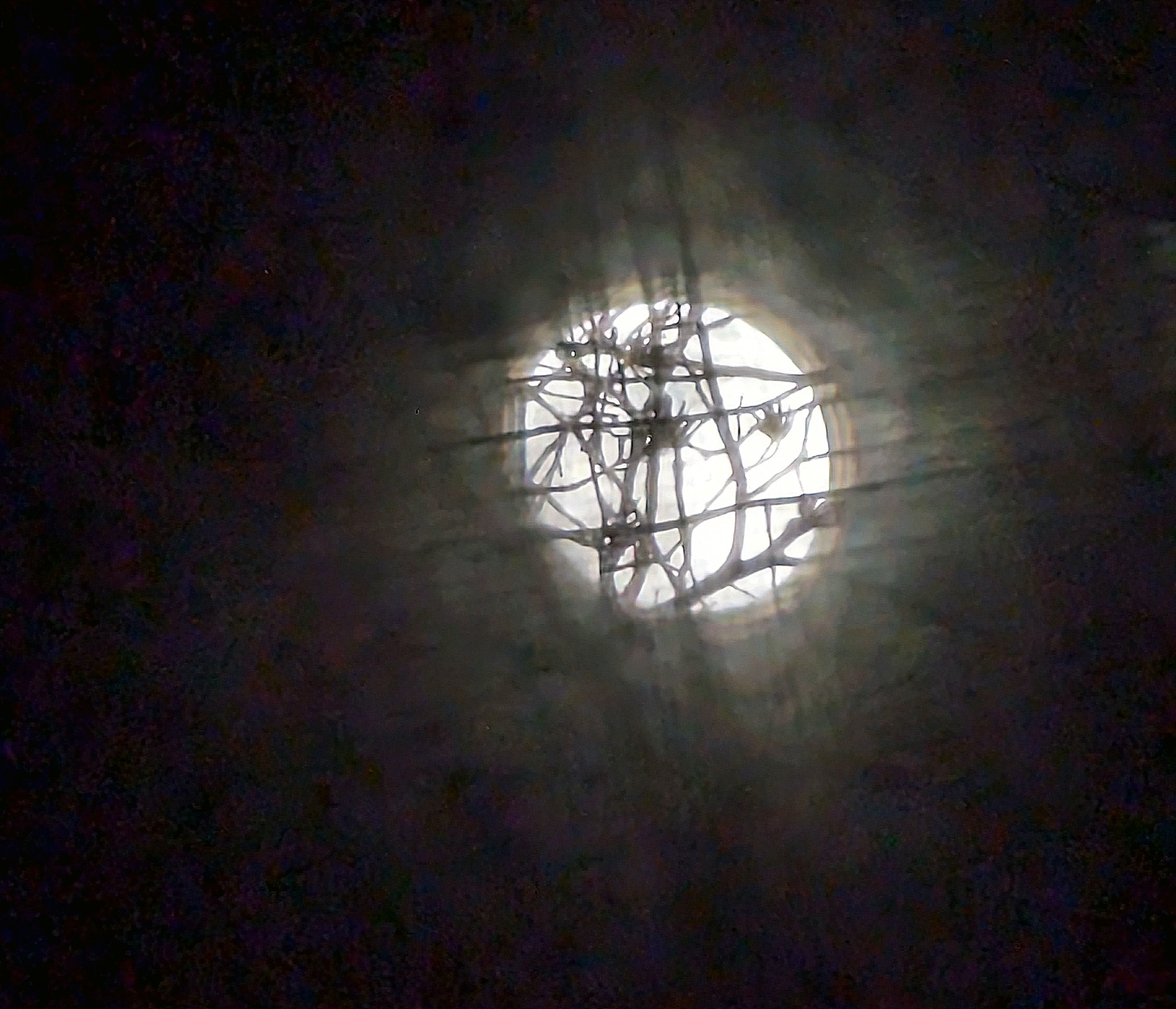
One day from full, says the Moon. What’s this silly stuff about calendars? New Year’s Day, 2026.
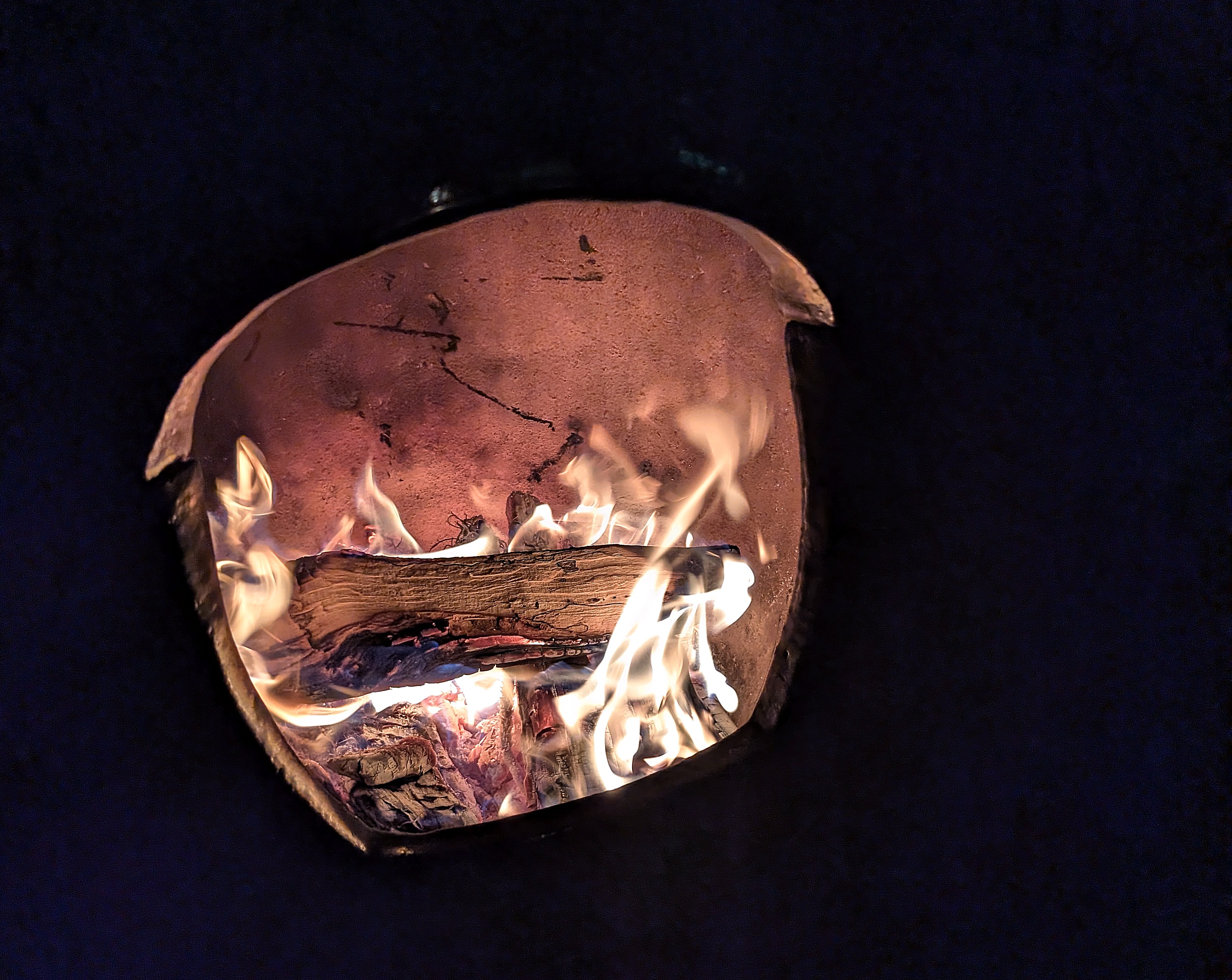
We gathered with friends to welcome the New Year with simple Southern fare: ham, boiled potatoes, boiled cabbage, biscuits. After loosening our creaky social graces with applications of Belgian beer, my Southern brother of a different mother lit up his new chiminea and we talked of things ponderous and trivial. The moon stared us down, afraid to blink for missing our ephemeral lives. Oak hissed and crackled in the fire.
Radiating warmth in all directions. New Year’s Day, 2026.
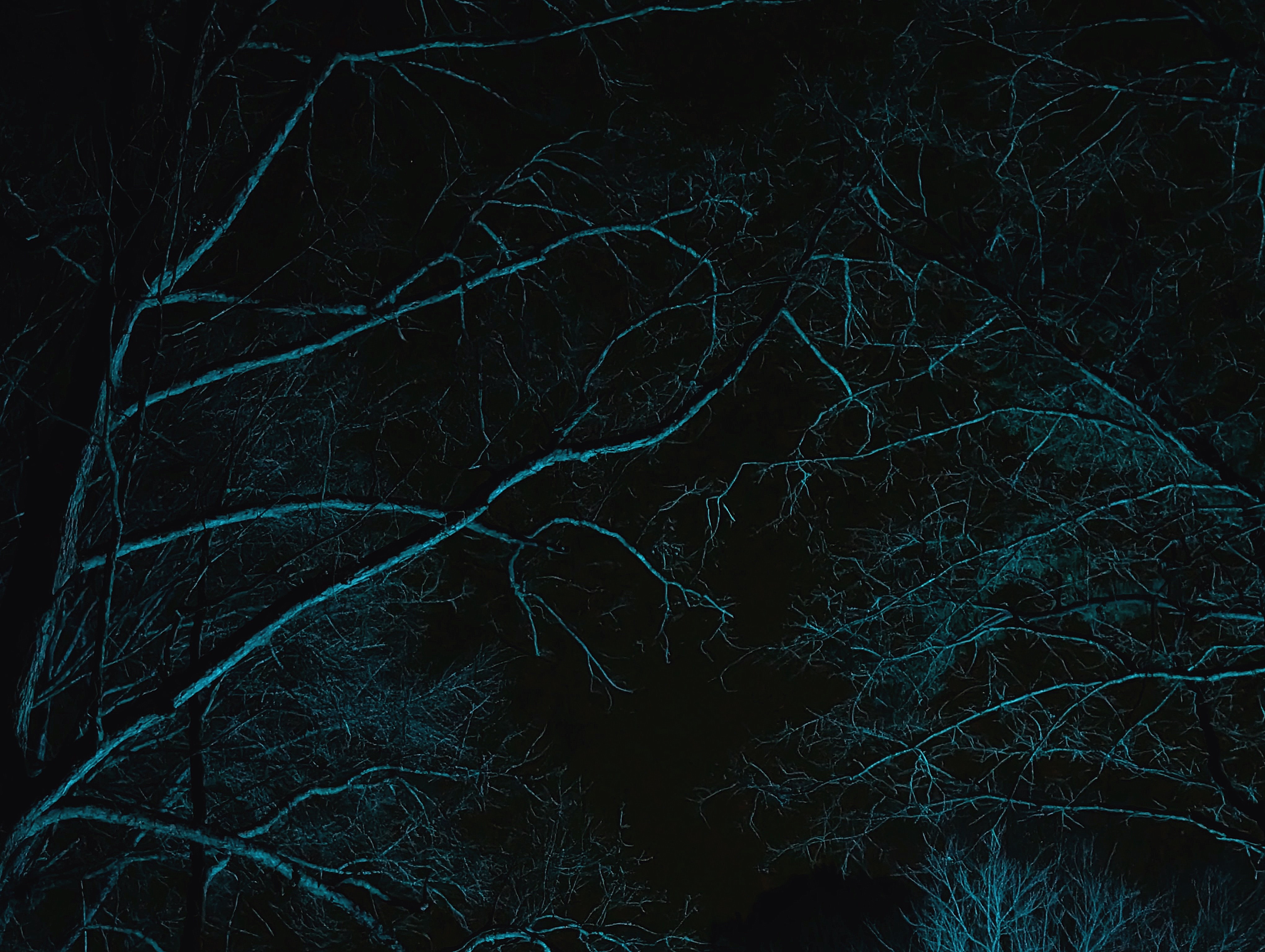
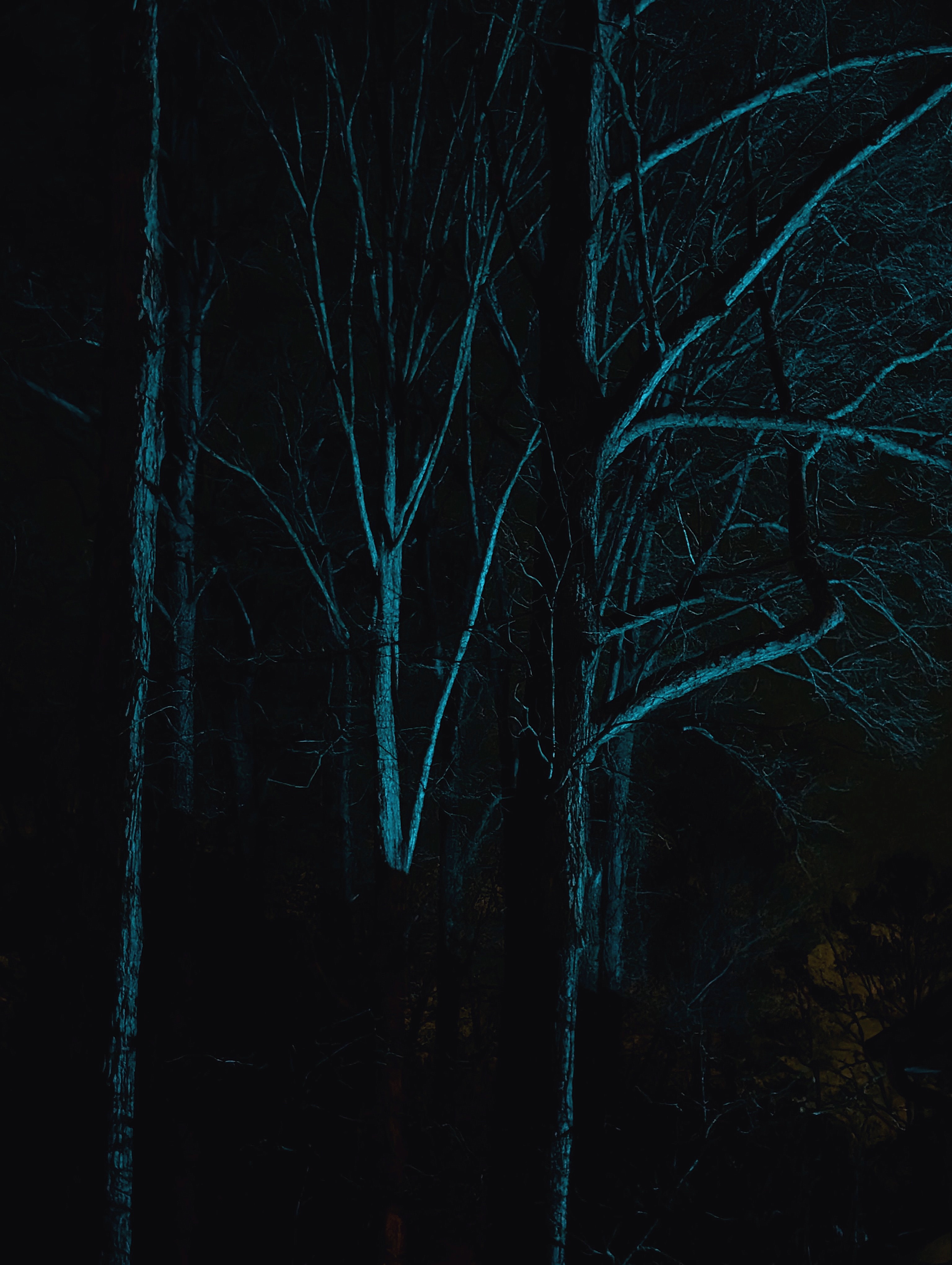
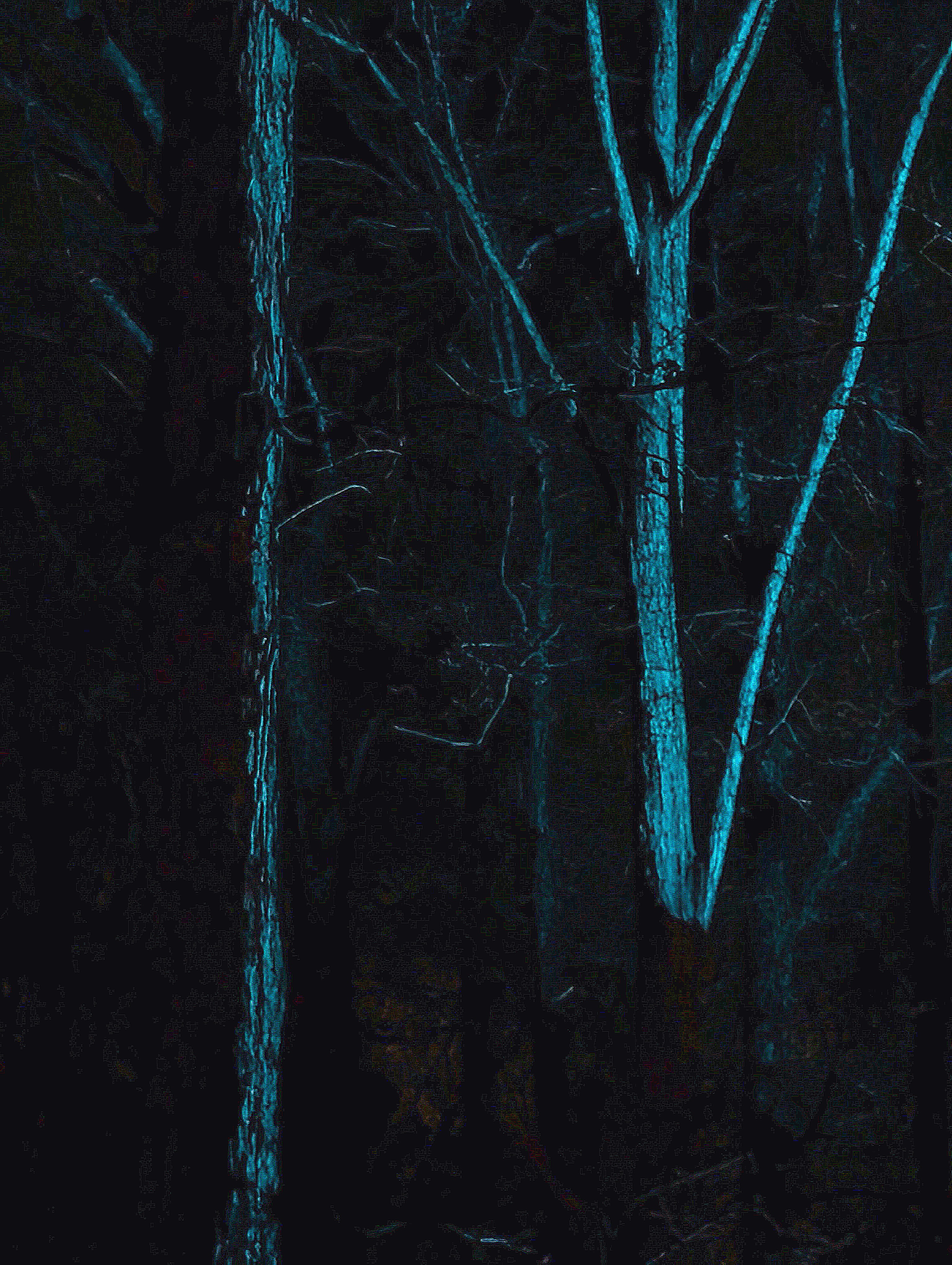
At one point we paused to look at the pretty effects of his neighbor’s light pollution…
Finally we admitted our backsides were too cold and our frontsides were getting quite toasty. We headed indoors, while tarted up versions of the trees danced in our heads…
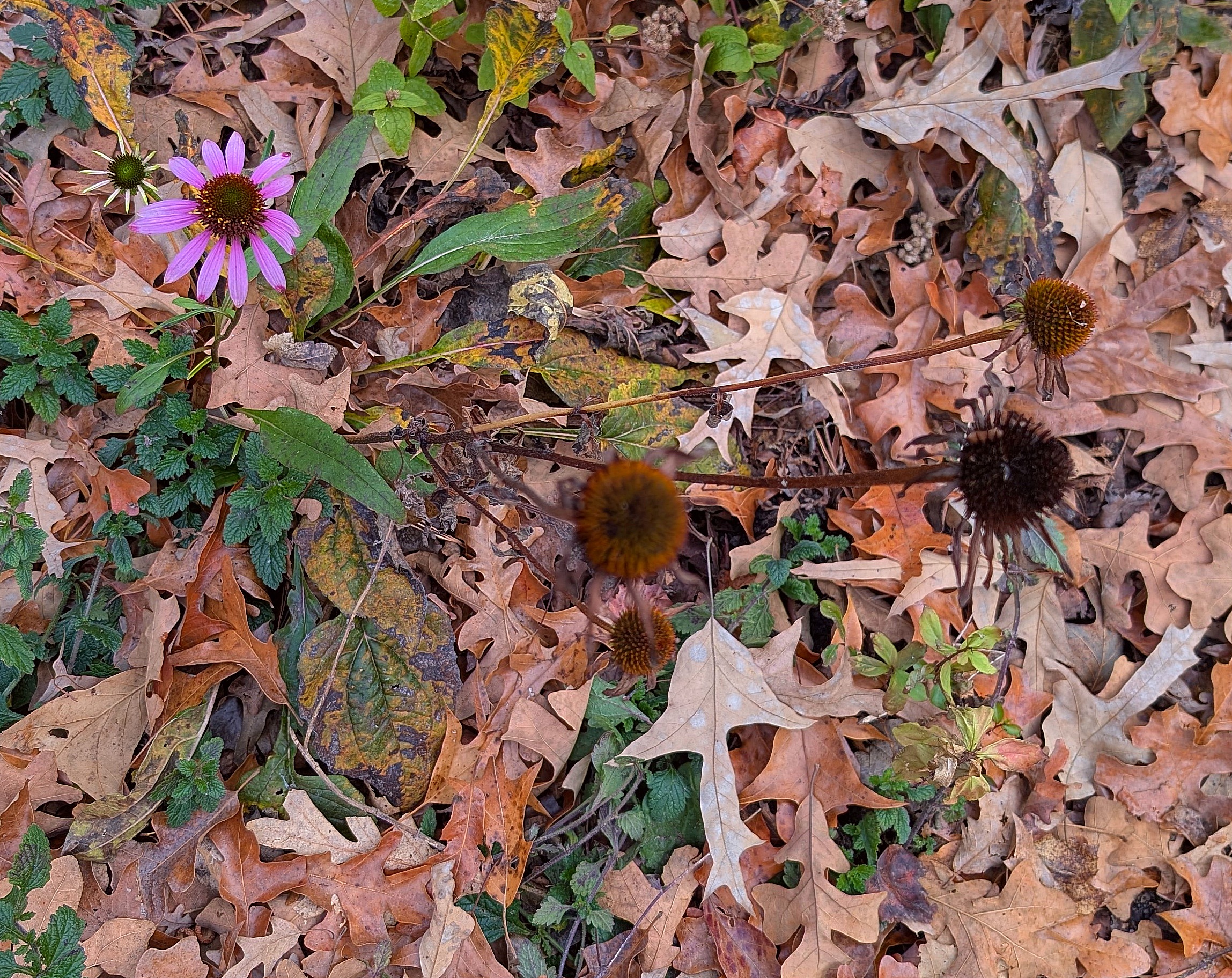
I seem to be on a leaf and garden kick. Though two short cold snaps have sent 99% of the plants into dormancy (unless they’re evergreen), a few brave stalwarts instead focus on the above-average warm weather to pop one last bloom out. November 3-9 ranged 65-75F with just a dash of rain the final two days. And then the 12th through 16th blessed us with sunny days of 64-73F. Look at these little troupers:
The blue mistflower who refused to die. All of its nearby compatriots are brown. Interestingly, the broad leaf or two at the top are from a purple coneflower, also still green. November 2025.Another purple coneflower with living on its mind. All of the originals have gone to see on the right, but no matter. Let’s make more! A nascent bloom can be seen to its immediate left (the little white spiky one). November 2025.Black-eyed Susan: you can see dead plant everywhere but it decided to come up again when the weather warranted. November 2025.
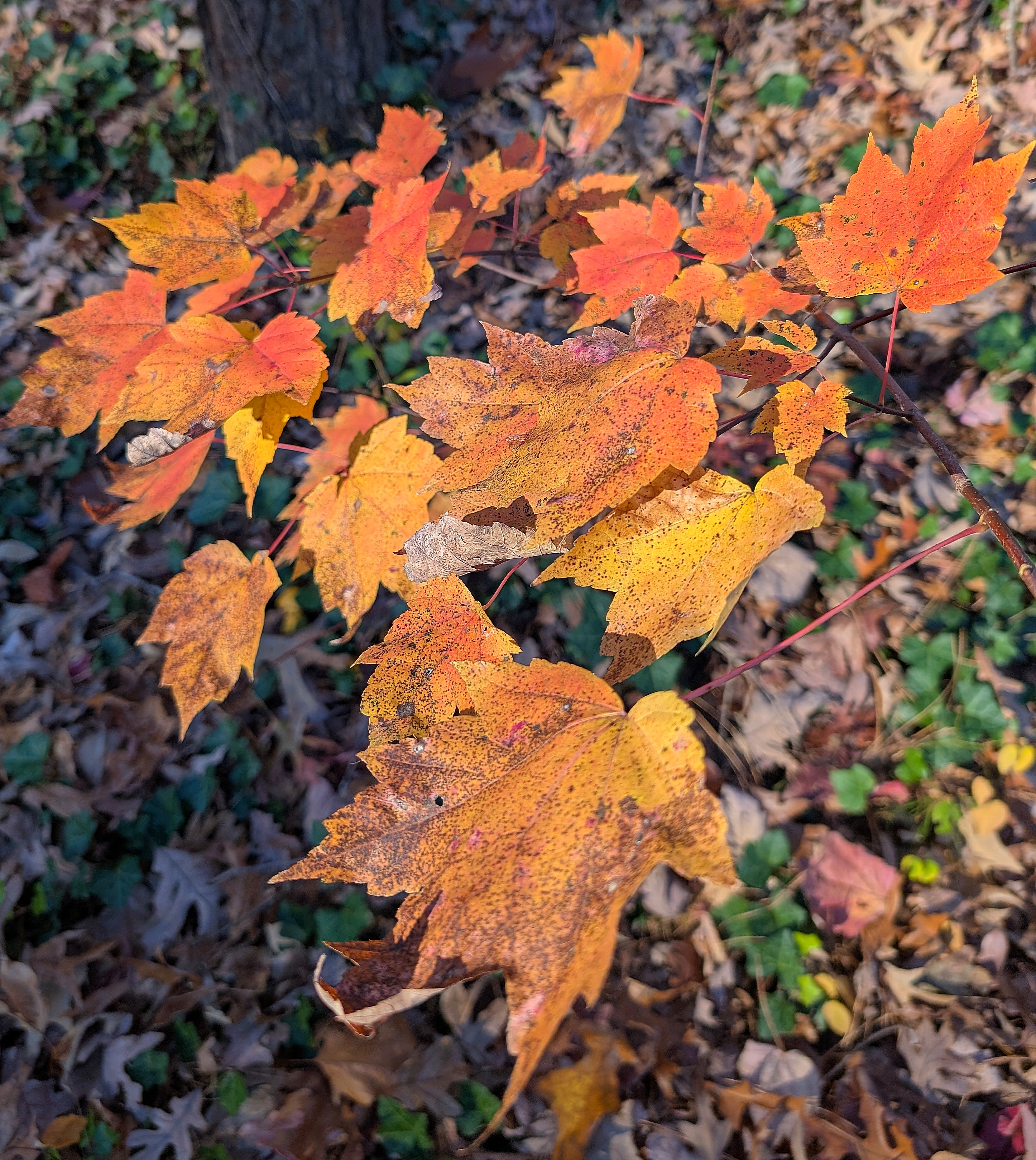
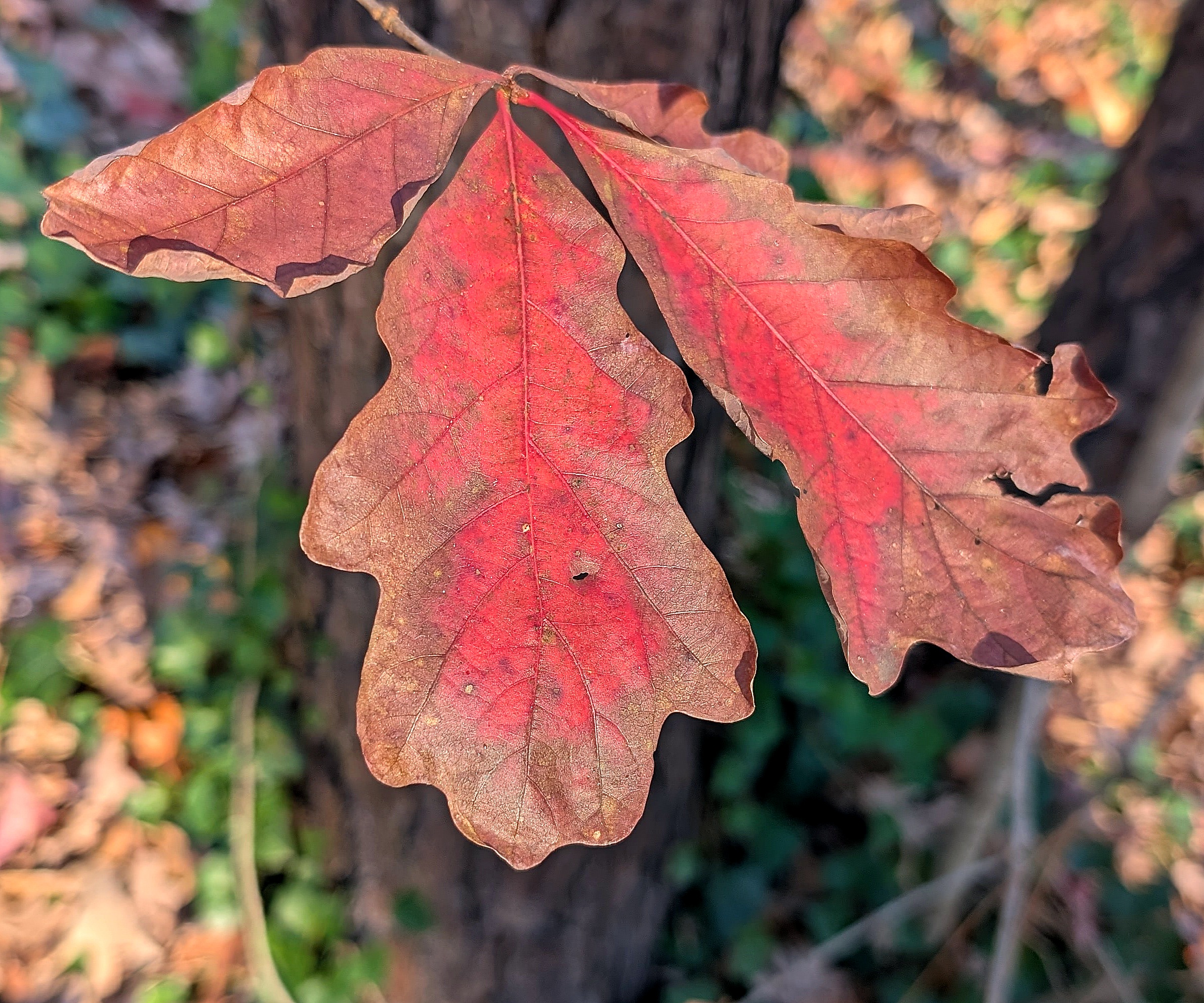
I took a walk this morning as the newly risen sun filtered through the tops of trees. The ethereal lighting isn’t quite captured here, sadly. Nice to see the natives doing well.
American beech, a.k.a., Carolina beech. November 2025.Red maple. November 2025.White oak…maybe…looks different than our white oak. November 2025.
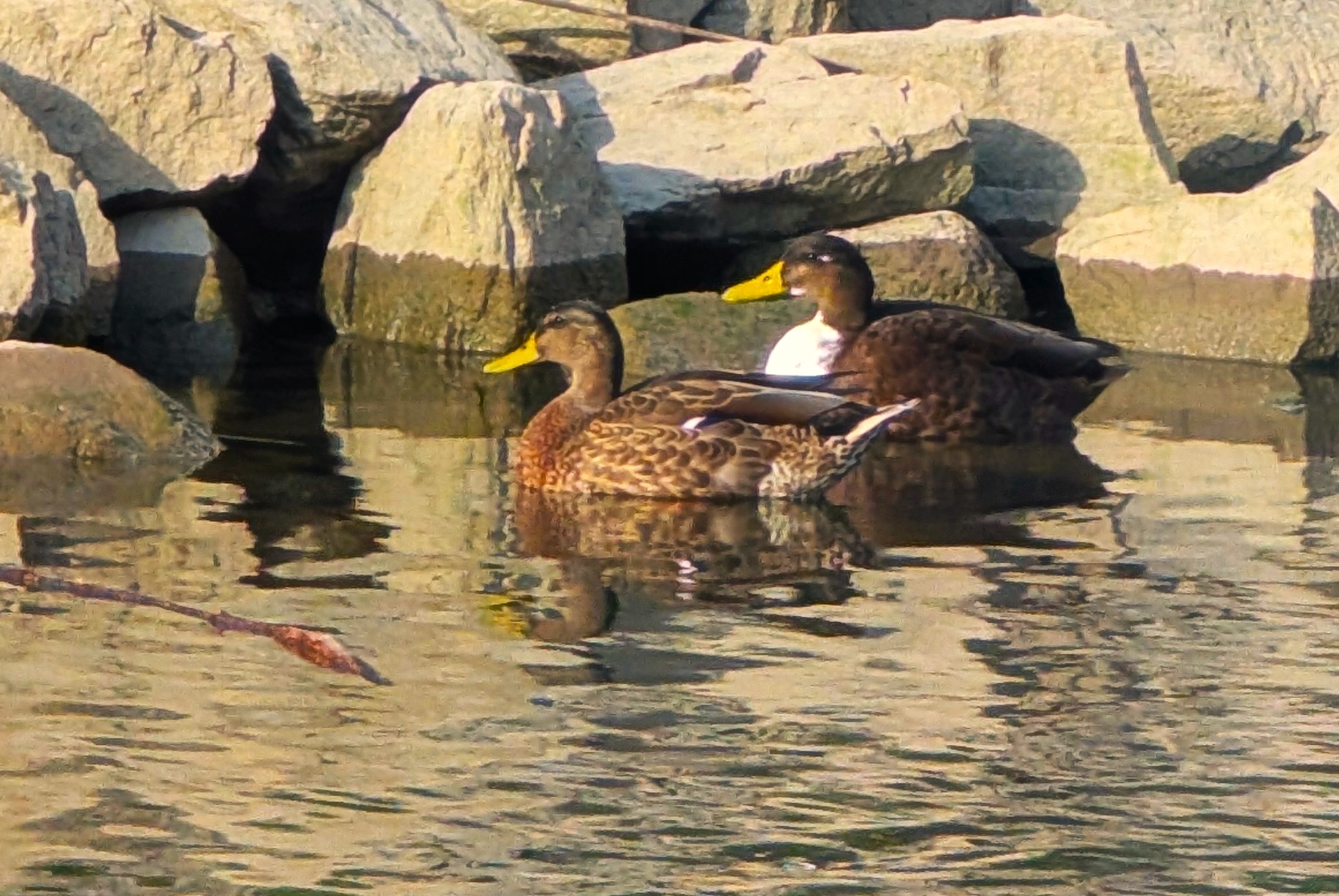
One of the several species of waterfowl we saw while moored at Rüdesheim, Germany. August 2025.
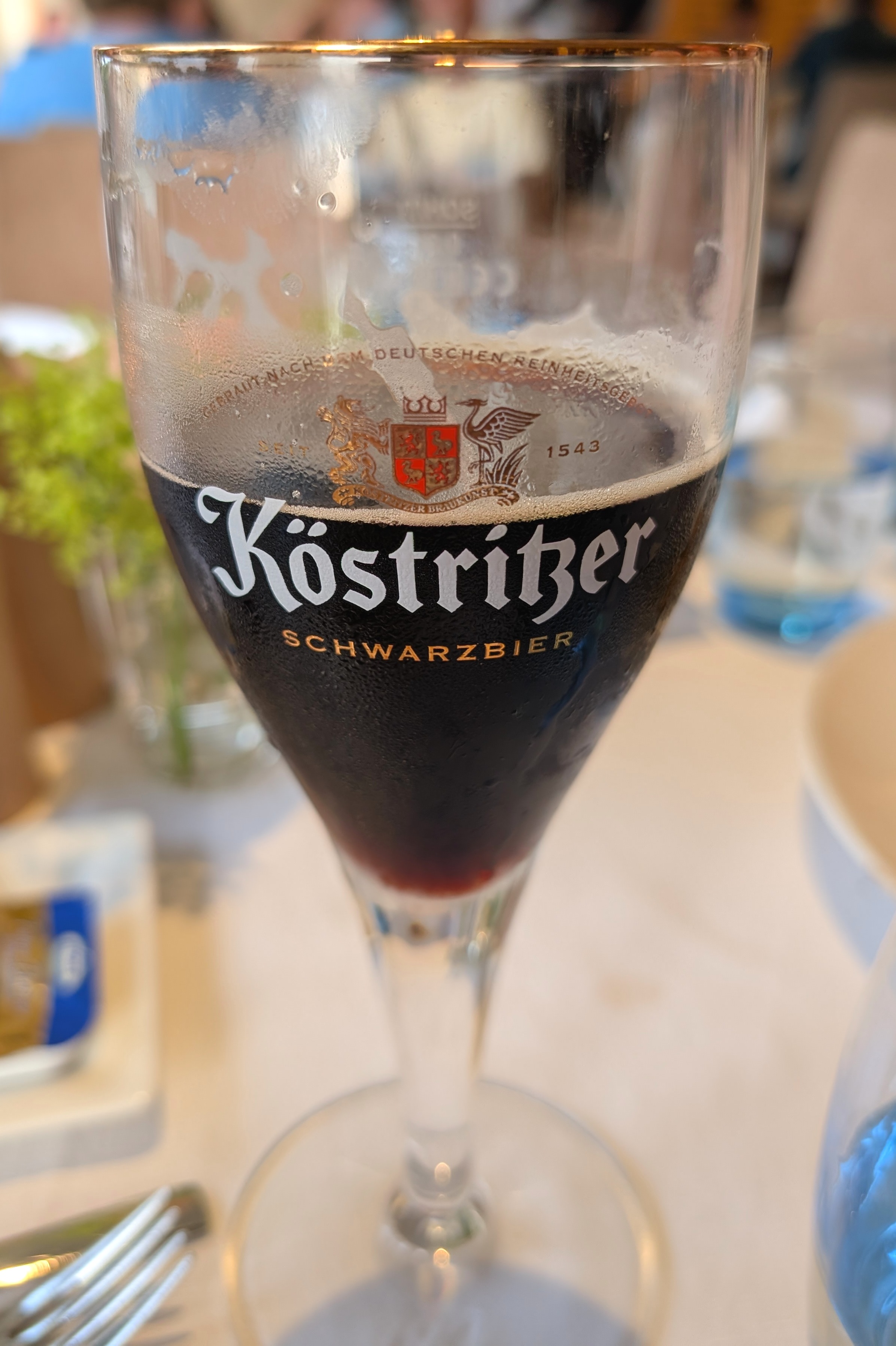
River cruising resembles train travel: you journey from Here to There but don’t have to do the driving yourself. One thus experiences the journey. (Flying lacks this: one experiences only the point of departure and the destination. The experience of travel disappears, lost in abstract non-motion at 30,000+ feet.) Our afternoon cruising capped our morning in Speyer, just right for my still-recovering wife. Once moored at Rüdesheim, we chatted with the local ducks and enjoyed fine beverages. For me, that included this delightful Schwarzbier from Köstritzer.
…or Spires if you want the English name, presented a much-needed comfort level after the unanticipated end to our “Strasbourg Buildup” of expectations. Only 50,000 folks live in this city on the west bank of the Rhine. Yes, we now saw Germany on both sides of the Rhine. Midway through the night’s cruise to Speyer our ship had passed the point where the pentagonal border of France had turned to the northwest and left the Rhine behind. For the first time since Basel, we docked on the west bank of the river. We had the worst guide of the trip there, but a lovely time nonetheless—we simply ignored him and tried to stay within shouting distance of the group. (“Worst guide ever” equates to having him leave a third of our group at a crosswalk where the light had turned against us. He continued with the tour, and then admonished us when we saw a break in the traffic, crossed against the light, and ran to keep up with his idea of pacing a tour!)
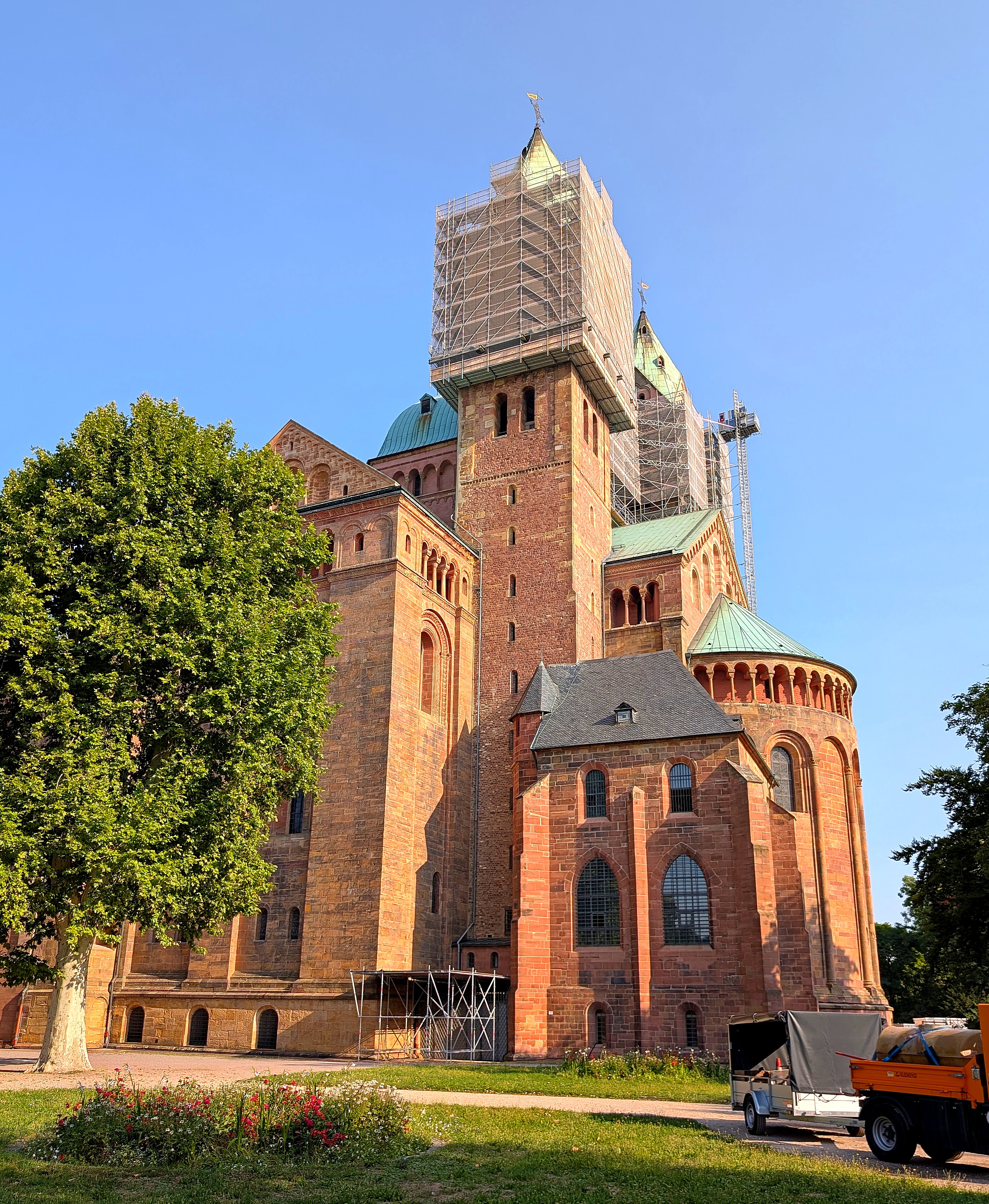
Speyer’s cathedral dominated the city both in its placement on the edge of the bluff overlooking the river, and simply because its size completely outstripped any other building around it. I need two photographs to show all of it:
Speyer Cathedral, east end, with extensive renovations occurring. August 2025.Speyer Cathedral, west end. I normally avoid wide-angle shots on buildings like this, but it proved necessary. The abutment on the right edge is visible in the previous photo behind the tree on the left. August 2025.
Parishioners built the cathedral in several distinct phases. Though our guide dryly and boringly explained it to us, I concentrated on photographs to his exclusion. I therefore can’t give you much history about the building’s timeline. I do remember that like all “touristy” cathedrals you will ever see, this one was the biggest in some category or other—I think “biggest at the time it was built.” If I remember correctly, the middle part of the building (seen in the second photograph) predated either end. Part of it had to be rebuilt after WWII, also. Look on the tower in the second photograph and you’ll see stones laid much more hodge-podge on the lower right of it. The rest gets a more uniform, geometric treatment.
Our guide left us no time to go inside the church. Instead, he took us into the center of the city, a small area of just a few blocks which extend westward from the church. As we turned westward from the cathedral, he noted (for our safety) an oddity I’ve not seen anywhere but Speyer: a city street routed through the plaza, marked only by regularly spaced concrete posts. It struck me simultaneously as beautifully quaint and dangerous.
Speyer cathedral throws a shadow on the historical building across the plaza from it. In the foreground runs a city street, marked by the posts visible in front of the building. I don’t remember if the lighter paving stones represent ‘sidewalk’ or not, but I think ‘not’ is the operative word. I believe the building pictured served at one time as quarters for the bishop, but now might be a private residence. Speyer, Germany, August 2025.
Our guided trip into town proved blessedly short, after which we broke free and wandered at will. We quickly encountered a beautiful Orthodox church…I think.
As far as we could get into this beautiful sanctuary—a locked glass door prevented entry but facilitated photography. Speyer, Germany, August 2025.
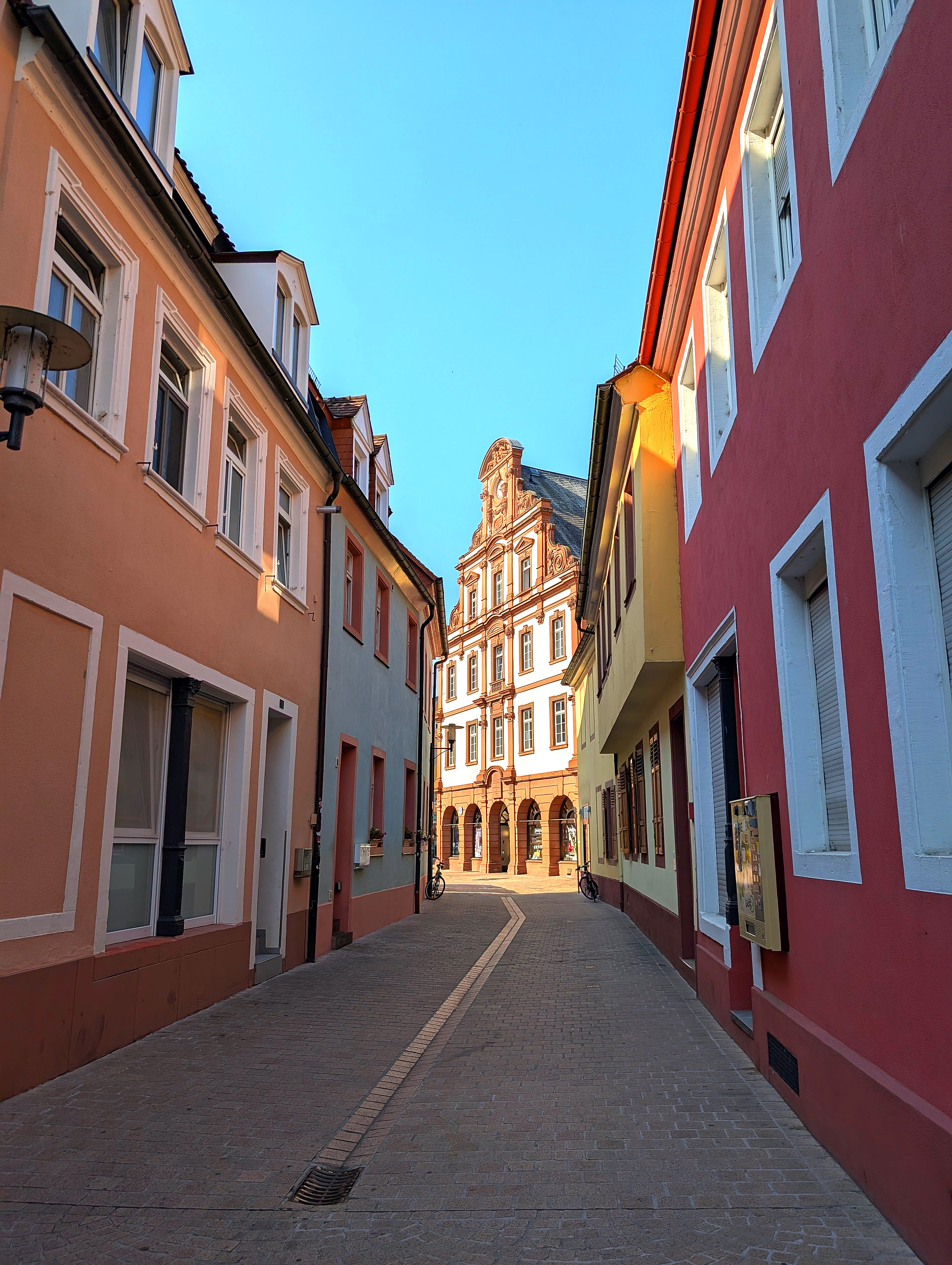
We struck off from the main street through the city center and found little plazas tucked behind several other buildings. One hid a strikingly designed school of drama, if I read the German correctly. The streets off of the main drag lived up to my fantasies of narrow, old, and quaint. A sign informed us that many of these buildings were associated with the Jewish community. Speyer and the nearby cities of Worms and Mainz have been recognized as UNESCO World Heritage Sites. Near the photo on the right (below) we passed an old synagogue.
Yes, they allow cars down this street. Note center-of-street gutter. Speyer, Germany, August 2025.
It’s true, all streets curved to the left! (Unless you turn around.) Speyer, Germany, August 2020.
Walking back toward the cathedral to meet up with our group for the walk back to our buses, we finally had time to enter the cathedral. We made a good decision to allow time for that.
Much older than other churches we encountered on our trip, Speyer’s looks much smaller in this photo than it is. This is due to the large supporting columns which frame this shot. Speyer Cathedral, August 2025.
Speyer’s cathedral offered a delightful blend of modern furnishings contrasting with the centuries old structure. The minimalist lines of its furnishings complement the austerity of the stonework. It had several altars. I surmised different ones get used depending on the size of the congregation at that particular service. Perhaps at least one stands there for historical reasons. The most modern one sits far forward. The candles flanking it, both those on stands and the votives to the side, were displayed on modern metalwork which evoke the baroque in a minimalist way. The bishop’s chair sat halfway back in the sanctuary (altar area), to the right in the photo below. The next photo gives a sense of the depth of the sanctuary/chancel.
The first altar of the Speyer Cathedral. Note the organ in background. Speyer Cathedral, August 2025.Bishop’s chair and back portion of the sanctuary. Speyer Cathedral, August 2025.
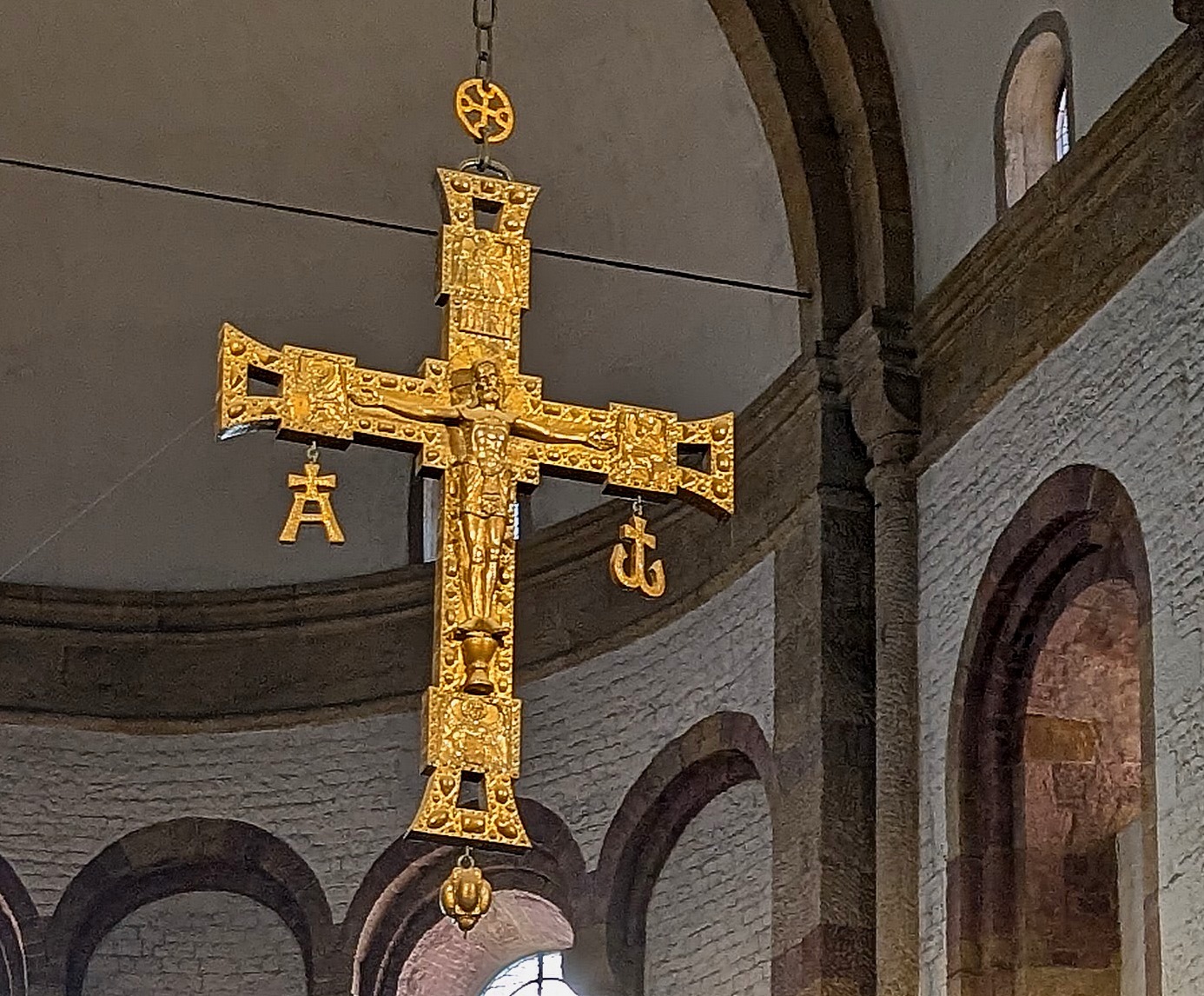
Detail of the suspended cross just rear of the “bishop’s altar” in the middle of the chancel. August 2025.
When looking at the photo above, you’ll remember the bishop’s chair is to the right of the first altar. In the lower right corner, note the raised floor. This is for the second altar. Light shone into the cathedral from many angles. At the top of the photo is the lowest tip of a suspended cross, caught in sunlight which casts a shadow on the back wall. See detail, left.
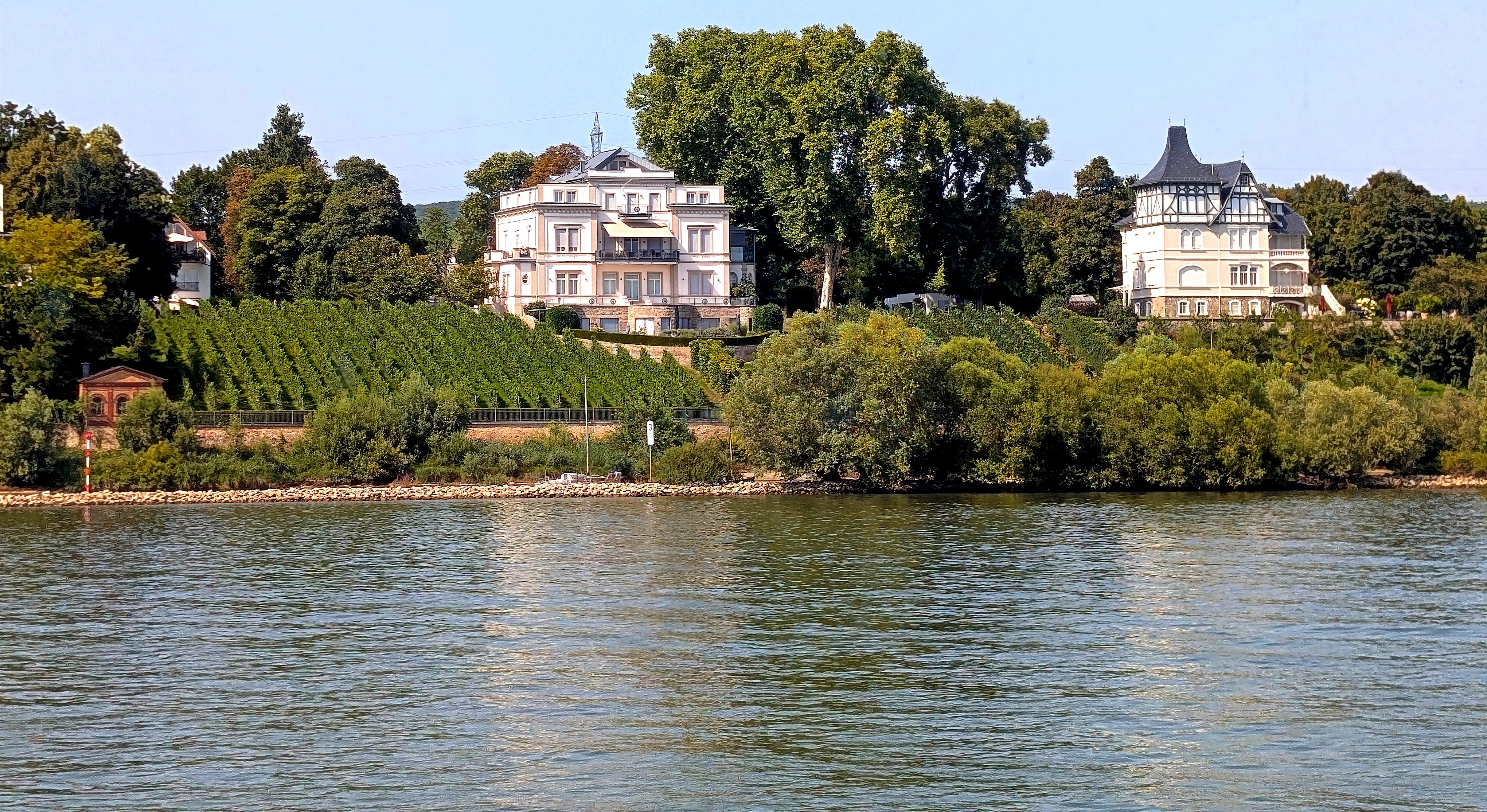
Our several tour groups boarded buses for a short trip to Worms where the good ship Hlin had tied up after getting a head start on the afternoon voyage to Rüdesheim. We couldn’t seem to take enough photos as the historical buildings glided past us. That evening we stayed aboard. Others had purchased one of two different dinner packages (one at a fort high atop an overlooking bluff).
From the starboard side, first you photograph the building on the right. Then you see the next one to the left…then its vineyards…then the little red stone building down by the railroad tracks which run along the Rhine. Then there’s another building…it never ends. And you’re sitting in the lounge where the next cool beverage is only steps away. August 2025.









 all the voices in my head