Typically, or typical for the previous few years, our star magnolia blossoms sometime between the first week of February and around Valentine’s Day. Yesterday (February 27th), I looked out as I opened the blinds and saw many swollen, fuzzy buds, but no blossoms. Just after 10:30 I looked again and saw several had said, “Sun! Hooray!” and opened up to greet it. Spring, as defined by me, starts when some of the days peak at 60-70 degrees (or higher here in North Carolina) with the additional stipulation of the early bloomers: daffodils, magnolias, the camellia, and a few others. This occurs in the first half of February usually, although cold and sometimes snow have occurred too in those weeks. Put a gun to my head and I would admit we can’t count on these blossoms until about the end of February. Our winters have been warm for a handful of years. A return to a more normal range of temperatures in February (complete with a windy, cold snow-and-ice storm on the 19th) perhaps signals a return to normalcy.
My first photo at Volcanoes National Park: a steam vent on the edge of the Kilauea crater. September 2024.
The island of Hawai’i could be called triangular. The west coast roughly runs north to south. From its northern tip, though, the coast runs northwest to southeast. Then from that easternmost point it runs northeast to southwest to join up with the west coast. Situated inland from the southeast-facing coastline lies Volcanoes National Park. Volcanoes presents much more than just dormant craters. Its most active feature (inland) turned out to be the first thing we saw: steam vents. Craters? I found their vastness difficult to comprehend.
Kilauea from steam vents on north rim, looking southwest. September 2024.
I’m not even sure the photo above shows only Kilauea. I see “Hale Ma’uma’u Crater” on the ol’ Google Maps. Lava flowed in 1919, 1921, 1954, 1959, and on and on I would guess. I paid little attention to information, so I’ve only myself to blame! Seeing it seemed more important than reading about it on signs, the internet, pamphlets, and the like.
Trade winds blow northeasterly toward the park. There are dry plains inland, but plenty of slopes catch the moisture. Plant life abounds there. Even in this dryness:
On the edge of the steam vents. Volcanoes National Park, September 2024.
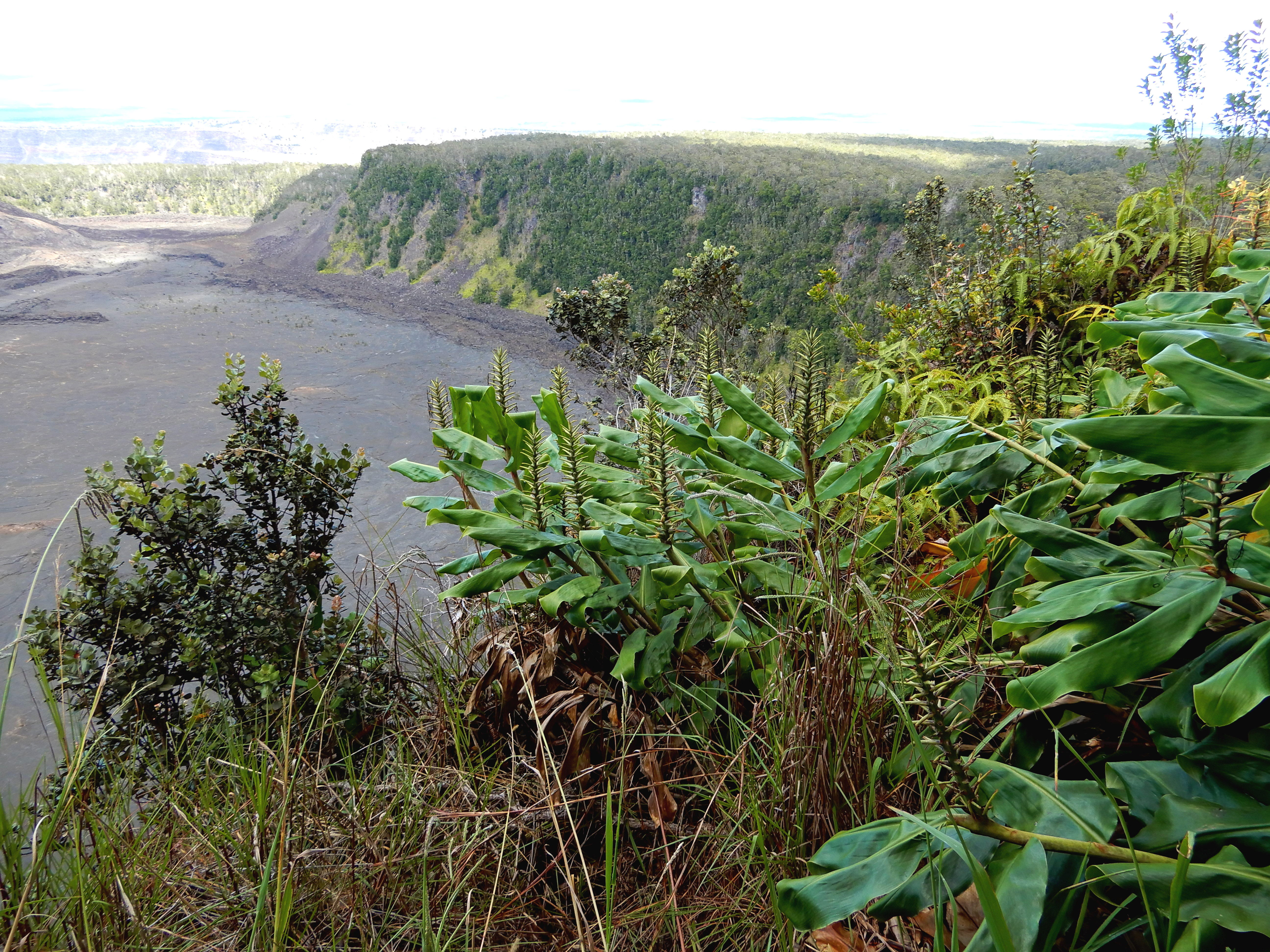
Where the rain can fall, things change rapidly. Just a few miles away from the photos above…
Kilauea Iki Overlook trail. Volcanoes National Park, September 2024.Kilauea Iki Overlook trail. Volcanoes National Park, September 2024.
Eventually I realized this incredibly wide circle we were tracing surrounded a ‘family’ of volcano craters. We continued past many tantalizing side trips, acknowledging our (a) laziness, (b) general physical un-fitness, and (c) certain time constraints. Turning off of the Crater Rim Drive where it intersected Chain of Craters Road–further westward travel was blocked–we traced the path of lava flows to the ocean.
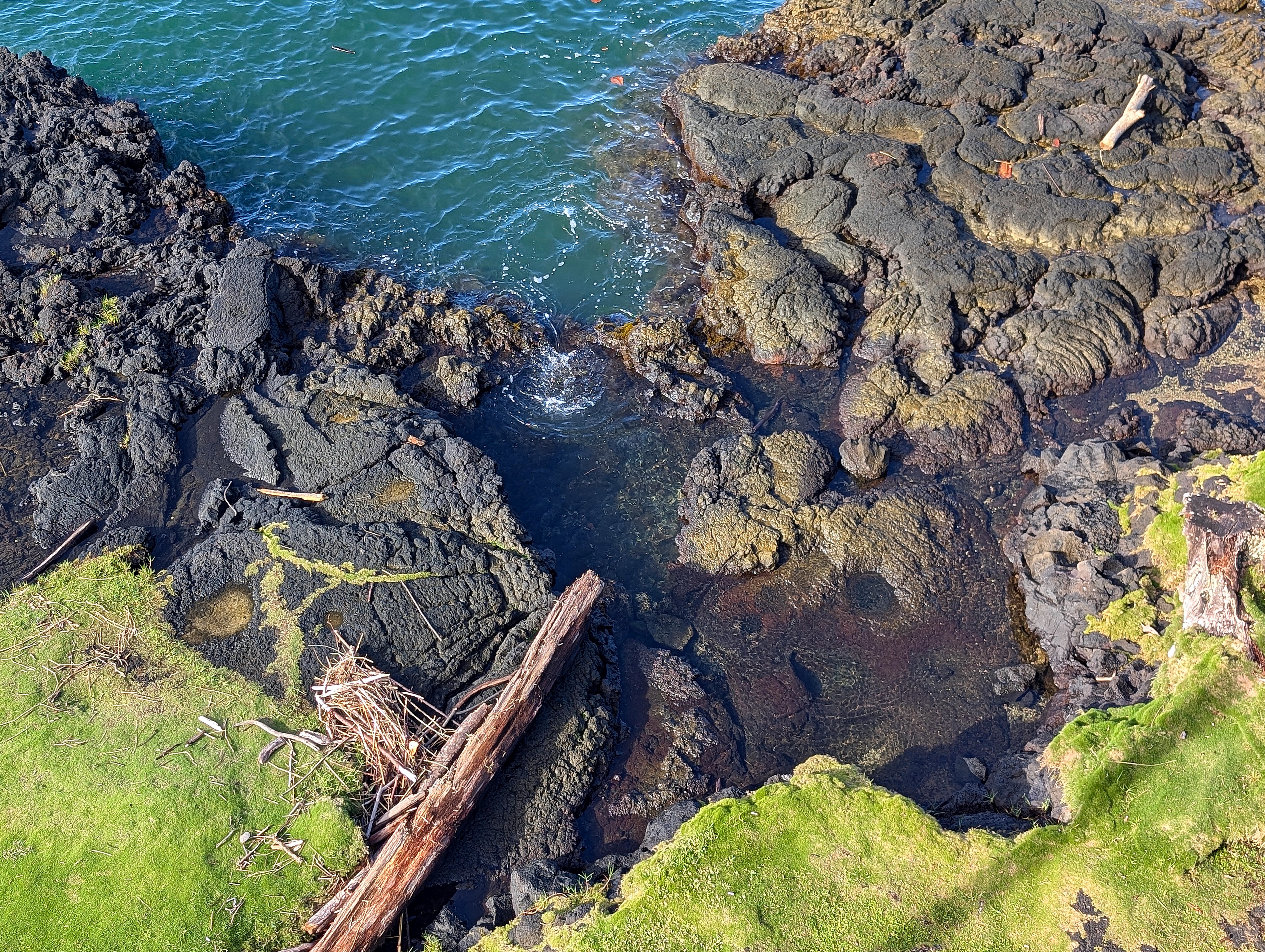
Approaching the coast in Volcanoes National Park. September 2024.Where lava meets the sea: Holei Sea Arch. Volcanoes National Park, September 2024.
Now that I know more about this park, I would go back to look into lava tubes, to hike a bit here and there, to see if some of the roads had opened up, and to maybe hike down into a crater…maybe. It looked kinda boring to be truthful.
‘Yep, the rock looks just as black down here. Why did we hike down here again?’ Volcanoes National Park, September 2024.
It all impressed this guy who grew up with the volcanoes of the North Cascades, a far different kind of thing.
Thus ended our day-to-market. My usual procrastinating nature had combined with Hawai’i’s induced laziness to leave two journeys for the final two days on this island. To be continued…
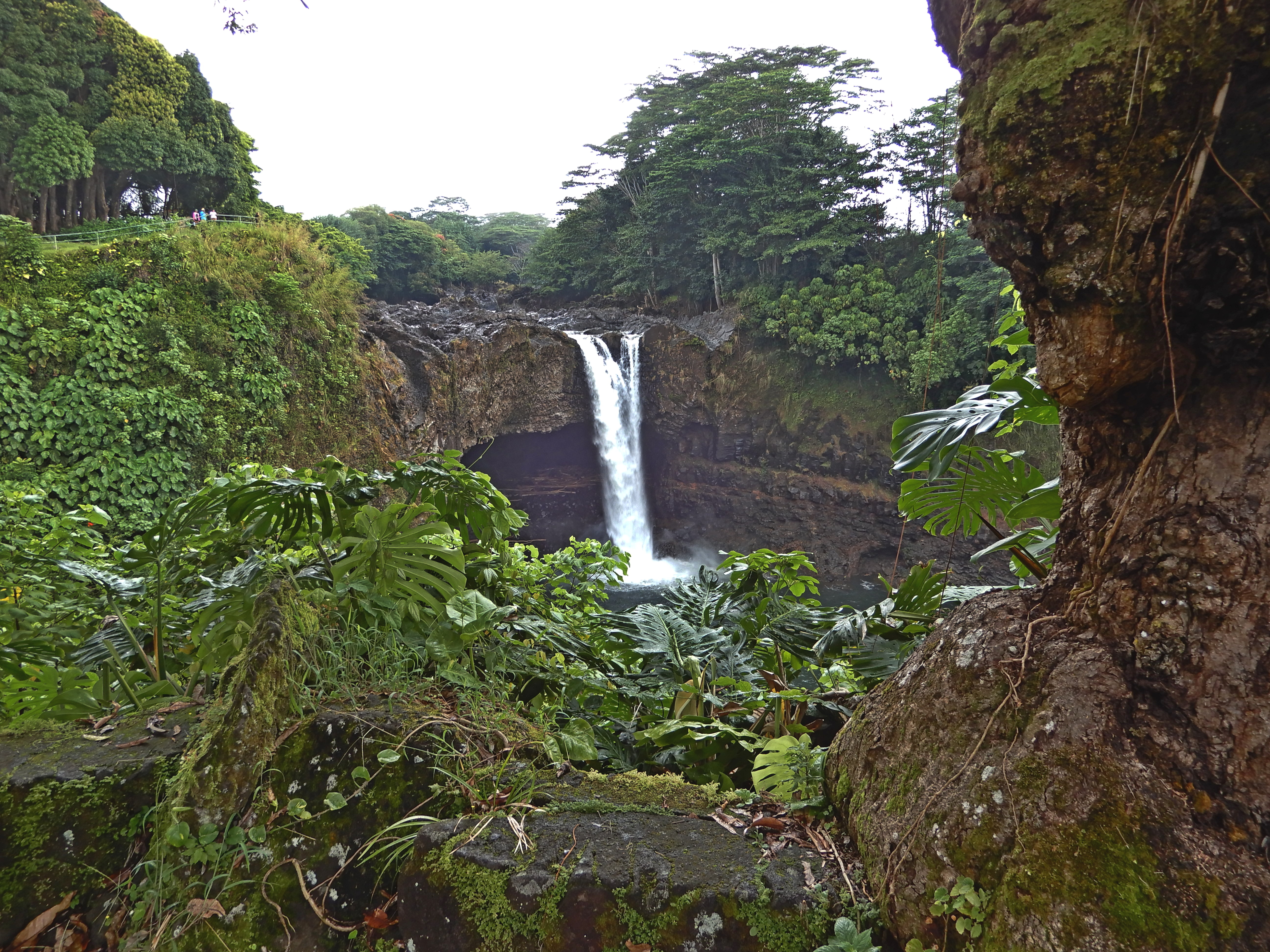
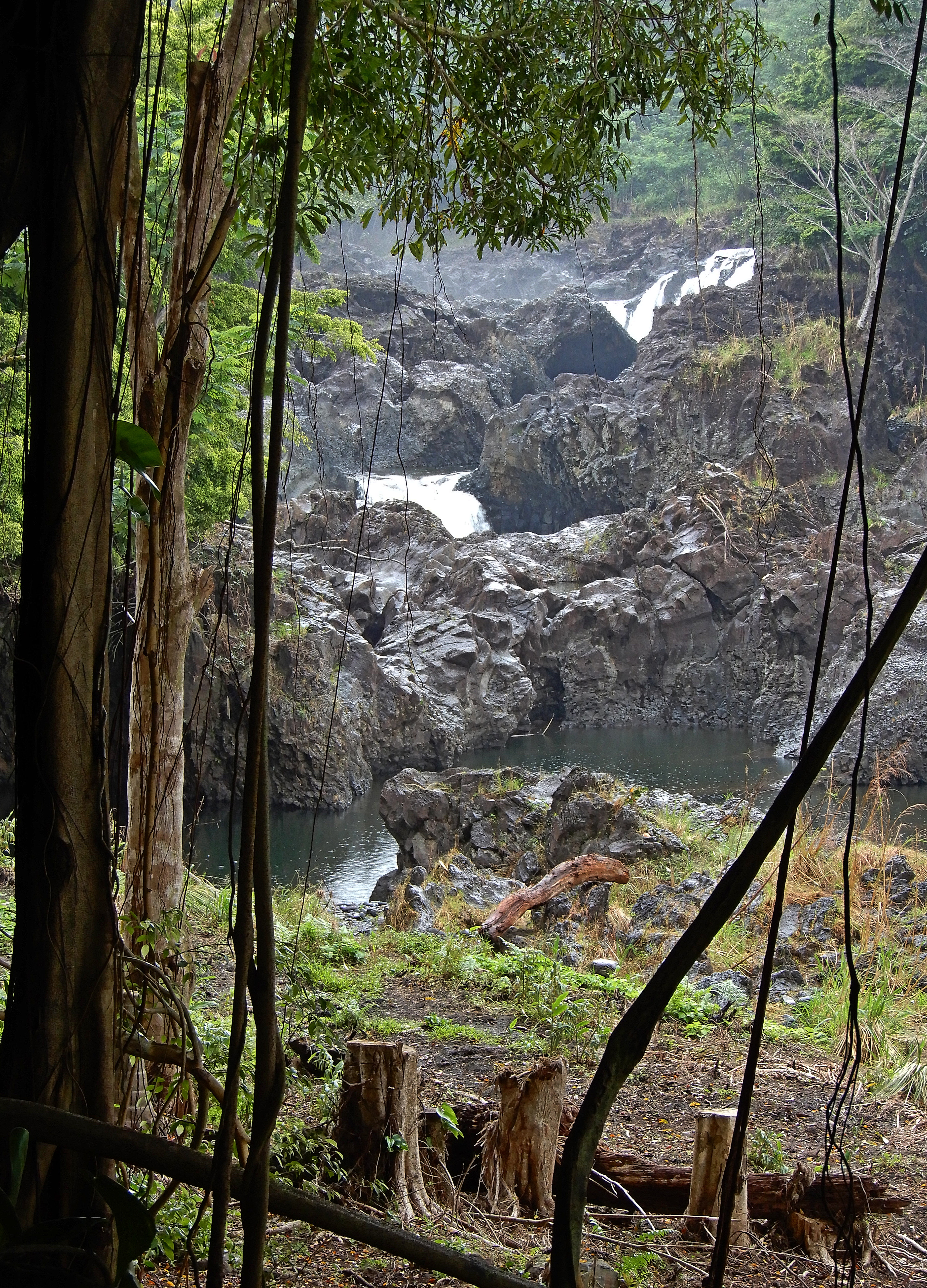
Rainbow Falls, Wailuku River State Park. Hilo, HI. September 2024.
Gray skies colored all of Friday the 13th, as promised by the dawn. After a lazy start, and feeling the effects of our up-and-down trek to ‘Akaka Falls the previous day, we drove all of 3.5 miles or so across Hilo to Rainbow Falls in Wailuku River State Park. A gentle, sporadic spitting of raindrops punctuated our first view of Rainbow Falls (above). They continued as we climbed under the trees for a closer look.
Rainbow Falls, Wailuku River State Park. Hilo, HI. September 2024.
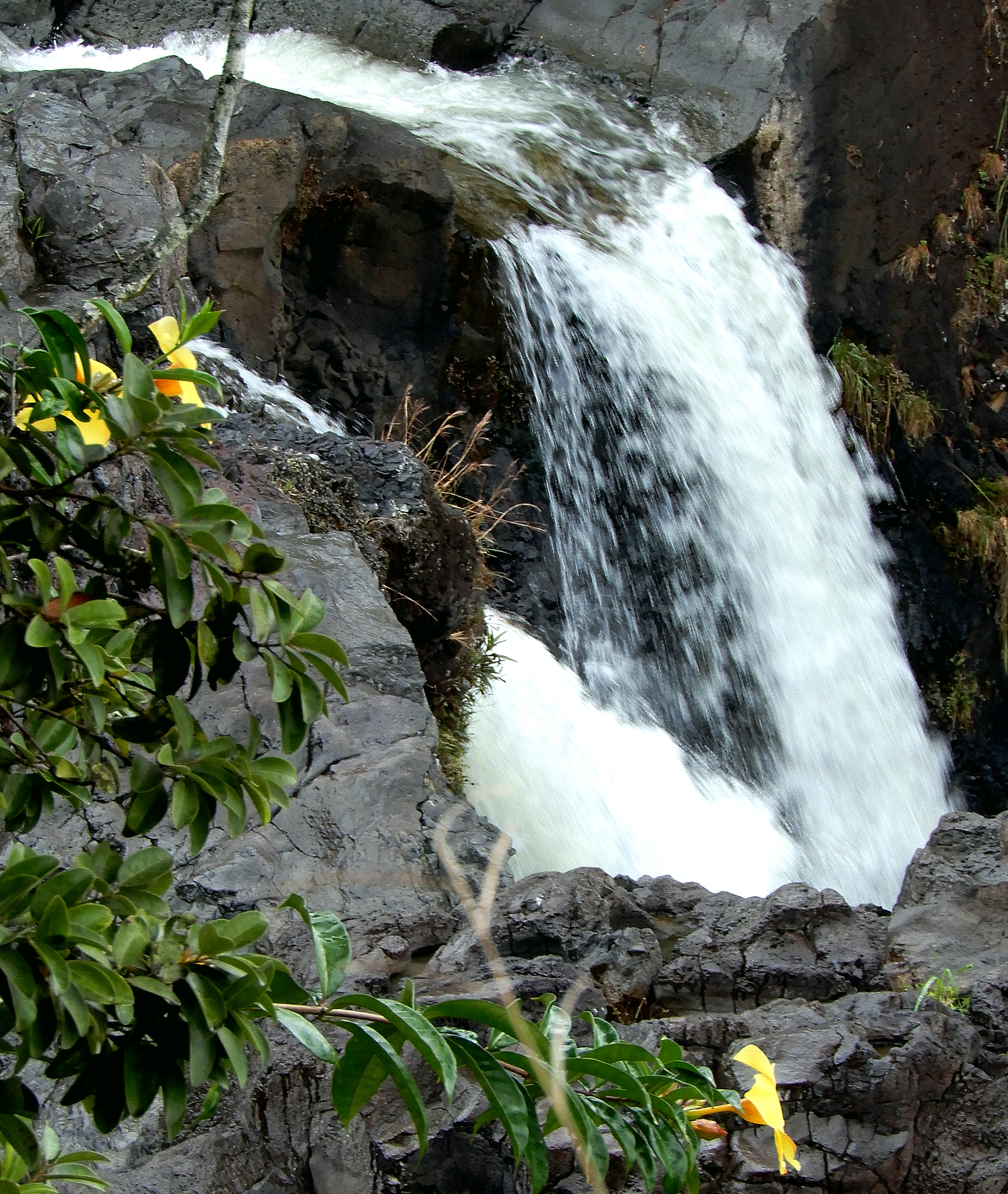
Volcanic rocks made slippery with rain didn’t appeal to us. We stayed under the trees and gazed upriver, unaware another set of falls existed just a short distance away.
The Wailuku River above Rainbow Falls. Wailuku River State Park, Hilo, HI. September 2024.
Weather dictated indoor activities, so we headed to the Lyman Museum (recommended). Ravenous afterward, we grabbed fried plantains and beer at Ola Brewing.
‘Akaka Falls. It really is this green. September 2024.
On our second full day in Hawai’i, we arrived to ‘Akaka Falls State Park near midday. We paid to park in front of the entrance rather than along the road as some did, paid for entrance, and received a warning from a woman there that the trail required one to go up and down more than 600 steps. Her warning wasn’t an empty one: for nearly a month after our visit I experienced a sharp pain in my left knee when I went up or down stairs. I later learned construction on the path forced us to take the long way around a loop trail, in essence covering three times the normal distance. This trail descends to a stream, crosses it, climbs again on the other side, basically cresting a ridge obliquely to be above Kolekole Stream which plunges 442 feet at ‘Akaka Falls. One hears but does not see a variety of birds. Foliage is lush, a result of the near-constant rain (measured best in feet). It sprinkled on and off while we visited.
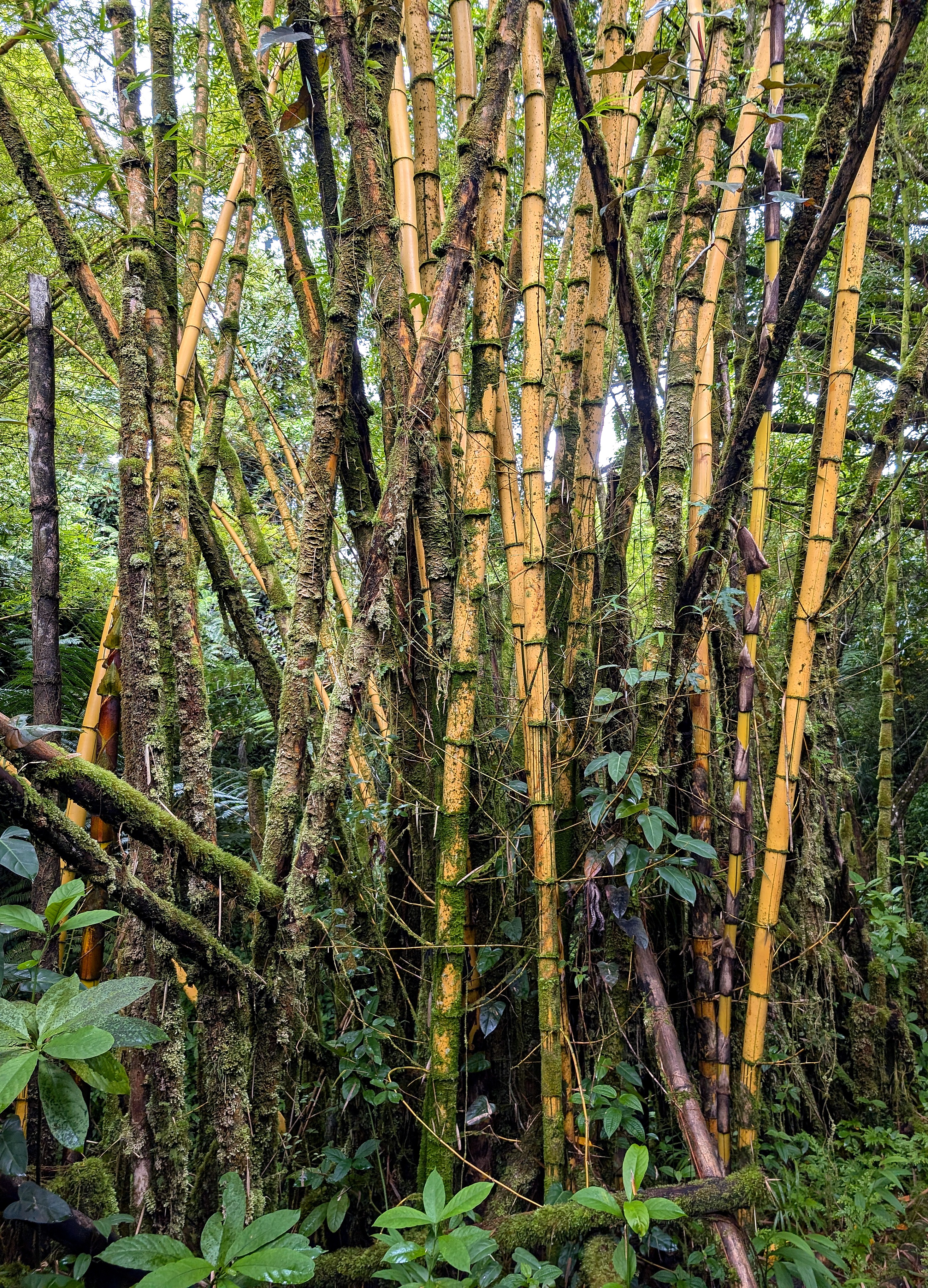
Bamboo stand in ‘Akaka Falls State Park, Big Island, HI. September 2024.
Our rental car, trees, vines, and a curve on the Old Mamalahoa Highway. The Big Island, HI. September 2024.
If you find yourself on the Big Island, and most especially if you stay on the east side in or near Hilo, a must stop (for the physically fit) is Akaka Falls State Park. As you head north to that park–only 15 miles distant, a very easy drive–just past Paukaa you’ll see a typically yellow/orange/ochre, diamond-shaped highway sign telling you that to your right is a “Scenic Highway” with a little sign beneath that says it’s four miles in length. Hopefully someone in your car (perhaps you?) will say as my wife did, “Let’s take that!” When you jerk the steering wheel to the right in the Papaikou census area (pop 1314), you’ll be on the Old Mamalahoa Highway.
These aren’t my best photos. Skies were overcast. Dense tropical foliage made it dark everywhere. Green predominates. The road twists, turns, offers few places to just pull over to grab a photo.
Halfway in we stopped at the Hawai’i Tropical Botanical Garden. It looked interesting, and it had restrooms. Our interest waned when faced with admission prices of $30/each and the prominent display of mosquito repellant for sale right beside the register. Translated from “customer-eze”, the signs basically said, “You’re a fool if you don’t apply repellant.” I’m sure it’s a wonderful point of interest: it features a valley down to the ocean with 2,500 species of plants. Nevertheless, we drove on. We stopped soon after when we found a bridge and a wide spot to pull off the road.
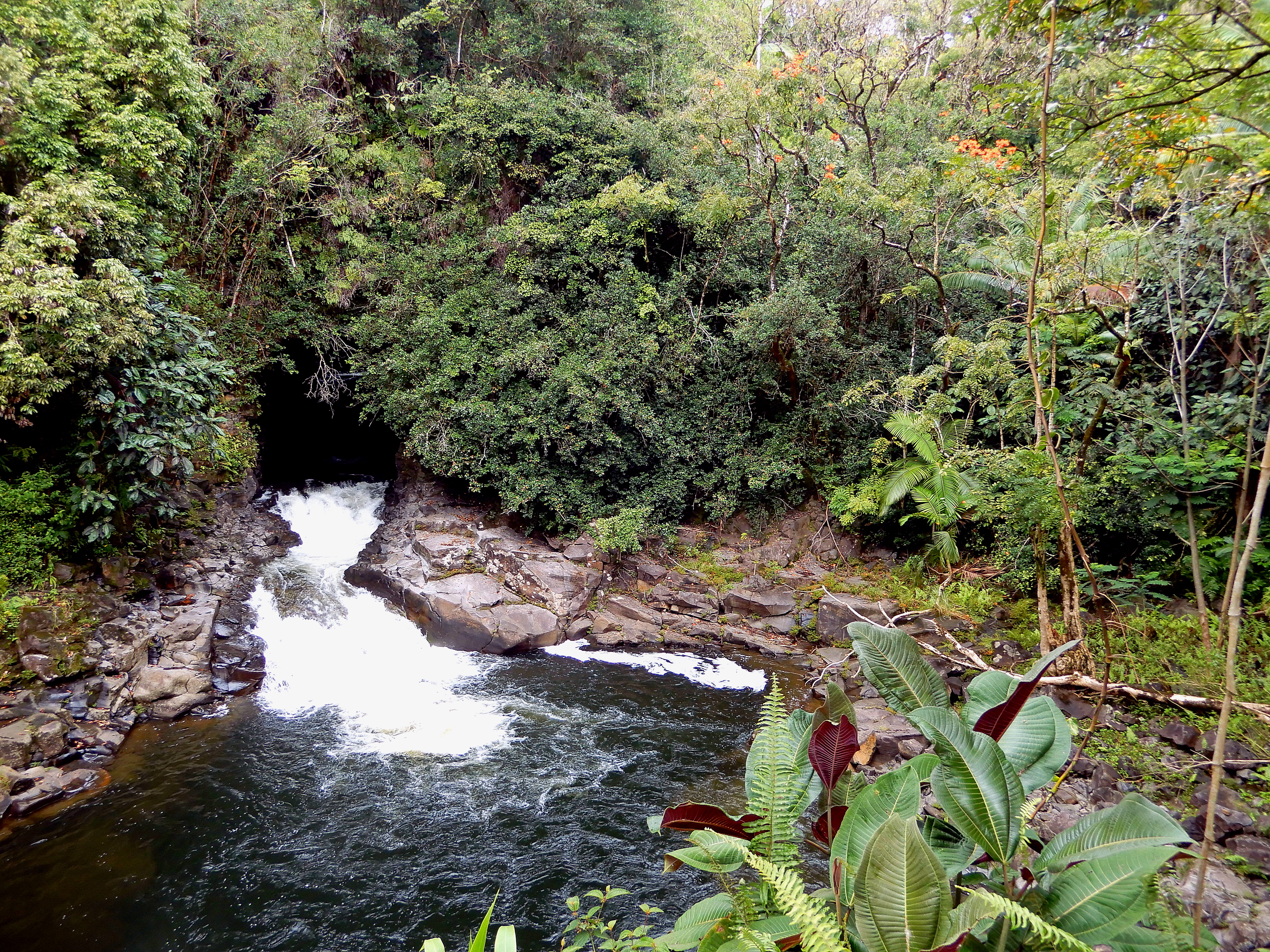
Kawainui Stream, Big Island, HI. September 2024.Kawainui Stream, Big Island, HI. September 2024.
I had become fascinated by a orange-red flower growing high in the canopy. At this stop we found ourselves above some of these trees, permitting me to photograph them:
Big Island, HI. September 2024
Driving north as we did, one suddenly pops out of the dense foliage and into a grassy pasture area on the edge of Pepeekeo. Joining the main highway, we drove on to Akaka Falls.
I felt drawn to making a pithy statement about the symbolism of the leaves with their green and red, but sometimes you just need to let leaves be leaves.
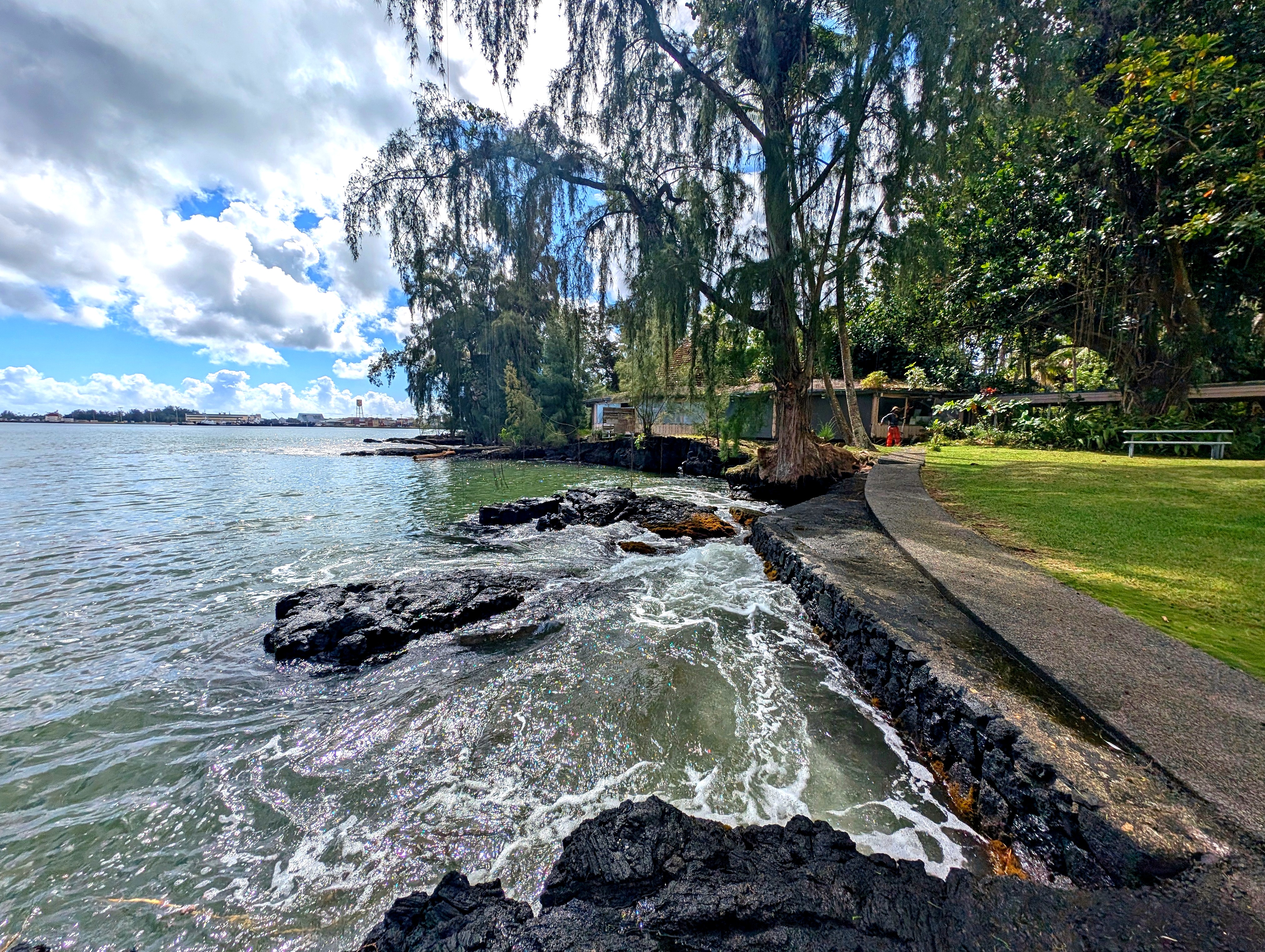
One of our many islets in the waters around our hotel. Big Island, HI. September 2024.
Our first full day in Hawai’i on the Big Island, we woke to mostly cloudy skies–not surprising considering we were on the rainy side of the island and we’d arrived to Hilo Airport under a solid overcast. As is our wont, we spent our first morning lazily, eventually venturing forth to explore our near surroundings. Here, it meant taking a walk around the western half of Waiakea Peninsula. Our hotel sat on the northernmost tip of the peninsula, situated on pretty grounds, so we started there.
Grounds of Grand Naniloa Hotel, looking east. Big Island, HI. September 2024.Grounds of Grand Naniloa Hotel, looking north. Big Island, HI. September 2024.A flower-cluster on one of the plants around the grand Naniloa Hotel. Big Island, HI. September 2024.Looking northwest from the northern tip of the peninsula. Big Island, HI. September 2024.
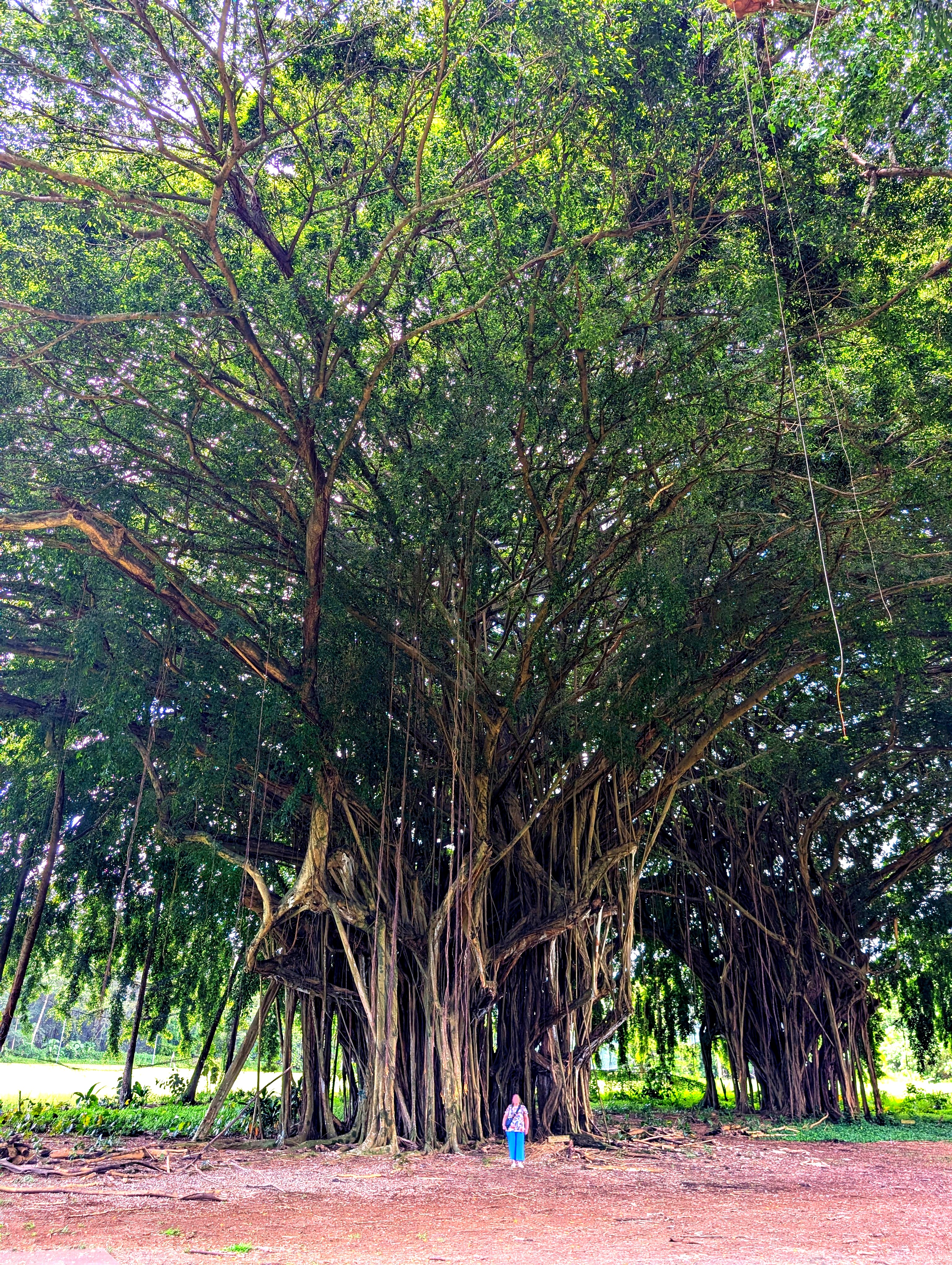
After touring the property, fencing forced us to the road in front of the hotel, Banyan Drive, so-called because 75-90 years ago a bunch of folks planted banyan trees to line it. Every time we drove in and out of the property we traveled Banyan Dr, making it one of the cool pieces of Hawai’i for me. Banyan trees are huge:
Typical banyan tree on Banyan Dr, Hilo, Big Island, HI. September 2024.
Our perambulations took us to a small park which culminated in Coconut Island, a spit of an island which took it in the teeth when a tsunami hit in 1960. (The somewhat famous Tsunami Clock is located nearby.) By now I had started cursing my brother who talked about the gloriously comfortable weather where humidity gets balanced by near-constant breezes. Our shirts were getting soaked. Temps were running close to 90 as the clock approached noon. As North Carolinians we’re very experienced with gray, overcast skies accompanying warm, humid conditions. We learned later this weather pattern wasn’t normal.
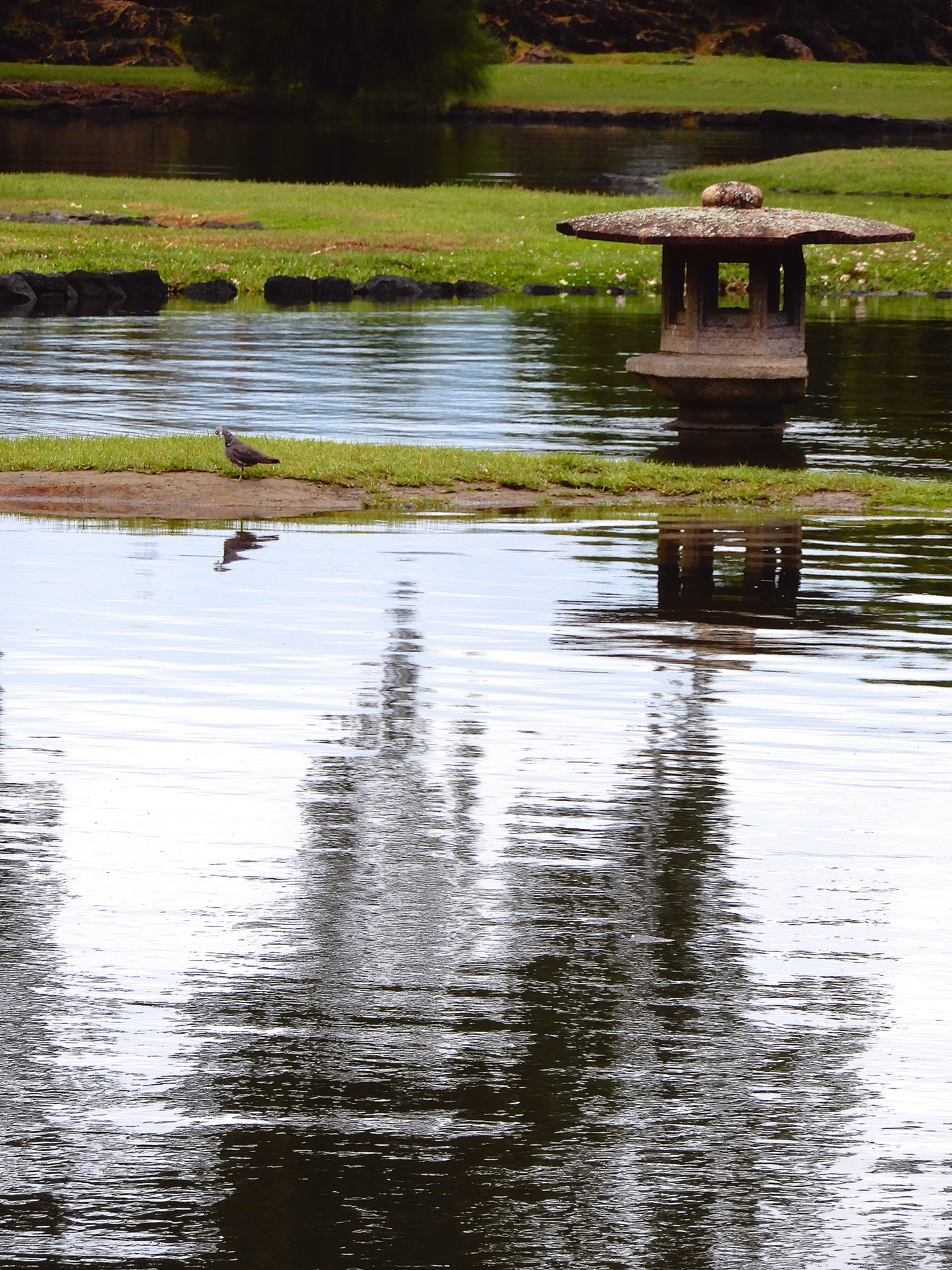
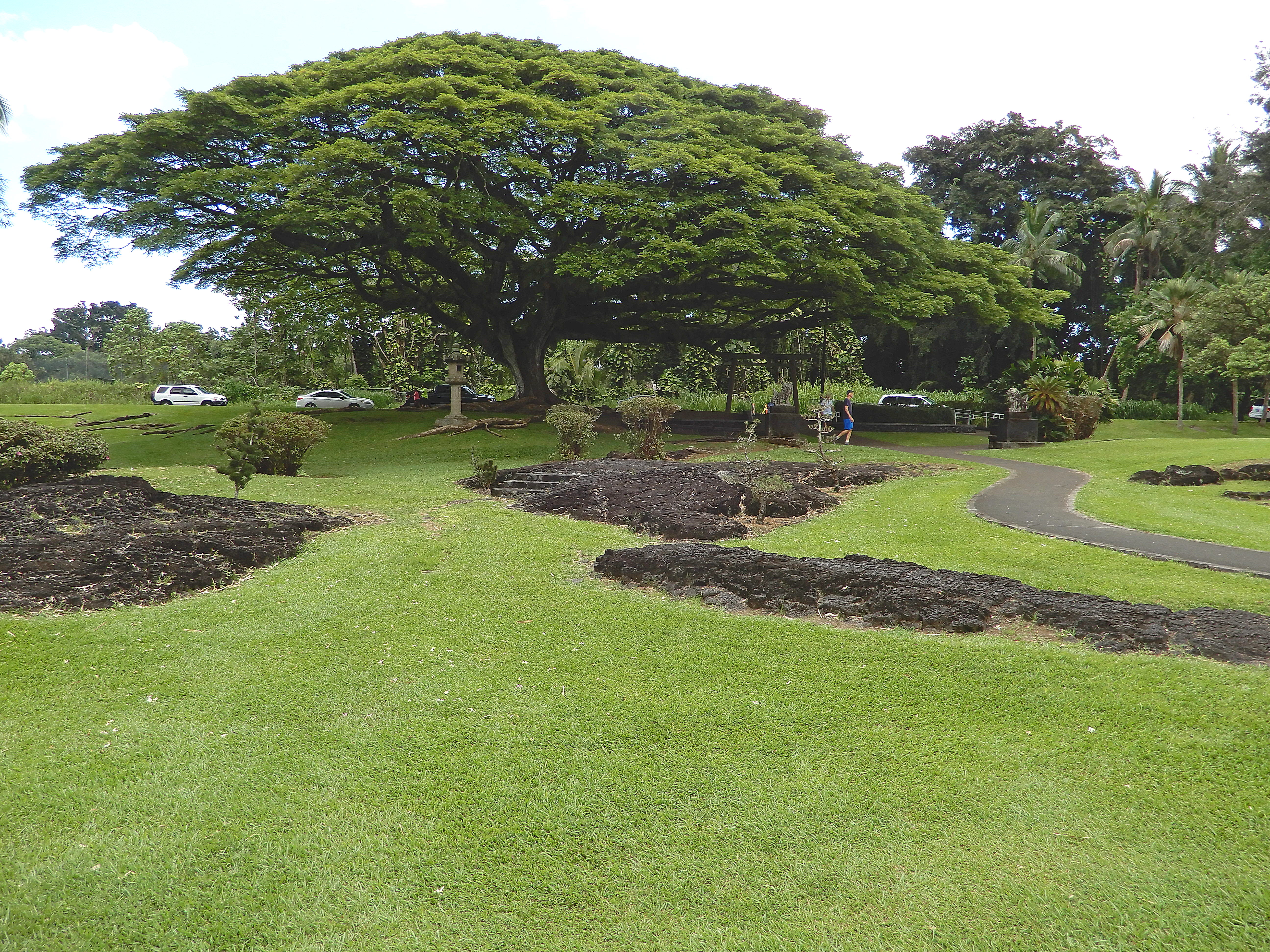
Our last stop consisted of wandering Lili’uokalani Gardens, a Japanese-style layout with plenty of Hawai’ian flora–at least I took it to be native. Who knows? Asking around later, I learned the park lies so low, so near Hilo Bay, that Waihonu Pond and other low-lying areas fill with extra water from the high tides. It prevented us from walking some of the paths.
At low tide one apparently can walk to and over this nice little Japanese-esque bride. Lili’uokalani Gardens. Hilo, Big Island, HI. September 2024.A Nene goose, Hawai’ian native. Lili’uokalani Gardens, Big Island, HI. September 2024.Yes, it really was that green. Lili’uokalani Gardens. Hilo, Big Island, HI. September 2024.
While meeting with a representative from the company which recently installed a natural front yard for us, we watched a red-shouldered hawk sitting in our white oak tree. It sat there five minutes, flew a small circle through the neighbor’s trees, and returned for another ten minutes. Unlike my usual luck–it flew that circle just as I returned with my phone–after it returned, it remained there so long I grabbed a half dozen photos, finished with the landscape rep, ran downstairs for my 50x zoom, and captured another couple shots on that camera. I’ve yet to download it.
I get confused between Cooper’s and Red-shouldered hawks, but noted that Cooper’s don’t have the mottled white pattern on the wings that this one does. Also, all those skreeeee’s I hear aren’t Cooper’s, according to Audubon. If that’s the case, most hawks I see around our little copse of trees are Red-shouldered.












 all the voices in my head