A meditation on death

Mission San Juan, San Antonio, TX. November 2021.

My friend’s mother died this week. These deaths of friends, relatives of friends, and famous people we’ve known of our entire adult lives, become more frequent as I march toward the end of my 60s. When they strike near, they strike deeply. I’ve been reminded of my mother’s passing in 2019 and to a lesser extent of my father’s passing in 2013. Then, thinking of my father’s death reminds me of my friend’s father passing about four and half years ago. In turn, I recall I became close to this friend of mine when a very close friend of his died much too young. One thing leads to another, then another. Memory isn’t so much a card catalog as it’s a word-association game.

Each recurrence resonates with those which came before. Though my personal losses do not gut-punch me anymore the way they did when they occurred, memory-tropes have become stronger through the ensuing years. More and more, very specific moments become the definition of the entire event. Other details fall away. My friend’s mother had fluid building up in her lungs. My mother had the same though caused by a cancerous tumor. When I learned about my friend’s mother this week and her symptoms, I also heard the watery sound of my mother’s lungs as she tried to draw her final breaths, like smoke burbling through a hookah. It wasn’t pleasant, then or now.

Deaths link up in my memory, each resonating the others. This day the bells of death sound across my entire life. My first memory of death occurred when I had just turned 14. My family vacationed to San Francisco where we drove through The Haight staring at hippies–“make sure your doors are locked, boys!” We also visited my great-grandmother lying on what she assured us was her deathbed. “I’ve run the good race, I’ve fought the good fight,” she proclaimed to Mom, her granddaughter. “Oh, don’t say that, Grandma!” my mother exclaimed which I thought odd since the old lady obviously lay at death’s door. (We lack so much tact in our early teens.) I remembered this because my friend’s mother remained lucid into her final hours, just as had my great-grandmother. My mother and father both were not, each of them passing in a morphine-laced state of unconsciousness. I remain grateful I didn’t have to encounter the attitude my mother did in San Francisco in 1968. Do you protest as a matter of good taste, as my mother did? Do you agree with the fading relative, thereby assuring yourself honorable mention in the Total Jerk Hall of Fame? Do you hesitate, mumble something neutral, and earn their scorn for your equivocation? Maybe it all goes well if you’re lucky.

My mother slowly lost her engagement with reality, not that her grasp had been firm. (I too suffer from that state, having one foot firmly planted in a hallucinatory land where reality exists somewhere between a fond memory and a meaningless joke.) We crossed a threshold in 2017 when Mom could not grasp why failing an eye test meant she could no longer have a driver’s license. “But I had just recently had eye surgery!” She remained convinced a simple form filled out by her doctor and sent to the DMV would straighten everything out. I think she didn’t give up hope so much as the matter just faded into the background. By the time she entered the hospital 18 months later, diagnosed with stage four breast cancer at 89, she couldn’t quite comprehend how she had gone from her daily existence to this state of affairs–never mind that her life at that point had become rely-on-strangers-for-meals-and-all-tasks. In truth she only changed venues and caretakers, swapping neighbors for nurses.

This disturbed me less than it may sound. When she fought to understand why her driver’s license had been suspended, my superficial exasperation papered over how my mother’s stance resonated with all of those memories where she also couldn’t understand the logical progression of bureaucracy in all its forms; when she cried because in attempting a sewing class exercise called Idiot’s Delight she couldn’t get it “to work” and felt she was worse than an idiot; and those myriad times when she couldn’t understand electro-mechanical issues, made all the more rich because her father had been an electrical engineer. Does it sound as if I mock my mother? Absolutely not! Love of the maternal wraps itself around what the maternal is, regardless of its logic, perseverance, emotive sustenance, or intellectual prowess. I loved my mother. Everything followed from that. The mother I loved, and what I loved about her, relied wholeheartedly upon her husband and in her final days upon my brother and me, but truthfully mostly on her neighbors since my brother lived hundreds and I thousands of miles away.

Bells from my father’s death ring different tones; they peal a melancholy chorus. He never outgrew being a preacher’s kid, a PK. He learned the social skills that most nomadic children do, those whose parent(s) are in the military and travel from base to base, those who follow their academician parents from university to university, and those like my father who moved from place to place as his father pursued Calling after Calling. His father was an American Baptist minister. My father experienced a couple of moves early in his life, but by 3 or 4 began a decade in the suburbs of Minneapolis. His family then moved to Havre, Montana, where my father spent all of his high school years. His graduation from high school in 1942 permitted but one short year in college before the United States Army came calling because of World War II. He served in the Quartermaster Corps, achieved the rank of Sergeant, and told us absolutely nothing else about it other than he apparently sailed back and forth across the Pacific. I learned later how dangerous those convoys were and the dangers he faced. His background is relevant here because it informs his passing.

Just as he hid from his war years, my father hid from the aspects of his personality which didn’t fit into the mold of being a PK, a devout Christian, of being the “perfect kid” (a different kind of PK). The monsters in his closet slipped out a few times during his life, most notably at the end of it: he retreated from the corporate track he was on and moved his family from Los Angeles back to Spokane, Washington, returning to the same job he had left less than 24 months previously; he quit that job because he couldn’t conform to the ethical stances of his peers (or was it just a midlife crisis?); and at the end, he fell into a crevasse of personal turmoil when as chair of the church finance committee he learned the church secretary had embezzled a substantial sum from a struggling church. This final trip to the dark side took place when he had marked 82+ years and the pall of it never lifted. Retirement makes us face the delightful dilemma of the retired: how much meaning must one instill into one’s life? How ‘permissible’ is it to just “take it easy,” “take it as it comes” or in essence to live in the moment when the moment requires nothing significant of you? My father seemed to have no issues with the relaxation of retirement until The Failure. After that, he could see no path out of his darkness, and it continued to haunt him until he died in the middle of his 88th year.

If I wander the aisles of memory’s storeroom where I’ve tucked so many things, I come across other deaths, less impactful but salient nonetheless. The Sunday School classmate who died of a brain tumor the year following my great-grandmother. The teaching friend of my first wife who lived longer than expected with her congenital heart defect. When young I found it more difficult to feel these deaths, to be sorrowful. I don’t know why. Youth? Failure to connect with these people? Perhaps the latter. Before the teaching friend, my father’s father died of a stroke in 1980. (I was going to write “massive stroke” but any stroke which strikes down a man in his mid-80s packs a wallop.) Despite the sorrow I felt at his death, my strongest memory from that time is of our very small family–his two sons, my father and my uncle; my four cousins with a spouse or two; and my mother and me–hanging out in a motel room reminiscing in what passed for a wake.

But as the 1980s closed out my remaining three grandparents died in successive years: my mother’s mother in 1988; my father’s mother in 1989; my mother’s father in 1990. My second strongest memory at my grandfather’s passing haunts me. Because it is of my grandmother, I don’t think of it right away when I think of his death. I think of it as a bridge memory to hers. I arrived early to my grandparent’s house but everyone had gone somewhere except my grandmother. I still can see her clearly, staring, staring into her backyard as the gentle rains of the Willamette River Valley fell. Lost in thought? In shock? Numb? A mixture perhaps. I’ve noticed no pattern to the reaction of the surviving spouse when they’ve lost their lifetime companion. My father’s mother had her emotional heart ripped out of her when her husband died. She never recovered. Soon she lived in assisted living because of a gentle dementia, and afterward suffered a stroke in 1983 or 1984. She then lived in a vegetative state for five years. My mother’s father also slowly lost the mental faculties which made him my grandfather. The final time I saw him he lay sleeping in the infirmary where he had lived for several years, even before his wife died.

I look at the memories of those last two deaths reluctantly. I do not handle hospitals and deathbeds well. I visited each of them only once. My grandmother ate and breathed with machines. My grandfather just hung on for no reason anyone could articulate. When I said “the final time I saw him” it also was my first time seeing him in the infirmary.

My mother’s mother died between these troubling deaths and the early one for my father’s father. Today I’m reminded more of her passing because like my friend’s mother, my grandmother passed in a lucid state albeit with a bit of morphine-induced hallucinations. (“Why do they allow cats in here, Louise?” she asked my mother toward the end.) Despite certain traits which lessened her as a Good Person, she and I connected throughout our lives. I mourned her more than the others, especially as I had matured by then and learned to cry. (I’m guessing that I cried when my final two grandparents passed, but I do not remember one way or another.)

All these peals from the bells of memory ring back when someone dies, more loudly when it is someone close such as my friend’s mother this week. I met her at least a half dozen times in her final five years. I see her legacy in my friend. I offer my support, I share his grief, I attempt to help where I can. What strikes to my core, however, isn’t this. It’s those resonant bells which call me back to the deaths in my family, to my loved ones. And, frankly, to my own and my wife’s which have yet to occur. What lies ahead for us? Will I meet it with dignity? Perhaps. Will I cry and moan and complain about my state in the world? Much more likely. Will I be aware I’m dying? Do I want to be aware? What if my wife goes first? How will I cope? I’m not a mentally strong person; I fear I will act as my father’s mother did and just withdraw from the world.

These bells ring across time’s arc from the past and into the future. They sound more frequently these days. They’re louder. They’re more insistent. I sometimes would like to ignore them, but that would be like ignoring the sun or perhaps more aptly, like closing one’s eyes while driving a car. Best to listen and maybe learn.

Mission San Francisco de la Espada Catholic Church, San Antonio, TX. November 2021.

thinkin’ Spring

Crocus (?) along the Little Spokane River. May 1972. Photographed with Honeywell Pentax SP500. Scanned from either negative or slide.

We’ve had several days of early spring-like weather. Despite all that assails one, sunny days like today lighten the heart and fill the soul with optimism. Sure we’re falling apart like a cheap toy and every famous person we liked as children seems to be dying, but just enjoying this moment beats not enjoying it.

17 years

Grafton, NY. January 2006.

Lately I’ve been thinking a lot about chunks of time. “How long do I have to live?” and “Where was I that many years ago?” and “At this stage of my life, a half century after graduating from high school, what did I think?” …and crap like that. The chunk that keeps coming up, though, is this one: 17 years ago we prepared to leave the snowy realms of upstate New York and head to North Carolina. A truly shit job and what should have been a wonderful company (and was for many others) had ended unceremoniously with a layoff. Less than three months later we were headed to what became the best dozen years or so of my working life, and ended with a pandemic and my retirement. Above, we’re about five minutes from leaving our home and never seeing it again. (I had to use the snow blower on the driveway that morning.)

A Facebook allegory

Imagine you live in a country. It’s larger than Lichtenstein, but smaller than America, lots smaller. Maybe something like Portugal or Austria even.  That’s significantly smaller than Texas. France is a bit smaller than Texas. We’re talking some country only a quarter or less of California. It’s still a country with cities and such–it would take quite a while to walk from one end to the other, especially if you stopped to talk to folks along the way.

Now suppose, in order to make it much, much easier for everyone in the country to talk to each other, all the sports fields–soccer pitches both professional and amateur, all the school yards, all of the parks–were converted into Talk Bubbles. A new technology. Inflated domes were put over these areas, shiny so you couldn’t see inside. Everyone could step inside the Bubble nearest them and talk to anyone…anyone, that is, who also had stepped inside a Bubble in their own locale. You didn’t even have to pay to walk inside your nearest Bubble; all you had to do was agree to wear a monitoring device which you were assured didn’t listen in “exactly” but parsed words it heard and relayed those words back to the folks who ran the Bubbles. Oh, and the device also relayed where you walked in the Bubble. That’s all. Easy-peasy, ever so sleazy. (woops, sorry about that).

You love it at first. Your job took you to Lisbon but look, right over there’s a handful of schoolmates from college, from that little village we loved so well (and so long ago)! And more, from your elementary school! You can just talk to them! Of course, as you walk over to them you have several persons intercept you and say things like, “Have you ever wondered about removing your ugly warts?” and “Let me tell you why you should never invest in stocks!” It’s annoying but you brush them off, basically just ignoring them and walking away.

Over time you start to wonder why the guy about the warts–or a woman; it’s not always the same person but the message is the same–keeps intercepting you no matter where you walk. You realize you once said to your friends, “Remember that song from when we were children, ‘Walter Wart, the Freaky Frog’?” (That’s a real song by the Thorndike Pickledish Choir; look it up.) Suddenly you realize you started seeing Wart Guy after you asked that question. Then you realize you’re starting to see that guy and his cohorts everywhere you walk. Even weirder, nameless folk come up to you and say things like, “Do you know Melissa Mickleberger? She’s over there.” Sometimes you do know Melissa, but sometimes Melissa is just some stranger. These interruptions occur a little more frequently now…plus your paranoia starts to grow, making it doubly annoying.

Later you find out the owners of the Bubbles actually are listening to what you say, and they’re selling that information. Never mind why, it’s too boring and scary all at the same time. What’s far more annoying to the point of effrontery seems to be occurring more and more: a contentious election approaches, and when you’re having a nice polite discussion with your friends, someone else walks up and screams “WHAT A COMPLETE IDIOT YOU ARE!”. Your friend just smiles and says, “Oh, don’t mind Roger, he just gets a little worked up is all.” Then pretty soon your friend starts saying to you, “You know, I’m not sure about that. My friend Roger says, ….” and then adds something so outlandish, you wonder what has happened to this friend of yours. If your friend and you were still in grade five, you would merely point out that Roger also wears his shirts backwards and the two of you would laugh, secure in the knowledge that you’re both still on the same friendship page, and Roger is a Very Peculiar Individual who shouldn’t be trusted to provide accurate, truthful, relevant information. Instead, when you cautiously query your friend privately, you find out she thinks Roger might be on to something. “After all, a lot of Roger’s friends are saying the same thing, and lately so are quite a few of my friends. You’re still my friend, aren’t you?”

Disturbingly, you’ve noticed your friendship now depends, at the very least, on tolerating Roger, and you can see the writing on the wall. Pretty soon you’ll have to agree with what Roger says if you want to remain friends. A friendship built on shared experience has become predicated on Belief and Opinion. You start to notice also that all of this friend’s friends say almost the exact same thing, much like a Twilight Zone episode or that Stepford Wives thing from a long time ago.

It finally comes to this: when you’re standing around as part of a circle of old high school chums–and frankly you don’t know a lot of them, but the ones you do know are all friends with the other ones, and hey, it was a big school–the topic turns political again. Strong opinions get stated, opinions you agree with. One person, though, says something not logical and all the others immediately say, “yeah! That’s right!” When you speak up to say, “well, but that’s not actually factual or logical” the group turns on you as if you were carrying typhoid or you had just molested a child or something equally reprehensible.

You walk to the Bubble’s exit. To the attendant there you state, “I am not coming back. You can take my name off of the list of approved entrants.” “Oh, no!” cries the attendant. “You can’t be serious! Are you sure you don’t want to just take a vacation from the Bubble?” You’ve taken vacations before so you say, “no, I don’t,” to which the attendant replies, sorrowfully, “well, okay, but any time you want to come back in, all you have to do is show up, say to the current attendant ‘just reactivate my Bubble Device’ and you can rejoin the Community!” The last phrase has a near-religious tone to it.

While walking the streets of Lisbon you begin to realize some things. Virtually all of those friends with whom you connected were not so important that you ever took time to look them up when you were in the home village. The few you talked to who weren’t historical friends–in other words, people you met in the Bubble–were people you only knew from limited conversation in the Bubble. You’ve had similarly engaging but shallow conversations in bars on a Thursday evening with strangers. Your friend who kept bringing Roger to the conversation had a habit of listening to and spreading outrageous gossip about teachers and students when she and you were classmates. You also realize your True Friends were those you stayed in contact with before the Bubbles. Though a few say they miss your presence in the Bubble, when they see you on the streets, you still see them, you still laugh/cry/argue with them. Nothing has changed; life still goes on outside the Bubble; the Bubble is not life or an approximation thereof.

And then it hits you: the Bubble has somehow focused, distilled, accentuated the tendencies we had before. It has connected the gossips from your early schooling with those of your university and those early co-workers. All of the people who annoyed you individually but in isolation as you grew up now have the ability to connect in the Bubble and reinforce each other’s message. They’ve grown in volume simply because they speak in unison. The promise of the Bubble–that we can connect and forge a more social and socially aware community–has produced just the opposite. People are meant to interact differently: anonymously sometimes, reservedly most of the time, and definitely more intermittently than in the Bubble.  In the Bubble people seem to talk as if they are in their cars where no one can hear what they’re saying. What the Bubble has produced then are people revealing the thoughts which just ought not to be revealed. Not that individuals should repress themselves, but any psychotherapist will likely confess they hear things which should remain between the patient and the therapist for the good of society, for the individual, and for the individual’s friends and social life.

After a few weeks you notice other, rival Bubbles have sprung up which you did not know about. You see that the people entering these Bubbles do not enter your former company’s Bubble. Far from encouraging societal discourse, you realize people have been splintered into non-communicating Bubbles built, not on ideology but on the corporate interests of those launching the bubbles. Still, you try one, thinking it might offer something a bit less manipulated than the first Bubble. It does, in a limited way, but none of the people you want to talk to are here. The Bubble itself is confusing. Soon, lacking patronage, this alternate Bubble shuts down.

You go back to the Bubble nearest you operated by the original Bubble company (OBC?). When you approach the door, the attendant gets ready to admit you but you say, “No, I want you to erase me from your lists. I want you to make it so I will never enter a Bubble of yours again. I want you to delete all of the information you’ve gathered about me. I frankly never want to enter a Bubble of yours again.” The attendant huffs and makes you sign some forms where you acknowledge you will lose all of the conversations you’ve ever had in the Bubble–to which you inwardly say, “oh thank God”–and then it’s done.

You walk away with a bounce in your step, knowing you will have True and Real conversations for the rest of your life.

yes, I posted this once before…but it was just a year ago, and this month got me thinking, and…

Quail

California quail in a white pine. Spokane, Washington, November 2019.

My mother loved the quail which started to appear in the backyard years after I had left home for good. I’ve never bothered to find out why deer and quail became so common in the past few decades. Loss of habitat as the city limits pushed further out? Seems backwards. Regardless, appear they did, more and more, until coveys could be observed daily running through the backyard, spring through fall. Smaller groups appeared in the winter. My mother just loved them. She purchased a small wooden carving of one.

My wife, Philadelphia-born and -bred, also loves quail. A city girl, any game bird interests her, but the cuteness and the comical mating calls of the males in spring really grabbed her fancy and held on.

When my mother died in the fall of 2019, and we settled out the belongings, I took a quiet satisfaction when she opted to snag the little wooden quail and place it on our mantel at home.

California quail, Spokane, Washington. January 2020.

The Essayist

Inadvertently, I have discovered I’ve always been meant to essay.

Today I pulled down a dozen issues of Granta, with the intent to pluck the issue I once received which had travel writing as a theme. This I would gift to my brother with whom I share a love of good travel writing: Paul Theroux, Bruce Chatwin, Bill Bryson, et al. Because these issues were from the 1980s, I reasoned, this would be a fun backwards look at writers we now respect, writers who were but beginning to be known at the time.

For those who remain unfamiliar with Granta, its existence since 1889 as an outlet for literary exploration has been a source of refreshment to us literati (of which I am only an acolyte). Founded by students at Cambridge University, the publication fell on hard times in the 1970s. It was acquired by postgrads and their friends and relaunched in 1979 as a quarterly publication. I subscribed somewhere around 1986 or 1987 and continued through 1990.

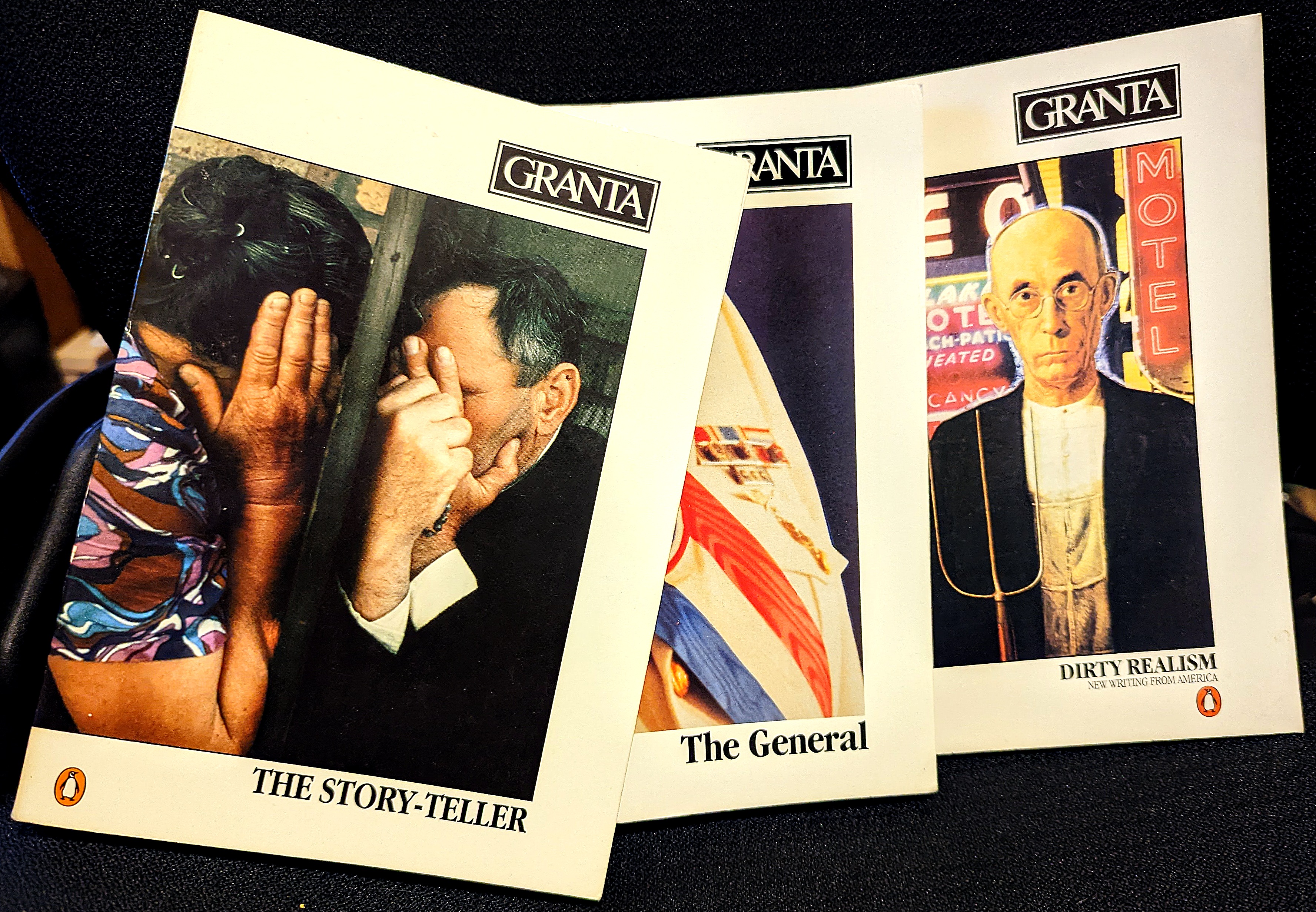
Some issues of Granta from the late 1980s. The authors in “The Story-Teller” are: John Berger, Michael Ignatieff (interviewing Bruce Chatwin), Bruce Chatwin, Ryszard Kapuscinski (plus an interview of him by Bill Buford), Richard Ford, Raymond Carver, Patrick Suskind, Isabel Allende, Oliver Sacks, Jonathan Schell, Vaclav Havel, Ian Jack, and Primo Levi. Astounding. 255pp.

In an oddly fortunate turn, I couldn’t find the issue I remember, “In Trouble Again” which featured a panoply of then-current travel writers. Perhaps I gave it to him already? No matter. It caused me to look through all of the issues I have, those from Spring 1987 to Spring 1990 plus an issue I think was a bonus for subscribing, volume #8 from 1983. (I believe the  issue I’m looking for was also a bonus issue.) In looking through all of my issues, which I have not since the early 1990s, I realized what fantastic writing it is. I want to read these pieces again, all of them. Here is Hanif Kureishi writing “With Your Tongue Down My Throat” back when he only was known for writing plays, and not many of those. Multiple issues feature Bruce Chatwin and Bill Bryson. Gabriel Garcia Marquez. Mario Vargas Llosa. Jay McInerney (Mr. “Bright Lights, Big City”). Ryszard Kapuscinski, wandering the world as a Polish communist. Salman Rushdie. And certainly I should but don’t recognize some of the other names out of the volumes I just pulled at random.

When I left off with Granta I instinctively turned to other sources of expository writing: Pushcart essay collections, books by Nicholson Baker (A Box Of Matches), Verlyn Klinkenborg (The Rural Life), Joan Didion (Slouching Towards Bethlehem), Annie Dillard (Pilgrim at Tinker Creek), and Making Waves, a collection of essays by Mario Vargas Llosa. I reveled in a large book purchased for $2 from a used bookstore in Hobart, New York, (population 400-something), The Art of the Personal Essay, an anthology of essays from the classical era to the present curated by Phillip Lopate.

From when I was 13 I fancied myself a writer. As I’ve detailed in other pieces, I beat my head against the wall of You Are A Writer Of Fiction. It has always appealed to me because you invent the stories out of your head. You don’t have to go research anything, you don’t have to be an expert, you don’t have to go interview people, you don’t have to do anything but be creative. I grew up, though, and learned that yes, you do need to do these things to be successful (i.e., make enough money to not starve).

Yet after I took this literary excursion I realized I have arrived where I always wanted to be. Essayists do not make special efforts to research so that they can write. They usually write out of experience, wisdom, and self-contained knowledge. They do not attempt to follow a structure to ‘hook’ the reader or create characters who will follow the inevitable crisis-obstacles-solution-redemption cycle which ‘guarantees’ success. They do not attempt to sway society through pithy and incisive novels commenting on the human condition. Essayists just write. They attempt to entertain themselves, yet write to a wider audience. They seek to illuminate an idea, a feeling, a place, a time, a memory, a person, and sometimes several of these at once. What they don’t do is attempt anything grand. In essence, they don’t “attempt” anything. They just write.

I’ve been bemused that after 15 months this site has yet to see one piece of fiction. I had thought to post short stories and micro-novellas here, but nothing has moved me to do so. I’ve just written, and what gets published has been poetry and essays. So be it. We write what we write.

Perhaps at an earlier age I would have attempted to force myself through other hoops. Practicing certain techniques, I might have become adept at it, enjoyed it, and then you would (maybe) be reading those works of fiction. It has not been thus. My entire writing life has been 99% expository writing: a journey of persuasion, reflection, explanation, instruction, and self-discovery. As Ursula Le Guinn wrote in A Wizard of Earthsea, “The truth is that as a man’s real power grows and his knowledge widens, ever the way he can follow grows narrower: until at last he chooses nothing but does only and wholly what he must do.”

My one-draft-and-done approach to college papers, my write-on-a-deadline life as a reporter makes it such that I must hold myself back from hitting the Publish button reflexively. What might be “good enough” isn’t usually good enough. I have an exhilarating freedom, however, in writing from my heart and my experience without worrying where the chips should fall. I guess I’m an essayist. There are worse things to be.

RP for the win!

This is about RP, whom I’ve mentioned before. It’s also about how attitude–sometimes called “clubhouse culture” in baseball–affects the championship possibilities of a team. Thus, it’s also a little bit about the 2022 Phillies.

RP nearly always had a smile on his face. You could call it RSF: Resting Smiling Face. He provided everyone with an example of how to be childlike–not childish but taking a delight in whatever life had to offer. He joined the district where I taught in 1983, the same year I did. I taught English to 13-year-olds. He taught Social Studies to these same students, which in most Washington school districts back then meant they received a healthy dose of United States history. I wish I could’ve taken it from him or at least sat in for a few sessions. It must have been entertaining, because he always entertained. When he didn’t find things entertaining enough he raised the entertainment level. To wit:

Toward the end of one school year our school held its annual Open House. Teachers prepped for Open Houses by putting their best visual foot forward–bulletin boards were spruced up, posters and other motivational aids adorned walls, and where possible certain subject matter teachers were allowed to create displays in our cafeteria (the only gathering space in the main building). These displays were typically science, home economics, or art related subjects, those which naturally produce something to look at.

This year our art teacher planned to display collages. Nearing retirement, he mostly mailed it in when it came to teaching. He had issues with his home life, also, which probably affected his abilities in the classroom. This apparently led to his lack of judgment when he allowed a couple of his students to make collages of photos torn from magazines, all of which featured naked women. None showed those “absolutely forbidden areas”, but they were torn from women’s magazines and primarily advertised such products as bath oils, shaving, and other products which would display a lot of skin.

Our staff learned about this one day as we lounged about the  faculty room immediately after students had been dismissed. Two of the younger teachers, both women and both outspoken feminists, marched in brandishing two questionable collages and demanded, “What the hell, B—-! You can’t put up stuff like this!” Turning to our principal they implored her to “do something”. Most of us stood there, seeking the mild entertainment level or clucking a bit disapprovingly to stay on the Right Side of Things. Not RP. Not enough entertainment for him. He and I were standing in the doorway to the faculty room when he took a half step back so that I obscured him from the others. Leaning closer to me, he whispered, “watch this.” He wiped the ever-present smile from his face to look serious and stepped into the room.

“Well, really, I mean, I don’t see what’s so bad about it.” That’s all he said. It was like throwing a match onto a pool of gasoline. The two young women turned around so fast I’m surprised they didn’t pull a muscle. They raised their already loud voices to screeching level. “What’s wrong with you! You can’t see how inappropriate this is? I can’t believe it! We can’t display this to the parents.” One of them went so far as to impugn him because he was a coach: “Well I guess coaching all the time you wouldn’t understand!”

Sure it was momentary, but it provided both him and me a great deal of entertainment. More importantly, RP didn’t care what they thought of him at that moment, nor that he immediately wound up on the wrong side of a couple of the more conservative members of the staff. Heck, even I thought it was inappropriate to display something like that to parents because we were sure to be attacked for letting their precious little children be exposed to that…never mind that 13-year-olds are about the most oversexed beings on the face of the planet.

RP encountered several of us in the faculty room another time as April 15th neared. All Americans know this day better as Tax Day since that is the deadline for submitting our annual tax returns detailing how accurate our tax withholding had been during the previous calendar year. Many people play with their withholding levels, artificially lowering them to have more money in each paycheck, or artificially raising them to guarantee a refund. As Tax Day nears, the latter like to provoke the former by asking the former things like, “I’m only getting back a thousand dollars this year–how ’bout you?” 

Both strategies are short-sighted. Over-withholding means letting the government hold onto your money, interest-free for up to a year. Under-withholding represents the epicurean approach, living large in the present, and ignoring the bill which comes due in the future. RP shared my belief that one shouldn’t seek either a large refund or pay a large tax bill, but instead should seek to pay a very small amount: this guaranteed that an appropriate level of your own money stayed in your pocket paycheck to paycheck, the government didn’t get to hold onto it any longer than legally necessary, and your tax bill remained easily affordable.

RP, however, had his own twist to taxes. He listened a bit to a couple co-workers complain about how much they owed, and said, “I never pay very much. I just decide how much I think is fair for me to pay and just work my taxes backward from there.” For a moment you could hear the ticking of the clock on the wall. Several jaws hung slack. Soon several rushed to educate him about how wrong he was. By this time I had learned more about RP and just leaned against the wall, amused. Did he really do his taxes that way? I didn’t know, and I didn’t care. He had highjacked the conversation from its annual woe-is-you-and-I’m-so-great theme. He yet again provided entertainment.

Perhaps RP just felt one should envision what one wants and then go get it. He certainly encountered this every year when he coached high school sports. In the fall he played his part on the coaching staff for the football team. (American-style.) He must have chafed under someone else’s coaching style, because I knew his philosophy and that it diametrically opposed the current head coach’s. Our district had the lowest student population of all the districts in our athletic league. This is a serious thing for football: the team fields 11 players at a time, and one usually trots out different players for defense than for offense. When special situations come up (extra point attempts, kickoffs, etc.), one would like to send out at least a few special teams players. Small districts just don’t have the turnout to field teams of this size. Some players play both offense and defense. They tire. The team can’t perform by the final minutes in a game. They lose.

Come basketball season our district should have excelled. Basketball lends itself to small schools as Gonzaga University, Creighton, Xavier and others can attest. RP helped coach football, a boys sport, but in the basketball season he took over as head coach for the girls basketball team. Those girls teams did quite well under his guidance. Our boys? Not so much. RP got most of those boys when he served as the head coach for baseball season in the spring.

“Pilcher, it just sucks,” he said to me enough times it’s been burned into my memory cells. “Our district is so small we’ve got the same boys playing football, basketball, and baseball. By the time I get them, they’re convinced they’re losers. Hell, this year they didn’t win any games in football and only one in basketball. They actually started chanting on the bus after a football loss ‘WE SUCK!’

“I get them and spend the first half of the season convincing them they can win. Teach them the right way to play. We play twenty games each season. This year we went oh-and-ten the first half of the season and ten-and-oh the second half. If I could just get those boys before they’re convinced they’re losers!”

In professional sports, but particularly in baseball, there’s a term thrown about by fans, sportswriters, players, just about everyone: clubhouse culture. It’s indefinable and unmeasurable which means the statisticians don’t like it. It’s difficult to discount, though. Teams such as the 2003 Florida Marlins, the 1993 Phillies, the 2004 Boston Red Sox, and yes, the 2022 Phillies will attest to what it means when it seems they captured lightning in a bottle. Repeatedly they cite the team camaraderie and other factors which allowed them to play relaxed, to the best of their abilities. RP would be saying, “hell yeah!”

In 2018 the Phillies–I told you this would be about them sooner or later–were supposed to be “better”. In the parlance of fans, that means “we’re going to have a winning season and maybe contend for the playoffs.” Up and comer Aaron Nola had been pitching for three years for a cumulative Earned Run Average of 3.94, and Rhys Hoskins had debuted in 2017, hitting 18 home runs in just 212 plate appearances. The team boasted a number of stars-in-the-making: catcher Jorge Alfaro, third baseman Maikel Franco, centerfielder Odubel Herrera, and rightfielder Aaron Altherr. Several other players looked promising, as did the pitching staff, and the team had a proven first baseman (Carlos Santana…no, not that one). Things looked bright. Hoskins, a natural first baseman was shoved into left field where hitters go to watch balls die somewhere not near to where they’re standing. Things looked good on paper, but the games are played on grass, and the Phillies finished 80-82. This vastly bettered 2017’s record of 66-96, but wasn’t the winning season everyone expected.

In 2019, therefore, when the team signed superstar Bryce Harper to a contract whose value would allow more than two hundred families to retire comfortably, fans got hopeful. They traded that young stud catcher Alfaro for a proven commodity, J. T. Realmuto. They ditched Santana and put Hoskins at first. They snagged Andrew McCutchen, a five-time All-Star and National League Most Valuable Player in 2013, and they traded a surefire prospective shortstop (J. P. Crawford) to the Seattle Mariners for Jean Segura. Sure the new manager from 2017, Gabe Kapler, seemed to be an idiot, but he got better during 2017, didn’t he? This team looked like it was “going places”. Where it went was one win better than 2018, 81-81. Kapler got fired because …you have to blame somebody or it’s going to be your fault isn’t it Mister General Manager (Matt Klentak). Former Yankee great as both player and manager, Joe Girardi, took over managing the team.

Everyone got a pass in 2020. Well, everyone but Matt Klentak.  To fill in a better option at shortstop, the Phillies had signed Did Gregorius, hoping he could regain the star statistics he had displayed through 2018. Segura moved to second base. A rookie third baseman, Alec Bohm, showed up and hit a bunch. The team finished 28-32 in the pandemic-shortened season, two games under .500, a backwards direction from the previous year. Worse, the postseason field was expanded to reflect that the 60-game season couldn’t sort out teams like a 162-game would. The Phillies, had they just played to .500 ball as they did in 2019, would have been in the postseason. GM Klentak had no one left to blame, and out the door he went.

Enter Dave Dombrowski. He exhibited patience. He pushed a few prospects to manager Joe Girardi’s dugout but spent 2021 figuring things out. A lot of “stupid money” had been spent but the team had underachieved by a lot. Players arrived to the major league team unprepared to fit in. Worse, Girardi seemed to have a short leash with these players, seemingly saying, “hey, the minors are supposed to prepare these guys!” At the end of 2021 the Phillies tried to make the most out of the fact they went 82-80, the first actual winning season since the juggernaut 2011 team won 102 games. But c’mon–one more win than the dissatisfying 2019 team? Really?

Let’s bring it back to RP and clubhouse culture. Here’s the point: Dombrowski made sweeping moves regarding the scouting and player development systems, changes which will eventually prove to be more important than his signings and trades for 2022. Most impressively he signed Kyle Schwarber, not just because he smacks a lot of home runs but because he walks into a clubhouse and pulls it together into a cohesive unit. The Phillies aren’t in the World Series this year without him. And they aren’t in the World Series if Dombrowski doesn’t fire Girardi on June 3rd. Yankee Joe remains an admirable player/manager, but he wasn’t the right fit for this baseball club. Looking back at it, no one ever wanted to mold the franchise into the Yankees, and that’s all Joe really knew. He expected certain things his players could not, would not deliver.

Ultimately clubhouse culture, attitude, atmosphere–whatever you want to call it–rests with the guy at the top. For the players in the clubhouse, that’s the manager in the dugout. Dombrowski’s most important move was putting even-keeled Rob Thomson in charge. (RP, anybody?) Secondly, putting Kyle Schwarber in the clubhouse. His batting drove in 94 runs; the team scored 747 runs in the season. That means Schwarber was responsible for 12.5% of the runs scored. It would take more math than I want to perform to compare his plate appearances against total plate appearances for the Phillies, but considering all the “extra” guys who play because of substitutions, filling in for injured players, and giving guys a breather, it’s significant Schwarber could manage one-eighth of all the team’s runs. But remember, it’s the clubhouse attitude which sets Schwarber apart.

As RP would say, “Hell, Pilcher, Schwarbs thinks the team can win on any given day! It’s like having a second manager in the clubhouse!” (By the way: it was RP who nicknamed me “Pilchbo” which has stuck for these 40 years.)

write me poetry (wriggling fish eludes grasp)

"Write me poems,"
she said. "Not that
sonnet, rondeau
crap. Make it formed,
but not formal.
Make it happy,
poignant, heartfelt."

Whew! Tall order.
How to commit
to words which don't
bring despair, don't 
touch my psyche's 
crackling third rail?
'formed, not formal'?

Wrapped around my
neutrality
entwine serpents
of dark, of light,
yet both truthful.
One favors pain,
despair, sadness.

Countering, its
mirror favors
hopeful, joyous
optimism.
But it whispers--
'gainst its brother--
screams less, asks more.

"Everything's great!"
doesn't cut it.
Good news--no news.
Seismic shifts, stabs
to my heart grab
more attention
than goody-ness.

Problems add edge,
life's hoppy bite,
offsetting its 
malty sweetness.
But she challenged!
Can happiness
inspire poems?

My life-garden
hosts tangled plants,
gnarled, tall, choking
new growth. Little
shoots blossom up
regardless, and...
Something happens.

My ultimate
Gardener, my
concept of God
nurtures sprouts, brings
forth fresh flowers
striving to vie
with woody growths.

Despite these new 
optimistic 
upstarts, my soul's
garden remains
wild: poison vines,
weeds, burrs, thorns. No
apologies.

Who am I to
question what grows,
what does not? Why
question my lived 
reality, 
denigrate my 
totality?

Are we happy
now? Are we mired
in hopelessness?
Do we focus 
on pretty new
blossoms? Do we
ignore the whole?

Without yin there's
no yang. Without
black, white on white.
Speak to truth no
matter its source.
Shuffle the deck;
deal ALL its cards.

Thirteen sevens
multiplies two
potent numbers,
magical yet
at odds with each
other. She will
appreciate [this].

Development of a Phan

[Warning: hyperlinks to Wikipedia articles actually go to Wikiwand which mirrors the site and provides a much lovelier interface. If you don’t want to go there–don’t click the hyperlink.]

I love baseball.  Sure, I might catch a few games when Gonzaga University’s basketball teams (a hometown darling) tweak the noses of the big universities yet again in March Madness. I might watch the Kentucky Derby, just because my mother and her mother always did. There’s a chance I’ll watch 30 minutes of professional American football–and of course, the Super Bowl is a great excuse for culinary excess, beer, and oh, those commercials! But baseball has captured me with its elegance, mystery, nuance, precision, intelligence, definability, and history. It has mirrored my life, informing it. In return, Life has given me a greater appreciation for the game.

When you’re a fan….you buy merchandise!

Baseball transcends simple sport. It rewards fans who can appreciate nuance and bores fans who cannot. It combines the cerebral approach of chess with occasional, all-pieces-in-motion excitement like that of soccer (football), basketball, or hockey. But before a ball is put in play, baseball proceeds at a pace where the informed fan can appreciate where fielders position themselves for this pitch, how the batter might greet that selfsame pitch, and then allows one to thoroughly examine how the pitcher delivers that pitch from the windup through the catcher’s reception of it.

In childhood, I thought I liked following sports. Given the perspective of age, I realized sports photography grabbed me more than the sports themselves. The first years of the 70’s swept away these shallow roots. Sports, associated with conformism and militarism back then, fell from my favor. I read books about rockets, aliens, sexual revolution, wizards, hobbits, and crazed soldiers in various wars and psychiatric wards. We marched against The War, watched women burn bras, contemplated world peace–surely just around the corner once The Revolution occurred–and contemplated global annihilation “if we failed”. I indulged my enjoyment of competition by watching my brother run competitively. I stayed in touch with athletics when I volunteered to be a manager for the wrestling and track teams because it freed me from the otherwise compulsory attendance in physical education classes.

I attended no football games in college nor any other sport. I jumped into the Real World as a reporter/editor of a weekly newspaper, photographing the local high school’s various sports for a half hour or so, then leaving because my boss told me to: “Don’t let them get used to thinking you’re going to cover the whole of anything.”

I left newspapering, earned another degree, this time in English Education, and sought employment as a secondary teacher of English. Inexperienced teachers without the desire to coach a sport were not in high demand. It took nearly a year to get a steady job, and even then it occurred only because the principal of the junior high and its head teacher, both on the hiring committee, argued that my potential in the classroom outweighed my lack of interest in coaching.

At the same time I was hired, the school district also hired my (somewhat) opposite: a two-sport coach with no compunctions about taking on a third sport. He taught social studies (that would basically be history for you non-Americans). The district placed him at my junior high school; I taught beside him nearly all nine of my teaching years. This teacher, RP, opened my eyes to several things. First, he was intelligent, and frankly, that was not the stereotype of the typical small town sports coach. Many of the coaches did their best to perpetuate the stereotype of the dumb jock: I won’t relate all of the stories about GG because even reducing the name to initials doesn’t adequately hide who it was. Suffice to say he thought he looked good with all those gold chains hanging around his neck.

RP however perked up when I bragged about never being defeated at Trivial Pursuit and said, “Oh ho, Pilcher, I’ll take that bet!” It wasn’t a bet, but the next time we had a staff party, there we both were. I can’t remember his status, but I was three and half sheets to the wind–I played better drunk because then I didn’t overthink. I would guess he either was sober or had sampled just a few light beers. Oddly, I can’t remember who won, which means he probably did. We both acknowledged the other as a worthy intellectual opponent. RP was “a character” but that part of him will be a writing topic for another day. What he did for me occurred in 1989 when he touted the business advantage of investing in baseball cards. I can’t believe in persons not knowing what these are, but I can conceive it. Therefore for the ignorant: baseball cards are (to quote Wikipedia) “a type of trading card relating to baseball, usually printed on cardboard, silk, or plastic….Baseball card production peaked in the late 1980s.” (More about their history here.)

Oh, and did it peak. For a dollar or two one could buy a pack of cards which might have one card in it worth tens or even hundreds of dollars due to the crazed demand. Baseball cards were the Bitcoin of their time; it was like the lottery for little kids and speculators both.

Baseball cards with the magic of their beautiful photography capturing a moment of baseball prowess rekindled my love of sports photography. The cards also sparked an interest in the game. Soon I had purchased George F. Will’s just-published book Men At Work: The Craft of Baseball, still one of the finest books written for understanding the nuances of the game. I gobbled it up when a vicious virus laid me out for a few days at home.

Just three years later, I chucked teaching to indulge my fantasy of writing, and I moved to Philadelphia. I arrived at the right time to fan my beginning baseball interests, which could not be indulged in out-of-the-way Colville, Washington, tucked near the borders with Canada and Idaho. There I had no team to follow, to cheer on. Seattle’s team, the Mariners, established in 1977 while I still attended the University of Washington, played badly and in 1990-1992 it still played badly. Besides, 300 miles with an intervening mountain range dampens one’s feeling for “your local team”.

Ah, but Philadelphia possessed a major league baseball team, and not just that, one of the very first, established in 1883! It had a sad history of losing, mostly, including 1992, the year I arrived. But the year after I arrived in Philly, the team that finished 1992 in last place captured magic and found themselves in the playoffs. (Amphetamines are strongly suspected, but hey, let’s not besmirch some loveable characters.) I raced out to buy a new color TV to replace my 20-year-old one. I cheered. I shouted.  Macho Row rewarded me by playing all the way to the World Series…where a walk-off home run by Toronto’s Joe Carter in Game 6 clinched the championship for Toronto. It was a three-run homer served up by the closer, Mitch “Wild Thing” Williams. Sorry, non-baseball fans, but I’m not going to explain all the rules and terms–suffice to say a homer run (“homer”) is not good if the other team gets one. Ahead by one run at the time, the Phillies lost the game by two. There is no bigger gut-punch in sports than to be two outs away from winning a game only to serve up a home run which not only ends the game with a loss for your team but also wins the championship for your opponent. To this day, nearly 30 years later, just sit in the Phillies’ ballpark and mutter “that damn Joe Carter.” You will have instant friends, bonding over the shared pain.

I fell deeply in love with the Phillies that year. They burned their brand into my hide, injected their drug into my veins, played their Lucy-holding-the-football to my Charlie Brown. My journey to true fandom started there. I’m glad I didn’t know what a fluke that 1993 season was: the next year Macho Row reverted to its 1992 form, sitting fourth out of the five teams in the National League East when the Major League Baseball Players Association mercifully went on strike, ending the season in August.

From 1994 through 2000 I did what fans do: I followed games; I read about them in the Philadelphia press (aided by the newly introduced World Wide Web); I watched the few games I could, aided by satellite TV; and the Phillies slowly, slowly indoctrinated me about the customs and mores of fandom. One cannot usually make a living as a fan: I drifted into “real” work when the writing thing went bust, writing business reports in pharmaceutical manufacturing. Just as with the Phillies and baseball, I learned most of the basics and some the nuances about my new career.

By 2001 the Phillies had installed their third manager since the magic of 1993. From this lesson of sport, I learned life’s employment situations are ephemeral. In 1997, recently married, I had carted my bride back to my hometown in eastern Washington State. (You always have to add the word “state” for anyone born in the northeastern United States; otherwise they assume you mean the nation’s capital.) Now in 2001, I looked nationwide, found a job in upstate New York, and we moved back into the same time zone as our beloved Phillies.

Promises, promises: for four years the Phillies promised more than they delivered. Maybe I believed their press too much. A typical day started with me connecting the computer to the internet via a dial-up connection. (squeek, squarl, kweeeeeeeee-quchchchchchchchch) I would open each Phillies story in the Philadelphia Inquirer in a separate browser window. This would take time to load, so I’d start making the morning lattes. About the time I had steamed and frothed the milk, I would cycle through those browser windows, hitting “print” each time. This gave me time to pull the espresso and complete the lattes. Then my wife and I would settle before breakfast, me reading the latest stories about the Phillies.

By 2004 I realized I was a square peg in a round hole where I was working. I saw too that many in baseball might be the right guy but with the wrong team. I looked for a new job, and the Phillies looked for a new manager. They succeeded; I did not. In 2005 Charlie Manuel assumed control of those on-field decisions. After that season ended, I learned that my services were no longer needed where I worked–a layoff included me. Luckily I already had lined up an interview which led to a new state, a better job, etc., etc.

And in 2006 things looked up. My wife and I learned we should have been living in the South of the United States many years before we actually got there. The Phillies dumped their general manager at the same time and brought in Pat Gillick, a guy with a proven track record of winning. He predicted they would contend in 2008. He was right, although in 2007 the Phillies made every fan salivate when they managed to get to the postseason–only to get bounced immediately by the Colorado Rockies in a three-game sweep.

In 2007 my employment decision turned. The FDA responded to reports about our company site and showed up to perform a “for cause” inspection. These never end well. We received a Warning Letter to shape up or else. By 2008 a workforce of about 125 had experienced 17 firings and a half dozen more left voluntarily. I labored through this as the Phillies in 2008 trailed the Mets heading through August, just as they had in 2007. And just like 2007, the Mets graciously choked by playing 22-17 to the Phillies’ 27-12. It wasn’t as dramatic as 2007, but the teams had been close. By dropping six of their final nine games, the Mets finished three games behind the Phillies.

Then wonder of wonders, the Phillies rode that magic carpet all the way to the World Series and beat the Tampa Bay Rays for the championship…and in the middle of the Series, I accepted a new job to escape my own version of a losing season.

Pat Gillick resigned, mission accomplished. For the rest of my life as a corporate lackey–as a new, less-promising GM took over–the Phillies performed well but slid backward step by painful step. In 2009 they won more games than 2008 and returned to the World Series but lost to the New York Yankees. In 2010 they won even more games than 2009 and lost to the San Francisco Giants in the NL Championship Series–no World Series trip that year. In 2011 they assembled a wonder team and won 102 games. A troubling sign, however, occurred in early September. The team’s victories pointed to it setting a club record for total wins, but beginning on September 11th, the team finished 8-12. They played a spirited Division Series with the St. Louis Cardinal, going all five games, but in the final inning of the final Game 5, their star first baseman, Ryan Howard, sprinted toward first base and tore his Achilles tendon halfway there. You can’t run without an Achilles tendon. Just like that, the “run” was over. Philadelphia didn’t return to the postseason until this year (2022).

In 2012 the Phillies’ GM thought he could retool in a minor way and get further in the postseason. Unlike the Phillies, I realized retooling my career was not an option–I had cycled through three different roles for my current employer and none were good. My cog-in-the-machine job would get me nowhere.  Embarking on eight years of consulting, I learned to evaluate organizations by looking at various companies in stress. (Companies rarely call consultants when things are going well). I could see the same signs of dysfunction in the Phillies too. The team spent 2012 and 2013 denying they had a deep problem, similar to my clients who wanted the superficial blemishes covered up rather than healing the causes for them. By 2014 the well-meaning ineptitude of the Phillies (symbolized by the GM who had run the team since the beginning of 2009) became apparent. They were stuck in one gear, spinning their tires in the mud. I too was stuck in the mud of an absolutely terrible employment assignment. It convinced me at the beginning of 2015 to seek a different contract agency, just as the Phillies chose to dump their GM at the end of the 2015 season.

My career cycled through good and bad, but the bad beat the best days of “regular” employment. Consulting let me dive fulltime into analytics–clients loved it. And the Phillies dove into analytics too. Their new GM, Matt Klentak, hired around the same time, unfortunately didn’t know what the heck he was doing–a perfect example of having a good concept without knowing how to make it happen. After stumbling along with the manager he inherited (Pete Mackanin), he hired an analytics fanboy in Gabe Kapler for the 2017 season. Kapler also didn’t know what he was doing–he’d never managed a team before. As the team entered the spring training portion of the season, I completed a 15-month assignment which reinforced that I had the chops to hang with “the big boys” in my industry. I had learned novel approaches to problems can sometimes clear a logjam of we-can’t-do-that problems. Unfortunately for the Phillies, it worked for me but not for them. Kapler made amazingly boneheaded decisions, learning on the job so that he could move on to the San Francisco Giants and earn Manager of the Year in 2021.

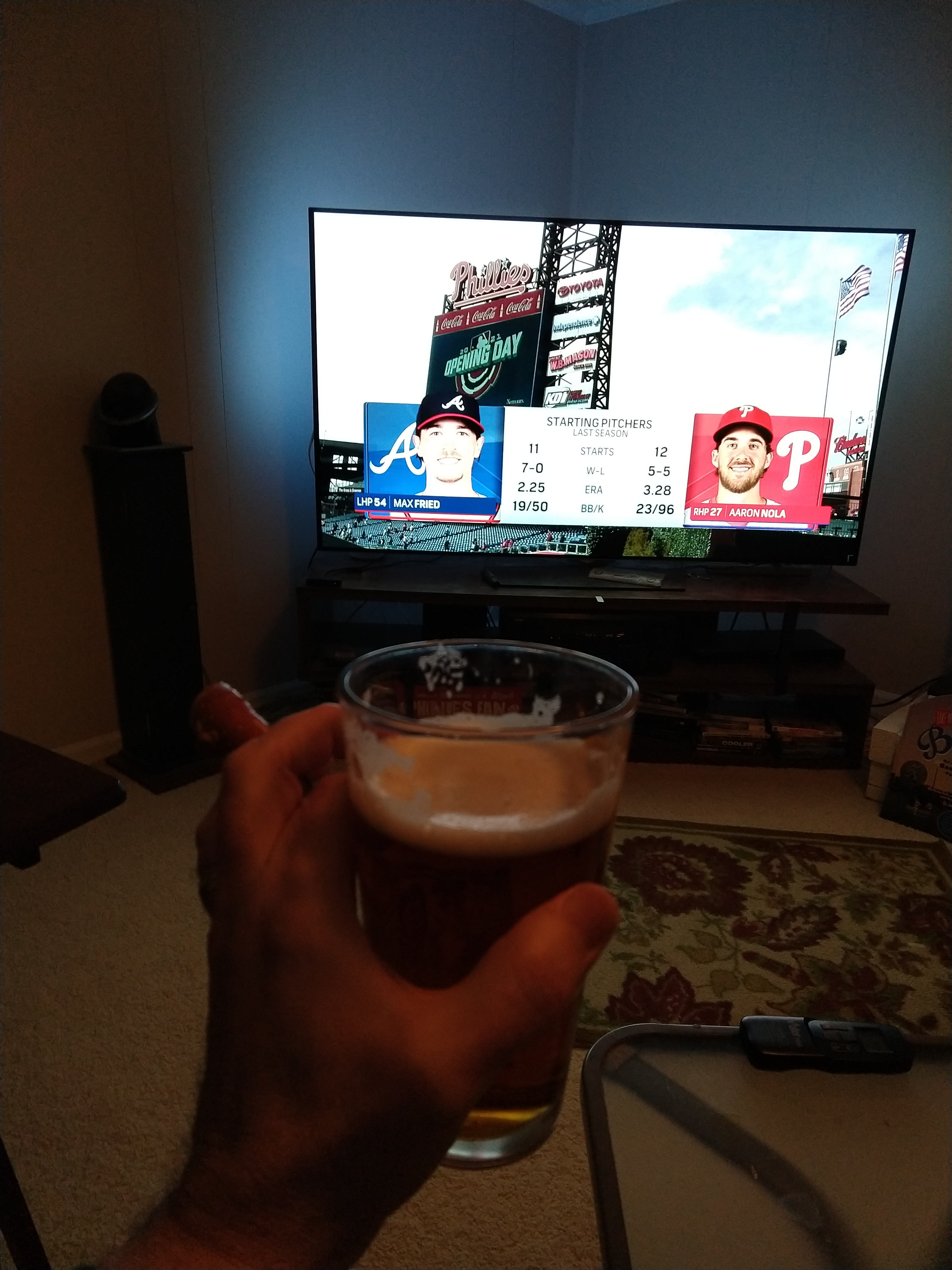
Opening Day, 2021.

By that time, I had learned hiring solid performers and the occasional superstar would quickly pull a damaged company out of the spiral which led to the sewer of “thanks for trying”. Similarly, the Phillies signed Bryce Harper, Jean Segura, and J. T. Realmuto prior to the 2019 season. But the Phillies managed an 81-81 record, missing a winning season yet again, and Kapler was out.

Everything changed in 2020, and I don’t mean the pandemic. My mother died at the end of the 2019 postseason. The Phillies hired Joe Girardi the day she died. Less than two months later the Phillies hired a new GM, Dave Dombrowski. Saddled with a new manager, Dombrowski decided to figure it out before making wholesale changes. And then came 2020, the year everything was upside down.

I retired at the end of 2019. No need to work: my final years of work built a bit of financial comfort and my inheritance took care of the rest. Baseball might as well not have happened in 2020 (but we’re glad it did). In 2021, Dombrowski began to evaluate the team in earnest. At the end of that season he made sweeping changes, some of which will be felt for years. He dumped everyone in charge of player development. He reorganized things. He hired a new hitting coach, the same one who had been successful in Washington, D.C., where Bryce Harper had played.

And then he signed a slugging All-Star, Kyle Schwarber. And then he signed Nick Castellanos. Suddenly the Phillies looked (potentially) good. At the same time, the psychic blows of having the final parent die combined with the bunker mentality of the pandemic lessened. At the end of 2021 “free movement about the country” seemed even more possible. The few trips taken in 2021 seemed to be a promise of things to come. And then came 2022.

If anything, 2022 should go down as the unsatisfactory second act to 2021. Covid still scourges. Free movement about the country didn’t translate to free movement about the world. And the Phillies started the baseball season 22-27, a sad commentary on the talent assembled during the offseason by Dombrowski. And then came a “miracle” for Phillies fans. The Philadelphia had come to be known as a very loyal organization to its top employees over the past 50 years. Managers, GM’s, and presidents weren’t “fired”–they were “reassigned to special advisor” status. But on June 3rd of 2022, the Phillies fired manager Joe Girardi.

Seasons can transcend one’s existence. Throughout this piece I’ve attempted to draw a comparison to my personal life, just as all sports fans attempt to relate the performance of ‘their’ team to their own existence. There is no comparison in my life to what the Phillies have done this year. After firing Girardi less than a week before my birthday, they’ve played relaxed and more importantly, they’ve played winning. They’ve parleyed that from a barely-in-the-playoffs third wildcard seed to a berth in the National League Championship Series which starts tomorrow.

I don’t know if most persons can trace an arc to their lives through the ups and downs of a professional sports team. I do. But nothing compares to this year. This team shouldn’t have succeeded after being an afterthought one-third of the way through the season. Even after they played their way into serious consideration for a wildcard berth, no one with a modicum of sanity thought they would contend beyond the very first round. Instead they’ve quickly vanquished the St. Louis Cardinals in the Wild Card round, and dumped the Atlanta Braves with little difficulty.

All bets are off in retirement. You become a bystander without a distinct connection to society’s day-to-day rhythms. Though you have 40-50 years of experience, few value it. Thus, the Phillies and I part ways a little bit. Will I still thrill to their success? Absolutely! Will they do things which more and more mystify me? Very probably. My father-in-law remains a Phillies fan. He’s been one all of his 90-year-old life. He decries the “new” approach of taking walks instead of swinging (something which is now at least 25 years old). He complains about the superimposed box which shows the strike zone when a pitch comes in.

I look forward to being the recalcitrant fan he is.

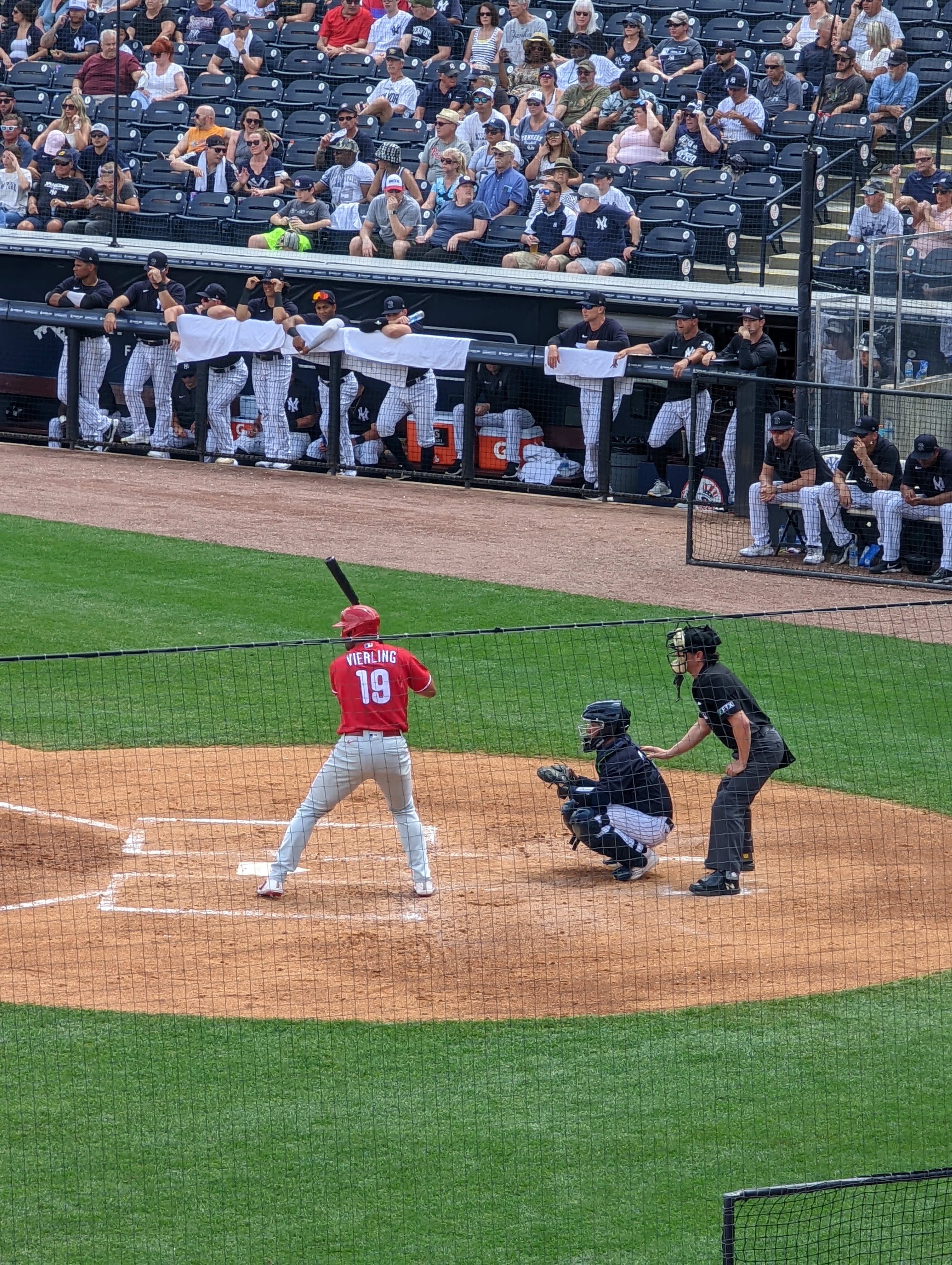
Matt Vierling in Spring Training, 2022. Tampa, FL.