Shriveling expectations

Small, shriveled golden oyster mushrooms. September 2023.

When I converted an old, seldom-used blog into this one, I envisioned a writing outlet and ‘daily’ blog combination. After all, I’d just canceled Facebook for reasons too obvious and previously stated. I figured my need to communicate, to shout into the gale winds of social media would inevitably fill this site up with lots and lots of pithy writing punctuating my daily doin’s. It’s now time to admit something about getting older I had witnessed but not from this side of the divide, so to speak: that driving urge to make something happen and accomplish something fades. Some of this is good. Recently I’ve reflected on my typical mindset four years ago when I juggled weekly trips across the continent to San Diego and Seattle from my Raleigh home, monthly visits to attend to my ailing mother in Spokane, and to arrange her final rites in October. (I ended it all with an audit performed in Toronto…in rainy November weather. Yay.) I barely recognize the person who kept multiple itineraries in his head, who could tell you which airports had which kiosks at which intervals, who had a set and efficient routine for unpacking and packing a suitcase, who parleyed sarcastic cynicism into a business persona, and who grabbed beers and food as time allowed. I wish I could convey the inner pressure which led others to give me wide berth at times, but which seemed to be crucial to my survival. But now…

Hard to thrill,
Nothing really moves me anymore.

from “Hard To Thrill” by Eric Clapton/John Mayer, performed by Clapton & J.J. Cale on The Road To Escondido

When Covid partnered with retirement to give me a crash course in inactivity, I reverted to a boyhood prototype: read; pursue an idea as it blossomed; eat; drink; repeat. But don’t call me lazy. I bristle at being called lazy. “Inside my head I’m more active than you’ll ever be,” I think. (We’ll leave to another day what steps I took to slow down and/or turn off the voices in my head.) I learned early that giving voice to my stream of consciousness at speed guaranteed a fairly quick response: “oh god, would you PLEASE JUST SHUT UP!” (Well, I somewhat learned it. I’ve received refresher courses throughout the ensuing 50 years.) Example from a coastal drive during this past week’s visit from a lifelong friend: “There’s a Free Will Baptist Church…not to be confused with a movie about orcas…and definitely Free Willy shouldn’t be confused with that series of pornographic films.” I think I saw heads spin in the car. Did I mention I liked Robin Williams because he delivered comedy at a speed I could appreciate?

All of this by way of explaining my consternation at noting only three or four posts in the past six weeks. Remove the writer’s conceit of a Virtual Vacation and I’ve posted little in the past three or four months. No promises, but I’m headed into a (slightly) more optimistic future in October. In mid-month I’m looking at two periods in the month which hold a dozen days of solitude–a gift to a loner like me.

Our shriveled photo at the top represents a failure at growing a beautiful blooming of golden oyster mushrooms. I was promised a gorgeous cluster, maybe two or three from a kit I purchased in early August. It should have looked like this…ah but that would be stealing someone else’s photo. Let’s just say it would be ten times bigger than the clump in the photo above.

Instead, nothing happened within the 10-14 days it should have. I gifted a friend with the same kind of mushroom kit, and he started a week ahead of me. He didn’t reach harvest until about day 19 or 20, so I held on. About three weeks in, I finally got some growth where it shouldn’t have occurred and it consisted of two distinct clusters which both looked like the picture at the top of this post. It’s an accurate symbol of my shriveled hopes these days. The vendor came through though and sent me a new block which arrived Friday. I started it Sunday, and noted I had not followed instructions–imagine that. This time I made the required shallow incision in the mycelium-impregnated starter block as specified. Stay tuned.

It’s possible that the advent of Oktoberfest with its namesake beer has contributed to some of the lassitude I feel. Or…others…. I’m still polishing off some representatives from the Michigan trip in July. (Though not representative of the state: it’s where I found North Coast Brewing’s Old Rasputin, an imperial stout that drinks like a cross between beer, chocolate, and coffee, all without any additions. Good stuff, but potent. Two of these babies and you’re more than halfway through a typical six-pack.)

The glass is mightier than the sword…particularly when the glasses gang up on the pen.

September saw a few happenings. We got to know our new steel steed, Percy Pilcher:

Percy Pilcher, aviator extraordinaire!

We set out at the end of August to replace Mr. Lincoln, a 2015 Lincoln MKC and a beautiful realization of automotive vision, but who had become a bit outdated, frustrating, and tired after eight years. “A hybrid, dear,” I told my wife. “That’s what we need. And probably a minivan, though I’m loath to admit those words. We need the cargo room.” We went shopping. Hybrid Toyota Sierras would be available six to eight months–if we pre-ordered. Chrysler Pacificas looked cheap, even at the so-called high end of the model spectrum. The others were DOA, and so…we headed back to the Lincoln dealership where we were treated like returning royalty. No hybrid Aviators? There’s a familiar song. A ‘pre-owned’ model? (Hmm. Weren’t those called “used” not long ago? I think I’m differently opinionated!) Sure. And that’s how we wound up with a current-year Aviator which was returned after five months because the purchasers just loved the vehicle they had traded in, so they bought another one and used this one to cover the cost. Their disappointment was our gain. We bought a vehicle with less than one year’s mileage on it, looks sharp, has all the features we wanted, and…it’s a Lincoln. When I woke up from the euphoria, though, I realized we had purchased another gas combustion engine and that it had 25% worse gas mileage than what we had traded in! Ah, no matter. For now Percy is our new Aviator. Why Percy? Because Percy Pilcher, a relative for sure–there aren’t many Pilchers in the world–achieved quite a bit of notoriety as an inventor and aviator, and likely would’ve bested the Wright brothers at the first to fly a heavier-than-air aircraft if he hadn’t been killed right before attempting it. If you click through to that link, the photograph of him looks similar to my grandfather, the Rev. Howard B. Pilcher, enough that he could’ve been a cousin. I’ve not done much with genealogy, so I’ve no idea how close the relationship is.

Tuesday marked the beginning of a month of travel, both us and others. Or more specifically, both my wife and others. I’m not going anywhere. In my teen years I became acquainted with a guy who later became a good and close friend. Throughout junior and senior high I knew who he was, saw him in groups, but not until I dropped out of college after my freshman year in 1973 did I start working at a Spokane hospital where he also worked. We started hanging out, and because I had become just a little more “normal” we connected. Though diametrically different, we became friends. He was the best man at my first wedding in 1983. We fell into and out of touch, but by 1990 we had renewed it for good. I moved away, and he served in the wedding party for my second wedding. (It was only fair. I participated in multiple weddings for him. Perhaps I’ll tell that tale later.) This past week represented the second time he visited us in Raleigh; the first occurred only because he had followed a woman to Florida in 2009. Had that not happened….but that’s also another story.

This week my brother visits for the first time in over a year. When he leaves a week later, one of my wife’s triplet sisters drops in the next day to pick up my wife and continue to Florida where she (my sister-in-law, not my wife) will look for her retirement home. When that’s done my wife and I will enjoy a whole seven days all by ourselves before she takes off again with a group of friends called The Biker Chicks (though my wife has never ridden a hog or any other type of motorcycle that I am aware of). Finally, as October bows itself out with Hallowe’en, and All Saints and All Souls ushers us into November, I will settle into a sedate period of enjoying my life with my wife. I really don’t need much else. She lets me be to sit here and write these screeds, matches me drink for drink and recipe for recipe, creates handcrafted art in a panoply of media, and joins me in a love of good video, good music, and good times.

What could be better? It’s why I sometimes don’t post here regularly. I’m having too much fun.

Edisto

Sunset at Edisto, SC. October 2014.

In 2014 we vacationed to Edisto Beach, an off-the-beaten path resort area in South Carolina. I was over a year into the Job from Hell (as it has been known to my wife and me). Though this vacation started on some bad notes, Edisto worked its magic. I returned refreshed by a simpler time spent walking, staring at scenes like this, and strolling to one of the dining/drinking establishments at dinner. Sometimes one just doesn’t know until one knows. (“How profound,” says the Editor drily. “Been smokin’ that ganja again, boy?”)

When we lost Lokisson

photo by -geo

We watched, sadly horrified
when little human-things
took down Lokisson--one fine
oak with humors unusual.
"I lean over their rock-paths,
put down by these silly
human-things: they look up
fearful, ignorant of my
deep-rooted stability."
He would laugh at his humor.
If only he were stable 
as his roots! No.
Humor's ultimate end:
fearful, weak-full, they attack
first. Angry, snarling chainsaws 
bit from all sides, ganged up,
velociraptors hunting
arboreal prey. We knew 
their type from so long ago.
Elephant-bellows issued
from metal contraptions which
looked vaguely tree-like, screaming
their masters' fears skyward, their
cries sometimes oddly resembling 
bugling elks we heard in times
before. Lokisson's beautiful
limbs disappeared first, fed
into hungry maws, exiting
pulverized to bits. Metal 
sheets rang thunder to our sky.
Then...section by section...his
segments fell, crashing, loudly
cutting off his jokes forever.
We cannot laugh through our hurt,
perhaps won't for many seasons.

For two days afterward our
living sky cried and grumbled.

Virtual vacation: Day 13

I love rock and roll. (Put another dime in the jukebox, baby.) For years I’ve wanted to visit the Rock and Roll Hall of Fame in Cleveland, and on Day 13 we did just that. I selected a hotel downtown specifically to be near Progressive Field where the Guardians play baseball. On this day our boys, the Phightin’ Phillies of Philadelphia, would open a three-game series against the Guardians and we planned to be there. Having a hotel which was more or less across the street from the park satisfied my first requirement, and offered an extra perk: one mile straight north from the hotel sits the Hall of Fame.

Obviously a popular photo spot–this was the fewest number of persons between me and the sign! Rock and Roll Hall of Fame, Cleveland, OH. July 2023.

We both liked the Hall despite the thick crowd of people everywhere. I felt let down, though. I’ve been to the Baseball Hall of Fame several times, and to the Country Music Hall of Fame and Museum in Nashville, and both of these establishments have a more formal visual presentation which leads to a better understanding of the subject matter. I had a great time remembering the various decades of popular music (the RnR Hall uses the term “rock and roll” quite loosely), smiling as songs from big names (Rolling Stones) and small (Link Wray, early pioneers in the 50’s) blasted out of the speakers in front of each display case. The Hall does a great job explaining the antecedents of rock, and it dwells on early stars with entertaining and memorable videos which loop back to the beginning when completed. This last feature facilitates watching the video as soon as you see it; you’ll pick up the beginning sooner or later. Several displays, however, were mystifyingly not connected to other areas to which they chronologically belonged.

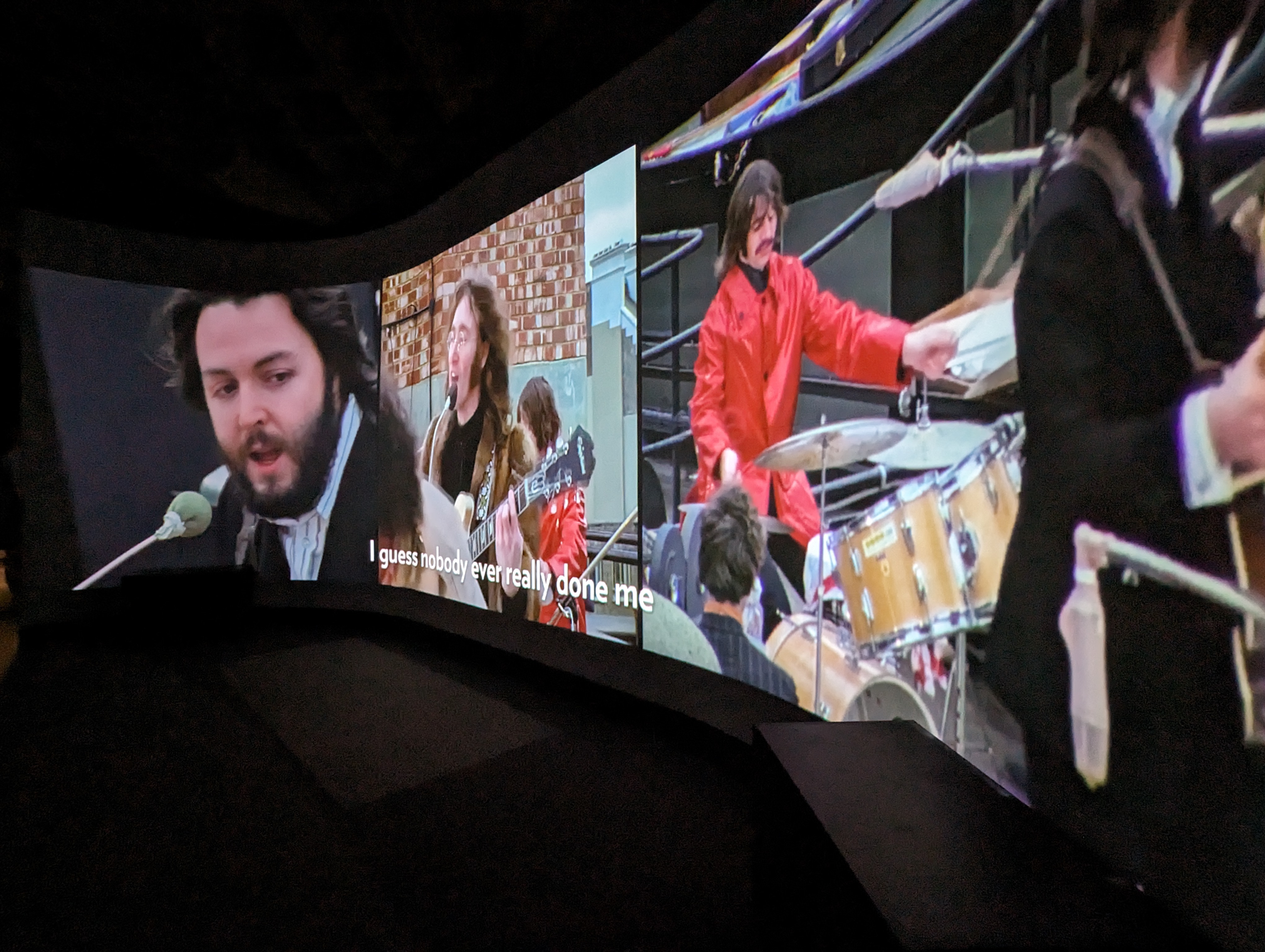
One of the special exhibits featured Peter Jackson’s The Beatles: Get Back in a multimedia curved display. No one stopped me from taking photos, so…

Of course signature instruments, clothes, and miscellaneous items jam the displays: an electric guitar used by Howlin’ Wolf at the beginning of his career, a 1952 Kay K-161; one of Gregg Allman’s organs with a Jaimoe kick drum and a guitar from brother Duane; a large window display with many items each for quite a few signature acts, such as The Faces.

If you go, be sure to go all the way to the top. Each floor in the Hall gets successively smaller–look at the shape in the photo above. At the top a small room featured short films on four acts. My memory should be better than this…one was Nine Inch Nails… Alas, the others have escaped my porous memory cells. Too bad because I do remember eagerly awaiting a film up there, and it wasn’t NIN. Ah! A second film featured Quicksilver Messenger Service. This leaves two including the one I wish I could remember…

We returned in mid-afternoon, snapping photos along the way and prepped for our early dinner and the true highlight of the day: the Phillies meeting the Guardians. A decent dinner later we walked the one block to the field, presented our ticket QR codes….and heard the dreaded “ANCK” all scanners seem to produce these days when they can’t electronically parse the information they’ve just reviewed. One more try, one more ANCK and the ticketmeister said,

“Oh, these tickets are for tomorrow.” I’m going to need quite a bit of time to expunge from my memory the shock and sadness I saw on my wife’s face. We walked back to the hotel, a lot more slowly on the return than on the approach. As a consolation, the hotel’s TV featured the regional sports network which carried the game that night. While the game started I crunched some numbers: if I canceled the hotel for Day 14 and added one more night to our stay in Cleveland it would increase our vacation lodging expenses by over $350, the cost for one night when the Guardians were playing at home. The other hotel room was on points; no money saved there. In addition, we would have a nine-hour drive on Day 15 to get home, not something we like doing on a vacation. Alternatively we could stay out on the road another night, incurring one day’s additional expense for the cat sitter plus the $350+ for the room, plus the extra food we’d need to eat. We didn’t take long to decide to resell the tickets on SeatGeek. Two weeks on the road is enough these days, perhaps a function of my flying weekly to locations all over America during the final five years of my working life. SeatGeek rubbed some vinegar into the wound when we realized less than 50% the original price of the tickets.

I still can’t figure out how I managed to buy tickets for the wrong day. On the MLB website for each team, the game calendar features large squares just like a printed calendar. Difficult to believe I clicked the one furthest right (representing Saturday) instead of the one next to it. Unless I had a brain fart….did I momentarily think we were going to the game on Saturday? No matter; done is done. This was to be our only Phillies game for 2023, though. [insert crying emojis].

We drank a bit extra that night–and the Phillies lost in a dispirited contest, although Bryce Harper played first base for the first time in his MLB career and made a fantastic catch into the photographer’s area.

Howlin’ Wolf, play a sad song for me. Rock and Roll Hall of Fame, Cleveland, OH. July 2023.

Virtual vacation, Day 11: coda

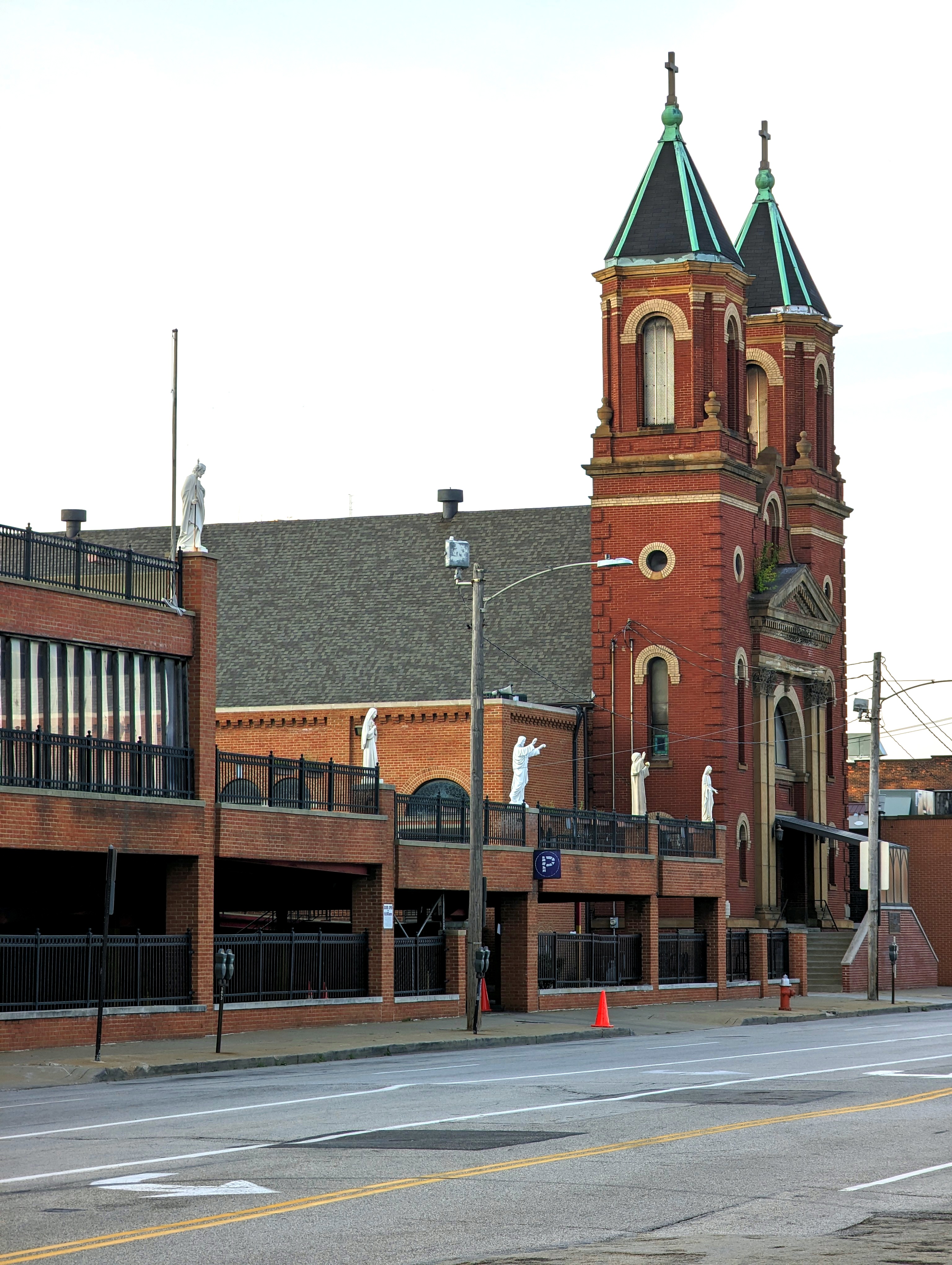
St. Maron Church, Cleveland, OH. July 2023.

Returning from dinner the day we arrived in Cleveland, I noticed statues of what I took to be saints on top of a parking garage across the street from our hotel. As I followed the line of statuary eastward, I saw that the parking garage must serve a church since the statues continued up to there. I snapped one of the lesser photos of my life, then went inside to look up the name: Saint Maron Church. Thus do we learn new things.

Saint Maron lived in the 300’s AD, a Syriac Christian hermit monk in the Tarsus Mountains. His followers established a religious movement after he died, and this movement became known as the Syriac Maronite Church. This church is in full communion with the Holy See (the Vatican) and the Catholic Church. From my readings it’s debated whether the Syriac church ever left the communion, but it’s definitely in communion now. This makes them my religious family since I’m a Roman Catholic. The Maronites are part of the Eastern Churches, what we loosely call Orthodox churches. There are six traditions in the Catholic Church; one is called Latin, what most Americans think of when they hear the word “Catholic”. Maronites were re-established after Islamic rule by the Greek Orthodox Church of Antioch, hence the official name Antiochene Syriac Maronite Church. Today its parishioners are primarily Lebanese, with smaller amounts of Syrians, Cypriots, Israelis, and Jordanians.

Huh!

Measuring the inevitable

Lake Quinault, WA. August 2017.

I’ve been pondering (to quote one of my new favorite bloggers) that I stand on the threshold of 70 and I’ve only 10-15 years of travel left in me. This starkly scares me. I usually figure two or three significant times of travel per year. Twenty to forty-five seems like a goodly amount, but it’s that lower end that makes me wonder: if I’ve only 20 trips left, and I want to go to Europe more than once, to Hawaii, to places in the USA, to just experience certain periods of unfettered wandering…how much is left in me?

It’s funny. You think for much of your life, “hey, there’s plenty of time for that,” because you’re 35 or 45 and decades stretch out before you. Then you get up toward retirement, and frankly you’re just thinking about that retirement. There are a lot of channels to negotiate to retire: income when you’re not working, riding herd on the expenses, and the projects you always thought you’d do but you just didn’t have the time or the money to do them. You negotiate that when suddenly a little global pandemic kinda s-t-r-e-t-c-h-e-s that whole process out. When the world comes to, everyone removes their masks (assuming they were wearing them in the first place), and you realize, “crap, I’m almost 70. How much time is there?”

This clarifies things but in a brutal way. When someone comes at you with a knife, your options suddenly are VERY focused. When life comes at you with a knife…… Didn’t the Fates snip a man’s life thread and end it?

Foggy starts

Fog at the mouth of the Columbia River sets a standard for fog. Fog defines where Oregon and Washington share its outlet to the Pacific. It also defined my nascent and up-to-then non-existent career as I drove to Ilwaco, WA, and my second job interview of that early weekend in December 1977.

Car-less at that point of my life, my folks loaned me a 1968 Ford Galaxie 500. Though only nine years old, one could see already why it had been handed down. I piloted this coffin on wheels toward the southwestern tip of Washington through a typically drizzly early winter day in the western part of the state. “Man, talk about wet!” I muttered. At the same time I thought this, I drove my 1968 Ford Galaxie 500 into a fog bank. Until that point of my life–all 23 years of it–I don’t think I had ever realized what the phrase “bank of fog” meant. Within 100 yards I drove from a gray, drizzly day into a shroud of bright nothingness. I could barely make out the highway signs along the shoulder of the road.

How had I gotten here?

Simple. In mid-December 1977 I found myself in imminent need of a job. The University of Washington School of Communications planned to foist me on society with a degree. I had trained, in a mediocre fashion, for a job as a reporter. I realized I wouldn’t get any top-tier jobs at the dailies of Washington State, Idaho, Oregon, and I wasn’t plugged into destinations further away. (No Internet, no networking skills, no time spent learning about how to get jobs pretty much anywhere.) The state association of independent weekly newspaper publishers had to do. For one thing, the association headquartered itself in Seattle just a couple miles from the University campus. I figured, correctly as it turned out, they would be desperate (in a relative sense). Our corner of the US hadn’t experienced the stagflation of the Carter Administration, and talented graduates don’t seek jobs with weekly newspapers. Neither do most graduates want to head to the hinterlands to report about social teas, high school sports, and local city council meetings. It sounded easier, and I was all about easy, then and now.

Shortly after finishing my final final, I traveled to my parents’ home in Spokane. Once there, I gorged on home cooking, spoke to them as little as possible, and grabbed their old Ford for some serious job hunting.

My first stop that early December weekend was in Moses Lake, afairly strange place if you’re from outside of the state. To us it merely offered a respite in the cross-state drive. I met a married couple who owned and managed two newspapers. One was a weekly in Ritzville, WA, which is a small farming-oriented community at the northern edge of the Palouse wheatfields where it enjoys a location on the main east-west corridor through the state, I-90. They also published a paper in Cle Elum, but I do not remember if it was the Miner Echo or the Northern Kittitas County Tribune. I tend to think it was the former.

The owners were salt-of-the-earth, don’t-give-me-shit small business owners in a small community, a class of person I soon was to become deeply knowledgeable about. They didn’t make the job sound attractive. And they offered $125 a week. (Keep that figure in mind.) I told them I was interviewing elsewhere, and I would let them know. Notice they offered me a job on the spot. My alarm was sounding, but not loudly: I had kinda figured this wouldn’t be extremely difficult. A theme of my life to that point, and for a goodly part of my life from thereafter, was to flow into the path of least resistance.

This was a Saturday. I continued after the interview to drive westward, arriving at my dorm sometime in the late afternoon. (What a “thrill” to park a car in the student garage like all the kids that had more money than I did!) On Sunday I got myself up at a non-student, responsible hour, got in the car again, and headed to Ilwaco where an interview at the Chinook Observer awaited me.

My encounter with the fog bank said, “Welcome to Ilwaco.” It continued, growing more dense as I got into town. I found the office and parked outside. Upon knocking on the door, I was met by a pasty-complexioned man who owned the paper. He seemed ill at ease, hesitant, insecure. I immediately wondered how a man could own a weekly newspaper, the klaxon of any community, the polestar of community ire, and have a personality like this. We had a milquetoast interview and he offered me my second job in two days, also at $125/week. He seemed upset when I said I already had one offer on the table and another interview pending.

The Skykomish River near Monroe, WA, at dawn. There is a river there. And trees on the far bank. Almost as foggy as the mouth of the Columbia River near Ilwaco. Sometime in 1979 or 1980.

On Tuesday two days later I headed to Monroe, WA. Only 15 miles east of Everett and about 30 miles from my dorm in Seattle, Monroe was the gateway to the North Cascades via US Highway 2. Tuesdays, I learned later, was publication day which meant that the paper was being “put to bed” while I interviewed with the owner. I omit his name in case I say something which might get me in trouble.

This interview started out weird and stayed weird. The antithesis of the Ilwaco publisher faced me. He’d served as motorcycle courier in World War II in Europe, and he carried that hard-bitten attitude with him. He revered John Wayne. He kept Cutty Sark in his desk drawer. He ended the interview thusly: “So…I can start you at $150 per week. When can you start?” I trotted out my now-practiced “well-I-have-other-offers-on-the-table” speech and he said, “Well, call them and tell them you’ve accepted this position!” I was caught off guard. He asked, “Do you want this job or not?” I thought (quickly) about $25 more per week. He was offering $7800 per year. In 1977 more than 25% of Americans earned less than this. I was young. Earning less than the median American ($13,572) didn’t sound that awful. I would be working as a reporter. I told him yes, I would give those others a call. He said:

“We’ve got phones, I’ve got an extra office. You can call from there.”

So I wound up on a Tuesday in mid-December sitting in what was definitely not an office but more a glorified cube (and would soon become my cube), calling the other two publishers and telling them that I had accepted an offer elsewhere.

Because we were at this point looking at the issue which would come out right before Christmas, we agreed it would make the most sense for me to arrive right after Christmas and start work on Monday the 27th. I got in the old Ford Galaxie, drove to my dorm, cleaned it out, and drove to Spokane. I celebrated Christmas with my family, including my brother, home from a separate university in the state.

On Sunday the 26th I drove across the state for the fourth time that month, the old Galaxie towing a U-Haul trailer with all my possessions. I got to my mother’s childhood home in Seattle very late afternoon, when it was dark. There my grandparents bequeathed me a chair and some other odds and ends, some of which–like the chair–I own to this day, more than 40 years later. I pulled into the parking lot for the Monroe Motel later that evening, checked in, and reported to work the next morning.

Fog defines my entire job interviewing process and my newspaper work thereafter. I’d no idea what I really wanted to do other than write. I couldn’t discern which job sounded better until the last publisher just plain told me. I stumbled through my first year until I managed to trust that all those empty inches would somehow be filled by Deadline Day. Less than four years later I drifted into something else.

We are not called

Cannonballs at the Tryon Palace, New Bern, NC. May 2009.

or, “To all who run toward the open field”

Not all are called to priesthood;
...to teach,
...to heal,
...to defend,
...to right wrongs,
...to lead,
...to agitate,
...to write
The Great American Novel.

Some of us pursue
not purpose but
meaning in being,
in "job well done",
in talents exercised,
in immediate
gratification for
problems solved,
purposes fulfilled, in
greasing wheels for
others, serving those
we do not know to
accomplish what we also
do not know. To add one 
rock to the pyramid
being built by us all.

The Joyful Quitter

Hello, I’m Ken, and I’m a quitter.

This isn’t the opening to a 12-step, I’m-so-ashamed program. The act of quitting bandages the abrasions earned by scraping your metaphorical knees as you learn what you shouldn’t do. Bandages shouldn’t be applied unnecessarily; so too don’t apply quitting without need. At best it looks stupid; at worst, it hampers your movement, just as an elaborate bandage hobbles you and can lead to permanent restriction.

We’re conditioned to abhor quitting. “Don’t be a quitter!” and “Winners never quit and quitters never win!” But what if you’re not in the right contest? Quitters may never win, but the untalented never win either, and there is no shame in realizing you’re in the wrong game: a five-foot body isn’t going to cut it in the NBA.

I’ve quit many a race. I regret few. I much more regret the months and months of anguishing about whether I should quit as I languished in a situation going nowhere. After the fact, I realized that I perversely reversed the thinking process, making the decision (without consciously acknowledging it) then searching for a rationalization to get to it.

Quitting can force itself on you. What blessed relief when something like an emergency appendectomy absolves you of all personal responsibility! Just lie there and let others administer to you! Or maybe a Tyrant-Disguised-As-Your-New-Boss suddenly makes the exit look exceedingly attractive. Or the ultimate quit occurs–your significant other stabs your heart by quitting the relationship. Take a moment to cry, then notice all the windows that opened when the door was slammed shut.

I can’t remember all the times I’ve quit, but I do still remember clearly one of the first when the 13-year-old version of me spent a couple weeks on the track team in junior high, a very round peg in a very square hole. I talked myself into a poor 880-yard run performance by saying things like, “don’t worry if you’re losing; someone has to finish last.” No surprise then when the last-place runner passed me and gasped, “why are we doing this?” before he made me the last-place runner! That was a Friday. I quit Monday. Sorry, Coach Skilstead, but I’m sure 57 years later that I made the right decision. Before I got out of high school I had quit vocal music, despite the fact I was good at it and it comprised one-third of all my classes as a sophomore. As I entered my senior year, I quit taking math classes despite being one of the best students in every class I took to that point. I mentally quit thinking I would be a journalist when I returned to creative writing as a senior. (But then I “quit” on that idea when I realized I needed the discipline of a deadline to get myself to the typewriter. [Typewriter! Look it up younglings!]

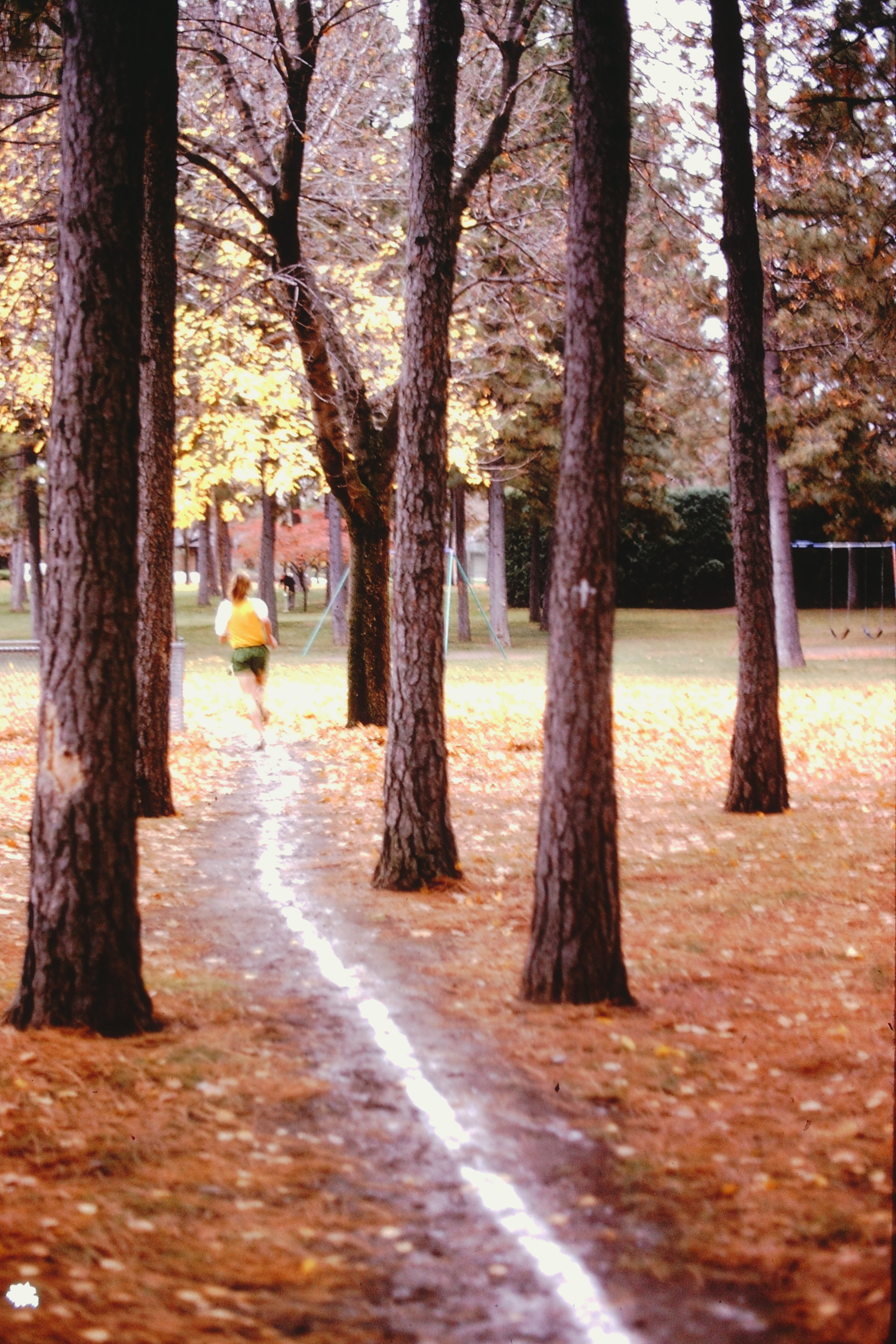
A good runner, way out front. Not me. This is my brother. Fall 1973. Spokane, WA.

Once upon a time I quit a college class called Introduction to Political Science. I sat down for the mid-term examination and found I couldn’t answer any of the questions–a Friday again, naturally. I caught up with the professor the following week and told him I wanted to withdraw from the class. He whipped out his gradebook, registered surprise, and said, “But you’ve got a B at this point and that’s one of the highest marks in the class!” I referenced the midterm and insisted.

I’ve quit church choirs. I’ve quit jobs, sometimes even without having another job to go to. I tried to quit a job for over a year in 2004 and 2005, but the company laid me off before I could line up something else. I indulged in The Big Quit, a.k.a. Retirement at the end of 2019, answering firmly the question, “What would you do if you won/inherited a million dollars?” I had always equivocated when the question seemed theoretical. I told my co-workers I would keep working “unless I felt I was depriving someone who needed a job”. Yeah, it wasn’t a million dollars, but that didn’t matter. I was outta there…but that’s another story for another day.

Recently a person whose work I admire here on WordPress said something about quitting, subtly invoking the tropes our society attempts to get all of us to believe in. Apologetic notes crept in. I hurt for this person, yes, but I enjoyed seeing the acceptance of quitting and the benefits it could bring.

Lately my brother ran into a mental wall which made him abandon his plan to visit us today (April 22). These enforced ‘quits’ don’t always sit well with a person, but I hope he can embrace the possibilities quitting can bring. I hope he can become a Good Quitter.

Meanwhile, I’ll continue to absolve myself when I set aside books which fail to engage me. I’ll feel little remorse for giving up on all the gardening I thought I would do when retired. I’ll try to let myself off the hook for all the home repairs which haven’t been completed. I’ll give myself the freedom to pursue what I want when I want to. It’s been about seven decades–I’m still learning how to do this quitting thing. I’ll let you know how it works out.

Cat tale: Wolf

People telling you about their pet cats and dogs can bore one more efficiently than even those who haul out photos of their grandchildren, worn from months of friction in back pocket wallets. Singular tales do exist, however. John Steinbeck’s Travels With Charley leaps to mind, and of course Jack London made his name with a tale about a dog, though certainly not his pet dog. More recently I choked up when I read Gwen Cooper’s Homer’s Odyssey very accurately subtitled A Fearless Feline Tale, Or How I Learned About Love and Life with a Blind Wonder Cat.

With this in mind, I viewed a recent comment on this blog with trepidation. It can be summed up as “more cat photos!” and my initial reaction somewhat remains: this space isn’t for memes, political screaming, or cute cat photos. But there was one singular cat…and so the author succumbs…

This is a story about Wolf the Cat, as different from most cats as her name: companion, roommate, best friend, zen master, and a being who made the most of a physical challenge for most of her life.

At the beginning of 1978, having pried a degree from the dons at the University of Washington and snagged a newspaper reporter/editor/photographer job in the foothills of the North Cascades, I began to live in responsible society. Two months in, I adopted a gorgeous white cat with blue eyes. Natasha’s pelt could have been marketed in a high fashion boutique. She demonstrated an independent nature, spending large amounts of time outside. (Times were different then; most cats went outdoors.)

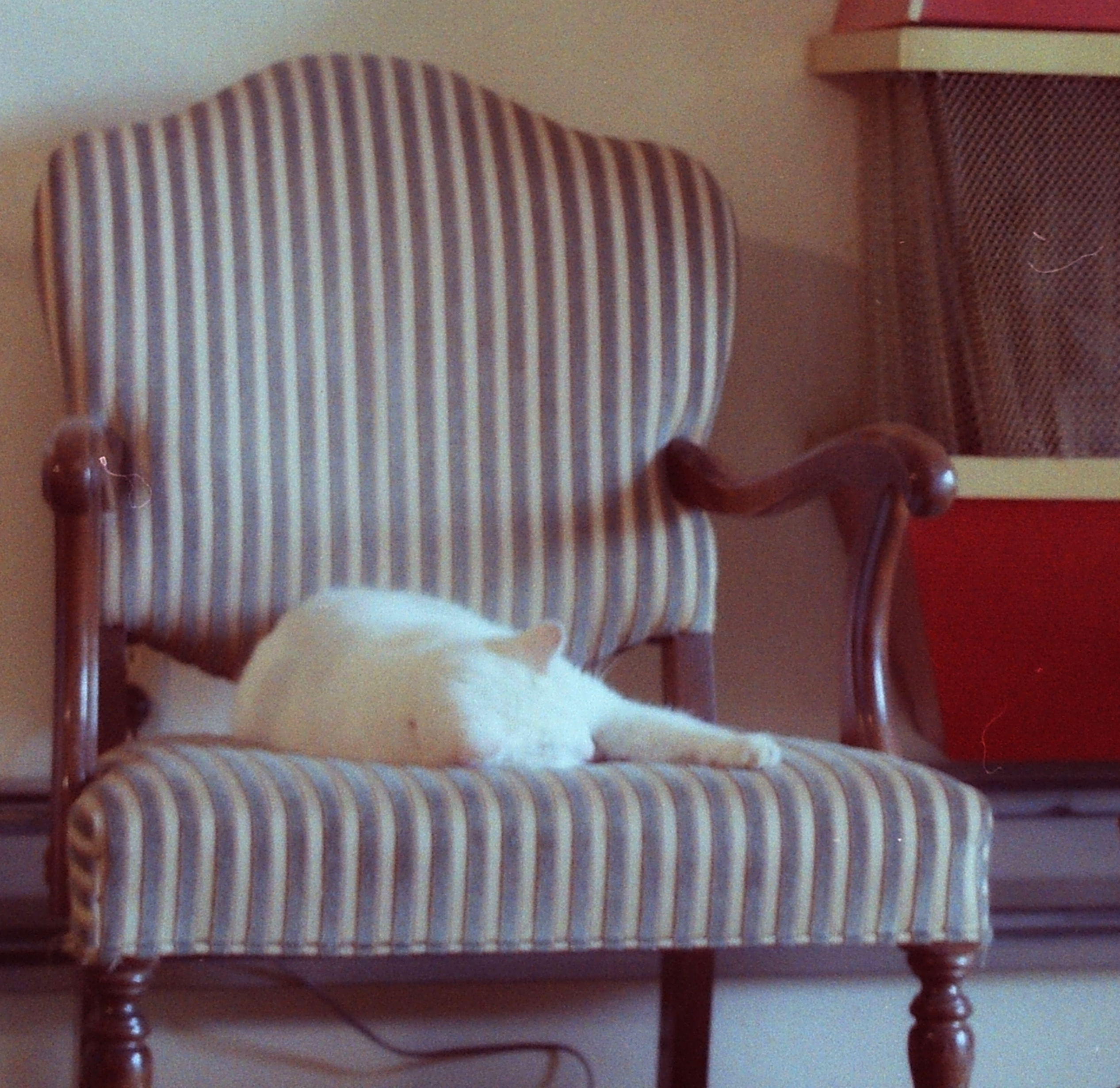
Natasha at rest. Sometime in 1978, probably April-June. Monroe, WA.

Natasha, or Tasha as I came to call her, only sets our stage for the true star, her daughter Wolf. After a few months of frequent sorties to who-knows-where, Tasha began to show the swelling belly of pregnancy. Six months after she arrived to live with me, she littered. She obviously had consorted with a similar solidly-colored cat, but black. Three of the five kittens were white like their mother, with one black smudge on the tops of their heads in varying amounts: one had just a few hairs, one had a small fingertip’s worth, and one had more of an adult’s thumbprint. The most purely white one was delivered three months later to a friend in Walla Walla, who called her Powder…because, well, The 70s. Of the final two, one was all black, striking, and mischievous. I called him Shiva the Destroyer based on his habits, and gave him to my brother about a half year later. Shiva promptly revealed he was a she, littered on the middle of my brother’s matrimonial bed, and Shiva soon found herself and her litter at the local animal shelter.

And then there was this nondescript gray tabby, a commoner among the gorgeous and highly born. Because this kitten had a fuzzy overcoat of lighter gray and looked a little jowly, it reminded me of a wolf, so I called her Wolfrydda, a completely made-up attempt at Norski-ness. It was Wolf on the vet records and in my mouth–so what indeed was her name? Wolf showed a precociousness that captivated me. She always wanted to be with me, climbing up the side of my couch to get to me even though she could barely walk.

Wolf and her siblings deeply annoyed Tasha, whose maternal instincts were minimal. When Tasha had weaned her progeny, they didn’t leave–so Tasha did. I saw Natasha every four or five days until I found her weeks later, dead on the side of our country road.

Wolf and Shiva, Fall of 1978. Monroe, WA.

Wolf proved every bit as companionable as she first indicated. By the time she died almost 20 years later, we had been through a lot together. She had advised me, entertained me, put up with me, and shown me through her quiet approach to life how I probably should have lived myself. But I’m getting ahead of myself. Wolf calmly accepted life as it came at her, much like the zen masters I read about later. If a chest of drawers had one left open, she slept there. Or the waterbed was good, and being covered up seemed even better:

Always aware, always calm. Wolf the Zen Master. January 1980, Monroe, WA.

At one year she gave birth to a litter of four anemic kittens who all died. Wolf spent the week crying in the bathroom where I had put the kittens in a box directly under the ceiling heat lamp. By February 1980 she had littered again, four again, a black one, two gray tabbies, and an odd beige one with caramel-colored tabby markings. The two tabbies stayed, but one, Noko Marie, died. I suspected the vet who had spayed her. (Hold that thought; we’ll return to it momentarily.) The other tabby grew into a big lug and into his name: Frank N. Stein.

About six months later Wolf disappeared for three days. I spent mornings, lunchtimes, and after work hours standing on my apartment’s little patio, whistling the special Wolf whistle, and scouring the large rocks a few feet beyond the edge of that patio which prevented erosion on the steep slope lying below. On the third day I saw her, hopping oddly from rock to rock as she laboriously climbed the hill with what turned out to be a broken right rear leg. She had gone across the road at the bottom of the hill, perhaps to get to the creek on the other side. Her luck ran better than her mother’s, and with a cast on her leg a few hours later, I headed back to work. That night I couldn’t find her until I looked on the top of the refrigerator. Somehow, with a newly applied cast on one of her jumping legs, Wolf had climbed onto the seat of a kitchen chair, then to its back, balanced herself there and leapt to the counter (three to four feet). Once on the counter she had dragged herself past the sink to where the refrigerator rose and again had leapt with only the one leg to get to the top of the fridge.

Two weeks later I took her to the vet to check on the leg. He unwrapped the cast, examined her, and rewrapped the garish pink stretch tape over the casting material. In a couple of more weeks I noticed the tip of the cast was wet. Back to the vet we went. The vet discovered a gangrenous leg and admitted he had likely wrapped the cast too loosely in a mistaken effort to give her a little more comfort. The cast had turned and cut off the blood supply to the leg. The leg would have to be amputated or Wolf would need to be put down. It didn’t seem to be much of a decision. Wolf was barely over two years old, and had demonstrated over the past four to five weeks she could get around quite well dragging her right leg behind her. I figured it would be easier for her at that point not to have the leg versus the cast. The vet said he felt badly about it and wouldn’t charge for the amputation! Back then I was naïve; I would not be as nice today. Since he wasn’t getting any money for the operation, he said he was going to do it after hours and did I want to watch and/or assist? I said “sure” and found myself that evening holding up a furless leg that looked remarkably like a chicken leg/thigh you buy at the grocer’s while the vet used a large pair of side-cutters to snap through the bone.

Wolf educated me over the next year with what was possible. We moved across the state only two months later, and Wolf discovered a new favorite spot in a tree beside the driveway. This tree grew as one trunk to approximately five feet and then shot many branches straight up from there. It thus formed a natural nest. One night I came home from work and found her there, staring at me eye to eye, five to six feet up. I figured at that point she could ramble around outdoors without too much fear. She had taken to sticking close to home after the accident, and she always spent the night indoors. Smart cat. I wish I had listened to her more.

In mid-1981, six months after our move, I met a woman allergic to cats. She gave herself shots which seemed to work a bit, but extended time around my two cats (Frank was still in the picture), and she would start suffering. Wolf neither hated nor liked her–tolerated would be more accurate. Within two months this woman helped me decide to quit being a reporter/editor, go back to college, earn a teaching degree, and join her in the teaching ranks. I found a cheap apartment in Spokane, WA, but it didn’t allow pets. Pressed for time, I convinced my parents (who also lived in Spokane, just ten minutes from the apartment) to take in Wolf for a year. They had never had cats in their adult lives, and they had a dog, something Wolf hadn’t encountered before. Despite this, they agreed, and a few weeks later–after living in my car for a day while I attended classes–Wolf went to her new, temporary home. To get away from the dog she learned within the first hour to jump with that one rear leg to a small basement window four or five feet above the tallest furniture. The dog was lazy, and after his initial curiosity, he let her be. (Frank is another tale for another time, when I feel like confessing a poor decision.)

Enduring my parents and their dog. Sometime between Sept 1981 and August 1982. Spokane, WA.

After ten months I earned a degree in English Education, August 1982, grabbed Wolf, and moved in with my woman friend now living in a small lake cabin with a small dog. We married in 1983, moved to a small city in the mountains of Washington, and over eight years we welcomed four more cats into our house. In 1990 we moved to a new, bigger house, dropping Dolly with a friend. Three days after the move, Cooper disappeared. Suddenly we weren’t a 5-cat family, but only a 3-cat one. My wife laid down a new rule: cats in the basement at night. The rule lasted until she moved out ten months later, taking the dog and Petunia with her.

Four years and counting. Livin’ the lake life. Late 1982. Diamond Lake, WA

Wolf, Calvin, and I spent a year rattling around the 4000 square foot house. I met a different woman which gave me the pretext I needed to upend my life. The cats and I moved to a Philadelphia suburb.

Nearing 14 years: supervising the mover (me). June 1992. Colville, WA.

Wolf spent her time, per usual, under the seat of the Ryder rental truck I had procured for the move. Calvin ate tranquilizers and sat in a cat carrier the whole time we were in the truck. Occasionally Wolf would perform recon, hopping across the dash and then spending just enough time on top of Calvin’s carrier to annoy him, before she retreated to her under-seat abode. In Philly I intended “to become a freelance writer”. Such was not to be. I did, however, let my fling die away and in 1994 met a lovely woman who to this day keeps sticking around for no good reason I can fathom. Wolf liked her. Calvin spent most of his time outdoors and didn’t care.

Shortly after our marriage in 1995, we lost Calvin in the middle of an overnight December snowstorm when he insisted he needed to go outside exploring. (Another sin on my cat balance sheet.) My focus on the missing Calvin prevented me from noticing Wolf’s increasing lethargy. A Friday trip to the vet didn’t net much of a diagnosis; on Monday morning she couldn’t hold her head up while sitting on my wife’s lap. A second trip to the vet (and a diagnosis from a more competent vet) revealed a bad failure of her kidneys. They were flushed with large infusions of saline water twice that week, and Wolf The Miracle Cat bounced back as good as ever.

Eventually I convinced my new wife to move back to Spokane. Wolf joined us on a pillow on the middle console. We moved into a rented house complete with swimming pool. By this time, nearing her 19th birthday, she spent most of her time at the new house on top of a stack of deconstructed cardboard boxes from our move. The sun shone there most of the day.

In May 1998 we moved her one last time to a house we bought there. Wolf had been complaining of something for a week or so before the move. She worsened just a week or two after the move, and we learned her kidneys were failing again. A few tries at jump-starting them with fluids failed, and we decided to stop the pain in mid-June, just a couple months short of her 20th birthday.

Along the way I appreciated this cat more and more. She benefited by being my first real feline companion–Natasha had disappeared far too quickly and been too standoffish to claim that role. She liked rock and roll: playing one of my favorite albums, The Who Live At Leeds, at full volume not only didn’t disturb her, it caused her to climb up in my lap and enjoy the tunes! She enjoyed sleeping right on top of me (or my bed partner), which made me thankful for her light weight. She had a two-toned purr, with a high-pitched note above the customary low, growly one. When purringly happy she would drool, just one drop which would sit at the tip of her muzzle. She exhibited calm, patience, and live-in-the-moment wisdom. (I once watched her sit at the corner of the house waiting for a couple sparrows to work their way down the side of house toward her. She knew this was the only way a three-legged cat could hunt them. She missed anyway.) After losing her leg at the age of two, we moved five times from 1981-1990. I moved her five more times from 1992 until her death almost exactly six years later. She took it in stride, so much so that I’ve been shocked since then to have a cat stress out over moving. Throughout it all I never felt I was in charge; I felt I had a roommate who just happened to keep moving with me.

If I had listened to this cat, I would not have married when I did in 1983. I would have become far less upset about life’s tribulations. I would have accepted the bad with the good, and learned to not grasp either. To this date, almost 25 years since Wolf died, no other cat has quite captured her spot in my heart. I doubt that one will. I’m nearing 69. The years run together now. First time events, like meeting such a cat, become less and less prevalent. No matter how much I try, I can’t quite connect with my cats like I did this one. Maybe the right one just hasn’t appeared. Maybe they just don’t come but once in a life.

This profile seems abysmally truncated to me, long as it must have seemed to the reader. I covered a decade in one paragraph! (1982-1992) I had thought, “hey, from time to time I’ll tell tales of the others, but I’m not sure how I could. Everything would seem downhill after Wolf.