Eastern carpenter bee working the beebalm. June 2025.
I opened the month shooting photos of the beebalm with a swallowtail butterfly on it. This photo is from the same set. The swallowtails, bumblebees, and little tiny bees I haven’t identified yet all had to work around the behemoths of the flowers, the carpenter bees. At 1.25-1.50 inches (or more!) they pretty much go where they want to. Now the beebalm has slowly dropped all those fuchsia-colored petals. (Or are they petals? I don’t know much about plants.) All that remains are the ball in the center, still suspended on those long stems. Our new visitors love these: goldfinches. They flit from flower to flower, their nearly weightless bodies hardly making the stems bend at all. It seems too soon for seeds, but what do I know?
Summer temperatures, documented a few days back, will continue for the near term future. Americans look forward to celebrating Independence Day on Friday, the 249th of our country’s existence. In these muddled times, I wonder what that will bring. Meanwhile, the business of life marches on, from the mundane (it’s Gather the Garbage Day) to the inconvenient (workers coming to work on the leak in the bathroom shower) to the calm and simple (my wife returned from a coastal sojourn yesterday afternoon; this day will be our first together in a week).
Howard, 11 weeks; with his mother, Esther Dahl Pilcher. Lansing, MI, August 1925.
Howard Bliss Pilcher entered the world on this date 100 years ago. He died toward the end of 2013. In those 88 years, like most of us, he did nothing to affect the globe or any large portion of it. His impact, again like most us, accrued from those individuals he knew and perhaps from patrons of the two entities which employed him for 39 years. He most affected his wife and sons, Steven (my brother) and Kenneth (me). Seventy years later, to me he remains both enigmatic yet an apparently open book. Whether nature or nurture, his traits run through my being. Whether you knew him matters not. He might have subtly affected you too: every one of us amplifies his presence on humanity simply by interacting with more than one person and making an impression them; it ripples out to touch people we never knew.
Howard Bliss Pilcher—technically a Junior though never named as such—came into the world in Lansing, MI, on June 22, 1925. He moved with his brother and parents from city to city as his father, an American Baptist minister, moved from church to church. The younger HBP served in World War II, completed college, started his career, married, procreated, retired, traveled, and died December 16, 2013. He resembled thousands, millions of other men born around the same time. We each are unique, though, and this unique man fathered and raised me. If we are constituted from our roots, our times, and our experiences, then exploring those roots isn’t so much recounting their life as it is exploring our own. Therefore, we can’t call this biography. I haven’t the time or desire to research the nuances of his history, let alone the history of the times and regions through which he passed. (And thanks for that, too, Dad.) But there will be biographical elements to it, just as there will be aspects of memoir stemming from his inescapable impact on my life, and how the two remain intertwined even after his death. Perhaps reminiscence remains as the most accurate term.
A confession before we start: I’ve procrastinated all my life—a trait which will be explored through the telling of this tale—and this procrastination has left me too little time to complete this piece prior to deadline. My vision for it looms at far too many words to dash off in one or two sessions. Unlike the great gonzo journalist Hunter S. Thompson, I cannot lock myself in a hotel room for a few days, wire myself on pharmaceutical grade crank, and pound out a semblance of the piece this subject deserves. My physique won’t handle it, my psyche won’t handle, my marriage won’t withstand it, and I don’t see why after seven decades I should start caring about deadlines now. Okay. Let us begin. We’ll start with the thumbnail bio:
The senior Howard Bliss Pilcher, my grandfather, the one my grandmother called “Bliss,” came into the world in 1894 in Urbana, Illinois. The Pilchers traditionally lived in north central North Carolina in Yadkin and Surrey counties, up by the Virginia state line, but the “movin’ bug” ran through our branch of the family as far back as the early 1800’s. Bliss’s father, Wiley Pilcher (1861-1935), moved to Illinois where he fathered all three of his children. Wiley later moved to Fargo, ND, and finally to Libby, MT. All of this perhaps explains why, when he heard the call and enrolled in seminary, he became an American Baptist minister. American Baptists were at one time called Northern Baptists and trace church lineage through the Triennial Convention, the first Baptist convention in the United States of America. In 1845 a pro-slavery faction split off from the Triennial Convention to uphold the institution of slavery. It came to be known as the Southern Baptists. Without researching the topic, we may surmise that many Pilchers would not have been happy with my grandfather’s choice, particularly the majority of them still living in North Carolina. The decision to minister in that denomination reflects the equanimity which characterized my father’s upbringing, and which he instilled in me.
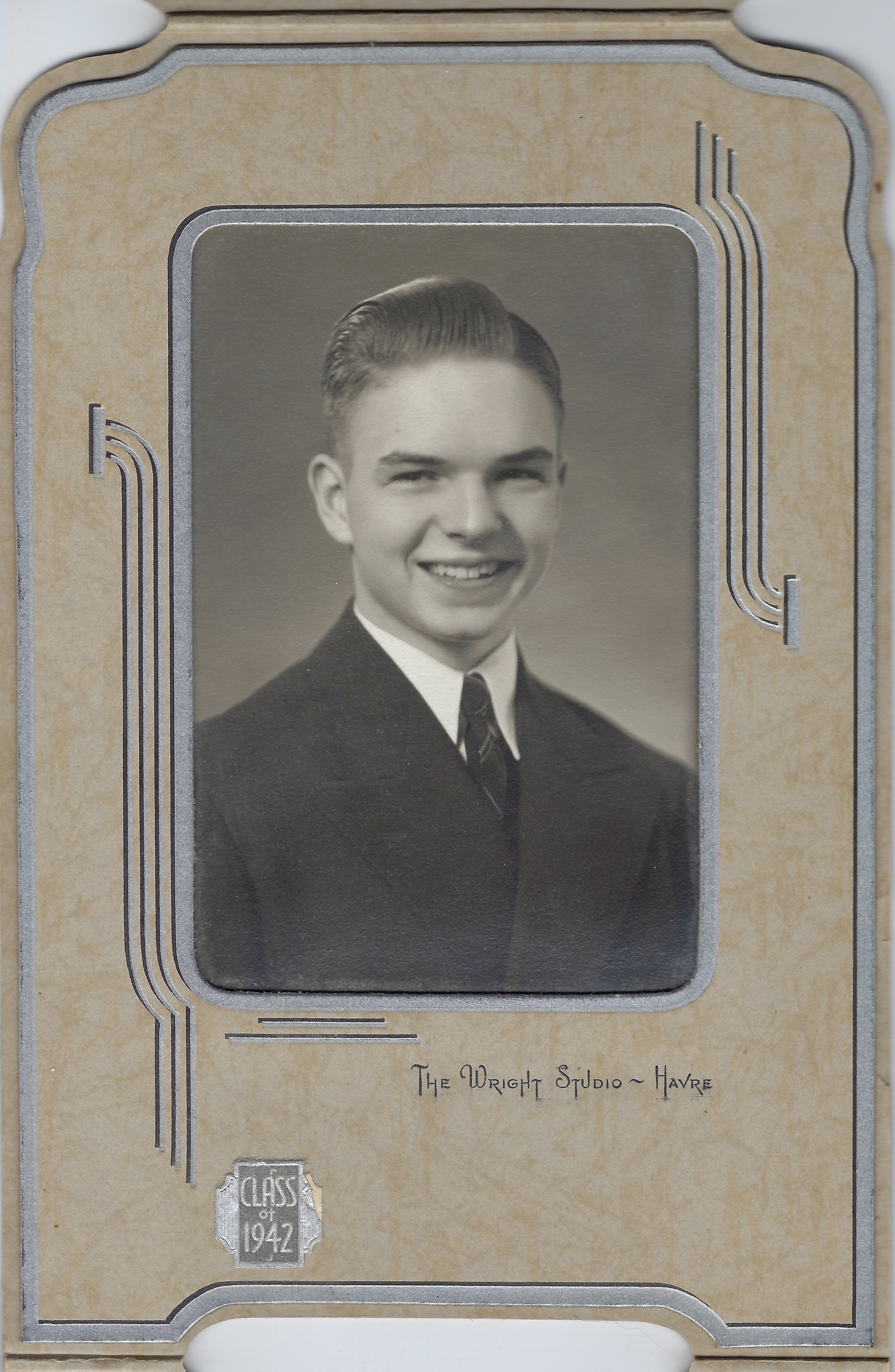
One year after my grandfather married Esther Dahl, my father was born. Lansing, the capital of Michigan, had nearly quadrupled in growth from 1900-1920. Not only were these the Roaring Twenties but this sizeable city (about 67,000) boasted all the activity inherent to a state capital. Thus, he started life in the thick of it: the capitol building stood about a half mile from their house. Not that this would have had much of an impact since by age 3 the family moved to Edina, MN, a suburb of Minneapolis. In between was a short stint in Dover, ID, an unfathomably small and remote place for a minister to travel, perhaps explained because Bliss stepped up from being a youth minister in Lansing to having his own church in Dover. The family lived in Edina for ten years more. At the threshold of my father’s entrance to high school in 1938, his father accepted a call to Havre, MT. (I’ve started to wonder if the “calls” were based more on wanting to stay reasonably close to his father, Wiley. Edina lies less than 250 miles east of Fargo; Havre is 350 twisting miles east of Libby.) Four years later my father graduated from high school. He attended the local college, Northern Montana, for at least a semester, but the reality of World War II loomed. The U.S. Army drafted him, placed him in the Quartermaster Corps, and sent him back and forth across the Pacific guarding supplies.
Howard’s senior photo from Havre High School. 1942.
At least, that’s what I surmise. My father didn’t want to talk about his time in the service at all. We did learn he made some grade of sergeant, but I only called him Sarge once. Let’s just say he made it very clear it would be the last time I called him that.
Howard mustered out of the service, enrolled at Washington State College (now WSU), hired on with the Carnation Milk Company in Seattle, married Louise Bach there in 1952, and they had a baby in 1954…me. We moved to Spokane, WA, when the Carnation Company transferred him soon after my first birthday. My brother was born there. My father accepted transfers back to Seattle (fall of 1962) then to Los Angeles (the beginning of 1964) before he made his dislike of Los Angeles and corporate life known. The company allowed him to go back to the same job he had left in Spokane just two years prior. We will revisit that career-killing decision. Four to five years later, as I approached high school age, he went through a personal crisis, quit Carnation, emptied out his profit sharing account, and maintained the family on that while he searched for a new career path. When a close family friend needed to fill a comptroller position at Sacred Heart Medical Center, he thought of my father who then began a very nice career managing financial matters for the hospital. As his mentor ascended the ladder of responsibility, so too did my father, eventually boasting the title Director of Fiscal Services. He retired after about 20 years of service to this medical center founded by the Sisters of Providence, a Catholic order of nuns.
In retirement he tended roses and indulged the Pilcher penchant for wandering by undertaking numerous road trips with our mother. There were a handful of trips by plane, but he fought claustrophobia for much of his adult life and those weren’t comfortable trips for him. Two trips abroad (England and Spain), a cruise package to Alaska, and near-annual trips to Hawai’i for a while rounded out the travel. They celebrated 50 years of marriage in 2002, quietly marked 60 in 2012, and he died after a sudden trip to the hospital in 2013 which saw him enter the hospital on a Tuesday and pass on the following Monday morning.
What did people think of my father? “That weirdo”? A “super nice guy”? “Honest as the day is long”? I know that he was loved. I know he withdrew toward the end of his life, and one by one most of the people he knew and loved died before he did. I know he worshiped my mother yet had a condescending tone toward her (which I adopted to my detriment). I know many, many superficial things. What I don’t know is the man he truly was, and what force ultimately took over the final five years of his life, making him mentally miserable at times. I know, too, it lurks within me and whispers that it just may do the same when my time nears.
This has been but a snippet, a dry telling of mostly factual matters, an introduction as stated in the title. To explore the man through reminiscence requires setting the stage. Much like reading your playbill before the curtain rises, you’ve now gained the background to enjoy the show (hopefully). In subsequent posts we’ll explore in no particular order and perhaps not under these self-same titles:
Ebullience, Positive Thought, and the Eleemosynary Ethic
Accruing Guilt: Understanding What Your FatherMeant
The world is going to hell in a handbasket. This attitudinal shift remains a nearly unavoidable aspect of aging. We age and cast off following things for their own sakes. For example, fashion? Oh sure, we keep an eye on it, rotating neckties or jewelry to our favorite “it-will-come-back-into-fashion” location, but we pick and choose. Skinny, tailored suits? On this old beer-bellied bod? I think not. Hip-hugging jeans, says my wife? “I never wore them when they were in fashion decades ago!” And don’t get her started about wearing clothes which look more like lingerie than outer garments.
Everything’s going to hell. For us oldsters, new technologies get picked up as they’re convenient, and when they serve a purpose, not because they’re trendy. Consider: smart phones debuted (debatably) in 2006. I waited six years, until 2012, to get one. Even then I got it mostly because I needed a better communication tool when I started consulting. I might have picked up one eventually. I’m sure I would have been forced/enticed into it sometime before 2020…maybe. After all, I’m a techie; I like all the toys. About forty years ago I could hardly wait to upgrade my first desktop computer or for it to conk out and justify buying a new one. Now? I’m leisurely approaching the time when I’ll dig into my Windows 10 machine and tweak its registry settings to permit upgrading to Windows 11. Another old man thing: texting has proven to be a boon but it doesn’t replace email. And why trade clean, open texting for the closed gardens of WhatsApp, the-app-formerly-known-as-Twitter, or Instagram? I resisted Facebook for years, but joined ten years ago. I grew uneasy with a technology that demands everyone ‘talk’ all the time. Doesn’t someone have to listen? And how can everyone something important to say? The horrible year of 2020 pushed me to delete the account. Who wants to be sanctioned for being reasonable? (I understand getting attacked for being ‘out there’, but for being calm and objective?) My point’s drifting here, old man! It’s this: seven decades in, one learns it isn’t very important to follow every trend…or pretty much any trend.
These thoughts crept into my mind as it wandered from thinking about our church’s chorister program (elementary and junior high students who sing in the cathedral once in a while) to the pre-pubescent boys who sing at New College, Oxford, or in the Vienna Boys choir, until finally it came to rest on my own 5th and 6th grade experience of participating in All-City Chorus in Spokane, WA. This program met once or twice a week after school in the most centrally located public high school, Lewis and Clark. How did I get there? I took the bus. Due to its meandering route the trip lasted about half an hour as it drove the seven miles from my elementary school to LCHS. I can’t remember if I took the bus home, or if my father picked me up, since he worked less than a mile away and would have been leaving work about that time. My brother similarly took private clarinet lessons in an old building downtown. It housed a music store on the street level and housed offices on the second floor, one for his teacher. My brother also took the bus, catching it at the end of the block where we lived, and traveling the same amount of time and distance as I. This wasn’t unusual for 10-year-olds at the time. My mind kept wandering. I wondered how common that is now. I don’t know as a parent if I would rest easy letting my child do the same. I’m certain few if any modern parents would. Kids seem to be scheduled for most of their free time and driven by an adult to these activities. This illustrates my point, the one I wandered to this morning:
Old people experienced a different world. I don’t care which generation you’re considering, it wasn’t necessarily worse in their mind. We–any of us at any point in time–dealt with what we dealt with. Life presented itself, and we were up to date with it. We cling to some of the practices from back then, not because they’re antiquated but because they worked. We cling to the beliefs which those practices engendered. Let me explain, by way of an example, how life occurred and thus, how we think and thought. Consider the situation in which two parents decide to let their boys travel alone on a city bus after school. During the winter we left our respective music activities in the dark—Spokane lies a latitudinal degree further north than Duluth, MN, and almost three degrees further north than Bangor, ME. How could a parent allow this? First, we didn’t have two cars. Though we were comfortably middle class, it wasn’t that unusual for families to have only one car. My parents decided they could share it—Dad took the bus at least two days each week—and the money would be better saved for other things (notably our college education). Dad could have taken the bus on those music days, though, leaving Mom the car to shuttle her children.
But you see, that was just a strange notion back in the 1960’s. Kids gained in freedom when they gained in age and maturity. When we were very young, three to five years old, we were told where our boundaries were in the neighborhood. We respected them (mostly). We got to travel the block and only on our street. I got in severe trouble when I crossed the street at the end of our block and decided with a couple other kids it would be fun to roll rocks down the hillside. (It didn’t occur to me that there were cars on the road a hundred feet below us or what a rock the size of a teapot might do to a car.) When a county sheriff’s deputy delivered us to our parents, we caught a lot of hell. When we were in elementary school we wandered wooded lots, rode bicycles for miles away from our homes, and all we had to do was say, “Mom, I’m headed down to Mitch’s house!” As we neared and then entered junior high it was more like, “so where did you two wind up today?” from my mother. Our parents expected us to entertain ourselves, stay safe, and observe the behavioral rules they laid down. We did pretty good with that first part, fairly good with the second part, and…what they didn’t know didn’t hurt them, right?
Today therefore represents a path to perdition, always, for every old person. I stay optimistic generally (and the further I look into the future), but many things worry me about habits which younger people have acquired. I now can see that 100 years ago cars would worry a 70-year-old born in 1855. “Everybody scootin’ and tootin’ these infernal muh-SHEENS! T’aint nachurl! Next thing ya know, people won’t even live together cuz they can just drive to work!” with the word “drive” carrying all the distaste and disapproval an old man might feel.
Humans measure the world using an internal scale developed through experience. We slow our learning process with each passing year, experience becoming a boon and an obstacle to learning new ways. Fifty years later, we don’t even see the same world as younger people do. This is neither good or bad; it simply explains our attitudinal shift. Maybe you caught a bit of that here, but I fear I’m too caught up in it to accurately relay it to you. Everyone my age is nodding their head while everyone thirty years younger has made some derisive sound en route to dismissing the whole notion out of hand.
A few hours ago I surpassed seven decades upon the planet. My first memories occur somewhere around three to four years of age; make that six and a half decades of consciousness. I rode tricycles and bicycles with playing cards clothes-pinned into the spokes for noise. I saw the first television come into our house, the advent of easily available color TV’s, and the beginnings of data processing centers (long before personal computers became a thing). I celebrated the first humans going into space. I cowered under my desk as I practiced “what to do in the event of a nuclear attack.”
I entered my teens as we kicked off the Summer of Love (“we” being a rather generous term for my inclusion in it). I protested the Vietnam War in a lukewarm manner. I wore strange clothes, even considering what teens normally do.
I campaigned with my father in 1960 for presidential candidate Barry Goldwater. I voted for the first time in 1972 for George McGovern. I watched as Nixon resigned rather than face impeachment. (Imagine that, Bill. Donald.) I jump aboard the personal computing “thing” in 1982 and never looked back. I became a newshound; a teacher; a cog in corporate America; a consulting ‘expert’; and a retired, lazy bum.
So what? Every single person born before 1960 can pretty much say the same. It’s because looking back shocks one. My grandparents saw the advent of cars which radically changed society, and they knew grandparents or great-grandparents which served in America’s Civil War. My parents watched as first radio and then TV made changes almost as radical. And those of us of a certain age have witnessed computers do the same as the automobile. I cannot convey the visceral feeling of being the head of this time-worm, with a tail stretching back to days which did not know any color of T-shirt but white, which never saw a man wear hair which touched or covered his ears, which had just completed two significant wars in a little over 15 years.
You’ll have to experience it yourself. It’s a trip.
It’s not August, but I feel like posting a photo taken by my grandfather almost 70 years ago. He grew up in Seattle from the final years of the 1800s until he passed in 1990. He would regale me about what Seattle was like in those early years, before Grandma would say, “hush, now, Roy, he doesn’t want to hear about all that old stuff!” I actually did. This photo is one of three dozen (a long roll of 35mm film back then). From the shots I can tell my grandfather never moved, just shot what paraded by. This photo is interesting because the young woman in the position of honor on the float looks like my mother. I doubt it’s her–she was way too shy to be this involved in things–but nonetheless… I’ve not delved deeply enough into parade routes, but it’s very likely this corner now has one or more skyscrapers on it. I can tell from some of the photos that it’s at an intersection and the street that leads off in front of the building in the background goes steeply downhill toward Elliott Bay…but then, many streets do that in Seattle. I can see Bainbridge Island in the background of some of the photos shot just a few more degrees to the left. Today it would be impossible to see Bainbridge Island this far up from the Bay.
Sorghum Mill near Greenup, KY– my Grandmother is on left. Oct 7, 1966
I have published this photo before to social media, but not in this edited format. (The shadows have been lightened to the point where my grandmother is recognizably her. The barrels stand out.) My grandmother was raised primarily in Greenup, KY, on the Ohio River, though she also lived in the nearby cities/towns of Ironton and Cincinnati, OH, before she moved with her mother and brother to San Francisco, CA. At that point she was a young woman and soon met her husband-to-be, my grandfather. When this photo was taken, she had not lived in this area (KY/OH) for 40 to 50 years. I am uncertain, but I know my grandparents married in the mid-1920s and were living in Seattle, WA, by 1929 when my mother was born. Greenup, KY is on the edge of the Appalachians. Though northerly (near West Virginia and western Pennsylvania), the so-called hillbilly influence was large. My grandmother told a story of her grandmother (her mother’s mother) coming out of the hills to visit, complete with logging boots and corncob pipe. It likely affected my grandmother–she put on airs all her life. But that is another story….
Back side of Cathedral Rock, near Sedona, AZ, February 2022
I grew up looking at the old travel photos and souvenir filmstrips of the 1920’s through 1940’s which my mother and her parents collected. I distinctly remember some textured postcard-like sets of souvenir vistas which either she or her parents collected when traveling. This photo reminds me of those little cards (approximately 2 inches by 3 inches).
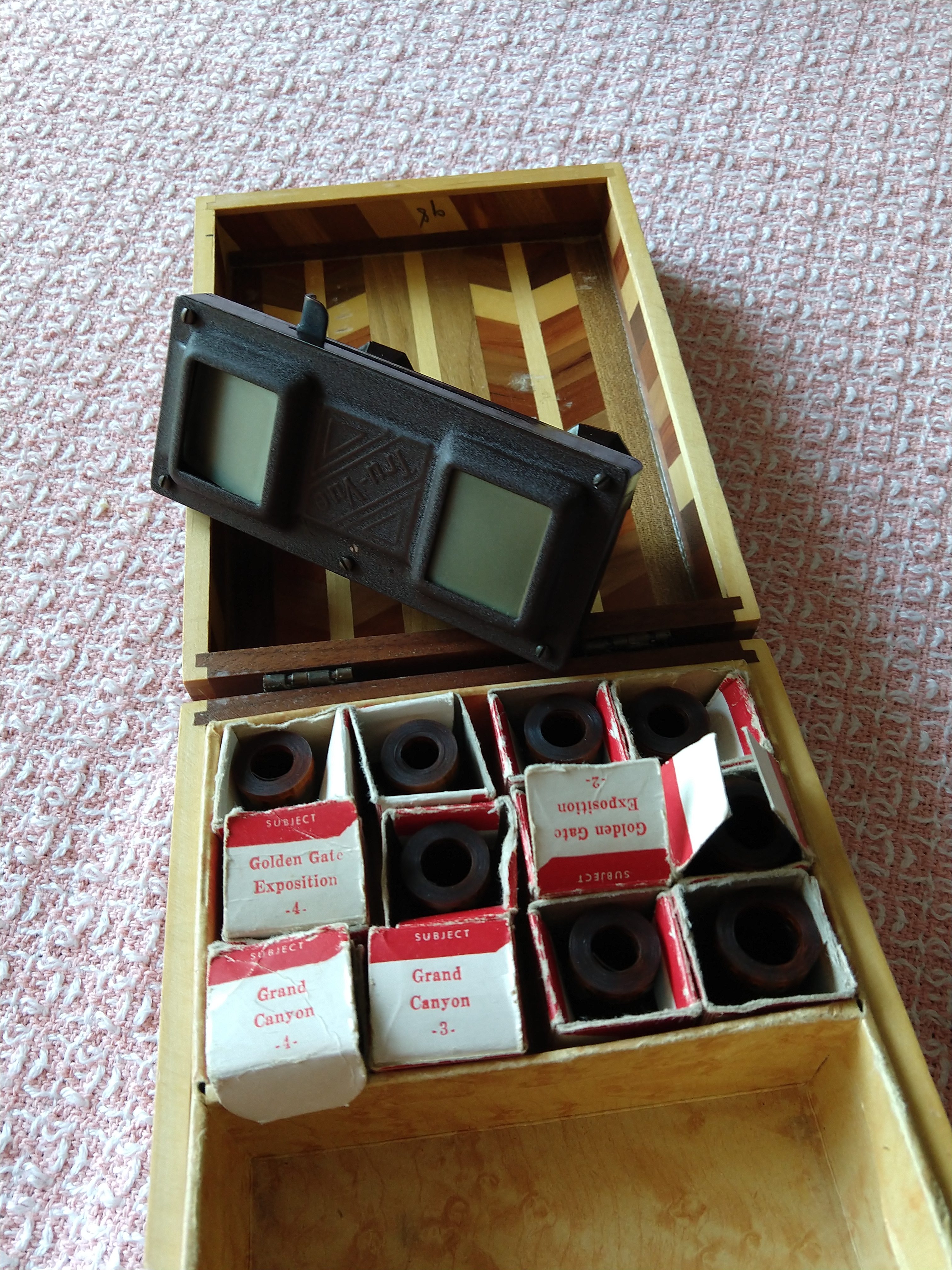
I never view these classic southwest American vistas without thinking of the Tru-Vue filmstrip viewer which introduced me to them:
Tru-Vue 3D filmstrip viewer, circa 1940s?
It’s not the best photo I have of the viewer, but it’s the most informative. The viewer itself is upside down: the flange sticking out of the top is the advancing mechanism which is customarily used at the bottom. Those persons aged 60-70 will recognize the concept which was translated into discs of photos which we looked at through similar, but more plastic viewers. A giant loss with these viewers of the 1960’s was that they only had a dozen or so images. The filmstrips above were almost limitless and offered several dozen black-and-white photos of the subjects named on the cartons shown. Even so, one notices that the Grand Canyon has at least three filmstrips. As I recall, the eight boxes which are not identified in the photo were of Yosemite National Park and Yellowstone National Park. An added plus is the intricately inlaid box which housed everything.




 all the voices in my head