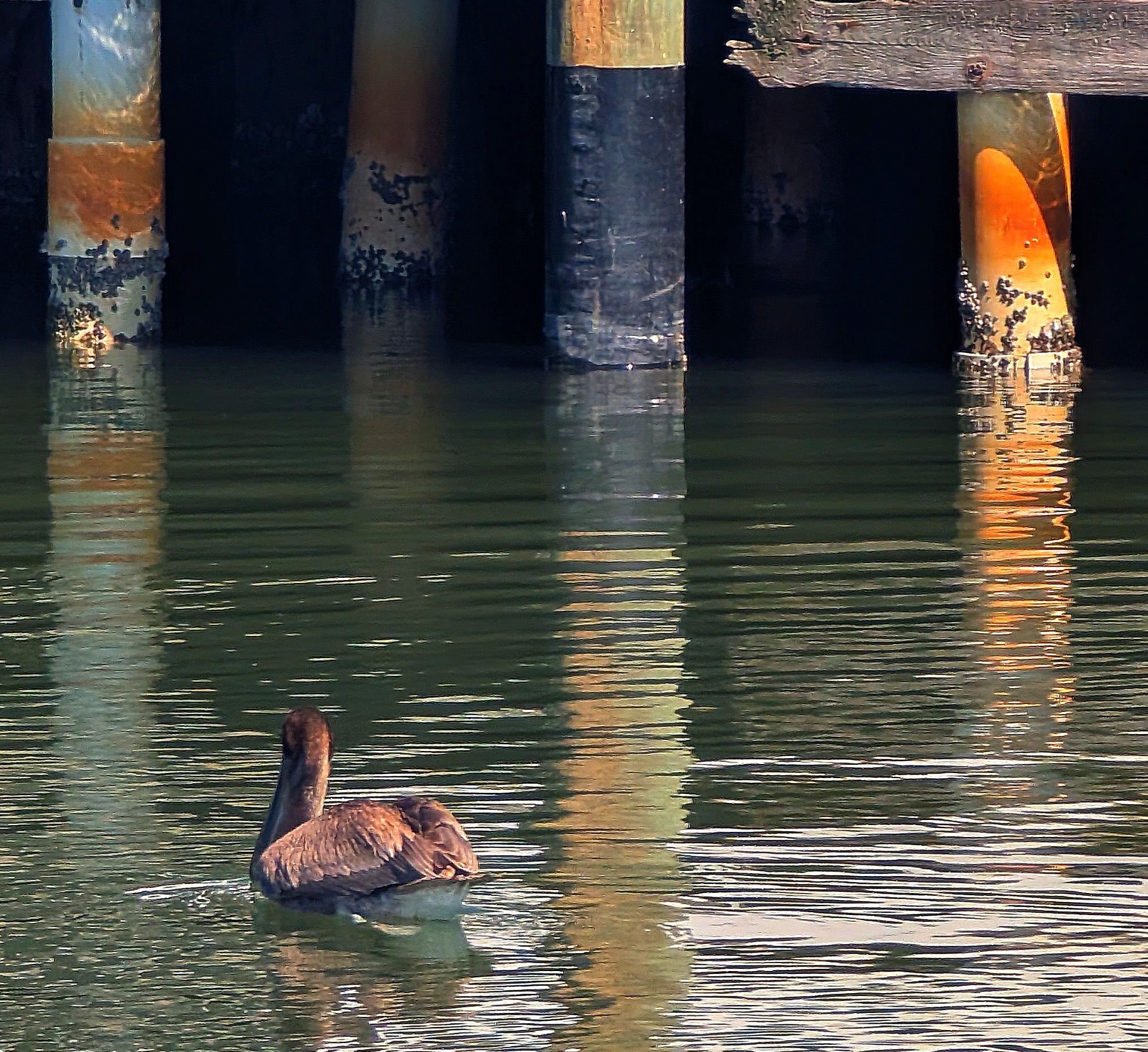
One of a good-sized group of brown pelicans we watched while we ate lunch in Tin City, a group of shops located in old tin buildings on Naples Bay. Naples, FL, February 2026.
We had brought the frigid temps of the Carolinas and Georgia with us to Tampa, and my wife’s sister lamented the loss of her typical 70’s and 80’s. It warmed a bit on our second day there. I bundled up in the warmest things I’d packed and walked to a nearby reservoir to see what bird life I could find. Driving south the next day, we arrived at the Tin City shopping mecca early afternoon, and tucked into a late lunch. The food and the bird life entertained; the shops did not. Tin City seemed a poor and miniscule version of Seattle’s Pike Street Market. Most shops sold typical tourist trinkets which said “made in China” on the bottom. Combined with the exorbitant hotel rates—$300+ for a Springhill Suites on the outskirts of greater Naples?—I doubt we’ll be back in Naples. One saving grace? We’re not exactly foodies but we’re kissin’ close, and discovering that the Cracklin’ Jack’s just up the road from the hotel had recently been featured on Diners, Drive-Ins, and Dives sure put a fine end to the day. Best fried catfish I’ve ever had! We looked forward a bit more eagerly to entering the Everglades and surrounds the next day.
Although the westernmost entry to the Everglades National Park, the Marjory Stoneman Douglas Visitor Center, purported to not be open until the end of February, we decided to chance it on the 26th. We were rewarded with an open, brand-spanking-refurbished center….but not much else because it’s a jump-off point for visitors who want to boaters and to those who want to hike/camp in the Ten Thousand Islands. We are neither of those types. We traveled east on US-41, a.k.a. the Tamiami Trail, the southern route across the Florida peninsula which parallels I-75 a.k.a. “Alligator Alley”. I planned the US-41 route; it became a wise decision when a fire broke out between the two and officials closed sections of the interstate. (It also precluded driving very far north from the US-41.) The southern tip of Florida is a patchwork of state parks, state forests, national preserves, and the national park. We stopped first at the Big Cypress Swamp Welcome Center in the Big Cypress National Preserve. After that, a stop at the H.P. Williams Roadside Park gave us our first good glimpse of alligators, and some nice views of the bird denizens.
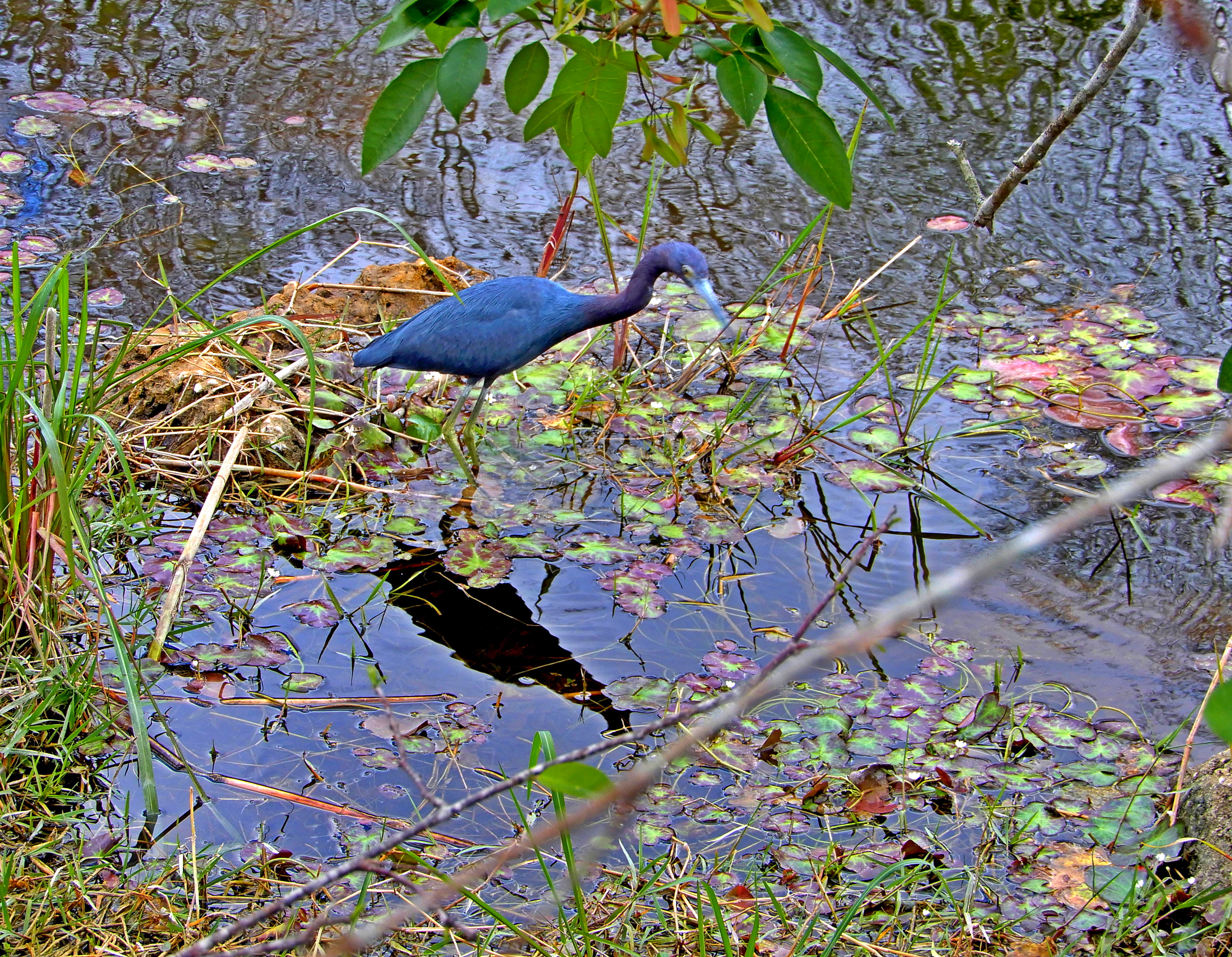
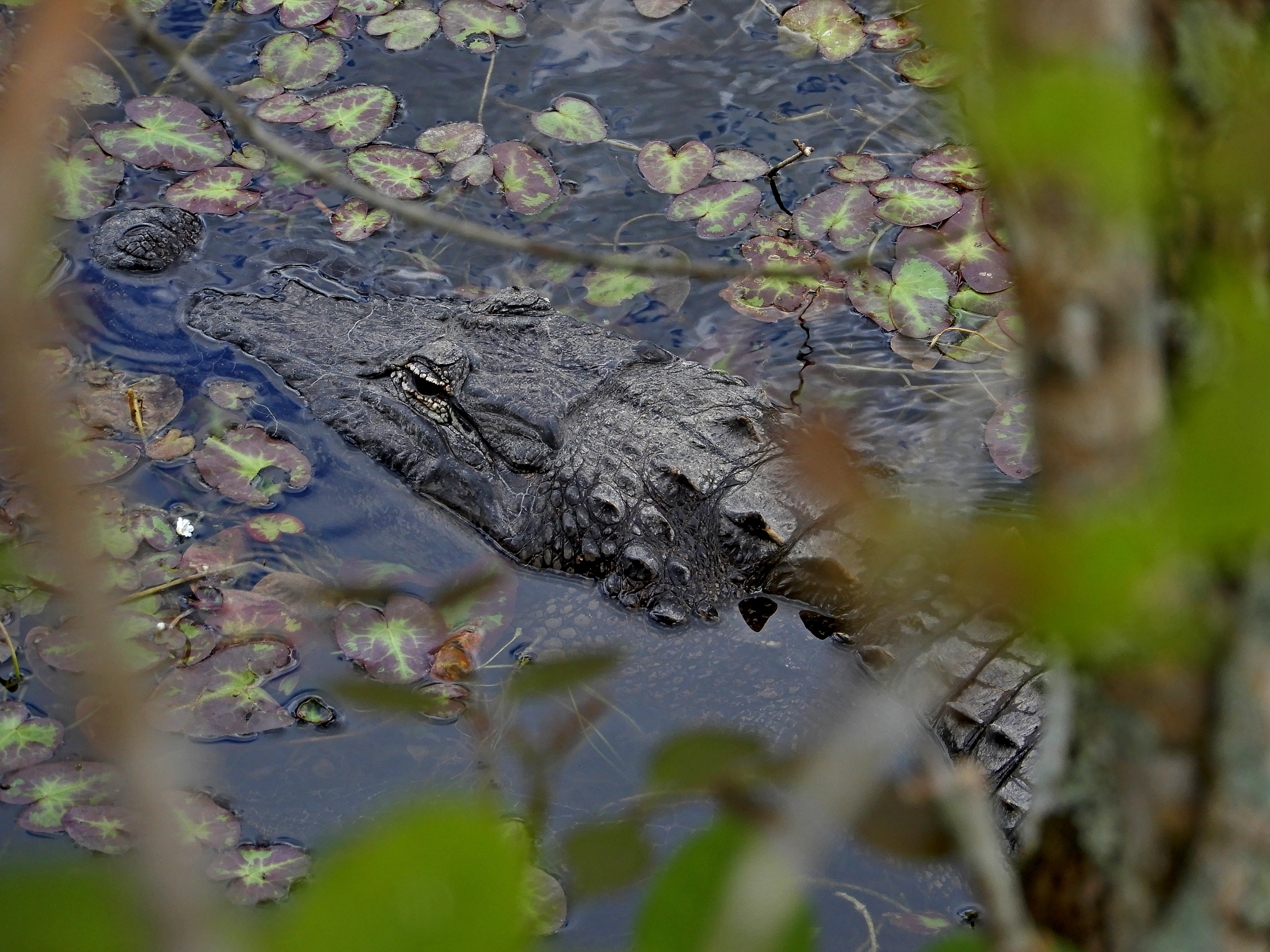
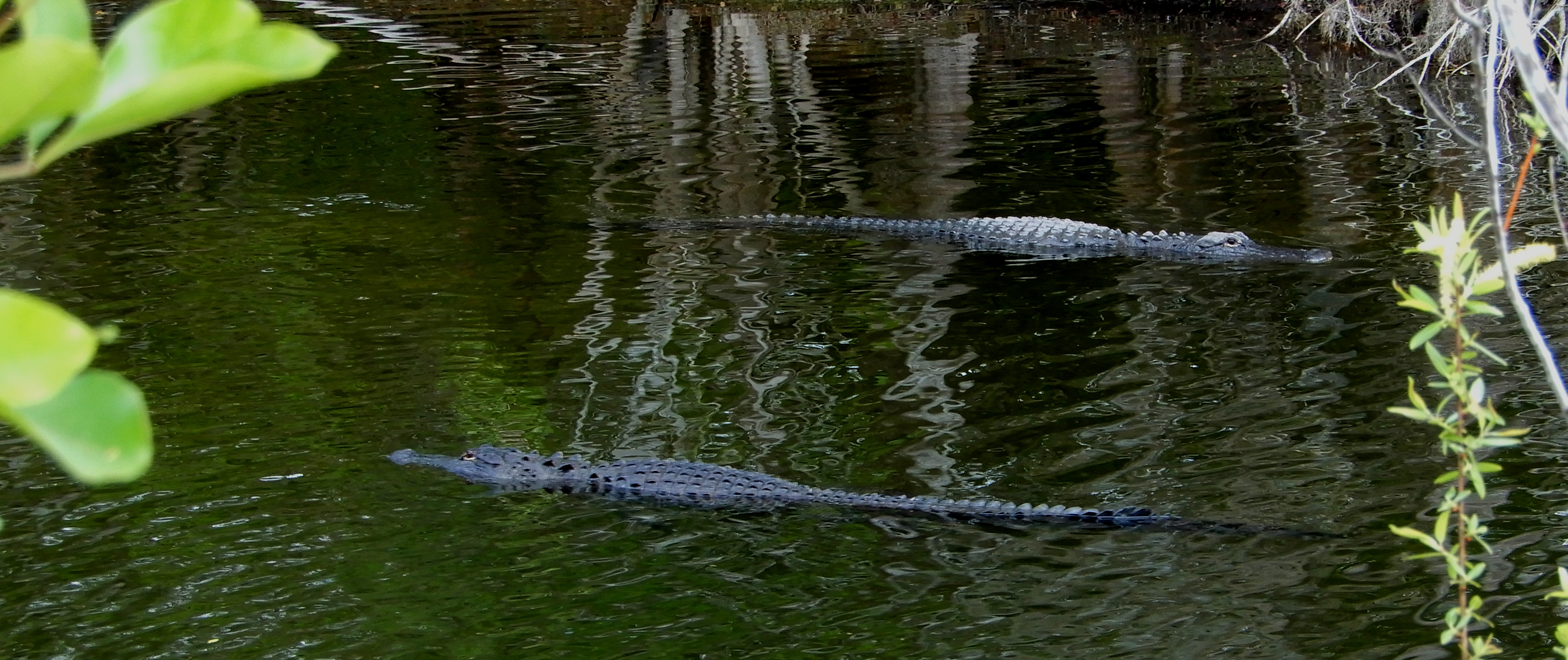
A Tri-Colored Heron stalks its prey. Big Cypress National Preserve, February 2026.It’s not “oh, look, there’s a gator.” It’s more a find-the-gator experience. Sure they’re swimming up and down the minor canal you’re looking at. Can you spot the one hanging out under your nose? Big Cypress National Preserve, February 2026.“like ships passing in the night…” Some gators were easier to spot. Big Cypress National Preserve, February 2026.
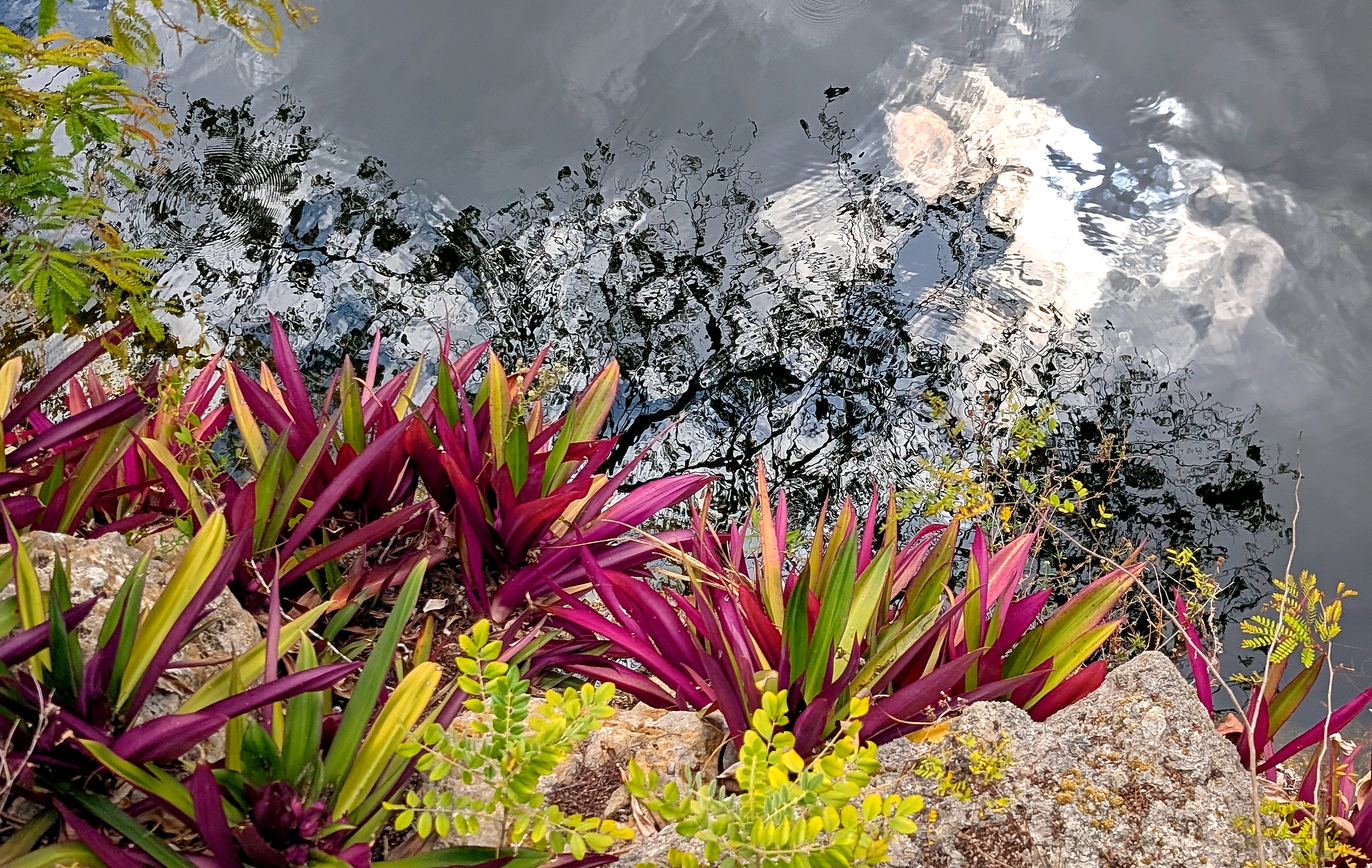
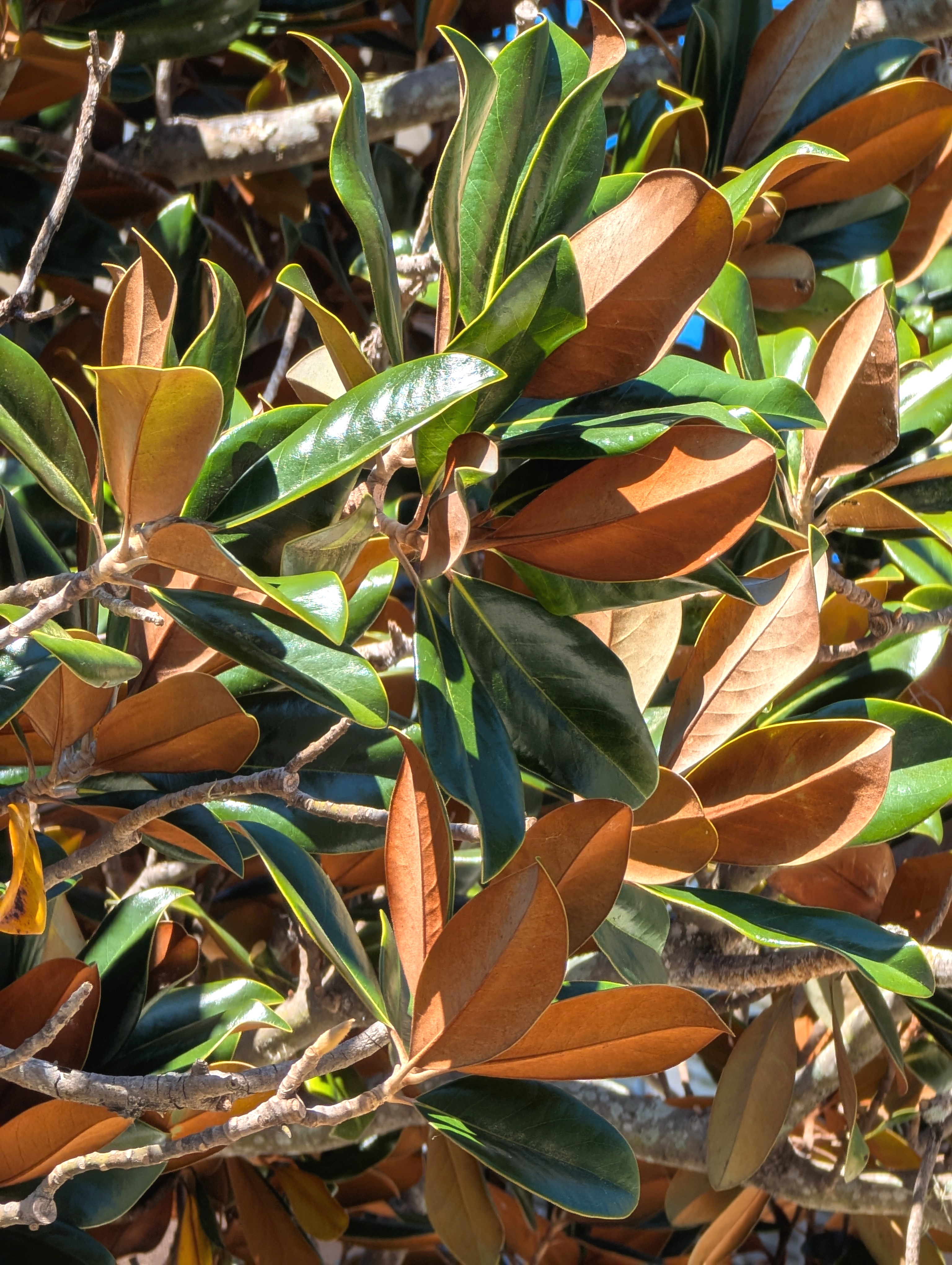
Sometimes, though, the subtropical plants grab one’s attention…
“Moses-in-the-cradle”??? That’s what my plant ID program says, but it seems doubtful. Regardless, it created a stark contrast to the water’s edge. Big Cypress National Preserve, February 2026.
Technically, the final photo of the plants was taken at the Oasis Visitor Center for the Big Cypress National Preserve. If you’re traveling “to see the Everglades,” I would highly recommend US-41 and the Big Cypress route, because it’s basically the northern environs of the Everglades. When one leaves the eastern boundary of the preserve, it’s less than a mile before the Everglades’ Shark Valley Visitor Center. As good as our day’s beginning had been, we had much to look forward to, it turned out.
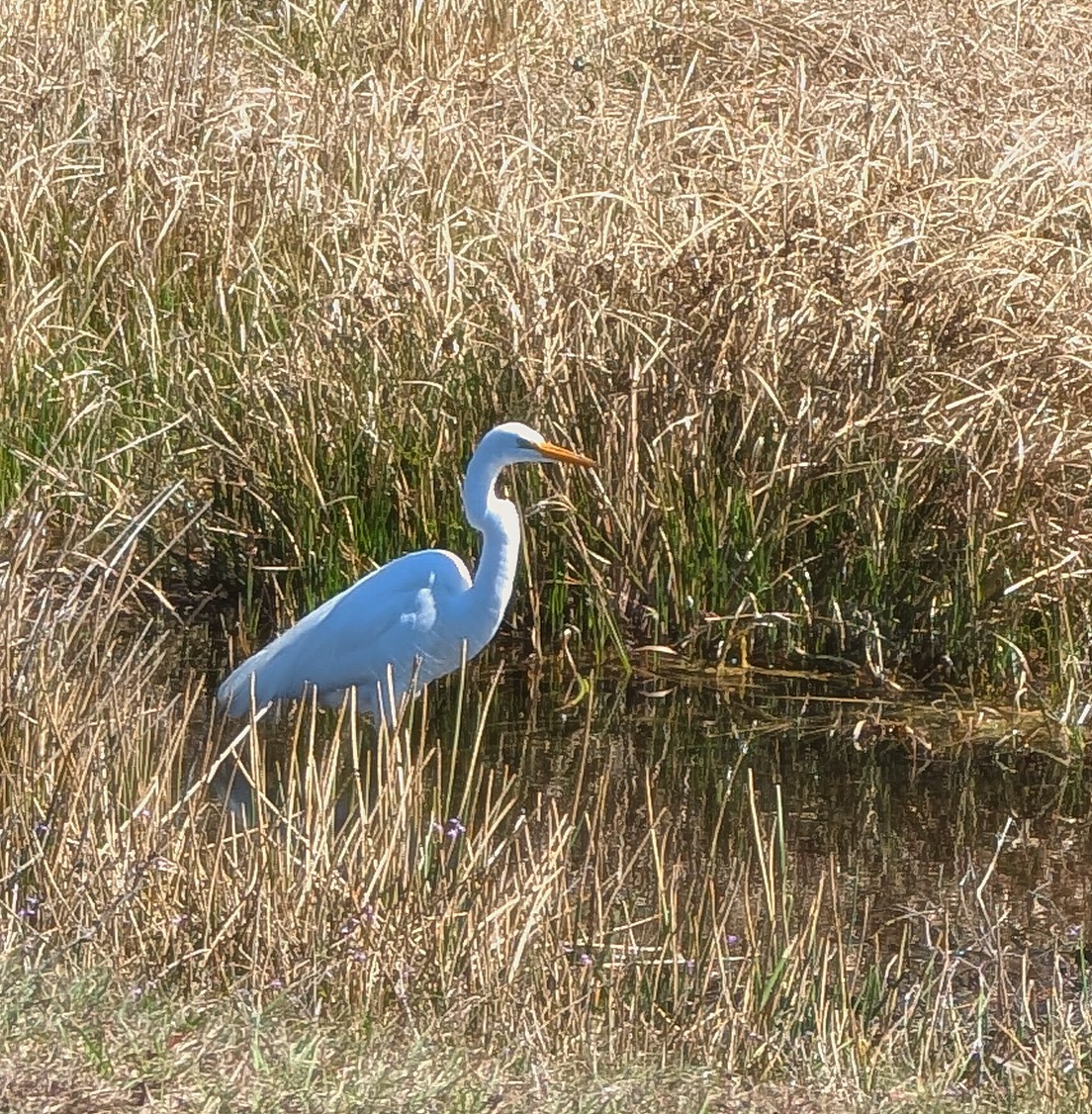
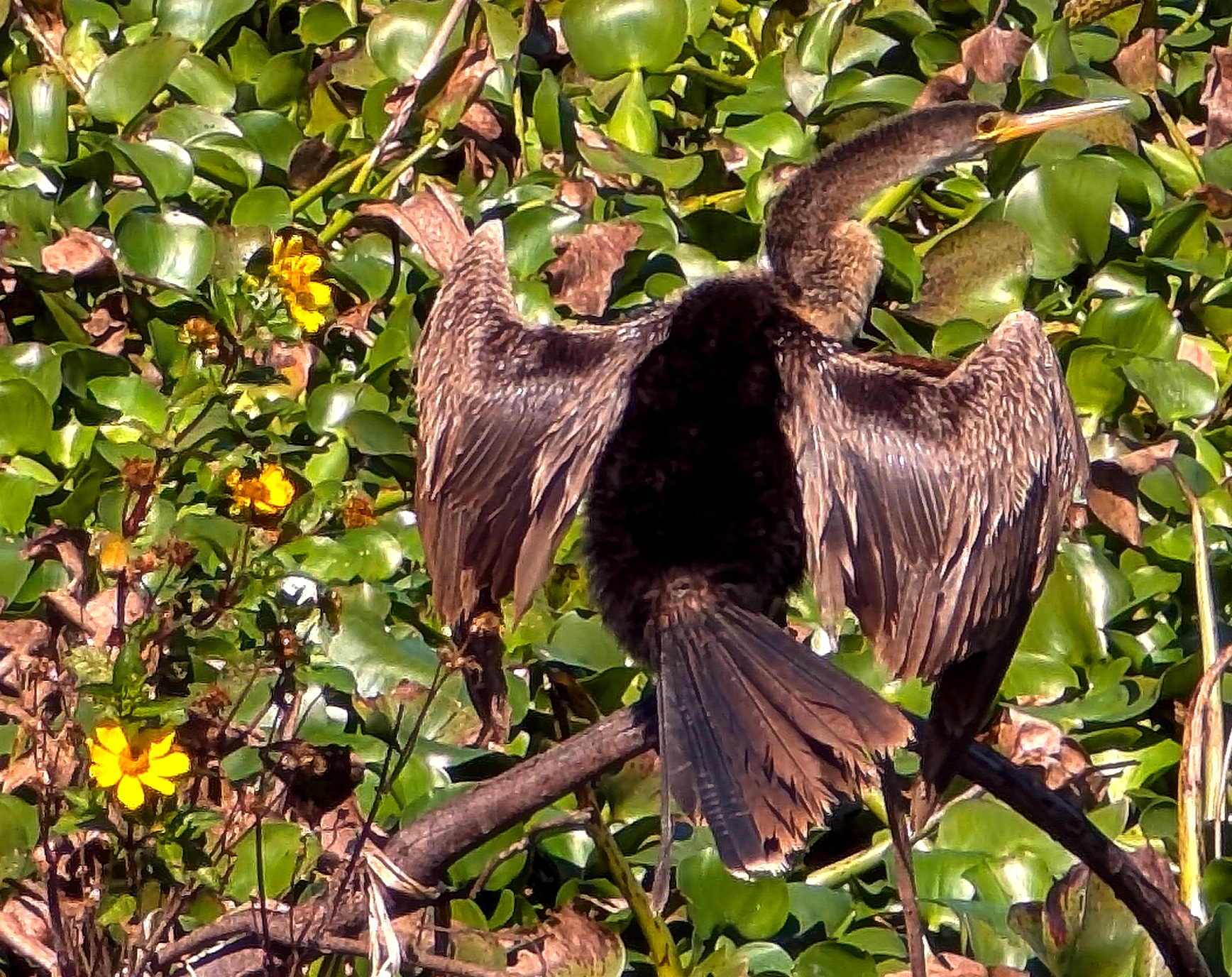
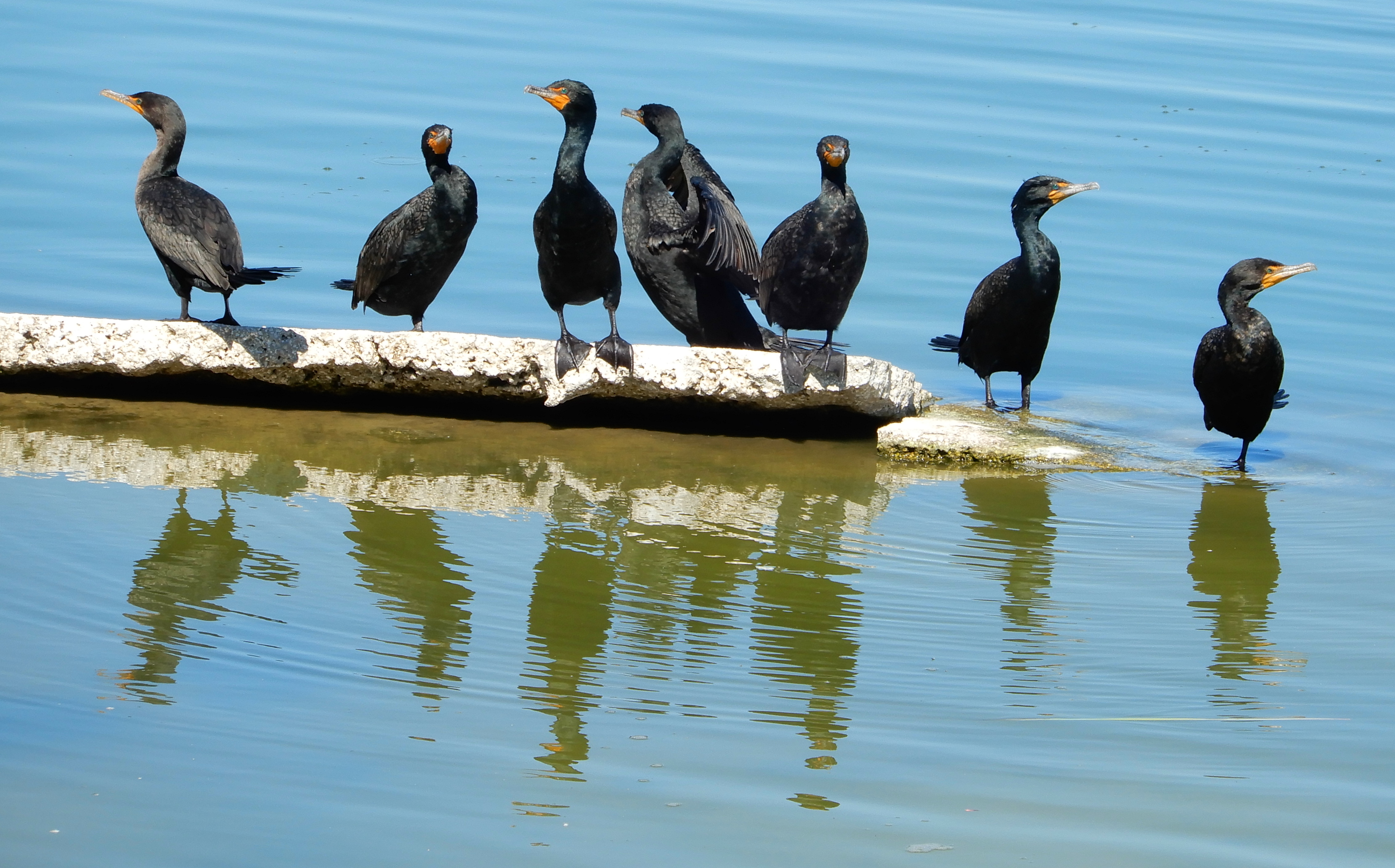
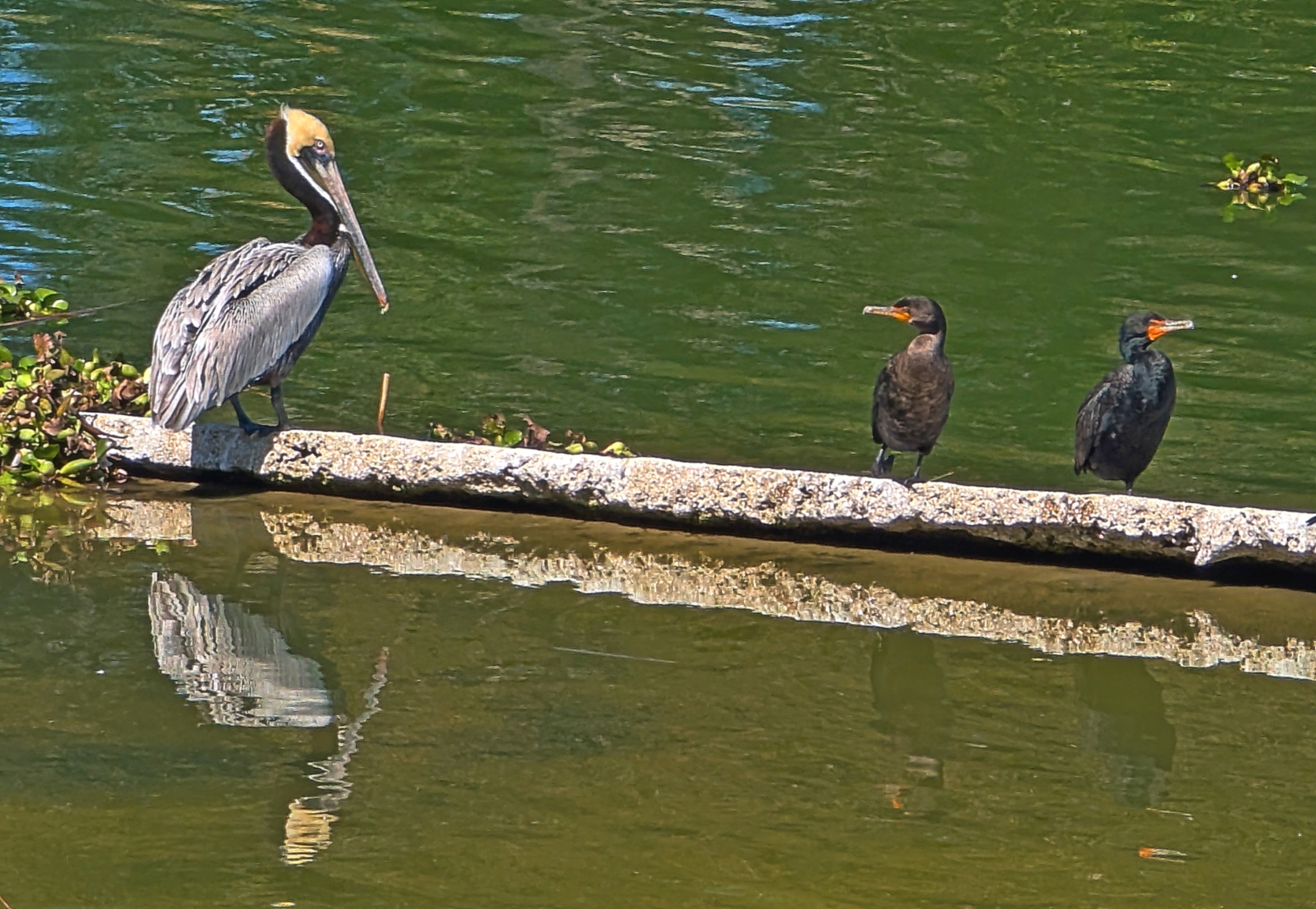
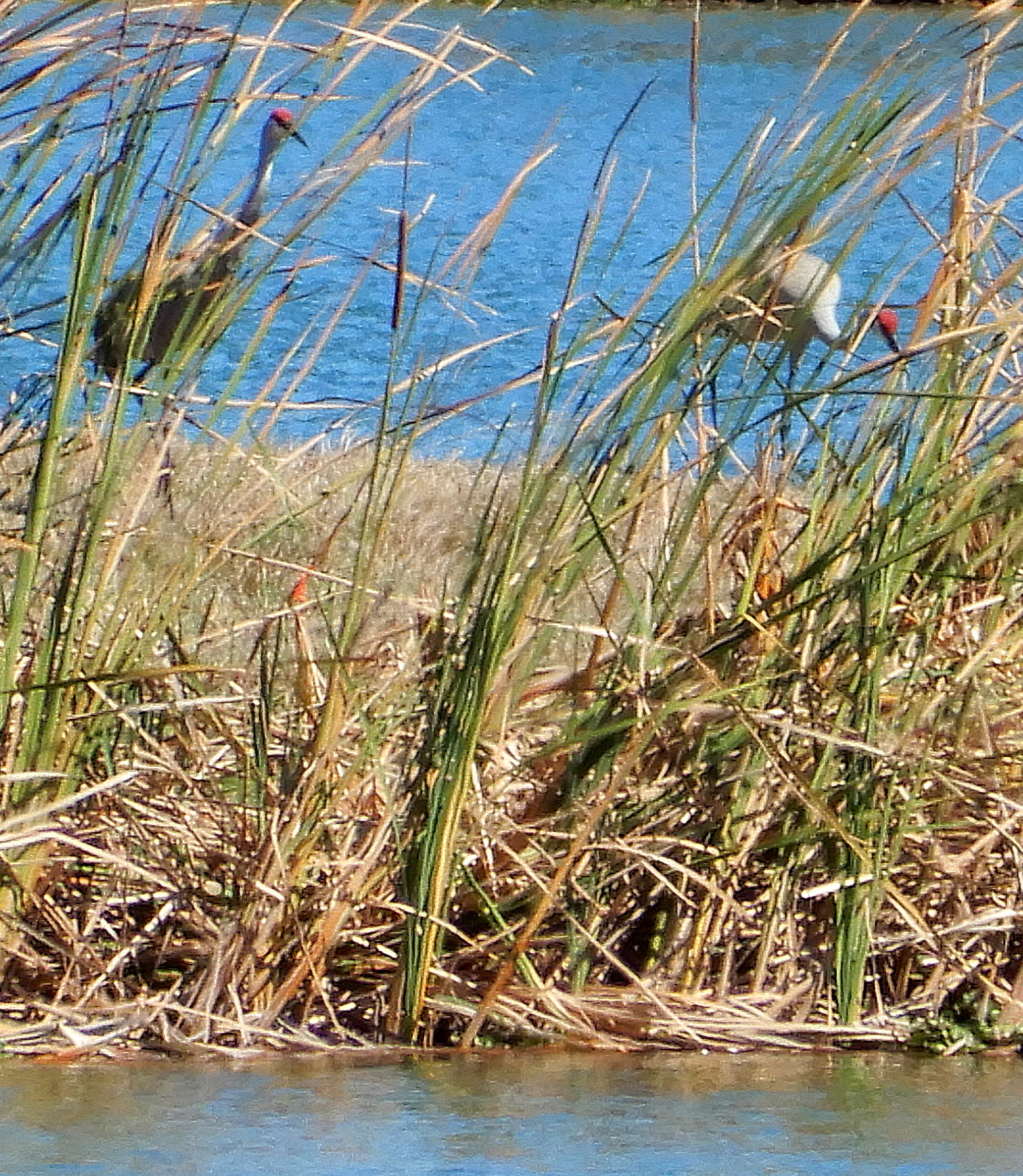
A wrong turn turned right when I spotted this Great Egret. Riverview, FL, February 2026.Arriving at my destination, a reservoir in land known as the Leyke Ranch, I saw an old friend: the Anhinga, seen here in a typical sunning-of-the-wings pose. A strange, almost exotic bird which frequents Florida but gets up to NC only rarely. February 2026.A short distance offshore from the Anhinga were the similar-looking cormorants. These Double-crested Cormorants reminded me of turtles all lined up on their log…even if one end of it was sinking into the water! February 2026.A Brown Pelican flew in to join the cormorants. February 2026.I heard a strange call as I left the reservoir, and turning toward it, I saw two large birds on the island in the middle of the water. I thought they looked like cranes and my sister-in-law identified them as Sandhill Cranes which are nesting out there. Way cool. I’ve seldom seen these birds. February 2026.
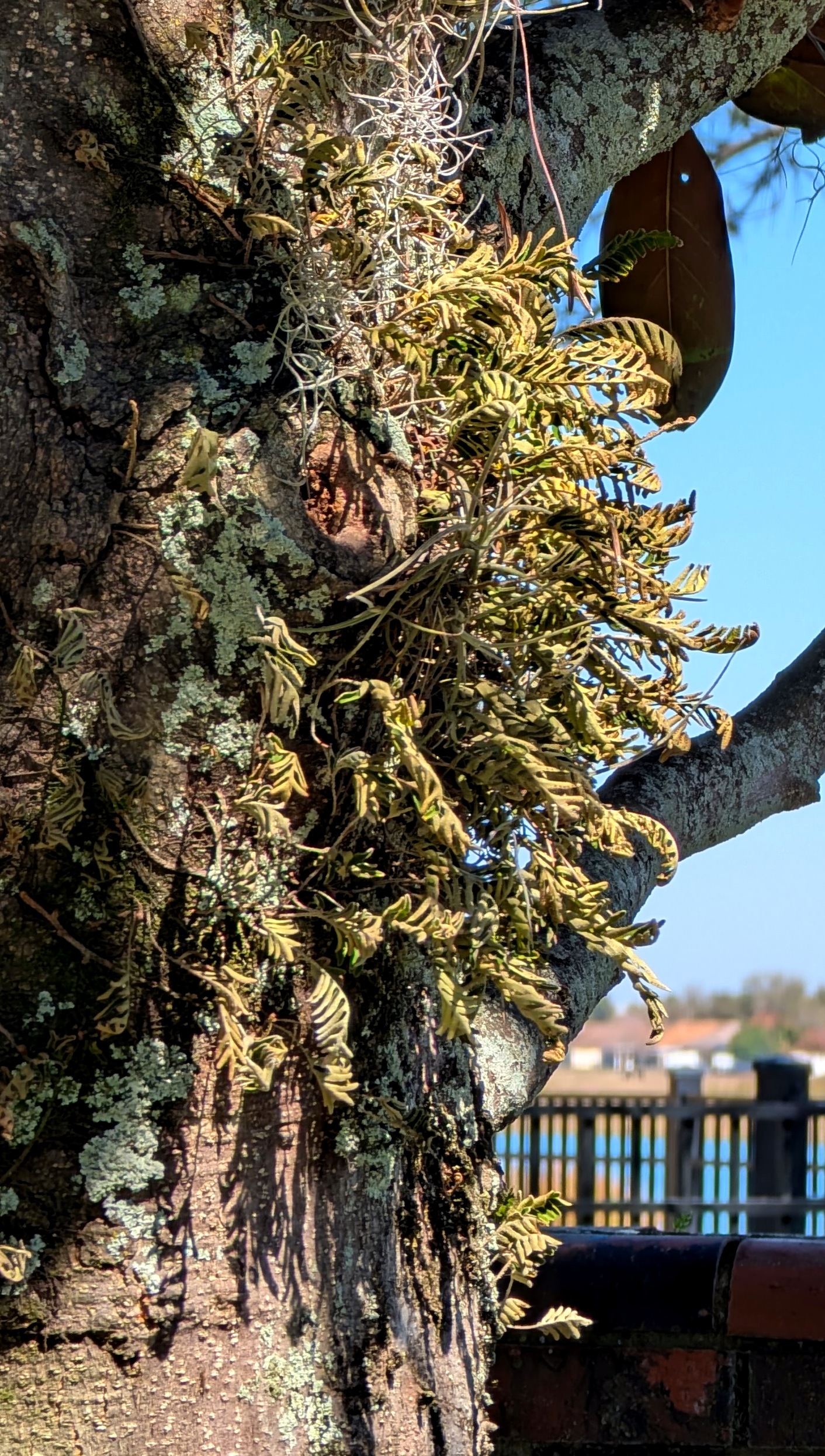
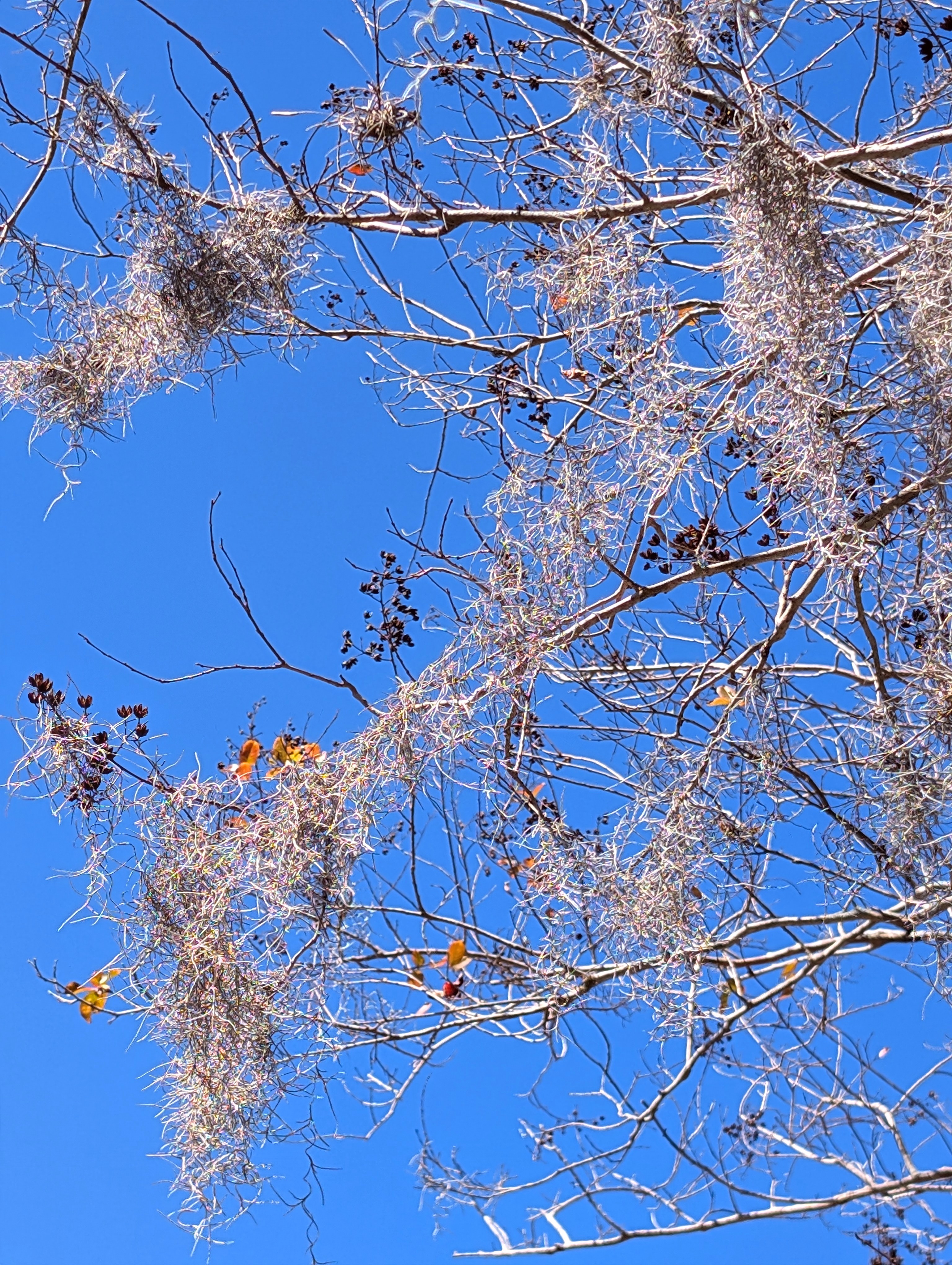
On my return walk I noted several interesting looking plants. Altogether a very nice if cool time of it. (It dipped toward the 30’s here this morning!)
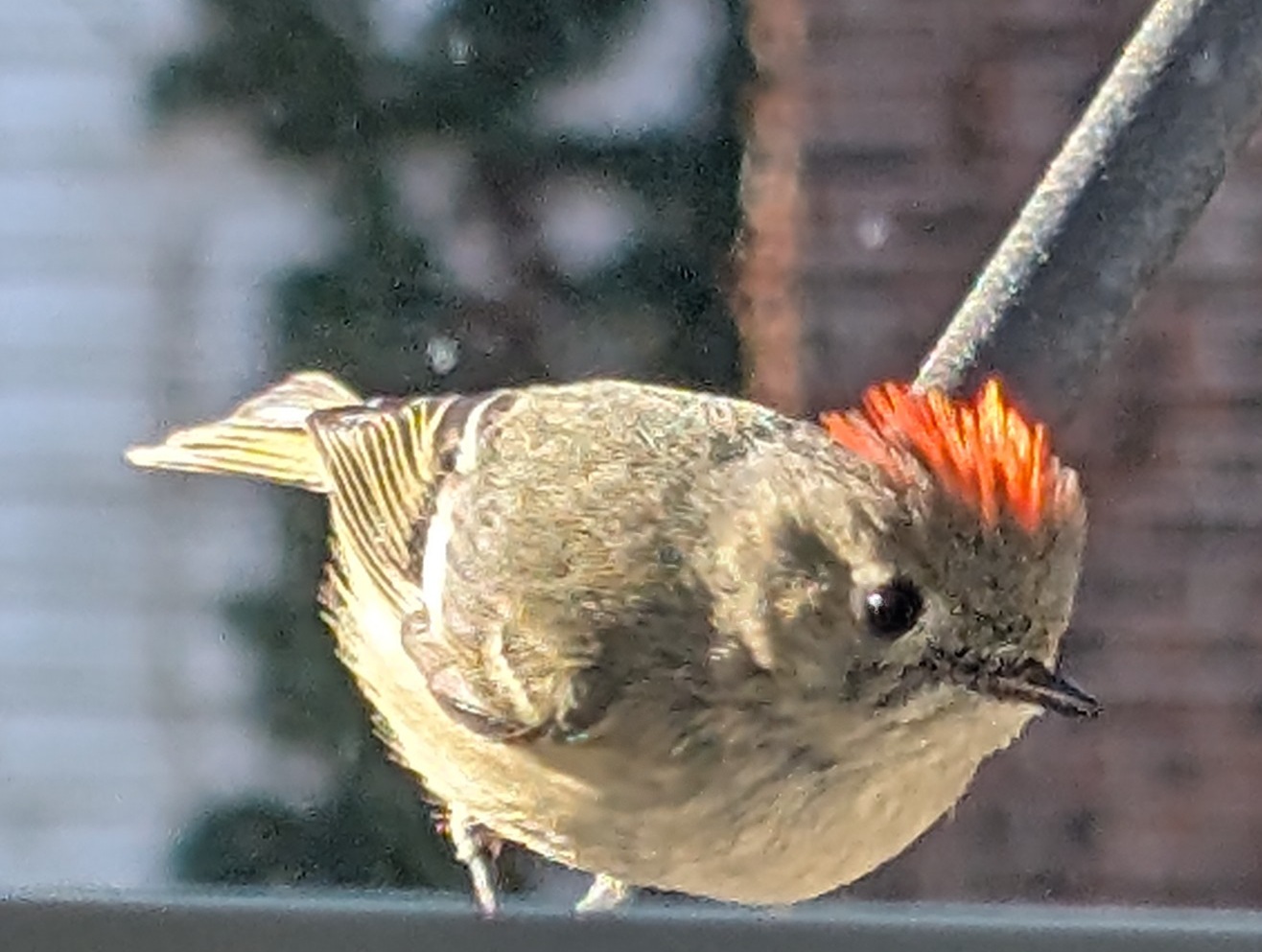
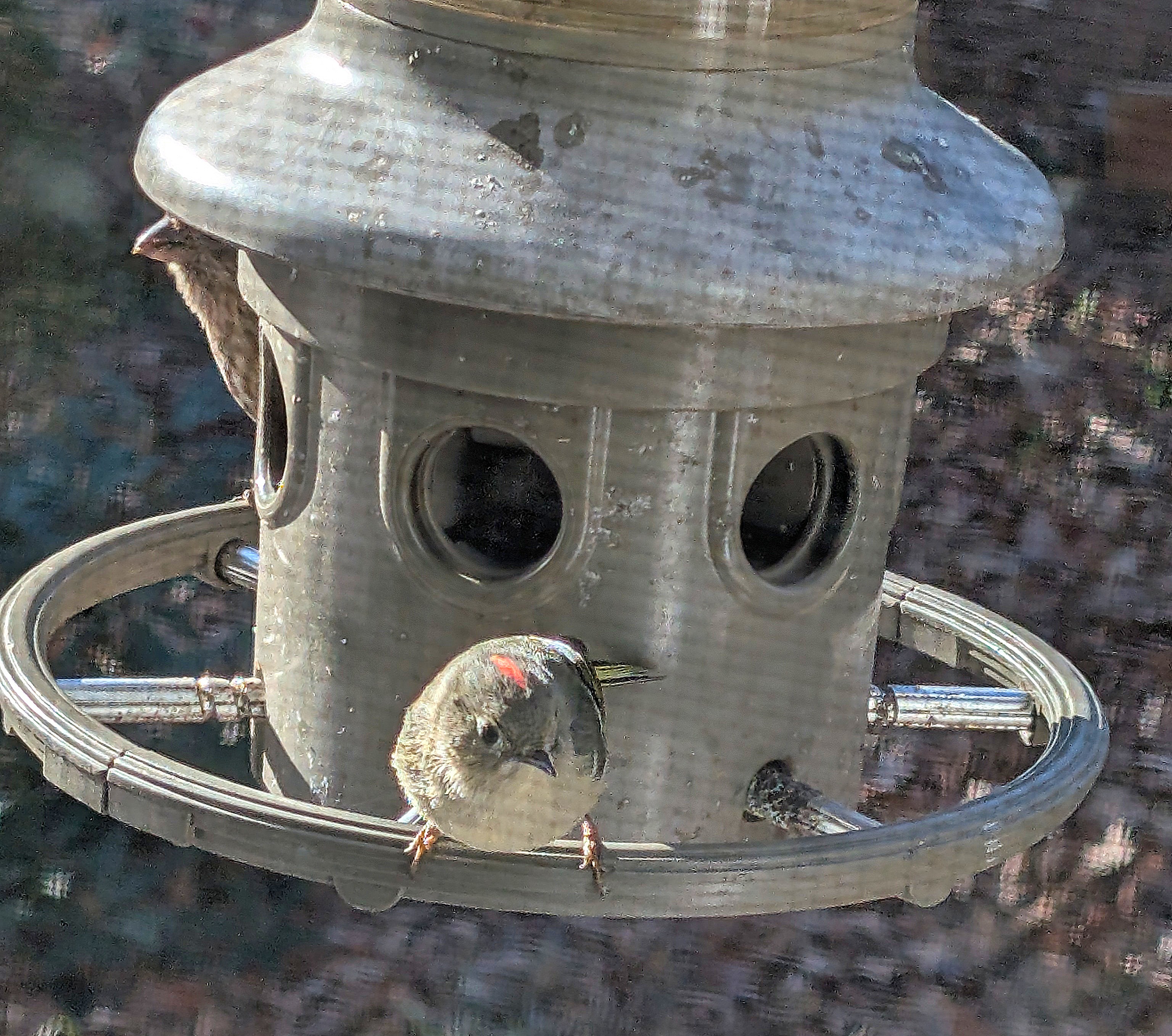
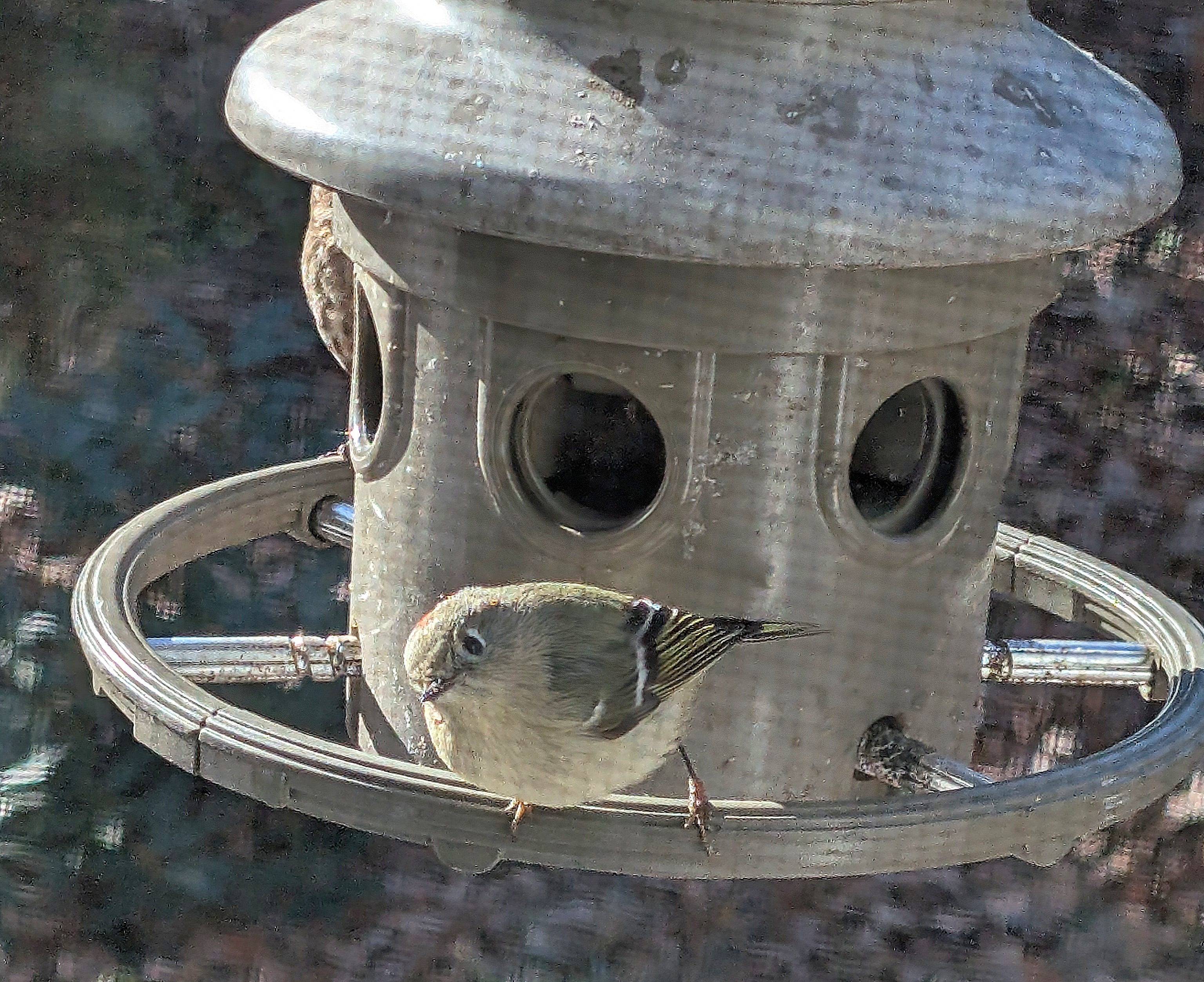
I finally identified a little bird this morning which had been zipping all around our feeder while ignoring it all the same. He mostly seemed interested in getting into our kitchen. The cool thing about him is the crown: when a bit agitated, he flips it up as it is in the photo above. When he’s calmer, it’s down and more difficult to see, as shown below.
Ruby-crowned kinglet with crown feathers in the ‘down’ position. Both photos shot less than 60 seconds apart. Unless you are looking down at the bird, the red crown is very easy to miss. At first I thought I was looking at a warbler. (The bird is barely 4 inches long.) January 2026.
I planned our cruise on the Rhine River to celebrate our 30th wedding anniversary, and redeem the ruination of our 25th. I purposefully reserved a cruise which docked at Strasbourg on our anniversary, looking forward to all it promised. The Year 2020 had teamed up with my back to scuttle our (limited) plans for our 25th. As that day dawned, I experienced a spasm in my back which necessitated taking an emergency muscle relaxant I keep on hand for these occasional problems. A fine dinner which we had planned to cook for each other became a take-out pizza, and for my wife, some wine. I crawled into bed early. Therefore, 2025 promised to atone for all of that. The pandemic had subsided, we had our health, and, well, what could go wrong? The trip had far exceeded our expectations for four days.
The day promised much: Strasbourg with its cathedral and its amazing clock where I planned to walk inside of it and marvel. Then my wife croaked from bed, “I don’t feel well.” We traded our anniversary cards, and she dragged herself out to breakfast. I chose to forego the group tour of Strasbourg on the French side of the river. “I can catch the afternoon shuttle back into the city,” I told myself. “At least I can see the cathedral and that famous clock.” I tucked my wife into a deck chaise to soak up some sunshine and spent a few minutes observing the begging swans and a heron across the river…
Swan at Kehl’s riverfront park. August 2025.
Finally I decided to go wandering. I stopped first to admire the mooring strategy of our ship, the Hlin, wondering still why the woman at the guest services desk couldn’t explain to me why our ship’s bow pointed southward when we were cruising northward. Later I learned from our “hotel manager” that the captain turns the ship around when docking so that the bow points upstream whenever the river runs high and the current proves strong.
The good ship Hlin pointing south as I photographed it looking to the north. Note the pedestrian bridge supports in the background. They figure into my afternoon adventure. August 2025.
I watched river ships carrying freight along the Rhine. Gases, coal, cars, and livestock all sailed past me. As I walked south, the river to my right and the park to my left, I saw a strange tree not far ahead. It proved to be a manmade thing, demonstrating the Germans’ ingenuity while reinforcing stereotypes about their precision and exactitude. The ‘tree’ looked real enough, and the whimsy of opening a neighborhood for sociable birds seemed admirable, but I couldn’t help noticing how the houses spiraled around the trunk in a near-perfect corkscrew. Other pedestrians paid it no mind, apparently inured to its presence.
I reversed course and headed north. The children’s waterpark to my left had become a bit too boisterous for me.
Bird treehouse. Kehl, Germany, August 2025.
I soon encountered a small marker in the ground, its painted message cracked from the sun’s rays and the weather, modestly announced, “Biblischer Garten/Jardin bibliqu” the remainder of the French title cut off by the sign’s erosion. I intuited it announced a Bible Garden and intrigued, set off on the graveled path. I learned at the end of the path its plan had been for residents to approach the river from land not vice versa; I had walked it backward. It made little difference. Each stop along the path—there were 17—announced an important aspect of the Judeo-Christian Bible, and not entirely the ones I expected. Yes, The Resurrection received a marker, and so too Pentecost but The Field of the Dead? And some I didn’t understand until I could translate them. (I didn’t think to use my smartphone.) Here are a few:
Das Totenfeld / Les ossements desséchés or in English, The Fields of the Dead. Biblischer Garten, Kehl, Germany, August 2025.
I especially like how The Last Supper rose up out of the shadows in my photo and how wheat had been planted in support of the marker.
Das Letzte Abendmahl / La Sainte Cène i.e., The Last Supper rising out of a field of wheat. Biblischer Garten, Kehl, Germany, August 2025.Crossing the Red Sea, Biblischer Garten, Kehl, Germany. August 2025.
The marker for Paradise evoked humankind’s ignorance of what is to come: it consisted only of a shiny cylinder rising out of a simple terra cotta marker similar to the others. A separate, hexagonal marker had the names of six different churches on it of varying denominations. I realized they had paid for the installation and marveled how such a thing could be placed in what seemed to be a public park, given the “separation of church and state” we have in America.
I returned to the Hlin and my wife, took her to lunch on board, and then tucked her into bed because she felt even worse than before. For my part, I planned to catch the 2 p.m. shuttle to Strasbourg. One learns to be prompt on board, so I gathered in the ‘lobby’ of the ship at 1:55 to walk with the other guests to the bus which we had been told would take 15 minutes. Remember that pedestrian bridge in the background of the photo above? That was the first bridge. The bus would be parked at the next bridge downriver. When I arrived at the gathering point, I surmised something might be amiss when I found myself alone with the guest services representative. She informed me the bus left at 2 p.m., not the group of guests walking to it. “But you still might be able to make it,” said the chipper (and overly optimistic) young lady. Google Maps tells me the hike should take twelve minutes; I had five. The distance (900 meters) equates to more than a half mile. I tried, really I did, but I simply can’t walk six miles per hour, and at my age and physical shape running isn’t an option. I missed the bus. I watched it/them drive across the bridge when I still needed about two more minutes.
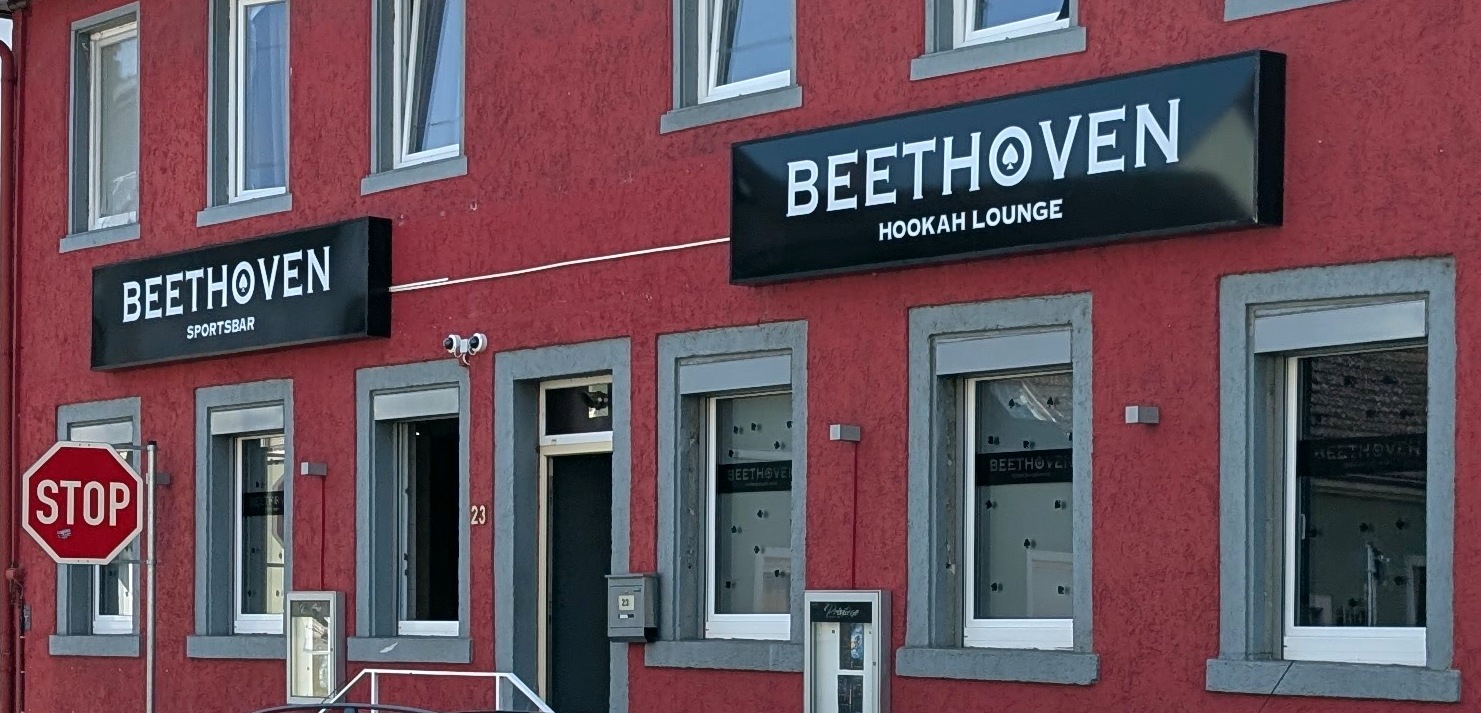
Dejected, I attempted to see the upside. Yes, I had just force-marched myself through 92+ degree weather (Fahrenheit), but my wife might appreciate some medicines, right? And the steward for our deck had mentioned a pharmacy very close to the ship. I walked toward the center of Kehl. Along the way, I encountered a very, very strange sign:
Yes, just STOP. I do not think Beethoven would approve. Kehl, Germany, August 2025.
I located the pharmacy. Kehl is charmingly small (38,000), similar to so many small cities in America. Its downtown proved easily negotiable, and my first encounter with a European pharmacy enlightening. The ability to get a physician’s assistant-grade consult from the clerk impressed me. I returned with aspirin and throat lozenges. As I walked back to the ship, not sure exactly where I needed to go, I realized I would need to drop off the meds, turn around, and immediately march my way back across the park again to catch the final bus shuttle at 3 p.m. My first exercise session in mid-90’s weather had caused my shirt to stick to my back and chest. I realized some things are not to be. My wife and I would need to return, together, to experience Strasbourg as we had intended. Meds delivered, I grabbed my tablet, retired to the lounge for my first beer, and fired up an eBook. Later, the setting sun seemed to say, “You did alright today, sir.”
The sun sets over Strasbourg, France. August 2025.
Vacationing has meant several things over the years. As a child it meant adventure. Dad would plan a two-week sojourn through the beauty of the American West, plotting the journey for months, and utilizing guidebooks (well, the AAA one) to find both motels and sights to see along the way. By the time I reached “summer job” stage and such vacations no longer were possible, we had seen most of the national parks from the Rockies westward, plus the Grand Canyon, and the tourist hot spots of Southern California (Disneyland, the San Diego Zoo, Knott’s Berry Farm, etc.). We visited San Francisco in 1968 where I saw my great-grandmother on her deathbed and hippies in The Haight. And we always tried to loop through either Seattle or Woodburn, OR, to visit one set of grandparents. Back then, vacationing meant lots of hours in a car reading or imagining things as the countryside went by. It meant rolling with the punches when the road Dad wanted to drive was under construction or the motel he wanted looked better suited to hookers than small children. It mostly meant seeing state after state, park after park, city after city which I had never seen before, and which in my short life presented amazing memories and lessons.
I couldn’t capture that as a younger adult. Vacations at first mostly entailed going home to visit my parents and my friends. I tried a brief camping trip along the Snake and Salmon rivers, but the spectacular views couldn’t make up for my inability to build a fire and thereby have any food to eat. (Or perhaps one could say, the views couldn’t make up for my ineptness as a camper.) A bit later as a newly wedded teacher, summers were for further training, loafing at my in-law’s lake cabin a couple times, and once or twice attempting to emulate my father’s grand tours of the West. I thereby got to see parts of Arizona south of the Grand Canyon for the first time and see some lesser known but equally impressive sights. I explored my own state, Washington, better. The 10 to 11-week length of our summer breaks diluted the compressed wonder of a two-week vacation.
Life changes and a relocation to greater Philadelphia put the kibosh on traditional vacations. Just living there was a new experience. After two years there I discovered a new type of vacation which brings a different kind of satisfaction: the introductory tour. I had met a new love (who married me the next year), and I had entered corporate America where two weeks is the only significant time off you get. I took this woman on a whirlwind nine-day tour of Washington and meet-the-folks. My bride-to-be loved the state and my parents loved her. I repeated the tour in 2017 for a dear couple of friends from North Carolina.
[Disclaimer time: despite the fact I’ve lived in Washington for only four years since I left it back in 1992, I still consider it one of the best places on Earth. My values have to do with variety. In my mind only California comes close to the diversity of climactic zones and has the varied population densities ranging from the Seattle-Tacoma-Olympia wash of people to areas where it’s difficult to find the next house from the one you’re standing beside. Want desert? Check. Alpine? Check. Rainforest? Check. Scablands, Arctic, Temperate forest? Check, check, and check.]
Less than a year after our marriage in 1995, we vacationed to New Mexico for two weeks. We wandered from Albuquerque north, were unimpressed with Santa Fe and hightailed to Taos. In ’95 it had started to build up, but only a little. We stayed at an honest-to-God auto court, and breakfasted at a old West-style cafe on the square. (Revisiting in 2022 saddened me when I saw all of that charm washed away by touristy stuff.) That second week of the vacations, all my tensions dropped away as we shot into southwestern Colorado for two nights before striking to southern NM and the Carlsbad Caverns. Until a couple weeks ago, I held this up as our standard of Best Vacation Ever.
Then we cruised down the Rhine River for eight days on the Viking Hlin, and visited Basel, Switzerland, and Antwerp, Belgium, at the beginning and end of the voyage, respectively. Viking is known for catering to old folks like us (no one under 18 is allowed) and for its all-inclusive approach. We could have been very happy just eating the food, drinking the beer and wine with lunch and dinner, and taking the included tours, but it made sense for us to add two optional tours, take care of gratuities in one tidy little package, and buy the Silver Sipper beverage package so that we could drink beer, wine, and cocktails just about any time we wanted. Given the slant toward the retired and soon-to-be-retired, I must say my initial introduction to the ship gave me a jolt:
“Welcome aboard” kinda takes on a whole new meaning with a tag like that! August 2025.
I’ve nothing against people living the love lives they desire, but still I was thankful there occurred no hot gay sex (that I know of ) on the Hlin. It reinforced my initial reaction after two nights in Basel before boarding, that European cities seem to take a more blasé view about tagging. There seems to be an unwritten rule that it isn’t done on cathedrals and other historical buildings, but other than that…sure, indulge yourself.
As with my Hawaii series [tag: Hawaii] and my Virtual Vacation series [tag: Virtual Vacation] about Michigan and Ohio, this will be a lengthy series of posts recounting how two neophytes who never traveled abroad for pleasure decided to do so in retirement. For now, I’ll end with two photos about our first few hours onboard.
The appearance of swans became commonplace by the end of the cruise. They paddled up for treats just as ducks do in cities throughout the United States. Rhine River just downstream from Basel, SW. August 2025.
On the first night I met one of my new friends: Köstritzer schwarzbier. If you think you don’t like dark beers, give schwarzbier a try. Light-bodied, crisp, but it has a nice roasted taste lacking in traditional lagers. One of the handful of beers offered on board. I wish there had been more! And yes, Europeans are civilized: each beer has its dedicated glass. Viking Hlin , August 2025.
Eastern honeybee (?) on just opened sunflower. July 2025.
I feed birds, mostly black-oil sunflower seeds. This year it looks like I’ll through about 400 pounds of them. Apparently one got planted in our newly landscaped front yard, and there amid many of the similar-spiky Obedient plants was this lone sunflower. I love sunflowers. Therefore, I got pretty irritated when something, probably a deer, nipped off the top where a bud had been forming. The joke’s on the deer, though. By trimming the plant, it put up TWO stalks from where it had been lopped, each of which had buds…until one burst open on Independence Day.
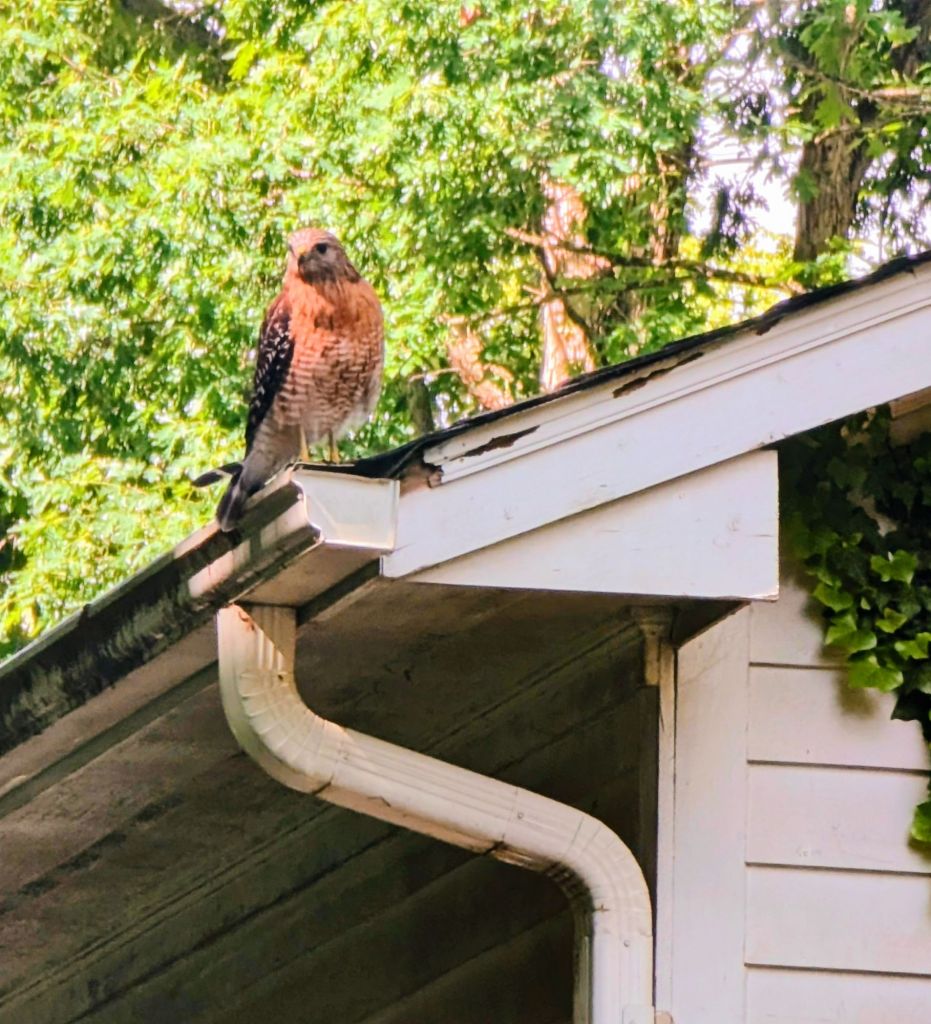
Five days ago this red-shouldered hawk sat in our front yard dogwood, just ten feet or so outside our kitchen window. For a few minutes it surveyed the landscape. Upon finding nothing to eat, it swooshed off. March 2025.
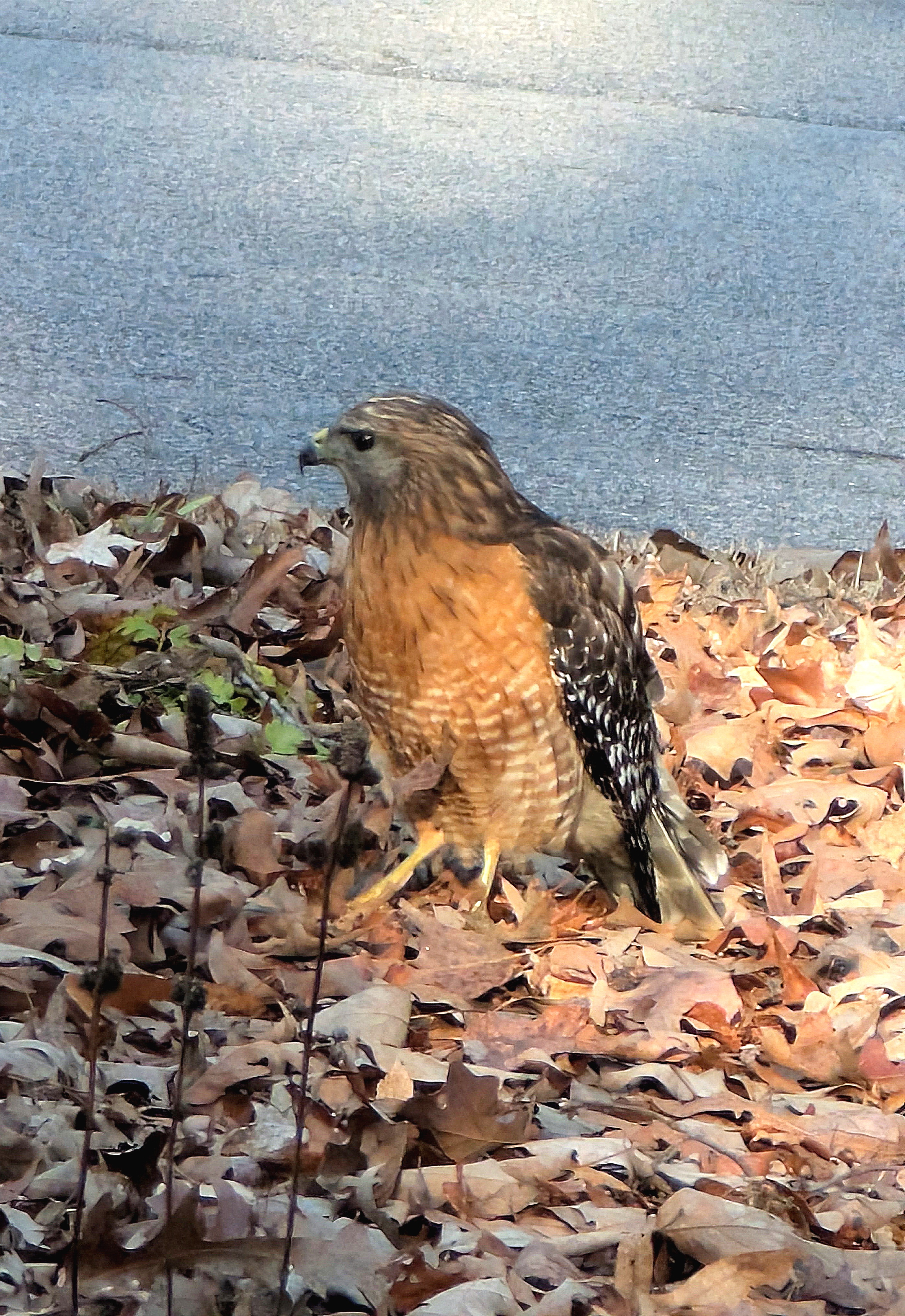
Just before breakfast today we looked out to the front yard and watched a Red-shouldered hawk taking a small rodent for its breakfast. It took a couple of minutes. Leaving the leaves: good idea. That’s the street in the background. Due to last fall’s landscaping, the front yard is crowned, hiding the sidewalk and the parking strip.
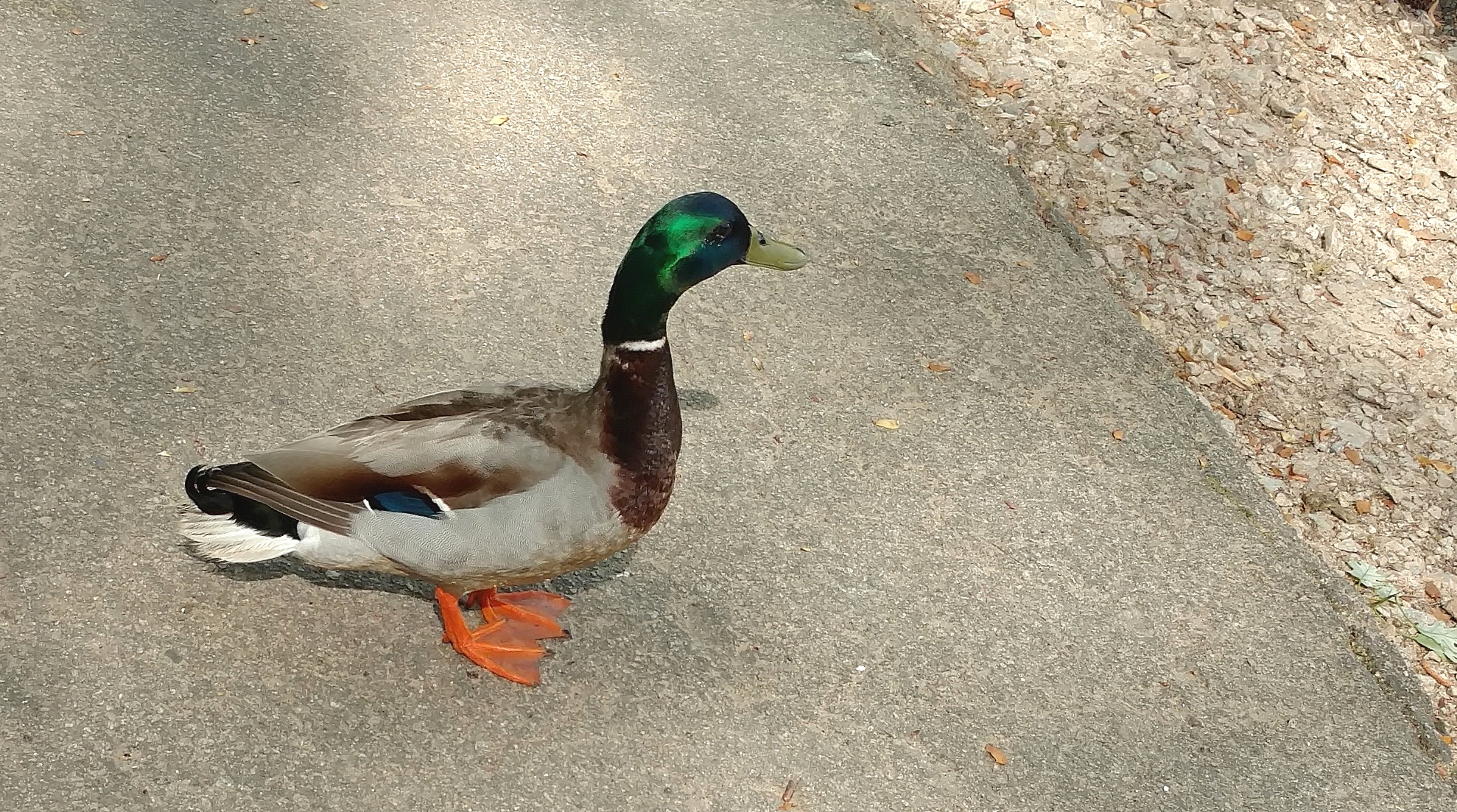
… I would serve a dish of duxelles, a French term referring to a mince of mushrooms, onions, herbs and black pepper which is then reduced to a paste. I’d add cream and a dash of madeira. I would serve this as a two- to three-inch smear over sliced breast of duck. I’d call it …
Dux’ and Quackers
[Patrons will kindly stop throwing bottles at the stage.]








 all the voices in my head