The perfect vacation

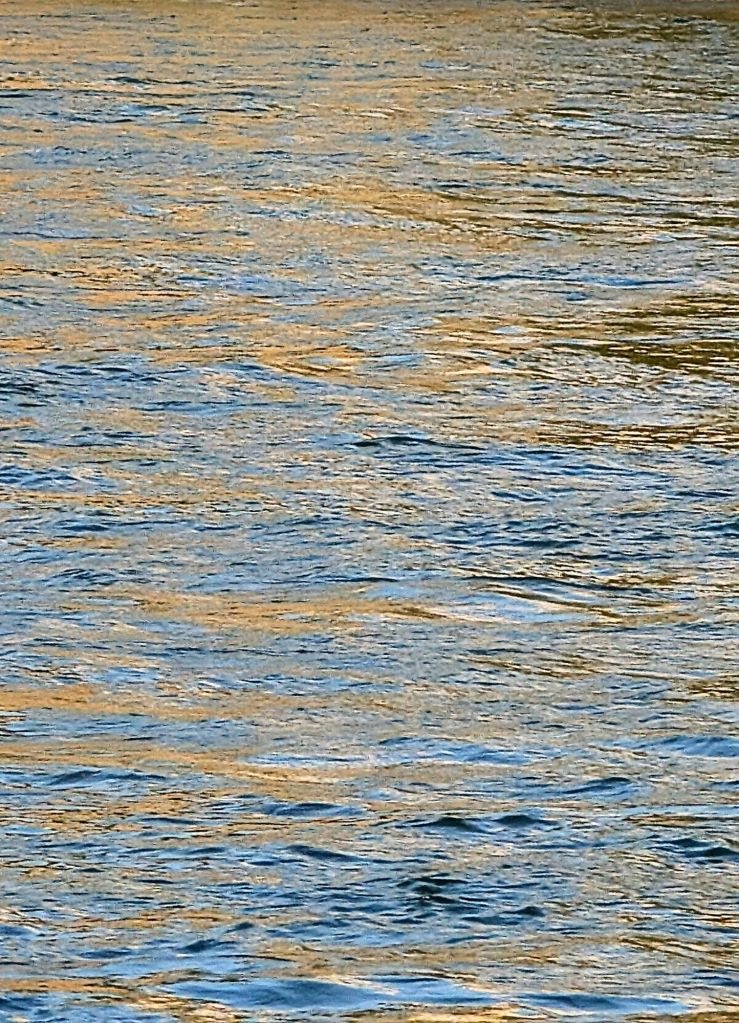
Rhine River at Koblenz, Germany. August 2025.

Vacationing has meant several things over the years. As a child it meant adventure. Dad would plan a two-week sojourn through the beauty of the American West, plotting the journey for months, and utilizing guidebooks (well, the AAA one) to find both motels and sights to see along the way. By the time I reached “summer job” stage and such vacations no longer were possible, we had seen most of the national parks from the Rockies westward, plus the Grand Canyon, and the tourist hot spots of Southern California (Disneyland, the San Diego Zoo, Knott’s Berry Farm, etc.). We visited San Francisco in 1968 where I saw my great-grandmother on her deathbed and hippies in The Haight. And we always tried to loop through either Seattle or Woodburn, OR, to visit one set of grandparents. Back then, vacationing meant lots of hours in a car reading or imagining things as the countryside went by. It meant rolling with the punches when the road Dad wanted to drive was under construction or the motel he wanted looked better suited to hookers than small children. It mostly meant seeing state after state, park after park, city after city which I had never seen before, and which in my short life presented amazing memories and lessons.

I couldn’t capture that as a younger adult. Vacations at first mostly entailed going home to visit my parents and my friends. I tried a brief camping trip along the Snake and Salmon rivers, but the spectacular views couldn’t make up for my inability to build a fire and thereby have any food to eat. (Or perhaps one could say, the views couldn’t make up for my ineptness as a camper.) A bit later as a newly wedded teacher, summers were for further training, loafing at my in-law’s lake cabin a couple times, and once or twice attempting to emulate my father’s grand tours of the West. I thereby got to see parts of Arizona south of the Grand Canyon for the first time and see some lesser known but equally impressive sights. I explored my own state, Washington, better. The 10 to 11-week length of our summer breaks diluted the compressed wonder of a two-week vacation.

Life changes and a relocation to greater Philadelphia put the kibosh on traditional vacations. Just living there was a new experience. After two years there I discovered a new type of vacation which brings a different kind of satisfaction: the introductory tour. I had met a new love (who married me the next year), and I had entered corporate America where two weeks is the only significant time off you get. I took this woman on a whirlwind nine-day tour of Washington and meet-the-folks. My bride-to-be loved the state and my parents loved her. I repeated the tour in 2017 for a dear couple of friends from North Carolina.

[Disclaimer time: despite the fact I’ve lived in Washington for only four years since I left it back in 1992, I still consider it one of the best places on Earth. My values have to do with variety. In my mind only California comes close to the diversity of climactic zones and has the varied population densities ranging from the Seattle-Tacoma-Olympia wash of people to areas where it’s difficult to find the next house from the one you’re standing beside. Want desert? Check. Alpine? Check. Rainforest? Check. Scablands, Arctic, Temperate forest? Check, check, and check.]

Less than a year after our marriage in 1995, we vacationed to New Mexico for two weeks. We wandered from Albuquerque north, were unimpressed with Santa Fe and hightailed to Taos. In ’95 it had started to build up, but only a little. We stayed at an honest-to-God auto court, and breakfasted at a old West-style cafe on the square. (Revisiting in 2022 saddened me when I saw all of that charm washed away by touristy stuff.) That second week of the vacations, all my tensions dropped away as we shot into southwestern Colorado for two nights before striking to southern NM and the Carlsbad Caverns. Until a couple weeks ago, I held this up as our standard of Best Vacation Ever.

Then we cruised down the Rhine River for eight days on the Viking Hlin, and visited Basel, Switzerland, and Antwerp, Belgium, at the beginning and end of the voyage, respectively. Viking is known for catering to old folks like us (no one under 18 is allowed) and for its all-inclusive approach. We could have been very happy just eating the food, drinking the beer and wine with lunch and dinner, and taking the included tours, but it made sense for us to add two optional tours, take care of gratuities in one tidy little package, and buy the Silver Sipper beverage package so that we could drink beer, wine, and cocktails just about any time we wanted. Given the slant toward the retired and soon-to-be-retired, I must say my initial introduction to the ship gave me a jolt:

“Welcome aboard” kinda takes on a whole new meaning with a tag like that! August 2025.

I’ve nothing against people living the love lives they desire, but still I was thankful there occurred no hot gay sex (that I know of ) on the Hlin. It reinforced my initial reaction after two nights in Basel before boarding, that European cities seem to take a more blasé view about tagging. There seems to be an unwritten rule that it isn’t done on cathedrals and other historical buildings, but other than that…sure, indulge yourself.

As with my Hawaii series [tag: Hawaii] and my Virtual Vacation series [tag: Virtual Vacation] about Michigan and Ohio, this will be a lengthy series of posts recounting how two neophytes who never traveled abroad for pleasure decided to do so in retirement. For now, I’ll end with two photos about our first few hours onboard.

The appearance of swans became commonplace by the end of the cruise. They paddled up for treats just as ducks do in cities throughout the United States. Rhine River just downstream from Basel, SW. August 2025.
On the first night I met one of my new friends: Köstritzer schwarzbier. If you think you don’t like dark beers, give schwarzbier a try. Light-bodied, crisp, but it has a nice roasted taste lacking in traditional lagers. One of the handful of beers offered on board. I wish there had been more! And yes, Europeans are civilized: each beer has its dedicated glass. Viking Hlin , August 2025.

Our sunflower

Eastern honeybee (?) on just opened sunflower. July 2025.

I feed birds, mostly black-oil sunflower seeds. This year it looks like I’ll through about 400 pounds of them. Apparently one got planted in our newly landscaped front yard, and there amid many of the similar-spiky Obedient plants was this lone sunflower. I love sunflowers. Therefore, I got pretty irritated when something, probably a deer, nipped off the top where a bud had been forming. The joke’s on the deer, though. By trimming the plant, it put up TWO stalks from where it had been lopped, each of which had buds…until one burst open on Independence Day.

A hawk visits

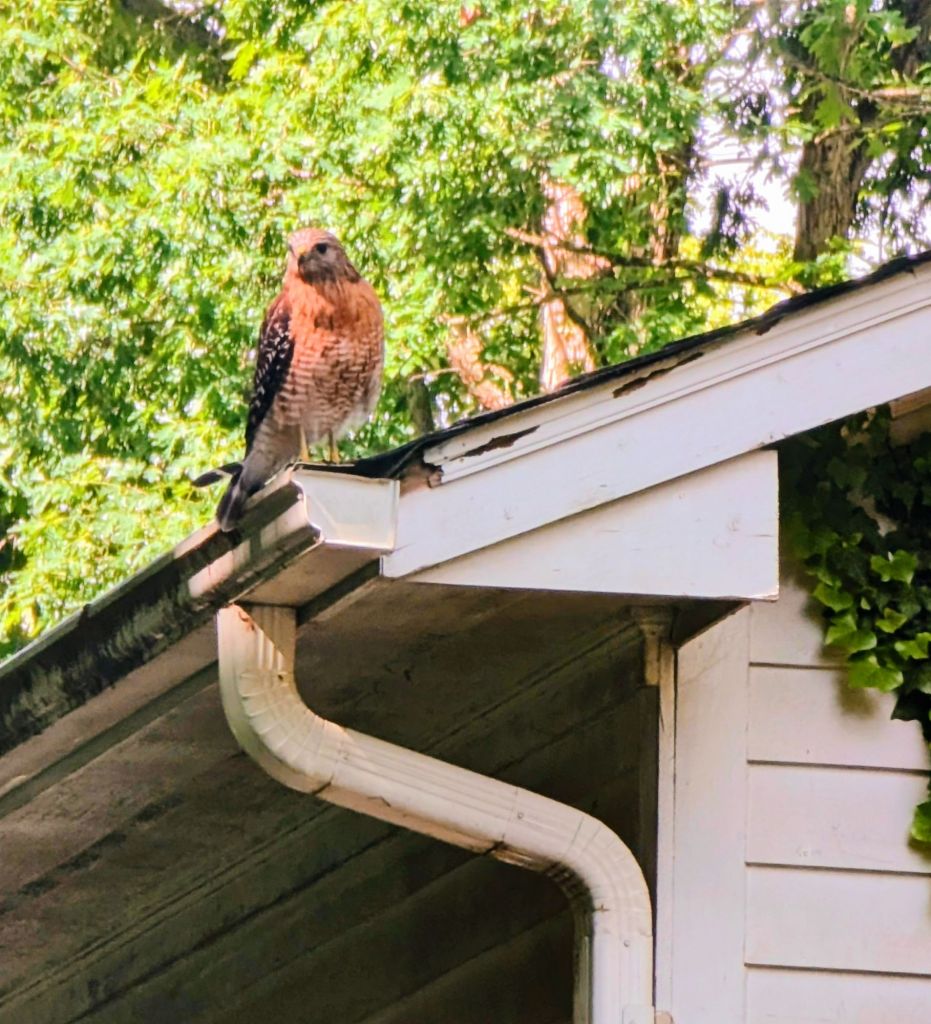
The neighbor’s roof. Red-shouldered hawk, Raleigh, NC. May 2025.
A hawk stopped by
Here yesterday
I learned of him
From angry jays.

He acted like
He couldn't hear,
Though jays buzzed by
His perch so near.

Resigned, he jumped
To fly away
Flapped once, twice,
And sailed away.

Another visitor

Five days ago this red-shouldered hawk sat in our front yard dogwood, just ten feet or so outside our kitchen window. For a few minutes it surveyed the landscape. Upon finding nothing to eat, it swooshed off. March 2025.

Dropping in

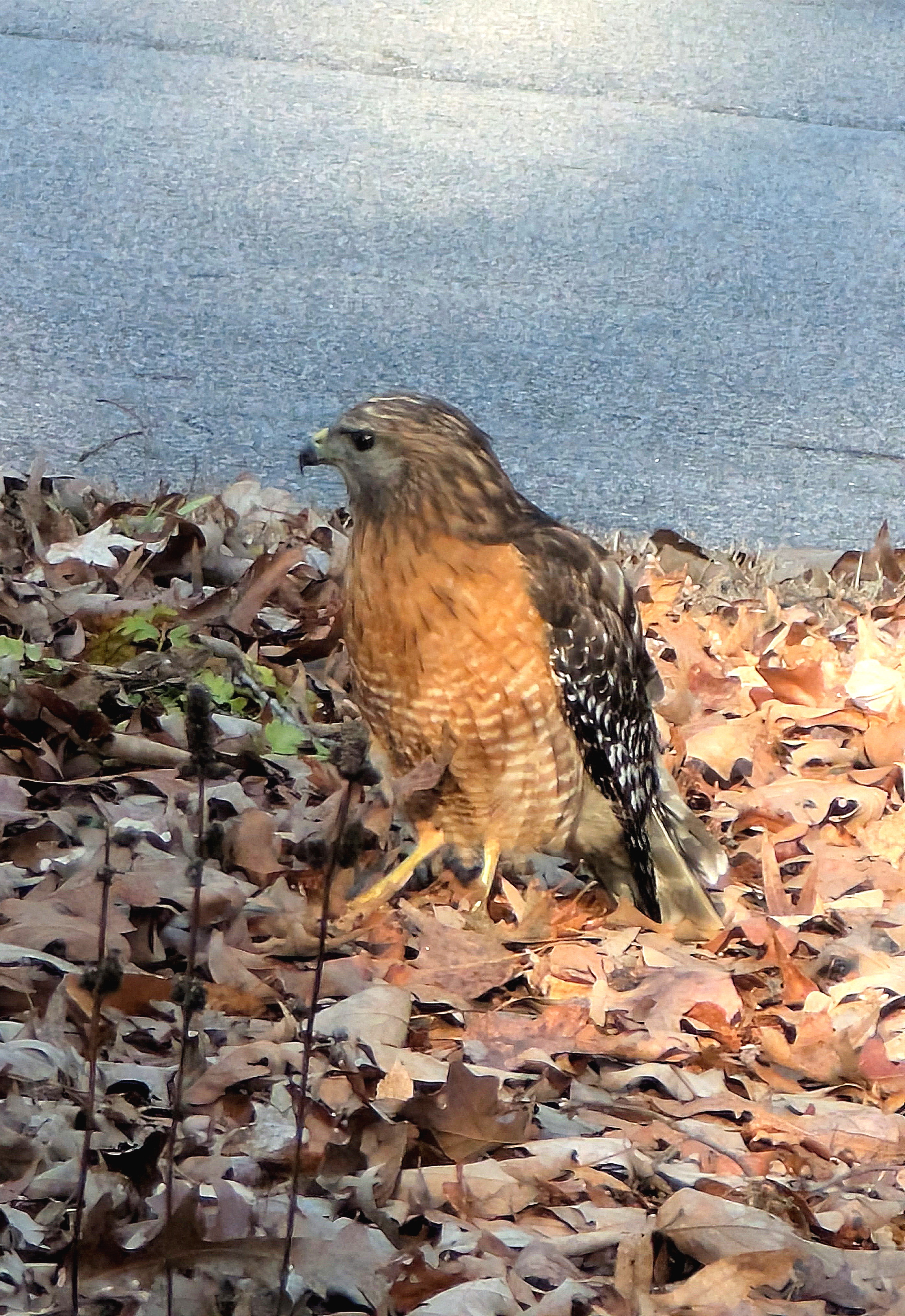
Red-shouldered hawk, Raleigh, NC. March 2025

Just before breakfast today we looked out to the front yard and watched a Red-shouldered hawk taking a small rodent for its breakfast. It took a couple of minutes. Leaving the leaves: good idea. That’s the street in the background. Due to last fall’s landscaping, the front yard is crowned, hiding the sidewalk and the parking strip.

If I ran a restaurant…

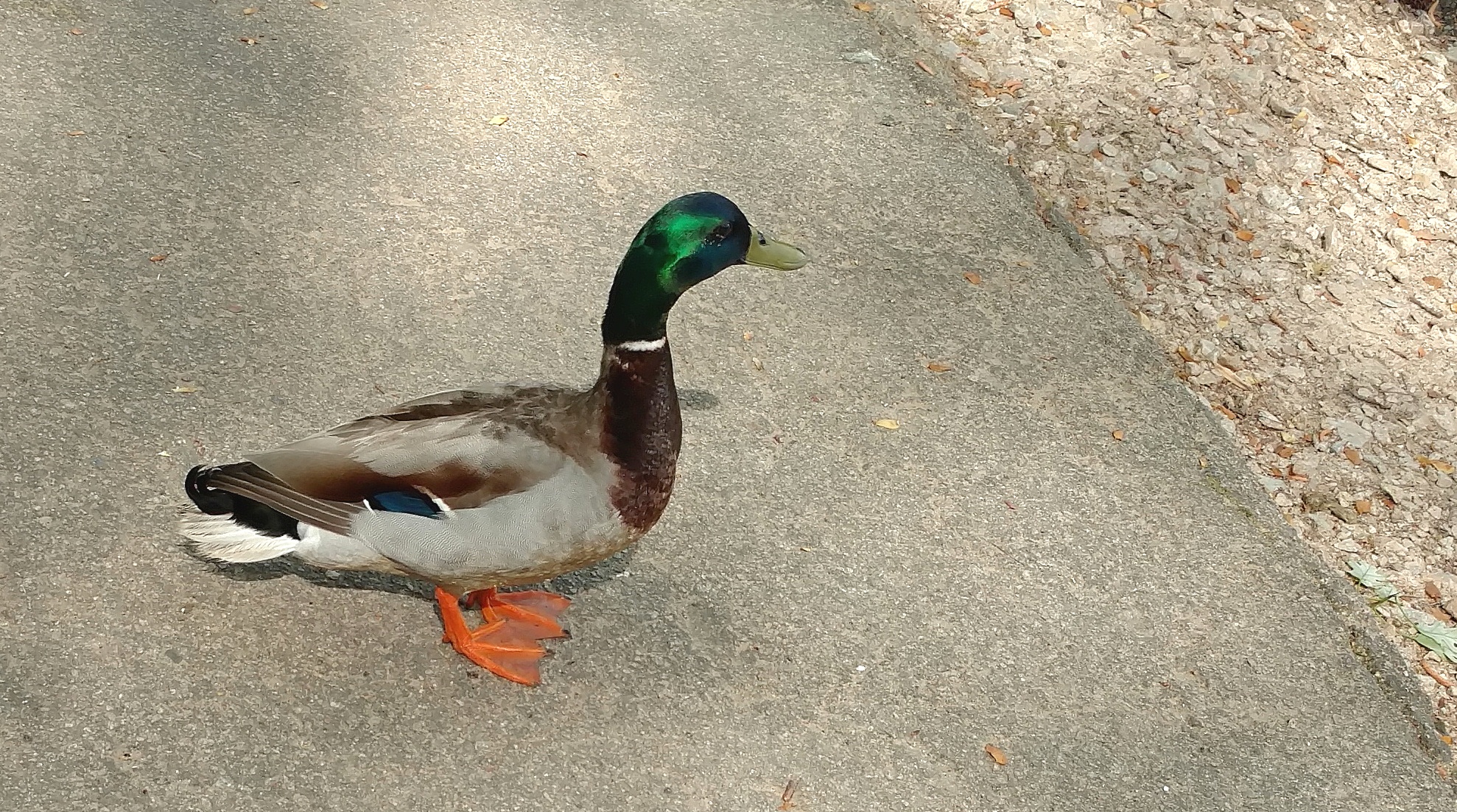
Mallard at Lake Lynn, Raleigh, NC. April 2017.

… I would serve a dish of duxelles, a French term referring to a mince of mushrooms, onions, herbs and black pepper which is then reduced to a paste. I’d add cream and a dash of madeira. I would serve this as a two- to three-inch smear over sliced breast of duck. I’d call it …

Dux’ and Quackers

[Patrons will kindly stop throwing bottles at the stage.]

On watch

Red-shouldered hawk. October 2024.

While meeting with a representative from the company which recently installed a natural front yard for us, we watched a red-shouldered hawk sitting in our white oak tree. It sat there five minutes, flew a small circle through the neighbor’s trees, and returned for another ten minutes. Unlike my usual luck–it flew that circle just as I returned with my phone–after it returned, it remained there so long I grabbed a half dozen photos, finished with the landscape rep, ran downstairs for my 50x zoom, and captured another couple shots on that camera. I’ve yet to download it.

I get confused between Cooper’s and Red-shouldered hawks, but noted that Cooper’s don’t have the mottled white pattern on the wings that this one does. Also, all those skreeeee’s I hear aren’t Cooper’s, according to Audubon. If that’s the case, most hawks I see around our little copse of trees are Red-shouldered.

I encounter birds of Hawaii

I’m conflicted. I enjoy casual birding, and when I visit Hawai’i and can suddenly see many new birds, I should be thrilled. I did thrill to bright, different birds. Then I learned that virtually every bird I saw had been introduced to the islands in the past 150 years or so. It seemed none of the common ones (the birds hopping around parks and following the tourists around) could claim they were indigenous to any island in Hawaii. Still…they are quite different to commonly spotted birds where I live.

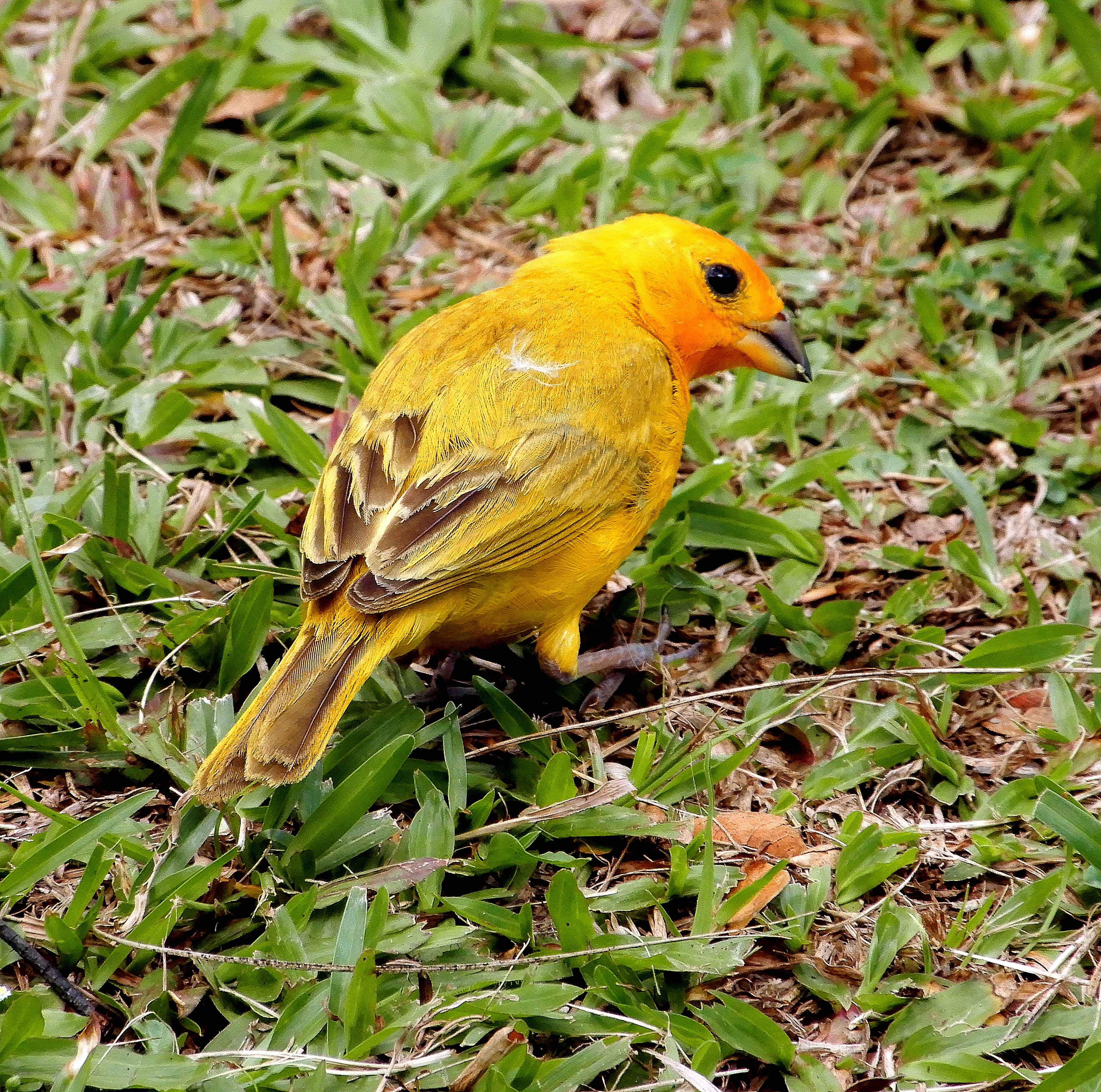
A Saffron Finch. Lili’uokalani Gardens, Hawaii, HI. September 2024.
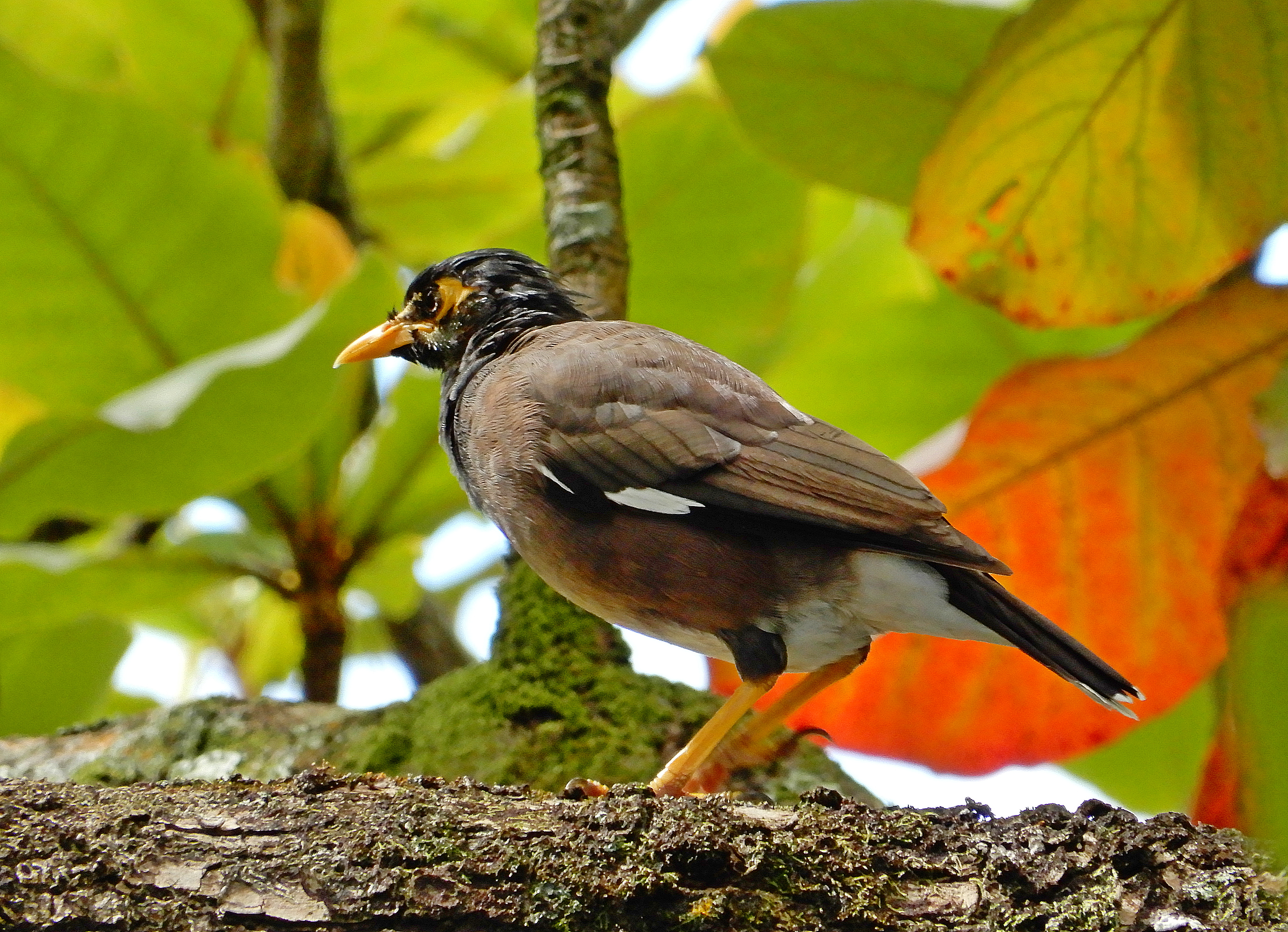
The Common Myna. Outside our hotel, Hilo, HI. September 2024.

The Common Myna appeared everywhere on Hawaii and Maui. It’s native to Asia, but has spread so much it qualifies as “one of the world’s most invasive species,” according to the IUCN Species Survival Commission which listed it on its 100 of the World’s Worst Invasive Species (one of only three birds on it). When we first landed on the Big Island, and I heard this incessant chattering, I thought Starlings had made it to Hawai’i. It’s a noisy bird, and it looks a little bit like a Starling until you get close enough to see the yellow eye patch, the more brown body, and that it moves rapidly on the ground when it wants to.

The Saffron Finch comes from South America. It’s been on the Big Island (Hawaii) only since 1960. We only saw these in the Lili’uokalani Gardens and around our hotel, both of which are on a very small peninsula on the east edge of Hilo, Mokuako.

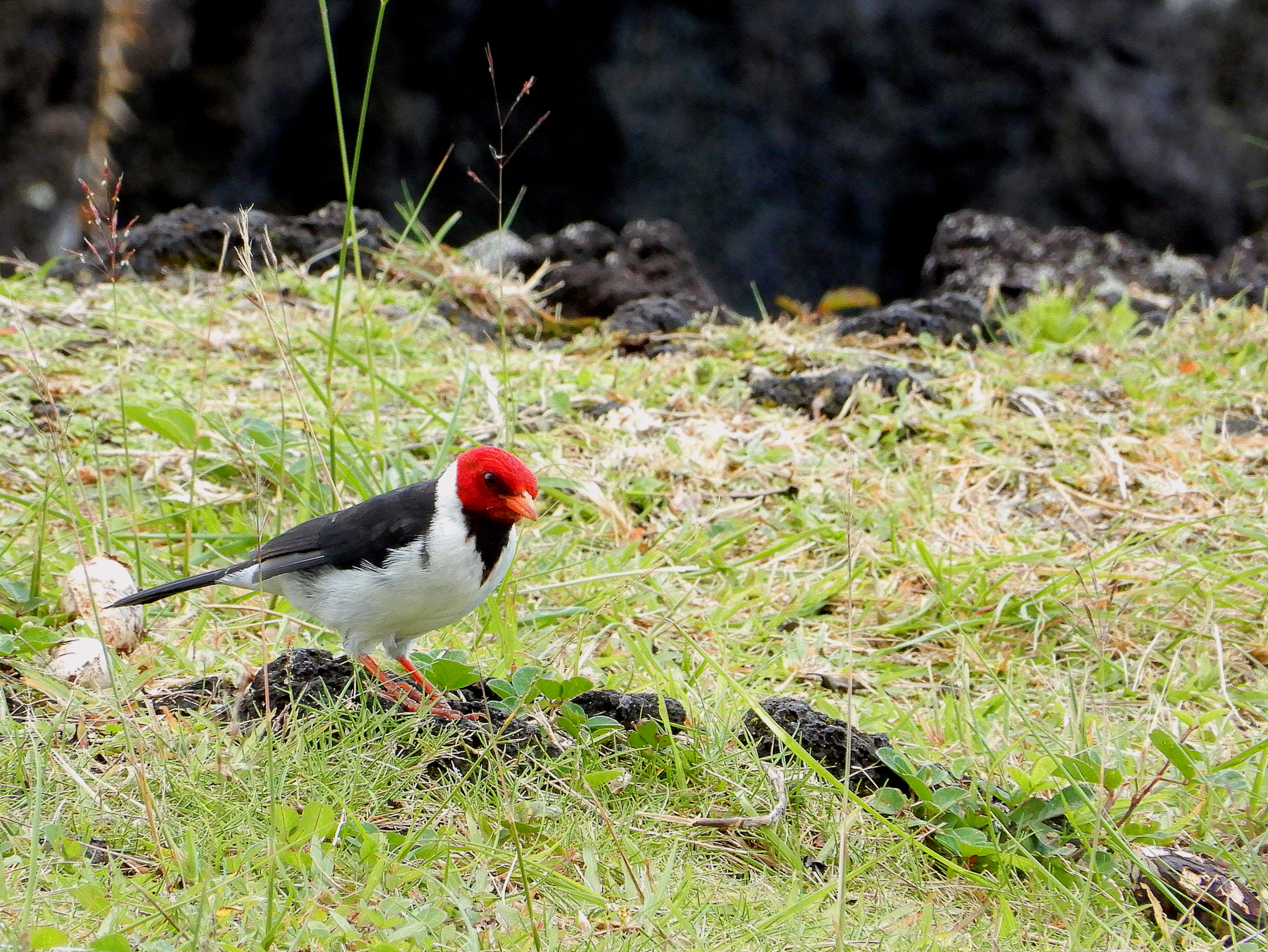
A Yellow-billed Cardinal. Seriously–see below. Outside our hotel. Hilo, HI. September 2024.

There are three common cardinals in Hawai’i, and none of them are native. One of them isn’t even a cardinal! We saw two: I photographed only the Yellow-billed but we also saw the Red-crested. They both originate in Brazil, but the former has a wider range into Paraguay, Bolivia, Uruguay, and northern Argentina. Thankfully we didn’t see any Northern Cardinals. I see plenty of those at home, and it would have been very depressing. Because I have no photos of the Red-crested, I’m including one from Wikimedia Commons.

Two cardinals photographed at Waihe’e Coastal Dunes & Wetlands Refuge on Maui, HI. Northern on left, Red-Crested on right.
Photo By lwolfartist – https://www.flickr.com/photos/151817352@N04/53873018807/, CC BY 2.0, https://commons.wikimedia.org/w/index.php?curid=150656259

My biggest consternation regarding birds wasn’t the Northern Cardinal. It was the onslaught of House Sparrows which assail one in every open restaurant, marketplace, park, and you name it. The fearless critters even hopped into our room in Hilo on several occasions….

“G’morning! Could ya take this peanut-bread-Cheeto whatsit off my bill?” Our first morning waking in Hilo, HI. September 2024.

Though we saw plenty of spotted and zebra doves (both introduced from SE Asia), I failed to take a good photo of one. It remained until we traveled to Maui before I saw a bird endemic to the Hawaiian Islands…

This is the tail end of a family of Nene geese, the state bird of Hawai’i. Maui, September 2024.

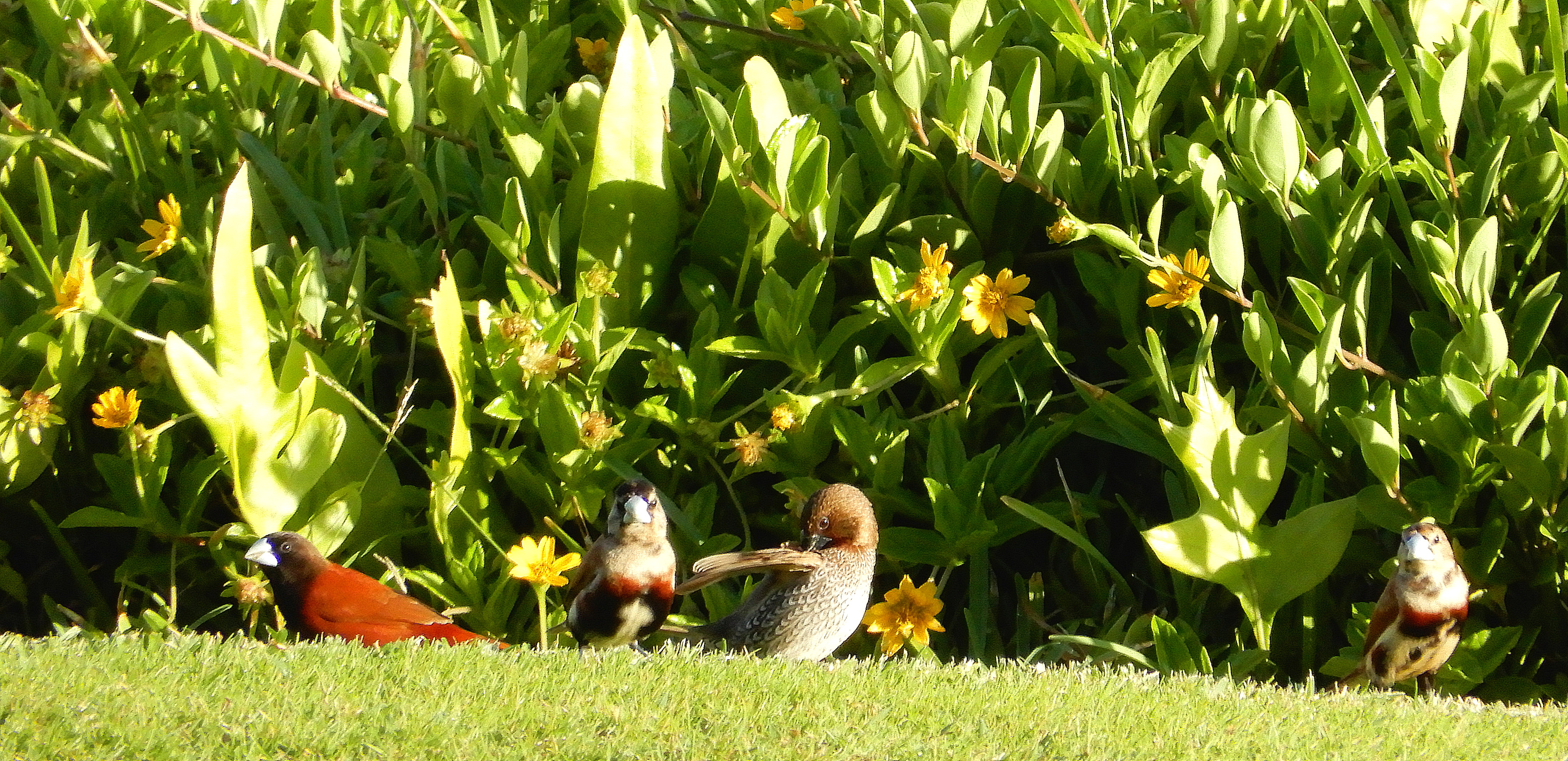
Sifting my photos for birds proved beneficial when I tripped over one, and only one, photo of a different group of birds. The Chestnut Munia isn’t native to Hawai’i (of course), but it’s a pretty cool-looking bird nonetheless. In the photo below, the bird on the left is a classic, I’m-sure-it’s-a-Munia example. Moving left to right, birds #2 and #4 appear to be Munias but they’re not supposed to have breasts like that. (Males and females are supposed to look about the same.) Photos of immature birds don’t look like those two. Bird #3? I’ve no idea what that is, but I find it difficult to believe it would just hang out in this group without being one of them.

Chestnut Munia (L) with friends. Kapalua coast, Maui. September 2024.

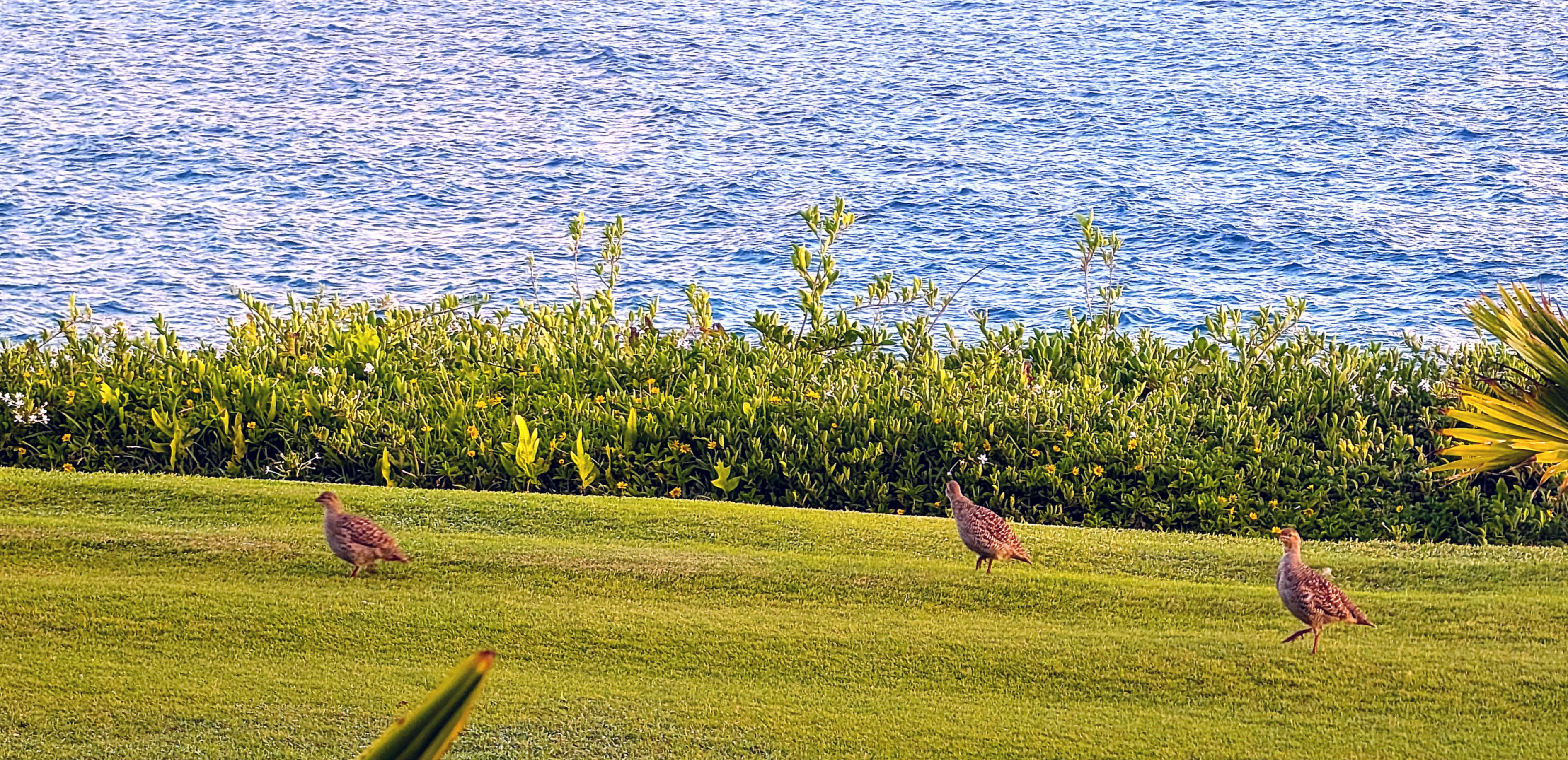
And in Maui I finally got a photo of one of these long-legged things which had bedeviled me on the Big Island. (Blurry photos? Sure, I’ve got ’em.) I don’t try to identify long-legged birds like this because they are so diverse and so similar. I don’t even know if this one is the same species as the ones which ran around on the rocky coasts of Hilo Bay.

Hello Mr. Long Legs. I’ll ID you one day. Kapalua coast, Maui. September 2024.

I would be remiss not to include a photo like the one below. Chickens. Yes, chickens. They’re not exactly everywhere but they’re darn common running around many areas where you wouldn’t expect to see them. They apparently are “wild” in the sense they don’t go to a coop and get fed by humans. They hang around the cities and towns, though, so…what is “wild” anyway?

The parking lot outside the Maui Aquarium. I think this guy met me ten minutes later at the nearby gas station. Maui, September 2024.