

Dawn on our second morning at Kapalua Bay struck clouds delivering a rain shower between us and Molokai, creating a brilliant rainbow. This may be common: I’ll post another instance later in this series.
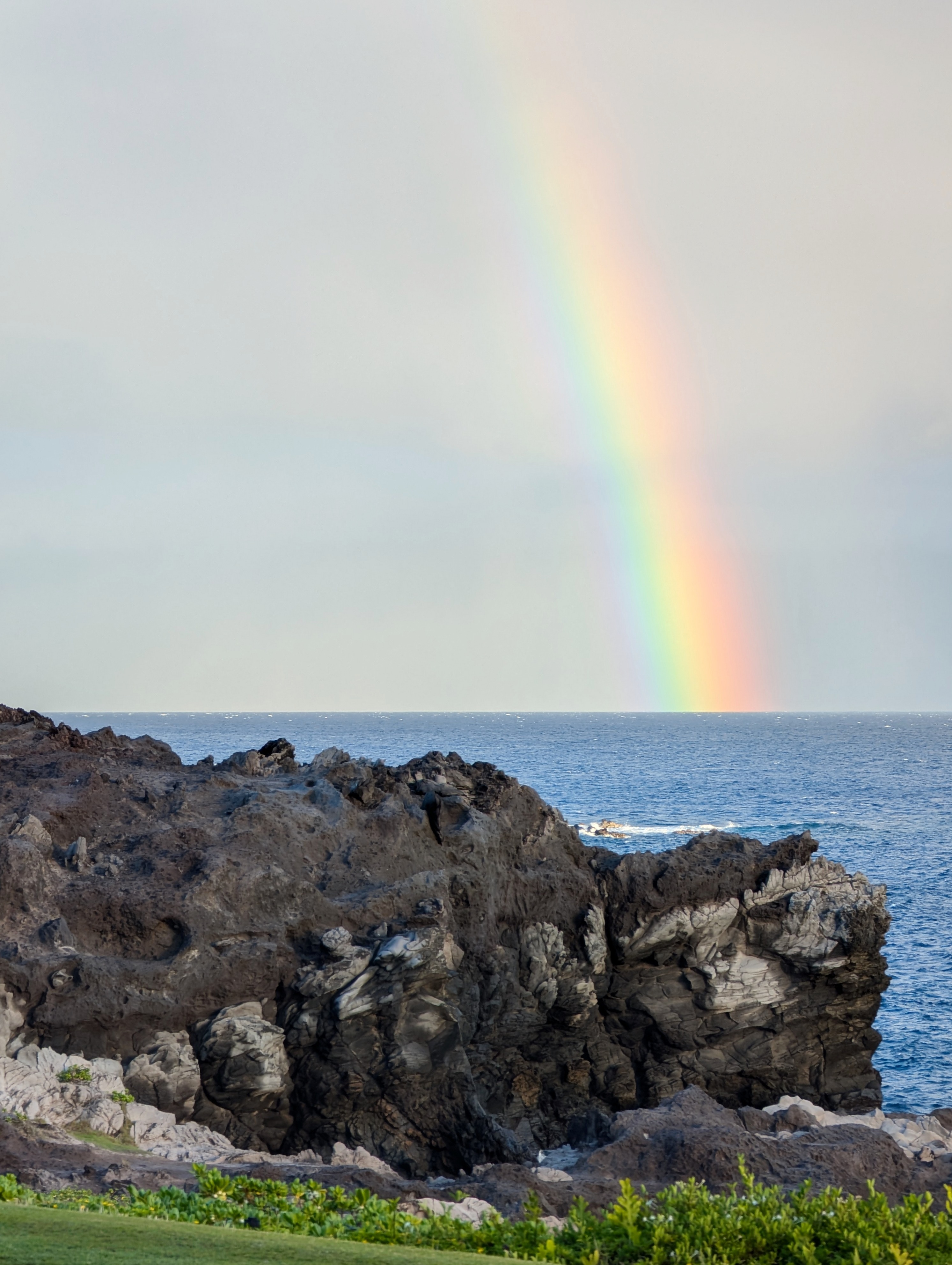
Dawn on our second morning at Kapalua Bay struck clouds delivering a rain shower between us and Molokai, creating a brilliant rainbow. This may be common: I’ll post another instance later in this series.

Our first full day on Maui consisted of settling in to a condo (“we need food” we realized). Then, we rendezvoused with one of my few cousins after more than 50 years. While spending the afternoon with them, we wandered an upscale mall. I spied a coffee shop and within, some ground Kona coffee. I needed coffee. I grabbed the package pictured above. At check-out the clerk said, “That will be forty-three dollars” and change. A mixture of shock and avoidance of embarrassment made me extend my credit card, tap the terminal, and commit to one of the most foolish purchases I’ve made in my life. You’ll note the package is only 7 ounces. As in barely-more-than-half-a-pound. Unfortunately, I can’t resist doing the math, and that’s more than $98/pound. Ouch.
I don’t like Kona coffee. I’ve had it off and on (mostly off) over 45 years of fine coffee drinking. I therefore didn’t think too much about buying something that purportedly was a lot less well-positioned on the ladder of quality. Because I absentmindedly left the package in my cousin’s car, I therefore needed coffee still. I purchased this:
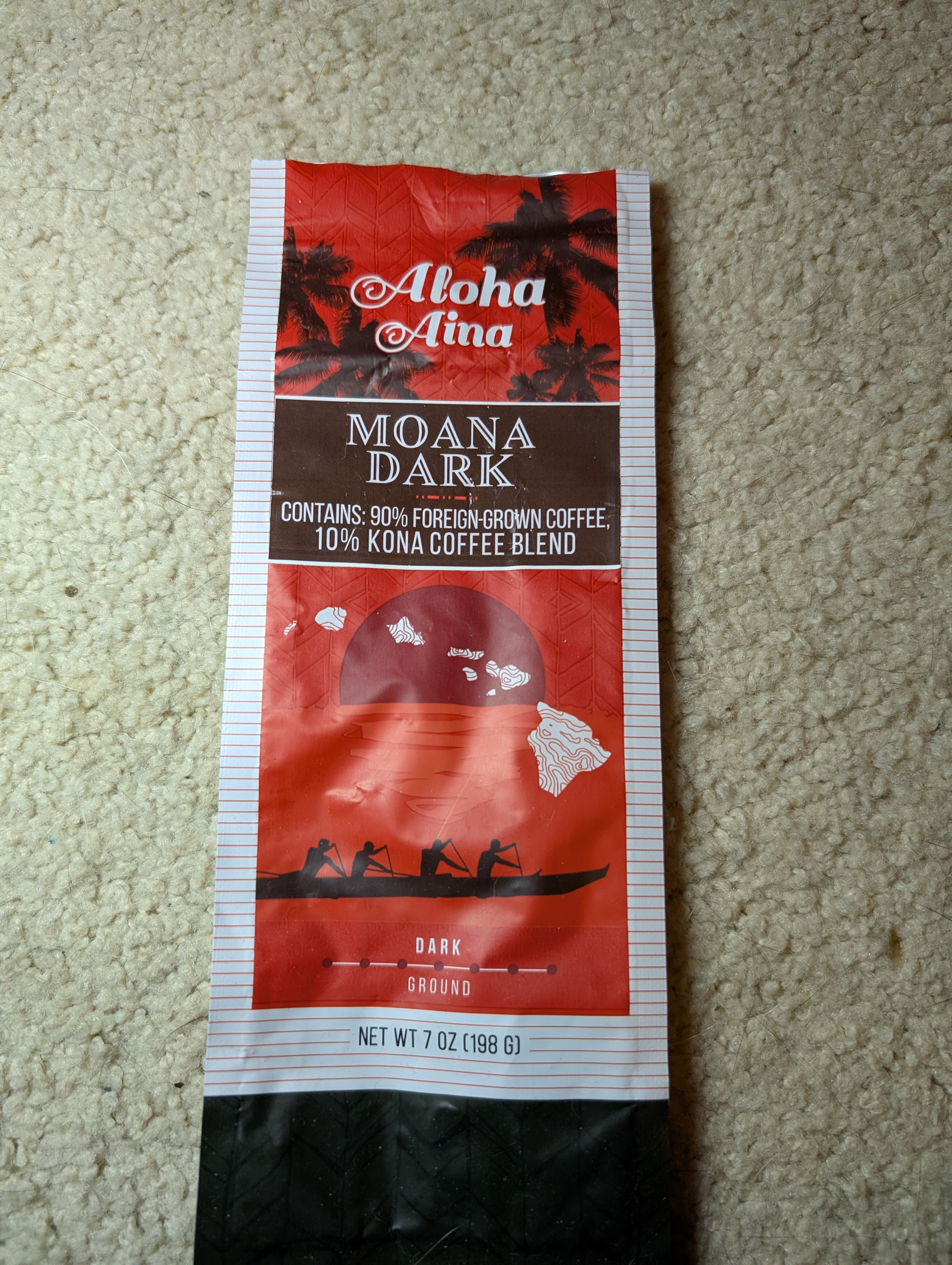
The pound above cost around $12-13. Same amount of ounces. Tasted…not quite as good, but really it wasn’t a three-fold difference. I felt stupid. And there you go.

Apologies, everyone. I’m going full Grandpa Mode in this one. It needs to be done.
After passing through three airports ranging from nice to delightful (see I Love You Hilo B. Airport), renting a car, and driving around the western lobe of Maui, we negotiated the contactless check-in process to our condo (another post for another day), unpacked, and stepped outside just as the sun set. Apologies for posting yet another sunset photo! It fits and I love ’em!
By the time our first full day in Maui dawned, we had made the decision we wouldn’t be driving around much. That drive from Kahului Airport to our condo at Kapalua Bay had taken nearly an hour. With little of interest in the miles and miles of condos stretching south of us to Lahaina, which itself offered much less after the 2023 fire wiped out half of its center, we realized going to any of the attractions mid-island would mean a two-hour roundtrip drive…every day. Attractions on the eastern part of the island (Haleakala National Park, for example) would be even further. If this had been our first few days in Hawai’i….but they were not.
We did drive back that very first day, however, so I could connect with my cousin whom I had not seen in 40-50 years. I grew up with only three cousins, all girls, who lived many hundreds of miles distant by the time I entered school (especially when they moved to Hawai’i for a few years). I gained a fourth when she was born as I finished high school and college, but the cousin one year older than me passed away about 20 years ago. With only three surviving cousins, and only two I actually knew growing up, seeing my Maui cousin qualified as a Big Deal. We met at the Maui Brewing Company in Kihei. After a delightfully long meal full of laughter, reminiscences, and plenty of beer, we toured the gated community where my cousin’s husband works as head of security. It’s a sweet gig: he works but two or three days each week and rubs shoulders with The Rich. He dropped some names, but I’m not allowed to pass them on to you. Suffice to say, when one of them purchases a home there, they promptly drop about a million to remodel it.
At the end of the afternoon we faced that one-hour drive back. We stopped in Lahaina at a Safeway for supplies, representing the first time I’ve ever seen a wine cellar in a Safeway.

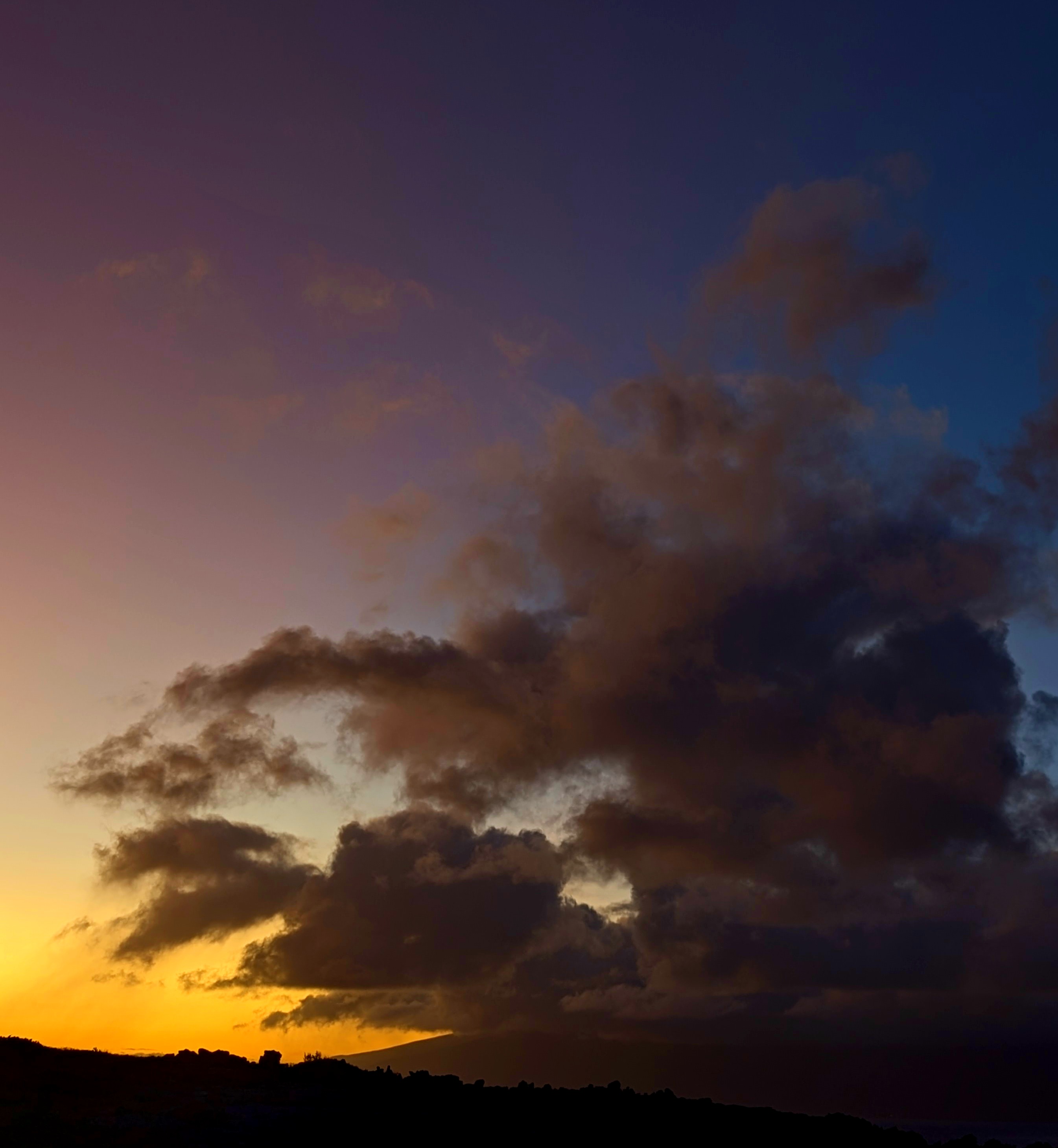
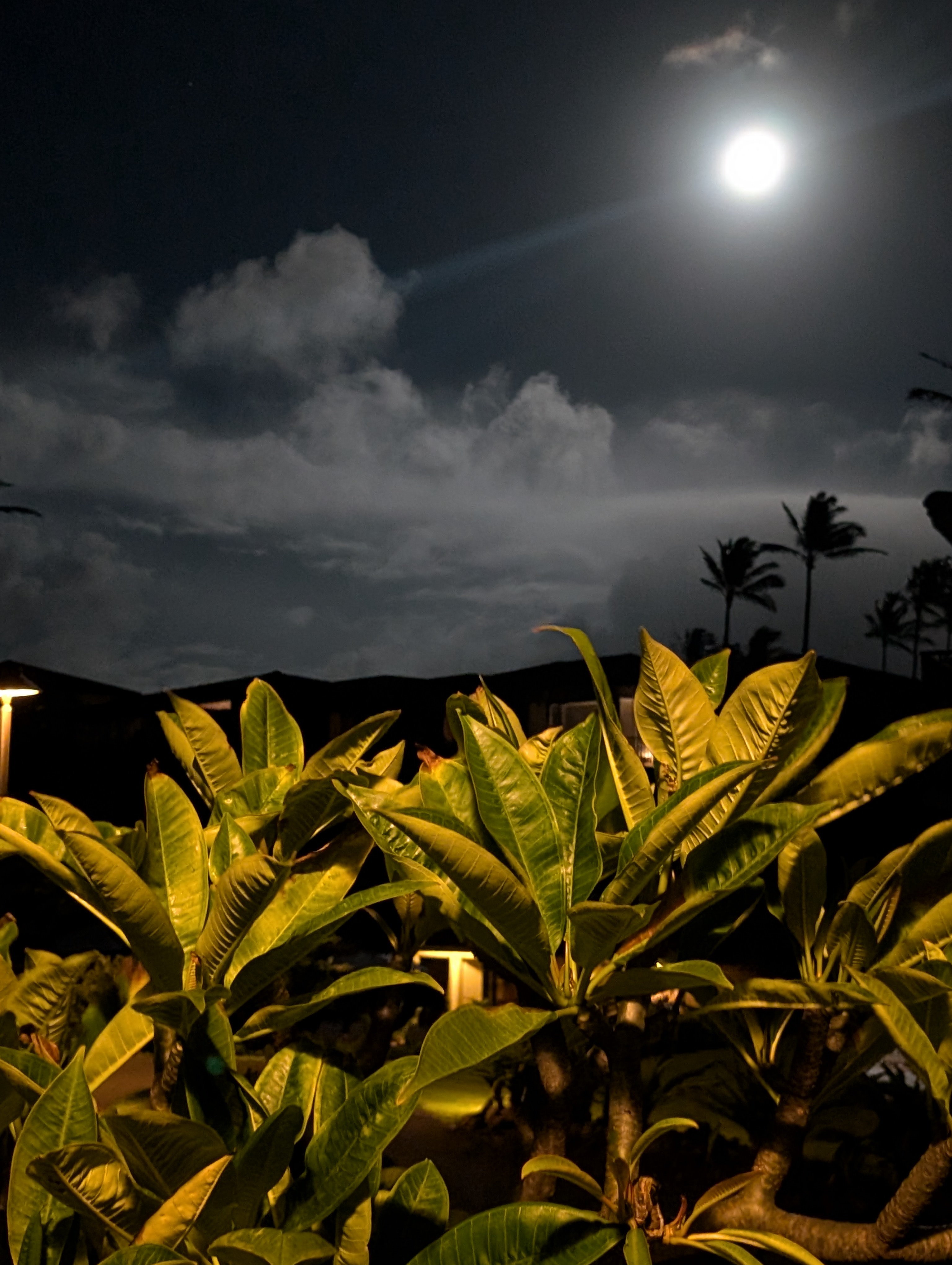
That night the sun dutifully set, and I just as dutifully captured it photographically with twenty shots.

[written on January 3rd, but subjected to the Don’t-Post-Anything-After-The-First-Beer rule.]
At the end of September 2024 I mused on boring y’all with 100 Days of Hawaii, my poor-taste humor suggesting I would post every day through the end of the year something about Hawaii, thereby driving away the few visitors who swing by this little neck of the Interweb. Today, 96 days since then, I find 100 days will not be enough owing to my typical lack of focus. (“Oh, look! Something shiny!”) I’ve only posted through our arrival on Maui, barely more than halfway into our trip. And I’ve made myself a mockery for eagerly anticipating the 12 Days of Christmas and all of the writing which would spring to life from my keyboard. (See link for last year’s procession through the Christmastide.) Therefore, on this Tenth Day of Christmas, and just past the turning of the civil calendar from 2024 to 2025, I pause to reflect, to resolve, to anticipate, to evaluate, and to pontificate. I guess I should apologize in advance. I’ll try to return to better stuff soon.
There you have it. Nothing earth-shaking. Except, hopefully, for me!
I saw three examples of this in one day! Two in the New York Times! Example with discussion below:
Name your second-favorite airport- or airplane-based movie.
“Die Hard 2” was certainly was an influence.
—from interview with T. J. Fixman, writer of Netflix movie Carry On
Just a general discussion because I don’t know how to rate errors like this, annoying to read as they are. Your eye might have skipped over it. In the author’s response, the passive verb was gets repeated before and after the adverb certainly. Presumably when first typed, the writer of this sentence wasn’t certain whether to split the verb from its descriptive object influence (called a subjective complement to be exact). Did this occur because the author thought the editor would pick the ‘right’ one? Technically both are correct, but I could make an argument for “certainly was”. Is the author self-editing, and planned to come back to this? Or, as I fear most likely, did the author have a brain-fart, being unable to carry the sentence construct mentally for only three words?
Twice in one session of reading, New York Times? When I saw a third one on a sports blog, I couldn’t believe it, but at least it’s written by dedicated amateurs more interested in sports than writing. I can’t rate it because it’s egregiously wrong, yet quite possibly represents a case of just typing too quickly and hitting ‘Send’.

My wife and I first wish you all a Merry Christmas. At the very least we hope the seasonal aspects of peace, love, and deeply rooted joy enter your heart and soul. We still dare to hope these wishes also spread from the end of this season through 2025 and beyond. Despite this being my 71st Christmas and the accumulation of a freight train’s worth of cynicism, I’ve found hope and optimism remain surprisingly strong in my heart.
In the photo above, the ornament symbolizes all of that. Its pink and white frosted layers have many imperfections. The bulb has carried most of those imperfections since its creation, but also has lost some of its sparkle as grains have fallen off through the years. It nevertheless remains shiny where first it shone, and it draws the eye amid the more modern ornaments picked up during the years, the modern (and safer) lights, and the not-so-accurately-manufactured tree needles on our artificial tree. My parents gave me this ornament with a few others when I struck out on my own about 45 years ago. It can’t be younger than the 1950’s, the same as me. As it’s lost its sheen to poor handling, indifferent storage, and the jostling of eight moves during our marriage alone, it’s gained character and presence, standing out among the gaudier yet superficial touches of the newer decorations.
Ultimately, like this ornament, all of us arrive at this Now and this Here being who we are. We put on and take off habits every few years, but settle into most for decades. Beneath the cloak(s) of these habits lie the core of our beings. This Christmastide, I wish you what I wish for myself: a closer understanding of that. When we walk confidently with our Selves, we can accept the unique Others who walk with us on this path. Maybe then we’ll have a little more peace in this world. Maybe then we won’t shout in anger at each other. Maybe we can inch a little bit closer to the perfection buried in our hearts.
Postscript: I’ve kept the above thoughts on the vague, bordering-on-vacuous-greeting card level because I don’t want to push an agenda at you. These thoughts underlie all spiritual beliefs. Even those who believe in nothing but organic humanism (just the brain, baby, then you’re gone!) have a spiritual belief–they believe there aren’t any. To these and to all, I say, “Acknowledge the Self. Recognize it in Others. This forms a bedrock more fundamental than the trappings of religions and philosophy. We all could get behind this concept and make a better world in the process.
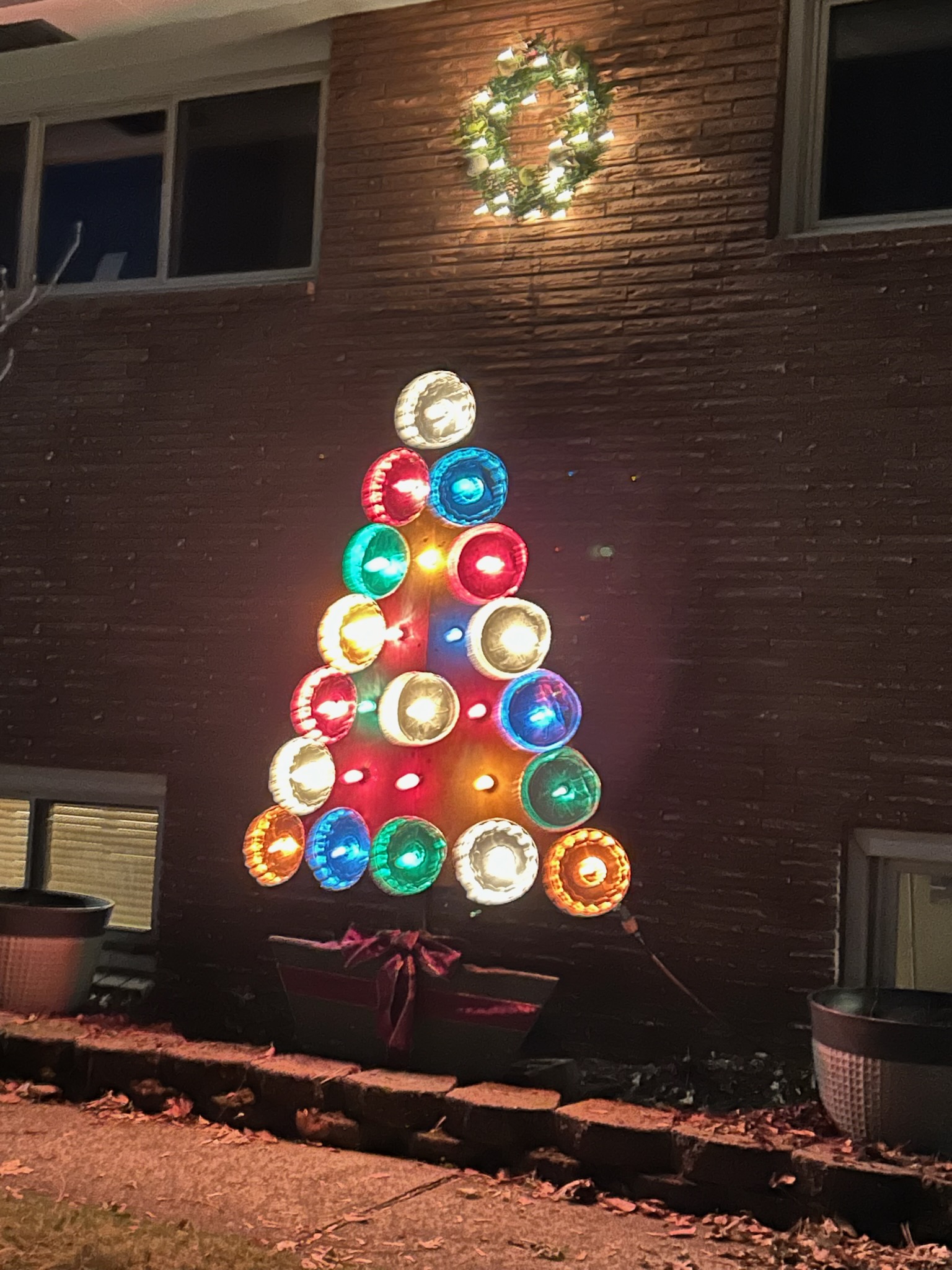
Christmas waits impatiently on the other side of midnight, less than five hours away on the East Coast of the US. Besides its ultimate meaning, Christmas carries a bagful of gifts called memories: some good, some painful, some both. When my family returned to Spokane after a 22-month period of moves to Seattle, Los Angeles, and back to Spokane, the neighbors across the street organized a block Christmas decorating project. They lived in the house pictured above. All the men–times differed a bit back then–gathered in the double-car garage just out of the photo to the right, all of the women kept them stocked with hot or cold beverages of their choice, and all of us children ran around in the snow and threw snowballs at each other. For several years our block featured wooden trees lit colorfully…almost as in this photo.
One by one fewer trees appeared each year. This person moved. That person got tired of the maintenance involved. (Ours needed a new stake to keep it upright in the nearly frozen ground.) By the mid-70’s the folks in the pictured house–the ones who instigated the tree-building–had moved, all of the neighborhood children were grown, the trees had disappeared entirely, and ours began its 45-year hibernation in the rafters of our garage.
In 2013 my father died, and in 2019 my mother joined him. Through 2018 the new neighbors in the brick house across the street had taken care of my mother as she declined, assisting her with all those little tasks that get more difficult as one nears 90. My brother lived hundreds of miles away, while I lived thousands. We did nothing with the house during the ten months she alternated quarters in the rehab center or the assisted living facility, but after she had passed we went through the stuff and asked neighbors if they wanted anything. Our neighbor wanted the tree. He spent a couple years before he souped it up with the reflectors, but other than that he returned it to its original condition. It seems appropriate it now lives where it came into being. I ran across this photo looking back through December photos. Funny how so much can be packed into one unassuming photograph.
A friend of mine speaks of his “phonographic” memory. I believe all of us interested in music have this, else ear-worms would not be a thing, right? Over the past ten years I’ve focused more on this phenomena, and I further believe there’s a distinguishing characteristic between songs we can recall and songs which form our sonic foundation. In the latter type, I don’t mean these are fundamentally good, I just mean that they come unbidden on a Tuesday morning when you’re in the shower, or when you’re driving to the grocery store. Or perhaps you hear a snippet of conversation and an overheard phrase comes to you overlaid with music because it’s word-for-word (or nearly so) with a phrase in a song from your youth.
Here’s one which illustrates the vagaries of this kind of aural memory. “It’s Good News Week” pops into my head every few months for the past couple of years. Why? I have no idea. It gets billed as a protest song, and certainly some of its lines will shake you up–perhaps a few will offend. All I remember, however, are two short stanzas which I have always sung together, but which do not appear consecutively in the song:
It's good news week
Someone's dropped a bomb somewhere
Contaminating atmosphere...

...It's good news week
Doctors finding many ways
Of wrapping brains on metal trays
To keep us from the heat.
Plus, I remember the refrain:
Have you heard the news
What did it say?
Who's won that race?
What's the weather like today?
Memory clouds things, too. I’ve remembered this for nearly 60 years as a novelty song, and listening to it today, it didn’t sound the way I remember it. I wonder if that has something to do with the tiny transistor radio I used to listen to it? Looking at the lyrics today, it seems anything but a novelty song. So many songs from the mid-60’s through the mid-80’s just can’t be played these days. Not like “Walter Wart” from 1966 by The Thorndike Pickledish Choir!
Our final full day on The Big Island, we drove west across the island to the Kona Coast. It didn’t totally waste our time, but it validated our decision to stay in Hilo. In our short taste of it, the Kona Coast appeals to people who aren’t us–hence they’re nuts: Kona Nuts. Near as I can figure out, the west side of The Big Island appeals to people who like:
We don’t like any of that. Okay, we’ll take an occasional hike, and we’ll poke into those small shops catering to tourists (but they’re better when they don’t). We’re not the physically active types. I’m not at 70, and haven’t been since I flipped the dial past 40.
On top of that, we found the western side of the island to be hot, dry, a bit desiccated. Our first inkling occurred driving across the the caldera of Mauna Kea. We had left rain in Hilo, low wispy clouds misting us, sprinkling us with life-encouraging water. Once we climbed to the center of the island, things looked quite a bit different. (Photos are from our return drive to the east.)
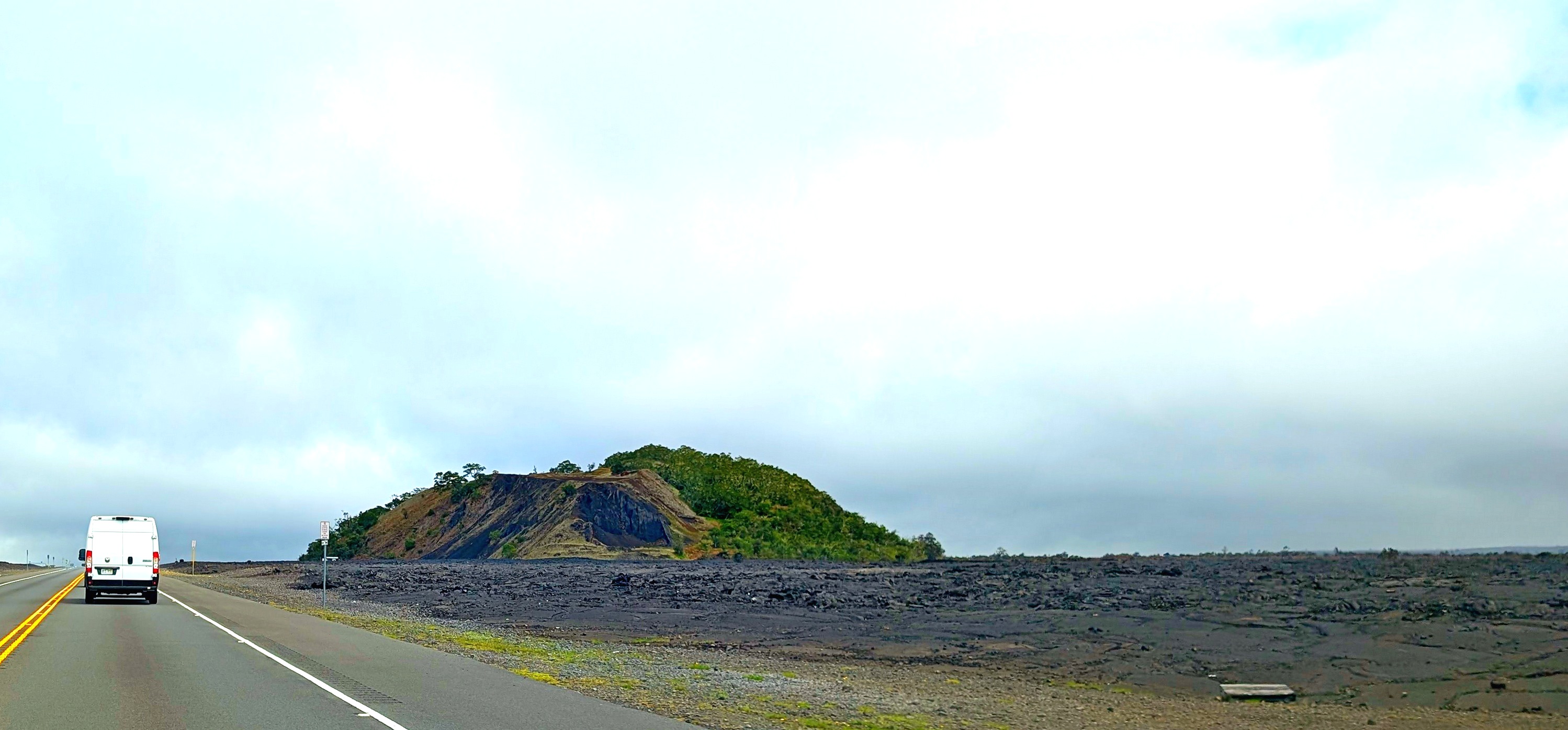
I grew up in eastern Washington State where lava flows poke like basalt bones through a grass-covered skin of dirt. It looked a lot like the western half the Big Island. If you told me this next photo was the interstate exchange just west of Spokane where students head south to Eastern Washington University, I would believe you:
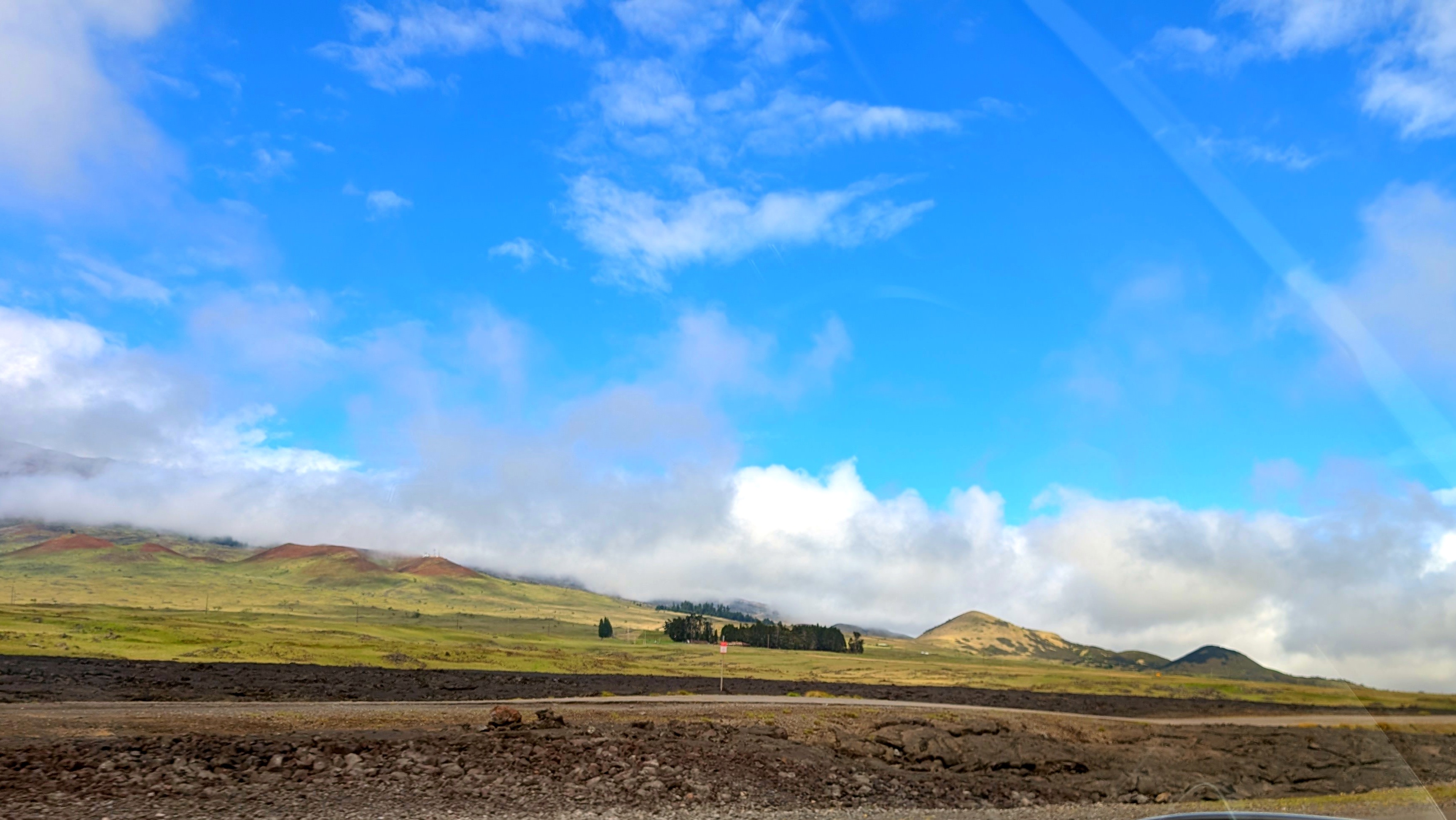

Once we descended the steep slopes to Kona coast–an oddity to me; shouldn’t the leeward side be more gently sloped?–we found a whole lotta nothing…which isn’t really fair, but our first stop gave us that impression. The Kaloko-Honokohau National Historic Park starts out looking like this:
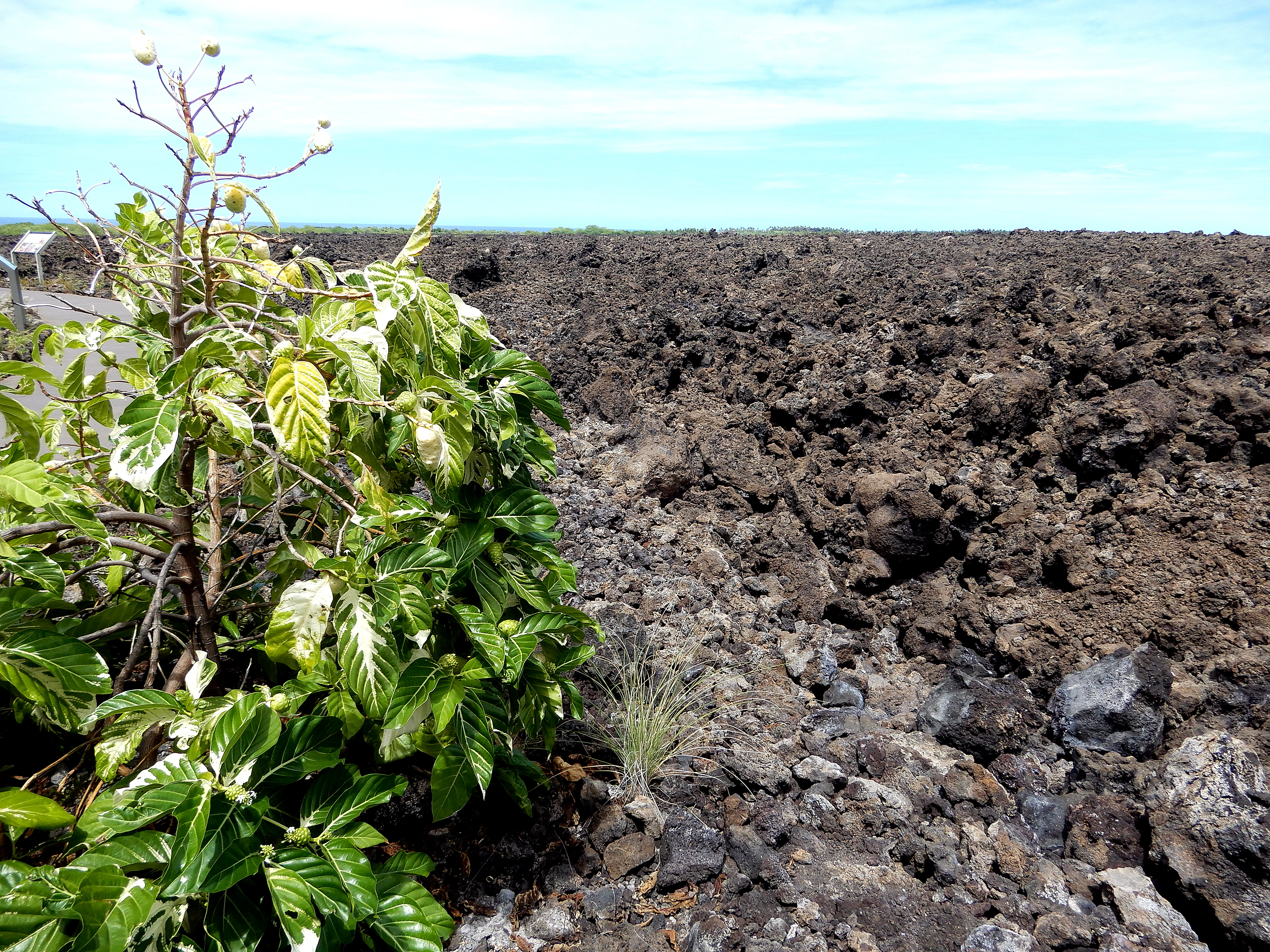
Although bleak, this stop proved informative. Indigenous peoples used these coasts to trap fish and perform other ocean-related activities (I think they got salt also–can’t remember). Families owned narrow parcels of land stretching from the shore up the slopes. Those members who lived at higher elevations would farm and bring their harvests to the shore to trade for fish and seafood. We chose not to walk the mile-long trail to a recreated site about the coastal folks, primarily because the 90+ degrees and lava fields intimidated us. Finding the entrance to that area of the park proved elusive, hidden and nearly unmarked as it was in the backmost corner of a parking lot for various marina businesses.

After this we drove south into Kailua-Kona proper. We found nothing but strip malls, hotels, gas stations, various support businesses, and the airport where virtually every airline flies except for Southwest Airlines (explaining why we flew into Hilo). We found restrooms and beat feet to the east side of the island. We had great views on our climb out of Kona: foregrounds of all the roofs of the vacation homes, backgrounds of the ocean. Yay.
Today’s assault holds a special dose of vinegar because it inverts the usual way this mistake gets committed. In a New York Times article about the Congressional scuttling of a temporary federal funding bill, Hakeem Jeffries is quoted thusly:
House Republican have been ordered to shut down the government and hurt every day Americans all across this country.
I’m ignoring the politics involved here, except those of grammar, usage, and mechanics. Usually when writers mix up every day and everyday they use the latter to refer to every singled blessed day. This is wrong. When referring to all of the days, every single one of them, there must be a space because we’re using the adjective every to describe and restrict the noun day. However, when we want to describe something as being routine, mundane, ordinary, etc., no space is used. Make the compound word everyday to describe the noun of your choice. In the paragraph above it’s Americans.
I’m tempted to say the above error actually hurts everyday Americans right now, not in some undefined future, but the mistaken usage likely slipped right past most of them. The everyday/every day error resembles those involving into/in to and onto/on to. In the case of today’s horror, the most common format for every + day would be with a space. Non-proficient writers usually slam them together making this supposed-to-be uncommon word more common in print these days. I suspect the reverse is true for the other two, but I’ve no data to support this.
Author’s role: I’m going to assume this error found its way into print due to the author, not an editor. This is a writer for the NYT, one of the premier news organizations in the world. The author should know better. We therefore rate this a 4.
Egregiousness of the error: The error will be read by most readers to mean what the author intended. As explained in the first Reader’s Horror, these space-oriented mistakes where a compound word is used when it should not be represent one of the many confusing aspects of English. Since most readers won’t notice it and will get the intended meaning, we therefore rate this a 2.
My personal reaction rating: I sigh, shake my head slightly, and mutter, “but of course.” Immediately thereafter I also say, “but it’s still wrong.” That makes it a 1.
Final rating: This error rates a 4/2/1 for an 7 out of 10 on the Reader’s Horror scale.
[Note: I’m tweaking the scale, and I’ll write a quick update later. The egregiousness rating above became a “2” instead of a “3” as a result.
 all the voices in my head