Our yard on the left, neighbor’s on the right. Photo is unretouched. January 2026.
Last October we paid to have our back yard replanted with plants native to North Carolina, the American Southeast, and the Atlantic seaboard. As in colder climes, the vast majority of native plants drop their leaves and enter dormancy for the colder winter months. We also “leave the leaves” which allows them to decompose into the soil as they should, creates cover for the little creatures to stay warm (and avoid hawks), and supports the lives of little bugs which in turn provide food for the ground-feeding birds. Thus, the predominant color of our back yard and our front yard is brown.
Our neighbor’s yard represents most yards around us. The green of English ivy covers the ground and the trunks of the trees. Saplings of non-natives take advantage of the warmer winter weather much as sunbirds head for Arizona or the coast of the Gulf of Mexico. Some keep their summer foliage—no need to drop leaves and protect a plant conditioned to far colder climes. It’s not that leaves fall only in our yard; there’s an oak or two and some poplars over there. It’s that the ivy manages to conceal somewhat the leaves in my neighbor’s yard.
In winter, therefore, brown is good, and green is at best questionable. (Before my southern readers chime in, yes, there are plenty of Southern evergreens, but not many around here consciously cover their yard with them.)
Our natives, once established, should have staying power also. It’s kind of defined by the word “native” is it not? I will need to wage constant war, though, on the ivy, the Virginia creeper, the japonica, and the various saplings which will inevitably attempt to broach the property line. It’s a battle I freely take up. For the time I live on this speck of the Earth, it will bring forth those plants which grew here naturally and nurtured the birds, mammals, insects, reptiles, and amphibians which depend on them for healthy populations.
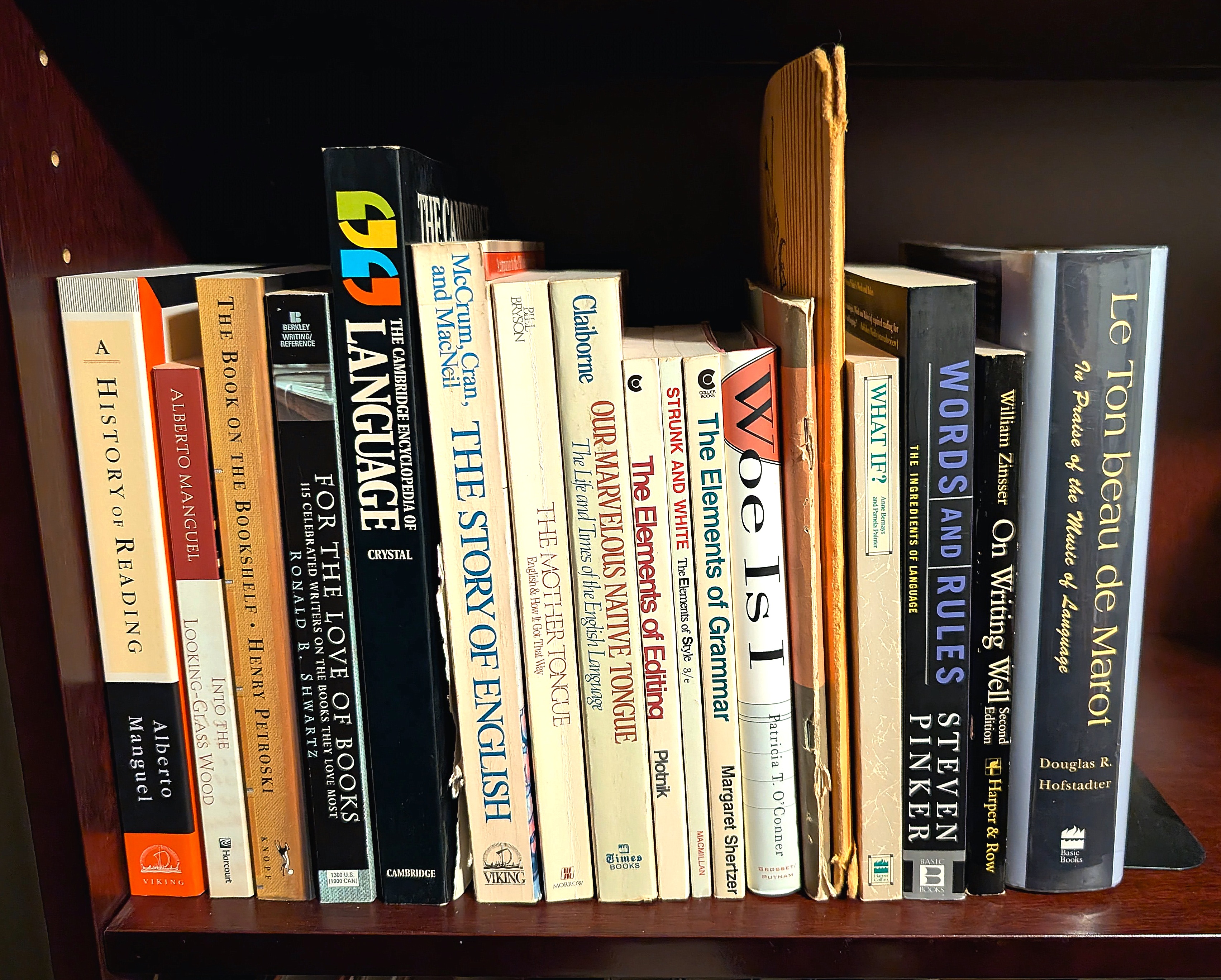
Several days ago I began a loving reminiscence for this little half-shelf of books:
Yep, repetitive, I know. September 2025.
Other than specific works of literature and the anthologies which collected them, I’ve pretty much trashed my college textbooks. One slim little volume, sporting a stiff paper cover, has followed me around since 1982 and will be there when I die very likely: Sentence Analysis by Donald W. Emery.
So small. So dull…to all but me. September 2025.
June 1982 brought me the final set of courses I needed to complete my English Education degree. Who knew a graduate-level course on grammar would be the most agreeable of them? Few of my fellow classmates agreed with me. First, the class began at 7 a.m., if I recall correctly, and ran for two hours. This allowed the professor (who happened to be the chair of the English department) to teach the class in only four weeks instead of eight. After the first week we diagrammed sentences. That’s all. Each day we discussed a construct of English grammar, diagrammed five sentences that night, and began the next class discussing how they should have been diagrammed and if there might be any which were open to interpretation. Even in something as definitive as diagramming English refuses to be pinned down. In fact, the professor told us we used the sentences in the book because they had been vetted to be “diagrammable”! It would take me too long to explain why English sentences as spoken and written by its practitioners do not lend themselves to analysis. Take my word for it, at least for now.
Unfortunately, I stole a bit of my thunder on this topic a couple of years ago when I ranted about compound prepositions, foreshadowing this book even if I didn’t name it. This series, Bibliophilia, however, purports to be about a love of books, not of specific topics per se. We attempt to not delve too much into the memories evoked by the books, but rather to celebrate them and explain why such feelings rise up. In this case, it’s pride pure and simple, pride in knowing something esoteric, something only a small sliver of English speakers know. My course contained about 15 students, all but three of whom were teachers returning for some of those credits mandated by law for the recently hired or to achieve a Masters degree. Despite the fact all were English teachers/English majors, I ran rings around that class. I aced it. I aced the final. After acing it I and leaving long before the rest of the class, I waited in the lobby for them to come out. “What did you do on the last one?” they asked. I could have been smug, and said, “what I did when we diagrammed it for homework,” because all of these sentences had been discussed in class. Instead I just answered the question. The bulk of these people were older than me. My pride came with a good dose of awkward, too.
Because we’re sticking to love of books, and on this shelf, love of language, I’ll save further discussions of the diagrams for another piece of writing. One memory will illustrate my love for this slim little volume: I hope I will never forget this experience which illustrates the frustration of teaching and the uselessness of diagramming sentences. In the 8th grade English classes I taught, I decided for a year or two to use diagramming sentences for a unit. I think this had to do with a “street cred” issue I had with another English teacher and also because teaching sentence diagramming comes about as close as possible to teaching math. Many teachers of English shy away from the ‘squishy’ nature of their chosen field. One can only teach writing by having students write and giving them feedback about it. This puts them in a bind. Reading, grading, and (God forbid) giving feedback requires huge amounts of time, time which could be better spent drinking beer/wine and reading a book. Worse, it’s nearly impossible to teach literature without having students write about it. Double-whammy because now one has to grade the content as well as the expression of it. But…begin a unit on diagramming sentences, and one can kick back like the math teachers do, marking the incorrect lines, assigning points, and adding up the points for a grade on that day’s assignment.
I don’t remember this kid’s name, so we’ll call him Rick. A little kid who could be used to illustrate the late-bloomer end of the scale for 13-year-old males, Rick sat in the front row because I probably put him there. His philosophy toward English seemed to be one of ignoring it: he had a perfect record for turning in homework which barely had been started or not turning it in at all. He consistently maintained a Failing grade–until I started the diagramming unit. Suddenly English interested him. He turned in every assignment. He did okay; not the top student, but a good solid one. Deconstructing sentences grabbed him in a way that constructing them had not. And as soon as we moved on, Rick’s turned his interest off like a faucet. His writing contained few sentences and none were well-written. I saw that just because you could take a car apart and put engine parts in one corner, drive-train parts in a second corner, and boxes surrounding them for the ancillary parts which supported those systems, that didn’t mean you could put the car back together. I also realized some students were going to tune out. They just were.
That’s why this book lives on my shelf. I glance at it fondly, remembering how truly great I was in the class! Quickly thereafter come the memories of how useless this information is to all but linguists, how useless it remains to teach to 8th graders (or any other student not majoring at the college level in English linguistics), and how I likely failed to provide some students the incentives they needed to try to better their skills at writing. It’s nice knowing something well that few know how to do all. It’s nicer knowing what to do with this knowledge to help others succeed.
And you know that you’re over the hill When your mind makes a promise that your body can’t fill.
“Old Folks Boogie” by Little Feat
I’m sure someone got excited when they received this offer in the mail from AARP. September 2025.
The American Association of Retired Persons (which only wants to go by AARP now for fairly obvious reasons) sent a fundraising request to me yesterday. If I send their foundation a paltry $12, I can get that nifty clock/calculator thingy pictured above! Oh, however will I resist? I don’t know what would be handier than to tell someone on the phone, “Just a minute, young man, I’m going to get my calculator to see if that Nigerian property is a good deal! Hold on, I just have to put this phone down. The cord doesn’t reach that far,” and off I’ll shuffle. (We shuffle because of course all old people shuffle.) It will be a long trip because the clock will reside on my nightstand at the other end of the house. Then of course I’ll have to shuffle back, make all those scruffly noises as I fumble the phone up to my ear, drop the receiver again, and while muttering “oh my…” make all those noises again. Presuming the nice young man is still on the phone, we’ll have to start punching the numbers. Oh, I do hope I can hear him okay! It’s such a bother when we have to start all over because I didn’t hear right, or when I accidentally press the Clear button on the calculator.
If only someone would invent something that just had a phone, a clock, and a calculator in it! And while they’re at it, maybe it could be, …oh, I dunno, ….cordless?
[Full disclosure: I’m 71 years old as I write this. How old does someone have to be to think, “wow, that’s a pretty slick lookin’ little calculator-clock!”?]
Vacationing has meant several things over the years. As a child it meant adventure. Dad would plan a two-week sojourn through the beauty of the American West, plotting the journey for months, and utilizing guidebooks (well, the AAA one) to find both motels and sights to see along the way. By the time I reached “summer job” stage and such vacations no longer were possible, we had seen most of the national parks from the Rockies westward, plus the Grand Canyon, and the tourist hot spots of Southern California (Disneyland, the San Diego Zoo, Knott’s Berry Farm, etc.). We visited San Francisco in 1968 where I saw my great-grandmother on her deathbed and hippies in The Haight. And we always tried to loop through either Seattle or Woodburn, OR, to visit one set of grandparents. Back then, vacationing meant lots of hours in a car reading or imagining things as the countryside went by. It meant rolling with the punches when the road Dad wanted to drive was under construction or the motel he wanted looked better suited to hookers than small children. It mostly meant seeing state after state, park after park, city after city which I had never seen before, and which in my short life presented amazing memories and lessons.
I couldn’t capture that as a younger adult. Vacations at first mostly entailed going home to visit my parents and my friends. I tried a brief camping trip along the Snake and Salmon rivers, but the spectacular views couldn’t make up for my inability to build a fire and thereby have any food to eat. (Or perhaps one could say, the views couldn’t make up for my ineptness as a camper.) A bit later as a newly wedded teacher, summers were for further training, loafing at my in-law’s lake cabin a couple times, and once or twice attempting to emulate my father’s grand tours of the West. I thereby got to see parts of Arizona south of the Grand Canyon for the first time and see some lesser known but equally impressive sights. I explored my own state, Washington, better. The 10 to 11-week length of our summer breaks diluted the compressed wonder of a two-week vacation.
Life changes and a relocation to greater Philadelphia put the kibosh on traditional vacations. Just living there was a new experience. After two years there I discovered a new type of vacation which brings a different kind of satisfaction: the introductory tour. I had met a new love (who married me the next year), and I had entered corporate America where two weeks is the only significant time off you get. I took this woman on a whirlwind nine-day tour of Washington and meet-the-folks. My bride-to-be loved the state and my parents loved her. I repeated the tour in 2017 for a dear couple of friends from North Carolina.
[Disclaimer time: despite the fact I’ve lived in Washington for only four years since I left it back in 1992, I still consider it one of the best places on Earth. My values have to do with variety. In my mind only California comes close to the diversity of climactic zones and has the varied population densities ranging from the Seattle-Tacoma-Olympia wash of people to areas where it’s difficult to find the next house from the one you’re standing beside. Want desert? Check. Alpine? Check. Rainforest? Check. Scablands, Arctic, Temperate forest? Check, check, and check.]
Less than a year after our marriage in 1995, we vacationed to New Mexico for two weeks. We wandered from Albuquerque north, were unimpressed with Santa Fe and hightailed to Taos. In ’95 it had started to build up, but only a little. We stayed at an honest-to-God auto court, and breakfasted at a old West-style cafe on the square. (Revisiting in 2022 saddened me when I saw all of that charm washed away by touristy stuff.) That second week of the vacations, all my tensions dropped away as we shot into southwestern Colorado for two nights before striking to southern NM and the Carlsbad Caverns. Until a couple weeks ago, I held this up as our standard of Best Vacation Ever.
Then we cruised down the Rhine River for eight days on the Viking Hlin, and visited Basel, Switzerland, and Antwerp, Belgium, at the beginning and end of the voyage, respectively. Viking is known for catering to old folks like us (no one under 18 is allowed) and for its all-inclusive approach. We could have been very happy just eating the food, drinking the beer and wine with lunch and dinner, and taking the included tours, but it made sense for us to add two optional tours, take care of gratuities in one tidy little package, and buy the Silver Sipper beverage package so that we could drink beer, wine, and cocktails just about any time we wanted. Given the slant toward the retired and soon-to-be-retired, I must say my initial introduction to the ship gave me a jolt:
“Welcome aboard” kinda takes on a whole new meaning with a tag like that! August 2025.
I’ve nothing against people living the love lives they desire, but still I was thankful there occurred no hot gay sex (that I know of ) on the Hlin. It reinforced my initial reaction after two nights in Basel before boarding, that European cities seem to take a more blasé view about tagging. There seems to be an unwritten rule that it isn’t done on cathedrals and other historical buildings, but other than that…sure, indulge yourself.
As with my Hawaii series [tag: Hawaii] and my Virtual Vacation series [tag: Virtual Vacation] about Michigan and Ohio, this will be a lengthy series of posts recounting how two neophytes who never traveled abroad for pleasure decided to do so in retirement. For now, I’ll end with two photos about our first few hours onboard.
The appearance of swans became commonplace by the end of the cruise. They paddled up for treats just as ducks do in cities throughout the United States. Rhine River just downstream from Basel, SW. August 2025.
On the first night I met one of my new friends: Köstritzer schwarzbier. If you think you don’t like dark beers, give schwarzbier a try. Light-bodied, crisp, but it has a nice roasted taste lacking in traditional lagers. One of the handful of beers offered on board. I wish there had been more! And yes, Europeans are civilized: each beer has its dedicated glass. Viking Hlin , August 2025.
Take a Sears-Roebuck catalog, cross it with the hippie ethos, and add a large dose of product recommendations. WEC blazed a new trail. Photo, July 2025. Catalogs, Summer 1972 and sometime in 1994.
When I headed off to college in 1972 my curiosity led me to enroll in an experimental education program funded by the Ford Foundation. I hope to write of that someday, but today we consider two peculiar residents of my library: two editions of The Whole Earth Catalog. Being 18 in 1972, I didn’t exactly participate in “The Sixties” which meant I hadn’t heard of The Whole Earth Catalog until it appeared on the textbook list for that experimental program I’d enrolled in. What is it and why am I making a big deal about it? Is this just some oldster nostalgia trip? Maybe, but I think it’s much more than that.
The WEC basically laid the groundwork for what today is Wirecutter and everything like it, except…what if Wirecutter had a hefty dose of social awareness ethos baked in? And what if there were no suspicions that Wirecutter and websites like it make decisions partially based on monetary reward? Before The WEC, I’m unaware how one could have gone to a single source for information, evaluations, and recommendations on a number of topics. Everything one needed know about consuming involved a physical trip to interface with salespeople. In certain cases one could consult a dedicated publication for audio equipment, say, or fashion, but sooner or later one needed to go to a store to buy something. If I wanted information about high quality stereo equipment, I went to Huppin’s Hi-Fi downtown where all the audiophiles (a.k.a., stereo gearheads) gathered and had all the information. When one wanted furniture, one headed to a furniture store or several and bought the best of whatever you saw. The same with clothes, garden tools, hardware, books, cars, pretty much anything. Who knew if it was good? Who knew if the price here was as good as there? If you ordered something, like a car with all the options in your favorite color, you started at a dealership. Everything filtered through the salespeople.
But the WEC gathered its recommendations for just about everything which interested the Peace Generation (or whatever you want to call us), told you why it represented the best you could buy, and gave information about how to get it. Or as the Function statement on the very first page of The Last WEC said , “The WHOLE EARTH CATALOG functions as an evaluation and access device. With it, the user should know better what is worth getting and where and how to do the getting.” This “last” edition didn’t have a table of contents. After page two told you how to get the stuff, and other tips, the third page launched right into “Whole Systems” and starting with the subsection Buckminster Fuller (anything dealing with Buckminster Fuller, a near-god of social planning). Other sections dealt with land use, industry, craft, community, nomadics, communication, and learning. These were loosely defined: subsections in Learning include “Thinking,” “Serendipity,” “Psychology,” and “Free Schools”. Additionally, the lower right corner of all right-hand pages from Page 9 onward contained the story “Divine Right’s Trip” where the main character, Divine Right, experiences many adventures of the time until he lands on the Whole Earth Catalog at the very end, a sort of gold-at-the-end-of-the-rainbow thing.
I could write pages and pages about the WEC to little effect on anyone who hasn’t seen it. In its way it picked up the tradition of the old Sears-Roebuck catalogs which allowed people living in the backwaters of America to buy through the mail most of the things they could ever want for their farms, their businesses, their personal health, and to clothe their bodies. (“Through the mail” • prep phrase describing movement of written communication and goods prior to delivery services such as UPS and FedEx) The S-R catalog fell onto hard times when everyone started to get electricity and cars made it easier to get to the merchants.
After navigating the remainder of the 1970’s and all of the 1980’s, issuing a few Supplements—the informal publications which came out between editions of The WEC—founder Stewart Brand and crew decided a new edition needed to be published. Those 20 years saw the introduction and rise of the personal computer, for one thing, and the starry-eyed, inchoate idealism of The Sixties had given way to a gritty, in-the-trenches attitude by the early 90’s. Most of the casual members of the Peace Generation had left the ranks, lured by money, security, and mere existence. The title page of The Millennium Whole Earth Catalog quoted Brand from 1969: “We are as gods and might as well get good at it,” before explaining that good things performed by governments and other large bodies were being obscured by “gross defects”; a rising personal power needed a guide to the new tools making this possible.
Two random samples from The WEC shall suffice, one from each.
Opening The Last Whole Earth Catalog to pages 36-37, I find myself in the middle of a five-page description of something called Liferaft Earth. I’ve no personal knowledge of this, and I’m not reading all five pages of very tiny print (looks like 6-8pt type; it varies because consistency was not a strong point for The WEC). It appears to be about making sure everyone on the planet has enough to eat. Here’s a snippet from the top of the second column of page 35…
The following five pages chronicles a week-long event sponsored and organized by the CATALOG in October 1969.
Richard Brautigan saw the end of it. The beginning of it was three days I spent alone on a train with excellent hash and Paul Ehrlich’s Population Bomb. Ehrlich had been a teacher of mine, back in his butterfly and my tarantula days, so I knew to believe him.
—SB
“SB” was Stewart Brand who created and led the WEC publication team. Incidentally, in looking for a formal description of his title/role, I discovered the entire Last WEC was composed using an IBM Selectric typewriter. I didn’t find his role.
I left a bookmark in the Millennium edition long ago. Opening to this page brought me to the Communications section/Writing subsection. An article preceding the tools for and about writing begins, “We are swimming in a great polluted sea of language, and we wonder why we can’t write.” How much more so now! It continues:
We wonder why we don’t want to read. Even worse, we cease to wonder; we just don’t do it. It’s as though it didn’t matter anymore.
As though hammers didn’t matter; as though air didn’t matter; as though horses and balloons had disappeared.
It’s not a hardware problem; it’s not a brain-wire problem. It’s a writing problem. It’s software, it’s soft words, it’s swampish bureaucratic slide-down of mush-mouthed ass-covering prose that promotes long term despair in humans.
—Jon Carroll
This appears on page 242 of 384 pages in a book measuring 11×14.5 inches in fonts rarely bigger than 8pt. You can see how one would get lost in there, and how part of him would never come back out. Which is why more than fifty years later they remain on my bookshelves despite the hundreds (thousands?) which have not withstood the journey.
How to look up words before the Internet. July 2025.
Today I needed to move two of my bookcases because I inconveniently parked them underneath the main water shutoff valve to my house. Downstream of that valve is the Pressure Relief Valve (Pressure Regulating Valve?) or PRV which will be replaced tomorrow. Books moved include the latter half of the alphabet for authors of fiction, plus poetry, essays, books about reading and language, literary quarterlies, literature anthologies, drama, and the stuff I call “books too big to fit anywhere else”. Moving these books renewed the love affair I have with them.
I cannot claim to have coined the word bibliophilia but my spell checker doesn’t like it. Obviously a primitive type of AI with all the words at its digital fingertips would sneer at such a word. I maintain it exists, nonetheless, and I further claim it describes a condition similar to addiction in that those afflicted with it do not recognize it as a malady. Rather they proudly lean into it right up to the moment it degrades their lives into sociopathy. I never had a lot going for me in the sociopathy-avoidance spectrum; it therefore has impacted my life little.
Though I read 99% of my books electronically now, I’ve developed no attachment to them the way I have to the physical ones. Perhaps it’s because I don’t have the history with them? No matter. I realized today what a wonderful paradigm for a series of posts! Forthwith:
I’ve carted around the above two dictionaries since 1978. They were ‘useless’ even then. The one on the bottom has a copyright of 1939 on it, with 14 more copyrights stretching back to 1903 on the reverse of the title page. In 1939 my mother was 10. This must have guided her through the end of elementary school and through high school. It undoubtedly felt the fingers of my grandfather paging through it as he sought a word for some of his reports and letters. He would have been in his 40’s at the time.
As with the bottom dictionary, the one on top reminds me of a relative also. When my mother was in her early teens around 1941-1943, her Uncle Dennis came to live with his half-sister (my grandmother) and her small family. He needed to establish residency in Washington State because he planned to attend the University of Washington. I’m not sure if he worked for a year or attended high school. This dictionary is copyrighted 1942, and its title I feel reflects his academic bent. (He went to work in an athletic supply store in Seattle after graduation, eventually bought it with one or two partners, and had a very comfortable life financially. The store was called Athletic Supply.)
All my childhood I stared at these dictionaries and pulled them out again and again, every time we visited my grandparents. I’m pretty sure where my brother and I slept is where my great-uncle lived for that year. Upon graduation I guess he figured he didn’t need the dictionary anymore. My grandfather had finished off the basement in gorgeous tongue-and-groove pine boards, and he built in next to his desk the bookcase which held these two volumes.
As I may have detailed before, I purged about 400 books from our library in 2020, primarily so I could use some of the shelves to display family memorabilia. Books I felt held no special tug on my heart joined those I felt wouldn’t be read again nor would they need to be consulted. It represented a Marie Kondo approach: if the book brought joy, it almost always stayed on the shelf. The rest were boxed up and shoved in a closet. One doesn’t just throw away books unless they’re an ignorant cretin which means they likely don’t own books in the first place. (Although there was that mother/daughter pair I saw once at a giant book sale who were buying a shopping cart full of books based on how they looked! Books as interior design elements! Horrific to think such people exist.) I’ve since found an outlet in a used bookstore/coffee shop/beer & wine cafe which gives me credit for the books I drop off. Imagine that! I drop off a half dozen hardbacks, and I get to buy three pints on half-price Wednesday!
Though 400 went to live in the closet, an even 1100 remain. I can’t believe that when I look at the shelves, but that’s what my library cataloging program says. Today, just pulling down about seven shelves of books inspired such joy and memories. There are the literary quarterlies I got from Eastern Washington University while teaching English. And there are the half dozen volumes of varying size I needed to buy for my Medieval Literature class. Oh look, there’s the best book I ever read on the slipperiness of translations (Le Ton Beau de Marot: In Praise Of The Music Of Language by Douglas R Hofstadter who previously had won the Pulitzer Prize for Gödel, Escher, Bach: An Eternal Golden Braid). Oh, my college literature texts! The glorious translation of Anna Karenina purchased on the first family vacation I organized just a couple years before my father died. And look there, the slim volume of fairy tales my parents and grandparents read to me when I and my brother were quite young.
Some of it is snob appeal. I make no apologies for that. If you can’t be proud of yourself for having read a goodly collection of great literature, if you think it a waste of your time, then I ask, why did you waste it? Didn’t you have something better to do? Like, I don’t know, trade it for a differently colored book which matches your decor better?
In the weeks ahead I’ll focus on particular books which spark that wonderful joy of reading…like the books about reading itself!
For several weeks I’ve written, re-written, and re-re-written a difficult piece about my father. Its point still eludes me. I fear several things: I’ve attempted to describe something, but I’m only describing it superficially; I’ve selected an inferior topic to one which begs to be heard; or perhaps what I’m writing about doesn’t rise to worthiness. This has delayed my promise to myself to post one piece of writing about my father every Sunday. It’s been like attempting to grasp a wriggling fish. I shall continue to rant to the air, to myself, to my wife—heck, to the birds on the grass—about this, and hope it gels in my mind and in my words.
Until then I’ll post a few photos, and maybe I’ll write something less weighty, something which elicits a few chuckles or wry reactions. Yes. That would be it.
In the late 1960’s I listened to Barbra Streisand on a transistor radio the size of a cheap paperback. She sang “People who need people are the luckiest people in the world.” I never understood that, emotionally at least. Intellectually I valued it and wanted to be one of those persons. I still do….but….
I don’t like people. There, it’s out. Liking people is inherent to my religious faith. We are supposed to like all people as caricatures of God, as images of God, or at the very least, as created beings who have as much claim to the Kingdom as anyone else. But…I do not gravitate toward people as an instinctive or cultured trait. I’ve known people who show themselves to be introverts, but they put on a social face, forcing themselves to reach out, building a practice that becomes instinctual. I’m not one of those, at least not in most milieus.
It’s more nuanced than it sounds. I like individual examples of “people” just not People in general and certainly not together in a group. Nothing tops my list of activities to be avoided like a cocktail party or “open house”. A group of people in a social situation where I know only one or maybe two of them makes me nervous, shuts me down, inspires my feet to start edging toward the exit, my lips mumbling an excuse to the host. Or that nervousness gets channeled into a babbling energy, creating The Entertainer—usually to my later embarrassment and dismay. After decades of experience with these situations—which mercifully I’ve kept to a limited number of occasions—I’ve learned some coping techniques. Mostly I avoid them unless I know a goodly handful of the people and like those who will be there. When I misjudge I desperately cast about for someone I know at least casually and bother them for as long as I can.
Oh boy, another wedding reception. Great for them, not so great for me.
I’ve learned how to maintain a veneer of sociability. I’m verbally talented after all. Talking to an individual about something they like makes you likeable. I’ve a wide range of interests and I’m well-read. I can usually relate to folks. But I’m uncomfortable.
Thankfully wedding receptions have beer, and this one had photogenic grounds to keep me away from all those people.
Perhaps this explains my delight in this blog, and in others’. We skip the social chit-chat on these things (usually). We do sometimes utter the banal (“I’m so happy for you” or “Getting that disease is so horrible!”), but mostly we utter honest statements because the beauty and scourge of the Internet lies in its anonymity for those who post. It’s why I’ve chosen to blog under my actual name. That seems contradictory, but it’s not. Most of you know my name, but you don’t actually know me except through these writings—the same way I know you only through what you post. Is it bold or stupid to put my own name? I’d prefer to think “honest” in that I will utter my opinions and not hide behind total anonymity. But y’all know me from a load of coal: except for two of you, and that has inhibited some of the things I would post, which illustrates the difference I’m talking about, this being known but anonymous simultaneously.
Where all of this blather leads turns out to be unexpected. I do need people, but just not the ones who mouth platitudes, clichés, and banal statements about the weather. Symbolic language has its place, but in a social setting it makes for a symbolic encounter signifying nothing. Sure, I can do it, but the sheer uselessness of it bothers me considerably. This need for people has been reinforced (again) by spending a week alone while my wife visits the NC coast with her friend. I’m reminded of living in my head like I did so many years. I believe we all need people to listen to us. That there are so many diaries and journals of people famous and otherwise reveals a deep need for others to understand what they’re going through. I guess I am a “people who need people” but only deep down and selfishly.
Needing and caring for people remains a distinct view of my religious faith. Listen to people with care. They need that. Yes. But so do I. The adroit, talented person knows when to listen and when to ask for a listener. I, however, refer you to the beginnings of this post. I do not possess those talents. I seek for listeners, but not to be the listener. Reminded again and again of my failure in the social arena, I withdraw. This is my learning path, perhaps one of several.
Howard, 11 weeks; with his mother, Esther Dahl Pilcher. Lansing, MI, August 1925.
Howard Bliss Pilcher entered the world on this date 100 years ago. He died toward the end of 2013. In those 88 years, like most of us, he did nothing to affect the globe or any large portion of it. His impact, again like most us, accrued from those individuals he knew and perhaps from patrons of the two entities which employed him for 39 years. He most affected his wife and sons, Steven (my brother) and Kenneth (me). Seventy years later, to me he remains both enigmatic yet an apparently open book. Whether nature or nurture, his traits run through my being. Whether you knew him matters not. He might have subtly affected you too: every one of us amplifies his presence on humanity simply by interacting with more than one person and making an impression them; it ripples out to touch people we never knew.
Howard Bliss Pilcher—technically a Junior though never named as such—came into the world in Lansing, MI, on June 22, 1925. He moved with his brother and parents from city to city as his father, an American Baptist minister, moved from church to church. The younger HBP served in World War II, completed college, started his career, married, procreated, retired, traveled, and died December 16, 2013. He resembled thousands, millions of other men born around the same time. We each are unique, though, and this unique man fathered and raised me. If we are constituted from our roots, our times, and our experiences, then exploring those roots isn’t so much recounting their life as it is exploring our own. Therefore, we can’t call this biography. I haven’t the time or desire to research the nuances of his history, let alone the history of the times and regions through which he passed. (And thanks for that, too, Dad.) But there will be biographical elements to it, just as there will be aspects of memoir stemming from his inescapable impact on my life, and how the two remain intertwined even after his death. Perhaps reminiscence remains as the most accurate term.
A confession before we start: I’ve procrastinated all my life—a trait which will be explored through the telling of this tale—and this procrastination has left me too little time to complete this piece prior to deadline. My vision for it looms at far too many words to dash off in one or two sessions. Unlike the great gonzo journalist Hunter S. Thompson, I cannot lock myself in a hotel room for a few days, wire myself on pharmaceutical grade crank, and pound out a semblance of the piece this subject deserves. My physique won’t handle it, my psyche won’t handle, my marriage won’t withstand it, and I don’t see why after seven decades I should start caring about deadlines now. Okay. Let us begin. We’ll start with the thumbnail bio:
The senior Howard Bliss Pilcher, my grandfather, the one my grandmother called “Bliss,” came into the world in 1894 in Urbana, Illinois. The Pilchers traditionally lived in north central North Carolina in Yadkin and Surrey counties, up by the Virginia state line, but the “movin’ bug” ran through our branch of the family as far back as the early 1800’s. Bliss’s father, Wiley Pilcher (1861-1935), moved to Illinois where he fathered all three of his children. Wiley later moved to Fargo, ND, and finally to Libby, MT. All of this perhaps explains why, when he heard the call and enrolled in seminary, he became an American Baptist minister. American Baptists were at one time called Northern Baptists and trace church lineage through the Triennial Convention, the first Baptist convention in the United States of America. In 1845 a pro-slavery faction split off from the Triennial Convention to uphold the institution of slavery. It came to be known as the Southern Baptists. Without researching the topic, we may surmise that many Pilchers would not have been happy with my grandfather’s choice, particularly the majority of them still living in North Carolina. The decision to minister in that denomination reflects the equanimity which characterized my father’s upbringing, and which he instilled in me.
One year after my grandfather married Esther Dahl, my father was born. Lansing, the capital of Michigan, had nearly quadrupled in growth from 1900-1920. Not only were these the Roaring Twenties but this sizeable city (about 67,000) boasted all the activity inherent to a state capital. Thus, he started life in the thick of it: the capitol building stood about a half mile from their house. Not that this would have had much of an impact since by age 3 the family moved to Edina, MN, a suburb of Minneapolis. In between was a short stint in Dover, ID, an unfathomably small and remote place for a minister to travel, perhaps explained because Bliss stepped up from being a youth minister in Lansing to having his own church in Dover. The family lived in Edina for ten years more. At the threshold of my father’s entrance to high school in 1938, his father accepted a call to Havre, MT. (I’ve started to wonder if the “calls” were based more on wanting to stay reasonably close to his father, Wiley. Edina lies less than 250 miles east of Fargo; Havre is 350 twisting miles east of Libby.) Four years later my father graduated from high school. He attended the local college, Northern Montana, for at least a semester, but the reality of World War II loomed. The U.S. Army drafted him, placed him in the Quartermaster Corps, and sent him back and forth across the Pacific guarding supplies.
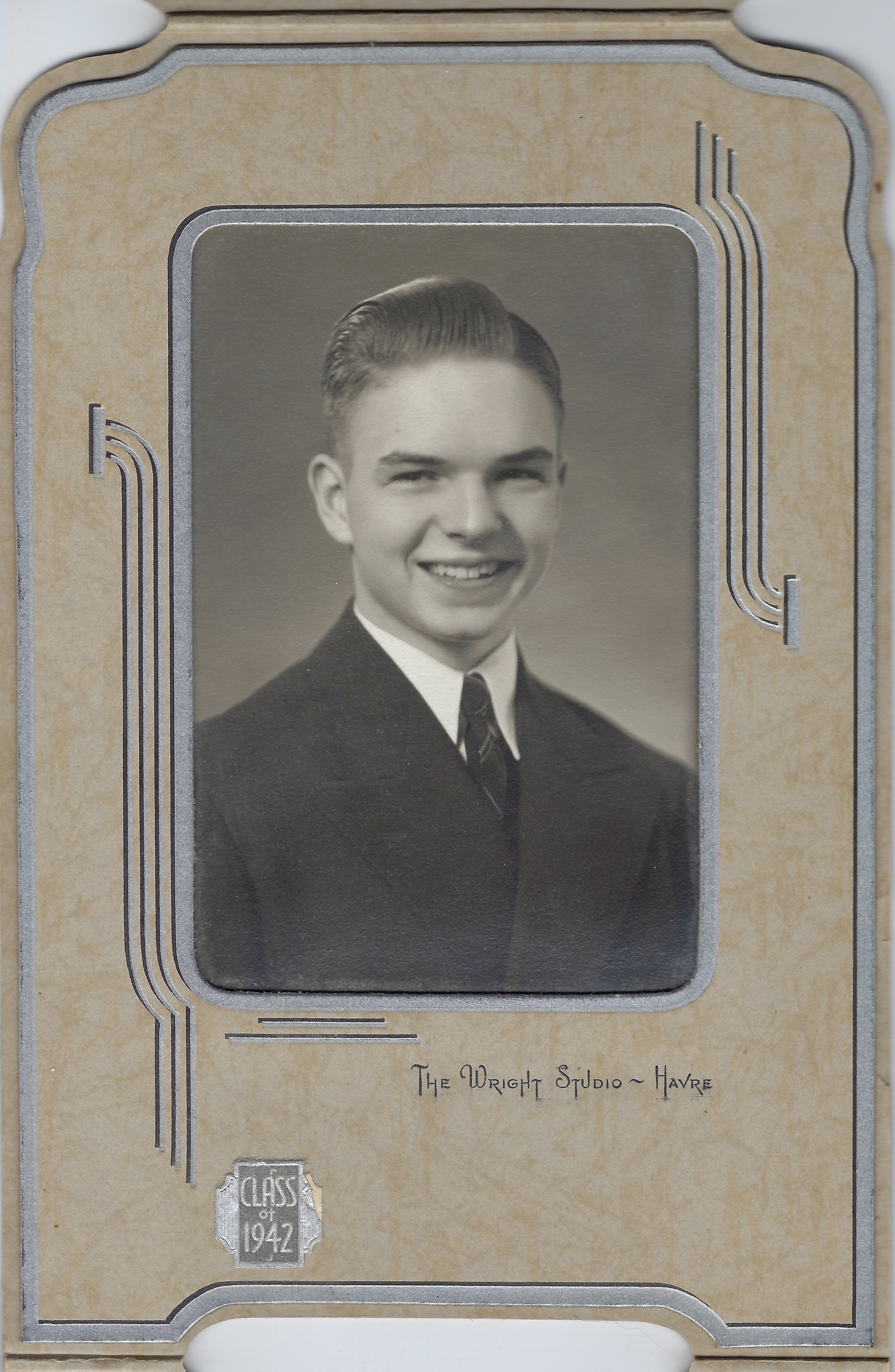
Howard’s senior photo from Havre High School. 1942.
At least, that’s what I surmise. My father didn’t want to talk about his time in the service at all. We did learn he made some grade of sergeant, but I only called him Sarge once. Let’s just say he made it very clear it would be the last time I called him that.
Howard mustered out of the service, enrolled at Washington State College (now WSU), hired on with the Carnation Milk Company in Seattle, married Louise Bach there in 1952, and they had a baby in 1954…me. We moved to Spokane, WA, when the Carnation Company transferred him soon after my first birthday. My brother was born there. My father accepted transfers back to Seattle (fall of 1962) then to Los Angeles (the beginning of 1964) before he made his dislike of Los Angeles and corporate life known. The company allowed him to go back to the same job he had left in Spokane just two years prior. We will revisit that career-killing decision. Four to five years later, as I approached high school age, he went through a personal crisis, quit Carnation, emptied out his profit sharing account, and maintained the family on that while he searched for a new career path. When a close family friend needed to fill a comptroller position at Sacred Heart Medical Center, he thought of my father who then began a very nice career managing financial matters for the hospital. As his mentor ascended the ladder of responsibility, so too did my father, eventually boasting the title Director of Fiscal Services. He retired after about 20 years of service to this medical center founded by the Sisters of Providence, a Catholic order of nuns.
In retirement he tended roses and indulged the Pilcher penchant for wandering by undertaking numerous road trips with our mother. There were a handful of trips by plane, but he fought claustrophobia for much of his adult life and those weren’t comfortable trips for him. Two trips abroad (England and Spain), a cruise package to Alaska, and near-annual trips to Hawai’i for a while rounded out the travel. They celebrated 50 years of marriage in 2002, quietly marked 60 in 2012, and he died after a sudden trip to the hospital in 2013 which saw him enter the hospital on a Tuesday and pass on the following Monday morning.
What did people think of my father? “That weirdo”? A “super nice guy”? “Honest as the day is long”? I know that he was loved. I know he withdrew toward the end of his life, and one by one most of the people he knew and loved died before he did. I know he worshiped my mother yet had a condescending tone toward her (which I adopted to my detriment). I know many, many superficial things. What I don’t know is the man he truly was, and what force ultimately took over the final five years of his life, making him mentally miserable at times. I know, too, it lurks within me and whispers that it just may do the same when my time nears.
This has been but a snippet, a dry telling of mostly factual matters, an introduction as stated in the title. To explore the man through reminiscence requires setting the stage. Much like reading your playbill before the curtain rises, you’ve now gained the background to enjoy the show (hopefully). In subsequent posts we’ll explore in no particular order and perhaps not under these self-same titles:
Ebullience, Positive Thought, and the Eleemosynary Ethic
Accruing Guilt: Understanding What Your FatherMeant
I thought to make an extended metaphor about how life resembled a track event or maybe cross-country, how most of us spend the first 18 years getting in shape. When the gun sounds at 18, though, I ran into trouble because not all of us have those lovely first splits where the race seems to be a breeze and you think you could run forever. By 21, when I envisioned the first little twinge of pain, I realized that many couldn’t say that—for them the race becomes an endless drudge to be run, not at the front of the pack, but at the end of that solid bunch of runners who know they’ll never come close to winning this thing. And then I saw it isn’t a race anyway, and the metaphor petered out. If I apply this metaphor to myself I…
changed my event almost as soon as I signed up for it…
sat out the second lap…
signed up for a different event and changed that one twice before quitting the race again…
entered the original event chosen by 17-year-old me…
ran that race until I realized I just wasn’t suited for it…
trained for a different event and ran that one for a decade…
left that race, dreaming of the Perfect Event…
and fell into a nondescript event only to find my innate talents bloom
And that’s just the metaphorical telling of my career. What about love? Family? The experience of life? No matter. It was fun playing with that photo of my brother running cross-country when we both were young and naïve.








 all the voices in my head