In the late 1960’s I listened to Barbra Streisand on a transistor radio the size of a cheap paperback. She sang “People who need people are the luckiest people in the world.” I never understood that, emotionally at least. Intellectually I valued it and wanted to be one of those persons. I still do….but….
I don’t like people. There, it’s out. Liking people is inherent to my religious faith. We are supposed to like all people as caricatures of God, as images of God, or at the very least, as created beings who have as much claim to the Kingdom as anyone else. But…I do not gravitate toward people as an instinctive or cultured trait. I’ve known people who show themselves to be introverts, but they put on a social face, forcing themselves to reach out, building a practice that becomes instinctual. I’m not one of those, at least not in most milieus.
It’s more nuanced than it sounds. I like individual examples of “people” just not People in general and certainly not together in a group. Nothing tops my list of activities to be avoided like a cocktail party or “open house”. A group of people in a social situation where I know only one or maybe two of them makes me nervous, shuts me down, inspires my feet to start edging toward the exit, my lips mumbling an excuse to the host. Or that nervousness gets channeled into a babbling energy, creating The Entertainer—usually to my later embarrassment and dismay. After decades of experience with these situations—which mercifully I’ve kept to a limited number of occasions—I’ve learned some coping techniques. Mostly I avoid them unless I know a goodly handful of the people and like those who will be there. When I misjudge I desperately cast about for someone I know at least casually and bother them for as long as I can.
Oh boy, another wedding reception. Great for them, not so great for me.
I’ve learned how to maintain a veneer of sociability. I’m verbally talented after all. Talking to an individual about something they like makes you likeable. I’ve a wide range of interests and I’m well-read. I can usually relate to folks. But I’m uncomfortable.
Thankfully wedding receptions have beer, and this one had photogenic grounds to keep me away from all those people.
Perhaps this explains my delight in this blog, and in others’. We skip the social chit-chat on these things (usually). We do sometimes utter the banal (“I’m so happy for you” or “Getting that disease is so horrible!”), but mostly we utter honest statements because the beauty and scourge of the Internet lies in its anonymity for those who post. It’s why I’ve chosen to blog under my actual name. That seems contradictory, but it’s not. Most of you know my name, but you don’t actually know me except through these writings—the same way I know you only through what you post. Is it bold or stupid to put my own name? I’d prefer to think “honest” in that I will utter my opinions and not hide behind total anonymity. But y’all know me from a load of coal: except for two of you, and that has inhibited some of the things I would post, which illustrates the difference I’m talking about, this being known but anonymous simultaneously.
Where all of this blather leads turns out to be unexpected. I do need people, but just not the ones who mouth platitudes, clichés, and banal statements about the weather. Symbolic language has its place, but in a social setting it makes for a symbolic encounter signifying nothing. Sure, I can do it, but the sheer uselessness of it bothers me considerably. This need for people has been reinforced (again) by spending a week alone while my wife visits the NC coast with her friend. I’m reminded of living in my head like I did so many years. I believe we all need people to listen to us. That there are so many diaries and journals of people famous and otherwise reveals a deep need for others to understand what they’re going through. I guess I am a “people who need people” but only deep down and selfishly.
Needing and caring for people remains a distinct view of my religious faith. Listen to people with care. They need that. Yes. But so do I. The adroit, talented person knows when to listen and when to ask for a listener. I, however, refer you to the beginnings of this post. I do not possess those talents. I seek for listeners, but not to be the listener. Reminded again and again of my failure in the social arena, I withdraw. This is my learning path, perhaps one of several.
Howard, 11 weeks; with his mother, Esther Dahl Pilcher. Lansing, MI, August 1925.
Howard Bliss Pilcher entered the world on this date 100 years ago. He died toward the end of 2013. In those 88 years, like most of us, he did nothing to affect the globe or any large portion of it. His impact, again like most us, accrued from those individuals he knew and perhaps from patrons of the two entities which employed him for 39 years. He most affected his wife and sons, Steven (my brother) and Kenneth (me). Seventy years later, to me he remains both enigmatic yet an apparently open book. Whether nature or nurture, his traits run through my being. Whether you knew him matters not. He might have subtly affected you too: every one of us amplifies his presence on humanity simply by interacting with more than one person and making an impression them; it ripples out to touch people we never knew.
Howard Bliss Pilcher—technically a Junior though never named as such—came into the world in Lansing, MI, on June 22, 1925. He moved with his brother and parents from city to city as his father, an American Baptist minister, moved from church to church. The younger HBP served in World War II, completed college, started his career, married, procreated, retired, traveled, and died December 16, 2013. He resembled thousands, millions of other men born around the same time. We each are unique, though, and this unique man fathered and raised me. If we are constituted from our roots, our times, and our experiences, then exploring those roots isn’t so much recounting their life as it is exploring our own. Therefore, we can’t call this biography. I haven’t the time or desire to research the nuances of his history, let alone the history of the times and regions through which he passed. (And thanks for that, too, Dad.) But there will be biographical elements to it, just as there will be aspects of memoir stemming from his inescapable impact on my life, and how the two remain intertwined even after his death. Perhaps reminiscence remains as the most accurate term.
A confession before we start: I’ve procrastinated all my life—a trait which will be explored through the telling of this tale—and this procrastination has left me too little time to complete this piece prior to deadline. My vision for it looms at far too many words to dash off in one or two sessions. Unlike the great gonzo journalist Hunter S. Thompson, I cannot lock myself in a hotel room for a few days, wire myself on pharmaceutical grade crank, and pound out a semblance of the piece this subject deserves. My physique won’t handle it, my psyche won’t handle, my marriage won’t withstand it, and I don’t see why after seven decades I should start caring about deadlines now. Okay. Let us begin. We’ll start with the thumbnail bio:
The senior Howard Bliss Pilcher, my grandfather, the one my grandmother called “Bliss,” came into the world in 1894 in Urbana, Illinois. The Pilchers traditionally lived in north central North Carolina in Yadkin and Surrey counties, up by the Virginia state line, but the “movin’ bug” ran through our branch of the family as far back as the early 1800’s. Bliss’s father, Wiley Pilcher (1861-1935), moved to Illinois where he fathered all three of his children. Wiley later moved to Fargo, ND, and finally to Libby, MT. All of this perhaps explains why, when he heard the call and enrolled in seminary, he became an American Baptist minister. American Baptists were at one time called Northern Baptists and trace church lineage through the Triennial Convention, the first Baptist convention in the United States of America. In 1845 a pro-slavery faction split off from the Triennial Convention to uphold the institution of slavery. It came to be known as the Southern Baptists. Without researching the topic, we may surmise that many Pilchers would not have been happy with my grandfather’s choice, particularly the majority of them still living in North Carolina. The decision to minister in that denomination reflects the equanimity which characterized my father’s upbringing, and which he instilled in me.
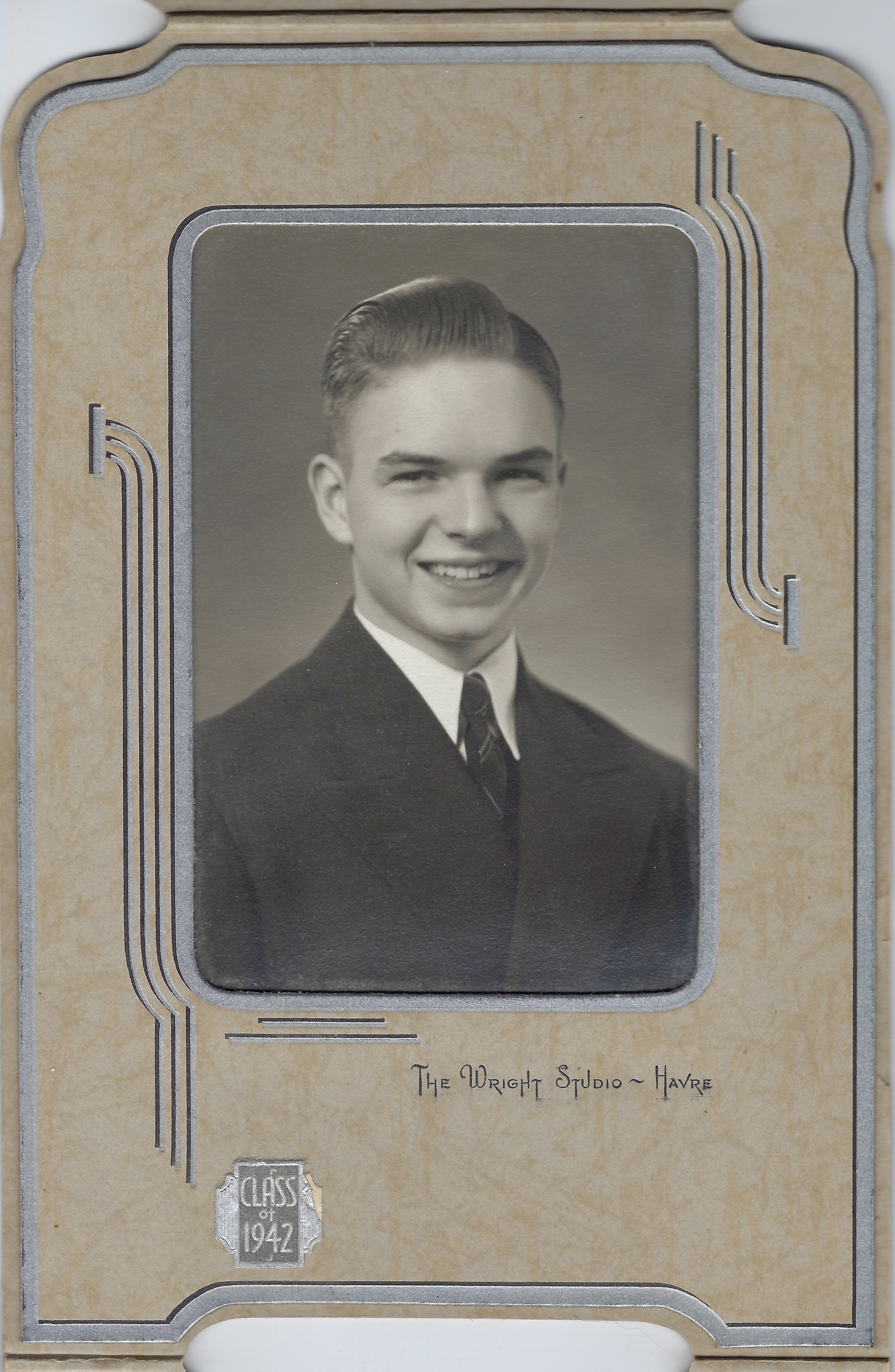
One year after my grandfather married Esther Dahl, my father was born. Lansing, the capital of Michigan, had nearly quadrupled in growth from 1900-1920. Not only were these the Roaring Twenties but this sizeable city (about 67,000) boasted all the activity inherent to a state capital. Thus, he started life in the thick of it: the capitol building stood about a half mile from their house. Not that this would have had much of an impact since by age 3 the family moved to Edina, MN, a suburb of Minneapolis. In between was a short stint in Dover, ID, an unfathomably small and remote place for a minister to travel, perhaps explained because Bliss stepped up from being a youth minister in Lansing to having his own church in Dover. The family lived in Edina for ten years more. At the threshold of my father’s entrance to high school in 1938, his father accepted a call to Havre, MT. (I’ve started to wonder if the “calls” were based more on wanting to stay reasonably close to his father, Wiley. Edina lies less than 250 miles east of Fargo; Havre is 350 twisting miles east of Libby.) Four years later my father graduated from high school. He attended the local college, Northern Montana, for at least a semester, but the reality of World War II loomed. The U.S. Army drafted him, placed him in the Quartermaster Corps, and sent him back and forth across the Pacific guarding supplies.
Howard’s senior photo from Havre High School. 1942.
At least, that’s what I surmise. My father didn’t want to talk about his time in the service at all. We did learn he made some grade of sergeant, but I only called him Sarge once. Let’s just say he made it very clear it would be the last time I called him that.
Howard mustered out of the service, enrolled at Washington State College (now WSU), hired on with the Carnation Milk Company in Seattle, married Louise Bach there in 1952, and they had a baby in 1954…me. We moved to Spokane, WA, when the Carnation Company transferred him soon after my first birthday. My brother was born there. My father accepted transfers back to Seattle (fall of 1962) then to Los Angeles (the beginning of 1964) before he made his dislike of Los Angeles and corporate life known. The company allowed him to go back to the same job he had left in Spokane just two years prior. We will revisit that career-killing decision. Four to five years later, as I approached high school age, he went through a personal crisis, quit Carnation, emptied out his profit sharing account, and maintained the family on that while he searched for a new career path. When a close family friend needed to fill a comptroller position at Sacred Heart Medical Center, he thought of my father who then began a very nice career managing financial matters for the hospital. As his mentor ascended the ladder of responsibility, so too did my father, eventually boasting the title Director of Fiscal Services. He retired after about 20 years of service to this medical center founded by the Sisters of Providence, a Catholic order of nuns.
In retirement he tended roses and indulged the Pilcher penchant for wandering by undertaking numerous road trips with our mother. There were a handful of trips by plane, but he fought claustrophobia for much of his adult life and those weren’t comfortable trips for him. Two trips abroad (England and Spain), a cruise package to Alaska, and near-annual trips to Hawai’i for a while rounded out the travel. They celebrated 50 years of marriage in 2002, quietly marked 60 in 2012, and he died after a sudden trip to the hospital in 2013 which saw him enter the hospital on a Tuesday and pass on the following Monday morning.
What did people think of my father? “That weirdo”? A “super nice guy”? “Honest as the day is long”? I know that he was loved. I know he withdrew toward the end of his life, and one by one most of the people he knew and loved died before he did. I know he worshiped my mother yet had a condescending tone toward her (which I adopted to my detriment). I know many, many superficial things. What I don’t know is the man he truly was, and what force ultimately took over the final five years of his life, making him mentally miserable at times. I know, too, it lurks within me and whispers that it just may do the same when my time nears.
This has been but a snippet, a dry telling of mostly factual matters, an introduction as stated in the title. To explore the man through reminiscence requires setting the stage. Much like reading your playbill before the curtain rises, you’ve now gained the background to enjoy the show (hopefully). In subsequent posts we’ll explore in no particular order and perhaps not under these self-same titles:
Ebullience, Positive Thought, and the Eleemosynary Ethic
Accruing Guilt: Understanding What Your FatherMeant
I thought to make an extended metaphor about how life resembled a track event or maybe cross-country, how most of us spend the first 18 years getting in shape. When the gun sounds at 18, though, I ran into trouble because not all of us have those lovely first splits where the race seems to be a breeze and you think you could run forever. By 21, when I envisioned the first little twinge of pain, I realized that many couldn’t say that—for them the race becomes an endless drudge to be run, not at the front of the pack, but at the end of that solid bunch of runners who know they’ll never come close to winning this thing. And then I saw it isn’t a race anyway, and the metaphor petered out. If I apply this metaphor to myself I…
changed my event almost as soon as I signed up for it…
sat out the second lap…
signed up for a different event and changed that one twice before quitting the race again…
entered the original event chosen by 17-year-old me…
ran that race until I realized I just wasn’t suited for it…
trained for a different event and ran that one for a decade…
left that race, dreaming of the Perfect Event…
and fell into a nondescript event only to find my innate talents bloom
And that’s just the metaphorical telling of my career. What about love? Family? The experience of life? No matter. It was fun playing with that photo of my brother running cross-country when we both were young and naïve.
An old ornament on a new tree. Kinda like us in 2024.
My wife and I first wish you all a Merry Christmas. At the very least we hope the seasonal aspects of peace, love, and deeply rooted joy enter your heart and soul. We still dare to hope these wishes also spread from the end of this season through 2025 and beyond. Despite this being my 71st Christmas and the accumulation of a freight train’s worth of cynicism, I’ve found hope and optimism remain surprisingly strong in my heart.
In the photo above, the ornament symbolizes all of that. Its pink and white frosted layers have many imperfections. The bulb has carried most of those imperfections since its creation, but also has lost some of its sparkle as grains have fallen off through the years. It nevertheless remains shiny where first it shone, and it draws the eye amid the more modern ornaments picked up during the years, the modern (and safer) lights, and the not-so-accurately-manufactured tree needles on our artificial tree. My parents gave me this ornament with a few others when I struck out on my own about 45 years ago. It can’t be younger than the 1950’s, the same as me. As it’s lost its sheen to poor handling, indifferent storage, and the jostling of eight moves during our marriage alone, it’s gained character and presence, standing out among the gaudier yet superficial touches of the newer decorations.
Ultimately, like this ornament, all of us arrive at this Now and this Here being who we are. We put on and take off habits every few years, but settle into most for decades. Beneath the cloak(s) of these habits lie the core of our beings. This Christmastide, I wish you what I wish for myself: a closer understanding of that. When we walk confidently with our Selves, we can accept the unique Others who walk with us on this path. Maybe then we’ll have a little more peace in this world. Maybe then we won’t shout in anger at each other. Maybe we can inch a little bit closer to the perfection buried in our hearts.
Postscript: I’ve kept the above thoughts on the vague, bordering-on-vacuous-greeting card level because I don’t want to push an agenda at you. These thoughts underlie all spiritual beliefs. Even those who believe in nothing but organic humanism (just the brain, baby, then you’re gone!) have a spiritual belief–they believe there aren’t any. To these and to all, I say, “Acknowledge the Self. Recognize it in Others. This forms a bedrock more fundamental than the trappings of religions and philosophy. We all could get behind this concept and make a better world in the process.
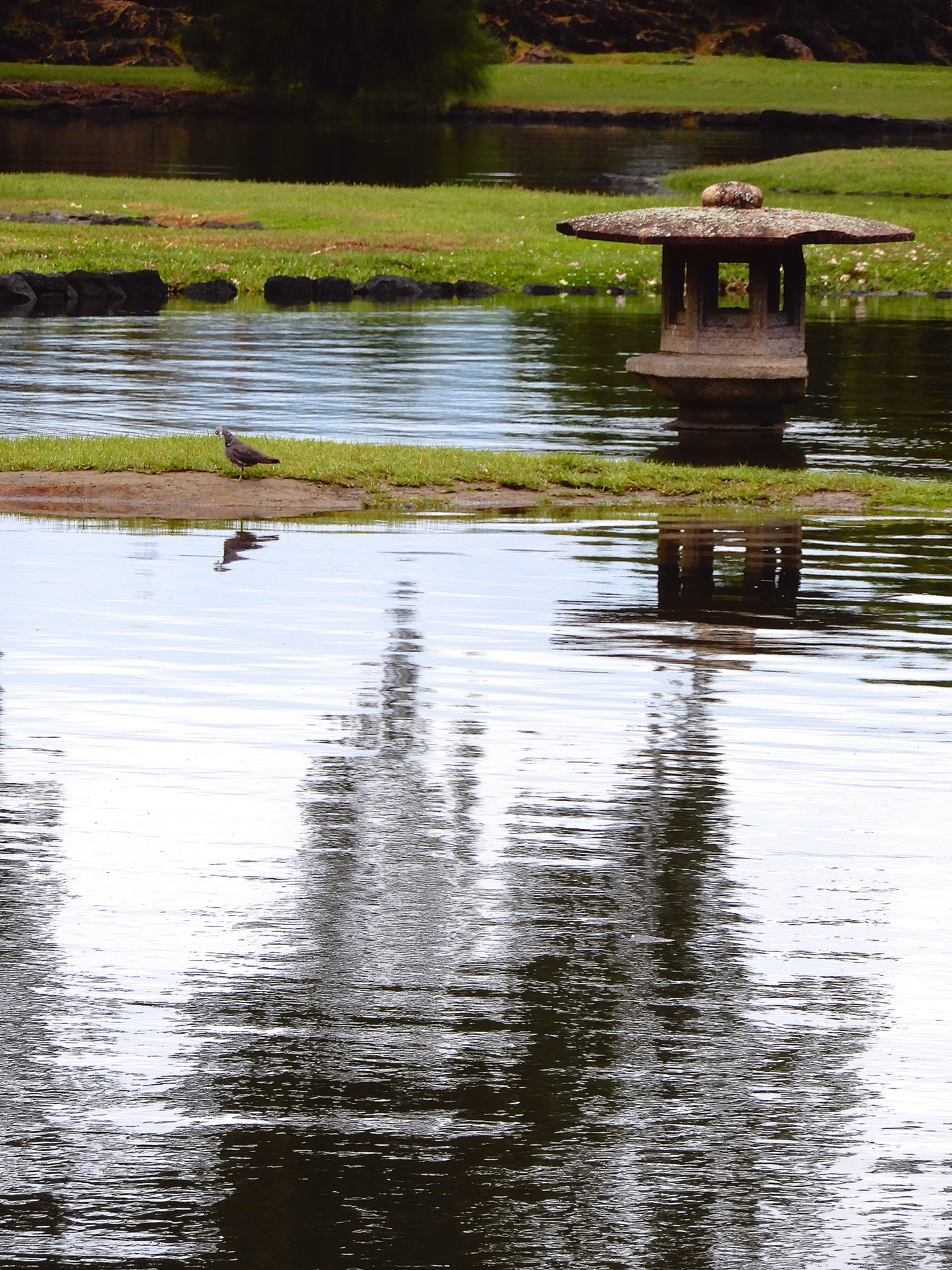
One of our many islets in the waters around our hotel. Big Island, HI. September 2024.
Our first full day in Hawai’i on the Big Island, we woke to mostly cloudy skies–not surprising considering we were on the rainy side of the island and we’d arrived to Hilo Airport under a solid overcast. As is our wont, we spent our first morning lazily, eventually venturing forth to explore our near surroundings. Here, it meant taking a walk around the western half of Waiakea Peninsula. Our hotel sat on the northernmost tip of the peninsula, situated on pretty grounds, so we started there.
Grounds of Grand Naniloa Hotel, looking east. Big Island, HI. September 2024.Grounds of Grand Naniloa Hotel, looking north. Big Island, HI. September 2024.A flower-cluster on one of the plants around the grand Naniloa Hotel. Big Island, HI. September 2024.Looking northwest from the northern tip of the peninsula. Big Island, HI. September 2024.
After touring the property, fencing forced us to the road in front of the hotel, Banyan Drive, so-called because 75-90 years ago a bunch of folks planted banyan trees to line it. Every time we drove in and out of the property we traveled Banyan Dr, making it one of the cool pieces of Hawai’i for me. Banyan trees are huge:
Typical banyan tree on Banyan Dr, Hilo, Big Island, HI. September 2024.
Our perambulations took us to a small park which culminated in Coconut Island, a spit of an island which took it in the teeth when a tsunami hit in 1960. (The somewhat famous Tsunami Clock is located nearby.) By now I had started cursing my brother who talked about the gloriously comfortable weather where humidity gets balanced by near-constant breezes. Our shirts were getting soaked. Temps were running close to 90 as the clock approached noon. As North Carolinians we’re very experienced with gray, overcast skies accompanying warm, humid conditions. We learned later this weather pattern wasn’t normal.
Our last stop consisted of wandering Lili’uokalani Gardens, a Japanese-style layout with plenty of Hawai’ian flora–at least I took it to be native. Who knows? Asking around later, I learned the park lies so low, so near Hilo Bay, that Waihonu Pond and other low-lying areas fill with extra water from the high tides. It prevented us from walking some of the paths.
At low tide one apparently can walk to and over this nice little Japanese-esque bride. Lili’uokalani Gardens. Hilo, Big Island, HI. September 2024.A Nene goose, Hawai’ian native. Lili’uokalani Gardens, Big Island, HI. September 2024.Yes, it really was that green. Lili’uokalani Gardens. Hilo, Big Island, HI. September 2024.
It never really began. One victory sandwiched by defeats and garnished with the end to their season? No, the machine ran down and died. Just like that.
I confess to you, my brothers and sisters in Philadelphia baseball, that I greatly sinned. After the Mets rattled off six unanswered runs in Game 3, I quit drinking Yuengling, the talismatic beer whose magic didn’t fail so much as it failed to show up. I lost faith. Our boys lost. Yesterday, with a sinking feeling that foretold the eventual outcome of Game 4, I didn’t watch the game, and I didn’t drink the final Yuengling in the fridge. There it is, Philly. You can blame me–although there are more than one million folks in SE Pennsylvania who certainly felt more pessimistic than I.
Now I face my most depressing season without the solace of fan-fueled postseason baseball. I detest cold weather, and autumn’s ever-cooling presence reminds me of it, like one of those guests who comes to the party late, immediately begins to suck the joy from the festive partygoers, drives away the liveliest guests first, and eventually leaves you alone in your cold, wintery room. Autumn’s first cold mornings might look pretty, but they signal the beginning of the end for summer’s warmth. I need the hopes of postseason baseball. When baseball’s postseason rolls around, fans fall into three groups: those whose teams weren’t expected to make it and didn’t; those whose teams were expected to make it and didn’t; and those who have varying degrees of hope that this timewe’ll go all the way. When teams drop out of the postseason, as the Phillies just did, their fans join the middle group, the Group of Dashed Hopes. At times like this we say, “I would rather they were an up-and-coming team that wasn’t expected to make the postseason than to think they were going all the way only to watch them crash and burn.”
Of course, this isn’t true. Phillies fans suffered through two lengthy periods where year after year it seemed no one in charge had a plan for making the team better. I’m talking about the years 1994-2004 after 1993’s appearance in the World Series (the Joe Carter game!), and the period from 2012-2019 following the five-year run of 2007-2011. We know that having no hope tastes worse than this, a bland meal which becomes ever more unpleasant as the season unfolds. (Ask a White Sox fan.) But to savor a .586 season and the first division title in a dozen years, only to be served this…this…what can we call a 1-3 performance in their first round? Something steaming for sure. And to the Mets! There are many insufferable fans in baseball, but the ones who flood your ballpark from barely more than 100 miles away? Who fill your ballpark with their “Let’s go, Mets!” chants? Who have thrown beverages and even batteries at players (1999, John Rocker, Atlanta Braves) and yet somehow dodged the rep while it sticks to Phillies fans like an undeserved judgment? No, please, not to the Mets.
All because I failed to drink a Yuengling? Surely there are greater sins, oh gods of baseball. Give me back my joy. Make this autumnal chill release its grip on my baseball heart. Send me a reason to hope again.
Johnny boy, he's always propping up the bar
He sees life crystallized through his jar
He says he only lives for beer
But deep in his heart is a cry of fear

Give me a heart to hang onto
Give me a soul that's tailored new
Give me a heart to hang onto
A heart to hang onto

--Pete Townshend, "Heart To Hang Onto" from the album Rough Mix with Ronnie Lane