Every day walkers march past our house. They pass every ten minutes or so in the early morning, then dwindle. When summer brings 80+ degrees by mid-morning, accompanied with 80% relative humidity, “only mad dogs and Englishmen” will attempt a walk. Some walk to exercise dogs which have seemingly conducted a PR campaign to make sure every house has at least one. Some walk because they like it. (You can tell: they appear to be in good physical shape, they walk on a regular schedule, they seem to enjoy it.) Others walk because someone told them to–perhaps a doctor, a spouse, their conscience, a good friend, or one of the ubiquitous self-help gurus on the internet. We suspect one elderly gentleman walks three times each day to regulate his blood sugar. My father-in-law did that for many years, and managed in that endeavor to postpone insulin shots for more than a decade.
For several weeks I’ve joined them on this circuit, up and down this short stretch of street, oddly reminiscent of a treadmill laid out in a short course of concrete. I’ve learned by leaning into this as a practice (as opposed to “an exercise program”). Sometimes, I walk more slowly, listening to my muscles, my fortitude, walking within the boundaries of what is possible. Sometimes I push my pace exuberantly, reveling in my ability at 70 to suck oxygen into my lungs quickly enough to maintain this rapid pace, thrilled that EXERCISE can still be a part of one’s life.
Today I melded the two, yielding to an inner desire to go slower, not for physical reasons but to focus on the incremental occurrences which blow by me normally. Today….
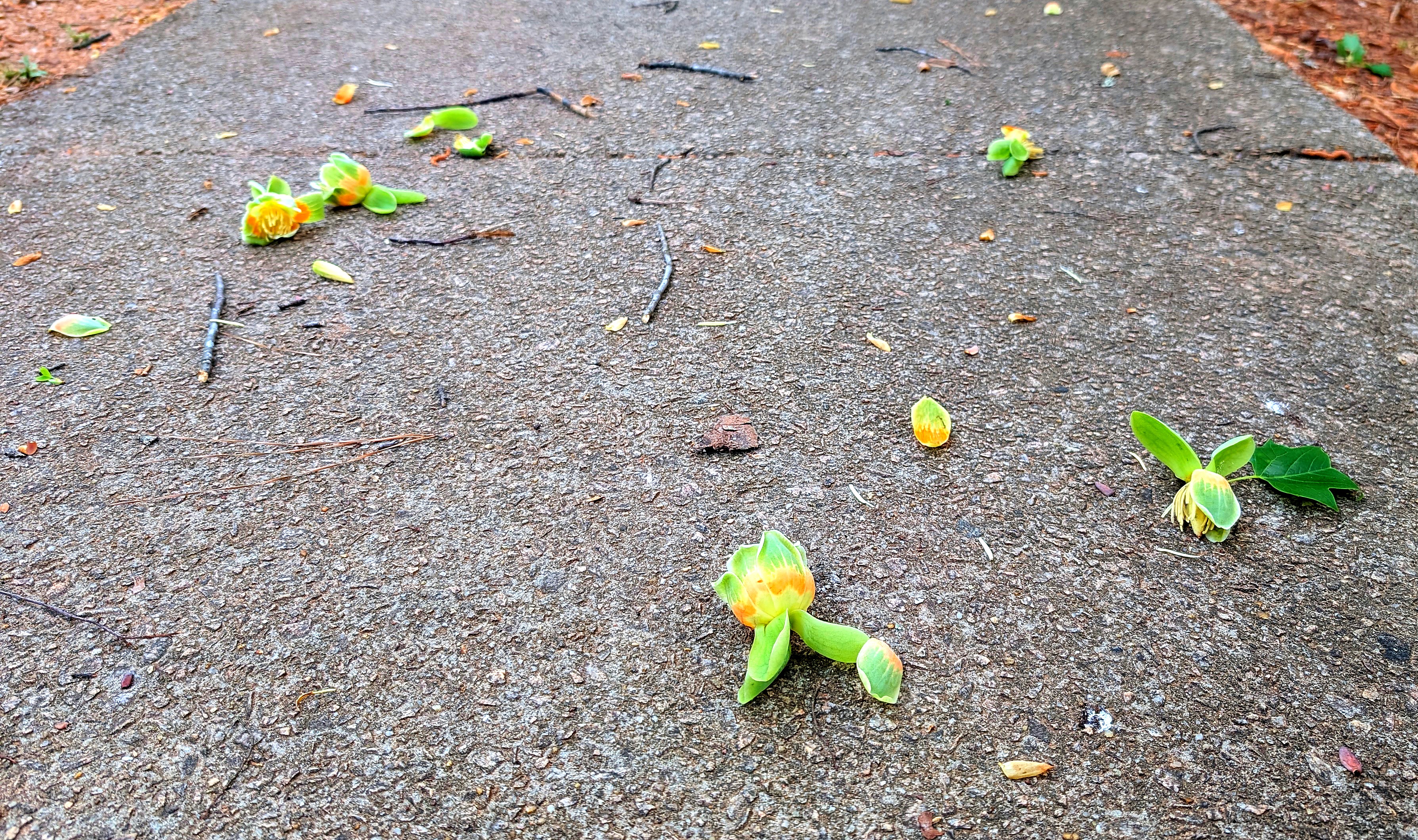
I noticed how rapidly tulip poplars have dropped their blossoms. Apparently a quick flowering gets consummated as rapidly. Their flowers no longer being necessary….
Tulip Poplar flowers. Raleigh, NC. April 2025.
It’s trash day and with it, yard waste pickup day. Reflecting the beginning of the spring/summer interface, we see sights such as these…
Overfull yard waste containers. Raleigh, NC. April 2025.
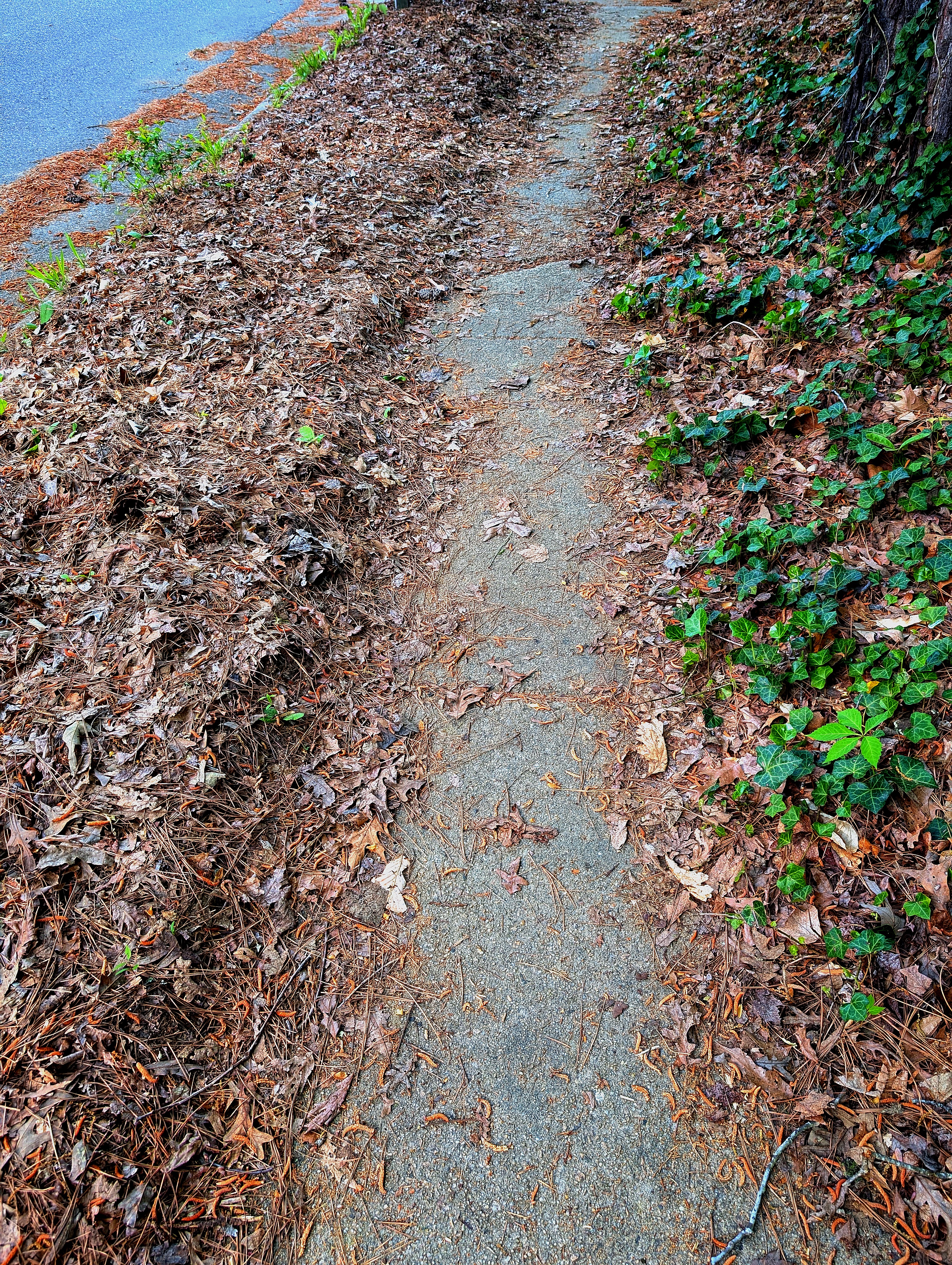
Circling at the block’s end, I encounter my across-the-street neighbor’s sidewalk. Older than me, quite likely in his 80’s, he maintains his large corner lot minimally. Those of us who pass make our own paths through the accumulation of leaves he does not clear:
Spring in Raleigh, NC. April 2025.
Many sights beckon, but one cannot stop every few feet to snap photos. (Not if one desires to arrive home and brew tea before one’s spouse arrives at the kitchen.) At the “modern” end of the three-block length of our street, where a developer with more cachet than aesthetics decided “hey, a boulevard would be nice,” said boulevard is filled with ornamental trees which have no right to be here. This is a Chinese snowball tree, on the backside of its blooming peak:
Chinese snowball tree. Raleigh, NC. April 2025.
One of the delights of continuously walking a circuit lies in encountering familiar sights suddenly made new. How does one walk past a plant daily without focusing on what it is? Suddenly it blooms, saying, “Take notice! Look at me!” I did not use my plant identification software on this, and I don’t know what it is. It looks rose-like, but obviously it isn’t. A mystery to be solved for another day:
A plant. A beautiful plant. Another day. Raleigh, NC. April 2025.
And one notices the fire ants have established many beachheads in the sidewalk crevices.
Fire ant colony. Raleigh, NC. April 2025.
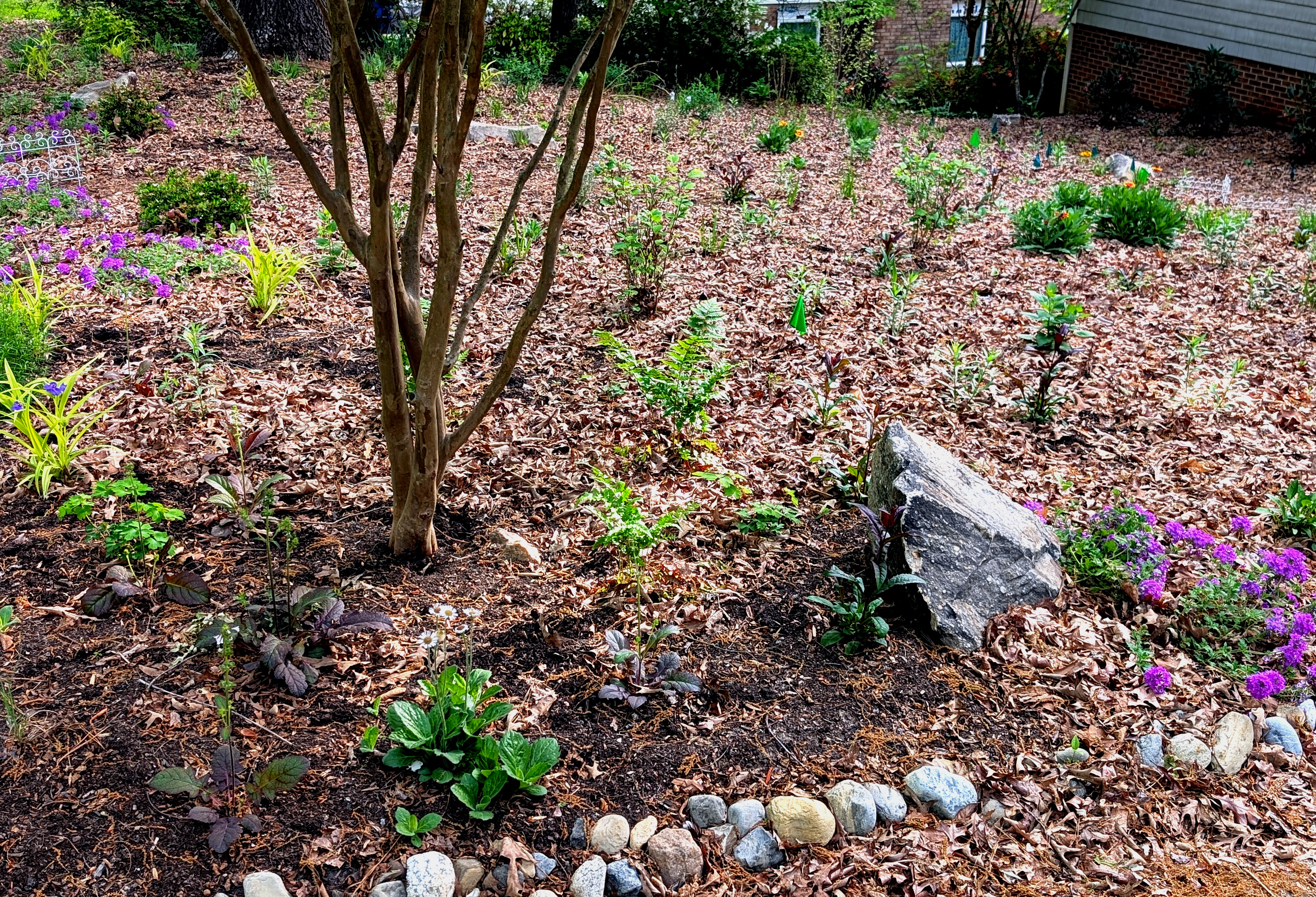
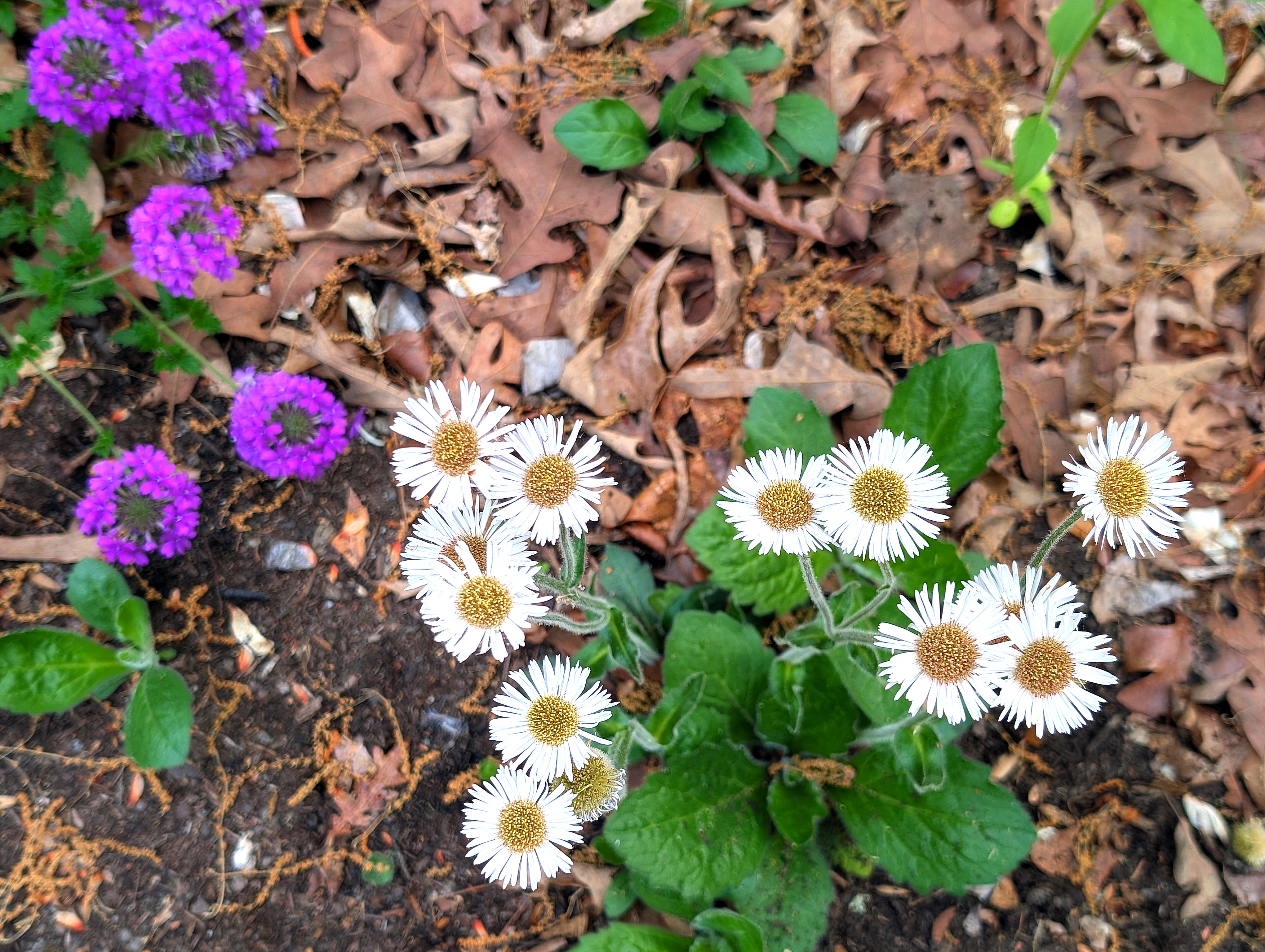
Finally, arriving at the start point, one marvels at the stark contrast of a natural environment composed of native plants that have flowered vociferously in the past weeks.
Our front yard, six months after its installation. Raleigh, NC. April 2025.Mock vervain (I think) on the left, Robin’s plantain on the right (a cultivar of fleabane). Raleigh, NC. April 2025.
Watching a specific environment over time delivers meaning which a one-time walk through a park does not. The tide and ebb of the seasons, the minor changes in foliage, the calls of the birds as they cycle through a mating season, the feel of the air as less humid air gives way to summer–all of this imprints the incremental passage of time on one’s psyche.
Every week I count out three different prescription pills and one over-the-counter drug into a one-week pill minder. Every week I think of my mother doing the same.
My brother and I traded exasperated texts when one of us witnessed this. By the time I shot the photo above, Mom had only eight months until others would count out the pills for her, and she had but 18 months left with us. She’s closer to 89 than 88 in that photo. Never strong in linear thought and simple arithmetic progressions, aging had taken a bit more away from what once was there. Our exasperation hid our anguish at several things: who in their right mind would think it’s a great idea to make tiny little white pills which will be taken mostly by old people with arthritic hands? And shouldn’t it be a regulation that no pill can look exactly like another? And how can a person not just look inside the pill minder partitions to see if there’s a pill in there before you start? Which of course left us with the question, how can one not notice when a pill isn’t taken one day of the week?
Having worked in pharmaceutical manufacturing, I have a formalized method for dispensing my pills, and for taking them.
Open the container and flip out all ‘leftovers’. (I sometimes elect not to take the decongestant so I have leftovers.)
Take prescription blood pressure medicine #1. Drop one into each partition. Double-check that it’s just one-per-cell. Close that pill bottle. Turn it upside down.
Take prescription #2. Cut a tab in half. Drop one half each into the first two cells. Work left to right and repeat for cells 3-4 and 5-6. Drop another half tab into the seventh day’s cell. Close that bottle. Turn it upside down.
Start the same for prescription #3, dropping two tabs in each cell.
Cut seven tabs of the OTC drug in half, dropping the split tab each time into a cell.
When it comes time to take the day’s pills, flip out the day’s cell into a little pill cup I have, then put one half OTC tab back in. At the end of my breakfast, dump the contents of the pill cup into my palm. Stop. Stare at the pills to be sure I know each of them and that there are the right number of each. Swallow them down.
“Rigidity for the things which should be rigid,” is my motto. Otherwise I don’t care. (Okay, yeah I do, but that’s a lengthier post about borderline OCD-ness.) Yet…when I dispense my pills each week, I think of how difficult this was for my mother when she was but 15 or so years older than I am now. I don’t believe she had nearly as much trouble when she was 70. What’s coming down the road? Why couldn’t I see that being 88 is not like being 64?
Next week: how to torture yourself about any trivial thing for the rest of your life. Please prepare by reflecting on your teenaged years and the relationship you had with your parents.
[In our continuing series, Cranky Old Man Yells At Clouds, today we again tackle the tough Time issue. For other time-rants, see here and here.]
“Upon This Altar” — manipulated photograph. October 2024.
This morning, November 3rd, 2024, I rose at 6:16 a.m. according to our two bedside clocks. Dressing and walking to the kitchen, I noted the analog kitchen clock concurred, as did the digital clock on the stove (except when the now-failed crossbar made an “8” look like a “0”). For some reason the microwave got confused and reported the time actually was two hours and 50 minutes prior. All of these timepieces and presumably the clock on the deck, the clock in the guest bedroom, and the clock on the fireplace mantel backed the majority opinion: 6:16 a.m.
My cellphone, however, said I had risen earlier–it was still prior to 5:30 a.m. It reflected the common and legal opinion that an extra hour had appeared overnight during which no time passed. For the rest of 2024, time would be measured on Standard Time.
This clock conflict didn’t bother me. It’s been dark for weeks when I rise. The sun rose today approximately 90 minutes after I did, and it did the same yesterday. My wife and I ate breakfast about an hour later than we usually do on a Sunday, but our breakfast times are flexible these days, and we’re not going to church because we’re still quarantining due to Covid. My day so far has run its course normally, and the only effect of this time change will be making sure we tune into our church services at a specific time which the kitchen clocks would say is 11:30 a.m., but my connected clocks (phone, desktop computer, etc.) will say is 10:30 a.m.
You could argue my cavalier approach to this time change results from my retired state, and you would be partially correct. Few things happen at set times in my day anymore. But even when my day revolved around “getting to work” and “catching a plane,” I’ve looked at time as a voluntary measurement. I don’t need to order my life by it. For nearly 30 years I have rarely used an alarm clock to make myself get up at a certain time. They exist primarily as safety nets to make sure I don’t oversleep, and usually the mere act of setting a morning alarm will suffice to wake me just prior to the nasty thing interrupting my sleep. I mention all of this not to brag about how wonderfully I deal with time, but to explain a relationship to it which causes me to blow a few gaskets twice a year.
Each year about this time we’re subjected to some of the lamest reportage, critical thinking, and general common sense that we see all year–except for the commensurate period in late winter/early spring when it rears its foolish head and reverses its so-called logic (sometimes). I’m talking about all the nonsense you’ll read about Leaping Forward in time when we go to Daylight Saving Time, and when we Fall Back to Standard Time on the first weekend in November.
“Fall” — manipulated photograph. October 2024.
I’m not talking about the ill effects many people report from the shift in timekeeping. These effects align with everything we know about a body’s rhythms and the general circadian rhythms of most creatures on this planet. One shouldn’t wonder that attempting to stick to a personal schedule which has been artificially shifted an hour would have an impact on the person attempting it. No, what I’m talking about are all the inane things said about Time when earnest people lose their literary way. Here’s an example written by a presumably respected reporter for the New York Times on November 2, 2024, in a morning newsletter I received:
I know, it’s just one hour. How one spends it or doesn’t is hardly determinative of whether they’re making the most of their time on earth. But the scarcity of daylight this time of year does make every hour feel that much more valuable.
from the New York Times Morning Brief — author’s name omitted for decency’s sake
Making the most of your time means you’re looking at Time as a Real Thing, something which can be rationed like oats or good whisky or the chocolates in a one-pound sampler. You’re looking into the future and saying, in essence, “this hour coming up is a gift and I have to be sure to spend it wisely.” Okay, let’s just set aside the easily demonstrable fact that none of us lives in the future. “Now” is now, it’s always now, and focusing on the future remains an efficient method for not living mindfully in the present. Regardless, most of do make plans. We’ll give Ms. Kirsch a pass on this one. We’ll also let her unpack with her therapist this need to do something with that extra hour. Perhaps her parents raised her to “make something of herself”? I’ve succumbed to this state of mind many a time, but I’ve found great satisfaction in being what I am.
Instead, let’s consider the statement at the end, the one about daylight’s scarcity making each hour feel more valuable. Huh. Daylight hours are valuable, nighttime’s aren’t? I was unaware I cannot do anything when the sun sets. I guess overachievers everywhere violate some social norm when we rise 90 minutes prior to the sun and write things like this. More seriously, you can perhaps feel a certain pressure to use this extra hour for some purpose, but predicating that pressure on the sun’s daily appearance ties two things together which have nothing to do with each other. In New York City, where I believe she lives from other things she has written, the sun will be in the sky ten hours and 19 minutes today. Yesterday it lingered for three more minutes. This process has been happening so gradually, one wonders exactly when this “scarcity of daylight” made its presence known. After the vernal equinox? When the author realized in late August that sun shone for only twelve minutes more than half the day, but in June it had done so for more than three hours? (All measurements here are based on Manhattan in 2024 as recorded on timeanddate.com.) This so-called scarcity of daylight doesn’t seem to have bothered her too much a week ago when it was all of about 20-25 minutes more than it will be today.
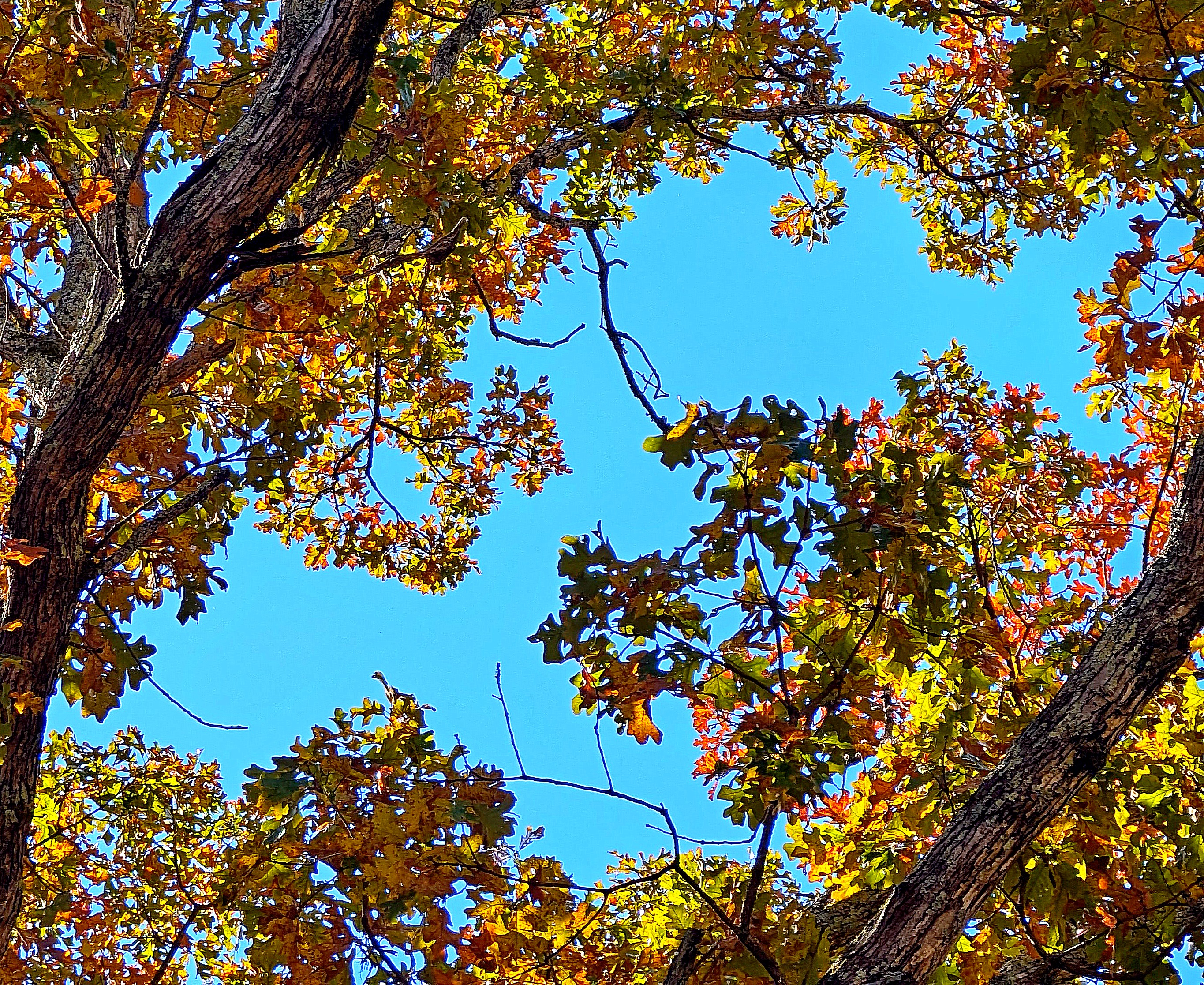
White oak in fall. October 2024.
No, I have little empathy for a person who feels this extra hour represents something mildly momentous and not to be taken lightly. She opens with the idea of just sleeping an extra hour–“sleep as much as you need to!” I want to shout–adding that as she sets her clocks back on Saturday evening, she will anticipate “that brief moment of confused excitement tomorrow when I wake and check the time: It’s 7, no wait, it’s actually 6!” Putting aside the fact that this undercuts the beginning of the very same sentence–you just said you’re setting the clocks back, so you can’t look at 7 and think it’s 6!–I will grant her the idea of an extra hour on this weekend motivates me too, but not as if it represents some life-changing moment. Rather it’s analogous to the feeling I get when a surprise rain shower eliminates a plan to work in the yard and thereby grants me an hour or two to do something unplanned. But immediately after the quote above, she writes a sentence which buried within it contains what I think might be a common belief which is just plain wrong:
As we enter the final two months of the year, thoughts naturally turn to how we’re filling our days. [same source]
I hope I’m reading that incorrectly. Why do one’s thoughts turn “naturally” to this? (Mine don’t.) Has it something to do with the End of the Year, another silly time construct? Is it because we’re approaching Christmas and other holidays, many of which have an element of self-examination? It seems to imply our author thinks November and December are the darkest months, coming as it does on the heels of lamenting the scarcity of daylight. No, no, you poor, benighted columnist. Today, Nov. 3, 2024, is 48 days prior to the winter solstice. Another 48 days after the solstice will be February 7, 2025. Ignoring that the solstice really isn’t the shortest amount of daylight in the year all the time–that’s intermediate temporal mechanics; we’ll get to that in our next course–you won’t see a speck more daylight for 96 days! That’s a lot more scarcity than just two months. It’s three with a handful of days left over.
Buried in another paragraph, our writer brings out one of the bigger fallacies about changing the clocks: that somehow having an hour “moved” to the evening or morning will have a meaningful impact on one’s life. See if you can spot it:
“Every first Sunday in November, I contemplate becoming a different, better person, one who gets up one hour earlier to meditate or exercise or meal-prep. I could be the person who spends an hour journaling, or fixing a large, healthy breakfast or taking the dog for a brisk walk in the cold dark. ” [same source]
If you get up one hour earlier, it’s just one hour earlier in the same day. It’s coming from somewhere. Are you going to bed earlier in the evening? Or are you cheating yourself out of an hour’s sleep? Are you going to tell your employer you’ll be in the office one hour less so that you can have a full evening, a decent night’s sleep, and still start a meditation practice before breakfast each day? I suspect, however, our author thinks that somehow an extra hour has ‘appeared’ in the morning. “Look, y’all, I used to get up right now according to the clock, but right now is only 5:30 a.m., not 6:30 a.m. I’ve got an extra hour! Yippee!” (Insert reference to Spinal Tap and “turning it up to 11.”)
Let’s bring this diatribe to a close. Let’s all try to realize daylight lessens from summer solstice to winter solstice, and that each day’s length mirrors another on either side of the solstice (either solstice, it doesn’t matter). Every day, every moment, moves the same: the length of the sun’s presence above the horizon added to the length of its absence always runs about 24 hours (if you absolutely must measure it). When we live artificially in the Timescape instead of the reality of the Dayscape, we suddenly think “Oh, I’ve lost an hour,” in March and “Oh, I’ve gained an hour,” in November, but really, truly nothing has changed. Let go of that desperate grip on Time. It’s okay. You won’t fall. You’ll still be here…just like always.
A few hours ago I surpassed seven decades upon the planet. My first memories occur somewhere around three to four years of age; make that six and a half decades of consciousness. I rode tricycles and bicycles with playing cards clothes-pinned into the spokes for noise. I saw the first television come into our house, the advent of easily available color TV’s, and the beginnings of data processing centers (long before personal computers became a thing). I celebrated the first humans going into space. I cowered under my desk as I practiced “what to do in the event of a nuclear attack.”
I entered my teens as we kicked off the Summer of Love (“we” being a rather generous term for my inclusion in it). I protested the Vietnam War in a lukewarm manner. I wore strange clothes, even considering what teens normally do.
I campaigned with my father in 1960 for presidential candidate Barry Goldwater. I voted for the first time in 1972 for George McGovern. I watched as Nixon resigned rather than face impeachment. (Imagine that, Bill. Donald.) I jump aboard the personal computing “thing” in 1982 and never looked back. I became a newshound; a teacher; a cog in corporate America; a consulting ‘expert’; and a retired, lazy bum.
So what? Every single person born before 1960 can pretty much say the same. It’s because looking back shocks one. My grandparents saw the advent of cars which radically changed society, and they knew grandparents or great-grandparents which served in America’s Civil War. My parents watched as first radio and then TV made changes almost as radical. And those of us of a certain age have witnessed computers do the same as the automobile. I cannot convey the visceral feeling of being the head of this time-worm, with a tail stretching back to days which did not know any color of T-shirt but white, which never saw a man wear hair which touched or covered his ears, which had just completed two significant wars in a little over 15 years.
You’ll have to experience it yourself. It’s a trip.
I’ve been thinking about Pop Music a bit the past week or two, prompted by being forced to listen to my wife’s choice of music in our car one day. It’s some “hits of the 70’s, 80’s, and 90’s” piece of something-or-other…unless you like that sort of thing, then it’s a wonderful FM station which plays all the greatest songs you know and love. I’ve assiduously avoided listening to radio from the first opportunity I had to not listen to it, sometime in my late teens or early 20’s. I suppose some readers don’t understand what I’m talking about. Through high school we listened to music in two places, basically: cars and our bedrooms. We had AM radio in the cars and vinyl records in our bedrooms. If you really got into it and had deep pockets, you bought a big Wollensak reel-to-reel tape machine, but if you were a wannabe like my brother and me, you bought a cheap little portable recorder and stuck the painfully crappy microphone in front of a tiny transistor radio speaker to record “off the air”.
In small-market Spokane only two radio stations catered to young people and their shocking tastes in music: KNEW (neé KJRB by the time I left high school), and KXLY. All popular music of whatever genre mixed freely on these stations. No FM station played popular music until around the time I entered college when KREM-FM suddenly started an “underground” playlist. Underground radio featured stoned out DJ’s: “Hi, I’m John. Yeah. We’ll be playing some heavy tunes for a while. I hope you like them.” We programmed the buttons on the radio–oh Lord, do I have to explain how car radios worked back then? Those too?–to the two AM stations and became adept at punching the button for whichever one wasn’t playing a song we loathed, which happened frequently. You’ll understand in another paragraph.
But back to that moment a week ago when I listened to many songs I hadn’t heard in years. The one which sticks in my head is “If This Is It” by Huey Lewis and the News. I’m going to hate myself for looking that up and reminding my brain about it: I had a viral ear-worm for days after hearing that song. It’s not that I don’t appreciate Mr Lewis, it’s that I don’t particularly like that specific song. “I Wanna New Drug” has sentiment I can get behind. “The Heart of Rock & Roll” zips along quite nicely. But a slow near-ballad which basically says, “do you see this going where I think it’s going” struck me then and continues to as ridiculously mundane. Maybe you like it. Fine, you’re entitled because we all ask music to deliver different things and if the song delivers, great…for you. I like absolutely stupid songs because of a bass line or because the singer’s voice seems to mock the very words being sung, or because it has a frenetic beat, or a multitude of other reasons. I’m not going to mention two extremely popular groups which demographics say I should love, and I can’t stand them. I lost a friend over that once.
Listening to my wife’s radio station, I had a startling realization. I had been getting pretty egotistic about how broad my musical horizons are. I like country, blues, rock, blues-rock, folk, world/ethnic, jazz of various ilks, classical, a little bit of hip-hop and…pop. My enforced listening session in the car showed me I don’t really like pop per se, I like it very selectively. I protested to myself about all that pop music I liked from my youth. That’s when it hit me: we like all those songs which formed us as we left childhood, negotiated adolescence, and became adults. After that? Not so much. We went in different directions. Some folks I’ve met never went anywhere. They only listen to songs from the oeuvre when they were 10-25.
Today proves my point. Yesterday I finished chores and declared it to be Birthday Week. I’ve decided one day isn’t big enough to handle 70 years. Until Tuesday June 11th, I’m celebrating. Today unfolded at a leisurely pace, pointed toward some music listening, writing, and a Phillies game. I decided to listen to music from the beginning of my listening life, and then realized “the beginning” eludes definition. I settled for the year my pre-teen fan-tasy grew into musical appreciation: 1966. Until then I’d focused on whatever TV and radio served up: The Beatles, early The Rolling Stones, The Monkees. In 1965 my brother and I began buying a few different bands on 45rpm records, and in 1966 I got my first 33rpm LP, The Young Rascals. It coincided with my birthday and the end of the school year. I ran out of the schoolroom never to return to elementary school, and I ran into adolescence with a newfound appreciation for the melding of pop, soul, and rock which had started to occur.
I decided to re-introduce myself to 1966 by looking at the Top 40 lists for the year and selecting songs to listen to from it. Locating a wonderful site called Top 40 Weekly, I selected 1966 to be presented with the Top 40 chart for every single week in 1966! Wow. Here’s the beginning of the first one from January of that year:
Top 40 Weekly’s chart for the beginning of 1966.
This proves my point. (Of course, it’s self-referential, but nevermind.) I look at the first song and start singing the lyrics. I look at the second one and smile and hear Paul singing the title words. Likewise with #3 and #4. I’ll admit #5 threw me for a minute–I’m more familiar with “Catch Us If You Can” by that group, as heard on the Lloyd Thaxton show. Giving it a play, though, it came back to mind. How about #6? Check. And #7? Check. Not until #8 did I say to myself, “punch the button.” I like a few Righteous Brothers songs, but they carried a crooning 50’s style of music into the 60’s, and it didn’t play well. But who can’t smile listening to #9?
Then we hit #10. Lord knows how Eddy Arnold managed to get a charting song out of that number. I felt the revulsion rise up. Today’s form of button-pushing, the skip-track button on the streaming service came into play quickly. The remaining songs? I smiled again at #11; sang the lyrics to #12 with my wife; and wondered how #’s 13 and 14 got on the list. I don’t recall ever hearing them. The Shangri-Las managed to push out a charting song in 1966? You gotta admire that, even if the song was horrible. (I never heard that one either.) Gary Lewis’s song typified his talentless group, but made me remember “This Diamond Ring” so it wasn’t worthless. I couldn’t find #17 on Tidal, and then a relaxed wide smile–the Beatles again. Before there were LP’s in my life, there were 45’s:
Both songs in the top 20 starting January 1966.
I couldn’t find Ramsey Lewis Trio’s version of “Hang On Sloopy” and wonder what the heck a jazz trio could’ve done with The McCoys’ big hit. The Beach Boys were a selective thing for me, and #20 didn’t hit the spot. I continued through the list until I hit #40. It kinda made the whole journey worthwhile: “Lies” by The Knickerbockers. I loved that song; still do. They had another great one as shown at the top of this post.
The final 45 I bought occurred in 1976. I bought it only because I knew I would never like the album, but I wanted the song for posterity’s sake:
“The king is dead but not forgotten…this is a song about Johnny Rotten” –from “My My, Hey Hey” by Neil Young.
Our musical likes have more to do with where we grew up and what we listened to at the time, than anything objectively wonderful about the music. We like what we like, and we don’t what we don’t. Objective criticism fails precisely because it rejects subjectivity. Do I like “bad” songs? You bet. Do I dislike “good” ones? True. Are you totally inexplicable to me because you like “A White Shade Of Pale”? Abso-effing-lutely.
I’ve come to believe everyone thinks in pictures, even if they don’t know it. By adulthood some of us go on autopilot, our connection to the pictures, images, emotion-movies cemented so far in the foundation-concrete of our makeup that we know only words anymore.
Creativity demands turning away from the words and toward the pictures. Visual creatives, you live here. Connect your hands to your pictures. We wordsmiths, though, must act as our own interpreters, must turn our backs on the pictures while remembering them, must translate the pictures into words.
At least, that’s how it works for me. When it works for me. (The rest of the time I just wander among the pictures and say to myself, “sure, I’ll remember this for later.”)
Maybe my purpose simply lies in imitating Charlie: hang out at the bar and drink a half gallon dry? May 2024.
I’ve several pieces of writing sitting on the shelf in a to-be-born state. Some even sit at the front edge of the shelf, just waiting to be taken down, polished, exhibited. This beckons now, however. It underpins the others.
I’ve too often settled for what I can do instead of striving for what I want to do. This blog and its recent lack of activity exemplifies that. There exist but a handful of activities which bring me as much pleasure as posting photos, essays, poems, and other pieces of writing here. Why the weekslong gaps?
At the age of 13, as inchoate as any such a creature, I became focused by two things: my Language Arts teacher said (using a bit of poetic license), “Damn, Pilcher, you can write! You should consider being a writer!” The other event occurred in the same year when a partner and I debated some topic which I now forget in front of the entire 8th grade class, all 300-400 of us. I got a glimmer into my innate bent toward logic and reasoning, both inductive and deductive. Our duo lost the 8th grader vote, but we won the teacher vote, similar to winning the electoral college but losing the popular vote. I considered myself a Writer and a Debater from that point forward. I did not know they were sometimes mutually exclusive.
In high school my teachers redirected my interest in writing. I learned they placed little emphasis on writing creatively, focusing instead on the expository writing of the essay, the critique (book reviews), and the like. Can one function in society where business letters rule the day? (At least they did then. If those teachers could only see today’s society…alas, most are dead.) I therefore looked to the available outlets, enrolled in Journalism, and joined the school paper (an elective class). In my senior year the two points of view in C. P. Snow’s The Two Cultures collided. All that expository writing reached new heights when Senior Humanities brought me the two-hour essay as a substitute for a test. But…the loosening of curricular philosophies brought me the elective of Creative Writing. Suddenly I wanted to go back to the latter. Yet already I had applied to the University of Montana because it had an excellent School of Journalism.
To shorten this up: I did attend the U of M, but enrolled in an experimental education program instead of journalism. I spent one year there. There followed a year of earning money, a two-year stint at a regional college learning to be a recording engineer—no, wait, a radio-TV newsman—no, wait, a weird combo of that with Economics—before I enrolled in journalism (again) at the University of Washington, determined to make my way in that field because, “if I don’t focus on something, I’ll never do anything!” And I did work in newspapering for almost four whole years.
Pause. This supposedly promised to be about how he couldn’t focus his desire to write into the pursuit of WRITING. He settled for what came to hand, taking the path of least resistance, doing what he appeared to be reasonably talented for. Compress the next twelve years: convenience and aptitude led to a ten-year teaching gig. Divorce and early-onset midlife crisis led to One Last Attempt to Be A Creative Writer. It failed in less than a year. (Insert all the comment you want; I/we know our psyche. I/we did what seemed necessary to maintain mental health.) Through a series of events which defy a bad Hollywood script, I wound up analyzing data and writing scientific reports for the world’s largest pharmaceutical manufacturing company at that time. I did well. I spent a quarter century at it, eventually as a consultant, and retired.
WAIT! WTF? I THOUGHT THIS PROMISED SOMETHING ABOUT HONOR AND ALL THAT?
What is honoring thyself? Youth #1 has innate talents for playing baseball, thinks “I really like buying and selling stuff” but goes into baseball because his/her innate talent take them that way. They succeed as expected, then coast for the rest of life realizing passive income from the insane amount of money earned as a ballplayer. They neglect to build a business empire based on that initial desire to be a capitalist. Youth #2 loves baseball despite having mediocre talent at playing it. He/she works every waking moment for years to make this dream come true. They are drafted into professional baseball, succeed despite what their projected ceiling is, and spend the rest of their life in baseball as a coach or a manager or a consultant developing young talent.
Which one honors themselves? The one who leaned into their innate talent? Or the one who ignored who-knows-what talent to pursue a dream? Youth #1 drifted into baseball on talent. Youth #2 ignored talent to pursue a dream which consumed the remainder of their life.
And for the religious among us, which one is pursuing their God-given path? Youth #1 made the most of their innate talent. Not #2.
How can I be nearing 70 years on the planet and still wonder which one of these I am, and what the answer is to that question about honor?
When I volunteer to write a database/listing application for my church choir, am I fulfilling my innate talent, or am I defaulting on my dream? Ditto for ditching teaching to write business reports that pretty much anybody could write. To make it more mundane, when I derive great joy and satisfaction in planning a set of weekly menus, selecting good recipes, and cooking them, am I dodging my greater dream, my greater desire to Be A Writer?
Is Being A Writer just an ephemeral dream, a wisp of wanna in a wind of reality?
Deep down I think I fear that though I have a talent for crafting language, I have nothing to say with it. I need to be explaining something, reacting to something, pontificating upon something. (I’m doing it now.) Avoidance mechanism or recognition of doing what I truly want to do? I fear it’s a bit of both.
I intended to end this with a promise about upending my approach to the day, the week, my life. To declare, “I will write FIRST, I will read FIRST, and only then will I tackle the mundane!” (“Dear, have you emptied the cat boxes yet?”) I cannot do that. I’m sitting here thinking about the monks with writing skills who eschewed them to pray aloud and work the fields. Of soldiers skilled in various practical skills who instead served on the front lines. Of women (and a few men) who gave up promising careers to raise children. What is a Calling and what is a desire?
In the end I come back to this: you have done what you wanted to do at the time. If more high school guidance counselors—do they still have those?—had told this to their junior and senior clients, a lot more of them would have been able to pursue what they were drawn to. I know I would have.
There will be no end to this piece. Not until I reach my death bed and give you the answer, and likely not even then.
Among my pantheon of pet peeves I count the astronomical definition of the seasons. People look around on March 21st–or 22nd, because They Say So–expecting some radical change. You can almost hear the globe laughing. Let’s leave astronomy to matters of astrophysics: rotations, revolutions, light years, and such. Let’s leave Spring to what our eyes see, our noses smell, our ears hear, and what our skin feels as it collides with our sun’s radiant energy and the increased load of humidity it can carry. Here in central North Carolina, it’s definitely the beginning of Spring. For over two weeks I’ve posted photos of such, and this past week left no room for doubters:
The star magnolia has hit full bloom…
Star magnolia. February 29, 2024.
The camellia has busted out its peppermint blossoms, and in its exuberance, an aberrant deep pink one:
Normal camellia blossom. February 2024.Abnormal camellia blossom. February 2024.
…and daffodils (or relatives thereof) are blooming everywhere:
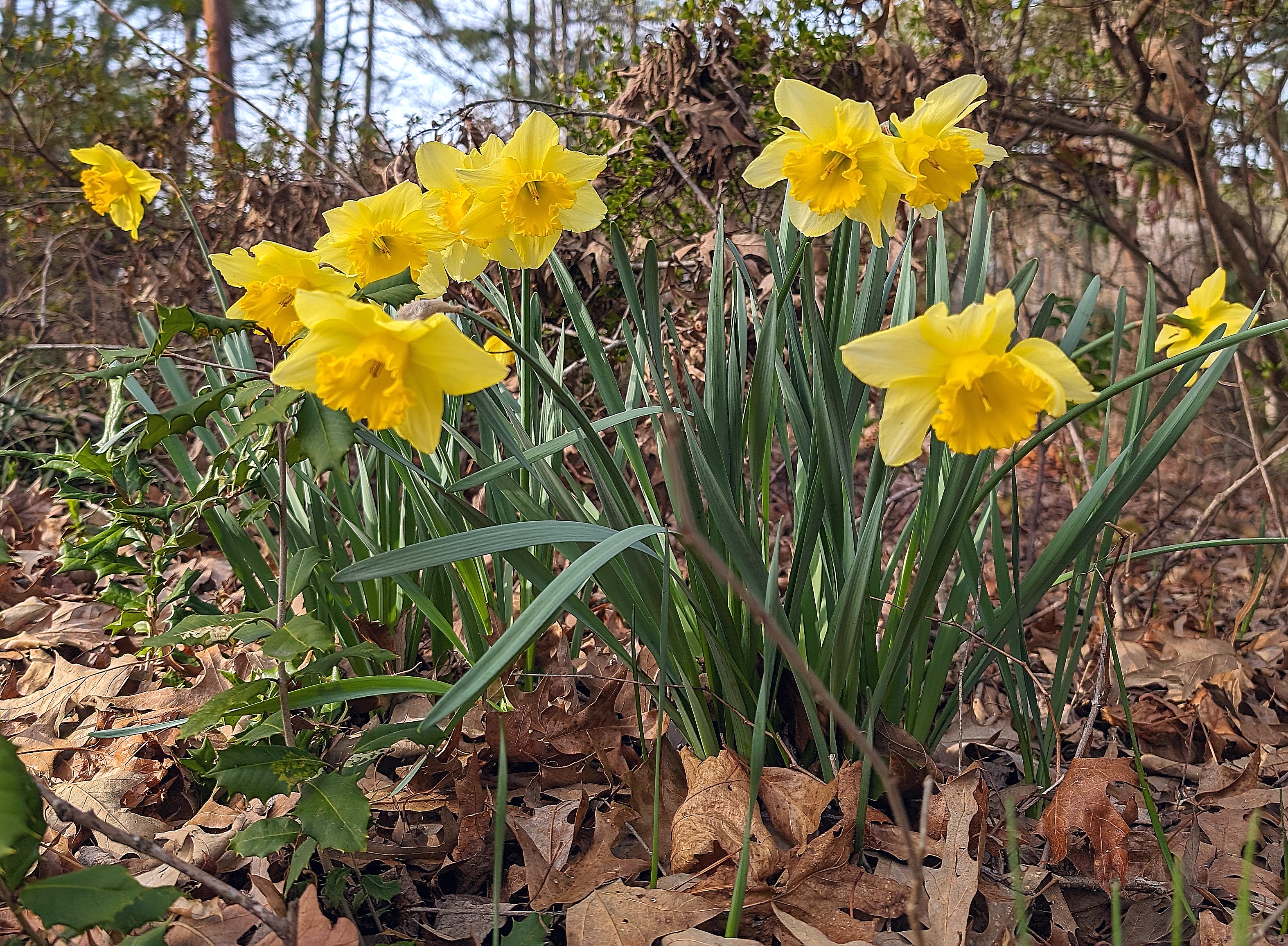
Ready for their close-up: daffodils. Leap Day 2024.
A screeching blush of robins stopped by a week ago, but I had no time to properly photograph them. Just arrived from further south to torment those who stuck it out? Or just a gathering to kick off the aggressive mating season? One of them has been attacking his own reflection on my side storm door for ten days now. The bird feeder needs filling about five times more than usual. Yes, it’s good. Soon I’ll note that first sheen of green as I look through the tops of the until-now bare trees, a sheen foreshadowing the imminent burst of leaves as we launch into the heightened glory of full Spring.
Growing up, my parents’ chairs interested me little. They still don’t. I consider them in my mind: the bulbous thing they reupholstered from a shocking golden mélange of 50’s colors, vaguely like a tweed, to a deep blue-green as hideous as you likely just pictured. Another horrible chair, this one chalky gray underlaid with a chocolate brown, thankfully disappeared from our lives as my parents focused ever more on Danish modern. Two deep mustard gold chairs sculpted from a cube joined the blue-green thing. I took Danish modern for granted then, hate it in retrospect. For reasons never given, our sofa matched nothing else in the room, either in style or color. Its creamy colored soft contours with the ever-present throw pillows would scream Rooms-To-Go today. Back then it just said, “I came from the middle aisle of our local furniture store.”
Chairs only rarely occupy our minds beyond whether we can find one to sit in. We take them for granted, I suppose because those of our upbringing formed part of the Always-There background. We sat on hard wooden chairs in school, replaced later by hard plastic seats, replaced in turn by a hard substance which defies any characterization other than “smooth”. College offered the same but with more variety unless you attended something exclusive in which case the chairs weren’t any more comfortable but they looked a lot older, more distinguished. When newly graduate, one’s interior decorating attitude toward chairs usually is something like, “is there one” and “is there room for one or two?” Perhaps I should add, “Can I get them from Mom and Dad?” because that’s their provenance for the most part.
“For the most part.” I moved from my dorm to my first apartment towing the usual hand-me-down furnishings including a deep brown and deeply ugly sofa. Along the way, however, I stopped at my grandparents’ house to pick up a chair from their basement which meant a lot to me. Now in their 80s, they were moving to a senior-living apartment. At the time this chair represented a place where I had sat a lot, a place I found both comfortable and comforting. Over time my bones became more brittle, my muscle turned to fat, and I found the chair less comfortable. At the same time, the comfort of seeing a chair with deep green shiny silk-like ribbons running vertically on a cream background, with dark-stained wooden arms and legs, sustained me emotionally. In 1992 I looked at the chair in my new Pennsylvania apartment where I had fled my divorce and my teaching career, seeing the chair as an anchor to my past and to my family. As a child I sat on the floor of my grandparents’ basement when Grandpa read Mr. Murphy the Irish Potato. (It’s horribly inappropriate, but times were different then.) A little older, I sat in that chair when my brother and I would hide out from the adults upstairs. In college, I ducked over for dinner every few weeks with my grandparents and spent a couple weeks there my final college summer as I waited for summer quarter to become fall quarter. I’m sure I sat in that chair then, also. Fifteen years after graduation I could reflect on that in Pennsylvania. My one regret with regard to it? We reupholstered it 20 years after I took it from my grandparents’ house. We chose fabric practically instead with our hearts, and the upholsterer somehow made a hard seat even harder. Today it’s usually covered in blankets and our cat sleeps there.
My hands have contributed to the wear on those arms. February 2024.
Other chairs came later, mostly as my grandparents died. The shield chair from those same grandparents, still sporting the upholstery I know from childhood, sixty years ago:
That red looked a lot more crimson about 60 years ago! February 2024.
My parents claimed one chair from my mother’s parents and kept it until they both had died by 2020. True to form, they immediately reupholstered it to a completely inappropriate modernist pattern, cream with trailing colors of brown, muted oranges, and dusky rose. Later, perhaps recognizing the error of their ways, they chose a formal but slightly modern pattern in rose, and that is what sits in my library today (and yes, I posted this chair once before):
The rose Queen Anne chair in the corner has become my library reading chair. For more than a decade, the heart-shaped table beside it has played a supporting role. The footstool might have been needle-pointed by my grandmother, and certainly has been around for more than 60 years. The torchiere lamp graced my father’s parents’ house. An oil painting of my grandmother, the one who purchased these chairs, painted from a very old black-and-white photograph, adorns the wall. February 2024.
Some chairs entered my life at times indeterminate. I can tell you where they’re from, but not when and how they came to me, or at best guess at it. The cherrywood rocker which my mother’s mother sat in the corner of her bedroom to match the shockingly gorgeous cherry bedroom set. Every morning I too sit on this to dress, just as my grandmother did about 100 years ago.
A truly beautiful piece of functional furniture. February 2024.
Then again there’s the wooden rocker with a caned seat which I used to sit on to dress myself until the caning gave way one day, and I thought I would go through it to the floor. My father’s father sat in this chair in his study while taking a break from his duties as a Baptist minister. I remember the beautiful rolltop oak desk he would work at. Sometimes he needed a break. He would move to this rocker, sitting in an opposite corner near the window of his study which looked out to the next-door church. I can see him rub then rest his eyes from all the reading he had done.
So beautiful. Now it sits beside my wife’s side of the bed, perpetually encumbered by clothes. But I know it’s there. February 2024.
When my father’s father died, and his mother entered a nursing home, I inherited another rocker and its matching straight-legged chair, a captain’s chair style. I wish I could remember their position in their household. These two must have had either sentimental or practical value for my grandparents to have moved them from a large Victorian three-bedroom house to a small two-bedroom home in a retirement community. The rocker is missing one of the dowels between the seat and the arms. My father’s brother got his leg stuck between two dowels and my panicking grandmother insisted to her husband that they break out one dowel to free him.
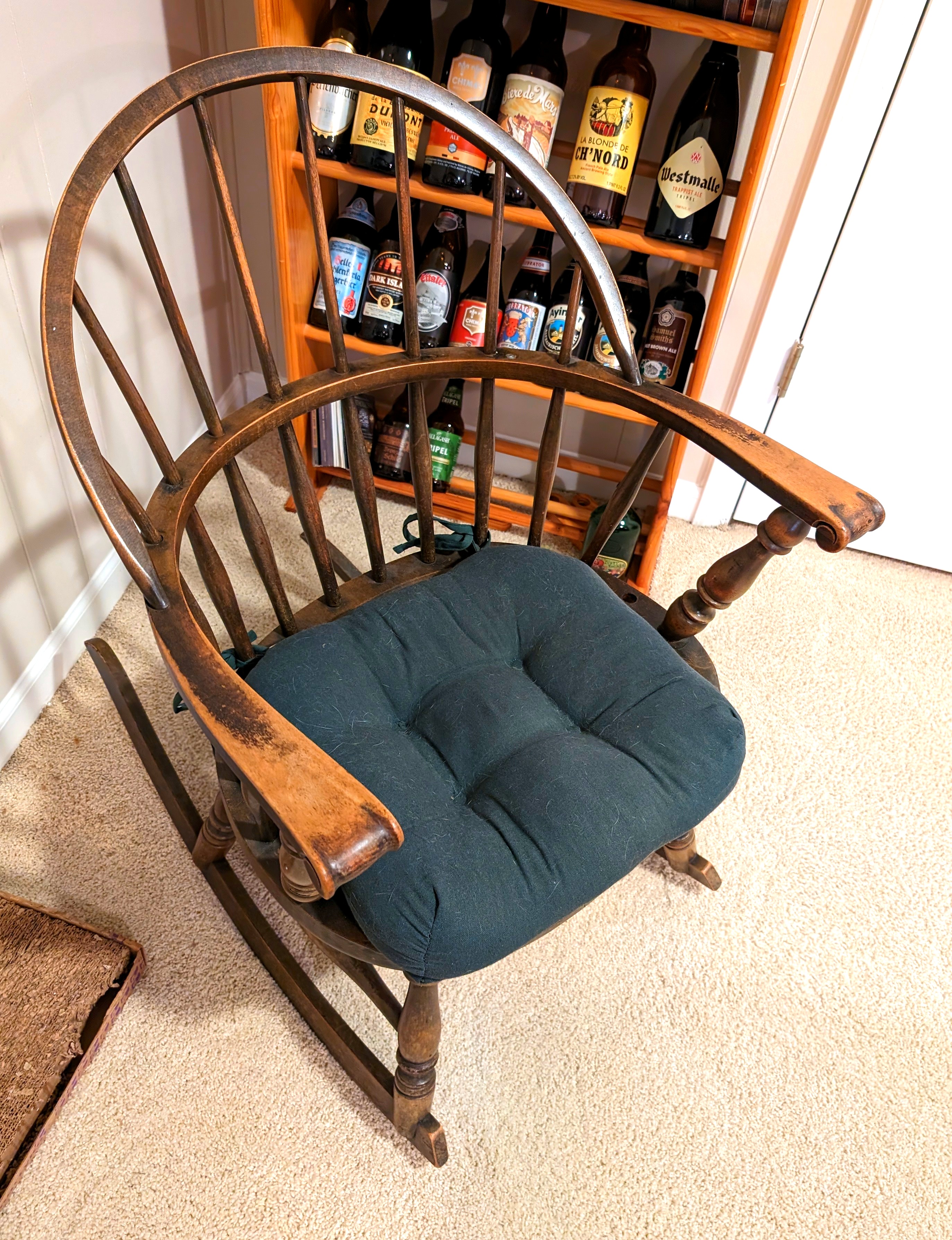
The true Captain’s chair. February 2024.The matching chair. Note how all of these old chairs have lost the finish on the arms, due to loving wear. February 2024.
Despite my love for this older furniture, it has only graced our main rooms by necessity. Early in our marriage (the second, lasting one) we purchased a Broyhill recliner which echoed the wing-backed design of these older chairs complete with a brocade upholstery. It also complemented our older, inherited chairs. Unfortunately, only a few years after we did, we invited a streetwise cat into our house whose scratching habits proceeded to turn it into a tasseled mockery of itself. It sits in the rec room now, with the other rejects who form the viewing area for our ‘home theater’. (It’s not really a home theater; it’s two chairs and a love seat, all of which recline and are positioned as optimally as possible to a large TV with a surround speaker system. We invited the other chair in the ensemble into our living room in 2009, and sent it to the basement in 2017.) I’m thinking we should reupholster it and return it to its rightful place in our living room.
Early relegation to our basement (or worse) seems to be the norm for modern furniture. I would tell you of the two loveseats which have been purchased and abandoned in that time, falling out of favor and usefulness just as the one now in our basement, and I could detail the two sofas we purchased in 2006 and 2013, the former being replaced by the latter, the latter going “to a deserving home” in 2020. But we’re talking of chairs. We started 2020 with a fixation on chairs. We purchased four chairs which looked decent, solid, and worthy of the prices we paid. Two of them replaced two of the inherited chairs detailed above. Two motorized recliners replaced the sofa. Now, barely more than four years old, the two recliners have entered middle age, declaring themselves for the James Dean life with the exception they’ve never lived fast nor will they leave a beautiful corpse. They’ve become more uncomfortable to me as I deal with lower back issues. Luckily the two side chairs have been making their case for sticking around more than a few years. They simplistically mimic the older inherited chairs, causing me to wonder: why I don’t seek out chairs like that?
Before ending this, office chairs should be mentioned. Though often unremarkable, they offer a unique feature: they almost always have wheels. On top of industrial-grade, quarter-inch-thick carpet, these babies provide transportation to those unwilling to stand simply to walk 10-20 feet to a neighbor’s cubicle. (And that one time my four-person team found ourselves housed in a former microbiological incubation room with hard, sealed floors? One of eight such rooms on a hallway with the same flooring? Do you know how far you can push a well-lubricated chair on such floors? Not if you haven’t tried it!) Once, though, I purchased an old office chair my employer had slated for disposal. Although the calendar said 1997, this chair hailed from the 1950’s. Completely upholstered with wood accent on the arms, this chair would swivel and tilt just like modern chairs–but with no ability to make adjustments. Yes, it had wheels. And from that year until 2006 (I think) it served me well as my computer desk chair.
Ultimately we think of office furniture similarly to most of our then co-workers: there have been many but we remember only a few. Not so our heirloom chairs. Not so the chairs of our childhood, from the plastic-sheathed kitchen chairs to the kitchen stools to the weird plastic furniture used on our parents’ patios. Not so the chairs which graced our first apartments, entering the doorway by whatever means necessary, whether begging, stealing, inheriting, or in our last-ditch efforts, purchasing. Not so where we sat when visiting our grandparents, our uncles/aunts/cousins, or even our friends in college when a Naugahyde sack full of styrofoam could be called “a bean-bag chair”.
When I look at this cycle, I see that my parents’ chairs came and went, my chairs in school could at best be called functional, my chairs in early adulthood had value only because they were there, my chairs throughout my life have primarily existed only until I could replace them–but the chairs I inherited from my grandparents, the ones constructed in the 1920’s, the 1930’s, the 1940’s, have outlasted all of the others and, like the British monarchy, say, “yet, I’m still here!”
A plant’s leaf. In North Carolina. At Biltmore. May 2007.
Today’s photograph has about nothing to do with today’s topic, but I’ll try: some folks think (or rather don’t think) about how some things don’t belong together in all cases. Red and green for instance. On this plant it’s a natural thing. At Christmas it evokes the symbolism of holly and green leaves and all that. In July it says, “Who’s this freak that thinks it’s Christmas?” Today we’re going to talk about people putting words together which don’t belong together.
For newcomers to this blog: Once upon a time I taught English to 8th graders. Once upon a time I took a graduate-level course in grammar, most of which consisted of diagramming sentences. I killed that class–most of my fellow students were returning teachers who clustered around me after the final to learn how I had diagrammed the sentences on the test, even though these were sentences which we’d already diagrammed in homework assignments. I’m not bragging, merely establishing my credentials for the next paragraph.
There’s a grammatical distance between “on to” and “onto”. The latter one is a preposition. The first one, however, is an adverb followed by a preposition. Or some would say it’s a compound preposition. I disagree, but it’s debatable. What’s not debatable is when you put them together as if they’re one word but they shouldn’t be. Here:
Ken wants to turn his audience on to prepositions.
The turtle hauled himself onto the log.
“Onto” indicates position. In the first sentence you can see I am not trying to physically turn my audience and put them “onto” a preposition. Children, pets, and occasionally a frisky adult will get onto the furniture. A lace hem might be sewn onto a dress.
Prepositional phrases usually come in a three-word format of preposition-article-object/noun, and they’re often strung together one after the other. Here’s one: Susan got out of the bed, put her pajamas in the clothes hamper, and made her way to the shower. I boldfaced the prepositions. (If you’re really into the stuff, that’s a compound predicate where the subject “Susan” has three verbs to go with it, “got”, “put”, and “made”. It has direct objects, “pajamas” for the first verb phrase and “way” for the third. This looks really cool when you diagram it, but let’s hold that thought for now.)
Why am I doing this? Who gives a rodent’s rear? Here’s the deal: I see at least one writer who doesn’t know how to use prepositions, homophones, or those tricky complement/compliment words every morning when I read my news. I read (in this sequence) MLB.com to see if there are Phillies stories; The Athletic for Phillies stories and general baseball news; the Washington Post, primarily for the comics, but some headline always snags my attention; and the New York Times. All of these sites command highly respected writers. One assumes there are editors, at least a few. How is it something as basic as this can’t be understood by some of the top writers in the country? To wit:
She turned her father into the police. Perhaps she did, but only in her mind (parents behaving like cops sometimes). Dad never joined the force, though, and she has no magic wand to turn him into the police. She turned him in. To the police. See? Separate words.
Note to grammarians: yeah, I know this isn’t grammar. It’s not even usage. It’s mechanics and those are a slippery thing. Fifty years from now what I’m saying will be as anachronistic as railing against tomorrow because it’s supposed to be to-morrow indicating the link to its linguistic past, to the morrow. I don’t care. I will hasten e-mail by typing email wherever I can, which I did in the 1990s and 2000s. I will type awhile even when the algorithms in the software says “no-o-o-o!” I’ll even type alright because I think it’s alright. (And I wonder if anyone under 50 or 60 wonders what the heck I’m talking about.)
I will not give in to compound prepositions. (See what I did there?) There is meaning contained in the words the heathen are stringing together, and those meanings change when you join the two into one. I hope you’re turned into frogs. Or is it turned in, to frogs? I hope the latter, and that said frogs will thwwpt! your face with their tongues for eternity.
Look, I’m all about breaking rules. You need to know the rules before you can break them, though. Picasso said that, more or less. If you just ignore the fact rules exist, you’re just a hellion-without-a-clue.
And now for that diagramming I promised. I’m afraid that nearly 42 years later I have not kept every assignment but I kept the quizzes and the final. Below is the last page of the final. It’s a ditto, so the questions are faded quite a bit. (“Ditto”–look it up. They were as much fun to make as it was typing on a manual typewriter: every mistake basically was uncorrectable.) We can discuss this below in the comments. The little blue zero means no mistakes. Grant Smith, the chair of the department and teacher of the course (Eastern Washington University) graded this stuff like golf is scored: mistakes were 0.5, 1.0, and 1.5 point mistakes, and the more you got, the lower your grade. Thus, the highest score possible was “0”. (And another day, children, we’ll discuss why I put the period outside of the quotation marks. You may background yourselves by reading William Safire.) By the way, at 28 years of age I already exhibited the anal qualities which now circumscribe my life. Those lines look nice and straight because I used a 6-inch ruler on all of my assignments and on my quizzes and tests.