Eastern carpenter bee working the beebalm. June 2025.
I opened the month shooting photos of the beebalm with a swallowtail butterfly on it. This photo is from the same set. The swallowtails, bumblebees, and little tiny bees I haven’t identified yet all had to work around the behemoths of the flowers, the carpenter bees. At 1.25-1.50 inches (or more!) they pretty much go where they want to. Now the beebalm has slowly dropped all those fuchsia-colored petals. (Or are they petals? I don’t know much about plants.) All that remains are the ball in the center, still suspended on those long stems. Our new visitors love these: goldfinches. They flit from flower to flower, their nearly weightless bodies hardly making the stems bend at all. It seems too soon for seeds, but what do I know?
Summer temperatures, documented a few days back, will continue for the near term future. Americans look forward to celebrating Independence Day on Friday, the 249th of our country’s existence. In these muddled times, I wonder what that will bring. Meanwhile, the business of life marches on, from the mundane (it’s Gather the Garbage Day) to the inconvenient (workers coming to work on the leak in the bathroom shower) to the calm and simple (my wife returned from a coastal sojourn yesterday afternoon; this day will be our first together in a week).
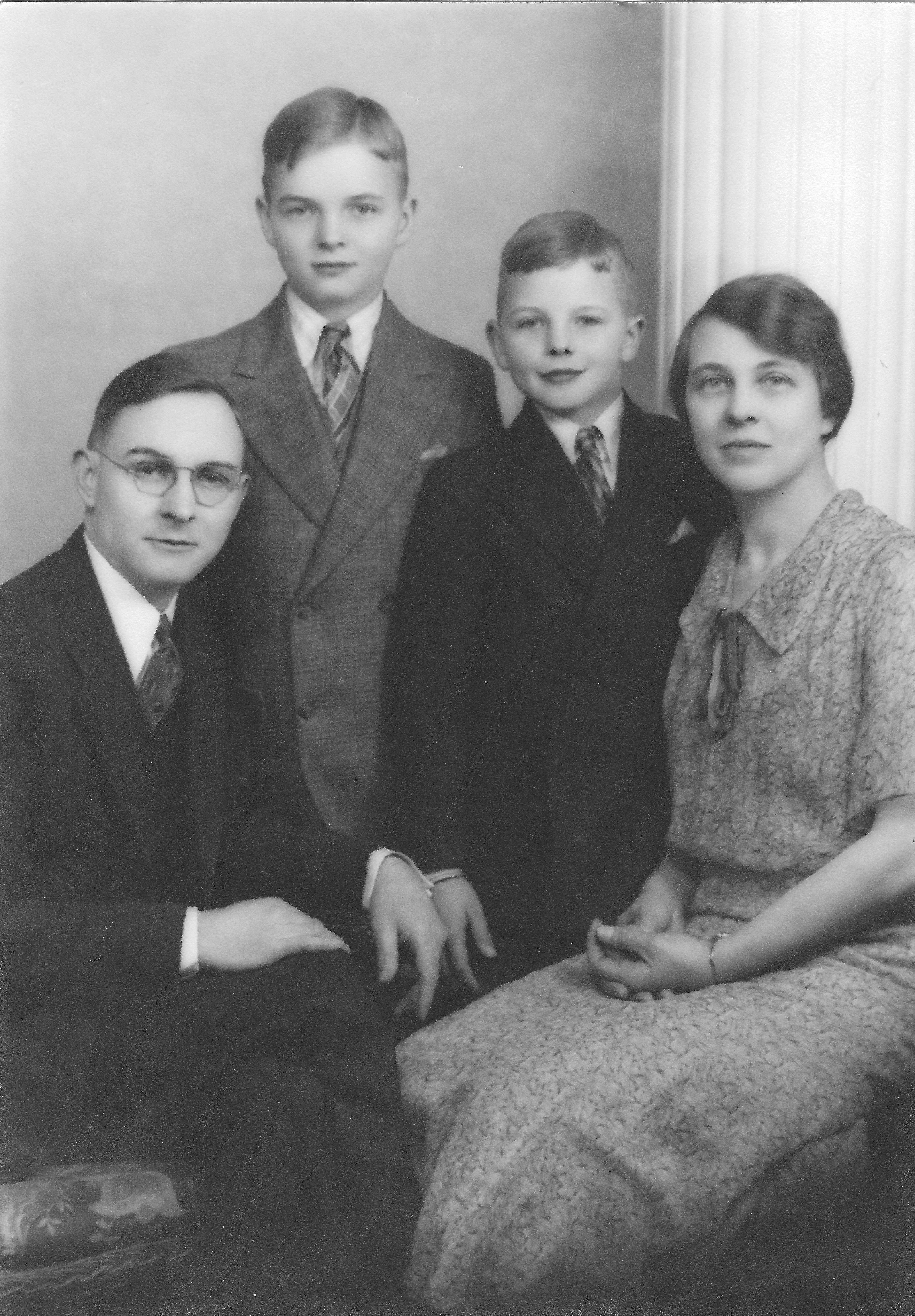
I’m partially through my next installment about my father, Howard Bliss Pilcher, but it will not be published today. My goal is “every Sunday” but this week’s post is a sober and kinda negative thing about him. Regardless of how deserved that viewpoint may be, I want to pair it with another installment which is more upbeat and entertaining. Instead I offer this portrait of my father’s family from 1938. This photo was taken in Minnesota which makes it a year prior to the family’s move to Havre, MT. Based on family values, I’m estimating it would have been a formal thing around Easter because of the importance of that day for a minister. My father is nearing 13 if so, and I’m pretty sure my uncle will be 10 soon. My grandparents are in their early 40’s.
Left to right: The Rev. Howard “Bliss” Pilcher, sons Howard and Gordon, and Esther (Dahl) Pilcher. Edina, MN, 1938.
In the late 1960’s I listened to Barbra Streisand on a transistor radio the size of a cheap paperback. She sang “People who need people are the luckiest people in the world.” I never understood that, emotionally at least. Intellectually I valued it and wanted to be one of those persons. I still do….but….
I don’t like people. There, it’s out. Liking people is inherent to my religious faith. We are supposed to like all people as caricatures of God, as images of God, or at the very least, as created beings who have as much claim to the Kingdom as anyone else. But…I do not gravitate toward people as an instinctive or cultured trait. I’ve known people who show themselves to be introverts, but they put on a social face, forcing themselves to reach out, building a practice that becomes instinctual. I’m not one of those, at least not in most milieus.
It’s more nuanced than it sounds. I like individual examples of “people” just not People in general and certainly not together in a group. Nothing tops my list of activities to be avoided like a cocktail party or “open house”. A group of people in a social situation where I know only one or maybe two of them makes me nervous, shuts me down, inspires my feet to start edging toward the exit, my lips mumbling an excuse to the host. Or that nervousness gets channeled into a babbling energy, creating The Entertainer—usually to my later embarrassment and dismay. After decades of experience with these situations—which mercifully I’ve kept to a limited number of occasions—I’ve learned some coping techniques. Mostly I avoid them unless I know a goodly handful of the people and like those who will be there. When I misjudge I desperately cast about for someone I know at least casually and bother them for as long as I can.
Oh boy, another wedding reception. Great for them, not so great for me.
I’ve learned how to maintain a veneer of sociability. I’m verbally talented after all. Talking to an individual about something they like makes you likeable. I’ve a wide range of interests and I’m well-read. I can usually relate to folks. But I’m uncomfortable.
Thankfully wedding receptions have beer, and this one had photogenic grounds to keep me away from all those people.
Perhaps this explains my delight in this blog, and in others’. We skip the social chit-chat on these things (usually). We do sometimes utter the banal (“I’m so happy for you” or “Getting that disease is so horrible!”), but mostly we utter honest statements because the beauty and scourge of the Internet lies in its anonymity for those who post. It’s why I’ve chosen to blog under my actual name. That seems contradictory, but it’s not. Most of you know my name, but you don’t actually know me except through these writings—the same way I know you only through what you post. Is it bold or stupid to put my own name? I’d prefer to think “honest” in that I will utter my opinions and not hide behind total anonymity. But y’all know me from a load of coal: except for two of you, and that has inhibited some of the things I would post, which illustrates the difference I’m talking about, this being known but anonymous simultaneously.
Where all of this blather leads turns out to be unexpected. I do need people, but just not the ones who mouth platitudes, clichés, and banal statements about the weather. Symbolic language has its place, but in a social setting it makes for a symbolic encounter signifying nothing. Sure, I can do it, but the sheer uselessness of it bothers me considerably. This need for people has been reinforced (again) by spending a week alone while my wife visits the NC coast with her friend. I’m reminded of living in my head like I did so many years. I believe we all need people to listen to us. That there are so many diaries and journals of people famous and otherwise reveals a deep need for others to understand what they’re going through. I guess I am a “people who need people” but only deep down and selfishly.
Needing and caring for people remains a distinct view of my religious faith. Listen to people with care. They need that. Yes. But so do I. The adroit, talented person knows when to listen and when to ask for a listener. I, however, refer you to the beginnings of this post. I do not possess those talents. I seek for listeners, but not to be the listener. Reminded again and again of my failure in the social arena, I withdraw. This is my learning path, perhaps one of several.
Second from left=outdoors. Raleigh, NC. June 2025.
The photo above shows the indoor and outdoor temps/humidity before the heat dome here in Raleigh slightly broke. My indoor display for my rudimentary weather station tells the tale: it’s less than 45 minutes since sunrise. Outdoors on the deck immediately behind my living room it’s already in the 80’s and the humidity at that temp is still 83%, which boggles my mind given that it’s a relative humidity indicating how much moisture the air could hold. It implies the dew point is in the mid-70’s. And disturbingly, this usually runs below the official temperature a few miles west of here at the airport. The deck is shaded, the sensor is located up by the house, and our neighborhood boasts many tall trees unlike the openness of the airport environment. The A/C had been running all night, hence the basement temperature (on the far right) reading less than 65 degrees. The other two temps are in upstairs locations. Welcome to the Southern Summer, boy!
…or “Reader, beware”. Today I’m reading a lengthy piece on why major appliances seem to break down so much (yes, really), which was posted on a popular buying guide website (rhymes with Spire Sputter). It’s an interesting article up until I read this to support a statement about appliances being “even cheaper than they were 50 years ago”:
In 1972, Sears sold a clothes washer for $220 and a dryer for $90, per 2022 research by AARP Magazine. That’s about $2,389 in 2025, adjusted for inflation. Today you can get a washer-and-dryer pair on sale from Sears for around $1,200.
And suddenly my BS meter started pinging. Okay, I’ve got a near-degree in economics and a head for rudimentary statistics. I also was 18 years old in 1972, so I’ve got a feel for that end of the timeline cited. But still….this just seems to be wrong on so many levels. Let’s assume the poorly worded second sentence means that the washer/dryer combo cost $310 (220+90) and in 2025 it would be $2,389. That’s almost exactly 7.7 times more. In 1973 (close enough) I took a fringe job at a hospital which paid $2.65/hour including the shift differential I got for working swing shift. There were a few down-on-their-luck old bachelors who managed to survive on that in scuzzy little apartments where they drank the cheapest beer they could find while eating the cheapest pizza you could buy at a grocery store. Doing the math, that’s $106 for a 40-hour week, and $5,512 for a 52-week year. And 7.7 times that is…$42,442.40!! I sincerely doubt that I could find a menial job which pays $20.41/hour.
Just to add some more perspective, during the almost four years I worked as a reporter from 1977-1981, I earned from $200/week to $250/week. I actually was looking at another job in the $10K range when I said, “this is nuts, I can barely live on this after four years? And now a daily wants to pay me the same thing?” After an indiscriminate raise to $250/week I agreed with the new publisher that $225 was more reasonable, so let’s use $11,700/year. That was the beginning of 1979. I think this is ridiculously conservative, but let’s halve that inflation factor to 3.85 and see what it gets us…whoa! $45,045? For a beginning reporter? I doubt it. Unfortunately I can’t compare this to weekly newspapers because that industry has gone through a complete upheaval over the past 20 years and I don’t think many exist in 2025.
I could rant on and on about any number of indicators you could look at. My only point here is to think about the numbers you see. You don’t have to be adept at mental arithmetic as I guess I am. (It’s what my family and friends say.) It’s nearly a no-brainer, though, to look at $220 and $2389 to see you’ve gone from a 3-digit number to a 4-digit number and they both start with 2. That suggests a factor of ten; add a zero to the $220 figure to see and yup, $2200 is getting pretty close to $2389. Then you might figure out like I did that the author means for you to add in the dryer, but by then you’re in the ballpark. You’ve only performed rudimentary arithmetic, nothing strenuous, and nothing you need to haul out your phone’s calculator app for. (Of course, if you really like the ever-listening digital assistant and haven’t turned off its spying, you could just say, “Hey [insert name], what’s two-thousand-eighty-nine divided by two-hundred-and-twenty?”)
Figures never lie, but liars figure, salespeople figure you won’t check, well-meaning but not overly ambitious reporters won’t, and they’re okay with that because they don’t think their readers will check either. And I’m leaning into that: I considered a different measure which actually supports what was reported—but I didn’t include it because it doesn’t support me!
Howard, 11 weeks; with his mother, Esther Dahl Pilcher. Lansing, MI, August 1925.
Howard Bliss Pilcher entered the world on this date 100 years ago. He died toward the end of 2013. In those 88 years, like most of us, he did nothing to affect the globe or any large portion of it. His impact, again like most us, accrued from those individuals he knew and perhaps from patrons of the two entities which employed him for 39 years. He most affected his wife and sons, Steven (my brother) and Kenneth (me). Seventy years later, to me he remains both enigmatic yet an apparently open book. Whether nature or nurture, his traits run through my being. Whether you knew him matters not. He might have subtly affected you too: every one of us amplifies his presence on humanity simply by interacting with more than one person and making an impression them; it ripples out to touch people we never knew.
Howard Bliss Pilcher—technically a Junior though never named as such—came into the world in Lansing, MI, on June 22, 1925. He moved with his brother and parents from city to city as his father, an American Baptist minister, moved from church to church. The younger HBP served in World War II, completed college, started his career, married, procreated, retired, traveled, and died December 16, 2013. He resembled thousands, millions of other men born around the same time. We each are unique, though, and this unique man fathered and raised me. If we are constituted from our roots, our times, and our experiences, then exploring those roots isn’t so much recounting their life as it is exploring our own. Therefore, we can’t call this biography. I haven’t the time or desire to research the nuances of his history, let alone the history of the times and regions through which he passed. (And thanks for that, too, Dad.) But there will be biographical elements to it, just as there will be aspects of memoir stemming from his inescapable impact on my life, and how the two remain intertwined even after his death. Perhaps reminiscence remains as the most accurate term.
A confession before we start: I’ve procrastinated all my life—a trait which will be explored through the telling of this tale—and this procrastination has left me too little time to complete this piece prior to deadline. My vision for it looms at far too many words to dash off in one or two sessions. Unlike the great gonzo journalist Hunter S. Thompson, I cannot lock myself in a hotel room for a few days, wire myself on pharmaceutical grade crank, and pound out a semblance of the piece this subject deserves. My physique won’t handle it, my psyche won’t handle, my marriage won’t withstand it, and I don’t see why after seven decades I should start caring about deadlines now. Okay. Let us begin. We’ll start with the thumbnail bio:
The senior Howard Bliss Pilcher, my grandfather, the one my grandmother called “Bliss,” came into the world in 1894 in Urbana, Illinois. The Pilchers traditionally lived in north central North Carolina in Yadkin and Surrey counties, up by the Virginia state line, but the “movin’ bug” ran through our branch of the family as far back as the early 1800’s. Bliss’s father, Wiley Pilcher (1861-1935), moved to Illinois where he fathered all three of his children. Wiley later moved to Fargo, ND, and finally to Libby, MT. All of this perhaps explains why, when he heard the call and enrolled in seminary, he became an American Baptist minister. American Baptists were at one time called Northern Baptists and trace church lineage through the Triennial Convention, the first Baptist convention in the United States of America. In 1845 a pro-slavery faction split off from the Triennial Convention to uphold the institution of slavery. It came to be known as the Southern Baptists. Without researching the topic, we may surmise that many Pilchers would not have been happy with my grandfather’s choice, particularly the majority of them still living in North Carolina. The decision to minister in that denomination reflects the equanimity which characterized my father’s upbringing, and which he instilled in me.
One year after my grandfather married Esther Dahl, my father was born. Lansing, the capital of Michigan, had nearly quadrupled in growth from 1900-1920. Not only were these the Roaring Twenties but this sizeable city (about 67,000) boasted all the activity inherent to a state capital. Thus, he started life in the thick of it: the capitol building stood about a half mile from their house. Not that this would have had much of an impact since by age 3 the family moved to Edina, MN, a suburb of Minneapolis. In between was a short stint in Dover, ID, an unfathomably small and remote place for a minister to travel, perhaps explained because Bliss stepped up from being a youth minister in Lansing to having his own church in Dover. The family lived in Edina for ten years more. At the threshold of my father’s entrance to high school in 1938, his father accepted a call to Havre, MT. (I’ve started to wonder if the “calls” were based more on wanting to stay reasonably close to his father, Wiley. Edina lies less than 250 miles east of Fargo; Havre is 350 twisting miles east of Libby.) Four years later my father graduated from high school. He attended the local college, Northern Montana, for at least a semester, but the reality of World War II loomed. The U.S. Army drafted him, placed him in the Quartermaster Corps, and sent him back and forth across the Pacific guarding supplies.
Howard’s senior photo from Havre High School. 1942.
At least, that’s what I surmise. My father didn’t want to talk about his time in the service at all. We did learn he made some grade of sergeant, but I only called him Sarge once. Let’s just say he made it very clear it would be the last time I called him that.
Howard mustered out of the service, enrolled at Washington State College (now WSU), hired on with the Carnation Milk Company in Seattle, married Louise Bach there in 1952, and they had a baby in 1954…me. We moved to Spokane, WA, when the Carnation Company transferred him soon after my first birthday. My brother was born there. My father accepted transfers back to Seattle (fall of 1962) then to Los Angeles (the beginning of 1964) before he made his dislike of Los Angeles and corporate life known. The company allowed him to go back to the same job he had left in Spokane just two years prior. We will revisit that career-killing decision. Four to five years later, as I approached high school age, he went through a personal crisis, quit Carnation, emptied out his profit sharing account, and maintained the family on that while he searched for a new career path. When a close family friend needed to fill a comptroller position at Sacred Heart Medical Center, he thought of my father who then began a very nice career managing financial matters for the hospital. As his mentor ascended the ladder of responsibility, so too did my father, eventually boasting the title Director of Fiscal Services. He retired after about 20 years of service to this medical center founded by the Sisters of Providence, a Catholic order of nuns.
In retirement he tended roses and indulged the Pilcher penchant for wandering by undertaking numerous road trips with our mother. There were a handful of trips by plane, but he fought claustrophobia for much of his adult life and those weren’t comfortable trips for him. Two trips abroad (England and Spain), a cruise package to Alaska, and near-annual trips to Hawai’i for a while rounded out the travel. They celebrated 50 years of marriage in 2002, quietly marked 60 in 2012, and he died after a sudden trip to the hospital in 2013 which saw him enter the hospital on a Tuesday and pass on the following Monday morning.
What did people think of my father? “That weirdo”? A “super nice guy”? “Honest as the day is long”? I know that he was loved. I know he withdrew toward the end of his life, and one by one most of the people he knew and loved died before he did. I know he worshiped my mother yet had a condescending tone toward her (which I adopted to my detriment). I know many, many superficial things. What I don’t know is the man he truly was, and what force ultimately took over the final five years of his life, making him mentally miserable at times. I know, too, it lurks within me and whispers that it just may do the same when my time nears.
This has been but a snippet, a dry telling of mostly factual matters, an introduction as stated in the title. To explore the man through reminiscence requires setting the stage. Much like reading your playbill before the curtain rises, you’ve now gained the background to enjoy the show (hopefully). In subsequent posts we’ll explore in no particular order and perhaps not under these self-same titles:
Ebullience, Positive Thought, and the Eleemosynary Ethic
Accruing Guilt: Understanding What Your FatherMeant
I uploaded a new gravatar photo just now. It’s bothered me that my it’s over 15 years old. I don’t believe in dissembling about oneself at least not unless it’s near-Machiavellian. If done at all, dissembling should be done consciously and with purpose.
Once upon a time, I had a full head of very nice-looking curly hair:
Me. Hair. Do not mention heavy-lidded look. It was 1979, okay? Monroe, WA, sometime in 1979.
It got a lot shorter through the years, but 25 years later it still had a couple inches of nice curliness. However…I started to notice a bit of thinning at the crown. “I’m not going to be one of those men who clings to the idea he has wonderfully bushy hair when it’s really thinning and fading away,” says I. My hairdresser cried when I told her to shave off all the curls. “I want to look like early Paul Simon.” (BTW, Paul, look at how good you looked in the late 60’s. Now look at your shaggy-but-not-in-a-good-way hair. Take a hint.) My hair reflects where I am on the journey of life. So too do my increasing folds of flabby skin, the creases in my face, and the sinking of my eyes into their sockets. I paid a lot of years to get to 71. I don’t intend to look 80, but I’m not shooting for 55 either. So there.
I thought to make an extended metaphor about how life resembled a track event or maybe cross-country, how most of us spend the first 18 years getting in shape. When the gun sounds at 18, though, I ran into trouble because not all of us have those lovely first splits where the race seems to be a breeze and you think you could run forever. By 21, when I envisioned the first little twinge of pain, I realized that many couldn’t say that—for them the race becomes an endless drudge to be run, not at the front of the pack, but at the end of that solid bunch of runners who know they’ll never come close to winning this thing. And then I saw it isn’t a race anyway, and the metaphor petered out. If I apply this metaphor to myself I…
changed my event almost as soon as I signed up for it…
sat out the second lap…
signed up for a different event and changed that one twice before quitting the race again…
entered the original event chosen by 17-year-old me…
ran that race until I realized I just wasn’t suited for it…
trained for a different event and ran that one for a decade…
left that race, dreaming of the Perfect Event…
and fell into a nondescript event only to find my innate talents bloom
And that’s just the metaphorical telling of my career. What about love? Family? The experience of life? No matter. It was fun playing with that photo of my brother running cross-country when we both were young and naïve.
Father’s Day means less to me than many. My only children have been and are being cats. My relationship to the day runs one direction only, upward, to my progenitor. He left this mortal world more than a decade ago, but the memories remain vivid, accentuated by the passing of my father-in-law ten months ago. Life’s little irony, its bitter dessert: with every one of my years I understand him better; but this understanding always was for the Father in the past never for the Father of the now. Then he’s gone, and only the past exists. Unfairness salts this wound which never heals.
Growing up with this man my feelings differed, of course. How could they not? Once I became self-aware, our similar make-up combined with my contrarianism to make the sparks fly. This isn’t a truism. We argued and disagreed about everything. I remember these actual, real arguments, all of which went on for 20, 30 minutes, perhaps for an hour or more:
Does a body get colder or warmer immediately after eating? (I said colder, but neither of us had more than theoretical knowledge, and there was no Internet to solve things back then.)
If you learn a job applicant will be the second income for a family, should you favor the person who needs this job as the primary breadwinner? (He said yes, I said no. Back then the secondary income likely would be a woman’s, so the argument carried a deeper discussion about feminism and Women’s Lib.)
And one of my favorites: a yard should be allowed to go natural (said I); “you just don’t want to mow the lawn,” he said.
Father’s Day got diluted for him by the fluke of his birth date and the vagaries of politicians: it always occurred within eight days of his birthday. Take a look at that calendar over his shoulder. I used to hate Junes like that one. The third Sunday (and therefore Father’s Day) falls on the 21st. His birthday occurred on the 22nd. Two presents and two consecutive days I had to be nice to him. A year like this one, 2025, provided the maximum eight days of distance.
I used to commiserate with my brother (who took the photo above, I believe) about the monetary hit of birthdays and ‘parental recognition days’ in our family. Starting with his birthday on April 21st we ran through all the birthdays plus Mother’s Day and Father’s Day all by July 10th. In those 11 weeks he and I would buy five presents, an average of a present every other week. He especially hated June when my birthday (the 8th) smacked into Father’s Day (between the 15th and the 21st) and Dad’s birthday on the 22nd. And 18 days later came Mom’s birthday on July 10th. “The parade of presents, the meandering of money, the draining of dollars,…” —you get the idea. We didn’t have a lot of money back then; we bought our own presents, no help from Mom and Dad.
Despite this being my absolute favorite time of year with its leap into summer as the advent of June brings warm weather, the end of school and all the seasonal activities associated with it, and the chance to relax to a degree not permitted September through May, I run into these thoughts a bit more too. So many things become bittersweet with age. This continual discovery of more love for a man who’s gone remains one of the most important.
Eastern carpenter bee on scarlet beebalm. June 2025.
For a good handful of years I fought a war against carpenter bees. These large bees (1.0-1.5 inches long) bored perfectly symmetrical holes in the decking of our house. First I attempted to plug all the holes with caulk, twigs, anything that came to hand. Then I bought horrendously over-priced traps, only one of which did its job and for only one year. This year I gave up, waved the white flag, said, “you win.” They are vigorous pollinators: that beebalm looks long past its prime, but they keep working the blossoms for that last speck of pollen. They’re only antagonistic to each other, although they’re scary in the spring: imagine a bee as big as your eye and flying right toward it. They still leave little piles of sawdust around my deck here and there in the spring.
And I still have the trap up. It’s a sign of self-respect. I don’t want to appear as if I’ve cravenly capitulated to them. Call it a fighting retreat.