
Thoughts upon waking in my own bed again on June 17, 2026
As Jules Verne pointed out fictionally in 1872, travel over any distance isn’t just spatial, it’s temporal. In this age of electronic connectivity, this gets thrown in our face every time we realize our friend lies many time zones to the west: “I can’t send that text! My buddy’s gone to bed!” Or maybe he’s hours away from waking. Phileas Fogg’s seemingly lost wager reminds us we must consider how we’ve slipped through time as we’ve traversed any significant part of this globe.
Less than 24 hours ago we re-entered America’s Eastern time zone, which currently runs it clocks on the hijacking concept of “daylight savings” time (as if one could just pocket a bit of sunshine for a rainy day). Twelve hours previously we’d been delivered to the front of Heathrow airport’s Terminal 3 and just a few hours before that we had walked to St. James’s Square for a bit of air, exercise, and an attempt to distract my wife. She became quite agitated upon waking when she learned our flight’s departure to America had been delayed by 2.5 hours. The square is not spectacular in London terms: many areas exceed it in acreage and beauty. Yet the square offered a lovely little distraction and glimpse into the morning working world of London. Within it a very small area of peace existed. Few, if any, used it as a shortcut, no doubt due to its strategic gate locations. Had they been on the corners the story might have been different.
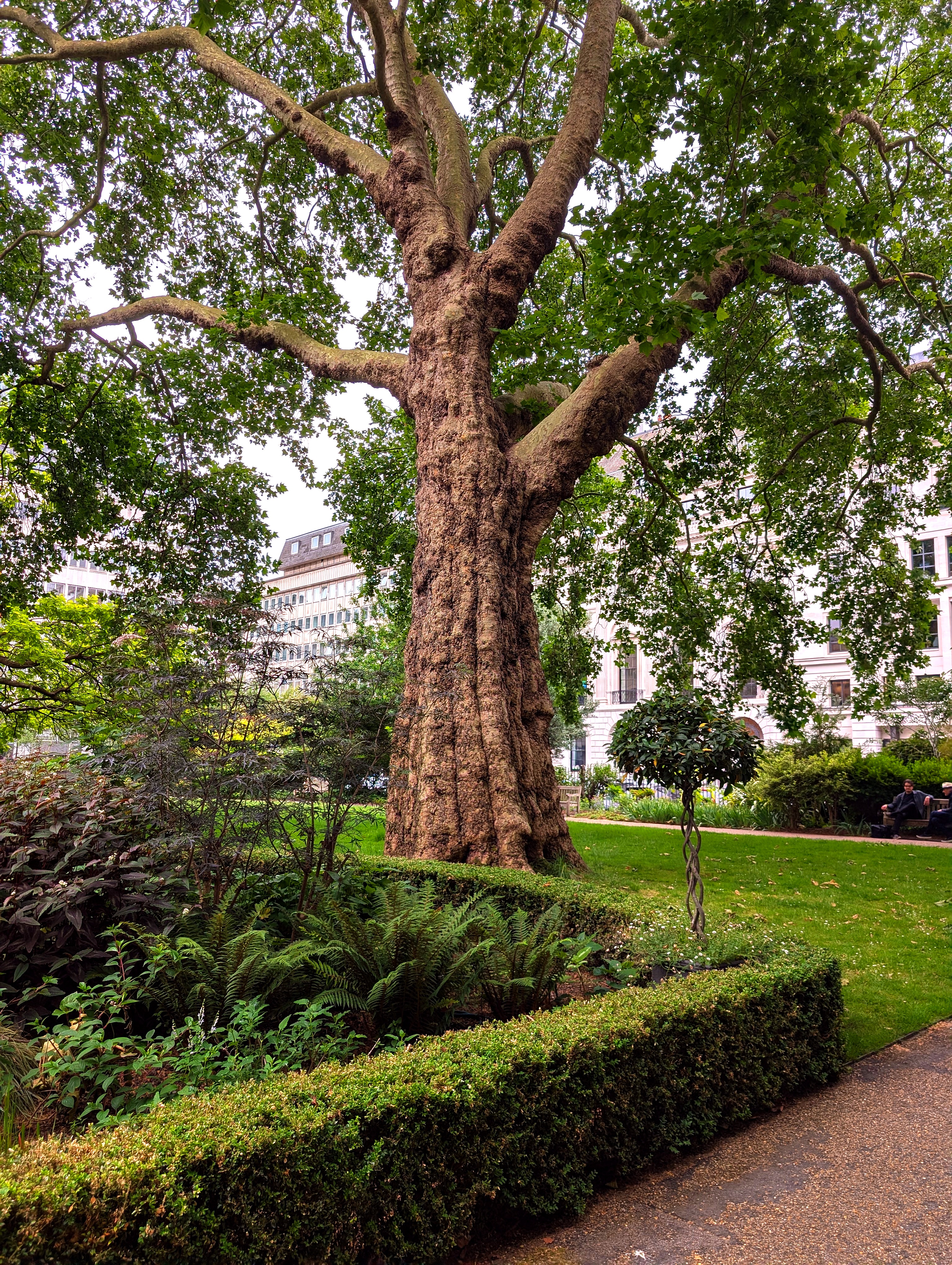
Not for the first time on our two-week sojourn I marveled at what I believe are plane trees. (I will happily consider being corrected.) I’m attempting to learn if the way the trees’ massive trunks (compared to each tree’s canopy) is natural or produced by extensive pruning over the years. Regardless, it’s striking.
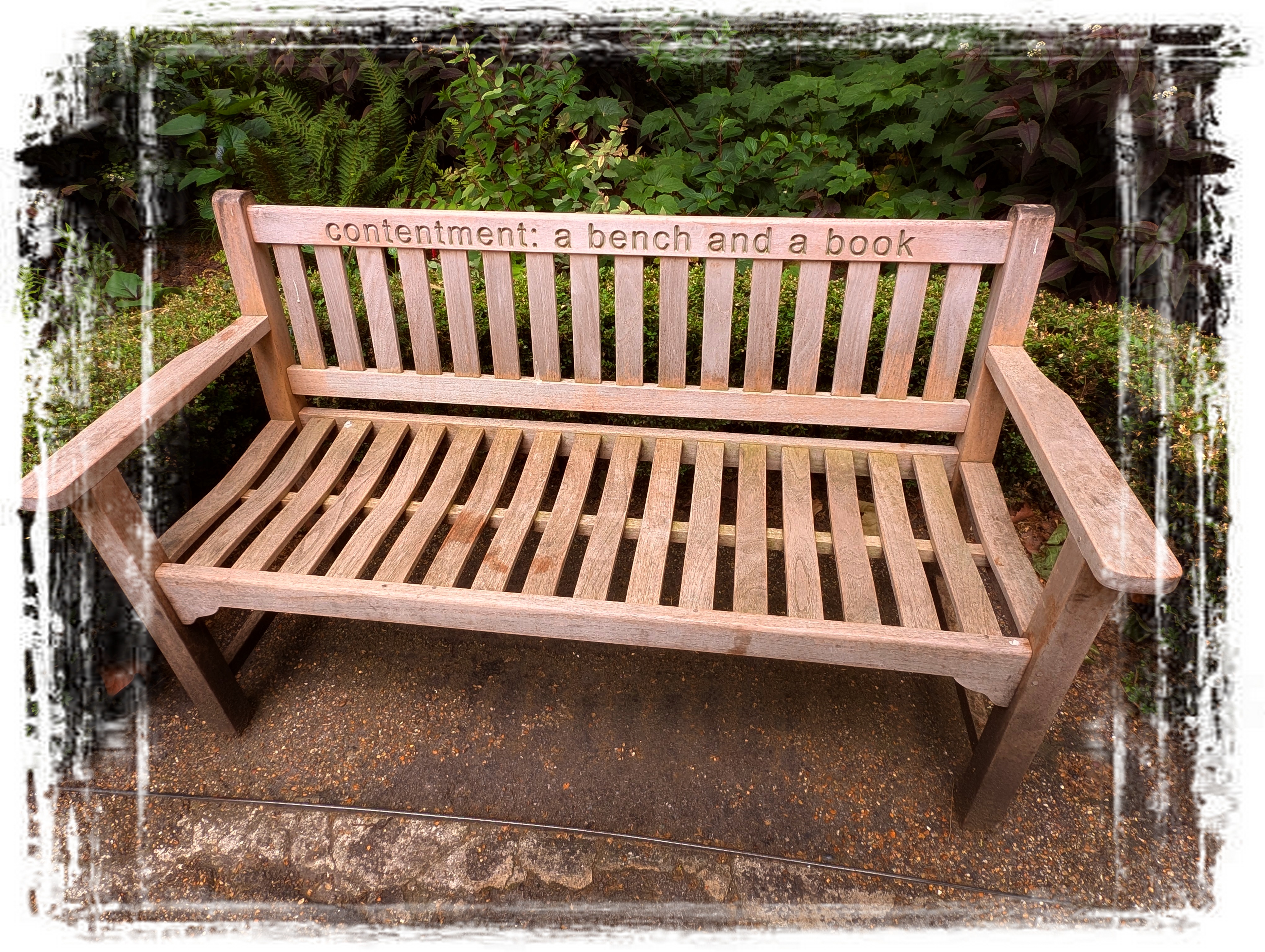
By the time of our walk we were experiencing our 14th day of wandering the island, our 14th day of experiencing how 2000 years of history permeates this land. Or perhaps the British/Scots/Welsh just hang onto it more. I never felt France or Germany along the Rhine River held onto their historical tropes the way these Celtic, Anglo-Saxon, Gaelic, Viking, Norman descendants do. Thus this bench brought me up short. I don’t read a physical book but maybe once per year and only then because I have a Luddite friend who insists on buying me one for my birthday. If this is the definition of contentment, I will be hard-pressed. Additionally, I received the reminder that my particular method of e-reading doesn’t work well in direct sunlight.
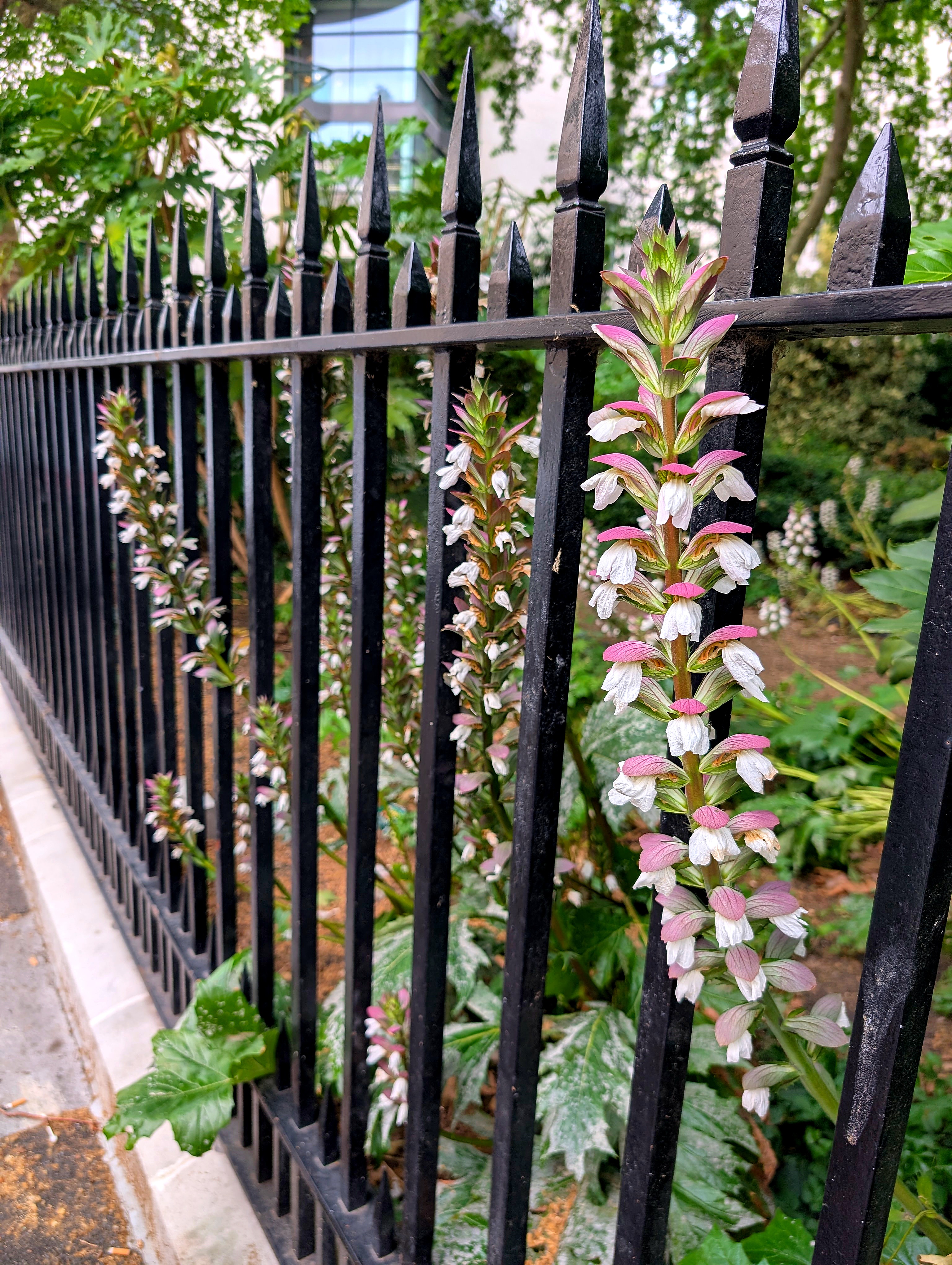
We wandered out. As we left I captured this photo showing how the natural world attempts to insinuate itself into the busy metro-life of London. Then again, how natural is it when every branch, stem, flower, even the plants, are artificially formed, planted, pruned, moved, replaced, and trained? The English do seem to love their carefully manicured gardens, at least within the historical districts of London.
Other elements for the returning traveler: an odd disjointedness associated with returning to one’s home country, but fearful about proving one belongs (via passport); having a distinctive experience of how different countries are…different countries, not just a place where “hey, people are people”; looking forward to the first time in two weeks that temperatures will actually align with “the summer months” of June/July/August; using toilets which aren’t square; drinking American beer which doesn’t hold a candle to the ones available around every corner in Great Britain; and realizing the myriad little ways a country founded on liberty has innate limits, wonderful as that liberty might be.
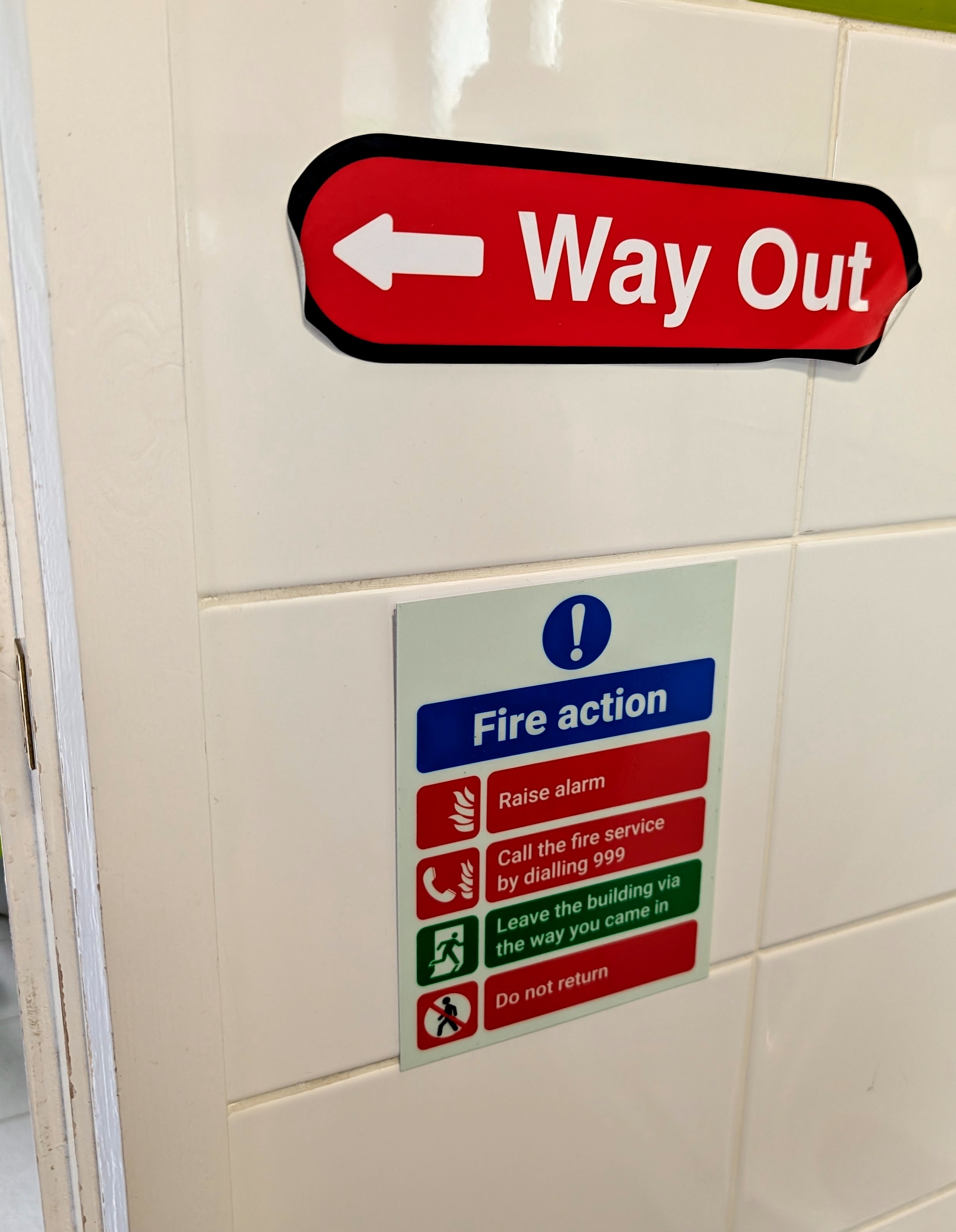
Removing oneself from the group grants both perspective and a desire (usually) to return to the group, the familiarity. Thus it was with us. All the little ways the United Kingdom differs from America brought our usually habitual daily habits into focus. Several hotels had Nespresso machines. One didn’t re-stock the capsules, however, despite our four-night stay. The simple act of looking right for oncoming traffic when crossing a street. (And on controlled-access highways, never getting used to the passing lane being on the right.) Marveling at how green everything was, everywhere. Sunrise occurring prior to 5 a.m. preceded by a leisurely pre-dawn that started around 4. On occasion, paying to use a toilet. Calling them toilets instead of restrooms. And the simple expressions of everyday life, turned sideways by a different culture despite ostensibly speaking the same language:



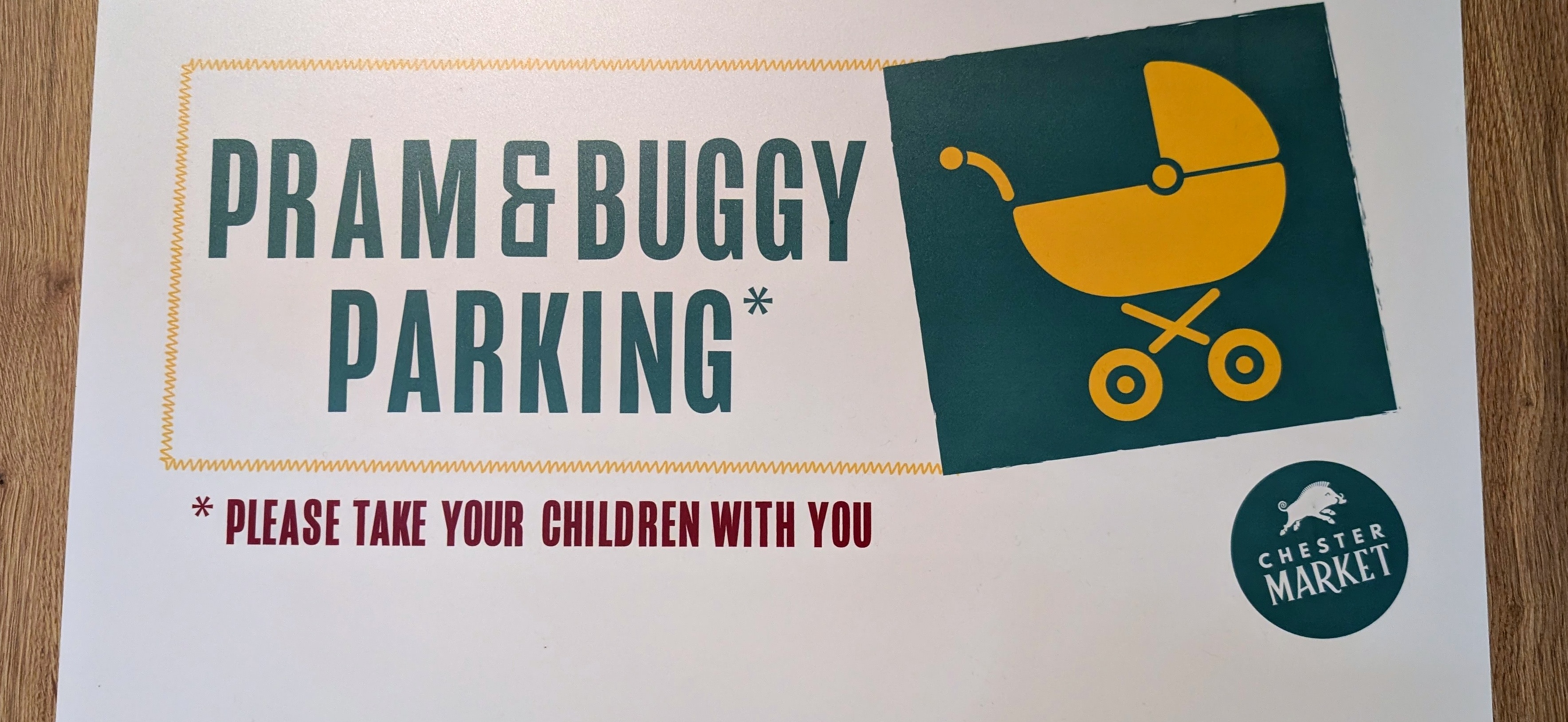
I’ve decided not to publish an itinerary-based series of posts about our two-week tour of Scotland, Wales, and England. This partially is based on the fact I’ve never completed the Rhine River cruise series which we experienced in August 2025! Mostly it’s based on the fact I have over 1000 photographs of far too many locations to handle it adequately in the time I have for writing. Instead, I’ll drop in from time to time on a particular excursion: Conwy Castle on the edge of Llandudno; the Royal Mile in Edinburgh; the Lake District of England; and all that touristy stuff from London. Hope you’ll join me.


I’ve always marveled at my own capacity to get used to a new place. It takes only a day or two and it becomes my new normal, then returning home, it takes a few days for it to return to my normal again. I always have a new eye for my space, as if time and distance have altered my vision of it.
Not sure what I’m adding to the conversation here, only that I think it says something about our ability to adapt.
I’d yearn to wander London, and love the photos you shared. Our country is a baby compared to the history there. I traveled to France seven years ago, Paris, and couldn’t stop just staring at the buildings, touching everything, marveling at his time has weathered some things and how others have persevered.
Thanks for sharing and have a great day!
Kind words! London is particularly weird because of the WWII blitz. Modern buildings are side by side with those from the 1700’s and 1800’s, some much older. I feel a post coming on…