
[I wish there were a photo here. There isn’t because all the good photos I have about poor usage of written English are owned by someone else who likely would sue me. But, hey, we’ve illustrated the use of the subjunctive verb conjugation! That’s cool, right?]
In my email every day I receive a list of books which can be purchased in electronic format from Amazon for $1-$4. Each book is described in only two or three sentences, just enough to hopefully entice you to read the full description on Amazon and then buy the book. [See Caveats below regarding split infinitives.] Today a description of the book Girl by Alona Frankel contained this opening sentence:
In this “impressionistic memoir,” a world-renowned children’s author and illustrator offers a “truly moving and bravely rendered” account of her time as a Polish Jewish girl hiding as a Gentle in Nazi-occupied Poland (Kirkus Reviews).
A “Gentle”? Surely you meant “Gentile”?
Every day–not everyday as may be written ignorantly–I read something where the author and/or the author’s editor have recorded their ignorance of the written English language. After noting for several years how these blemishes have crept into what I consider to be prestigious sources–New York Times anyone?–I’ve decided to record all of the offenses, rating them similar to a fact-checking site. Not all offenses are equal. We will consider the source and the egregiousness of the error.
Time out for my GUM Guidelines. Grammar is how we know words mean something. “Ball he red the threw,” confuses a speaker of English because it’s out of order: “He threw the red ball.” Don’t go all Noam Chomsky on me. My definition will suffice for our purposes. Grammar is not class-based. Usage refers to the accepted way of saying something. People who say “don’t nobody know nuttin’ but me!” are deemed ignorant by the people who say “nobody knows anything except for me!” Usage is class-based. Mechanics refers to how spoken language is rendered in print. It’s a convention, neither class-based nor non-class-based. As a society we have come to an agreement that words will be written a certain way…until they aren’t. As such, mechanics change over time. Mechanics refer to punctuation, capitalization, spelling, and the like. Okay, back to our tirade of the day.
Me
At the bottom of the heap I will place graffiti, notes from friends and relatives, and other signs posted in haste. Everyone of us and every one of these examples have been written on the fly, often by persons who somehow passed through school while they regarded English classes as the scheduling version of a roulette wheel. Who knows where the ball will land? Maybe they were lucky on a certain day when final exams were given. Maybe the teachers just didn’t want to try teaching them one more time. Regardless, we can hardly damn ignorance when it’s being spray-painted on the side of a building or dashed off in haste on the back of a grocery store sales receipt. Occasionally one of these haste-lays-waste mistakes will crop up in what we read. We will sigh and rate these a 1.
Next up we encounter those who labor with the English language–and I want to emphasize “labor”. [See Caveats below for punctuating quotation marks.] People with only a passing knowledge of how to write English can find themselves employed in jobs demanding continual use of those non-existent/woefully lacking talents. In these days of electronic word processing, I suspect they often don’t write the English, they just copy and paste it from somewhere else. This copy-and-paste existence demands editing skills but ultimately the failure to catch errors, i.e., to edit your own writing or someone else’s is exactly what we’re concerned with here. We’re not dissing people for not measuring up to Shakespeare, Hemingway, or the adroit use of language we read in the work of so many fine authors. We’re taking these writers to task for how they symbolically render their thoughts into print. At this level, one up from the ignorant, they should know better–but they don’t. That’s why we will rate these a 2 and not higher.
Unlike the previous group, many persons do write professionally. They might not consider it the defining talent for their profession, but it commands an integral part in it. I’m thinking of the people who design and render web pages, paralegals who draft documents all day, people who work in advertising or real estate, and those who write blogs or newsletters or for small town newspapers (to name only a few). These people generally should know better. At the very least, they should know when they don’t know better and take the time to figure out whatever is perplexing them. (Actually, I’m probably kidding myself. They likely think they do know how that particular phrase should be written, that particular word spelled. It never crosses their mind to check it.) Perhaps most egregious, these are the people who ought to be able to question the suggestions from autocorrect, check the spelling of the underlined words, and turn on grammar checkers to parse their work. When they don’t, we must hold them more accountable. We will rate the lazy and purposefully ignorant a 3.
Finally, we come to the no-excuses group. These folks have climbed to the top of the writing pyramid. They write for the most prestigious news organizations, for literary reviews, for think tanks, for professional journals. They write books. They edit books. These people not only represent the best writers of English, they are monitored by those who set the standards of the language itself. The more frequently intelligent writers spell the word gel as “jell,” the more dictionaries will list it as an acceptable spelling. Although this is how the mechanics of written language change, it should happen slowly, and it should happen with intent. In the first years of this century I started writing “e-mail” as “email” because I figured it was headed thataway and wanted to hurry it along. I argued with co-worker and fellow purist, citing the words such as to-morrow to bolster my position. He served a useful purpose by objecting. If we unilaterally accept new spellings when one or two people obstinately use them, we start heading toward spelling chaos. Therefore, those who speed up the pace of change through sheer ignorance should not be rewarded with the support of dictionaries. At the top of the heap we should demand better. We will rate these erring standard-bearers with a 4, our highest rating.
We’re only halfway. Not all errors are equal. We can sum these up more rapidly.
We’ll deliver a gentle admonishment for missing apostrophes (some of them), plain typos, and mistakes which indicate the writer/editor willingly caved to the masses even when those masses don’t know what they’re talking about. We’ll rate them 1.
Mix-ups which appear to be a general miss by the autocorrect, those which don’t change the meaning of the writing (much), those which generally seem to be based more on haste than ignorance get a slap on the wrist and the advice to “slow down!” We rate these errors with a 2.
Ignorant errors which change or obfuscate the intended meaning must result in stronger reactions, but in the face of the difficult we need to be flexible. In writing about an online class did the author say the learners “tuned into learn”? I won’t go into details why it should be “tuned in to learn” because this error has become ubiquitous and I’ll have plenty of opportunities to explain it later. And I’m willing to admit I might deserve to be put in this group for the previous paragraph where I didn’t capitalize the S when I wrote “slow down!” My defense is that I didn’t think it appropriate to put a comma after the word “to,” and commas before quotations indicate they’re being used to set off independent clauses…so if this isn’t an independent clause but only a phrase…eh, that’s where my mind takes me. I have a reason, and I hope, nay, believe I’m right. However, I can see the argument that says the two word imperative does represent an independent clause. You see how complex this can be? Let’s not condemn these ignorant mistakes made in the face of English’s complexity with our full force. We’ll rate these errors a 3 only.
Some errors provoke the response, “That’s just wrong! How could THAT get into print?” Setting aside the skill level of the writer, we look at the error and evaluate it from a standpoint of how easy it would be to get it right, presuming the writer knew enough to figure it out. Sadly, these are the ones I see more and more. I would like to say that a 4 isn’t nearly as common as a 2 or a 3, just as most writers will fall into the 2 and 3 level in our first set of standards. No, errors seem to be at best evenly distributed from 1 to 4. Too many are grievous and demand a 4.
While the above rating scales for the actor and the act will be applied somewhat subjectively, the final scale will be totally, purely subjective. I’m going to add 0, 1, or 2 points for how much it pisses me off! A good example would be this screenshot from a local TV station’s newscast a number of years ago:
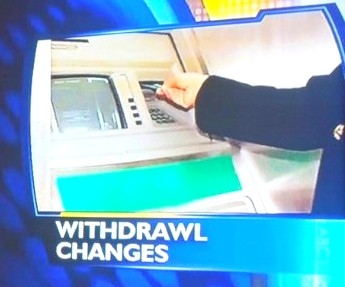
This one would get a “0” because it amuses me. We live in North Carolina, so of course it’s withDRAWL instead of withDRAWAL! (And by the way, I had to check how to spell withdrawal–it’s what responsible writers do.) Most of the time this type of error in all caps and prominently displayed on the screen of a TV station in the 41st largest city in the USA would rate a “2” because at the time I captured this photo, they routinely were making horrible typographical errors like this. The station broadcasts to the Cary-Durham-Raleigh area which contains more than 1.5 million people. Apparently they fired the person who kept making these errors because they became few and then disappeared altogether.
Which brings us back to the email which set me off this morning. Clicking through to Amazon, I note that the word Gentile is spelled correctly at the top of the book’s description. Therefore I presume some low-level clerk hurriedly typed the description directly from the Amazon page. Much less likely but plausible: it was copied and pasted from Amazon, then Amazon corrected its mistake afterward. The clerk-level role is a 2. The error is grievous, though, one which should have been caught by all but the most ignorant person–apparently no one ever looked at what had been typed. The error is a 4. And because it’s so obviously wrong, it pissed me off a great deal, so I’m throwing a 2 at it. This error rates a total level of 8 out of 10 on the Reader’s Horror scale.
The Caveats:
- I have a highly subjective and not terribly consistent approach to how I italicize words versus putting them in quotation marks (single or double). Generalized, when I talk about something symbolically I italicize it; when I am quoting from something I use double quotes. When I want to indicate ‘air quotes’ I use single quote marks.
- Also, I stand with William Safire that only a fully quoted independent clause should have ending punctuation inside the quotation marks.
- I don’t give a rat’s posterior about split infinitives. If I notice I’m doing it and if I can flip the words around to avoid it and still sound natural, I’ll rearrange the words. The abhorrence of split infinitives comes from Latin teachers. Latin verb infinitives cannot be split (as in the Romance languages), which led them to regard English infinitives as one word. Your eyes can tell you this isn’t true. It wonderfully represents the beautiful fluidity of English, and its ability to totally disregard (hah!) the silly Latin rule. The phrase “totally to disregard” is at once more awkward and slightly different in meaning.
- Similar to split infinitives, I don’t overly worry about prepositions at the ends of clauses. If I can easily switch the sentence around, I will. Winston Churchill is famous for being accused of ending a sentence with a preposition and replying, “Madam, that is an accusation up with which I will not put.”
- At 70 my opinions tend toward the conservative end of the scale but I started out liberal once. I surmise I’m somewhere in the middle at this point.
 all the voices in my head
Bravo! Now, can you create an app to check my writing to see where, within the spectrum, my scribblings are at?
Sadly, no. It’s an inexact science.