
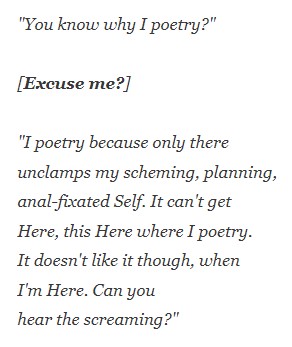
Something perhaps has changed with WordPress. I’ve been irritated to see that choosing the “Verse” setting for a block, which I thought yielded the above, doesn’t even come close on some devices. Here’s what my friend received in his email:

I knew that WordPress converted poetry to a monospaced font, rather liked it actually, because I follow a couple of poetry blogs which deliver the entire poem to my inbox. I’m pretty sure in the past that I saw the same thing on the WordPress website when I used my phone. Ah, but now there is Jetpack, newly changed for the…better? This is what appears on my actual blog when using an Android phone:
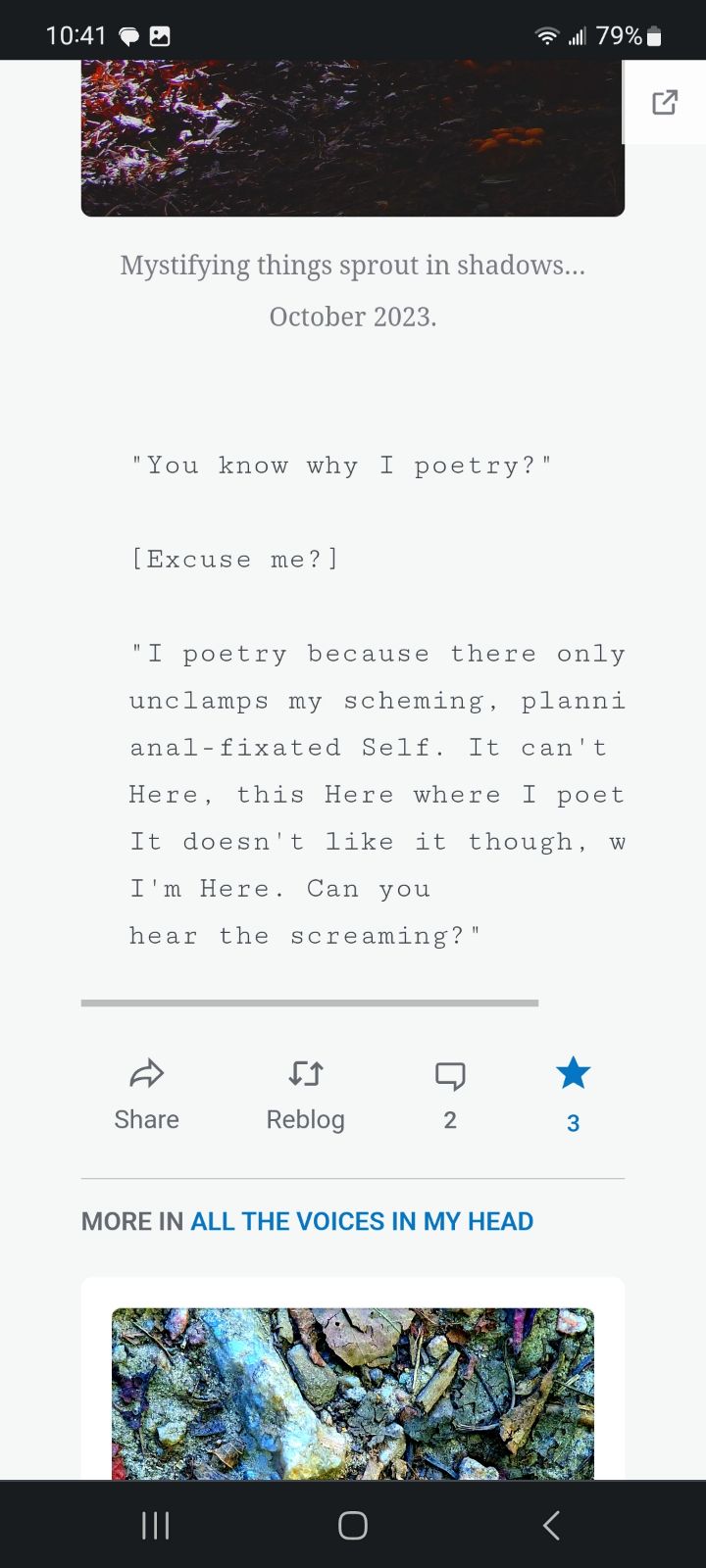
That’s not “verse,” WordPress, nor is it “poem.” That is called “paragraph” and “prose” and perhaps “simplistic crap” unless one makes a living as a stream-of-consciousness author, and even then one must establish a certain cadence and structure to ‘musically’ signal to the Reader that yes, this is something beyond prose. (Unless one is James Joyce, then nevermind.)
Canadian philosopher and communications theory god Marshall McLuhan invented the phrase “the medium in the message”. I’ve perverted what this means. He meant that content doesn’t really matter, that a children’s cartoon or a vicious slasher movie is all the same when broadcast identically on television. To me he meant the message of any communication effort takes its ultimate meaning from the medium by which it is delivered. Spoken words in a living room conversation take on new meanings when sung in a concert hall. More familiarly, books turned into movies tell a different story and cannot help do otherwise. Even if Peter Jackson had managed to control every reference in his Lord of the Rings movies, visual, aural, or what-have-you, the story still would have been just as vastly different than the books as they turned out to be.
For these reasons, it’s deeply unsettling to oldsters such as me to watch the different devices reformat and repackage the content of what purportedly is the same thing. I see this nearly every day as I follow Major League Baseball. MLB.com presents a side-by-side box score for both teams, but on the phone you must select one team or the other–never can you present them at the same time on your phone’s screen. Baseball-Reference.com displays a wonderfully useful tool when looking at any particular season for a baseball team: a histogram of green and red bars which tell the tale of the entire season, game by game, read left to right. Mouse over any bar and it tells you the date of that particular game, who this team played (and where), and what the score was. It also shows what the team’s Won-Lost record was when the game finished. On a mobile device (tablet or phone) this histogram tool disappears. It makes me wonder if certain features of a website are completely unknown to a majority of the younglings who stare into their phones for 90% of the time they’re awake.
Thus, we come back to my dilemma/consternation and the question posed in the headline. Have I delivered a poem at all when it looks like a short paragraph raising an offhand question? Does the trivialization effected by the mobile presentation indicate my poem lacked substance and can only stake a claim to poetry because of its window-dressed arrangement? (Believe me, I’ve thought some unkind thoughts about other’s postings which, if returned to a more prose-like arrangement, look like the musings of a teenager in a diary. Am I just as shallow?) Did McLuhan not go far enough? Does the message ultimately get defined by how the technology delivers it, even when it lives simultaneously in different media formats?
A light bulb creates an environment by its mere presence.
Marshall McLuhan from Understanding Media (as quoted in Wikipedia)
Ultimately I think McLuhan would argue each device configuration represents a medium. But I never signed up for this, WordPress! My understanding of the matter was this: you give me the tools to put my message together, and I pay for it by giving you ultimate ownership of my content (which I cannot believe I did, but there ya go). I expected a bit more, though. I expected a very nuanced difference to my content. Sure, I’ll accept McLuhan’s theory that those who read my stuff on a phone get a different message than those who read it on a big desktop monitor, but I would prefer to be left out of the “definition changing” part of the equation. You’ve made me a partner to it by changing my content not just the medium.
Which leaves me little closer to answering my question but has given me an excellent opportunity to rely on that first college degree and to prove yet again that old age clothes old men in curmudgeonly behaviors as surely as dogs become grizzled and oaks gnarled.
 all the voices in my head
You address a problem I’ve noticed too. It always looks different on every device. What to do? I notice some people are creating images of their poems and posting those but that’s a lot of work. Also, shouldn’t it just be fixed? I think I say this about things all the time.
“Why doesn’t somebody fix this?” Many times I think, sure, that should be me. But I’ve no oar in this river. I’m just a passenger. And there’s only one boat on the river.