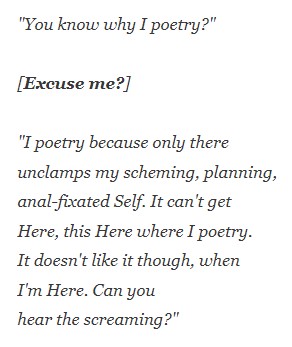
If the medium is the message, what is the device?

what my latest poem looks like on my desktop computer monitor. October 2023.

Something perhaps has changed with WordPress. I’ve been irritated to see that choosing the “Verse” setting for a block, which I thought yielded the above, doesn’t even come close on some devices. Here’s what my friend received in his email:

what my poem looks like on an Android phone, as delivered in a Gmail message. October 2023.

I knew that WordPress converted poetry to a monospaced font, rather liked it actually, because I follow a couple of poetry blogs which deliver the entire poem to my inbox. I’m pretty sure in the past that I saw the same thing on the WordPress website when I used my phone. Ah, but now there is Jetpack, newly changed for the…better? This is what appears on my actual blog when using an Android phone:
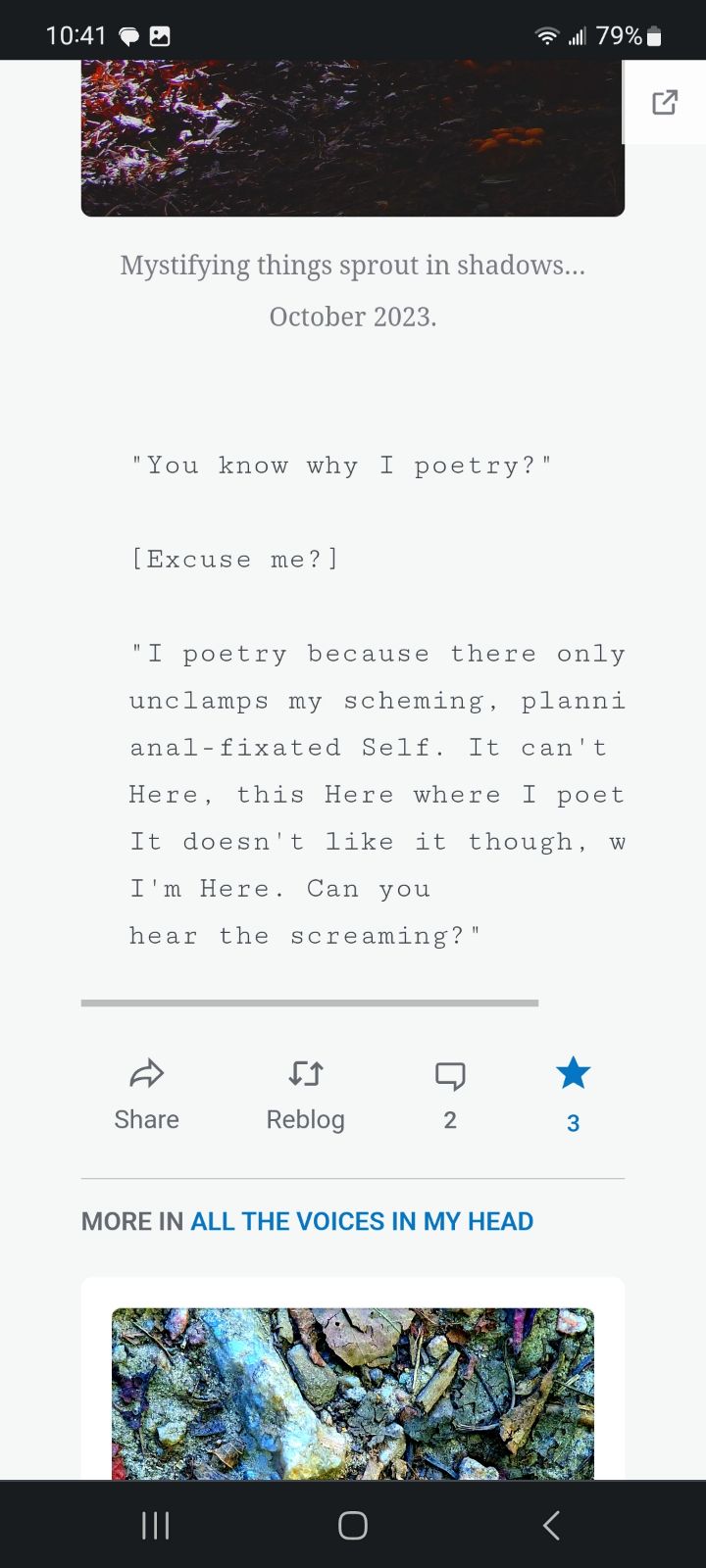
What my poem looks like on an Android phone using WordPress/Jetpack. October 2023.

That’s not “verse,” WordPress, nor is it “poem.” That is called “paragraph” and “prose” and perhaps “simplistic crap” unless one makes a living as a stream-of-consciousness author, and even then one must establish a certain cadence and structure to ‘musically’ signal to the Reader that yes, this is something beyond prose. (Unless one is James Joyce, then nevermind.)

Canadian philosopher and communications theory god Marshall McLuhan invented the phrase “the medium in the message”. I’ve perverted what this means. He meant that content doesn’t really matter, that a children’s cartoon or a vicious slasher movie is all the same when broadcast identically on television. To me he meant the message of any communication effort takes its ultimate meaning from the medium by which it is delivered. Spoken words in a living room conversation take on new meanings when sung in a concert hall. More familiarly, books turned into movies tell a different story and cannot help do otherwise. Even if Peter Jackson had managed to control every reference in his Lord of the Rings movies, visual, aural, or what-have-you, the story still would have been just as vastly different than the books as they turned out to be.

For these reasons, it’s deeply unsettling to oldsters such as me to watch the different devices reformat and repackage the content of what purportedly is the same thing. I see this nearly every day as I follow Major League Baseball. MLB.com presents a side-by-side box score for both teams, but on the phone you must select one team or the other–never can you present them at the same time on your phone’s screen. Baseball-Reference.com displays a wonderfully useful tool when looking at any particular season for a baseball team: a histogram of green and red bars which tell the tale of the entire season, game by game, read left to right. Mouse over any bar and it tells you the date of that particular game, who this team played (and where), and what the score was. It also shows what the team’s Won-Lost record was when the game finished. On a mobile device (tablet or phone) this histogram tool disappears. It makes me wonder if certain features of a website are completely unknown to a majority of the younglings who stare into their phones for 90% of the time they’re awake.

Thus, we come back to my dilemma/consternation and the question posed in the headline. Have I delivered a poem at all when it looks like a short paragraph raising an offhand question? Does the trivialization effected by the mobile presentation indicate my poem lacked substance and can only stake a claim to poetry because of its window-dressed arrangement? (Believe me, I’ve thought some unkind thoughts about other’s postings which, if returned to a more prose-like arrangement, look like the musings of a teenager in a diary. Am I just as shallow?) Did McLuhan not go far enough? Does the message ultimately get defined by how the technology delivers it, even when it lives simultaneously in different media formats?

A light bulb creates an environment by its mere presence.

Marshall McLuhan from Understanding Media (as quoted in Wikipedia)

Ultimately I think McLuhan would argue each device configuration represents a medium. But I never signed up for this, WordPress! My understanding of the matter was this: you give me the tools to put my message together, and I pay for it by giving you ultimate ownership of my content (which I cannot believe I did, but there ya go). I expected a bit more, though. I expected a very nuanced difference to my content. Sure, I’ll accept McLuhan’s theory that those who read my stuff on a phone get a different message than those who read it on a big desktop monitor, but I would prefer to be left out of the “definition changing” part of the equation. You’ve made me a partner to it by changing my content not just the medium.

Which leaves me little closer to answering my question but has given me an excellent opportunity to rely on that first college degree and to prove yet again that old age clothes old men in curmudgeonly behaviors as surely as dogs become grizzled and oaks gnarled.

Random thoughts

Yates Mill Pond, NC. October 2023.

Things that have been bouncing around in my head lately:

  • What’s wrong with these directions from a recipe I used this morning? “Sift before measuring: 2 cups flour.” Seriously, Joy of Cooking? How do I sift 2C without measuring it first? (The waffles were delicious, however.)
  • I’m trying to be on a stay-cation while my wife travels to Florida. This means I don’t want to do “chores” — but I reminded myself that “even on vacation, one has to pack the trunk.”
  • One of the all-time best blues-rock (Chicago style) performances is Kenny Wayne Shepherd’s “Dance For Me Girl” on Live in Chicago.
  • Attaboy, Harper!” Jesus, don’t poke the bear, Arcia. That’s just basic Survival 101. As if Bryce needed more motivation!
  • I’ve realized recently my emotional IQ hovers around “special needs”. Unfortunately, my intellectual IQ makes me think I’m the smartest person in the room at all times. In terms of roulette, smart people think that just because it comes up red 98% of the time, it will always come up red. So, 2% of the time they’re wrong. Unfortunately, we never know if “this time” is in the 2% or not.
  • Getting old sucks.
  • I will need to be institutionalized if my wife dies before I do. There’s only so much crazy society can tolerate. (Our current politicians notwithstanding.) I’ve been alone for four days, and I remember how the internalized thoughts and lack of social contact distill the craziness. Not pretty.
  • Those of you with big families have no idea the paucity of having few (if any) relatives. I have/had one uncle, four cousins, and one brother. Grandparents died, the uncle died, one of the cousins has died. My brother had two children–one is estranged to the point of “whereabouts unknown”. My close family consists of a brother and a niece. My wife, meanwhile, has seven siblings, and 23 nieces and nephews, and her parents are still living. Those nieces and nephews have had a good handful of children. It’s night and day here in my house.
  • I daily lament not “getting to the important things” and then spend the afternoon reading, cruising the Interweb, and drinking beer. And writing posts like these. Not one important thing is addressed.

one of my many pet peeves

if you’re going to post poetry as if you’re a poet, for God’s sake, learn the damn language! It’s pretty easy to do that and still write bad poetry, but it’s impossible for you to write good poetry without a basic understanding of grammar, usage, and mechanics.

Shriveling expectations

Small, shriveled golden oyster mushrooms. September 2023.

When I converted an old, seldom-used blog into this one, I envisioned a writing outlet and ‘daily’ blog combination. After all, I’d just canceled Facebook for reasons too obvious and previously stated. I figured my need to communicate, to shout into the gale winds of social media would inevitably fill this site up with lots and lots of pithy writing punctuating my daily doin’s. It’s now time to admit something about getting older I had witnessed but not from this side of the divide, so to speak: that driving urge to make something happen and accomplish something fades. Some of this is good. Recently I’ve reflected on my typical mindset four years ago when I juggled weekly trips across the continent to San Diego and Seattle from my Raleigh home, monthly visits to attend to my ailing mother in Spokane, and to arrange her final rites in October. (I ended it all with an audit performed in Toronto…in rainy November weather. Yay.) I barely recognize the person who kept multiple itineraries in his head, who could tell you which airports had which kiosks at which intervals, who had a set and efficient routine for unpacking and packing a suitcase, who parleyed sarcastic cynicism into a business persona, and who grabbed beers and food as time allowed. I wish I could convey the inner pressure which led others to give me wide berth at times, but which seemed to be crucial to my survival. But now…

Hard to thrill,
Nothing really moves me anymore.

from “Hard To Thrill” by Eric Clapton/John Mayer, performed by Clapton & J.J. Cale on The Road To Escondido

When Covid partnered with retirement to give me a crash course in inactivity, I reverted to a boyhood prototype: read; pursue an idea as it blossomed; eat; drink; repeat. But don’t call me lazy. I bristle at being called lazy. “Inside my head I’m more active than you’ll ever be,” I think. (We’ll leave to another day what steps I took to slow down and/or turn off the voices in my head.) I learned early that giving voice to my stream of consciousness at speed guaranteed a fairly quick response: “oh god, would you PLEASE JUST SHUT UP!” (Well, I somewhat learned it. I’ve received refresher courses throughout the ensuing 50 years.) Example from a coastal drive during this past week’s visit from a lifelong friend: “There’s a Free Will Baptist Church…not to be confused with a movie about orcas…and definitely Free Willy shouldn’t be confused with that series of pornographic films.” I think I saw heads spin in the car. Did I mention I liked Robin Williams because he delivered comedy at a speed I could appreciate?

All of this by way of explaining my consternation at noting only three or four posts in the past six weeks. Remove the writer’s conceit of a Virtual Vacation and I’ve posted little in the past three or four months. No promises, but I’m headed into a (slightly) more optimistic future in October. In mid-month I’m looking at two periods in the month which hold a dozen days of solitude–a gift to a loner like me.

Our shriveled photo at the top represents a failure at growing a beautiful blooming of golden oyster mushrooms. I was promised a gorgeous cluster, maybe two or three from a kit I purchased in early August. It should have looked like this…ah but that would be stealing someone else’s photo. Let’s just say it would be ten times bigger than the clump in the photo above.

Instead, nothing happened within the 10-14 days it should have. I gifted a friend with the same kind of mushroom kit, and he started a week ahead of me. He didn’t reach harvest until about day 19 or 20, so I held on. About three weeks in, I finally got some growth where it shouldn’t have occurred and it consisted of two distinct clusters which both looked like the picture at the top of this post. It’s an accurate symbol of my shriveled hopes these days. The vendor came through though and sent me a new block which arrived Friday. I started it Sunday, and noted I had not followed instructions–imagine that. This time I made the required shallow incision in the mycelium-impregnated starter block as specified. Stay tuned.

It’s possible that the advent of Oktoberfest with its namesake beer has contributed to some of the lassitude I feel. Or…others…. I’m still polishing off some representatives from the Michigan trip in July. (Though not representative of the state: it’s where I found North Coast Brewing’s Old Rasputin, an imperial stout that drinks like a cross between beer, chocolate, and coffee, all without any additions. Good stuff, but potent. Two of these babies and you’re more than halfway through a typical six-pack.)

The glass is mightier than the sword…particularly when the glasses gang up on the pen.

September saw a few happenings. We got to know our new steel steed, Percy Pilcher:

Percy Pilcher, aviator extraordinaire!

We set out at the end of August to replace Mr. Lincoln, a 2015 Lincoln MKC and a beautiful realization of automotive vision, but who had become a bit outdated, frustrating, and tired after eight years. “A hybrid, dear,” I told my wife. “That’s what we need. And probably a minivan, though I’m loath to admit those words. We need the cargo room.” We went shopping. Hybrid Toyota Sierras would be available six to eight months–if we pre-ordered. Chrysler Pacificas looked cheap, even at the so-called high end of the model spectrum. The others were DOA, and so…we headed back to the Lincoln dealership where we were treated like returning royalty. No hybrid Aviators? There’s a familiar song. A ‘pre-owned’ model? (Hmm. Weren’t those called “used” not long ago? I think I’m differently opinionated!) Sure. And that’s how we wound up with a current-year Aviator which was returned after five months because the purchasers just loved the vehicle they had traded in, so they bought another one and used this one to cover the cost. Their disappointment was our gain. We bought a vehicle with less than one year’s mileage on it, looks sharp, has all the features we wanted, and…it’s a Lincoln. When I woke up from the euphoria, though, I realized we had purchased another gas combustion engine and that it had 25% worse gas mileage than what we had traded in! Ah, no matter. For now Percy is our new Aviator. Why Percy? Because Percy Pilcher, a relative for sure–there aren’t many Pilchers in the world–achieved quite a bit of notoriety as an inventor and aviator, and likely would’ve bested the Wright brothers at the first to fly a heavier-than-air aircraft if he hadn’t been killed right before attempting it. If you click through to that link, the photograph of him looks similar to my grandfather, the Rev. Howard B. Pilcher, enough that he could’ve been a cousin. I’ve not done much with genealogy, so I’ve no idea how close the relationship is.

Tuesday marked the beginning of a month of travel, both us and others. Or more specifically, both my wife and others. I’m not going anywhere. In my teen years I became acquainted with a guy who later became a good and close friend. Throughout junior and senior high I knew who he was, saw him in groups, but not until I dropped out of college after my freshman year in 1973 did I start working at a Spokane hospital where he also worked. We started hanging out, and because I had become just a little more “normal” we connected. Though diametrically different, we became friends. He was the best man at my first wedding in 1983. We fell into and out of touch, but by 1990 we had renewed it for good. I moved away, and he served in the wedding party for my second wedding. (It was only fair. I participated in multiple weddings for him. Perhaps I’ll tell that tale later.) This past week represented the second time he visited us in Raleigh; the first occurred only because he had followed a woman to Florida in 2009. Had that not happened….but that’s also another story.

This week my brother visits for the first time in over a year. When he leaves a week later, one of my wife’s triplet sisters drops in the next day to pick up my wife and continue to Florida where she (my sister-in-law, not my wife) will look for her retirement home. When that’s done my wife and I will enjoy a whole seven days all by ourselves before she takes off again with a group of friends called The Biker Chicks (though my wife has never ridden a hog or any other type of motorcycle that I am aware of). Finally, as October bows itself out with Hallowe’en, and All Saints and All Souls ushers us into November, I will settle into a sedate period of enjoying my life with my wife. I really don’t need much else. She lets me be to sit here and write these screeds, matches me drink for drink and recipe for recipe, creates handcrafted art in a panoply of media, and joins me in a love of good video, good music, and good times.

What could be better? It’s why I sometimes don’t post here regularly. I’m having too much fun.

the most disturbing book and the beauty of disturbances

This month LibraryThing provoked me with its monthly newsletter. It contained a link to an ongoing discussion topic (months-long): “What is the most disturbing book you’ve ever read?” (If like me, you find library cataloging software and sites lacking, you might want to look at LibraryThing which offers a version for running small libraries. For a control freak like myself, who also needs much more data than a site like Goodreads can provide, this has been a godsend.)

When I read that question, I immediately thought of One Day of Life by Manlio Argueta. I read this book in the first half of my 30’s; it came as part of a four-volume set of Latin America writers from Quality Paperback Books. I enjoyed them, great works all: 100 Years of Solitude by Gabriel García Márquez; Aunt Julia and the Scriptwriter by Mario Vargas Llosa; Dora, Doralina by Rachel de Queiroz. But the fourth one, One Day of Life by Argueta haunted me then and haunts me whenever I think about it, and that’s more often than you would think despite its detailing the lead up to the El Salvador Civil War in the 1980’s and despite the fact I never re-read it.

The book’s matter-of-fact, simple prose details horrors the same way any war-zone child would. It just happens. It is what has happened. It is their life. Though it covers a single “day of life”, the flashbacks offer more detail, all of it disturbing. This was the time of the death squads where people were tortured and executed at the hands of faceless men.

[SPOILER COMING UP]

Though I haven’t read the book since the mid-1980’s, it’s seared into my brain. All I had to do was read this synopsis of the end of the novel, about the central character, Guadalupe Guardado and the novel came back to life. Guardado’s granddaughter, involved in the protests of the time, is Adolfina:

At the end of the novel, the authorities bring a beaten man to Guadalupe and Adolfina who had said the name “Adolfina” after being severely beaten. Adolfina does not recognize the man, but Guadalupe recognizes her husband José. On his previous advice, she denies knowing him, and he is taken away.

Wikipedia entry “One Day of Life”

There’s a horrific beauty contained in vessels such as this which exquisitely contain the pain, the despair, the sadness, the very twisted ways of life which the mainstream hopes to avoid. Argueta’s novel reminds me of another version of the same thing, a song by Rubén Blades, “In Salvador” on the album Nothing But the Truth released in 1988. (I’m unable to find a YouTube video of the song although you can watch a “complete album” video of the album. It’s the 7th song.) Although Lou Reed, Elvis Costello, and Sting contributed songwriting efforts to this album (Blades’ first in English), this song is not one of those. Critics have knocked the fact that Blades sings with an over-enunciated English but to me, it makes the album more honest. We’re hearing his description of what life is still like in El Salvador, and we’re hearing someone from Central America (Blades is Panamanian) speak to us. We wouldn’t expect to hear someone speak fluid English when it’s a second language. The refrain:

“No one can protect your life in Salvador. Judges that condemn you have no name. Could it be the gentleman who lives next door? Or the guy who goes with you to work?

transcribed from the album Nothing But The Truth

There are several other disturbing songs on the album in varying degrees. “The Hit” describes how a young Hispanic male violates the main law of the street that “you don’t double-cross the ones you love”. He’s gunned down. “Letters to the Vatican” describes a woman who’s lost a good chunk of her mind, but finds support in the bar scene where the patrons remember how she was “before she got this way”. In “Ollie’s Doo Wop” Blades sings about the cultivated ignorance of Ronald Reagan to Ollie North’s nefarious doings. I get a very personal meaning from “Hope’s On Hold” where Blades sings of all the things that inhibit falling in love, which leads to “hope’s on hold”.

If we go into the beauty of ugliness, of disturbance, I would offer up Lou Reed’s Berlin which has a semi-rock opera construction. It’s about speed freaks living in Berlin. You can imagine the seaminess of it.

Raw emotions of any type remain more true to me than than the equivocal nature of living in polite society. For this reason, I rarely tell anyone, even my wife, what is going on inside my head. As a creative, we entertain the un-entertainable, the unappreciated, the unapproved. We shed the mundane memories which frankly hamper our movement in polite society. We accept all, winnow it, and feed it back to our world, hoping that if we do it in a meaningful manner, it will illuminate rather than obscure.

Read Argueta’s book. It remains pertinent because the horror merely moved to different countries. It’s the same visceral, hateful viciousness which fuels America’s cultural and political battles. It blossoms in central Africa, in Singapore, in India, in the Europe. It sustains all ideologues on right and left.

Or if you need the short course: listen to Rubén Blades’s song.

Foggy starts

Fog at the mouth of the Columbia River sets a standard for fog. Fog defines where Oregon and Washington share its outlet to the Pacific. It also defined my nascent and up-to-then non-existent career as I drove to Ilwaco, WA, and my second job interview of that early weekend in December 1977.

Car-less at that point of my life, my folks loaned me a 1968 Ford Galaxie 500. Though only nine years old, one could see already why it had been handed down. I piloted this coffin on wheels toward the southwestern tip of Washington through a typically drizzly early winter day in the western part of the state. “Man, talk about wet!” I muttered. At the same time I thought this, I drove my 1968 Ford Galaxie 500 into a fog bank. Until that point of my life–all 23 years of it–I don’t think I had ever realized what the phrase “bank of fog” meant. Within 100 yards I drove from a gray, drizzly day into a shroud of bright nothingness. I could barely make out the highway signs along the shoulder of the road.

How had I gotten here?

Simple. In mid-December 1977 I found myself in imminent need of a job. The University of Washington School of Communications planned to foist me on society with a degree. I had trained, in a mediocre fashion, for a job as a reporter. I realized I wouldn’t get any top-tier jobs at the dailies of Washington State, Idaho, Oregon, and I wasn’t plugged into destinations further away. (No Internet, no networking skills, no time spent learning about how to get jobs pretty much anywhere.) The state association of independent weekly newspaper publishers had to do. For one thing, the association headquartered itself in Seattle just a couple miles from the University campus. I figured, correctly as it turned out, they would be desperate (in a relative sense). Our corner of the US hadn’t experienced the stagflation of the Carter Administration, and talented graduates don’t seek jobs with weekly newspapers. Neither do most graduates want to head to the hinterlands to report about social teas, high school sports, and local city council meetings. It sounded easier, and I was all about easy, then and now.

Shortly after finishing my final final, I traveled to my parents’ home in Spokane. Once there, I gorged on home cooking, spoke to them as little as possible, and grabbed their old Ford for some serious job hunting.

My first stop that early December weekend was in Moses Lake, afairly strange place if you’re from outside of the state. To us it merely offered a respite in the cross-state drive. I met a married couple who owned and managed two newspapers. One was a weekly in Ritzville, WA, which is a small farming-oriented community at the northern edge of the Palouse wheatfields where it enjoys a location on the main east-west corridor through the state, I-90. They also published a paper in Cle Elum, but I do not remember if it was the Miner Echo or the Northern Kittitas County Tribune. I tend to think it was the former.

The owners were salt-of-the-earth, don’t-give-me-shit small business owners in a small community, a class of person I soon was to become deeply knowledgeable about. They didn’t make the job sound attractive. And they offered $125 a week. (Keep that figure in mind.) I told them I was interviewing elsewhere, and I would let them know. Notice they offered me a job on the spot. My alarm was sounding, but not loudly: I had kinda figured this wouldn’t be extremely difficult. A theme of my life to that point, and for a goodly part of my life from thereafter, was to flow into the path of least resistance.

This was a Saturday. I continued after the interview to drive westward, arriving at my dorm sometime in the late afternoon. (What a “thrill” to park a car in the student garage like all the kids that had more money than I did!) On Sunday I got myself up at a non-student, responsible hour, got in the car again, and headed to Ilwaco where an interview at the Chinook Observer awaited me.

My encounter with the fog bank said, “Welcome to Ilwaco.” It continued, growing more dense as I got into town. I found the office and parked outside. Upon knocking on the door, I was met by a pasty-complexioned man who owned the paper. He seemed ill at ease, hesitant, insecure. I immediately wondered how a man could own a weekly newspaper, the klaxon of any community, the polestar of community ire, and have a personality like this. We had a milquetoast interview and he offered me my second job in two days, also at $125/week. He seemed upset when I said I already had one offer on the table and another interview pending.

The Skykomish River near Monroe, WA, at dawn. There is a river there. And trees on the far bank. Almost as foggy as the mouth of the Columbia River near Ilwaco. Sometime in 1979 or 1980.

On Tuesday two days later I headed to Monroe, WA. Only 15 miles east of Everett and about 30 miles from my dorm in Seattle, Monroe was the gateway to the North Cascades via US Highway 2. Tuesdays, I learned later, was publication day which meant that the paper was being “put to bed” while I interviewed with the owner. I omit his name in case I say something which might get me in trouble.

This interview started out weird and stayed weird. The antithesis of the Ilwaco publisher faced me. He’d served as motorcycle courier in World War II in Europe, and he carried that hard-bitten attitude with him. He revered John Wayne. He kept Cutty Sark in his desk drawer. He ended the interview thusly: “So…I can start you at $150 per week. When can you start?” I trotted out my now-practiced “well-I-have-other-offers-on-the-table” speech and he said, “Well, call them and tell them you’ve accepted this position!” I was caught off guard. He asked, “Do you want this job or not?” I thought (quickly) about $25 more per week. He was offering $7800 per year. In 1977 more than 25% of Americans earned less than this. I was young. Earning less than the median American ($13,572) didn’t sound that awful. I would be working as a reporter. I told him yes, I would give those others a call. He said:

“We’ve got phones, I’ve got an extra office. You can call from there.”

So I wound up on a Tuesday in mid-December sitting in what was definitely not an office but more a glorified cube (and would soon become my cube), calling the other two publishers and telling them that I had accepted an offer elsewhere.

Because we were at this point looking at the issue which would come out right before Christmas, we agreed it would make the most sense for me to arrive right after Christmas and start work on Monday the 27th. I got in the old Ford Galaxie, drove to my dorm, cleaned it out, and drove to Spokane. I celebrated Christmas with my family, including my brother, home from a separate university in the state.

On Sunday the 26th I drove across the state for the fourth time that month, the old Galaxie towing a U-Haul trailer with all my possessions. I got to my mother’s childhood home in Seattle very late afternoon, when it was dark. There my grandparents bequeathed me a chair and some other odds and ends, some of which–like the chair–I own to this day, more than 40 years later. I pulled into the parking lot for the Monroe Motel later that evening, checked in, and reported to work the next morning.

Fog defines my entire job interviewing process and my newspaper work thereafter. I’d no idea what I really wanted to do other than write. I couldn’t discern which job sounded better until the last publisher just plain told me. I stumbled through my first year until I managed to trust that all those empty inches would somehow be filled by Deadline Day. Less than four years later I drifted into something else.

is it me…?

Many an evening an inspiration strikes, and I dutifully grab a pad and write it down. About 90% of the time I read it the next morning and say to myself, “WTF?” This morning this is what I read:

Social Wallpaper

–you divert the attention from ME

sincerely recorded by brain-addled me

All I remember is saying this to my wife in the context of me pontificating (as I am wont to do), and exclaiming to her, “Wow! I’ve got to write that down!”

Yay.

We are not called

Cannonballs at the Tryon Palace, New Bern, NC. May 2009.

or, “To all who run toward the open field”

Not all are called to priesthood;
...to teach,
...to heal,
...to defend,
...to right wrongs,
...to lead,
...to agitate,
...to write
The Great American Novel.

Some of us pursue
not purpose but
meaning in being,
in "job well done",
in talents exercised,
in immediate
gratification for
problems solved,
purposes fulfilled, in
greasing wheels for
others, serving those
we do not know to
accomplish what we also
do not know. To add one 
rock to the pyramid
being built by us all.

sucked dry

Intracoastal Waterway, Bogue Sound, NC. November 2016.
Did I say,
"nailed by meaning?"

Sometimes 
your lines suck
my lungs dry,
replacing my
oxygen with
amniotic,
fluidic meaning,
sustaining me
more than I
knew I needed.

what frustration feels like

In the approximately 18 months I’ve been writing this blog of…whatever it is, I’ve accumulated 31 essays or starts to essays which haven’t been published or weren’t worthy of being finished; 16 unpublished poems; three different memoirs which will never see the light of day; a rough draft of a play; the outline for a novella; a political satire; three chapters of a science fiction story blended with politics; and three dozen idea starters plus a dozen or two “snippets” to prime the writing pump. This doesn’t count some old blog entries which could be polished up and republished, journal entries which shall remain private, and older pieces of writing which predate using OneNote as a writing notebook.

Today I spent two to three hours writing what was supposedly going to be a ranging, breezy, entertaining look at my relationship to time and a look at time itself. When I stopped I had a pedantic, trivial piece of crap such as I would’ve written on deadline for the newspaper and never thought about again. “Disappointing” is when your realization is a pale copy of your dream; “abject failure” is when your beautiful idea is born as devil-spawn and requires an immediate stake through its heart.

No wonder I mostly put up photos.