Book review: Watering Words

Watering Words: 52 Short Stories by Bridgette Kay.
Self-published 2025. ISBN: 979-8-218-58862-5

Artists differ from most of the rest of humanity. Artists tap emotions and experiences others prefer to hide or, at best, to reveal carefully to select individuals and audiences. Unlike the careful revelation practiced by most, artists display their work on the public walls like graffiti in subways. Wedged between “For a good time, call ###” and obscenities, the artist inserts a portrait, often rooted in pain or struggle and rendered in words, brushstrokes, sculpted metal, or other media. Where most humans rush to clothe their naked feelings, the artist drops such obscurations to the ground and invites the errant passerby to look, but more than that, to judge. This is how they differ: they invite comment upon creations rooted in their own psyches, their own souls.

Humans hurt. We all hurt. We bear our wounds heroically, badly, simperingly, stoically, resentfully, and sometimes all of these and more depending on the time of day. Authors live with the uncomfortable knowledge that their wounds, their innermost thoughts, beliefs, prejudices, emotions, and most of all, memories, will bleed out—must bleed out—onto the pages they write, an emotional, psychic wound which perversely will not staunch without being exposed. It’s analogous to being handed a bite bar and hearing, “this is gonna hurt but you’ll thank me later.” Authors bleed out into their words and wait for the comments, but in truth, their healing began when the words gelled, the pages were printed, and the books displayed.

Commenting in any manner on such courageous behavior feels wrong. There cannot be a wrong way “to art.” As a teacher of English, though, I learned there exist many wrong ways to connect with an audience. And ultimately, anyone who publishes a book expects an audience to react to it. I’ve followed Kay’s blog Bridgette Tales for several years. Her personal revelations in that space represent why blogs need to be written. Done honestly and well, a blog sends joy and pain and struggle and hope out to the world, asking only to be heard. In the process, blogs show others, “Look! I hurt like you, love sunsets like you, see little clumps of moss like you, and I revel in it, even the painful stuff.” They build the global community. It came as a relief, then, when I discovered the stories were actually good. I’ve seen many a near-breathless author hand me something with excitement in their eyes and words, only to find upon reading it that the author hadn’t a clue either about constructing a story or writing one.

Don’t read Watering Words expecting John Cheever. These stories are not “high literature”—they instead represent what most readers look for: engaging stories with whimsy, a little magic, humor, and told with style. These stories speak less to the human condition than to one human’s condition. As one who has followed her blog, I see the pain, longing, fears, insecurities, joy, laughter, righteousness, sadness, glee, and maturity I’ve sensed in her near-daily posts. Two of the early stories stand out.

In the first story, “Waiting For The Bus”, every author will resonate with Kay’s personification of all those fears and excuses with which we keep ourselves from writing. The narrator’s ultimate triumph echoes Kay’s, I’m sure. And in “Final Goodbye” I invest my supposition that Kay writes of a home in her past (at least symbolically). I detect references to tragedies mentioned on her blog, but leave them for others to discover.

Read this book. Read it not for “high” literature but for “hi” literature: an author reaching out and saying, “Here I am. I’m saying it as best, as entertainingly as I can. Do you see me? Do you feel the same?

“Do your wounds match mine?”
Bibliophilia: tearing English apart

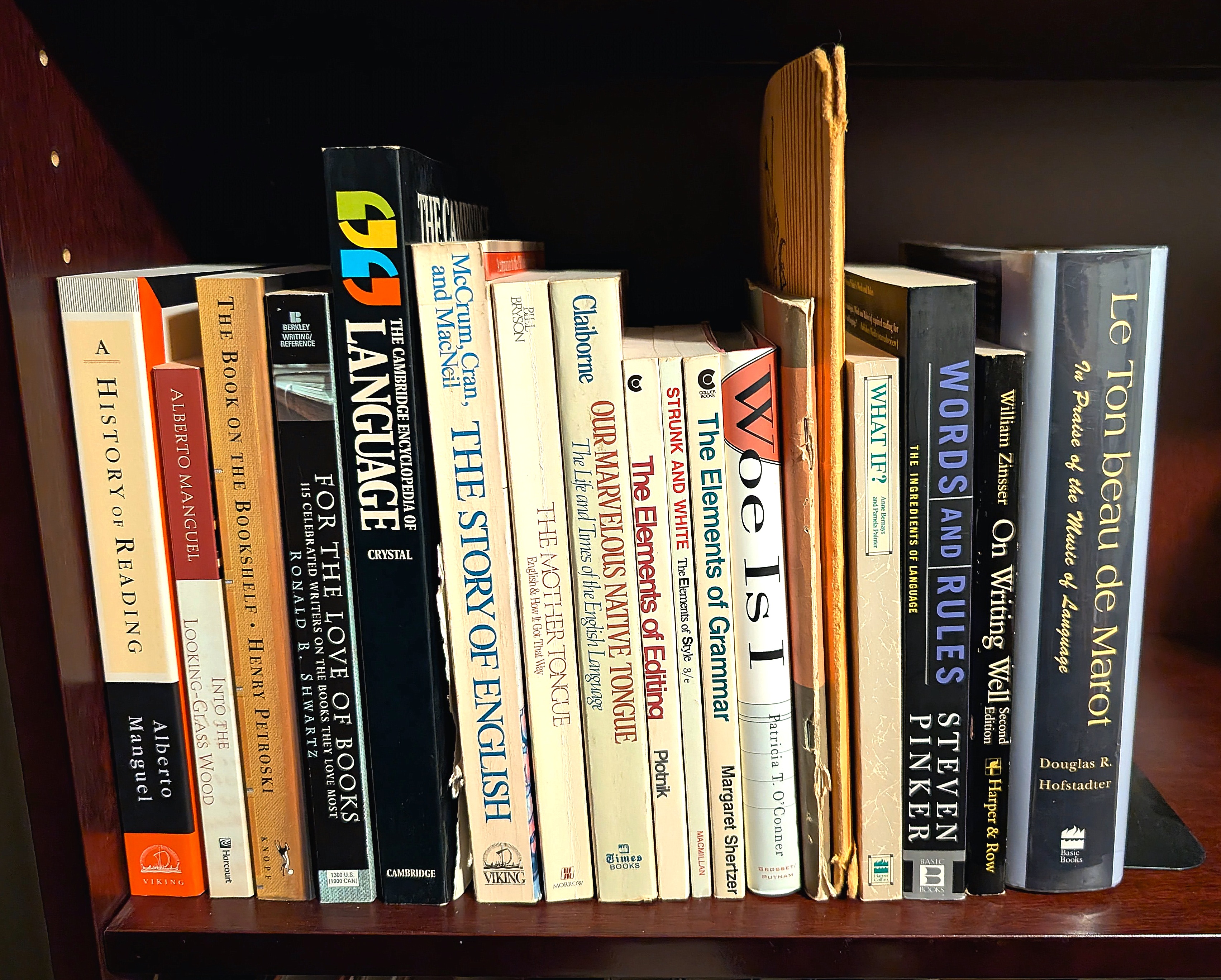
Several days ago I began a loving reminiscence for this little half-shelf of books:

Yep, repetitive, I know. September 2025.

Other than specific works of literature and the anthologies which collected them, I’ve pretty much trashed my college textbooks. One slim little volume, sporting a stiff paper cover, has followed me around since 1982 and will be there when I die very likely: Sentence Analysis by Donald W. Emery.

So small. So dull…to all but me. September 2025.

June 1982 brought me the final set of courses I needed to complete my English Education degree. Who knew a graduate-level course on grammar would be the most agreeable of them? Few of my fellow classmates agreed with me. First, the class began at 7 a.m., if I recall correctly, and ran for two hours. This allowed the professor (who happened to be the chair of the English department) to teach the class in only four weeks instead of eight. After the first week we diagrammed sentences. That’s all. Each day we discussed a construct of English grammar, diagrammed five sentences that night, and began the next class discussing how they should have been diagrammed and if there might be any which were open to interpretation. Even in something as definitive as diagramming English refuses to be pinned down. In fact, the professor told us we used the sentences in the book because they had been vetted to be “diagrammable”! It would take me too long to explain why English sentences as spoken and written by its practitioners do not lend themselves to analysis. Take my word for it, at least for now.

Unfortunately, I stole a bit of my thunder on this topic a couple of years ago when I ranted about compound prepositions, foreshadowing this book even if I didn’t name it. This series, Bibliophilia, however, purports to be about a love of books, not of specific topics per se. We attempt to not delve too much into the memories evoked by the books, but rather to celebrate them and explain why such feelings rise up. In this case, it’s pride pure and simple, pride in knowing something esoteric, something only a small sliver of English speakers know. My course contained about 15 students, all but three of whom were teachers returning for some of those credits mandated by law for the recently hired or to achieve a Masters degree. Despite the fact all were English teachers/English majors, I ran rings around that class. I aced it. I aced the final. After acing it I and leaving long before the rest of the class, I waited in the lobby for them to come out. “What did you do on the last one?” they asked. I could have been smug, and said, “what I did when we diagrammed it for homework,” because all of these sentences had been discussed in class. Instead I just answered the question. The bulk of these people were older than me. My pride came with a good dose of awkward, too.

Because we’re sticking to love of books, and on this shelf, love of language, I’ll save further discussions of the diagrams for another piece of writing. One memory will illustrate my love for this slim little volume: I hope I will never forget this experience which illustrates the frustration of teaching and the uselessness of diagramming sentences. In the 8th grade English classes I taught, I decided for a year or two to use diagramming sentences for a unit. I think this had to do with a “street cred” issue I had with another English teacher and also because teaching sentence diagramming comes about as close as possible to teaching math. Many teachers of English shy away from the ‘squishy’ nature of their chosen field. One can only teach writing by having students write and giving them feedback about it. This puts them in a bind. Reading, grading, and (God forbid) giving feedback requires huge amounts of time, time which could be better spent drinking beer/wine and reading a book. Worse, it’s nearly impossible to teach literature without having students write about it. Double-whammy because now one has to grade the content as well as the expression of it. But…begin a unit on diagramming sentences, and one can kick back like the math teachers do, marking the incorrect lines, assigning points, and adding up the points for a grade on that day’s assignment.

I don’t remember this kid’s name, so we’ll call him Rick. A little kid who could be used to illustrate the late-bloomer end of the scale for 13-year-old males, Rick sat in the front row because I probably put him there. His philosophy toward English seemed to be one of ignoring it: he had a perfect record for turning in homework which barely had been started or not turning it in at all. He consistently maintained a Failing grade–until I started the diagramming unit. Suddenly English interested him. He turned in every assignment. He did okay; not the top student, but a good solid one. Deconstructing sentences grabbed him in a way that constructing them had not. And as soon as we moved on, Rick’s turned his interest off like a faucet. His writing contained few sentences and none were well-written. I saw that just because you could take a car apart and put engine parts in one corner, drive-train parts in a second corner, and boxes surrounding them for the ancillary parts which supported those systems, that didn’t mean you could put the car back together. I also realized some students were going to tune out. They just were.

That’s why this book lives on my shelf. I glance at it fondly, remembering how truly great I was in the class! Quickly thereafter come the memories of how useless this information is to all but linguists, how useless it remains to teach to 8th graders (or any other student not majoring at the college level in English linguistics), and how I likely failed to provide some students the incentives they needed to try to better their skills at writing. It’s nice knowing something well that few know how to do all. It’s nicer knowing what to do with this knowledge to help others succeed.

Bibliophilia: the vagaries and joy of English

If my self-defined word bibliophilia means both a love of books and a certain madness about them, what then describes a certain madness about books written by others about that very madness? A madness for madness? Is that a thing? Where and when does it stop? Ever? (Death would be a safe bet.) Of those who love to read, there exists a subset who thrill, not to be reading, but in anticipation of reading. Cue Carly Simon. People in this subset feel a fevered, shaking promise when entering a funky bookstore in the middle of nowhere and the first ten titles they see scream “READ ME! NOW!!” And yet…

Within this subset of bibliphiliacs, a smaller, more exclusive sub-subset exists. These distinct suffers of bibliophilia feel an intimate rush when they espy that one volume probing directly into their literary, book-loving soul, purporting to deliver not just a few hundred finely written pages but promising those pages will satisfy not just their book-lusting souls but will simultaneously glorify the very building blocks which construct the objects of their obsessions. It’s a feedback loop not unlike the pleasure paddles given to rats which OD’ed on opiates. It’s as if one of their objects of desire shed all the clothing of characterization and plot or rhetorical structure and laid themselves bare for the reader’s ultimate satisfaction. No wonder we tingle all over and feel a slight loss of rationale thought when we see these titles.

My, my. Did it suddenly get warm in here? Let’s cover up and move on…

Language books that stood the tests of time and usefulness. July 2025.

Despite having degrees in both Communications and English, I possess a scant half-shelf of books about the language I use. Perhaps this relates to the Communications degree carrying a focus of journalism and the latter one a focus on literature. The English degree also had a few courses pared from it because of the additional classes I had to take to get the “.Ed” added to the end of it. Linguistics interested me until I encountered the arguments for Noam Chomsky’s innate grammar versus the classic thought that grammar remains culturally induced. I suppose this means something important to someone, but who really cares right now? All books I bought for linguistics possessed such rarified, dry prose to make them insufferable the moment I finished the class which required their purchase.

Other books departed for different reasons. Those which all claimed to be about “being a writer” fell victim to The Purge of 2020 when I removed about a third of the library to live in boxes designated for assignment to others…or to the trash. I determined at that time I will never be A Writer although I will write. A freeing decision. Joining those were books which celebrate the language of English and which I found only mildly amusing: volumes by William Safire, Willard Espy, and Richard Lederer all sit waiting to grace someone else’s shelves.

Nine “keepers” don’t appear on the shelf at all because they are points of data in Kindle form. Several lovely books appear in this group: Ella Minnow Pea: A Novel in L:etter [sic] by Mark Dunn, sadly prescient for our time, where a Council decrees the removal of letters one by one from all written and spoken communication; Alex & Me: How a Scientist and a Parrot Discovered a Hidden World of Animal Intelligence—and Formed a Deep Bond in the Process by Irene Pepperberg which I haven’t read yet but which looks great; Our Magnificent Bastard Tongue: The Untold History of English by John McWhorter, a slightly controversial book dealing with how certain aspects of English came into being; and The Professor and the Madman: A Tale of Murder, Insanity, and the Making of the Oxford English Dictionary by Simon Winchester, a true story about a murderer incarcerated due to insanity who nevertheless overwhelms the compilers of the OED with 10,000 entries. I’m looking forward to two more: Empires of the Word: A Language History of the World by Nicholas Ostler; and Kant and the Platypus: Essays on Language and Cognition by Umberto Eco.

Missing from the shelf because I loaned it ten years ago to a friend who I believe is “still getting around to it”: Don’t Sleep, There Are Snakes: Life and Language in the Amazonian Jungle by Daniel Everett. Though some revile him, the book fascinated me. Everett traveled to the Amazonian jungle to proselytize Christianity to the Pirahã mostly by learning their language and then translating the Bible into it. A trained linguist, he discovered the Pirahã have no counting system, no fixed words for color, no concept of war, and no personal property. I seem to recall they didn’t have all the temporal aspects of language (past, present, future and the permutations thereof). The title comes from their belief that evil spirits (and snakes) can only get you when you fall asleep, therefore they attempt to sleep as little as possible. They sleep communally and at all times several will be awake talking to each other.

I decided to take pity on you. Rather than a lengthy bibliologue through the shelf, left to right (because that’s how these things are done), I’m breaking things out for individual treatment. In my subjective view of the shelf, L to R, it breaks into books about books and reading them; books about English, including how to physically present it on the page; a few books I’ve retained which promise advice on writing; and one lovely volume which defies categorization but touches on the meaning of words, poetry, and translation, all while tackling the relationship of cognition to language and adding in the personal pain of losing a spouse to a killer disease.

Or am I delaying and stringing out this series to heighten my pleasure? (It’s getting warm again…)

Bibliophilia: Whole Earth Catalog

Take a Sears-Roebuck catalog, cross it with the hippie ethos, and add a large dose of product recommendations. WEC blazed a new trail. Photo, July 2025. Catalogs, Summer 1972 and sometime in 1994.

When I headed off to college in 1972 my curiosity led me to enroll in an experimental education program funded by the Ford Foundation. I hope to write of that someday, but today we consider two peculiar residents of my library: two editions of The Whole Earth Catalog. Being 18 in 1972, I didn’t exactly participate in “The Sixties” which meant I hadn’t heard of The Whole Earth Catalog until it appeared on the textbook list for that experimental program I’d enrolled in. What is it and why am I making a big deal about it? Is this just some oldster nostalgia trip? Maybe, but I think it’s much more than that.

The WEC basically laid the groundwork for what today is Wirecutter and everything like it, except…what if Wirecutter had a hefty dose of social awareness ethos baked in? And what if there were no suspicions that Wirecutter and websites like it make decisions partially based on monetary reward? Before The WEC, I’m unaware how one could have gone to a single source for information, evaluations, and recommendations on a number of topics. Everything one needed know about consuming involved a physical trip to interface with salespeople. In certain cases one could consult a dedicated publication for audio equipment, say, or fashion, but sooner or later one needed to go to a store to buy something. If I wanted information about high quality stereo equipment, I went to Huppin’s Hi-Fi downtown where all the audiophiles (a.k.a., stereo gearheads) gathered and had all the information. When one wanted furniture, one headed to a furniture store or several and bought the best of whatever you saw. The same with clothes, garden tools, hardware, books, cars, pretty much anything. Who knew if it was good? Who knew if the price here was as good as there? If you ordered something, like a car with all the options in your favorite color, you started at a dealership. Everything filtered through the salespeople.

But the WEC gathered its recommendations for just about everything which interested the Peace Generation (or whatever you want to call us), told you why it represented the best you could buy, and gave information about how to get it. Or as the Function statement on the very first page of The Last WEC said , “The WHOLE EARTH CATALOG functions as an evaluation and access device. With it, the user should know better what is worth getting and where and how to do the getting.” This “last” edition didn’t have a table of contents. After page two told you how to get the stuff, and other tips, the third page launched right into “Whole Systems” and starting with the subsection Buckminster Fuller (anything dealing with Buckminster Fuller, a near-god of social planning). Other sections dealt with land use, industry, craft, community, nomadics, communication, and learning. These were loosely defined: subsections in Learning include “Thinking,” “Serendipity,” “Psychology,” and “Free Schools”. Additionally, the lower right corner of all right-hand pages from Page 9 onward contained the story “Divine Right’s Trip” where the main character, Divine Right, experiences many adventures of the time until he lands on the Whole Earth Catalog at the very end, a sort of gold-at-the-end-of-the-rainbow thing.

I could write pages and pages about the WEC to little effect on anyone who hasn’t seen it. In its way it picked up the tradition of the old Sears-Roebuck catalogs which allowed people living in the backwaters of America to buy through the mail most of the things they could ever want for their farms, their businesses, their personal health, and to clothe their bodies. (“Through the mail” • prep phrase describing movement of written communication and goods prior to delivery services such as UPS and FedEx) The S-R catalog fell onto hard times when everyone started to get electricity and cars made it easier to get to the merchants.

After navigating the remainder of the 1970’s and all of the 1980’s, issuing a few Supplements—the informal publications which came out between editions of The WEC—founder Stewart Brand and crew decided a new edition needed to be published. Those 20 years saw the introduction and rise of the personal computer, for one thing, and the starry-eyed, inchoate idealism of The Sixties had given way to a gritty, in-the-trenches attitude by the early 90’s. Most of the casual members of the Peace Generation had left the ranks, lured by money, security, and mere existence. The title page of The Millennium Whole Earth Catalog quoted Brand from 1969: “We are as gods and might as well get good at it,” before explaining that good things performed by governments and other large bodies were being obscured by “gross defects”; a rising personal power needed a guide to the new tools making this possible.

Two random samples from The WEC shall suffice, one from each.

Opening The Last Whole Earth Catalog to pages 36-37, I find myself in the middle of a five-page description of something called Liferaft Earth. I’ve no personal knowledge of this, and I’m not reading all five pages of very tiny print (looks like 6-8pt type; it varies because consistency was not a strong point for The WEC). It appears to be about making sure everyone on the planet has enough to eat. Here’s a snippet from the top of the second column of page 35…

The following five pages chronicles a week-long event sponsored and organized by the CATALOG in October 1969.

Richard Brautigan saw the end of it. The beginning of it was three days I spent alone on a train with excellent hash and Paul Ehrlich’s Population Bomb. Ehrlich had been a teacher of mine, back in his butterfly and my tarantula days, so I knew to believe him.

—SB

“SB” was Stewart Brand who created and led the WEC publication team. Incidentally, in looking for a formal description of his title/role, I discovered the entire Last WEC was composed using an IBM Selectric typewriter. I didn’t find his role.

I left a bookmark in the Millennium edition long ago. Opening to this page brought me to the Communications section/Writing subsection. An article preceding the tools for and about writing begins, “We are swimming in a great polluted sea of language, and we wonder why we can’t write.” How much more so now! It continues:

We wonder why we don’t want to read. Even worse, we cease to wonder; we just don’t do it. It’s as though it didn’t matter anymore.

As though hammers didn’t matter; as though air didn’t matter; as though horses and balloons had disappeared.

It’s not a hardware problem; it’s not a brain-wire problem. It’s a writing problem. It’s software, it’s soft words, it’s swampish bureaucratic slide-down of mush-mouthed ass-covering prose that promotes long term despair in humans.

—Jon Carroll

This appears on page 242 of 384 pages in a book measuring 11×14.5 inches in fonts rarely bigger than 8pt. You can see how one would get lost in there, and how part of him would never come back out. Which is why more than fifty years later they remain on my bookshelves despite the hundreds (thousands?) which have not withstood the journey.

A slippery fish

Fish at Maui Aquarium. September 2024.

For several weeks I’ve written, re-written, and re-re-written a difficult piece about my father. Its point still eludes me. I fear several things: I’ve attempted to describe something, but I’m only describing it superficially; I’ve selected an inferior topic to one which begs to be heard; or perhaps what I’m writing about doesn’t rise to worthiness. This has delayed my promise to myself to post one piece of writing about my father every Sunday. It’s been like attempting to grasp a wriggling fish. I shall continue to rant to the air, to myself, to my wife—heck, to the birds on the grass—about this, and hope it gels in my mind and in my words.

Until then I’ll post a few photos, and maybe I’ll write something less weighty, something which elicits a few chuckles or wry reactions. Yes. That would be it.

Intentions

Our first night view from our Maui condo (unretouched). September 2024.

[written on January 3rd, but subjected to the Don’t-Post-Anything-After-The-First-Beer rule.]

At the end of September 2024 I mused on boring y’all with 100 Days of Hawaii, my poor-taste humor suggesting I would post every day through the end of the year something about Hawaii, thereby driving away the few visitors who swing by this little neck of the Interweb. Today, 96 days since then, I find 100 days will not be enough owing to my typical lack of focus. (“Oh, look! Something shiny!”) I’ve only posted through our arrival on Maui, barely more than halfway into our trip. And I’ve made myself a mockery for eagerly anticipating the 12 Days of Christmas and all of the writing which would spring to life from my keyboard. (See link for last year’s procession through the Christmastide.) Therefore, on this Tenth Day of Christmas, and just past the turning of the civil calendar from 2024 to 2025, I pause to reflect, to resolve, to anticipate, to evaluate, and to pontificate. I guess I should apologize in advance. I’ll try to return to better stuff soon.

  • Most obviously, Hawaii remains unfinished. I therefore resolve to complete my reminiscence by the end of January. Given that we lazed out in Maui, did very little, and that I took the same few photographs over and over and over, this likely won’t prove difficult.
  • I anticipate a medical march through the month. I had a doctor consultation today. Coming up I’ve got a blood draw, a procedure I would name but for the fear I bring to its table, a semi-annual physical, and one or more appointments with those who keep my legs from collapsing. That last item melodramatically addresses ankle and feet issues which would take a lengthy post of little interest to address.
  • At 70, health becomes ever more preoccupying. I’m trying to change my instinct to live in front of this keyboard when I’m not in the kitchen, the choir loft, or in front of the TV. We’ll see. This intent has been issued many times before, apparently to the void for all the good it did.
  • I’m ditching Reader’s Horror. It intimidates rather than educates. I think I’ve made my point. Just as with several other things important to me–music reproduction, technology, cars that do what they’re supposed to do–the masses happily settle every day for a lower level of quality, all in the name of convenience. My parents’ and my generation bear some responsibility for thinking TV dinners freed us from cooking; polyester and “wrinkle-free” represented a step forward from cotton; plastic and just-throw-it-away moved us away from the repetitive chores of cleaning our glass and metal containers (can you say disposable diaper?); and gosh darn it, anything digital must be better. This mindset surprisingly (?) led to the demise of institutional journalism and the important publishing houses of my youth. Predictable, maybe, but we’ve tossed too much out with that bathwater: copyeditors, proofreaders, and those who function as guardrails and protect us from the mental cockroaches who crawl out in the absence of intellectual light. Thus sayeth me: When all voices equal each other, rationale thought dies.
  • I miss my decades-long foray into poetry. In pushing to publish, I’ve lost that time for stewing in my juices which engenders my poetic thoughts. I can’t make this a resolution, but I acknowledge it to myself, if only to start writing down the thoughts when they occur, even if I’m heading for bed! Just this past week I lost two pretty good poems.
  • I’ve read too few books and too much news. I ditched one digital subscription at the beginning of December, and I’m ditching another in the next week. If it weren’t for the depth of its offerings, I would ditch the New York Times.

There you have it. Nothing earth-shaking. Except, hopefully, for me!

Reader’s Horror 241219

Today’s assault holds a special dose of vinegar because it inverts the usual way this mistake gets committed. In a New York Times article about the Congressional scuttling of a temporary federal funding bill, Hakeem Jeffries is quoted thusly:

House Republican have been ordered to shut down the government and hurt every day Americans all across this country.

I’m ignoring the politics involved here, except those of grammar, usage, and mechanics. Usually when writers mix up every day and everyday they use the latter to refer to every singled blessed day. This is wrong. When referring to all of the days, every single one of them, there must be a space because we’re using the adjective every to describe and restrict the noun day. However, when we want to describe something as being routine, mundane, ordinary, etc., no space is used. Make the compound word everyday to describe the noun of your choice. In the paragraph above it’s Americans.

I’m tempted to say the above error actually hurts everyday Americans right now, not in some undefined future, but the mistaken usage likely slipped right past most of them. The everyday/every day error resembles those involving into/in to and onto/on to. In the case of today’s horror, the most common format for every + day would be with a space. Non-proficient writers usually slam them together making this supposed-to-be uncommon word more common in print these days. I suspect the reverse is true for the other two, but I’ve no data to support this.

Author’s role: I’m going to assume this error found its way into print due to the author, not an editor. This is a writer for the NYT, one of the premier news organizations in the world. The author should know better. We therefore rate this a 4.

Egregiousness of the error: The error will be read by most readers to mean what the author intended. As explained in the first Reader’s Horror, these space-oriented mistakes where a compound word is used when it should not be represent one of the many confusing aspects of English. Since most readers won’t notice it and will get the intended meaning, we therefore rate this a 2.

My personal reaction rating: I sigh, shake my head slightly, and mutter, “but of course.” Immediately thereafter I also say, “but it’s still wrong.” That makes it a 1.

Final rating: This error rates a 4/2/1 for an 7 out of 10 on the Reader’s Horror scale.

[Note: I’m tweaking the scale, and I’ll write a quick update later. The egregiousness rating above became a “2” instead of a “3” as a result.

Flaking out

Tatted (and tarted) snowflake in a window. November 2024.
  • I discovered 30 minutes in my day! Our holiday newsletter has reached 50% completion. For the first time in several years, I am “on schedule”—I dare not say “ahead” both due to the Law of Jinxing and because I see little time to work on it during the next two days. My Sunday deadline approaches, just as Tuesdays did decades ago when I worked on weeklies. Let me tell you, there’s nothing like starting a Tuesday knowing you don’t have enough copy to fill the empty pages! It really gets the creative juices flowing! I used the same approach as a teacher, walking in some days only clutching a topic in my mind. Lesson plans? Hah!
  • We kicked Covid out for good this week, but like with any unwanted guest there’s a bit of cleaning up to do. Last night’s choir rehearsal—my first in four weeks, my second in two months—did a number on my throat, partly because I had to violate the “sing from your diaphragm” rule on several pieces. My muscles ache from weeks spent primarily sitting in this office chair. The cough hasn’t completely disappeared either, small but annoying.
  • And lastly, one of the readers of this site and the one who partly inspired a trip to Michigan in 2023, may be amused by the photo below. I’m not a cider drinker, but I think this is being newly distributed here in NC:
From the exurbs of Detroit! Spotted in a Raleigh, NC, grocery store. November 2024.

Reader’s Horror, 241119-1

From a story in today’s New York Times describing a veteran who was court-martialed for shooting an Iraqi in 2004.

Mr. Richmond shot the herder in the back of the head from six feet away as the man, who has handcuffed, stumbled.

from “Veteran Who Was Court Martialed Gets 4 Years in Prison for Jan. 6 Attack”, New York Times, November 18, 2024

Error: “…, who has handcuffed,…” instead of “…, who was handcuffed,…”

Type of error rating: 2, because this seems to be a typo which wasn’t caught. (Although we should note the H key isn’t near the W key. Actually this is more a brain-fart than a typo.)

Author/editor rating: 4, because regardless of the minor level of error, a reader of the Times has a right to expect the author (or an editor) actually reads the copy prior to its being published, and even if it slipped by everyone on Nov. 18, it would be noted by somebody and corrected by the time I read it midday on the 19th.

Personal reaction rating: 1…It neither entertained or enraged. It jarred me a little, but my blood pressure stayed constant.

Bottom line: This error rates a 2/4/1 for a 7 out of 10 on the Reader’s Horror scale.

Discussion:

  • I’m going to need to see if all of these errors wind up being in the 7-9 range. The scale won’t mean much if so.
  • Writing something like this really puts one on his toes. I know I’ve corrected numerous errors in already-published posts!