One day from full, says the Moon. What’s this silly stuff about calendars? New Year’s Day, 2026.
We gathered with friends to welcome the New Year with simple Southern fare: ham, boiled potatoes, boiled cabbage, biscuits. After loosening our creaky social graces with applications of Belgian beer, my Southern brother of a different mother lit up his new chiminea and we talked of things ponderous and trivial. The moon stared us down, afraid to blink for missing our ephemeral lives. Oak hissed and crackled in the fire.
Radiating warmth in all directions. New Year’s Day, 2026.
At one point we paused to look at the pretty effects of his neighbor’s light pollution…
Finally we admitted our backsides were too cold and our frontsides were getting quite toasty. We headed indoors, while tarted up versions of the trees danced in our heads…
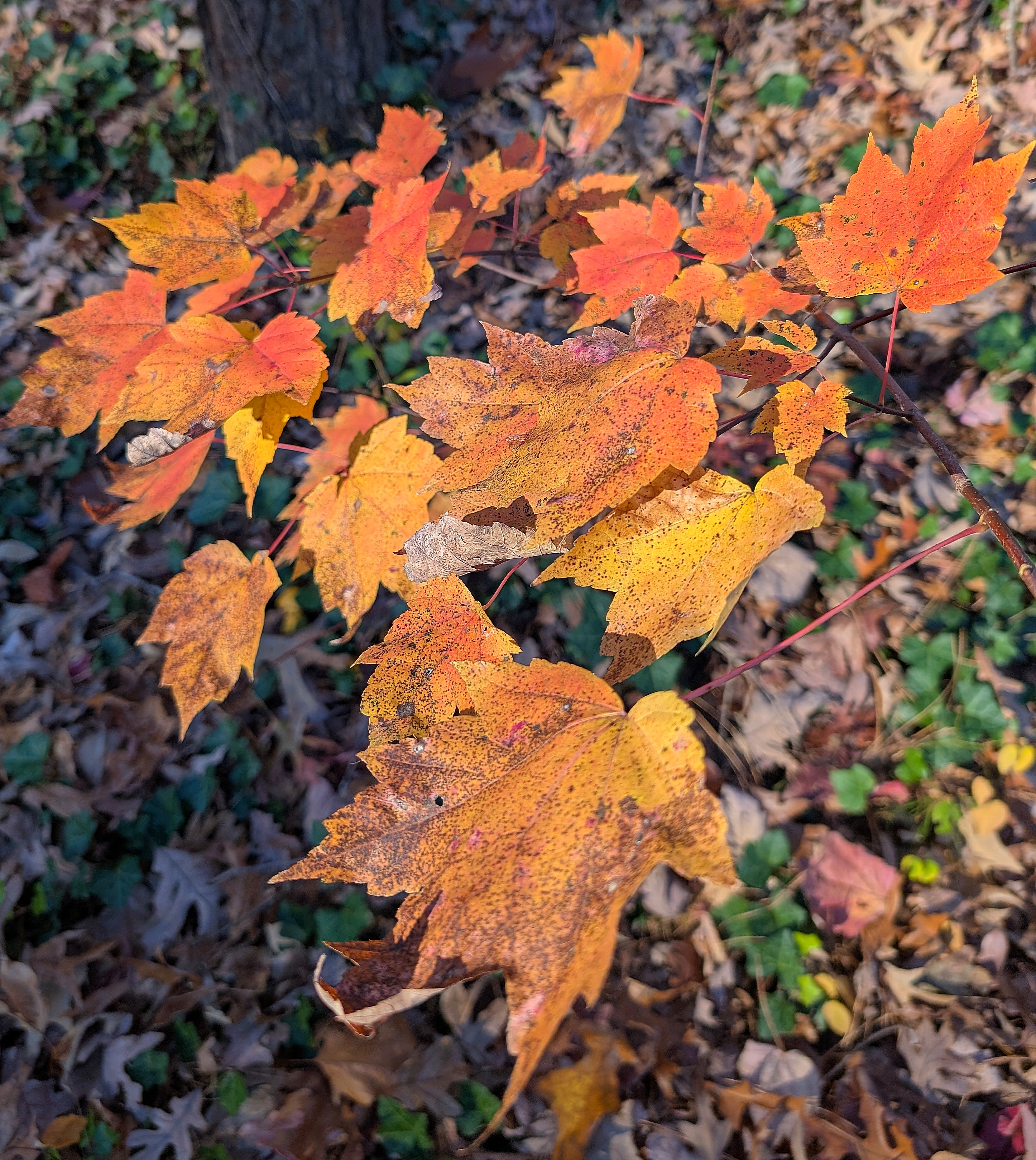
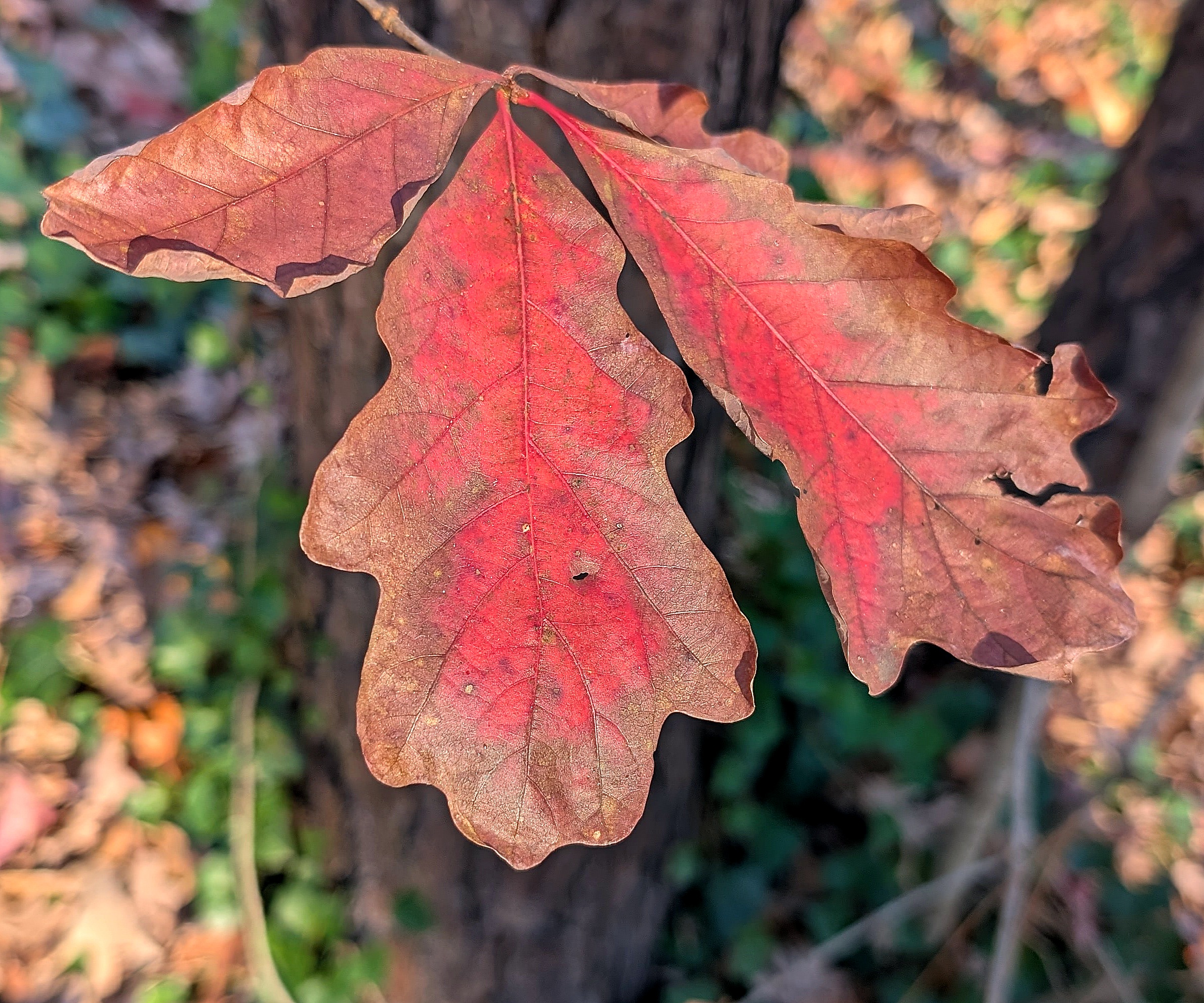
I took a walk this morning as the newly risen sun filtered through the tops of trees. The ethereal lighting isn’t quite captured here, sadly. Nice to see the natives doing well.
American beech, a.k.a., Carolina beech. November 2025.Red maple. November 2025.White oak…maybe…looks different than our white oak. November 2025.
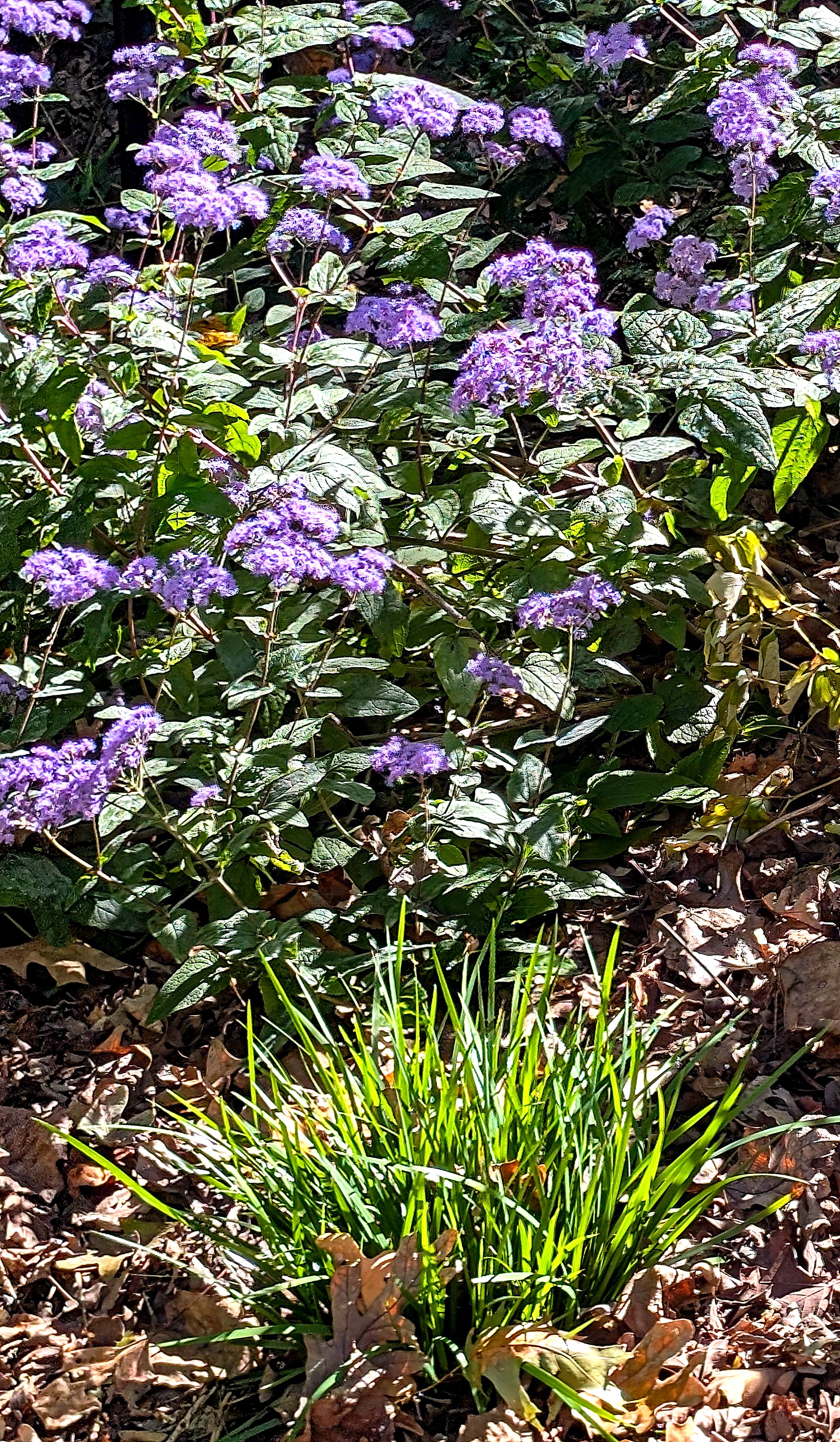
Blue-eyed grass and blue mistflower. October 2025.
With all apologies to Huey Lewis & and The News, I need a new song. Its lyrics will borrow from the Rolling Stones: “You can’t always do what you want,….but if you try sometimes, you just might find—you do what you need.” Yeah. That. We were told once to pay attention to our Inner Child, and I’ve done that far, far too much in my life. That little pouty bastard gets everything he wants to my usual detriment. I’m going to start listening to my Inner Parent. Maybe I’ll graduate to Inner Adult. (transactional analysis—I can’t escape the cultural references.)
Anyway, it’s fall y’all. The dusky red of the dogwood illumines in direct sunlight and dances a colored jig with the wind-bestirred poplar leaves behind them.
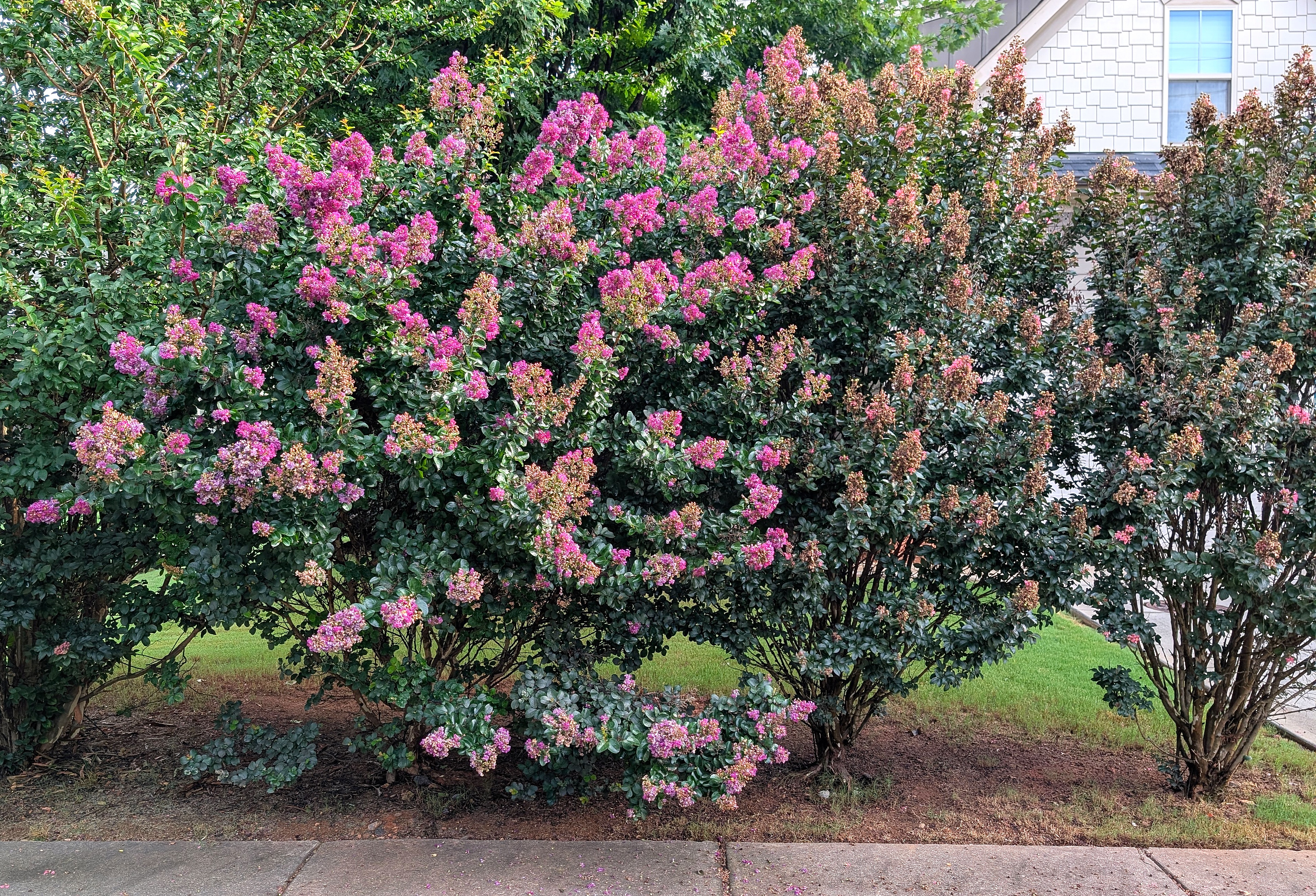
…or crepe myrtles if you prefer…seem ubiquitous here in Raleigh, NC. From what I read and hear they’re throughout the South, though I haven’t paid enough attention while driving through our neighbor states. Crape myrtles take their time, slowly becoming substantial trees of a type called thicket trees. They can be well-tended and trained, as this one is:
With care, the trunks grow together. Raleigh, NC. July 2025.
Usual care involves letting them grow as they will, but pruning suckers and sometimes trimming the tops to shape them:
Crape myrtle with usual thicket look and showing white blooms. Raleigh, NC. July 2025.
Crape myrtles are everywhere here. The photo above is across the street from the first photo. The thicket-trunked myrtle in the foreground has a substantial myrtle right to its left, the one with a more substantial trunk. Follow the sidewalk and you’ll see two more, smaller (younger) crape myrtles flowering. These last two demonstrate the variety of the approximately 50 species of crape myrtle (or are a particular cultivar of one):
Younger, different crape myrtles. Raleigh, NC. July 2025.
Crape myrtle are maintained by the City of Raleigh in the decorative medians:
Three “City” crape myrtles at the end of my street. Raleigh, NC. July 2025.
To me the Ultimate Crape Myrtle lives in my neighbor’s yard. Its branches extend from the edge of the sidewalk and tower over her house. It’s at least 30 feet tall. Someone appears to have pruned a few suckers in its youth, but mostly it’s been left to its own.
Crape myrtle in neighbor’s yard. Our white car and yard in the background. Raleigh, NC. July 2025.
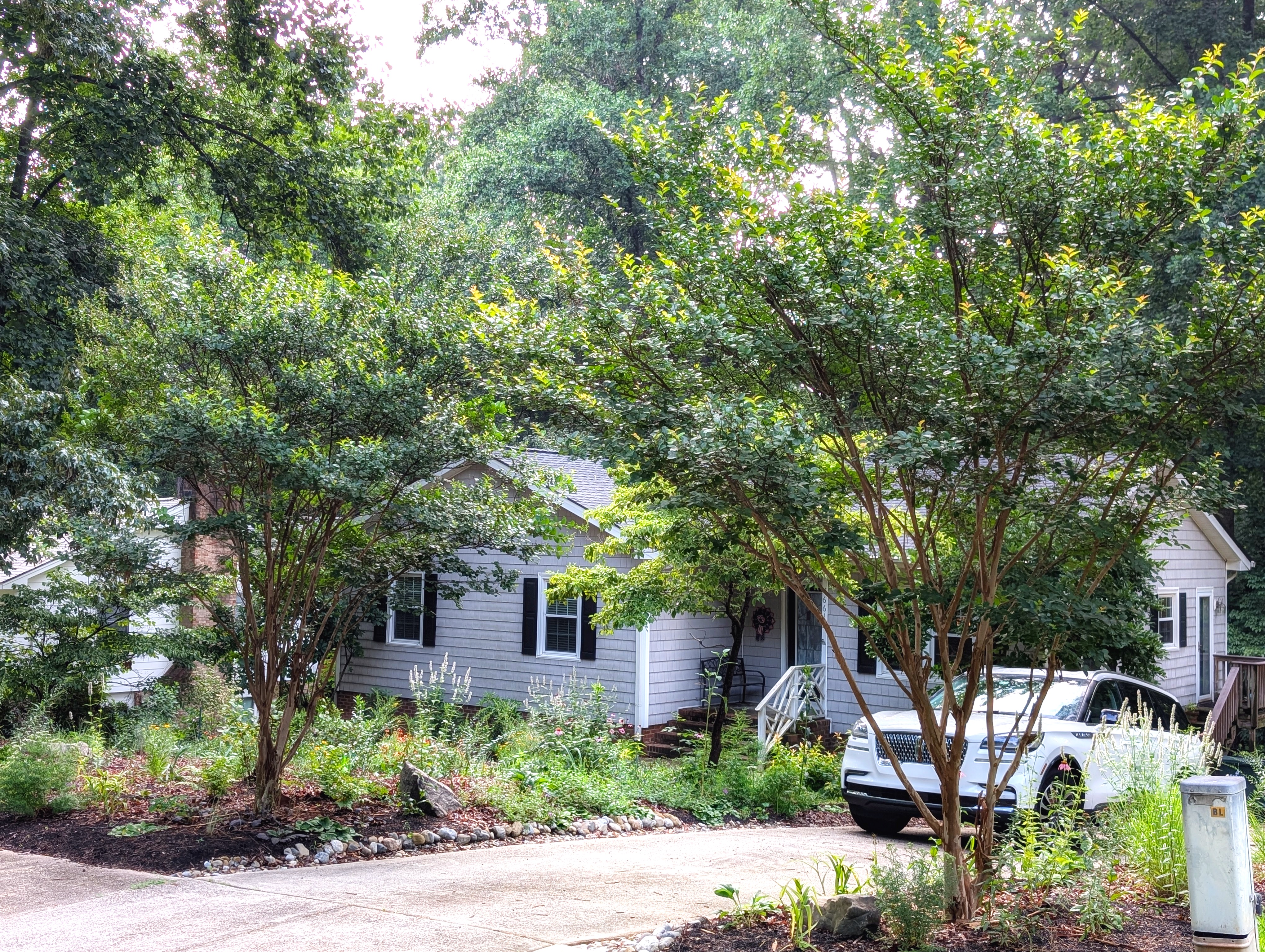
And then there are our crape myrtles. Ours were planted sometime between 2007 and 2014 (using Google Maps Street View), with the most likely time frame being 2010-2012, a period when the former owners rapidly changed the landscaping and interior of the house. The myrtles probably were purchased as saplings, and have doubled in height for the eight years we’ve lived here. For reasons I suspect have to do with amount of sunlight and my utter lack of any care beyond occasional pruning, they flower very late. I suspect sunlight because my other neighbor has three, also near the sidewalk, which haven’t bloomed yet either. In the photos above you might have noticed most of the myrtles nearing the end of their blooming period. Ours?
Our two crape myrtles, either side of the driveway, not blooming. July 2025.
But here’s the thing: though closely identified with the American South, they are not native to it. To quote the NC State University’s Extension Gardener website, “[Crape myrtle] is native to the Philippines, Japan and central Himalayas to southern China and Indochina.” Our whole move the past 12 months has been to replace everything in the front yard with native plants. (note that in the photo above) After a year of debate, and many years of saying, “Maybe they will bloom better when they get bigger,” we’ve decided to replace them. (Sorry, former owners. Consider it payback for removing that big tree in the front yard and not properly having the stump ground. I nearly broke my ankle in that mess many a time.) On one side will be an ‘Amethyst’ witch hazel which blooms in winter and very early spring. (Photo here.) On the other side will be a serviceberry. It mimics the look of a crape myrtle with the multi-trunk growth, but it will provide berries for birds and other critters.
Every day walkers march past our house. They pass every ten minutes or so in the early morning, then dwindle. When summer brings 80+ degrees by mid-morning, accompanied with 80% relative humidity, “only mad dogs and Englishmen” will attempt a walk. Some walk to exercise dogs which have seemingly conducted a PR campaign to make sure every house has at least one. Some walk because they like it. (You can tell: they appear to be in good physical shape, they walk on a regular schedule, they seem to enjoy it.) Others walk because someone told them to–perhaps a doctor, a spouse, their conscience, a good friend, or one of the ubiquitous self-help gurus on the internet. We suspect one elderly gentleman walks three times each day to regulate his blood sugar. My father-in-law did that for many years, and managed in that endeavor to postpone insulin shots for more than a decade.
For several weeks I’ve joined them on this circuit, up and down this short stretch of street, oddly reminiscent of a treadmill laid out in a short course of concrete. I’ve learned by leaning into this as a practice (as opposed to “an exercise program”). Sometimes, I walk more slowly, listening to my muscles, my fortitude, walking within the boundaries of what is possible. Sometimes I push my pace exuberantly, reveling in my ability at 70 to suck oxygen into my lungs quickly enough to maintain this rapid pace, thrilled that EXERCISE can still be a part of one’s life.
Today I melded the two, yielding to an inner desire to go slower, not for physical reasons but to focus on the incremental occurrences which blow by me normally. Today….
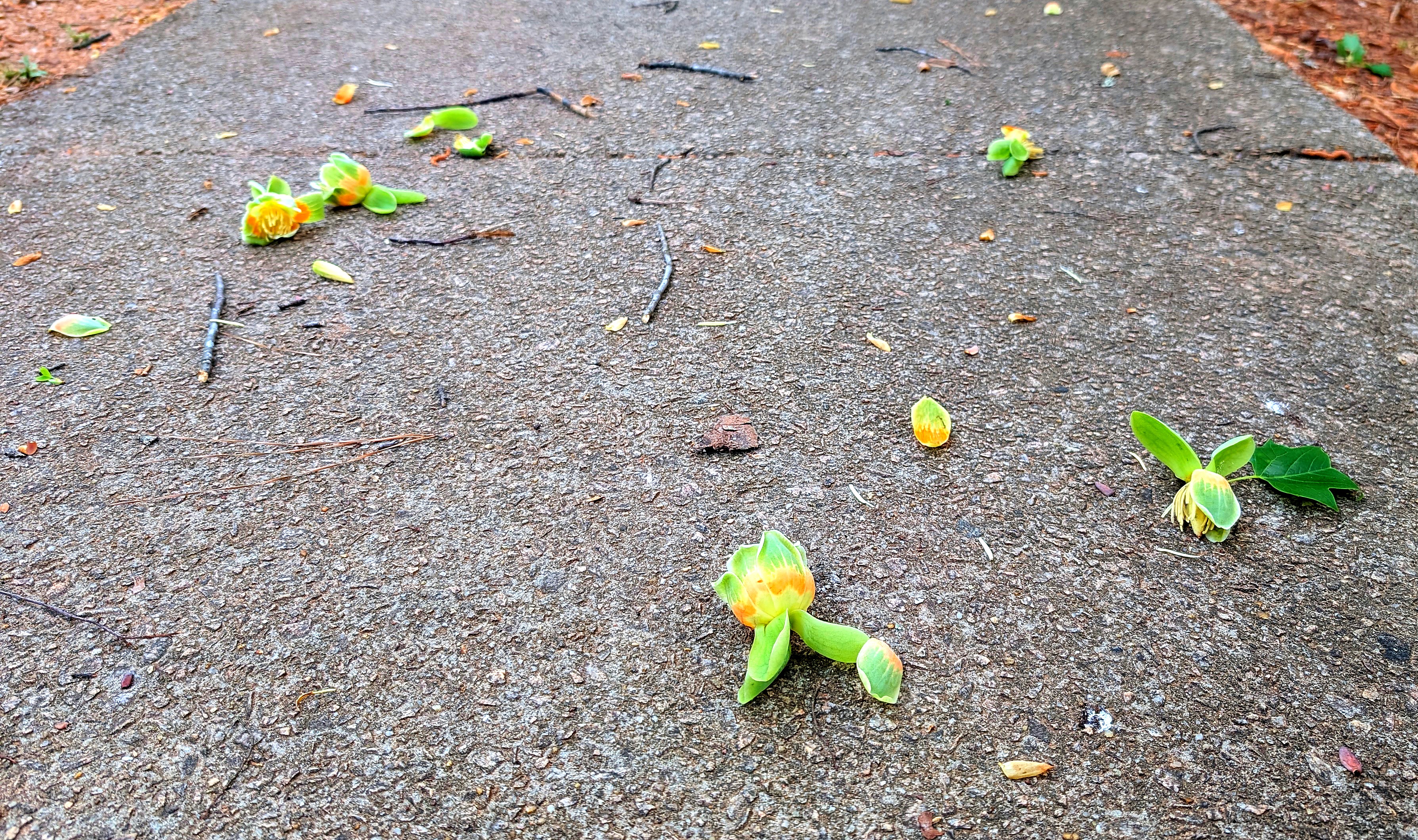
I noticed how rapidly tulip poplars have dropped their blossoms. Apparently a quick flowering gets consummated as rapidly. Their flowers no longer being necessary….
Tulip Poplar flowers. Raleigh, NC. April 2025.
It’s trash day and with it, yard waste pickup day. Reflecting the beginning of the spring/summer interface, we see sights such as these…
Overfull yard waste containers. Raleigh, NC. April 2025.
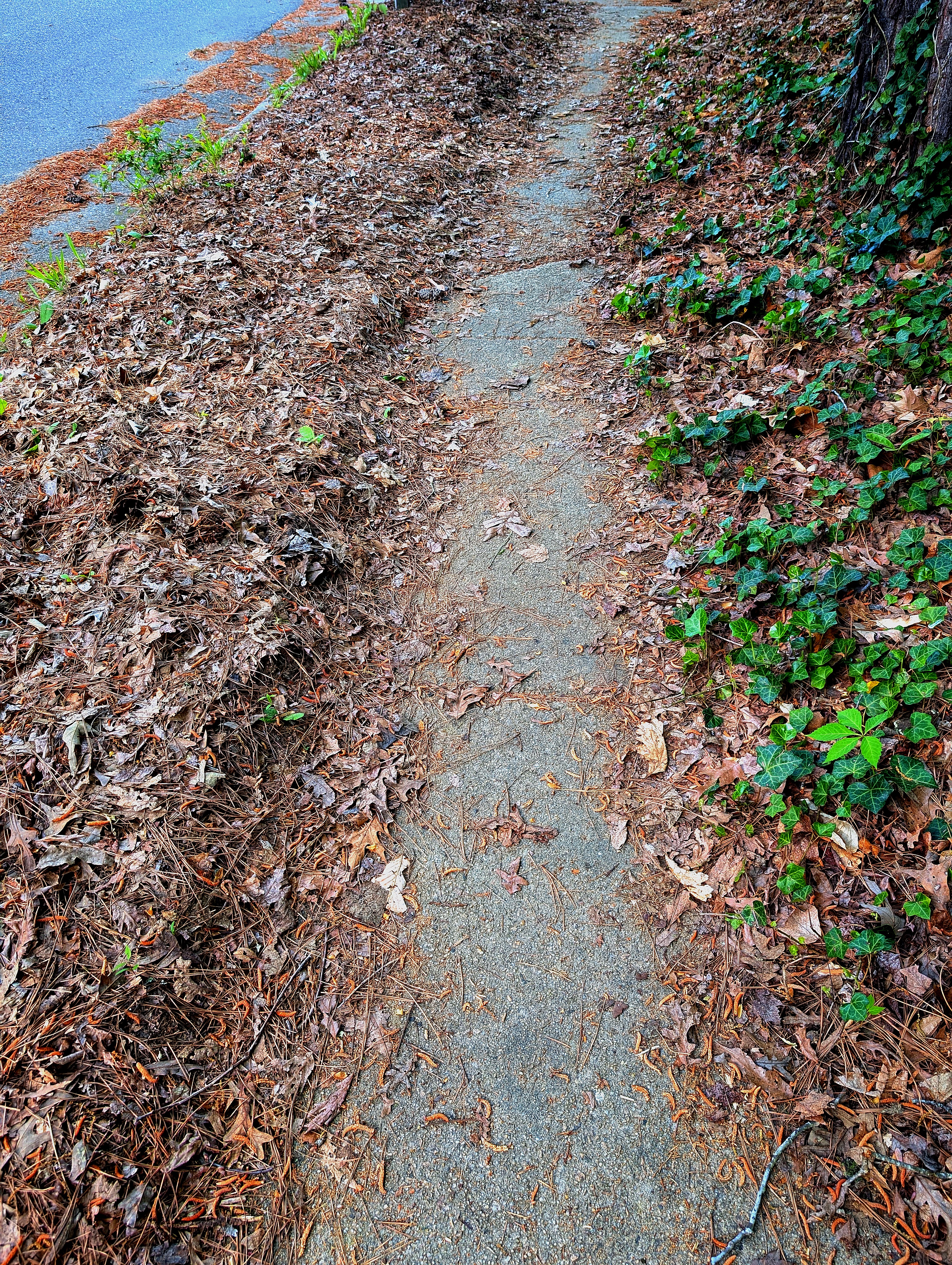
Circling at the block’s end, I encounter my across-the-street neighbor’s sidewalk. Older than me, quite likely in his 80’s, he maintains his large corner lot minimally. Those of us who pass make our own paths through the accumulation of leaves he does not clear:
Spring in Raleigh, NC. April 2025.
Many sights beckon, but one cannot stop every few feet to snap photos. (Not if one desires to arrive home and brew tea before one’s spouse arrives at the kitchen.) At the “modern” end of the three-block length of our street, where a developer with more cachet than aesthetics decided “hey, a boulevard would be nice,” said boulevard is filled with ornamental trees which have no right to be here. This is a Chinese snowball tree, on the backside of its blooming peak:
Chinese snowball tree. Raleigh, NC. April 2025.
One of the delights of continuously walking a circuit lies in encountering familiar sights suddenly made new. How does one walk past a plant daily without focusing on what it is? Suddenly it blooms, saying, “Take notice! Look at me!” I did not use my plant identification software on this, and I don’t know what it is. It looks rose-like, but obviously it isn’t. A mystery to be solved for another day:
A plant. A beautiful plant. Another day. Raleigh, NC. April 2025.
And one notices the fire ants have established many beachheads in the sidewalk crevices.
Fire ant colony. Raleigh, NC. April 2025.
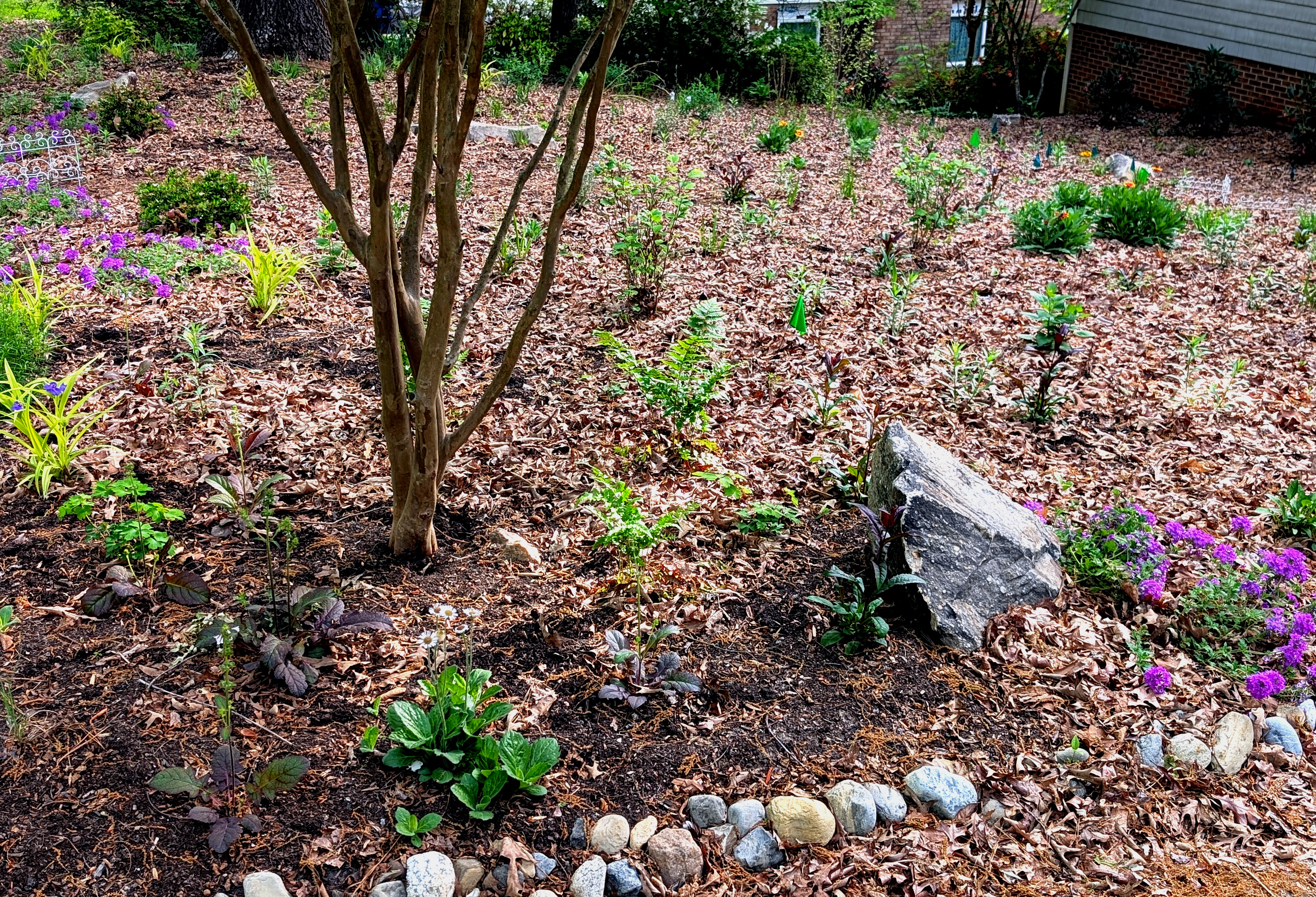
Finally, arriving at the start point, one marvels at the stark contrast of a natural environment composed of native plants that have flowered vociferously in the past weeks.
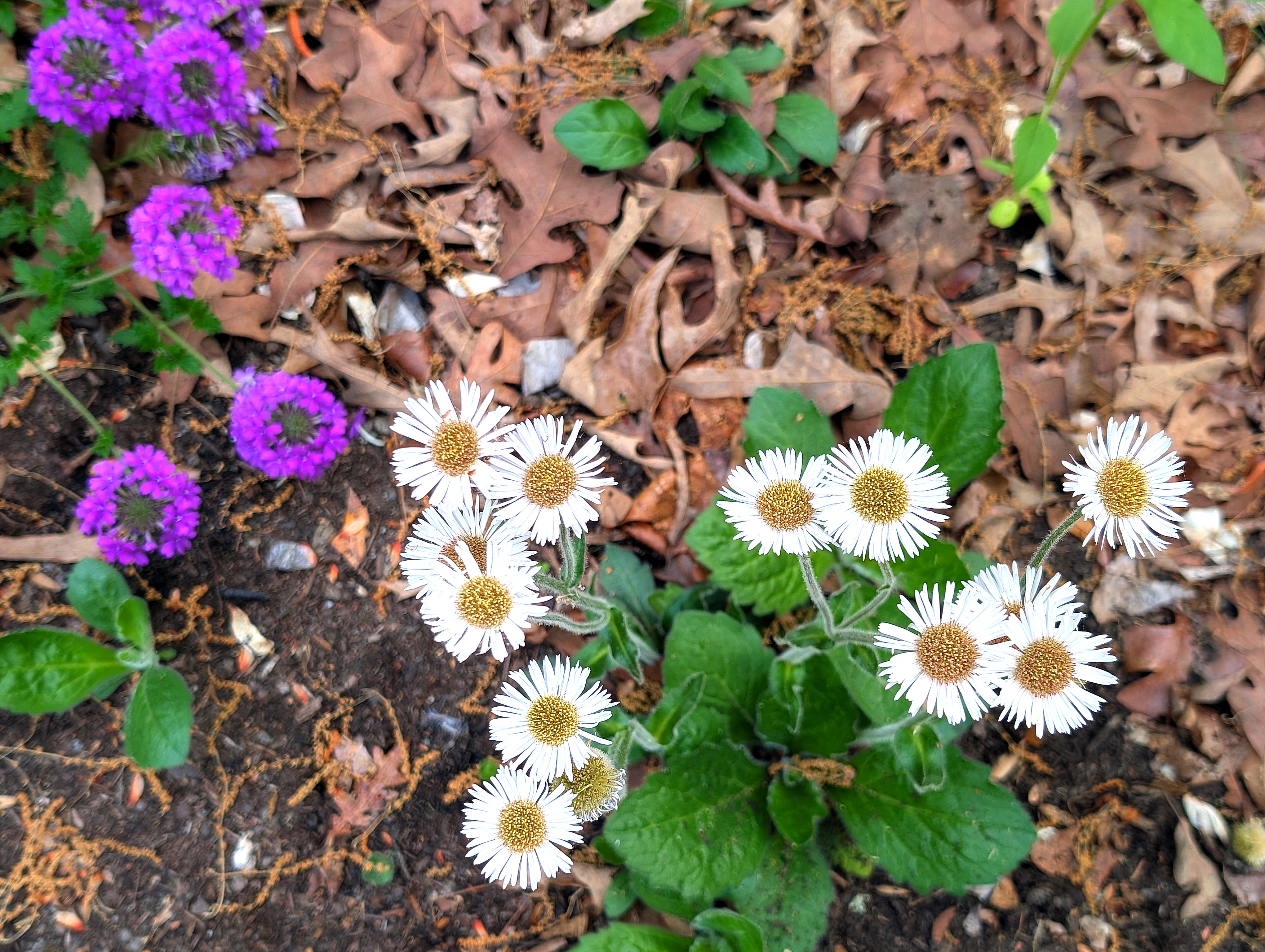
Our front yard, six months after its installation. Raleigh, NC. April 2025.Mock vervain (I think) on the left, Robin’s plantain on the right (a cultivar of fleabane). Raleigh, NC. April 2025.
Watching a specific environment over time delivers meaning which a one-time walk through a park does not. The tide and ebb of the seasons, the minor changes in foliage, the calls of the birds as they cycle through a mating season, the feel of the air as less humid air gives way to summer–all of this imprints the incremental passage of time on one’s psyche.
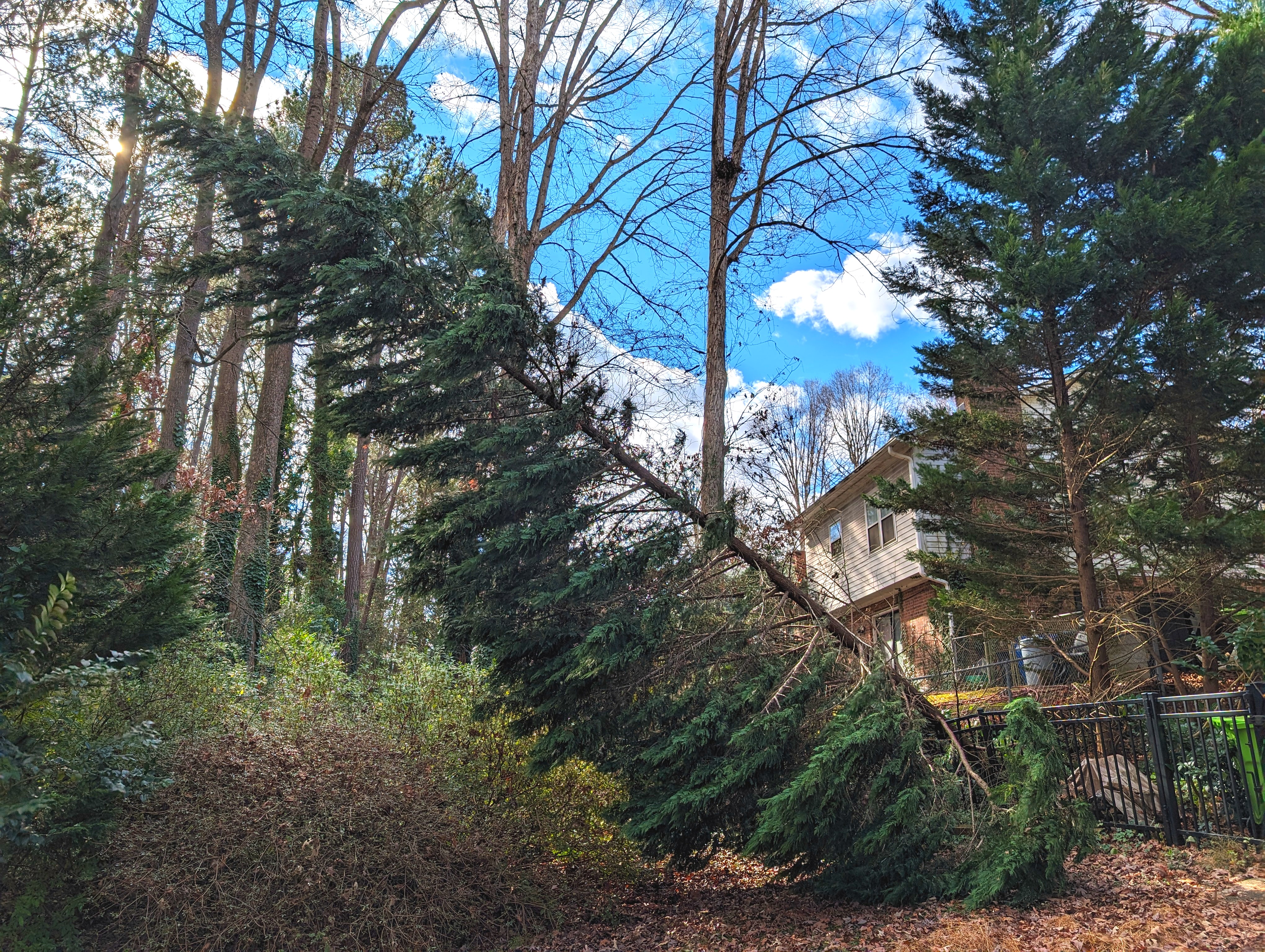
Leaning Tower of Cypress. Raleigh, NC. January 2024.
Storms have ravaged the country this past week. Still do. Four days ago I discovered the easternmost Leyland cypress in a row of them had taken a tumble from the stiff winds we endured Tuesday night. If you’re thinking, “hey, Leyland cypress, that sounds like a cool tree to grow” do yourself a favor and find out about their root system, their gangly nature, and whether they’re meant to be grown in your climate region. The folks we bought the house from (or maybe the folks before them) didn’t. To quote Wikipedia:
…because their roots are relatively shallow, a large leylandii tends to topple over. The shallow root structure also means that it is poorly adapted to areas with hot summers, such as the southern half of the United States.
Wikipedia, “Leyland cypress”
Theoretically they should die within 10-12 years in North Carolina. And hey, are you thinking, “Well, I live in the north so it would be okay?” How about this add-on: “In northern areas where heavy snows occur, this plant is also susceptible to broken branches and uprooting in wet, heavy snow.“
We’ve owned our house for almost seven years. The folks before us, about eight years. Using the timeline feature on Google Maps Street View, I can see that the row of cypress were planted as early as 2011 underneath larger trees which then were removed at a later date. These cypress grow really fast, like one-meter-per-year fast. All I’m saying is…13-15 years and these trees are doomed. I wish the black fence there at the bottom wasn’t holding it up. I could have used a chainsaw to take care of this myself. But for a sense of scale, consider that the branches I would need to limb (so I could cut it down safely) are the ones just up the trunk from the black fence and that’s 5-6 feet above the ground. I would be holding a chainsaw at face level and over my head. Not gonna happen. Instead I’ll pay hundreds of dollars for some professionals to do it.
Did I mention I hate these trees? I do. There’s a whole row of them planted as a property screen by former owners of this house. We parked our car Mr. Lincoln beneath them, and I cursed a lot from all the sap and tannin-juice I had to wash off the top of the car. Percy the Aviator gets parked in the upper part of the driveway where he isn’t underneath them. They’re ugly at eye level. You can see from the photo above the tree has no branches on one side of it, the side which faces its nearest neighbor–yeah they planted them too close together too. Here’s most of the rest of them (four of six):
A row of disasters waiting to happen. Raleigh, NC. January 2024.
You can see my eye-level view here: nothing but bare branches which do nothing to screen me from the neighbor’s house to the south. (That’s it in the background of these photos.) You also can see I’m about to lose another one. That one in the center leaning way in. The only beings who like these trees are the large number of birds who use it as cover from the Cooper’s hawks so they can safely hit my bird feeders just across the driveway, and the squirrels who of course just go where they want to.
In December 2018 I lost my first one. There were two in the backyard. My guess? Whoever bought and planted these had more than they needed for the driveway screen and said to themselves, “well, where should we plant these two?” They wound up, incongruously, between the azaleas in the bottom left of the photo above and my tool shed. In fact, you can see the one which still remains on the left side of that photo there. We caught 9 inches of wet snow in early December that year. I knocked a lot of snow off of the branches, a successful attempt to save them from breaking. (In fact, I think one of the worst hit trees was the one now lying on my fence.) What I couldn’t do was save the Leyland cypress in the backyard which bent down nearly to the ground. Apparently I didn’t take a photo of it.
Friday’s wind dealt far less damage. Those of us on the North American continent know we’re in for a lot of intense storms this winter. Hope y’all ‘weather’ them better than this!
















 all the voices in my head