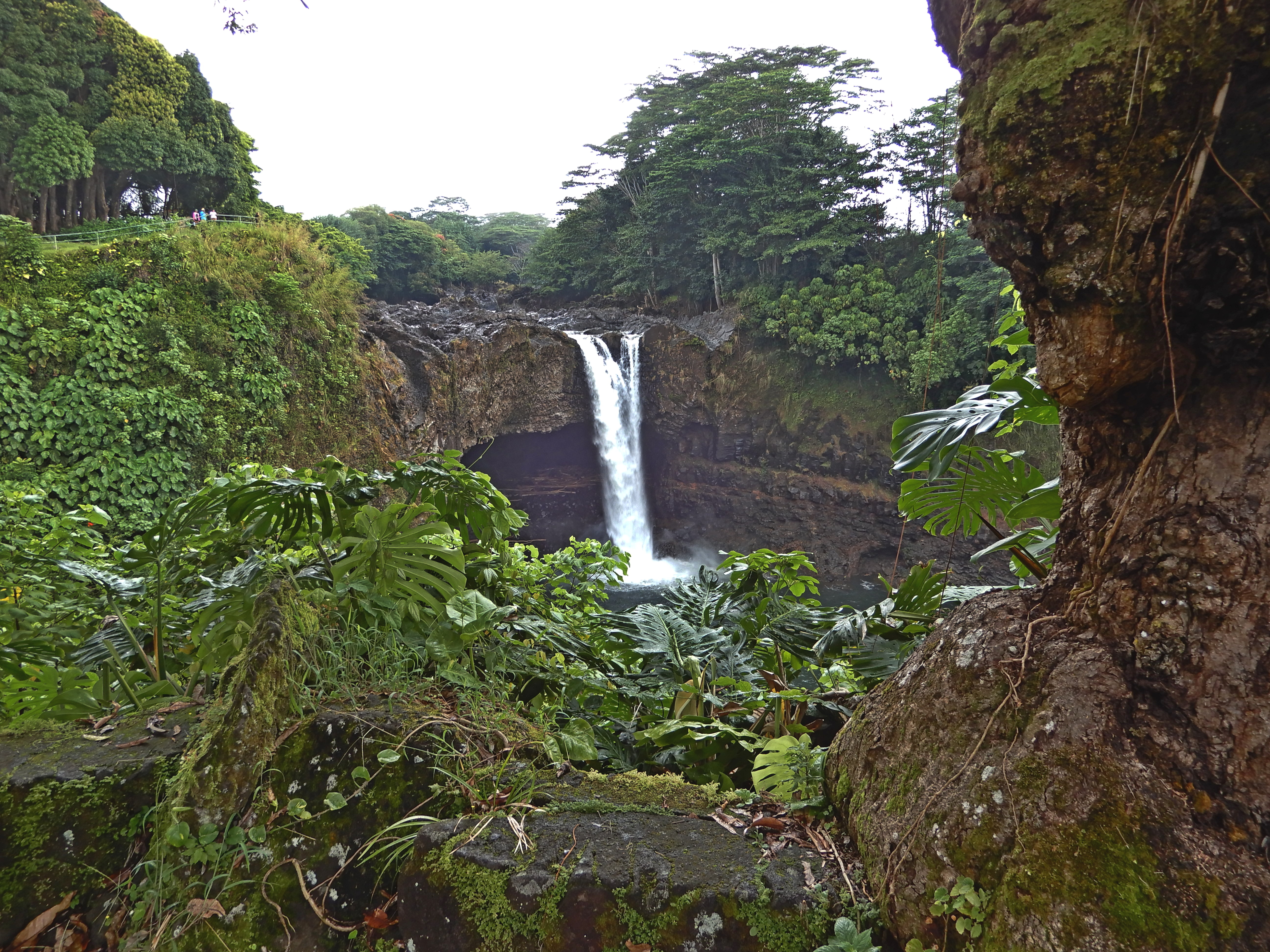
Rainbow Falls, Wailuku River State Park. Hilo, HI. September 2024.
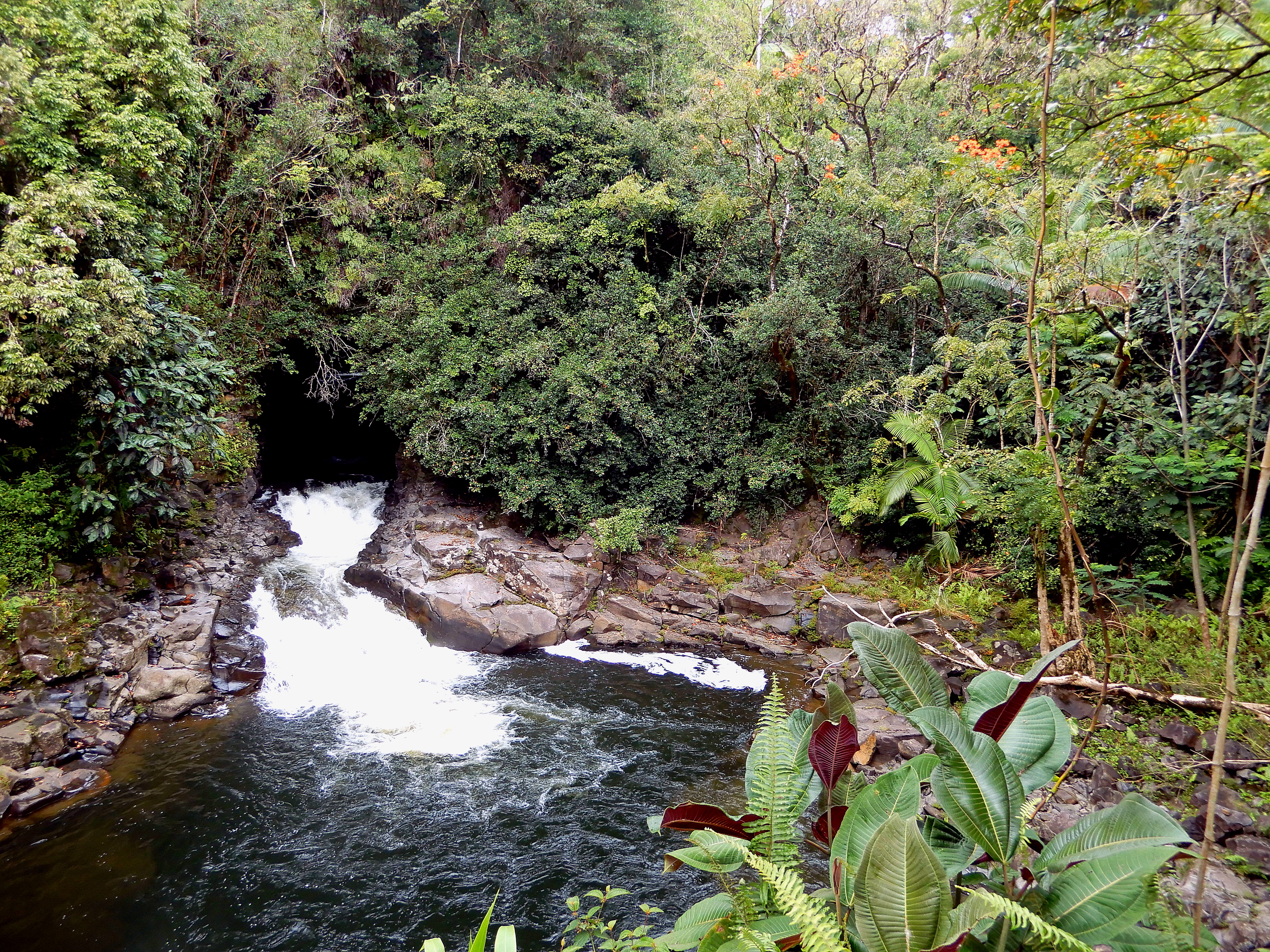
Gray skies colored all of Friday the 13th, as promised by the dawn. After a lazy start, and feeling the effects of our up-and-down trek to ‘Akaka Falls the previous day, we drove all of 3.5 miles or so across Hilo to Rainbow Falls in Wailuku River State Park. A gentle, sporadic spitting of raindrops punctuated our first view of Rainbow Falls (above). They continued as we climbed under the trees for a closer look.
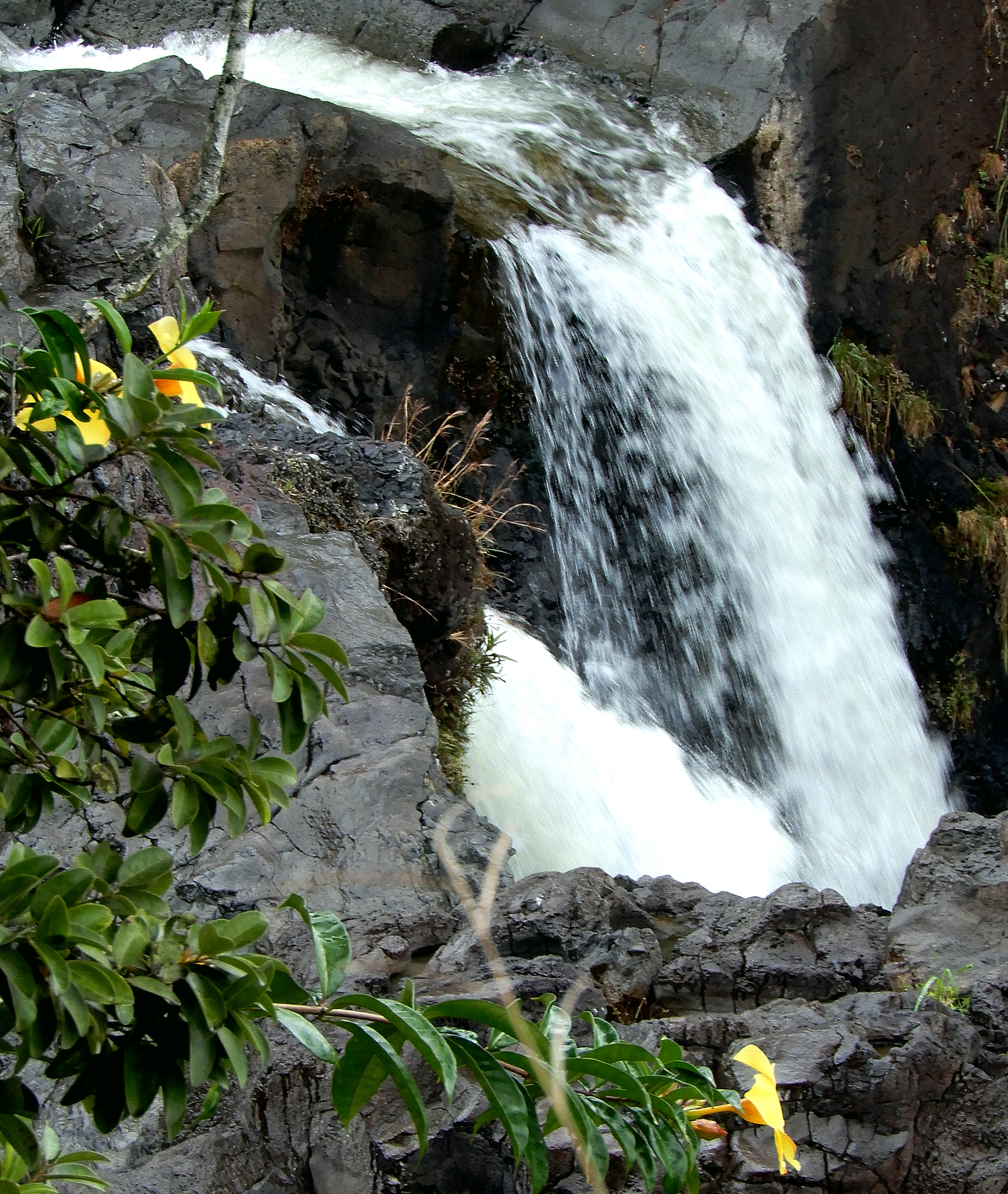
Rainbow Falls, Wailuku River State Park. Hilo, HI. September 2024.
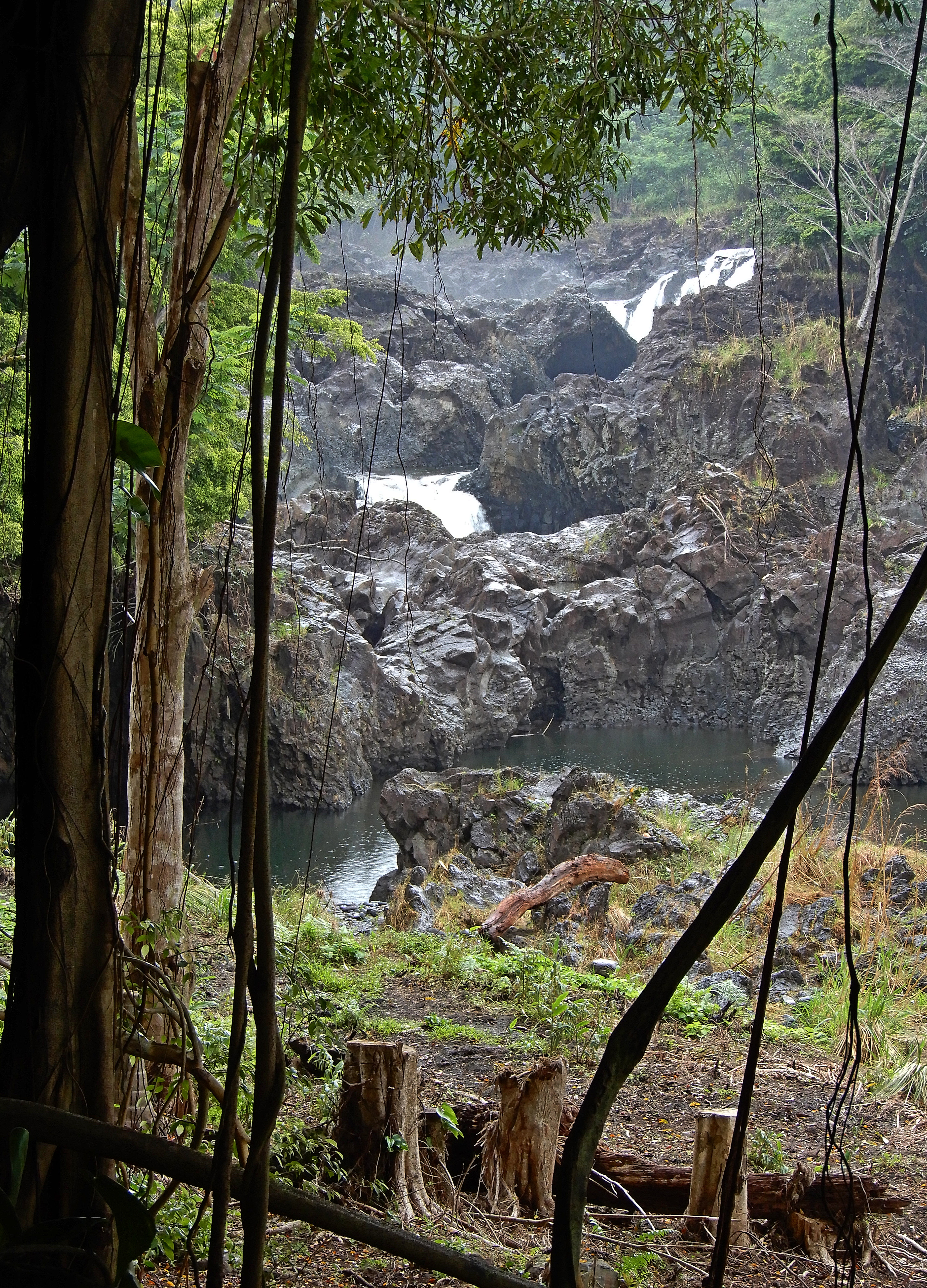
Volcanic rocks made slippery with rain didn’t appeal to us. We stayed under the trees and gazed upriver, unaware another set of falls existed just a short distance away.
The Wailuku River above Rainbow Falls. Wailuku River State Park, Hilo, HI. September 2024.
Weather dictated indoor activities, so we headed to the Lyman Museum (recommended). Ravenous afterward, we grabbed fried plantains and beer at Ola Brewing.
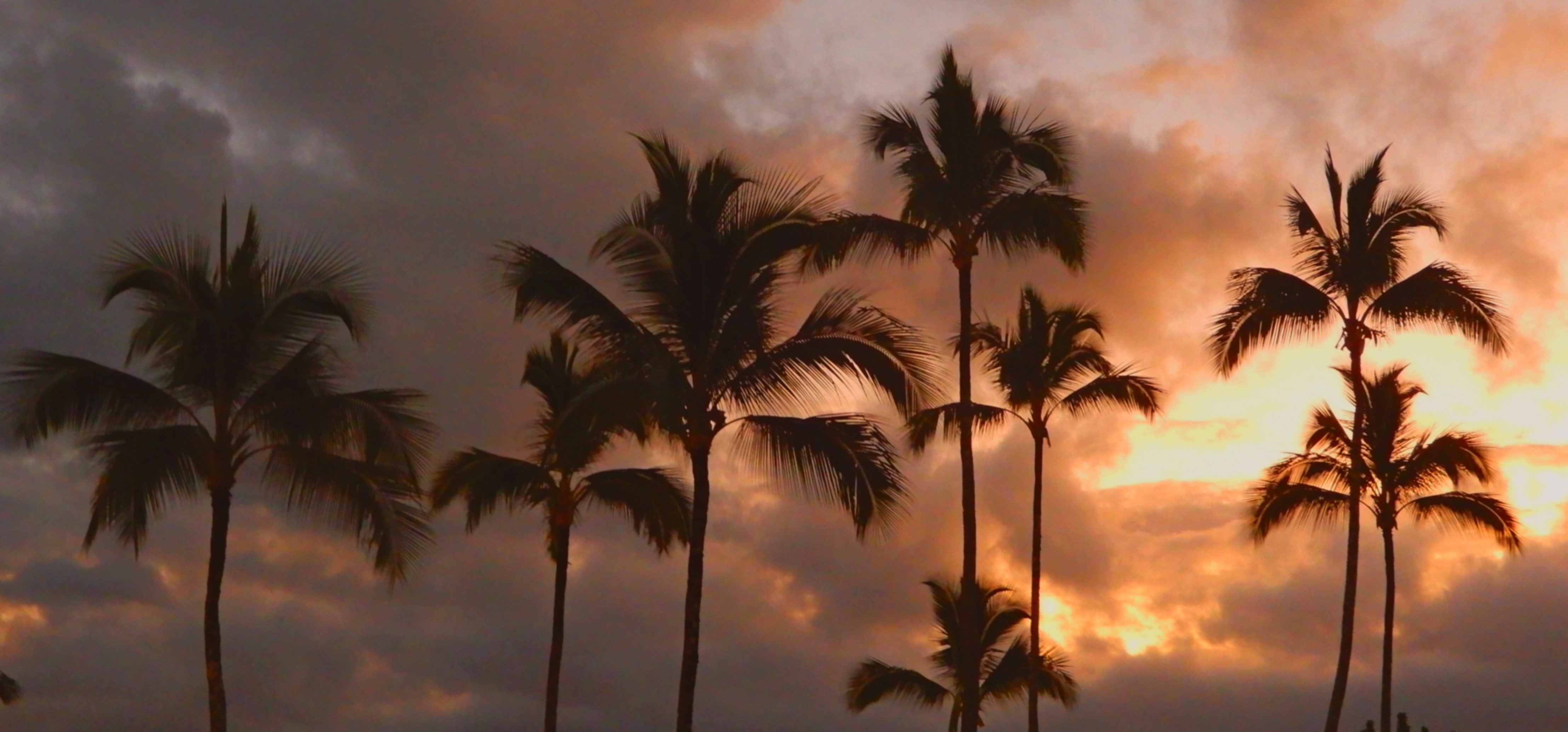
Dawn over Hilo and Kuhio Bays delivered colorful dawns because of the clouds. Waking on our third morning, however, the clouds were thicker and more ominous. Weather generally arrives from the east, after all. Outdoor activities seemed like a bad idea. By this time I’d learned the clouds keep moving; one hour’s clouds do not the day’s weather make. We did collect a few drops later in the day, but the gnarly-looking cloud in the photo here passed by dryly.
Palms over Hilo Bay at sunset. Hilo, HI, September 2024.
After visiting ‘Akaka Falls, we drove northward (which actually is northwestward) along the coast until we came to Waimea where we admired true free-range chickens and had lunch. I marveled at how dry it had become. The fields as we approached were pastures with cattle at times. Upon our return to Hilo, a day’s-end beer and sunset awaited us.
‘Akaka Falls. It really is this green. September 2024.
On our second full day in Hawai’i, we arrived to ‘Akaka Falls State Park near midday. We paid to park in front of the entrance rather than along the road as some did, paid for entrance, and received a warning from a woman there that the trail required one to go up and down more than 600 steps. Her warning wasn’t an empty one: for nearly a month after our visit I experienced a sharp pain in my left knee when I went up or down stairs. I later learned construction on the path forced us to take the long way around a loop trail, in essence covering three times the normal distance. This trail descends to a stream, crosses it, climbs again on the other side, basically cresting a ridge obliquely to be above Kolekole Stream which plunges 442 feet at ‘Akaka Falls. One hears but does not see a variety of birds. Foliage is lush, a result of the near-constant rain (measured best in feet). It sprinkled on and off while we visited.
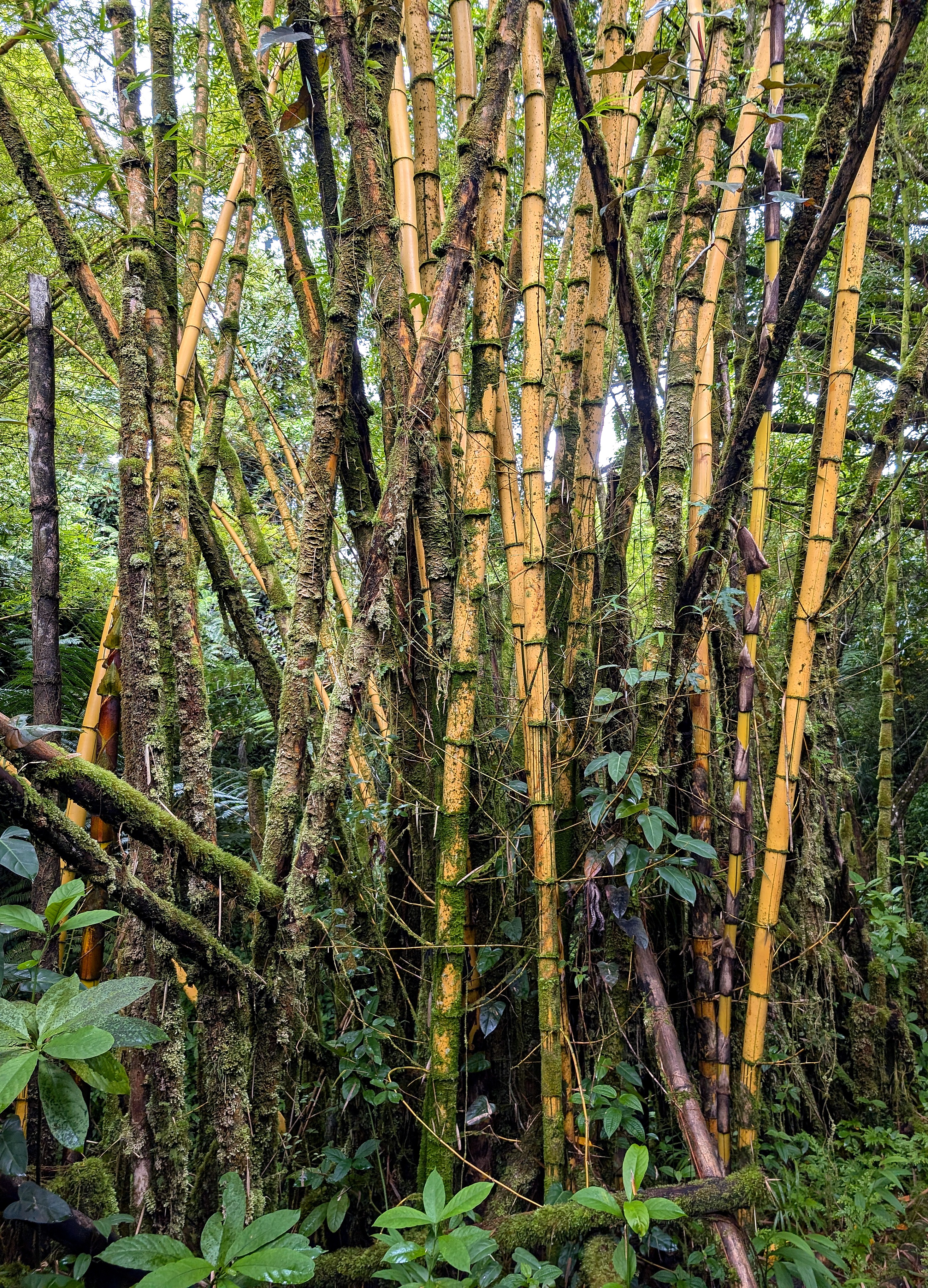
Bamboo stand in ‘Akaka Falls State Park, Big Island, HI. September 2024.
Our rental car, trees, vines, and a curve on the Old Mamalahoa Highway. The Big Island, HI. September 2024.
If you find yourself on the Big Island, and most especially if you stay on the east side in or near Hilo, a must stop (for the physically fit) is Akaka Falls State Park. As you head north to that park–only 15 miles distant, a very easy drive–just past Paukaa you’ll see a typically yellow/orange/ochre, diamond-shaped highway sign telling you that to your right is a “Scenic Highway” with a little sign beneath that says it’s four miles in length. Hopefully someone in your car (perhaps you?) will say as my wife did, “Let’s take that!” When you jerk the steering wheel to the right in the Papaikou census area (pop 1314), you’ll be on the Old Mamalahoa Highway.
These aren’t my best photos. Skies were overcast. Dense tropical foliage made it dark everywhere. Green predominates. The road twists, turns, offers few places to just pull over to grab a photo.
Halfway in we stopped at the Hawai’i Tropical Botanical Garden. It looked interesting, and it had restrooms. Our interest waned when faced with admission prices of $30/each and the prominent display of mosquito repellant for sale right beside the register. Translated from “customer-eze”, the signs basically said, “You’re a fool if you don’t apply repellant.” I’m sure it’s a wonderful point of interest: it features a valley down to the ocean with 2,500 species of plants. Nevertheless, we drove on. We stopped soon after when we found a bridge and a wide spot to pull off the road.
Kawainui Stream, Big Island, HI. September 2024.Kawainui Stream, Big Island, HI. September 2024.
I had become fascinated by a orange-red flower growing high in the canopy. At this stop we found ourselves above some of these trees, permitting me to photograph them:
Big Island, HI. September 2024
Driving north as we did, one suddenly pops out of the dense foliage and into a grassy pasture area on the edge of Pepeekeo. Joining the main highway, we drove on to Akaka Falls.
The Pride of America (Norwegian Cruise Lines) leaving Hilo Harbor, having just sailed through the opening in the breakwater. September 2024.
Our room at our Hilo hotel afforded me a delightful perk because it faced Hilo bay and its breakwater. I hadn’t realized only the larger rooms faced this direction–just a lucky pick, I guess. I’ve always had a curiosity about boats and ships, but especially commercial ships. I’ve never had a desire to work on a ship–heck, I barely want to be on one at all. Maybe that’s what makes it intriguing to see ships plying their trade in coastal waters.
After checking in to the Grand Naniloa hotel on a Tuesday, we witnessed a Norwegian Cruise Lines ship leaving the bay at dusk (above). By Wednesday morning I realized the passage in the breakwater lay to the west of us, but moorage lay to the east. Therefore, all of the ships passed our balcony in a leisurely fashion, guided by two tugs. (Astute readers will note the commercial docks in all my sunrise photos posted to date.) Within 24 hours I learned this would be a frequent feature of our visit.
Guiding her out; our first full day. September 2024.Dawn, our second full day. The Pasha Hawaii and a tug-guided barge of containers. September 2024.
I never did figure out the exact roles of the two tugs. One always headed out after the first one, and one always peeled off and headed back to the dock as they guided the ship in–leaving the other tug to finish the job.
Tug #2, heading out to catch up with the job at hand. Day #3. September 2024.Still catching up! September 2024.
They worked at night too….
Bringing in a container ship. Day #5. September 2024.
Getting ready to leave, again on a Tuesday, we managed to complete the cycle: the Pride of America returned to stay docked all day before heading out again on a Tuesday evening. We left a few hours later, but I still see it as I write these words, magical perhaps to no one but me.
The Pride of America, guided once again by The Tug That Remained. Day #7. September 2024.
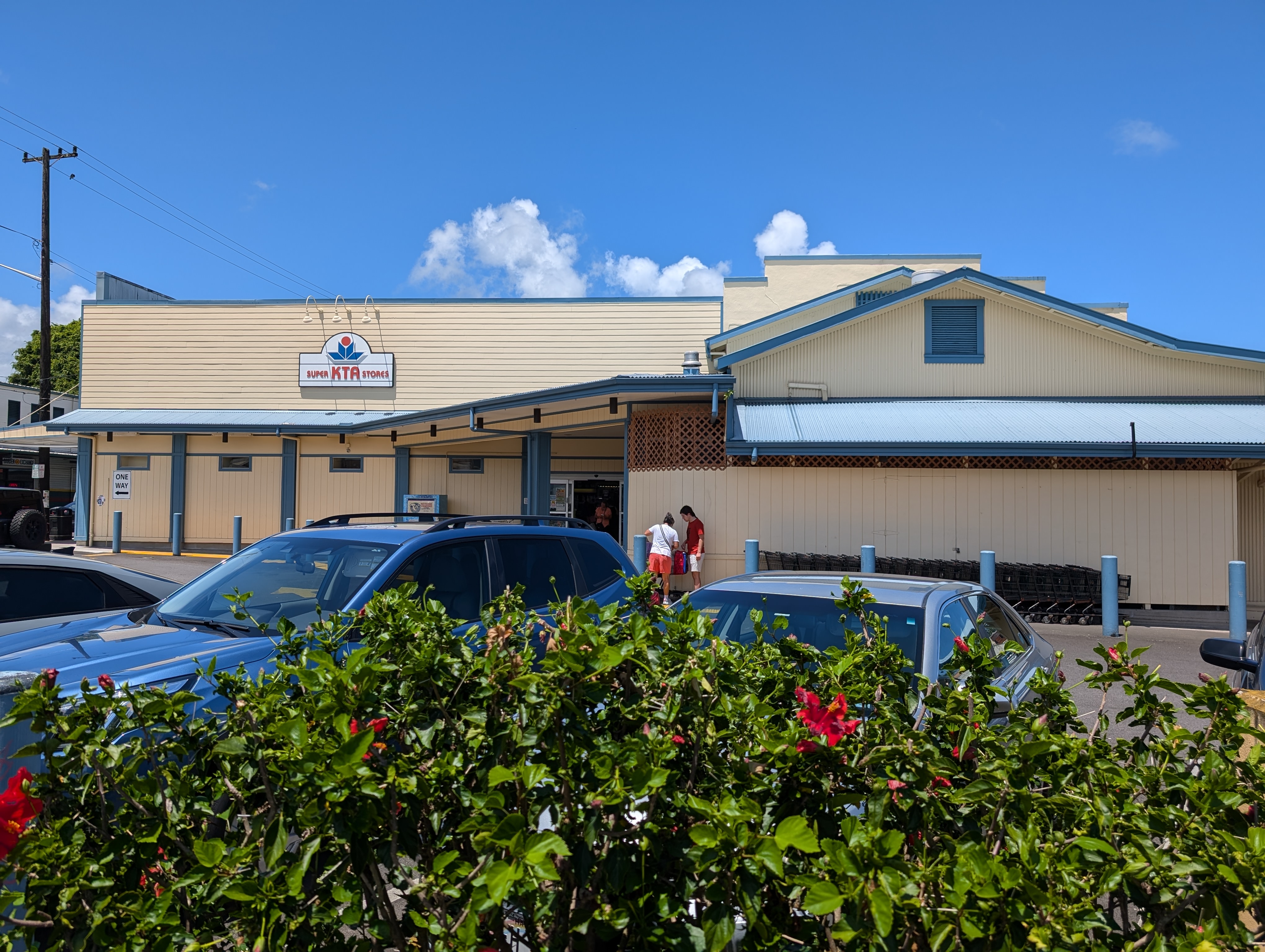
The KTA Super Store in downtown Hilo…on a much sunnier day. September 2024.
Since our hotel suite had a small range, pots/pans, and dishes, after our morning walk on the first day, we visited the downtown Hilo KTA Super Store, a funky grocery that reminded me of rural groceries which need to be a little bit more of everything for their customers. A guy at breakfast had described getting to a grocery, but I think I didn’t understand him because a flashy new Safeway and a much spiffier version of a KTA existed a similar distance to the southwest…but we went northwest, and I was glad we did. We dodged the raindrops which had threatened all morning, and as we shopped, I saw many products I’d never seen before, including….
Dried fruit at the downtown Hilo KTA Superstore. Hilo, HI. September 2024.
One of our many islets in the waters around our hotel. Big Island, HI. September 2024.
Our first full day in Hawai’i on the Big Island, we woke to mostly cloudy skies–not surprising considering we were on the rainy side of the island and we’d arrived to Hilo Airport under a solid overcast. As is our wont, we spent our first morning lazily, eventually venturing forth to explore our near surroundings. Here, it meant taking a walk around the western half of Waiakea Peninsula. Our hotel sat on the northernmost tip of the peninsula, situated on pretty grounds, so we started there.
Grounds of Grand Naniloa Hotel, looking east. Big Island, HI. September 2024.Grounds of Grand Naniloa Hotel, looking north. Big Island, HI. September 2024.A flower-cluster on one of the plants around the grand Naniloa Hotel. Big Island, HI. September 2024.Looking northwest from the northern tip of the peninsula. Big Island, HI. September 2024.
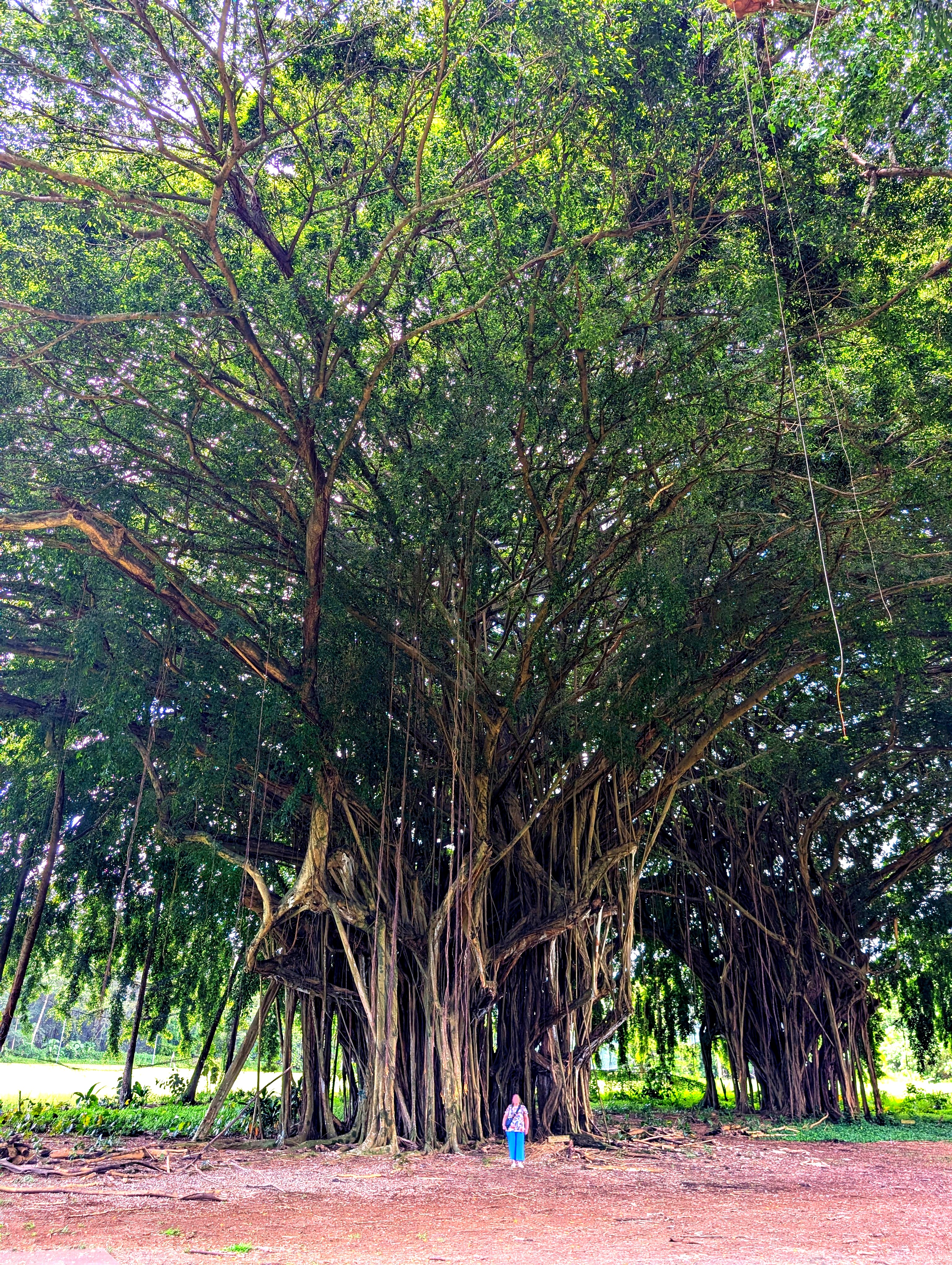
After touring the property, fencing forced us to the road in front of the hotel, Banyan Drive, so-called because 75-90 years ago a bunch of folks planted banyan trees to line it. Every time we drove in and out of the property we traveled Banyan Dr, making it one of the cool pieces of Hawai’i for me. Banyan trees are huge:
Typical banyan tree on Banyan Dr, Hilo, Big Island, HI. September 2024.
Our perambulations took us to a small park which culminated in Coconut Island, a spit of an island which took it in the teeth when a tsunami hit in 1960. (The somewhat famous Tsunami Clock is located nearby.) By now I had started cursing my brother who talked about the gloriously comfortable weather where humidity gets balanced by near-constant breezes. Our shirts were getting soaked. Temps were running close to 90 as the clock approached noon. As North Carolinians we’re very experienced with gray, overcast skies accompanying warm, humid conditions. We learned later this weather pattern wasn’t normal.
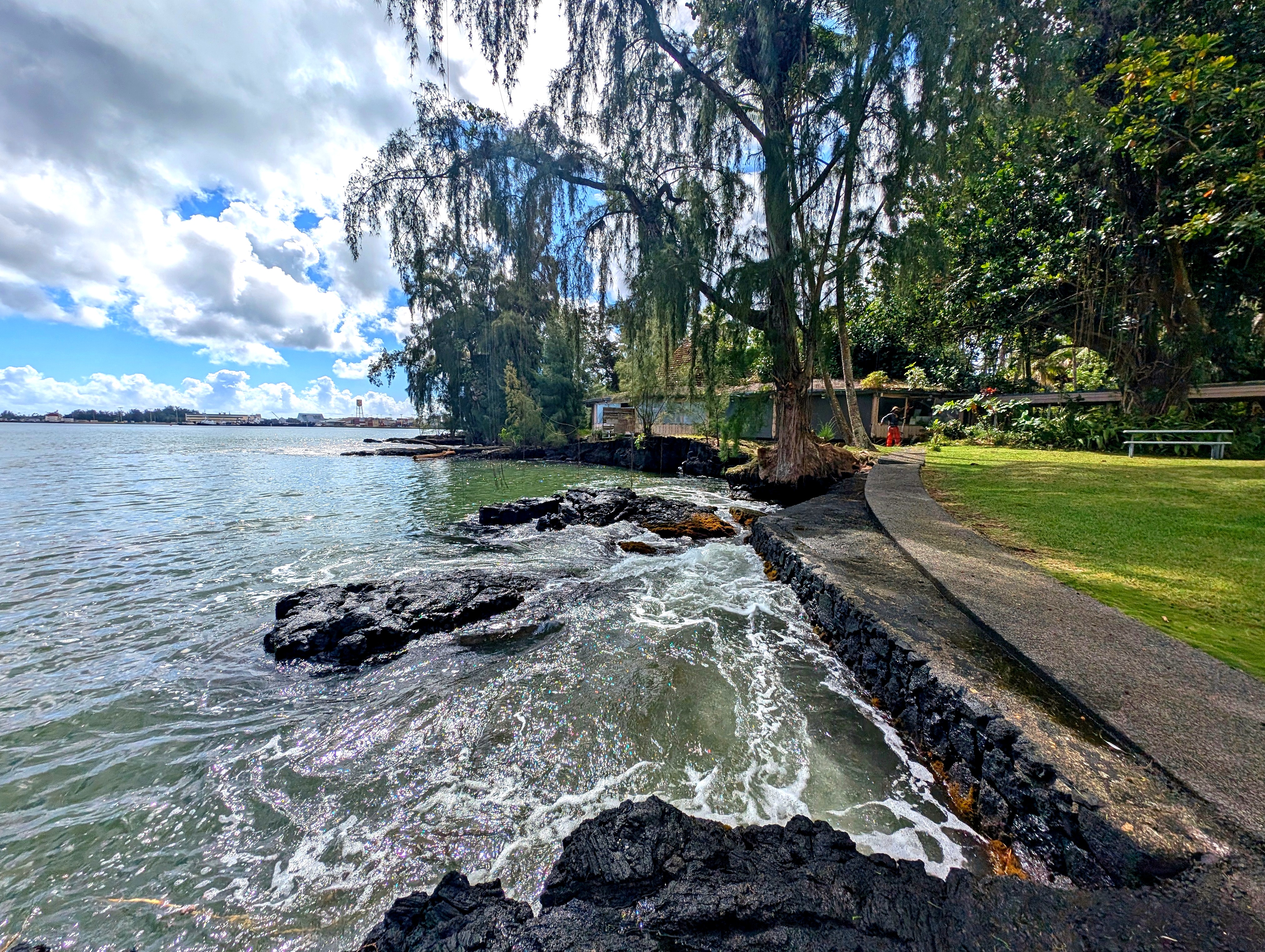
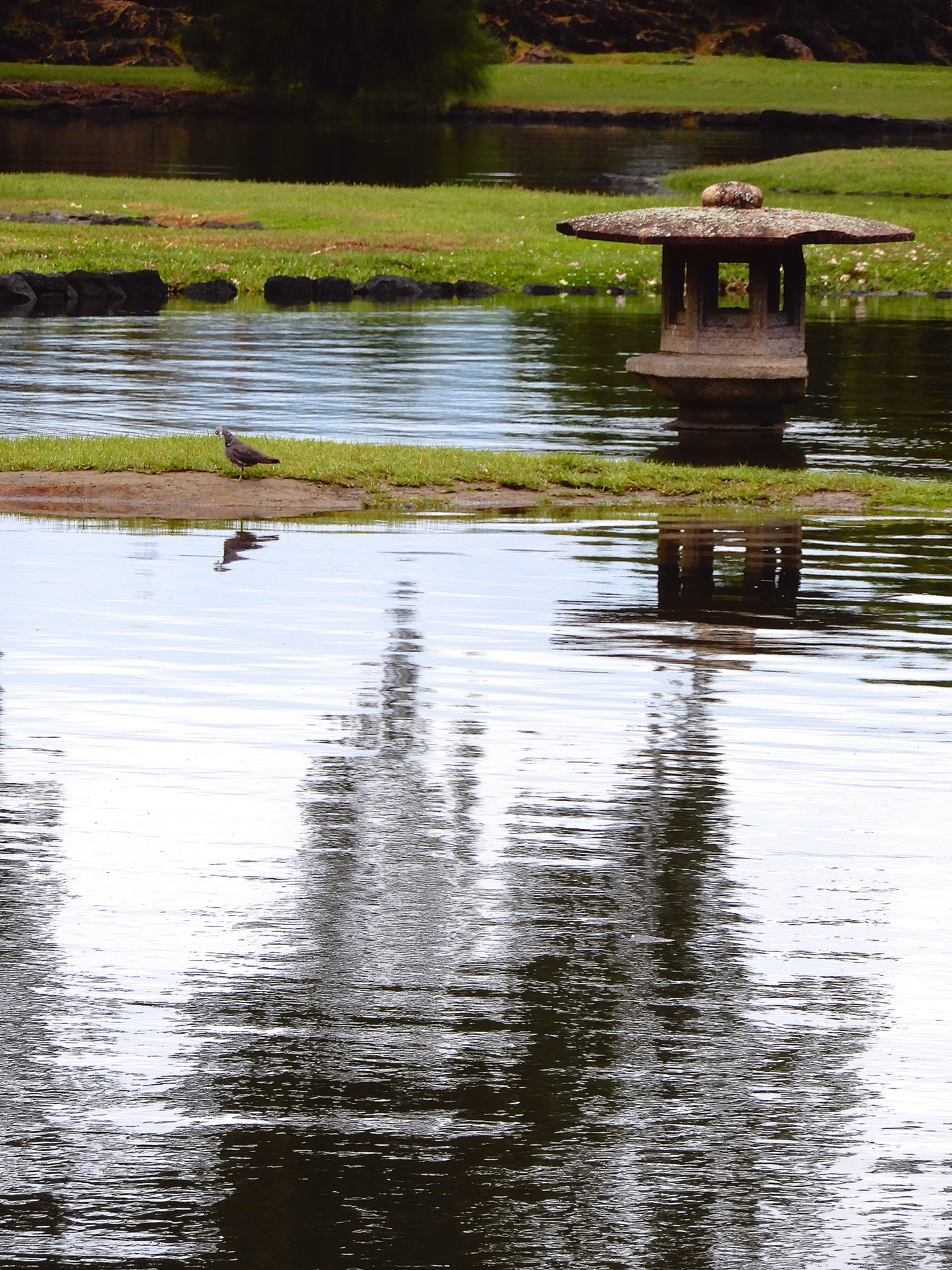
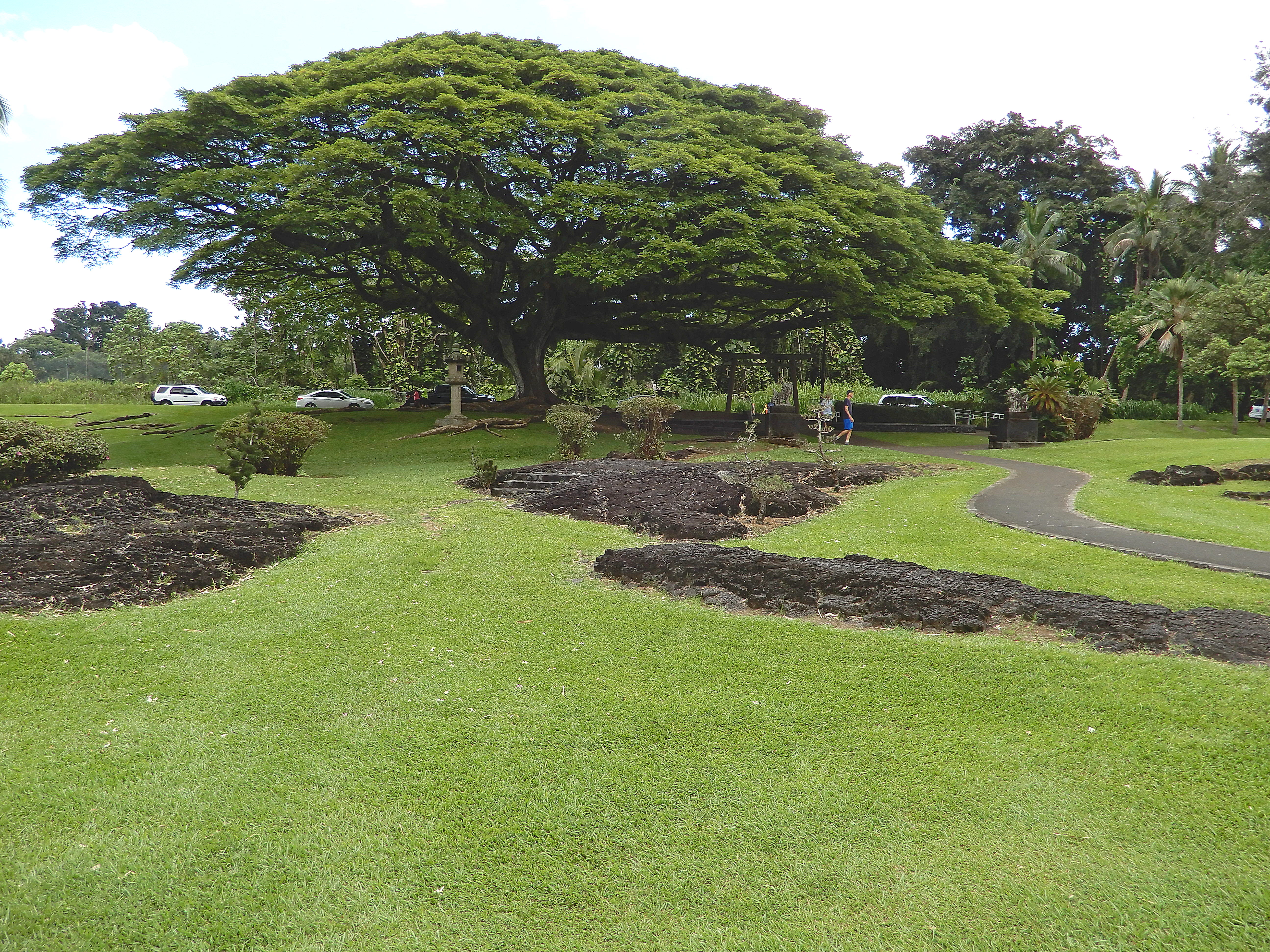
Our last stop consisted of wandering Lili’uokalani Gardens, a Japanese-style layout with plenty of Hawai’ian flora–at least I took it to be native. Who knows? Asking around later, I learned the park lies so low, so near Hilo Bay, that Waihonu Pond and other low-lying areas fill with extra water from the high tides. It prevented us from walking some of the paths.
At low tide one apparently can walk to and over this nice little Japanese-esque bride. Lili’uokalani Gardens. Hilo, Big Island, HI. September 2024.A Nene goose, Hawai’ian native. Lili’uokalani Gardens, Big Island, HI. September 2024.Yes, it really was that green. Lili’uokalani Gardens. Hilo, Big Island, HI. September 2024.
I’m conflicted. I enjoy casual birding, and when I visit Hawai’i and can suddenly see many new birds, I should be thrilled. I did thrill to bright, different birds. Then I learned that virtually every bird I saw had been introduced to the islands in the past 150 years or so. It seemed none of the common ones (the birds hopping around parks and following the tourists around) could claim they were indigenous to any island in Hawaii. Still…they are quite different to commonly spotted birds where I live.
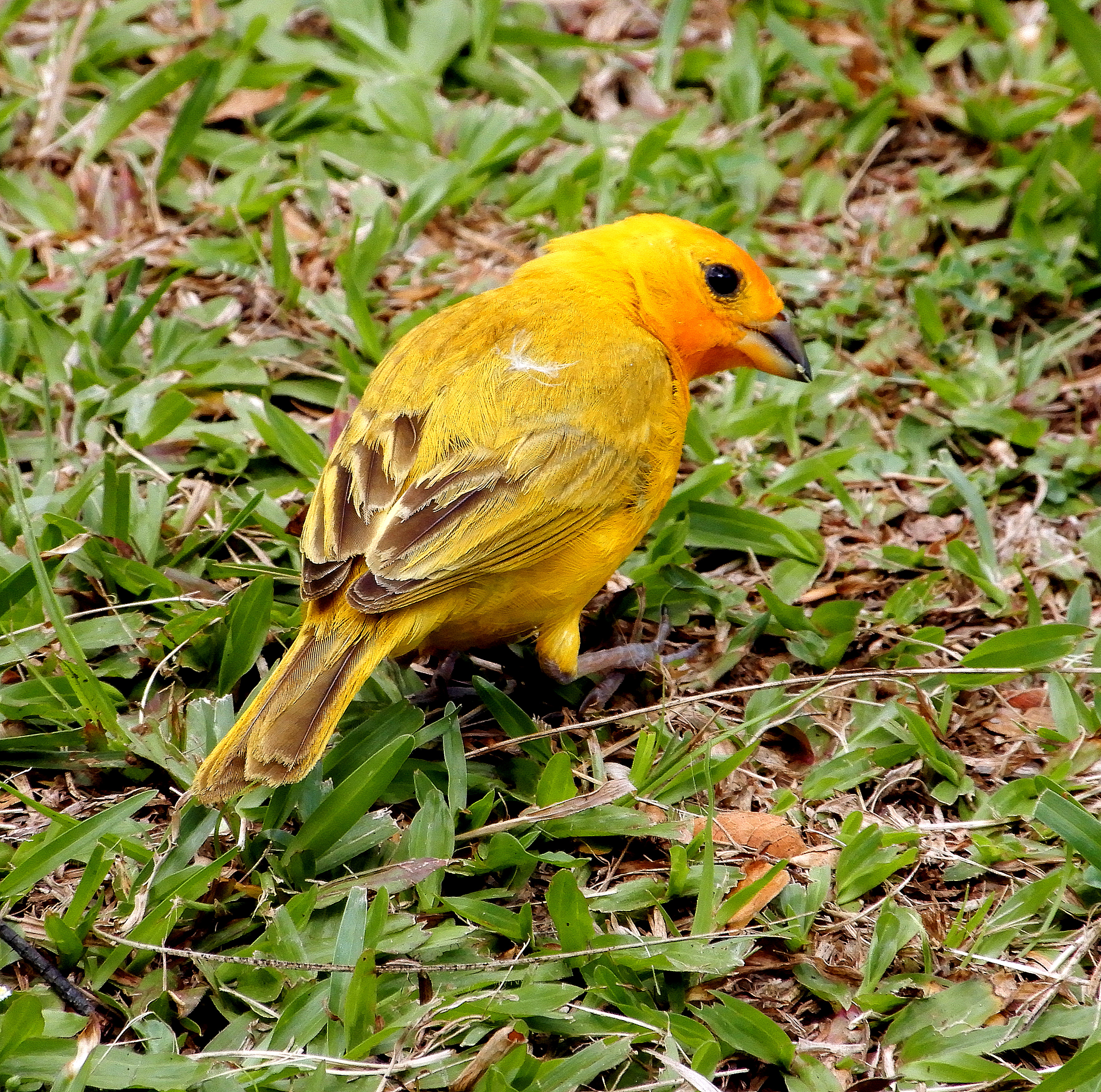
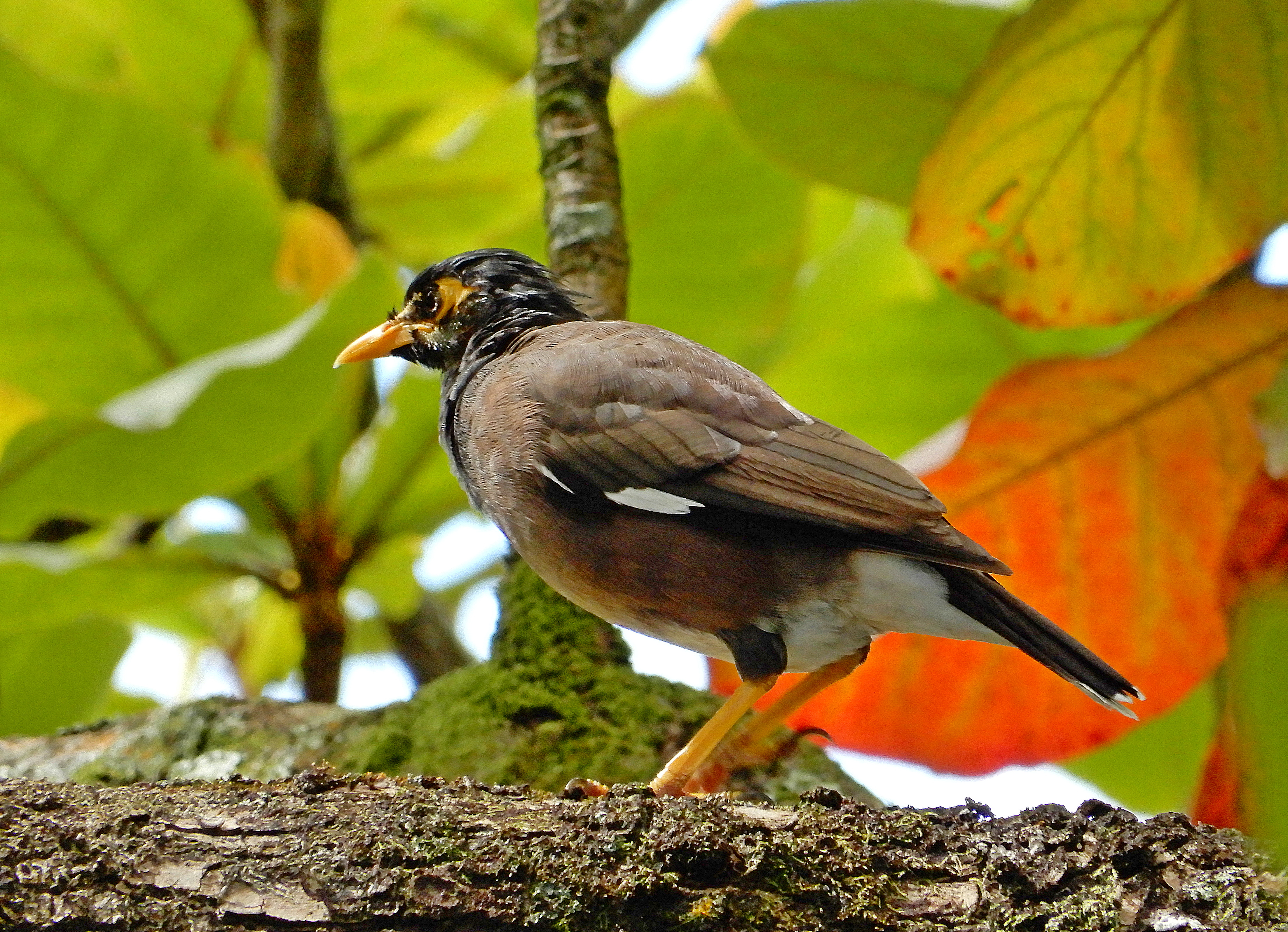
A Saffron Finch. Lili’uokalani Gardens, Hawaii, HI. September 2024.The Common Myna. Outside our hotel, Hilo, HI. September 2024.
The Common Myna appeared everywhere on Hawaii and Maui. It’s native to Asia, but has spread so much it qualifies as “one of the world’s most invasive species,” according to the IUCN Species Survival Commission which listed it on its 100 of the World’s Worst Invasive Species (one of only three birds on it). When we first landed on the Big Island, and I heard this incessant chattering, I thought Starlings had made it to Hawai’i. It’s a noisy bird, and it looks a little bit like a Starling until you get close enough to see the yellow eye patch, the more brown body, and that it moves rapidly on the ground when it wants to.
The Saffron Finch comes from South America. It’s been on the Big Island (Hawaii) only since 1960. We only saw these in the Lili’uokalani Gardens and around our hotel, both of which are on a very small peninsula on the east edge of Hilo, Mokuako.
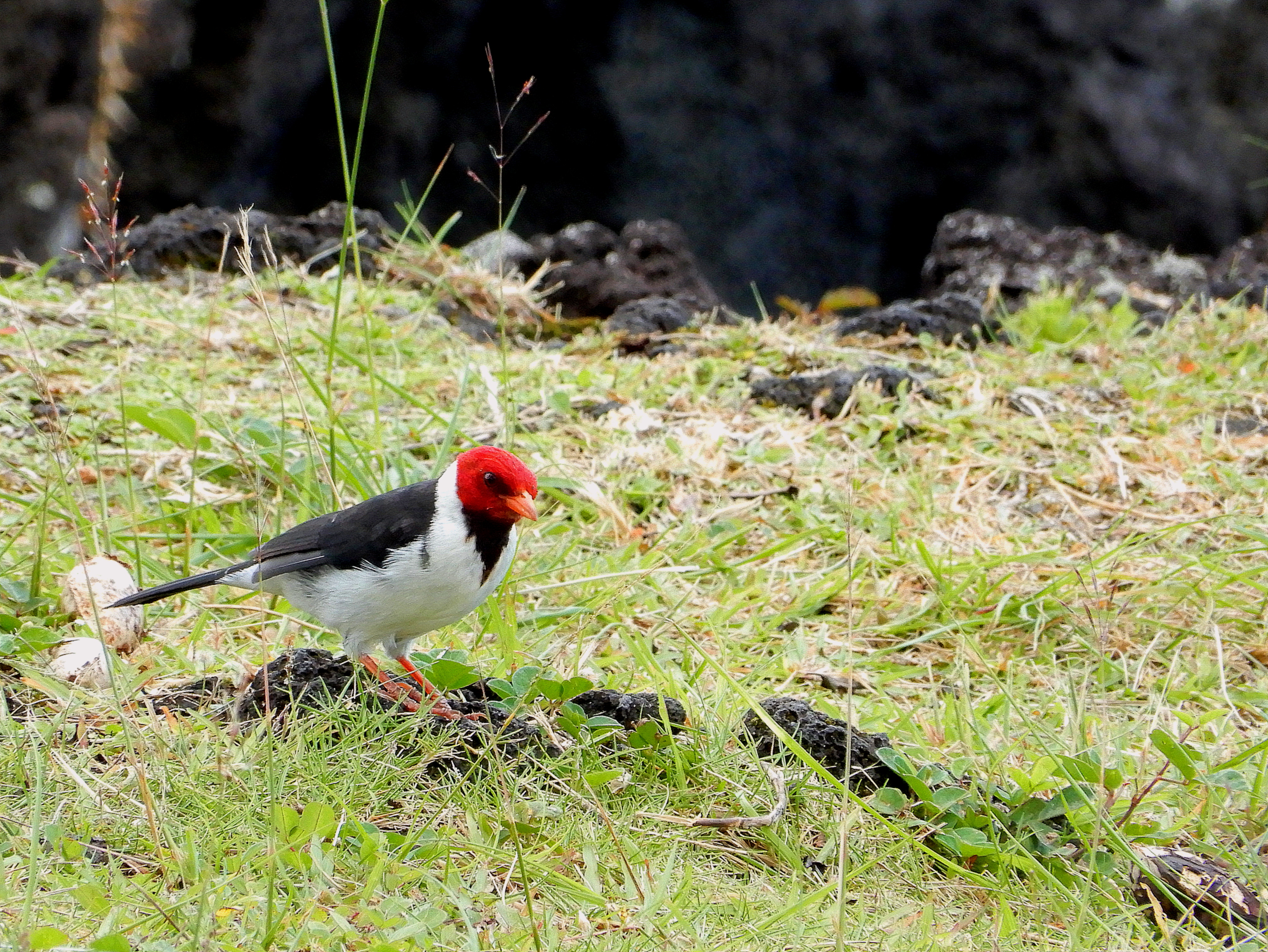
A Yellow-billed Cardinal. Seriously–see below. Outside our hotel. Hilo, HI. September 2024.
There are three common cardinals in Hawai’i, and none of them are native. One of them isn’t even a cardinal! We saw two: I photographed only the Yellow-billed but we also saw the Red-crested. They both originate in Brazil, but the former has a wider range into Paraguay, Bolivia, Uruguay, and northern Argentina. Thankfully we didn’t see any Northern Cardinals. I see plenty of those at home, and it would have been very depressing. Because I have no photos of the Red-crested, I’m including one from Wikimedia Commons.
My biggest consternation regarding birds wasn’t the Northern Cardinal. It was the onslaught of House Sparrows which assail one in every open restaurant, marketplace, park, and you name it. The fearless critters even hopped into our room in Hilo on several occasions….
“G’morning! Could ya take this peanut-bread-Cheeto whatsit off my bill?” Our first morning waking in Hilo, HI. September 2024.
Though we saw plenty of spotted and zebra doves (both introduced from SE Asia), I failed to take a good photo of one. It remained until we traveled to Maui before I saw a bird endemic to the Hawaiian Islands…
This is the tail end of a family of Nene geese, the state bird of Hawai’i. Maui, September 2024.
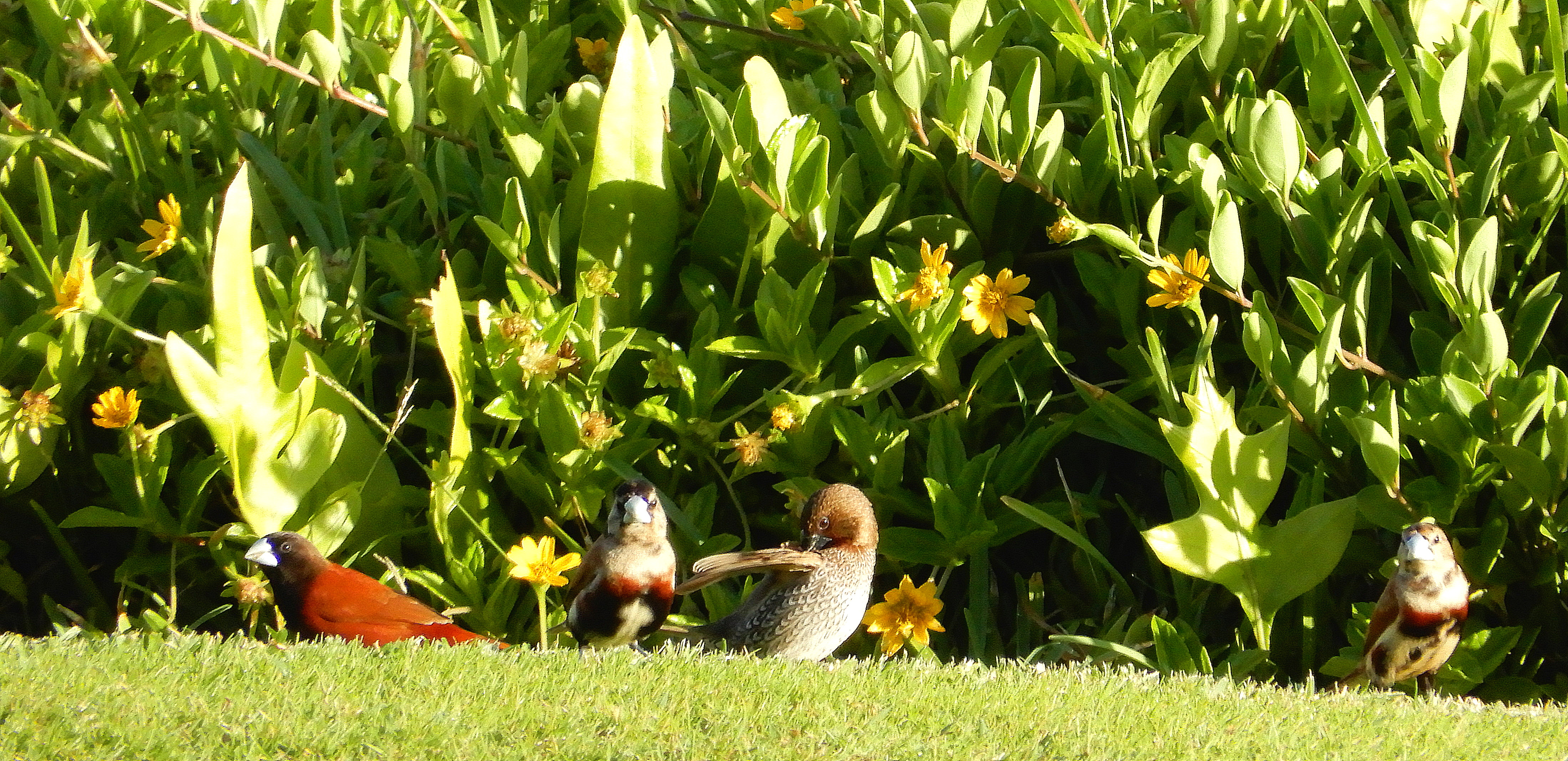
Sifting my photos for birds proved beneficial when I tripped over one, and only one, photo of a different group of birds. The Chestnut Munia isn’t native to Hawai’i (of course), but it’s a pretty cool-looking bird nonetheless. In the photo below, the bird on the left is a classic, I’m-sure-it’s-a-Munia example. Moving left to right, birds #2 and #4 appear to be Munias but they’re not supposed to have breasts like that. (Males and females are supposed to look about the same.) Photos of immature birds don’t look like those two. Bird #3? I’ve no idea what that is, but I find it difficult to believe it would just hang out in this group without being one of them.
Chestnut Munia (L) with friends. Kapalua coast, Maui. September 2024.
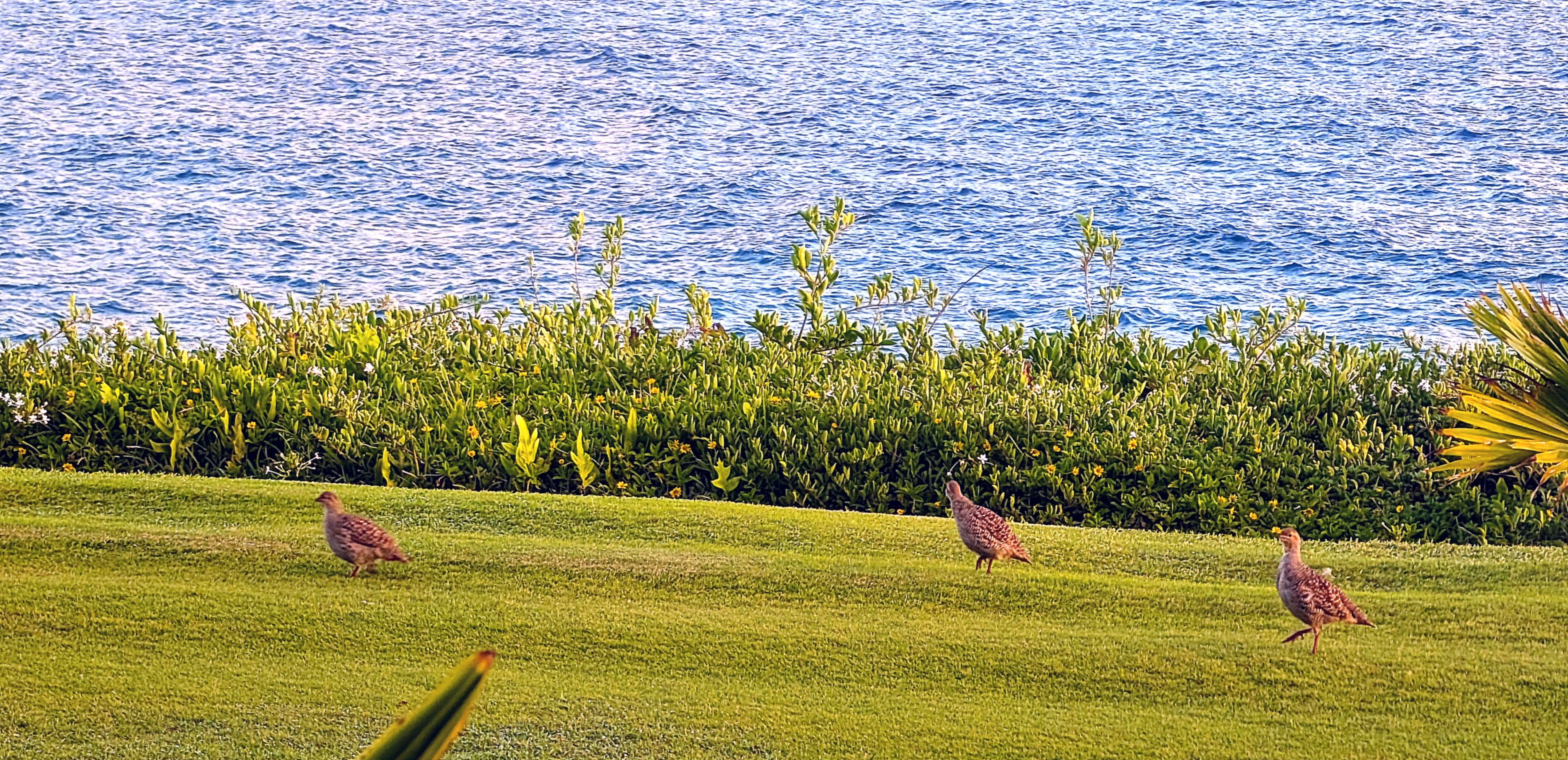
And in Maui I finally got a photo of one of these long-legged things which had bedeviled me on the Big Island. (Blurry photos? Sure, I’ve got ’em.) I don’t try to identify long-legged birds like this because they are so diverse and so similar. I don’t even know if this one is the same species as the ones which ran around on the rocky coasts of Hilo Bay.
Hello Mr. Long Legs. I’ll ID you one day. Kapalua coast, Maui. September 2024.
I would be remiss not to include a photo like the one below. Chickens. Yes, chickens. They’re not exactly everywhere but they’re darn common running around many areas where you wouldn’t expect to see them. They apparently are “wild” in the sense they don’t go to a coop and get fed by humans. They hang around the cities and towns, though, so…what is “wild” anyway?
The parking lot outside the Maui Aquarium. I think this guy met me ten minutes later at the nearby gas station. Maui, September 2024.















 all the voices in my head