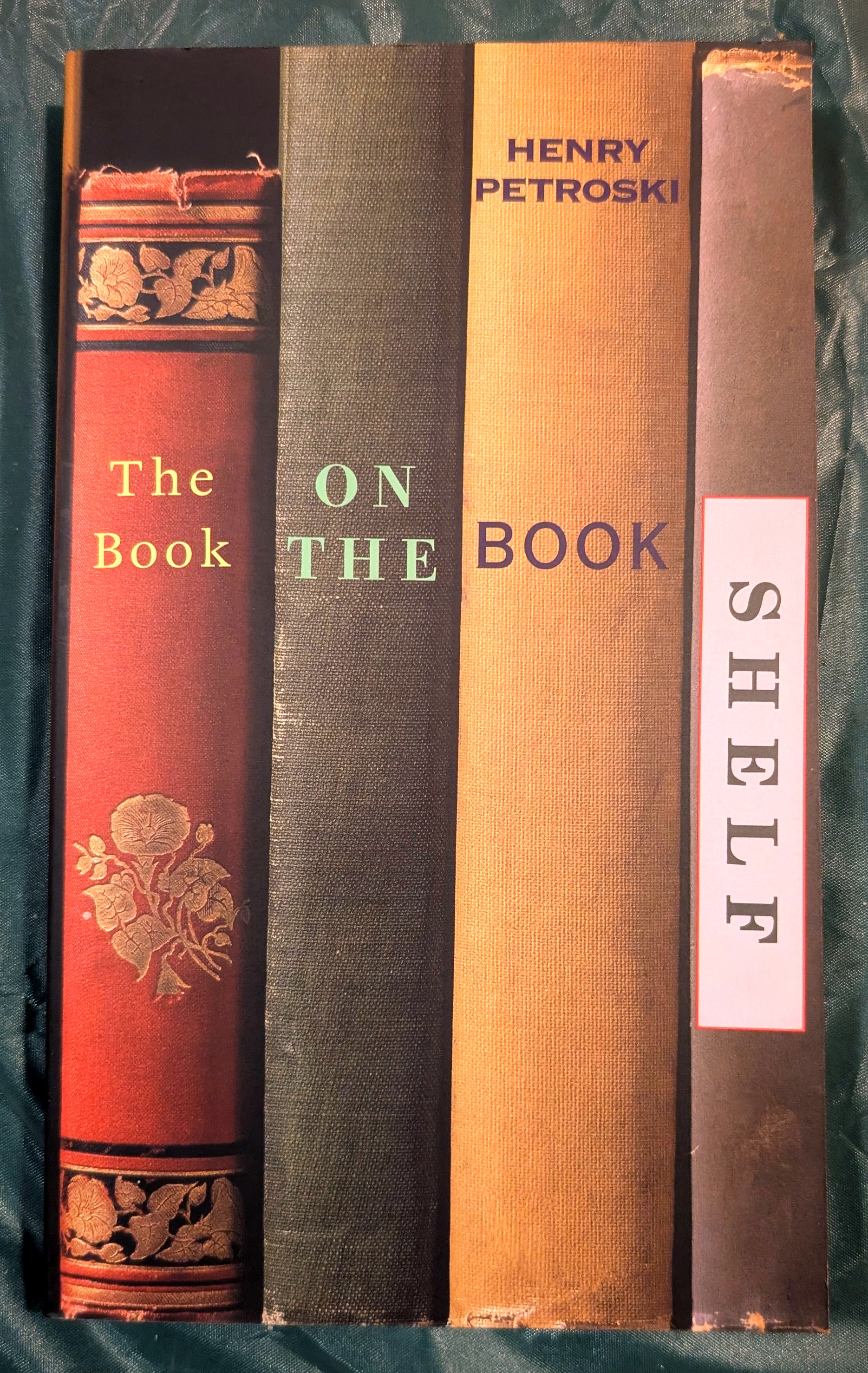
People who truly, truly love books, love books about books. One of the most unique of these appears above. Henry Petroski’s book The Book On The Bookshelf traces the history of books from their earliest inception as scrolls through the Middle Ages when they were chained to the shelf, and proceeds in its history to the present day. It’s a lovely read. Petroski winds up the book with a chapter about bookshops, another on the shelving of books, and a final one about the care of books.
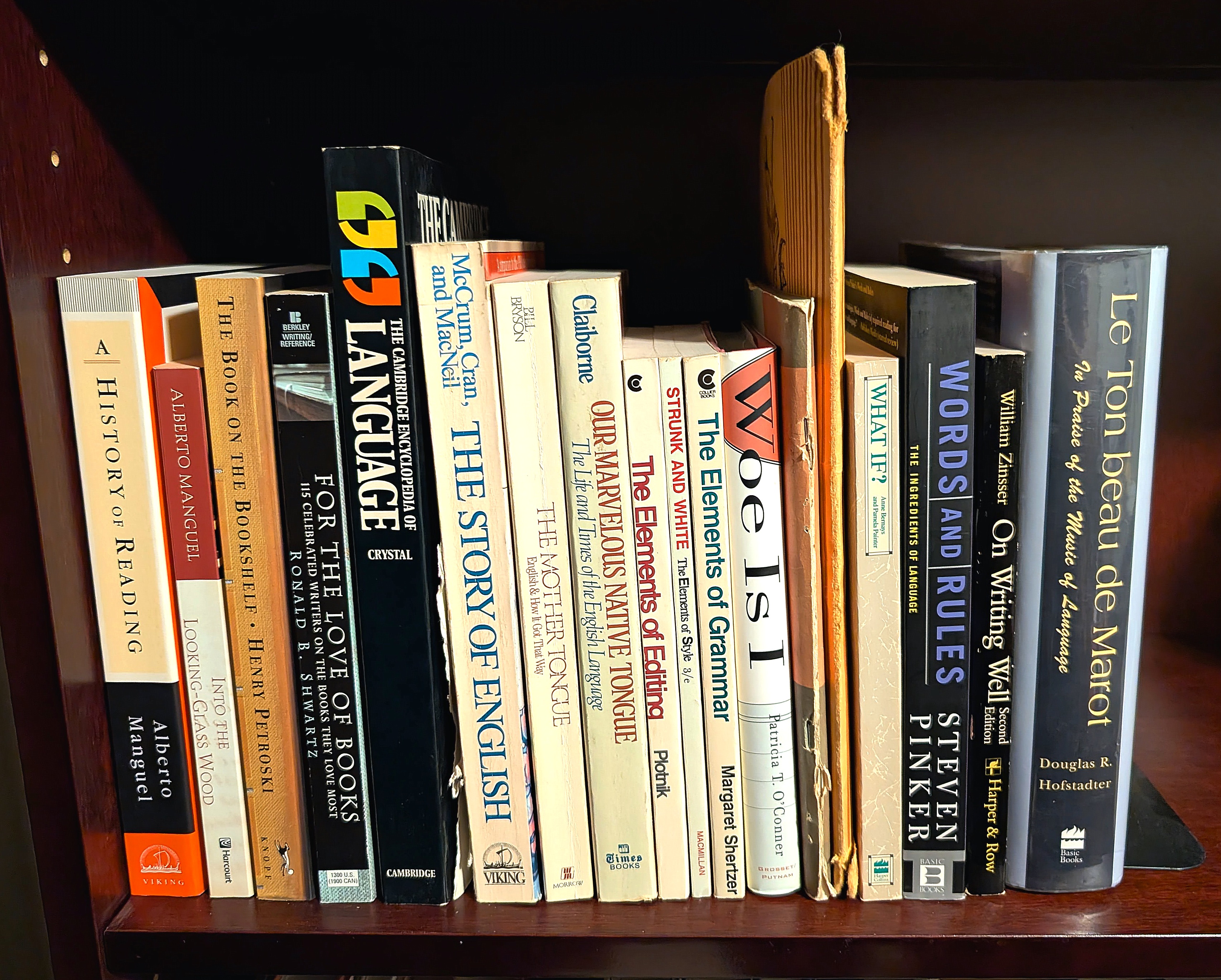
The phrase “books about books” includes those about reading them. My original photo for this Bibliophilia subplot is repeated here:
Books about books, language, grammar, and linguistics. July 2025.
In the semi-arbitrary manner I use to organize my bookshelves, books about books (and reading them) precede those which address English and languages. Alberto Manguel, an Argentine-Canadian writer (and translator, editor, essayist, and director of the National Library of Argentina) has two entries, both wonderful. A History of Reading celebrates the reader. With chapters such as “Being Read To” and “The Missing First Page” Manguel explores all of the aspects of the author-reader experience. Manguel divides the book into two sections: “Acts of Reading” and “Powers of the Reader”. I particularly liked this second section with its chapters of “The Author as Reader” and “The Book Fool”.
Manguel’s other book, Into The Looking-Glass Wood contains essays about books and reading. These range more widely than his History of Reading. Essays include reviews, reactions to other authors, browsing for books, essays about wordplay, and other more wide-ranging topics.
Ronald B. Shwartz’s book For The Love Of Books gets included here, simply because it’s on the shelf, and I can’t bear to part with it despite its shortcomings. I’m not one for the types of books which sample a range of acclaimed artists about a certain topic. This book gets the subtitle “115 Celebrated Writers On The Books They Love Most”. Yeah, so? What makes their opinion better or even equal to the critic for the New York Times Review of Books? Or any literature professor at dozens of highly regarded universities? Or, frankly, me? Regardless, I succumbed when I saw the authors cited include Joyce Carol Oates, Michael Ondaatje, John Irving, Bruce Jay Friedman, Doris Lessing, Norman Mailer, Witold Rybczynski, Kurt Vonnegut, John Updike, and Gay Talese. (Actually…I’m not sure I’ve ever completed this book! It still captures my imagination, and thus, it remains on my shelves.)
There you have it, books about books. If we can happily descend into the depths of books about books, how dare we deplore those who delve into the backgrounds of various oeuvres such as Tolkien’s Lord of the Rings? A nerd is a nerd is a nerd…
Le Ton Beau de Marot, purchased in a shiny-covered form.
Having published a book review just an hour ago, it seems fitting to revisit my Bibliophilia series with what amounts to another review. Le Ton beau de Marot: In Praise of the Music of Language by Douglas R. Hofstadter impressed me to such an extent that I purchased another when I lost the book to a less-than-responsible work friend. For nearly a decade it bothered me that I couldn’t pick it up and show it to people when I said, “you’ve got to read this!” Finally, having purchased Hofstadter’s Pulitzer Prize-winning Gödel, Escher, Bach: an Eternal Golden Braid (which has proved so dense I’ve never finished it), I tracked down a used version of Marot from a bookstore in Santa Fe, NM. (I necessarily bought it used because it apparently was out of print.) It’s inching its way up the Read Me list, probably gaining the top position in 2026. But why gush about it? To answer that, I must detour to 1999.
In July 1999 my wife received news that the lump in her breast was a benign cyst, nothing to worry about. A little over a month later she received word that the tests had been mixed up and that she actually had cancer. This occurred on her birthday. After three surgery procedures in September, we took a vacation to the Oregon Coast just one week prior to her beginning the chemotherapy regime. We stayed in a wonderful condo on Yaquina Bay at Newport, OR. When we left, we took a leisurely drive up Highway 101 along the coast all the way to Astoria before turning east the next day toward home. Shortly before we arrived to Astoria we stopped at Seaside when a largish bookstore caught our eyes. There I found Hofstadter’s book. Loving language, I read the flap, learned it took up the challenge of translation, and that it also touched many other topics. From the flap:
…he not only did many of his own translations of Marot’s poem, but also enlisted friends, students, colleagues, family, noted poets and translators—even three state-of-the-art translation programs!—to try their hand at this subtle challenge.
The rich harvest is represented here by 88 wildly diverse variations on Marot’s little theme. Yet this barely scratches the surface of Le Ton beau de Marot, for small groups of these poems alternate with chapters that run all over the map of language and thought.
Not merely a set of translations of one poem, Le Ton beau de Marot is an autobiographical essay, a love letter to the French language, a series of musings on life, loss, and death, a sweet bouquet of stirring poetry—but most of all, it celebrates the limitless creativity fired by a passion for the music of words.
What the flap only hints at I learned later. During the time Hofstadter gathered his many translations by consulting all those people, his own wife was dying of cancer. Thus, his “musings on life, loss, and death” dive deep into his soul and therefore ours. Add to that my own wife’s tussle with cancer—she won, unlike Hofstadter’s wife—and the work compels. As I worked my way through the book, I found it dealt with language at a very basic level some of the time: how do we mean things? How does one language differ from another? How does cognition play out in word choices? And on, and on…
When I finished it, I felt Le Ton beau de Marot had been one of the best books I’d read because it didn’t just deal with language or cognition or love or translation or meaning or any other of those things mentioned above. It dealt with all of them! I loaned the book to a co-worker whose daughter was headed off to college to pursue a degree in English and who wanted to be a writer. I undoubtedly didn’t make it clear enough that one day I expected the book back. When I handed it off, though, I held back my gloss notes, which instead of writing into the book I had written out on fine paper. (They were too extensive to write into the margins anyway!) The book meant so much that I still have the notes a dozen or more years later. Here’s one:
[p. 138-139] I would side with Frost, that poetry is what’s lost in translation. Not that it can’t be re-discovered in the new language, but it’s not the same poem. Thus the poet-translator is intent on supplying a twin, not the real thing.
Hofstadter’s work combined with my college readings on communication, media, and meaning to form my personal philosophy and understanding of all types of translation. I “see” the issue of meaning more deeply than many I engage with when discussing how a work translates from one language to another, how people in different cultures perceive things, how books become movies and vice versa, even in how Superman or Batman is translated every decade by a different director all of whom seemingly work from the same “text”. I even see the problems of translation as one of the issues currently plaguing United States politics.
Hofstadter’s book satisfied on so many levels, engaged so many pleasure neurons, that I can’t do it any justice. You’ll simply have to read it yourself if you love reading about language and the problems of translation…and cognition…and…
If my self-defined word bibliophilia means both a love of books and a certain madness about them, what then describes a certain madness about books written by others about that very madness? A madness for madness? Is that a thing? Where and when does it stop? Ever? (Death would be a safe bet.) Of those who love to read, there exists a subset who thrill, not to be reading, but in anticipation of reading. Cue Carly Simon. People in this subset feel a fevered, shaking promise when entering a funky bookstore in the middle of nowhere and the first ten titles they see scream “READ ME! NOW!!” And yet…
Within this subset of bibliphiliacs, a smaller, more exclusive sub-subset exists. These distinct suffers of bibliophilia feel an intimate rush when they espy that one volume probing directly into their literary, book-loving soul, purporting to deliver not just a few hundred finely written pages but promising those pages will satisfy not just their book-lusting souls but will simultaneously glorify the very building blocks which construct the objects of their obsessions. It’s a feedback loop not unlike the pleasure paddles given to rats which OD’ed on opiates. It’s as if one of their objects of desire shed all the clothing of characterization and plot or rhetorical structure and laid themselves bare for the reader’s ultimate satisfaction. No wonder we tingle all over and feel a slight loss of rationale thought when we see these titles.
My, my. Did it suddenly get warm in here? Let’s cover up and move on…
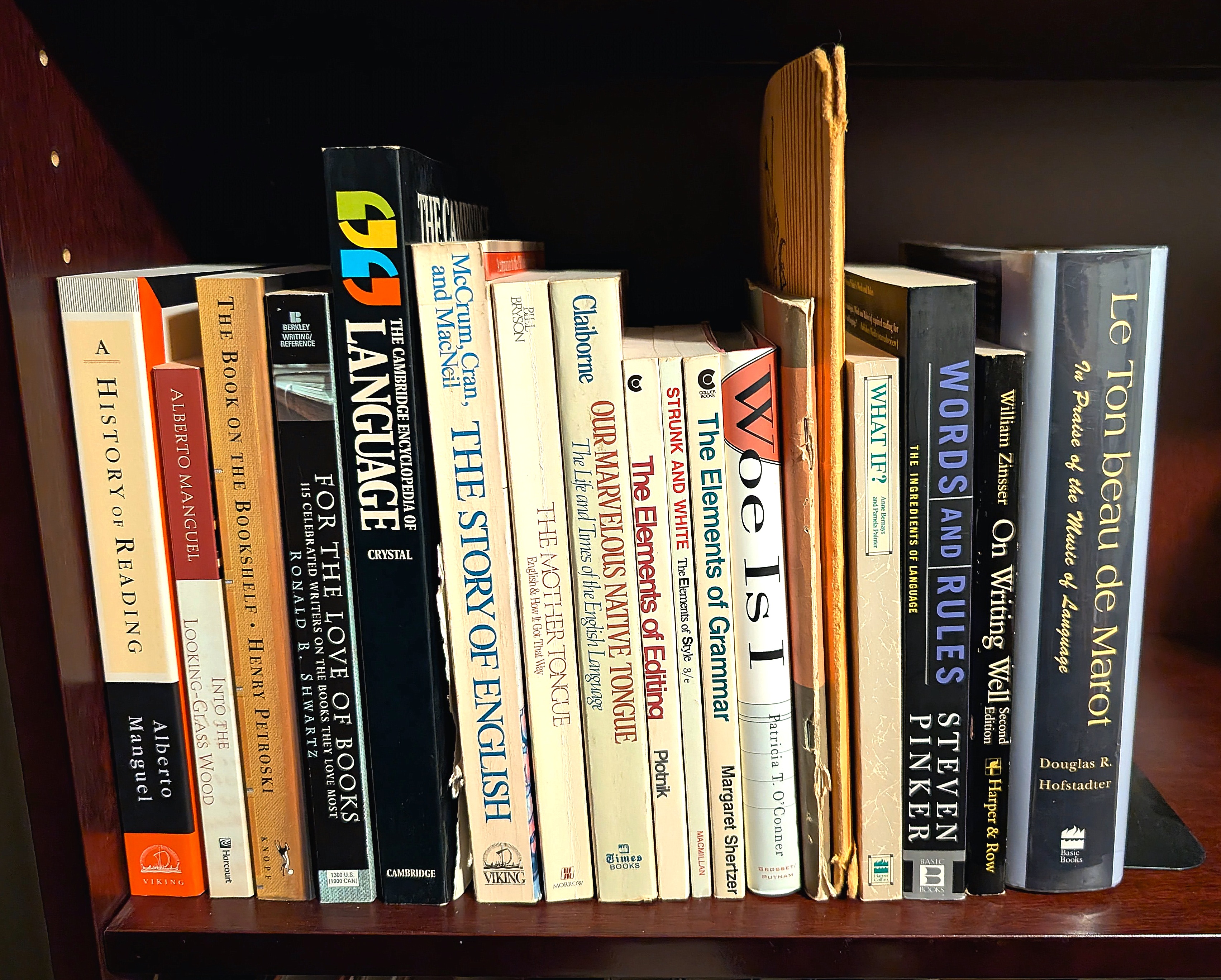
Language books that stood the tests of time and usefulness. July 2025.
Despite having degrees in both Communications and English, I possess a scant half-shelf of books about the language I use. Perhaps this relates to the Communications degree carrying a focus of journalism and the latter one a focus on literature. The English degree also had a few courses pared from it because of the additional classes I had to take to get the “.Ed” added to the end of it. Linguistics interested me until I encountered the arguments for Noam Chomsky’s innate grammar versus the classic thought that grammar remains culturally induced. I suppose this means something important to someone, but who really cares right now? All books I bought for linguistics possessed such rarified, dry prose to make them insufferable the moment I finished the class which required their purchase.
Other books departed for different reasons. Those which all claimed to be about “being a writer” fell victim to The Purge of 2020 when I removed about a third of the library to live in boxes designated for assignment to others…or to the trash. I determined at that time I will never be A Writer although I will write. A freeing decision. Joining those were books which celebrate the language of English and which I found only mildly amusing: volumes by William Safire, Willard Espy, and Richard Lederer all sit waiting to grace someone else’s shelves.
Nine “keepers” don’t appear on the shelf at all because they are points of data in Kindle form. Several lovely books appear in this group: Ella Minnow Pea: A Novel in L:etter [sic] by Mark Dunn, sadly prescient for our time, where a Council decrees the removal of letters one by one from all written and spoken communication; Alex & Me: How a Scientist and a Parrot Discovered a Hidden World of Animal Intelligence—and Formed a Deep Bond in the Process by Irene Pepperberg which I haven’t read yet but which looks great; Our Magnificent Bastard Tongue: The Untold History of English by John McWhorter, a slightly controversial book dealing with how certain aspects of English came into being; and The Professor and the Madman: A Tale of Murder, Insanity, and the Making of the Oxford English Dictionary by Simon Winchester, a true story about a murderer incarcerated due to insanity who nevertheless overwhelms the compilers of the OED with 10,000 entries. I’m looking forward to two more: Empires of the Word: A Language History of the World by Nicholas Ostler; and Kant and the Platypus: Essays on Language and Cognition by Umberto Eco.
Missing from the shelf because I loaned it ten years ago to a friend who I believe is “still getting around to it”: Don’t Sleep, There Are Snakes: Life and Language in the Amazonian Jungle by Daniel Everett. Though some revile him, the book fascinated me. Everett traveled to the Amazonian jungle to proselytize Christianity to the Pirahã mostly by learning their language and then translating the Bible into it. A trained linguist, he discovered the Pirahã have no counting system, no fixed words for color, no concept of war, and no personal property. I seem to recall they didn’t have all the temporal aspects of language (past, present, future and the permutations thereof). The title comes from their belief that evil spirits (and snakes) can only get you when you fall asleep, therefore they attempt to sleep as little as possible. They sleep communally and at all times several will be awake talking to each other.
I decided to take pity on you. Rather than a lengthy bibliologue through the shelf, left to right (because that’s how these things are done), I’m breaking things out for individual treatment. In my subjective view of the shelf, L to R, it breaks into books about books and reading them; books about English, including how to physically present it on the page; a few books I’ve retained which promise advice on writing; and one lovely volume which defies categorization but touches on the meaning of words, poetry, and translation, all while tackling the relationship of cognition to language and adding in the personal pain of losing a spouse to a killer disease.
Or am I delaying and stringing out this series to heighten my pleasure? (It’s getting warm again…)
OR, “I’M STILL WORKING ON MY COLLEGE READING ASSIGNMENTS!”
Literature anthology texts, college and otherwise. July 2025.
College literature texts resemble the reading equivalent of eating at an upscale buffet restaurant. You know the food will possess decent quality, but you don’t expect one of those “oh, wow, go get the chef!” moments. On the other hand, you know it isn’t Golden Corral, there won’t be questionable entrees and a lack of things which resemble lovingly prepared food. It’s therefore a safe, pleasurable experience you look forward to, but not too much. So too the literature anthology, usually targeted to college freshman and sophomores, aims higher than 50 Romance Stories For The Modern Lover but the reader doesn’t usually expect anything challenging or inclusive. There can be exceptions which prove pleasant. Sometimes, particularly in those early college years, one experiences surprises less pleasant: “But I thought that was a great story, professor!” ran through my mind a few times when my instructor somewhat condescendingly told us a piece we’d just read “was at best, B literature…good, but not great.” No matter. Turn the page. There’s something potentially better at the next station of this literary buffet.
As I’ve ditched books along the way, including texts which seemed useless for the future me, I’ve clung to nearly every anthology I’ve come across. In fact, as a teacher of English for 8th graders from 1983-1992, I accompanied my then-wife to garage sales specifically buying the college texts of other people to flesh out a reference library. In the days before e-books and a true Internet, I either had to seek these texts out from various bookstores and mail order outlets (at full price) or pounce on jewels sitting in the dross of some middle-ager who realized, “why am I carting this book around anymore?” I’m not sure, but I think I’ve only cut the ties with one, The Sagas of Icelanders, and technically it’s still in my house so have I really let it go? It’s categorically called “Purged” and fair game for donating/selling.
Let’s discuss what’s on the shelf above:
Quality Paperback Book Club rescued me when I found myself in Colville, WA, in 1983, a city of 10,000 souls 75 miles from any true city of note, and yet the largest city to the east or west for hundreds of miles. One of the final books I purchased from them before bowing to the Power of the Internet was the QPB Book of Irish Literature (copyright 1999). Beginning with Edmund Spenser and Jonathan Swift, it runs through “The Sheridans,” “The Wildes” (yes, including Oscar), and “The O’Faolains” while picking up George Bernard Shaw, W. B. Yeats, and James Joyce along the way. The latter is represented by the full inclusion of “A Portrait of the Artist as a Young Man.” Samuel Beckett has three entries including a slice of the play Waiting for Godot. A nice touch for a modern anthology was the inclusion of Nobel Prize-winning poet Seamus Heaney. I’ve selectively read throughout the 900+ pages.
The Norton Anthology of English Literature remains one of the classics for this genre, and I had to have it when I found it. My college text is two books more to the right, The Norton Anthology of American Literature. The condescension of a country with about 2000 years of literary achievement can be seen here: I have only Volume 2 of the English literature, but the shorter work, American Literature, represents all of what the Norton editors consider representative and worthy.
Between the two Norton collections lies a silly conceit, fifty great short stories, a humble paperback which I’ve never read. So sue me.
Another book I’ve never read, but have consulted, is Adventures in American Literature which appears to be volume 2.
A Handbook to Literature caught my eye because it isn’t an anthology, but an alphabetical listing of literary criticism terms and themes, genres, theaters, and poetry scansion terms. Unfortunately for this book, I now realize it’s as useful as Benet’s Readers Guide which is “not at all” in this day of AI and the Internet. This book will not be rejoining the shelf. Sad.
The observant person in looking at the above photo will have noticed there are two books with the same title and author: Literature: Structure, Sound, And Sense by Laurence Perrine and in the case of one, Thomas R. Arp. The white-spined edition, the third, guided me through more than one course at Eastern Washington University which seemed to have taken pity on the budgets of its students and used it for both prose and poetry courses…or maybe my memory is faulty. I find it difficult to believe I’ve lost track of the text we used for the poetry class. The wine-colored is Perrine’s 6th edition, this time in collaboration with Arp. Not only does it have a significant number of different selections, but the best part for me? It was bound upside down! One looks with a slight smile at the cover, proud to have purchased one of the first texts ever in what will, of course, be a glorious college career, and then opens the book. Okay, we knew we purchased a used book, so Marc’s name inside the cover is okay. Wait, what’s this? The final page of the index? Upside down? Oh yeah, I would’ve bought the book even if I had no other interest in it.
The two black-colored spines toward the right end of this display belong to The Oxford Anthology of English Literature. In my world, both then and now, if it says “Oxford” it’s an immediate buy. Ironically, I’ve read not a word of either. I took a course in Medieval English literature at the University of Washington which had us buy individual copies of those significant works; reading the Oxford would be redundant. Plus, I’ve recently purchased J. R. R. Tolkien’s translation of Beowulf (and other works) which will take precedence in my hierarchy of reading. Perhaps I will one day compare the works in The Restoration and the Eighteenth Century to The Norton Anthology of English Literature to see what differs. Or not. There are hundreds of books to read, after all.
Which brings us to our final volume, The Treasure of American Short Stories. I’ve read selectively from this book, but it’s mostly redundant to the Norton one on American literature.
Part of our satisfaction for holding onto these types of books—and I know some of you didn’t even question that statement—lies in the combined meaning of memory and potential. We look at these books and they evoke our time so long ago when we sat in uncomfortable chair-desks, taking notes (or not), and experiencing aspects of literature for the first time. Decades later, discarding those memory-tokens seems almost sacrilegious. We turn then to the argument of potential: “I think I might still want to read some of these.” Hence their place still on my shelves, 40-50 years after I purchased them.
Take a Sears-Roebuck catalog, cross it with the hippie ethos, and add a large dose of product recommendations. WEC blazed a new trail. Photo, July 2025. Catalogs, Summer 1972 and sometime in 1994.
When I headed off to college in 1972 my curiosity led me to enroll in an experimental education program funded by the Ford Foundation. I hope to write of that someday, but today we consider two peculiar residents of my library: two editions of The Whole Earth Catalog. Being 18 in 1972, I didn’t exactly participate in “The Sixties” which meant I hadn’t heard of The Whole Earth Catalog until it appeared on the textbook list for that experimental program I’d enrolled in. What is it and why am I making a big deal about it? Is this just some oldster nostalgia trip? Maybe, but I think it’s much more than that.
The WEC basically laid the groundwork for what today is Wirecutter and everything like it, except…what if Wirecutter had a hefty dose of social awareness ethos baked in? And what if there were no suspicions that Wirecutter and websites like it make decisions partially based on monetary reward? Before The WEC, I’m unaware how one could have gone to a single source for information, evaluations, and recommendations on a number of topics. Everything one needed know about consuming involved a physical trip to interface with salespeople. In certain cases one could consult a dedicated publication for audio equipment, say, or fashion, but sooner or later one needed to go to a store to buy something. If I wanted information about high quality stereo equipment, I went to Huppin’s Hi-Fi downtown where all the audiophiles (a.k.a., stereo gearheads) gathered and had all the information. When one wanted furniture, one headed to a furniture store or several and bought the best of whatever you saw. The same with clothes, garden tools, hardware, books, cars, pretty much anything. Who knew if it was good? Who knew if the price here was as good as there? If you ordered something, like a car with all the options in your favorite color, you started at a dealership. Everything filtered through the salespeople.
But the WEC gathered its recommendations for just about everything which interested the Peace Generation (or whatever you want to call us), told you why it represented the best you could buy, and gave information about how to get it. Or as the Function statement on the very first page of The Last WEC said , “The WHOLE EARTH CATALOG functions as an evaluation and access device. With it, the user should know better what is worth getting and where and how to do the getting.” This “last” edition didn’t have a table of contents. After page two told you how to get the stuff, and other tips, the third page launched right into “Whole Systems” and starting with the subsection Buckminster Fuller (anything dealing with Buckminster Fuller, a near-god of social planning). Other sections dealt with land use, industry, craft, community, nomadics, communication, and learning. These were loosely defined: subsections in Learning include “Thinking,” “Serendipity,” “Psychology,” and “Free Schools”. Additionally, the lower right corner of all right-hand pages from Page 9 onward contained the story “Divine Right’s Trip” where the main character, Divine Right, experiences many adventures of the time until he lands on the Whole Earth Catalog at the very end, a sort of gold-at-the-end-of-the-rainbow thing.
I could write pages and pages about the WEC to little effect on anyone who hasn’t seen it. In its way it picked up the tradition of the old Sears-Roebuck catalogs which allowed people living in the backwaters of America to buy through the mail most of the things they could ever want for their farms, their businesses, their personal health, and to clothe their bodies. (“Through the mail” • prep phrase describing movement of written communication and goods prior to delivery services such as UPS and FedEx) The S-R catalog fell onto hard times when everyone started to get electricity and cars made it easier to get to the merchants.
After navigating the remainder of the 1970’s and all of the 1980’s, issuing a few Supplements—the informal publications which came out between editions of The WEC—founder Stewart Brand and crew decided a new edition needed to be published. Those 20 years saw the introduction and rise of the personal computer, for one thing, and the starry-eyed, inchoate idealism of The Sixties had given way to a gritty, in-the-trenches attitude by the early 90’s. Most of the casual members of the Peace Generation had left the ranks, lured by money, security, and mere existence. The title page of The Millennium Whole Earth Catalog quoted Brand from 1969: “We are as gods and might as well get good at it,” before explaining that good things performed by governments and other large bodies were being obscured by “gross defects”; a rising personal power needed a guide to the new tools making this possible.
Two random samples from The WEC shall suffice, one from each.
Opening The Last Whole Earth Catalog to pages 36-37, I find myself in the middle of a five-page description of something called Liferaft Earth. I’ve no personal knowledge of this, and I’m not reading all five pages of very tiny print (looks like 6-8pt type; it varies because consistency was not a strong point for The WEC). It appears to be about making sure everyone on the planet has enough to eat. Here’s a snippet from the top of the second column of page 35…
The following five pages chronicles a week-long event sponsored and organized by the CATALOG in October 1969.
Richard Brautigan saw the end of it. The beginning of it was three days I spent alone on a train with excellent hash and Paul Ehrlich’s Population Bomb. Ehrlich had been a teacher of mine, back in his butterfly and my tarantula days, so I knew to believe him.
—SB
“SB” was Stewart Brand who created and led the WEC publication team. Incidentally, in looking for a formal description of his title/role, I discovered the entire Last WEC was composed using an IBM Selectric typewriter. I didn’t find his role.
I left a bookmark in the Millennium edition long ago. Opening to this page brought me to the Communications section/Writing subsection. An article preceding the tools for and about writing begins, “We are swimming in a great polluted sea of language, and we wonder why we can’t write.” How much more so now! It continues:
We wonder why we don’t want to read. Even worse, we cease to wonder; we just don’t do it. It’s as though it didn’t matter anymore.
As though hammers didn’t matter; as though air didn’t matter; as though horses and balloons had disappeared.
It’s not a hardware problem; it’s not a brain-wire problem. It’s a writing problem. It’s software, it’s soft words, it’s swampish bureaucratic slide-down of mush-mouthed ass-covering prose that promotes long term despair in humans.
—Jon Carroll
This appears on page 242 of 384 pages in a book measuring 11×14.5 inches in fonts rarely bigger than 8pt. You can see how one would get lost in there, and how part of him would never come back out. Which is why more than fifty years later they remain on my bookshelves despite the hundreds (thousands?) which have not withstood the journey.
How to look up words before the Internet. July 2025.
Today I needed to move two of my bookcases because I inconveniently parked them underneath the main water shutoff valve to my house. Downstream of that valve is the Pressure Relief Valve (Pressure Regulating Valve?) or PRV which will be replaced tomorrow. Books moved include the latter half of the alphabet for authors of fiction, plus poetry, essays, books about reading and language, literary quarterlies, literature anthologies, drama, and the stuff I call “books too big to fit anywhere else”. Moving these books renewed the love affair I have with them.
I cannot claim to have coined the word bibliophilia but my spell checker doesn’t like it. Obviously a primitive type of AI with all the words at its digital fingertips would sneer at such a word. I maintain it exists, nonetheless, and I further claim it describes a condition similar to addiction in that those afflicted with it do not recognize it as a malady. Rather they proudly lean into it right up to the moment it degrades their lives into sociopathy. I never had a lot going for me in the sociopathy-avoidance spectrum; it therefore has impacted my life little.
Though I read 99% of my books electronically now, I’ve developed no attachment to them the way I have to the physical ones. Perhaps it’s because I don’t have the history with them? No matter. I realized today what a wonderful paradigm for a series of posts! Forthwith:
I’ve carted around the above two dictionaries since 1978. They were ‘useless’ even then. The one on the bottom has a copyright of 1939 on it, with 14 more copyrights stretching back to 1903 on the reverse of the title page. In 1939 my mother was 10. This must have guided her through the end of elementary school and through high school. It undoubtedly felt the fingers of my grandfather paging through it as he sought a word for some of his reports and letters. He would have been in his 40’s at the time.
As with the bottom dictionary, the one on top reminds me of a relative also. When my mother was in her early teens around 1941-1943, her Uncle Dennis came to live with his half-sister (my grandmother) and her small family. He needed to establish residency in Washington State because he planned to attend the University of Washington. I’m not sure if he worked for a year or attended high school. This dictionary is copyrighted 1942, and its title I feel reflects his academic bent. (He went to work in an athletic supply store in Seattle after graduation, eventually bought it with one or two partners, and had a very comfortable life financially. The store was called Athletic Supply.)
All my childhood I stared at these dictionaries and pulled them out again and again, every time we visited my grandparents. I’m pretty sure where my brother and I slept is where my great-uncle lived for that year. Upon graduation I guess he figured he didn’t need the dictionary anymore. My grandfather had finished off the basement in gorgeous tongue-and-groove pine boards, and he built in next to his desk the bookcase which held these two volumes.
As I may have detailed before, I purged about 400 books from our library in 2020, primarily so I could use some of the shelves to display family memorabilia. Books I felt held no special tug on my heart joined those I felt wouldn’t be read again nor would they need to be consulted. It represented a Marie Kondo approach: if the book brought joy, it almost always stayed on the shelf. The rest were boxed up and shoved in a closet. One doesn’t just throw away books unless they’re an ignorant cretin which means they likely don’t own books in the first place. (Although there was that mother/daughter pair I saw once at a giant book sale who were buying a shopping cart full of books based on how they looked! Books as interior design elements! Horrific to think such people exist.) I’ve since found an outlet in a used bookstore/coffee shop/beer & wine cafe which gives me credit for the books I drop off. Imagine that! I drop off a half dozen hardbacks, and I get to buy three pints on half-price Wednesday!
Though 400 went to live in the closet, an even 1100 remain. I can’t believe that when I look at the shelves, but that’s what my library cataloging program says. Today, just pulling down about seven shelves of books inspired such joy and memories. There are the literary quarterlies I got from Eastern Washington University while teaching English. And there are the half dozen volumes of varying size I needed to buy for my Medieval Literature class. Oh look, there’s the best book I ever read on the slipperiness of translations (Le Ton Beau de Marot: In Praise Of The Music Of Language by Douglas R Hofstadter who previously had won the Pulitzer Prize for Gödel, Escher, Bach: An Eternal Golden Braid). Oh, my college literature texts! The glorious translation of Anna Karenina purchased on the first family vacation I organized just a couple years before my father died. And look there, the slim volume of fairy tales my parents and grandparents read to me when I and my brother were quite young.
Some of it is snob appeal. I make no apologies for that. If you can’t be proud of yourself for having read a goodly collection of great literature, if you think it a waste of your time, then I ask, why did you waste it? Didn’t you have something better to do? Like, I don’t know, trade it for a differently colored book which matches your decor better?
In the weeks ahead I’ll focus on particular books which spark that wonderful joy of reading…like the books about reading itself!
I’ve reached the Thanksgiving through who-knows-when-it-all-will-get-done time of the year. My current project, the annual Christmas newsletter, occupies virtually all of my writing bandwidth because it’s a true news letter. This old journalist packages it as a four-page newspaper complete with individual stories, headlines, a masthead, photos, captions, all of it written in the third person. It takes 40 to 80 hours depending how much I agonize over it. (I’m lying: it takes at least 80 hours.)
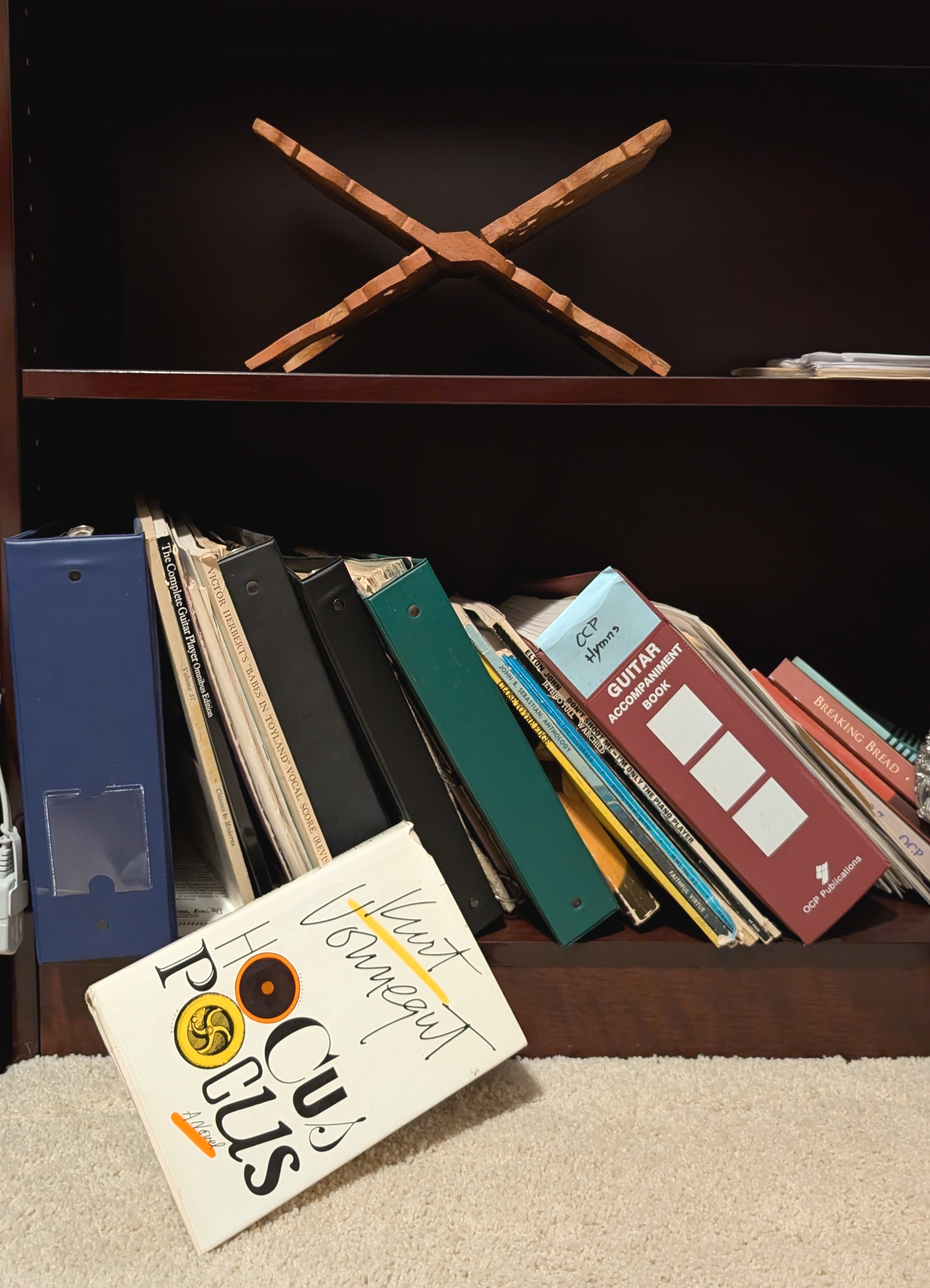
Meanwhile, one of our cats decided to get his paws on some Vonnegut, but apparently became disgusted it wasn’t Cat’s Cradle.
The original shelf for this book is the next one up from the bookstand in the photo. I didn’t even know they could read. December 2024.
A Roman recipe from An Alphabet for Gourmets by M. F. K. Fisher from a collection of her works entitled The Art of Eating:
GARUM (400 B.C.)
Place in a vessel all the insides of fish, both large fish and small. Salt them well. Expose them to the air until they are completely rotted. Drain off the liquid that comes from them, and it is the sauce garum.
Kennedy Fisher, Mary Frances . The Art of Eating: 50th Anniversary Edition (p. 901). Houghton Mifflin Harcourt. Kindle Edition.
Or perhaps it is the cesspool of death that it appears to be…
I’ve just completed reading My Grandmother Asked Me To Tell You She’s Sorry by Fredrik Backman. He’s the one who wrote A Man Called Ove which was made into the movie A Man Called Otto with Tom Hanks recently. It’s a tear-jerking adult fairy tale of a book which skirts the edge of formulaic, contains frequent self-referential passages (which I find tiresome), tells a well-worn tale without breaking any new ground,…and I gave the book a five-star rating. For one thing, I like a pathos-riddled book which adroitly brings tears to my eyes. Mainly, though it’s for two other reasons I gave it those stars. The book re-taught me a lesson about reading (and therefore about life a bit): when you dislike a book (or a person or whatever) because it isn’t what you thought it was going to be, then you’re not disliking it for what it is, you’re disliking it for not living up to your expectations. If those expectations were based on very little, as most of our snap judgments tend to be, then it isn’t the book’s fault. In this case, my expectations were built upon some not-very-specific blurbs which said what the book was ‘about’. I expected a different storyline. Once I accepted it wasn’t going to follow my imagined plot, I realized I liked the book very much. (Had I not, I would have put it down, but with the acknowledgement that I did so based on what it was rather than what it wasn’t.)
Since the blurbs I read led me to expect a book where an adult protagonist runs around Europe delivering letters from her now-deceased grandmother, here’s my blurb, only slightly more accurate and still very vague:
When the grandmother of the “almost-eight-year old” protagonist dies, the granddaughter is charged by her Granny to deliver a series of letters to people from her grandmother’s past. Through this device, Backman weaves together the competing narratives of being someone’s hero and being a shit, and teaches a young, precocious girl that Truth (and Life) lie somewhere between the two. Oh, and along the way he makes a good case for forgiveness and tolerance, fairytales, loyalty, courage, and that anyone can redeem themselves and become a hero.
Me
Other than that, I liked the book for its style which led to some lovely little quotes:
“Only different people change the world,” Granny used to say. “No one normal has ever changed a crapping thing.”
Backman, Fredrik. My Grandmother Asked Me to Tell You She’s Sorry: A Novel (p. 89). Atria Books. Kindle Edition.
Children know that time is just an emotion, so “now” is a meaningless word to them, just as it was for Granny. George used to say that Granny wasn’t a time-optimist, she was a time-atheist,…
Backman, Fredrik. My Grandmother Asked Me to Tell You She’s Sorry: A Novel (p. 231). Atria Books. Kindle Edition
Because life is both complicated and simple. Which is why there are cookies.
Backman, Fredrik. My Grandmother Asked Me to Tell You She’s Sorry: A Novel (p. 368). Atria Books. Kindle Edition.
I wish there were more quotes, but I became too involved in the novel to take time to highlight them. I’ve been gifted some alone-time what with my wife gone for a week, which led me to read hours yesterday and today, which I do too seldom much as I did before adulthood. (True, many would argue about calling me an adult, but I’ve shook them from my boots like the clods they were and kept walking.)
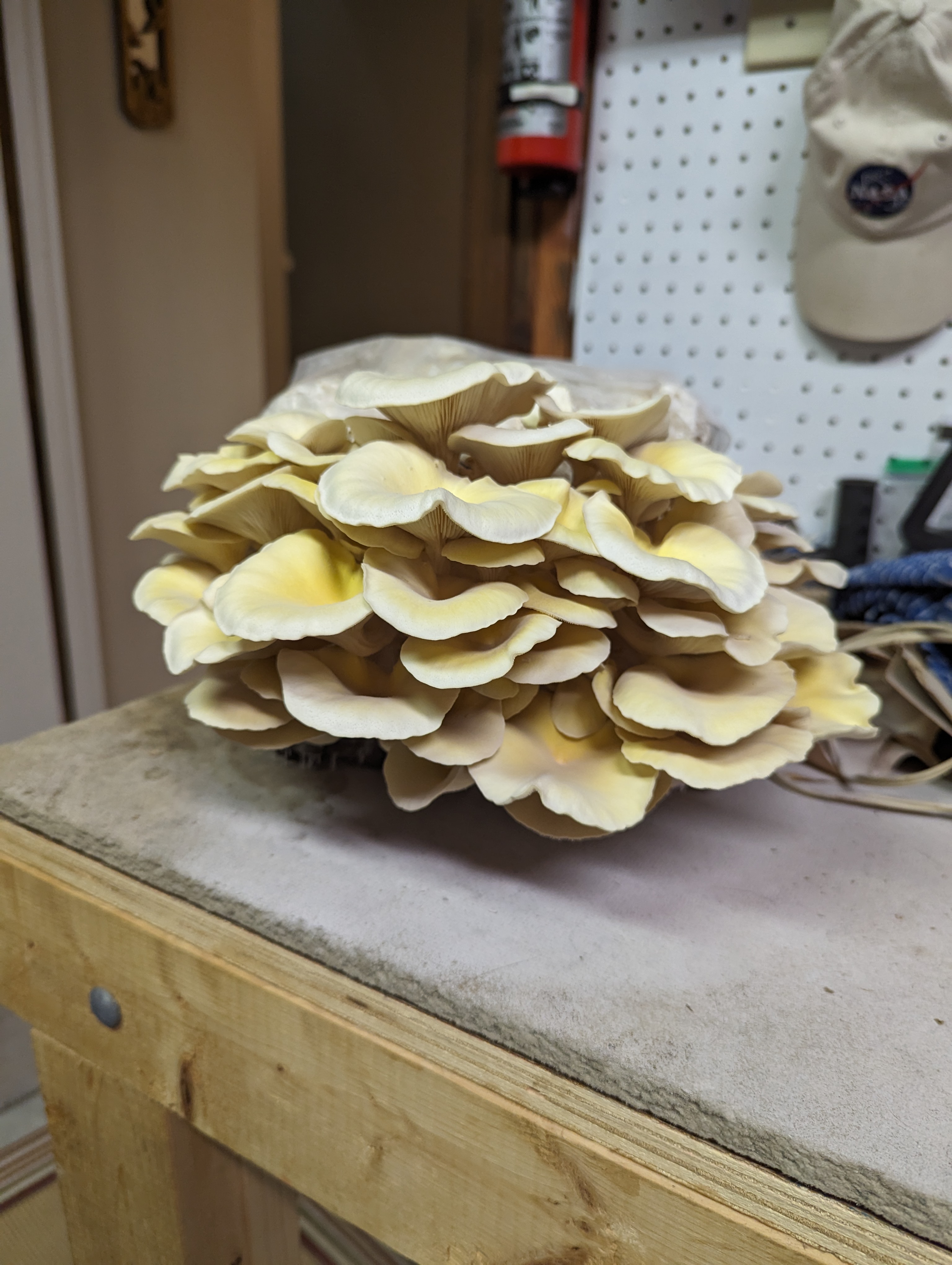
And now, because all posts deserve a photo, here are the mushrooms I’m going to sauté in an hour or two. After the fiasco of the first kit, my purveyors made good with one which burst forth in just seven days and has yielded these fully ripe, ready-to-harvest golden oysters in just 11 days:
Golden oyster mushrooms, at Day 11 + 5 hours. October 2023.
I’ve just finished entering my latest e-book purchases into my preferred library cataloging software, LibraryThing. Entering new books into the library brings joy, frustration, smug self-satisfaction, and fills me with an urgency for and desire to read. I’ve noted before my acceptance for “owning” books which I will never read, that in essence I spend minor amounts of money to reserve a book, for it to sit on my bookshelves real or electronic, to tantalize me and inspire me to read. But why?
Today I’ve 422 unread books. I suppose I’ll live another 20 years. That’s 21 books per year, and frankly I’ve disappointed myself with my slow pace of late. (On the other hand I’ve read 661 books on those shelves. I’m still ahead, right?) The combination of time remaining and still to be read has changed my reading habits. No longer do I tolerate and read mediocre books. I give them a suitable audition then cruelly call “Next!” to them. The definition of mediocre has changed too. No longer does this word represent quality, but rather suitability: perfectly respectable books which just don’t grab me get tossed aside. A good example is Ben Okri’s The Famished Road winner of the Man Booker Prize for literature in 1991. It purported to be the type of book I like, a meaningful fiction filled with magical realism. Yet it became tedious (likely by design) as I endured dream-chase sequences again and again. Finally, after a much longer audition than planned (four weeks), I read a plot summary and realized little of note was going to happen which I hadn’t encountered already. Goodbye, Mr. Okri. Thanks for the entertainment.
I’ve gone through a spate of this. Gore Vidal’s Inventing a Nation proved a sad disappointment after reading Burr and Lincoln, two other books in his loose series on American history. Though I peer dimly through the decades since I read Washington, D.C., from the same series, I remember it with admiration also.
I’ll use a random number generator to select ten unread books from my library to illustrate some points. But first let’s confess to liking some of the children less than others: books are categorized as “To read” but the ones I really want to read also sit in the “To read ASAP” category. Books to consider for my next read get special billing: “The Short List” whose members change with the whims of this reader.
Our first candidate is Gap Creek: The Story of a Marriage by Robert Morgan. It interests me little. I didn’t purchase it (my wife did), it boasts of inclusion in Oprah’s Book Club–not a kiss of death, but smacking of the detraction of populism for sure–and, sadly, because it is a physical book. Nearly all of my books of interest now are e-books, a whole ‘nother topic for ‘nother day. In its favor? According to The New York Times, it’s a “Notable Book” written by a professor of English, and this blurb from the New York Times Book Review intrigues: “At their finest, his stripped-down and almost primitive sentences burn with the raw, lonesome pathos of Hank Williams’s best songs.” (Let us pause and thank the NYT Book Review for properly writing the singular possessive form of Williams.) Chances of being read before I die? Around 25%.
Book #2: A Handbook to Literature assembled by C. Hugh Holman. Another physical book, likely picked up at a garage sale in the 1980s. This is not an anthology of literature as one might suspect from the title, but instead a type of reader’s encyclopedia. In this digital age, virtually superfluous. The fact I own Benet’s Reader’s Encyclopedia kills any chance I would have of reading anything in this book. (Why is it still on my shelf?)
Book #3: Empires of the Word: A Language History of the World by Nicholas Ostler. It promises to dish out a history of all of “the world’s great tongues”. I remain equally an amateur linguist and student of literature. It sounds interesting but one must consider the reading menu. Chances I read it? About 25%.
Book #4: Northanger Abbey and Persuasion from the Oxford Illustrated Jane Austen, volume five. Intellectually I want to say, “sure, I’ve read Jane Austen.” In truth I never have. Just didn’t get assigned in college courses, didn’t break through certain barriers I had as a youth when I read just about anything, and now fights against so many more modern and personally relevant books. On the other hand, I’ve read books from the 1800s to great enjoyment. Why not Austen? I don’t know. We’ve got the entire six volumes of it, plus I snagged Sanditon as an e-book. The chance I’ll read this particular book instead of Pride and Prejudice or Sense and Sensibility or Emma? Pretty much zero.
Book #5: Between Two Worlds (The Lanny Budd Novels Book 2) by Upton Sinclair. Tellingly, I react with, “Oh. That book.” Based on a well-written blurb once, I started collecting the entire 11-book series whenever one would be offered on sale. It seemed like a good idea. Not until I had all eleven did I read book one, World’s End. How disappointing. It made me want to cry or hit someone because instead of writing a story, Sinclair wrote a narrative about a story. Don’t tell me; show me. I’m still trying to figure out how this series could ever be considered as highly as it apparently was about 75 years ago. Chances of being read? 1%, based on the perception that “maybe book two is better than book one…even though I bailed on book one before I was done with it.”
Book #6: Antimony by Spider Robinson, a science fiction anthology of his short stories. I enjoyed reading his Lady Slings the Booze, but he has a tongue-in-cheek style of writing which is clever, not good. Watching someone settle for the easy, quick, and stereotypical would bother me now. The chances I’ll read a bunch of his short stories? About 10%.
Book #7: Writing Down Your Soul: How to Activate and Listen to the Extraordinary Voice Within by Janet Conner. It’s the first book here marked “to read ASAP” because it’s Amazon review quotes at the top, “I am a writer. Today I write.” This grabbed me when I couldn’t ignite this writing life. Now that I’ve done so (thank you, WordPress), I’m kinda turned off by this book. The author “discovered how to activate a divine Voice by slipping into the theta brain wave state…while writing.” Yeah, no. I’m out. And I’m dropping the ASAP designation.
We’re down to the final three contenders and nothing much to show for it…but here’s one at #8: The Ghost Road (Regeneration Book 3) by Pat Barker. The first book in this series, Regeneration, was nominated for the Booker Prize. Ms. Barker felt she had been typecast as a feminist writer so she undertook this trilogy about the First World War. It purports to weave history and fiction with doses of poetry, to throw real and fictional characters into the mix, and to address how war can be terrible yet valuable all at once. I’ve categorized it “To read ASAP”, and I’m looking forward to reading it, 100%.
At #9 we have…a quite intriguing book: My Grandmother Asked Me to Tell You She’s Sorry: A Novel by Fredrik Backman, translated from Swedish by Henning Koch. This is another “read ASAP” book. In this book Backman imagines a “different” 11-year-old girl who connects only with her crazy grandmother. Grandmother dies, leaving letters apologizing to people she has wronged. The granddaughter carries out her grandmother’s wish to have these delivered and experiences the connection between real and fable, experience and stories. I made that up, obviously since I’ve never read it, but I feel as if I have in an abstract sense. I yearn to read the details which underpin this story’s arc. Chance I’ll read it? 100%
Here we are at #10: New American Short Stories 2: The Writers Select Their Own Favorites edited by Gloria Norris. I can tell this physical book has sat on my shelves for 30-35 years as I’ve moved nearly a dozen times. Will I read it? The chances are a bit less than 50% because I’m not a big fan of short stories anymore unless they’re illustrative of a great writer.
There you have it. As a 27-year-old I was challenged by a professor well past her retirement age to consider the judgment of time regarding the “greatness” of an author and of a work. I slowly came around to her idea as I put more years behind me–I know several works which smacked of greatness back then now seem merely good. That’s not to disparage them, but they seem embedded in their time, incapable of providing the illuminating experience which truly great works command. Some recent (past 100 years) authors exist there already: Jose Saramago, Carson McCullers, Italo Calvino, Lawrence Durrell, Jim Harrison, Ernest Hemingway, and Gabriel Garcia Marquez to name but a few. Some contemporaries–F. Scott Fitzgerald, Donald Harington, Hortense Calisher, Annie Proulx, Neal Stephenson, John Irving, and the just mentioned Fredrik Backman–must wait until the jury renders its verdict, likely not in my lifetime. We read, though, for our own enlightenment, our own enjoyment, and our own sense of needing to connect with more than we are. We write for those same reasons. We need make few, if any, excuses for reading or writing the works which will do that for us.





 all the voices in my head