Bibliophilia: translation

Le Ton Beau de Marot, purchased in a shiny-covered form.

Having published a book review just an hour ago, it seems fitting to revisit my Bibliophilia series with what amounts to another review. Le Ton beau de Marot: In Praise of the Music of Language by Douglas R. Hofstadter impressed me to such an extent that I purchased another when I lost the book to a less-than-responsible work friend. For nearly a decade it bothered me that I couldn’t pick it up and show it to people when I said, “you’ve got to read this!” Finally, having purchased Hofstadter’s Pulitzer Prize-winning Gödel, Escher, Bach: an Eternal Golden Braid (which has proved so dense I’ve never finished it), I tracked down a used version of Marot from a bookstore in Santa Fe, NM. (I necessarily bought it used because it apparently was out of print.) It’s inching its way up the Read Me list, probably gaining the top position in 2026. But why gush about it? To answer that, I must detour to 1999.

In July 1999 my wife received news that the lump in her breast was a benign cyst, nothing to worry about. A little over a month later she received word that the tests had been mixed up and that she actually had cancer. This occurred on her birthday. After three surgery procedures in September, we took a vacation to the Oregon Coast just one week prior to her beginning the chemotherapy regime. We stayed in a wonderful condo on Yaquina Bay at Newport, OR. When we left, we took a leisurely drive up Highway 101 along the coast all the way to Astoria before turning east the next day toward home. Shortly before we arrived to Astoria we stopped at Seaside when a largish bookstore caught our eyes. There I found Hofstadter’s book. Loving language, I read the flap, learned it took up the challenge of translation, and that it also touched many other topics. From the flap:

…he not only did many of his own translations of Marot’s poem, but also enlisted friends, students, colleagues, family, noted poets and translators—even three state-of-the-art translation programs!—to try their hand at this subtle challenge.

The rich harvest is represented here by 88 wildly diverse variations on Marot’s little theme. Yet this barely scratches the surface of Le Ton beau de Marot, for small groups of these poems alternate with chapters that run all over the map of language and thought.

Not merely a set of translations of one poem, Le Ton beau de Marot is an autobiographical essay, a love letter to the French language, a series of musings on life, loss, and death, a sweet bouquet of stirring poetry—but most of all, it celebrates the limitless creativity fired by a passion for the music of words.

What the flap only hints at I learned later. During the time Hofstadter gathered his many translations by consulting all those people, his own wife was dying of cancer. Thus, his “musings on life, loss, and death” dive deep into his soul and therefore ours. Add to that my own wife’s tussle with cancer—she won, unlike Hofstadter’s wife—and the work compels. As I worked my way through the book, I found it dealt with language at a very basic level some of the time: how do we mean things? How does one language differ from another? How does cognition play out in word choices? And on, and on…

When I finished it, I felt Le Ton beau de Marot had been one of the best books I’d read because it didn’t just deal with language or cognition or love or translation or meaning or any other of those things mentioned above. It dealt with all of them! I loaned the book to a co-worker whose daughter was headed off to college to pursue a degree in English and who wanted to be a writer. I undoubtedly didn’t make it clear enough that one day I expected the book back. When I handed it off, though, I held back my gloss notes, which instead of writing into the book I had written out on fine paper. (They were too extensive to write into the margins anyway!) The book meant so much that I still have the notes a dozen or more years later. Here’s one:

[p. 138-139] I would side with Frost, that poetry is what’s lost in translation. Not that it can’t be re-discovered in the new language, but it’s not the same poem. Thus the poet-translator is intent on supplying a twin, not the real thing.

Hofstadter’s work combined with my college readings on communication, media, and meaning to form my personal philosophy and understanding of all types of translation. I “see” the issue of meaning more deeply than many I engage with when discussing how a work translates from one language to another, how people in different cultures perceive things, how books become movies and vice versa, even in how Superman or Batman is translated every decade by a different director all of whom seemingly work from the same “text”. I even see the problems of translation as one of the issues currently plaguing United States politics.

Hofstadter’s book satisfied on so many levels, engaged so many pleasure neurons, that I can’t do it any justice. You’ll simply have to read it yourself if you love reading about language and the problems of translation…and cognition…and…

Bibliophilia: literature anthologies

OR, “I’M STILL WORKING ON MY COLLEGE READING ASSIGNMENTS!”

Literature anthology texts, college and otherwise. July 2025.

College literature texts resemble the reading equivalent of eating at an upscale buffet restaurant. You know the food will possess decent quality, but you don’t expect one of those “oh, wow, go get the chef!” moments. On the other hand, you know it isn’t Golden Corral, there won’t be questionable entrees and a lack of things which resemble lovingly prepared food. It’s therefore a safe, pleasurable experience you look forward to, but not too much. So too the literature anthology, usually targeted to college freshman and sophomores, aims higher than 50 Romance Stories For The Modern Lover but the reader doesn’t usually expect anything challenging or inclusive. There can be exceptions which prove pleasant. Sometimes, particularly in those early college years, one experiences surprises less pleasant: “But I thought that was a great story, professor!” ran through my mind a few times when my instructor somewhat condescendingly told us a piece we’d just read “was at best, B literature…good, but not great.” No matter. Turn the page. There’s something potentially better at the next station of this literary buffet.

As I’ve ditched books along the way, including texts which seemed useless for the future me, I’ve clung to nearly every anthology I’ve come across. In fact, as a teacher of English for 8th graders from 1983-1992, I accompanied my then-wife to garage sales specifically buying the college texts of other people to flesh out a reference library. In the days before e-books and a true Internet, I either had to seek these texts out from various bookstores and mail order outlets (at full price) or pounce on jewels sitting in the dross of some middle-ager who realized, “why am I carting this book around anymore?” I’m not sure, but I think I’ve only cut the ties with one, The Sagas of Icelanders, and technically it’s still in my house so have I really let it go? It’s categorically called “Purged” and fair game for donating/selling.

Let’s discuss what’s on the shelf above:

  • Quality Paperback Book Club rescued me when I found myself in Colville, WA, in 1983, a city of 10,000 souls 75 miles from any true city of note, and yet the largest city to the east or west for hundreds of miles. One of the final books I purchased from them before bowing to the Power of the Internet was the QPB Book of Irish Literature (copyright 1999). Beginning with Edmund Spenser and Jonathan Swift, it runs through “The Sheridans,” “The Wildes” (yes, including Oscar), and “The O’Faolains” while picking up George Bernard Shaw, W. B. Yeats, and James Joyce along the way. The latter is represented by the full inclusion of “A Portrait of the Artist as a Young Man.” Samuel Beckett has three entries including a slice of the play Waiting for Godot. A nice touch for a modern anthology was the inclusion of Nobel Prize-winning poet Seamus Heaney. I’ve selectively read throughout the 900+ pages.
  • The Norton Anthology of English Literature remains one of the classics for this genre, and I had to have it when I found it. My college text is two books more to the right, The Norton Anthology of American Literature. The condescension of a country with about 2000 years of literary achievement can be seen here: I have only Volume 2 of the English literature, but the shorter work, American Literature, represents all of what the Norton editors consider representative and worthy.
  • Between the two Norton collections lies a silly conceit, fifty great short stories, a humble paperback which I’ve never read. So sue me.
  • Another book I’ve never read, but have consulted, is Adventures in American Literature which appears to be volume 2.
  • A Handbook to Literature caught my eye because it isn’t an anthology, but an alphabetical listing of literary criticism terms and themes, genres, theaters, and poetry scansion terms. Unfortunately for this book, I now realize it’s as useful as Benet’s Readers Guide which is “not at all” in this day of AI and the Internet. This book will not be rejoining the shelf. Sad.
  • The observant person in looking at the above photo will have noticed there are two books with the same title and author: Literature: Structure, Sound, And Sense by Laurence Perrine and in the case of one, Thomas R. Arp. The white-spined edition, the third, guided me through more than one course at Eastern Washington University which seemed to have taken pity on the budgets of its students and used it for both prose and poetry courses…or maybe my memory is faulty. I find it difficult to believe I’ve lost track of the text we used for the poetry class. The wine-colored is Perrine’s 6th edition, this time in collaboration with Arp. Not only does it have a significant number of different selections, but the best part for me? It was bound upside down! One looks with a slight smile at the cover, proud to have purchased one of the first texts ever in what will, of course, be a glorious college career, and then opens the book. Okay, we knew we purchased a used book, so Marc’s name inside the cover is okay. Wait, what’s this? The final page of the index? Upside down? Oh yeah, I would’ve bought the book even if I had no other interest in it.
  • The two black-colored spines toward the right end of this display belong to The Oxford Anthology of English Literature. In my world, both then and now, if it says “Oxford” it’s an immediate buy. Ironically, I’ve read not a word of either. I took a course in Medieval English literature at the University of Washington which had us buy individual copies of those significant works; reading the Oxford would be redundant. Plus, I’ve recently purchased J. R. R. Tolkien’s translation of Beowulf (and other works) which will take precedence in my hierarchy of reading. Perhaps I will one day compare the works in The Restoration and the Eighteenth Century to The Norton Anthology of English Literature to see what differs. Or not. There are hundreds of books to read, after all.
  • Which brings us to our final volume, The Treasure of American Short Stories. I’ve read selectively from this book, but it’s mostly redundant to the Norton one on American literature.

Part of our satisfaction for holding onto these types of books—and I know some of you didn’t even question that statement—lies in the combined meaning of memory and potential. We look at these books and they evoke our time so long ago when we sat in uncomfortable chair-desks, taking notes (or not), and experiencing aspects of literature for the first time. Decades later, discarding those memory-tokens seems almost sacrilegious. We turn then to the argument of potential: “I think I might still want to read some of these.” Hence their place still on my shelves, 40-50 years after I purchased them.

Monet, trampled and redeemed

Tonight
Our cheap Monet poster
mounted on Styrofoam--
bowed, faded, purchased for
$2 at a garage sale,
displayed for three years,
neglected for eight—
finally found purpose again
covering Ethernet cabling
which carries premium network
signals from one room to another.
As I walked across it, I said,
"Sorry, Claude. Such becomes of genius."
Another Monet bites the dust.

Guest poetry

Charlie, seen here two weeks into his stay with us, and letting us know that warm laundry out of the dryer is for sleeping and nothing else. January 2016.
A MOTHERS DAY GREETING
by Susan Pilcher

The cat blinked once,
The cat blinked twice,
'I love you, Mom.
That should suffice.'
Benny adds, “…and luggage…luggage is for sleeping also.” May 2021.

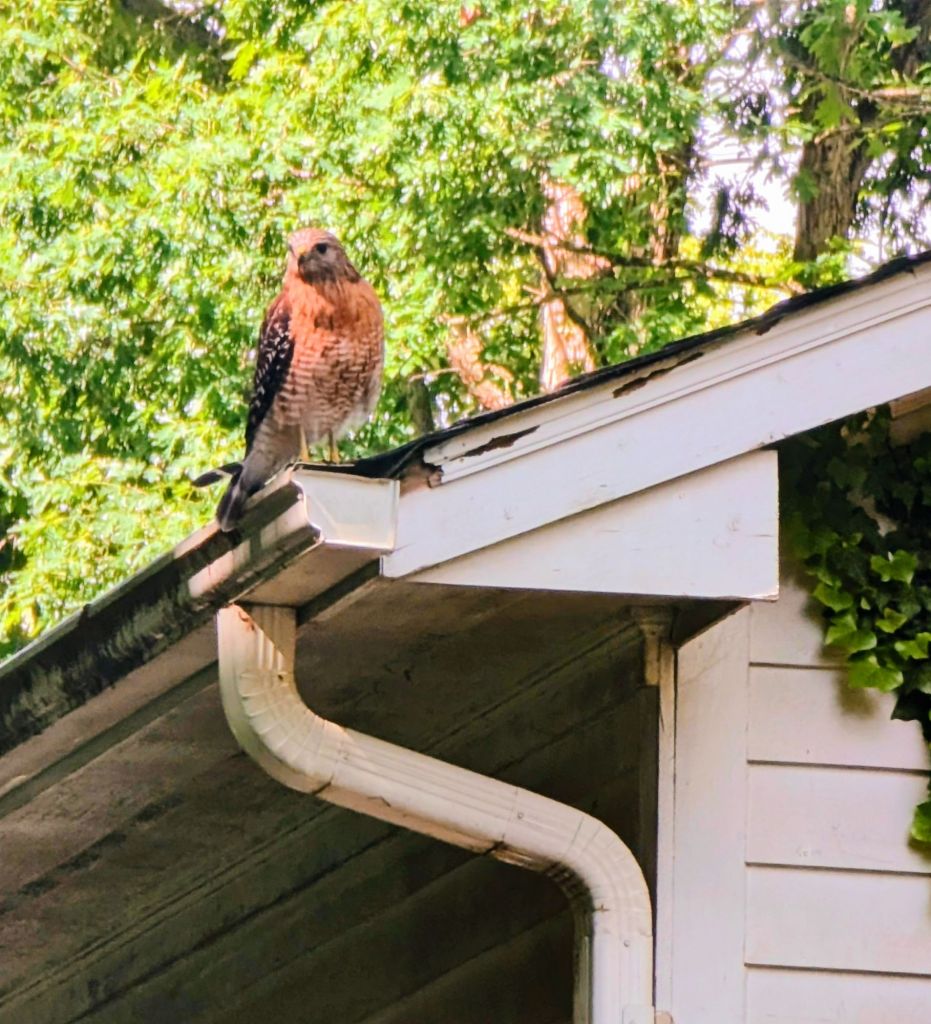
A hawk visits

The neighbor’s roof. Red-shouldered hawk, Raleigh, NC. May 2025.
A hawk stopped by
Here yesterday
I learned of him
From angry jays.

He acted like
He couldn't hear,
Though jays buzzed by
His perch so near.

Resigned, he jumped
To fly away
Flapped once, twice,
And sailed away.

is that you, Covid?

gums ache
teeth want out
bones seethe,
agitate,
fight their neighbor—
"just get me out!"—
eyes pulse painfully,
echoing sinuses behind them

"how can this freakin' test
say negative!"
Oh.
Just a bad cold:
grab the Kleenex, drink
fluids, cough, hack,
sneeze—do it
again.

Bouncin' back,
yessiree! And...
...what just blindsided me?
Can barely move. And
testing says...
[15 minutes, please]
positive?
Oh...,
oh.
oh.

Rite of Reconciliation

The trees of Monumental Mountain, outside Colville, WA. October 2019.

Mother died this way:
Her eyes snapped open
unfocused, scanning,
finding no one. Then,
she passed.

Mother died this way:
Her labored breathing
eased for a moment.
She smiled.
She passed.

Mother died this way:
Coma-tized with
narcotics, drowning
lungs filling up.
She passed.

I wasn't with Mother.
I don't know. In another
room I talked quietly by phone
to Mother's cousin,
re-entered to find Mom gone.

I suspect version three,
fear number one,
want number two.
They've entwined my thoughts
for years. Always will.

Rhyme time

St. Lawrence Seaway, NY. September 2005.

I took my tumble into poetry when I returned to college in 1981 for an English Education degree after four years spent writing and editing weekly newspapers. We were required to pick one of three concentrations: Literature, Composition, or Linguistics. While we were expected to take classes in all three areas, the majority of our coursework would occur in the concentration we chose for our major. I already possessed a degree in Communications (with a concentration in Journalism), so I chose Literature. It seemed to be the most useful choice between that and Linguistics. I don’t recall how many courses in poetry I took; I presume it was two plus I had a class in Shakespeare. (As part of my Communications degree I also had taken a course in Medieval Literature which is as much poem as prose, in my opinion.)

I remember my poetry professor as a grandfatherly figure: white hair, thick glasses, dressed always in a button-down shirt and a thin cardigan sweater. He wasn’t pedantic; rather he sought to lure us in to the beauty of poetry, slowly instilling an appreciation for the nuances which one poem achieves perhaps a bit better than another. He taught the meaning of the word “scansion” and how to do it. He taught us the formal structures of historic poetic forms, such as the various forms of sonnets. I distinctly remember he appreciated but ultimately relegated to B-status the poems of Henry Reed (“Lessons of the War: I: Naming of Parts“) and A. E. Housman (“Terence, This is Stupid Stuff“). He attempted to relate a continuum where doggerel existed on one end and truly sublime, great poetry existed on the other. “There is a difference between verse and poetry,” he insisted.

A while back I wrote a poem about why I don’t often write rhymed poems. Too many of the poems I read online from those who fancy themselves poets barely nudge the needle from where it pegs at “doggerel”. It’s down here at this end of the spectrum where we read “cowboy poems” and such. Rhymed poetry doesn’t have to be doggerel or its cousin, trite whimsy. I hope my poem might exist in the middle ground, somewhere between a clerihew and Housman’s “Terence”. Here’s the beginning of the latter:

"Terence, this is stupid stuff:
You eat your victuals fast enough;
There can't be much amiss, 'tis clear,
To see the rate you drink your beer.

My barely informed opinion about rhymed poetry? Look to Shakespeare who crafted his poems to specific rhyme schemes, with specific metric schemes which must scan appropriately. Another, more modern poet who understood how to write a poem which rhymed is Robert Frost. Here’s an example, to be discussed below:

Locked Out
(As Told to a Child)

When we locked up the house at night,
We always locked the flowers outside
And cut them off from window light.
The time I dreamed the door was tried
and brushed with buttons upon sleeves,
The flowers were out there with the thieves.
Yet nobody molested them!
We did find one nasturtium
Upon the steps with bitten stem.
I may have been to blame for that:
I always thought it must have been
Some flower I played with as I sat
At dusk to watch the moon down early.

(as transcribed from Robert Frost: Collected Poems, Prose, & Plays [The Library of America])

Is this a great poem? No, but Frost tells a small tale easily, conversationally, with rhymed words. He warns us in a sense by titling it “as told to a child” and keeps the central thoughts of the poem simple. And what’s this? He chooses not to rhyme the very last line? Doesn’t that just punch it up all the more? Great poets reveal their hand even when the poem isn’t truly great. Looking deeper, I’m reminded how just as adults get nuances out of ‘children’s cartoons’, we gather meaning in passing from lines like the first three lines. A child would take it simplistically, but we consider the symbolism of locking up all that is natural outside of ourselves, of shutting ourselves off from beauty, of starving the fair flowers of our existence from the light of our presence. Frost uses the tenth line (“I may have been to blame for that”) to zing us with a perfect iambic (dah-DAH) tetrameter (four of ’em). To my mind, it hurries us through the line as if the narrator feels a bit guilty that his inadvertent playing with a flower has been used to invoke a threat of thieves to a small child.

Those are just a few thoughts which occur to me in looking at this poem again after first reading it about a week ago. Look, I understand we’re not all four-time Pulitzer Prize winners. But can’t we at least try? Must we succumb to “My boyfriend left me/I’m feeling blue/I’ll leave the country/Now that we’re through”? Just as a prose thought can be made meaningful by converting it to poetry, consider if your poem isn’t so mundane it ought to be simply stated as prose. Making four lines rhyme A/B/A/B shows about as much skill as photographing a sunset and thinking you’re a great photographer just because you captured a glorious sight made-to-order.

I applaud the poets I read online who use blank, free-form verse yet hew to ideas of tune, rhythm, compression, precise word choice, and who frankly have something worthy to say. We can’t realistically dream we’re rhymers like Frost, or poets laureate like Stanley Kunitz, or poets-for-the-ages like Dante Alighieri. But…we can try.

The trees blushed

Blushing tree. October 2023.
The trees blushed last night,
embarrassed they're leaving so
soon, like those party guests who
upon seeing John sit at the piano while
another round gets ordered, reach
quietly for their coats, murmuring,
"we have an early morning"...

BE! (be)

Monroe, WA. 1978.
Be!
Dot-unique,
singleton
on Life's plane.

Dance!
Tip-zipping
laser beam
on Life's wall.

Shout!
Bellow-strong
carrier sound
o'er Life's noise.

Be...
Amorphous,
substantially
less than fog.

Dance...
Molecule
between droplets
hung in fog.

Shout...
Your whisper
sound-dampened by
Invisible fog.
Monroe, WA. 1978.