Crape myrtles…

…or crepe myrtles if you prefer…seem ubiquitous here in Raleigh, NC. From what I read and hear they’re throughout the South, though I haven’t paid enough attention while driving through our neighbor states. Crape myrtles take their time, slowly becoming substantial trees of a type called thicket trees. They can be well-tended and trained, as this one is:

With care, the trunks grow together. Raleigh, NC. July 2025.

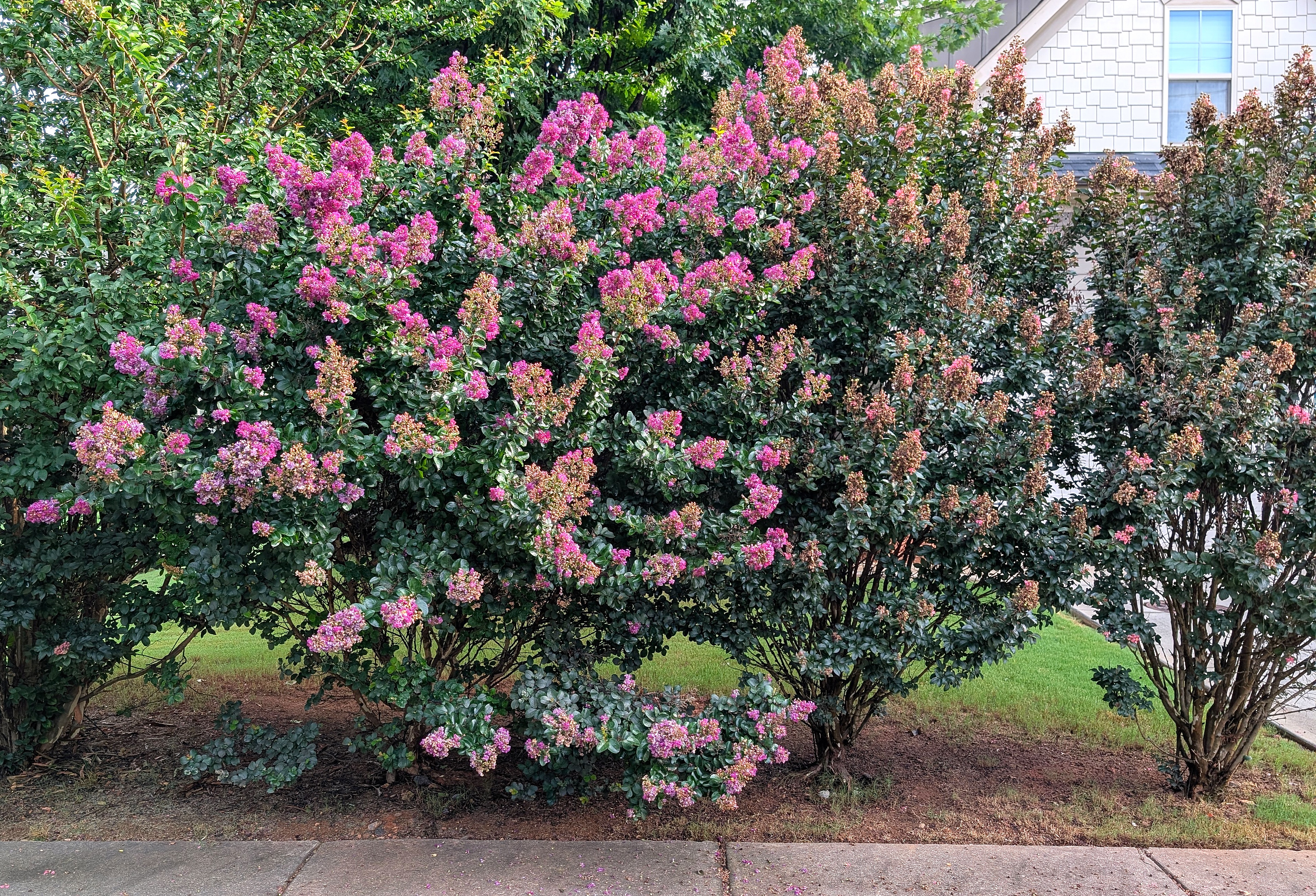
Usual care involves letting them grow as they will, but pruning suckers and sometimes trimming the tops to shape them:

Crape myrtle with usual thicket look and showing white blooms. Raleigh, NC. July 2025.

Crape myrtles are everywhere here. The photo above is across the street from the first photo. The thicket-trunked myrtle in the foreground has a substantial myrtle right to its left, the one with a more substantial trunk. Follow the sidewalk and you’ll see two more, smaller (younger) crape myrtles flowering. These last two demonstrate the variety of the approximately 50 species of crape myrtle (or are a particular cultivar of one):

Younger, different crape myrtles. Raleigh, NC. July 2025.

Crape myrtle are maintained by the City of Raleigh in the decorative medians:

Three “City” crape myrtles at the end of my street. Raleigh, NC. July 2025.

To me the Ultimate Crape Myrtle lives in my neighbor’s yard. Its branches extend from the edge of the sidewalk and tower over her house. It’s at least 30 feet tall. Someone appears to have pruned a few suckers in its youth, but mostly it’s been left to its own.

Crape myrtle in neighbor’s yard. Our white car and yard in the background. Raleigh, NC. July 2025.

And then there are our crape myrtles. Ours were planted sometime between 2007 and 2014 (using Google Maps Street View), with the most likely time frame being 2010-2012, a period when the former owners rapidly changed the landscaping and interior of the house. The myrtles probably were purchased as saplings, and have doubled in height for the eight years we’ve lived here. For reasons I suspect have to do with amount of sunlight and my utter lack of any care beyond occasional pruning, they flower very late. I suspect sunlight because my other neighbor has three, also near the sidewalk, which haven’t bloomed yet either. In the photos above you might have noticed most of the myrtles nearing the end of their blooming period. Ours?

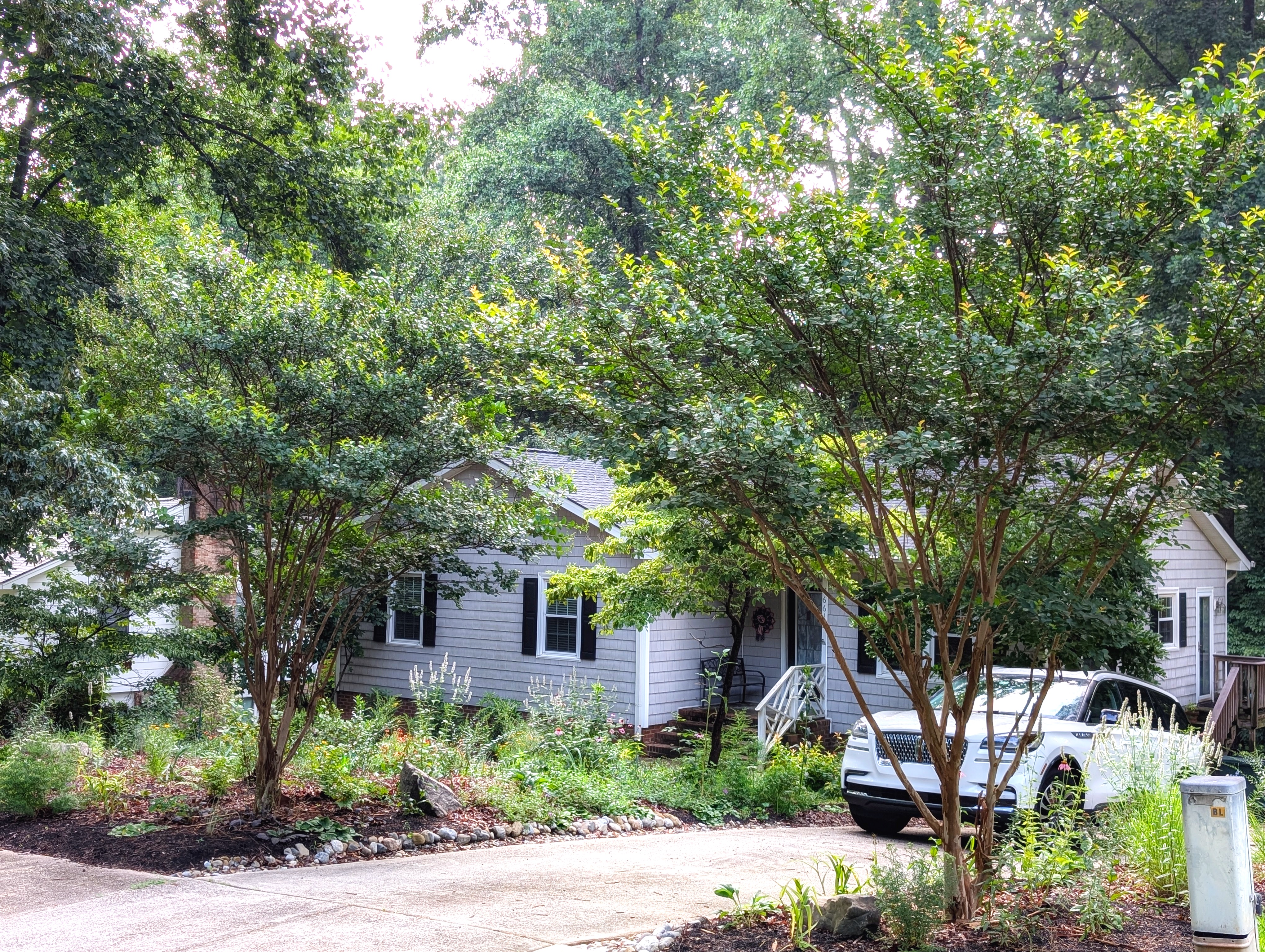
Our two crape myrtles, either side of the driveway, not blooming. July 2025.

But here’s the thing: though closely identified with the American South, they are not native to it. To quote the NC State University’s Extension Gardener website, “[Crape myrtle] is native to the Philippines, Japan and central Himalayas to southern China and Indochina.” Our whole move the past 12 months has been to replace everything in the front yard with native plants. (note that in the photo above) After a year of debate, and many years of saying, “Maybe they will bloom better when they get bigger,” we’ve decided to replace them. (Sorry, former owners. Consider it payback for removing that big tree in the front yard and not properly having the stump ground. I nearly broke my ankle in that mess many a time.) On one side will be an ‘Amethyst’ witch hazel which blooms in winter and very early spring. (Photo here.) On the other side will be a serviceberry. It mimics the look of a crape myrtle with the multi-trunk growth, but it will provide berries for birds and other critters.

All right, I’m craped out.
Clouds from the ground

My first photo at Volcanoes National Park: a steam vent on the edge of the Kilauea crater. September 2024.

The island of Hawai’i could be called triangular. The west coast roughly runs north to south. From its northern tip, though, the coast runs northwest to southeast. Then from that easternmost point it runs northeast to southwest to join up with the west coast. Situated inland from the southeast-facing coastline lies Volcanoes National Park. Volcanoes presents much more than just dormant craters. Its most active feature (inland) turned out to be the first thing we saw: steam vents. Craters? I found their vastness difficult to comprehend.
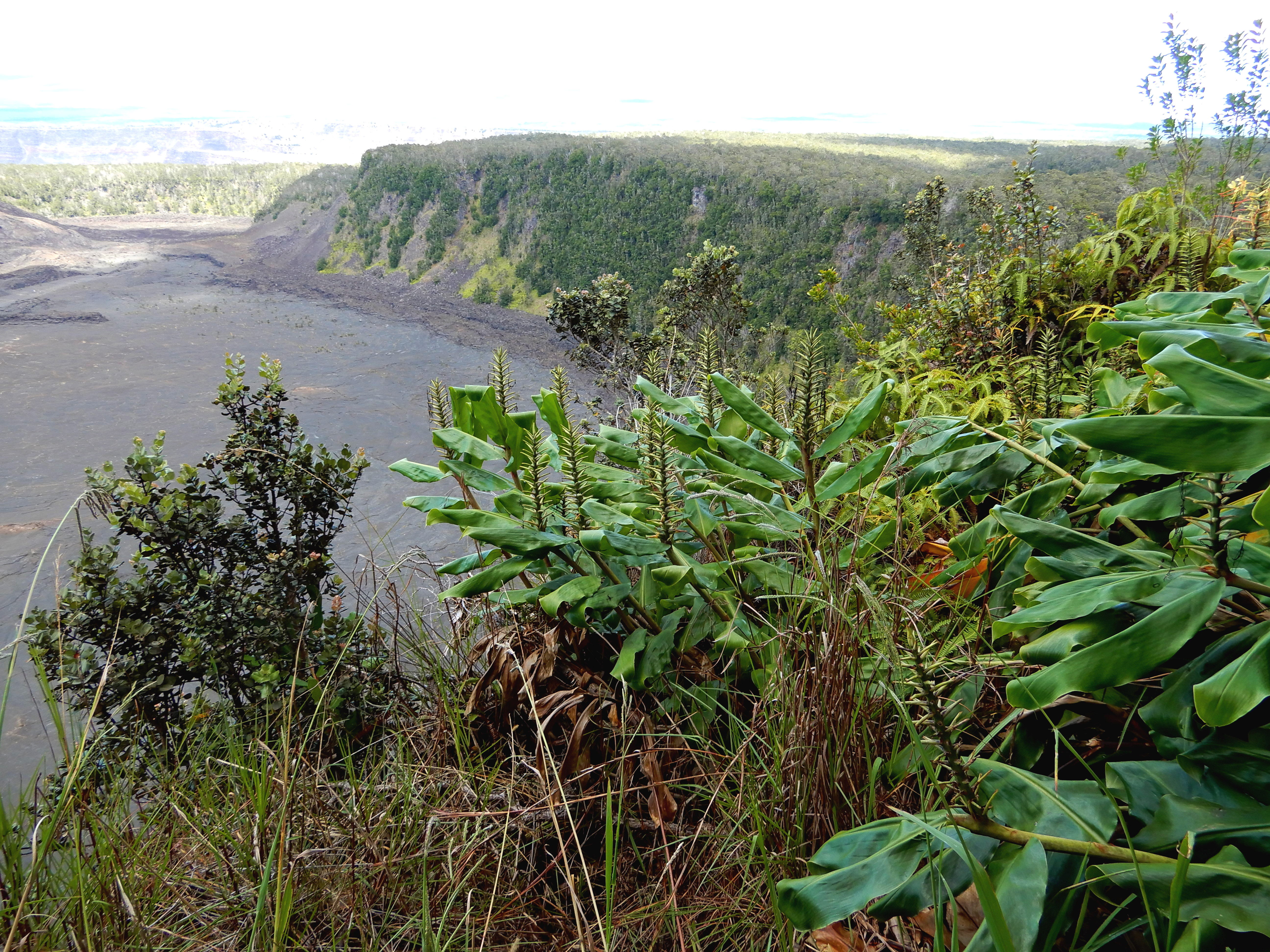
Kilauea from steam vents on north rim, looking southwest. September 2024.

I’m not even sure the photo above shows only Kilauea. I see “Hale Ma’uma’u Crater” on the ol’ Google Maps. Lava flowed in 1919, 1921, 1954, 1959, and on and on I would guess. I paid little attention to information, so I’ve only myself to blame! Seeing it seemed more important than reading about it on signs, the internet, pamphlets, and the like.

Trade winds blow northeasterly toward the park. There are dry plains inland, but plenty of slopes catch the moisture. Plant life abounds there. Even in this dryness:

On the edge of the steam vents. Volcanoes National Park, September 2024.

Where the rain can fall, things change rapidly. Just a few miles away from the photos above…

Kilauea Iki Overlook trail. Volcanoes National Park, September 2024.

Eventually I realized this incredibly wide circle we were tracing surrounded a ‘family’ of volcano craters. We continued past many tantalizing side trips, acknowledging our (a) laziness, (b) general physical un-fitness, and (c) certain time constraints. Turning off of the Crater Rim Drive where it intersected Chain of Craters Road–further westward travel was blocked–we traced the path of lava flows to the ocean.

Approaching the coast in Volcanoes National Park. September 2024.
Where lava meets the sea: Holei Sea Arch. Volcanoes National Park, September 2024.

Now that I know more about this park, I would go back to look into lava tubes, to hike a bit here and there, to see if some of the roads had opened up, and to maybe hike down into a crater…maybe. It looked kinda boring to be truthful.

‘Yep, the rock looks just as black down here. Why did we hike down here again?’ Volcanoes National Park, September 2024.

It all impressed this guy who grew up with the volcanoes of the North Cascades, a far different kind of thing.

Old Mamalahoa Highway

Our rental car, trees, vines, and a curve on the Old Mamalahoa Highway. The Big Island, HI. September 2024.

If you find yourself on the Big Island, and most especially if you stay on the east side in or near Hilo, a must stop (for the physically fit) is Akaka Falls State Park. As you head north to that park–only 15 miles distant, a very easy drive–just past Paukaa you’ll see a typically yellow/orange/ochre, diamond-shaped highway sign telling you that to your right is a “Scenic Highway” with a little sign beneath that says it’s four miles in length. Hopefully someone in your car (perhaps you?) will say as my wife did, “Let’s take that!” When you jerk the steering wheel to the right in the Papaikou census area (pop 1314), you’ll be on the Old Mamalahoa Highway.

These aren’t my best photos. Skies were overcast. Dense tropical foliage made it dark everywhere. Green predominates. The road twists, turns, offers few places to just pull over to grab a photo.

Halfway in we stopped at the Hawai’i Tropical Botanical Garden. It looked interesting, and it had restrooms. Our interest waned when faced with admission prices of $30/each and the prominent display of mosquito repellant for sale right beside the register. Translated from “customer-eze”, the signs basically said, “You’re a fool if you don’t apply repellant.” I’m sure it’s a wonderful point of interest: it features a valley down to the ocean with 2,500 species of plants. Nevertheless, we drove on. We stopped soon after when we found a bridge and a wide spot to pull off the road.

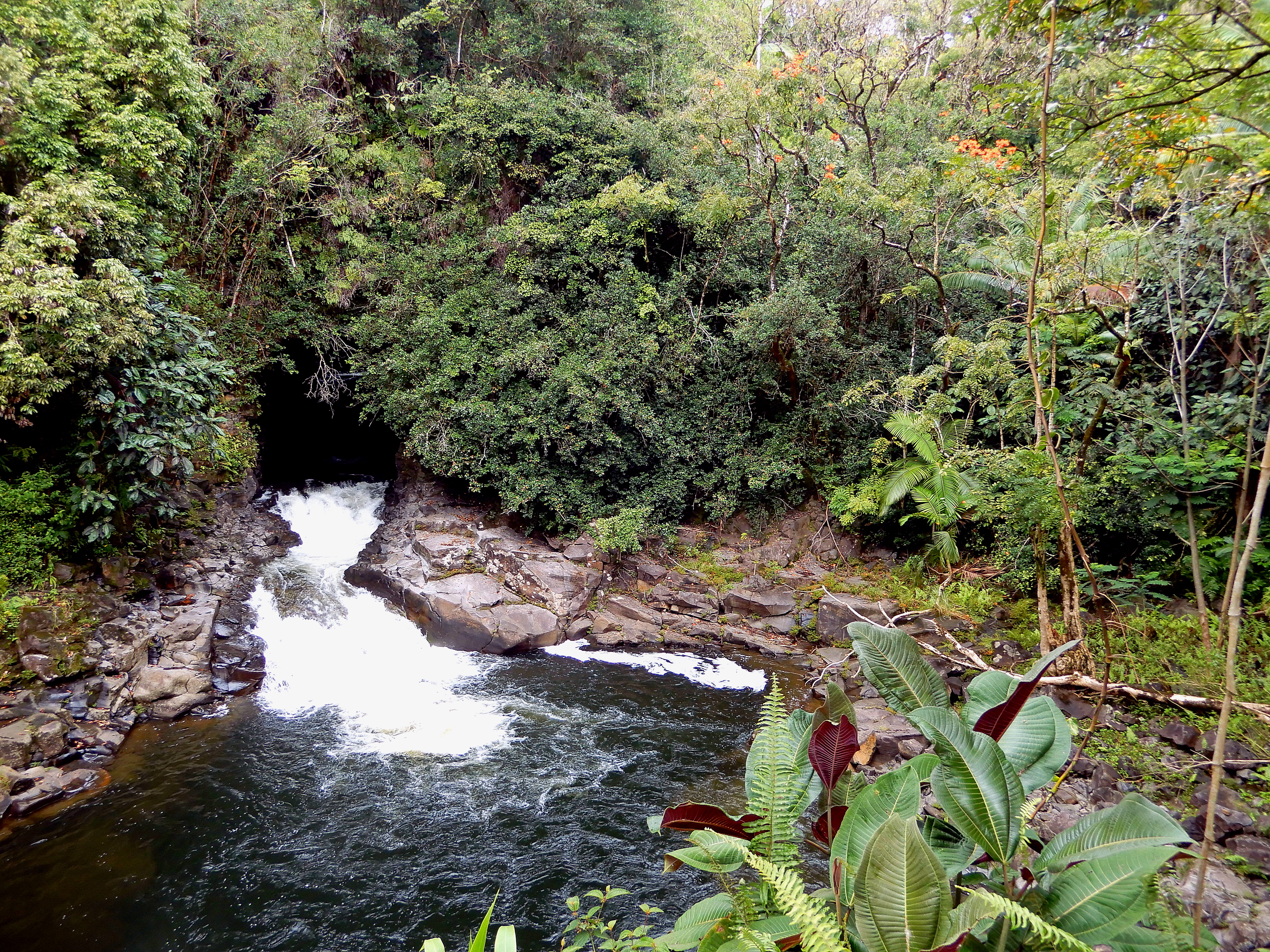
Kawainui Stream, Big Island, HI. September 2024.

I had become fascinated by a orange-red flower growing high in the canopy. At this stop we found ourselves above some of these trees, permitting me to photograph them:

Big Island, HI. September 2024

Driving north as we did, one suddenly pops out of the dense foliage and into a grassy pasture area on the edge of Pepeekeo. Joining the main highway, we drove on to Akaka Falls.

Fall, y’all

Like so many things in the American South, the arrival of autumn takes its own sweet time. I should say “fall” also because at two syllables, both of which have a “u” in them, “it “autumn” just seems a bit pretentious here. Our first inkling summer is nearing its end (besides a simple look at the calendar) occurs when “someone turns the humidity off” as a former boss of mine put it. (He was from Michigan.) Humidity levels build quickly in early June, and by mid-month your A/C chokes on the amount of water it’s removing from your indoor atmosphere. Around Labor Day a similarly rapid decline in humidity takes place. It seems even quicker than the ramp up because the lack of humidity means heat no longer lingers around all night, ready to leap into action at dawn. Instead of staying in the high 60’s and low 70’s suddenly one’s body registers temps that are downright cool at dawn. What follows seems like a coda to the summer, a time of 72-80 degree weather, mostly sunny weather, and dawn temperatures in the low 50’s.

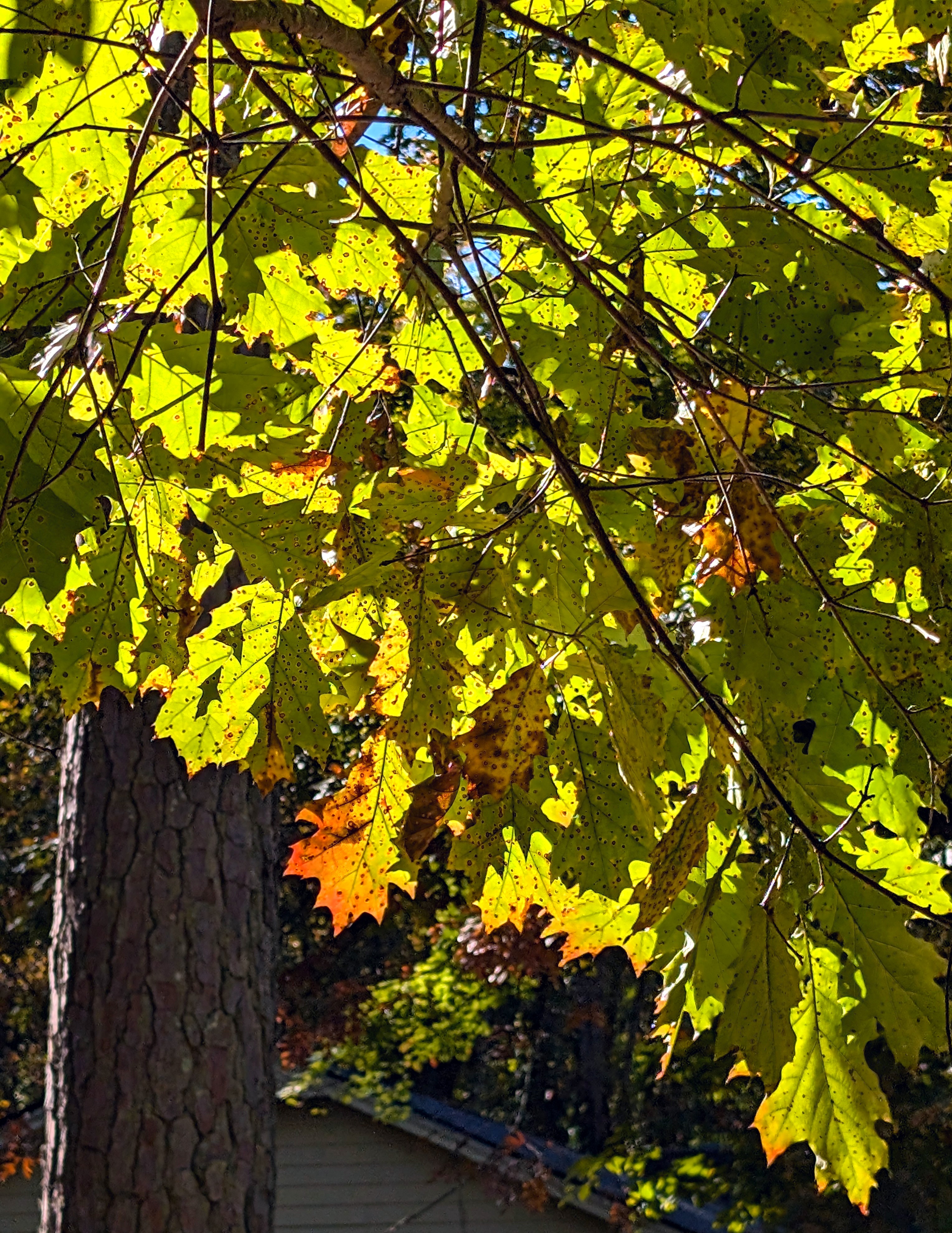
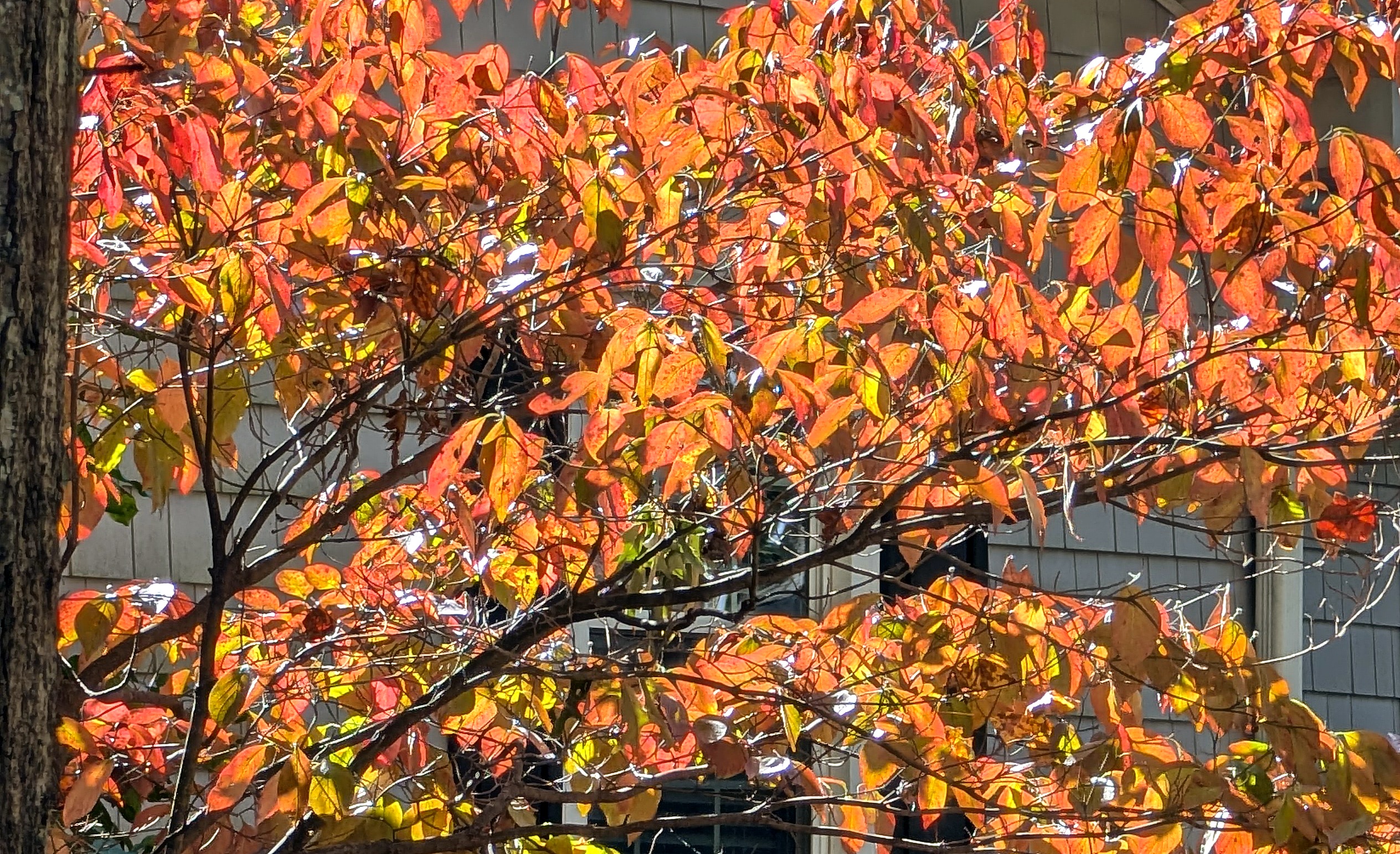
For me fall can be said to be truly here when leaves start to turn color. Except for stressed trees and shrubs, this usually occurs around the second to third weekend in October. Even then it’s a slow, drawn out affair. This cluster of leaves seemed representative to me. We’re in the last week of October, and the trees reluctantly turn various colors dependent on species.

Fall in Raleigh, NC. October 2024.

We arrived home Monday after a quick dash north for a wedding, when I realized, “Hey the dogwood is really turning color.” One of the first to herald spring with its blossoms, and one of the first to leaf out, it’s also one of the first to say, “Nope, gettin’ a mite too cold. Goodbye.”

Front yard dogwood. Shaded trees in back a more dusky red. October 2024.

And finally this photo to illustrate the sadness of invasive species. The Virginia creeper is native to central and eastern North America. It knows that it’s fall here. The English ivy isn’t native to North America at all. The latter will hang around nearly all winter, and in milder winters I believe I haven’t seen it turn colors at all. It chokes out most undergrowth if allowed, and it adds weight to trees if allowed to proliferate. It creates an eco-desert.

Tree with ivy and creeper, L foreground; tree with mostly ivy center. October 2024.

True thoughts for false spring

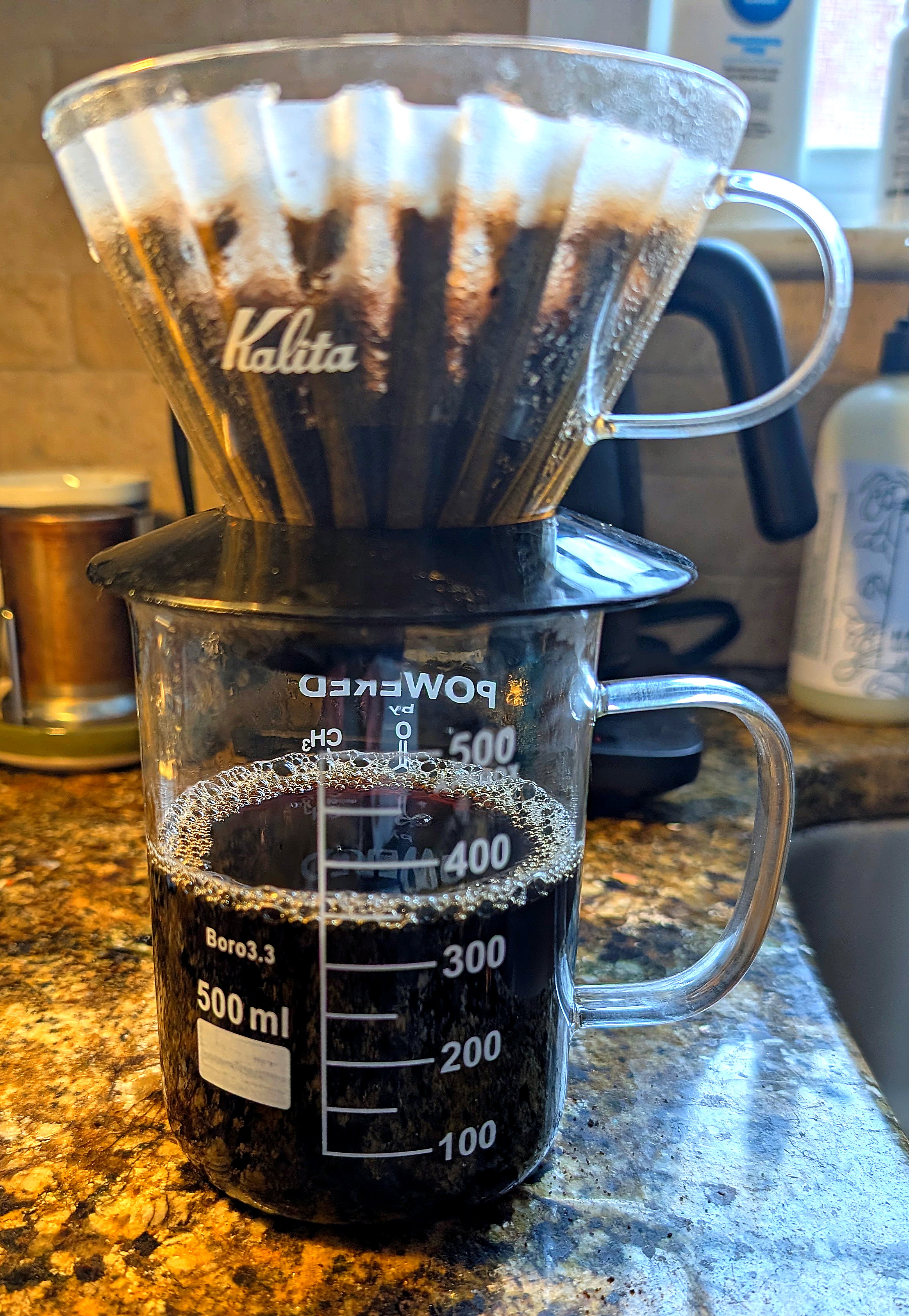
Imagine I’m drinking this–because I am. February 2024.

American football has ended its seeming stranglehold on the domestic sports scene. A surprisingly close game last night between the San Francisco 49ers and the Kansas City Chiefs kept me up to the end. That’s pretty unusual. I quit watching football decades ago. My interest diminished with the demise of an old version of the Seattle Seahawks, the one with Jim Zorn and Steve Largent. Or perhaps it diminished with my renewed interest in baseball. Whatever.

For a baseball fan, football feels about as welcome as your ex showing up at your next wedding. Baseball has just introduced itself at the beginning of April when the National Football League holds it’s draft. When the season gets going and the annual draft of new baseball talent occurs in early June, the NFL starts rattling its sabers about pre-camp workouts. Baseball gets some clarity as good teams rise to the top, bad teams falter, and the 2024 trade deadline approaches–and the NFL opens its training camps! All of these boorish events pale to this: baseball heads into its final month to determine the postseason, a five-week celebration of near-daily baseball games ending in the World Championship, and the NFL opens its season. In a pragmatic but depressing capitulation to reality, MLB mostly avoids holding postseason games on Sundays when most NFL games occur.

(And why do we call it football? Players’ feet only intentionally touch the ball to punt the ball away or kick the ball through the goalposts. This likely reflects my ignorance, but go with me here: players hand off, run, pass, and catch the ball. Now that European née global sport has appropriately called itself football!)

Ah, but for a few glorious weeks baseball reigns supreme. Football retires from the stage and lets the sport-formerly-known-as-America’s-sport, baseball, back into into the leading role it once occupied. Collegiate basketball intrudes, true, during March Madness, but it displays the genteel manners one would expect from amateur athletics. Baseball spring training games occur in the afternoon; NCAA games occur primarily in the evening. It crowns a champion during the first week of the baseball season, turning in that assignment a week late just as college students will, and bows itself from the stage. And the professionals in the NBA? Who cares? Their interminable playoff schedule will just be starting in mid-April, a two-month slog that ends in the middle of June.

Baseball and football play nice once each year. Football crowns a champ just prior to the start of baseball’s spring training. For six weeks all baseball fans think one of two things:

  • My team could win the World Series this year!
  • My team might not be as bad as it looks!

Hope springs, regardless. Thank you, Super Bowl; thank you, Spring.


First of the year: 11FEB2024

I know more cold weather remains a very real possibility. By the weekend we will see temperatures at or below freezing. Yet the ephemeral forecasts from various sources promise me I’ll see more early spring temps than I will not, and that’s something. Very soon the star magnolia will bloom, daring the other trees to follow suit. Judging by last year, we’re running a bit late. Here’s a photo from February 10th last year:

Star magnolia blossom. February 2023.

Perhaps you can tell from the photo that the star magnolia (all magnolias?) blossoms prior to putting out leaves. Our purple magnolia does this too. Those little buds appear in the fall, winter like a butterfly’s chrysalis, and then get a bit fuzzier and bigger as their imminent bursting approaches. Most pop out together, but some appear late. March sees only a few:

Hence…Star Magnolia. March 2018.

Like the Star of Bethlehem in Christian scripture, the star magnolia signals the rebirth of our plant world around the small plot of land we manage.


Tomorrow goes by Shrove Tuesday, Mardi Gras, Fat Tuesday and some German name which I can’t pronounce or spell and which means Doughnut Day. All of them imply, “hey, we need to party and indulge, because tomorrow begins Lent.” Unfortunately (kind of) Ash Wednesday coincides with Valentine’s Day. We’ve decided our party tomorrow will stand in for Valentine’s Day. While we nibble on a few berries, nuts, maybe a piece or two of cheese, I will prepare calas or rice beignets using this recipe. I’m looking forward to it. I love involved, authentic-in-spirit recipes, and this Anson Mills recipe promises all of that. I’ve not purchased their rice or pastry flour; we’ll hope the expensive Carolina rice I did purchase will suffice. Dinner, which we’ll start working on after our late morning calas in at least a desultory way, will be Anson Mills’ Roasted Stuffed Quail for Two with Madeira Sauce. We did not spring for the mail-order quail when we first planned this as a New Year’s Eve meal. Our local grocer carried them. Nor do we have madeira, let alone a 5-year one, and I’m not buying one for 3 tablespoons of recipe use! Some marsala and sherry will suffice. We’ll set some simply prepared asparagus next to the quail and toast our near-30-year relationship.

As lovely as that may (or may not) sound, it’s Lent which occupies my mind today and for the past few. One needs to prepare for Lent. Arriving to Ash Wednesday, opening one’s bleary, I-partied-too-much eyes, and arbitrarily picking something to give up for Lent represents a knee-jerk response to the liturgical meaning of Lent which undercuts it. Sure, you can give up caffeine or alcohol or that favorite candy or whatever because, “that’s what I always do”–and Lent will mean about as much as the thought you put into it. One’s spiritual life basically runs on cruise control (at whatever speed you’ve set) if this represents your approach.

Alternatively, a person in touch with one’s relationship to the Presence which animated this Universe–which created life (a scientifically provable proposition which I will address in a future post), which appears to have imbued all of us with a portion of Its spirit, and which in a way not describable to me, appears to care about us–seeks with initiative and purpose to pledge oneself to one or more practices during Lent, then that person approaches the mystery of Easter with (hopefully) a clearer insight to understanding that mystery. If nothing else, they approach in a better ‘spiritual plane’ which even the non-religious believe to be a good thing.

I have for more than a decade attempted to set one practice each for the physical, the mental, and the spiritual/emotional. (I know, I know. Let’s debate the conflation of “spiritual/emotional” some other time.) This year my practices do not need to be hidden, as they sometimes do to be authentic. I plan to…

  • Go to the gym thrice weekly as we originally intentioned a year ago. We’ve attempted to restart the gym practice since a falling off in the holidays to limited success. I also have a more private concern here which isn’t so much a practice as a focus on what I’m already doing.
  • I’m going to begin reading the Bible with an emphasis on two things: the Pentateuch (the first five books) and the four gospels. I’m not sure of the juxtaposition. About seven to ten years ago I used a guide to a first-time reading of the Bible in which one read Genesis, Mark, a few other books–it gave a representation of the Bible overall, including a book from the prophets, a couple apostolic books, etc. I liked it, but I’m ready for a bit more.
  • Emotionally/spiritually? I’m still not sure on this one. I think my fledging effort to be more social will come into play. Of the varieties of introversion, I’m the one who avoids social gatherings among other things. This will be ….interesting.

Lent means more than Advent to me. Perhaps the focus on penance/introspection? I can definitively say there are days which anchor me to my spiritual pursuits. Ash Wednesday and its implication of Lent is one.

Our spiritual life, and therefore our inspirations, remains in this world. A focus on Jesus, Buddha, or whomever, to the exclusion of the physical world insulates us from our reality. The light poles and cell towers of our world inhabit the day-to-day milieu where we must perfect ourselves as humans. Like this photo, we must see the beauty in the context of the mundane. Ash Wednesday 2023.

Liturgical year endnotes

In the Roman Catholic Church tomorrow is The Solemnity of Our Lord Jesus Christ, King of the Universe. This begins the final week of the year…as far as liturgy is concerned. The new year begins with the First Sunday of Advent on December 3. This year Advent is three weeks and one day long, the shortest it can be, because the Fourth Sunday of Advent falls on Christmas Eve Day. It can be four weeks long when Christmas falls on a Sunday as it did last year. Thus the end of the year prompts a bit of reflection for me before falling into the seasonal frenzy.

All of this by way of saying too many things dance in my head this moment to make this a coherent piece of writing. One of yesterday’s posts prompted a request for more “soundtrack” postings, and I’ve decided to play with that for a little bit.

Today’s soundtrack

I’m a bass in one of the choirs at the Holy Name of Jesus Cathedral in Raleigh, NC. There’s a lot of music coming down the road right now. We’ve a special liturgy full of music coming up, Lessons and Carols, and then there is the tradition of a musical presentation preceding the Midnight Mass on December 24-25. (The music begins between 11-11:30 p.m. to make sure the mass itself begins on Christmas Day–“midnight” mass.) This year’s music packet for the choir is nearly 100 pages. I’m not telling this to brag, convert, solicit sympathy, or narrate information about the church. I’m telling you this to explain that the soundtrack began with a lot ME practicing my music!

The remainder of it has been finishing Yessongs by Yes. Released in 1973, it’s more interesting than good. Large amounts of the two-hour album are better on the studio albums where the group could overdub to its heart’s content. I’m particularly not fond of some of the improvised melodic changes. They’re just not as good as the originals they’re meant to bring to their audience. But considering the large of amount of overdubbing and the intricate work which went into making the studio albums, it’s illuminating to hear how well that is conveyed in concert.

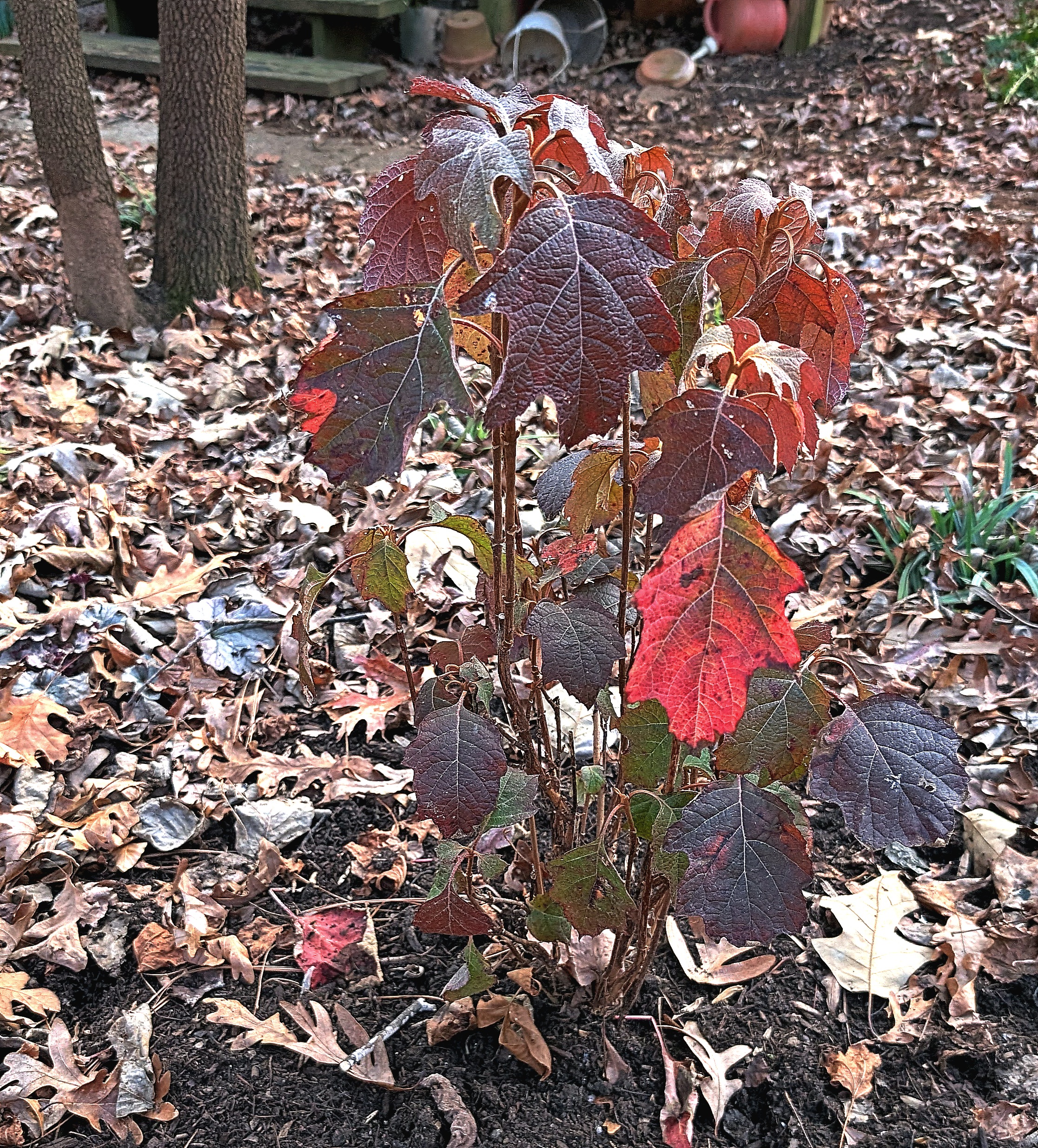
Enough. It’s time to sip some cheer, consider stories for my annual Christmas newsletter (more on that later), and relax. For now I will leave you with an oakleaf hydrangea, a native plant in the southeastern USA (which I just learned!). Some lousy squirrels broke it off just above the ground last year because it’s almost directly under a bird feeder which they cannot reach. Thinking the entire thing was dead and gone, you can imagine my delight to see it sprout a small plant this spring. It has conical heads of white flowers which turn woody in the fall–literally, like little chips of wood. And of course the leaves! Worth trying to save.

Oakleaf hydrangea. November 2023.