Eastern carpenter bee on scarlet beebalm. June 2025.
For a good handful of years I fought a war against carpenter bees. These large bees (1.0-1.5 inches long) bored perfectly symmetrical holes in the decking of our house. First I attempted to plug all the holes with caulk, twigs, anything that came to hand. Then I bought horrendously over-priced traps, only one of which did its job and for only one year. This year I gave up, waved the white flag, said, “you win.” They are vigorous pollinators: that beebalm looks long past its prime, but they keep working the blossoms for that last speck of pollen. They’re only antagonistic to each other, although they’re scary in the spring: imagine a bee as big as your eye and flying right toward it. They still leave little piles of sawdust around my deck here and there in the spring.
And I still have the trap up. It’s a sign of self-respect. I don’t want to appear as if I’ve cravenly capitulated to them. Call it a fighting retreat.
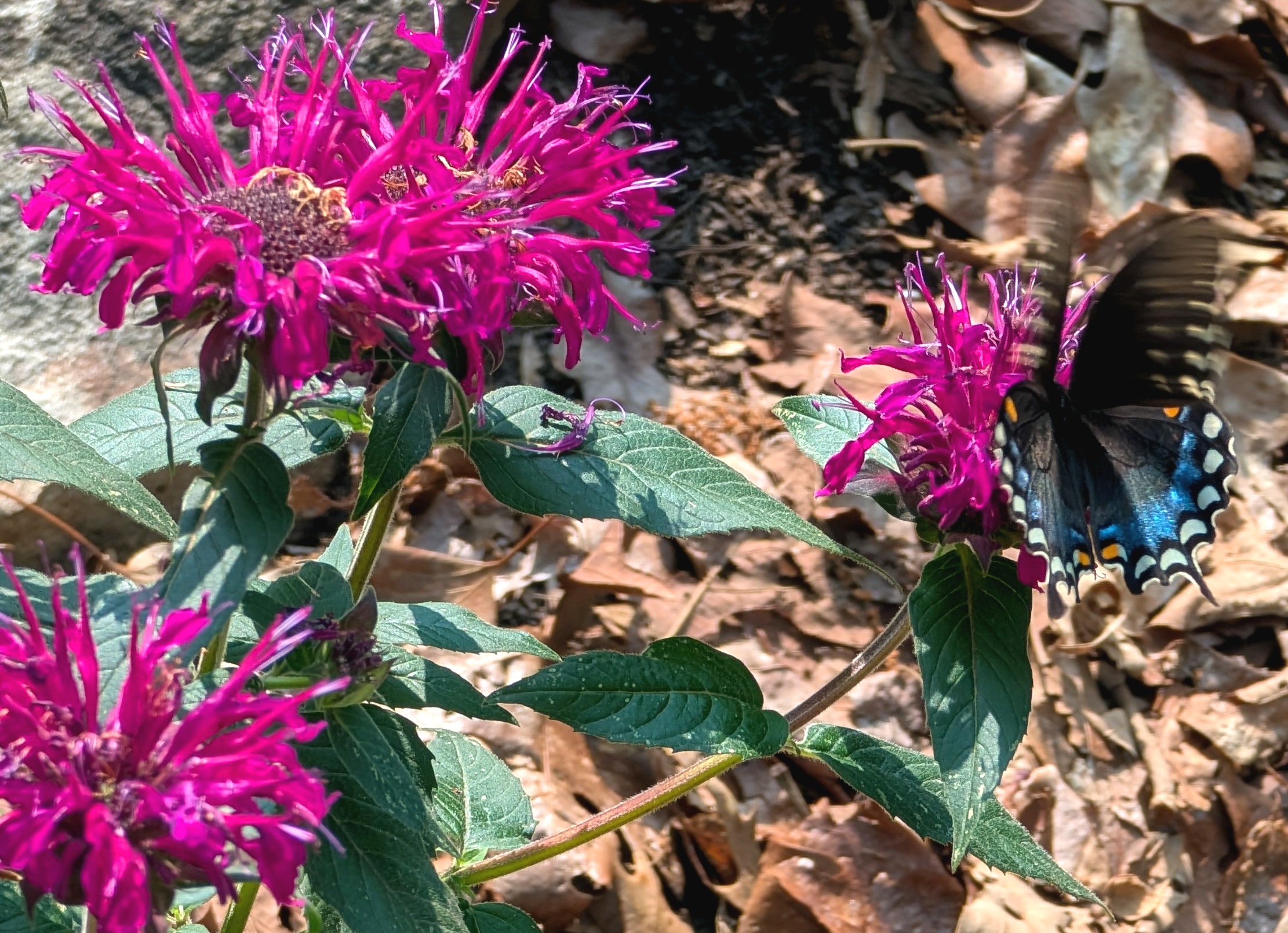
Watching our newly landscaped front yard has become one of my particular joys this year. Where once there existed a lackluster lawn, pockmarked with chipmunk burrows—which I had to continually mow—now new plants take turns proffering flowers for the pollinators. The spicebush swallowtail butterfly shown above would have shown up better were not its wings fluttering madly as it sampled the scarlet beebalm flowers. Sharing the butterfly’s zeal were bees of all sizes: little ones that looked like flying sugar ants about a quarter-inch long to bumblebees and something larger which I haven’t identified yet.
As May ended and turned to June, fireflies appear at dusk to illuminate the plants. Shrubby St. John’s wort, below, seems to be a favorite of the Easter honeybee.
This spring has been a joy, watching our newly planted front yard bring forth blossoms we’ve never seen before. The one above, about the size of a standard marigold, tucks in by the front porch. Demure, perhaps, but eventually it can grow to small tree height if not pruned.
Monday as we sat down to breakfast, my wife noticed a guy putting something on the parking strip in front of our house. I stepped out to see what he was doing, which turned out to be moving a box turtle off of the heavily traveled street. The turtle had been close to our side of the road, so he moved it along. Box turtles have five sub-species; at first this one looked to be a Gulf Coast one, strange as that may sound here in North Carolina, but I found photos of the Eastern which resemble this one. Apparently the shell wears as they age, and the shells will become the lighter, golden color seen in the pattern on the shell above. They fairly easily live to be 100 years of age.
Wondering “why the heck is a turtle up here about a full block and uphill from where there’s a creek?”, I learned something. Box turtles hang out in moist forests and wet meadows/pastures. I would like to think transforming our front yard from grass to a meadow facilitated this little visitor, but who knows? I do wish, however, I had just watched him/her from afar because I went back out five to six minutes later, and it had disappeared. I searched diligently around our front yard, near parked cars, even back on the other side of the street, but nope–gone. I worried. Drivers looking for a short-cut found our supposedly residential street a few years ago which makes it highly hazardous to slow-moving turtles. Heck, it’s become highly hazardous to humans. Despite a posted speed of 25 mph and that it’s only three blocks long, cars routinely hit 45 mph. I hope the turtle likes our yard and decides ranging from there to the drainage swale behind our property will be its new home. It’s safer and nicer.
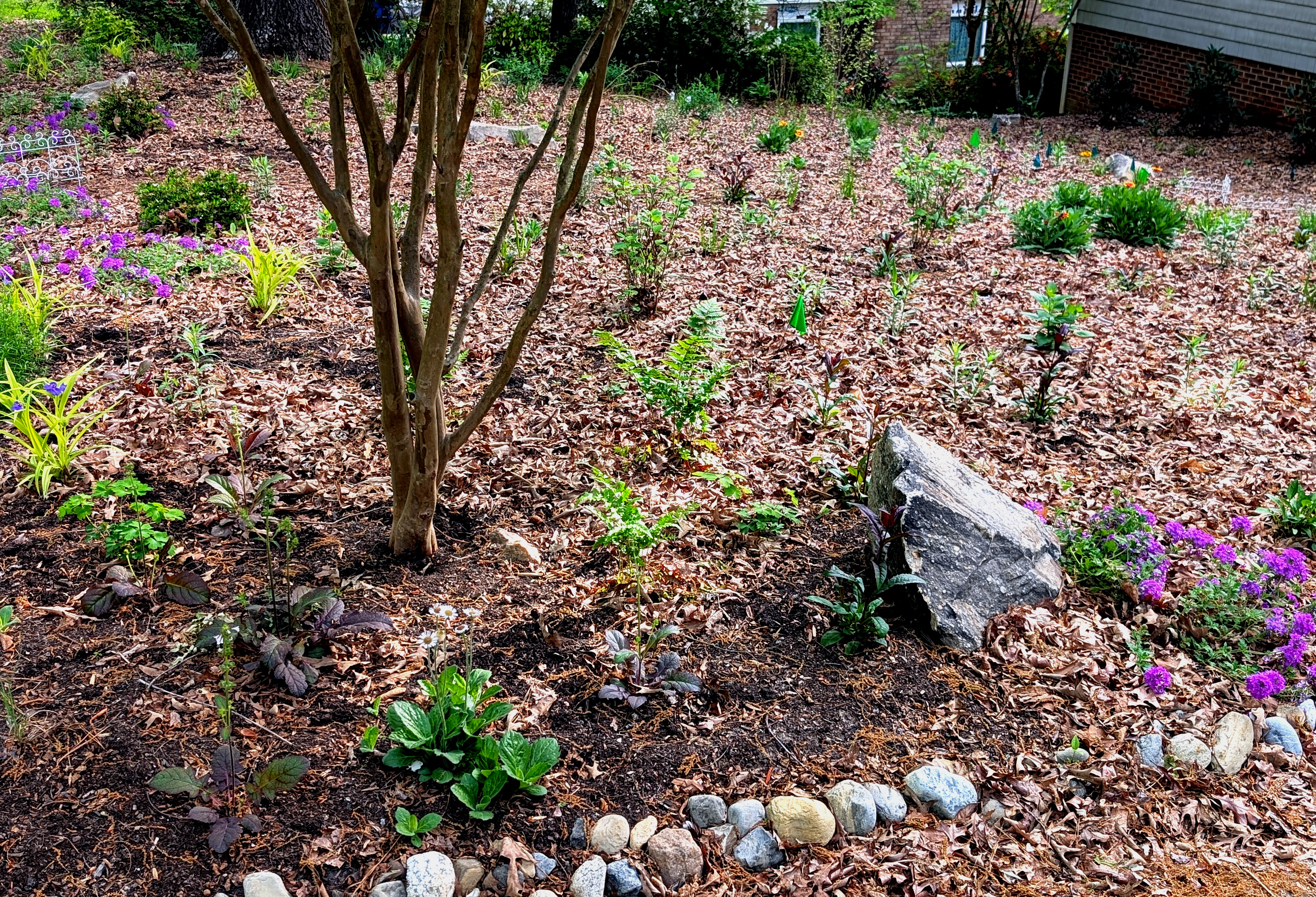
Our new front yard at slightly over six months of age. This photo taken the final Monday of April 2025. Many of the taller red-brown plants in the middle (foxglove beardtongue) have since flowered. The purple ones are rose mock vervain.
Every day walkers march past our house. They pass every ten minutes or so in the early morning, then dwindle. When summer brings 80+ degrees by mid-morning, accompanied with 80% relative humidity, “only mad dogs and Englishmen” will attempt a walk. Some walk to exercise dogs which have seemingly conducted a PR campaign to make sure every house has at least one. Some walk because they like it. (You can tell: they appear to be in good physical shape, they walk on a regular schedule, they seem to enjoy it.) Others walk because someone told them to–perhaps a doctor, a spouse, their conscience, a good friend, or one of the ubiquitous self-help gurus on the internet. We suspect one elderly gentleman walks three times each day to regulate his blood sugar. My father-in-law did that for many years, and managed in that endeavor to postpone insulin shots for more than a decade.
For several weeks I’ve joined them on this circuit, up and down this short stretch of street, oddly reminiscent of a treadmill laid out in a short course of concrete. I’ve learned by leaning into this as a practice (as opposed to “an exercise program”). Sometimes, I walk more slowly, listening to my muscles, my fortitude, walking within the boundaries of what is possible. Sometimes I push my pace exuberantly, reveling in my ability at 70 to suck oxygen into my lungs quickly enough to maintain this rapid pace, thrilled that EXERCISE can still be a part of one’s life.
Today I melded the two, yielding to an inner desire to go slower, not for physical reasons but to focus on the incremental occurrences which blow by me normally. Today….
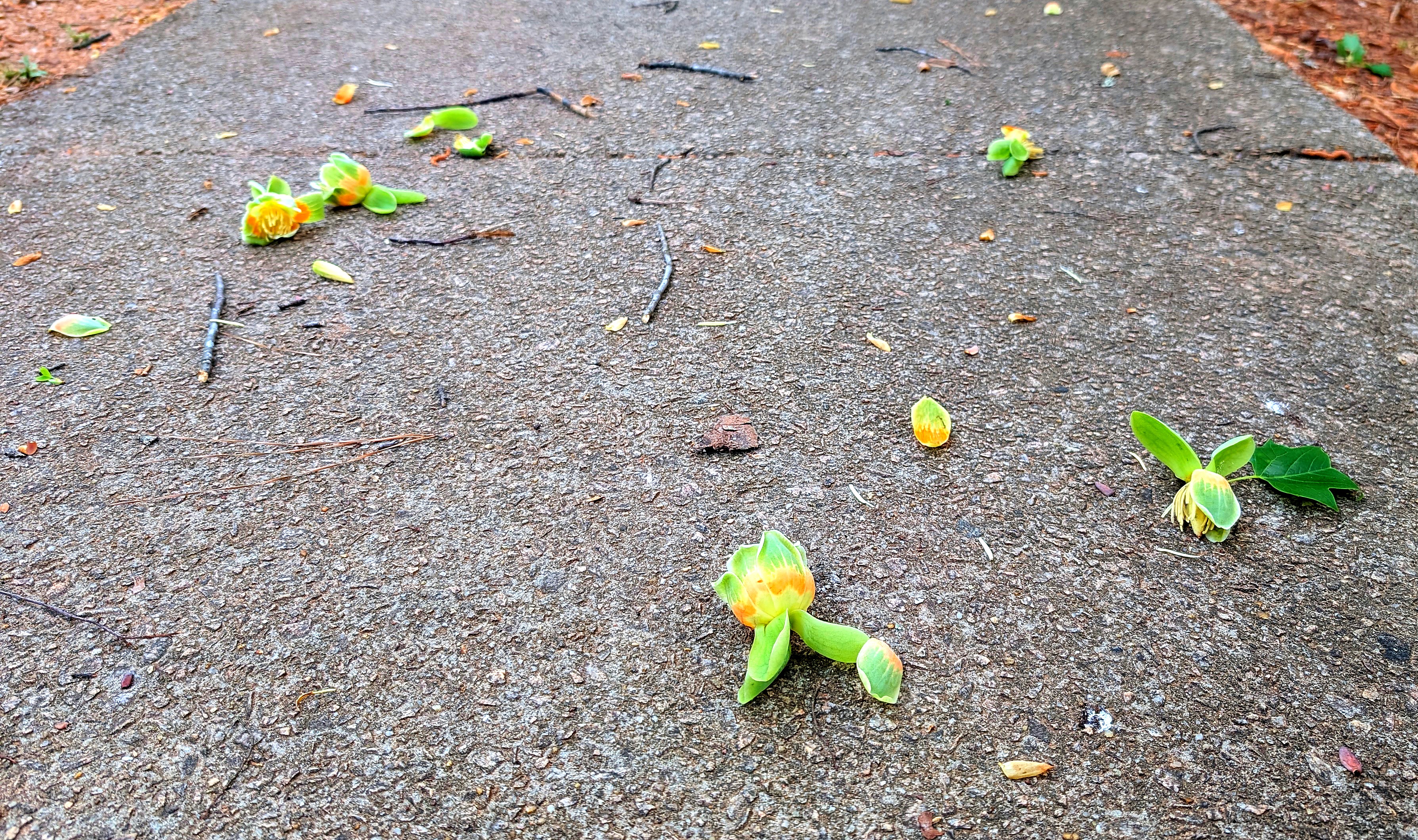
I noticed how rapidly tulip poplars have dropped their blossoms. Apparently a quick flowering gets consummated as rapidly. Their flowers no longer being necessary….
Tulip Poplar flowers. Raleigh, NC. April 2025.
It’s trash day and with it, yard waste pickup day. Reflecting the beginning of the spring/summer interface, we see sights such as these…
Overfull yard waste containers. Raleigh, NC. April 2025.
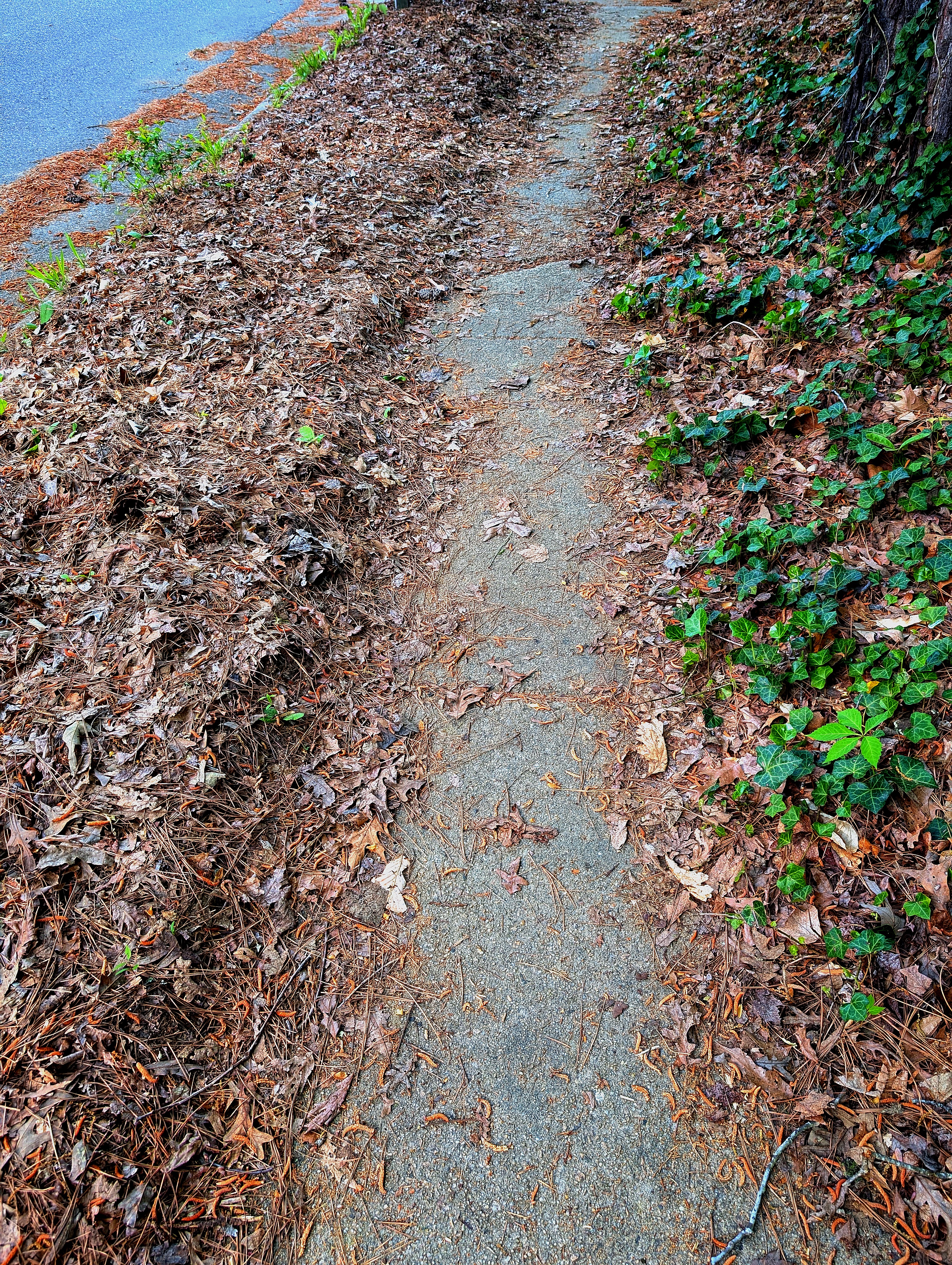
Circling at the block’s end, I encounter my across-the-street neighbor’s sidewalk. Older than me, quite likely in his 80’s, he maintains his large corner lot minimally. Those of us who pass make our own paths through the accumulation of leaves he does not clear:
Spring in Raleigh, NC. April 2025.
Many sights beckon, but one cannot stop every few feet to snap photos. (Not if one desires to arrive home and brew tea before one’s spouse arrives at the kitchen.) At the “modern” end of the three-block length of our street, where a developer with more cachet than aesthetics decided “hey, a boulevard would be nice,” said boulevard is filled with ornamental trees which have no right to be here. This is a Chinese snowball tree, on the backside of its blooming peak:
Chinese snowball tree. Raleigh, NC. April 2025.
One of the delights of continuously walking a circuit lies in encountering familiar sights suddenly made new. How does one walk past a plant daily without focusing on what it is? Suddenly it blooms, saying, “Take notice! Look at me!” I did not use my plant identification software on this, and I don’t know what it is. It looks rose-like, but obviously it isn’t. A mystery to be solved for another day:
A plant. A beautiful plant. Another day. Raleigh, NC. April 2025.
And one notices the fire ants have established many beachheads in the sidewalk crevices.
Fire ant colony. Raleigh, NC. April 2025.
Finally, arriving at the start point, one marvels at the stark contrast of a natural environment composed of native plants that have flowered vociferously in the past weeks.
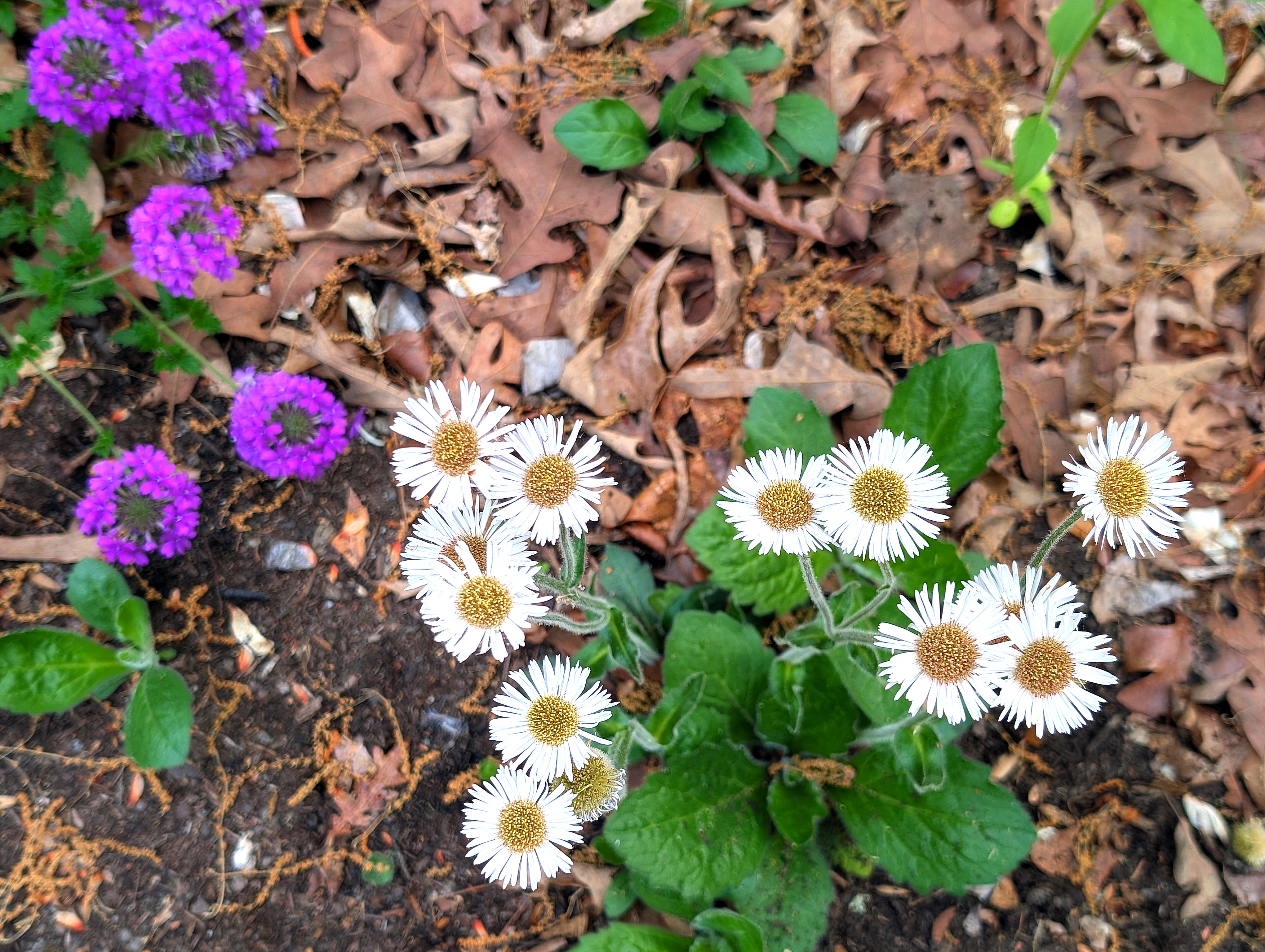
Our front yard, six months after its installation. Raleigh, NC. April 2025.Mock vervain (I think) on the left, Robin’s plantain on the right (a cultivar of fleabane). Raleigh, NC. April 2025.
Watching a specific environment over time delivers meaning which a one-time walk through a park does not. The tide and ebb of the seasons, the minor changes in foliage, the calls of the birds as they cycle through a mating season, the feel of the air as less humid air gives way to summer–all of this imprints the incremental passage of time on one’s psyche.
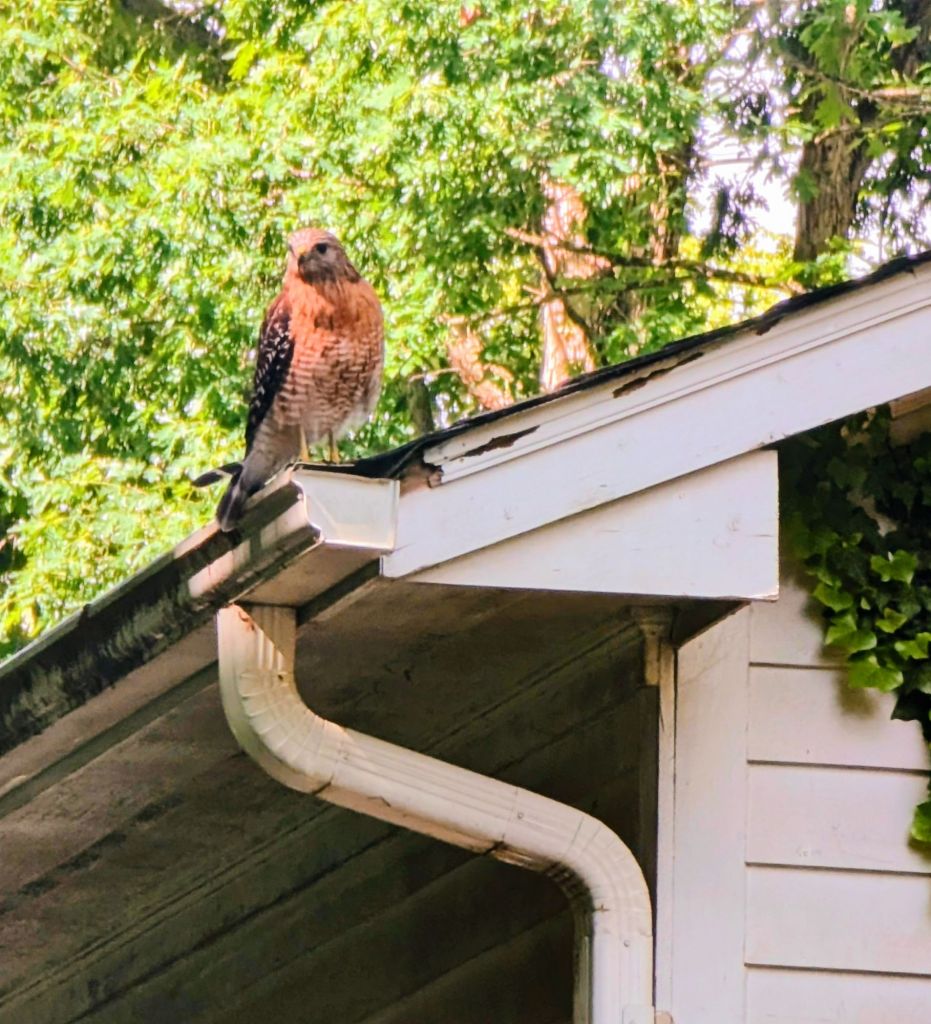
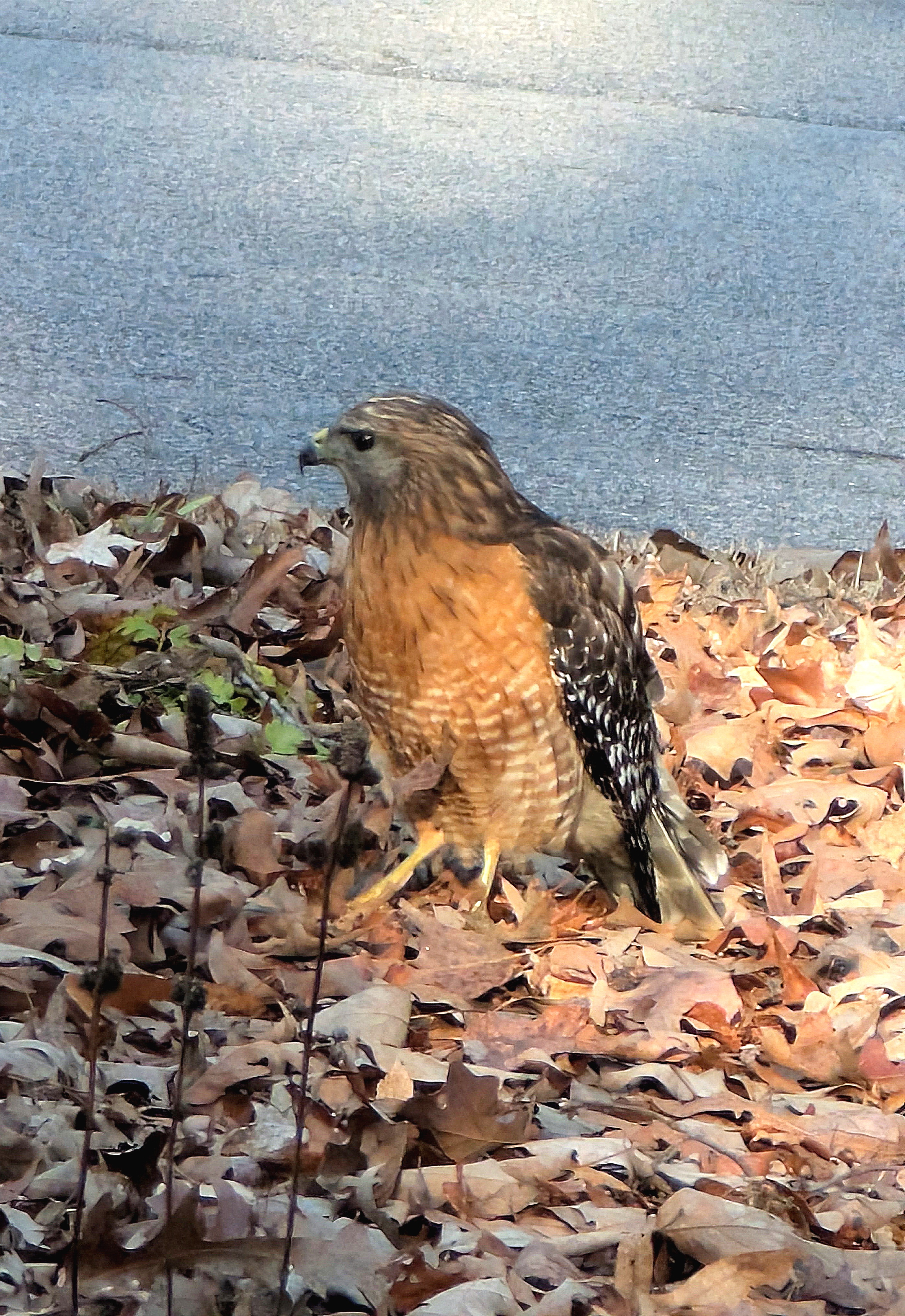
Five days ago this red-shouldered hawk sat in our front yard dogwood, just ten feet or so outside our kitchen window. For a few minutes it surveyed the landscape. Upon finding nothing to eat, it swooshed off. March 2025.
It’s been a lengthy stretch of sporadic posting at best. I’ve excused it with “spending time with my wife” and “getting things done” which certainly sound worthy. We’ve just returned from attending her mother’s funeral. (More on that later.) A slate of urgent tasks demands my attention, as does maintaining my health, both physical and mental.
A few pieces of writing, stubs and nothing more, await more attention than I can manage right now. Today let’s just review the two-plus weeks since I posted a hawk in our front yard. Hawks continue to drop by, a vivid affirmation to our decision to rip out the front lawn and install native plants—and especially to my decision to let the leaves lie where they fall. The leaf cover has fostered those little grubs and bugs birds like eat and extends to small rodents for the hawks.
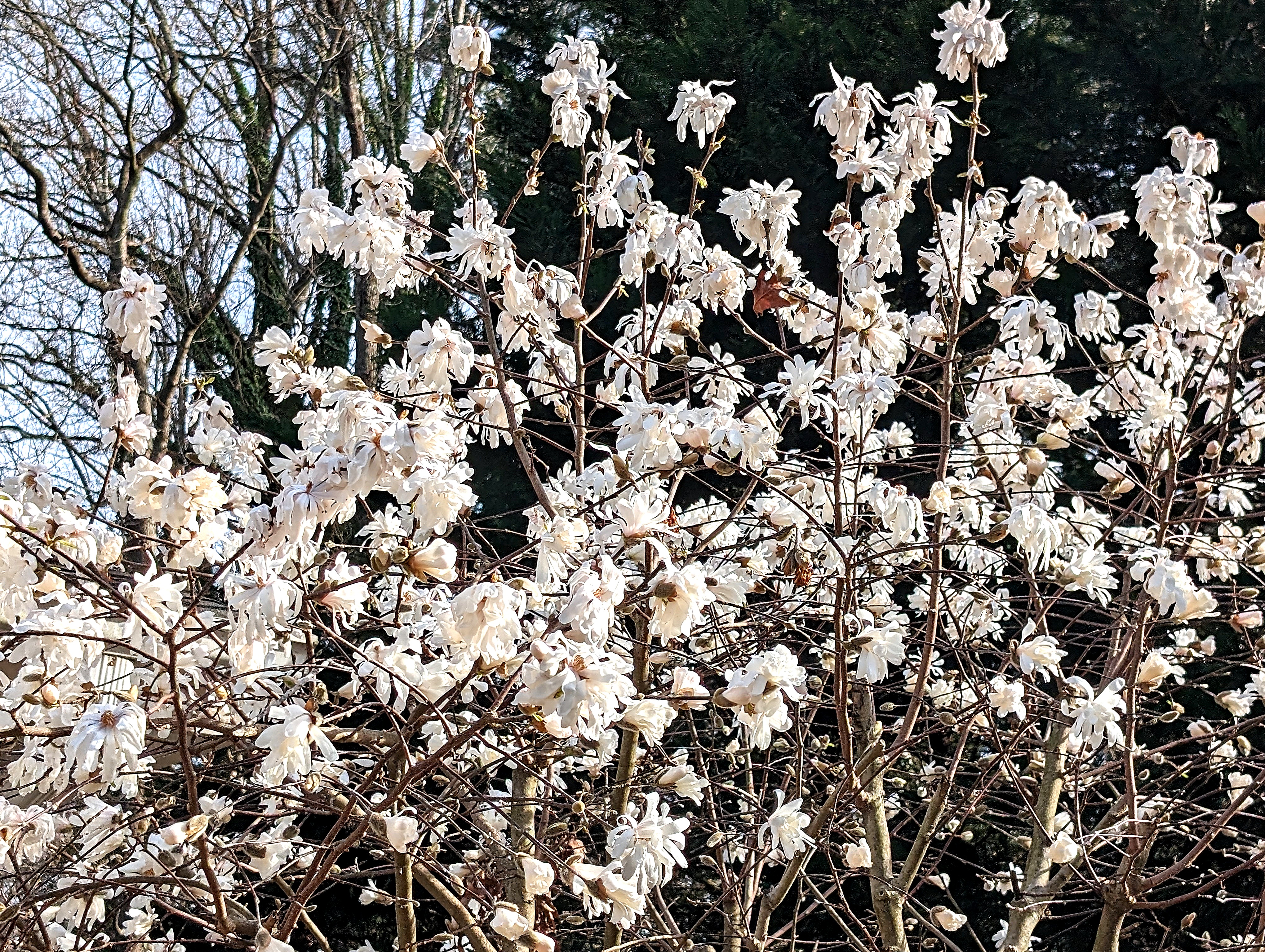
Sadly, rodents (squirrels) ripped into the blossoms of our star magnolia. This is as good as it ever looked this spring:
Star magnolia in the middle of March, 2025.
Perhaps the false starts to spring affected it? We had days in the 70’s and hit 80 once before cold weather set in again, complete with dustings of snow and some freezing rain. The cold became brutal for North Carolina, dropping into the teens. This delayed the magnolia’s blooming by two weeks or more. It looked like this last year, weeks earlier:
Reposted from 2024. Star magnolia on February 29, 2024.
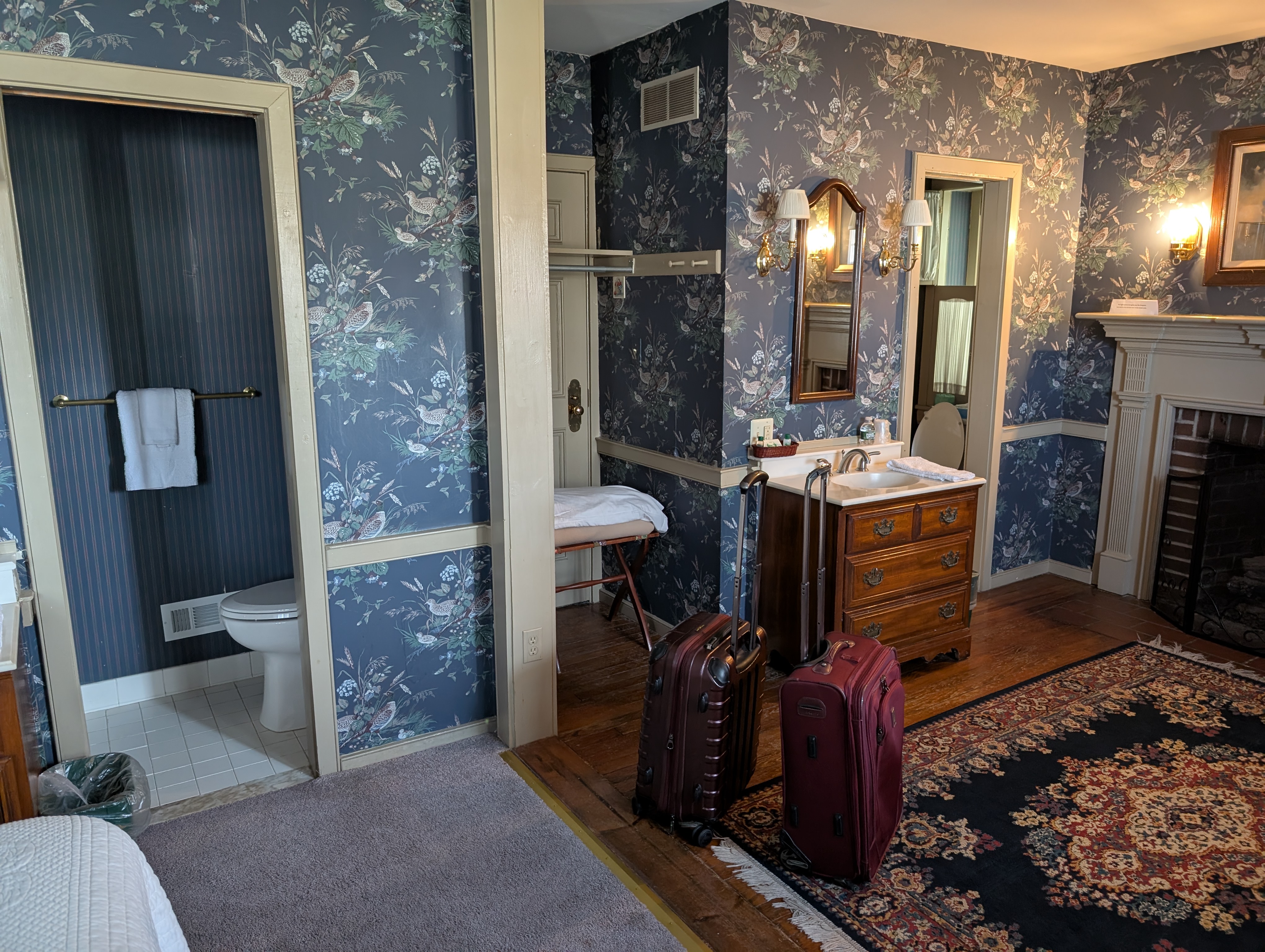
We revisited the Duling-Kurtz Country Inn in Exton, PA, Sunday evening. Sitting up by the fire that evening pleased us both. Dressing for the funeral in this room made things marginally better than performing the same in a generic Hilton or Marriott property.
The Winston Churchill Room at the Duling-Kurtz Country Inn. The sharp-eyed viewers will have noted the presence of TWO bathrooms. Two very small rooms were obviously turned into one. The door to one room no longer being needed (center), it was turned into a closet. March 2025, Exton, PA.
We’re on the eve of a personal holiday, Opening Day of Baseball. The joy baseball brings will temper the immediate sorrow of losing our last parent. This year promises many highs and lows, a challenge from start to finish. “May you live in interesting times.” Indeed.
Just before breakfast today we looked out to the front yard and watched a Red-shouldered hawk taking a small rodent for its breakfast. It took a couple of minutes. Leaving the leaves: good idea. That’s the street in the background. Due to last fall’s landscaping, the front yard is crowned, hiding the sidewalk and the parking strip.
Typically, or typical for the previous few years, our star magnolia blossoms sometime between the first week of February and around Valentine’s Day. Yesterday (February 27th), I looked out as I opened the blinds and saw many swollen, fuzzy buds, but no blossoms. Just after 10:30 I looked again and saw several had said, “Sun! Hooray!” and opened up to greet it. Spring, as defined by me, starts when some of the days peak at 60-70 degrees (or higher here in North Carolina) with the additional stipulation of the early bloomers: daffodils, magnolias, the camellia, and a few others. This occurs in the first half of February usually, although cold and sometimes snow have occurred too in those weeks. Put a gun to my head and I would admit we can’t count on these blossoms until about the end of February. Our winters have been warm for a handful of years. A return to a more normal range of temperatures in February (complete with a windy, cold snow-and-ice storm on the 19th) perhaps signals a return to normalcy.










 all the voices in my head