
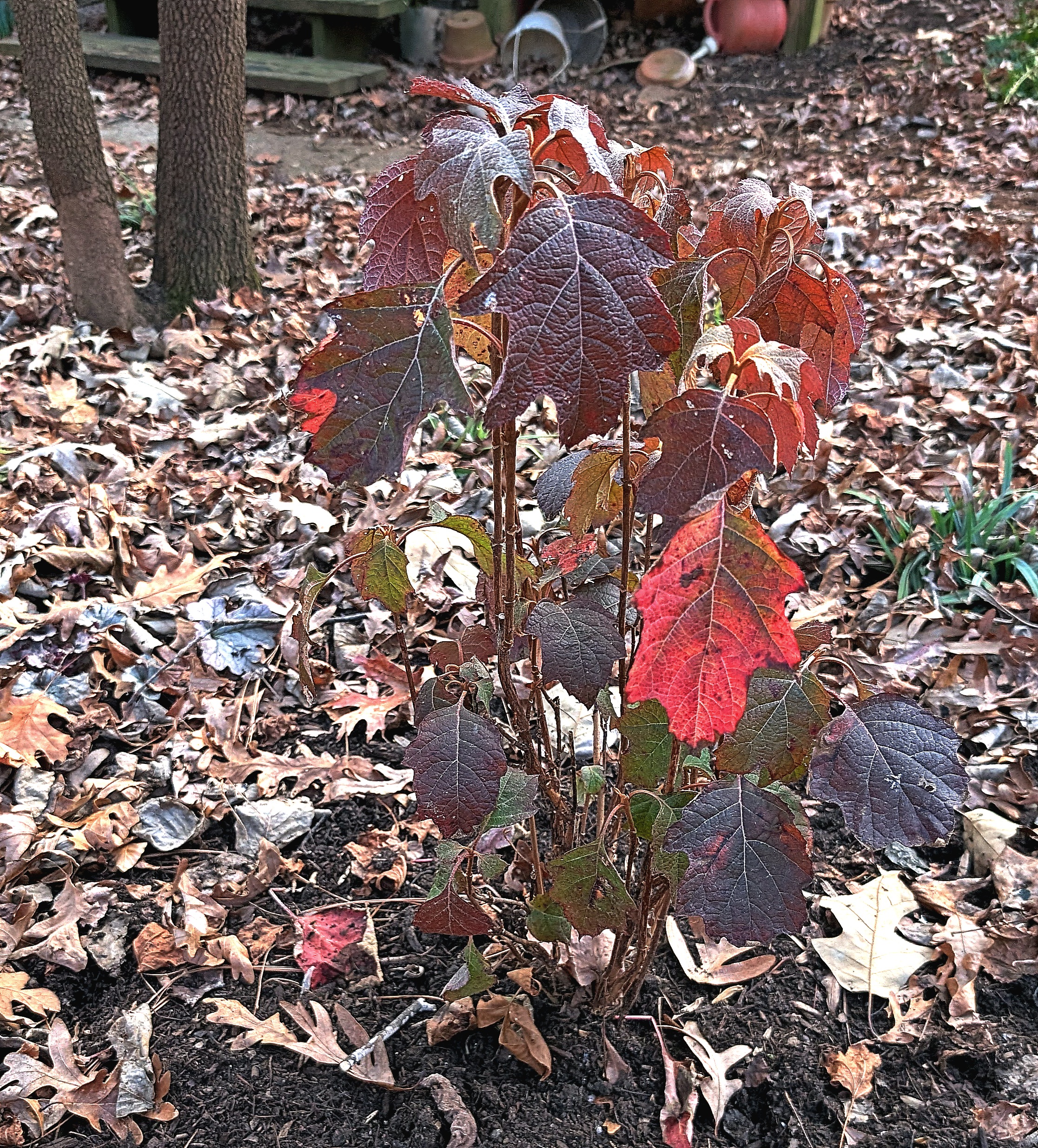




Last October we paid to have our back yard replanted with plants native to North Carolina, the American Southeast, and the Atlantic seaboard. As in colder climes, the vast majority of native plants drop their leaves and enter dormancy for the colder winter months. We also “leave the leaves” which allows them to decompose into the soil as they should, creates cover for the little creatures to stay warm (and avoid hawks), and supports the lives of little bugs which in turn provide food for the ground-feeding birds. Thus, the predominant color of our back yard and our front yard is brown.
Our neighbor’s yard represents most yards around us. The green of English ivy covers the ground and the trunks of the trees. Saplings of non-natives take advantage of the warmer winter weather much as sunbirds head for Arizona or the coast of the Gulf of Mexico. Some keep their summer foliage—no need to drop leaves and protect a plant conditioned to far colder climes. It’s not that leaves fall only in our yard; there’s an oak or two and some poplars over there. It’s that the ivy manages to conceal somewhat the leaves in my neighbor’s yard.
In winter, therefore, brown is good, and green is at best questionable. (Before my southern readers chime in, yes, there are plenty of Southern evergreens, but not many around here consciously cover their yard with them.)
Our natives, once established, should have staying power also. It’s kind of defined by the word “native” is it not? I will need to wage constant war, though, on the ivy, the Virginia creeper, the japonica, and the various saplings which will inevitably attempt to broach the property line. It’s a battle I freely take up. For the time I live on this speck of the Earth, it will bring forth those plants which grew here naturally and nurtured the birds, mammals, insects, reptiles, and amphibians which depend on them for healthy populations.
One month ago today we woke in our own bed after flying in from Belgium the night before. Only now am I catching up to yardwork, which these days consists of staying ahead of the interlopers in our all-natives garden covering the front yard and hacking away at plants in the back before they can seed. Their days are numbered: two weeks from now we hope to start the replanting of the backyard. I question, at times, why we paid so much to plant perennials which should natively grow here but there ya go. A complete and pleasant shock has been seeing the blue mistflowers explode in size and coverage. These beautiful and late-blooming plants had for years volunteered amid the purple coneflowers I’ve showcased many times on this blog. Most of them were taken out to facilitate the new landscaping plan, but the architect of that plan instructed his crew to transplant as many as possible. Given that it was a week into October, he also sprinkled any seed heads he encountered. I think the much better soil helped them out a little bit:


I had to transplant two which ‘volunteered’ at the edge of the walkway to our front door and by doing so, obstructed most of the sidewalk. One withstood the shock and has many buds on it. The other has stood with severely wilted (but green!) leaves for almost four weeks. I keep telling it, “hang in there! You don’t need to bloom! Just live!”
…or crepe myrtles if you prefer…seem ubiquitous here in Raleigh, NC. From what I read and hear they’re throughout the South, though I haven’t paid enough attention while driving through our neighbor states. Crape myrtles take their time, slowly becoming substantial trees of a type called thicket trees. They can be well-tended and trained, as this one is:

Usual care involves letting them grow as they will, but pruning suckers and sometimes trimming the tops to shape them:

Crape myrtles are everywhere here. The photo above is across the street from the first photo. The thicket-trunked myrtle in the foreground has a substantial myrtle right to its left, the one with a more substantial trunk. Follow the sidewalk and you’ll see two more, smaller (younger) crape myrtles flowering. These last two demonstrate the variety of the approximately 50 species of crape myrtle (or are a particular cultivar of one):
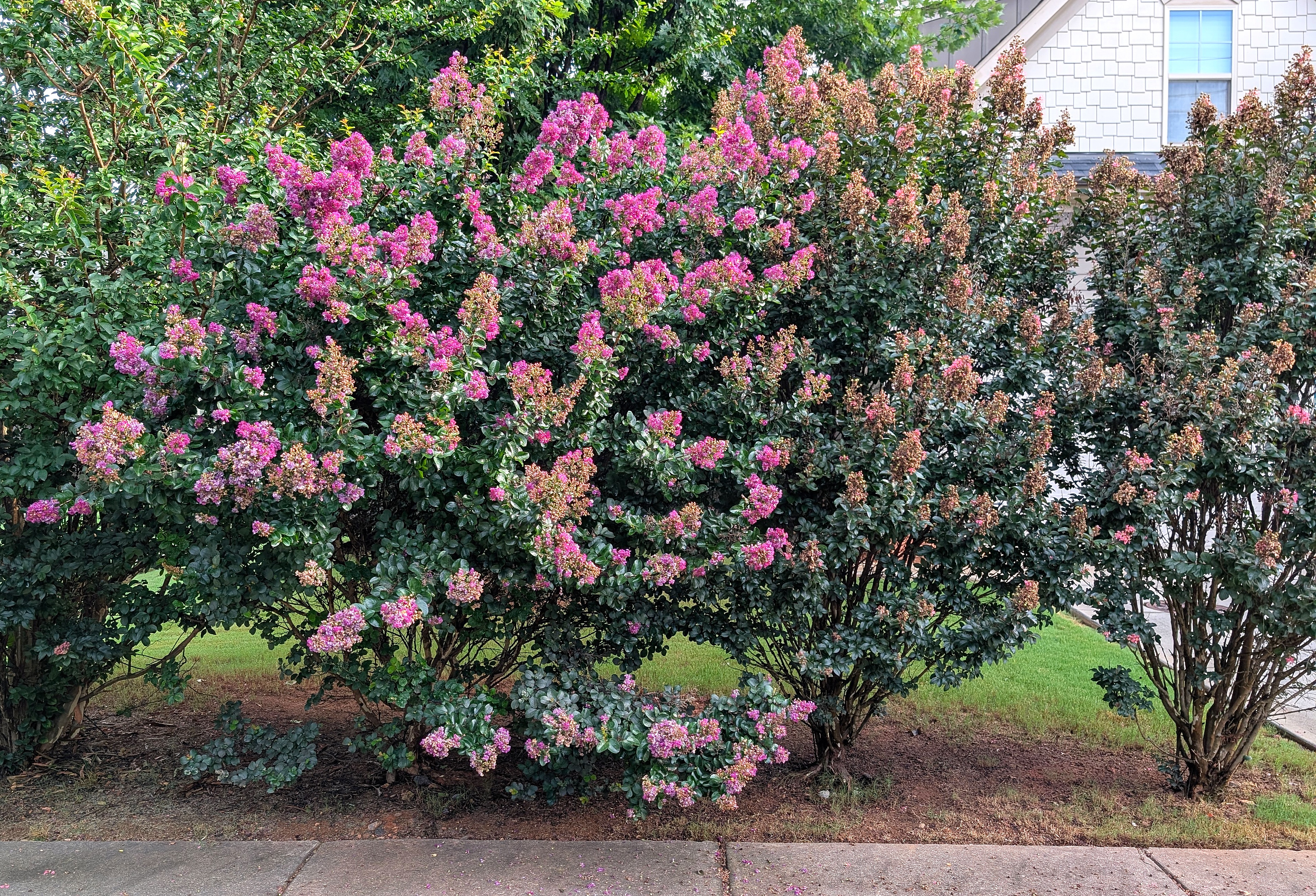
Crape myrtle are maintained by the City of Raleigh in the decorative medians:

To me the Ultimate Crape Myrtle lives in my neighbor’s yard. Its branches extend from the edge of the sidewalk and tower over her house. It’s at least 30 feet tall. Someone appears to have pruned a few suckers in its youth, but mostly it’s been left to its own.

And then there are our crape myrtles. Ours were planted sometime between 2007 and 2014 (using Google Maps Street View), with the most likely time frame being 2010-2012, a period when the former owners rapidly changed the landscaping and interior of the house. The myrtles probably were purchased as saplings, and have doubled in height for the eight years we’ve lived here. For reasons I suspect have to do with amount of sunlight and my utter lack of any care beyond occasional pruning, they flower very late. I suspect sunlight because my other neighbor has three, also near the sidewalk, which haven’t bloomed yet either. In the photos above you might have noticed most of the myrtles nearing the end of their blooming period. Ours?
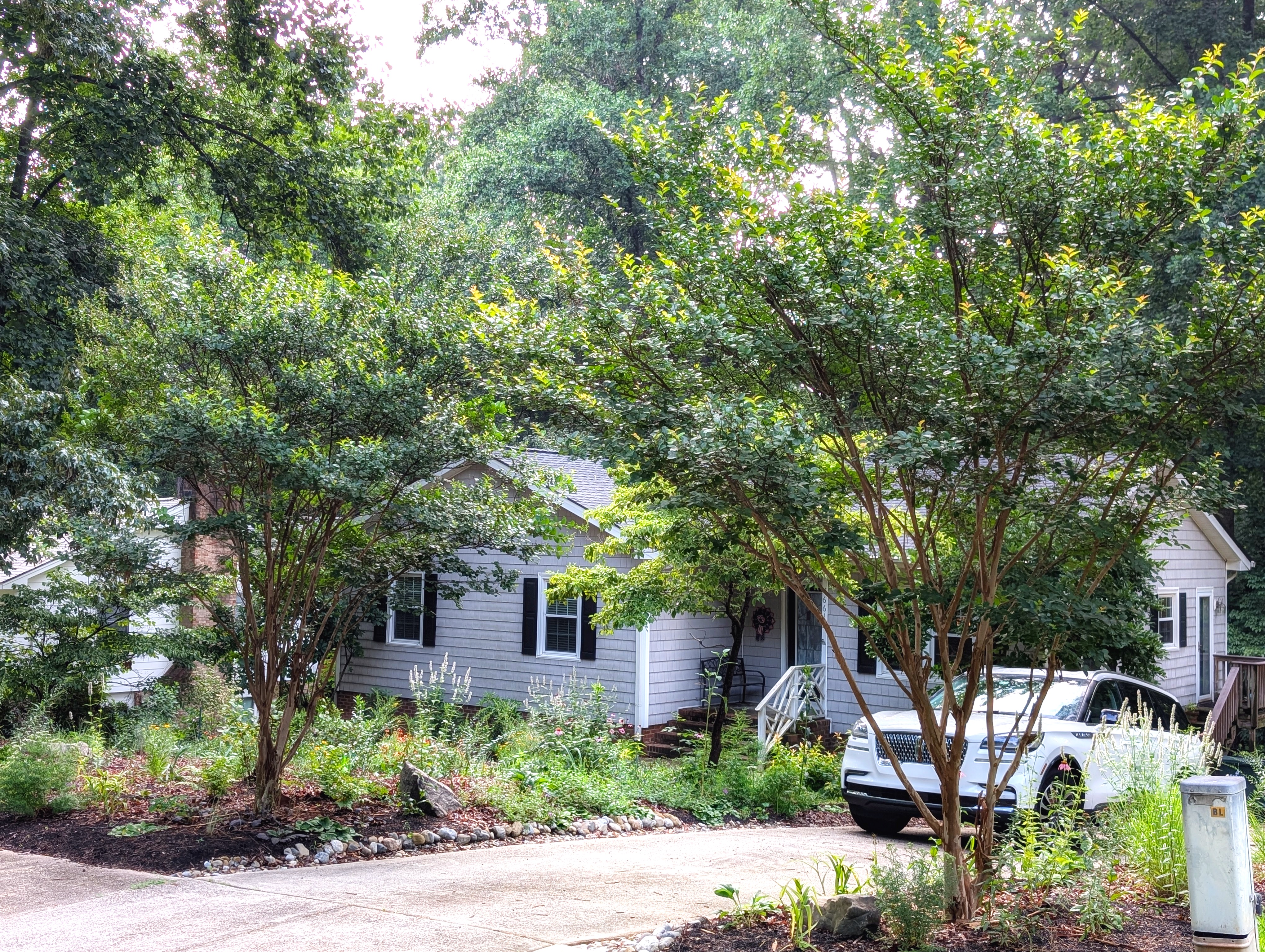
But here’s the thing: though closely identified with the American South, they are not native to it. To quote the NC State University’s Extension Gardener website, “[Crape myrtle] is native to the Philippines, Japan and central Himalayas to southern China and Indochina.” Our whole move the past 12 months has been to replace everything in the front yard with native plants. (note that in the photo above) After a year of debate, and many years of saying, “Maybe they will bloom better when they get bigger,” we’ve decided to replace them. (Sorry, former owners. Consider it payback for removing that big tree in the front yard and not properly having the stump ground. I nearly broke my ankle in that mess many a time.) On one side will be an ‘Amethyst’ witch hazel which blooms in winter and very early spring. (Photo here.) On the other side will be a serviceberry. It mimics the look of a crape myrtle with the multi-trunk growth, but it will provide berries for birds and other critters.
All right, I’m craped out.

 all the voices in my head