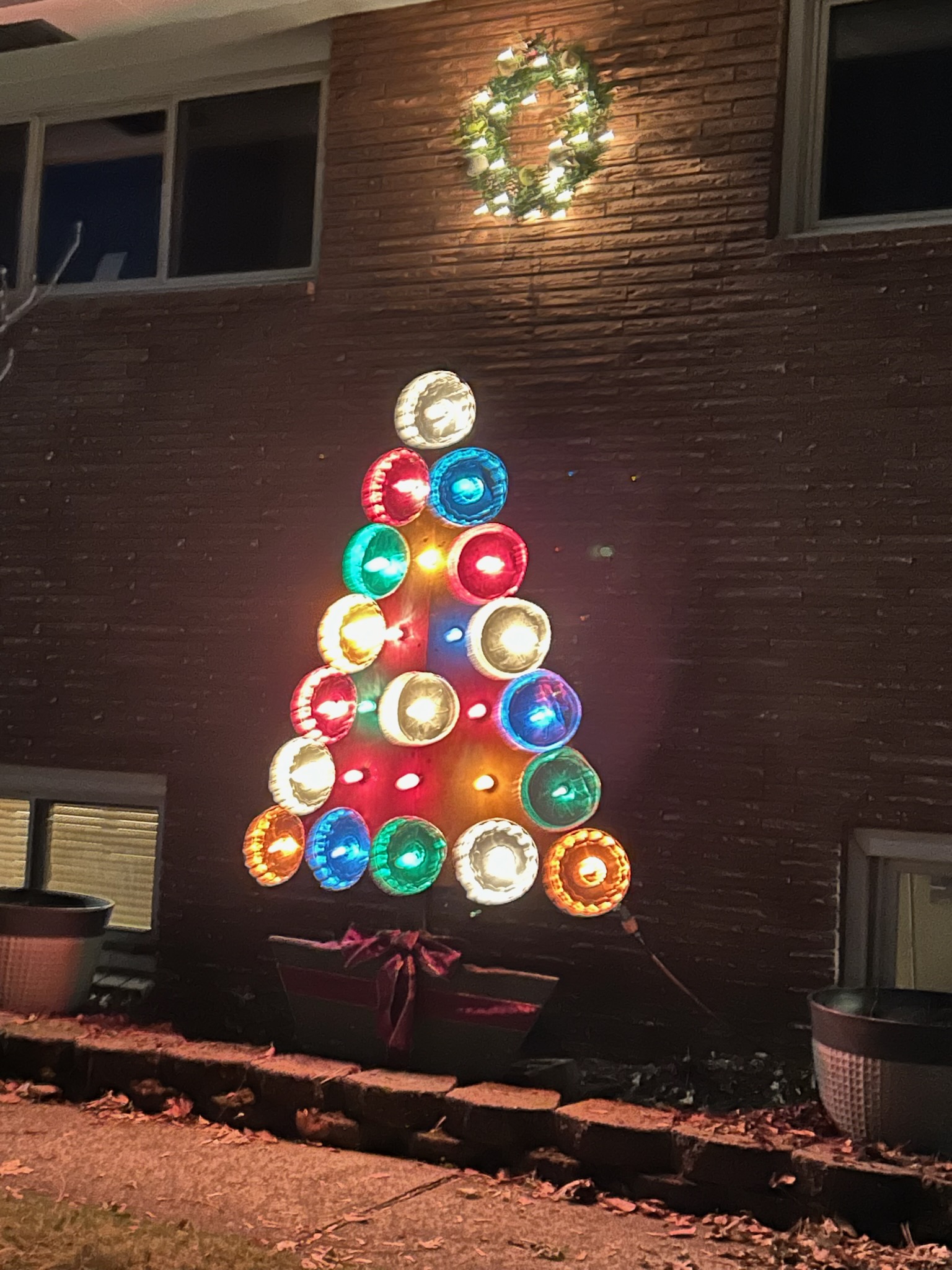
My parents’ neighbor’s resurrected Christmas tree decoration. Christmas 2023. [Photo by current owner of the house.]
Christmas waits impatiently on the other side of midnight, less than five hours away on the East Coast of the US. Besides its ultimate meaning, Christmas carries a bagful of gifts called memories: some good, some painful, some both. When my family returned to Spokane after a 22-month period of moves to Seattle, Los Angeles, and back to Spokane, the neighbors across the street organized a block Christmas decorating project. They lived in the house pictured above. All the men–times differed a bit back then–gathered in the double-car garage just out of the photo to the right, all of the women kept them stocked with hot or cold beverages of their choice, and all of us children ran around in the snow and threw snowballs at each other. For several years our block featured wooden trees lit colorfully…almost as in this photo.
One by one fewer trees appeared each year. This person moved. That person got tired of the maintenance involved. (Ours needed a new stake to keep it upright in the nearly frozen ground.) By the mid-70’s the folks in the pictured house–the ones who instigated the tree-building–had moved, all of the neighborhood children were grown, the trees had disappeared entirely, and ours began its 45-year hibernation in the rafters of our garage.
In 2013 my father died, and in 2019 my mother joined him. Through 2018 the new neighbors in the brick house across the street had taken care of my mother as she declined, assisting her with all those little tasks that get more difficult as one nears 90. My brother lived hundreds of miles away, while I lived thousands. We did nothing with the house during the ten months she alternated quarters in the rehab center or the assisted living facility, but after she had passed we went through the stuff and asked neighbors if they wanted anything. Our neighbor wanted the tree. He spent a couple years before he souped it up with the reflectors, but other than that he returned it to its original condition. It seems appropriate it now lives where it came into being. I ran across this photo looking back through December photos. Funny how so much can be packed into one unassuming photograph.
I remember this too. It had sound. I could taste the colors.
A friend of mine speaks of his “phonographic” memory. I believe all of us interested in music have this, else ear-worms would not be a thing, right? Over the past ten years I’ve focused more on this phenomena, and I further believe there’s a distinguishing characteristic between songs we can recall and songs which form our sonic foundation. In the latter type, I don’t mean these are fundamentally good, I just mean that they come unbidden on a Tuesday morning when you’re in the shower, or when you’re driving to the grocery store. Or perhaps you hear a snippet of conversation and an overheard phrase comes to you overlaid with music because it’s word-for-word (or nearly so) with a phrase in a song from your youth.
Here’s one which illustrates the vagaries of this kind of aural memory. “It’s Good News Week” pops into my head every few months for the past couple of years. Why? I have no idea. It gets billed as a protest song, and certainly some of its lines will shake you up–perhaps a few will offend. All I remember, however, are two short stanzas which I have always sung together, but which do not appear consecutively in the song:
It's good news week
Someone's dropped a bomb somewhere
Contaminating atmosphere...

...It's good news week
Doctors finding many ways
Of wrapping brains on metal trays
To keep us from the heat.
Plus, I remember the refrain:
Have you heard the news
What did it say?
Who's won that race?
What's the weather like today?
Memory clouds things, too. I’ve remembered this for nearly 60 years as a novelty song, and listening to it today, it didn’t sound the way I remember it. I wonder if that has something to do with the tiny transistor radio I used to listen to it? Looking at the lyrics today, it seems anything but a novelty song. So many songs from the mid-60’s through the mid-80’s just can’t be played these days. Not like “Walter Wart” from 1966 by The Thorndike Pickledish Choir!
Growing up, my parents’ chairs interested me little. They still don’t. I consider them in my mind: the bulbous thing they reupholstered from a shocking golden mélange of 50’s colors, vaguely like a tweed, to a deep blue-green as hideous as you likely just pictured. Another horrible chair, this one chalky gray underlaid with a chocolate brown, thankfully disappeared from our lives as my parents focused ever more on Danish modern. Two deep mustard gold chairs sculpted from a cube joined the blue-green thing. I took Danish modern for granted then, hate it in retrospect. For reasons never given, our sofa matched nothing else in the room, either in style or color. Its creamy colored soft contours with the ever-present throw pillows would scream Rooms-To-Go today. Back then it just said, “I came from the middle aisle of our local furniture store.”
Chairs only rarely occupy our minds beyond whether we can find one to sit in. We take them for granted, I suppose because those of our upbringing formed part of the Always-There background. We sat on hard wooden chairs in school, replaced later by hard plastic seats, replaced in turn by a hard substance which defies any characterization other than “smooth”. College offered the same but with more variety unless you attended something exclusive in which case the chairs weren’t any more comfortable but they looked a lot older, more distinguished. When newly graduate, one’s interior decorating attitude toward chairs usually is something like, “is there one” and “is there room for one or two?” Perhaps I should add, “Can I get them from Mom and Dad?” because that’s their provenance for the most part.
“For the most part.” I moved from my dorm to my first apartment towing the usual hand-me-down furnishings including a deep brown and deeply ugly sofa. Along the way, however, I stopped at my grandparents’ house to pick up a chair from their basement which meant a lot to me. Now in their 80s, they were moving to a senior-living apartment. At the time this chair represented a place where I had sat a lot, a place I found both comfortable and comforting. Over time my bones became more brittle, my muscle turned to fat, and I found the chair less comfortable. At the same time, the comfort of seeing a chair with deep green shiny silk-like ribbons running vertically on a cream background, with dark-stained wooden arms and legs, sustained me emotionally. In 1992 I looked at the chair in my new Pennsylvania apartment where I had fled my divorce and my teaching career, seeing the chair as an anchor to my past and to my family. As a child I sat on the floor of my grandparents’ basement when Grandpa read Mr. Murphy the Irish Potato. (It’s horribly inappropriate, but times were different then.) A little older, I sat in that chair when my brother and I would hide out from the adults upstairs. In college, I ducked over for dinner every few weeks with my grandparents and spent a couple weeks there my final college summer as I waited for summer quarter to become fall quarter. I’m sure I sat in that chair then, also. Fifteen years after graduation I could reflect on that in Pennsylvania. My one regret with regard to it? We reupholstered it 20 years after I took it from my grandparents’ house. We chose fabric practically instead with our hearts, and the upholsterer somehow made a hard seat even harder. Today it’s usually covered in blankets and our cat sleeps there.
My hands have contributed to the wear on those arms. February 2024.
Other chairs came later, mostly as my grandparents died. The shield chair from those same grandparents, still sporting the upholstery I know from childhood, sixty years ago:
That red looked a lot more crimson about 60 years ago! February 2024.
My parents claimed one chair from my mother’s parents and kept it until they both had died by 2020. True to form, they immediately reupholstered it to a completely inappropriate modernist pattern, cream with trailing colors of brown, muted oranges, and dusky rose. Later, perhaps recognizing the error of their ways, they chose a formal but slightly modern pattern in rose, and that is what sits in my library today (and yes, I posted this chair once before):
The rose Queen Anne chair in the corner has become my library reading chair. For more than a decade, the heart-shaped table beside it has played a supporting role. The footstool might have been needle-pointed by my grandmother, and certainly has been around for more than 60 years. The torchiere lamp graced my father’s parents’ house. An oil painting of my grandmother, the one who purchased these chairs, painted from a very old black-and-white photograph, adorns the wall. February 2024.
Some chairs entered my life at times indeterminate. I can tell you where they’re from, but not when and how they came to me, or at best guess at it. The cherrywood rocker which my mother’s mother sat in the corner of her bedroom to match the shockingly gorgeous cherry bedroom set. Every morning I too sit on this to dress, just as my grandmother did about 100 years ago.
A truly beautiful piece of functional furniture. February 2024.
Then again there’s the wooden rocker with a caned seat which I used to sit on to dress myself until the caning gave way one day, and I thought I would go through it to the floor. My father’s father sat in this chair in his study while taking a break from his duties as a Baptist minister. I remember the beautiful rolltop oak desk he would work at. Sometimes he needed a break. He would move to this rocker, sitting in an opposite corner near the window of his study which looked out to the next-door church. I can see him rub then rest his eyes from all the reading he had done.
So beautiful. Now it sits beside my wife’s side of the bed, perpetually encumbered by clothes. But I know it’s there. February 2024.
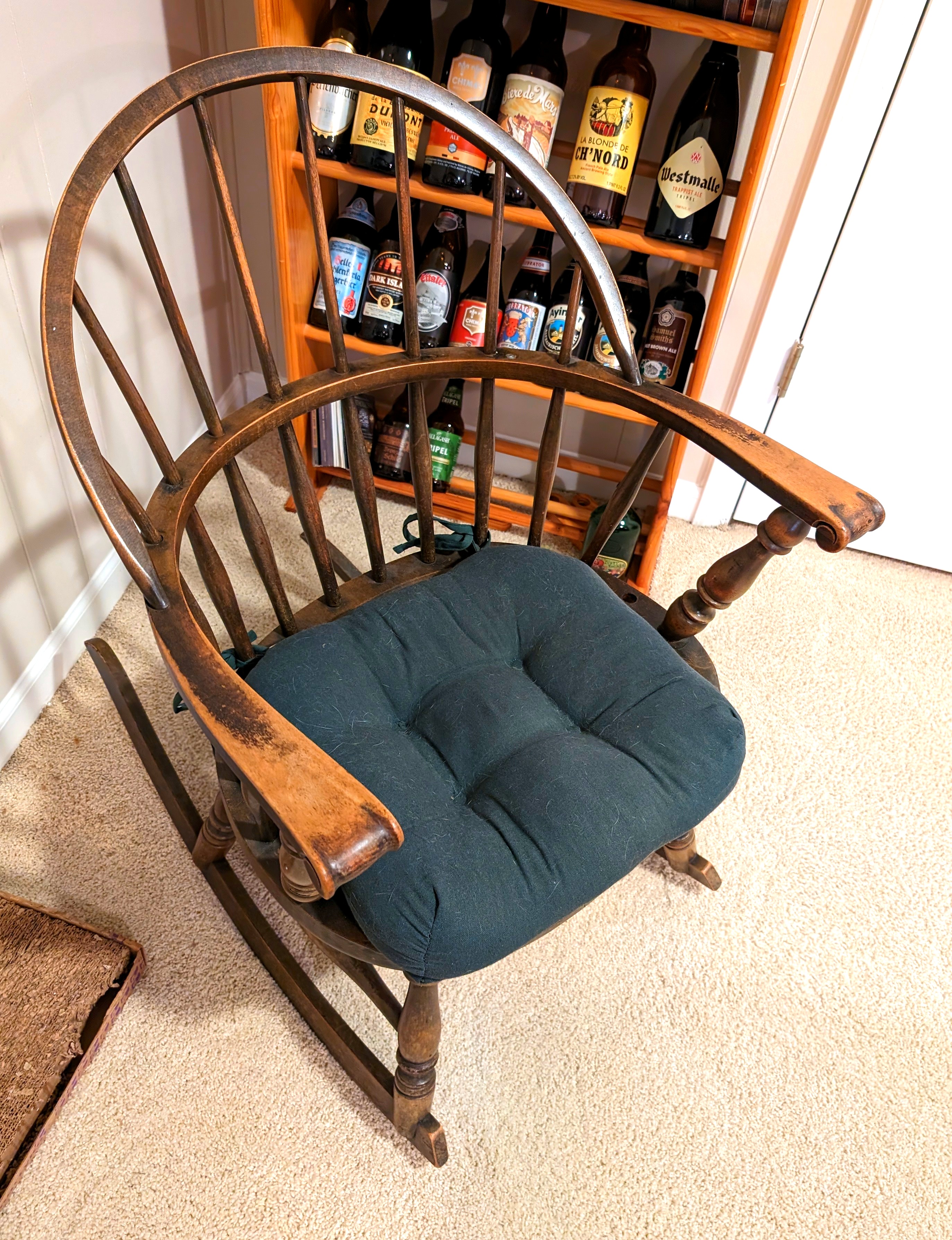
When my father’s father died, and his mother entered a nursing home, I inherited another rocker and its matching straight-legged chair, a captain’s chair style. I wish I could remember their position in their household. These two must have had either sentimental or practical value for my grandparents to have moved them from a large Victorian three-bedroom house to a small two-bedroom home in a retirement community. The rocker is missing one of the dowels between the seat and the arms. My father’s brother got his leg stuck between two dowels and my panicking grandmother insisted to her husband that they break out one dowel to free him.
The true Captain’s chair. February 2024.The matching chair. Note how all of these old chairs have lost the finish on the arms, due to loving wear. February 2024.
Despite my love for this older furniture, it has only graced our main rooms by necessity. Early in our marriage (the second, lasting one) we purchased a Broyhill recliner which echoed the wing-backed design of these older chairs complete with a brocade upholstery. It also complemented our older, inherited chairs. Unfortunately, only a few years after we did, we invited a streetwise cat into our house whose scratching habits proceeded to turn it into a tasseled mockery of itself. It sits in the rec room now, with the other rejects who form the viewing area for our ‘home theater’. (It’s not really a home theater; it’s two chairs and a love seat, all of which recline and are positioned as optimally as possible to a large TV with a surround speaker system. We invited the other chair in the ensemble into our living room in 2009, and sent it to the basement in 2017.) I’m thinking we should reupholster it and return it to its rightful place in our living room.
Early relegation to our basement (or worse) seems to be the norm for modern furniture. I would tell you of the two loveseats which have been purchased and abandoned in that time, falling out of favor and usefulness just as the one now in our basement, and I could detail the two sofas we purchased in 2006 and 2013, the former being replaced by the latter, the latter going “to a deserving home” in 2020. But we’re talking of chairs. We started 2020 with a fixation on chairs. We purchased four chairs which looked decent, solid, and worthy of the prices we paid. Two of them replaced two of the inherited chairs detailed above. Two motorized recliners replaced the sofa. Now, barely more than four years old, the two recliners have entered middle age, declaring themselves for the James Dean life with the exception they’ve never lived fast nor will they leave a beautiful corpse. They’ve become more uncomfortable to me as I deal with lower back issues. Luckily the two side chairs have been making their case for sticking around more than a few years. They simplistically mimic the older inherited chairs, causing me to wonder: why I don’t seek out chairs like that?
Before ending this, office chairs should be mentioned. Though often unremarkable, they offer a unique feature: they almost always have wheels. On top of industrial-grade, quarter-inch-thick carpet, these babies provide transportation to those unwilling to stand simply to walk 10-20 feet to a neighbor’s cubicle. (And that one time my four-person team found ourselves housed in a former microbiological incubation room with hard, sealed floors? One of eight such rooms on a hallway with the same flooring? Do you know how far you can push a well-lubricated chair on such floors? Not if you haven’t tried it!) Once, though, I purchased an old office chair my employer had slated for disposal. Although the calendar said 1997, this chair hailed from the 1950’s. Completely upholstered with wood accent on the arms, this chair would swivel and tilt just like modern chairs–but with no ability to make adjustments. Yes, it had wheels. And from that year until 2006 (I think) it served me well as my computer desk chair.
Ultimately we think of office furniture similarly to most of our then co-workers: there have been many but we remember only a few. Not so our heirloom chairs. Not so the chairs of our childhood, from the plastic-sheathed kitchen chairs to the kitchen stools to the weird plastic furniture used on our parents’ patios. Not so the chairs which graced our first apartments, entering the doorway by whatever means necessary, whether begging, stealing, inheriting, or in our last-ditch efforts, purchasing. Not so where we sat when visiting our grandparents, our uncles/aunts/cousins, or even our friends in college when a Naugahyde sack full of styrofoam could be called “a bean-bag chair”.
When I look at this cycle, I see that my parents’ chairs came and went, my chairs in school could at best be called functional, my chairs in early adulthood had value only because they were there, my chairs throughout my life have primarily existed only until I could replace them–but the chairs I inherited from my grandparents, the ones constructed in the 1920’s, the 1930’s, the 1940’s, have outlasted all of the others and, like the British monarchy, say, “yet, I’m still here!”
Five days after a funeral. Lake Lynn, 07 November 2019.
Warnings & Notes: This post contains a few graphic depictions of death, some examples of socially unacceptable behavior, and is just generally a downer if you look at it a certain way. Also, some of these observations have been made before. If you read this blog regularly (there’s only a half dozen or so of you), well, sorry….a little.
This year All Souls Day, November 2nd, marked the fourth anniversary of my mother’s funeral. It’s the day I most think back upon her life and death. The anniversary of her death, October 24, I barely note. Sometimes it even slips by me before I realize it. The funeral symbolizes my mother’s love, her life, and all those influences we spend a lifetime unraveling. In contrast, the date of her death represents thoughts I acknowledge but do not celebrate, and her passing is hardly something to celebrate in and of itself. I would rather focus on the entirety of her life and death: the funeral marked that, not the death.
My mother and I lived more than 2100 miles apart at that point. My profession had taken me to the eastern United States; she remained in Spokane, WA, from where she had encouraged me to follow my dreams wherever they led. Her parents had, my father’s parents had, they had themselves, so why shouldn’t their children? Still, it didn’t reduce my guilt much for not being more available to her in that last year, indeed that span of a half dozen years when she lived on after my father’s death. My brother lived nearly ten times closer in Tacoma but it took me only a few more hours to get there by plane versus him taking a drive across the state. He encouraged her to move to Tacoma. I half-heartedly supported him. She refused, saying her friends and neighbors were in Spokane. I strongly pushed that she could move to a “retirement community” there in Spokane where some of her friends lived. She demurred, then refused. Her best support network were the good neighbors she had. She was right. We were wrong. I saw one of those retirement homes at the end of her life. I was really wrong, and–
But I’m not going to rehash that whole period. I’ll just note this: I watched her steadily decline during the five years after my father died, visiting her more and more frequently. (The Fates blessed me in several ways when 13 months after my father died, I started traveling the country for work. It became just as easy to fly to Spokane as to Raleigh.) In December 2018 my mother learned she had Stage IV breast cancer. At 89 years, she recoiled from and declined chemotherapy, threw her lot in with hormone receptor treatment (a pill, nothing more), and for various reasons was in and out of hospitals, convalescent homes, and her new apartment in a “retirement community” through the fall of 2019. She celebrated her 90th birthday in that apartment.
I visited my mother a dozen days into October 2019 as she lived her final days. I returned home only to receive The Call two days later. It was a Thursday. Knowing my brother could drive there quickly, and emotionally exhausted from watching her exist in a morphine-induced stupor, I rolled the dice, told him I wouldn’t come until Monday, and I let him spend Friday through Sunday with her. I flew back on that Monday, and sat beside her bed a lot until she passed away on Thursday. My brother had returned to his home and job. Thus it fell to me to handle the first round of details.
From the moment a loved one dies, those closest to them experience a bewildering whirlwind of details thrust upon them which must be handled immediately. As the elder of two children, the most controlling of us, and frankly, just because I was the one there, it fell to me to make those arrangements. Again, I shall refrain from a step by step accounting of it. This is supposed to be an accounting of All Souls and a celebration, not a macabre dwelling on those days of death. One example shall suffice: on Thursday morning, the day she died officially at 10:22 a.m., I had to leave her to be at the bank when it opened at 9 a.m. The instruction manual entitled “What You Will Have To Do When Your Second Parent Dies” never made it into my mailbox, I guess. If it had, maybe I would have been better prepared than to learn in her final hours that her investment accounts would be frozen for disbursement when she died, and that as her executor I would be paying bills with whatever sat in that bank account for the foreseeable future. The bank account had less than $3200 in it when I dumped a huge amount in there. Take note if you’re ever in this position: for the next year, I had to pay bills from that account. If I hadn’t done that, my brother and I would have had to agree on splitting the bills. Really, take note.
My mother’s death came as a relief. I’m saddened to admit her death came as a relief. I know many have said this, but I feel as I feel. She had suffered with increasing pain from the breast cancer for a year. I doubt anything can prepare you to listen to your mother slowly drown and die, to realize the fluidic sounds of her breathing come from her lungs as they slowly fill, to watch from a removed perspective as your voice sharply criticizes the health staff which insists on turning a patient even when this obviously makes the breathing worse. Beyond prayer, I simply endured. I carry with me that immense relief I felt when I re-entered her room after a short phone call from her cousin and discovered my mother had died. I also carry with me the commensurate load of guilt for not being there at that moment. The part of me formed by social mores scolds me perpetually; the accepting, independent side of me simply says, “that’s the way it happened. There’s nothing which could have been done at the time, and there’s no shame in feeling relief.”
In contrast to the anniversary of her death, which represents a smorgasbord of feelings, few of them good, even fewer comforting, the anniversary of the funeral represents a day of love. It’s the day remaining friends and family gathered to mark how much they loved your mother and how much they would miss her. It’s the day you created all the little remembrances which would afterward become powerful symbols in your life. It’s the day you got to reminisce about all the times: mostly good, some bad, some funny, some sad. It’s the day when many told you “You did a good job by your mother,” even if they were lying a little bit. And it’s the day you closed the door, for just a bit, on all of those things which just have to be done. It’s the day when you looked forward to a few days where nothing about your mother’s funeral and estate needed to be accomplished: those things would wait a few days–with luck, a few weeks.
Each All Souls Day since that time refreshes all these memories. It’s the stem that gathers all the roots of remembrance and supports the branches of What Has Come To Be. For me, it’s inextricably bound up with my decision two weeks after her funeral to retire. Those twin events, her passing and my retirement, have become tied to those crazy years when a pandemic changed our society, or perhaps, when it revealed who we had come to be. All Souls Day, which exists quietly in the immediate shadow of its more important sibling, All Saints Day, and is heralded by All Hallows’ E’en, tells us it’s important to mark the passing of those we loved and to pray for them, to remember them, to honor them. By its existence, it says to ignore the ones who have been declared important, and that we must instead recognize the importance of each of us.
Mostly, though, All Souls Day reminds all of us of the death of those we loved. It picks at the scab of a wound which will not scar over and which has become part of who we are.
What if sunsets were blue? What if
they resembled my recollections:
how I broke upon your hardness, how you
ran from my insensitive cutting
remarks, lasers which severed whatever
tied us together those few years? Would I
ever have experienced solar reds, oranges,
pink-tinged magic? Known this reality?

Turned from unreal shadows dancing on
Plato's cave wall, pushed into dwelling
among well-lit shadow-makers,
my memories hold
only blue shadows
watching blue sunsets.
There are at least 15 different collective nouns for robins, most of which seem to refer to actual European robins, not the thrushes Americans call robins. I like blush. I watched a group feast on leftover apples one morning, orange on orange, then discovered the robins across the street where they had gone to refresh themselves.
January 2020, Spokane, WA
This occurred two months after we held my mother’s funeral. When not watching robins, I spent bittersweet time wallowing in the memories of my parents, my relationships with them, and growing up with my younger brother–in short, my familial life–while I sorted through the accumulations of two lifetimes. The word “wallow” serves better than “savor”: the latter implies a taking in, a controlled appreciation, a distinction between myself and the memories; the former captures my headlong dive into the totemic magic and power of objects which transports one involuntarily to other places in time and space. “Wallow” accurately conveys being in the memories, one with them as they washed over me, a miniscule little man leaping into a snifter filled with rare cognac, voluntarily giving up all control, at times wondering if he will drown. Nevertheless these memories, like the cognac, provided a warming experience within and without.
Each object could open a trapdoor in my emotions, sluicing me downward, backward in time to feelings and events held in thrall by the fallibility of my memory: the coaster my mother brought back from Spain when my father fulfilled her lifelong dream of going there…
Wooden coaster, Spain.
…the footstool which sat in my maternal grandparents’ living room until it sat in my parents’ living room and now sits in my library…
Footstool, circa 1920s
…the pen and ink reproduction of Lake Quinault Lodge in Olympic National Park where my parents visited with the dearest friends of their later years…and where I introduced my wife to the magic of the Washington State temperate rainforest…and where we in turn visited with our dearest friends…
Lake Quinault Lodge, Olympic National Park, Washington State, USA
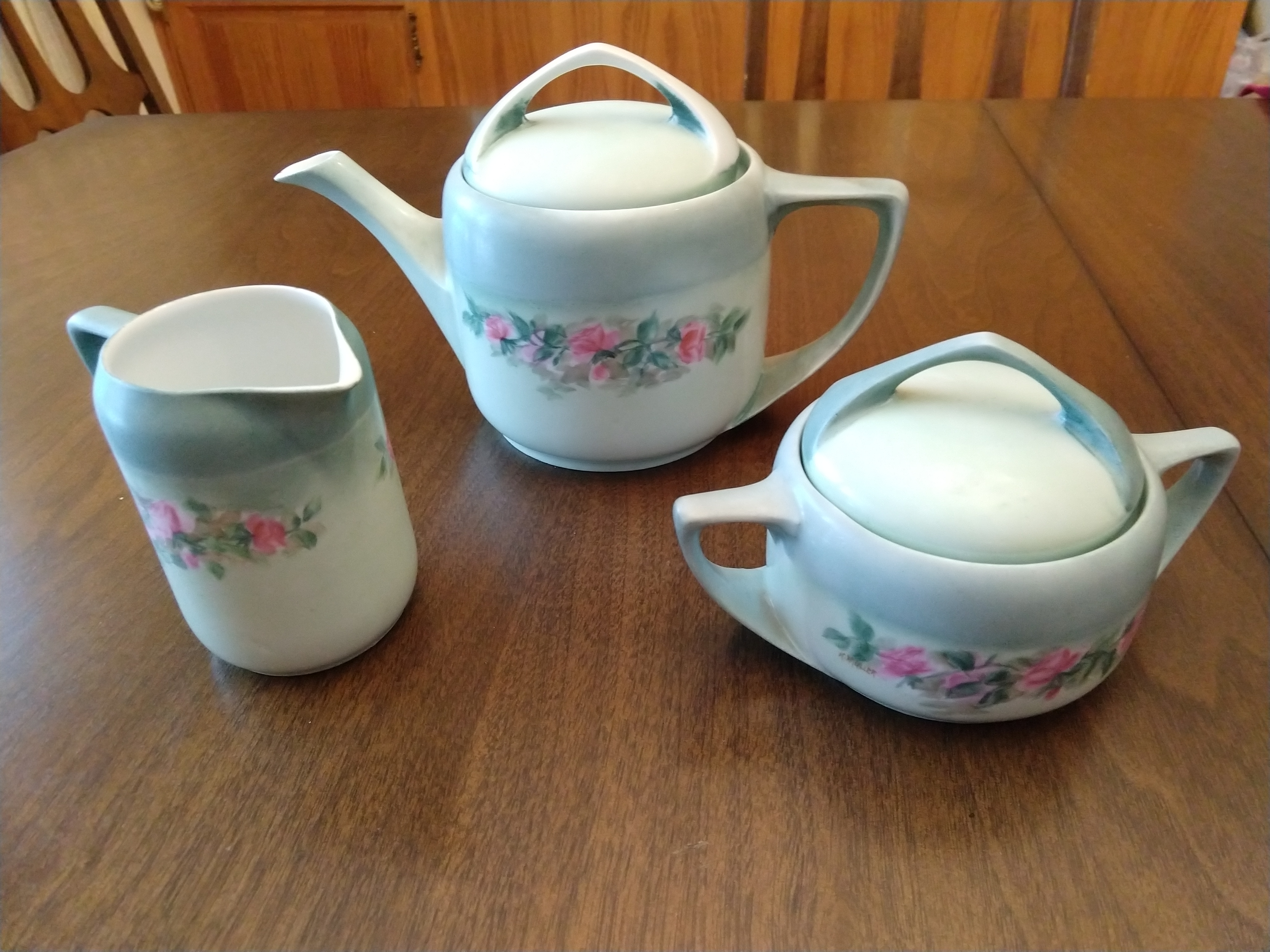
New doors opened, new memories were made: discovering via a piece of masking tape on the bottom of a teapot that a tea set which sat in our house for decades once belonged to my great-grandmother, who died over a half century ago…
Bavarian tea set, early 1900s
…that my maternal grandmother had been a flapper, wearing this dress…
Flapper dress with handsewn beadwork, 1920s
…that my mother appeared to save every letter I wrote to her throughout my life…that my father was both more obsessed with record-keeping than I had suspected and less organized about it than I had thought…that my brother was very artistic in elementary school as evidenced by all of our school papers having been preserved by my mother.
When I acted in community theater, I read Impro: Improvisation and the Theatre by Keith Johnstone. After the typical introduction and notes sections, Johnstone presented four sections, the final of which was entitled “Masks and Trance”. I likely do Johnstone an injustice here, but what I’ve taken away from the section is that objects can possess an actor if the actor permits it. Further, the same object will induce similar acting performances from two different actors. Masks in this sense do not need to be facial coverings, although much of Johnstone’s work was with traditional comic or character masks which cover the top half of the face. The Charlie Chaplin Tramp costume represents a mask. Chaplin is quoted from his autobiography as saying this about what happened after he chose baggy pants, a tight jacket, a false moustache, a cane, and big shoes: “…I had no idea of the character. But the moment I was dressed, the clothes and make-up made me feel the kind of person he was. I began to know him, and by the time I walked on the stage he was fully born…with the clothes on I felt he was a reality, a living person. In fact he ignited all sorts of crazy ideas that I would never have dreamt of until I was dressed and made-up as the Tramp…For me he was fixed, complete, the moment I looked in the mirror and saw him for the first time, yet even now I don’t know all the things that are to be known about him.”
Johnstone speaks intuitive truth, which I experienced as I sorted my parents’ possessions. Though I had little knowledge of the various tea cups and sets my mother collected, a simple reference to her own grandmother triggered the three-generational appreciation for fine china, pottery, and the allure of the Orient for them. I could feel it, not just appreciate it. Similarly, seeing the dress (suit) my mother wore on the first day of her honeymoon created in me the feeling of pride, joy, anticipation, and love for my father which she felt as he took the photograph of her I had seen so many times growing up. Perhaps I leapt to make connections where none existed. Perhaps I merely stitched together disparate memories when I looked at the diamond ring my father commissioned to repurpose his mother’s wedding ring. Perhaps it reflects only the deductive approach of a historian, not the inductive episodes I’ve described here. Perhaps…
That objects carry weight and meaning seems unavoidably true. To dismiss them, to clear them away from one’s life because they represent “clutter”, to periodically get rid of things simply because “I ought to”, to focus only on life experiences–certainly this has a minimalist, zen allure to it, but it ultimately represents a negation of the physical. When the important aspects of one’s reality exist only in the mind, then another may question, “Why are you here then?” This attitude and that question sum up for me the problem with certain Christian scriptures which seem to advise us to dismiss the world as secondary. Likewise the Buddhist notion that life is but illusion avoids the simple fact that we must walk through this illusion until death. To repeat: why are we here then?
Most of those objects I sorted through have moved on to others’ hands. Like a death from one thousand cuts, I could not transport the contents of a 2600 square foot house to mine. Ignoring marital discord, it simply defied the laws of physics, and it represented a serious challenge to my fiscal state to transport them across the United States. Except for select items, photos must stand in to stimulate my memories now. But I still haven’t captured the magic, the hold these things have on me. Where are the words to describe what I feel when hold a small little lockbox made from metal, fashioned to look like a suitcase from the 1940s, and scarcely large enough to hold a pack of cards? I can tell you how I held this in my hands over the course of my childhood and listened to the coins inside slide around. I can tell you my father threw a few coins in it from time to time, coins which represented singular things to him. I don’t even know why some of the coins were there. What made a particular nickel so important? I even can attempt a description of my young feelings as I looked at a representational suitcase and saw things that suitcases did not have to the best of my young knowledge: straps to tie it up and hold it together; images of stickers from all the major cities and countries where the suitcase theoretically had been; a putty gray-green color accentuated by tan for the faux leather at the edges and on the belts securing it together. I can describe how I would take a little odd-shaped key to unlock the box to view those coins, but how can I convey to you how I still can feel what I felt then at the age of ten simply by holding the case in my hands? How I can see my father at 40 instead of 80? I can picture where it was tucked in the top drawer of his chest of drawers, underneath the white handkerchiefs he always carried in his suits–until he didn’t. I see the arrangement of the furniture in my parents’ bedroom in 1965. I feel the lumpiness of the awful-colored shag carpet rug alongside the bed. It never really stops. I can continue to describe the bedroom, the events which happened there, which trigger other events, other items–because I am at that moment living there-then not here-now.
Am I too old to envision a different way to relate to objects? In 75 years, 100 years will someone like me fondly recall the cumbersome approach to non-fungible tokens (NFTs) his grandparents had, and how he still cherishes them in the virtual vault where he stores them? I think not. Just as archeologists delicately brush dust from clay tablets and vases, so too do we mentally brush the cobwebs of time aside to relive those times we held these objects. In just the same way that we gaze on those ancients artifacts in museums, so too do we mentally consider the displays we’ve built in our mind of all those objects we couldn’t hang onto–and we’ll experience true joy to have a small little museum ourselves, maybe just a part of a shelf, maybe one room of our house, where we can look at the salient objects which invoke these magical feelings in us, feelings we cannot articulate fully, memories we can only share with others who hold them too.
Memories can bring a cascade of others until we are possessed. Sometimes it only takes a blush of robins to trigger them.











 all the voices in my head