Bibliophilia: translation

Le Ton Beau de Marot, purchased in a shiny-covered form.

Having published a book review just an hour ago, it seems fitting to revisit my Bibliophilia series with what amounts to another review. Le Ton beau de Marot: In Praise of the Music of Language by Douglas R. Hofstadter impressed me to such an extent that I purchased another when I lost the book to a less-than-responsible work friend. For nearly a decade it bothered me that I couldn’t pick it up and show it to people when I said, “you’ve got to read this!” Finally, having purchased Hofstadter’s Pulitzer Prize-winning Gödel, Escher, Bach: an Eternal Golden Braid (which has proved so dense I’ve never finished it), I tracked down a used version of Marot from a bookstore in Santa Fe, NM. (I necessarily bought it used because it apparently was out of print.) It’s inching its way up the Read Me list, probably gaining the top position in 2026. But why gush about it? To answer that, I must detour to 1999.

In July 1999 my wife received news that the lump in her breast was a benign cyst, nothing to worry about. A little over a month later she received word that the tests had been mixed up and that she actually had cancer. This occurred on her birthday. After three surgery procedures in September, we took a vacation to the Oregon Coast just one week prior to her beginning the chemotherapy regime. We stayed in a wonderful condo on Yaquina Bay at Newport, OR. When we left, we took a leisurely drive up Highway 101 along the coast all the way to Astoria before turning east the next day toward home. Shortly before we arrived to Astoria we stopped at Seaside when a largish bookstore caught our eyes. There I found Hofstadter’s book. Loving language, I read the flap, learned it took up the challenge of translation, and that it also touched many other topics. From the flap:

…he not only did many of his own translations of Marot’s poem, but also enlisted friends, students, colleagues, family, noted poets and translators—even three state-of-the-art translation programs!—to try their hand at this subtle challenge.

The rich harvest is represented here by 88 wildly diverse variations on Marot’s little theme. Yet this barely scratches the surface of Le Ton beau de Marot, for small groups of these poems alternate with chapters that run all over the map of language and thought.

Not merely a set of translations of one poem, Le Ton beau de Marot is an autobiographical essay, a love letter to the French language, a series of musings on life, loss, and death, a sweet bouquet of stirring poetry—but most of all, it celebrates the limitless creativity fired by a passion for the music of words.

What the flap only hints at I learned later. During the time Hofstadter gathered his many translations by consulting all those people, his own wife was dying of cancer. Thus, his “musings on life, loss, and death” dive deep into his soul and therefore ours. Add to that my own wife’s tussle with cancer—she won, unlike Hofstadter’s wife—and the work compels. As I worked my way through the book, I found it dealt with language at a very basic level some of the time: how do we mean things? How does one language differ from another? How does cognition play out in word choices? And on, and on…

When I finished it, I felt Le Ton beau de Marot had been one of the best books I’d read because it didn’t just deal with language or cognition or love or translation or meaning or any other of those things mentioned above. It dealt with all of them! I loaned the book to a co-worker whose daughter was headed off to college to pursue a degree in English and who wanted to be a writer. I undoubtedly didn’t make it clear enough that one day I expected the book back. When I handed it off, though, I held back my gloss notes, which instead of writing into the book I had written out on fine paper. (They were too extensive to write into the margins anyway!) The book meant so much that I still have the notes a dozen or more years later. Here’s one:

[p. 138-139] I would side with Frost, that poetry is what’s lost in translation. Not that it can’t be re-discovered in the new language, but it’s not the same poem. Thus the poet-translator is intent on supplying a twin, not the real thing.

Hofstadter’s work combined with my college readings on communication, media, and meaning to form my personal philosophy and understanding of all types of translation. I “see” the issue of meaning more deeply than many I engage with when discussing how a work translates from one language to another, how people in different cultures perceive things, how books become movies and vice versa, even in how Superman or Batman is translated every decade by a different director all of whom seemingly work from the same “text”. I even see the problems of translation as one of the issues currently plaguing United States politics.

Hofstadter’s book satisfied on so many levels, engaged so many pleasure neurons, that I can’t do it any justice. You’ll simply have to read it yourself if you love reading about language and the problems of translation…and cognition…and…

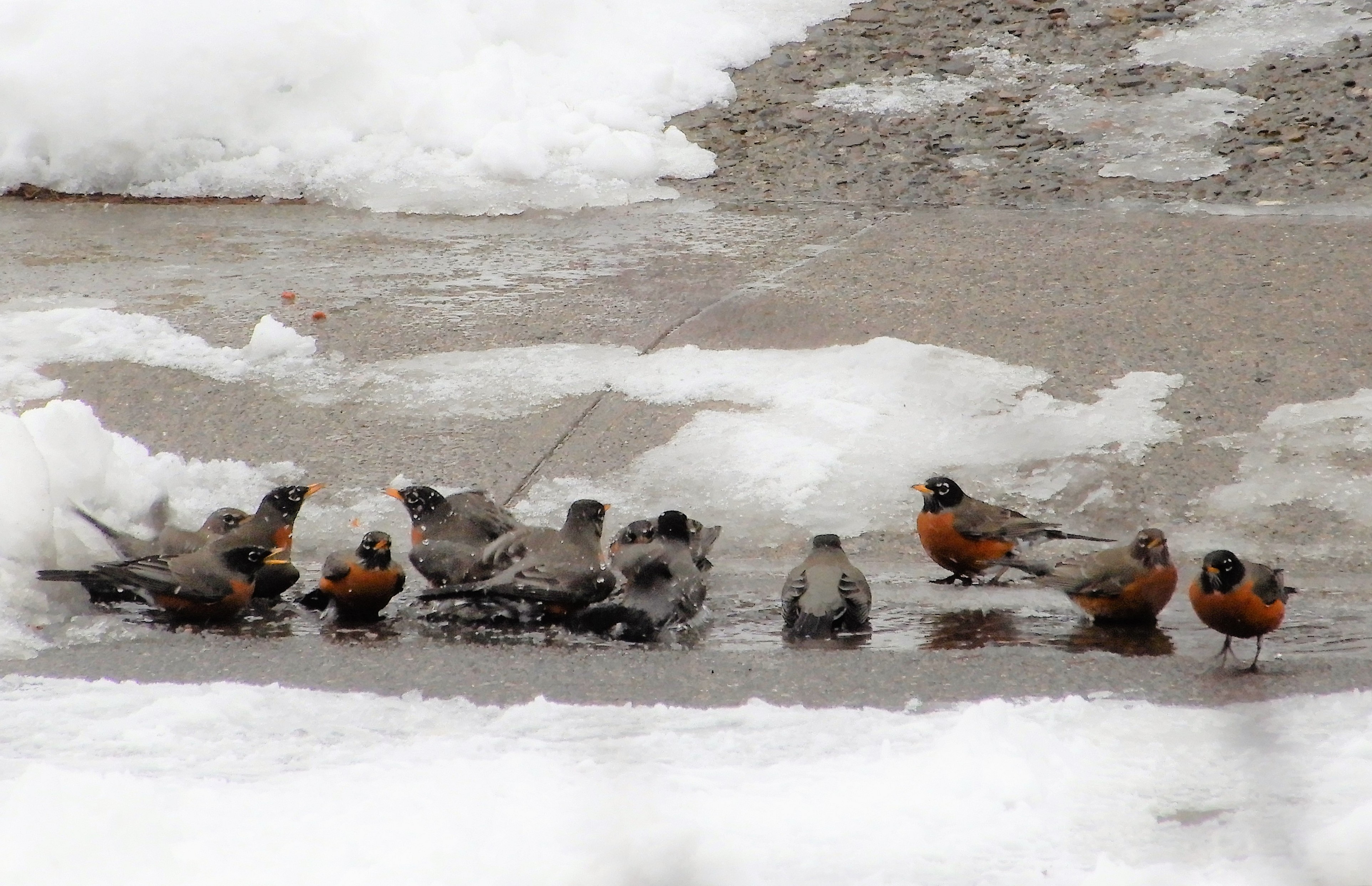
a blush of robins

January 2020, Spokane, WA.

There are at least 15 different collective nouns for robins, most of which seem to refer to actual European robins, not the thrushes Americans call robins. I like blush. I watched a group feast on leftover apples one morning, orange on orange, then discovered the robins across the street where they had gone to refresh themselves.

January 2020, Spokane, WA

This occurred two months after we held my mother’s funeral.  When not watching robins, I spent bittersweet time wallowing in the memories of my parents, my relationships with them, and growing up with my younger brother–in short, my familial life–while I sorted through the accumulations of two lifetimes. The word “wallow” serves better than “savor”: the latter implies a taking in, a controlled appreciation, a distinction between myself and the memories; the former captures my headlong dive into the totemic magic and power of objects which transports one involuntarily to other places in time and space. “Wallow” accurately conveys being in the memories, one with them as they washed over me, a miniscule little man leaping into a snifter filled with rare cognac, voluntarily giving up all control, at times wondering if he will drown. Nevertheless these memories, like the cognac, provided a warming experience within and without.

Each object could open a trapdoor in my emotions, sluicing me downward, backward in time to feelings and events held in thrall by the fallibility of my memory:  the coaster my mother brought back from Spain when my father fulfilled her lifelong dream of going there…

Wooden coaster, Spain.

…the footstool which sat in my maternal grandparents’ living room until it sat in my parents’ living room and now sits in my library…

Footstool, circa 1920s

…the pen and ink reproduction of Lake Quinault Lodge in Olympic National Park where my parents visited with the dearest friends of their later years…and where I introduced my wife to the magic of the Washington State temperate rainforest…and where we in turn visited with our dearest friends…

Lake Quinault Lodge, Olympic National Park, Washington State, USA

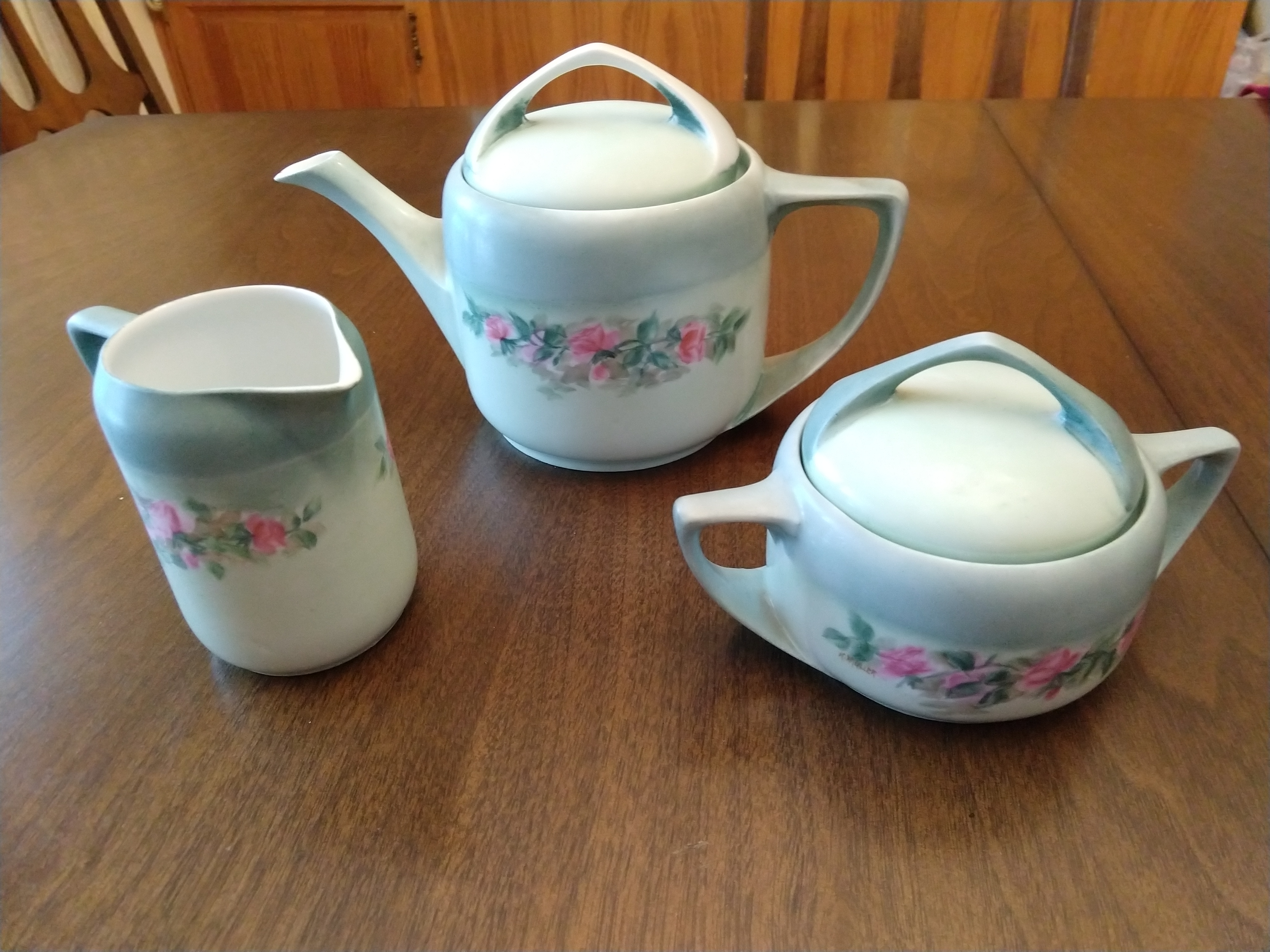
New doors opened, new memories were made:  discovering via a piece of masking tape on the bottom of a teapot that a tea set which sat in our house for decades once belonged to my great-grandmother, who died over a half century ago…

Bavarian tea set, early 1900s

…that my maternal grandmother had been a flapper, wearing this dress…

Flapper dress with handsewn beadwork, 1920s

…that my mother appeared to save every letter I wrote to her throughout my life…that my father was both more obsessed with record-keeping than I had suspected and less organized about it than I had thought…that my brother was very artistic in elementary school as evidenced by all of our school papers having been preserved by my mother.

When I acted in community theater, I read Impro: Improvisation and the Theatre by Keith Johnstone. After the typical introduction and notes sections, Johnstone presented four sections, the final of which was entitled “Masks and Trance”. I likely do Johnstone an injustice here, but what I’ve taken away from the section is that objects can possess an actor if the actor permits it. Further, the same object will induce similar acting performances from two different actors. Masks in this sense do not need to be facial coverings, although much of Johnstone’s work was with traditional comic or character masks which cover the top half of the face. The Charlie Chaplin Tramp costume represents a mask. Chaplin is quoted from his autobiography as saying this about what happened after he chose baggy pants, a tight jacket, a false moustache, a cane, and big shoes: “…I had no idea of the character. But the moment I was dressed, the clothes and make-up made me feel the kind of person he was. I began to know him, and by the time I walked on the stage he was fully born…with the clothes on I felt he was a reality, a living person. In fact he ignited all sorts of crazy ideas that I would never have dreamt of until I was dressed and made-up as the Tramp…For me he was fixed, complete, the moment I looked in the mirror and saw him for the first time, yet even now I don’t know all the things that are to be known about him.”

Johnstone speaks intuitive truth, which I experienced as I sorted my parents’ possessions. Though I had little knowledge of the various tea cups and sets my mother collected, a simple reference to her own grandmother triggered the three-generational appreciation for fine china, pottery, and the allure of the Orient for them. I could feel it, not just appreciate it. Similarly, seeing the dress (suit) my mother wore on the first day of her honeymoon created in me the feeling of pride, joy, anticipation, and love for my father which she felt as he took the photograph of her I had seen so many times growing up. Perhaps I leapt to make connections where none existed. Perhaps I merely stitched together disparate memories when I looked at the diamond ring my father commissioned to repurpose his mother’s wedding ring. Perhaps it reflects only the deductive approach of a historian, not the inductive episodes I’ve described here. Perhaps…

That objects carry weight and meaning seems unavoidably true. To dismiss them, to clear them away from one’s life because they represent “clutter”, to periodically get rid of things simply because “I ought to”, to focus only on life experiences–certainly this has a minimalist, zen allure to it, but it ultimately represents a negation of the physical. When the important aspects of one’s reality exist only in the mind, then another may question, “Why are you here then?” This attitude and that question sum up for me the problem with certain Christian scriptures which seem to advise us to dismiss the world as secondary. Likewise the Buddhist notion that life is but illusion avoids the simple fact that we must walk through this illusion until death. To repeat: why are we here then?

Most of those objects I sorted through have moved on to others’ hands. Like a death from one thousand cuts, I could not transport the contents of a 2600 square foot house to mine. Ignoring marital discord, it simply defied the laws of physics, and it represented a serious challenge to my fiscal state to transport them across the United States. Except for select items, photos must stand in to stimulate my memories now. But I still haven’t captured the magic, the hold these things have on me. Where are the words to describe what I feel when hold a small little lockbox made from metal, fashioned to look like a suitcase from the 1940s, and scarcely large enough to hold a pack of cards? I can tell you how I held this in my hands over the course of my childhood and listened to the coins inside slide around. I can tell you my father threw a few coins in it from time to time, coins which represented singular things to him. I don’t even know why some of the coins were there. What made a particular nickel so important? I even can attempt a description of my young feelings as I looked at a representational suitcase and saw things that suitcases did not have to the best of my young knowledge: straps to tie it up and hold it together; images of stickers from all the major cities and countries where the suitcase theoretically had been; a putty gray-green color accentuated by tan for the faux leather at the edges and on the belts securing it together. I can describe how I would take a little odd-shaped key to unlock the box to view those coins, but how can I convey to you how I still can feel what I felt then at the age of ten simply by holding the case in my hands? How I can see my father at 40 instead of 80? I can picture where it was tucked in the top drawer of his chest of drawers, underneath the white handkerchiefs he always carried in his suits–until he didn’t. I see the arrangement of the furniture in my parents’ bedroom in 1965. I feel the lumpiness of the awful-colored shag carpet rug alongside the bed. It never really stops. I can continue to describe the bedroom, the events which happened there, which trigger other events, other items–because I am at that moment living there-then not here-now.

Am I too old to envision a different way to relate to objects? In 75 years, 100 years will someone like me fondly recall the cumbersome approach to non-fungible tokens (NFTs) his grandparents had, and how he still cherishes them in the virtual vault where he stores them? I think not. Just as archeologists delicately brush dust from clay tablets and vases, so too do we mentally brush the cobwebs of time aside to relive those times we held these objects. In just the same way that we gaze on those ancients artifacts in museums, so too do we mentally consider the displays we’ve built in our mind of all those objects we couldn’t hang onto–and we’ll experience true joy to have a small little museum ourselves, maybe just a part of a shelf, maybe one room of our house, where we can look at the salient objects which invoke these magical feelings in us, feelings we cannot articulate fully, memories we can only share with others who hold them too.

Memories can bring a cascade of others until we are possessed. Sometimes it only takes a blush of robins to trigger them.

A blush of two

Dance of Dense

First:
'There’s a problem with poetry,'
He said. 'Today all poets
Want to compress meaning into
Too few words. This squeezing of
Words, accordion-like,
Displays the poet’s desire
To be obscure,
To force the reader
To find the meaning,
Giving away nothing,
Hiding mediocrity by claiming
My meaning is clear to those
Who know.’
Second:
Poetry today problems itself:
Compressing fruitful meaning until
Pulp disappears, leaving it
Compressed to star-dense
Proportions, a light-sucking
Mass. Makes me
Sick
Reading stuff like that.
Third:
Poetry today
Suffering from
Minimalism,
Obscurism,
Densification.
Searching for meaning,
This reader finds only
Sickness.
Fourth:
Consider today’s poem—
Dense with meaning—
Makes me sick!
Finis:
Poem.
Dense.
VomitSPLATTER!