Bibliophilia: translation

Le Ton Beau de Marot, purchased in a shiny-covered form.

Having published a book review just an hour ago, it seems fitting to revisit my Bibliophilia series with what amounts to another review. Le Ton beau de Marot: In Praise of the Music of Language by Douglas R. Hofstadter impressed me to such an extent that I purchased another when I lost the book to a less-than-responsible work friend. For nearly a decade it bothered me that I couldn’t pick it up and show it to people when I said, “you’ve got to read this!” Finally, having purchased Hofstadter’s Pulitzer Prize-winning Gödel, Escher, Bach: an Eternal Golden Braid (which has proved so dense I’ve never finished it), I tracked down a used version of Marot from a bookstore in Santa Fe, NM. (I necessarily bought it used because it apparently was out of print.) It’s inching its way up the Read Me list, probably gaining the top position in 2026. But why gush about it? To answer that, I must detour to 1999.

In July 1999 my wife received news that the lump in her breast was a benign cyst, nothing to worry about. A little over a month later she received word that the tests had been mixed up and that she actually had cancer. This occurred on her birthday. After three surgery procedures in September, we took a vacation to the Oregon Coast just one week prior to her beginning the chemotherapy regime. We stayed in a wonderful condo on Yaquina Bay at Newport, OR. When we left, we took a leisurely drive up Highway 101 along the coast all the way to Astoria before turning east the next day toward home. Shortly before we arrived to Astoria we stopped at Seaside when a largish bookstore caught our eyes. There I found Hofstadter’s book. Loving language, I read the flap, learned it took up the challenge of translation, and that it also touched many other topics. From the flap:

…he not only did many of his own translations of Marot’s poem, but also enlisted friends, students, colleagues, family, noted poets and translators—even three state-of-the-art translation programs!—to try their hand at this subtle challenge.

The rich harvest is represented here by 88 wildly diverse variations on Marot’s little theme. Yet this barely scratches the surface of Le Ton beau de Marot, for small groups of these poems alternate with chapters that run all over the map of language and thought.

Not merely a set of translations of one poem, Le Ton beau de Marot is an autobiographical essay, a love letter to the French language, a series of musings on life, loss, and death, a sweet bouquet of stirring poetry—but most of all, it celebrates the limitless creativity fired by a passion for the music of words.

What the flap only hints at I learned later. During the time Hofstadter gathered his many translations by consulting all those people, his own wife was dying of cancer. Thus, his “musings on life, loss, and death” dive deep into his soul and therefore ours. Add to that my own wife’s tussle with cancer—she won, unlike Hofstadter’s wife—and the work compels. As I worked my way through the book, I found it dealt with language at a very basic level some of the time: how do we mean things? How does one language differ from another? How does cognition play out in word choices? And on, and on…

When I finished it, I felt Le Ton beau de Marot had been one of the best books I’d read because it didn’t just deal with language or cognition or love or translation or meaning or any other of those things mentioned above. It dealt with all of them! I loaned the book to a co-worker whose daughter was headed off to college to pursue a degree in English and who wanted to be a writer. I undoubtedly didn’t make it clear enough that one day I expected the book back. When I handed it off, though, I held back my gloss notes, which instead of writing into the book I had written out on fine paper. (They were too extensive to write into the margins anyway!) The book meant so much that I still have the notes a dozen or more years later. Here’s one:

[p. 138-139] I would side with Frost, that poetry is what’s lost in translation. Not that it can’t be re-discovered in the new language, but it’s not the same poem. Thus the poet-translator is intent on supplying a twin, not the real thing.

Hofstadter’s work combined with my college readings on communication, media, and meaning to form my personal philosophy and understanding of all types of translation. I “see” the issue of meaning more deeply than many I engage with when discussing how a work translates from one language to another, how people in different cultures perceive things, how books become movies and vice versa, even in how Superman or Batman is translated every decade by a different director all of whom seemingly work from the same “text”. I even see the problems of translation as one of the issues currently plaguing United States politics.

Hofstadter’s book satisfied on so many levels, engaged so many pleasure neurons, that I can’t do it any justice. You’ll simply have to read it yourself if you love reading about language and the problems of translation…and cognition…and…

People who don’t need people

In the late 1960’s I listened to Barbra Streisand on a transistor radio the size of a cheap paperback. She sang “People who need people are the luckiest people in the world.” I never understood that, emotionally at least. Intellectually I valued it and wanted to be one of those persons. I still do….but….

I don’t like people. There, it’s out. Liking people is inherent to my religious faith. We are supposed to like all people as caricatures of God, as images of God, or at the very least, as created beings who have as much claim to the Kingdom as anyone else. But…I do not gravitate toward people as an instinctive or cultured trait. I’ve known people who show themselves to be introverts, but they put on a social face, forcing themselves to reach out, building a practice that becomes instinctual. I’m not one of those, at least not in most milieus.

It’s more nuanced than it sounds. I like individual examples of “people” just not People in general and certainly not together in a group. Nothing tops my list of activities to be avoided like a cocktail party or “open house”. A group of people in a social situation where I know only one or maybe two of them makes me nervous, shuts me down, inspires my feet to start edging toward the exit, my lips mumbling an excuse to the host. Or that nervousness gets channeled into a babbling energy, creating The Entertainer—usually to my later embarrassment and dismay. After decades of experience with these situations—which mercifully I’ve kept to a limited number of occasions—I’ve learned some coping techniques. Mostly I avoid them unless I know a goodly handful of the people and like those who will be there. When I misjudge I desperately cast about for someone I know at least casually and bother them for as long as I can.

Oh boy, another wedding reception. Great for them, not so great for me.

I’ve learned how to maintain a veneer of sociability. I’m verbally talented after all. Talking to an individual about something they like makes you likeable. I’ve a wide range of interests and I’m well-read. I can usually relate to folks. But I’m uncomfortable.

Thankfully wedding receptions have beer, and this one had photogenic grounds to keep me away from all those people.

Perhaps this explains my delight in this blog, and in others’. We skip the social chit-chat on these things (usually). We do sometimes utter the banal (“I’m so happy for you” or “Getting that disease is so horrible!”), but mostly we utter honest statements because the beauty and scourge of the Internet lies in its anonymity for those who post. It’s why I’ve chosen to blog under my actual name. That seems contradictory, but it’s not. Most of you know my name, but you don’t actually know me except through these writings—the same way I know you only through what you post. Is it bold or stupid to put my own name? I’d prefer to think “honest” in that I will utter my opinions and not hide behind total anonymity. But y’all know me from a load of coal: except for two of you, and that has inhibited some of the things I would post, which illustrates the difference I’m talking about, this being known but anonymous simultaneously.

Where all of this blather leads turns out to be unexpected. I do need people, but just not the ones who mouth platitudes, clichés, and banal statements about the weather. Symbolic language has its place, but in a social setting it makes for a symbolic encounter signifying nothing. Sure, I can do it, but the sheer uselessness of it bothers me considerably. This need for people has been reinforced (again) by spending a week alone while my wife visits the NC coast with her friend. I’m reminded of living in my head like I did so many years. I believe we all need people to listen to us. That there are so many diaries and journals of people famous and otherwise reveals a deep need for others to understand what they’re going through. I guess I am a “people who need people” but only deep down and selfishly.

Needing and caring for people remains a distinct view of my religious faith. Listen to people with care. They need that. Yes. But so do I. The adroit, talented person knows when to listen and when to ask for a listener. I, however, refer you to the beginnings of this post. I do not possess those talents. I seek for listeners, but not to be the listener. Reminded again and again of my failure in the social arena, I withdraw. This is my learning path, perhaps one of several.

Thanks for listening.

Life as a track event

Spokane, WA. Fall 1973.

I thought to make an extended metaphor about how life resembled a track event or maybe cross-country, how most of us spend the first 18 years getting in shape. When the gun sounds at 18, though, I ran into trouble because not all of us have those lovely first splits where the race seems to be a breeze and you think you could run forever. By 21, when I envisioned the first little twinge of pain, I realized that many couldn’t say that—for them the race becomes an endless drudge to be run, not at the front of the pack, but at the end of that solid bunch of runners who know they’ll never come close to winning this thing. And then I saw it isn’t a race anyway, and the metaphor petered out. If I apply this metaphor to myself I…

  • changed my event almost as soon as I signed up for it…
  • sat out the second lap…
  • signed up for a different event and changed that one twice before quitting the race again…
  • entered the original event chosen by 17-year-old me…
  • ran that race until I realized I just wasn’t suited for it…
  • trained for a different event and ran that one for a decade…
  • left that race, dreaming of the Perfect Event…
  • and fell into a nondescript event only to find my innate talents bloom

And that’s just the metaphorical telling of my career. What about love? Family? The experience of life? No matter. It was fun playing with that photo of my brother running cross-country when we both were young and naïve.

Fathers Day musings

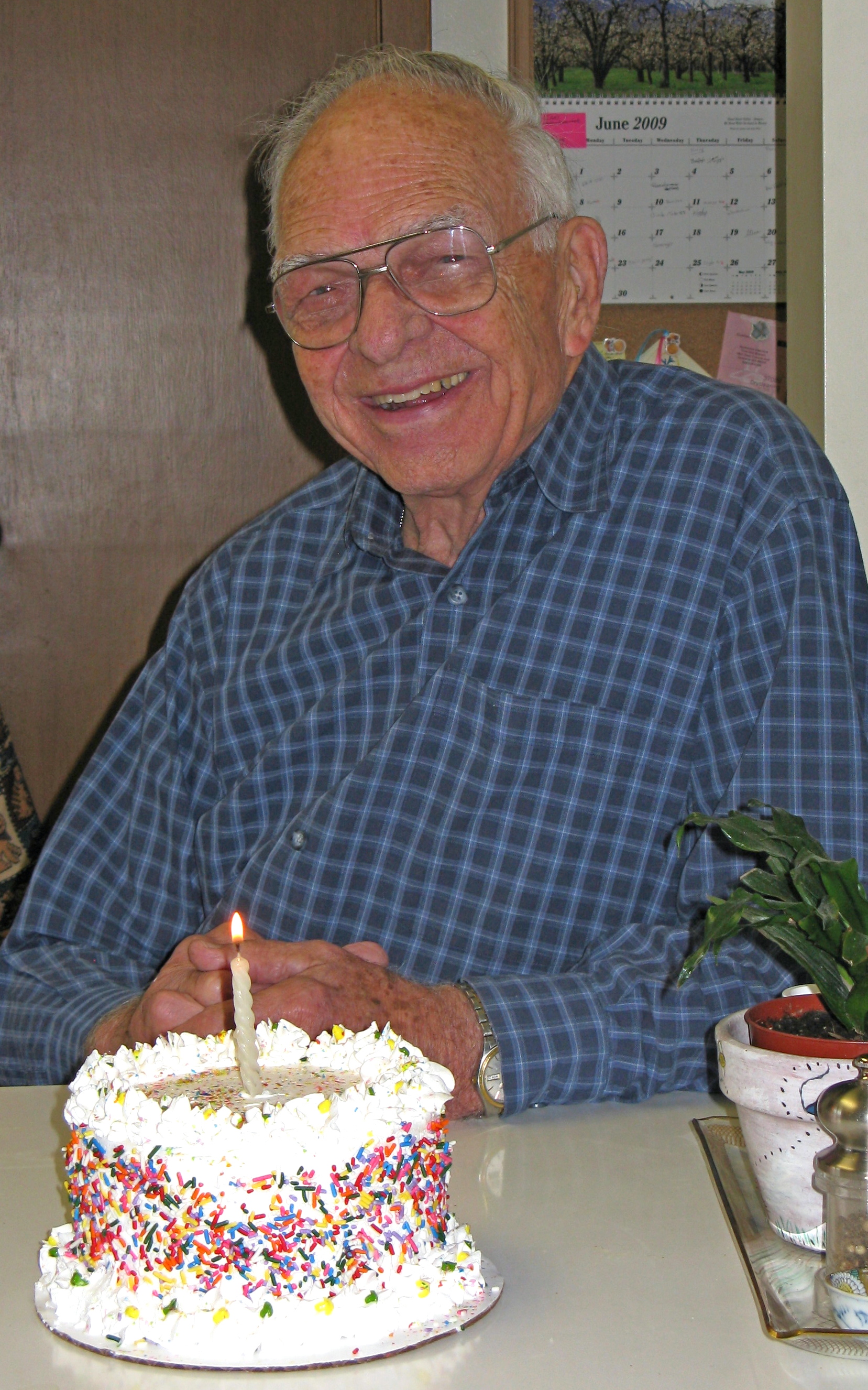
Happy 85th birthday, Dad! Spokane, WA, June 2009.

Father’s Day means less to me than many. My only children have been and are being cats. My relationship to the day runs one direction only, upward, to my progenitor. He left this mortal world more than a decade ago, but the memories remain vivid, accentuated by the passing of my father-in-law ten months ago. Life’s little irony, its bitter dessert: with every one of my years I understand him better; but this understanding always was for the Father in the past never for the Father of the now. Then he’s gone, and only the past exists. Unfairness salts this wound which never heals.

Growing up with this man my feelings differed, of course. How could they not? Once I became self-aware, our similar make-up combined with my contrarianism to make the sparks fly. This isn’t a truism. We argued and disagreed about everything. I remember these actual, real arguments, all of which went on for 20, 30 minutes, perhaps for an hour or more:

  • Does a body get colder or warmer immediately after eating? (I said colder, but neither of us had more than theoretical knowledge, and there was no Internet to solve things back then.)
  • If you learn a job applicant will be the second income for a family, should you favor the person who needs this job as the primary breadwinner? (He said yes, I said no. Back then the secondary income likely would be a woman’s, so the argument carried a deeper discussion about feminism and Women’s Lib.)
  • And one of my favorites: a yard should be allowed to go natural (said I); “you just don’t want to mow the lawn,” he said.

Father’s Day got diluted for him by the fluke of his birth date and the vagaries of politicians: it always occurred within eight days of his birthday. Take a look at that calendar over his shoulder. I used to hate Junes like that one. The third Sunday (and therefore Father’s Day) falls on the 21st. His birthday occurred on the 22nd. Two presents and two consecutive days I had to be nice to him. A year like this one, 2025, provided the maximum eight days of distance.

I used to commiserate with my brother (who took the photo above, I believe) about the monetary hit of birthdays and ‘parental recognition days’ in our family. Starting with his birthday on April 21st we ran through all the birthdays plus Mother’s Day and Father’s Day all by July 10th. In those 11 weeks he and I would buy five presents, an average of a present every other week. He especially hated June when my birthday (the 8th) smacked into Father’s Day (between the 15th and the 21st) and Dad’s birthday on the 22nd. And 18 days later came Mom’s birthday on July 10th. “The parade of presents, the meandering of money, the draining of dollars,…” —you get the idea. We didn’t have a lot of money back then; we bought our own presents, no help from Mom and Dad.

Despite this being my absolute favorite time of year with its leap into summer as the advent of June brings warm weather, the end of school and all the seasonal activities associated with it, and the chance to relax to a degree not permitted September through May, I run into these thoughts a bit more too. So many things become bittersweet with age. This continual discovery of more love for a man who’s gone remains one of the most important.

True thoughts for false spring

Imagine I’m drinking this–because I am. February 2024.

American football has ended its seeming stranglehold on the domestic sports scene. A surprisingly close game last night between the San Francisco 49ers and the Kansas City Chiefs kept me up to the end. That’s pretty unusual. I quit watching football decades ago. My interest diminished with the demise of an old version of the Seattle Seahawks, the one with Jim Zorn and Steve Largent. Or perhaps it diminished with my renewed interest in baseball. Whatever.

For a baseball fan, football feels about as welcome as your ex showing up at your next wedding. Baseball has just introduced itself at the beginning of April when the National Football League holds it’s draft. When the season gets going and the annual draft of new baseball talent occurs in early June, the NFL starts rattling its sabers about pre-camp workouts. Baseball gets some clarity as good teams rise to the top, bad teams falter, and the 2024 trade deadline approaches–and the NFL opens its training camps! All of these boorish events pale to this: baseball heads into its final month to determine the postseason, a five-week celebration of near-daily baseball games ending in the World Championship, and the NFL opens its season. In a pragmatic but depressing capitulation to reality, MLB mostly avoids holding postseason games on Sundays when most NFL games occur.

(And why do we call it football? Players’ feet only intentionally touch the ball to punt the ball away or kick the ball through the goalposts. This likely reflects my ignorance, but go with me here: players hand off, run, pass, and catch the ball. Now that European née global sport has appropriately called itself football!)

Ah, but for a few glorious weeks baseball reigns supreme. Football retires from the stage and lets the sport-formerly-known-as-America’s-sport, baseball, back into into the leading role it once occupied. Collegiate basketball intrudes, true, during March Madness, but it displays the genteel manners one would expect from amateur athletics. Baseball spring training games occur in the afternoon; NCAA games occur primarily in the evening. It crowns a champion during the first week of the baseball season, turning in that assignment a week late just as college students will, and bows itself from the stage. And the professionals in the NBA? Who cares? Their interminable playoff schedule will just be starting in mid-April, a two-month slog that ends in the middle of June.

Baseball and football play nice once each year. Football crowns a champ just prior to the start of baseball’s spring training. For six weeks all baseball fans think one of two things:

  • My team could win the World Series this year!
  • My team might not be as bad as it looks!

Hope springs, regardless. Thank you, Super Bowl; thank you, Spring.


First of the year: 11FEB2024

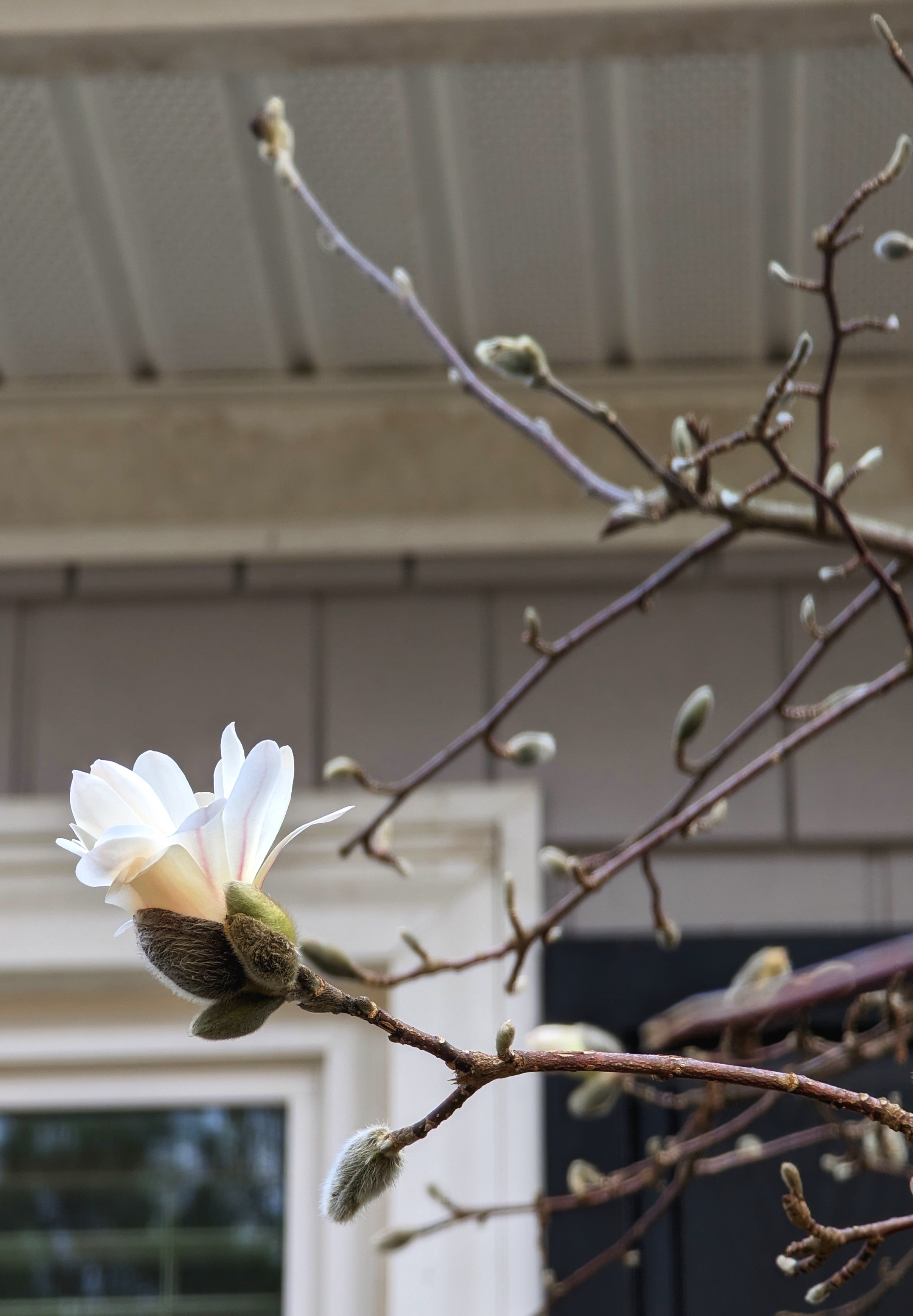
I know more cold weather remains a very real possibility. By the weekend we will see temperatures at or below freezing. Yet the ephemeral forecasts from various sources promise me I’ll see more early spring temps than I will not, and that’s something. Very soon the star magnolia will bloom, daring the other trees to follow suit. Judging by last year, we’re running a bit late. Here’s a photo from February 10th last year:

Star magnolia blossom. February 2023.

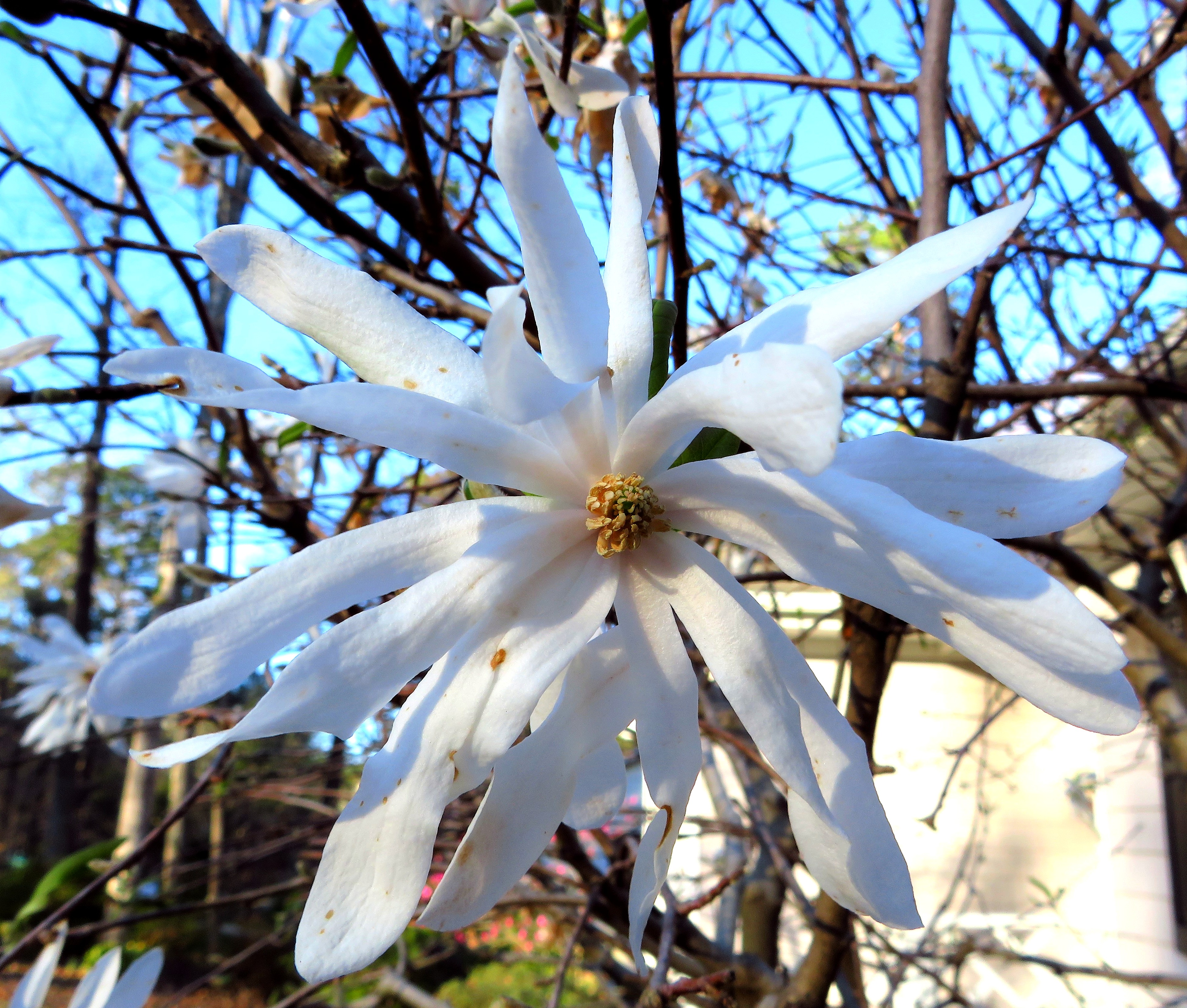
Perhaps you can tell from the photo that the star magnolia (all magnolias?) blossoms prior to putting out leaves. Our purple magnolia does this too. Those little buds appear in the fall, winter like a butterfly’s chrysalis, and then get a bit fuzzier and bigger as their imminent bursting approaches. Most pop out together, but some appear late. March sees only a few:

Hence…Star Magnolia. March 2018.

Like the Star of Bethlehem in Christian scripture, the star magnolia signals the rebirth of our plant world around the small plot of land we manage.


Tomorrow goes by Shrove Tuesday, Mardi Gras, Fat Tuesday and some German name which I can’t pronounce or spell and which means Doughnut Day. All of them imply, “hey, we need to party and indulge, because tomorrow begins Lent.” Unfortunately (kind of) Ash Wednesday coincides with Valentine’s Day. We’ve decided our party tomorrow will stand in for Valentine’s Day. While we nibble on a few berries, nuts, maybe a piece or two of cheese, I will prepare calas or rice beignets using this recipe. I’m looking forward to it. I love involved, authentic-in-spirit recipes, and this Anson Mills recipe promises all of that. I’ve not purchased their rice or pastry flour; we’ll hope the expensive Carolina rice I did purchase will suffice. Dinner, which we’ll start working on after our late morning calas in at least a desultory way, will be Anson Mills’ Roasted Stuffed Quail for Two with Madeira Sauce. We did not spring for the mail-order quail when we first planned this as a New Year’s Eve meal. Our local grocer carried them. Nor do we have madeira, let alone a 5-year one, and I’m not buying one for 3 tablespoons of recipe use! Some marsala and sherry will suffice. We’ll set some simply prepared asparagus next to the quail and toast our near-30-year relationship.

As lovely as that may (or may not) sound, it’s Lent which occupies my mind today and for the past few. One needs to prepare for Lent. Arriving to Ash Wednesday, opening one’s bleary, I-partied-too-much eyes, and arbitrarily picking something to give up for Lent represents a knee-jerk response to the liturgical meaning of Lent which undercuts it. Sure, you can give up caffeine or alcohol or that favorite candy or whatever because, “that’s what I always do”–and Lent will mean about as much as the thought you put into it. One’s spiritual life basically runs on cruise control (at whatever speed you’ve set) if this represents your approach.

Alternatively, a person in touch with one’s relationship to the Presence which animated this Universe–which created life (a scientifically provable proposition which I will address in a future post), which appears to have imbued all of us with a portion of Its spirit, and which in a way not describable to me, appears to care about us–seeks with initiative and purpose to pledge oneself to one or more practices during Lent, then that person approaches the mystery of Easter with (hopefully) a clearer insight to understanding that mystery. If nothing else, they approach in a better ‘spiritual plane’ which even the non-religious believe to be a good thing.

I have for more than a decade attempted to set one practice each for the physical, the mental, and the spiritual/emotional. (I know, I know. Let’s debate the conflation of “spiritual/emotional” some other time.) This year my practices do not need to be hidden, as they sometimes do to be authentic. I plan to…

  • Go to the gym thrice weekly as we originally intentioned a year ago. We’ve attempted to restart the gym practice since a falling off in the holidays to limited success. I also have a more private concern here which isn’t so much a practice as a focus on what I’m already doing.
  • I’m going to begin reading the Bible with an emphasis on two things: the Pentateuch (the first five books) and the four gospels. I’m not sure of the juxtaposition. About seven to ten years ago I used a guide to a first-time reading of the Bible in which one read Genesis, Mark, a few other books–it gave a representation of the Bible overall, including a book from the prophets, a couple apostolic books, etc. I liked it, but I’m ready for a bit more.
  • Emotionally/spiritually? I’m still not sure on this one. I think my fledging effort to be more social will come into play. Of the varieties of introversion, I’m the one who avoids social gatherings among other things. This will be ….interesting.

Lent means more than Advent to me. Perhaps the focus on penance/introspection? I can definitively say there are days which anchor me to my spiritual pursuits. Ash Wednesday and its implication of Lent is one.

Our spiritual life, and therefore our inspirations, remains in this world. A focus on Jesus, Buddha, or whomever, to the exclusion of the physical world insulates us from our reality. The light poles and cell towers of our world inhabit the day-to-day milieu where we must perfect ourselves as humans. Like this photo, we must see the beauty in the context of the mundane. Ash Wednesday 2023.

All the Dearly Departed

Five days after a funeral. Lake Lynn, 07 November 2019.

Warnings & Notes: This post contains a few graphic depictions of death, some examples of socially unacceptable behavior, and is just generally a downer if you look at it a certain way. Also, some of these observations have been made before. If you read this blog regularly (there’s only a half dozen or so of you), well, sorry….a little.

This year All Souls Day, November 2nd, marked the fourth anniversary of my mother’s funeral. It’s the day I most think back upon her life and death. The anniversary of her death, October 24, I barely note. Sometimes it even slips by me before I realize it. The funeral symbolizes my mother’s love, her life, and all those influences we spend a lifetime unraveling. In contrast, the date of her death represents thoughts I acknowledge but do not celebrate, and her passing is hardly something to celebrate in and of itself. I would rather focus on the entirety of her life and death: the funeral marked that, not the death.

My mother and I lived more than 2100 miles apart at that point. My profession had taken me to the eastern United States; she remained in Spokane, WA, from where she had encouraged me to follow my dreams wherever they led. Her parents had, my father’s parents had, they had themselves, so why shouldn’t their children? Still, it didn’t reduce my guilt much for not being more available to her in that last year, indeed that span of a half dozen years when she lived on after my father’s death. My brother lived nearly ten times closer in Tacoma but it took me only a few more hours to get there by plane versus him taking a drive across the state. He encouraged her to move to Tacoma. I half-heartedly supported him. She refused, saying her friends and neighbors were in Spokane.  I strongly pushed that she could move to a “retirement community” there in Spokane where some of her friends lived. She demurred, then refused. Her best support network were the good neighbors she had. She was right. We were wrong. I saw one of those retirement homes at the end of her life. I was really wrong, and–

But I’m not going to rehash that whole period. I’ll just note this: I watched her steadily decline during the five years after my father died, visiting her more and more frequently. (The Fates blessed me in several ways when 13 months after my father died, I started traveling the country for work. It became just as easy to fly to Spokane as to Raleigh.) In December 2018 my mother learned she had Stage IV breast cancer. At 89 years, she recoiled from and declined chemotherapy, threw her lot in with hormone receptor treatment (a pill, nothing more), and for various reasons was in and out of hospitals, convalescent homes, and her new apartment in a “retirement community” through the fall of 2019. She celebrated her 90th birthday in that apartment.

I visited my mother a dozen days into October 2019 as she lived her final days. I returned home only to receive The Call two days later. It was a Thursday. Knowing my brother could drive there quickly, and emotionally exhausted from watching her exist in a morphine-induced stupor, I rolled the dice, told him I wouldn’t come until Monday, and I let him spend Friday through Sunday with her. I flew back on that Monday, and sat beside her bed a lot until she passed away on Thursday. My brother had returned to his home and job. Thus it fell to me to handle the first round of details.

From the moment a loved one dies, those closest to them experience a bewildering whirlwind of details thrust upon them which must be handled immediately. As the elder of two children, the most controlling of us, and frankly, just because I was the one there, it fell to me to make those arrangements. Again, I shall refrain from a step by step accounting of it. This is supposed to be an accounting of All Souls and a celebration, not a macabre dwelling on those days of death. One example shall suffice: on Thursday morning, the day she died officially at 10:22 a.m., I had to leave her to be at the bank when it opened at 9 a.m. The instruction manual entitled “What You Will Have To Do When Your Second Parent Dies” never made it into my mailbox, I guess. If it had, maybe I would have been better prepared than to learn in her final hours that her investment accounts would be frozen for disbursement when she died, and that as her executor I would be paying bills with whatever sat in that bank account for the foreseeable future. The bank account had less than $3200 in it when I dumped a huge amount in there. Take note if you’re ever in this position: for the next year, I had to pay bills from that account. If I hadn’t done that, my brother and I would have had to agree on splitting the bills. Really, take note.

My mother’s death came as  a relief. I’m saddened to admit her death came as a relief. I know many have said this, but I feel as I feel. She had suffered with increasing pain from the breast cancer for a year. I doubt anything can prepare you to listen to your mother slowly drown and die, to realize the fluidic sounds of her breathing come from her lungs as they slowly fill, to watch from a removed perspective as your voice sharply criticizes the health staff which insists on turning a patient even when this obviously makes the breathing worse. Beyond prayer, I simply endured. I carry with me that immense relief I felt when I re-entered her room after a short phone call from her cousin and discovered my mother had died. I also carry with me the commensurate load of guilt for not being there at that moment. The part of me formed by social mores scolds me perpetually; the accepting, independent side of me simply says, “that’s the way it happened. There’s nothing which could have been done at the time, and there’s no shame in feeling relief.”

In contrast to the anniversary of her death, which represents a smorgasbord of feelings, few of them good, even fewer comforting, the anniversary of the funeral represents a day of love. It’s the day remaining friends and family gathered to mark how much they loved your mother and how much they would miss her. It’s the day you created all the little remembrances which would afterward become powerful symbols in your life. It’s the day you got to reminisce about all the times: mostly good, some bad, some funny, some sad. It’s the day when many told you “You did a good job by your mother,” even if they were lying a little bit. And it’s the day you closed the door, for just a bit, on all of those things which just have to be done. It’s the day when you looked forward to a few days where nothing about your mother’s funeral and estate needed to be accomplished: those things would wait a few days–with luck, a few weeks.

Each All Souls Day since that time refreshes all these memories. It’s the stem that gathers all the roots of remembrance and supports the branches of What Has Come To Be. For me, it’s inextricably bound up with my decision two weeks after her funeral to retire. Those twin events, her passing and my retirement, have become tied to those crazy years when a pandemic changed our society, or perhaps, when it revealed who we had come to be. All Souls Day, which exists quietly in the immediate shadow of its more important sibling, All Saints Day, and is heralded by All Hallows’ E’en, tells us it’s important to mark the passing of those we loved and to pray for them, to remember them, to honor them. By its existence, it says to ignore the ones who have been declared important, and that we must instead recognize the importance of each of us.

Mostly, though, All Souls Day reminds all of us of the death of those we loved. It picks at the scab of a wound which will not scar over and which has become part of who we are.

Heart To Hang Onto

Rose of Sharon
Johnny boy, he's always propping up the bar
He sees life crystallized through his jar
He says he only lives for beer
But deep in his heart is a cry of fear

Give me a heart to hang onto
Give me a soul that's tailored new
Give me a heart to hang onto
A heart to hang onto

--Pete Townshend, "Heart To Hang Onto" from the album Rough Mix with Ronnie Lane

A better Valentines Day

Clearwater Beach on the Gulf of Mexico. February 13, 2013.

Sure, flowers are nice–especially the two dozen roses I handed my wife a few hours ago. But warmth, white sand, palm trees, the Gulf, and a previous visit to the Phillies Spring Training Camp? Priceless. “Bouquet” is a fluid term.