Bibliophilia: books about books

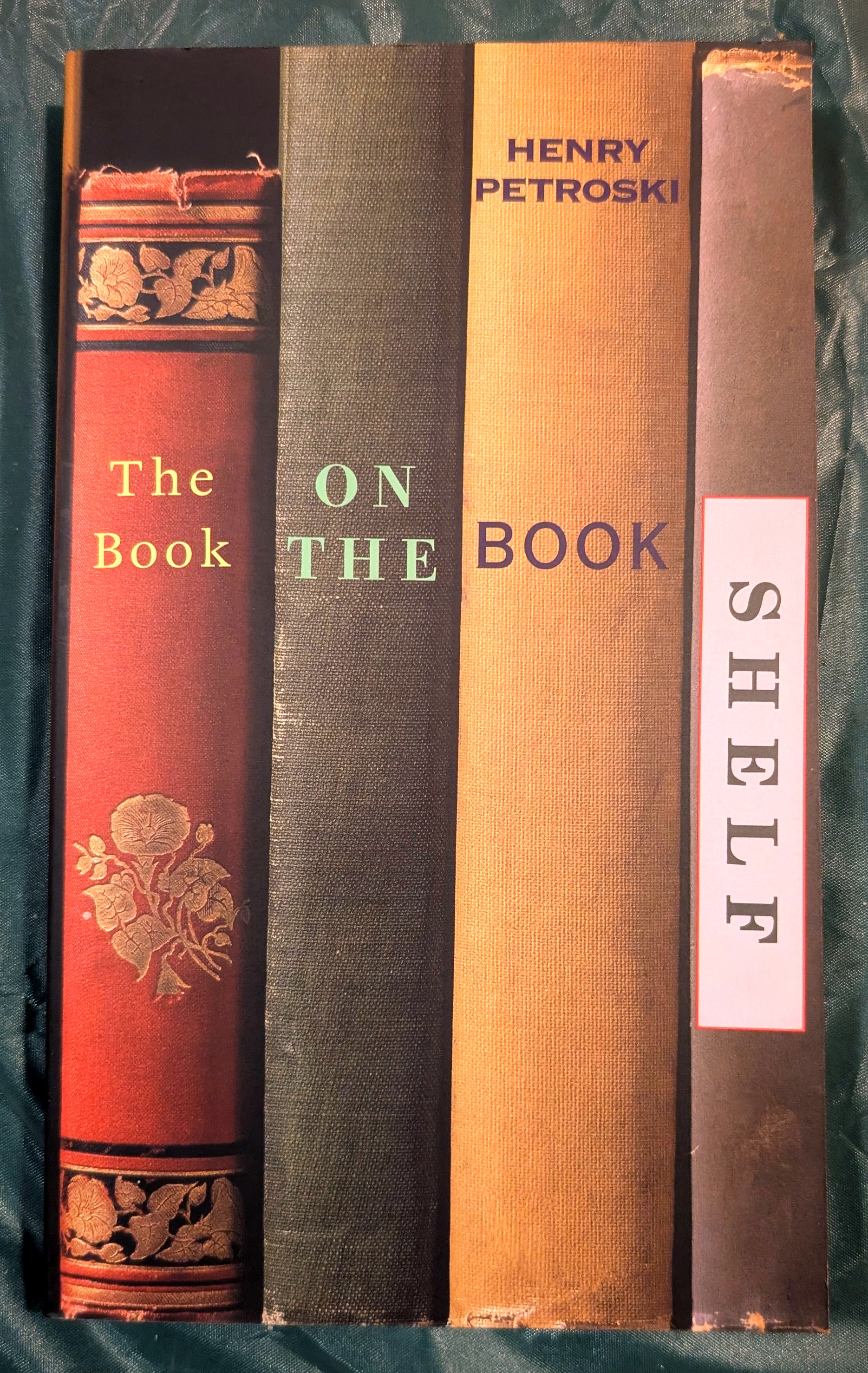
The cover to The Book On The Shelf

People who truly, truly love books, love books about books. One of the most unique of these appears above. Henry Petroski’s book The Book On The Bookshelf traces the history of books from their earliest inception as scrolls through the Middle Ages when they were chained to the shelf, and proceeds in its history to the present day. It’s a lovely read. Petroski winds up the book with a chapter about bookshops, another on the shelving of books, and a final one about the care of books.

The phrase “books about books” includes those about reading them. My original photo for this Bibliophilia subplot is repeated here:
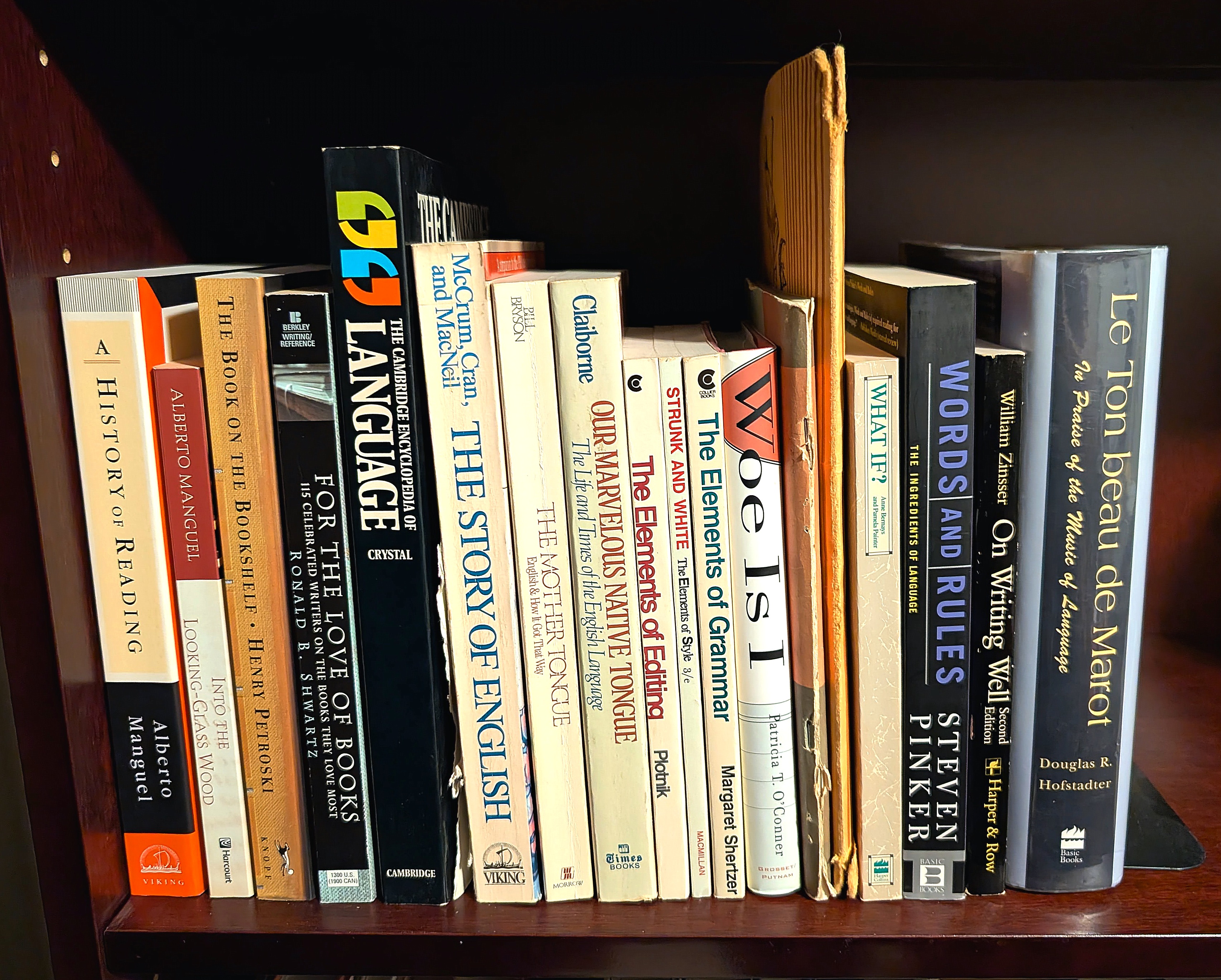
Books about books, language, grammar, and linguistics. July 2025.

In the semi-arbitrary manner I use to organize my bookshelves, books about books (and reading them) precede those which address English and languages. Alberto Manguel, an Argentine-Canadian writer (and translator, editor, essayist, and director of the National Library of Argentina) has two entries, both wonderful. A History of Reading celebrates the reader. With chapters such as “Being Read To” and “The Missing First Page” Manguel explores all of the aspects of the author-reader experience. Manguel divides the book into two sections: “Acts of Reading” and “Powers of the Reader”. I particularly liked this second section with its chapters of “The Author as Reader” and “The Book Fool”.

Manguel’s other book, Into The Looking-Glass Wood contains essays about books and reading. These range more widely than his History of Reading. Essays include reviews, reactions to other authors, browsing for books, essays about wordplay, and other more wide-ranging topics.

Ronald B. Shwartz’s book For The Love Of Books gets included here, simply because it’s on the shelf, and I can’t bear to part with it despite its shortcomings. I’m not one for the types of books which sample a range of acclaimed artists about a certain topic. This book gets the subtitle “115 Celebrated Writers On The Books They Love Most”. Yeah, so? What makes their opinion better or even equal to the critic for the New York Times Review of Books? Or any literature professor at dozens of highly regarded universities? Or, frankly, me? Regardless, I succumbed when I saw the authors cited include Joyce Carol Oates, Michael Ondaatje, John Irving, Bruce Jay Friedman, Doris Lessing, Norman Mailer, Witold Rybczynski, Kurt Vonnegut, John Updike, and Gay Talese. (Actually…I’m not sure I’ve ever completed this book! It still captures my imagination, and thus, it remains on my shelves.)

There you have it, books about books. If we can happily descend into the depths of books about books, how dare we deplore those who delve into the backgrounds of various oeuvres such as Tolkien’s Lord of the Rings? A nerd is a nerd is a nerd…

Book review: Watering Words

Watering Words: 52 Short Stories by Bridgette Kay.
Self-published 2025. ISBN: 979-8-218-58862-5

Artists differ from most of the rest of humanity. Artists tap emotions and experiences others prefer to hide or, at best, to reveal carefully to select individuals and audiences. Unlike the careful revelation practiced by most, artists display their work on the public walls like graffiti in subways. Wedged between “For a good time, call ###” and obscenities, the artist inserts a portrait, often rooted in pain or struggle and rendered in words, brushstrokes, sculpted metal, or other media. Where most humans rush to clothe their naked feelings, the artist drops such obscurations to the ground and invites the errant passerby to look, but more than that, to judge. This is how they differ: they invite comment upon creations rooted in their own psyches, their own souls.

Humans hurt. We all hurt. We bear our wounds heroically, badly, simperingly, stoically, resentfully, and sometimes all of these and more depending on the time of day. Authors live with the uncomfortable knowledge that their wounds, their innermost thoughts, beliefs, prejudices, emotions, and most of all, memories, will bleed out—must bleed out—onto the pages they write, an emotional, psychic wound which perversely will not staunch without being exposed. It’s analogous to being handed a bite bar and hearing, “this is gonna hurt but you’ll thank me later.” Authors bleed out into their words and wait for the comments, but in truth, their healing began when the words gelled, the pages were printed, and the books displayed.

Commenting in any manner on such courageous behavior feels wrong. There cannot be a wrong way “to art.” As a teacher of English, though, I learned there exist many wrong ways to connect with an audience. And ultimately, anyone who publishes a book expects an audience to react to it. I’ve followed Kay’s blog Bridgette Tales for several years. Her personal revelations in that space represent why blogs need to be written. Done honestly and well, a blog sends joy and pain and struggle and hope out to the world, asking only to be heard. In the process, blogs show others, “Look! I hurt like you, love sunsets like you, see little clumps of moss like you, and I revel in it, even the painful stuff.” They build the global community. It came as a relief, then, when I discovered the stories were actually good. I’ve seen many a near-breathless author hand me something with excitement in their eyes and words, only to find upon reading it that the author hadn’t a clue either about constructing a story or writing one.

Don’t read Watering Words expecting John Cheever. These stories are not “high literature”—they instead represent what most readers look for: engaging stories with whimsy, a little magic, humor, and told with style. These stories speak less to the human condition than to one human’s condition. As one who has followed her blog, I see the pain, longing, fears, insecurities, joy, laughter, righteousness, sadness, glee, and maturity I’ve sensed in her near-daily posts. Two of the early stories stand out.

In the first story, “Waiting For The Bus”, every author will resonate with Kay’s personification of all those fears and excuses with which we keep ourselves from writing. The narrator’s ultimate triumph echoes Kay’s, I’m sure. And in “Final Goodbye” I invest my supposition that Kay writes of a home in her past (at least symbolically). I detect references to tragedies mentioned on her blog, but leave them for others to discover.

Read this book. Read it not for “high” literature but for “hi” literature: an author reaching out and saying, “Here I am. I’m saying it as best, as entertainingly as I can. Do you see me? Do you feel the same?

“Do your wounds match mine?”

Bibliophilia: literature anthologies

OR, “I’M STILL WORKING ON MY COLLEGE READING ASSIGNMENTS!”

Literature anthology texts, college and otherwise. July 2025.

College literature texts resemble the reading equivalent of eating at an upscale buffet restaurant. You know the food will possess decent quality, but you don’t expect one of those “oh, wow, go get the chef!” moments. On the other hand, you know it isn’t Golden Corral, there won’t be questionable entrees and a lack of things which resemble lovingly prepared food. It’s therefore a safe, pleasurable experience you look forward to, but not too much. So too the literature anthology, usually targeted to college freshman and sophomores, aims higher than 50 Romance Stories For The Modern Lover but the reader doesn’t usually expect anything challenging or inclusive. There can be exceptions which prove pleasant. Sometimes, particularly in those early college years, one experiences surprises less pleasant: “But I thought that was a great story, professor!” ran through my mind a few times when my instructor somewhat condescendingly told us a piece we’d just read “was at best, B literature…good, but not great.” No matter. Turn the page. There’s something potentially better at the next station of this literary buffet.

As I’ve ditched books along the way, including texts which seemed useless for the future me, I’ve clung to nearly every anthology I’ve come across. In fact, as a teacher of English for 8th graders from 1983-1992, I accompanied my then-wife to garage sales specifically buying the college texts of other people to flesh out a reference library. In the days before e-books and a true Internet, I either had to seek these texts out from various bookstores and mail order outlets (at full price) or pounce on jewels sitting in the dross of some middle-ager who realized, “why am I carting this book around anymore?” I’m not sure, but I think I’ve only cut the ties with one, The Sagas of Icelanders, and technically it’s still in my house so have I really let it go? It’s categorically called “Purged” and fair game for donating/selling.

Let’s discuss what’s on the shelf above:

  • Quality Paperback Book Club rescued me when I found myself in Colville, WA, in 1983, a city of 10,000 souls 75 miles from any true city of note, and yet the largest city to the east or west for hundreds of miles. One of the final books I purchased from them before bowing to the Power of the Internet was the QPB Book of Irish Literature (copyright 1999). Beginning with Edmund Spenser and Jonathan Swift, it runs through “The Sheridans,” “The Wildes” (yes, including Oscar), and “The O’Faolains” while picking up George Bernard Shaw, W. B. Yeats, and James Joyce along the way. The latter is represented by the full inclusion of “A Portrait of the Artist as a Young Man.” Samuel Beckett has three entries including a slice of the play Waiting for Godot. A nice touch for a modern anthology was the inclusion of Nobel Prize-winning poet Seamus Heaney. I’ve selectively read throughout the 900+ pages.
  • The Norton Anthology of English Literature remains one of the classics for this genre, and I had to have it when I found it. My college text is two books more to the right, The Norton Anthology of American Literature. The condescension of a country with about 2000 years of literary achievement can be seen here: I have only Volume 2 of the English literature, but the shorter work, American Literature, represents all of what the Norton editors consider representative and worthy.
  • Between the two Norton collections lies a silly conceit, fifty great short stories, a humble paperback which I’ve never read. So sue me.
  • Another book I’ve never read, but have consulted, is Adventures in American Literature which appears to be volume 2.
  • A Handbook to Literature caught my eye because it isn’t an anthology, but an alphabetical listing of literary criticism terms and themes, genres, theaters, and poetry scansion terms. Unfortunately for this book, I now realize it’s as useful as Benet’s Readers Guide which is “not at all” in this day of AI and the Internet. This book will not be rejoining the shelf. Sad.
  • The observant person in looking at the above photo will have noticed there are two books with the same title and author: Literature: Structure, Sound, And Sense by Laurence Perrine and in the case of one, Thomas R. Arp. The white-spined edition, the third, guided me through more than one course at Eastern Washington University which seemed to have taken pity on the budgets of its students and used it for both prose and poetry courses…or maybe my memory is faulty. I find it difficult to believe I’ve lost track of the text we used for the poetry class. The wine-colored is Perrine’s 6th edition, this time in collaboration with Arp. Not only does it have a significant number of different selections, but the best part for me? It was bound upside down! One looks with a slight smile at the cover, proud to have purchased one of the first texts ever in what will, of course, be a glorious college career, and then opens the book. Okay, we knew we purchased a used book, so Marc’s name inside the cover is okay. Wait, what’s this? The final page of the index? Upside down? Oh yeah, I would’ve bought the book even if I had no other interest in it.
  • The two black-colored spines toward the right end of this display belong to The Oxford Anthology of English Literature. In my world, both then and now, if it says “Oxford” it’s an immediate buy. Ironically, I’ve read not a word of either. I took a course in Medieval English literature at the University of Washington which had us buy individual copies of those significant works; reading the Oxford would be redundant. Plus, I’ve recently purchased J. R. R. Tolkien’s translation of Beowulf (and other works) which will take precedence in my hierarchy of reading. Perhaps I will one day compare the works in The Restoration and the Eighteenth Century to The Norton Anthology of English Literature to see what differs. Or not. There are hundreds of books to read, after all.
  • Which brings us to our final volume, The Treasure of American Short Stories. I’ve read selectively from this book, but it’s mostly redundant to the Norton one on American literature.

Part of our satisfaction for holding onto these types of books—and I know some of you didn’t even question that statement—lies in the combined meaning of memory and potential. We look at these books and they evoke our time so long ago when we sat in uncomfortable chair-desks, taking notes (or not), and experiencing aspects of literature for the first time. Decades later, discarding those memory-tokens seems almost sacrilegious. We turn then to the argument of potential: “I think I might still want to read some of these.” Hence their place still on my shelves, 40-50 years after I purchased them.

Bibliophilia: dictionaries

How to look up words before the Internet. July 2025.

Today I needed to move two of my bookcases because I inconveniently parked them underneath the main water shutoff valve to my house. Downstream of that valve is the Pressure Relief Valve (Pressure Regulating Valve?) or PRV which will be replaced tomorrow. Books moved include the latter half of the alphabet for authors of fiction, plus poetry, essays, books about reading and language, literary quarterlies, literature anthologies, drama, and the stuff I call “books too big to fit anywhere else”. Moving these books renewed the love affair I have with them.

I cannot claim to have coined the word bibliophilia but my spell checker doesn’t like it. Obviously a primitive type of AI with all the words at its digital fingertips would sneer at such a word. I maintain it exists, nonetheless, and I further claim it describes a condition similar to addiction in that those afflicted with it do not recognize it as a malady. Rather they proudly lean into it right up to the moment it degrades their lives into sociopathy. I never had a lot going for me in the sociopathy-avoidance spectrum; it therefore has impacted my life little.

Though I read 99% of my books electronically now, I’ve developed no attachment to them the way I have to the physical ones. Perhaps it’s because I don’t have the history with them? No matter. I realized today what a wonderful paradigm for a series of posts! Forthwith:

I’ve carted around the above two dictionaries since 1978. They were ‘useless’ even then. The one on the bottom has a copyright of 1939 on it, with 14 more copyrights stretching back to 1903 on the reverse of the title page. In 1939 my mother was 10. This must have guided her through the end of elementary school and through high school. It undoubtedly felt the fingers of my grandfather paging through it as he sought a word for some of his reports and letters. He would have been in his 40’s at the time.

As with the bottom dictionary, the one on top reminds me of a relative also. When my mother was in her early teens around 1941-1943, her Uncle Dennis came to live with his half-sister (my grandmother) and her small family. He needed to establish residency in Washington State because he planned to attend the University of Washington. I’m not sure if he worked for a year or attended high school. This dictionary is copyrighted 1942, and its title I feel reflects his academic bent. (He went to work in an athletic supply store in Seattle after graduation, eventually bought it with one or two partners, and had a very comfortable life financially. The store was called Athletic Supply.)

All my childhood I stared at these dictionaries and pulled them out again and again, every time we visited my grandparents. I’m pretty sure where my brother and I slept is where my great-uncle lived for that year. Upon graduation I guess he figured he didn’t need the dictionary anymore. My grandfather had finished off the basement in gorgeous tongue-and-groove pine boards, and he built in next to his desk the bookcase which held these two volumes.

As I may have detailed before, I purged about 400 books from our library in 2020, primarily so I could use some of the shelves to display family memorabilia. Books I felt held no special tug on my heart joined those I felt wouldn’t be read again nor would they need to be consulted. It represented a Marie Kondo approach: if the book brought joy, it almost always stayed on the shelf. The rest were boxed up and shoved in a closet. One doesn’t just throw away books unless they’re an ignorant cretin which means they likely don’t own books in the first place. (Although there was that mother/daughter pair I saw once at a giant book sale who were buying a shopping cart full of books based on how they looked! Books as interior design elements! Horrific to think such people exist.) I’ve since found an outlet in a used bookstore/coffee shop/beer & wine cafe which gives me credit for the books I drop off. Imagine that! I drop off a half dozen hardbacks, and I get to buy three pints on half-price Wednesday!

Though 400 went to live in the closet, an even 1100 remain. I can’t believe that when I look at the shelves, but that’s what my library cataloging program says. Today, just pulling down about seven shelves of books inspired such joy and memories. There are the literary quarterlies I got from Eastern Washington University while teaching English. And there are the half dozen volumes of varying size I needed to buy for my Medieval Literature class. Oh look, there’s the best book I ever read on the slipperiness of translations (Le Ton Beau de Marot: In Praise Of The Music Of Language by Douglas R Hofstadter who previously had won the Pulitzer Prize for Gödel, Escher, Bach: An Eternal Golden Braid). Oh, my college literature texts! The glorious translation of Anna Karenina purchased on the first family vacation I organized just a couple years before my father died. And look there, the slim volume of fairy tales my parents and grandparents read to me when I and my brother were quite young.

Some of it is snob appeal. I make no apologies for that. If you can’t be proud of yourself for having read a goodly collection of great literature, if you think it a waste of your time, then I ask, why did you waste it? Didn’t you have something better to do? Like, I don’t know, trade it for a differently colored book which matches your decor better?

In the weeks ahead I’ll focus on particular books which spark that wonderful joy of reading…like the books about reading itself!