Saturday sunrise, Kuhio Bay, Hilo, HI. September 2024.
As I type this the sun is peeking over the horizon here in Raleigh. I won’t see it due to trees and ridges…and because I’m sitting in a windowless room in the basement. Nine weeks ago our first Saturday in Hilo brought an orange glow as the sun peeked over the industrial buildings at the port of Hilo (located east of Hilo proper). I never tired of this. I think people who live where they can see to the horizon unimpeded by anything must have a different outlook on life or at least on the natural world. I know it has that effect on me.
[In our continuing series, Cranky Old Man Yells At Clouds, today we again tackle the tough Time issue. For other time-rants, see here and here.]
“Upon This Altar” — manipulated photograph. October 2024.
This morning, November 3rd, 2024, I rose at 6:16 a.m. according to our two bedside clocks. Dressing and walking to the kitchen, I noted the analog kitchen clock concurred, as did the digital clock on the stove (except when the now-failed crossbar made an “8” look like a “0”). For some reason the microwave got confused and reported the time actually was two hours and 50 minutes prior. All of these timepieces and presumably the clock on the deck, the clock in the guest bedroom, and the clock on the fireplace mantel backed the majority opinion: 6:16 a.m.
My cellphone, however, said I had risen earlier–it was still prior to 5:30 a.m. It reflected the common and legal opinion that an extra hour had appeared overnight during which no time passed. For the rest of 2024, time would be measured on Standard Time.
This clock conflict didn’t bother me. It’s been dark for weeks when I rise. The sun rose today approximately 90 minutes after I did, and it did the same yesterday. My wife and I ate breakfast about an hour later than we usually do on a Sunday, but our breakfast times are flexible these days, and we’re not going to church because we’re still quarantining due to Covid. My day so far has run its course normally, and the only effect of this time change will be making sure we tune into our church services at a specific time which the kitchen clocks would say is 11:30 a.m., but my connected clocks (phone, desktop computer, etc.) will say is 10:30 a.m.
You could argue my cavalier approach to this time change results from my retired state, and you would be partially correct. Few things happen at set times in my day anymore. But even when my day revolved around “getting to work” and “catching a plane,” I’ve looked at time as a voluntary measurement. I don’t need to order my life by it. For nearly 30 years I have rarely used an alarm clock to make myself get up at a certain time. They exist primarily as safety nets to make sure I don’t oversleep, and usually the mere act of setting a morning alarm will suffice to wake me just prior to the nasty thing interrupting my sleep. I mention all of this not to brag about how wonderfully I deal with time, but to explain a relationship to it which causes me to blow a few gaskets twice a year.
Each year about this time we’re subjected to some of the lamest reportage, critical thinking, and general common sense that we see all year–except for the commensurate period in late winter/early spring when it rears its foolish head and reverses its so-called logic (sometimes). I’m talking about all the nonsense you’ll read about Leaping Forward in time when we go to Daylight Saving Time, and when we Fall Back to Standard Time on the first weekend in November.
“Fall” — manipulated photograph. October 2024.
I’m not talking about the ill effects many people report from the shift in timekeeping. These effects align with everything we know about a body’s rhythms and the general circadian rhythms of most creatures on this planet. One shouldn’t wonder that attempting to stick to a personal schedule which has been artificially shifted an hour would have an impact on the person attempting it. No, what I’m talking about are all the inane things said about Time when earnest people lose their literary way. Here’s an example written by a presumably respected reporter for the New York Times on November 2, 2024, in a morning newsletter I received:
I know, it’s just one hour. How one spends it or doesn’t is hardly determinative of whether they’re making the most of their time on earth. But the scarcity of daylight this time of year does make every hour feel that much more valuable.
from the New York Times Morning Brief — author’s name omitted for decency’s sake
Making the most of your time means you’re looking at Time as a Real Thing, something which can be rationed like oats or good whisky or the chocolates in a one-pound sampler. You’re looking into the future and saying, in essence, “this hour coming up is a gift and I have to be sure to spend it wisely.” Okay, let’s just set aside the easily demonstrable fact that none of us lives in the future. “Now” is now, it’s always now, and focusing on the future remains an efficient method for not living mindfully in the present. Regardless, most of do make plans. We’ll give Ms. Kirsch a pass on this one. We’ll also let her unpack with her therapist this need to do something with that extra hour. Perhaps her parents raised her to “make something of herself”? I’ve succumbed to this state of mind many a time, but I’ve found great satisfaction in being what I am.
Instead, let’s consider the statement at the end, the one about daylight’s scarcity making each hour feel more valuable. Huh. Daylight hours are valuable, nighttime’s aren’t? I was unaware I cannot do anything when the sun sets. I guess overachievers everywhere violate some social norm when we rise 90 minutes prior to the sun and write things like this. More seriously, you can perhaps feel a certain pressure to use this extra hour for some purpose, but predicating that pressure on the sun’s daily appearance ties two things together which have nothing to do with each other. In New York City, where I believe she lives from other things she has written, the sun will be in the sky ten hours and 19 minutes today. Yesterday it lingered for three more minutes. This process has been happening so gradually, one wonders exactly when this “scarcity of daylight” made its presence known. After the vernal equinox? When the author realized in late August that sun shone for only twelve minutes more than half the day, but in June it had done so for more than three hours? (All measurements here are based on Manhattan in 2024 as recorded on timeanddate.com.) This so-called scarcity of daylight doesn’t seem to have bothered her too much a week ago when it was all of about 20-25 minutes more than it will be today.
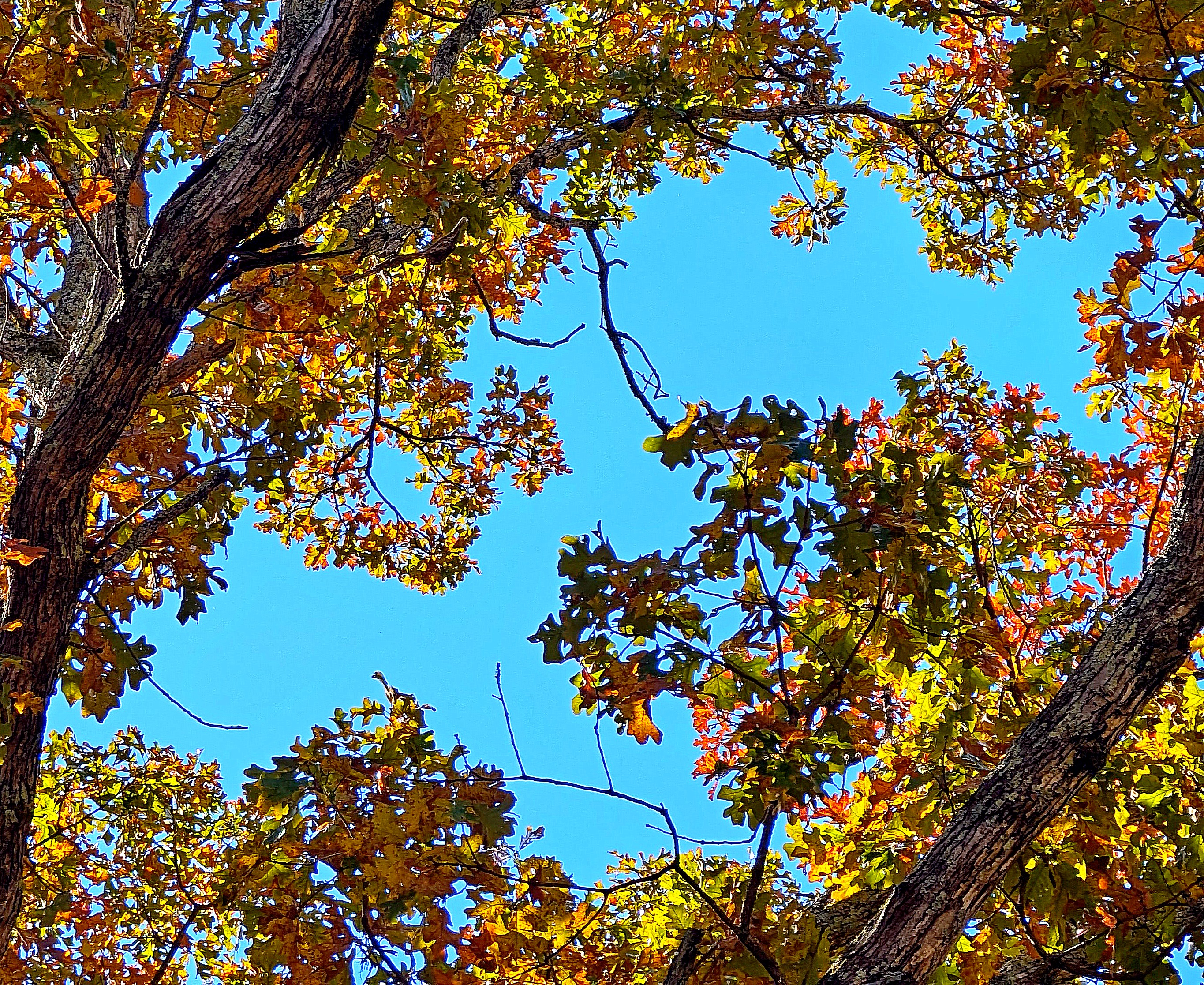
White oak in fall. October 2024.
No, I have little empathy for a person who feels this extra hour represents something mildly momentous and not to be taken lightly. She opens with the idea of just sleeping an extra hour–“sleep as much as you need to!” I want to shout–adding that as she sets her clocks back on Saturday evening, she will anticipate “that brief moment of confused excitement tomorrow when I wake and check the time: It’s 7, no wait, it’s actually 6!” Putting aside the fact that this undercuts the beginning of the very same sentence–you just said you’re setting the clocks back, so you can’t look at 7 and think it’s 6!–I will grant her the idea of an extra hour on this weekend motivates me too, but not as if it represents some life-changing moment. Rather it’s analogous to the feeling I get when a surprise rain shower eliminates a plan to work in the yard and thereby grants me an hour or two to do something unplanned. But immediately after the quote above, she writes a sentence which buried within it contains what I think might be a common belief which is just plain wrong:
As we enter the final two months of the year, thoughts naturally turn to how we’re filling our days. [same source]
I hope I’m reading that incorrectly. Why do one’s thoughts turn “naturally” to this? (Mine don’t.) Has it something to do with the End of the Year, another silly time construct? Is it because we’re approaching Christmas and other holidays, many of which have an element of self-examination? It seems to imply our author thinks November and December are the darkest months, coming as it does on the heels of lamenting the scarcity of daylight. No, no, you poor, benighted columnist. Today, Nov. 3, 2024, is 48 days prior to the winter solstice. Another 48 days after the solstice will be February 7, 2025. Ignoring that the solstice really isn’t the shortest amount of daylight in the year all the time–that’s intermediate temporal mechanics; we’ll get to that in our next course–you won’t see a speck more daylight for 96 days! That’s a lot more scarcity than just two months. It’s three with a handful of days left over.
Buried in another paragraph, our writer brings out one of the bigger fallacies about changing the clocks: that somehow having an hour “moved” to the evening or morning will have a meaningful impact on one’s life. See if you can spot it:
“Every first Sunday in November, I contemplate becoming a different, better person, one who gets up one hour earlier to meditate or exercise or meal-prep. I could be the person who spends an hour journaling, or fixing a large, healthy breakfast or taking the dog for a brisk walk in the cold dark. ” [same source]
If you get up one hour earlier, it’s just one hour earlier in the same day. It’s coming from somewhere. Are you going to bed earlier in the evening? Or are you cheating yourself out of an hour’s sleep? Are you going to tell your employer you’ll be in the office one hour less so that you can have a full evening, a decent night’s sleep, and still start a meditation practice before breakfast each day? I suspect, however, our author thinks that somehow an extra hour has ‘appeared’ in the morning. “Look, y’all, I used to get up right now according to the clock, but right now is only 5:30 a.m., not 6:30 a.m. I’ve got an extra hour! Yippee!” (Insert reference to Spinal Tap and “turning it up to 11.”)
Let’s bring this diatribe to a close. Let’s all try to realize daylight lessens from summer solstice to winter solstice, and that each day’s length mirrors another on either side of the solstice (either solstice, it doesn’t matter). Every day, every moment, moves the same: the length of the sun’s presence above the horizon added to the length of its absence always runs about 24 hours (if you absolutely must measure it). When we live artificially in the Timescape instead of the reality of the Dayscape, we suddenly think “Oh, I’ve lost an hour,” in March and “Oh, I’ve gained an hour,” in November, but really, truly nothing has changed. Let go of that desperate grip on Time. It’s okay. You won’t fall. You’ll still be here…just like always.
I ‘shoulda’ been on the outside of the screened in porch to take this photo yesterday. August 2024.
For the past 35 years, well….pretty much for my whole adult life, I’ve tried to use a few words very consciously: can’t, had to/have to (and variants), and should have/shoulda. The last breaks down into me telling you that you should do or say something. More insidiously we say this to ourselves.
In that vein, I realized I’m again spending far too much time on reading things I think I should, and not enough on what I like. This occurred right after I subscribed to a newsletter from the New York Times which twice a week will highlight some songs that are pretty salient and should be listened to, a topic I really care about. Yes, I appreciate the irony. Instead I spend several hours making sure I’m on top of geo-politics, cultural developments, science and technology, and all sorts of sociological things like economics and psychology.
In the past couple weeks a few things happened, but I don’t even have photos to show for it because most aren’t fun and some are ideas, not physical things lending themselves to the snap of a shutter: an impending death in our family; a friend having serious surgery; discovering that a minor roof leak isn’t so minor after all and requires a complete re-roofing from the rafters on up; and learning today that quite possibly an incredible amount of our personal data may have been stolen because of some third party company I’ve never heard of but which inexplicably has our complete health records including diagnoses, our complete financial stuff like credit cards and account numbers, and oh yeah, our Social Security numbers. Apparently health insurance companies use this company to do what they can’t because they’re too busy counting my money.
Sigh. I shoulda just posted a photo…
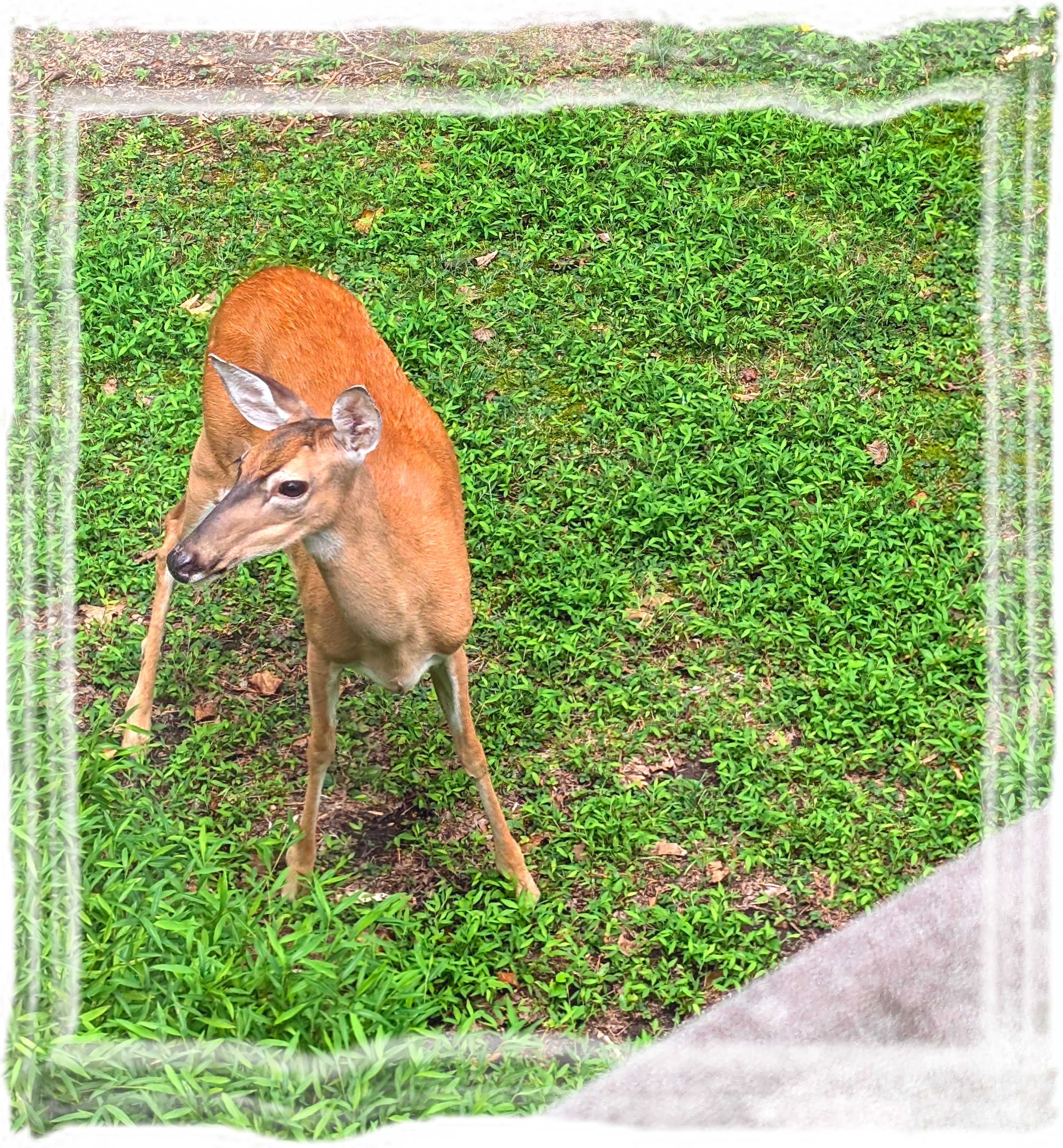
That doe up there has been hanging around for weeks. Deer aren’t that remarkable in the city’s right-of-way in back of lots, but they don’t often venture into our yards or bed down there like this one has on several occasions. That’s the deck railing, lower right, showing how close to the house she was. July 2024.
It’s 86 with a “feels like” of 93, and I’ve been home from a trip of errands for about 30 minutes. After I couldn’t find a third of what I wanted at the Lowe’s gardening center and finding out that the prescription I needed to pick up had been filled at my old pharmacy instead of my new one, I negotiated a ridiculous traffic pattern to cross the street to a grocery store. Parking halfway up one aisle, this is what I observed as I got closer to the store:
You know those handicapped parking spaces with the extra wide ‘stripey section’ to assist those who need more room getting out of a vehicle? A nondescript sedan, an older Chevy or something, swung in front of me quickly and parked haphazardly in that space such that it was half in the parking space and half in the stripey section. Sensitive to these things both because my late mother and father both needed handicapped parking, and because one of our closest friends now seriously needs it, I noted it had no handicapped license plate, nor did I see a placard hanging from the rear-view mirror. I saw only a driver, a 25-35 year-old. She popped out of the car without any obvious ambulatory issues, left the car running, and zipped into the store ahead of me. “Oh, probably an employee picking up a paycheck or something,” I thought. A bit cheeky, but at least just a minute or so. Nope. She pulled out a shopping cart and took off into the store.
Seriously? I felt like going back to her car and seeing if I could move it to a different parking space. (No, I didn’t, but it sounds good. People pack lethal force in this state.)
I’m reading Constance by Lawrence Durrell, set in the years immediately prior to and at the beginnings of World War II. It’s the third book of Durrell’s Avignon Quintet. Last night Constance has returned to Avignon as a Red Cross liaison to the Vichy French. In the passage I read last night, she is shocked when she realizes that the Germans stationed there (who in actuality run everything) aren’t embarrassed by their actions in executing 20 villagers because someone fired on a tank; are not embarrassed by collecting all bicycles in the area and destroying them with two tanks because now no one can take messages to the supposed resistance in the hills; are not embarrassed by seriously discussing the processing of Jews for the camps in Vichy.
This lack of embarrassment, exemplified by the young woman this afternoon, continues to defy my brain’s ability to parse many behaviors of the past ten years, mostly political ones. I eschew politics on this blog. I merely will say how disappointed I am that a large majority of centrist politicians have capitulated to their respective fringe elements, and worse, so have voters. The arena of civil discourse demands recognition of differing opinions. It demands certain social niceties.
Whatever. The Curmudgeon has an appointment with the Old Fogey Police. Apparently I need an OF license now that I’m 70.
A few hours ago I surpassed seven decades upon the planet. My first memories occur somewhere around three to four years of age; make that six and a half decades of consciousness. I rode tricycles and bicycles with playing cards clothes-pinned into the spokes for noise. I saw the first television come into our house, the advent of easily available color TV’s, and the beginnings of data processing centers (long before personal computers became a thing). I celebrated the first humans going into space. I cowered under my desk as I practiced “what to do in the event of a nuclear attack.”
I entered my teens as we kicked off the Summer of Love (“we” being a rather generous term for my inclusion in it). I protested the Vietnam War in a lukewarm manner. I wore strange clothes, even considering what teens normally do.
I campaigned with my father in 1960 for presidential candidate Barry Goldwater. I voted for the first time in 1972 for George McGovern. I watched as Nixon resigned rather than face impeachment. (Imagine that, Bill. Donald.) I jump aboard the personal computing “thing” in 1982 and never looked back. I became a newshound; a teacher; a cog in corporate America; a consulting ‘expert’; and a retired, lazy bum.
So what? Every single person born before 1960 can pretty much say the same. It’s because looking back shocks one. My grandparents saw the advent of cars which radically changed society, and they knew grandparents or great-grandparents which served in America’s Civil War. My parents watched as first radio and then TV made changes almost as radical. And those of us of a certain age have witnessed computers do the same as the automobile. I cannot convey the visceral feeling of being the head of this time-worm, with a tail stretching back to days which did not know any color of T-shirt but white, which never saw a man wear hair which touched or covered his ears, which had just completed two significant wars in a little over 15 years.
You’ll have to experience it yourself. It’s a trip.
I’ve been thinking about Pop Music a bit the past week or two, prompted by being forced to listen to my wife’s choice of music in our car one day. It’s some “hits of the 70’s, 80’s, and 90’s” piece of something-or-other…unless you like that sort of thing, then it’s a wonderful FM station which plays all the greatest songs you know and love. I’ve assiduously avoided listening to radio from the first opportunity I had to not listen to it, sometime in my late teens or early 20’s. I suppose some readers don’t understand what I’m talking about. Through high school we listened to music in two places, basically: cars and our bedrooms. We had AM radio in the cars and vinyl records in our bedrooms. If you really got into it and had deep pockets, you bought a big Wollensak reel-to-reel tape machine, but if you were a wannabe like my brother and me, you bought a cheap little portable recorder and stuck the painfully crappy microphone in front of a tiny transistor radio speaker to record “off the air”.
In small-market Spokane only two radio stations catered to young people and their shocking tastes in music: KNEW (neé KJRB by the time I left high school), and KXLY. All popular music of whatever genre mixed freely on these stations. No FM station played popular music until around the time I entered college when KREM-FM suddenly started an “underground” playlist. Underground radio featured stoned out DJ’s: “Hi, I’m John. Yeah. We’ll be playing some heavy tunes for a while. I hope you like them.” We programmed the buttons on the radio–oh Lord, do I have to explain how car radios worked back then? Those too?–to the two AM stations and became adept at punching the button for whichever one wasn’t playing a song we loathed, which happened frequently. You’ll understand in another paragraph.
But back to that moment a week ago when I listened to many songs I hadn’t heard in years. The one which sticks in my head is “If This Is It” by Huey Lewis and the News. I’m going to hate myself for looking that up and reminding my brain about it: I had a viral ear-worm for days after hearing that song. It’s not that I don’t appreciate Mr Lewis, it’s that I don’t particularly like that specific song. “I Wanna New Drug” has sentiment I can get behind. “The Heart of Rock & Roll” zips along quite nicely. But a slow near-ballad which basically says, “do you see this going where I think it’s going” struck me then and continues to as ridiculously mundane. Maybe you like it. Fine, you’re entitled because we all ask music to deliver different things and if the song delivers, great…for you. I like absolutely stupid songs because of a bass line or because the singer’s voice seems to mock the very words being sung, or because it has a frenetic beat, or a multitude of other reasons. I’m not going to mention two extremely popular groups which demographics say I should love, and I can’t stand them. I lost a friend over that once.
Listening to my wife’s radio station, I had a startling realization. I had been getting pretty egotistic about how broad my musical horizons are. I like country, blues, rock, blues-rock, folk, world/ethnic, jazz of various ilks, classical, a little bit of hip-hop and…pop. My enforced listening session in the car showed me I don’t really like pop per se, I like it very selectively. I protested to myself about all that pop music I liked from my youth. That’s when it hit me: we like all those songs which formed us as we left childhood, negotiated adolescence, and became adults. After that? Not so much. We went in different directions. Some folks I’ve met never went anywhere. They only listen to songs from the oeuvre when they were 10-25.
Today proves my point. Yesterday I finished chores and declared it to be Birthday Week. I’ve decided one day isn’t big enough to handle 70 years. Until Tuesday June 11th, I’m celebrating. Today unfolded at a leisurely pace, pointed toward some music listening, writing, and a Phillies game. I decided to listen to music from the beginning of my listening life, and then realized “the beginning” eludes definition. I settled for the year my pre-teen fan-tasy grew into musical appreciation: 1966. Until then I’d focused on whatever TV and radio served up: The Beatles, early The Rolling Stones, The Monkees. In 1965 my brother and I began buying a few different bands on 45rpm records, and in 1966 I got my first 33rpm LP, The Young Rascals. It coincided with my birthday and the end of the school year. I ran out of the schoolroom never to return to elementary school, and I ran into adolescence with a newfound appreciation for the melding of pop, soul, and rock which had started to occur.
I decided to re-introduce myself to 1966 by looking at the Top 40 lists for the year and selecting songs to listen to from it. Locating a wonderful site called Top 40 Weekly, I selected 1966 to be presented with the Top 40 chart for every single week in 1966! Wow. Here’s the beginning of the first one from January of that year:
Top 40 Weekly’s chart for the beginning of 1966.
This proves my point. (Of course, it’s self-referential, but nevermind.) I look at the first song and start singing the lyrics. I look at the second one and smile and hear Paul singing the title words. Likewise with #3 and #4. I’ll admit #5 threw me for a minute–I’m more familiar with “Catch Us If You Can” by that group, as heard on the Lloyd Thaxton show. Giving it a play, though, it came back to mind. How about #6? Check. And #7? Check. Not until #8 did I say to myself, “punch the button.” I like a few Righteous Brothers songs, but they carried a crooning 50’s style of music into the 60’s, and it didn’t play well. But who can’t smile listening to #9?
Then we hit #10. Lord knows how Eddy Arnold managed to get a charting song out of that number. I felt the revulsion rise up. Today’s form of button-pushing, the skip-track button on the streaming service came into play quickly. The remaining songs? I smiled again at #11; sang the lyrics to #12 with my wife; and wondered how #’s 13 and 14 got on the list. I don’t recall ever hearing them. The Shangri-Las managed to push out a charting song in 1966? You gotta admire that, even if the song was horrible. (I never heard that one either.) Gary Lewis’s song typified his talentless group, but made me remember “This Diamond Ring” so it wasn’t worthless. I couldn’t find #17 on Tidal, and then a relaxed wide smile–the Beatles again. Before there were LP’s in my life, there were 45’s:
Both songs in the top 20 starting January 1966.
I couldn’t find Ramsey Lewis Trio’s version of “Hang On Sloopy” and wonder what the heck a jazz trio could’ve done with The McCoys’ big hit. The Beach Boys were a selective thing for me, and #20 didn’t hit the spot. I continued through the list until I hit #40. It kinda made the whole journey worthwhile: “Lies” by The Knickerbockers. I loved that song; still do. They had another great one as shown at the top of this post.
The final 45 I bought occurred in 1976. I bought it only because I knew I would never like the album, but I wanted the song for posterity’s sake:
“The king is dead but not forgotten…this is a song about Johnny Rotten” –from “My My, Hey Hey” by Neil Young.
Our musical likes have more to do with where we grew up and what we listened to at the time, than anything objectively wonderful about the music. We like what we like, and we don’t what we don’t. Objective criticism fails precisely because it rejects subjectivity. Do I like “bad” songs? You bet. Do I dislike “good” ones? True. Are you totally inexplicable to me because you like “A White Shade Of Pale”? Abso-effing-lutely.
Sometimes I feel like a baby spider floating through the air on my gossamer web-string, wondering when this little journey will end, where it will deposit me, and in general, what does the near future hold. I’m in one of those in-between times right now. I would like to tie this up neatly by saying, “Well! I’m approaching my 70th birthday this weekend, and that explains it! Ipso facto, easy-peasy, make no buts about it.” It’s not so. I’ve never lost the summer vacation feeling we all used to get at the end of May as we eagerly anticipated the end of another school year and the beginning of a responsibility-less (or less responsibility) summer. I had barely joined the workforce at the beginning of 1978 then I returned to college in September 1981. From then until 1992 I taught in public schools–summers off! After taking a year off, working the summer of 1993 started my final move, this time to a permanent career in pharmaceutical manufacturing. But…my antsy ways caused me to move cross-country in May 1997, and we moved to a new house in May of 1998, and we moved to New York in May 2001. In May 2003 my job situation changed markedly and by August I started looking for something new. Cutting to the chase: I started many of my dozen or so consultant contracts in May, plus or minus a month. Then there’s our society’s natural predilection to mark the end of May as summer, and the end of our church choir season, and the beginning of really warm weather, and the fact I’ve always loved warm weather, and…and….and…it all seems tied up with my birthday in the beginning of June.
Turtle cannibalism
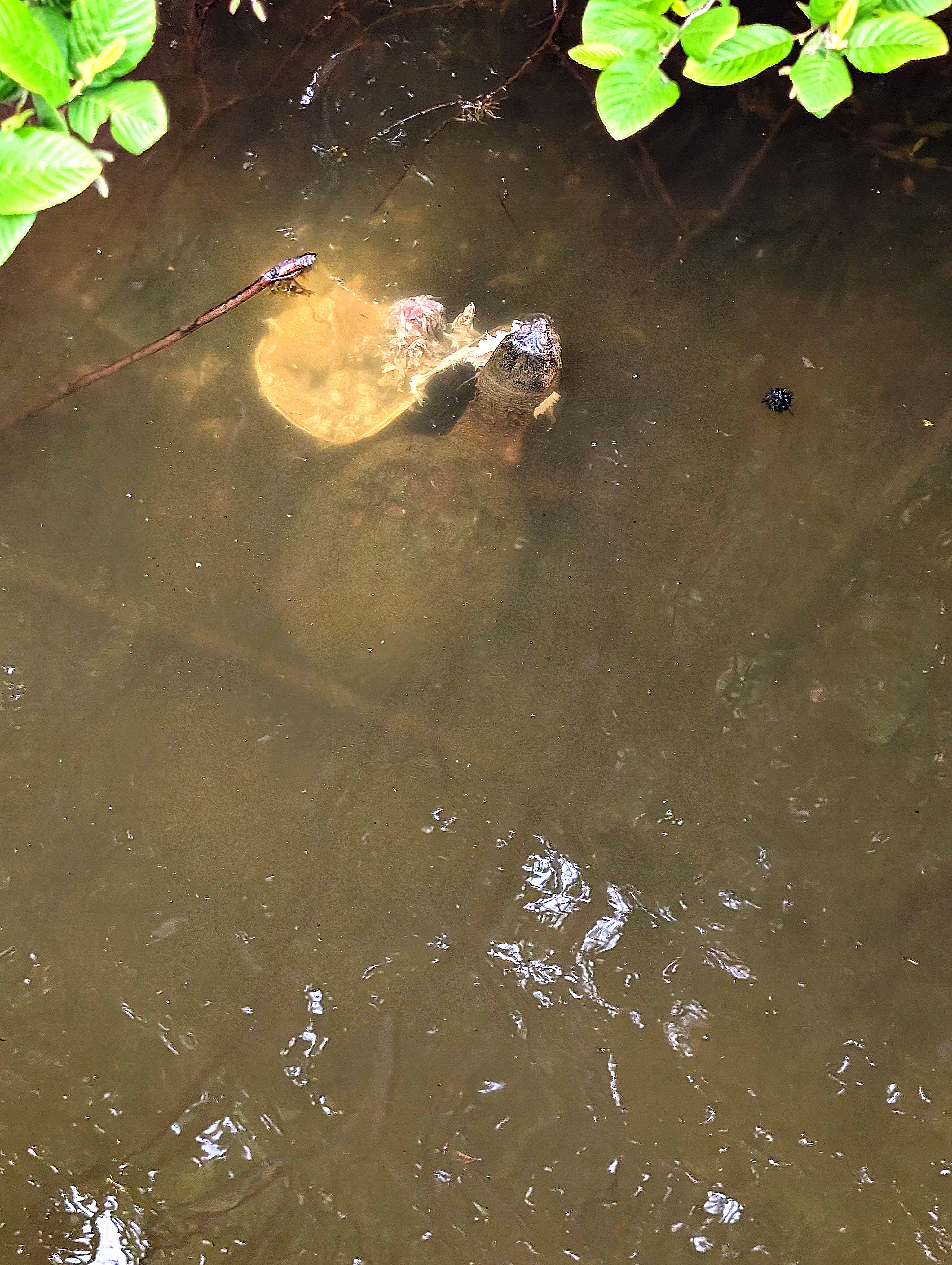
My wife and I came across an odd sight this morning. The photo below, though taken in poor lighting and into murky water, shows a snapping turtle feeding on something.
Snapping turtle eating….a turtle? Lake Lynn, Raleigh, NC. June 2024.
I’m pretty sure that’s a snapping turtle. I estimated the shell at around 15 inches lengthwise, maybe 18. Snappers average 10-18 inches, so that’s the right ballpark. It took awhile to make out what was going on until I realized it was feeding, and the object of its meal-affection appeared to be an upside down turtle of pretty good size itself. They are omnivores and eat carrion.
Other sights during our walk around Lake Lynn:
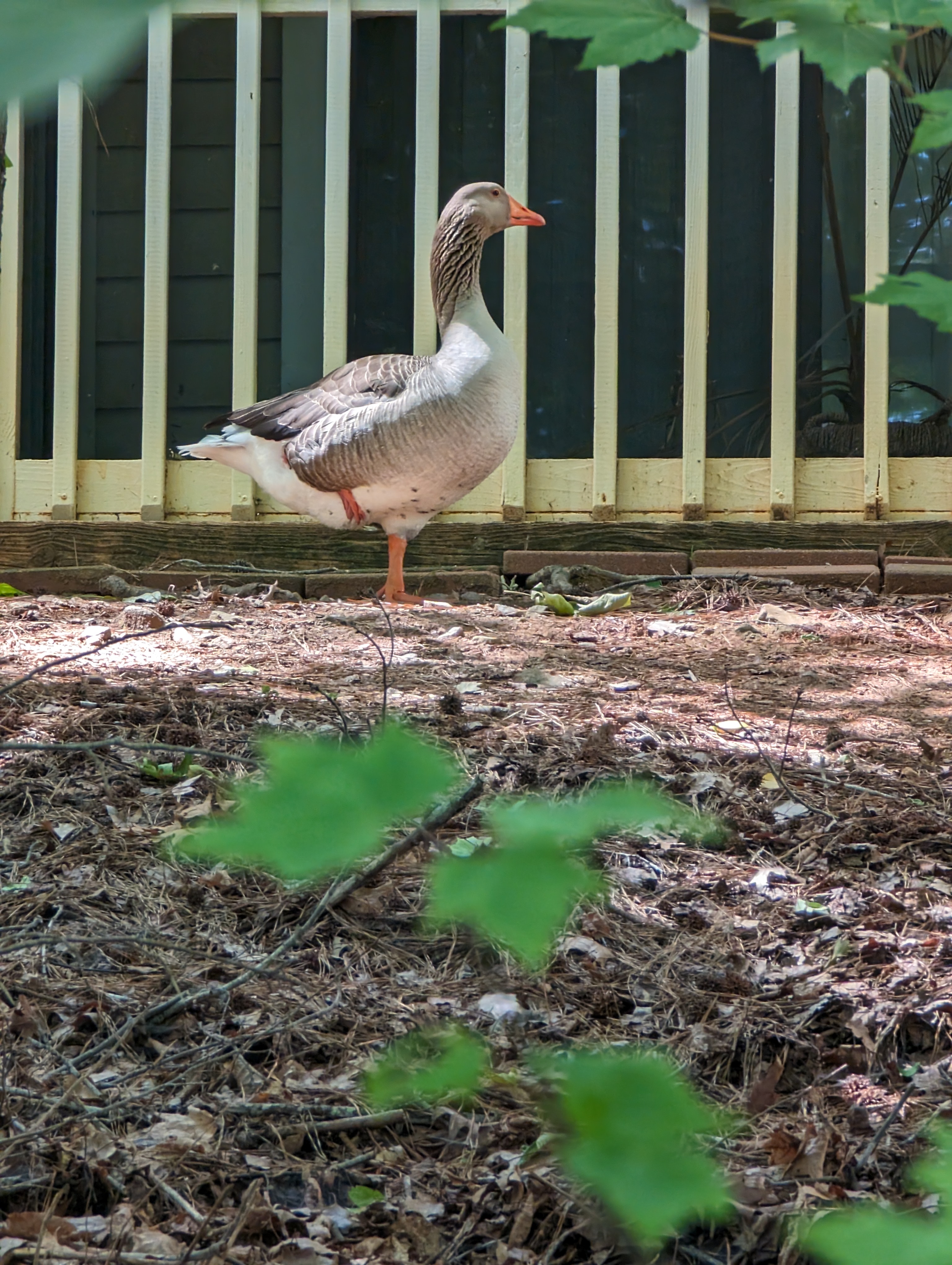
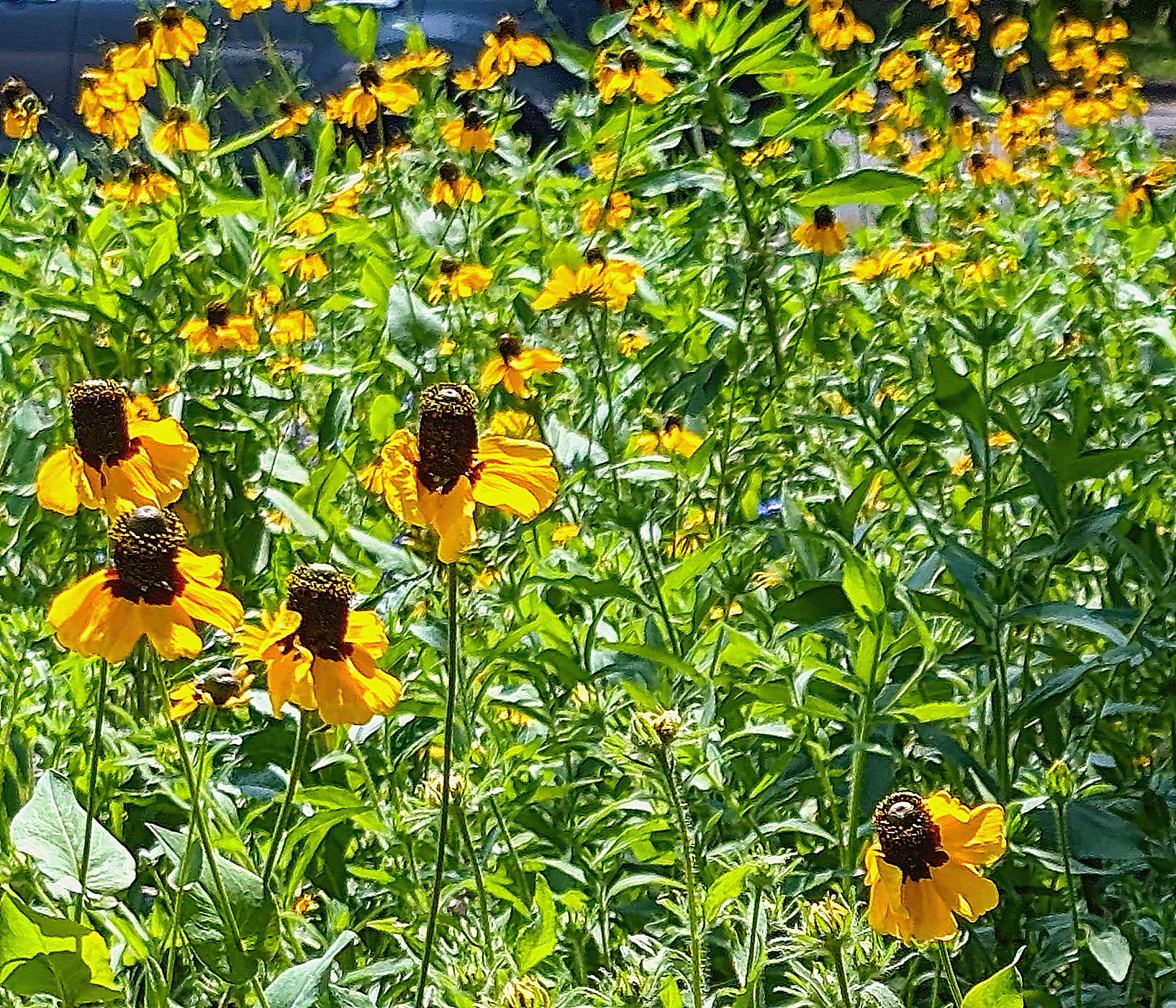
One of two geese of this species we see frequently. This one stands one-legged up the slope from the lake near an apartment in the many buildings which ring the lake. Lake Lynn, Raleigh, NC. June 2024.The Lake Lynn southern parking lot has a small butterfly/pollinator bed including these Bachelor Buttons. Lake Lynn, Raleigh, NC. June 2024.In the butterfly/pollinator garden Black-eyed Susans predominate. Lake Lynn, Raleigh, NC. June 2024.
Coming home we remarked that our own surprising volunteer Black-eyed Susan plants were starting to look pretty good:
Or maybe this isn’t a Black-eyed Susan…or the others aren’t? June 2024.
Our hydrangea plant continues to weird us out by changing color just a bit every year, getting more and more pink:
Pretty sure I shared one like this last year. The blue stamen/pistils are really something. June 2024.
And this year the main hydrangea bush’s outlier, a new plant coming up beside it and presumably from the same root system, shows a new color scheme altogether, seeming to lean in to the color scheme of its parent:
New hydrangea. June 2024.
What I’m brooding on…
These lyrics by John Prine in “Hello In There” haunted me in the 1970s and do so more the older I get. “Happy” Monday to you all.
"Hello In There"

We had an apartment in the city,
Me and Loretta liked living there.
Well, it's been years since the kids had grown,
A life of their own left us alone.
John and Linda live in Omaha,
And Joe is somewhere on the road.
We lost Davy in the Korean war,
And I still don't know what for,
Don't matter anymore.

You know that old trees just grow stronger,
And old rivers grow wilder every day.
Old people just grow lonesome
Waiting for someone to say, "Hello in there. Hello."

Me and Loretta, we don't talk much more,
She sits and stares through the back door screen.
And all the news just repeat itself
Like some forgotten dream that we've both seen.
Someday I'll go and call up Rudy,
We worked together at the factory.
But what could I say if he asks "What's new?"
"Nothing, what's with you?
Nothing much to do."

You know that old trees just grow stronger,
And old rivers grow wilder every day.
Old people just grow lonesome
Waiting for someone to say, "Hello in there. Hello."

So if you're walking down the street sometime
And spot some hollow ancient eyes,
Please don't just pass 'em by and stare
As if you didn't care, say, "Hello in there. Hello."
Maybe my purpose simply lies in imitating Charlie: hang out at the bar and drink a half gallon dry? May 2024.
I’ve several pieces of writing sitting on the shelf in a to-be-born state. Some even sit at the front edge of the shelf, just waiting to be taken down, polished, exhibited. This beckons now, however. It underpins the others.
I’ve too often settled for what I can do instead of striving for what I want to do. This blog and its recent lack of activity exemplifies that. There exist but a handful of activities which bring me as much pleasure as posting photos, essays, poems, and other pieces of writing here. Why the weekslong gaps?
At the age of 13, as inchoate as any such a creature, I became focused by two things: my Language Arts teacher said (using a bit of poetic license), “Damn, Pilcher, you can write! You should consider being a writer!” The other event occurred in the same year when a partner and I debated some topic which I now forget in front of the entire 8th grade class, all 300-400 of us. I got a glimmer into my innate bent toward logic and reasoning, both inductive and deductive. Our duo lost the 8th grader vote, but we won the teacher vote, similar to winning the electoral college but losing the popular vote. I considered myself a Writer and a Debater from that point forward. I did not know they were sometimes mutually exclusive.
In high school my teachers redirected my interest in writing. I learned they placed little emphasis on writing creatively, focusing instead on the expository writing of the essay, the critique (book reviews), and the like. Can one function in society where business letters rule the day? (At least they did then. If those teachers could only see today’s society…alas, most are dead.) I therefore looked to the available outlets, enrolled in Journalism, and joined the school paper (an elective class). In my senior year the two points of view in C. P. Snow’s The Two Cultures collided. All that expository writing reached new heights when Senior Humanities brought me the two-hour essay as a substitute for a test. But…the loosening of curricular philosophies brought me the elective of Creative Writing. Suddenly I wanted to go back to the latter. Yet already I had applied to the University of Montana because it had an excellent School of Journalism.
To shorten this up: I did attend the U of M, but enrolled in an experimental education program instead of journalism. I spent one year there. There followed a year of earning money, a two-year stint at a regional college learning to be a recording engineer—no, wait, a radio-TV newsman—no, wait, a weird combo of that with Economics—before I enrolled in journalism (again) at the University of Washington, determined to make my way in that field because, “if I don’t focus on something, I’ll never do anything!” And I did work in newspapering for almost four whole years.
Pause. This supposedly promised to be about how he couldn’t focus his desire to write into the pursuit of WRITING. He settled for what came to hand, taking the path of least resistance, doing what he appeared to be reasonably talented for. Compress the next twelve years: convenience and aptitude led to a ten-year teaching gig. Divorce and early-onset midlife crisis led to One Last Attempt to Be A Creative Writer. It failed in less than a year. (Insert all the comment you want; I/we know our psyche. I/we did what seemed necessary to maintain mental health.) Through a series of events which defy a bad Hollywood script, I wound up analyzing data and writing scientific reports for the world’s largest pharmaceutical manufacturing company at that time. I did well. I spent a quarter century at it, eventually as a consultant, and retired.
WAIT! WTF? I THOUGHT THIS PROMISED SOMETHING ABOUT HONOR AND ALL THAT?
What is honoring thyself? Youth #1 has innate talents for playing baseball, thinks “I really like buying and selling stuff” but goes into baseball because his/her innate talent take them that way. They succeed as expected, then coast for the rest of life realizing passive income from the insane amount of money earned as a ballplayer. They neglect to build a business empire based on that initial desire to be a capitalist. Youth #2 loves baseball despite having mediocre talent at playing it. He/she works every waking moment for years to make this dream come true. They are drafted into professional baseball, succeed despite what their projected ceiling is, and spend the rest of their life in baseball as a coach or a manager or a consultant developing young talent.
Which one honors themselves? The one who leaned into their innate talent? Or the one who ignored who-knows-what talent to pursue a dream? Youth #1 drifted into baseball on talent. Youth #2 ignored talent to pursue a dream which consumed the remainder of their life.
And for the religious among us, which one is pursuing their God-given path? Youth #1 made the most of their innate talent. Not #2.
How can I be nearing 70 years on the planet and still wonder which one of these I am, and what the answer is to that question about honor?
When I volunteer to write a database/listing application for my church choir, am I fulfilling my innate talent, or am I defaulting on my dream? Ditto for ditching teaching to write business reports that pretty much anybody could write. To make it more mundane, when I derive great joy and satisfaction in planning a set of weekly menus, selecting good recipes, and cooking them, am I dodging my greater dream, my greater desire to Be A Writer?
Is Being A Writer just an ephemeral dream, a wisp of wanna in a wind of reality?
Deep down I think I fear that though I have a talent for crafting language, I have nothing to say with it. I need to be explaining something, reacting to something, pontificating upon something. (I’m doing it now.) Avoidance mechanism or recognition of doing what I truly want to do? I fear it’s a bit of both.
I intended to end this with a promise about upending my approach to the day, the week, my life. To declare, “I will write FIRST, I will read FIRST, and only then will I tackle the mundane!” (“Dear, have you emptied the cat boxes yet?”) I cannot do that. I’m sitting here thinking about the monks with writing skills who eschewed them to pray aloud and work the fields. Of soldiers skilled in various practical skills who instead served on the front lines. Of women (and a few men) who gave up promising careers to raise children. What is a Calling and what is a desire?
In the end I come back to this: you have done what you wanted to do at the time. If more high school guidance counselors—do they still have those?—had told this to their junior and senior clients, a lot more of them would have been able to pursue what they were drawn to. I know I would have.
There will be no end to this piece. Not until I reach my death bed and give you the answer, and likely not even then.










 all the voices in my head