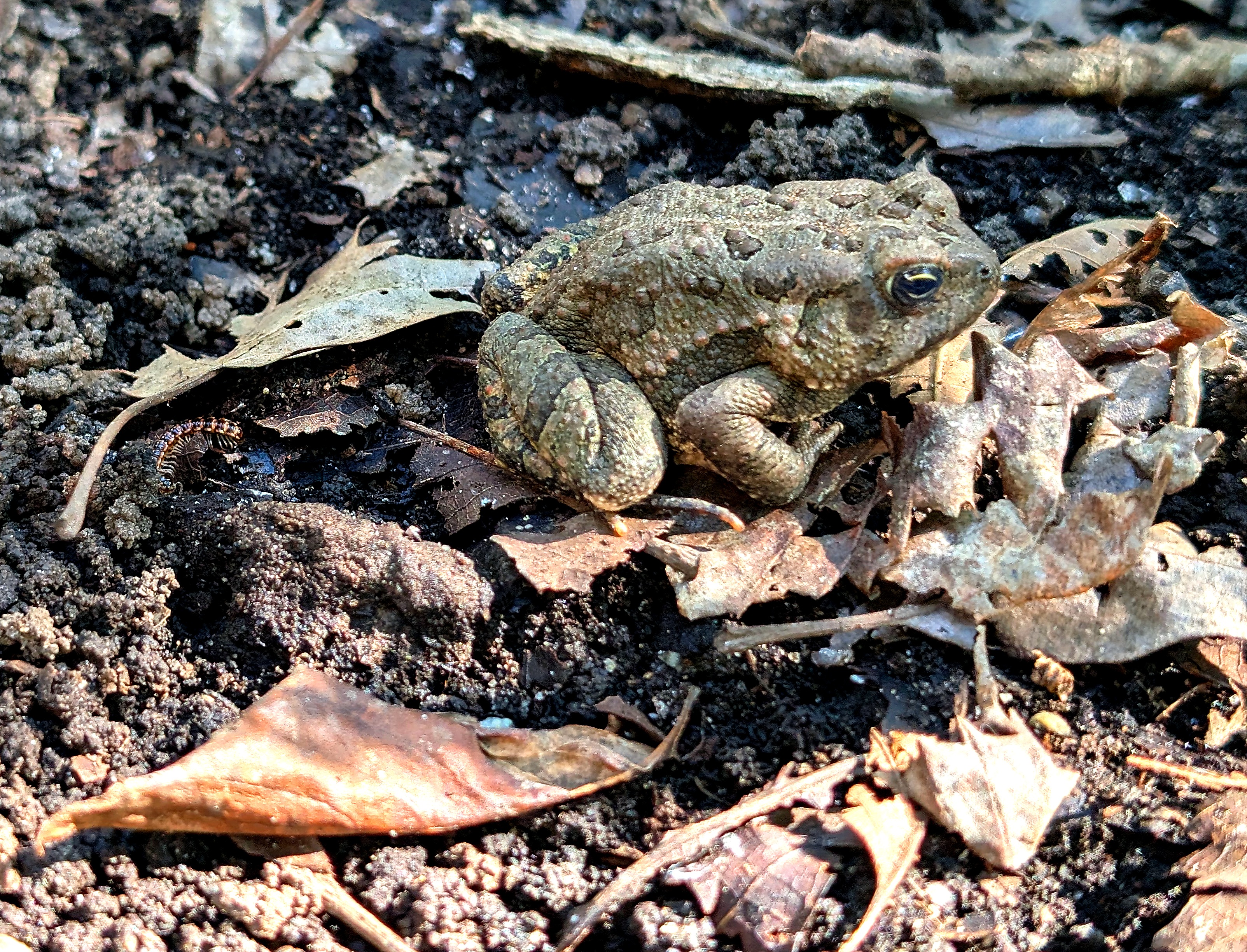
While weeding something moved, just a bit, and I spied this Southern toad. I haven’t seen one around this house since we moved in over 8 years ago, but saw them regularly at our former house on a pond. Pretty lethargic—it’s a nocturnal creature. September 2025.
One month ago today we woke in our own bed after flying in from Belgium the night before. Only now am I catching up to yardwork, which these days consists of staying ahead of the interlopers in our all-natives garden covering the front yard and hacking away at plants in the back before they can seed. Their days are numbered: two weeks from now we hope to start the replanting of the backyard. I question, at times, why we paid so much to plant perennials which should natively grow here but there ya go. A complete and pleasant shock has been seeing the blue mistflowers explode in size and coverage. These beautiful and late-blooming plants had for years volunteered amid the purple coneflowers I’ve showcased many times on this blog. Most of them were taken out to facilitate the new landscaping plan, but the architect of that plan instructed his crew to transplant as many as possible. Given that it was a week into October, he also sprinkled any seed heads he encountered. I think the much better soil helped them out a little bit:
This bank of blue mistflowers looked reasonably modest in size when we left for Europe on August 7, 2025. They’ve now taken over this segment of the yard, overwhelming several plants underneath them. September 2025.Detail from a much larger photo of another bank of the blue mistflowers, showing how small flowers form much larger clusters. This photo is unretouched except for a slight amount of sharpening I added to see the flower petals better. September 2025.
I had to transplant two which ‘volunteered’ at the edge of the walkway to our front door and by doing so, obstructed most of the sidewalk. One withstood the shock and has many buds on it. The other has stood with severely wilted (but green!) leaves for almost four weeks. I keep telling it, “hang in there! You don’t need to bloom! Just live!”
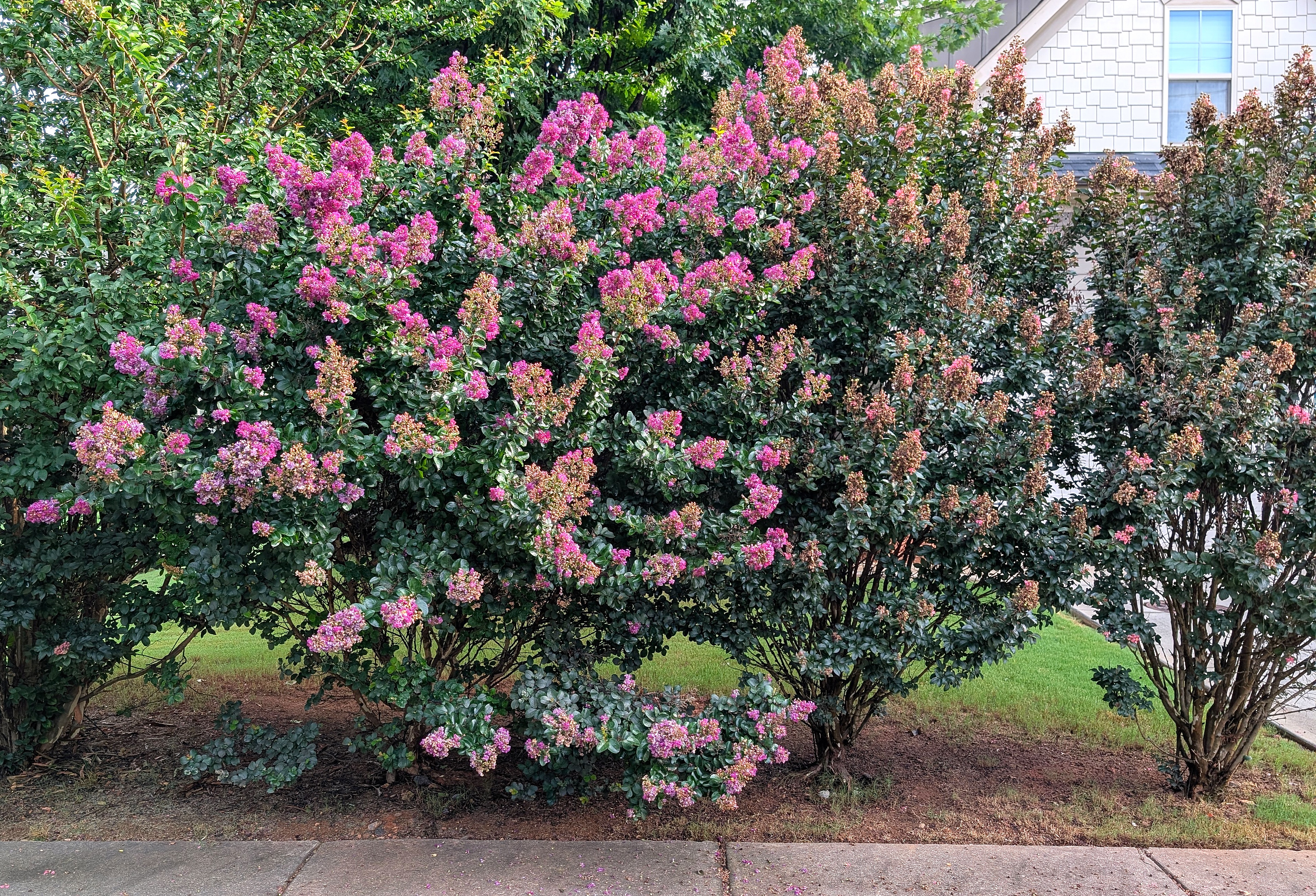
…or crepe myrtles if you prefer…seem ubiquitous here in Raleigh, NC. From what I read and hear they’re throughout the South, though I haven’t paid enough attention while driving through our neighbor states. Crape myrtles take their time, slowly becoming substantial trees of a type called thicket trees. They can be well-tended and trained, as this one is:
With care, the trunks grow together. Raleigh, NC. July 2025.
Usual care involves letting them grow as they will, but pruning suckers and sometimes trimming the tops to shape them:
Crape myrtle with usual thicket look and showing white blooms. Raleigh, NC. July 2025.
Crape myrtles are everywhere here. The photo above is across the street from the first photo. The thicket-trunked myrtle in the foreground has a substantial myrtle right to its left, the one with a more substantial trunk. Follow the sidewalk and you’ll see two more, smaller (younger) crape myrtles flowering. These last two demonstrate the variety of the approximately 50 species of crape myrtle (or are a particular cultivar of one):
Younger, different crape myrtles. Raleigh, NC. July 2025.
Crape myrtle are maintained by the City of Raleigh in the decorative medians:
Three “City” crape myrtles at the end of my street. Raleigh, NC. July 2025.
To me the Ultimate Crape Myrtle lives in my neighbor’s yard. Its branches extend from the edge of the sidewalk and tower over her house. It’s at least 30 feet tall. Someone appears to have pruned a few suckers in its youth, but mostly it’s been left to its own.
Crape myrtle in neighbor’s yard. Our white car and yard in the background. Raleigh, NC. July 2025.
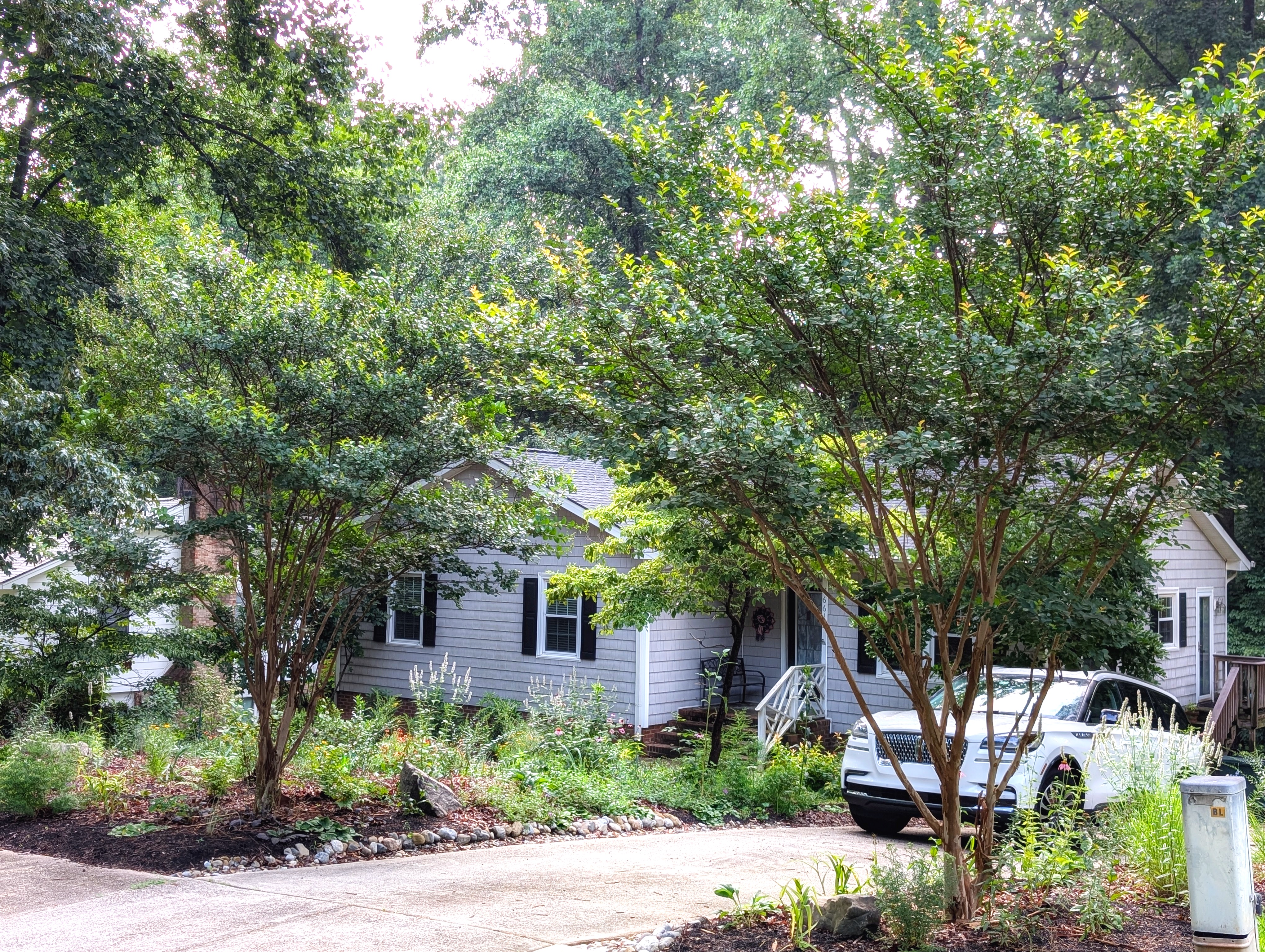
And then there are our crape myrtles. Ours were planted sometime between 2007 and 2014 (using Google Maps Street View), with the most likely time frame being 2010-2012, a period when the former owners rapidly changed the landscaping and interior of the house. The myrtles probably were purchased as saplings, and have doubled in height for the eight years we’ve lived here. For reasons I suspect have to do with amount of sunlight and my utter lack of any care beyond occasional pruning, they flower very late. I suspect sunlight because my other neighbor has three, also near the sidewalk, which haven’t bloomed yet either. In the photos above you might have noticed most of the myrtles nearing the end of their blooming period. Ours?
Our two crape myrtles, either side of the driveway, not blooming. July 2025.
But here’s the thing: though closely identified with the American South, they are not native to it. To quote the NC State University’s Extension Gardener website, “[Crape myrtle] is native to the Philippines, Japan and central Himalayas to southern China and Indochina.” Our whole move the past 12 months has been to replace everything in the front yard with native plants. (note that in the photo above) After a year of debate, and many years of saying, “Maybe they will bloom better when they get bigger,” we’ve decided to replace them. (Sorry, former owners. Consider it payback for removing that big tree in the front yard and not properly having the stump ground. I nearly broke my ankle in that mess many a time.) On one side will be an ‘Amethyst’ witch hazel which blooms in winter and very early spring. (Photo here.) On the other side will be a serviceberry. It mimics the look of a crape myrtle with the multi-trunk growth, but it will provide berries for birds and other critters.
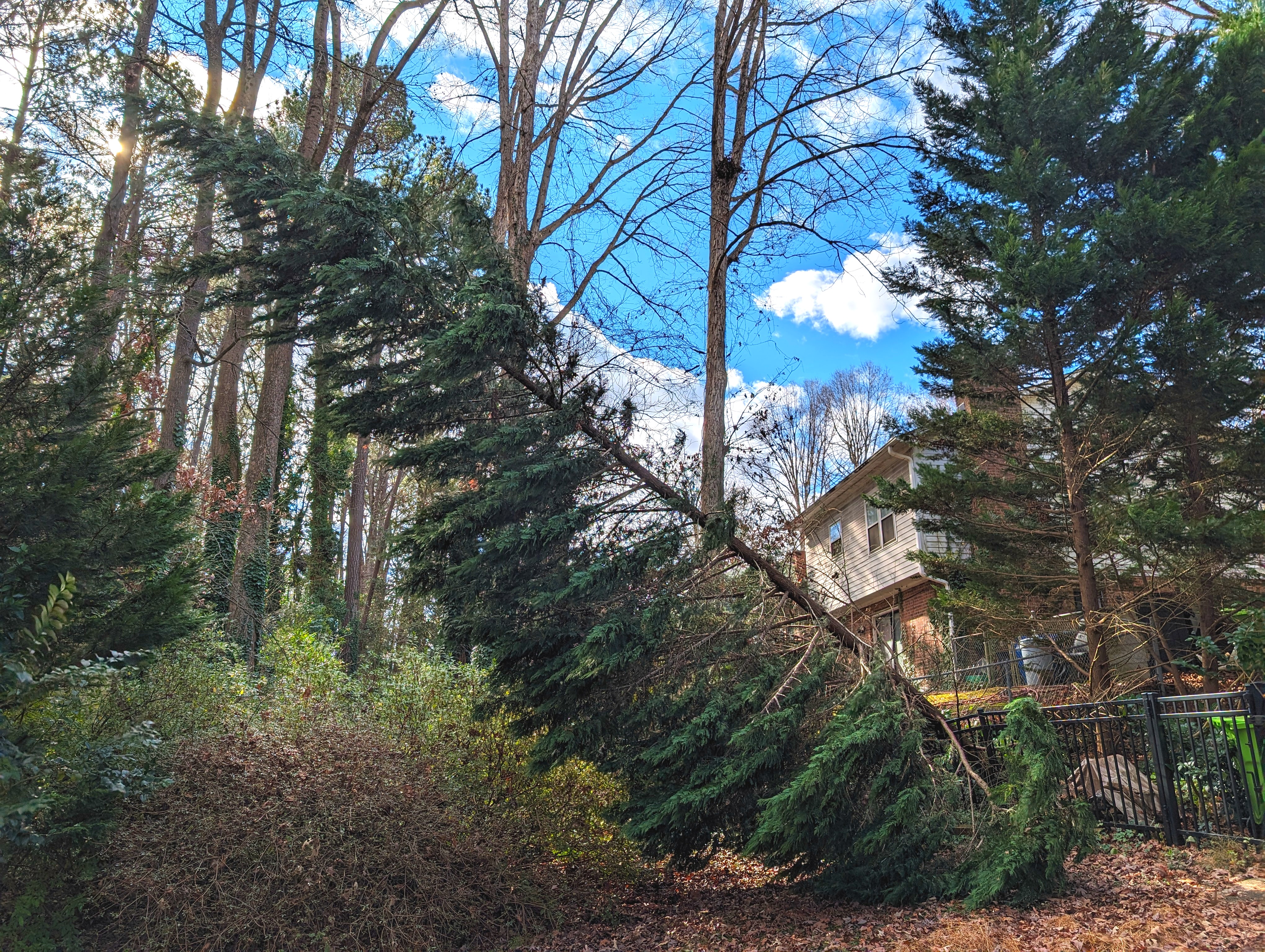
Leaning Tower of Cypress. Raleigh, NC. January 2024.
Storms have ravaged the country this past week. Still do. Four days ago I discovered the easternmost Leyland cypress in a row of them had taken a tumble from the stiff winds we endured Tuesday night. If you’re thinking, “hey, Leyland cypress, that sounds like a cool tree to grow” do yourself a favor and find out about their root system, their gangly nature, and whether they’re meant to be grown in your climate region. The folks we bought the house from (or maybe the folks before them) didn’t. To quote Wikipedia:
…because their roots are relatively shallow, a large leylandii tends to topple over. The shallow root structure also means that it is poorly adapted to areas with hot summers, such as the southern half of the United States.
Wikipedia, “Leyland cypress”
Theoretically they should die within 10-12 years in North Carolina. And hey, are you thinking, “Well, I live in the north so it would be okay?” How about this add-on: “In northern areas where heavy snows occur, this plant is also susceptible to broken branches and uprooting in wet, heavy snow.“
We’ve owned our house for almost seven years. The folks before us, about eight years. Using the timeline feature on Google Maps Street View, I can see that the row of cypress were planted as early as 2011 underneath larger trees which then were removed at a later date. These cypress grow really fast, like one-meter-per-year fast. All I’m saying is…13-15 years and these trees are doomed. I wish the black fence there at the bottom wasn’t holding it up. I could have used a chainsaw to take care of this myself. But for a sense of scale, consider that the branches I would need to limb (so I could cut it down safely) are the ones just up the trunk from the black fence and that’s 5-6 feet above the ground. I would be holding a chainsaw at face level and over my head. Not gonna happen. Instead I’ll pay hundreds of dollars for some professionals to do it.
Did I mention I hate these trees? I do. There’s a whole row of them planted as a property screen by former owners of this house. We parked our car Mr. Lincoln beneath them, and I cursed a lot from all the sap and tannin-juice I had to wash off the top of the car. Percy the Aviator gets parked in the upper part of the driveway where he isn’t underneath them. They’re ugly at eye level. You can see from the photo above the tree has no branches on one side of it, the side which faces its nearest neighbor–yeah they planted them too close together too. Here’s most of the rest of them (four of six):
A row of disasters waiting to happen. Raleigh, NC. January 2024.
You can see my eye-level view here: nothing but bare branches which do nothing to screen me from the neighbor’s house to the south. (That’s it in the background of these photos.) You also can see I’m about to lose another one. That one in the center leaning way in. The only beings who like these trees are the large number of birds who use it as cover from the Cooper’s hawks so they can safely hit my bird feeders just across the driveway, and the squirrels who of course just go where they want to.
In December 2018 I lost my first one. There were two in the backyard. My guess? Whoever bought and planted these had more than they needed for the driveway screen and said to themselves, “well, where should we plant these two?” They wound up, incongruously, between the azaleas in the bottom left of the photo above and my tool shed. In fact, you can see the one which still remains on the left side of that photo there. We caught 9 inches of wet snow in early December that year. I knocked a lot of snow off of the branches, a successful attempt to save them from breaking. (In fact, I think one of the worst hit trees was the one now lying on my fence.) What I couldn’t do was save the Leyland cypress in the backyard which bent down nearly to the ground. Apparently I didn’t take a photo of it.
Friday’s wind dealt far less damage. Those of us on the North American continent know we’re in for a lot of intense storms this winter. Hope y’all ‘weather’ them better than this!







 all the voices in my head