HBP: math and patterns

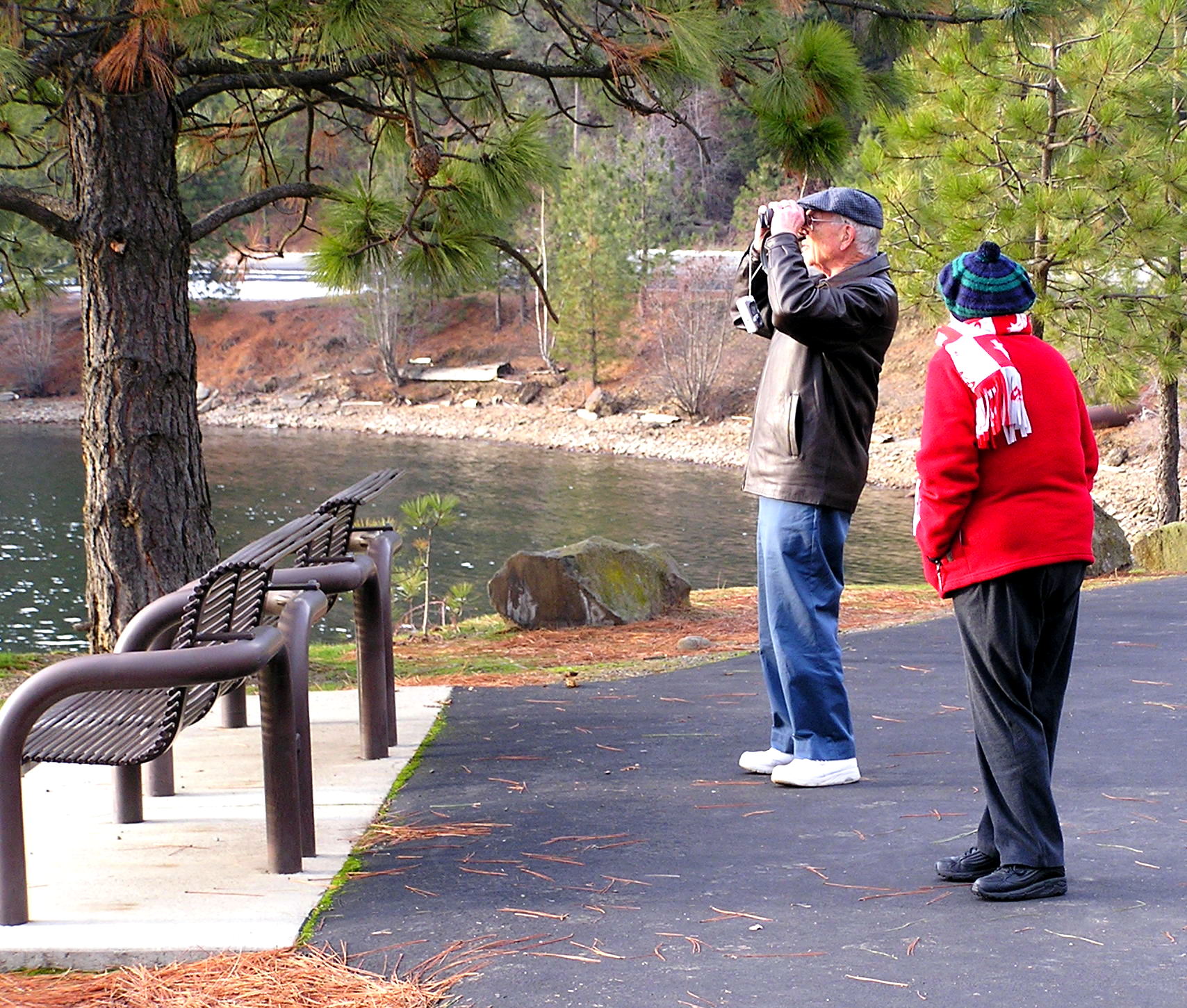
In this photo from the end of 2006, my father attempts to count all the eagles we’re seeing at Lake Coeur d’Alene, ID, while my mother wonders what the heck he’s doing. December 2006.

Our parents shape our lives. Even those who abandon us leave indelible marks on our psyches. Wonderful, painful, soothing, agitating, perplexing, satisfying, loving, and even the hatred—all of our reactions to them mold us. By the time we realize this fully, chances are they’ve departed our physical lives, living only in our memories and those of others. When I reflect on my father, I’ve come to realize he formed me more than any other person. One aspect of that recurs multiple times in a day when my mind ‘blinks’ and spits out an arithmetic calculation or it juggles a jumble of letters seemingly without conscious thought and spits out a perfectly spelled word. Patterns and numbers, numbers and patterns, all a gift, a curse from my father.

My father, Howard Bliss Pilcher, loved numbers. More than that he loved doing things with them, and he did them quickly. He inherited this from his mother, and he bequeathed it me for which I’ve (mostly) been grateful all my life. This pattern-recognition talent allowed me to move from career to career doing things I had no training to do. Yet there I was. My father never fully realized that aspect of it though I think he could have. I brought dreams and abstraction to his gift, seeing patterns in just about everything. His fixation with patterns and numbers remained in the concrete, the defined, the specific.

Numbers make patterns as do letters and words. Again, my father dwelt on how the letters made words yet never scaled the heights (plumbed the depths?) of how words make sentences and sentences make Writing. Not that he couldn’t write well, but his writing never would have challenged anyone in a writing club. It’s as if playing with the nuts and bolts was so much fun, why become a mechanic? He would delight in words with odd combinations of letters or how words tripped off of the tongue. He adored knowing arcane and niche words such as triskaidekaphobia (fear of the number 13). He once stumped us all (Mom, my brother, and me) at the game Probe by playing the word eleemosynary. This word describes things related to charity including being dependent on it. In Probe, played a bit like the paper game Hangman, contestants choose words by putting letters face down on a tray with 12 spaces. If the word is smaller than 12 letters, one fills the extra spaces with blank cards. Each player takes a turn guessing specific letters of their opponents. In that way it also resembles Wheel of Fortune. My brother and I were about nine and eleven, respectively. We expected and understood that our parents would use words with which we would be familiar. We had very good vocabularies due to hanging around them and from our incessant reading. As you might surmise, however, we were unfamiliar with eleemosynary. Heck, my mother didn’t know it! When all players of Probe have had their words revealed except for one, the remaining players each have two turns to guess the word. We never came closer than thinking it was elephant. I remember nearly sixty years later being so upset as to be near tears that he would think we’d know this word! He apologized, grinning awkwardly, sputtered something about charity—but he kept the points.

But doesn’t everybody?

Around this time we learned from our Uncle Gordy, my father’s brother, that he (and maybe their parents) had teased my father for his repeated incredulity that someone didn’t know something or do something that he did. “But doesn’t everybody…” became a way to slightly dig at his recurring belief that everyone could do what he did. This caused him to try to teach me to do long division in my head when I was 8, and before it had been taught in school using paper and pencil. On top of it all, we were weeding the garden at the time. That episode ended with me crying. Some other cases in point:

Every year in the arid West the pine trees drop needles and cones. Thankfully these events do not occur simultaneously to the best of my memory. Spokane might be the capital of the Lawn Nazis, those people who will semi-innocently ask you if you need help with lawn “because I noticed it’s getting a little long” or “I see you’ve had a bit of difficulty getting to your needles.” One did not leave needles and cones lying around on the lawn! I hated raking needles which my father always seemed to pawn off on his boys. Picking up cones, however, somewhat delighted him because as he picked them up, he would count them. “We got 103 cones this year from the front yard. That’s a new record I think!” and off he’d go to check. Yes, he kept track. When we were long gone, I could tell he still did this because the new neighbor across the street knew exactly what we were talking about decades later.

Our family vacations every summer involved driving for up to two weeks to visit scenic wonders and relatives. By the time I entered high school I had visited most of the national parks in the West, though getting further south than the Grand Canyon remained for my adulthood. On these vacations my mother rarely drove (and when she did it was with white knuckles—hers, not ours). My father kept car records on a 5.5 inch by 8.5 inch piece of stock on which he manually drew lines and columns. Each gas fill-up required the date, an odometer reading, the number of gallons purchased, and then while the attendant filled up the car’s tank (ah, those were the days) he would calculate the car’s gas mileage since the previous gas stop.

On any drive, vacation or not, we would at intervals be treated to his light double-tap of the horn and announcing to the car’s passengers, “that’s fifty thousand miles!” or “look! All fives!” Yes, he celebrated when the odometer read 55,555.5 miles. Or when he got 12345.6 miles. There were many possibilities. (Unfortunately this rubbed off on me a little bit. I routinely wake during the night and say to myself, “Oh, it’s one-two-three-four” when the clock reads 12:34 a.m.)

He particularly fixated on license plates. It feels wrong to say he memorized them. My father saw license plate designations as others do names they want to remember. He didn’t know only the plates for our two cars. He knew all of his friends’ plates, too. Though usually no more than a parlor trick—”hey what were you doing downtown last night?” he could say to someone whose car he saw on the way home—once this came in handy. A family friend called one evening: “What’s the license plate on Pete’s car?” A family emergency had occurred while her husband Pete was driving across the state to Seattle. She needed to tell the state patrol his car’s license plate number so they could find him and tell him to turn around. My father dutifully answered her, and Pete returned home as quickly as possible.

My father easily multiplied two two-digit numbers in his head. I remember an evening when I made him take me to an Amway meeting to see if this would be a way to earn money for college. We both realized quickly this definitely wasn’t for me, but we were too polite to get up and leave because we had sat in the front row. At a certain point the speaker began to illustrate how much money a person could make, citing X number of units on which a person would earn Y amount of profit. Before the speaker could punch all the numbers into his calculator my father piped up with the answer. After a few such examples, the speaker quit trying to use the calculator and just turned to my father for the answer.

Typos and misspelled words irritated him. He couldn’t fathom how a person possibly would fail to see the incorrect pattern. One of his favored word games was printed in the newspaper, buried in the classified ads. (If you’re younger than 40, classifieds were really small type printed at the back of the newspaper and somewhat like Craigslist.) The game was called Jumble and ran for decades; I remember seeing it in the past 20 years. Five (four?) words were jumbled up. Playing the game required one to unjumble the words, then take certain letters indicated by circles and use those to form an answer to a tongue-in-cheek question. “Why the sculptor disappeared”; “He was BUSTED” My father didn’t do these frequently because he instantly saw the words, working more or less like a lexicological hot knife through butter.

He counted everything, knew the patterns and sequences of most common things. If he bought a rack of Presto-logs (his preferred way to burn a fire in the fireplace), he knew soon how many stood in the rack. He knew what day of the week a certain date fell on…27 years ago. He knew how many lightbulbs were on the strands of his Christmas decorative lights, how much he weighed every day, where his stock prices ended yesterday, the number of feet from here to there, and the number of miles he had driven if you asked him point blank in the middle of sun-blasted Nevada. Once we were digging around in his dresser—certainly we weren’t supposed to?—and found a slim memo book small enough to fit in a shirt pocket. It dated from his fraternity days at Washington State College. In it, he had recorded the scores of every single ping pong game he had played against his frat brothers. More interestingly, there were three pages at the end with only the first names of women and a number after them! Since we cannot fathom my father being that much of a ladies man—there had to be three or four dozen names!—we’ve been baffled what the numbers meant. Kisses? Number of dates? Both strain credulity. A rating system? Even more unlikely. He certainly got embarrassed, though, when we made a big deal about it. Maybe…maybe… He never revealed what the numbers meant, but we noted he never threw the notebook away either.

When my family celebrated the gift-giving which happens at birthdays and Christmas, we always laid gifts out on the hearth of the fireplace. When my mother turned 64, her grinning husband led her to the hearth where she found a cubical box wrapped in plain paper. It measured nearly two feet on each dimension. Every face of it had a large numeral “4” drawn on it. Baffled, she looked at him quizzically. My father said, “Well, you’re sixty-four today!” She just scrunched her brows a little bit more. “You know,” he explained, “you’re sixty-four. That’s four cubed!” His grin must have been nearly ear to ear. My mother didn’t share his enthusiasm.

Sadly, I found after his death that his obsession with patterns did not extend to how he kept track of his financial information. Files were in disarray, his migration to using spreadsheets had been less than successful, numerous lists of critical information existed but they contradicted each other, and the trivial received thorough documentation but the important didn’t always. As an example, without understanding what his accounts were and where, I didn’t know for sure how much money my parents had in their investments. Seven years after he died, and one year after my mother had joined him, my brother and I found a certificate of deposit in their safe deposit box. Nothing indicated whether it had been received into their normal cash flow when it matured, or if it might be sitting somewhere waiting to be collected. We never could track down the company which sold it to them, and decided it must have been collected—but 25 years after maturity, the CD paperwork sat in the safety deposit vaults.

When I partially wake at night to stumble toward the bathroom, I idly look at the clock. Instantly, and whether I want to or not, my mind cranks out the amount of time since I turned out the light. I remember all the times I wake to do that or to feed cats, then regurgitate them to my wife in the morning. “Well, I was up at 4:37 feeding the boys.” My father lives in me at those moments. He whispers like a schizoid voice and makes me count the cars I see on a lonely stretch of highway. He makes me frown disapprovingly when I read yet another grammatical error in what passes for our newswriting these days. He laments that I don’t figure my car’s gas mileage, stares in disbelief when I search my brain for my own car’s license plate number, and smiles when I record the amount of rainfall for yesterday. I don’t tell him it’s only because I need to know when to water the yard. And I hope he’s proud of me for all the new ways I’ve used his gift to see the numbers and patterns in quality systems and manufacturing results. He never really said one way or another while he lived.

A slippery fish

Fish at Maui Aquarium. September 2024.

For several weeks I’ve written, re-written, and re-re-written a difficult piece about my father. Its point still eludes me. I fear several things: I’ve attempted to describe something, but I’m only describing it superficially; I’ve selected an inferior topic to one which begs to be heard; or perhaps what I’m writing about doesn’t rise to worthiness. This has delayed my promise to myself to post one piece of writing about my father every Sunday. It’s been like attempting to grasp a wriggling fish. I shall continue to rant to the air, to myself, to my wife—heck, to the birds on the grass—about this, and hope it gels in my mind and in my words.

Until then I’ll post a few photos, and maybe I’ll write something less weighty, something which elicits a few chuckles or wry reactions. Yes. That would be it.

HBP: photo break 1

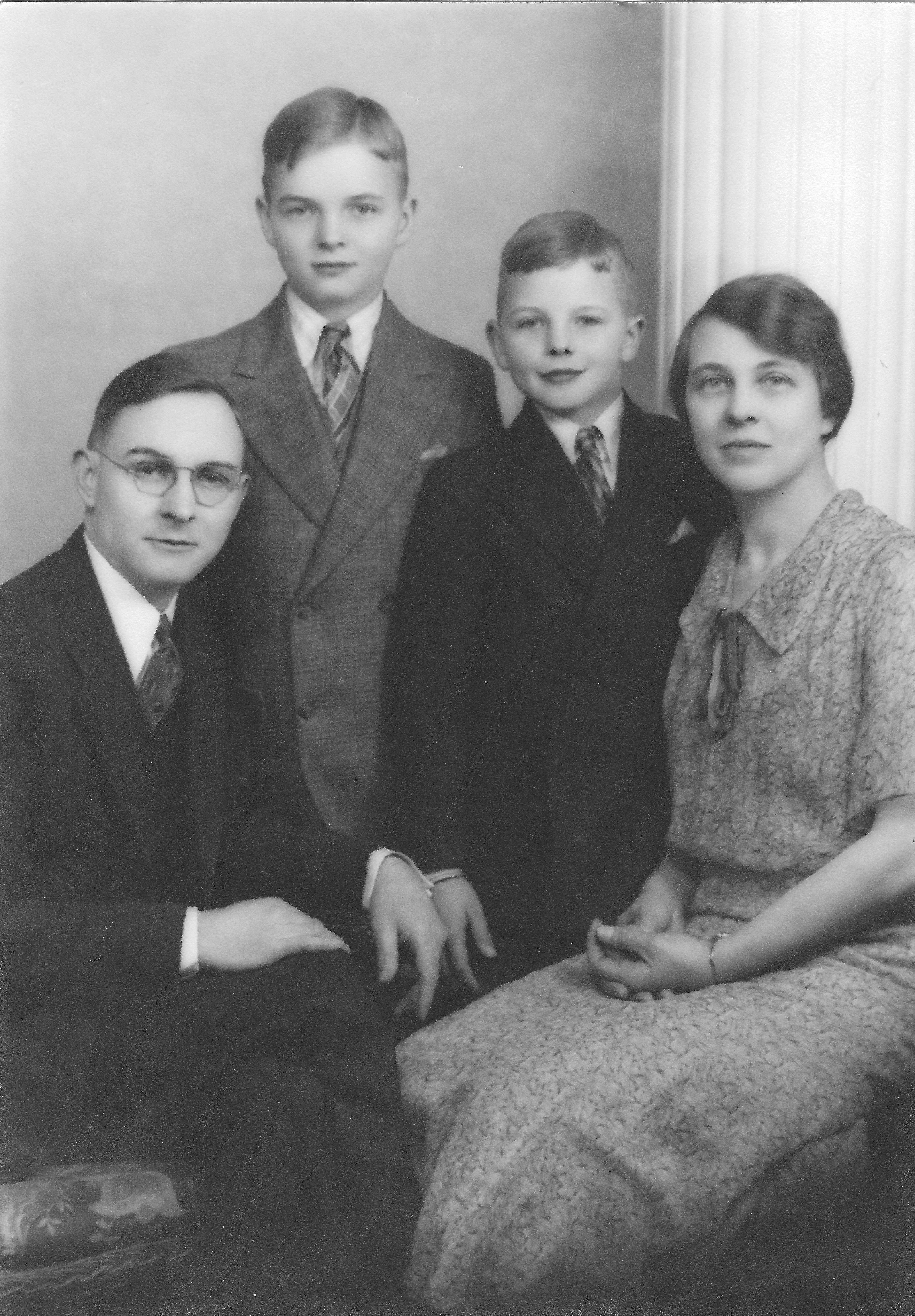
I’m partially through my next installment about my father, Howard Bliss Pilcher, but it will not be published today. My goal is “every Sunday” but this week’s post is a sober and kinda negative thing about him. Regardless of how deserved that viewpoint may be, I want to pair it with another installment which is more upbeat and entertaining. Instead I offer this portrait of my father’s family from 1938. This photo was taken in Minnesota which makes it a year prior to the family’s move to Havre, MT. Based on family values, I’m estimating it would have been a formal thing around Easter because of the importance of that day for a minister. My father is nearing 13 if so, and I’m pretty sure my uncle will be 10 soon. My grandparents are in their early 40’s.

Left to right: The Rev. Howard “Bliss” Pilcher, sons Howard and Gordon, and Esther (Dahl) Pilcher. Edina, MN, 1938.

Howard Bliss Pilcher: an introduction

Howard, 11 weeks; with his mother, Esther Dahl Pilcher. Lansing, MI, August 1925.

Howard Bliss Pilcher entered the world on this date 100 years ago. He died toward the end of 2013. In those 88 years, like most of us, he did nothing to affect the globe or any large portion of it. His impact, again like most us, accrued from those individuals he knew and perhaps from patrons of the two entities which employed him for 39 years. He most affected his wife and sons, Steven (my brother) and Kenneth (me). Seventy years later, to me he remains both enigmatic yet an apparently open book. Whether nature or nurture, his traits run through my being. Whether you knew him matters not. He might have subtly affected you too: every one of us amplifies his presence on humanity simply by interacting with more than one person and making an impression them; it ripples out to touch people we never knew.

Howard Bliss Pilcher—technically a Junior though never named as such—came into the world in Lansing, MI, on June 22, 1925. He moved with his brother and parents from city to city as his father, an American Baptist minister, moved from church to church. The younger HBP served in World War II, completed college, started his career, married, procreated, retired, traveled, and died December 16, 2013. He resembled thousands, millions of other men born around the same time. We each are unique, though, and this unique man fathered and raised me. If we are constituted from our roots, our times, and our experiences, then exploring those roots isn’t so much recounting their life as it is exploring our own. Therefore, we can’t call this biography. I haven’t the time or desire to research the nuances of his history, let alone the history of the times and regions through which he passed. (And thanks for that, too, Dad.) But there will be biographical elements to it, just as there will be aspects of memoir stemming from his inescapable impact on my life, and how the two remain intertwined even after his death. Perhaps reminiscence remains as the most accurate term.

A confession before we start: I’ve procrastinated all my life—a trait which will be explored through the telling of this tale—and this procrastination has left me too little time to complete this piece prior to deadline. My vision for it looms at far too many words to dash off in one or two sessions. Unlike the great gonzo journalist Hunter S. Thompson, I cannot lock myself in a hotel room for a few days, wire myself on pharmaceutical grade crank, and pound out a semblance of the piece this subject deserves. My physique won’t handle it, my psyche won’t handle, my marriage won’t withstand it, and I don’t see why after seven decades I should start caring about deadlines now. Okay. Let us begin. We’ll start with the thumbnail bio:

The senior Howard Bliss Pilcher, my grandfather, the one my grandmother called “Bliss,” came into the world in 1894 in Urbana, Illinois. The Pilchers traditionally lived in north central North Carolina in Yadkin and Surrey counties, up by the Virginia state line, but the “movin’ bug” ran through our branch of the family as far back as the early 1800’s. Bliss’s father, Wiley Pilcher (1861-1935), moved to Illinois where he fathered all three of his children. Wiley later moved to Fargo, ND, and finally to Libby, MT. All of this perhaps explains why, when he heard the call and enrolled in seminary, he became an American Baptist minister. American Baptists were at one time called Northern Baptists and trace church lineage through the Triennial Convention, the first Baptist convention in the United States of America. In 1845 a pro-slavery faction split off from the Triennial Convention to uphold the institution of slavery. It came to be known as the Southern Baptists. Without researching the topic, we may surmise that many Pilchers would not have been happy with my grandfather’s choice, particularly the majority of them still living in North Carolina. The decision to minister in that denomination reflects the equanimity which characterized my father’s upbringing, and which he instilled in me.

One year after my grandfather married Esther Dahl, my father was born. Lansing, the capital of Michigan, had nearly quadrupled in growth from 1900-1920. Not only were these the Roaring Twenties but this sizeable city (about 67,000) boasted all the activity inherent to a state capital. Thus, he started life in the thick of it: the capitol building stood about a half mile from their house. Not that this would have had much of an impact since by age 3 the family moved to Edina, MN, a suburb of Minneapolis. In between was a short stint in Dover, ID, an unfathomably small and remote place for a minister to travel, perhaps explained because Bliss stepped up from being a youth minister in Lansing to having his own church in Dover. The family lived in Edina for ten years more. At the threshold of my father’s entrance to high school in 1938, his father accepted a call to Havre, MT. (I’ve started to wonder if the “calls” were based more on wanting to stay reasonably close to his father, Wiley. Edina lies less than 250 miles east of Fargo; Havre is 350 twisting miles east of Libby.) Four years later my father graduated from high school. He attended the local college, Northern Montana, for at least a semester, but the reality of World War II loomed. The U.S. Army drafted him, placed him in the Quartermaster Corps, and sent him back and forth across the Pacific guarding supplies.

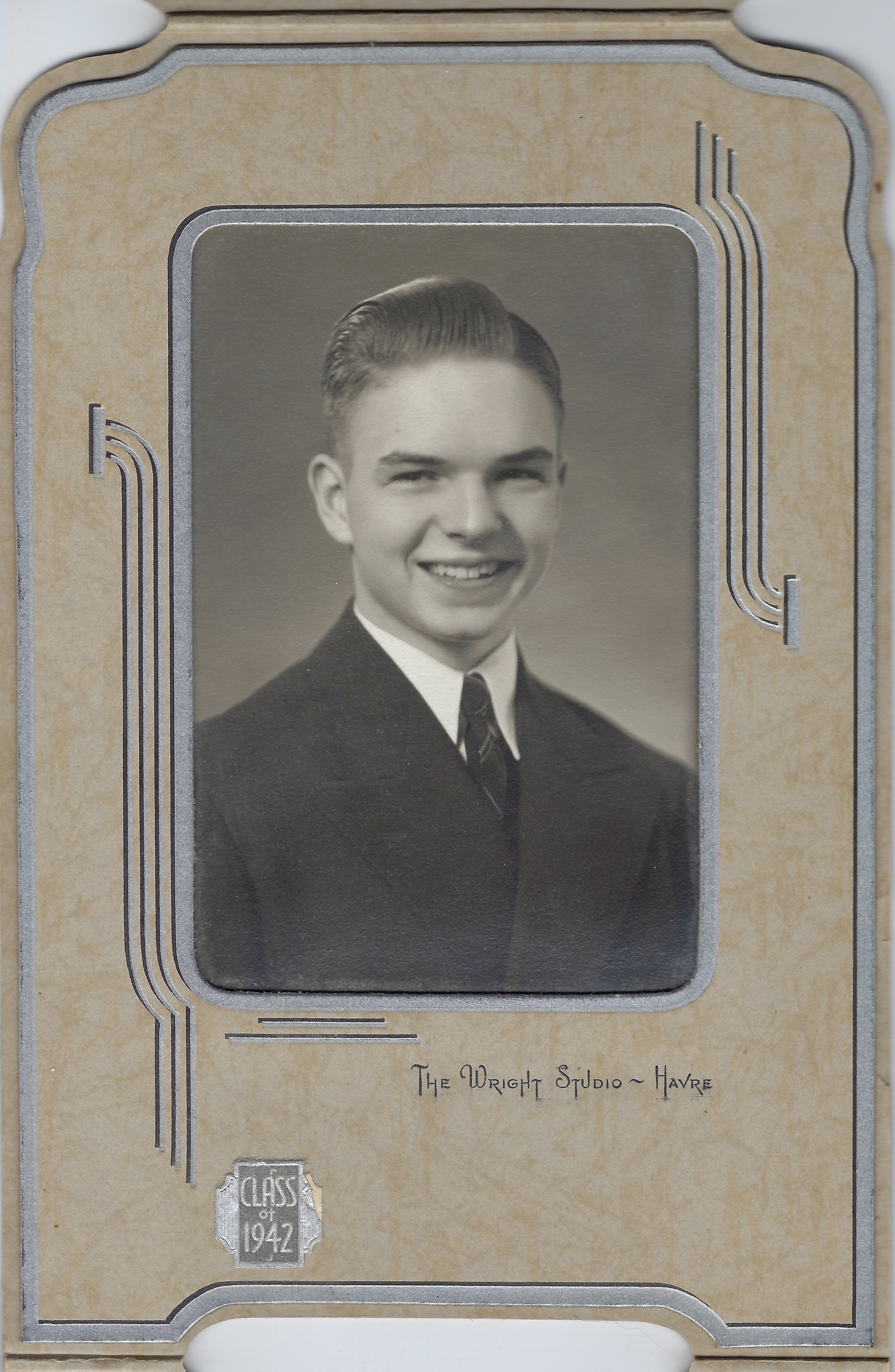
Howard’s senior photo from Havre High School. 1942.

At least, that’s what I surmise. My father didn’t want to talk about his time in the service at all. We did learn he made some grade of sergeant, but I only called him Sarge once. Let’s just say he made it very clear it would be the last time I called him that.

Howard mustered out of the service, enrolled at Washington State College (now WSU), hired on with the Carnation Milk Company in Seattle, married Louise Bach there in 1952, and they had a baby in 1954…me. We moved to Spokane, WA, when the Carnation Company transferred him soon after my first birthday. My brother was born there. My father accepted transfers back to Seattle (fall of 1962) then to Los Angeles (the beginning of 1964) before he made his dislike of Los Angeles and corporate life known. The company allowed him to go back to the same job he had left in Spokane just two years prior. We will revisit that career-killing decision. Four to five years later, as I approached high school age, he went through a personal crisis, quit Carnation, emptied out his profit sharing account, and maintained the family on that while he searched for a new career path. When a close family friend needed to fill a comptroller position at Sacred Heart Medical Center, he thought of my father who then began a very nice career managing financial matters for the hospital. As his mentor ascended the ladder of responsibility, so too did my father, eventually boasting the title Director of Fiscal Services. He retired after about 20 years of service to this medical center founded by the Sisters of Providence, a Catholic order of nuns.

In retirement he tended roses and indulged the Pilcher penchant for wandering by undertaking numerous road trips with our mother. There were a handful of trips by plane, but he fought claustrophobia for much of his adult life and those weren’t comfortable trips for him. Two trips abroad (England and Spain), a cruise package to Alaska, and near-annual trips to Hawai’i for a while rounded out the travel. They celebrated 50 years of marriage in 2002, quietly marked 60 in 2012, and he died after a sudden trip to the hospital in 2013 which saw him enter the hospital on a Tuesday and pass on the following Monday morning.

What did people think of my father? “That weirdo”? A “super nice guy”? “Honest as the day is long”? I know that he was loved. I know he withdrew toward the end of his life, and one by one most of the people he knew and loved died before he did. I know he worshiped my mother yet had a condescending tone toward her (which I adopted to my detriment). I know many, many superficial things. What I don’t know is the man he truly was, and what force ultimately took over the final five years of his life, making him mentally miserable at times. I know, too, it lurks within me and whispers that it just may do the same when my time nears.

This has been but a snippet, a dry telling of mostly factual matters, an introduction as stated in the title. To explore the man through reminiscence requires setting the stage. Much like reading your playbill before the curtain rises, you’ve now gained the background to enjoy the show (hopefully). In subsequent posts we’ll explore in no particular order and perhaps not under these self-same titles:

  • Ebullience, Positive Thought, and the Eleemosynary Ethic
  • Accruing Guilt: Understanding What Your Father Meant
  • On Humility and Perfectionism
  • Math versus Arithmetic, or Why I Skipped the CPA
  • How To Raise Two Merciless, Teasing Sons
  • …and others which do not yet leap to mind…