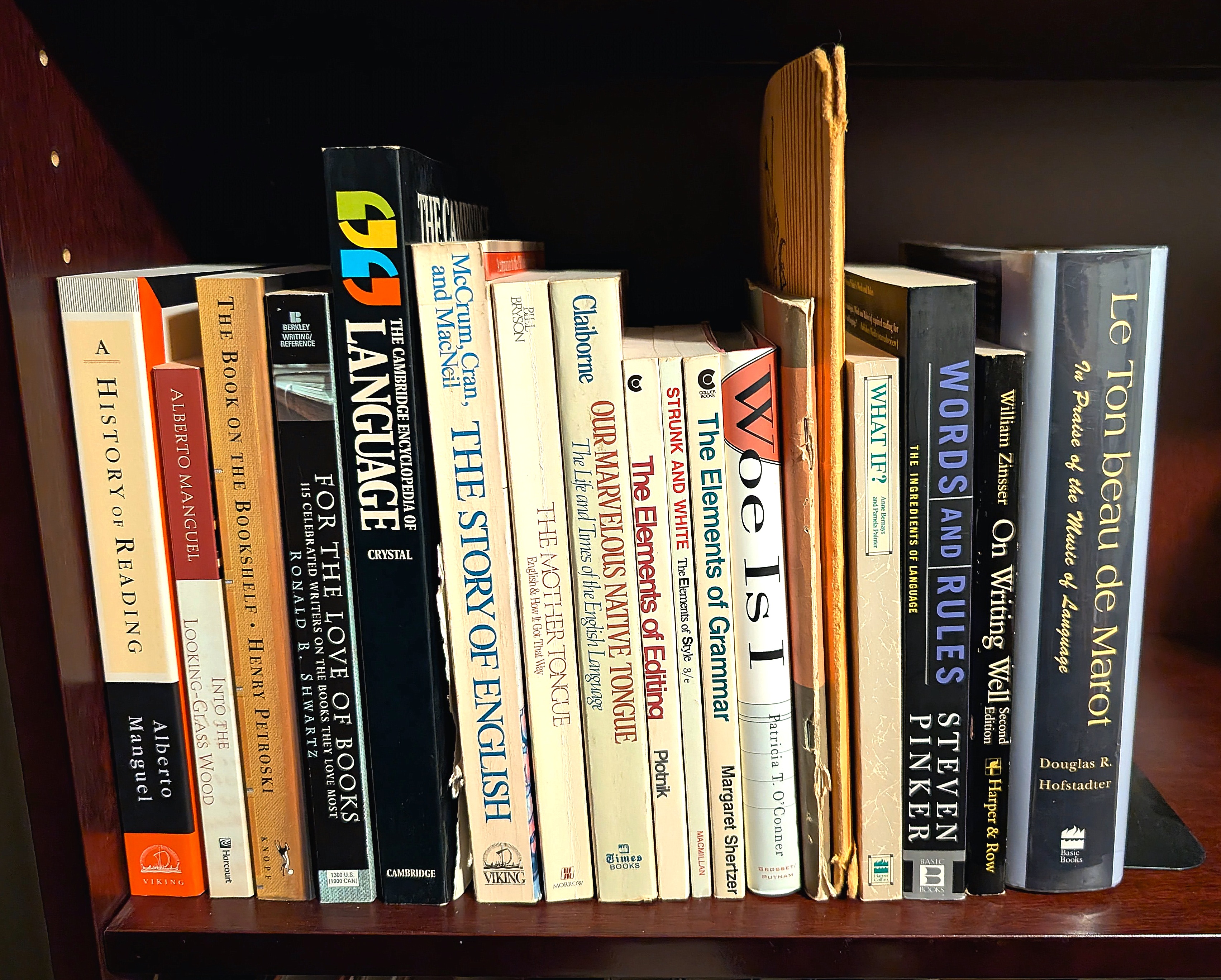
Several days ago I began a loving reminiscence for this little half-shelf of books:
Yep, repetitive, I know. September 2025.
Other than specific works of literature and the anthologies which collected them, I’ve pretty much trashed my college textbooks. One slim little volume, sporting a stiff paper cover, has followed me around since 1982 and will be there when I die very likely: Sentence Analysis by Donald W. Emery.
So small. So dull…to all but me. September 2025.
June 1982 brought me the final set of courses I needed to complete my English Education degree. Who knew a graduate-level course on grammar would be the most agreeable of them? Few of my fellow classmates agreed with me. First, the class began at 7 a.m., if I recall correctly, and ran for two hours. This allowed the professor (who happened to be the chair of the English department) to teach the class in only four weeks instead of eight. After the first week we diagrammed sentences. That’s all. Each day we discussed a construct of English grammar, diagrammed five sentences that night, and began the next class discussing how they should have been diagrammed and if there might be any which were open to interpretation. Even in something as definitive as diagramming English refuses to be pinned down. In fact, the professor told us we used the sentences in the book because they had been vetted to be “diagrammable”! It would take me too long to explain why English sentences as spoken and written by its practitioners do not lend themselves to analysis. Take my word for it, at least for now.
Unfortunately, I stole a bit of my thunder on this topic a couple of years ago when I ranted about compound prepositions, foreshadowing this book even if I didn’t name it. This series, Bibliophilia, however, purports to be about a love of books, not of specific topics per se. We attempt to not delve too much into the memories evoked by the books, but rather to celebrate them and explain why such feelings rise up. In this case, it’s pride pure and simple, pride in knowing something esoteric, something only a small sliver of English speakers know. My course contained about 15 students, all but three of whom were teachers returning for some of those credits mandated by law for the recently hired or to achieve a Masters degree. Despite the fact all were English teachers/English majors, I ran rings around that class. I aced it. I aced the final. After acing it I and leaving long before the rest of the class, I waited in the lobby for them to come out. “What did you do on the last one?” they asked. I could have been smug, and said, “what I did when we diagrammed it for homework,” because all of these sentences had been discussed in class. Instead I just answered the question. The bulk of these people were older than me. My pride came with a good dose of awkward, too.
Because we’re sticking to love of books, and on this shelf, love of language, I’ll save further discussions of the diagrams for another piece of writing. One memory will illustrate my love for this slim little volume: I hope I will never forget this experience which illustrates the frustration of teaching and the uselessness of diagramming sentences. In the 8th grade English classes I taught, I decided for a year or two to use diagramming sentences for a unit. I think this had to do with a “street cred” issue I had with another English teacher and also because teaching sentence diagramming comes about as close as possible to teaching math. Many teachers of English shy away from the ‘squishy’ nature of their chosen field. One can only teach writing by having students write and giving them feedback about it. This puts them in a bind. Reading, grading, and (God forbid) giving feedback requires huge amounts of time, time which could be better spent drinking beer/wine and reading a book. Worse, it’s nearly impossible to teach literature without having students write about it. Double-whammy because now one has to grade the content as well as the expression of it. But…begin a unit on diagramming sentences, and one can kick back like the math teachers do, marking the incorrect lines, assigning points, and adding up the points for a grade on that day’s assignment.
I don’t remember this kid’s name, so we’ll call him Rick. A little kid who could be used to illustrate the late-bloomer end of the scale for 13-year-old males, Rick sat in the front row because I probably put him there. His philosophy toward English seemed to be one of ignoring it: he had a perfect record for turning in homework which barely had been started or not turning it in at all. He consistently maintained a Failing grade–until I started the diagramming unit. Suddenly English interested him. He turned in every assignment. He did okay; not the top student, but a good solid one. Deconstructing sentences grabbed him in a way that constructing them had not. And as soon as we moved on, Rick’s turned his interest off like a faucet. His writing contained few sentences and none were well-written. I saw that just because you could take a car apart and put engine parts in one corner, drive-train parts in a second corner, and boxes surrounding them for the ancillary parts which supported those systems, that didn’t mean you could put the car back together. I also realized some students were going to tune out. They just were.
That’s why this book lives on my shelf. I glance at it fondly, remembering how truly great I was in the class! Quickly thereafter come the memories of how useless this information is to all but linguists, how useless it remains to teach to 8th graders (or any other student not majoring at the college level in English linguistics), and how I likely failed to provide some students the incentives they needed to try to better their skills at writing. It’s nice knowing something well that few know how to do all. It’s nicer knowing what to do with this knowledge to help others succeed.
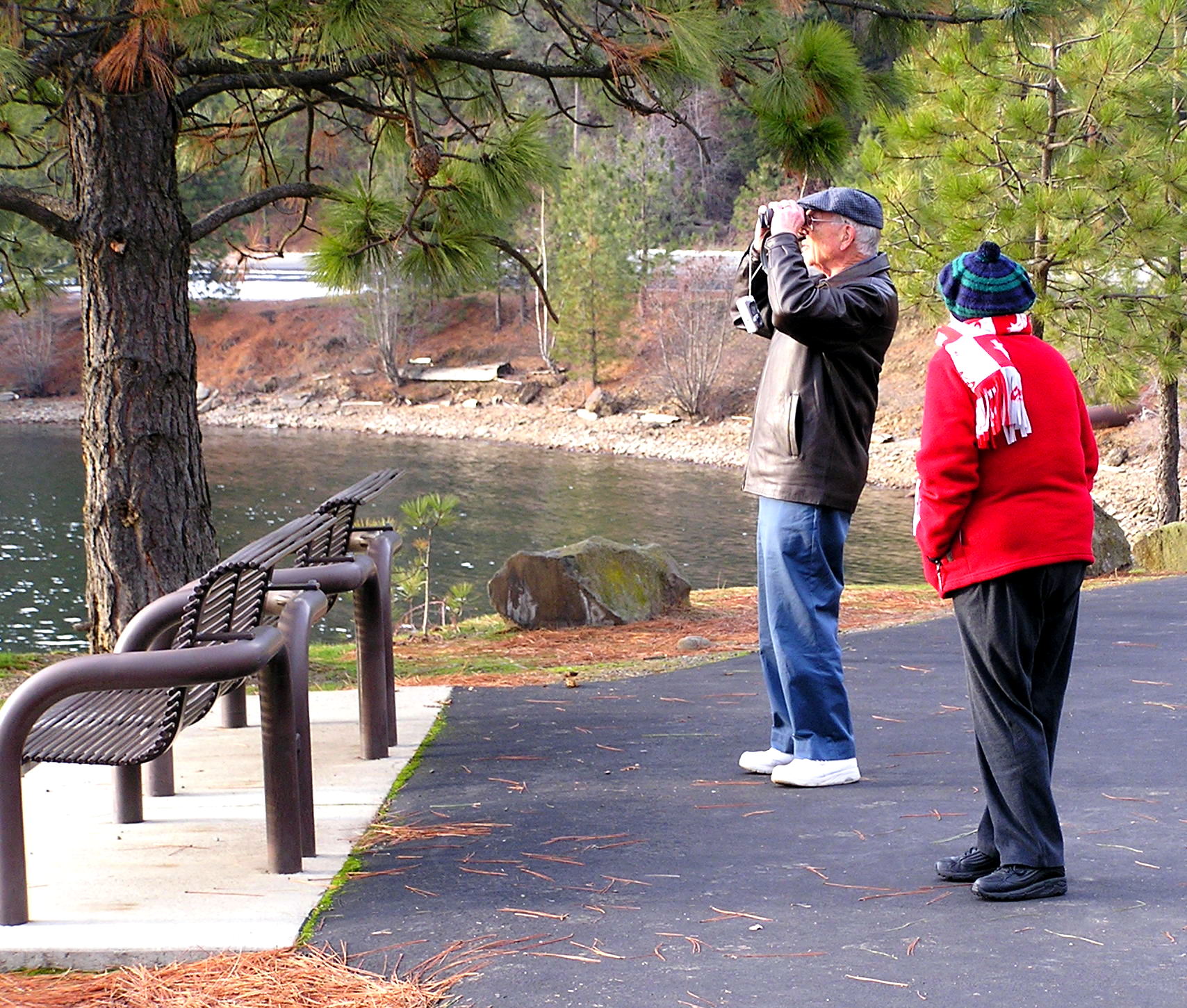
In this photo from the end of 2006, my father attempts to count all the eagles we’re seeing at Lake Coeur d’Alene, ID, while my mother wonders what the heck he’s doing. December 2006.
Our parents shape our lives. Even those who abandon us leave indelible marks on our psyches. Wonderful, painful, soothing, agitating, perplexing, satisfying, loving, and even the hatred—all of our reactions to them mold us. By the time we realize this fully, chances are they’ve departed our physical lives, living only in our memories and those of others. When I reflect on my father, I’ve come to realize he formed me more than any other person. One aspect of that recurs multiple times in a day when my mind ‘blinks’ and spits out an arithmetic calculation or it juggles a jumble of letters seemingly without conscious thought and spits out a perfectly spelled word. Patterns and numbers, numbers and patterns, all a gift, a curse from my father.
My father, Howard Bliss Pilcher, loved numbers. More than that he loved doing things with them, and he did them quickly. He inherited this from his mother, and he bequeathed it me for which I’ve (mostly) been grateful all my life. This pattern-recognition talent allowed me to move from career to career doing things I had no training to do. Yet there I was. My father never fully realized that aspect of it though I think he could have. I brought dreams and abstraction to his gift, seeing patterns in just about everything. His fixation with patterns and numbers remained in the concrete, the defined, the specific.
Numbers make patterns as do letters and words. Again, my father dwelt on how the letters made words yet never scaled the heights (plumbed the depths?) of how words make sentences and sentences make Writing. Not that he couldn’t write well, but his writing never would have challenged anyone in a writing club. It’s as if playing with the nuts and bolts was so much fun, why become a mechanic? He would delight in words with odd combinations of letters or how words tripped off of the tongue. He adored knowing arcane and niche words such as triskaidekaphobia (fear of the number 13). He once stumped us all (Mom, my brother, and me) at the game Probe by playing the word eleemosynary. This word describes things related to charity including being dependent on it. In Probe, played a bit like the paper game Hangman, contestants choose words by putting letters face down on a tray with 12 spaces. If the word is smaller than 12 letters, one fills the extra spaces with blank cards. Each player takes a turn guessing specific letters of their opponents. In that way it also resembles Wheel of Fortune. My brother and I were about nine and eleven, respectively. We expected and understood that our parents would use words with which we would be familiar. We had very good vocabularies due to hanging around them and from our incessant reading. As you might surmise, however, we were unfamiliar with eleemosynary. Heck, my mother didn’t know it! When all players of Probe have had their words revealed except for one, the remaining players each have two turns to guess the word. We never came closer than thinking it was elephant. I remember nearly sixty years later being so upset as to be near tears that he would think we’d know this word! He apologized, grinning awkwardly, sputtered something about charity—but he kept the points.
But doesn’t everybody?
Around this time we learned from our Uncle Gordy, my father’s brother, that he (and maybe their parents) had teased my father for his repeated incredulity that someone didn’t know something or do something that he did. “But doesn’t everybody…” became a way to slightly dig at his recurring belief that everyone could do what he did. This caused him to try to teach me to do long division in my head when I was 8, and before it had been taught in school using paper and pencil. On top of it all, we were weeding the garden at the time. That episode ended with me crying. Some other cases in point:
Every year in the arid West the pine trees drop needles and cones. Thankfully these events do not occur simultaneously to the best of my memory. Spokane might be the capital of the Lawn Nazis, those people who will semi-innocently ask you if you need help with lawn “because I noticed it’s getting a little long” or “I see you’ve had a bit of difficulty getting to your needles.” One did not leave needles and cones lying around on the lawn! I hated raking needles which my father always seemed to pawn off on his boys. Picking up cones, however, somewhat delighted him because as he picked them up, he would count them. “We got 103 cones this year from the front yard. That’s a new record I think!” and off he’d go to check. Yes, he kept track. When we were long gone, I could tell he still did this because the new neighbor across the street knew exactly what we were talking about decades later.
Our family vacations every summer involved driving for up to two weeks to visit scenic wonders and relatives. By the time I entered high school I had visited most of the national parks in the West, though getting further south than the Grand Canyon remained for my adulthood. On these vacations my mother rarely drove (and when she did it was with white knuckles—hers, not ours). My father kept car records on a 5.5 inch by 8.5 inch piece of stock on which he manually drew lines and columns. Each gas fill-up required the date, an odometer reading, the number of gallons purchased, and then while the attendant filled up the car’s tank (ah, those were the days) he would calculate the car’s gas mileage since the previous gas stop.
On any drive, vacation or not, we would at intervals be treated to his light double-tap of the horn and announcing to the car’s passengers, “that’s fifty thousand miles!” or “look! All fives!” Yes, he celebrated when the odometer read 55,555.5 miles. Or when he got 12345.6 miles. There were many possibilities. (Unfortunately this rubbed off on me a little bit. I routinely wake during the night and say to myself, “Oh, it’s one-two-three-four” when the clock reads 12:34 a.m.)
He particularly fixated on license plates. It feels wrong to say he memorized them. My father saw license plate designations as others do names they want to remember. He didn’t know only the plates for our two cars. He knew all of his friends’ plates, too. Though usually no more than a parlor trick—”hey what were you doing downtown last night?” he could say to someone whose car he saw on the way home—once this came in handy. A family friend called one evening: “What’s the license plate on Pete’s car?” A family emergency had occurred while her husband Pete was driving across the state to Seattle. She needed to tell the state patrol his car’s license plate number so they could find him and tell him to turn around. My father dutifully answered her, and Pete returned home as quickly as possible.
My father easily multiplied two two-digit numbers in his head. I remember an evening when I made him take me to an Amway meeting to see if this would be a way to earn money for college. We both realized quickly this definitely wasn’t for me, but we were too polite to get up and leave because we had sat in the front row. At a certain point the speaker began to illustrate how much money a person could make, citing X number of units on which a person would earn Y amount of profit. Before the speaker could punch all the numbers into his calculator my father piped up with the answer. After a few such examples, the speaker quit trying to use the calculator and just turned to my father for the answer.
Typos and misspelled words irritated him. He couldn’t fathom how a person possibly would fail to see the incorrect pattern. One of his favored word games was printed in the newspaper, buried in the classified ads. (If you’re younger than 40, classifieds were really small type printed at the back of the newspaper and somewhat like Craigslist.) The game was called Jumble and ran for decades; I remember seeing it in the past 20 years. Five (four?) words were jumbled up. Playing the game required one to unjumble the words, then take certain letters indicated by circles and use those to form an answer to a tongue-in-cheek question. “Why the sculptor disappeared”; “He was BUSTED” My father didn’t do these frequently because he instantly saw the words, working more or less like a lexicological hot knife through butter.
He counted everything, knew the patterns and sequences of most common things. If he bought a rack of Presto-logs (his preferred way to burn a fire in the fireplace), he knew soon how many stood in the rack. He knew what day of the week a certain date fell on…27 years ago. He knew how many lightbulbs were on the strands of his Christmas decorative lights, how much he weighed every day, where his stock prices ended yesterday, the number of feet from here to there, and the number of miles he had driven if you asked him point blank in the middle of sun-blasted Nevada. Once we were digging around in his dresser—certainly we weren’t supposed to?—and found a slim memo book small enough to fit in a shirt pocket. It dated from his fraternity days at Washington State College. In it, he had recorded the scores of every single ping pong game he had played against his frat brothers. More interestingly, there were three pages at the end with only the first names of women and a number after them! Since we cannot fathom my father being that much of a ladies man—there had to be three or four dozen names!—we’ve been baffled what the numbers meant. Kisses? Number of dates? Both strain credulity. A rating system? Even more unlikely. He certainly got embarrassed, though, when we made a big deal about it. Maybe…maybe… He never revealed what the numbers meant, but we noted he never threw the notebook away either.
When my family celebrated the gift-giving which happens at birthdays and Christmas, we always laid gifts out on the hearth of the fireplace. When my mother turned 64, her grinning husband led her to the hearth where she found a cubical box wrapped in plain paper. It measured nearly two feet on each dimension. Every face of it had a large numeral “4” drawn on it. Baffled, she looked at him quizzically. My father said, “Well, you’re sixty-four today!” She just scrunched her brows a little bit more. “You know,” he explained, “you’re sixty-four. That’s four cubed!” His grin must have been nearly ear to ear. My mother didn’t share his enthusiasm.
Sadly, I found after his death that his obsession with patterns did not extend to how he kept track of his financial information. Files were in disarray, his migration to using spreadsheets had been less than successful, numerous lists of critical information existed but they contradicted each other, and the trivial received thorough documentation but the important didn’t always. As an example, without understanding what his accounts were and where, I didn’t know for sure how much money my parents had in their investments. Seven years after he died, and one year after my mother had joined him, my brother and I found a certificate of deposit in their safe deposit box. Nothing indicated whether it had been received into their normal cash flow when it matured, or if it might be sitting somewhere waiting to be collected. We never could track down the company which sold it to them, and decided it must have been collected—but 25 years after maturity, the CD paperwork sat in the safety deposit vaults.
When I partially wake at night to stumble toward the bathroom, I idly look at the clock. Instantly, and whether I want to or not, my mind cranks out the amount of time since I turned out the light. I remember all the times I wake to do that or to feed cats, then regurgitate them to my wife in the morning. “Well, I was up at 4:37 feeding the boys.” My father lives in me at those moments. He whispers like a schizoid voice and makes me count the cars I see on a lonely stretch of highway. He makes me frown disapprovingly when I read yet another grammatical error in what passes for our newswriting these days. He laments that I don’t figure my car’s gas mileage, stares in disbelief when I search my brain for my own car’s license plate number, and smiles when I record the amount of rainfall for yesterday. I don’t tell him it’s only because I need to know when to water the yard. And I hope he’s proud of me for all the new ways I’ve used his gift to see the numbers and patterns in quality systems and manufacturing results. He never really said one way or another while he lived.
“Remember when Trea was the shiny new thing we were all exited about, back before we kneeled beside our bed each night?”
The above was posted on The Good Phight, a semi-professional blog about the Philadelphia Phillies hosted on SBNation. In case your eyes zipped over it, the error is “exited” for the intended word “excited”.
Author’s role: This is an author who has a day job. Writing never danced on stage for him as a possible role in his adult life. We therefore rate this a 2.
Egregiousness of the error: This is either a typo or an autocorrect error the author missed. (I doubt any editing occurs on this site.) A plain typo rates a 1, an autocorrect a 2. I’m going with the benefit of the doubt here that he just plain forgot to hit the “C” key. It’s a 1.
My personal reaction rating: I like this site. I willingly suffer the numerous run-on sentences, the failed verb tenses, the just plain “WTF did he mean there” writing. This is more mild than mild for this site. I’m giving this a 0.
From a story in today’s New York Times describing a veteran who was court-martialed for shooting an Iraqi in 2004.
Mr. Richmond shot the herder in the back of the head from six feet away as the man, who has handcuffed, stumbled.
—from “Veteran Who Was Court Martialed Gets 4 Years in Prison for Jan. 6 Attack”, New York Times, November 18, 2024
Error: “…, who has handcuffed,…” instead of “…, who was handcuffed,…”
Type of error rating: 2, because this seems to be a typo which wasn’t caught. (Although we should note the H key isn’t near the W key. Actually this is more a brain-fart than a typo.)
Author/editor rating: 4, because regardless of the minor level of error, a reader of the Times has a right to expect the author (or an editor) actually reads the copy prior to its being published, and even if it slipped by everyone on Nov. 18, it would be noted by somebody and corrected by the time I read it midday on the 19th.
Personal reaction rating: 1…It neither entertained or enraged. It jarred me a little, but my blood pressure stayed constant.
Bottom line: This error rates a 2/4/1 for a 7 out of 10 on the Reader’s Horror scale.
Discussion:
I’m going to need to see if all of these errors wind up being in the 7-9 range. The scale won’t mean much if so.
Writing something like this really puts one on his toes. I know I’ve corrected numerous errors in already-published posts!
[I wish there were a photo here. There isn’t because all the good photos I have about poor usage of written English are owned by someone else who likely would sue me. But, hey, we’ve illustrated the use of the subjunctive verb conjugation! That’s cool, right?]
In my email every day I receive a list of books which can be purchased in electronic format from Amazon for $1-$4. Each book is described in only two or three sentences, just enough to hopefully entice you to read the full description on Amazon and then buy the book. [See Caveats below regarding split infinitives.] Today a description of the book Girl by Alona Frankel contained this opening sentence:
In this “impressionistic memoir,” a world-renowned children’s author and illustrator offers a “truly moving and bravely rendered” account of her time as a Polish Jewish girl hiding as a Gentle in Nazi-occupied Poland (Kirkus Reviews).
A “Gentle”? Surely you meant “Gentile”?
Every day–not everyday as may be written ignorantly–I read something where the author and/or the author’s editor have recorded their ignorance of the written English language. After noting for several years how these blemishes have crept into what I consider to be prestigious sources–New York Times anyone?–I’ve decided to record all of the offenses, rating them similar to a fact-checking site. Not all offenses are equal. We will consider the source and the egregiousness of the error.
Time out for my GUM Guidelines. Grammar is how we know words mean something. “Ball he red the threw,” confuses a speaker of English because it’s out of order: “He threw the red ball.” Don’t go all Noam Chomsky on me. My definition will suffice for our purposes. Grammar is not class-based. Usage refers to the accepted way of saying something. People who say “don’t nobody know nuttin’ but me!” are deemed ignorant by the people who say “nobody knows anything except for me!” Usage is class-based. Mechanics refers to how spoken language is rendered in print. It’s a convention, neither class-based nor non-class-based. As a society we have come to an agreement that words will be written a certain way…until they aren’t. As such, mechanics change over time. Mechanics refer to punctuation, capitalization, spelling, and the like. Okay, back to our tirade of the day.
Me
At the bottom of the heap I will place graffiti, notes from friends and relatives, and other signs posted in haste. Everyone of us and every one of these examples have been written on the fly, often by persons who somehow passed through school while they regarded English classes as the scheduling version of a roulette wheel. Who knows where the ball will land? Maybe they were lucky on a certain day when final exams were given. Maybe the teachers just didn’t want to try teaching them one more time. Regardless, we can hardly damn ignorance when it’s being spray-painted on the side of a building or dashed off in haste on the back of a grocery store sales receipt. Occasionally one of these haste-lays-waste mistakes will crop up in what we read. We will sigh and rate these a 1.
Next up we encounter those who labor with the English language–and I want to emphasize “labor”. [See Caveats below for punctuating quotation marks.] People with only a passing knowledge of how to write English can find themselves employed in jobs demanding continual use of those non-existent/woefully lacking talents. In these days of electronic word processing, I suspect they often don’t write the English, they just copy and paste it from somewhere else. This copy-and-paste existence demands editing skills but ultimately the failure to catch errors, i.e., to edit your own writing or someone else’s is exactly what we’re concerned with here. We’re not dissing people for not measuring up to Shakespeare, Hemingway, or the adroit use of language we read in the work of so many fine authors. We’re taking these writers to task for how they symbolically render their thoughts into print. At this level, one up from the ignorant, they should know better–but they don’t. That’s why we will rate these a 2 and not higher.
Unlike the previous group, many persons do write professionally. They might not consider it the defining talent for their profession, but it commands an integral part in it. I’m thinking of the people who design and render web pages, paralegals who draft documents all day, people who work in advertising or real estate, and those who write blogs or newsletters or for small town newspapers (to name only a few). These people generally should know better. At the very least, they should know when they don’t know better and take the time to figure out whatever is perplexing them. (Actually, I’m probably kidding myself. They likely think they do know how that particular phrase should be written, that particular word spelled. It never crosses their mind to check it.) Perhaps most egregious, these are the people who ought to be able to question the suggestions from autocorrect, check the spelling of the underlined words, and turn on grammar checkers to parse their work. When they don’t, we must hold them more accountable. We will rate the lazy and purposefully ignorant a 3.
Finally, we come to the no-excuses group. These folks have climbed to the top of the writing pyramid. They write for the most prestigious news organizations, for literary reviews, for think tanks, for professional journals. They write books. They edit books. These people not only represent the best writers of English, they are monitored by those who set the standards of the language itself. The more frequently intelligent writers spell the word gel as “jell,” the more dictionaries will list it as an acceptable spelling. Although this is how the mechanics of written language change, it should happen slowly, and it should happen with intent. In the first years of this century I started writing “e-mail” as “email” because I figured it was headed thataway and wanted to hurry it along. I argued with co-worker and fellow purist, citing the words such as to-morrow to bolster my position. He served a useful purpose by objecting. If we unilaterally accept new spellings when one or two people obstinately use them, we start heading toward spelling chaos. Therefore, those who speed up the pace of change through sheer ignorance should not be rewarded with the support of dictionaries. At the top of the heap we should demand better. We will rate these erring standard-bearers with a 4, our highest rating.
We’re only halfway. Not all errors are equal. We can sum these up more rapidly.
We’ll deliver a gentle admonishment for missing apostrophes (some of them), plain typos, and mistakes which indicate the writer/editor willingly caved to the masses even when those masses don’t know what they’re talking about. We’ll rate them 1.
Mix-ups which appear to be a general miss by the autocorrect, those which don’t change the meaning of the writing (much), those which generally seem to be based more on haste than ignorance get a slap on the wrist and the advice to “slow down!” We rate these errors with a 2.
Ignorant errors which change or obfuscate the intended meaning must result in stronger reactions, but in the face of the difficult we need to be flexible. In writing about an online class did the author say the learners “tuned into learn”? I won’t go into details why it should be “tuned in to learn” because this error has become ubiquitous and I’ll have plenty of opportunities to explain it later. And I’m willing to admit I might deserve to be put in this group for the previous paragraph where I didn’t capitalize the S when I wrote “slow down!” My defense is that I didn’t think it appropriate to put a comma after the word “to,” and commas before quotations indicate they’re being used to set off independent clauses…so if this isn’t an independent clause but only a phrase…eh, that’s where my mind takes me. I have a reason, and I hope, nay, believe I’m right. However, I can see the argument that says the two word imperative does represent an independent clause. You see how complex this can be? Let’s not condemn these ignorant mistakes made in the face of English’s complexity with our full force. We’ll rate these errors a 3 only.
Some errors provoke the response, “That’s just wrong! How could THAT get into print?” Setting aside the skill level of the writer, we look at the error and evaluate it from a standpoint of how easy it would be to get it right, presuming the writer knew enough to figure it out. Sadly, these are the ones I see more and more. I would like to say that a 4 isn’t nearly as common as a 2 or a 3, just as most writers will fall into the 2 and 3 level in our first set of standards. No, errors seem to be at best evenly distributed from 1 to 4. Too many are grievous and demand a 4.
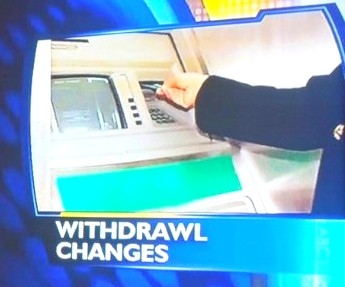
While the above rating scales for the actor and the act will be applied somewhat subjectively, the final scale will be totally, purely subjective. I’m going to add 0, 1, or 2 points for how much it pisses me off! A good example would be this screenshot from a local TV station’s newscast a number of years ago:
Photograph of local news story about changes coming to ATM’s in the Raleigh, NC market. Circa 2012.
This one would get a “0” because it amuses me. We live in North Carolina, so of course it’s withDRAWL instead of withDRAWAL! (And by the way, I had to check how to spell withdrawal–it’s what responsible writers do.) Most of the time this type of error in all caps and prominently displayed on the screen of a TV station in the 41st largest city in the USA would rate a “2” because at the time I captured this photo, they routinely were making horrible typographical errors like this. The station broadcasts to the Cary-Durham-Raleigh area which contains more than 1.5 million people. Apparently they fired the person who kept making these errors because they became few and then disappeared altogether.
Which brings us back to the email which set me off this morning. Clicking through to Amazon, I note that the word Gentile is spelled correctly at the top of the book’s description. Therefore I presume some low-level clerk hurriedly typed the description directly from the Amazon page. Much less likely but plausible: it was copied and pasted from Amazon, then Amazon corrected its mistake afterward. The clerk-level role is a 2. The error is grievous, though, one which should have been caught by all but the most ignorant person–apparently no one ever looked at what had been typed. The error is a 4. And because it’s so obviously wrong, it pissed me off a great deal, so I’m throwing a 2 at it. This error rates a total level of 8 out of 10 on the Reader’s Horror scale.
The Caveats:
I have a highly subjective and not terribly consistent approach to how I italicize words versus putting them in quotation marks (single or double). Generalized, when I talk about something symbolically I italicize it; when I am quoting from something I use double quotes. When I want to indicate ‘air quotes’ I use single quote marks.
Also, I stand with William Safire that only a fully quoted independent clause should have ending punctuation inside the quotation marks.
I don’t give a rat’s posterior about split infinitives. If I notice I’m doing it and if I can flip the words around to avoid it and still sound natural, I’ll rearrange the words. The abhorrence of split infinitives comes from Latin teachers. Latin verb infinitives cannot be split (as in the Romance languages), which led them to regard English infinitives as one word. Your eyes can tell you this isn’t true. It wonderfully represents the beautiful fluidity of English, and its ability to totally disregard (hah!) the silly Latin rule. The phrase “totally to disregard” is at once more awkward and slightly different in meaning.
Similar to split infinitives, I don’t overly worry about prepositions at the ends of clauses. If I can easily switch the sentence around, I will. Winston Churchill is famous for being accused of ending a sentence with a preposition and replying, “Madam, that is an accusation up with which I will not put.”
At 70 my opinions tend toward the conservative end of the scale but I started out liberal once. I surmise I’m somewhere in the middle at this point.
A plant’s leaf. In North Carolina. At Biltmore. May 2007.
Today’s photograph has about nothing to do with today’s topic, but I’ll try: some folks think (or rather don’t think) about how some things don’t belong together in all cases. Red and green for instance. On this plant it’s a natural thing. At Christmas it evokes the symbolism of holly and green leaves and all that. In July it says, “Who’s this freak that thinks it’s Christmas?” Today we’re going to talk about people putting words together which don’t belong together.
For newcomers to this blog: Once upon a time I taught English to 8th graders. Once upon a time I took a graduate-level course in grammar, most of which consisted of diagramming sentences. I killed that class–most of my fellow students were returning teachers who clustered around me after the final to learn how I had diagrammed the sentences on the test, even though these were sentences which we’d already diagrammed in homework assignments. I’m not bragging, merely establishing my credentials for the next paragraph.
There’s a grammatical distance between “on to” and “onto”. The latter one is a preposition. The first one, however, is an adverb followed by a preposition. Or some would say it’s a compound preposition. I disagree, but it’s debatable. What’s not debatable is when you put them together as if they’re one word but they shouldn’t be. Here:
Ken wants to turn his audience on to prepositions.
The turtle hauled himself onto the log.
“Onto” indicates position. In the first sentence you can see I am not trying to physically turn my audience and put them “onto” a preposition. Children, pets, and occasionally a frisky adult will get onto the furniture. A lace hem might be sewn onto a dress.
Prepositional phrases usually come in a three-word format of preposition-article-object/noun, and they’re often strung together one after the other. Here’s one: Susan got out of the bed, put her pajamas in the clothes hamper, and made her way to the shower. I boldfaced the prepositions. (If you’re really into the stuff, that’s a compound predicate where the subject “Susan” has three verbs to go with it, “got”, “put”, and “made”. It has direct objects, “pajamas” for the first verb phrase and “way” for the third. This looks really cool when you diagram it, but let’s hold that thought for now.)
Why am I doing this? Who gives a rodent’s rear? Here’s the deal: I see at least one writer who doesn’t know how to use prepositions, homophones, or those tricky complement/compliment words every morning when I read my news. I read (in this sequence) MLB.com to see if there are Phillies stories; The Athletic for Phillies stories and general baseball news; the Washington Post, primarily for the comics, but some headline always snags my attention; and the New York Times. All of these sites command highly respected writers. One assumes there are editors, at least a few. How is it something as basic as this can’t be understood by some of the top writers in the country? To wit:
She turned her father into the police. Perhaps she did, but only in her mind (parents behaving like cops sometimes). Dad never joined the force, though, and she has no magic wand to turn him into the police. She turned him in. To the police. See? Separate words.
Note to grammarians: yeah, I know this isn’t grammar. It’s not even usage. It’s mechanics and those are a slippery thing. Fifty years from now what I’m saying will be as anachronistic as railing against tomorrow because it’s supposed to be to-morrow indicating the link to its linguistic past, to the morrow. I don’t care. I will hasten e-mail by typing email wherever I can, which I did in the 1990s and 2000s. I will type awhile even when the algorithms in the software says “no-o-o-o!” I’ll even type alright because I think it’s alright. (And I wonder if anyone under 50 or 60 wonders what the heck I’m talking about.)
I will not give in to compound prepositions. (See what I did there?) There is meaning contained in the words the heathen are stringing together, and those meanings change when you join the two into one. I hope you’re turned into frogs. Or is it turned in, to frogs? I hope the latter, and that said frogs will thwwpt! your face with their tongues for eternity.
Look, I’m all about breaking rules. You need to know the rules before you can break them, though. Picasso said that, more or less. If you just ignore the fact rules exist, you’re just a hellion-without-a-clue.
And now for that diagramming I promised. I’m afraid that nearly 42 years later I have not kept every assignment but I kept the quizzes and the final. Below is the last page of the final. It’s a ditto, so the questions are faded quite a bit. (“Ditto”–look it up. They were as much fun to make as it was typing on a manual typewriter: every mistake basically was uncorrectable.) We can discuss this below in the comments. The little blue zero means no mistakes. Grant Smith, the chair of the department and teacher of the course (Eastern Washington University) graded this stuff like golf is scored: mistakes were 0.5, 1.0, and 1.5 point mistakes, and the more you got, the lower your grade. Thus, the highest score possible was “0”. (And another day, children, we’ll discuss why I put the period outside of the quotation marks. You may background yourselves by reading William Safire.) By the way, at 28 years of age I already exhibited the anal qualities which now circumscribe my life. Those lines look nice and straight because I used a 6-inch ruler on all of my assignments and on my quizzes and tests.





 all the voices in my head