Speyer,…

…or Spires if you want the English name, presented a much-needed comfort level after the unanticipated end to our “Strasbourg Buildup” of expectations. Only 50,000 folks live in this city on the west bank of the Rhine. Yes, we now saw Germany on both sides of the Rhine. Midway through the night’s cruise to Speyer our ship had passed the point where the pentagonal border of France had turned to the northwest and left the Rhine behind. For the first time since Basel, we docked on the west bank of the river. We had the worst guide of the trip there, but a lovely time nonetheless—we simply ignored him and tried to stay within shouting distance of the group. (“Worst guide ever” equates to having him leave a third of our group at a crosswalk where the light had turned against us. He continued with the tour, and then admonished us when we saw a break in the traffic, crossed against the light, and ran to keep up with his idea of pacing a tour!)

Speyer’s cathedral dominated the city both in its placement on the edge of the bluff overlooking the river, and simply because its size completely outstripped any other building around it. I need two photographs to show all of it:
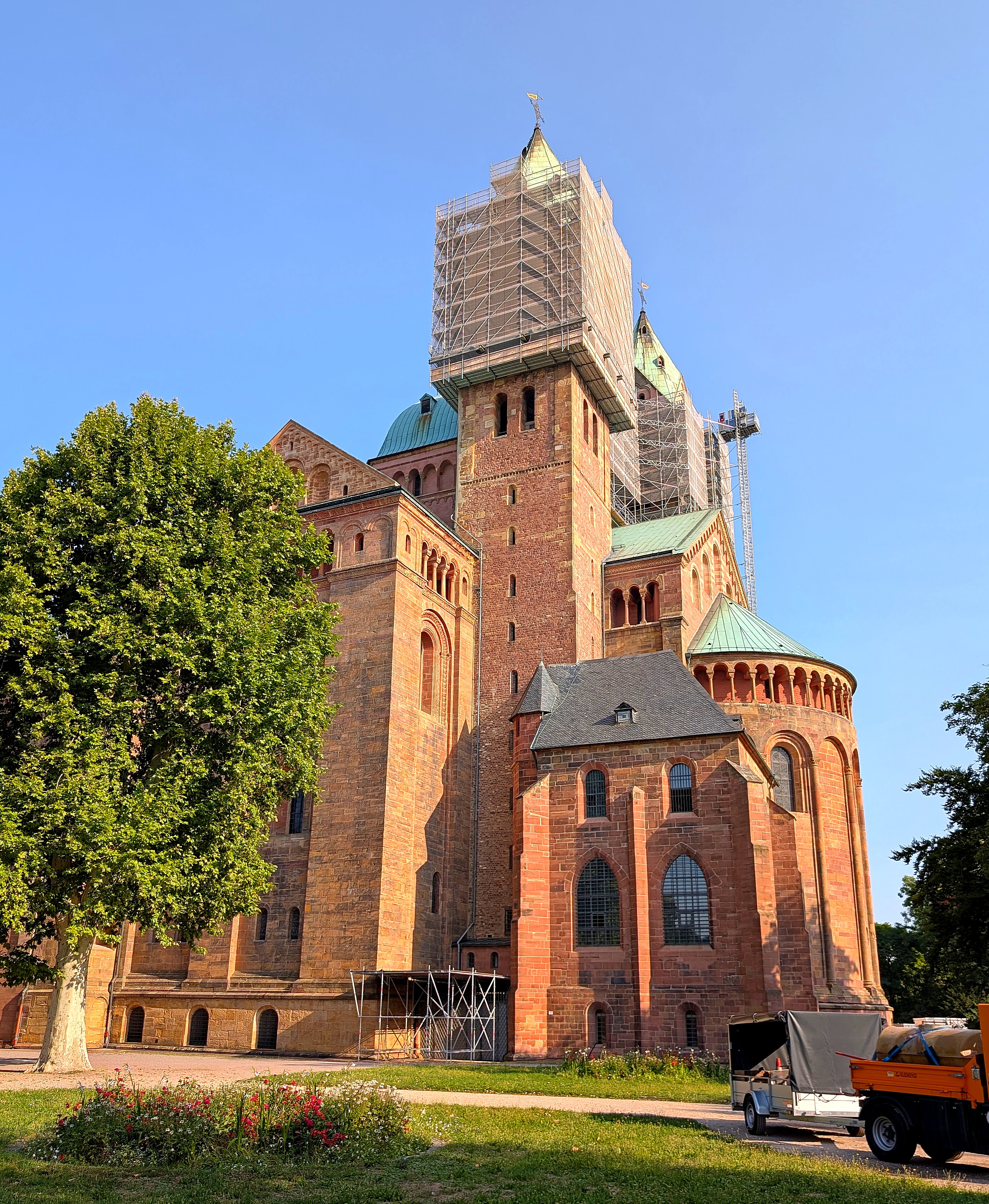
Speyer Cathedral, east end, with extensive renovations occurring. August 2025.
Speyer Cathedral, west end. I normally avoid wide-angle shots on buildings like this, but it proved necessary. The abutment on the right edge is visible in the previous photo behind the tree on the left. August 2025.

Parishioners built the cathedral in several distinct phases. Though our guide dryly and boringly explained it to us, I concentrated on photographs to his exclusion. I therefore can’t give you much history about the building’s timeline. I do remember that like all “touristy” cathedrals you will ever see, this one was the biggest in some category or other—I think “biggest at the time it was built.” If I remember correctly, the middle part of the building (seen in the second photograph) predated either end. Part of it had to be rebuilt after WWII, also. Look on the tower in the second photograph and you’ll see stones laid much more hodge-podge on the lower right of it. The rest gets a more uniform, geometric treatment.

Our guide left us no time to go inside the church. Instead, he took us into the center of the city, a small area of just a few blocks which extend westward from the church. As we turned westward from the cathedral, he noted (for our safety) an oddity I’ve not seen anywhere but Speyer: a city street routed through the plaza, marked only by regularly spaced concrete posts. It struck me simultaneously as beautifully quaint and dangerous.

Speyer cathedral throws a shadow on the historical building across the plaza from it. In the foreground runs a city street, marked by the posts visible in front of the building. I don’t remember if the lighter paving stones represent ‘sidewalk’ or not, but I think ‘not’ is the operative word. I believe the building pictured served at one time as quarters for the bishop, but now might be a private residence. Speyer, Germany, August 2025.

Our guided trip into town proved blessedly short, after which we broke free and wandered at will. We quickly encountered a beautiful Orthodox church…I think.

As far as we could get into this beautiful sanctuary—a locked glass door prevented entry but facilitated photography. Speyer, Germany, August 2025.

We struck off from the main street through the city center and found little plazas tucked behind several other buildings. One hid a strikingly designed school of drama, if I read the German correctly. The streets off of the main drag lived up to my fantasies of narrow, old, and quaint. A sign informed us that many of these buildings were associated with the Jewish community. Speyer and the nearby cities of Worms and Mainz have been recognized as UNESCO World Heritage Sites. Near the photo on the right (below) we passed an old synagogue.
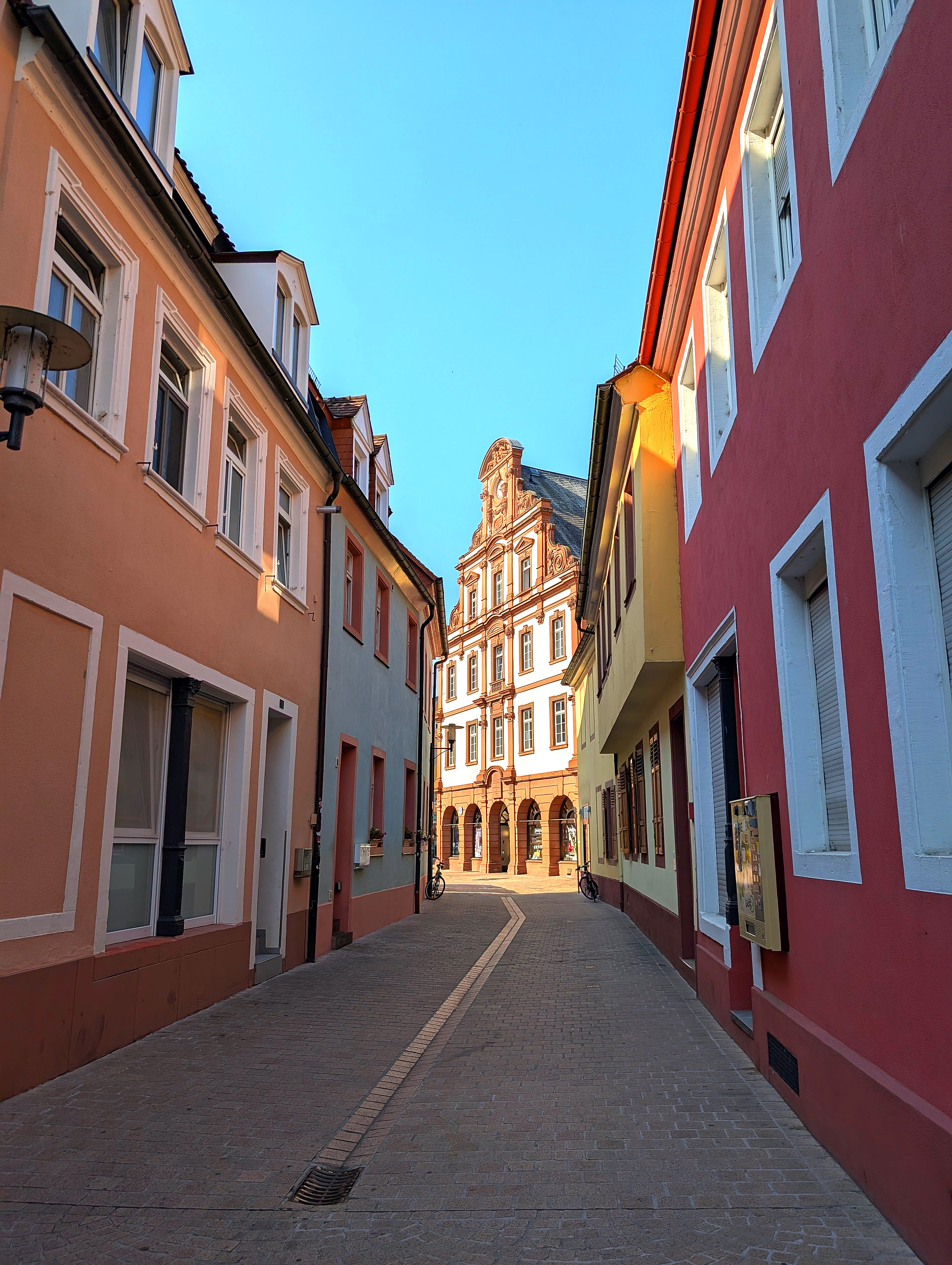
Yes, they allow cars down this street. Note center-of-street gutter. Speyer, Germany, August 2025.
It’s true, all streets curved to the left! (Unless you turn around.) Speyer, Germany, August 2020.

Walking back toward the cathedral to meet up with our group for the walk back to our buses, we finally had time to enter the cathedral. We made a good decision to allow time for that.

Much older than other churches we encountered on our trip, Speyer’s looks much smaller in this photo than it is. This is due to the large supporting columns which frame this shot. Speyer Cathedral, August 2025.

Speyer’s cathedral offered a delightful blend of modern furnishings contrasting with the centuries old structure. The minimalist lines of its furnishings complement the austerity of the stonework. It had several altars. I surmised different ones get used depending on the size of the congregation at that particular service. Perhaps at least one stands there for historical reasons. The most modern one sits far forward. The candles flanking it, both those on stands and the votives to the side, were displayed on modern metalwork which evoke the baroque in a minimalist way. The bishop’s chair sat halfway back in the sanctuary (altar area), to the right in the photo below. The next photo gives a sense of the depth of the sanctuary/chancel.

The first altar of the Speyer Cathedral. Note the organ in background. Speyer Cathedral, August 2025.
Bishop’s chair and back portion of the sanctuary. Speyer Cathedral, August 2025.
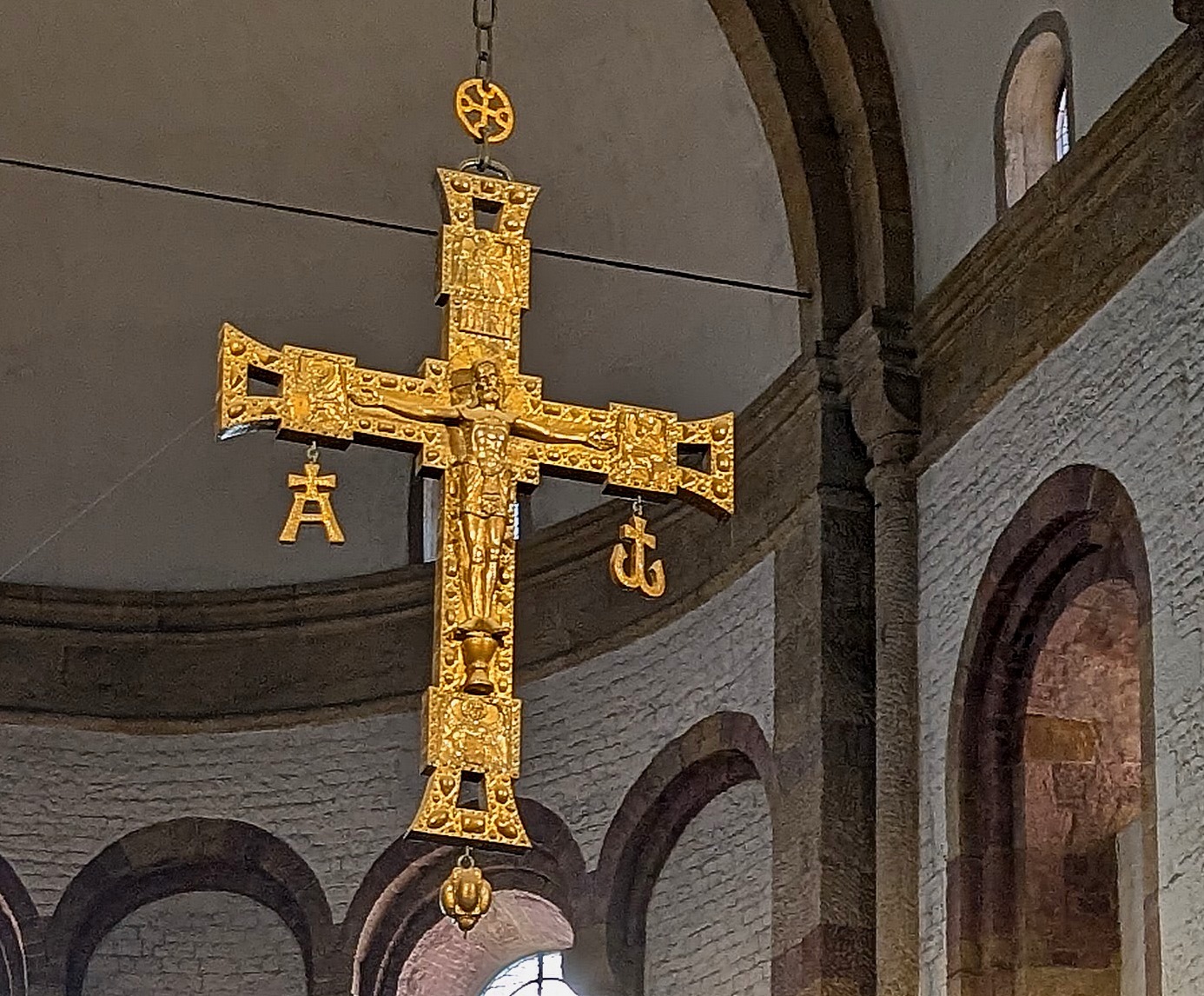
Detail of the suspended cross just rear of the “bishop’s altar” in the middle of the chancel. August 2025.

When looking at the photo above, you’ll remember the bishop’s chair is to the right of the first altar. In the lower right corner, note the raised floor. This is for the second altar. Light shone into the cathedral from many angles. At the top of the photo is the lowest tip of a suspended cross, caught in sunlight which casts a shadow on the back wall. See detail, left.

Our several tour groups boarded buses for a short trip to Worms where the good ship Hlin had tied up after getting a head start on the afternoon voyage to Rüdesheim. We couldn’t seem to take enough photos as the historical buildings glided past us. That evening we stayed aboard. Others had purchased one of two different dinner packages (one at a fort high atop an overlooking bluff).
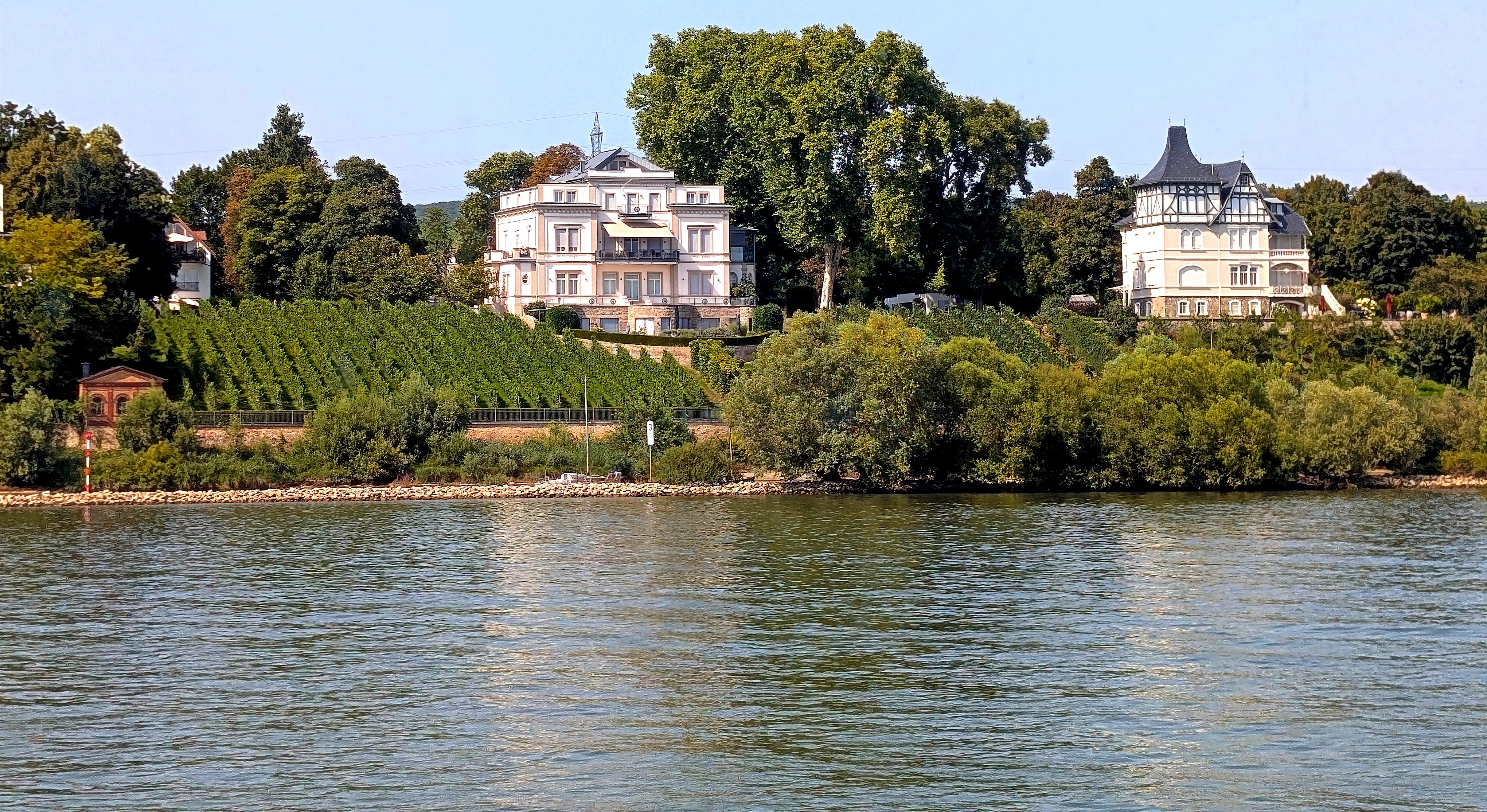
From the starboard side, first you photograph the building on the right. Then you see the next one to the left…then its vineyards…then the little red stone building down by the railroad tracks which run along the Rhine. Then there’s another building…it never ends. And you’re sitting in the lounge where the next cool beverage is only steps away. August 2025.

Celebration thwarted: Strasbourg, Kehl, and true love

I planned our cruise on the Rhine River to celebrate our 30th wedding anniversary, and redeem the ruination of our 25th. I purposefully reserved a cruise which docked at Strasbourg on our anniversary, looking forward to all it promised. The Year 2020 had teamed up with my back to scuttle our (limited) plans for our 25th. As that day dawned, I experienced a spasm in my back which necessitated taking an emergency muscle relaxant I keep on hand for these occasional problems. A fine dinner which we had planned to cook for each other became a take-out pizza, and for my wife, some wine. I crawled into bed early. Therefore, 2025 promised to atone for all of that. The pandemic had subsided, we had our health, and, well, what could go wrong? The trip had far exceeded our expectations for four days.

The day promised much: Strasbourg with its cathedral and its amazing clock where I planned to walk inside of it and marvel. Then my wife croaked from bed, “I don’t feel well.” We traded our anniversary cards, and she dragged herself out to breakfast. I chose to forego the group tour of Strasbourg on the French side of the river. “I can catch the afternoon shuttle back into the city,” I told myself. “At least I can see the cathedral and that famous clock.” I tucked my wife into a deck chaise to soak up some sunshine and spent a few minutes observing the begging swans and a heron across the river…

Swan at Kehl’s riverfront park. August 2025.

Finally I decided to go wandering. I stopped first to admire the mooring strategy of our ship, the Hlin, wondering still why the woman at the guest services desk couldn’t explain to me why our ship’s bow pointed southward when we were cruising northward. Later I learned from our “hotel manager” that the captain turns the ship around when docking so that the bow points upstream whenever the river runs high and the current proves strong.

The good ship Hlin pointing south as I photographed it looking to the north. Note the pedestrian bridge supports in the background. They figure into my afternoon adventure. August 2025.

I watched river ships carrying freight along the Rhine. Gases, coal, cars, and livestock all sailed past me. As I walked south, the river to my right and the park to my left, I saw a strange tree not far ahead. It proved to be a manmade thing, demonstrating the Germans’ ingenuity while reinforcing stereotypes about their precision and exactitude. The ‘tree’ looked real enough, and the whimsy of opening a neighborhood for sociable birds seemed admirable, but I couldn’t help noticing how the houses spiraled around the trunk in a near-perfect corkscrew. Other pedestrians paid it no mind, apparently inured to its presence.

I reversed course and headed north. The children’s waterpark to my left had become a bit too boisterous for me.

Bird treehouse. Kehl, Germany, August 2025.

I soon encountered a small marker in the ground, its painted message cracked from the sun’s rays and the weather, modestly announced, “Biblischer Garten/Jardin bibliqu” the remainder of the French title cut off by the sign’s erosion. I intuited it announced a Bible Garden and intrigued, set off on the graveled path. I learned at the end of the path its plan had been for residents to approach the river from land not vice versa; I had walked it backward. It made little difference. Each stop along the path—there were 17—announced an important aspect of the Judeo-Christian Bible, and not entirely the ones I expected. Yes, The Resurrection received a marker, and so too Pentecost but The Field of the Dead? And some I didn’t understand until I could translate them. (I didn’t think to use my smartphone.) Here are a few:

Das Totenfeld / Les ossements desséchés or in English, The Fields of the Dead. Biblischer Garten, Kehl, Germany, August 2025.

I especially like how The Last Supper rose up out of the shadows in my photo and how wheat had been planted in support of the marker.

Das Letzte Abendmahl / La Sainte Cène i.e., The Last Supper rising out of a field of wheat. Biblischer Garten, Kehl, Germany, August 2025.
Crossing the Red Sea, Biblischer Garten, Kehl, Germany. August 2025.

The marker for Paradise evoked humankind’s ignorance of what is to come: it consisted only of a shiny cylinder rising out of a simple terra cotta marker similar to the others. A separate, hexagonal marker had the names of six different churches on it of varying denominations. I realized they had paid for the installation and marveled how such a thing could be placed in what seemed to be a public park, given the “separation of church and state” we have in America.

I returned to the Hlin and my wife, took her to lunch on board, and then tucked her into bed because she felt even worse than before. For my part, I planned to catch the 2 p.m. shuttle to Strasbourg. One learns to be prompt on board, so I gathered in the ‘lobby’ of the ship at 1:55 to walk with the other guests to the bus which we had been told would take 15 minutes. Remember that pedestrian bridge in the background of the photo above? That was the first bridge. The bus would be parked at the next bridge downriver. When I arrived at the gathering point, I surmised something might be amiss when I found myself alone with the guest services representative. She informed me the bus left at 2 p.m., not the group of guests walking to it. “But you still might be able to make it,” said the chipper (and overly optimistic) young lady. Google Maps tells me the hike should take twelve minutes; I had five. The distance (900 meters) equates to more than a half mile. I tried, really I did, but I simply can’t walk six miles per hour, and at my age and physical shape running isn’t an option. I missed the bus. I watched it/them drive across the bridge when I still needed about two more minutes.

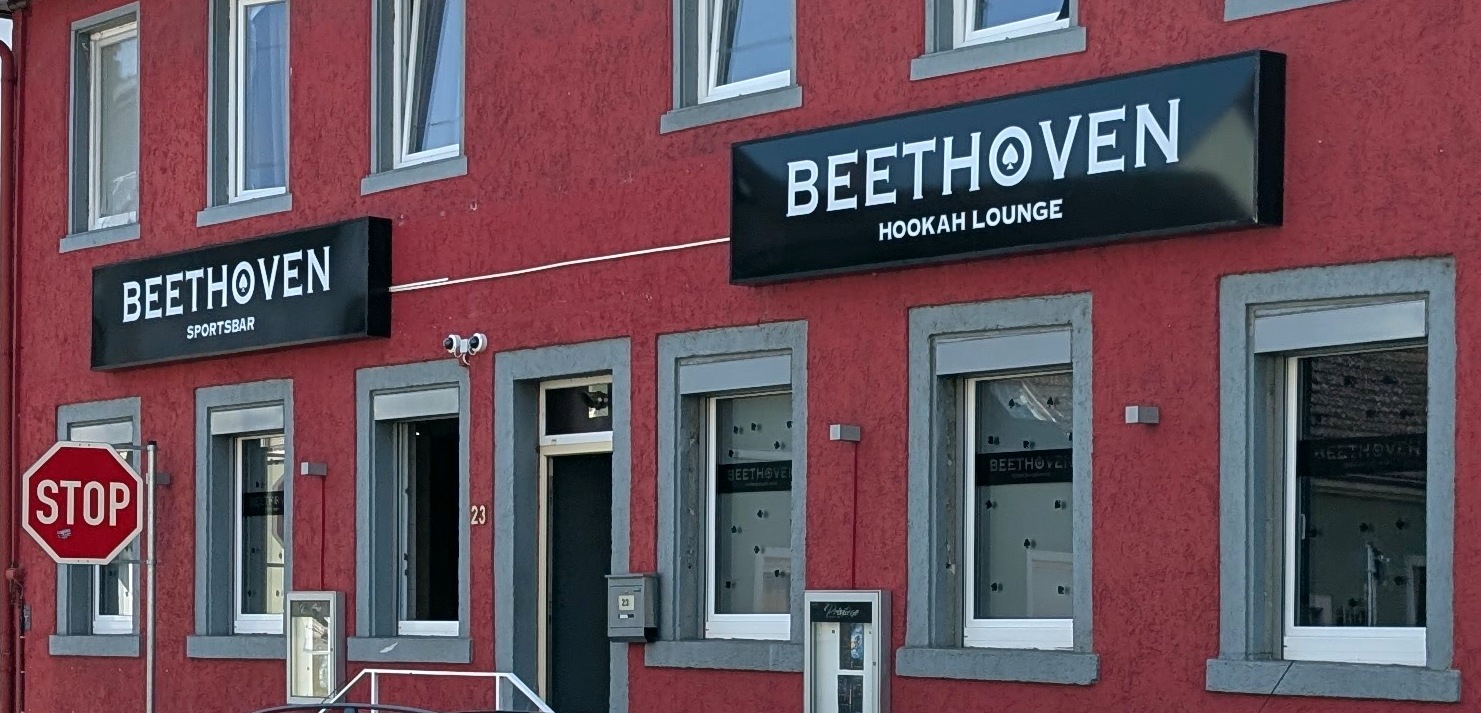
Dejected, I attempted to see the upside. Yes, I had just force-marched myself through 92+ degree weather (Fahrenheit), but my wife might appreciate some medicines, right? And the steward for our deck had mentioned a pharmacy very close to the ship. I walked toward the center of Kehl. Along the way, I encountered a very, very strange sign:

Yes, just STOP. I do not think Beethoven would approve. Kehl, Germany, August 2025.

I located the pharmacy. Kehl is charmingly small (38,000), similar to so many small cities in America. Its downtown proved easily negotiable, and my first encounter with a European pharmacy enlightening. The ability to get a physician’s assistant-grade consult from the clerk impressed me. I returned with aspirin and throat lozenges. As I walked back to the ship, not sure exactly where I needed to go, I realized I would need to drop off the meds, turn around, and immediately march my way back across the park again to catch the final bus shuttle at 3 p.m. My first exercise session in mid-90’s weather had caused my shirt to stick to my back and chest. I realized some things are not to be. My wife and I would need to return, together, to experience Strasbourg as we had intended. Meds delivered, I grabbed my tablet, retired to the lounge for my first beer, and fired up an eBook. Later, the setting sun seemed to say, “You did alright today, sir.”

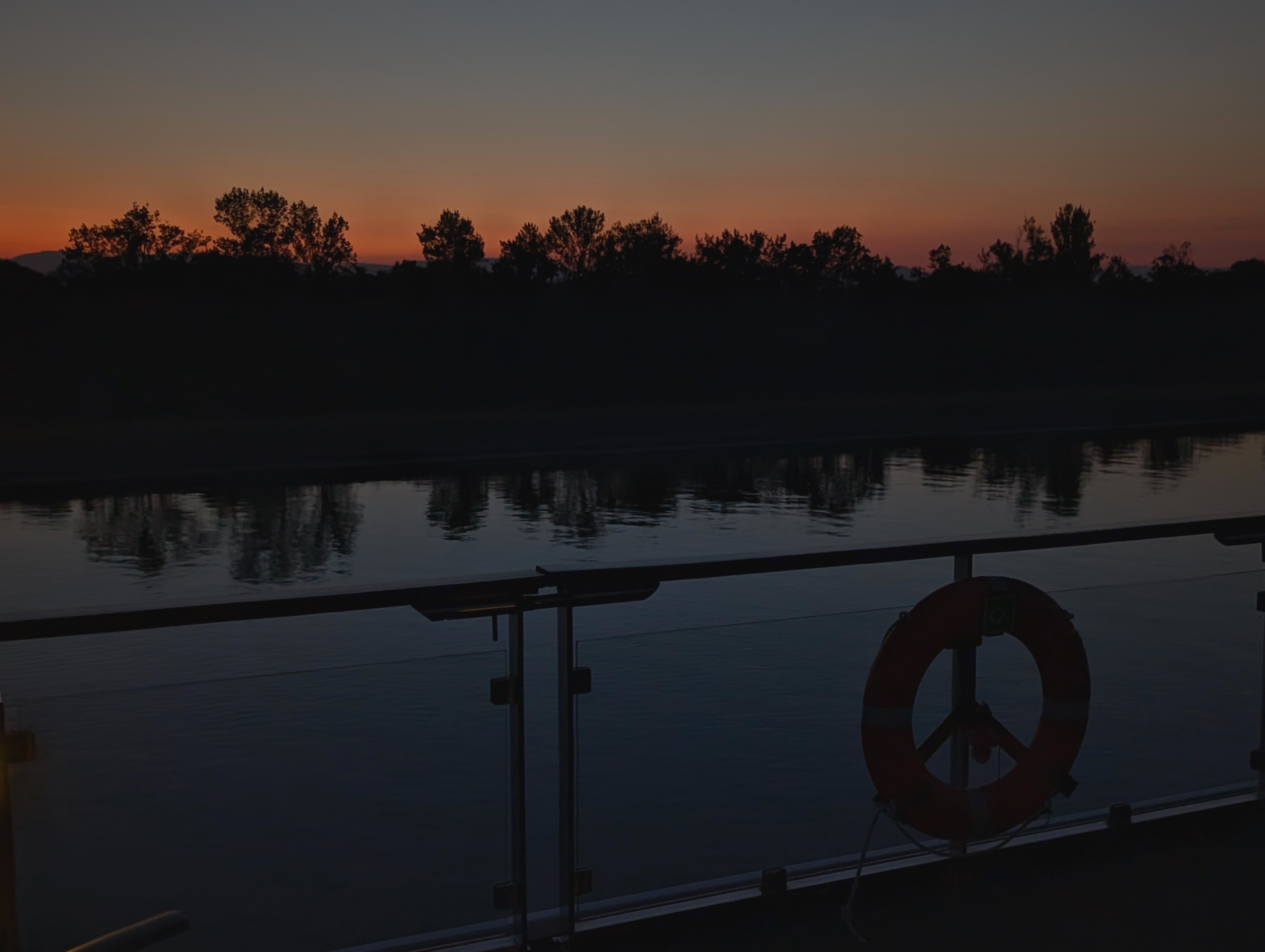
The sun sets over Strasbourg, France. August 2025.

Locks

The Rhine River north of Breisach, Germany. August 2025.

We returned from our afternoon in Colmar, dined, and watched the sun set as we sailed north toward one of the many locks on the Rhine. I stayed up to watch, but the night grew later…

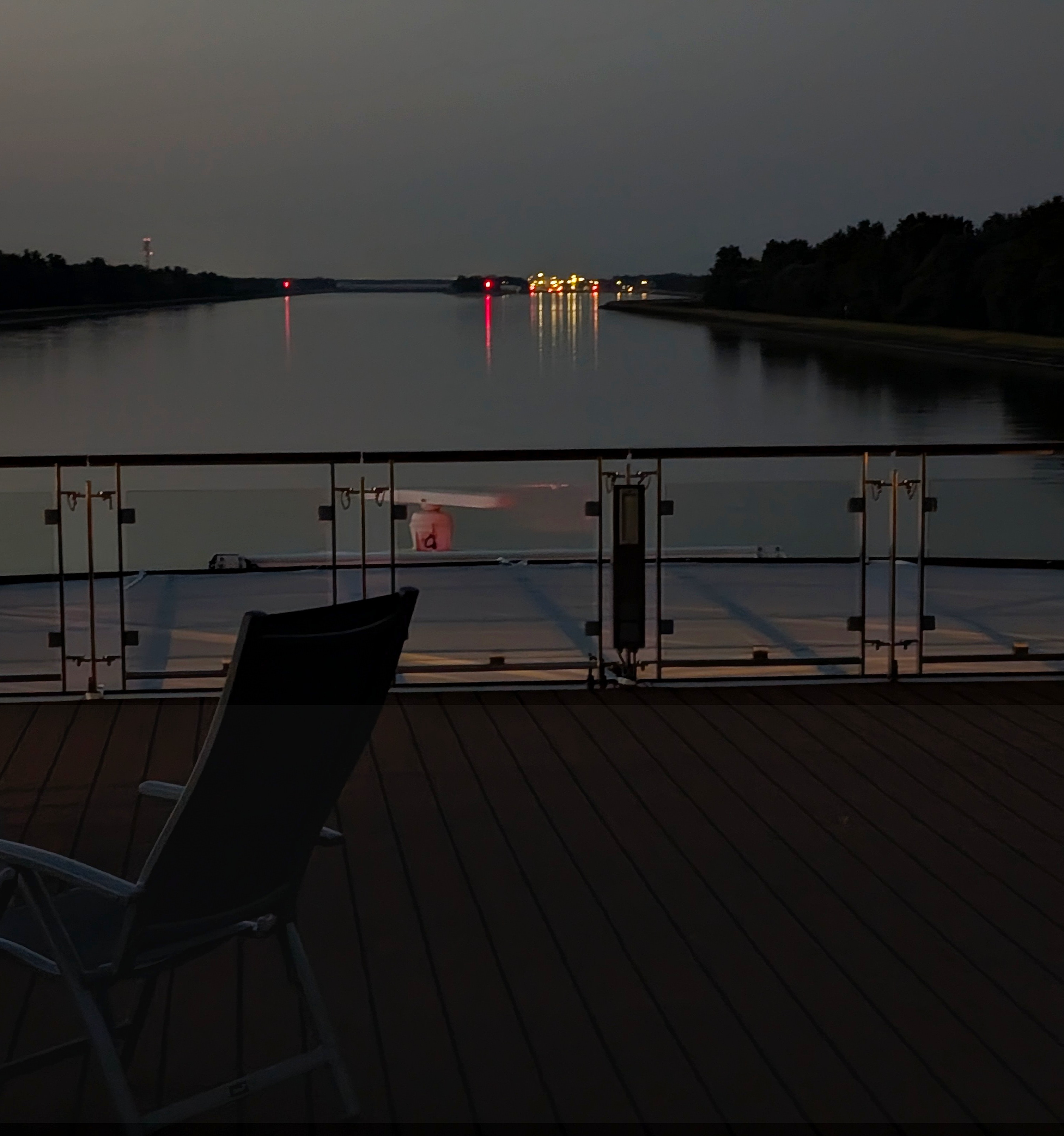
Approaching lights on the Rhine River. Locks? August 2025.

I managed to catch the first lock before bed beckoned beyond my ignoring it. I always cringe when I lean over a railing holding a smartphone to take a photo. I’m sure I’m going to watch an expensive tool/toy go “plop!” into the waters (or rocks) below.

Entering our first lock of the evening on the Rhine River. August 2025.

Heading downstream, the ship entered full locks which then drained before the ship continued its journey through the night.

The lock drained, the gate rises, and we continue on our way. August 2025.

At that point the clock chimed 10 p.m. and I headed to bed. Some of the folks stayed on the top deck through midnight and beyond as more locks were negotiated. The novelty never wore thin—any night which promised locks, a gathering topside seemed in order. If this appeals to you, I recommend booking in the May-September timeframe when temperatures support being outside comfortably. Even with temperatures in the 90’s during the afternoon, nights got very cool: by morning all but the really hardy wore a sweater or light jacket.

The Black Forest

Many tales have been told of this forest. I won’t recount them. Our guide said the rugged hills finally became settled when financial incentives were made (“land”). At the end of our mesmerizing ride in a tour bus on winding mountain roads, we were dumped into a created-for-tourists facsimile Black Forest village where seemingly every tour bus stopped. It didn’t engender itself. After starting on the guided tour to the small church on the grounds, it got a little better.

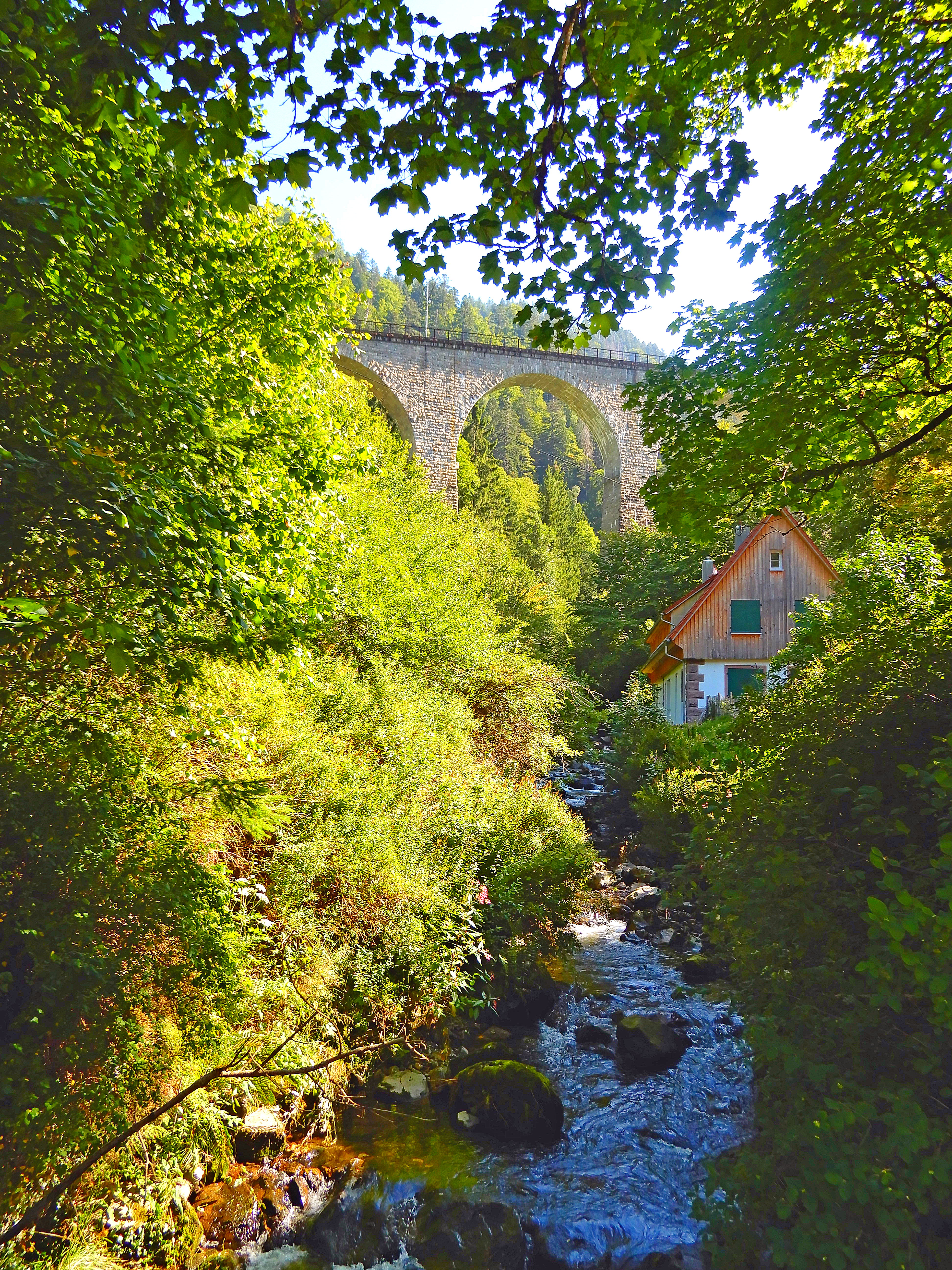
The Black Forest with creek. The bridge in the background is for passenger rail. A train appeared there minutes before this photo. September 2025.

Things were looking up! Until an “elderly” gentleman (i.e., older than me) fell badly on our way to the St. Oswald’s Chapel on the property. He escaped serious injury, thankfully. We meandered past pastures to the little chapel.

Cows outside the chapel. The slope well represents the entire Black Forest. September 2025.

This guided tour yielded one of the two poor guides we had during the six full days of the cruise. (Embarkation and debarkation days don’t have tours.) I remain greatly disturbed that she noted this chapel still saw use—meaning it’s a sacred space to any Christian—yet encouraged our group to grab a convenient rope to ring the church’s bell, all with a conspiratorial tone of “well we really shouldn’t…” The altar area was fenced and locked, but the rope snaked out under the fencing. (I’m also disturbed I didn’t say anything about how it disturbed me.) Annoyed, I went outside where a different kind of disturbance awaited me. When churches consecrate burial grounds and use them for decades and centuries, they fill up. Practically, this requires them to remove the older bones to make room for the new ones! Because these bones still deserve some respect, churches designate a more convenient place to store them, not worrying about whether they mingle. As I left the chapel and walked toward the sanctuary end of it, I saw a small locked grating which accessed a crawl space under the altar-end of the chapel. “Why would this mesh grating have a lock and a crucifix on it?” I wondered. Surprise!

I believe this would be called an ossuary. Black Forest village chapel, August 2025.
A closer look at the ossuary. August 2025.
Detail of framed crucifix on the Black Forest village chapel. August 2025.

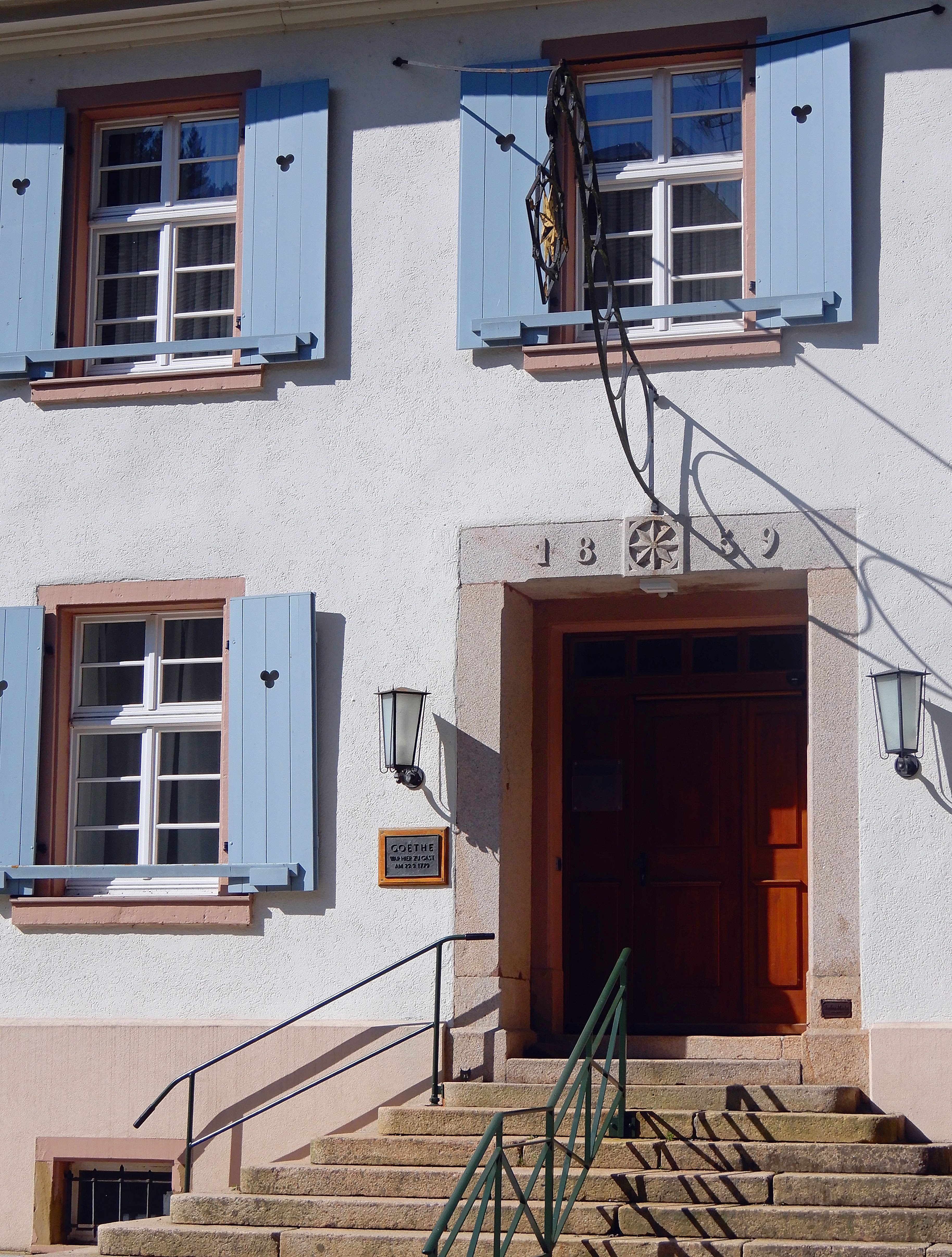
Other buildings were less impressive and/or photogenic to my eye. A building Goethe once slept in (lived in temporarily?) couldn’t be photographed well due to all the intervening people. I had better luck when I got closer.

Goethe House, Black Forest village. August 2025.

Typifying a traditional village in the Black Forest, this made-for-tourists village leaned in to the central reason for such villages: commerce. A quick in-and-out of the glass shop sufficed. I didn’t want to break anything worth hundreds or even thousands of dollars. Another building proved more eclectic: a $5000 bicycle with a handmade frame of spruce or fir; steins taller than my wife; cooking utensils of all sorts; knives; Christmas decorations; and fine spirits. We purchased a set of nice flat Christmas decorations which could transport home easily.

Upon our return to the ship for lunch, we discovered a second Viking ship had docked to ours, and now our veranda literally had only four inches between it and the other ship’s veranda. We had known this could happen, and I wonder if a person could book to avoid it. I’ll detail the considerations in case others might be considering a cruise like this:

  • Our voyage started at Basel and ended (supposedly; more later) at Amsterdam. Thus, we were traveling downstream.
  • Other than this first docking, our captain turned the ship around every time it docked. Significant rain had fallen in the weeks before our cruise; the Rhine therefore had risen much higher than normal and the current was particularly strong. Pointing the bow into the current meant the ship wouldn’t be knocked around as it would if the basically flat stern were facing the current.
  • The ship always docked on the east/north side of the river. Even the stop labeled “Strasbourg” in the brochures actually occurred at Kehl, Germany.
  • Our ship always docked first. Whenever two Viking ships were docked in tandem, the other ship was the one on the outside, furthest from the shore—not ours.
  • Putting the previous bullets together, our cabin on the port (left) side of the ship meant we always faced the shore with no other ships in our way…except the first stop. We only were docked two (or was it three) times with another ship en tandem meaning we were unlucky the first docking, but lucky all the dockings thereafter, and the ship docked more than once per day sometimes.

Your mileage may vary: we likely would have faced the river all the time if the water flow had been low. If rains haven’t fallen, it’s possible the ship cannot clear the bottom of the river when it comes to certain sections. In those cases one must re-pack all the suitcases, get bused to a different ship, and carry on with the cruise. That would be extremely time-consuming and eat into a leisurely but short and expensive cruise. The same can occur if too much rain has fallen, and the river runs so high the ship cannot clear the bridges it must go under. It’s a crap shoot and a fairly expensive one. We were affected by one of these unplanned events. It should have been planned, and I’m glad it worked out okay. Stay tuned for the end of the cruise.

Locked…and loaded

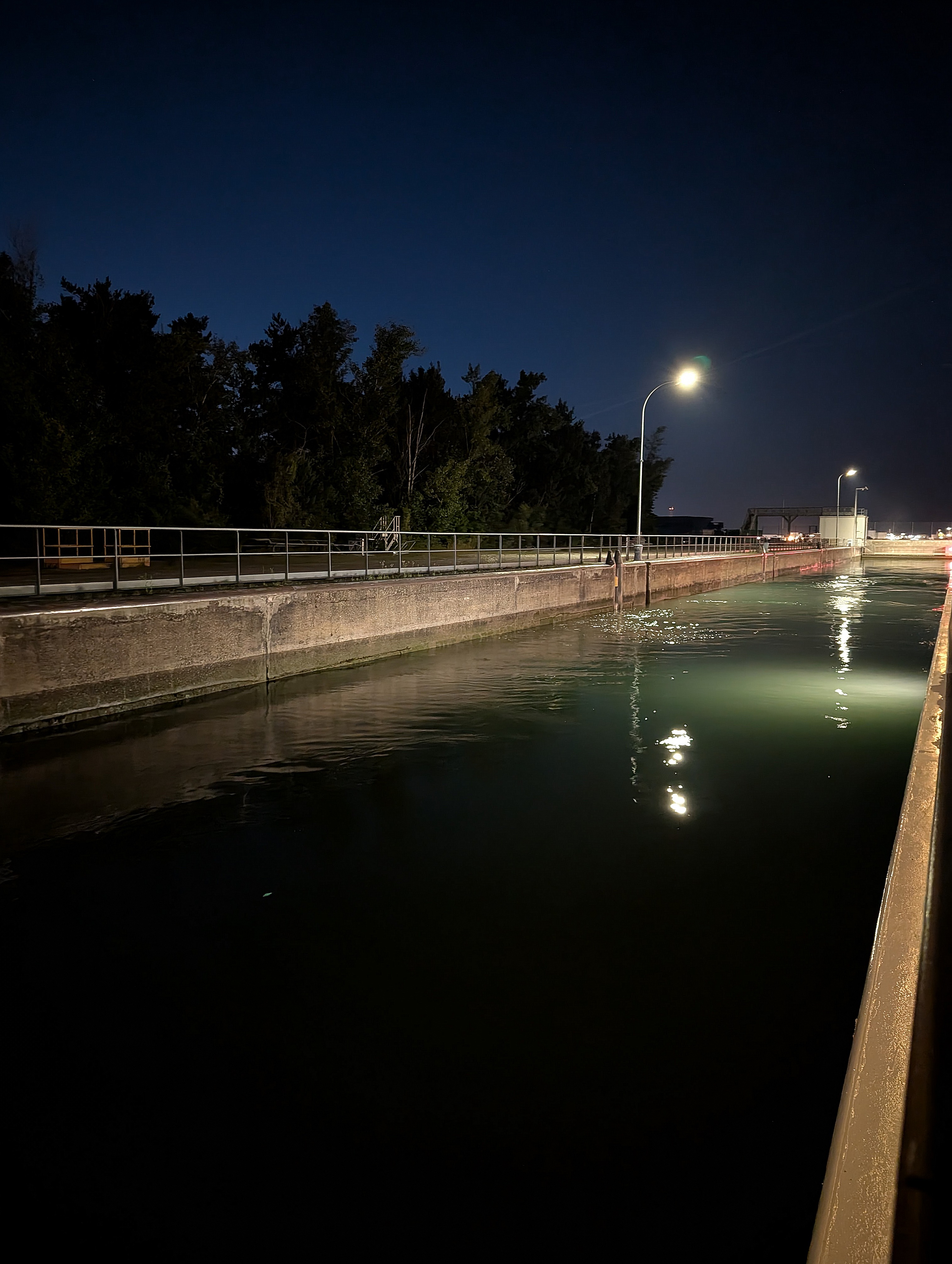
Lock on the Rhine River at night. August 2025.

Our first night on the Viking Hlin, we went through a series of locks en route to Breisach, Germany. Having started with beer prior to our shuttle ride to the Hlin before 3 p.m., by nighttime I could properly be called “loaded.” I had, after all, discovered what selections would be available on board, sampling most. By the time we were going through the locks, I snapped a few photos and collapsed happily into bed. (Our stateroom more than met our standards: a decent-sized bathroom and plenty of storage; very surprising.)

Touchdown Basel

If I understood our guide correctly, all of the fully-green-shuttered buildings are a high school. Although she claimed Friedrich Nietzsche and Carl Jung attended it, Nietzsche appears to have been schooled in Germany (Prussia). Jung may not have attended here either, but he at least spent some of his youth in Basel. Basel, Switzerland, August 2025.

I’ve visited Europe only twice, and I’ve already learned to dislike the flights over and back. Flying to Basel started off with annoyance before we even left home: whether because our United flights were actually mostly on Lufthansa or because they were booked through the Viking Cruise company, I couldn’t print the boarding passes. Instead I encountered a endless loop where I was shunted from United’s website to Lufthansa’s and then back to begin the process again. Thus, we arrived at the Raleigh airport far too early to accommodate my fear it would take a lot of time to sort out after waiting in a long line. Neither supposition proved true. Our Raleigh-Washington, D.C.-Frankfurt-Basel tickets in hand we whiled away the first hour by walking the full length of the terminal twice which allowed me a moment of irritation when I saw this sign:

When quicker isn’t the way you’re going. August 2025.

Our flight to Dulles departed at 3:10. Obviously this flight would get into Frankfurt prior to ours which would leave Dulles at 6:10 p.m. for the same city. Why Viking wouldn’t book this escapes me. And as it turned out, our plane from Dulles left the gate 60 minutes late, then spent 30 minutes on the tarmac for reasons I no longer remember. We therefore landed in Frankfurt at about the same time our connecting flight took off for Basel. Our worries were minimal because we knew this would be Viking’s problem, not ours, and indeed, a Viking rep handed us new tickets as soon as we cleared the gate upon landing. Our new flight would be on Air Dolomiti, an Italian airline. The least pleasant of all our flights over and back.

Despite the comfort of our seats (premium economy with no seats in front of us, only an emergency exit and about 15 glorious feet of space), we slept fitfully and as I suspected arrived fairly tired to Basel. My first impression: “Wow, we’re landing in France!” I had not noticed Basel sits at the juncture of France, Germany, and Switzerland. Suburbs from the city lie in the other two countries—our guide lived in Germany “so I can have A/C which I can’t get in Switzerland.” Exiting the controlled area, one follows large arrows to either France or Switzerland. A stop by the Viking desk in the airport, a short wait for two other parties (who didn’t arrive), and we were shuttled the 15 minutes to our hotel close to the Rhine River, but in a newer part of the city.

I then educated my wife on my coping strategy for the six-hour time jump: drop off your luggage, find the bar, quickly enjoy some of the best beer you’ll never see in the United States, and follow it with a full, preferably heavy meal. Guaranteed to put you to sleep quickly and jump start your rhythms to the new time zone. Accordingly….

The three beers of most interest entering the bar. We started with the Schweizer Helles on the right. Hyperion Hotel, Basel, Switzerland. August 2025.
An old friend from 2019, Grimbergen. This is the amber or “double amber” as it was called on our cruise. Hyperion Hotel, Basel, Switzerland, August 2025.

Perhaps now we should warn the teetotalers: there will be many references to beer in this series. It’s Europe, the cruise docked on the German side of the river, and we ended our vacation in Antwerp, Belgium, one of the most beer-obsessed countries on the planet.

Suitably sated, we toddled off to our room, marveled again at a completely computer-driven elevator system, and acquainted ourselves with a few vagaries in European plumbing (such as the toilet being on the opposite end of the room as the sinks and the shower).

The perfect vacation

Rhine River at Koblenz, Germany. August 2025.

Vacationing has meant several things over the years. As a child it meant adventure. Dad would plan a two-week sojourn through the beauty of the American West, plotting the journey for months, and utilizing guidebooks (well, the AAA one) to find both motels and sights to see along the way. By the time I reached “summer job” stage and such vacations no longer were possible, we had seen most of the national parks from the Rockies westward, plus the Grand Canyon, and the tourist hot spots of Southern California (Disneyland, the San Diego Zoo, Knott’s Berry Farm, etc.). We visited San Francisco in 1968 where I saw my great-grandmother on her deathbed and hippies in The Haight. And we always tried to loop through either Seattle or Woodburn, OR, to visit one set of grandparents. Back then, vacationing meant lots of hours in a car reading or imagining things as the countryside went by. It meant rolling with the punches when the road Dad wanted to drive was under construction or the motel he wanted looked better suited to hookers than small children. It mostly meant seeing state after state, park after park, city after city which I had never seen before, and which in my short life presented amazing memories and lessons.

I couldn’t capture that as a younger adult. Vacations at first mostly entailed going home to visit my parents and my friends. I tried a brief camping trip along the Snake and Salmon rivers, but the spectacular views couldn’t make up for my inability to build a fire and thereby have any food to eat. (Or perhaps one could say, the views couldn’t make up for my ineptness as a camper.) A bit later as a newly wedded teacher, summers were for further training, loafing at my in-law’s lake cabin a couple times, and once or twice attempting to emulate my father’s grand tours of the West. I thereby got to see parts of Arizona south of the Grand Canyon for the first time and see some lesser known but equally impressive sights. I explored my own state, Washington, better. The 10 to 11-week length of our summer breaks diluted the compressed wonder of a two-week vacation.

Life changes and a relocation to greater Philadelphia put the kibosh on traditional vacations. Just living there was a new experience. After two years there I discovered a new type of vacation which brings a different kind of satisfaction: the introductory tour. I had met a new love (who married me the next year), and I had entered corporate America where two weeks is the only significant time off you get. I took this woman on a whirlwind nine-day tour of Washington and meet-the-folks. My bride-to-be loved the state and my parents loved her. I repeated the tour in 2017 for a dear couple of friends from North Carolina.

[Disclaimer time: despite the fact I’ve lived in Washington for only four years since I left it back in 1992, I still consider it one of the best places on Earth. My values have to do with variety. In my mind only California comes close to the diversity of climactic zones and has the varied population densities ranging from the Seattle-Tacoma-Olympia wash of people to areas where it’s difficult to find the next house from the one you’re standing beside. Want desert? Check. Alpine? Check. Rainforest? Check. Scablands, Arctic, Temperate forest? Check, check, and check.]

Less than a year after our marriage in 1995, we vacationed to New Mexico for two weeks. We wandered from Albuquerque north, were unimpressed with Santa Fe and hightailed to Taos. In ’95 it had started to build up, but only a little. We stayed at an honest-to-God auto court, and breakfasted at a old West-style cafe on the square. (Revisiting in 2022 saddened me when I saw all of that charm washed away by touristy stuff.) That second week of the vacations, all my tensions dropped away as we shot into southwestern Colorado for two nights before striking to southern NM and the Carlsbad Caverns. Until a couple weeks ago, I held this up as our standard of Best Vacation Ever.

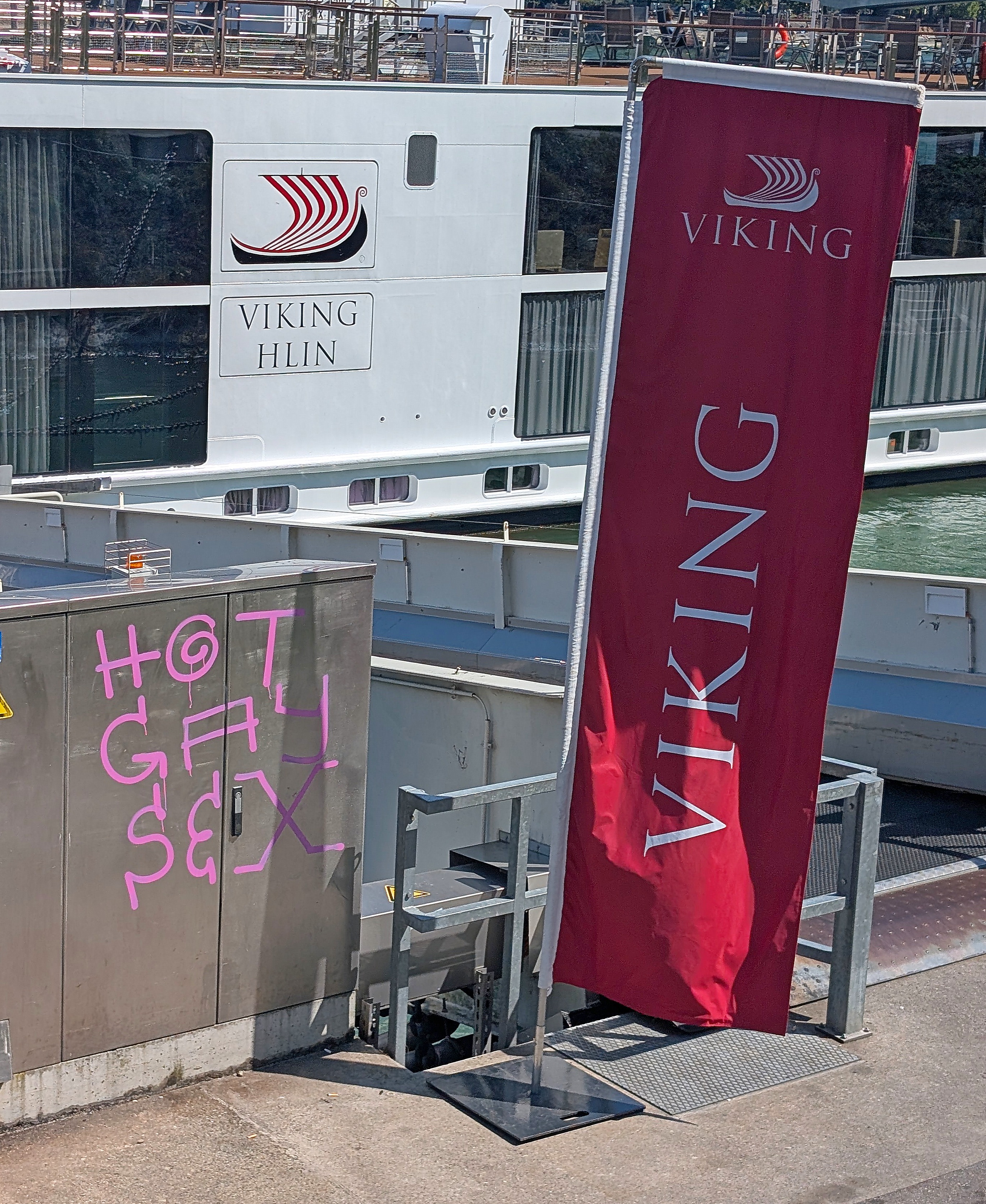
Then we cruised down the Rhine River for eight days on the Viking Hlin, and visited Basel, Switzerland, and Antwerp, Belgium, at the beginning and end of the voyage, respectively. Viking is known for catering to old folks like us (no one under 18 is allowed) and for its all-inclusive approach. We could have been very happy just eating the food, drinking the beer and wine with lunch and dinner, and taking the included tours, but it made sense for us to add two optional tours, take care of gratuities in one tidy little package, and buy the Silver Sipper beverage package so that we could drink beer, wine, and cocktails just about any time we wanted. Given the slant toward the retired and soon-to-be-retired, I must say my initial introduction to the ship gave me a jolt:

“Welcome aboard” kinda takes on a whole new meaning with a tag like that! August 2025.

I’ve nothing against people living the love lives they desire, but still I was thankful there occurred no hot gay sex (that I know of ) on the Hlin. It reinforced my initial reaction after two nights in Basel before boarding, that European cities seem to take a more blasé view about tagging. There seems to be an unwritten rule that it isn’t done on cathedrals and other historical buildings, but other than that…sure, indulge yourself.

As with my Hawaii series [tag: Hawaii] and my Virtual Vacation series [tag: Virtual Vacation] about Michigan and Ohio, this will be a lengthy series of posts recounting how two neophytes who never traveled abroad for pleasure decided to do so in retirement. For now, I’ll end with two photos about our first few hours onboard.

The appearance of swans became commonplace by the end of the cruise. They paddled up for treats just as ducks do in cities throughout the United States. Rhine River just downstream from Basel, SW. August 2025.
On the first night I met one of my new friends: Köstritzer schwarzbier. If you think you don’t like dark beers, give schwarzbier a try. Light-bodied, crisp, but it has a nice roasted taste lacking in traditional lagers. One of the handful of beers offered on board. I wish there had been more! And yes, Europeans are civilized: each beer has its dedicated glass. Viking Hlin , August 2025.