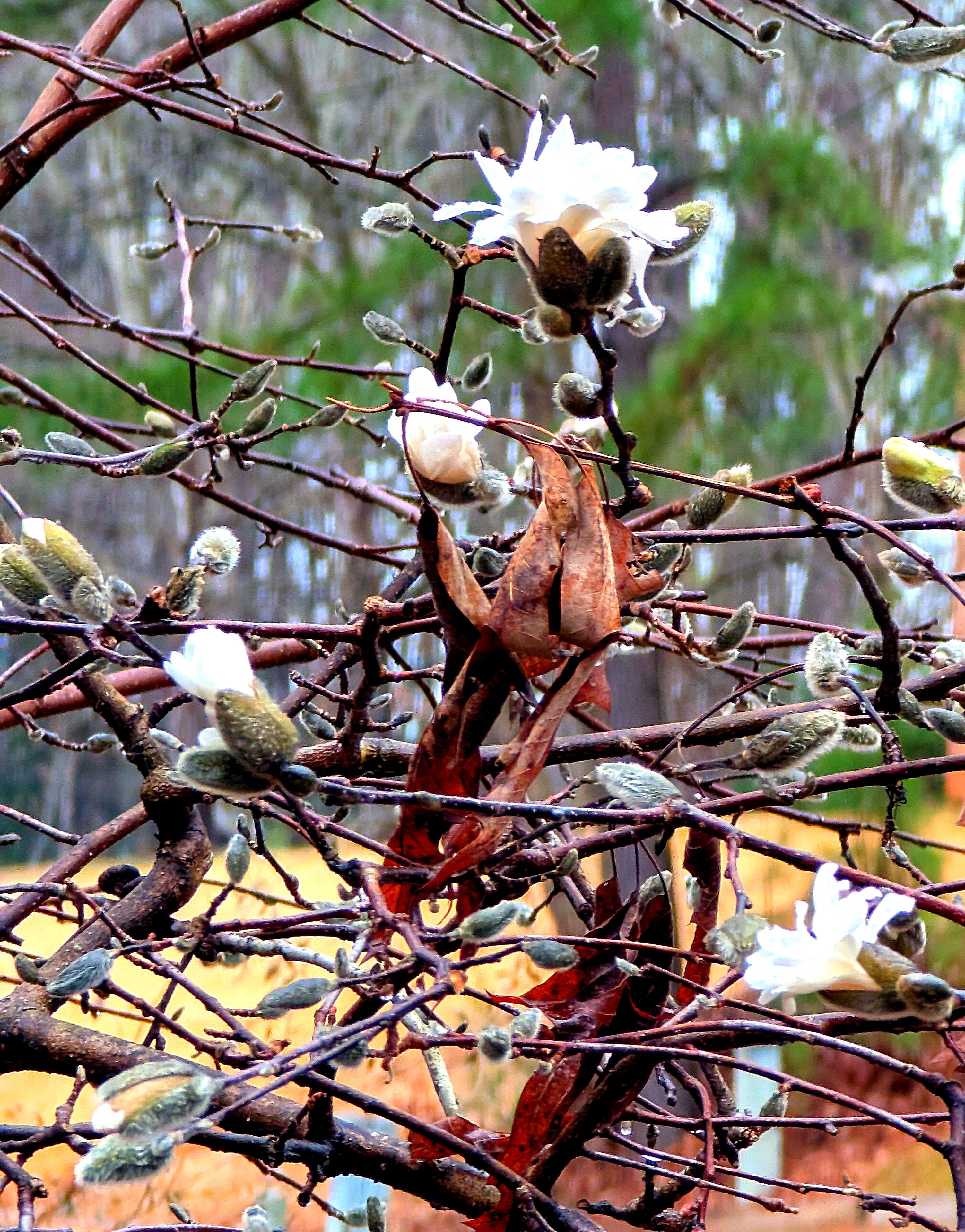
I had thought our late February vacation would preclude being greeted by the first bloomer of the spring, the star magnolia, but no! She bloomed between the 18th and 20th this year, at least with a few of the blossoms toward the top. I will still miss the entire shaggy mass, but the past couple years the ravenous squirrels eat more than half the blossoms before they “hatch”.
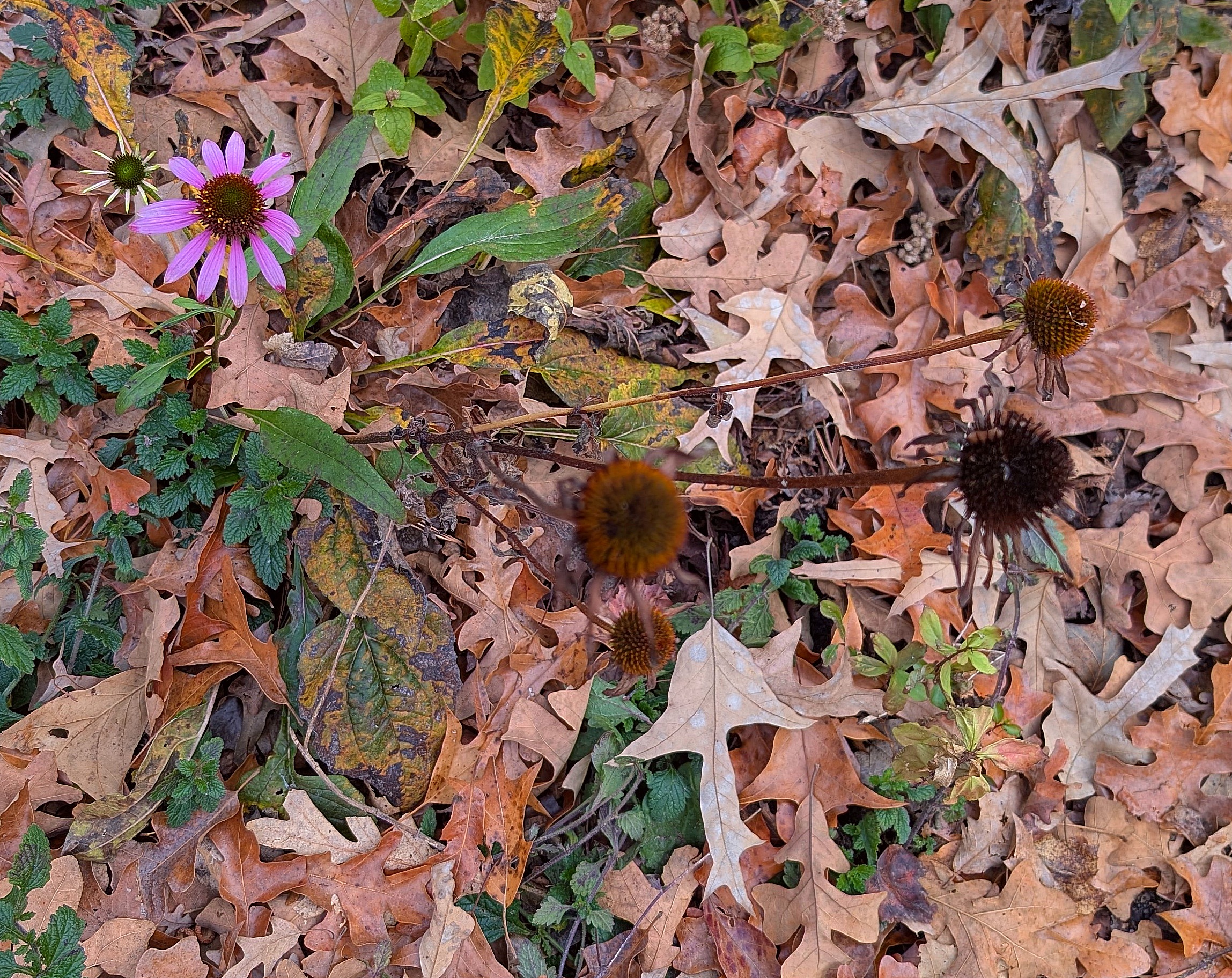
I seem to be on a leaf and garden kick. Though two short cold snaps have sent 99% of the plants into dormancy (unless they’re evergreen), a few brave stalwarts instead focus on the above-average warm weather to pop one last bloom out. November 3-9 ranged 65-75F with just a dash of rain the final two days. And then the 12th through 16th blessed us with sunny days of 64-73F. Look at these little troupers:
The blue mistflower who refused to die. All of its nearby compatriots are brown. Interestingly, the broad leaf or two at the top are from a purple coneflower, also still green. November 2025.Another purple coneflower with living on its mind. All of the originals have gone to see on the right, but no matter. Let’s make more! A nascent bloom can be seen to its immediate left (the little white spiky one). November 2025.Black-eyed Susan: you can see dead plant everywhere but it decided to come up again when the weather warranted. November 2025.
This past week we journeyed to Santa Fe, NM, where my brother has lived for about four years. This represented our last chance to do so, because he plans to relocate to a different state next year. Although our first two visits in 1996 and to my brother’s house in 2022 left us unimpressed with the city and its surrounds, I found my attitude changing this time. I think taking a more relaxed approach to each day helped, plus I’ve slowly decompressed over the past five years of retirement. My past as a Road Warrior for several years took a big hit when we all sat around in 2020 during the Covid pandemic. It kicked into gear again in 2021 and hadn’t dissipated by 2022. For whatever reason, we found ourselves hitting a few museums, seeing familiar sights, finding some new ones, and spent late afternoons in conversation prior to dining out every night. (Dining out might have aided our feeling of “vacation”.)
A few representative photos:
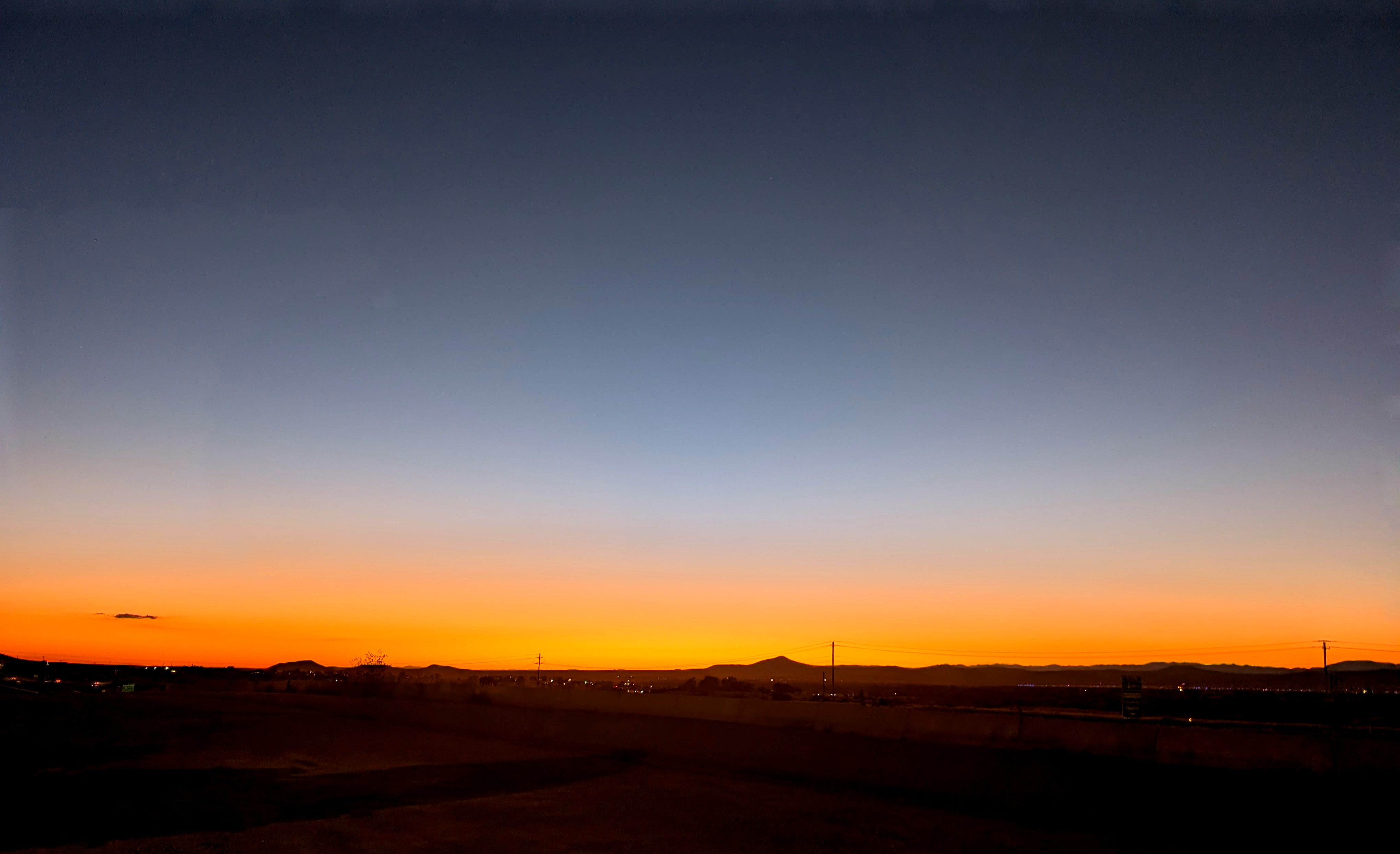
October begins: outside the Santa Fe Brewery on October 1st. Less than 2 miles from my brother’s house as a crow flies, but 4.4 miles by car. We stopped for a couple six-packs after a fine dinner at Escondido Santa Fe. I miss sunsets like this from my first decades in the western US. One needs to see the horizon to get good sunrises/sunsets. October 2025.
By October 2nd the federal shutdown in America took full effect, and we found all facilities closed at Pecos National Historical Park. I was unaware an important Civil War battle had been fought here when the Confederacy attempted to control the gold being mined in southwestern states. October 2025.
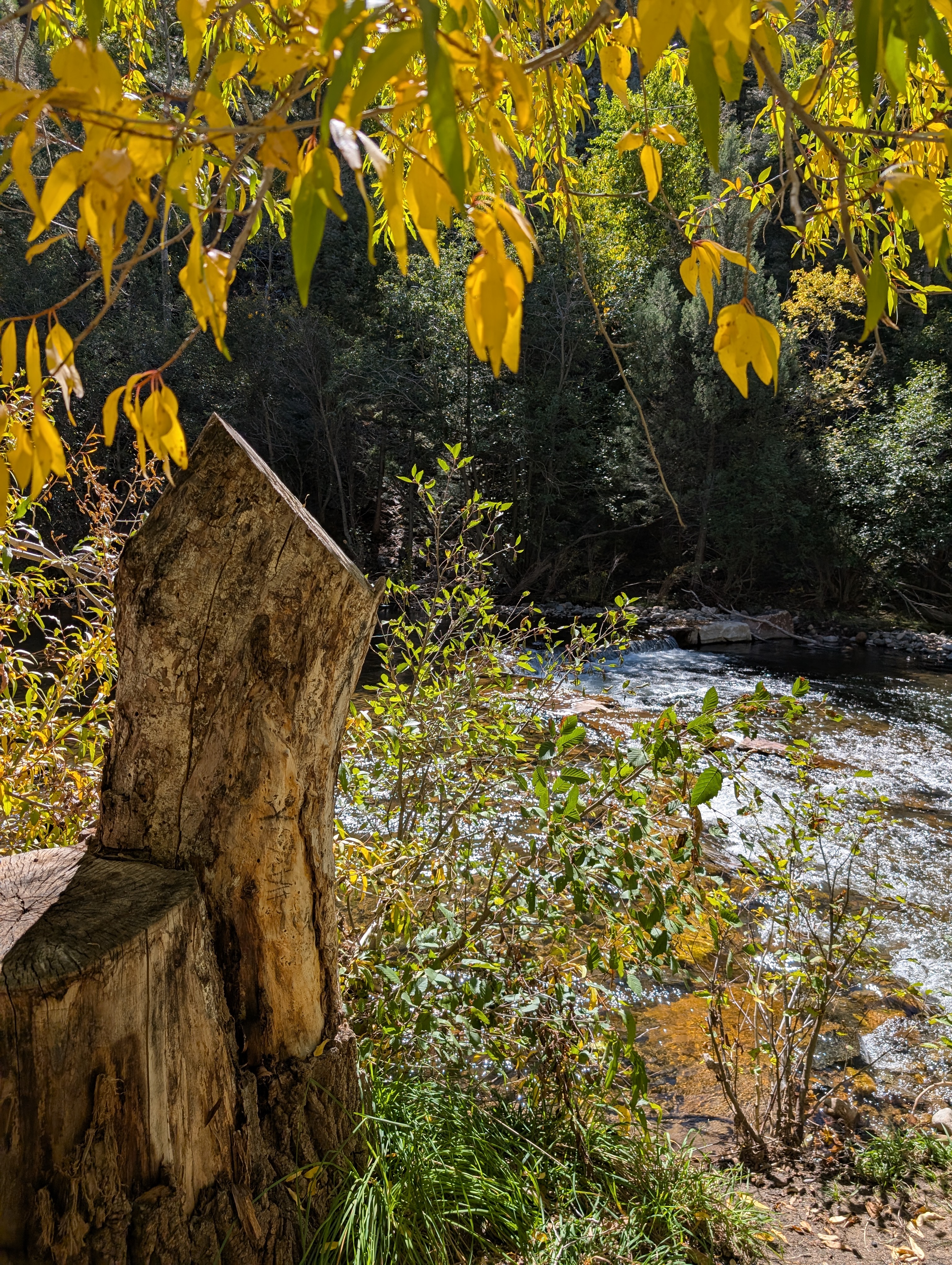
Because the national park closed, we turned north to a state park on the Pecos River. It catered mostly to campers and anglers, but provided some beautiful spots to stop and admire swiftly flowing water beneath the first signs of autumn. Rivers aren’t common in the semi-arid southwest. October 2025.
We visited the Georgia O’Keeffe museum Wednesday, a must stop because we had missed it in 2022 when our only day to do so turned out to be the day it closed. Out of deference for the artist I won’t reproduce her work here, although photos were allowed. Similarly I won’t reproduce the artwork I photographed at the Wheelwright Museum of the American Indian on Friday, October 3rd.
We ate New Mexican style food at Escondido, La Choza, and a super-high-end place called Sazón in downtown Santa Fe. On the 2nd we ate Indian at Paper Dosa, a restaurant we had seen on Diners, Drive-Ins, and Dives (Food Network). Mostly I will remember north central New Mexico like this:
On a walk from my brother’s house. This actually is in the middle of housing developments in the southwest part of Santa Fe. Housing in central Santa Fe is very expensive. I don’t remember the name of this yellow plants, but it’s everywhere. October 2025.
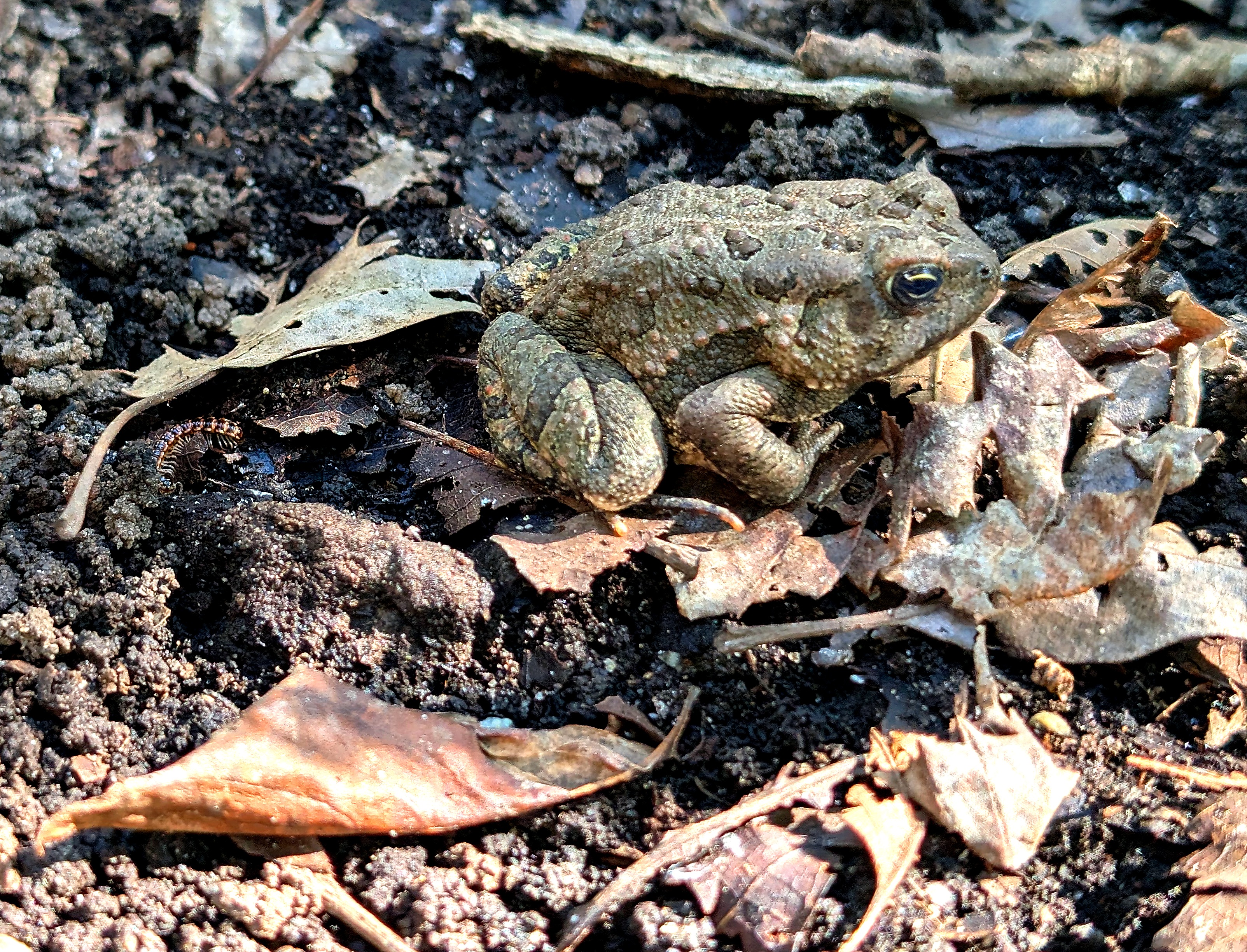
While weeding something moved, just a bit, and I spied this Southern toad. I haven’t seen one around this house since we moved in over 8 years ago, but saw them regularly at our former house on a pond. Pretty lethargic—it’s a nocturnal creature. September 2025.
One month ago today we woke in our own bed after flying in from Belgium the night before. Only now am I catching up to yardwork, which these days consists of staying ahead of the interlopers in our all-natives garden covering the front yard and hacking away at plants in the back before they can seed. Their days are numbered: two weeks from now we hope to start the replanting of the backyard. I question, at times, why we paid so much to plant perennials which should natively grow here but there ya go. A complete and pleasant shock has been seeing the blue mistflowers explode in size and coverage. These beautiful and late-blooming plants had for years volunteered amid the purple coneflowers I’ve showcased many times on this blog. Most of them were taken out to facilitate the new landscaping plan, but the architect of that plan instructed his crew to transplant as many as possible. Given that it was a week into October, he also sprinkled any seed heads he encountered. I think the much better soil helped them out a little bit:
This bank of blue mistflowers looked reasonably modest in size when we left for Europe on August 7, 2025. They’ve now taken over this segment of the yard, overwhelming several plants underneath them. September 2025.Detail from a much larger photo of another bank of the blue mistflowers, showing how small flowers form much larger clusters. This photo is unretouched except for a slight amount of sharpening I added to see the flower petals better. September 2025.
I had to transplant two which ‘volunteered’ at the edge of the walkway to our front door and by doing so, obstructed most of the sidewalk. One withstood the shock and has many buds on it. The other has stood with severely wilted (but green!) leaves for almost four weeks. I keep telling it, “hang in there! You don’t need to bloom! Just live!”
The valiant yellow rose on my daily walk. September 2025.
My daily walks haven’t been very “daily” since we returned from our Rhine River cruise. Today a familiar friend caught my eye. For the several years now when I’ve been walking regularly, a forlorn yellow rose has bloomed where it’s been planted next to a mailbox. Every year it shows little foliage, yet it always has one beautiful yellow blossom. I don’t recall ever seeing more than one at a time. I don’t know if someone strips the leaves purposefully, if deer or something else eat the leaves, or if this just represents the nature of this variety of rose. I do know, however, that it seems almost defiant to me to bloom that lustily when surrounded by bare, thorny stalks.
Even though we may be mostly thorns and difficult to handle, remember to blossom at least once today.
Eastern honeybee (?) on just opened sunflower. July 2025.
I feed birds, mostly black-oil sunflower seeds. This year it looks like I’ll through about 400 pounds of them. Apparently one got planted in our newly landscaped front yard, and there amid many of the similar-spiky Obedient plants was this lone sunflower. I love sunflowers. Therefore, I got pretty irritated when something, probably a deer, nipped off the top where a bud had been forming. The joke’s on the deer, though. By trimming the plant, it put up TWO stalks from where it had been lopped, each of which had buds…until one burst open on Independence Day.
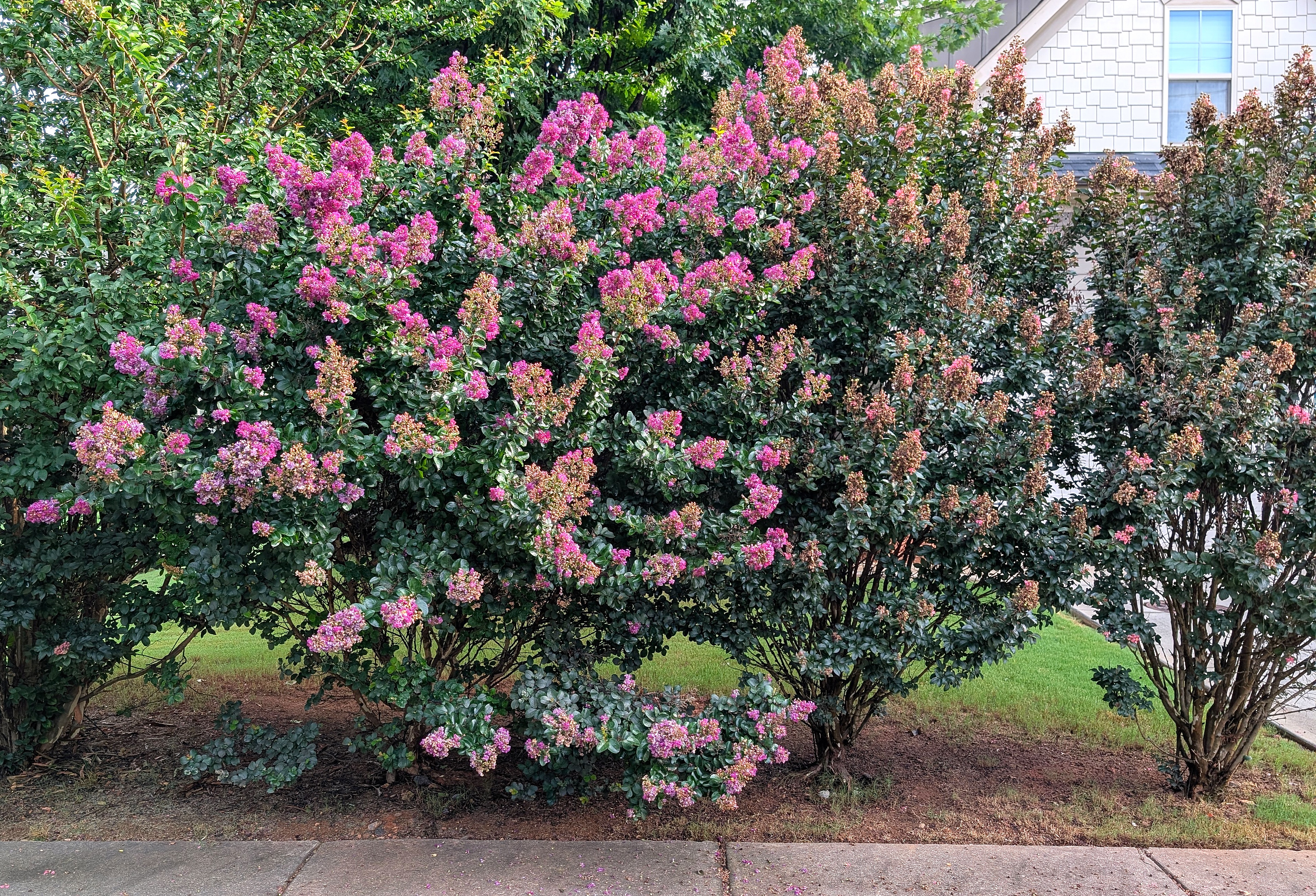
…or crepe myrtles if you prefer…seem ubiquitous here in Raleigh, NC. From what I read and hear they’re throughout the South, though I haven’t paid enough attention while driving through our neighbor states. Crape myrtles take their time, slowly becoming substantial trees of a type called thicket trees. They can be well-tended and trained, as this one is:
With care, the trunks grow together. Raleigh, NC. July 2025.
Usual care involves letting them grow as they will, but pruning suckers and sometimes trimming the tops to shape them:
Crape myrtle with usual thicket look and showing white blooms. Raleigh, NC. July 2025.
Crape myrtles are everywhere here. The photo above is across the street from the first photo. The thicket-trunked myrtle in the foreground has a substantial myrtle right to its left, the one with a more substantial trunk. Follow the sidewalk and you’ll see two more, smaller (younger) crape myrtles flowering. These last two demonstrate the variety of the approximately 50 species of crape myrtle (or are a particular cultivar of one):
Younger, different crape myrtles. Raleigh, NC. July 2025.
Crape myrtle are maintained by the City of Raleigh in the decorative medians:
Three “City” crape myrtles at the end of my street. Raleigh, NC. July 2025.
To me the Ultimate Crape Myrtle lives in my neighbor’s yard. Its branches extend from the edge of the sidewalk and tower over her house. It’s at least 30 feet tall. Someone appears to have pruned a few suckers in its youth, but mostly it’s been left to its own.
Crape myrtle in neighbor’s yard. Our white car and yard in the background. Raleigh, NC. July 2025.
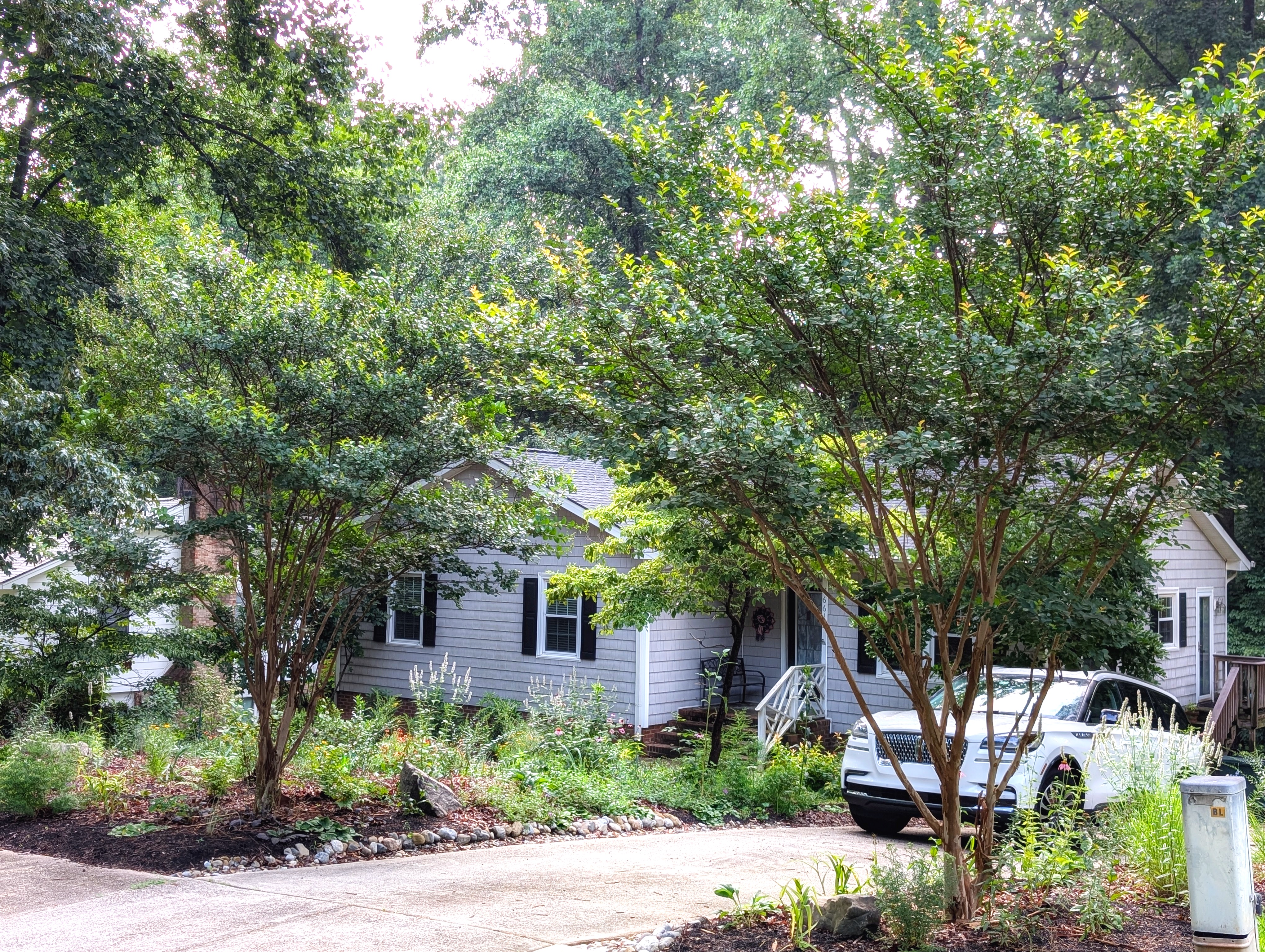
And then there are our crape myrtles. Ours were planted sometime between 2007 and 2014 (using Google Maps Street View), with the most likely time frame being 2010-2012, a period when the former owners rapidly changed the landscaping and interior of the house. The myrtles probably were purchased as saplings, and have doubled in height for the eight years we’ve lived here. For reasons I suspect have to do with amount of sunlight and my utter lack of any care beyond occasional pruning, they flower very late. I suspect sunlight because my other neighbor has three, also near the sidewalk, which haven’t bloomed yet either. In the photos above you might have noticed most of the myrtles nearing the end of their blooming period. Ours?
Our two crape myrtles, either side of the driveway, not blooming. July 2025.
But here’s the thing: though closely identified with the American South, they are not native to it. To quote the NC State University’s Extension Gardener website, “[Crape myrtle] is native to the Philippines, Japan and central Himalayas to southern China and Indochina.” Our whole move the past 12 months has been to replace everything in the front yard with native plants. (note that in the photo above) After a year of debate, and many years of saying, “Maybe they will bloom better when they get bigger,” we’ve decided to replace them. (Sorry, former owners. Consider it payback for removing that big tree in the front yard and not properly having the stump ground. I nearly broke my ankle in that mess many a time.) On one side will be an ‘Amethyst’ witch hazel which blooms in winter and very early spring. (Photo here.) On the other side will be a serviceberry. It mimics the look of a crape myrtle with the multi-trunk growth, but it will provide berries for birds and other critters.
Eastern carpenter bee working the beebalm. June 2025.
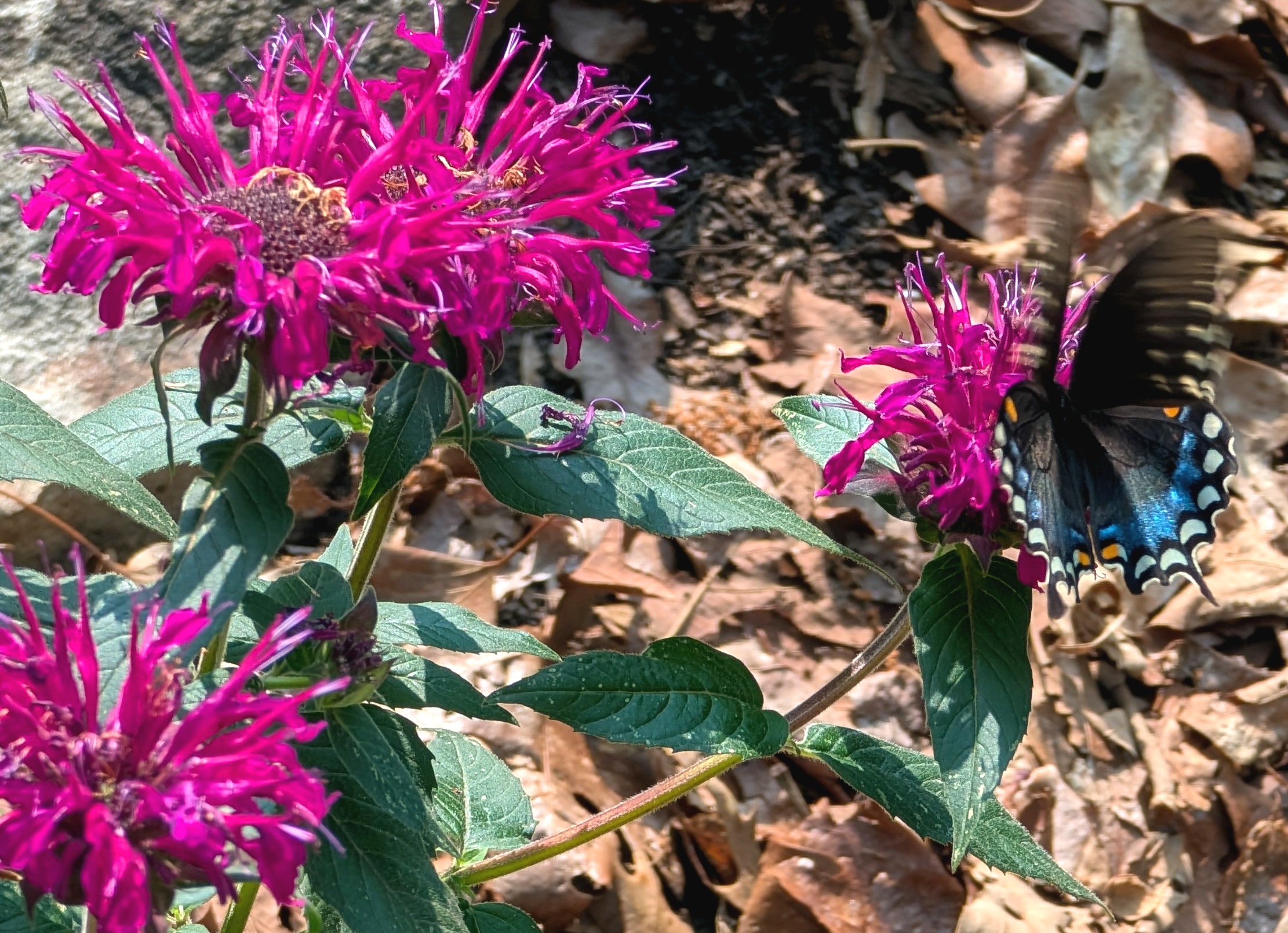
I opened the month shooting photos of the beebalm with a swallowtail butterfly on it. This photo is from the same set. The swallowtails, bumblebees, and little tiny bees I haven’t identified yet all had to work around the behemoths of the flowers, the carpenter bees. At 1.25-1.50 inches (or more!) they pretty much go where they want to. Now the beebalm has slowly dropped all those fuchsia-colored petals. (Or are they petals? I don’t know much about plants.) All that remains are the ball in the center, still suspended on those long stems. Our new visitors love these: goldfinches. They flit from flower to flower, their nearly weightless bodies hardly making the stems bend at all. It seems too soon for seeds, but what do I know?
Summer temperatures, documented a few days back, will continue for the near term future. Americans look forward to celebrating Independence Day on Friday, the 249th of our country’s existence. In these muddled times, I wonder what that will bring. Meanwhile, the business of life marches on, from the mundane (it’s Gather the Garbage Day) to the inconvenient (workers coming to work on the leak in the bathroom shower) to the calm and simple (my wife returned from a coastal sojourn yesterday afternoon; this day will be our first together in a week).
One of the few things I miss about participating in the Facebook platform is On This Day, where the app would push up photos and posts you had ‘published’ in the past. The photos were a nice blast from the recent past. Unfortunately, they encouraged participants to repost much like the boorish cocktail party guest who wanders from group to group telling the same overly-extended anecdote which bores each group equally.
But y’all haven’t seen these, I think… (photos are from any June 4 through June 6)
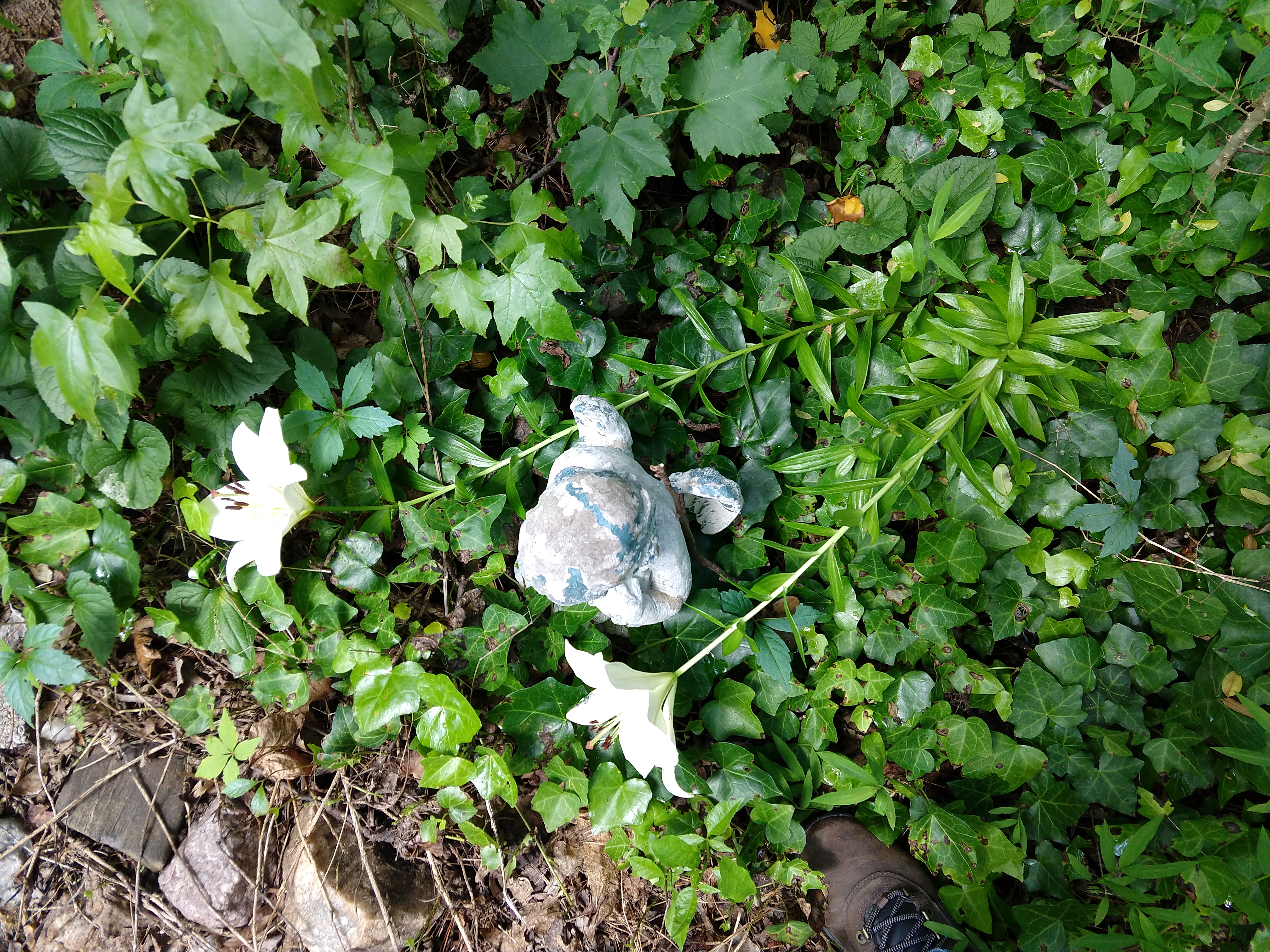
The last of the roses. Choked out by invasives and my indifference, they haven’t appeared since. June 2021.Some red lilies ready to bloom. Frustratingly, they disappeared only for one to appear a year or two later in the midst of a garden nightmare. I blame squirrels. June 2020.These two white lilies bloomed for three or four years, through the date of this photo. After that they disappeared, but behind this location the RED lily suddenly appeared. Squirrel atonement? June 2020.Houston, my second time to work at the same client. It’s a flat landscape. The sun sets and everything wallows in a beautiful light. Taken from my hotel window. June 2019.
And on and on they go… I cannot tarry or I will post all night. Each day brings a look at the past five years of retirement, the previous eight years of consultant work, and the mundane world of “home weekends/corporate trenches” that was my world before.
Watching our newly landscaped front yard has become one of my particular joys this year. Where once there existed a lackluster lawn, pockmarked with chipmunk burrows—which I had to continually mow—now new plants take turns proffering flowers for the pollinators. The spicebush swallowtail butterfly shown above would have shown up better were not its wings fluttering madly as it sampled the scarlet beebalm flowers. Sharing the butterfly’s zeal were bees of all sizes: little ones that looked like flying sugar ants about a quarter-inch long to bumblebees and something larger which I haven’t identified yet.
As May ended and turned to June, fireflies appear at dusk to illuminate the plants. Shrubby St. John’s wort, below, seems to be a favorite of the Easter honeybee.














 all the voices in my head