Chairs

Growing up, my parents’ chairs interested me little. They still don’t. I consider them in my mind: the bulbous thing they reupholstered from a shocking golden mélange of 50’s colors, vaguely like a tweed, to a deep blue-green as hideous as you likely just pictured. Another horrible chair, this one chalky gray underlaid with a chocolate brown, thankfully disappeared from our lives as my parents focused ever more on Danish modern. Two deep mustard gold chairs sculpted from a cube joined the blue-green thing. I took Danish modern for granted then, hate it in retrospect. For reasons never given, our sofa matched nothing else in the room, either in style or color. Its creamy colored soft contours with the ever-present throw pillows would scream Rooms-To-Go today. Back then it just said, “I came from the middle aisle of our local furniture store.”

Chairs only rarely occupy our minds beyond whether we can find one to sit in. We take them for granted, I suppose because those of our upbringing formed part of the Always-There background. We sat on hard wooden chairs in school, replaced later by hard plastic seats, replaced in turn by a hard substance which defies any characterization other than “smooth”. College offered the same but with more variety unless you attended something exclusive in which case the chairs weren’t any more comfortable but they looked a lot older, more distinguished. When newly graduate, one’s interior decorating attitude toward chairs usually is something like, “is there one” and “is there room for one or two?” Perhaps I should add, “Can I get them from Mom and Dad?” because that’s their provenance for the most part.

“For the most part.” I moved from my dorm to my first apartment towing the usual hand-me-down furnishings including a deep brown and deeply ugly sofa. Along the way, however, I stopped at my grandparents’ house to pick up a chair from their basement which meant a lot to me. Now in their 80s, they were moving to a senior-living apartment. At the time this chair represented a place where I had sat a lot, a place I found both comfortable and comforting. Over time my bones became more brittle, my muscle turned to fat, and I found the chair less comfortable. At the same time, the comfort of seeing a chair with deep green shiny silk-like ribbons running vertically on a cream background, with dark-stained wooden arms and legs, sustained me emotionally. In 1992 I looked at the chair in my new Pennsylvania apartment where I had fled my divorce and my teaching career, seeing the chair as an anchor to my past and to my family. As a child I sat on the floor of my grandparents’ basement when Grandpa read Mr. Murphy the Irish Potato. (It’s horribly inappropriate, but times were different then.) A little older, I sat in that chair when my brother and I would hide out from the adults upstairs. In college, I ducked over for dinner every few weeks with my grandparents and spent a couple weeks there my final college summer as I waited for summer quarter to become fall quarter. I’m sure I sat in that chair then, also. Fifteen years after graduation I could reflect on that in Pennsylvania. My one regret with regard to it? We reupholstered it 20 years after I took it from my grandparents’ house. We chose fabric practically instead with our hearts, and the upholsterer somehow made a hard seat even harder. Today it’s usually covered in blankets and our cat sleeps there.

My hands have contributed to the wear on those arms. February 2024.

Other chairs came later, mostly as my grandparents died. The shield chair from those same grandparents, still sporting the upholstery I know from childhood, sixty years ago:

That red looked a lot more crimson about 60 years ago! February 2024.

My parents claimed one chair from my mother’s parents and kept it until they both had died by 2020. True to form, they immediately reupholstered it to a completely inappropriate modernist pattern, cream with trailing colors of brown, muted oranges, and dusky rose. Later, perhaps recognizing the error of their ways, they chose a formal but slightly modern pattern in rose, and that is what sits in my library today (and yes, I posted this chair once before):

The rose Queen Anne chair in the corner has become my library reading chair. For more than a decade, the heart-shaped table beside it has played a supporting role. The footstool might have been needle-pointed by my grandmother, and certainly has been around for more than 60 years. The torchiere lamp graced my father’s parents’ house. An oil painting of my grandmother, the one who purchased these chairs, painted from a very old black-and-white photograph, adorns the wall. February 2024.

Some chairs entered my life at times indeterminate. I can tell you where they’re from, but not when and how they came to me, or at best guess at it. The cherrywood rocker which my mother’s mother sat in the corner of her bedroom to match the shockingly gorgeous cherry bedroom set. Every morning I too sit on this to dress, just as my grandmother did about 100 years ago.

A truly beautiful piece of functional furniture. February 2024.

Then again there’s the wooden rocker with a caned seat which I used to sit on to dress myself until the caning gave way one day, and I thought I would go through it to the floor. My father’s father sat in this chair in his study while taking a break from his duties as a Baptist minister. I remember the beautiful rolltop oak desk he would work at. Sometimes he needed a break. He would move to this rocker, sitting in an opposite corner near the window of his study which looked out to the next-door church. I can see him rub then rest his eyes from all the reading he had done.

So beautiful. Now it sits beside my wife’s side of the bed, perpetually encumbered by clothes. But I know it’s there. February 2024.

When my father’s father died, and his mother entered a nursing home, I inherited another rocker and its matching straight-legged chair, a captain’s chair style. I wish I could remember their position in their household. These two must have had either sentimental or practical value for my grandparents to have moved them from a large Victorian three-bedroom house to a small two-bedroom home in a retirement community. The rocker is missing one of the dowels between the seat and the arms. My father’s brother got his leg stuck between two dowels and my panicking grandmother insisted to her husband that they break out one dowel to free him.
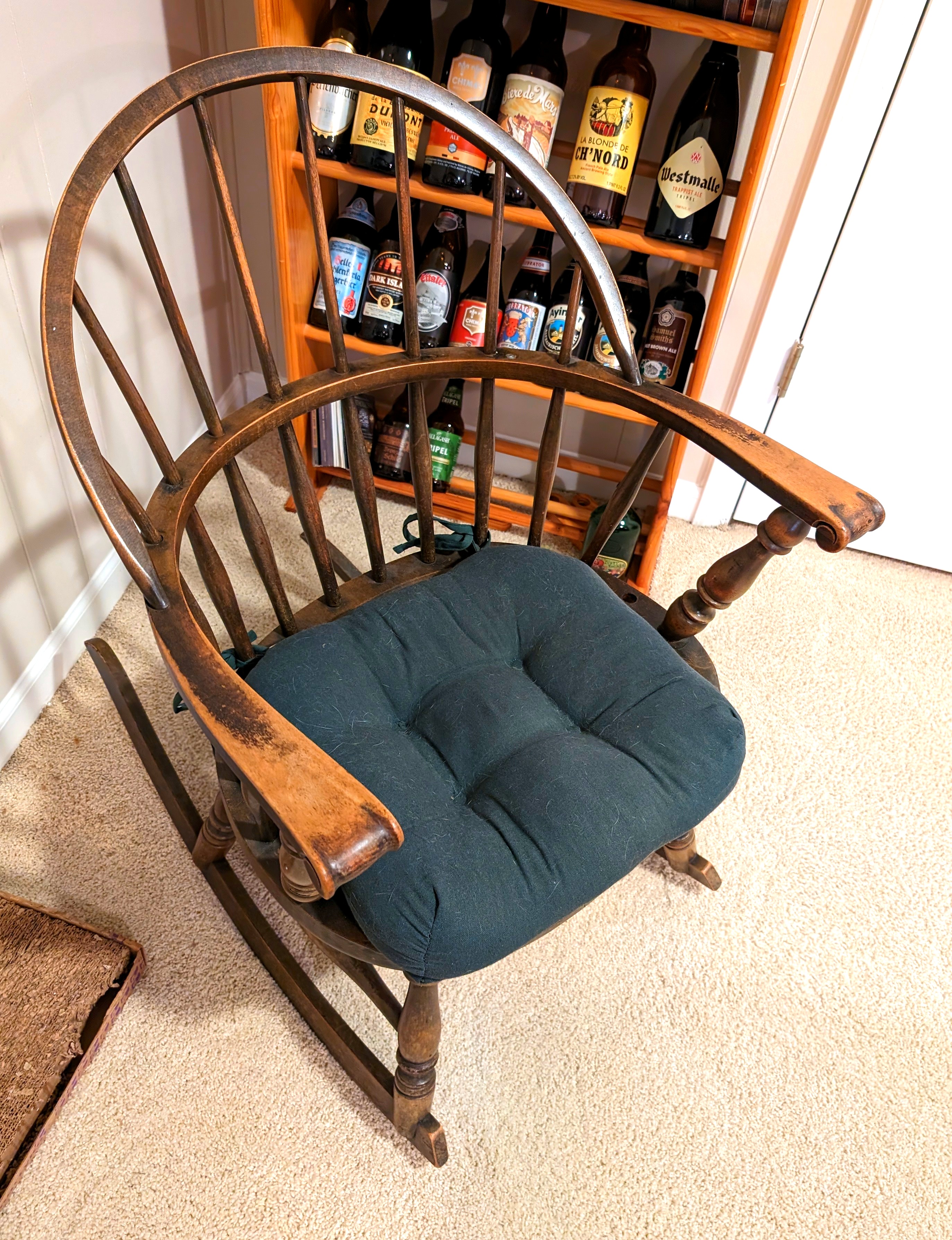
The true Captain’s chair. February 2024.
The matching chair. Note how all of these old chairs have lost the finish on the arms, due to loving wear. February 2024.

Despite my love for this older furniture, it has only graced our main rooms by necessity. Early in our marriage (the second, lasting one) we purchased a Broyhill recliner which echoed the wing-backed design of these older chairs complete with a brocade upholstery. It also complemented our older, inherited chairs. Unfortunately, only a few years after we did, we invited a streetwise cat into our house whose scratching habits proceeded to turn it into a tasseled mockery of itself. It sits in the rec room now, with the other rejects who form the viewing area for our ‘home theater’. (It’s not really a home theater; it’s two chairs and a love seat, all of which recline and are positioned as optimally as possible to a large TV with a surround speaker system. We invited the other chair in the ensemble into our living room in 2009, and sent it to the basement in 2017.) I’m thinking we should reupholster it and return it to its rightful place in our living room.

Early relegation to our basement (or worse) seems to be the norm for modern furniture. I would tell you of the two loveseats which have been purchased and abandoned in that time, falling out of favor and usefulness just as the one now in our basement, and I could detail the two sofas we purchased in 2006 and 2013, the former being replaced by the latter, the latter going “to a deserving home” in 2020. But we’re talking of chairs. We started 2020 with a fixation on chairs. We purchased four chairs which looked decent, solid, and worthy of the prices we paid. Two of them replaced two of the inherited chairs detailed above. Two motorized recliners replaced the sofa. Now, barely more than four years old, the two recliners have entered middle age, declaring themselves for the James Dean life with the exception they’ve never lived fast nor will they leave a beautiful corpse. They’ve become more uncomfortable to me as I deal with lower back issues. Luckily the two side chairs have been making their case for sticking around more than a few years. They simplistically mimic the older inherited chairs, causing me to wonder: why I don’t seek out chairs like that?

Before ending this, office chairs should be mentioned. Though often unremarkable, they offer a unique feature: they almost always have wheels. On top of industrial-grade, quarter-inch-thick carpet, these babies provide transportation to those unwilling to stand simply to walk 10-20 feet to a neighbor’s cubicle. (And that one time my four-person team found ourselves housed in a former microbiological incubation room with hard, sealed floors? One of eight such rooms on a hallway with the same flooring? Do you know how far you can push a well-lubricated chair on such floors? Not if you haven’t tried it!) Once, though, I purchased an old office chair my employer had slated for disposal. Although the calendar said 1997, this chair hailed from the 1950’s. Completely upholstered with wood accent on the arms, this chair would swivel and tilt just like modern chairs–but with no ability to make adjustments. Yes, it had wheels. And from that year until 2006 (I think) it served me well as my computer desk chair.

Ultimately we think of office furniture similarly to most of our then co-workers: there have been many but we remember only a few. Not so our heirloom chairs. Not so the chairs of our childhood, from the plastic-sheathed kitchen chairs to the kitchen stools to the weird plastic furniture used on our parents’ patios. Not so the chairs which graced our first apartments, entering the doorway by whatever means necessary, whether begging, stealing, inheriting, or in our last-ditch efforts, purchasing. Not so where we sat when visiting our grandparents, our uncles/aunts/cousins, or even our friends in college when a Naugahyde sack full of styrofoam could be called “a bean-bag chair”.

When I look at this cycle, I see that my parents’ chairs came and went, my chairs in school could at best be called functional, my chairs in early adulthood had value only because they were there, my chairs throughout my life have primarily existed only until I could replace them–but the chairs I inherited from my grandparents, the ones constructed in the 1920’s, the 1930’s, the 1940’s, have outlasted all of the others and, like the British monarchy, say, “yet, I’m still here!”

All the Dearly Departed

Five days after a funeral. Lake Lynn, 07 November 2019.

Warnings & Notes: This post contains a few graphic depictions of death, some examples of socially unacceptable behavior, and is just generally a downer if you look at it a certain way. Also, some of these observations have been made before. If you read this blog regularly (there’s only a half dozen or so of you), well, sorry….a little.

This year All Souls Day, November 2nd, marked the fourth anniversary of my mother’s funeral. It’s the day I most think back upon her life and death. The anniversary of her death, October 24, I barely note. Sometimes it even slips by me before I realize it. The funeral symbolizes my mother’s love, her life, and all those influences we spend a lifetime unraveling. In contrast, the date of her death represents thoughts I acknowledge but do not celebrate, and her passing is hardly something to celebrate in and of itself. I would rather focus on the entirety of her life and death: the funeral marked that, not the death.

My mother and I lived more than 2100 miles apart at that point. My profession had taken me to the eastern United States; she remained in Spokane, WA, from where she had encouraged me to follow my dreams wherever they led. Her parents had, my father’s parents had, they had themselves, so why shouldn’t their children? Still, it didn’t reduce my guilt much for not being more available to her in that last year, indeed that span of a half dozen years when she lived on after my father’s death. My brother lived nearly ten times closer in Tacoma but it took me only a few more hours to get there by plane versus him taking a drive across the state. He encouraged her to move to Tacoma. I half-heartedly supported him. She refused, saying her friends and neighbors were in Spokane.  I strongly pushed that she could move to a “retirement community” there in Spokane where some of her friends lived. She demurred, then refused. Her best support network were the good neighbors she had. She was right. We were wrong. I saw one of those retirement homes at the end of her life. I was really wrong, and–

But I’m not going to rehash that whole period. I’ll just note this: I watched her steadily decline during the five years after my father died, visiting her more and more frequently. (The Fates blessed me in several ways when 13 months after my father died, I started traveling the country for work. It became just as easy to fly to Spokane as to Raleigh.) In December 2018 my mother learned she had Stage IV breast cancer. At 89 years, she recoiled from and declined chemotherapy, threw her lot in with hormone receptor treatment (a pill, nothing more), and for various reasons was in and out of hospitals, convalescent homes, and her new apartment in a “retirement community” through the fall of 2019. She celebrated her 90th birthday in that apartment.

I visited my mother a dozen days into October 2019 as she lived her final days. I returned home only to receive The Call two days later. It was a Thursday. Knowing my brother could drive there quickly, and emotionally exhausted from watching her exist in a morphine-induced stupor, I rolled the dice, told him I wouldn’t come until Monday, and I let him spend Friday through Sunday with her. I flew back on that Monday, and sat beside her bed a lot until she passed away on Thursday. My brother had returned to his home and job. Thus it fell to me to handle the first round of details.

From the moment a loved one dies, those closest to them experience a bewildering whirlwind of details thrust upon them which must be handled immediately. As the elder of two children, the most controlling of us, and frankly, just because I was the one there, it fell to me to make those arrangements. Again, I shall refrain from a step by step accounting of it. This is supposed to be an accounting of All Souls and a celebration, not a macabre dwelling on those days of death. One example shall suffice: on Thursday morning, the day she died officially at 10:22 a.m., I had to leave her to be at the bank when it opened at 9 a.m. The instruction manual entitled “What You Will Have To Do When Your Second Parent Dies” never made it into my mailbox, I guess. If it had, maybe I would have been better prepared than to learn in her final hours that her investment accounts would be frozen for disbursement when she died, and that as her executor I would be paying bills with whatever sat in that bank account for the foreseeable future. The bank account had less than $3200 in it when I dumped a huge amount in there. Take note if you’re ever in this position: for the next year, I had to pay bills from that account. If I hadn’t done that, my brother and I would have had to agree on splitting the bills. Really, take note.

My mother’s death came as  a relief. I’m saddened to admit her death came as a relief. I know many have said this, but I feel as I feel. She had suffered with increasing pain from the breast cancer for a year. I doubt anything can prepare you to listen to your mother slowly drown and die, to realize the fluidic sounds of her breathing come from her lungs as they slowly fill, to watch from a removed perspective as your voice sharply criticizes the health staff which insists on turning a patient even when this obviously makes the breathing worse. Beyond prayer, I simply endured. I carry with me that immense relief I felt when I re-entered her room after a short phone call from her cousin and discovered my mother had died. I also carry with me the commensurate load of guilt for not being there at that moment. The part of me formed by social mores scolds me perpetually; the accepting, independent side of me simply says, “that’s the way it happened. There’s nothing which could have been done at the time, and there’s no shame in feeling relief.”

In contrast to the anniversary of her death, which represents a smorgasbord of feelings, few of them good, even fewer comforting, the anniversary of the funeral represents a day of love. It’s the day remaining friends and family gathered to mark how much they loved your mother and how much they would miss her. It’s the day you created all the little remembrances which would afterward become powerful symbols in your life. It’s the day you got to reminisce about all the times: mostly good, some bad, some funny, some sad. It’s the day when many told you “You did a good job by your mother,” even if they were lying a little bit. And it’s the day you closed the door, for just a bit, on all of those things which just have to be done. It’s the day when you looked forward to a few days where nothing about your mother’s funeral and estate needed to be accomplished: those things would wait a few days–with luck, a few weeks.

Each All Souls Day since that time refreshes all these memories. It’s the stem that gathers all the roots of remembrance and supports the branches of What Has Come To Be. For me, it’s inextricably bound up with my decision two weeks after her funeral to retire. Those twin events, her passing and my retirement, have become tied to those crazy years when a pandemic changed our society, or perhaps, when it revealed who we had come to be. All Souls Day, which exists quietly in the immediate shadow of its more important sibling, All Saints Day, and is heralded by All Hallows’ E’en, tells us it’s important to mark the passing of those we loved and to pray for them, to remember them, to honor them. By its existence, it says to ignore the ones who have been declared important, and that we must instead recognize the importance of each of us.

Mostly, though, All Souls Day reminds all of us of the death of those we loved. It picks at the scab of a wound which will not scar over and which has become part of who we are.

Random thoughts

Yates Mill Pond, NC. October 2023.

Things that have been bouncing around in my head lately:

  • What’s wrong with these directions from a recipe I used this morning? “Sift before measuring: 2 cups flour.” Seriously, Joy of Cooking? How do I sift 2C without measuring it first? (The waffles were delicious, however.)
  • I’m trying to be on a stay-cation while my wife travels to Florida. This means I don’t want to do “chores” — but I reminded myself that “even on vacation, one has to pack the trunk.”
  • One of the all-time best blues-rock (Chicago style) performances is Kenny Wayne Shepherd’s “Dance For Me Girl” on Live in Chicago.
  • Attaboy, Harper!” Jesus, don’t poke the bear, Arcia. That’s just basic Survival 101. As if Bryce needed more motivation!
  • I’ve realized recently my emotional IQ hovers around “special needs”. Unfortunately, my intellectual IQ makes me think I’m the smartest person in the room at all times. In terms of roulette, smart people think that just because it comes up red 98% of the time, it will always come up red. So, 2% of the time they’re wrong. Unfortunately, we never know if “this time” is in the 2% or not.
  • Getting old sucks.
  • I will need to be institutionalized if my wife dies before I do. There’s only so much crazy society can tolerate. (Our current politicians notwithstanding.) I’ve been alone for four days, and I remember how the internalized thoughts and lack of social contact distill the craziness. Not pretty.
  • Those of you with big families have no idea the paucity of having few (if any) relatives. I have/had one uncle, four cousins, and one brother. Grandparents died, the uncle died, one of the cousins has died. My brother had two children–one is estranged to the point of “whereabouts unknown”. My close family consists of a brother and a niece. My wife, meanwhile, has seven siblings, and 23 nieces and nephews, and her parents are still living. Those nieces and nephews have had a good handful of children. It’s night and day here in my house.
  • I daily lament not “getting to the important things” and then spend the afternoon reading, cruising the Interweb, and drinking beer. And writing posts like these. Not one important thing is addressed.

a scant century of weirdness

On June 22, 1925, my father was born in Lansing, MI. Back then I presume he and his mother stayed in the hospital for at least a week. Remember that, it will come up later. His father, the Rev. Howard Pilcher, had taken what I think was his first job after seminary, supporting youth ministry at a Baptist church there in the Michigan capitol.

In 1989 my father retired in May, shortly before he turned 64. Certain waves move through the business world, and computers had transformed his workplace in the 1980s. He had not bothered to join The Movement, his life at work was getting to be a grind, and frankly, he had struggled with the interior conflict of being a minister’s kid full of ethics and morality while he worked in business. That he worked for a nominal non-profit (a Catholic nun-supported hospital) didn’t seem to make enough of a difference. When he figured that 64 didn’t make that much difference from 65, he bailed.

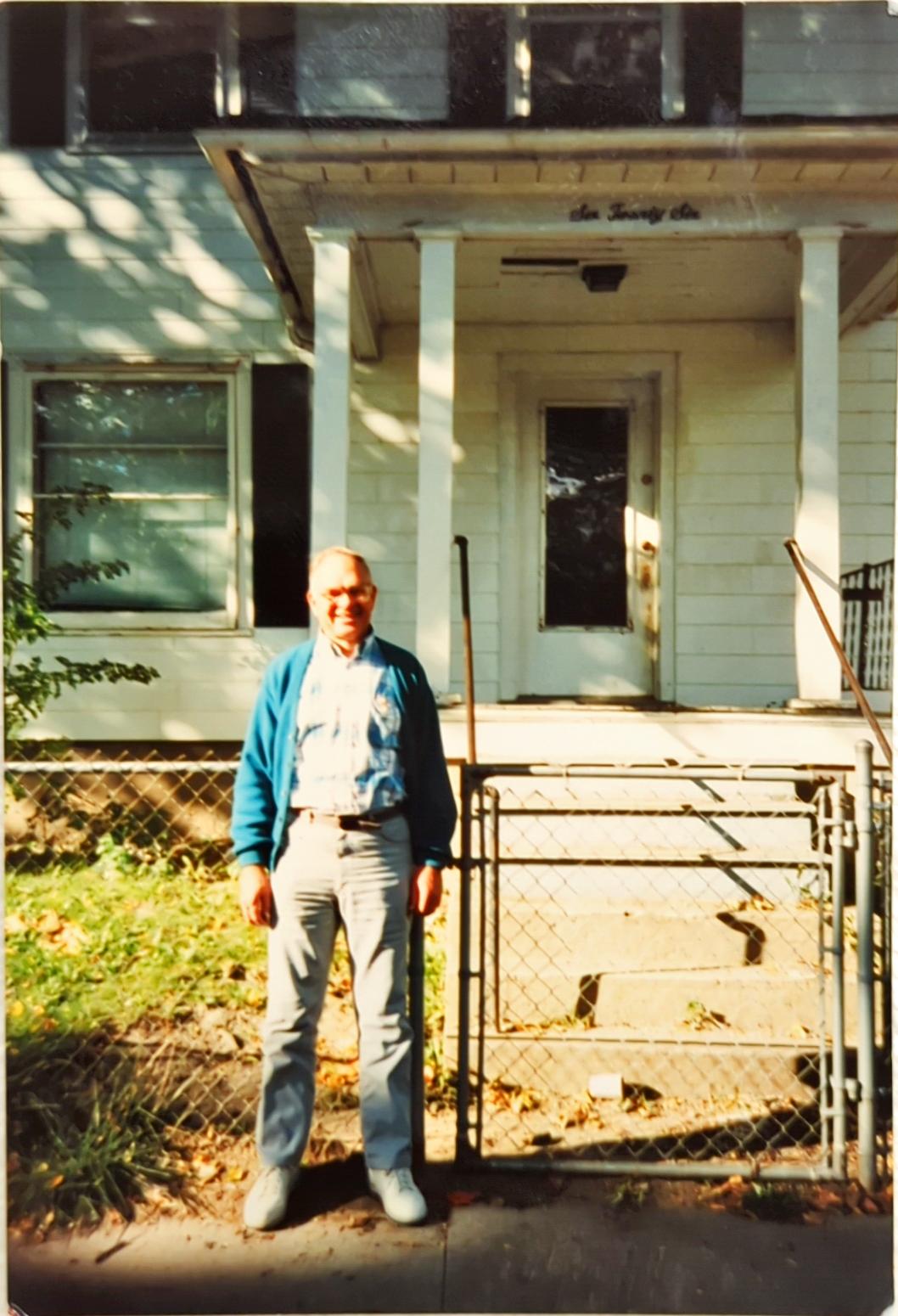
And only four months later, he found his way to the street he had ‘known’ as a newly born infant. He had my mother take this photo:

Howard Pilcher, Jr., in front of his first home. September 1989, Lansing, MI.

In 2013 my father died in December. My mother died in 2019. It was then I inherited all of their photos. Despite common sense saying in a whispered scream, “No! Just throw them away!” I instead sorted through every one of them last fall, noting the ones which documented salient events and/or salient people in our family lives or of my parents’. I ran across the above photo at that time, and smiled when I saw the address written on the back of the photo. Since we were talking about a trip to Michigan, I thought, “why not recreate the photo?” And thus in July 2023…..

In front of my father’s first house. July 2023.

I take a weird satisfaction in knowing it sometimes was weeks before a baby went home with its mother in 1925, and therefore, I stood in front of this house almost exactly 98 years after my father was carried into it. It’s funny how much stock is placed in this house since my father was moved at the age of 3 and never saw it again (to the best of my knowledge) until he was 64. I don’t know the address of his home in Edina, MN, where he lived from 3 to 14, nor do I know exactly where he lived in Havre, MT, during high school–I have a pretty good guess since they were always living in a parsonage provided by the local Baptist church.

As a side note, the resident of the house acted very graciously for all of the photos which were taken. (My wife didn’t understand the framing I wanted when she took the first set.) I went to the door to explain why someone would be doing such a weird thing. I couldn’t tell if he merely relaxed to know it wasn’t anything nefarious, or whether he just didn’t care.

Making sorghum syrup

Sorghum Mill near Greenup, KY– my Grandmother is on left. Oct 7, 1966

I have published this photo before to social media, but not in this edited format. (The shadows have been lightened to the point where my grandmother is recognizably her. The barrels stand out.) My grandmother was raised primarily in Greenup, KY, on the Ohio River, though she also lived in the nearby cities/towns of Ironton and Cincinnati, OH, before she moved with her mother and brother to San Francisco, CA. At that point she was a young woman and soon met her husband-to-be, my grandfather. When this photo was taken, she had not lived in this area (KY/OH) for 40 to 50 years. I am uncertain, but I know my grandparents married in the mid-1920s and were living in Seattle, WA, by 1929 when my mother was born. Greenup, KY is on the edge of the Appalachians. Though northerly (near West Virginia and western Pennsylvania), the so-called hillbilly influence was large. My grandmother told a story of her grandmother (her mother’s mother) coming out of the hills to visit, complete with logging boots and corncob pipe. It likely affected my grandmother–she put on airs all her life. But that is another story….

They Built This Marriage

(on the 50th anniversary of my parents)

They built this marriage as one
They sensed a need, they searched,
They found each other. Said,
“We’ll build on solid rock,
Full in the teeth of storms
That Life will hurl at us.
Where winds of public pressure
Howl–demanding that we bend–
We shall stand unbending.”

They placed love-stone on love-stone
With care-full hearts. They built
For strength by leaning in,
Encircling their love with walls
That have no end. They topped
This edifice of love with
One Central Light.
Transparently they prismed out
This Light: two directions,
One purpose, guiding,
Enlightening by being.

They tend this monument
That it may never crumble.
We can’t conceive its non-
Existence; surely it
Has always been there. We
Thank them, though we know
They did not build for us:
Their love’s completeness
Stands before us.

(My parents celebrated their 50th on 26 July, 2002. Ten years later they celebrated the 60th. My father passed away the next year, but well after 61st. I’m not totally satisfied with it, but I don’t think it becomes better after almost 20 years…unless it’s rewritten entirely. I’m having a bit of frustration trying to get WordPress to do what I want. I want the poem to be in the center of the page, but to be left-justified for instance. And one of the lines is supposed to be broken across two physical lines, a la Shakespeare, but WP takes out the spaces I put in to make it so.)