This past week we journeyed to Santa Fe, NM, where my brother has lived for about four years. This represented our last chance to do so, because he plans to relocate to a different state next year. Although our first two visits in 1996 and to my brother’s house in 2022 left us unimpressed with the city and its surrounds, I found my attitude changing this time. I think taking a more relaxed approach to each day helped, plus I’ve slowly decompressed over the past five years of retirement. My past as a Road Warrior for several years took a big hit when we all sat around in 2020 during the Covid pandemic. It kicked into gear again in 2021 and hadn’t dissipated by 2022. For whatever reason, we found ourselves hitting a few museums, seeing familiar sights, finding some new ones, and spent late afternoons in conversation prior to dining out every night. (Dining out might have aided our feeling of “vacation”.)
A few representative photos:
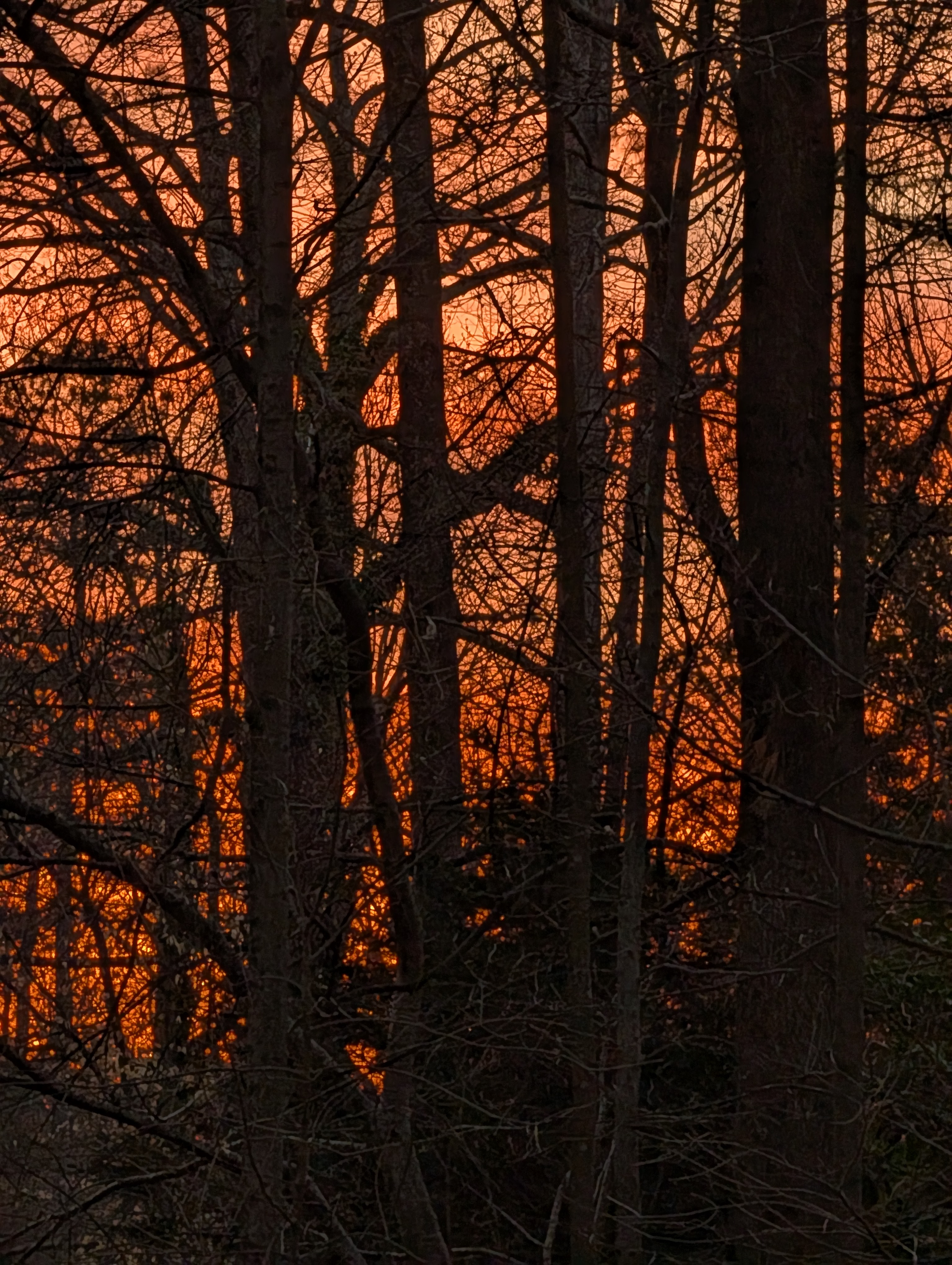
October begins: outside the Santa Fe Brewery on October 1st. Less than 2 miles from my brother’s house as a crow flies, but 4.4 miles by car. We stopped for a couple six-packs after a fine dinner at Escondido Santa Fe. I miss sunsets like this from my first decades in the western US. One needs to see the horizon to get good sunrises/sunsets. October 2025.
By October 2nd the federal shutdown in America took full effect, and we found all facilities closed at Pecos National Historical Park. I was unaware an important Civil War battle had been fought here when the Confederacy attempted to control the gold being mined in southwestern states. October 2025.
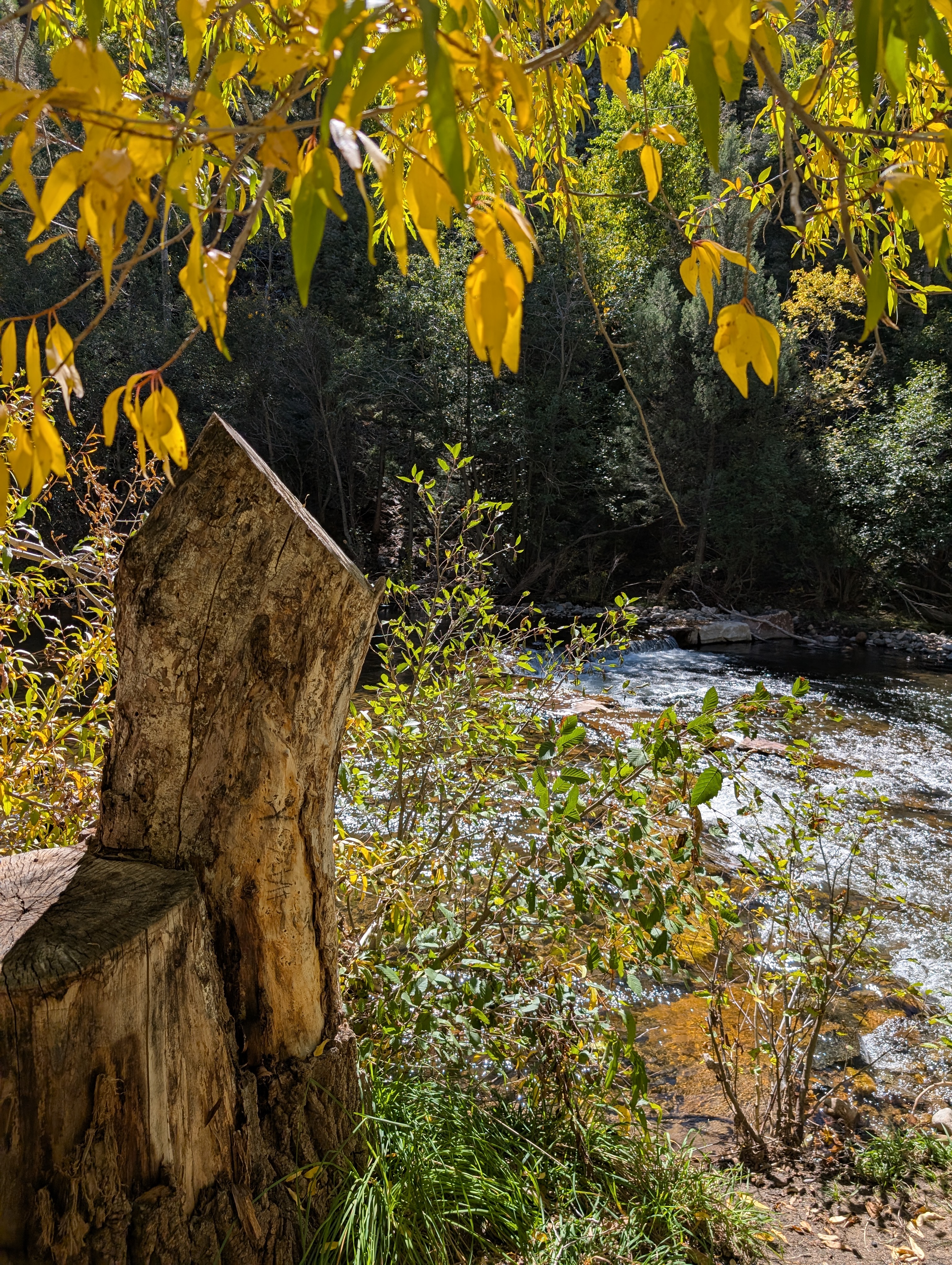
Because the national park closed, we turned north to a state park on the Pecos River. It catered mostly to campers and anglers, but provided some beautiful spots to stop and admire swiftly flowing water beneath the first signs of autumn. Rivers aren’t common in the semi-arid southwest. October 2025.
We visited the Georgia O’Keeffe museum Wednesday, a must stop because we had missed it in 2022 when our only day to do so turned out to be the day it closed. Out of deference for the artist I won’t reproduce her work here, although photos were allowed. Similarly I won’t reproduce the artwork I photographed at the Wheelwright Museum of the American Indian on Friday, October 3rd.
We ate New Mexican style food at Escondido, La Choza, and a super-high-end place called Sazón in downtown Santa Fe. On the 2nd we ate Indian at Paper Dosa, a restaurant we had seen on Diners, Drive-Ins, and Dives (Food Network). Mostly I will remember north central New Mexico like this:
On a walk from my brother’s house. This actually is in the middle of housing developments in the southwest part of Santa Fe. Housing in central Santa Fe is very expensive. I don’t remember the name of this yellow plants, but it’s everywhere. October 2025.
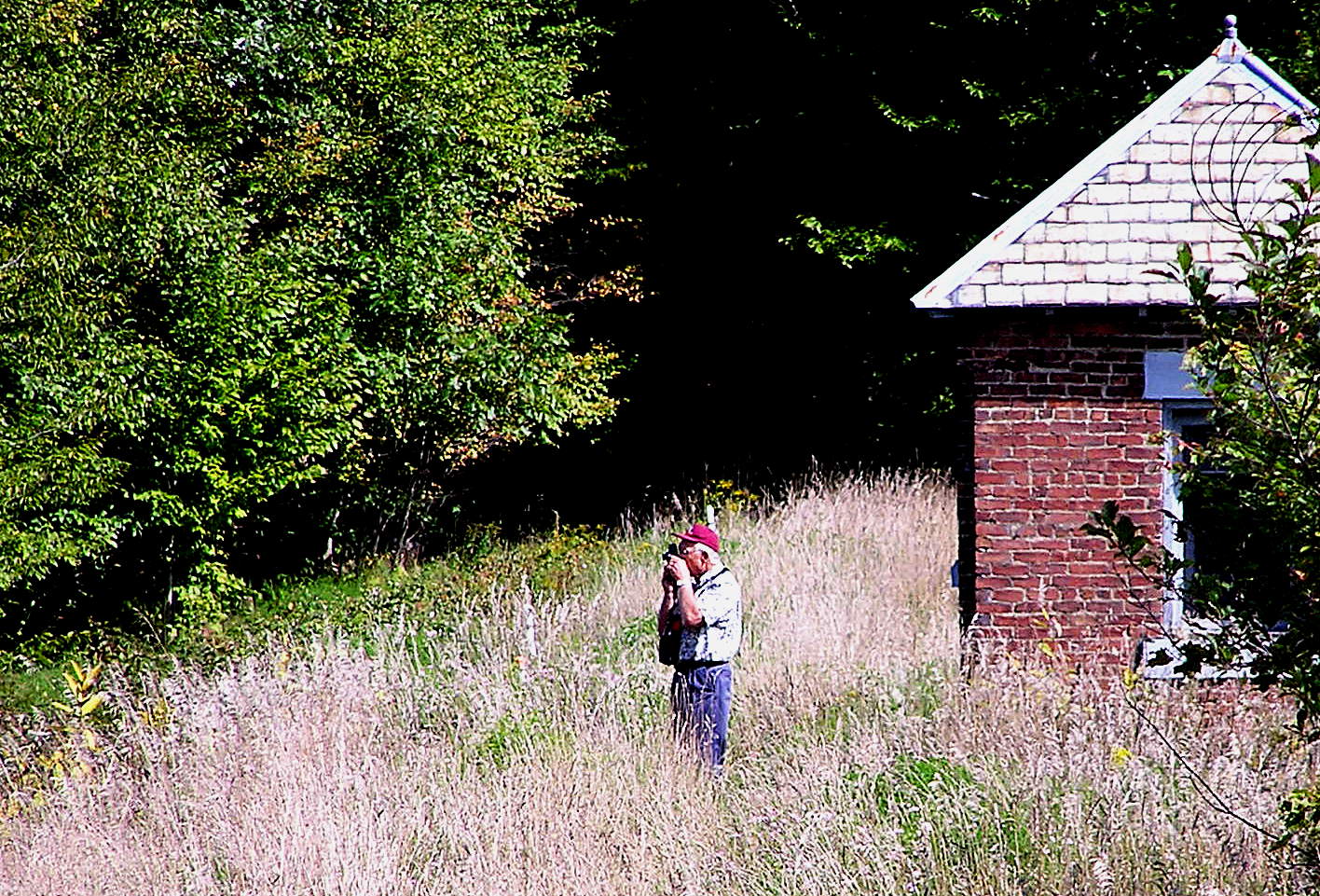
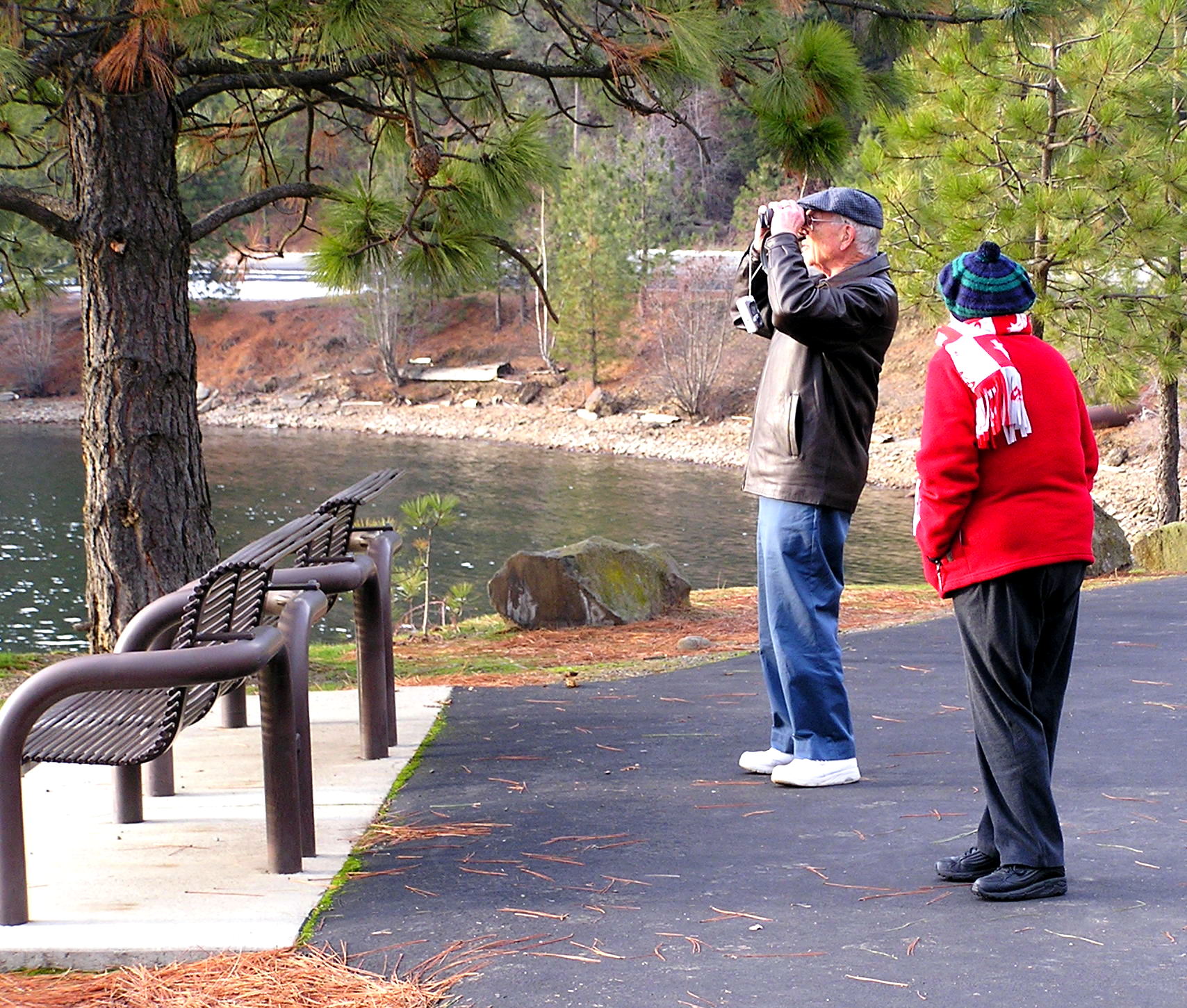
In this photo from the end of 2006, my father attempts to count all the eagles we’re seeing at Lake Coeur d’Alene, ID, while my mother wonders what the heck he’s doing. December 2006.
Our parents shape our lives. Even those who abandon us leave indelible marks on our psyches. Wonderful, painful, soothing, agitating, perplexing, satisfying, loving, and even the hatred—all of our reactions to them mold us. By the time we realize this fully, chances are they’ve departed our physical lives, living only in our memories and those of others. When I reflect on my father, I’ve come to realize he formed me more than any other person. One aspect of that recurs multiple times in a day when my mind ‘blinks’ and spits out an arithmetic calculation or it juggles a jumble of letters seemingly without conscious thought and spits out a perfectly spelled word. Patterns and numbers, numbers and patterns, all a gift, a curse from my father.
My father, Howard Bliss Pilcher, loved numbers. More than that he loved doing things with them, and he did them quickly. He inherited this from his mother, and he bequeathed it me for which I’ve (mostly) been grateful all my life. This pattern-recognition talent allowed me to move from career to career doing things I had no training to do. Yet there I was. My father never fully realized that aspect of it though I think he could have. I brought dreams and abstraction to his gift, seeing patterns in just about everything. His fixation with patterns and numbers remained in the concrete, the defined, the specific.
Numbers make patterns as do letters and words. Again, my father dwelt on how the letters made words yet never scaled the heights (plumbed the depths?) of how words make sentences and sentences make Writing. Not that he couldn’t write well, but his writing never would have challenged anyone in a writing club. It’s as if playing with the nuts and bolts was so much fun, why become a mechanic? He would delight in words with odd combinations of letters or how words tripped off of the tongue. He adored knowing arcane and niche words such as triskaidekaphobia (fear of the number 13). He once stumped us all (Mom, my brother, and me) at the game Probe by playing the word eleemosynary. This word describes things related to charity including being dependent on it. In Probe, played a bit like the paper game Hangman, contestants choose words by putting letters face down on a tray with 12 spaces. If the word is smaller than 12 letters, one fills the extra spaces with blank cards. Each player takes a turn guessing specific letters of their opponents. In that way it also resembles Wheel of Fortune. My brother and I were about nine and eleven, respectively. We expected and understood that our parents would use words with which we would be familiar. We had very good vocabularies due to hanging around them and from our incessant reading. As you might surmise, however, we were unfamiliar with eleemosynary. Heck, my mother didn’t know it! When all players of Probe have had their words revealed except for one, the remaining players each have two turns to guess the word. We never came closer than thinking it was elephant. I remember nearly sixty years later being so upset as to be near tears that he would think we’d know this word! He apologized, grinning awkwardly, sputtered something about charity—but he kept the points.
But doesn’t everybody?
Around this time we learned from our Uncle Gordy, my father’s brother, that he (and maybe their parents) had teased my father for his repeated incredulity that someone didn’t know something or do something that he did. “But doesn’t everybody…” became a way to slightly dig at his recurring belief that everyone could do what he did. This caused him to try to teach me to do long division in my head when I was 8, and before it had been taught in school using paper and pencil. On top of it all, we were weeding the garden at the time. That episode ended with me crying. Some other cases in point:
Every year in the arid West the pine trees drop needles and cones. Thankfully these events do not occur simultaneously to the best of my memory. Spokane might be the capital of the Lawn Nazis, those people who will semi-innocently ask you if you need help with lawn “because I noticed it’s getting a little long” or “I see you’ve had a bit of difficulty getting to your needles.” One did not leave needles and cones lying around on the lawn! I hated raking needles which my father always seemed to pawn off on his boys. Picking up cones, however, somewhat delighted him because as he picked them up, he would count them. “We got 103 cones this year from the front yard. That’s a new record I think!” and off he’d go to check. Yes, he kept track. When we were long gone, I could tell he still did this because the new neighbor across the street knew exactly what we were talking about decades later.
Our family vacations every summer involved driving for up to two weeks to visit scenic wonders and relatives. By the time I entered high school I had visited most of the national parks in the West, though getting further south than the Grand Canyon remained for my adulthood. On these vacations my mother rarely drove (and when she did it was with white knuckles—hers, not ours). My father kept car records on a 5.5 inch by 8.5 inch piece of stock on which he manually drew lines and columns. Each gas fill-up required the date, an odometer reading, the number of gallons purchased, and then while the attendant filled up the car’s tank (ah, those were the days) he would calculate the car’s gas mileage since the previous gas stop.
On any drive, vacation or not, we would at intervals be treated to his light double-tap of the horn and announcing to the car’s passengers, “that’s fifty thousand miles!” or “look! All fives!” Yes, he celebrated when the odometer read 55,555.5 miles. Or when he got 12345.6 miles. There were many possibilities. (Unfortunately this rubbed off on me a little bit. I routinely wake during the night and say to myself, “Oh, it’s one-two-three-four” when the clock reads 12:34 a.m.)
He particularly fixated on license plates. It feels wrong to say he memorized them. My father saw license plate designations as others do names they want to remember. He didn’t know only the plates for our two cars. He knew all of his friends’ plates, too. Though usually no more than a parlor trick—”hey what were you doing downtown last night?” he could say to someone whose car he saw on the way home—once this came in handy. A family friend called one evening: “What’s the license plate on Pete’s car?” A family emergency had occurred while her husband Pete was driving across the state to Seattle. She needed to tell the state patrol his car’s license plate number so they could find him and tell him to turn around. My father dutifully answered her, and Pete returned home as quickly as possible.
My father easily multiplied two two-digit numbers in his head. I remember an evening when I made him take me to an Amway meeting to see if this would be a way to earn money for college. We both realized quickly this definitely wasn’t for me, but we were too polite to get up and leave because we had sat in the front row. At a certain point the speaker began to illustrate how much money a person could make, citing X number of units on which a person would earn Y amount of profit. Before the speaker could punch all the numbers into his calculator my father piped up with the answer. After a few such examples, the speaker quit trying to use the calculator and just turned to my father for the answer.
Typos and misspelled words irritated him. He couldn’t fathom how a person possibly would fail to see the incorrect pattern. One of his favored word games was printed in the newspaper, buried in the classified ads. (If you’re younger than 40, classifieds were really small type printed at the back of the newspaper and somewhat like Craigslist.) The game was called Jumble and ran for decades; I remember seeing it in the past 20 years. Five (four?) words were jumbled up. Playing the game required one to unjumble the words, then take certain letters indicated by circles and use those to form an answer to a tongue-in-cheek question. “Why the sculptor disappeared”; “He was BUSTED” My father didn’t do these frequently because he instantly saw the words, working more or less like a lexicological hot knife through butter.
He counted everything, knew the patterns and sequences of most common things. If he bought a rack of Presto-logs (his preferred way to burn a fire in the fireplace), he knew soon how many stood in the rack. He knew what day of the week a certain date fell on…27 years ago. He knew how many lightbulbs were on the strands of his Christmas decorative lights, how much he weighed every day, where his stock prices ended yesterday, the number of feet from here to there, and the number of miles he had driven if you asked him point blank in the middle of sun-blasted Nevada. Once we were digging around in his dresser—certainly we weren’t supposed to?—and found a slim memo book small enough to fit in a shirt pocket. It dated from his fraternity days at Washington State College. In it, he had recorded the scores of every single ping pong game he had played against his frat brothers. More interestingly, there were three pages at the end with only the first names of women and a number after them! Since we cannot fathom my father being that much of a ladies man—there had to be three or four dozen names!—we’ve been baffled what the numbers meant. Kisses? Number of dates? Both strain credulity. A rating system? Even more unlikely. He certainly got embarrassed, though, when we made a big deal about it. Maybe…maybe… He never revealed what the numbers meant, but we noted he never threw the notebook away either.
When my family celebrated the gift-giving which happens at birthdays and Christmas, we always laid gifts out on the hearth of the fireplace. When my mother turned 64, her grinning husband led her to the hearth where she found a cubical box wrapped in plain paper. It measured nearly two feet on each dimension. Every face of it had a large numeral “4” drawn on it. Baffled, she looked at him quizzically. My father said, “Well, you’re sixty-four today!” She just scrunched her brows a little bit more. “You know,” he explained, “you’re sixty-four. That’s four cubed!” His grin must have been nearly ear to ear. My mother didn’t share his enthusiasm.
Sadly, I found after his death that his obsession with patterns did not extend to how he kept track of his financial information. Files were in disarray, his migration to using spreadsheets had been less than successful, numerous lists of critical information existed but they contradicted each other, and the trivial received thorough documentation but the important didn’t always. As an example, without understanding what his accounts were and where, I didn’t know for sure how much money my parents had in their investments. Seven years after he died, and one year after my mother had joined him, my brother and I found a certificate of deposit in their safe deposit box. Nothing indicated whether it had been received into their normal cash flow when it matured, or if it might be sitting somewhere waiting to be collected. We never could track down the company which sold it to them, and decided it must have been collected—but 25 years after maturity, the CD paperwork sat in the safety deposit vaults.
When I partially wake at night to stumble toward the bathroom, I idly look at the clock. Instantly, and whether I want to or not, my mind cranks out the amount of time since I turned out the light. I remember all the times I wake to do that or to feed cats, then regurgitate them to my wife in the morning. “Well, I was up at 4:37 feeding the boys.” My father lives in me at those moments. He whispers like a schizoid voice and makes me count the cars I see on a lonely stretch of highway. He makes me frown disapprovingly when I read yet another grammatical error in what passes for our newswriting these days. He laments that I don’t figure my car’s gas mileage, stares in disbelief when I search my brain for my own car’s license plate number, and smiles when I record the amount of rainfall for yesterday. I don’t tell him it’s only because I need to know when to water the yard. And I hope he’s proud of me for all the new ways I’ve used his gift to see the numbers and patterns in quality systems and manufacturing results. He never really said one way or another while he lived.
Howard, 11 weeks; with his mother, Esther Dahl Pilcher. Lansing, MI, August 1925.
Howard Bliss Pilcher entered the world on this date 100 years ago. He died toward the end of 2013. In those 88 years, like most of us, he did nothing to affect the globe or any large portion of it. His impact, again like most us, accrued from those individuals he knew and perhaps from patrons of the two entities which employed him for 39 years. He most affected his wife and sons, Steven (my brother) and Kenneth (me). Seventy years later, to me he remains both enigmatic yet an apparently open book. Whether nature or nurture, his traits run through my being. Whether you knew him matters not. He might have subtly affected you too: every one of us amplifies his presence on humanity simply by interacting with more than one person and making an impression them; it ripples out to touch people we never knew.
Howard Bliss Pilcher—technically a Junior though never named as such—came into the world in Lansing, MI, on June 22, 1925. He moved with his brother and parents from city to city as his father, an American Baptist minister, moved from church to church. The younger HBP served in World War II, completed college, started his career, married, procreated, retired, traveled, and died December 16, 2013. He resembled thousands, millions of other men born around the same time. We each are unique, though, and this unique man fathered and raised me. If we are constituted from our roots, our times, and our experiences, then exploring those roots isn’t so much recounting their life as it is exploring our own. Therefore, we can’t call this biography. I haven’t the time or desire to research the nuances of his history, let alone the history of the times and regions through which he passed. (And thanks for that, too, Dad.) But there will be biographical elements to it, just as there will be aspects of memoir stemming from his inescapable impact on my life, and how the two remain intertwined even after his death. Perhaps reminiscence remains as the most accurate term.
A confession before we start: I’ve procrastinated all my life—a trait which will be explored through the telling of this tale—and this procrastination has left me too little time to complete this piece prior to deadline. My vision for it looms at far too many words to dash off in one or two sessions. Unlike the great gonzo journalist Hunter S. Thompson, I cannot lock myself in a hotel room for a few days, wire myself on pharmaceutical grade crank, and pound out a semblance of the piece this subject deserves. My physique won’t handle it, my psyche won’t handle, my marriage won’t withstand it, and I don’t see why after seven decades I should start caring about deadlines now. Okay. Let us begin. We’ll start with the thumbnail bio:
The senior Howard Bliss Pilcher, my grandfather, the one my grandmother called “Bliss,” came into the world in 1894 in Urbana, Illinois. The Pilchers traditionally lived in north central North Carolina in Yadkin and Surrey counties, up by the Virginia state line, but the “movin’ bug” ran through our branch of the family as far back as the early 1800’s. Bliss’s father, Wiley Pilcher (1861-1935), moved to Illinois where he fathered all three of his children. Wiley later moved to Fargo, ND, and finally to Libby, MT. All of this perhaps explains why, when he heard the call and enrolled in seminary, he became an American Baptist minister. American Baptists were at one time called Northern Baptists and trace church lineage through the Triennial Convention, the first Baptist convention in the United States of America. In 1845 a pro-slavery faction split off from the Triennial Convention to uphold the institution of slavery. It came to be known as the Southern Baptists. Without researching the topic, we may surmise that many Pilchers would not have been happy with my grandfather’s choice, particularly the majority of them still living in North Carolina. The decision to minister in that denomination reflects the equanimity which characterized my father’s upbringing, and which he instilled in me.
One year after my grandfather married Esther Dahl, my father was born. Lansing, the capital of Michigan, had nearly quadrupled in growth from 1900-1920. Not only were these the Roaring Twenties but this sizeable city (about 67,000) boasted all the activity inherent to a state capital. Thus, he started life in the thick of it: the capitol building stood about a half mile from their house. Not that this would have had much of an impact since by age 3 the family moved to Edina, MN, a suburb of Minneapolis. In between was a short stint in Dover, ID, an unfathomably small and remote place for a minister to travel, perhaps explained because Bliss stepped up from being a youth minister in Lansing to having his own church in Dover. The family lived in Edina for ten years more. At the threshold of my father’s entrance to high school in 1938, his father accepted a call to Havre, MT. (I’ve started to wonder if the “calls” were based more on wanting to stay reasonably close to his father, Wiley. Edina lies less than 250 miles east of Fargo; Havre is 350 twisting miles east of Libby.) Four years later my father graduated from high school. He attended the local college, Northern Montana, for at least a semester, but the reality of World War II loomed. The U.S. Army drafted him, placed him in the Quartermaster Corps, and sent him back and forth across the Pacific guarding supplies.
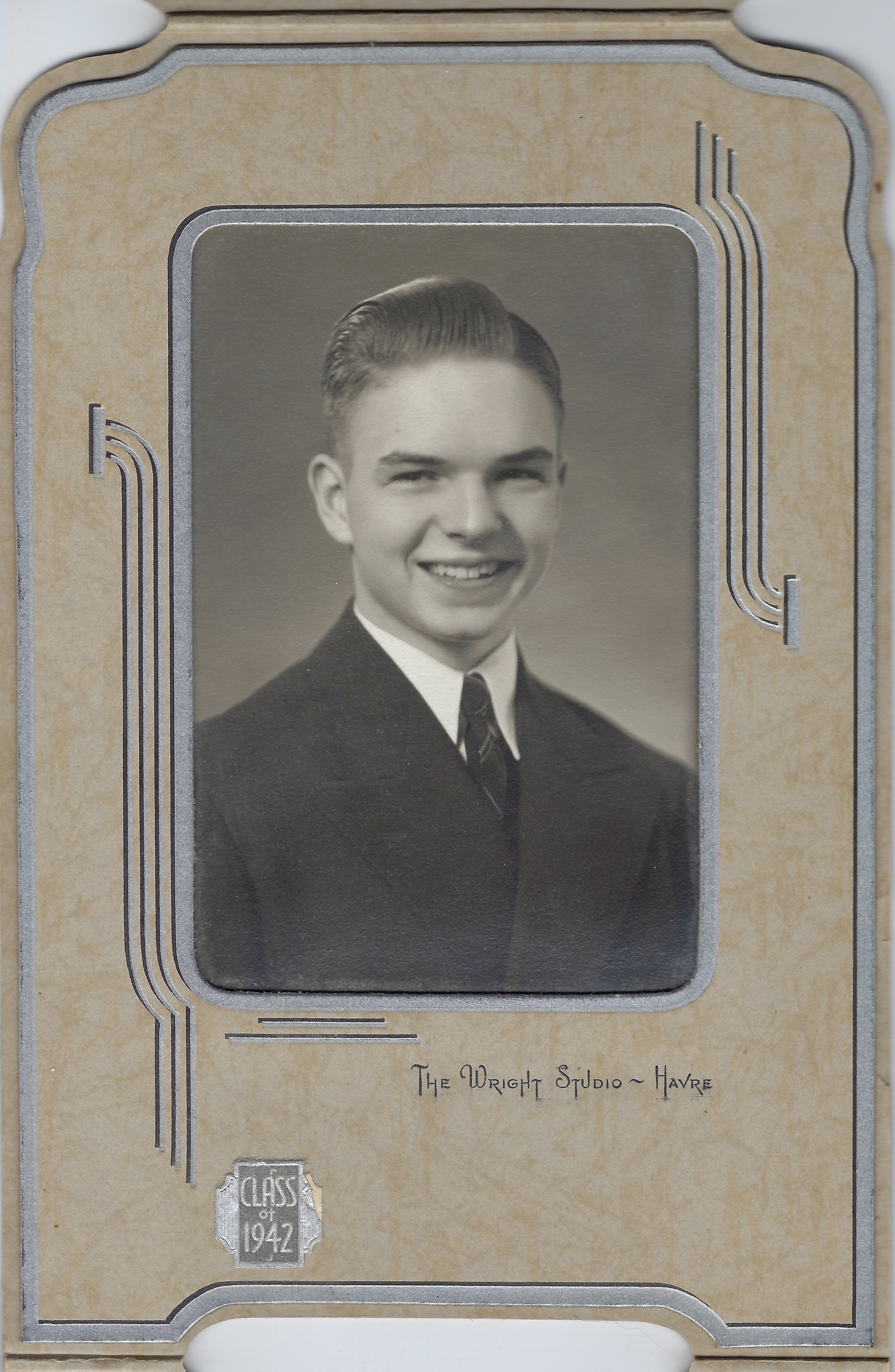
Howard’s senior photo from Havre High School. 1942.
At least, that’s what I surmise. My father didn’t want to talk about his time in the service at all. We did learn he made some grade of sergeant, but I only called him Sarge once. Let’s just say he made it very clear it would be the last time I called him that.
Howard mustered out of the service, enrolled at Washington State College (now WSU), hired on with the Carnation Milk Company in Seattle, married Louise Bach there in 1952, and they had a baby in 1954…me. We moved to Spokane, WA, when the Carnation Company transferred him soon after my first birthday. My brother was born there. My father accepted transfers back to Seattle (fall of 1962) then to Los Angeles (the beginning of 1964) before he made his dislike of Los Angeles and corporate life known. The company allowed him to go back to the same job he had left in Spokane just two years prior. We will revisit that career-killing decision. Four to five years later, as I approached high school age, he went through a personal crisis, quit Carnation, emptied out his profit sharing account, and maintained the family on that while he searched for a new career path. When a close family friend needed to fill a comptroller position at Sacred Heart Medical Center, he thought of my father who then began a very nice career managing financial matters for the hospital. As his mentor ascended the ladder of responsibility, so too did my father, eventually boasting the title Director of Fiscal Services. He retired after about 20 years of service to this medical center founded by the Sisters of Providence, a Catholic order of nuns.
In retirement he tended roses and indulged the Pilcher penchant for wandering by undertaking numerous road trips with our mother. There were a handful of trips by plane, but he fought claustrophobia for much of his adult life and those weren’t comfortable trips for him. Two trips abroad (England and Spain), a cruise package to Alaska, and near-annual trips to Hawai’i for a while rounded out the travel. They celebrated 50 years of marriage in 2002, quietly marked 60 in 2012, and he died after a sudden trip to the hospital in 2013 which saw him enter the hospital on a Tuesday and pass on the following Monday morning.
What did people think of my father? “That weirdo”? A “super nice guy”? “Honest as the day is long”? I know that he was loved. I know he withdrew toward the end of his life, and one by one most of the people he knew and loved died before he did. I know he worshiped my mother yet had a condescending tone toward her (which I adopted to my detriment). I know many, many superficial things. What I don’t know is the man he truly was, and what force ultimately took over the final five years of his life, making him mentally miserable at times. I know, too, it lurks within me and whispers that it just may do the same when my time nears.
This has been but a snippet, a dry telling of mostly factual matters, an introduction as stated in the title. To explore the man through reminiscence requires setting the stage. Much like reading your playbill before the curtain rises, you’ve now gained the background to enjoy the show (hopefully). In subsequent posts we’ll explore in no particular order and perhaps not under these self-same titles:
Ebullience, Positive Thought, and the Eleemosynary Ethic
Accruing Guilt: Understanding What Your FatherMeant
Father’s Day means less to me than many. My only children have been and are being cats. My relationship to the day runs one direction only, upward, to my progenitor. He left this mortal world more than a decade ago, but the memories remain vivid, accentuated by the passing of my father-in-law ten months ago. Life’s little irony, its bitter dessert: with every one of my years I understand him better; but this understanding always was for the Father in the past never for the Father of the now. Then he’s gone, and only the past exists. Unfairness salts this wound which never heals.
Growing up with this man my feelings differed, of course. How could they not? Once I became self-aware, our similar make-up combined with my contrarianism to make the sparks fly. This isn’t a truism. We argued and disagreed about everything. I remember these actual, real arguments, all of which went on for 20, 30 minutes, perhaps for an hour or more:
Does a body get colder or warmer immediately after eating? (I said colder, but neither of us had more than theoretical knowledge, and there was no Internet to solve things back then.)
If you learn a job applicant will be the second income for a family, should you favor the person who needs this job as the primary breadwinner? (He said yes, I said no. Back then the secondary income likely would be a woman’s, so the argument carried a deeper discussion about feminism and Women’s Lib.)
And one of my favorites: a yard should be allowed to go natural (said I); “you just don’t want to mow the lawn,” he said.
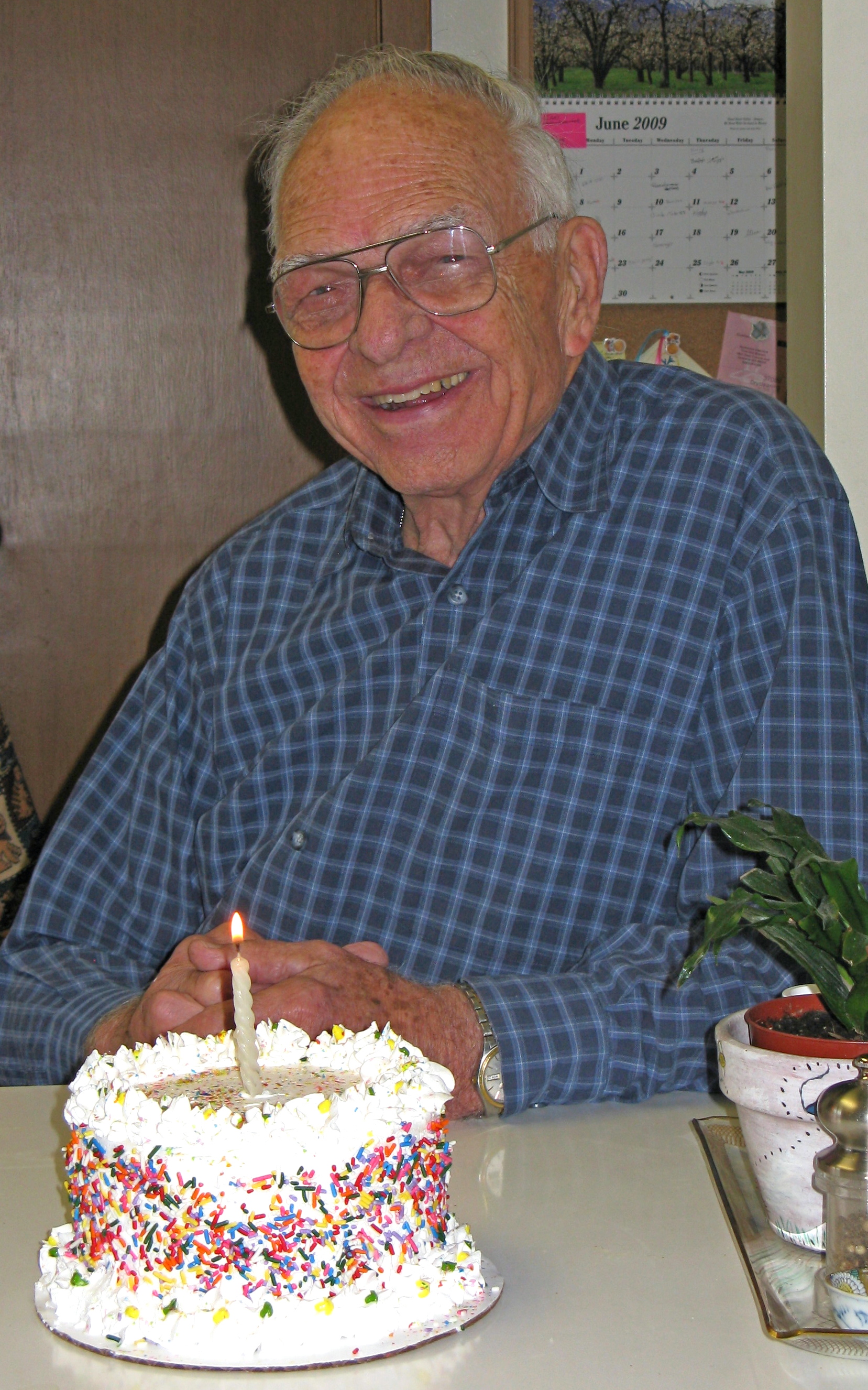
Father’s Day got diluted for him by the fluke of his birth date and the vagaries of politicians: it always occurred within eight days of his birthday. Take a look at that calendar over his shoulder. I used to hate Junes like that one. The third Sunday (and therefore Father’s Day) falls on the 21st. His birthday occurred on the 22nd. Two presents and two consecutive days I had to be nice to him. A year like this one, 2025, provided the maximum eight days of distance.
I used to commiserate with my brother (who took the photo above, I believe) about the monetary hit of birthdays and ‘parental recognition days’ in our family. Starting with his birthday on April 21st we ran through all the birthdays plus Mother’s Day and Father’s Day all by July 10th. In those 11 weeks he and I would buy five presents, an average of a present every other week. He especially hated June when my birthday (the 8th) smacked into Father’s Day (between the 15th and the 21st) and Dad’s birthday on the 22nd. And 18 days later came Mom’s birthday on July 10th. “The parade of presents, the meandering of money, the draining of dollars,…” —you get the idea. We didn’t have a lot of money back then; we bought our own presents, no help from Mom and Dad.
Despite this being my absolute favorite time of year with its leap into summer as the advent of June brings warm weather, the end of school and all the seasonal activities associated with it, and the chance to relax to a degree not permitted September through May, I run into these thoughts a bit more too. So many things become bittersweet with age. This continual discovery of more love for a man who’s gone remains one of the most important.
The world is going to hell in a handbasket. This attitudinal shift remains a nearly unavoidable aspect of aging. We age and cast off following things for their own sakes. For example, fashion? Oh sure, we keep an eye on it, rotating neckties or jewelry to our favorite “it-will-come-back-into-fashion” location, but we pick and choose. Skinny, tailored suits? On this old beer-bellied bod? I think not. Hip-hugging jeans, says my wife? “I never wore them when they were in fashion decades ago!” And don’t get her started about wearing clothes which look more like lingerie than outer garments.
Everything’s going to hell. For us oldsters, new technologies get picked up as they’re convenient, and when they serve a purpose, not because they’re trendy. Consider: smart phones debuted (debatably) in 2006. I waited six years, until 2012, to get one. Even then I got it mostly because I needed a better communication tool when I started consulting. I might have picked up one eventually. I’m sure I would have been forced/enticed into it sometime before 2020…maybe. After all, I’m a techie; I like all the toys. About forty years ago I could hardly wait to upgrade my first desktop computer or for it to conk out and justify buying a new one. Now? I’m leisurely approaching the time when I’ll dig into my Windows 10 machine and tweak its registry settings to permit upgrading to Windows 11. Another old man thing: texting has proven to be a boon but it doesn’t replace email. And why trade clean, open texting for the closed gardens of WhatsApp, the-app-formerly-known-as-Twitter, or Instagram? I resisted Facebook for years, but joined ten years ago. I grew uneasy with a technology that demands everyone ‘talk’ all the time. Doesn’t someone have to listen? And how can everyone something important to say? The horrible year of 2020 pushed me to delete the account. Who wants to be sanctioned for being reasonable? (I understand getting attacked for being ‘out there’, but for being calm and objective?) My point’s drifting here, old man! It’s this: seven decades in, one learns it isn’t very important to follow every trend…or pretty much any trend.
These thoughts crept into my mind as it wandered from thinking about our church’s chorister program (elementary and junior high students who sing in the cathedral once in a while) to the pre-pubescent boys who sing at New College, Oxford, or in the Vienna Boys choir, until finally it came to rest on my own 5th and 6th grade experience of participating in All-City Chorus in Spokane, WA. This program met once or twice a week after school in the most centrally located public high school, Lewis and Clark. How did I get there? I took the bus. Due to its meandering route the trip lasted about half an hour as it drove the seven miles from my elementary school to LCHS. I can’t remember if I took the bus home, or if my father picked me up, since he worked less than a mile away and would have been leaving work about that time. My brother similarly took private clarinet lessons in an old building downtown. It housed a music store on the street level and housed offices on the second floor, one for his teacher. My brother also took the bus, catching it at the end of the block where we lived, and traveling the same amount of time and distance as I. This wasn’t unusual for 10-year-olds at the time. My mind kept wandering. I wondered how common that is now. I don’t know as a parent if I would rest easy letting my child do the same. I’m certain few if any modern parents would. Kids seem to be scheduled for most of their free time and driven by an adult to these activities. This illustrates my point, the one I wandered to this morning:
Old people experienced a different world. I don’t care which generation you’re considering, it wasn’t necessarily worse in their mind. We–any of us at any point in time–dealt with what we dealt with. Life presented itself, and we were up to date with it. We cling to some of the practices from back then, not because they’re antiquated but because they worked. We cling to the beliefs which those practices engendered. Let me explain, by way of an example, how life occurred and thus, how we think and thought. Consider the situation in which two parents decide to let their boys travel alone on a city bus after school. During the winter we left our respective music activities in the dark—Spokane lies a latitudinal degree further north than Duluth, MN, and almost three degrees further north than Bangor, ME. How could a parent allow this? First, we didn’t have two cars. Though we were comfortably middle class, it wasn’t that unusual for families to have only one car. My parents decided they could share it—Dad took the bus at least two days each week—and the money would be better saved for other things (notably our college education). Dad could have taken the bus on those music days, though, leaving Mom the car to shuttle her children.
But you see, that was just a strange notion back in the 1960’s. Kids gained in freedom when they gained in age and maturity. When we were very young, three to five years old, we were told where our boundaries were in the neighborhood. We respected them (mostly). We got to travel the block and only on our street. I got in severe trouble when I crossed the street at the end of our block and decided with a couple other kids it would be fun to roll rocks down the hillside. (It didn’t occur to me that there were cars on the road a hundred feet below us or what a rock the size of a teapot might do to a car.) When a county sheriff’s deputy delivered us to our parents, we caught a lot of hell. When we were in elementary school we wandered wooded lots, rode bicycles for miles away from our homes, and all we had to do was say, “Mom, I’m headed down to Mitch’s house!” As we neared and then entered junior high it was more like, “so where did you two wind up today?” from my mother. Our parents expected us to entertain ourselves, stay safe, and observe the behavioral rules they laid down. We did pretty good with that first part, fairly good with the second part, and…what they didn’t know didn’t hurt them, right?
Today therefore represents a path to perdition, always, for every old person. I stay optimistic generally (and the further I look into the future), but many things worry me about habits which younger people have acquired. I now can see that 100 years ago cars would worry a 70-year-old born in 1855. “Everybody scootin’ and tootin’ these infernal muh-SHEENS! T’aint nachurl! Next thing ya know, people won’t even live together cuz they can just drive to work!” with the word “drive” carrying all the distaste and disapproval an old man might feel.
Humans measure the world using an internal scale developed through experience. We slow our learning process with each passing year, experience becoming a boon and an obstacle to learning new ways. Fifty years later, we don’t even see the same world as younger people do. This is neither good or bad; it simply explains our attitudinal shift. Maybe you caught a bit of that here, but I fear I’m too caught up in it to accurately relay it to you. Everyone my age is nodding their head while everyone thirty years younger has made some derisive sound en route to dismissing the whole notion out of hand.
It’s been a lengthy stretch of sporadic posting at best. I’ve excused it with “spending time with my wife” and “getting things done” which certainly sound worthy. We’ve just returned from attending her mother’s funeral. (More on that later.) A slate of urgent tasks demands my attention, as does maintaining my health, both physical and mental.
A few pieces of writing, stubs and nothing more, await more attention than I can manage right now. Today let’s just review the two-plus weeks since I posted a hawk in our front yard. Hawks continue to drop by, a vivid affirmation to our decision to rip out the front lawn and install native plants—and especially to my decision to let the leaves lie where they fall. The leaf cover has fostered those little grubs and bugs birds like eat and extends to small rodents for the hawks.
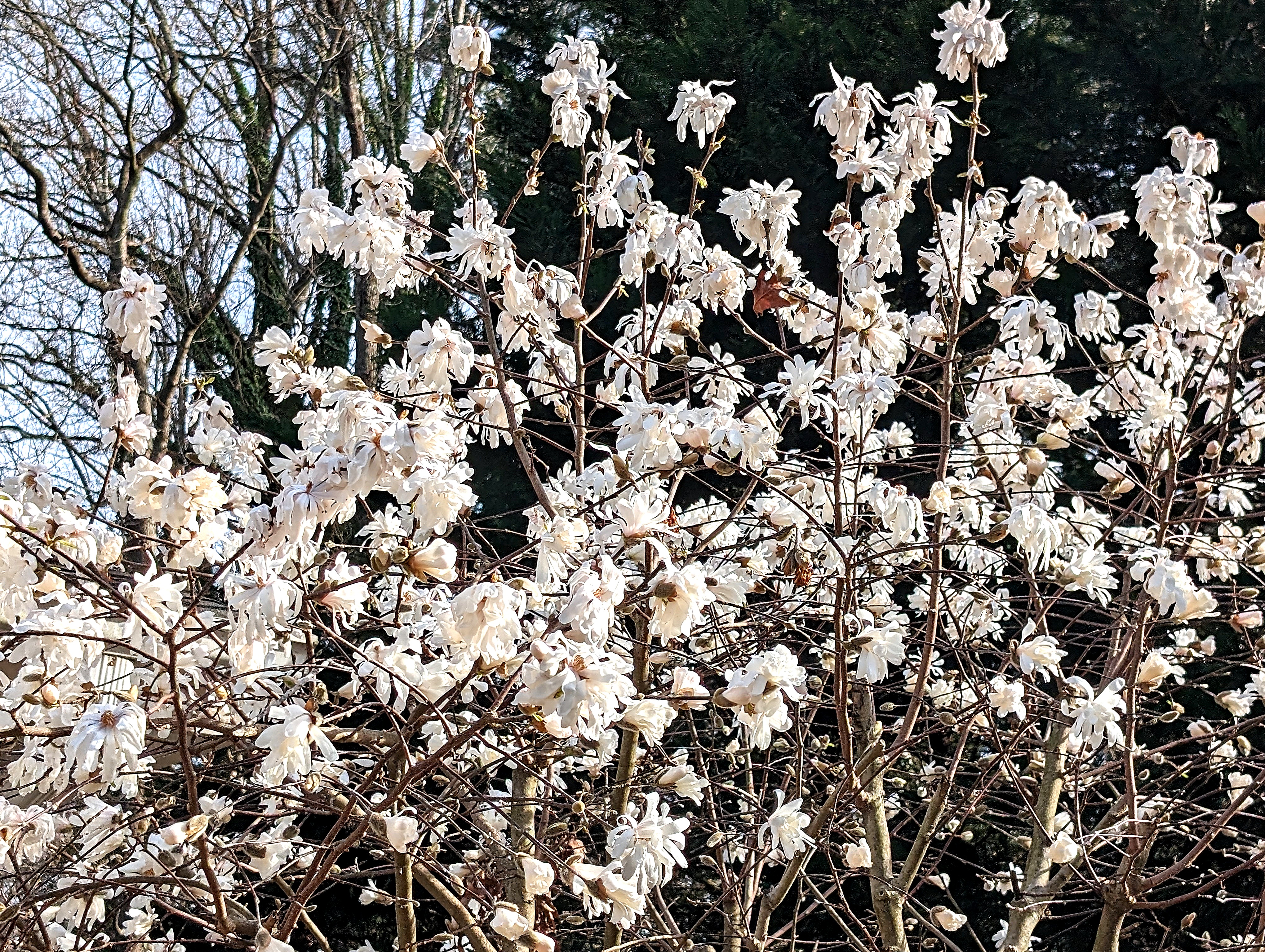
Sadly, rodents (squirrels) ripped into the blossoms of our star magnolia. This is as good as it ever looked this spring:
Star magnolia in the middle of March, 2025.
Perhaps the false starts to spring affected it? We had days in the 70’s and hit 80 once before cold weather set in again, complete with dustings of snow and some freezing rain. The cold became brutal for North Carolina, dropping into the teens. This delayed the magnolia’s blooming by two weeks or more. It looked like this last year, weeks earlier:
Reposted from 2024. Star magnolia on February 29, 2024.
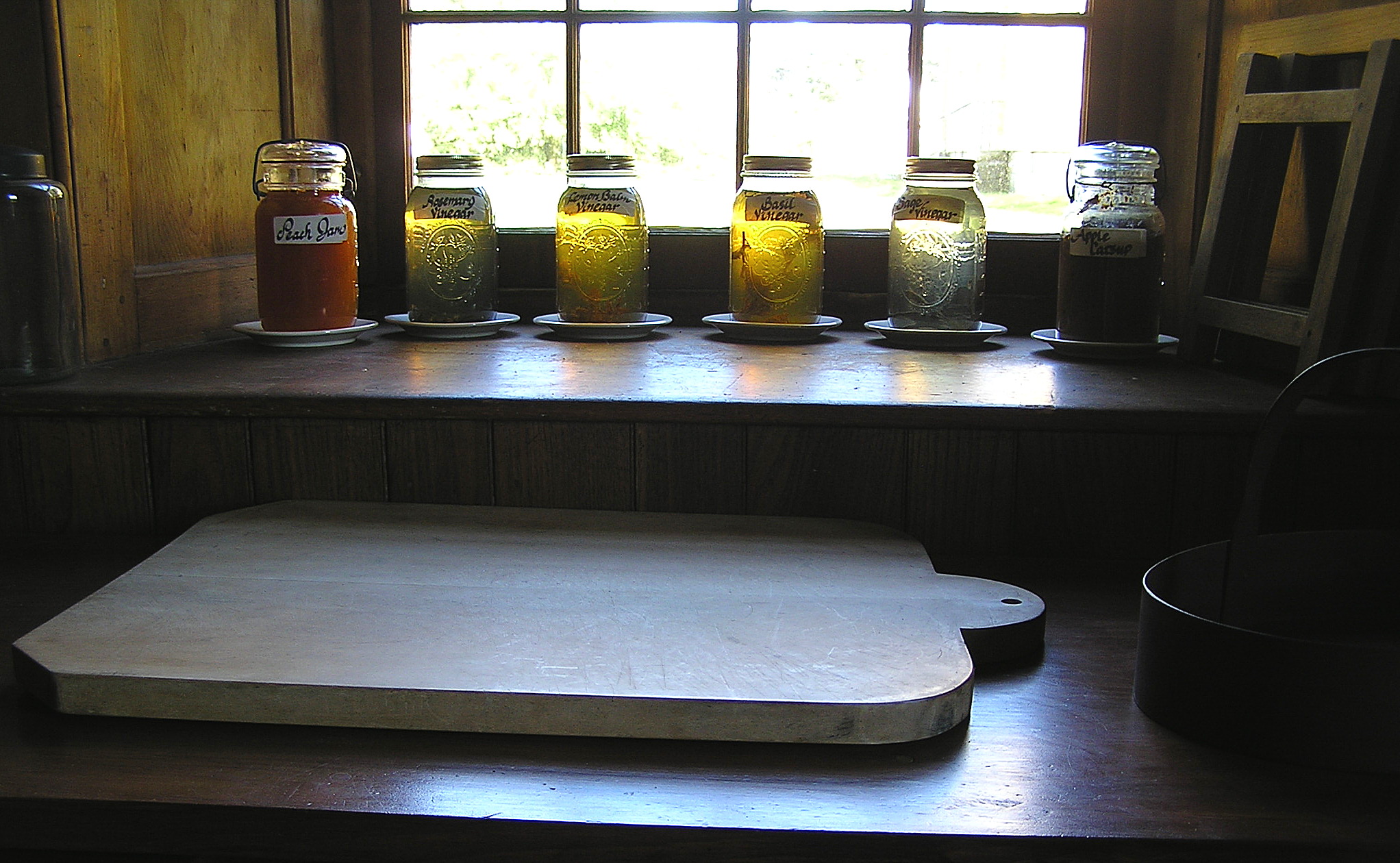
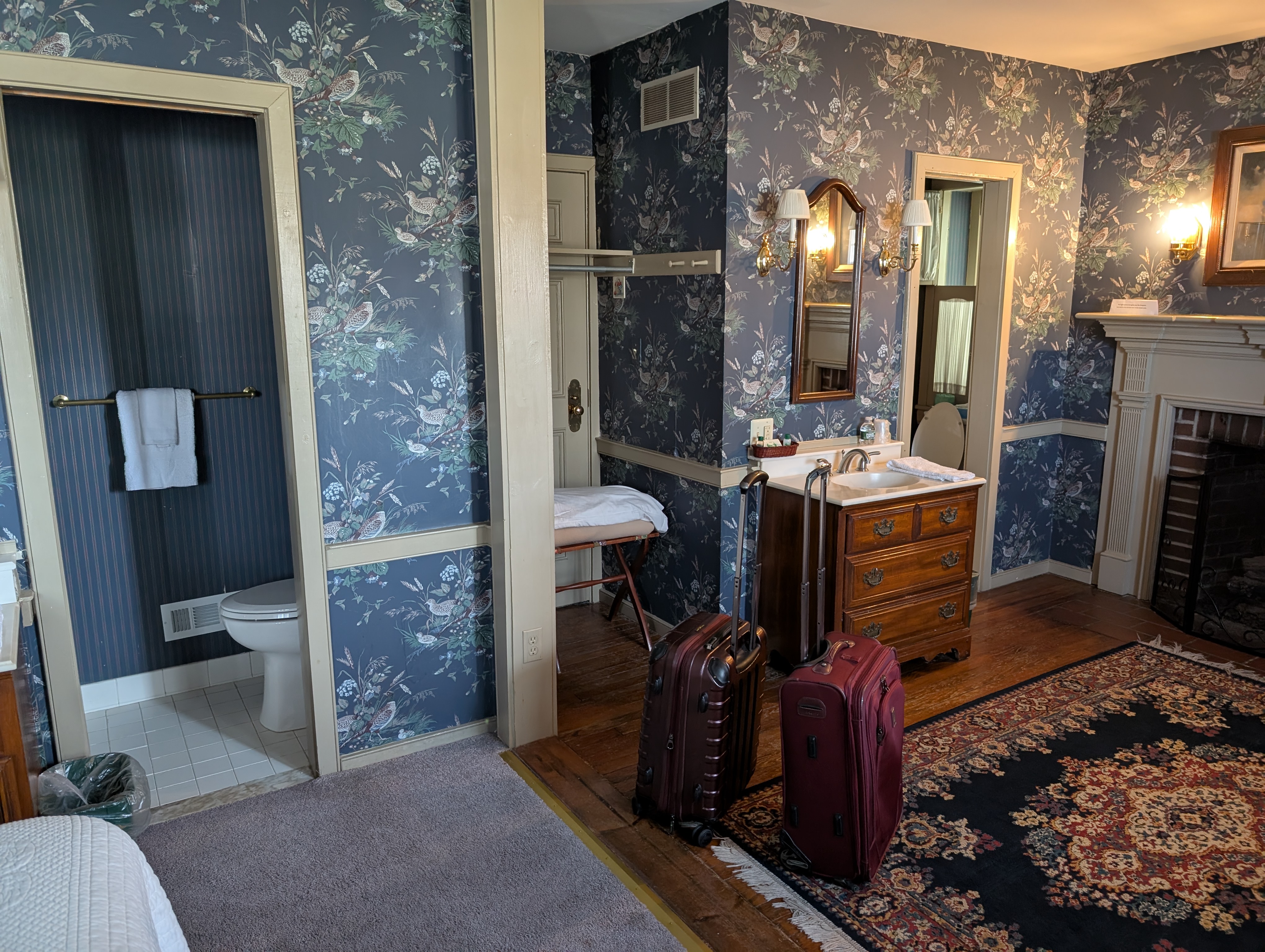
We revisited the Duling-Kurtz Country Inn in Exton, PA, Sunday evening. Sitting up by the fire that evening pleased us both. Dressing for the funeral in this room made things marginally better than performing the same in a generic Hilton or Marriott property.
The Winston Churchill Room at the Duling-Kurtz Country Inn. The sharp-eyed viewers will have noted the presence of TWO bathrooms. Two very small rooms were obviously turned into one. The door to one room no longer being needed (center), it was turned into a closet. March 2025, Exton, PA.
We’re on the eve of a personal holiday, Opening Day of Baseball. The joy baseball brings will temper the immediate sorrow of losing our last parent. This year promises many highs and lows, a challenge from start to finish. “May you live in interesting times.” Indeed.
As recounted here a few days ago, I balanced a 33-year-old slight this past month by traveling for nearly two weeks to Hawaii. Despite not being able to use my primary camera for most of our time on Maui, my smartphone took up the slack and I arrived home with over 750 photos. Now gather around while Grandpa adjusts the slide carousels just so and we’ll have a nice travelogue for the next couple hours.
No, just kidding. That’s what MY grandfather would’ve done. We would’ve been semi-bored because 30% of the photos were too dark to make out details, but mostly because Grandpa would feel the need to tell histories of many of the things we were trying to make out on the silver-encrusted screen–said histories sometimes being personal tales of the trip which really weren’t very interesting. “Now this is where we stayed in a really nice hotel. I don’t have a photo of that, but this bush caught our eye every morning when we left the hotel. It’s a rose-scented yackenberry–what, dear? It’s not? Well, then what is it?”
Occasionally we could have some fun by asking about weird things in the photos which he’d never noticed, or hooting when–despite all of his pre-show attention to detail–an occasional slide would be sideways and he would bravely carry on with the narrative despite his audience all having their heads at a 90º angle. The laughter would be uncontrollable if his photo also seemed near-unintelligibly dark while he droned on about what we couldn’t see.
Yet, a 10-to-14-day narrative a la our trip to Michigan and Ohio last year (starting here) seems too short–and as I reacquaint myself with last year’s travelogue–too much like Grandpa’s endless dronings in the guise of an interesting travel lecture. Instead, I’ll piecemeal it. Okay?
“Now after we overnighted in Las Vegas due to the inconvenient schedule of Southwest Airlines for Hawaii-bound East Coasters, we changed planes in Honolulu and caught our first glimpse of the Big Island when we flew by about four in the afternoon…oh, me…how did that happen?”
“You can’t really tell because it’s so dark, but…” The NW coast of Hawai’i, HI. September 2024.
We attended a wedding over the weekend in our old haunts around Philly. Our first ‘historic’ inn left a lot to be desired, but this one really delivered. Added plus: stupendous restaurant just to the right of this photo.
Growing up, my parents’ chairs interested me little. They still don’t. I consider them in my mind: the bulbous thing they reupholstered from a shocking golden mélange of 50’s colors, vaguely like a tweed, to a deep blue-green as hideous as you likely just pictured. Another horrible chair, this one chalky gray underlaid with a chocolate brown, thankfully disappeared from our lives as my parents focused ever more on Danish modern. Two deep mustard gold chairs sculpted from a cube joined the blue-green thing. I took Danish modern for granted then, hate it in retrospect. For reasons never given, our sofa matched nothing else in the room, either in style or color. Its creamy colored soft contours with the ever-present throw pillows would scream Rooms-To-Go today. Back then it just said, “I came from the middle aisle of our local furniture store.”
Chairs only rarely occupy our minds beyond whether we can find one to sit in. We take them for granted, I suppose because those of our upbringing formed part of the Always-There background. We sat on hard wooden chairs in school, replaced later by hard plastic seats, replaced in turn by a hard substance which defies any characterization other than “smooth”. College offered the same but with more variety unless you attended something exclusive in which case the chairs weren’t any more comfortable but they looked a lot older, more distinguished. When newly graduate, one’s interior decorating attitude toward chairs usually is something like, “is there one” and “is there room for one or two?” Perhaps I should add, “Can I get them from Mom and Dad?” because that’s their provenance for the most part.
“For the most part.” I moved from my dorm to my first apartment towing the usual hand-me-down furnishings including a deep brown and deeply ugly sofa. Along the way, however, I stopped at my grandparents’ house to pick up a chair from their basement which meant a lot to me. Now in their 80s, they were moving to a senior-living apartment. At the time this chair represented a place where I had sat a lot, a place I found both comfortable and comforting. Over time my bones became more brittle, my muscle turned to fat, and I found the chair less comfortable. At the same time, the comfort of seeing a chair with deep green shiny silk-like ribbons running vertically on a cream background, with dark-stained wooden arms and legs, sustained me emotionally. In 1992 I looked at the chair in my new Pennsylvania apartment where I had fled my divorce and my teaching career, seeing the chair as an anchor to my past and to my family. As a child I sat on the floor of my grandparents’ basement when Grandpa read Mr. Murphy the Irish Potato. (It’s horribly inappropriate, but times were different then.) A little older, I sat in that chair when my brother and I would hide out from the adults upstairs. In college, I ducked over for dinner every few weeks with my grandparents and spent a couple weeks there my final college summer as I waited for summer quarter to become fall quarter. I’m sure I sat in that chair then, also. Fifteen years after graduation I could reflect on that in Pennsylvania. My one regret with regard to it? We reupholstered it 20 years after I took it from my grandparents’ house. We chose fabric practically instead with our hearts, and the upholsterer somehow made a hard seat even harder. Today it’s usually covered in blankets and our cat sleeps there.
My hands have contributed to the wear on those arms. February 2024.
Other chairs came later, mostly as my grandparents died. The shield chair from those same grandparents, still sporting the upholstery I know from childhood, sixty years ago:
That red looked a lot more crimson about 60 years ago! February 2024.
My parents claimed one chair from my mother’s parents and kept it until they both had died by 2020. True to form, they immediately reupholstered it to a completely inappropriate modernist pattern, cream with trailing colors of brown, muted oranges, and dusky rose. Later, perhaps recognizing the error of their ways, they chose a formal but slightly modern pattern in rose, and that is what sits in my library today (and yes, I posted this chair once before):
The rose Queen Anne chair in the corner has become my library reading chair. For more than a decade, the heart-shaped table beside it has played a supporting role. The footstool might have been needle-pointed by my grandmother, and certainly has been around for more than 60 years. The torchiere lamp graced my father’s parents’ house. An oil painting of my grandmother, the one who purchased these chairs, painted from a very old black-and-white photograph, adorns the wall. February 2024.
Some chairs entered my life at times indeterminate. I can tell you where they’re from, but not when and how they came to me, or at best guess at it. The cherrywood rocker which my mother’s mother sat in the corner of her bedroom to match the shockingly gorgeous cherry bedroom set. Every morning I too sit on this to dress, just as my grandmother did about 100 years ago.
A truly beautiful piece of functional furniture. February 2024.
Then again there’s the wooden rocker with a caned seat which I used to sit on to dress myself until the caning gave way one day, and I thought I would go through it to the floor. My father’s father sat in this chair in his study while taking a break from his duties as a Baptist minister. I remember the beautiful rolltop oak desk he would work at. Sometimes he needed a break. He would move to this rocker, sitting in an opposite corner near the window of his study which looked out to the next-door church. I can see him rub then rest his eyes from all the reading he had done.
So beautiful. Now it sits beside my wife’s side of the bed, perpetually encumbered by clothes. But I know it’s there. February 2024.
When my father’s father died, and his mother entered a nursing home, I inherited another rocker and its matching straight-legged chair, a captain’s chair style. I wish I could remember their position in their household. These two must have had either sentimental or practical value for my grandparents to have moved them from a large Victorian three-bedroom house to a small two-bedroom home in a retirement community. The rocker is missing one of the dowels between the seat and the arms. My father’s brother got his leg stuck between two dowels and my panicking grandmother insisted to her husband that they break out one dowel to free him.
The true Captain’s chair. February 2024.The matching chair. Note how all of these old chairs have lost the finish on the arms, due to loving wear. February 2024.
Despite my love for this older furniture, it has only graced our main rooms by necessity. Early in our marriage (the second, lasting one) we purchased a Broyhill recliner which echoed the wing-backed design of these older chairs complete with a brocade upholstery. It also complemented our older, inherited chairs. Unfortunately, only a few years after we did, we invited a streetwise cat into our house whose scratching habits proceeded to turn it into a tasseled mockery of itself. It sits in the rec room now, with the other rejects who form the viewing area for our ‘home theater’. (It’s not really a home theater; it’s two chairs and a love seat, all of which recline and are positioned as optimally as possible to a large TV with a surround speaker system. We invited the other chair in the ensemble into our living room in 2009, and sent it to the basement in 2017.) I’m thinking we should reupholster it and return it to its rightful place in our living room.
Early relegation to our basement (or worse) seems to be the norm for modern furniture. I would tell you of the two loveseats which have been purchased and abandoned in that time, falling out of favor and usefulness just as the one now in our basement, and I could detail the two sofas we purchased in 2006 and 2013, the former being replaced by the latter, the latter going “to a deserving home” in 2020. But we’re talking of chairs. We started 2020 with a fixation on chairs. We purchased four chairs which looked decent, solid, and worthy of the prices we paid. Two of them replaced two of the inherited chairs detailed above. Two motorized recliners replaced the sofa. Now, barely more than four years old, the two recliners have entered middle age, declaring themselves for the James Dean life with the exception they’ve never lived fast nor will they leave a beautiful corpse. They’ve become more uncomfortable to me as I deal with lower back issues. Luckily the two side chairs have been making their case for sticking around more than a few years. They simplistically mimic the older inherited chairs, causing me to wonder: why I don’t seek out chairs like that?
Before ending this, office chairs should be mentioned. Though often unremarkable, they offer a unique feature: they almost always have wheels. On top of industrial-grade, quarter-inch-thick carpet, these babies provide transportation to those unwilling to stand simply to walk 10-20 feet to a neighbor’s cubicle. (And that one time my four-person team found ourselves housed in a former microbiological incubation room with hard, sealed floors? One of eight such rooms on a hallway with the same flooring? Do you know how far you can push a well-lubricated chair on such floors? Not if you haven’t tried it!) Once, though, I purchased an old office chair my employer had slated for disposal. Although the calendar said 1997, this chair hailed from the 1950’s. Completely upholstered with wood accent on the arms, this chair would swivel and tilt just like modern chairs–but with no ability to make adjustments. Yes, it had wheels. And from that year until 2006 (I think) it served me well as my computer desk chair.
Ultimately we think of office furniture similarly to most of our then co-workers: there have been many but we remember only a few. Not so our heirloom chairs. Not so the chairs of our childhood, from the plastic-sheathed kitchen chairs to the kitchen stools to the weird plastic furniture used on our parents’ patios. Not so the chairs which graced our first apartments, entering the doorway by whatever means necessary, whether begging, stealing, inheriting, or in our last-ditch efforts, purchasing. Not so where we sat when visiting our grandparents, our uncles/aunts/cousins, or even our friends in college when a Naugahyde sack full of styrofoam could be called “a bean-bag chair”.
When I look at this cycle, I see that my parents’ chairs came and went, my chairs in school could at best be called functional, my chairs in early adulthood had value only because they were there, my chairs throughout my life have primarily existed only until I could replace them–but the chairs I inherited from my grandparents, the ones constructed in the 1920’s, the 1930’s, the 1940’s, have outlasted all of the others and, like the British monarchy, say, “yet, I’m still here!”
Five days after a funeral. Lake Lynn, 07 November 2019.
Warnings & Notes: This post contains a few graphic depictions of death, some examples of socially unacceptable behavior, and is just generally a downer if you look at it a certain way. Also, some of these observations have been made before. If you read this blog regularly (there’s only a half dozen or so of you), well, sorry….a little.
This year All Souls Day, November 2nd, marked the fourth anniversary of my mother’s funeral. It’s the day I most think back upon her life and death. The anniversary of her death, October 24, I barely note. Sometimes it even slips by me before I realize it. The funeral symbolizes my mother’s love, her life, and all those influences we spend a lifetime unraveling. In contrast, the date of her death represents thoughts I acknowledge but do not celebrate, and her passing is hardly something to celebrate in and of itself. I would rather focus on the entirety of her life and death: the funeral marked that, not the death.
My mother and I lived more than 2100 miles apart at that point. My profession had taken me to the eastern United States; she remained in Spokane, WA, from where she had encouraged me to follow my dreams wherever they led. Her parents had, my father’s parents had, they had themselves, so why shouldn’t their children? Still, it didn’t reduce my guilt much for not being more available to her in that last year, indeed that span of a half dozen years when she lived on after my father’s death. My brother lived nearly ten times closer in Tacoma but it took me only a few more hours to get there by plane versus him taking a drive across the state. He encouraged her to move to Tacoma. I half-heartedly supported him. She refused, saying her friends and neighbors were in Spokane. I strongly pushed that she could move to a “retirement community” there in Spokane where some of her friends lived. She demurred, then refused. Her best support network were the good neighbors she had. She was right. We were wrong. I saw one of those retirement homes at the end of her life. I was really wrong, and–
But I’m not going to rehash that whole period. I’ll just note this: I watched her steadily decline during the five years after my father died, visiting her more and more frequently. (The Fates blessed me in several ways when 13 months after my father died, I started traveling the country for work. It became just as easy to fly to Spokane as to Raleigh.) In December 2018 my mother learned she had Stage IV breast cancer. At 89 years, she recoiled from and declined chemotherapy, threw her lot in with hormone receptor treatment (a pill, nothing more), and for various reasons was in and out of hospitals, convalescent homes, and her new apartment in a “retirement community” through the fall of 2019. She celebrated her 90th birthday in that apartment.
I visited my mother a dozen days into October 2019 as she lived her final days. I returned home only to receive The Call two days later. It was a Thursday. Knowing my brother could drive there quickly, and emotionally exhausted from watching her exist in a morphine-induced stupor, I rolled the dice, told him I wouldn’t come until Monday, and I let him spend Friday through Sunday with her. I flew back on that Monday, and sat beside her bed a lot until she passed away on Thursday. My brother had returned to his home and job. Thus it fell to me to handle the first round of details.
From the moment a loved one dies, those closest to them experience a bewildering whirlwind of details thrust upon them which must be handled immediately. As the elder of two children, the most controlling of us, and frankly, just because I was the one there, it fell to me to make those arrangements. Again, I shall refrain from a step by step accounting of it. This is supposed to be an accounting of All Souls and a celebration, not a macabre dwelling on those days of death. One example shall suffice: on Thursday morning, the day she died officially at 10:22 a.m., I had to leave her to be at the bank when it opened at 9 a.m. The instruction manual entitled “What You Will Have To Do When Your Second Parent Dies” never made it into my mailbox, I guess. If it had, maybe I would have been better prepared than to learn in her final hours that her investment accounts would be frozen for disbursement when she died, and that as her executor I would be paying bills with whatever sat in that bank account for the foreseeable future. The bank account had less than $3200 in it when I dumped a huge amount in there. Take note if you’re ever in this position: for the next year, I had to pay bills from that account. If I hadn’t done that, my brother and I would have had to agree on splitting the bills. Really, take note.
My mother’s death came as a relief. I’m saddened to admit her death came as a relief. I know many have said this, but I feel as I feel. She had suffered with increasing pain from the breast cancer for a year. I doubt anything can prepare you to listen to your mother slowly drown and die, to realize the fluidic sounds of her breathing come from her lungs as they slowly fill, to watch from a removed perspective as your voice sharply criticizes the health staff which insists on turning a patient even when this obviously makes the breathing worse. Beyond prayer, I simply endured. I carry with me that immense relief I felt when I re-entered her room after a short phone call from her cousin and discovered my mother had died. I also carry with me the commensurate load of guilt for not being there at that moment. The part of me formed by social mores scolds me perpetually; the accepting, independent side of me simply says, “that’s the way it happened. There’s nothing which could have been done at the time, and there’s no shame in feeling relief.”
In contrast to the anniversary of her death, which represents a smorgasbord of feelings, few of them good, even fewer comforting, the anniversary of the funeral represents a day of love. It’s the day remaining friends and family gathered to mark how much they loved your mother and how much they would miss her. It’s the day you created all the little remembrances which would afterward become powerful symbols in your life. It’s the day you got to reminisce about all the times: mostly good, some bad, some funny, some sad. It’s the day when many told you “You did a good job by your mother,” even if they were lying a little bit. And it’s the day you closed the door, for just a bit, on all of those things which just have to be done. It’s the day when you looked forward to a few days where nothing about your mother’s funeral and estate needed to be accomplished: those things would wait a few days–with luck, a few weeks.
Each All Souls Day since that time refreshes all these memories. It’s the stem that gathers all the roots of remembrance and supports the branches of What Has Come To Be. For me, it’s inextricably bound up with my decision two weeks after her funeral to retire. Those twin events, her passing and my retirement, have become tied to those crazy years when a pandemic changed our society, or perhaps, when it revealed who we had come to be. All Souls Day, which exists quietly in the immediate shadow of its more important sibling, All Saints Day, and is heralded by All Hallows’ E’en, tells us it’s important to mark the passing of those we loved and to pray for them, to remember them, to honor them. By its existence, it says to ignore the ones who have been declared important, and that we must instead recognize the importance of each of us.
Mostly, though, All Souls Day reminds all of us of the death of those we loved. It picks at the scab of a wound which will not scar over and which has become part of who we are.