It’s been a lengthy stretch of sporadic posting at best. I’ve excused it with “spending time with my wife” and “getting things done” which certainly sound worthy. We’ve just returned from attending her mother’s funeral. (More on that later.) A slate of urgent tasks demands my attention, as does maintaining my health, both physical and mental.
A few pieces of writing, stubs and nothing more, await more attention than I can manage right now. Today let’s just review the two-plus weeks since I posted a hawk in our front yard. Hawks continue to drop by, a vivid affirmation to our decision to rip out the front lawn and install native plants—and especially to my decision to let the leaves lie where they fall. The leaf cover has fostered those little grubs and bugs birds like eat and extends to small rodents for the hawks.
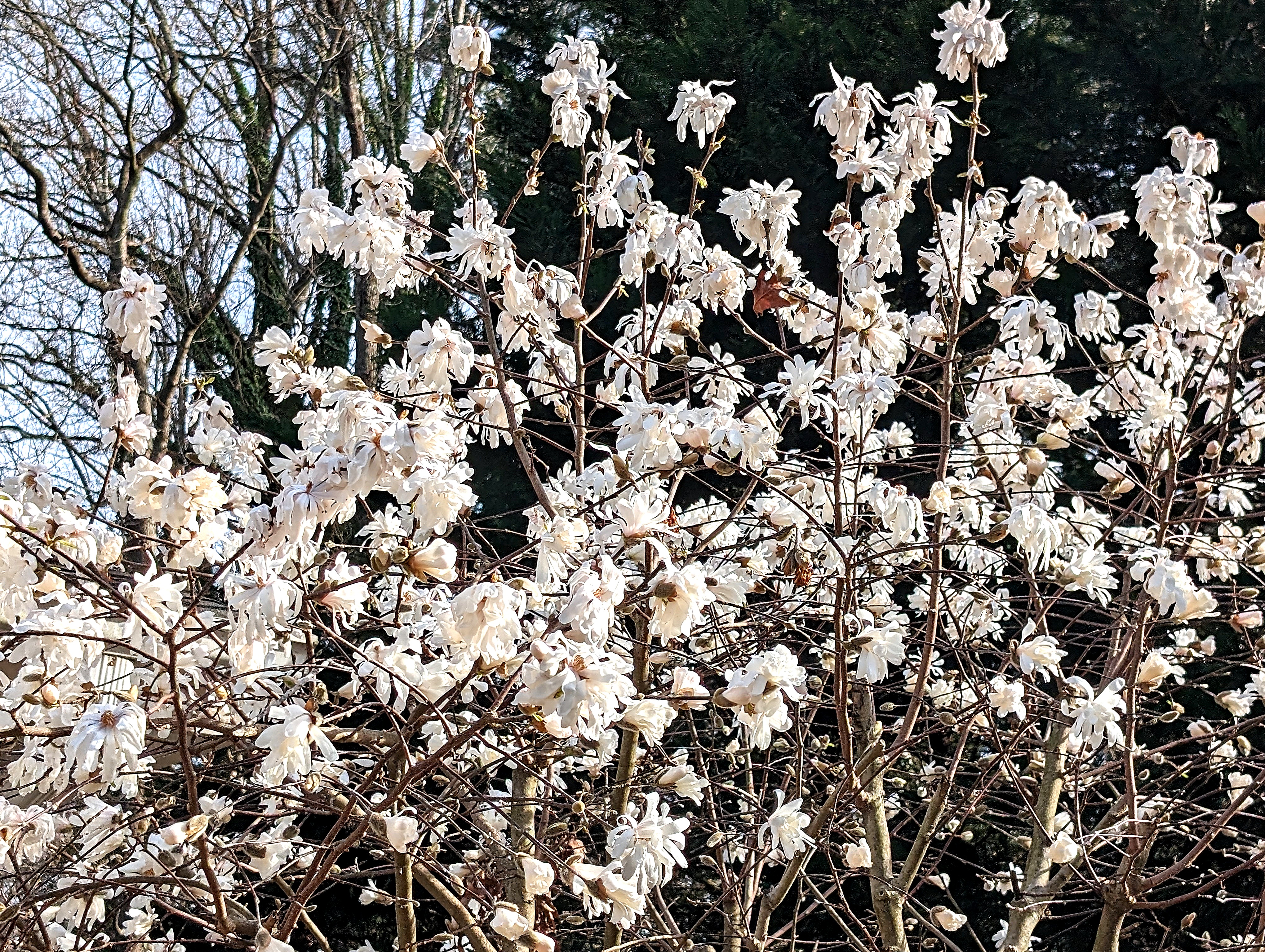
Sadly, rodents (squirrels) ripped into the blossoms of our star magnolia. This is as good as it ever looked this spring:
Star magnolia in the middle of March, 2025.
Perhaps the false starts to spring affected it? We had days in the 70’s and hit 80 once before cold weather set in again, complete with dustings of snow and some freezing rain. The cold became brutal for North Carolina, dropping into the teens. This delayed the magnolia’s blooming by two weeks or more. It looked like this last year, weeks earlier:
Reposted from 2024. Star magnolia on February 29, 2024.
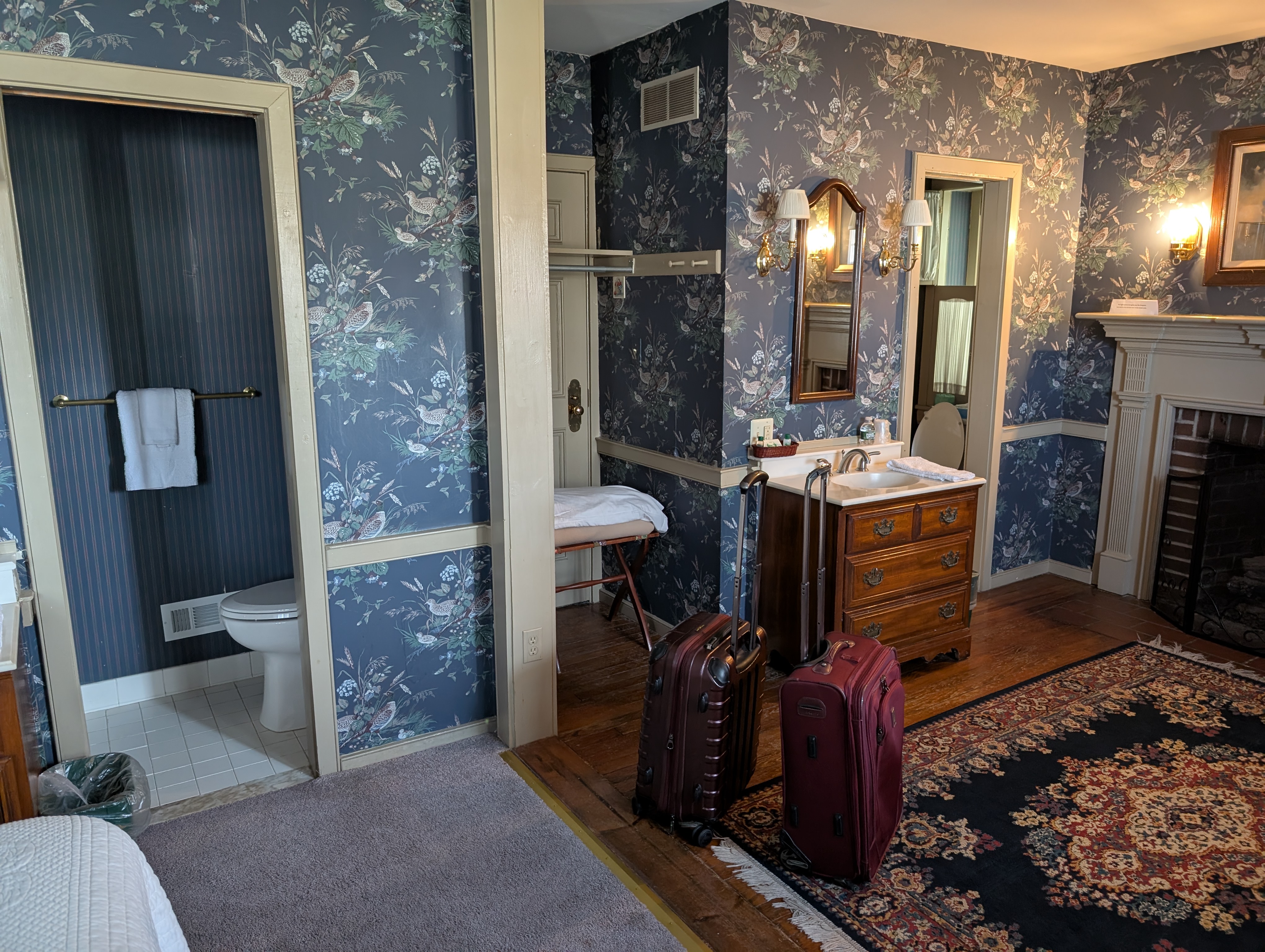
We revisited the Duling-Kurtz Country Inn in Exton, PA, Sunday evening. Sitting up by the fire that evening pleased us both. Dressing for the funeral in this room made things marginally better than performing the same in a generic Hilton or Marriott property.
The Winston Churchill Room at the Duling-Kurtz Country Inn. The sharp-eyed viewers will have noted the presence of TWO bathrooms. Two very small rooms were obviously turned into one. The door to one room no longer being needed (center), it was turned into a closet. March 2025, Exton, PA.
We’re on the eve of a personal holiday, Opening Day of Baseball. The joy baseball brings will temper the immediate sorrow of losing our last parent. This year promises many highs and lows, a challenge from start to finish. “May you live in interesting times.” Indeed.
To those who face the frailties of life and to those who have transitioned elsewhere…
We're marching to our deaths at birth
Then unaware of Life's propose.
Plans made, plans dashed, let's laugh with mirth
As march we must to last repose.

When first we view our life's true end,
Made real by year, yet not by day,
We vow to hoard, vow not to spend
More time in idleness, in play.

Not 'til our bodies tell us true,
Our end looms close, looms real,
Do we admit, "I wish I knew–
Please, one more spin around your wheel."

This knowledge brings its own reward,
Knits us to others suff'ring too.
As I face down my ailments hard,
I understand how so do you.
In the past month one of my blogosphere contacts has died, and another faces a tough cancer battle. Here in the physical world a good friend struggles to walk, a second puts on a good face as her husband remisses into cancer, a third breathes slightly easier that her sister didn’t die last week, and our closest friends both battle mystery ailments. On a personal note, sciatica has said, “Remember me? I think I’m gonna stick around this time,” and my blood pressure has decided to ignore all my meds. I really can’t think of one good reason for the fact I want to grab every single person between 40 and 60 and declare insistently to their startled face, “WAKE UP! QUIT WASTING YOUR TIME! DO WHAT YOU WANT, DO WHAT YOU MUST, BUT FOR GOD’S SAKE QUIT DOING WHAT YOU DON’T WANT, WHAT YOU KNOW IS WRONG FOR YOU!!” Yeah, I wouldn’t have listened to me either. I don’t really have regrets. It’s just the shock with how quickly it changed in the past five years. There’s no way to prepare for it–but for some reason, perhaps the shock, I want to turn around a tell someonehow I never realized what this was going to be like. Sure, I’ve seen folks navigate these years, but for some reason I never saw the road that connects I’m Okay Right Now with I Am Really Old And About To Die. And I really wish I had.
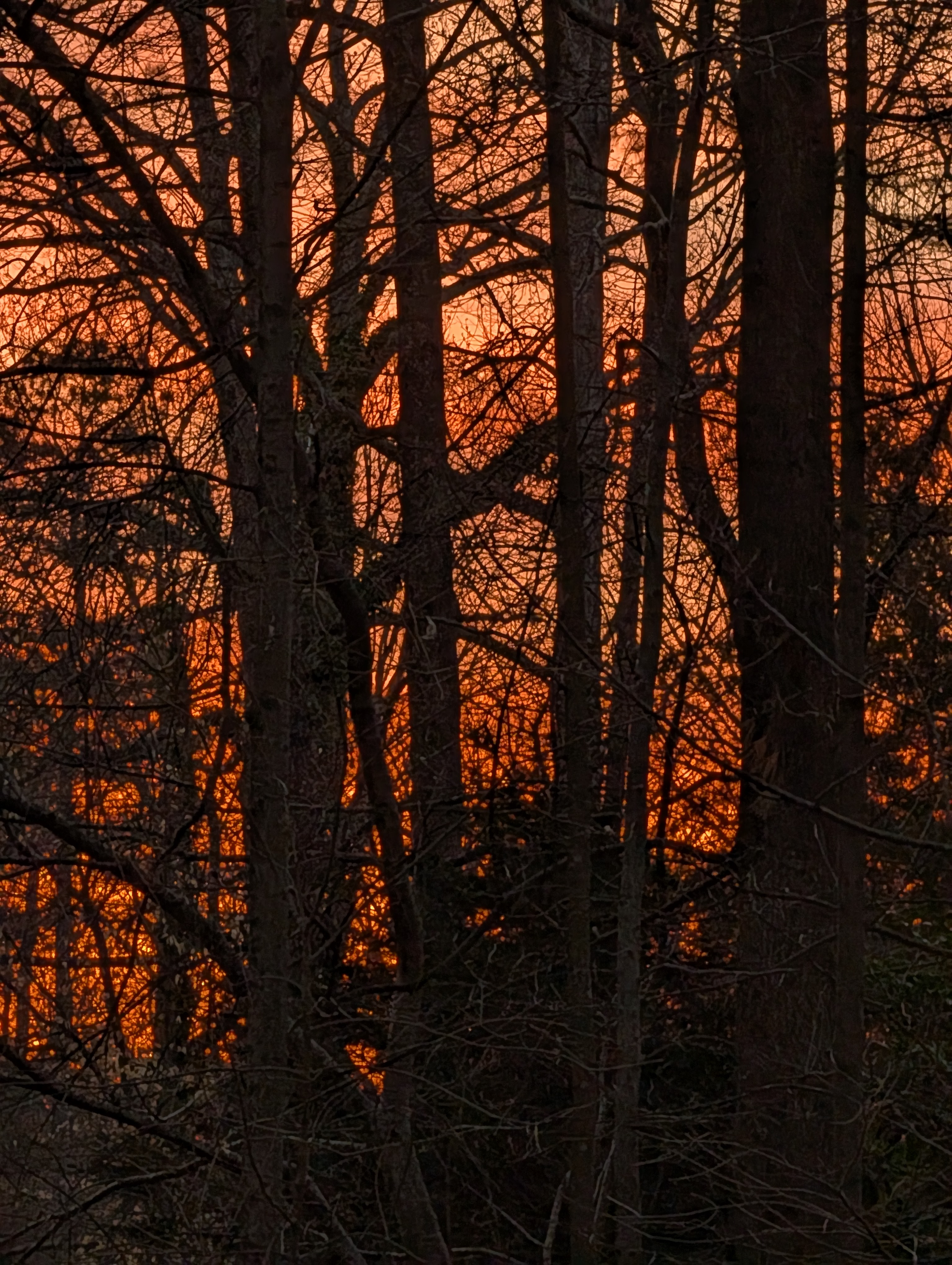
Five days after a funeral. Lake Lynn, 07 November 2019.
Warnings & Notes: This post contains a few graphic depictions of death, some examples of socially unacceptable behavior, and is just generally a downer if you look at it a certain way. Also, some of these observations have been made before. If you read this blog regularly (there’s only a half dozen or so of you), well, sorry….a little.
This year All Souls Day, November 2nd, marked the fourth anniversary of my mother’s funeral. It’s the day I most think back upon her life and death. The anniversary of her death, October 24, I barely note. Sometimes it even slips by me before I realize it. The funeral symbolizes my mother’s love, her life, and all those influences we spend a lifetime unraveling. In contrast, the date of her death represents thoughts I acknowledge but do not celebrate, and her passing is hardly something to celebrate in and of itself. I would rather focus on the entirety of her life and death: the funeral marked that, not the death.
My mother and I lived more than 2100 miles apart at that point. My profession had taken me to the eastern United States; she remained in Spokane, WA, from where she had encouraged me to follow my dreams wherever they led. Her parents had, my father’s parents had, they had themselves, so why shouldn’t their children? Still, it didn’t reduce my guilt much for not being more available to her in that last year, indeed that span of a half dozen years when she lived on after my father’s death. My brother lived nearly ten times closer in Tacoma but it took me only a few more hours to get there by plane versus him taking a drive across the state. He encouraged her to move to Tacoma. I half-heartedly supported him. She refused, saying her friends and neighbors were in Spokane. I strongly pushed that she could move to a “retirement community” there in Spokane where some of her friends lived. She demurred, then refused. Her best support network were the good neighbors she had. She was right. We were wrong. I saw one of those retirement homes at the end of her life. I was really wrong, and–
But I’m not going to rehash that whole period. I’ll just note this: I watched her steadily decline during the five years after my father died, visiting her more and more frequently. (The Fates blessed me in several ways when 13 months after my father died, I started traveling the country for work. It became just as easy to fly to Spokane as to Raleigh.) In December 2018 my mother learned she had Stage IV breast cancer. At 89 years, she recoiled from and declined chemotherapy, threw her lot in with hormone receptor treatment (a pill, nothing more), and for various reasons was in and out of hospitals, convalescent homes, and her new apartment in a “retirement community” through the fall of 2019. She celebrated her 90th birthday in that apartment.
I visited my mother a dozen days into October 2019 as she lived her final days. I returned home only to receive The Call two days later. It was a Thursday. Knowing my brother could drive there quickly, and emotionally exhausted from watching her exist in a morphine-induced stupor, I rolled the dice, told him I wouldn’t come until Monday, and I let him spend Friday through Sunday with her. I flew back on that Monday, and sat beside her bed a lot until she passed away on Thursday. My brother had returned to his home and job. Thus it fell to me to handle the first round of details.
From the moment a loved one dies, those closest to them experience a bewildering whirlwind of details thrust upon them which must be handled immediately. As the elder of two children, the most controlling of us, and frankly, just because I was the one there, it fell to me to make those arrangements. Again, I shall refrain from a step by step accounting of it. This is supposed to be an accounting of All Souls and a celebration, not a macabre dwelling on those days of death. One example shall suffice: on Thursday morning, the day she died officially at 10:22 a.m., I had to leave her to be at the bank when it opened at 9 a.m. The instruction manual entitled “What You Will Have To Do When Your Second Parent Dies” never made it into my mailbox, I guess. If it had, maybe I would have been better prepared than to learn in her final hours that her investment accounts would be frozen for disbursement when she died, and that as her executor I would be paying bills with whatever sat in that bank account for the foreseeable future. The bank account had less than $3200 in it when I dumped a huge amount in there. Take note if you’re ever in this position: for the next year, I had to pay bills from that account. If I hadn’t done that, my brother and I would have had to agree on splitting the bills. Really, take note.
My mother’s death came as a relief. I’m saddened to admit her death came as a relief. I know many have said this, but I feel as I feel. She had suffered with increasing pain from the breast cancer for a year. I doubt anything can prepare you to listen to your mother slowly drown and die, to realize the fluidic sounds of her breathing come from her lungs as they slowly fill, to watch from a removed perspective as your voice sharply criticizes the health staff which insists on turning a patient even when this obviously makes the breathing worse. Beyond prayer, I simply endured. I carry with me that immense relief I felt when I re-entered her room after a short phone call from her cousin and discovered my mother had died. I also carry with me the commensurate load of guilt for not being there at that moment. The part of me formed by social mores scolds me perpetually; the accepting, independent side of me simply says, “that’s the way it happened. There’s nothing which could have been done at the time, and there’s no shame in feeling relief.”
In contrast to the anniversary of her death, which represents a smorgasbord of feelings, few of them good, even fewer comforting, the anniversary of the funeral represents a day of love. It’s the day remaining friends and family gathered to mark how much they loved your mother and how much they would miss her. It’s the day you created all the little remembrances which would afterward become powerful symbols in your life. It’s the day you got to reminisce about all the times: mostly good, some bad, some funny, some sad. It’s the day when many told you “You did a good job by your mother,” even if they were lying a little bit. And it’s the day you closed the door, for just a bit, on all of those things which just have to be done. It’s the day when you looked forward to a few days where nothing about your mother’s funeral and estate needed to be accomplished: those things would wait a few days–with luck, a few weeks.
Each All Souls Day since that time refreshes all these memories. It’s the stem that gathers all the roots of remembrance and supports the branches of What Has Come To Be. For me, it’s inextricably bound up with my decision two weeks after her funeral to retire. Those twin events, her passing and my retirement, have become tied to those crazy years when a pandemic changed our society, or perhaps, when it revealed who we had come to be. All Souls Day, which exists quietly in the immediate shadow of its more important sibling, All Saints Day, and is heralded by All Hallows’ E’en, tells us it’s important to mark the passing of those we loved and to pray for them, to remember them, to honor them. By its existence, it says to ignore the ones who have been declared important, and that we must instead recognize the importance of each of us.
Mostly, though, All Souls Day reminds all of us of the death of those we loved. It picks at the scab of a wound which will not scar over and which has become part of who we are.
I’ve been pondering (to quote one of my new favorite bloggers) that I stand on the threshold of 70 and I’ve only 10-15 years of travel left in me. This starkly scares me. I usually figure two or three significant times of travel per year. Twenty to forty-five seems like a goodly amount, but it’s that lower end that makes me wonder: if I’ve only 20 trips left, and I want to go to Europe more than once, to Hawaii, to places in the USA, to just experience certain periods of unfettered wandering…how much is left in me?
It’s funny. You think for much of your life, “hey, there’s plenty of time for that,” because you’re 35 or 45 and decades stretch out before you. Then you get up toward retirement, and frankly you’re just thinking about that retirement. There are a lot of channels to negotiate to retire: income when you’re not working, riding herd on the expenses, and the projects you always thought you’d do but you just didn’t have the time or the money to do them. You negotiate that when suddenly a little global pandemic kinda s-t-r-e-t-c-h-e-s that whole process out. When the world comes to, everyone removes their masks (assuming they were wearing them in the first place), and you realize, “crap, I’m almost 70. How much time is there?”
This clarifies things but in a brutal way. When someone comes at you with a knife, your options suddenly are VERY focused. When life comes at you with a knife…… Didn’t the Fates snip a man’s life thread and end it?
My friend’s mother died this week. These deaths of friends, relatives of friends, and famous people we’ve known of our entire adult lives, become more frequent as I march toward the end of my 60s. When they strike near, they strike deeply. I’ve been reminded of my mother’s passing in 2019 and to a lesser extent of my father’s passing in 2013. Then, thinking of my father’s death reminds me of my friend’s father passing about four and half years ago. In turn, I recall I became close to this friend of mine when a very close friend of his died much too young. One thing leads to another, then another. Memory isn’t so much a card catalog as it’s a word-association game.
Each recurrence resonates with those which came before. Though my personal losses do not gut-punch me anymore the way they did when they occurred, memory-tropes have become stronger through the ensuing years. More and more, very specific moments become the definition of the entire event. Other details fall away. My friend’s mother had fluid building up in her lungs. My mother had the same though caused by a cancerous tumor. When I learned about my friend’s mother this week and her symptoms, I also heard the watery sound of my mother’s lungs as she tried to draw her final breaths, like smoke burbling through a hookah. It wasn’t pleasant, then or now.
Deaths link up in my memory, each resonating the others. This day the bells of death sound across my entire life. My first memory of death occurred when I had just turned 14. My family vacationed to San Francisco where we drove through The Haight staring at hippies–“make sure your doors are locked, boys!” We also visited my great-grandmother lying on what she assured us was her deathbed. “I’ve run the good race, I’ve fought the good fight,” she proclaimed to Mom, her granddaughter. “Oh, don’t say that, Grandma!” my mother exclaimed which I thought odd since the old lady obviously lay at death’s door. (We lack so much tact in our early teens.) I remembered this because my friend’s mother remained lucid into her final hours, just as had my great-grandmother. My mother and father both were not, each of them passing in a morphine-laced state of unconsciousness. I remain grateful I didn’t have to encounter the attitude my mother did in San Francisco in 1968. Do you protest as a matter of good taste, as my mother did? Do you agree with the fading relative, thereby assuring yourself honorable mention in the Total Jerk Hall of Fame? Do you hesitate, mumble something neutral, and earn their scorn for your equivocation? Maybe it all goes well if you’re lucky.
My mother slowly lost her engagement with reality, not that her grasp had been firm. (I too suffer from that state, having one foot firmly planted in a hallucinatory land where reality exists somewhere between a fond memory and a meaningless joke.) We crossed a threshold in 2017 when Mom could not grasp why failing an eye test meant she could no longer have a driver’s license. “But I had just recently had eye surgery!” She remained convinced a simple form filled out by her doctor and sent to the DMV would straighten everything out. I think she didn’t give up hope so much as the matter just faded into the background. By the time she entered the hospital 18 months later, diagnosed with stage four breast cancer at 89, she couldn’t quite comprehend how she had gone from her daily existence to this state of affairs–never mind that her life at that point had become rely-on-strangers-for-meals-and-all-tasks. In truth she only changed venues and caretakers, swapping neighbors for nurses.
This disturbed me less than it may sound. When she fought to understand why her driver’s license had been suspended, my superficial exasperation papered over how my mother’s stance resonated with all of those memories where she also couldn’t understand the logical progression of bureaucracy in all its forms; when she cried because in attempting a sewing class exercise called Idiot’s Delight she couldn’t get it “to work” and felt she was worse than an idiot; and those myriad times when she couldn’t understand electro-mechanical issues, made all the more rich because her father had been an electrical engineer. Does it sound as if I mock my mother? Absolutely not! Love of the maternal wraps itself around what the maternal is, regardless of its logic, perseverance, emotive sustenance, or intellectual prowess. I loved my mother. Everything followed from that. The mother I loved, and what I loved about her, relied wholeheartedly upon her husband and in her final days upon my brother and me, but truthfully mostly on her neighbors since my brother lived hundreds and I thousands of miles away.
Bells from my father’s death ring different tones; they peal a melancholy chorus. He never outgrew being a preacher’s kid, a PK. He learned the social skills that most nomadic children do, those whose parent(s) are in the military and travel from base to base, those who follow their academician parents from university to university, and those like my father who moved from place to place as his father pursued Calling after Calling. His father was an American Baptist minister. My father experienced a couple of moves early in his life, but by 3 or 4 began a decade in the suburbs of Minneapolis. His family then moved to Havre, Montana, where my father spent all of his high school years. His graduation from high school in 1942 permitted but one short year in college before the United States Army came calling because of World War II. He served in the Quartermaster Corps, achieved the rank of Sergeant, and told us absolutely nothing else about it other than he apparently sailed back and forth across the Pacific. I learned later how dangerous those convoys were and the dangers he faced. His background is relevant here because it informs his passing.
Just as he hid from his war years, my father hid from the aspects of his personality which didn’t fit into the mold of being a PK, a devout Christian, of being the “perfect kid” (a different kind of PK). The monsters in his closet slipped out a few times during his life, most notably at the end of it: he retreated from the corporate track he was on and moved his family from Los Angeles back to Spokane, Washington, returning to the same job he had left less than 24 months previously; he quit that job because he couldn’t conform to the ethical stances of his peers (or was it just a midlife crisis?); and at the end, he fell into a crevasse of personal turmoil when as chair of the church finance committee he learned the church secretary had embezzled a substantial sum from a struggling church. This final trip to the dark side took place when he had marked 82+ years and the pall of it never lifted. Retirement makes us face the delightful dilemma of the retired: how much meaning must one instill into one’s life? How ‘permissible’ is it to just “take it easy,” “take it as it comes” or in essence to live in the moment when the moment requires nothing significant of you? My father seemed to have no issues with the relaxation of retirement until The Failure. After that, he could see no path out of his darkness, and it continued to haunt him until he died in the middle of his 88th year.
If I wander the aisles of memory’s storeroom where I’ve tucked so many things, I come across other deaths, less impactful but salient nonetheless. The Sunday School classmate who died of a brain tumor the year following my great-grandmother. The teaching friend of my first wife who lived longer than expected with her congenital heart defect. When young I found it more difficult to feel these deaths, to be sorrowful. I don’t know why. Youth? Failure to connect with these people? Perhaps the latter. Before the teaching friend, my father’s father died of a stroke in 1980. (I was going to write “massive stroke” but any stroke which strikes down a man in his mid-80s packs a wallop.) Despite the sorrow I felt at his death, my strongest memory from that time is of our very small family–his two sons, my father and my uncle; my four cousins with a spouse or two; and my mother and me–hanging out in a motel room reminiscing in what passed for a wake.
But as the 1980s closed out my remaining three grandparents died in successive years: my mother’s mother in 1988; my father’s mother in 1989; my mother’s father in 1990. My second strongest memory at my grandfather’s passing haunts me. Because it is of my grandmother, I don’t think of it right away when I think of his death. I think of it as a bridge memory to hers. I arrived early to my grandparent’s house but everyone had gone somewhere except my grandmother. I still can see her clearly, staring, staring into her backyard as the gentle rains of the Willamette River Valley fell. Lost in thought? In shock? Numb? A mixture perhaps. I’ve noticed no pattern to the reaction of the surviving spouse when they’ve lost their lifetime companion. My father’s mother had her emotional heart ripped out of her when her husband died. She never recovered. Soon she lived in assisted living because of a gentle dementia, and afterward suffered a stroke in 1983 or 1984. She then lived in a vegetative state for five years. My mother’s father also slowly lost the mental faculties which made him my grandfather. The final time I saw him he lay sleeping in the infirmary where he had lived for several years, even before his wife died.
I look at the memories of those last two deaths reluctantly. I do not handle hospitals and deathbeds well. I visited each of them only once. My grandmother ate and breathed with machines. My grandfather just hung on for no reason anyone could articulate. When I said “the final time I saw him” it also was my first time seeing him in the infirmary.
My mother’s mother died between these troubling deaths and the early one for my father’s father. Today I’m reminded more of her passing because like my friend’s mother, my grandmother passed in a lucid state albeit with a bit of morphine-induced hallucinations. (“Why do they allow cats in here, Louise?” she asked my mother toward the end.) Despite certain traits which lessened her as a Good Person, she and I connected throughout our lives. I mourned her more than the others, especially as I had matured by then and learned to cry. (I’m guessing that I cried when my final two grandparents passed, but I do not remember one way or another.)
All these peals from the bells of memory ring back when someone dies, more loudly when it is someone close such as my friend’s mother this week. I met her at least a half dozen times in her final five years. I see her legacy in my friend. I offer my support, I share his grief, I attempt to help where I can. What strikes to my core, however, isn’t this. It’s those resonant bells which call me back to the deaths in my family, to my loved ones. And, frankly, to my own and my wife’s which have yet to occur. What lies ahead for us? Will I meet it with dignity? Perhaps. Will I cry and moan and complain about my state in the world? Much more likely. Will I be aware I’m dying? Do I want to be aware? What if my wife goes first? How will I cope? I’m not a mentally strong person; I fear I will act as my father’s mother did and just withdraw from the world.
These bells ring across time’s arc from the past and into the future. They sound more frequently these days. They’re louder. They’re more insistent. I sometimes would like to ignore them, but that would be like ignoring the sun or perhaps more aptly, like closing one’s eyes while driving a car. Best to listen and maybe learn.
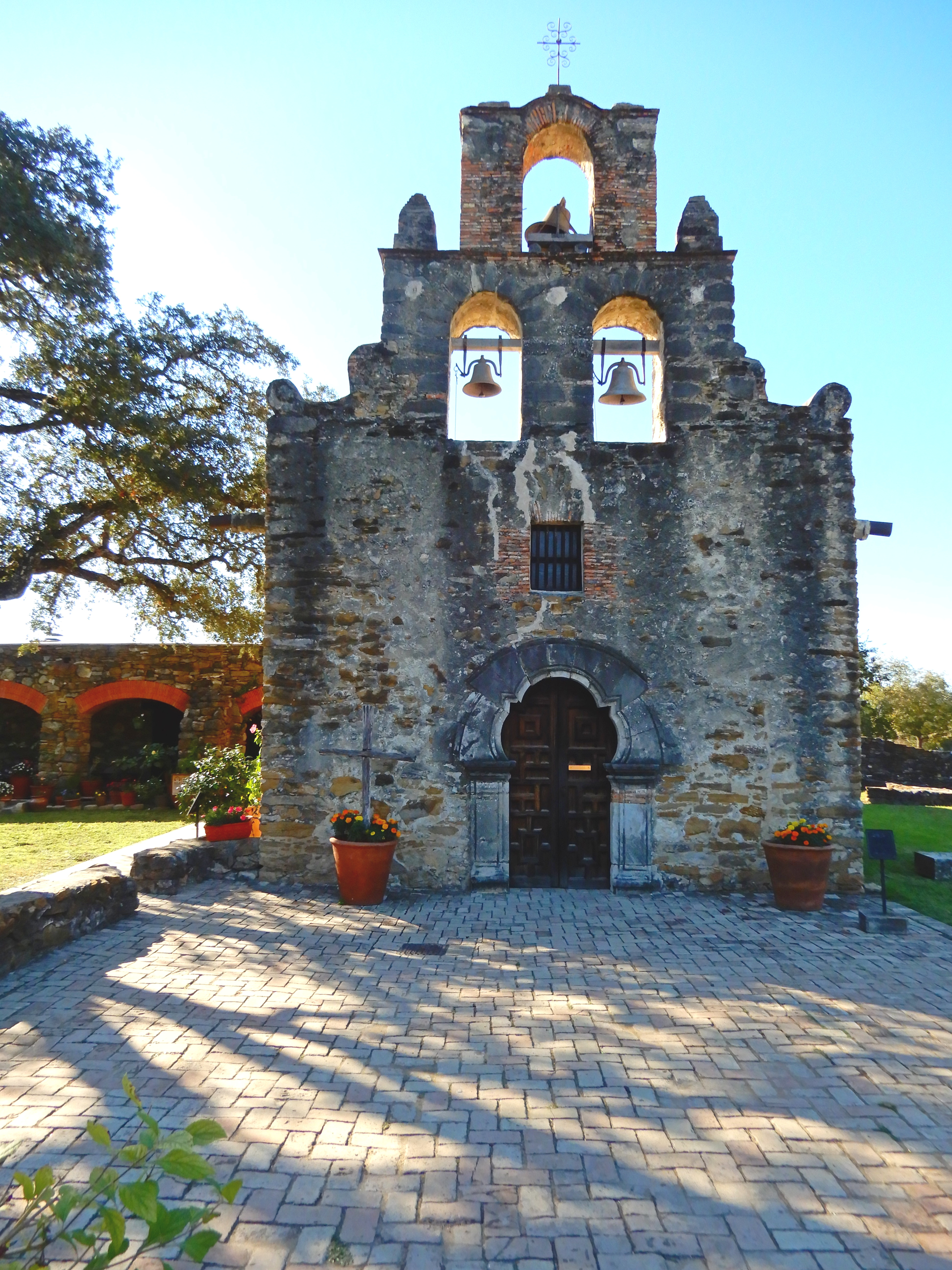
Mission San Francisco de la Espada Catholic Church, San Antonio, TX. November 2021.
It begins like this, this
path toward normalcy,
the funeral two weeks past:
One less beer before bed.
Dreams versus nightmares.
Willingly entering the jail of work.
Discovering your face is smiling.
Telling jokes.
Wondering why your friends
can't get along--then
not caring.
Considering
your life may continue as
once it did, an insensitive, joyous
expression of "Yes I'm Alive"...
Undermining this carefully
cultured mourning pose you've adopted.
And guiltlessly saying goodbye to it.







 all the voices in my head