I’ve just completed reading My Grandmother Asked Me To Tell You She’s Sorry by Fredrik Backman. He’s the one who wrote A Man Called Ove which was made into the movie A Man Called Otto with Tom Hanks recently. It’s a tear-jerking adult fairy tale of a book which skirts the edge of formulaic, contains frequent self-referential passages (which I find tiresome), tells a well-worn tale without breaking any new ground,…and I gave the book a five-star rating. For one thing, I like a pathos-riddled book which adroitly brings tears to my eyes. Mainly, though it’s for two other reasons I gave it those stars. The book re-taught me a lesson about reading (and therefore about life a bit): when you dislike a book (or a person or whatever) because it isn’t what you thought it was going to be, then you’re not disliking it for what it is, you’re disliking it for not living up to your expectations. If those expectations were based on very little, as most of our snap judgments tend to be, then it isn’t the book’s fault. In this case, my expectations were built upon some not-very-specific blurbs which said what the book was ‘about’. I expected a different storyline. Once I accepted it wasn’t going to follow my imagined plot, I realized I liked the book very much. (Had I not, I would have put it down, but with the acknowledgement that I did so based on what it was rather than what it wasn’t.)
Since the blurbs I read led me to expect a book where an adult protagonist runs around Europe delivering letters from her now-deceased grandmother, here’s my blurb, only slightly more accurate and still very vague:
When the grandmother of the “almost-eight-year old” protagonist dies, the granddaughter is charged by her Granny to deliver a series of letters to people from her grandmother’s past. Through this device, Backman weaves together the competing narratives of being someone’s hero and being a shit, and teaches a young, precocious girl that Truth (and Life) lie somewhere between the two. Oh, and along the way he makes a good case for forgiveness and tolerance, fairytales, loyalty, courage, and that anyone can redeem themselves and become a hero.
Me
Other than that, I liked the book for its style which led to some lovely little quotes:
“Only different people change the world,” Granny used to say. “No one normal has ever changed a crapping thing.”
Backman, Fredrik. My Grandmother Asked Me to Tell You She’s Sorry: A Novel (p. 89). Atria Books. Kindle Edition.
Children know that time is just an emotion, so “now” is a meaningless word to them, just as it was for Granny. George used to say that Granny wasn’t a time-optimist, she was a time-atheist,…
Backman, Fredrik. My Grandmother Asked Me to Tell You She’s Sorry: A Novel (p. 231). Atria Books. Kindle Edition
Because life is both complicated and simple. Which is why there are cookies.
Backman, Fredrik. My Grandmother Asked Me to Tell You She’s Sorry: A Novel (p. 368). Atria Books. Kindle Edition.
I wish there were more quotes, but I became too involved in the novel to take time to highlight them. I’ve been gifted some alone-time what with my wife gone for a week, which led me to read hours yesterday and today, which I do too seldom much as I did before adulthood. (True, many would argue about calling me an adult, but I’ve shook them from my boots like the clods they were and kept walking.)
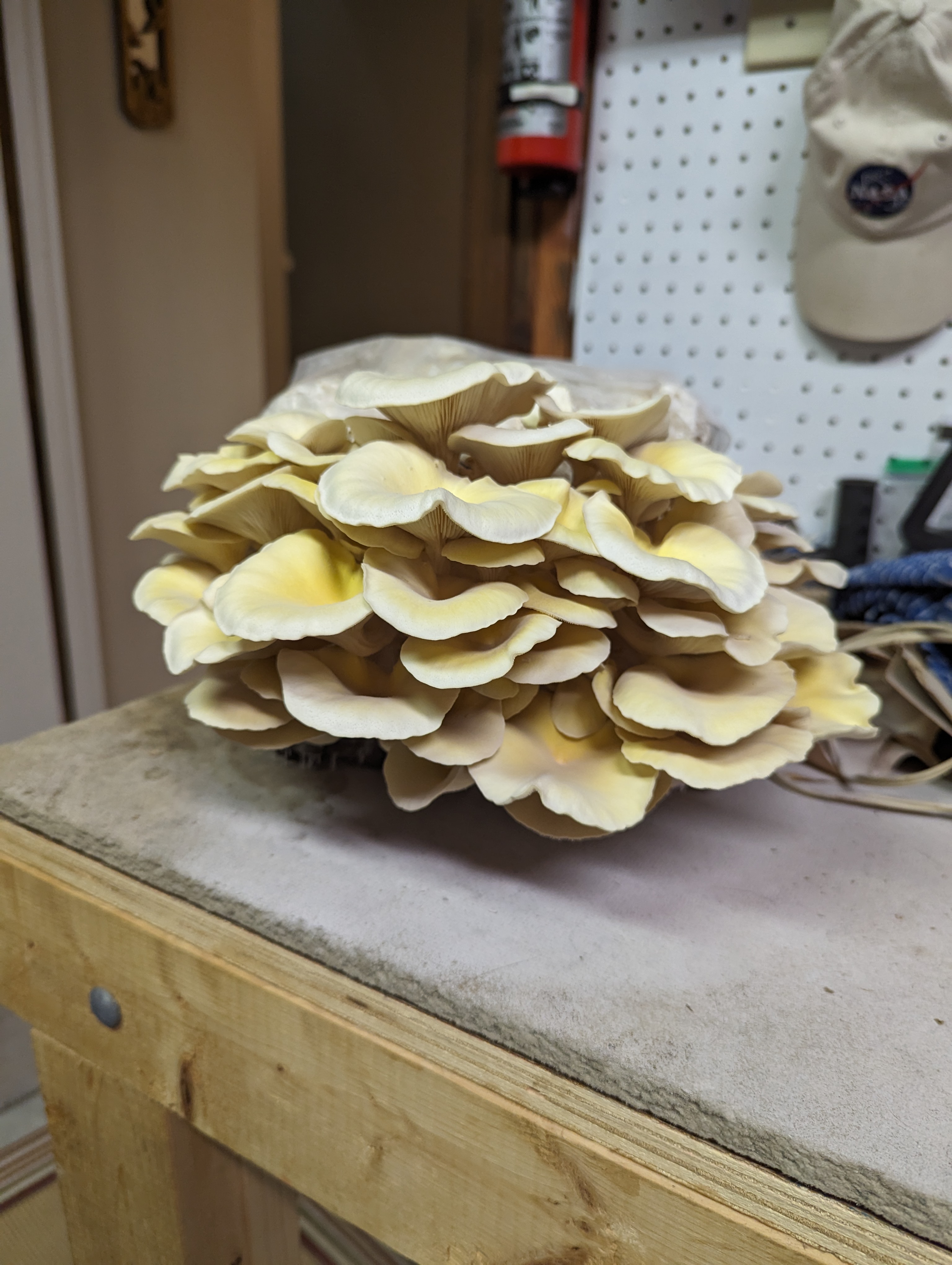
And now, because all posts deserve a photo, here are the mushrooms I’m going to sauté in an hour or two. After the fiasco of the first kit, my purveyors made good with one which burst forth in just seven days and has yielded these fully ripe, ready-to-harvest golden oysters in just 11 days:
Golden oyster mushrooms, at Day 11 + 5 hours. October 2023.
I love National Parks, National Monuments, National Seashores: in fact, any spot of natural beauty will draw me more than most other sights. Don’t even mention “typical” tourism highlights: amusement parks, rides of any sort, sports activities, hanging at a beach, or what’s euphemistically called “visiting the quaint shops of the [insert name here] district”. My idea of horror would be to wake up on board a two-week Carnival cruise on a ship which boasts thousands of guests. I travel to travel, which means being somewhere different from where you normally are. Places of unique natural wonder only exist where they are–one must travel to see them. Cities which superficially resemble all others boast residents who have uniquely combined their histories. One needs to just be with these peoples to understand them, their cities, their culture. This seems simple and logical to me. What seems illogical: spend thousands of dollars to take a family to some Vacation Destination for golf, tennis, horseback riding, shopping, dancing, and just lounging at the pool. You can do that at home for far fewer dollars.
Case in point: In 1997 I announced to my Philadelphia-area co-workers that I planned to quit and move my new wife with me to my hometown, Spokane, WA. Shortly before my last day, a 50-year-old co-worker asked what route I would be driving. I said we would drive west on the Pennsylvania Turnpike through Pittsburgh. This isn’t the most efficient route, necessarily, and he asked my why I was going that route. “Because I’ve never been to Pittsburgh,” I replied. His response remains vivid 26 years later: “So? I’ve lived here all my life. I’ve never been to Pittsburgh.” Pittsburgh lies 300 miles west of Philadelphia. He recently had returned from a fishing trip to Utah. I’m still dumbfounded. How can you not want to experience what represents the cultural definition of your state?
All of this represents my lead-in to Day 12 when we headed south from Cleveland to the Cuyahoga Valley National Park. Cuyahoga shares a background to other Eastern national parks because Congress carved it out of settled areas. Great Smoky Mountains, Acadia, and Shenandoah among others share that background because Europeans settled there centuries before the concept of national parks became realized in America. The photo below illustrates that. As the park was being formed–I can’t remember if it had been formally established or if this was the lead-up to it–a car junkyard existed in part of it. Many thousands of dollars were needed to clean it up. Heels were dragged. But the beavers tired of our politics, built a dam, and flooded the entire area. Problem solved–except all those automotive corpses still reside beneath the surface of the waters.
Beaver Marsh, south end of Cuyahoga Valley Nat’l Park. July 2023.
Before visiting the Beaver Marsh, we received a great introduction to the park by one of the rangers at the Boston Mill Visitors Center. He directed us to two specific destinations: Brandywine Falls and the Beaver Marsh. The falls were lovely:
Brandywine Falls, Cuyahoga Valley Nat’l Park. July 2023.
Temperatures weren’t devastating but the humidity had us sweating as we hiked from the viewpoint (from where I took the photo above) around the top of the falls by way of the bridge at the top of the photo, and then along the north bank of the Brandywine Creek. The trail leads down and down until you walk along the banks of the creek. Some (not us) take a “side trail” to the creek and wander barefoot in its cool waters. The trail crosses the creek and then heads back to the parking lot. Unfortunately for people in their mid-60’s and in poor physical shape, the trail up requires a lot. We paused several times to catch our breaths (and maybe let the feeble breeze evaporate some of the sweat staining our shirts). We regained the comfort of the modern air-conditioned vehicle and drove to the Beaver Marsh.
Beaver Marsh offers one of my favorite environments: still waters, marshes, lily pads, and the hidden inlets where long-legged waders lurk. Here’s one:
Great Blue Heron, Beaver Marsh, Cuyahoga Valley Nat’l Park. July 2023.
When we got to the marsh proper, we were welcomed by a bird I haven’t seen much in North Carolina:
Red-winged blackbird at Beaver Marsh, Cuyahoga Nat’l Park. July 2023.
Before we encountered Mister Blackbird, we had witnessed a few duck-like birds which have defied my ability to identify them. I’ve looked at Audubon and Cornell using multiple sources for each, and I don’t see ducks which look exactly like this. I think they are some type of teal, but…maybe one of y’all might know?
A pair of …ducks? teals? Still wondering. Cuyahoga Valley Nat’l Park. July 2023.
We gratefully escaped the humid hotness to the air-conditioned comfort of Mr. Lincoln, fueled up, and after a short break enjoyed a pub meal at Flannery’s Pub, an Irish-styled establishment.
This isn’t the opening to a 12-step, I’m-so-ashamed program. The act of quitting bandages the abrasions earned by scraping your metaphorical knees as you learn what you shouldn’t do. Bandages shouldn’t be applied unnecessarily; so too don’t apply quitting without need. At best it looks stupid; at worst, it hampers your movement, just as an elaborate bandage hobbles you and can lead to permanent restriction.
We’re conditioned to abhor quitting. “Don’t be a quitter!” and “Winners never quit and quitters never win!” But what if you’re not in the right contest? Quitters may never win, but the untalented never win either, and there is no shame in realizing you’re in the wrong game: a five-foot body isn’t going to cut it in the NBA.
I’ve quit many a race. I regret few. I much more regret the months and months of anguishing about whether I should quit as I languished in a situation going nowhere. After the fact, I realized that I perversely reversed the thinking process, making the decision (without consciously acknowledging it) then searching for a rationalization to get to it.
Quitting can force itself on you. What blessed relief when something like an emergency appendectomy absolves you of all personal responsibility! Just lie there and let others administer to you! Or maybe a Tyrant-Disguised-As-Your-New-Boss suddenly makes the exit look exceedingly attractive. Or the ultimate quit occurs–your significant other stabs your heart by quitting the relationship. Take a moment to cry, then notice all the windows that opened when the door was slammed shut.
I can’t remember all the times I’ve quit, but I do still remember clearly one of the first when the 13-year-old version of me spent a couple weeks on the track team in junior high, a very round peg in a very square hole. I talked myself into a poor 880-yard run performance by saying things like, “don’t worry if you’re losing; someone has to finish last.” No surprise then when the last-place runner passed me and gasped, “why are we doing this?” before he made me the last-place runner! That was a Friday. I quit Monday. Sorry, Coach Skilstead, but I’m sure 57 years later that I made the right decision. Before I got out of high school I had quit vocal music, despite the fact I was good at it and it comprised one-third of all my classes as a sophomore. As I entered my senior year, I quit taking math classes despite being one of the best students in every class I took to that point. I mentally quit thinking I would be a journalist when I returned to creative writing as a senior. (But then I “quit” on that idea when I realized I needed the discipline of a deadline to get myself to the typewriter. [Typewriter! Look it up younglings!]
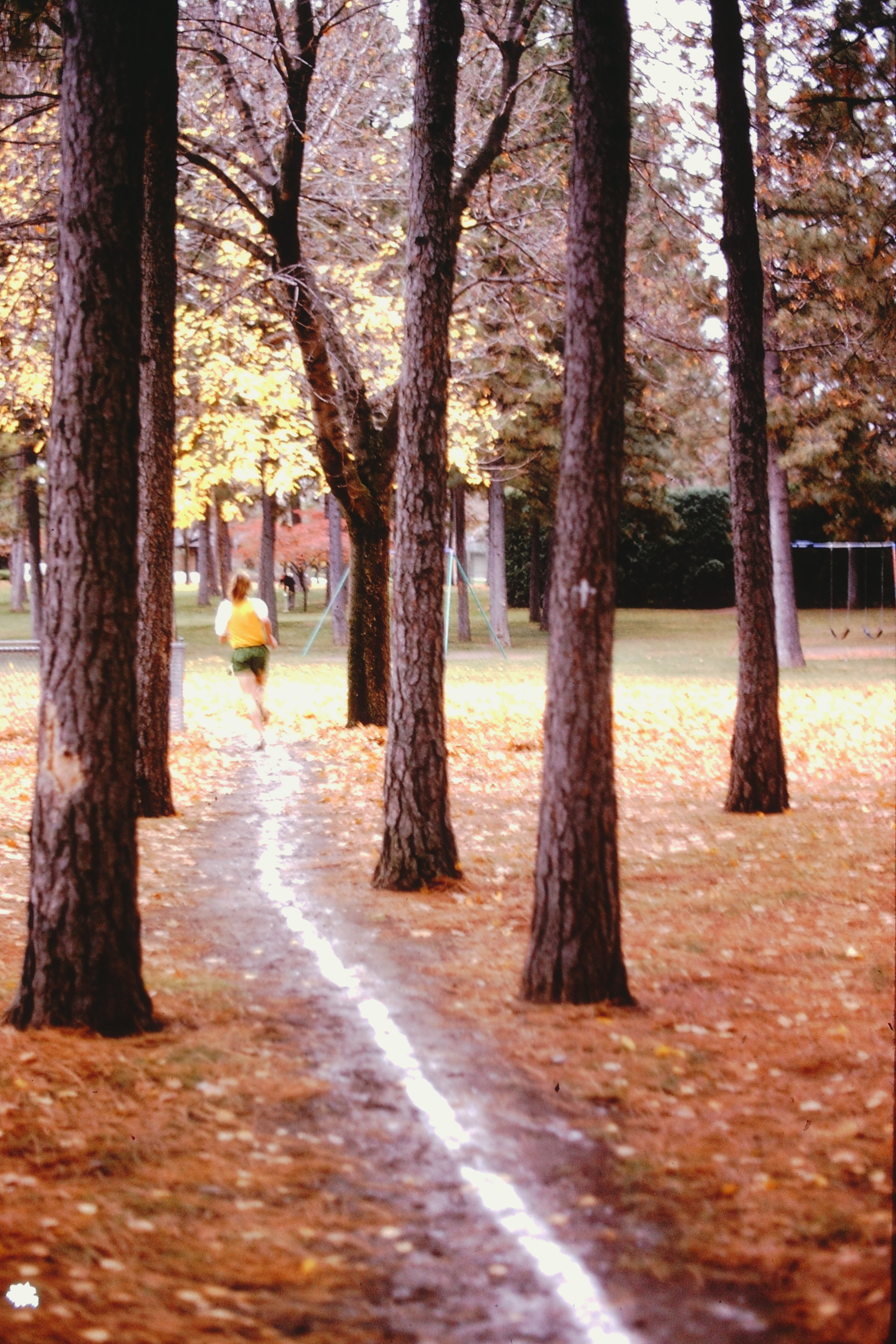
A good runner, way out front. Not me. This is my brother. Fall 1973. Spokane, WA.
Once upon a time I quit a college class called Introduction to Political Science. I sat down for the mid-term examination and found I couldn’t answer any of the questions–a Friday again, naturally. I caught up with the professor the following week and told him I wanted to withdraw from the class. He whipped out his gradebook, registered surprise, and said, “But you’ve got a B at this point and that’s one of the highest marks in the class!” I referenced the midterm and insisted.
I’ve quit church choirs. I’ve quit jobs, sometimes even without having another job to go to. I tried to quit a job for over a year in 2004 and 2005, but the company laid me off before I could line up something else. I indulged in The Big Quit, a.k.a. Retirement at the end of 2019, answering firmly the question, “What would you do if you won/inherited a million dollars?” I had always equivocated when the question seemed theoretical. I told my co-workers I would keep working “unless I felt I was depriving someone who needed a job”. Yeah, it wasn’t a million dollars, but that didn’t matter. I was outta there…but that’s another story for another day.
Recently a person whose work I admire here on WordPress said something about quitting, subtly invoking the tropes our society attempts to get all of us to believe in. Apologetic notes crept in. I hurt for this person, yes, but I enjoyed seeing the acceptance of quitting and the benefits it could bring.
Lately my brother ran into a mental wall which made him abandon his plan to visit us today (April 22). These enforced ‘quits’ don’t always sit well with a person, but I hope he can embrace the possibilities quitting can bring. I hope he can become a Good Quitter.
Meanwhile, I’ll continue to absolve myself when I set aside books which fail to engage me. I’ll feel little remorse for giving up on all the gardening I thought I would do when retired. I’ll try to let myself off the hook for all the home repairs which haven’t been completed. I’ll give myself the freedom to pursue what I want when I want to. It’s been about seven decades–I’m still learning how to do this quitting thing. I’ll let you know how it works out.
One of the nicest things about retirement occurs every morning. The alarm doesn’t go off–not that it sounded much in the past 25 years–and I lie in bed debating about getting up or rolling over for a bit more ‘driftology’ (the study of drifting through my inner time and space). Usually five minutes proves I won’t be dropping back into sleep. I quietly slide out of bed; leave my sleeping wife to her dreams; grab some clothes, my cellphone, my glasses, and the glass of water sitting on my bedside stand; and I walk to the kitchen to start the morning ritual. I avoid the weakening spot on the bedroom floor near my side of the bed, the one which squeaks loudly. Similarly, I walk closely to the wall as I pass the living room, again avoiding the creaking spots in the floor. In the kitchen I put on my morning clothes in the dark. They’re a completely inappropriate fashion statement proclaiming “hey, it’s warm.”
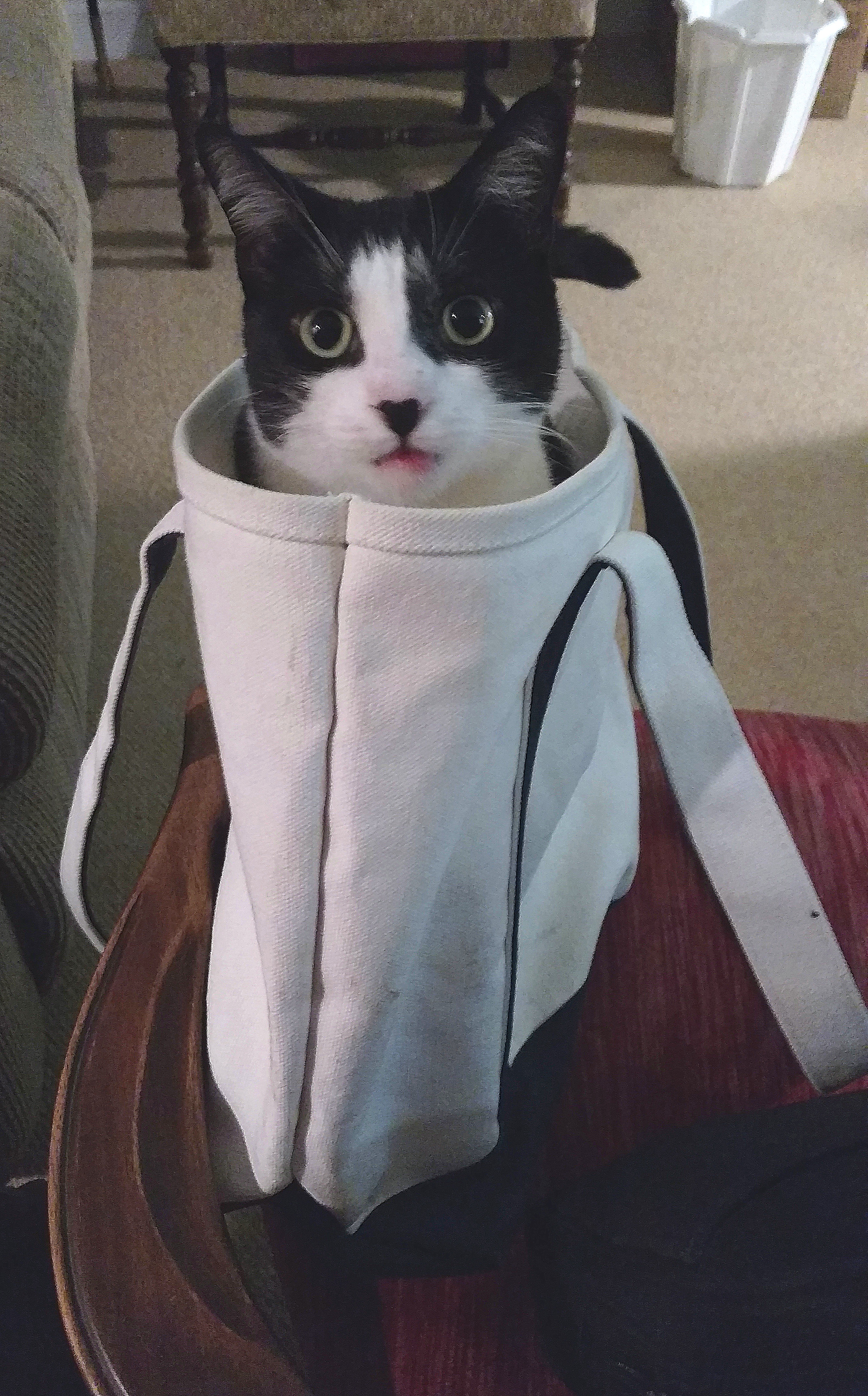
Sometimes Benny, one of our two nearly-identical black-and-white cats, accompanies me. The rest of the time he trots out a few minutes into my routine. I’m made aware of his presence by a gentle body slam against my calves. Despite having started the morning coffee ritual, I’ll stop and feed him. He likely isn’t hungry but why not? Returning to the ritual: coffee filter wetted, cup warmed, grounds measured, and when the water boils, a gentle dribble coaxes the coffee’s blooming. Then a steady pour fills the filter holder. After years of this I usually pour just the correct amount of water to fill the cup.
While these steps play out I’ve downed a glass of water to quench dehydrated cells, and I’ve opened kitchen blinds to prepare for the day. Regardless of standard or “daylight saving” time, very little light comes in these now-opened blinds, unless we’re near the summer solstice: on Retired Saving Time I wake at the slight lightening of the pre-dawn sky regardless the time. Birds will have just started their chirping in the spring. The sun will have become more insistently bright near the summer solstice. Nearing the winter solstice I might beat the sun to rising.
How to convey the calm of living rhythmically? Of waking at first light? Of eating a midday meal when hungry, regardless if it’s 11:30 a.m. or 2:30 p.m.? Of going to bed when tired, never caring if it’s 8:30 p.m. or 11 p.m.? The day becomes a physical meditation. Divorced from it, I can turn into a snarly bear, but being in tune with it resembles breathing at the steady, resonating rate synchronous with All Being.
In 1995 or 1996 I removed the watch from my wrist and never returned it. I turned off the morning alarm. Though I benefitted from a corporate job back then which allowed a laissez-faire approach to the start of the workday, I’m pretty sure I would have done this even had I been a shift worker. The slight tension induced in knowing there’s no alarm served to wake me with plenty of time to tackle morning matters; it proved far preferable to waking 25 minutes before the alarm was due to go off only to lie there cursing because I couldn’t get back to sleep and “why bother anyway”. In retirement this natural rhythm has extended to the whole day, but the slight tension doesn’t wake me anymore.
Coffee in hand, my day officially begins with reading. It may be the Morning Briefing from the New York Times. It might be the comics. It might be baseball, more specifically anything written overnight about the Phillies. Recently, during Lent, my morning read has been The Sign of Jonas, the journals of the Trappist monk Thomas Merton. This last requires turning on a light since it is a physical book, not something on my tablet or cellphone. For that reason my reading necessarily takes place downstairs where a light can illumine without bothering my sleeping wife. Benny benefits too: when I comfortably settle in front of a fire downstairs or in an old wing-backed chair in our library, Benny gets to jump up for a morning petting session. (If I’ve happened to have decided on reading material on my computer, he’ll happily claim my lap there, too.) Reading becomes a bit challenging with a cat squirming around, kneading and delivering headbutts. Soon he settles down and allows me to continue my study of Merton, my inquisitive plunge through data at my computer, or the latest take on This Stuff Really Matters (Today).
Henry Clay Mansion, KY. July 2014.
Because I’ve moved to the rhythm of the day for nearly 30 years, I alternate between chuckling or muttering in irritation when people rant about jumping forward to Daylight Saving Time or falling back to Standard Time. Time–being but a mental ruler imposed by humans upon our perception of past, present, and future–doesn’t exist. Every day we are reminded how a group of people living through the same events do not experience it in the same way, do not remember it in the same way, and will sometimes seek to rewrite those events to suit a particular purpose. To put it in someone else’s words:
What usually happens is that, once scientists have worked out their equations [for a Grand Unification Theory], time is nowhere to be found. And if it’s not part of the fundamental fabric of the universe, how do we know it’s not something we’ve invented to explain what we don’t understand?
In most senses I don’t care if it exists or not. Hours, minutes, and the clocks which measure them indisputably resemble rulers, nothing more. Just as that tree on the hill doesn’t get any closer if I declare I’m a foot closer to it (while not moving my feet), I don’t perceive time appearing or disappearing because we move to DST. Just as retirement has brought a detached view of the working world (and many other matters), so too has it altered my perception of time. (Time as a malleable substance?) Stereotyped jokes show us older folks forgetting the day of the week with regularity. Is this any wonder when time doesn’t exist? If I stop using a tape measure to measure how far I travel, am I assailed when I lose touch of my sense of distance? I can still walk from Here to There, can’t I?
[Which sparks a possible and humorous but too truthful dialog:
“Do you know what day it is, Mr. Pilcher?”
“Yes.”
“Would you tell me?”
“Yes.”
“What day is it Mr. Pilcher?” (a bit of exasperation now)
“It’s today.”
“And what day is ‘today’, Mr. Pilcher?” (more than a bit of exasperation now)
“It’s always today. I don’t understand your question.”
“What DAY of the WEEK is it, Mr. Pilcher?”
“Gee, I’m sorry if I annoyed you. I have no idea what day of the week it is. It’s a day between Sunday and Sunday; I go to church on Sunday, and I didn’t go to church today.”
(lengthy pause while Mr. Pilcher’s treatment plan is revised to indicate he is losing his marbles)]
My paternal grandfather spent many minutes and hours staring out of windows in his later years. He at times seem befuddled. He also showed he was sharp as a tack when it came to philosophical and existential questions. He had studied theology and led congregations for decades. Staring out of a window came with the territory, especially when composing this week’s sermon. While the need to write sermons disappeared in retirement, the window-staring did not. Did this indicate a dissociative mind? Doubtful. More likely old habits outlived their usefulness. So too my need to keep track of every hour of the day, every day of the week. I never did, much. Why should I be punished for that? I wouldn’t be punished for a deteriorating sense of distance; why a deteriorating sense of time?
I would argue my rising with the predawn light, moving through the day totally in touch with what needs to be done Now, whether it be eating, my taxes, planning meals, pruning shrubs, reading books, attending a doctor appointment on time, or going to bed when tired keeps me in a meditative state. Retirement provides extra incentive to be in touch with the here and now. I shouldn’t be penalized because I’ve approached a more natural state of being, I should be admired or at the very least respected. Instead, I feel the need to document how my memory of many things has been tenuous throughout my supposedly ‘with it’ years. I have never been able to tell you what I have to do today. As a reporter in my late 20s, I would drive to work oblivious of what stories I had to run down that day. As a teacher in the years that followed, I had only a fuzzy idea of what I had to teach that day, usually because I had planted the seed in my brain the night before: “you have to get to school quickly to print that test you’re giving today.” Ask me on Monday what the lesson plan for Thursday will be, and you would have received a panicked look. In the corporate world where each day’s list of to-do’s varied quite a bit, I had no idea what I would do that day until I looked at the task list. (Bless you Franklin planners for focusing me the idea of A, B, and C tasks.)
And now? How do I prove to those who will judge my mental competence that I have never been able to remember what I have to do today? That I’ve marched through many a day thinking it was Thursday, only to be reminded continuously “no, it’s Wednesday”? When my mother neared the end of her life, she was subjected to many a judgement like this. When she microwaved a throw pillow because she thought she could warm it up and use it on her sore neck, her dramatically shocked visiting nurse felt that Mom was ‘losing it’. Well, somewhat, yes, I concurred. “But Mom has always had a tenuous grasp of the physical sciences including those which govern a microwave. Just because it wasn’t marked “microwavable” on the throw pillow shouldn’t totally count against her. After all, she had several microwaveable neck pillows which she did put in the microwave each night–and they didn’t have “microwavable” on some tag attached to them, because they were handmade by the good ladies at her church. Should she have responded to the smoke filling the room? Yeah, probably. Then again, my wife should have reacted to the smoke filling our house that night in midwinter 2002 when the furnace’s chimney had decomposed, and I came home to a house filled with smoke and a wife merrily preparing my dinner. Losing your marbles doesn’t occur when you misplace the bag of marbles. You lose one here, one there, never noticing the slightly lighter bag you’re holding.
Our perception of time varies from person to person, and time’s but a human construct. Our perception of reality–whatever reality is according to the popular philosophers of the day–varies even more. We should be judged on who we are and who we were, not on who someone wants us to be. Want to scare yourself? Pretend you’re the plaintiff in a court hearing to prove that you are mentally incompetent. My guess? You can’t prove you’re competent right now! Good luck when you’re 80.
God forbid I should be denied my mornings with Benny, coffee, and reading material simply because someone says I need to stay in bed longer, or get into a shower, or do anything else I don’t want to do. “Oh Lord, I pray my ability to perceive how I’m being treated matches how I’m being treated.”
Ocean Isle Beach, North Carolina. Still there in November 2007.
A little bit ago I wrote about the longevity of clothes in my closet and how they mark the march of time in reverse. I’ve realized lately that they have staked out the future too. Today I wore a fleece top purchased when we took a Thanksgiving getaway to Ocean Isle Beach, NC, in 2007. It’s none the worse for wear (the fleece top, not Ocean Isle Beach which might very well be the worse for wear). It dawned on me today that a heavy flannel shirt/jacket, the aforementioned fleece top, the sweatshirt I wore last week which was given to me by my employer in 2003 or 2004, etcetera, etcetera, will possibly be in my closet when I die.
Recently I’ve tried to lengthen my time between Now and Death. “It’s likely twenty-plus years, you fool,” I tell myself. Retirement planning forces one to focus on ‘how long do I have’ and then hope the money lasts that long. It fosters looking toward the end instead of the path toward the end–instead of focusing on where you are right now. And lately, I’ve been successful in realizing where I am relative to my likely End. I accomplished this by looking backward the same amount of time I can expect to live. Today it means focusing on where I was twenty years ago. “Goodness, I thought things were grand back in 2003!” he thinks. It feels many years ago when looking backward. Then why not many years ahead when looking forward?
These darn clothes tell a different tale, or at least they have their own tale to tell. “We’ll still be there in your closet. This is your wardrobe for the rest of your life.” It’s weirdly depressing and freeing at the same time.
My poems seldom rhyme. To me
it seems contrived frivolity.
Pushing literary toes
into narrow shoes just shows
clever, well-turned rhyming tricks
meant not for skill, but merely hicks
who hold a cowpoke's doggerel
more meaningful than good ol' Bill!
Dashboard Cooper (aka D.B. Cooper) disrespected contrivance in all its forms. Sometime in 1989.
When I tossed my 1968 J. C. Penney’s Towncraft wool coat, it was older than about half my co-workers. Its brown, blanket-thick fabric had kept me warm for 38 winters. It arrived in my life as I began my freshman year for high school (still to be served in a junior high school), when my mother decided my brother and I needed new coats. We both came home with nearly identical wool coats, cut at the hips, and lined with polyester faux fur. They cost $20. According to the website in2013dollars their purchase price would be $170 or so today. That’s a little difficult to believe, because I know Mom wouldn’t have spent $170 in today’s marketplace to buy me a coat, but not everything remains the same today as it was then. A gallon of gas should cost about $2.90 based on 1968, but I’m paying more than that and only briefly did I see it below $3 at all in the past twelve months.
But back to the coats. In January 2006, more than 37 years later, I threw that coat away. It had hung in our basement, only coming out when I took walks in the woods behind our house, and the coat had developed a green sheen indicating some type of moss which I couldn’t see individually had taken over the wool. I promised my wife I wouldn’t try to save it when we moved south to North Carolina.
Moments before it went into the dumpster: the 37-year-old coat. Grafton, New York, January, 2006.
I still hear my parents saying you wear clothes until you outgrow them or they wear out. Before I reached 30, I realized I wouldn’t be throwing many clothes away for the latter reason because I just didn’t wear clothes out much for reasons I still don’t understand. Sadly, I do outgrow them still, but these days it has to do with an expanding waistline. I absolutely love buying clothes. The fact that they will take years to wear out frustrates the consummation of that desire. I prod myself to ‘just give them away–if they don’t bring joy…’ but it’s a lost cause. Most of them still bring joy. A few bring sweet pain:
There’s a wool Pendleton wool shirt I just took off two days ago. My father wore it in the last years before he died at the end of 2013. The shirt shows absolutely no wear, and I would bequeath it to my son except I don’t have one. I’ve donated most of the shirts I took from his closet, but a fleece pullover remains for reasons which elude me: I dislike it and wear it little, thus ensuring it will be good enough to bury me in, or at least keep me warm in the nursing home.
Look up at my avatar photo. Though difficult to see, I’m wearing a robin’s-egg blue sweater. The photo was taken at Christmas 2009. There are several other sweaters in my closet purchased at the same time, since I tend to buy several things at once but only once or twice a year.
Yesterday I wore a pair of sneakers which I distinctly remember purchasing when we lived in New York. We left New York in January 2006 as mentioned above.
I’ve lucked out more with t-shirts. The oldest one (I think) appears to be one purchased while on vacation in Boone, NC. We took that vacation in May 2013. The T-shirt looks fine; I’m sure it has years ahead of it given that I’ll only wear it in certain circumstances because it’s not 100% cotton, and I dislike such shirts. (“Why don’t you throw it or donate it?” “Because…”)
In the room two doors down from this office, a leaf-green down jacket is draped over a plastic lawn chair. I purchased three items in the summer of 1972 to keep me warm while camping in the Rocky Mountains. Recently graduated from high school, I had never camped in my life, and in the fall of that year I would enroll at the University of Montana in a program featuring frequent camping trips. My new advisor recommended two things for camping: a down jacket and a wool sweater. More precisely, he recommended buying two wool sweaters at Goodwill, cutting the bottom six-to-eight inches off of one and sewing them on to the other to make a wool tunic. I bought the jacket and the two sweaters as directed, paying $1.99 for one sweater and 99-cents for a second. My mother made the necessary alterations. (The more expensive sweater fell to her shears.) When camping ended a year later, I removed the add-on, and kept the 99-cent sweater until it joined the mossy wool coat from 1968 in the commercial dumpster in my front driveway. Mostly I tossed it to appease my wife, but I admitted to myself that the high neck on the coarse wool sweater irritated my skin. The green down jacket sports a two-inch square of green plastic tape on one elbow where a spark from a campfire fell and melted a hole. It’s the original tape from 40 years ago. I wore the jacket just a few weeks ago during a cold snap when temps lived in the teens and twenties. Come to think of it, I’m wearing it in the photo above as I toss its older brother into the dumpster!
My first real camping trip with Woolco, a group of us leaning in to the message of our faculty advisor: “you gotta wear wool if you wanna stay warm”. Arrowhead Lake, Glacier National Park, Montana. October 1972.
I’ll toss expired food as if it insulted my mother. I’ll throw away half of our Christmas decorations because I don’t like putting it all up in early December only to take it down as January begins. I once sold off virtually every piece of furniture from a 4000 square foot house prior to a cross-country move. I don’t hoard in general; I hoard specifically. To wit:
While working in New York I picked up the habit of using scratch paper for most computer printouts. From that point forward I routinely brought home scratch paper from work once I moved to North Carolina at the beginning of 2006. I still run across paper from those years. We’ve moved three times since then.
I recently forced myself to ‘designate for assignment’ most of the old computers I’ve clung to. Those which remain able to perform at an acceptable speed sit around waiting for a purpose in their sad little electronic lives. Until I joined the ranks of music streamers a year ago, an old laptop from 2012 sat on my downstairs bar to serve up our digitized music. Though it’s slipped into retirement again, it sits on the bar still. Perhaps it will become a photo display.
But for a divorce, I would still own a Yamaha amplifier and its matching cassette tape deck, purchased in 1986. (Well, not the latter. I’ve not needed a cassette deck for a decade.) I still cart around the Boston Acoustic speakers which they powered; these speakers were in use through 2009 when I discovered the woofer in one had shredded. I still plan to fix it, more than a dozen years later.
I want to think my distinction involves the usefulness for the tools in my life: the clothes which keep me warm, the computers which enable me to work and communicate, the audio/video equipment which entertains me. If so, how to explain all the memorabilia, the extensive library, the suits I will never fit into again, or, frankly, the pool table which came with the house and hasn’t heard the crack of a cue stick on the white cue ball in years? Perhaps the memorabilia serves as a tool for memory, and I can rationalize the books because every few months I want to look something up in them, but the suits? The pool table?
We’re all biologic collections at war with ourselves: laziness versus industriousness versus mindfulness versus purpose; emotion versus analytical thinking versus empathy versus pragmatism; habit versus creativity versus spontaneity versus thoughtful planning; childlike wonder versus mature knowledge versus arrogant authority. Those things around us, be they physical or metaphysical, play the part of a charcoal rubbing of our psyches, of who we are. I’m going to look a bit more closely at this “stuff”. It seems to want to tell me something.
I am not a friend.
I am an appliance
turned off and on
at whim; replaced
when my performance
fails.
Valued for comfort,
valued for feeding
egos/stomachs/hearts
(choose one or more)
until satiated.
Stress-walking, tense-talking,
wondering when this misstep
will negate our shared history.
This just in:
I too will turn you off
at a moment's notice.

Gardening emotionally,
I prune unfruitful relationships,
attempt to shape the unruly,
fight invasive species, but,
lately, I think I've pruned too
aggressively, fought too
vociferously, spent too little
time nurturing those pretties
who choose to live in my garden.

"Window up, window down",
Grandma's mantra. Why bother
with gradations, nuance, shades
of meaning, human failings?
Today's binary, electronic culture
can't see it's founded in
yesterday's hard realities:
"If'n it doan kill ya, it'sa prolly good,
but if'n it make ya sick, t'ro it! Ain't
no use hangin' onta sump'n gonna
maybe kill ya, sooner or latuh."

Yes,
I live not in my past but
in someone else's. It served
our ancestors for lifetimes, it
put backbone into indecipherable
existence, into amorphous life:
Symbolic living, roles for everyone--
must I think about myself,
about you, about everyone? Surely
I will die inside. I will face
insurmountable walls of
misunderstanding.

Today's non-roles just demand
different roles, other rules,
other games to play.
Just tweak roles from
millennia past. No need to
reinvent new modes of
emotional transportation.

But still...
It's on/off, "thanks for being
there, why can't you behave,
why can't you act the way
we act, push the buttons
we push, hate what we
hate, love what we love?"

I've got some on/off for ya:
Be who you are; I'll be the same.
Maybe similar will attract
Similar.
Or bug off.
Who’s using whom? Purple coneflower and bee. June 2017.
"Write me poems,"
she said. "Not that
sonnet, rondeau
crap. Make it formed,
but not formal.
Make it happy,
poignant, heartfelt."

Whew! Tall order.
How to commit
to words which don't
bring despair, don't
touch my psyche's
crackling third rail?
'formed, not formal'?

Wrapped around my
neutrality
entwine serpents
of dark, of light,
yet both truthful.
One favors pain,
despair, sadness.

Countering, its
mirror favors
hopeful, joyous
optimism.
But it whispers--
'gainst its brother--
screams less, asks more.

"Everything's great!"
doesn't cut it.
Good news--no news.
Seismic shifts, stabs
to my heart grab
more attention
than goody-ness.

Problems add edge,
life's hoppy bite,
offsetting its
malty sweetness.
But she challenged!
Can happiness
inspire poems?

My life-garden
hosts tangled plants,
gnarled, tall, choking
new growth. Little
shoots blossom up
regardless, and...
Something happens.

My ultimate
Gardener, my
concept of God
nurtures sprouts, brings
forth fresh flowers
striving to vie
with woody growths.

Despite these new
optimistic
upstarts, my soul's
garden remains
wild: poison vines,
weeds, burrs, thorns. No
apologies.

Who am I to
question what grows,
what does not? Why
question my lived
reality,
denigrate my
totality?

Are we happy
now? Are we mired
in hopelessness?
Do we focus
on pretty new
blossoms? Do we
ignore the whole?

Without yin there's
no yang. Without
black, white on white.
Speak to truth no
matter its source.
Shuffle the deck;
deal ALL its cards.

Thirteen sevens
multiplies two
potent numbers,
magical yet
at odds with each
other. She will
appreciate [this].








 all the voices in my head