Our yard on the left, neighbor’s on the right. Photo is unretouched. January 2026.
Last October we paid to have our back yard replanted with plants native to North Carolina, the American Southeast, and the Atlantic seaboard. As in colder climes, the vast majority of native plants drop their leaves and enter dormancy for the colder winter months. We also “leave the leaves” which allows them to decompose into the soil as they should, creates cover for the little creatures to stay warm (and avoid hawks), and supports the lives of little bugs which in turn provide food for the ground-feeding birds. Thus, the predominant color of our back yard and our front yard is brown.
Our neighbor’s yard represents most yards around us. The green of English ivy covers the ground and the trunks of the trees. Saplings of non-natives take advantage of the warmer winter weather much as sunbirds head for Arizona or the coast of the Gulf of Mexico. Some keep their summer foliage—no need to drop leaves and protect a plant conditioned to far colder climes. It’s not that leaves fall only in our yard; there’s an oak or two and some poplars over there. It’s that the ivy manages to conceal somewhat the leaves in my neighbor’s yard.
In winter, therefore, brown is good, and green is at best questionable. (Before my southern readers chime in, yes, there are plenty of Southern evergreens, but not many around here consciously cover their yard with them.)
Our natives, once established, should have staying power also. It’s kind of defined by the word “native” is it not? I will need to wage constant war, though, on the ivy, the Virginia creeper, the japonica, and the various saplings which will inevitably attempt to broach the property line. It’s a battle I freely take up. For the time I live on this speck of the Earth, it will bring forth those plants which grew here naturally and nurtured the birds, mammals, insects, reptiles, and amphibians which depend on them for healthy populations.
Take a Sears-Roebuck catalog, cross it with the hippie ethos, and add a large dose of product recommendations. WEC blazed a new trail. Photo, July 2025. Catalogs, Summer 1972 and sometime in 1994.
When I headed off to college in 1972 my curiosity led me to enroll in an experimental education program funded by the Ford Foundation. I hope to write of that someday, but today we consider two peculiar residents of my library: two editions of The Whole Earth Catalog. Being 18 in 1972, I didn’t exactly participate in “The Sixties” which meant I hadn’t heard of The Whole Earth Catalog until it appeared on the textbook list for that experimental program I’d enrolled in. What is it and why am I making a big deal about it? Is this just some oldster nostalgia trip? Maybe, but I think it’s much more than that.
The WEC basically laid the groundwork for what today is Wirecutter and everything like it, except…what if Wirecutter had a hefty dose of social awareness ethos baked in? And what if there were no suspicions that Wirecutter and websites like it make decisions partially based on monetary reward? Before The WEC, I’m unaware how one could have gone to a single source for information, evaluations, and recommendations on a number of topics. Everything one needed know about consuming involved a physical trip to interface with salespeople. In certain cases one could consult a dedicated publication for audio equipment, say, or fashion, but sooner or later one needed to go to a store to buy something. If I wanted information about high quality stereo equipment, I went to Huppin’s Hi-Fi downtown where all the audiophiles (a.k.a., stereo gearheads) gathered and had all the information. When one wanted furniture, one headed to a furniture store or several and bought the best of whatever you saw. The same with clothes, garden tools, hardware, books, cars, pretty much anything. Who knew if it was good? Who knew if the price here was as good as there? If you ordered something, like a car with all the options in your favorite color, you started at a dealership. Everything filtered through the salespeople.
But the WEC gathered its recommendations for just about everything which interested the Peace Generation (or whatever you want to call us), told you why it represented the best you could buy, and gave information about how to get it. Or as the Function statement on the very first page of The Last WEC said , “The WHOLE EARTH CATALOG functions as an evaluation and access device. With it, the user should know better what is worth getting and where and how to do the getting.” This “last” edition didn’t have a table of contents. After page two told you how to get the stuff, and other tips, the third page launched right into “Whole Systems” and starting with the subsection Buckminster Fuller (anything dealing with Buckminster Fuller, a near-god of social planning). Other sections dealt with land use, industry, craft, community, nomadics, communication, and learning. These were loosely defined: subsections in Learning include “Thinking,” “Serendipity,” “Psychology,” and “Free Schools”. Additionally, the lower right corner of all right-hand pages from Page 9 onward contained the story “Divine Right’s Trip” where the main character, Divine Right, experiences many adventures of the time until he lands on the Whole Earth Catalog at the very end, a sort of gold-at-the-end-of-the-rainbow thing.
I could write pages and pages about the WEC to little effect on anyone who hasn’t seen it. In its way it picked up the tradition of the old Sears-Roebuck catalogs which allowed people living in the backwaters of America to buy through the mail most of the things they could ever want for their farms, their businesses, their personal health, and to clothe their bodies. (“Through the mail” • prep phrase describing movement of written communication and goods prior to delivery services such as UPS and FedEx) The S-R catalog fell onto hard times when everyone started to get electricity and cars made it easier to get to the merchants.
After navigating the remainder of the 1970’s and all of the 1980’s, issuing a few Supplements—the informal publications which came out between editions of The WEC—founder Stewart Brand and crew decided a new edition needed to be published. Those 20 years saw the introduction and rise of the personal computer, for one thing, and the starry-eyed, inchoate idealism of The Sixties had given way to a gritty, in-the-trenches attitude by the early 90’s. Most of the casual members of the Peace Generation had left the ranks, lured by money, security, and mere existence. The title page of The Millennium Whole Earth Catalog quoted Brand from 1969: “We are as gods and might as well get good at it,” before explaining that good things performed by governments and other large bodies were being obscured by “gross defects”; a rising personal power needed a guide to the new tools making this possible.
Two random samples from The WEC shall suffice, one from each.
Opening The Last Whole Earth Catalog to pages 36-37, I find myself in the middle of a five-page description of something called Liferaft Earth. I’ve no personal knowledge of this, and I’m not reading all five pages of very tiny print (looks like 6-8pt type; it varies because consistency was not a strong point for The WEC). It appears to be about making sure everyone on the planet has enough to eat. Here’s a snippet from the top of the second column of page 35…
The following five pages chronicles a week-long event sponsored and organized by the CATALOG in October 1969.
Richard Brautigan saw the end of it. The beginning of it was three days I spent alone on a train with excellent hash and Paul Ehrlich’s Population Bomb. Ehrlich had been a teacher of mine, back in his butterfly and my tarantula days, so I knew to believe him.
—SB
“SB” was Stewart Brand who created and led the WEC publication team. Incidentally, in looking for a formal description of his title/role, I discovered the entire Last WEC was composed using an IBM Selectric typewriter. I didn’t find his role.
I left a bookmark in the Millennium edition long ago. Opening to this page brought me to the Communications section/Writing subsection. An article preceding the tools for and about writing begins, “We are swimming in a great polluted sea of language, and we wonder why we can’t write.” How much more so now! It continues:
We wonder why we don’t want to read. Even worse, we cease to wonder; we just don’t do it. It’s as though it didn’t matter anymore.
As though hammers didn’t matter; as though air didn’t matter; as though horses and balloons had disappeared.
It’s not a hardware problem; it’s not a brain-wire problem. It’s a writing problem. It’s software, it’s soft words, it’s swampish bureaucratic slide-down of mush-mouthed ass-covering prose that promotes long term despair in humans.
—Jon Carroll
This appears on page 242 of 384 pages in a book measuring 11×14.5 inches in fonts rarely bigger than 8pt. You can see how one would get lost in there, and how part of him would never come back out. Which is why more than fifty years later they remain on my bookshelves despite the hundreds (thousands?) which have not withstood the journey.
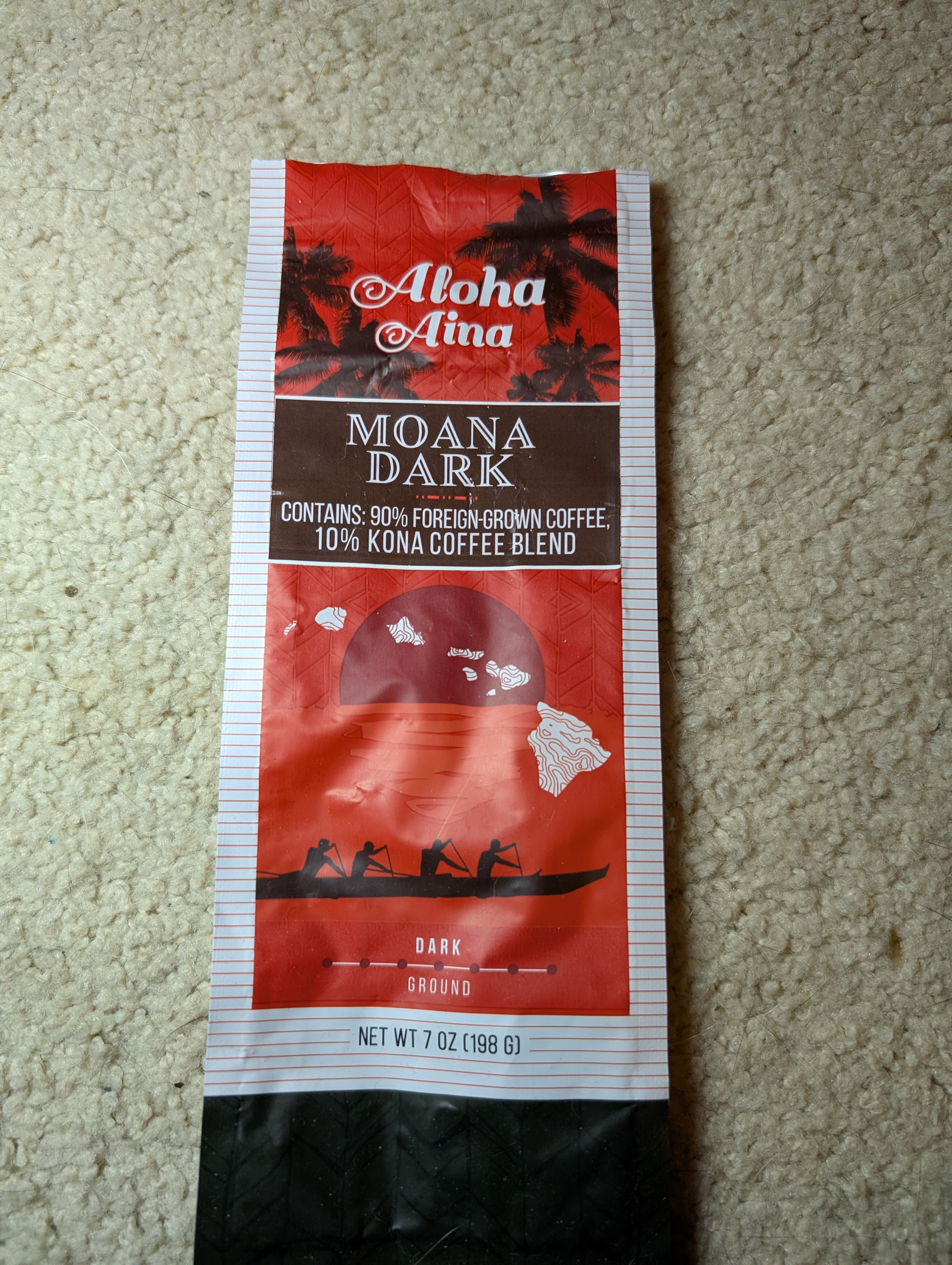
100% Kona coffee. Purchased in Maui, September 2024.
Our first full day on Maui consisted of settling in to a condo (“we need food” we realized). Then, we rendezvoused with one of my few cousins after more than 50 years. While spending the afternoon with them, we wandered an upscale mall. I spied a coffee shop and within, some ground Kona coffee. I needed coffee. I grabbed the package pictured above. At check-out the clerk said, “That will be forty-three dollars” and change. A mixture of shock and avoidance of embarrassment made me extend my credit card, tap the terminal, and commit to one of the most foolish purchases I’ve made in my life. You’ll note the package is only 7 ounces. As in barely-more-than-half-a-pound. Unfortunately, I can’t resist doing the math, and that’s more than $98/pound. Ouch.
I don’t like Kona coffee. I’ve had it off and on (mostly off) over 45 years of fine coffee drinking. I therefore didn’t think too much about buying something that purportedly was a lot less well-positioned on the ladder of quality. Because I absentmindedly left the package in my cousin’s car, I therefore needed coffee still. I purchased this:
Note–only 10% actual Kona coffee in this package. September 2024.
The pound above cost around $12-13. Same amount of ounces. Tasted…not quite as good, but really it wasn’t a three-fold difference. I felt stupid. And there you go.
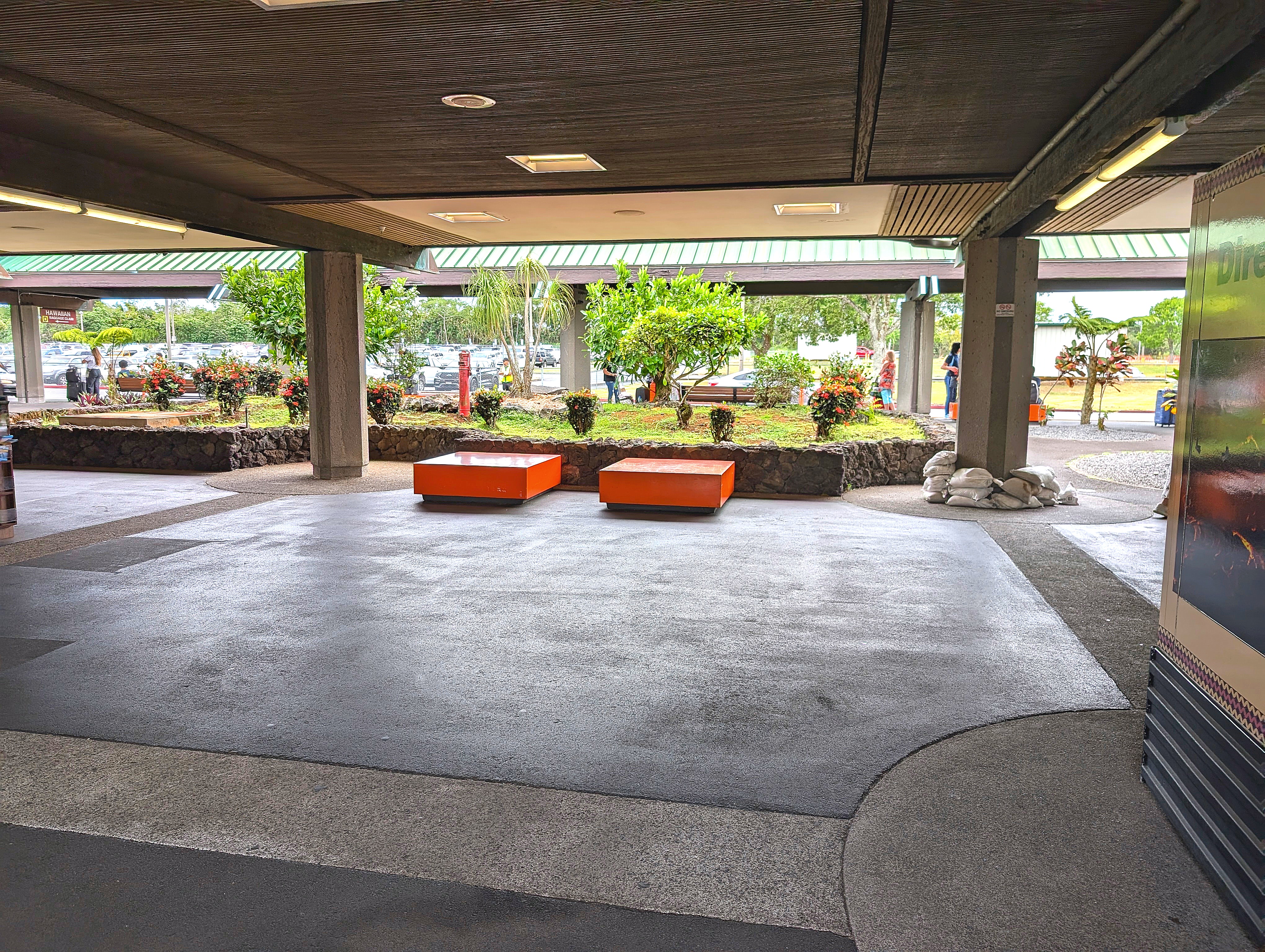
I’ve but three Hawaiian airports under my belt, so take this statement with several grains of salt: a first-timer’s arrival to Hawai’i could scarcely be better than passing through the Hilo International Airport. Smaller airports does not always mean better: a truly uninspired one exists in my hometown of Spokane. Most exist as tiny copies of the Big Boys. That’s what makes Hilo’s such a refreshing surprise.
An exit from Hilo International Airport. September 2024.
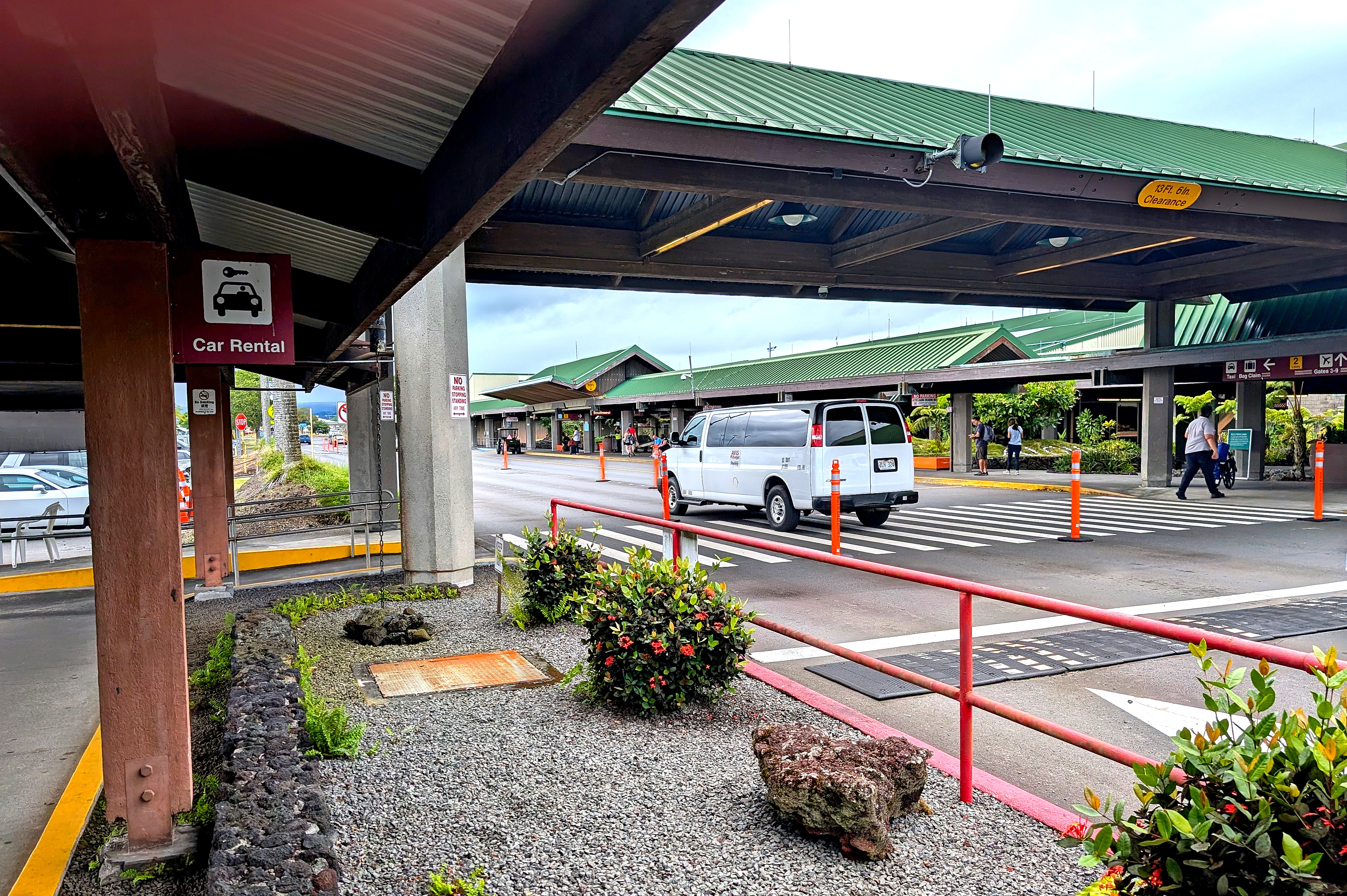
Unlike any other airport I’ve been in, Hilo’s opens to the air…everywhere. Call it The Lanai Effect. On the concourse level most walls rise to railing height only. The arrival/departure level echoes the effect. Large doorways punctuate the building so frequently, one becomes hard put not to claim the walls punctuate the openness. Green steel roofs the low-slung building and covers the walkways. It reminded me of photos I’ve seen of other tropical buildings, particularly those serving some kind of transportation need: freight depots in the Amazon; a train station in the Congo; tropical open-air markets in a cruise ship’s port of call.
Hilo International Airport as seen from “car rental row” across the street. September 2024.
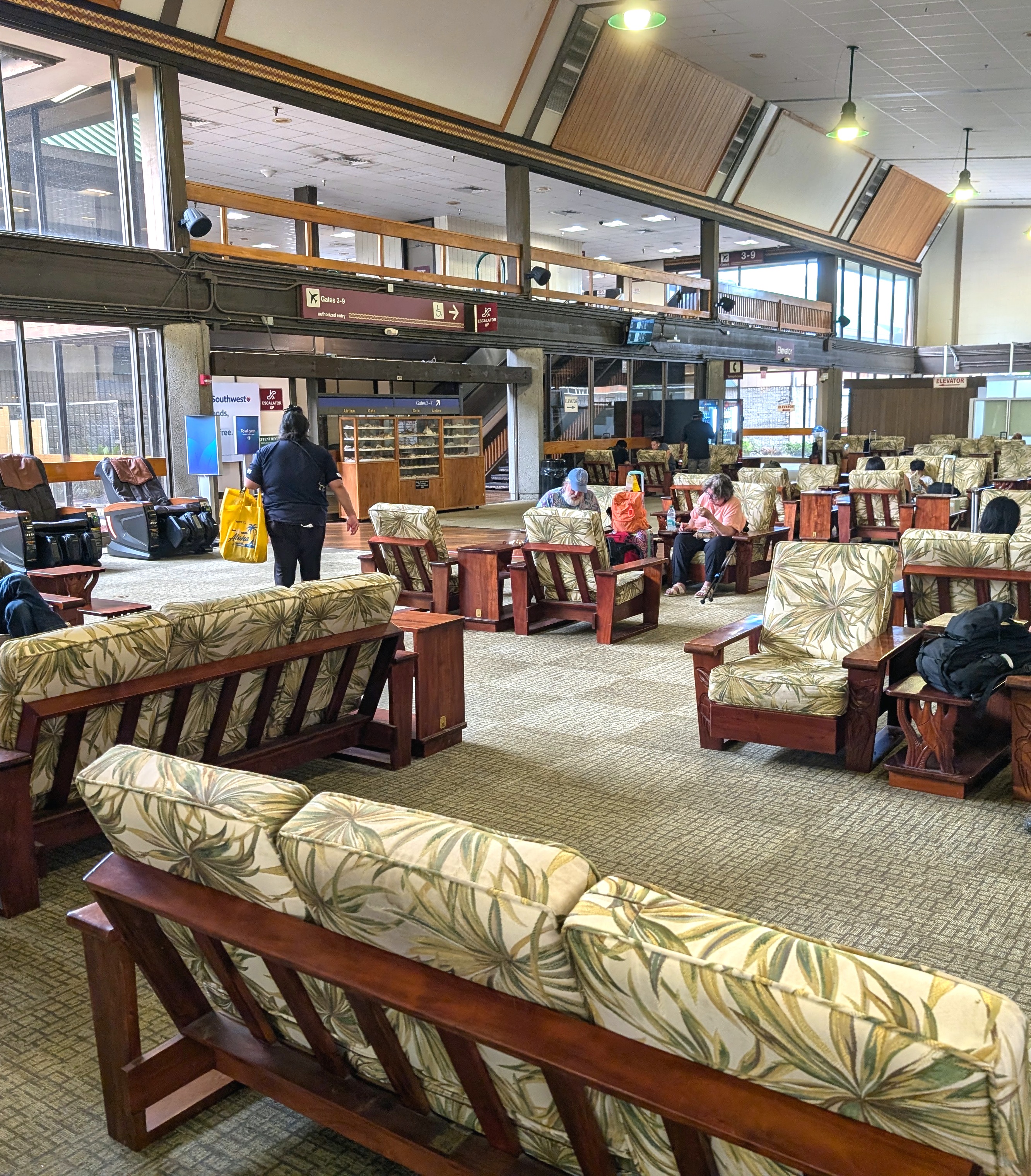
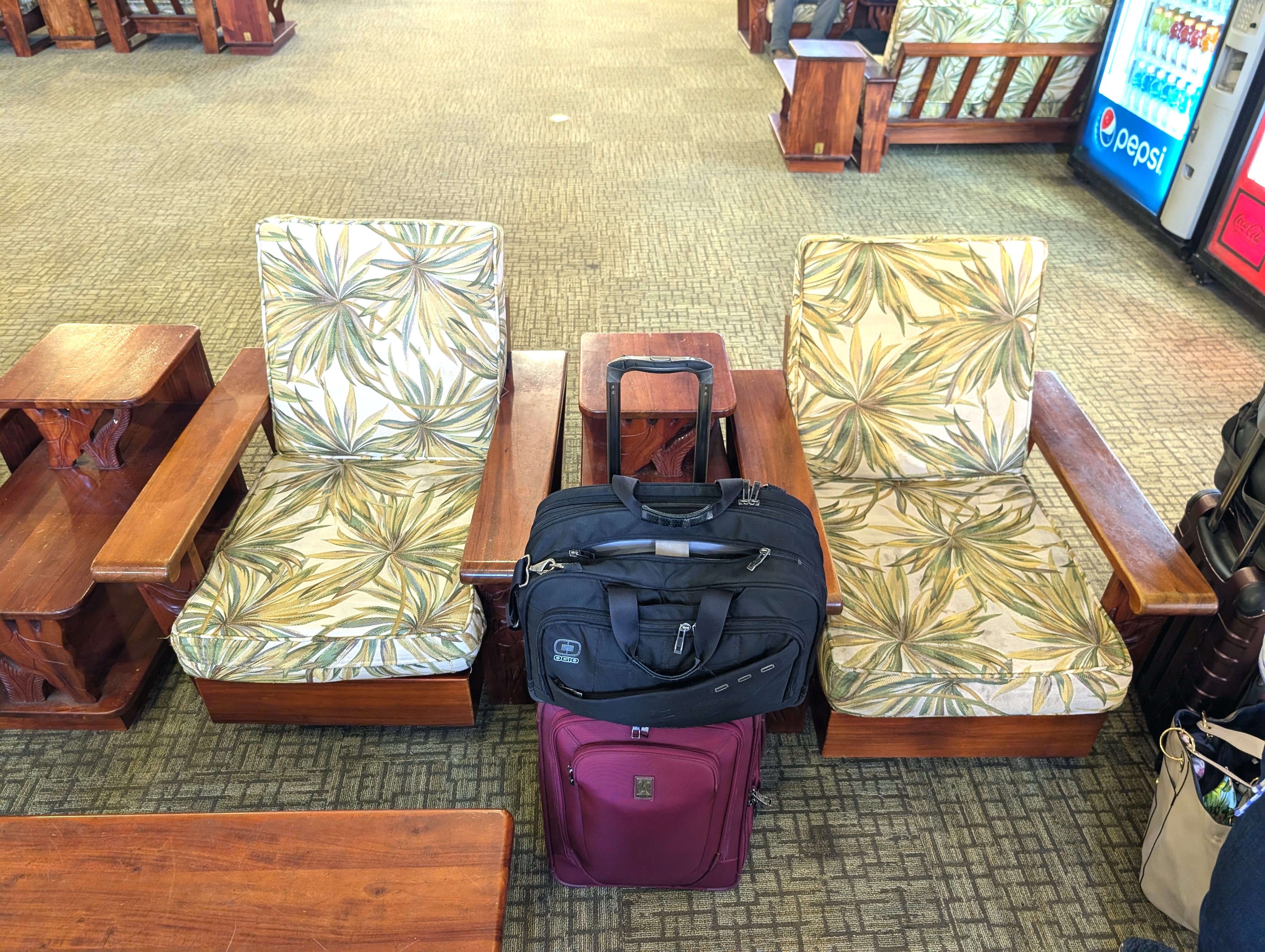
Hilo’s airport boasts the most comfortable waiting area seats this road warrior has ever seen, similar to someone’s living room (note coffee and end tables):
General waiting area, Hilo International Airport (ITO). September, 2024.Close-up of chairs in general waiting area at Hilo airport (post-TSA). September 2024.
I know, I know: not all airports could work this way. I’m just happy this one does.
I ‘shoulda’ been on the outside of the screened in porch to take this photo yesterday. August 2024.
For the past 35 years, well….pretty much for my whole adult life, I’ve tried to use a few words very consciously: can’t, had to/have to (and variants), and should have/shoulda. The last breaks down into me telling you that you should do or say something. More insidiously we say this to ourselves.
In that vein, I realized I’m again spending far too much time on reading things I think I should, and not enough on what I like. This occurred right after I subscribed to a newsletter from the New York Times which twice a week will highlight some songs that are pretty salient and should be listened to, a topic I really care about. Yes, I appreciate the irony. Instead I spend several hours making sure I’m on top of geo-politics, cultural developments, science and technology, and all sorts of sociological things like economics and psychology.
In the past couple weeks a few things happened, but I don’t even have photos to show for it because most aren’t fun and some are ideas, not physical things lending themselves to the snap of a shutter: an impending death in our family; a friend having serious surgery; discovering that a minor roof leak isn’t so minor after all and requires a complete re-roofing from the rafters on up; and learning today that quite possibly an incredible amount of our personal data may have been stolen because of some third party company I’ve never heard of but which inexplicably has our complete health records including diagnoses, our complete financial stuff like credit cards and account numbers, and oh yeah, our Social Security numbers. Apparently health insurance companies use this company to do what they can’t because they’re too busy counting my money.
Sigh. I shoulda just posted a photo…
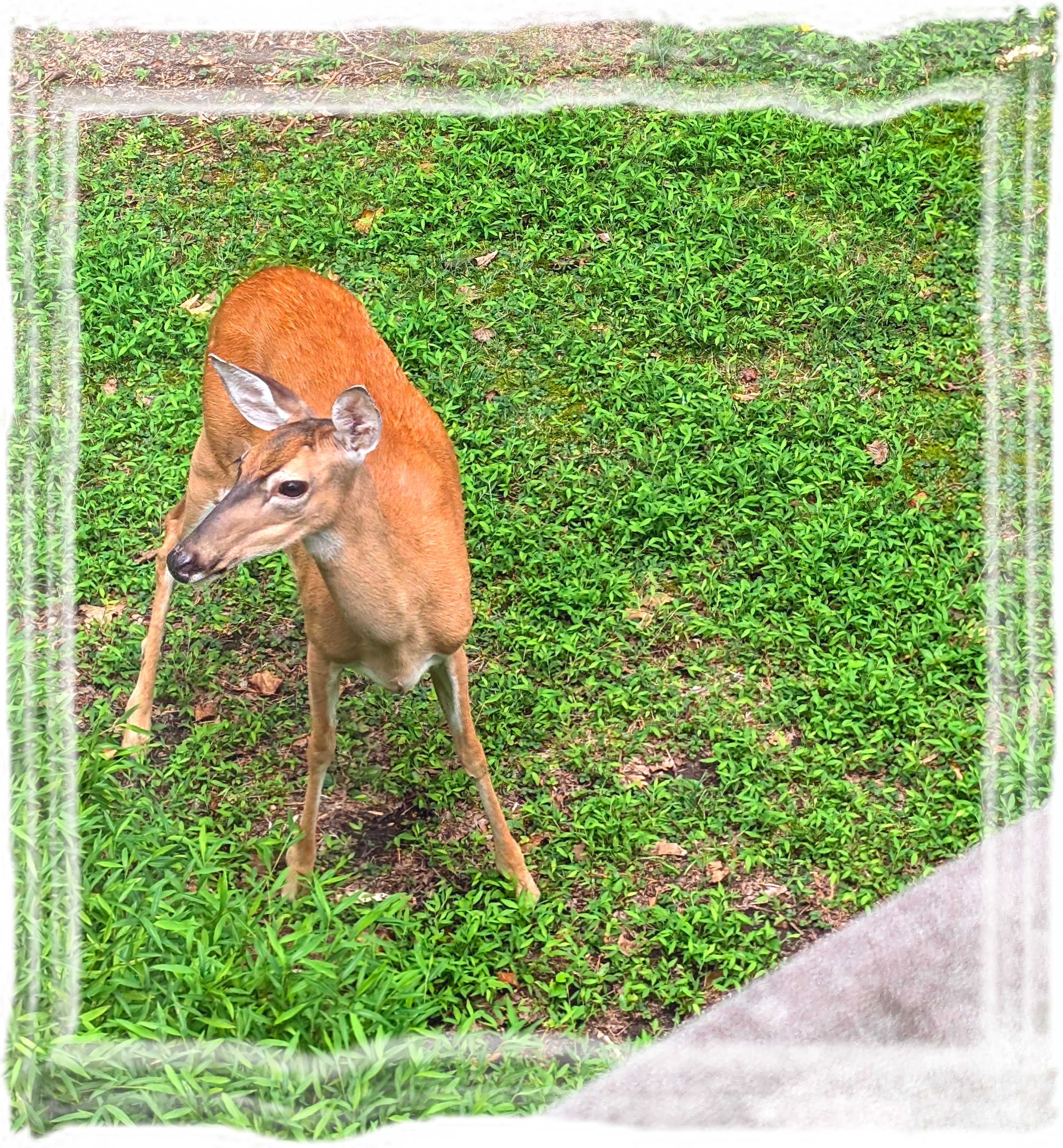
That doe up there has been hanging around for weeks. Deer aren’t that remarkable in the city’s right-of-way in back of lots, but they don’t often venture into our yards or bed down there like this one has on several occasions. That’s the deck railing, lower right, showing how close to the house she was. July 2024.
Five days after a funeral. Lake Lynn, 07 November 2019.
Warnings & Notes: This post contains a few graphic depictions of death, some examples of socially unacceptable behavior, and is just generally a downer if you look at it a certain way. Also, some of these observations have been made before. If you read this blog regularly (there’s only a half dozen or so of you), well, sorry….a little.
This year All Souls Day, November 2nd, marked the fourth anniversary of my mother’s funeral. It’s the day I most think back upon her life and death. The anniversary of her death, October 24, I barely note. Sometimes it even slips by me before I realize it. The funeral symbolizes my mother’s love, her life, and all those influences we spend a lifetime unraveling. In contrast, the date of her death represents thoughts I acknowledge but do not celebrate, and her passing is hardly something to celebrate in and of itself. I would rather focus on the entirety of her life and death: the funeral marked that, not the death.
My mother and I lived more than 2100 miles apart at that point. My profession had taken me to the eastern United States; she remained in Spokane, WA, from where she had encouraged me to follow my dreams wherever they led. Her parents had, my father’s parents had, they had themselves, so why shouldn’t their children? Still, it didn’t reduce my guilt much for not being more available to her in that last year, indeed that span of a half dozen years when she lived on after my father’s death. My brother lived nearly ten times closer in Tacoma but it took me only a few more hours to get there by plane versus him taking a drive across the state. He encouraged her to move to Tacoma. I half-heartedly supported him. She refused, saying her friends and neighbors were in Spokane. I strongly pushed that she could move to a “retirement community” there in Spokane where some of her friends lived. She demurred, then refused. Her best support network were the good neighbors she had. She was right. We were wrong. I saw one of those retirement homes at the end of her life. I was really wrong, and–
But I’m not going to rehash that whole period. I’ll just note this: I watched her steadily decline during the five years after my father died, visiting her more and more frequently. (The Fates blessed me in several ways when 13 months after my father died, I started traveling the country for work. It became just as easy to fly to Spokane as to Raleigh.) In December 2018 my mother learned she had Stage IV breast cancer. At 89 years, she recoiled from and declined chemotherapy, threw her lot in with hormone receptor treatment (a pill, nothing more), and for various reasons was in and out of hospitals, convalescent homes, and her new apartment in a “retirement community” through the fall of 2019. She celebrated her 90th birthday in that apartment.
I visited my mother a dozen days into October 2019 as she lived her final days. I returned home only to receive The Call two days later. It was a Thursday. Knowing my brother could drive there quickly, and emotionally exhausted from watching her exist in a morphine-induced stupor, I rolled the dice, told him I wouldn’t come until Monday, and I let him spend Friday through Sunday with her. I flew back on that Monday, and sat beside her bed a lot until she passed away on Thursday. My brother had returned to his home and job. Thus it fell to me to handle the first round of details.
From the moment a loved one dies, those closest to them experience a bewildering whirlwind of details thrust upon them which must be handled immediately. As the elder of two children, the most controlling of us, and frankly, just because I was the one there, it fell to me to make those arrangements. Again, I shall refrain from a step by step accounting of it. This is supposed to be an accounting of All Souls and a celebration, not a macabre dwelling on those days of death. One example shall suffice: on Thursday morning, the day she died officially at 10:22 a.m., I had to leave her to be at the bank when it opened at 9 a.m. The instruction manual entitled “What You Will Have To Do When Your Second Parent Dies” never made it into my mailbox, I guess. If it had, maybe I would have been better prepared than to learn in her final hours that her investment accounts would be frozen for disbursement when she died, and that as her executor I would be paying bills with whatever sat in that bank account for the foreseeable future. The bank account had less than $3200 in it when I dumped a huge amount in there. Take note if you’re ever in this position: for the next year, I had to pay bills from that account. If I hadn’t done that, my brother and I would have had to agree on splitting the bills. Really, take note.
My mother’s death came as a relief. I’m saddened to admit her death came as a relief. I know many have said this, but I feel as I feel. She had suffered with increasing pain from the breast cancer for a year. I doubt anything can prepare you to listen to your mother slowly drown and die, to realize the fluidic sounds of her breathing come from her lungs as they slowly fill, to watch from a removed perspective as your voice sharply criticizes the health staff which insists on turning a patient even when this obviously makes the breathing worse. Beyond prayer, I simply endured. I carry with me that immense relief I felt when I re-entered her room after a short phone call from her cousin and discovered my mother had died. I also carry with me the commensurate load of guilt for not being there at that moment. The part of me formed by social mores scolds me perpetually; the accepting, independent side of me simply says, “that’s the way it happened. There’s nothing which could have been done at the time, and there’s no shame in feeling relief.”
In contrast to the anniversary of her death, which represents a smorgasbord of feelings, few of them good, even fewer comforting, the anniversary of the funeral represents a day of love. It’s the day remaining friends and family gathered to mark how much they loved your mother and how much they would miss her. It’s the day you created all the little remembrances which would afterward become powerful symbols in your life. It’s the day you got to reminisce about all the times: mostly good, some bad, some funny, some sad. It’s the day when many told you “You did a good job by your mother,” even if they were lying a little bit. And it’s the day you closed the door, for just a bit, on all of those things which just have to be done. It’s the day when you looked forward to a few days where nothing about your mother’s funeral and estate needed to be accomplished: those things would wait a few days–with luck, a few weeks.
Each All Souls Day since that time refreshes all these memories. It’s the stem that gathers all the roots of remembrance and supports the branches of What Has Come To Be. For me, it’s inextricably bound up with my decision two weeks after her funeral to retire. Those twin events, her passing and my retirement, have become tied to those crazy years when a pandemic changed our society, or perhaps, when it revealed who we had come to be. All Souls Day, which exists quietly in the immediate shadow of its more important sibling, All Saints Day, and is heralded by All Hallows’ E’en, tells us it’s important to mark the passing of those we loved and to pray for them, to remember them, to honor them. By its existence, it says to ignore the ones who have been declared important, and that we must instead recognize the importance of each of us.
Mostly, though, All Souls Day reminds all of us of the death of those we loved. It picks at the scab of a wound which will not scar over and which has become part of who we are.
The trees blushed last night,
embarrassed they're leaving so
soon, like those party guests who
upon seeing John sit at the piano while
another round gets ordered, reach
quietly for their coats, murmuring,
"we have an early morning"...
what my latest poem looks like on my desktop computer monitor. October 2023.
Something perhaps has changed with WordPress. I’ve been irritated to see that choosing the “Verse” setting for a block, which I thought yielded the above, doesn’t even come close on some devices. Here’s what my friend received in his email:
what my poem looks like on an Android phone, as delivered in a Gmail message. October 2023.
I knew that WordPress converted poetry to a monospaced font, rather liked it actually, because I follow a couple of poetry blogs which deliver the entire poem to my inbox. I’m pretty sure in the past that I saw the same thing on the WordPress website when I used my phone. Ah, but now there is Jetpack, newly changed for the…better? This is what appears on my actual blog when using an Android phone:
What my poem looks like on an Android phone using WordPress/Jetpack. October 2023.
That’s not “verse,” WordPress, nor is it “poem.” That is called “paragraph” and “prose” and perhaps “simplistic crap” unless one makes a living as a stream-of-consciousness author, and even then one must establish a certain cadence and structure to ‘musically’ signal to the Reader that yes, this is something beyond prose. (Unless one is James Joyce, then nevermind.)
Canadian philosopher and communications theory god Marshall McLuhan invented the phrase “the medium in the message”. I’ve perverted what this means. He meant that content doesn’t really matter, that a children’s cartoon or a vicious slasher movie is all the same when broadcast identically on television. To me he meant the message of any communication effort takes its ultimate meaning from the medium by which it is delivered. Spoken words in a living room conversation take on new meanings when sung in a concert hall. More familiarly, books turned into movies tell a different story and cannot help do otherwise. Even if Peter Jackson had managed to control every reference in his Lord of the Rings movies, visual, aural, or what-have-you, the story still would have been just as vastly different than the books as they turned out to be.
For these reasons, it’s deeply unsettling to oldsters such as me to watch the different devices reformat and repackage the content of what purportedly is the same thing. I see this nearly every day as I follow Major League Baseball. MLB.com presents a side-by-side box score for both teams, but on the phone you must select one team or the other–never can you present them at the same time on your phone’s screen. Baseball-Reference.com displays a wonderfully useful tool when looking at any particular season for a baseball team: a histogram of green and red bars which tell the tale of the entire season, game by game, read left to right. Mouse over any bar and it tells you the date of that particular game, who this team played (and where), and what the score was. It also shows what the team’s Won-Lost record was when the game finished. On a mobile device (tablet or phone) this histogram tool disappears. It makes me wonder if certain features of a website are completely unknown to a majority of the younglings who stare into their phones for 90% of the time they’re awake.
Thus, we come back to my dilemma/consternation and the question posed in the headline. Have I delivered a poem at all when it looks like a short paragraph raising an offhand question? Does the trivialization effected by the mobile presentation indicate my poem lacked substance and can only stake a claim to poetry because of its window-dressed arrangement? (Believe me, I’ve thought some unkind thoughts about other’s postings which, if returned to a more prose-like arrangement, look like the musings of a teenager in a diary. Am I just as shallow?) Did McLuhan not go far enough? Does the message ultimately get defined by how the technology delivers it, even when it lives simultaneously in different media formats?
A light bulb creates an environment by its mere presence.
Marshall McLuhan from Understanding Media (as quoted in Wikipedia)
Ultimately I think McLuhan would argue each device configuration represents a medium. But I never signed up for this, WordPress! My understanding of the matter was this: you give me the tools to put my message together, and I pay for it by giving you ultimate ownership of my content (which I cannot believe I did, but there ya go). I expected a bit more, though. I expected a very nuanced difference to my content. Sure, I’ll accept McLuhan’s theory that those who read my stuff on a phone get a different message than those who read it on a big desktop monitor, but I would prefer to be left out of the “definition changing” part of the equation. You’ve made me a partner to it by changing my content not just the medium.
Which leaves me little closer to answering my question but has given me an excellent opportunity to rely on that first college degree and to prove yet again that old age clothes old men in curmudgeonly behaviors as surely as dogs become grizzled and oaks gnarled.
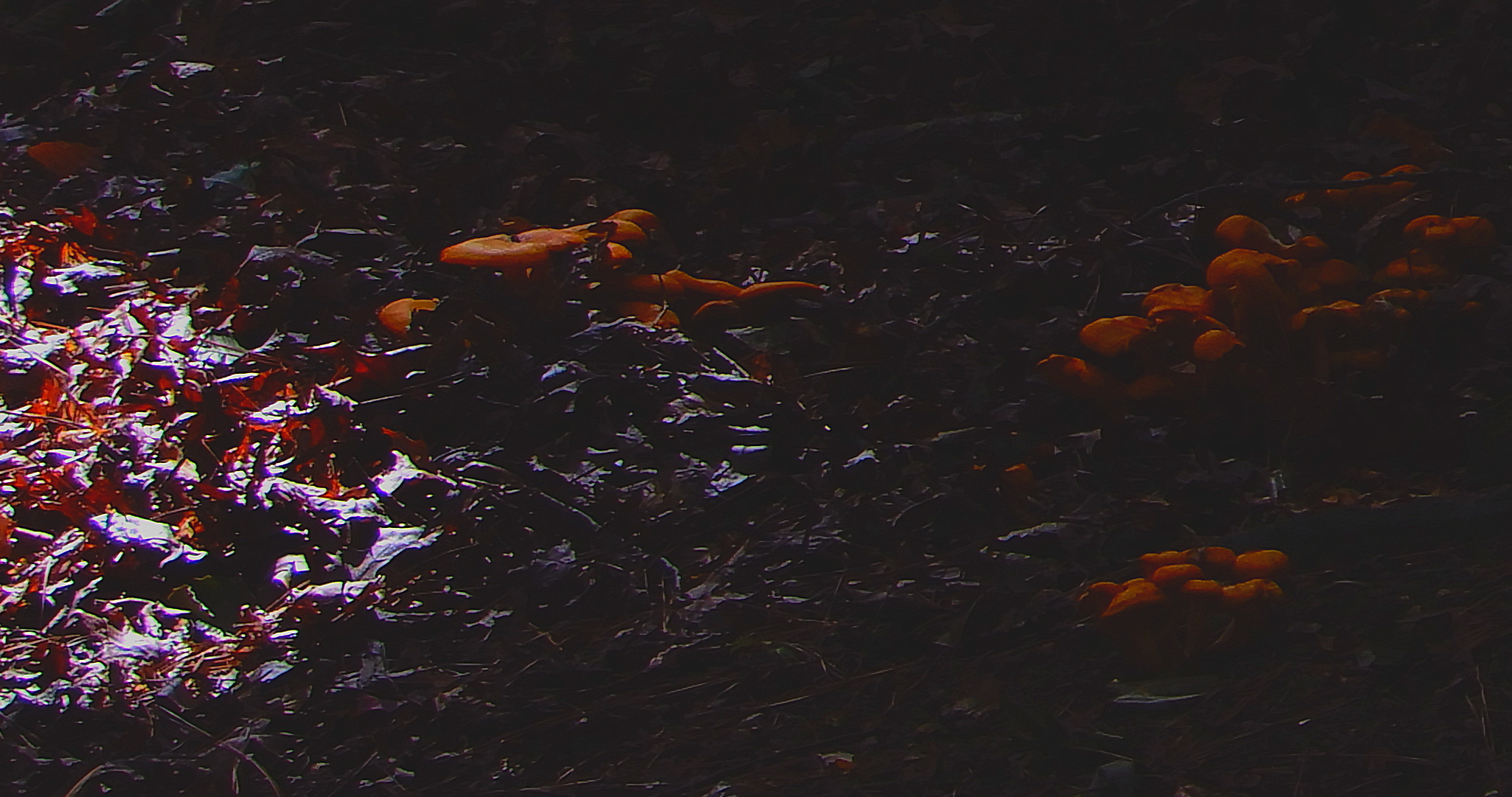
Mystifying things sprout in shadows… October 2023.
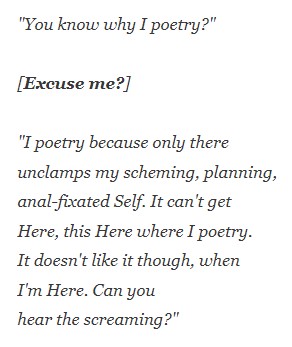
"You know why I poetry?"

[Excuse me?]

"I poetry because only there
unclamps my scheming, planning,
anal-fixated Self. It can't get
Here, this Here where I poetry.
It doesn't like it though, when
I'm Here. Can you
hear the screaming?"







 all the voices in my head